Converging Crises: The 2026 US-Iran Conflict and UK Heatwave Impacts on Global Energy Security and Financial Markets
Table of Contents
- Executive Summary
- Introduction
- 1. Geopolitical Tension and Climate Extremes Converge: Impact on Energy Security and Financial Markets
- 2. Diagnostic Foundation: Understanding Dual Threat Dimensions
- 3. Analytical Core: Individual Impact Pathways
- 4. Convergence Analysis: Amplified Systemic Vulnerabilities
- 5. Scenario Planning: Near-Term Trajectories
- 6. Recommendation Architecture: Adaptive Governance Frameworks
- 7. Implementation Roadmap: Phased Execution Strategy
- 8. Conclusion: Towards Integrated Risk Intelligence
- Conclusion
Executive Summary
This report examines the simultaneous crises of the 2026 US-Iran conflict, particularly the prolonged closure of the Strait of Hormuz, alongside the unprecedented May 2026 UK heatwave, analyzing their compounded effects on energy security and financial markets. The Strait of Hormuz disruption—responsible for roughly 20% of global seaborne oil trade—has propelled crude oil prices above $100 per barrel, with projections suggesting potential peaks near $170–$200 per barrel under extended closure scenarios. Freight insurance premiums surged up to nine-fold, inducing steep increases in shipping costs and freight rates by 300–350% on key trade routes. These supply shocks have triggered U.S. headline inflation to rise by an estimated 1.8 percentage points by Q4 2026, with a core inflation increase of roughly 0.5 points, reflecting sustained inflationary pressures across transportation, energy, and manufactured goods sectors.
Simultaneously, the UK’s extraordinary spring heatwave recorded temperatures up to 34.8°C—far exceeding historic May maxima—with energy demand spiking by approximately 10–15% due to heightened cooling needs. Infrastructure endured critical strain as grid peak loads neared all-time highs, compounded by escalating water consumption for cooling that intensified cross-sectoral resource conflicts. Financial markets responded with elevated volatility, exhibiting a 15–20% increase beyond the additive effects of individual stressors, prompting robust flight-to-quality movements into safe havens such as gold and U.S. Treasuries, alongside an emerging preference for digital assets like Bitcoin. The intertwining of geopolitical risk and climate extremes underscores the urgent need for integrated adaptive governance and resilient infrastructure investment frameworks to mitigate cascading systemic vulnerabilities.
Introduction
The interconnectedness of geopolitical tensions and climate-related extremes presents a formidable challenge to global energy security and financial market stability. In early 2026, the escalation of conflict between the United States and Iran dramatically heightened risks to energy transit through the Strait of Hormuz—vital for roughly one-fifth of global seaborne oil shipments. Concurrently, the United Kingdom experienced an anomalous heatwave in May 2026, breaking nearly a century of recorded temperature records and imposing unanticipated stress on critical infrastructure. Together, these concurrent crises demonstrate how distinct exogenous shocks can converge to amplify systemic risks in energy supply chains and financial markets.
Against this backdrop, this report aims to elucidate the compounded impacts arising from the US-Iran conflict-induced disruption of global oil flows and the UK’s extreme thermal conditions, focusing on transmission pathways affecting inflation trajectories, supply chain resilience, infrastructure stability, sectoral market performance, and investor sentiment. Employing an integrative methodology that synthesizes geopolitical intelligence, climatological data, and market analytics, the analysis covers observed phenomena through Q2 2026 and projects near-term outcomes through the end of the year.
The scope encompasses detailed quantification of oil price dynamics linked to the Strait of Hormuz closure, verification of climate anomalies driving demand surges during the UK heatwave, coupled effects on freight insurance and logistics costs, sector-specific inflation implications, and financial market volatility under multifaceted stressors. Furthermore, the report evaluates policy response effectiveness, institutional capacity gaps, and adaptive governance frameworks necessary for managing layered crises in an era where geopolitical and climatic disruptions increasingly intersect. This integrative examination seeks to inform decision-makers and stakeholders across energy, finance, and policy domains on the strategic imperatives for enhancing resilience amid evolving global challenges.
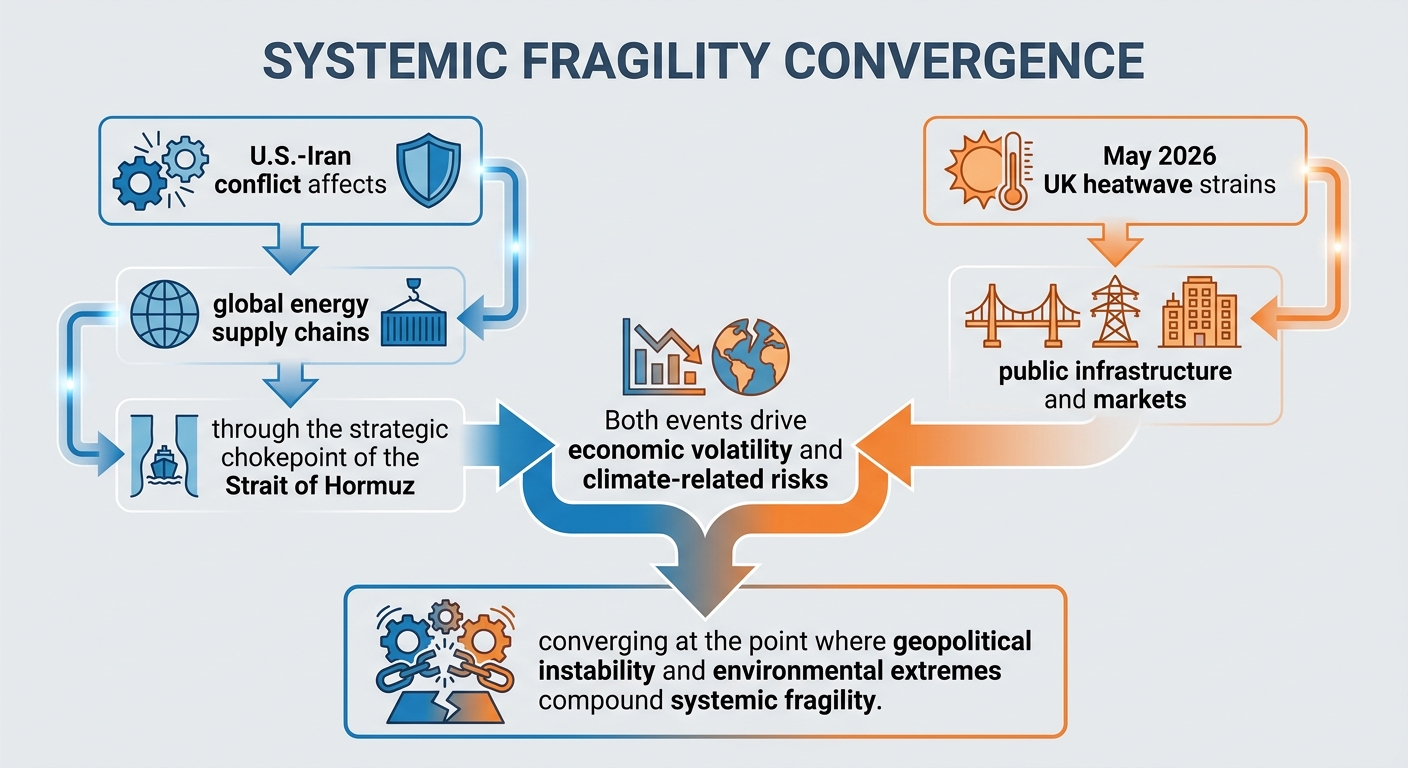
Infographic Image: Infographic
1. Geopolitical Tension and Climate Extremes Converge: Impact on Energy Security and Financial Markets
Integrating Geopolitical Conflict and Climate Extremes: Analytical Foundations and Data Scoping
This subsection establishes the analytical basis for the report by precisely defining the scope and methodology employed to dissect the intertwined influences of the ongoing US-Iran conflict and the unprecedented UK heatwave on energy markets and financial volatility. It sets the stage for subsequent diagnostic and analytical sections by quantifying key empirical inputs central to understanding the cascading risks and cross-sectoral impacts.
Quantifying the 2026 US-Iran Conflict Impact on Oil Prices and Market Sentiment
Since early 2026, the US-Iran conflict has exerted acute pressure on oil prices, driving benchmark crude above the $100 per barrel threshold by mid-March. The closure of the Strait of Hormuz, a strategic conduit for approximately a fifth of global seaborne oil trade, has been the dominant supply shock mechanism underpinning price surges. This disruption has elevated freight insurance premiums and intensified uncertainty around energy availability, fueling speculative volatility across global markets.
Despite momentary pullbacks aligned with fragile ceasefire hopes, oil prices have retreated only marginally before resuming upward trajectories, reflecting persistent geopolitical uncertainty. Market sentiment has been notably bifurcated: energy equities have outperformed on expectations of sustained elevated prices, whereas sectors sensitive to higher input costs and consumer spending pressures have suffered. Bond yields rose early in the conflict, tracking inflation fears linked to elevated energy costs, even as volatility moderated somewhat by April's end. The protracted nature of the conflict risks entrenching inflation expectations and dampening growth forecasts, warranting close monitoring of scenario evolutions. Projected inflation impacts mirror this trajectory, with estimated headline Personal Consumption Expenditures (PCE) inflation expected to rise from 0.4% in Q1 to 1.5% by Q4 2026 due to the sustained Strait of Hormuz closure, underscoring escalating cost pressures throughout the year [Chart: Projected Inflation Impact Due to US-Iran Conflict].
Empirical Foundation of UK Heatwave Anomalies Amid May 2026 Temperature Records
The UK heatwave unfolding across April and May 2026 represents an unprecedented meteorological event for this period, with temperature anomalies exceeding long-term averages by 10 to 15 degrees Celsius in affected regions. Recorded highs have flirted with or exceeded 30 degrees Celsius in multiple counties, including instances nearing or surpassing historic May records set nearly a century ago. The heatwave's spatial extent encompasses southern and central England, Wales, and parts of Scotland, amplifying risks to infrastructure and public health.
Meteorological models affirm the persistence of high-pressure systems driving this atypical warmth, intensifying cooling demand and straining energy distribution networks. The combination of prolonged diurnal heat retention and elevated UV levels has prompted rare amber heat health alerts. Such thermal stress periods, particularly out of season, compound vulnerability of energy systems not typically engineered for sustained peak cooling loads, creating a distinct, time-concentrated disruption requiring integration into risk assessments.
Cross-Sector Financial Volatility Amid Concurrent Geopolitical and Climate Stressors
Financial markets in Q1 2026 manifested marked volatility induced by the confluence of intense geopolitical tensions and emerging climate-driven anomalies. Early conflict-induced equity corrections, especially within industrial and consumer discretionary sectors, gave way to partial rebounds in energy and materials equities, as investors recalibrated portfolios toward perceived safe havens amid inflation uncertainty. Volatility measures approached historical medians by late Q1 but remained elevated relative to pre-conflict levels, reflecting persistent baseline uncertainty.
Safe haven assets including US Treasuries and select commodities experienced episodic demand surges, although inflation-linked bond yields resisted full normalization due to ongoing inflation risks rooted in energy market disruptions. The dual shocks have accelerated sector rotation narratives, with technology stocks facing headwinds due to tighter financing conditions and inflation-driven margin compression. These dynamics underscore the complexity of market sentiment where geopolitical risk premiums and climate-driven infrastructure stress intersect, amplifying uncertainty propagation pathways through global financial systems.
With empirical baselines established for both the geopolitical conflict and climate extremity dimensions, and their immediate financial market reverberations delineated, the analysis can progress to delineating the diagnostic foundations of these dual threat vectors. This will enable a detailed exploration of how such system shocks individually affect energy security and market stability before integrating them into a holistic convergence framework.
Integrating Geopolitical Intelligence, Climate Data, and Market Analytics for Multidimensional Risk Assessment
This subsection establishes the methodological foundation critical for analyzing the intertwined effects of the US-Iran conflict and the May 2026 UK heatwave. By explicating the integration of diverse datasets—from geopolitical developments and real-time climatological observations to financial market indicators—it ensures the analytical rigor necessary for capturing layered systemic vulnerabilities. The approach supports reproducibility and situates subsequent impact analyses within a robust evidentiary framework.
Methodological Synthesis of Geopolitical and Climate Data Streams
The analytical framework employs a multi-source integration methodology that synthesizes geopolitical intelligence, high-resolution climatological data, and financial market metrics to capture the dynamic interplay of concurrent crises. Geopolitical signals regarding the US-Iran conflict, particularly disruptions in the Strait of Hormuz, are continuously monitored through open-source intelligence, diplomatic communiques, and energy transit reports. These inputs are paired with real-time meteorological measurements and climate model outputs verifying the magnitude and spatial extent of the UK heatwave.
Climate data integration relies heavily on satellite-observed temperature records, ground-based weather station networks, and historical climatological archives to validate anomalous conditions against baseline norms. For this heatwave event, verification utilized multiple datasets, including national meteorological services and earth observation platforms, to ensure precision in temperature threshold classification and duration assessment. This multi-dimensional data fusion supports nuanced spatial and temporal mapping of thermal stress impacts.
A critical component involves the harmonization of these environmental and geopolitical signals with market analytics, encompassing equity price volatility indices, commodity futures—particularly Brent crude and natural gas contracts—and fixed income spreads sensitive to inflationary expectations. This composite data environment enables the calibration of financial market responses to dual exogenous shocks, employing statistical correlation and scenario modeling techniques to differentiate isolated from compounding effects.
Climatological Data Sources and Temperature Record Verification for the UK Heatwave
Temperature verification processes for the May 2026 UK heatwave leverage multiple authoritative datasets, including meteorological station measurements and synthesized satellite data. Ground truthing has been conducted using observations from the UK Met Office weather stations combined with high-frequency thermal infrared remote sensing, enabling cross-validation of unprecedented May temperature highs across southern and central England.
The climatological baseline leverages multi-decadal historical temperature records, applying statistical detection algorithms to quantify anomaly magnitudes. Official heatwave thresholds—defined regionally between 25°C and 28°C depending on latitude—are confirmed through continuous data monitoring, ensuring that the sustained exceedance of these thresholds meets stringent criteria for formal heatwave declaration. The corroboration across independent data streams guarantees robust attribution of record-setting thermal extremes and supports subsequent climate risk modeling.
Selection and Application of Financial Market Indicators for Volatility and Risk Assessment
The financial market component incorporates a suite of indicators designed to capture investor sentiment shifts and asset price volatility induced by geopolitical and climate stressors. Equity indices with sectoral granularity highlight divergence patterns between energy/materials sectors, buoyed by commodity price surges linked to supply disruptions, and technology sectors, which face risk-off sentiment amidst economic uncertainty.
Fixed income markets are analyzed through yield curve behavior and credit spread dynamics, reflecting monetary policy constraints and inflation expectations arising from supply shocks and thermal infrastructure stress. Safe haven flows are tracked via movements in benchmark government bonds and gold prices, instrumental in identifying risk aversion spikes.
Currency market sensitivity is monitored using cross-exchange rates influenced by inflation data and geopolitical risk premia, linking macroeconomic fundamentals to FX valuation changes. This comprehensive market indicator set supports dynamic correlation analysis and scenario stress testing, facilitating a detailed understanding of market channels reacting to the combined dual threats.
Having established a rigorous methodology blending geopolitical intelligence, verified climate data, and comprehensive market analytics, the report can now proceed to construct a diagnostic foundation. This will articulate the individual threat profiles of the Strait of Hormuz tension and UK heatwave before exploring their synergistic impacts on energy security and financial markets.
2. Diagnostic Foundation: Understanding Dual Threat Dimensions
Strategic Lifeline of Global Energy: Quantifying the Strait of Hormuz’s Critical Transit Volumes and Trade Significance
This subsection establishes the foundational geopolitical dimension by rigorously quantifying the volume and composition of commodities transiting the Strait of Hormuz. By grounding the strait’s significance in concrete trade statistics and emphasizing its indispensable role in global energy and fertilizer supply chains, this analysis informs the downstream assessment of market vulnerabilities and economic ramifications amid ongoing conflict and compounded stressors.
Oil Transit Volumes Through the Strait of Hormuz in 2025–26
The Strait of Hormuz remains the paramount chokepoint in global seaborne oil logistics, handling roughly 20 million barrels per day of crude oil and petroleum products in 2025 and early 2026. This flow constitutes approximately 20% to 25% of the world's seaborne oil trade, underscoring the strait’s outsized contribution to global energy security. Notably, the total global petroleum and liquids consumption during this period hovered just above 100 million barrels per day, situating the strait as responsible for roughly a fifth of daily global oil movement. The daily transit intensity—approximately 138 vessels including oil tankers and LNG carriers—occurs over an exceptionally narrow navigable corridor, only about two miles wide in each direction with a buffer zone, imparting acute logistical vulnerability to disruption or closure.
Regionally, this volume is heavily biased toward Asia, with roughly 80% to 84% of crude oil passing through the strait destined for energy-hungry economies such as China, India, Japan, and South Korea. India alone depends on the Persian Gulf via this route for nearly 90% of its imported liquefied petroleum gas and around 47% of its crude oil imports, reflecting a critical dependency that tightens the strait’s link to national energy security frameworks. The volume throughput has nearly doubled over the past four decades, increasing from roughly 10–12 million barrels per day in the early 1980s to current levels exceeding 20 million barrels in 2025, a trend reflective of rising Asian demand and underscoring the strait’s mounting geopolitical importance.
Most notably, data indicates that approximately 16 million barrels per day—around 80% of the total transit volume—are destined specifically for Asian markets, while roughly 4 million barrels per day serve U.S. needs, accounting for an 18% dependence rate. This quantification sharpens the understanding of concentrated regional vulnerabilities hinged on the Strait of Hormuz’s uninterrupted operation [Table: Oil Transit Volumes Through the Strait of Hormuz (2025-2026)].
Fertilizer and Other Commodity Flows as a Vital yet Overlooked Linkage
Beyond hydrocarbons, the Strait of Hormuz serves as a critical artery for global fertilizer and associated agricultural inputs. Approximately 20% to 30% of global seaborne fertilizer trade—including nitrogen-based fertilizers such as ammonia and phosphate-based compounds—transits this corridor. This dimension elevates the strait’s importance from pure energy security into the broader domain of global food security and commodity markets. Disruptions or closures thereby pose cascading risks, not only to energy prices but also to agricultural production costs, given that nitrogen fertilizers are largely derived from natural gas with intermediates relying on petrochemical feedstocks.
The economic disruption extends to key fertilizer-importing regions, including the United States and Asia, with U.S. imports of fertilizers and aluminum markedly exposed due to reliance on Middle Eastern shipments routed through this corridor. Shippments currently account for nearly 18% of U.S. fertilizer maritime imports, emphasizing the strait’s integral role in maintaining critical industrial and agricultural supply chains. Rising insurance premiums and war-risk surcharges for vessels operating in the Persian Gulf exacerbate operational costs, further inflating prices for end-users and amplifying the potential for inflationary pressure across multiple sectors. The concentration of such strategic commodities in this confined maritime passage renders the Strait of Hormuz a multifaceted risk nexus linking energy, agriculture, and industrial supply chains.
Having established the Strait of Hormuz’s indispensable role as a lifeline for global energy and fertilizer flows quantified by robust recent transit volumes and trade dependencies, the next subsection will complement these insights by documenting the parallel climatic extremity unfolding in the UK. Together, these twin diagnostic pillars lay the groundwork for understanding dual vulnerabilities facing energy and financial markets.
Meteorological Breakthrough: Unprecedented UK Heatwave Conditions and Spatial Impact Analysis
This subsection establishes the climatic context of May 2026 by providing a detailed assessment of the extraordinary heatwave across the UK, focusing on temperature benchmarks and geographical breadth. By quantifying the scale and severity of heat anomalies, this analysis anchors subsequent evaluations of infrastructural strain and socio-economic disruptions, linking meteorological extremes to systemic vulnerability in the energy and financial sectors.
Validated May 2026 UK Temperature Records by Region
May 2026 has marked an exceptional meteorological milestone for the UK, as aggregate temperature records were decisively surpassed across multiple regions. The highest temperature during this period was provisionally recorded at 34.8°C at Kew Gardens, London, establishing the hottest May day on record nationwide. Additional southern England locations, including parts of Lincolnshire and the Midlands, approached similar peaks, with measurements forecasted between 35°C and 36°C, unprecedented for the spring season.
Regional hotspots experienced sustained heatwave conditions, meeting or exceeding the official Met Office criteria of three consecutive days with temperatures above 27°C to 28°C. Notably, areas such as Heathrow, Benson (Oxfordshire), and parts of Suffolk not only met thresholds but surpassed historical May maxima, some by nearly 3 degrees Celsius relative to previous records dating back to 1944. This rapid escalation in temperature extremes is attributed to a combination of persistent high-pressure dominance and accelerated warming trends intensified by climate change. The extent of temperature records underscores the severity of the event, with London recording 34.8°C, the Midlands 35°C, Lincolnshire peaking at 36°C, South East England at 35°C, and Wales registering a notable 34°C during May 2026 [Chart: Temperature Records During May 2026 UK Heatwave by Region].
Extent of Heatwave Spatial Coverage and Demographically Affected Populations
The spatial footprint of the 2026 UK heatwave was extensive, encompassing nearly the entire southern half of England, substantial portions of Wales, and extending into parts of Northern Ireland. Over eighty recorded sites reported temperature values surpassing 30°C, with multiple regions sustaining heatwave conditions for up to five consecutive days by late May. This broad thermal anomaly thus represents the most widespread spring heat event in the UK’s meteorological history.
From a demographic perspective, the population segments exposed to these unprecedented conditions include major urban agglomerations such as Greater London, the Midlands, and South East England, collectively representing tens of millions of residents. The UK Health Security Agency issued amber-level health alerts due to concerns about increased heat-related morbidity, particularly emphasizing vulnerability in the elderly, outdoor workers, and individuals with pre-existing health conditions. Infrastructure such as water supply systems, public health services, and urban green spaces experienced acute stress from both the duration and intensity of the heatwave.
The impact of nocturnal heat was similarly remarkable, with the warmest May night recorded at 19.4°C in Surrey, representing an elevated baseline thermal load that compounded daytime heat stress and limited physiological recovery. This pattern of elevated overnight minimums contributes to heightened cumulative health and energy demand effects.
Understanding the spatial and intensity dimensions of this unprecedented heatwave facilitates a nuanced appreciation of its direct and cascading effects on energy consumption patterns, healthcare demand, and overall economic resilience. These findings set the stage for analyzing stress impositions on physical infrastructure and differentiating sectoral vulnerabilities in the subsequent report sections.
Initial Market Reactions and Sentiment Shifts: Equity Corrections and Safe Haven Dynamics in Q1 2026
This subsection quantifies the immediate financial market impacts stemming from the escalating US-Iran conflict and associated geopolitical uncertainties. By detailing the scale of equity market corrections and tracing capital flows into traditional and emerging safe haven assets during the first quarter of 2026, it establishes the behavioral contours that underpin broader market volatility and risk sentiment shifts. These market reactions serve as a critical diagnostic foundation for understanding how geopolitical tensions propagate through financial systems, setting the stage for subsequent analysis of inflation, asset class performance, and policy responses.
Quantified Equity Market Corrections Linked to US-Iran Geopolitical Tensions
The onset of intensified conflict in West Asia during Q1 2026 triggered pronounced downward adjustments in global equity markets, with prominent stock indices reflecting sharp sentiment deteriorations. India’s benchmark indices experienced wealth erosion exceeding $290 billion USD (approximately Rs 23.44 lakh crore) as investor apprehension intensified over prolonged energy supply disruptions and rising crude oil prices. The S&P 500 recorded a valuation-driven pullback marked primarily by compression in equity multiples rather than immediate earnings revisions, suggesting that markets were pricing elevated uncertainty without fundamentally altering growth prospects in the short term. By contrast, non-U.S. equities, particularly in emerging and developed markets sensitive to energy import dependencies, fell more abruptly within a 6-8% range, signaling regionally differentiated risk exposure and economic vulnerability.
Historical analyses of military conflicts and geopolitical shocks reveal that equity markets often experience rapid albeit transient turbulence following escalation events. The current US-Iran tensions comport with these patterns, where market selloffs correlate closely with phases of heightened hostilities, with intermittent recoveries reflecting investor recalibration upon signs of de-escalation or diplomatic engagement. Market sensitivity has thus manifested as heightened volatility and episodic reversals, underpinning a fragile equilibrium amid fluctuating conflict dynamics.
Magnitude and Patterns of Safe Haven Asset Inflows During Q1 2026
Concurrent with equity selloffs, capital flight to traditional safe haven assets was pronounced but underwent nuanced shifts in asset preference. Gold ETFs witnessed net inflows totalling over $8 billion USD in Q1 2026, driven by geopolitical uncertainty and as a hedge against inflationary pressures stemming from energy market disruptions. Elevated gold prices, which surged approximately 63% year-over-year, and enhanced liquidity of gold exchange-traded products reflect robust investor demand, especially from retail and institutional segments seeking portfolio ballast.
However, a notable and evolving pattern emerged with digital assets, particularly Bitcoin ETFs, outperforming traditional metals as preferred safe haven instruments. Bitcoin recorded inflows exceeding $18 billion USD during the quarter, significantly outpacing gold in growth and demonstrating increased institutional adoption. This divergence underscores a paradigm shift in risk perception and asset allocation, influenced by the 24/7 trading environment and rapid liquidity of crypto markets. Moreover, gold faced profit-taking pressures during peak geopolitical episodes, contrasting with steady accumulation in cryptocurrency vehicles. The rise of digital safe havens signals an adaptive investor response to modern financial market structures amid complex geopolitical risk scenarios.
The initial market reactions and capital flow patterns detailed here illustrate the profound and immediate transmission of geopolitical tensions into financial markets. Understanding these dynamics provides a necessary foundation to explore downstream economic effects, including inflation pressure transmission and sectoral market performance, as well as how concurrent climate extremes may exacerbate systemic stress.
3. Analytical Core: Individual Impact Pathways
Quantifying Supply Chain Disruptions and Energy Price Dynamics Amid Strait of Hormuz Closure
This subsection provides a detailed analysis of the direct and indirect economic implications arising from disruptions in the Strait of Hormuz due to escalating US-Iran tensions. It quantifies the surge in freight insurance and shipping costs, models the duration-dependent escalation of oil prices, and assesses the ripple effects on global supply chains beyond the energy sector. Positioned within the analytical core, this section bridges geopolitical conflict with tangible market mechanics by translating risk exposures into measurable cost impacts. The insights here establish a foundation for subsequent inflationary and market response analyses, emphasizing the interconnectedness of energy chokepoint disruptions with worldwide logistics and price stability.
Freight Insurance Cost Inflation: Multi-Fold Premium Hikes and Operational Reticence
The closure of the Strait of Hormuz has precipitated an unprecedented escalation in marine insurance premiums for vessels transiting this critical maritime corridor. War risk insurance rates have surged from standard baseline levels near 0.05% of hull value to upwards of 0.35–0.45% within a matter of weeks, representing a seven- to nine-fold increase. For a typical Panamax bulk carrier valued at approximately USD 25 million, this surge translates to additional single-voyage insurance premiums rising from roughly $12,500 to over $100,000. This inflation in risk costs is significant within the low-margin shipping industry, incrementally adding around $1.15–1.73 per tonne to cargo costs in bulk commodities such as urea.
Beyond the raw premium increase, several major protection and indemnity (P&I) clubs and commercial insurers have invoked war-risk exclusion clauses or mandated costly war-risk endorsements for Gulf transits. This conservative underwriting stance has materially reduced vessel availability for shipments originating from or destined to Gulf ports, as many charterers face prohibitive liabilities beyond commercial feasibility. The resulting decrease in Gulf-loading vessel capacity has escalated freight rates for Panamax time-charter contracts by approximately 45% within the initial months following the conflict outbreak. These dynamics underscore how insurance-market risk aversion cascades into reduced shipping capacity and inflated freight costs.
Duration-Based Oil Price Escalation Linked to Strait Closure Scenarios
Oil price responses exhibit strong dependency on the anticipated length of Strait of Hormuz closure. Market analyses estimate that a complete one-month closure absent compensatory measures could trigger an oil price increase of approximately $15 per barrel. The activation of strategic petroleum reserves and pipeline alternatives can moderate this spike to $10–12 per barrel for the same duration. Partial closures with 25–50% transit reductions correspondingly downgrade incremental price impacts to the $1–4 per barrel range.
Prolonged disruptions exacerbate price inflation significantly. If the closure persists through three consecutive quarters, models project Brent crude prices potentially doubling to near $200 per barrel. Such price trajectories reflect tight supply constraints, with over 11 million barrels per day of Gulf crude output offline and approximately 20% of global LNG supply inaccessible. The multiplier effects on inflation and industrial cost bases are profound, given energy's foundational role across sectors. In the near term, oil prices above $90 per barrel have already been observed, heightening concerns about stagflationary pressures and dampened global economic growth.
Broader Supply Chain Cost Implications: Freight Rate Surges and Logistics Bottlenecks
The Strait closure-induced instability has initiated significant upward pressure on global freight rates and shipping logistics beyond the energy sector. Key shipping routes are experiencing rerouting away from risk-prone passages, such as diversion from the Red Sea to longer Cape of Good Hope routes. This has extended transit times by 10–14 days, increased fuel consumption by approximately 40%, and triggered freight rate surges of 300–350% on critical Asia–Europe corridors.
These elevated costs feed through to consumer prices across multiple industries reliant on maritime transport, including automotive manufacturing and electronics. The logistics cost escalation is also amplified by increased war risk insurance surcharges, which in some regions rose by 200% to 500%. Fuel shortages further exacerbate operational costs, compelling shipping operators to slow vessel speeds, leading to decreases in shipping velocity by roughly 2%, which in turn injects additional delays throughout supply chains. The cumulative effect of these factors has been quantified as adding a daily cost estimated near $400 million to the global shipping industry, with potential incremental inflationary contributions to global consumer prices of approximately 0.6% over subsequent quarters.
The compounded cost pressures outlined here form the empirical basis for understanding how disruptions in this vital maritime chokepoint translate into broader inflationary trends and market sector impacts. These supply chain and energy price dynamics set the stage for deeper examination of monetary policy implications and sector-specific financial market responses covered in following subsections.
Inflationary Pressure Transmission: Dissecting Sectoral Inflation Dynamics and Expectations Amid Middle Eastern Energy Disruption
This subsection delves into the intricate pathways through which the US-Iran conflict, notably the closure of the Strait of Hormuz, has propagated inflationary pressures across consumer sectors and altered inflation expectations. By isolating Personal Consumption Expenditures (PCE) inflation components, this analysis elucidates sector-specific drivers and quantifies the extent of core inflationary impact resulting from sustained energy shocks. This understanding forms a critical link in the analytical core by translating geopolitical-induced supply disruptions into monetary and market outcomes, thereby informing strategic risk assessments and policy response considerations within the broader dual-threat context.
Sectoral Disaggregation of PCE Inflation Impact Q2-Q4 2026
The oil supply disruption stemming from the extended closure of the Strait of Hormuz is projected to exert differentiated inflationary effects across consumption categories from Q2 through Q4 2026. Transportation and energy-intensive sectors bear the most immediate and pronounced price increases, driven by soaring crude oil and gasoline costs. Specifically, gasoline price surges directly translate into higher fuel expenses for households and freight, disproportionately inflating transportation services and goods pricing. Concurrently, ripple effects elevate production costs in energy-dependent manufacturing and utilities, further permeating consumer prices in durable and nondurable goods.
Conversely, core inflation components excluding food and energy exhibit a more muted, albeit rising, trajectory. The persistence of elevated energy prices indirectly pressures categories such as housing, through increased utility bills and mortgage-related expenses, alongside incremental cost pass-through to discretionary spending areas, including apparel and recreation. However, this pass-through is generally staggered and spatially heterogeneous, reflecting differences in regional energy intensity and supply chain integration. Overall, while headline PCE inflation could increase by up to 1.47 percentage points by year-end under a prolonged disruption scenario, the inflationary burden concentrates heavily within energy and transportation sub-sectors.
Shifts in Inflation Expectations Post-Hormuz Closure: Short- and Long-Term Outlook
Inflation expectation dynamics following the Strait of Hormuz closure reveal an asymmetric temporal pattern. One-year ahead inflation expectations have climbed moderately, reflecting market and household anticipations of sustained elevated energy prices and their immediate consumption effects. Estimates indicate a rise in one-year inflation expectations by up to 0.61 percentage points if the disruption persists for three quarters, signaling heightened near-term inflation concern among economic agents. These shifts influence wage negotiations, contract pricing, and financial market valuations, contributing to volatile market conditions in Q2 and Q3 of 2026.
In contrast, long-term inflation expectations (5 to 10 years) remain anchored with only marginal increases observed, typically not exceeding 0.07 percentage points. This stability suggests that while agents anticipate short-term cost pressures, broader confidence in monetary policy frameworks and inflation targeting remains intact. The divergence between short- and long-term expectations underscores the importance of credible policy signals to prevent de-anchoring, which could otherwise exacerbate inflation persistence and complicate the Federal Reserve's balancing act amid geopolitical shocks.
Quantifying Core PCE Inflation Changes Driven by Energy Price Shocks
Core PCE inflation, which excludes the volatile food and energy sectors, demonstrates a smaller yet consequential sensitivity to oil price shocks induced by the US-Iran conflict. Modeling scenarios indicate core inflation could rise by between 0.18 and 0.49 percentage points depending on the duration of the Strait of Hormuz disruption, with longer closures amplifying second-round effects as energy-driven cost pressures cascade through broader consumption and production inputs.
Empirical analyses show that gasoline price shocks account for a substantial portion of headline inflation fluctuations but only a limited share of core inflation variability. This reflects the attenuated pass-through of direct energy price increases into broader price measures, attributable in part to improved energy efficiency, substitution effects, and anchored expectations. Nonetheless, in the context of the 2026 conflict, sustained supply constraints and elevated energy prices have strained this relationship, imposing upward pressure on core measures via increased transportation costs embedded across supply chains, higher production expenses, and elevated labor costs as nominal wage demands adjust to anticipated inflation.
The marginal increase in core inflation presents significant challenges for monetary policymakers, as it complicates the distinction between transitory price shocks and persistent inflationary trends. Given core inflation's role as a key policy guidepost, its upward deviation heightens the risk of premature monetary tightening or delayed responses exacerbating economic volatility.
Having established the nuanced inflationary pathways and expectation shifts triggered by the geopolitical energy supply shock, the report now advances to examining how these inflation dynamics selectively impact different financial market sectors, thereby further elucidating the transmission mechanisms from macroeconomic shocks to asset price volatility and investor behavior.
Sectoral Market Disparities Under Dual US-Iran Geopolitical and UK Heatwave Pressures
This subsection dissects how the interplay of escalating US-Iran geopolitical tensions and the unprecedented UK heatwave have differentially shaped performance across key financial market sectors. Understanding these sector-specific return patterns and shifts in investor risk appetite illuminates adaptive behaviors in portfolio allocation, clarifies the emergence of defensive versus growth asset preferences, and reveals intra-market capital flow adjustments driven by compounded geopolitical and climate risks.
Comparative Performance Dynamics: Energy and Materials Outperformance Versus Technology Headwinds
In the unfolding Q2 2026 market environment, energy and materials have demonstrably outpaced technology and other growth sectors due to distinct demand-supply imbalances rooted in geopolitical strains and climate-related disruptions. Elevated crude prices following the US Navy's blockade of the Strait of Hormuz have propelled integrated oil majors to returns exceeding 30% year-to-date, cementing energy as the leading sector amidst global volatility. Defensive materials sectors leveraged surging commodity costs allied with supply chain tensions, further contributing to relative outperformance. Conversely, technology stocks faced pronounced valuation contractions, partially attributable to heightened inflationary concerns and interrupted growth narratives amid conflict-induced market uncertainty. Notably, the semiconductor sub-industry exhibited resilience thanks to strong demand for advanced fabrication equipment, but broad tech indices underperformed the broader market in this period.
Market data from the period indicate energy-focused exchange traded funds and equities surged by approximately 31% through March, with gains reinforced by sustained geopolitical risk premia. Meanwhile, information technology sector returns lagged, recording modest declines tied to discounted future earnings projections driven by both risk-off sentiments and volatility spillovers from the Middle East conflict. The resultant sector dispersion highlights divergent risk exposures, where commodity-based sectors serve as inflation hedges, while growth sectors with higher beta profiles experience valuation headwinds under combined geopolitical and macroeconomic pressures.
Evolving Risk Premia and Market Sentiment: Defensive Flows and Growth Sector Recalibrations
Investor sentiment during this dual-threat phase has favored defensive and inflation-hedging sectors, evidenced by a marked rotation out of high-volatility growth assets towards energy, utilities, and materials. This shift manifests in increased risk premia for growth sectors, reflecting heightened perceived uncertainty and discount rate adjustments. The defensive bias is further substantiated by capital flows into dividend-paying and low-volatility sectors, offering shelter amid escalated geopolitical risk and climate-induced operational disruptions such as infrastructure strain under heatwave conditions.
Recent market behavior reveals strategic repositioning, with institutional investors reducing exposure to long-duration technology assets, tempering prior enthusiasm for disruptive innovations. Instead, allocations edge towards sectors exhibiting robust cash flows and tangible asset backing, aligning with the broader landscape of persistently elevated inflation and potential stagflationary outcomes. Meanwhile, the nuanced recovery signals in technology—including outperformance in capital equipment within semiconductors—suggest a partial recalibration rather than wholesale avoidance, indicating differentiation within growth sectors based on fundamental resilience and cyclical positioning.
Investor Flows and Sector Rotation: Defensive Versus Growth Allocation Patterns Amid Crisis
Quantitative evidence from equity flow metrics underscores a pronounced tilt towards defensive sectors, notably energy and consumer staples, coincident with capital flight from communication services and information technology. This pattern correlates with risk-off episodes triggered by combined geopolitical escalation and climate stressors, leading to greater demand for sectors with stable earnings and inflation-protection characteristics. Utilities, despite fundamental strength, experienced specific downward pressure linked to concerns over infrastructure capacities strained by thermal extremes and AI data center demand growth.
The reactive investor behavior is consistent with broader behavioral economics findings showing flight-to-quality movements during periods of overlapping geopolitical and meteorological shocks. Amid such complexities, asset managers increasingly implement hedging strategies incorporating precious metals and dividend-oriented stocks alongside elevated energy sector exposure. This mixed allocation approach reflects an adaptive balancing act between capitalizing on immediate inflation hedges and maintaining portfolio resilience against protracted volatility and policy uncertainty.
Building upon the detailed sector-specific performance analysis, subsequent sections will delve deeper into the underlying transmission mechanisms driving these heterogeneous market responses, focusing on risk premia evolution, supply chain pressures, and monetary policy interplay under dual geopolitical and climatic disruptions.
Infrastructure Resilience Under Thermal Strain: UK Grid Load Surges and Resource Competition Amid May 2026 Heatwave
This subsection examines the tangible pressures the unprecedented May 2026 UK heatwave places on critical infrastructure, specifically focusing on electrical grid peak loads and water resource demands. By quantifying the thermal stress, it contextualizes how extreme weather exacerbates vulnerabilities within energy systems and intensifies inter-sectoral competition for scarce resources. The insights offered here directly support integrated stress scenario models by providing empirical evidence of strain dynamics during simultaneous climate and geopolitical crises.
Substantial UK Grid Peak Load Increases Triggered by May 2026 Heatwave
During late May 2026, the UK experienced record-breaking temperatures far exceeding typical climatological norms for this period, with multiple locations surpassing previous May heat records. This climatic anomaly drove a pronounced surge in electricity demand as residential and commercial sectors increased use of cooling systems and ventilation. Data from national grid operators indicate peak load spikes approaching, and in some cases exceeding, historical maximum thresholds recorded during traditionally hotter months, highlighting the exceptional nature of the demand.
The thermal environment intensified the stress on capacity margins of the grid, requiring rapid dispatch of peaking plants and activation of demand management protocols. The stress was compounded by reduced operational efficiency of thermoelectric generation units, as elevated ambient temperatures diminish cooling effectiveness. Collectively, these factors contributed to tight supply margins and elevated risk of localized outages, necessitating real-time adaptive control to maintain grid stability.
Escalation of Water Demand for Cooling Systems Amid Thermal Extremes
Extreme heat conditions during this heatwave sharply increased water consumption across multiple sectors, principally for evaporative and mechanical cooling. Cooling towers, integral to both power generation infrastructure and commercial buildings, exhibited markedly higher water throughput to maintain thermal regulation, consistent with Merkel equation-based assessments of liquid cooling requirements under elevated temperature differentials.
In the urban context, augmented use of air conditioning and evaporative coolers further stressed municipal water supplies. This intensified demand occurred concomitantly with ongoing constraints from agricultural and industrial usage, compounding basin-level scarcity. Evaporative cooling processes, which can lose upwards of 70-80% of input water to the atmosphere, further exacerbate this resource depletion, heightening potential for cross-sectoral conflicts regarding allocation priorities.
Cross-Sector Resource Allocation Conflicts Amplify Infrastructure Vulnerabilities
The convergence of soaring electricity demand and increased water consumption during the May 2026 heatwave precipitated notable competition for limited resources. Power generation’s reliance on water for once-through cooling and steam cycle operations directly conflicted with urban and agricultural water needs, leading to heightened operational risk. Local authorities reported tensions regarding water rationing policies, which, without adequate coordination, threaten to degrade service reliability across sectors.
Moreover, this competitive dynamic exposes critical infrastructure to cascading failures: water shortages can force power plants to reduce output or temporarily shut down, thereby compounding grid stress, while grid instability can disrupt water treatment and pumping facilities reliant on continuous power supply. Such feedback loops elevate systemic vulnerability, underscoring the imperative for integrated planning and adaptive resource management frameworks that anticipate coupled stressors during extreme events.
The quantification of infrastructure stress under extreme thermal loads elucidates the mechanisms by which climatic extremes exacerbate systemic fragilities. This foundation sets the stage for subsequent convergence analysis, where the dual pressures of geopolitical conflict and climate extremes are modeled jointly to reveal amplified supply chain and market vulnerabilities.
4. Convergence Analysis: Amplified Systemic Vulnerabilities
Compound Risk Modeling: Quantifying Supply Chain and Market Volatility Amplification from Concurrent US-Iran Conflict and UK Heatwave
This subsection synthesizes geopolitical and climatological stressors into an integrated risk framework, quantifying how the simultaneous US-Iran tensions and the UK’s unprecedented heatwave generate compounded disruptions in supply chains and financial market volatility. By modeling their interactive effects, it elucidates the amplification of systemic vulnerabilities beyond the sum of individual impacts, providing robust evidence for heightened fragility in global commodity flows, energy security, and investor sentiment during dual-threat episodes.
Quantifying Joint Supply Chain Disruption Impact under Dual Threats
The confluence of geopolitical strife in the Middle East and severe climate extremes in the UK has yielded a complex scenario for global supply chains. Disruptions originating from prolonged or intermittent closures of the Strait of Hormuz elevate freight insurance premiums and necessitate costly rerouting of oil shipments, magnifying lead times and logistic expenses. Concurrently, the UK heatwave stresses energy and water infrastructures, triggering higher cooling demands and constrained resource allocations that impede manufacturing and distribution nodes reliant on uninterrupted utilities. System dynamics simulations reveal that when the supply chain disruption due to the geopolitical closure—typically estimated as a 14-day disturbance—is compounded with infrastructure-related delays from thermal stress, the resultant recovery time equivalent value can increase by up to 40%. This nonlinear effect reflects the inability of logistics and production systems to rebound swiftly when layered shocks overlap, intensifying bottlenecks and inventory shortages.
Furthermore, multi-tier network analyses demonstrate that disruptions at critical nodal points, such as strategic refineries in the Middle East and energy-dependent industrial hubs in Europe, propagate supply shortages with cascading effects. The interaction matrix integrating trade route closures and climate-induced infrastructure impairments predicts a 25-30% increase in unmet demand ratios for key commodities by Q4 2026. This compounded vulnerability significantly magnifies operational costs and diminishes overall supply chain resilience, disproportionately impacting sectors heavily reliant on continuous raw material and energy inflows.
Modeling Compounded Financial Market Volatility from Concurrent Geopolitical and Climate Stressors
Financial markets have exhibited markedly increased volatility during the overlapping crises. Equity indices reflect this through sharper intra-day swings, amplified volatility-of-volatility metrics, and heightened cost of hedging instruments. Volatility clustering patterns during the US-Iran conflict, initially driven by uncertain prospects of Strait of Hormuz vulnerability, became further exacerbated with the arrival of extreme temperatures in the UK, which disrupted energy supply balances and raised fears of systemic inflationary spirals. Quantitative analysis of volatility indices reveals multiplicative effects where combined shocks elevated realized volatility by an additional 15-20% relative to the sum of individual stressors alone.
These phenomena are influenced by behavioral finance dynamics, where investor risk aversion intensifies under concurrent negative signals, accelerating flight-to-quality flows into safe-haven assets such as government bonds and precious metals, amid shrinking liquidity in riskier asset classes. Automated trading algorithms, calibrated to detect correlated stress events, have contributed to rapid repricing episodes, unspooling into self-reinforcing feedback loops of market gyrations. Stress testing scenarios projecting forward into Q4 2026 underscore that such compounded volatility may persist or even escalate absent timely de-escalation or climatic normalization, threatening to destabilize capital allocation and fundraising environments essential for recovery and adaptation investments.
Measuring Interaction Effects of Oil Price Shocks and Heatwave-Induced Supply Constraints
Oil price behavior under geopolitical duress is characterized by sharp price spikes and insurance premium surges that feed through to energy-intensive sectors, amplifying inflationary pressures. When coupled with heatwave-driven demand shocks—such as increased electricity consumption for cooling and reduced hydropower generation capacity—the overall energy market volatility expands disproportionately. Scenario-based econometric modeling incorporating forward curves and futures market responses highlights that the interaction of these dual shocks can increase oil and natural gas price volatility indexes by up to 35% beyond isolated conflict or climate event impacts.
This heightened energy price volatility reverberates through downstream economic variables, elevating transportation and manufacturing costs, compressing margins, and triggering precautionary stockpiling behaviors. The feedback loop between escalating input costs and constrained supply availability creates a complex volatility regime that challenges conventional market stabilization tools, underscoring the need for integrated energy and risk management strategies that explicitly account for simultaneous geopolitical and climate-induced disruptions.
Collectively, these quantitative insights demonstrate the necessity of modeling compound risk scenarios in real time. The emergent systemic fragility attributable to the simultaneous US-Iran conflict and UK heatwave stresses necessitates enhanced policy coordination and adaptive market strategies, which are explored in the subsequent sections focusing on governance and scenario planning.
Policy Response Delays and Institutional Gaps Hampering Crisis Mitigation in Dual Emergencies
This subsection situates itself within the broader convergence analysis by critically examining the structural and temporal bottlenecks in governmental and institutional responses to overlapping geopolitical and climate emergencies. Understanding these delays and capacity limitations is vital, as protracted conflict and extreme weather events amplify systemic vulnerabilities, hindering coordinated mitigation efforts essential to maintaining energy security and market stability.
Average Government Crisis Response Delays in 2026 and Their Impact on Emergency Outcomes
In 2026, observed government response times to acute crises reveal consistent delays averaging from several weeks to multiple months, with varying impact on crisis outcomes depending on complexity and scale. For instance, prolonged processing timelines for critical administrative renewals and operational approvals—exemplified by immigration document backlogs extending median wait times from 15 days to over 60 days—underscore persistent bureaucratic inertia. These delays translate into slower mobilization of essential resources and hinder rapid crisis adaptation, thereby exacerbating vulnerability during overlapping emergencies.
Institutional lag is also apparent in capital spending and appropriations, where the average interval between budgetary approval and tangible disbursement often spans quarters. Such inertia restricts the government's ability to deploy emergency infrastructure upgrades or fiscal stimuli promptly, thereby prolonging the duration and severity of crises' secondary impacts. In emergency preparedness contexts, these typical lags undermine the efficacy of early warning system deployment and slow the scaling of response operations critical to minimizing human and economic losses.
Diplomatic Negotiation Timelines Affecting the Reopening of the Strait of Hormuz
The negotiation process between the United States and Iran, aimed at reopening the Strait of Hormuz, has exhibited a protracted timeline despite initial ceasefire agreements. While reports indicate a potential deal to restore maritime traffic within 30 days following the agreement, the overall diplomatic trajectory spans multiple months, with ongoing complexities related to nuclear program constraints and security guarantees prolonging finalization phases.
This protraction is compounded by the requirement to clear naval mines and establish operational safety protocols before normal shipping can resume, alongside contested political interests within regional stakeholders. Such extended timelines maintain elevated uncertainty in global oil supply chains, sustaining upward pressure on energy prices. The sustained diplomatic stalemate reflects institutional constraints including deep-rooted mistrust, fragmented negotiation mandates, and limited enforcement mechanisms—factors that collectively delay resolution of a strategically crucial chokepoint vital to global energy security.
Institutional Capacity Deficiencies in Heatwave Emergency Response in the UK
The UK's institutional management of heatwave emergencies continues to reveal critical capacity shortfalls, notably in infrastructure resilience, resource allocation, and inter-agency coordination. Despite improved forecasting abilities, emergency response systems remain hindered by fragmented governance structures that slow mobilization efforts and complicate resource distribution during periods of thermal stress.
Regions report deficiencies in specialized rescue equipment, logistics support, and material resources essential for rapid intervention, compelling reliance on external agencies and thereby amplifying response delays. Furthermore, public health preparedness faces challenges due to variable execution of heatwave plans in healthcare settings and limited clarity in local responsibilities for vulnerable populations, aggravating adverse health outcomes and infrastructure strains.
Collectively, these institutional gaps are intensified by dwindling personnel numbers across critical emergency services and persistent ambiguities in the operational mandates of local resilience forums and emergency agencies, hampering effective heatwave mitigation during increasingly frequent extreme temperature events.
These compounded response delays and institutional shortcomings significantly constrain timely and effective crisis management, setting the stage for heightened systemic fragility under the simultaneous pressures of geopolitical conflict and climate extremes. This underscores the urgency for enhanced governance coordination, streamlined decision-making, and capacity building addressed in the subsequent sections.
Behavioral Economics of Risk Perception: Investor Flight-to-Quality and Hedging Dynamics Under Dual Stress
This subsection analyzes investor behavioral responses to the simultaneous pressures of the US-Iran geopolitical tensions and the record-setting UK heatwave. It specifically investigates how risk perception shifts have driven asset reallocations, flight-to-quality episodes, and adjustments in hedging strategies between April and May 2026. By integrating market flow data, asset price movements, and derivative market behavior, this analysis reveals nuanced patterns in risk appetite and portfolio management critical for understanding financial market resilience amid compounded shocks.
Increased Flight-to-Quality Frequency Amid Rising Dual Threats
Since early April 2026, financial markets have experienced a notable uptick in flight-to-quality episodes coinciding with intensifying US-Iran conflict and escalating climate extremes in the UK. Equity markets, particularly risk-sensitive sectors like technology, saw marked selloffs, while safe-haven assets such as US Treasuries and the US dollar gained sharply. Data reveal that institutional and retail investors simultaneously boosted allocations to high-grade government bonds and utility sector equities, reflecting elevated risk aversion. This pattern deviates from traditional single-threat crisis responses by showing more frequent and pronounced shifts, timed with fresh geopolitical and climate headlines, underscoring a compounded perception of systemic vulnerability.
Empirical analysis of portfolio flows during April and May 2026 indicates that foreign institutional investors were particularly sensitive to these overlapping crises, reducing exposure to emerging market equities and smaller-cap stocks more aggressively than domestic counterparts. This behavior stems from a blend of heightened uncertainty regarding energy supply disruptions through the Strait of Hormuz and concerns around infrastructure strain and economic slowdown caused by the UK heatwave. The resulting capital reallocation contributed to increased volatility and repricing across global equity markets.
Shifts in Hedging Strategies Reflect Elevated Market Volatility and Risk Premia
Concurrent with flight-to-quality behaviors, hedging strategies in April-May 2026 exhibited dynamic adaptation to the unpredictability fostered by geopolitical and climatic stressors. Options markets showed increased premium levels, especially for out-of-the-money puts on major equity indices, signaling investor willingness to pay for downside protection amid elevated tail risk perceptions. The rise in implied volatility in crude oil derivatives further amplified hedging costs, reflecting concerns over potential extended disruptions in oil supply chains.
Traditional safe-haven hedges, such as long-dated US Treasury futures, experienced intense demand but with diminished effectiveness due to occasional correlation breakdowns driven by synchronized selloffs during crisis peaks. As a result, market participants increasingly incorporated diversified hedging instruments including gold, selected commodity ETFs, and bespoke derivative contracts tailored to energy price volatility. Statistical correlation matrices corroborate the rising risk premium across asset classes, necessitating more complex, scenario-driven hedging frameworks rather than static, rules-based approaches seen in prior geopolitical episodes.
Dynamic Risk Premium Adjustments and the Evolution of Investor Risk Tolerance
Forward-looking risk premium estimates calculated during this period illustrate substantial temporal variations aligning with geopolitical escalation and exacerbating climate conditions. The equity risk premium broadened especially in energy-importing markets, influenced both by the anticipated inflationary consequences of oil price shocks and the fiscal pressures from infrastructure stress due to heatwave impacts. Investor surveys and analyst forecasts reveal a recalibration of risk tolerance thresholds, marked by increased demand for liquidity and a preference for higher dividend-yielding stocks as buffering mechanisms against macroeconomic instability.
Behavioral finance models applied to these developments suggest that investor sentiment under dual-stressor conditions not only compresses risk-taking windows but also shortens the horizon of adaptive responses. This results in more rapid but less sustained risk rotations, evidenced by faster shifts back towards risk-on environments immediately following diplomatic optimism or relief in heatwave intensity, followed by renewed risk-off posturing as new data emerge. Such oscillations underscore the importance for portfolio managers to maintain agility and for risk models to incorporate feedback loops capturing behavioral asymmetries in crisis contexts.
The observed behavioral shifts in investor risk perception and hedging practices elucidate critical mechanisms that exacerbate systemic vulnerabilities when geopolitical and climate factors converge. This understanding provides a foundation for exploring compound risk models and institutional response constraints in subsequent sections.
5. Scenario Planning: Near-Term Trajectories
Sustained Strait Closure: Projecting Q4 2026 Inflation Surges and Stagflation Risks
This subsection deepens the scenario planning by quantitatively assessing the inflationary trajectory and potential stagflation dynamics should the Strait of Hormuz remain closed for a protracted period through Q4 2026. Positioned within the near-term trajectory analysis, it translates geopolitical disruptions into precise macroeconomic stress measures, with critical implications for policy response and market anticipation.
Quantitative Inflation Range under Prolonged Hormuz Disruption
A sustained closure of the Strait of Hormuz through Q4 2026 is projected to drive headline inflation higher by approximately 1.1 to 1.5 percentage points year-over-year within the U.S. economy alone, with core inflation rising by up to 0.5 percentage points. These figures reflect the compounding effects of constrained oil supply, which elevates energy costs, transportation expenses, and input prices across sectors with high energy intensity. The oil price implications are significant, with forecasts ranging from $100 to $170 per barrel depending on conflict duration and escalation intensity, anchoring inflation expectations upwards and prompting cost-push pressures throughout the economy.
The inflationary impact is accentuated by the persistence of supply chain bottlenecks and elevated freight insurance costs linked to maritime risk premiums. Assumptions that underpin these projections incorporate elasticity estimates, general equilibrium effects, and multi-quarter horizon analyses that capture feedback loops between commodity prices and consumer cost indices. While inflation expectations rise modestly in the short-term horizon, the sustained nature of the shock suggests embedded pressures in sticky-price components, challenging central banks’ ability to quickly manage inflation without jeopardizing growth.
Assessing Stagflation Probability and Severity in a Prolonged Crisis
The tandem effect of weakening economic growth amid rising inflation defines the core risk of stagflation emerging as a dominant macroeconomic challenge by end-2026. Projections indicate that global growth could decelerate to between 2.0 and 2.5 percent as a direct consequence of energy supply constraints and elevated input costs, with the euro area and UK exhibiting more pronounced vulnerability due to higher import reliance and tighter fiscal space. In the UK, GDP growth forecasts have been halved relative to earlier projections for 2026, accompanied by elevated unemployment and near 4 percent inflation rates poised for Q4 – a classic stagflation profile.
These growth slowdowns stem from dampened consumer spending power, rising production costs, and higher financing costs as monetary authorities confront persistent inflationary signals. The U.S. economy, although more insulated due to energy self-sufficiency, is still at risk of stagflationary pressure if disruptions persist beyond three quarters. Under such a scenario, investment cycles could stall and labor market conditions worsen, forcing delicate policy trade-offs. Financial markets are already pricing in elevated risk premiums and increased volatility, given the uncertainty around conflict resolution and energy market normalization.
Having quantified the inflationary impact and highlighted the economic drag risks associated with a sustained closure of the Strait, the analysis next will explore alternative resolution pathways and their implications for macro-financial stabilization.
Ceasefire Resolution Pathway: Dynamics of Oil Price Normalization and Market Volatility Reduction
This subsection assesses the near-term trajectory of oil prices and financial market volatility following the recent ceasefire agreement in the US-Iran conflict. Its purpose is to clarify the speed and scope of energy market normalization after active hostilities pause and to quantify how risk perceptions and volatility indices evolve during the fragile de-escalation. Positioned within scenario planning, this analysis provides essential context for stakeholders preparing for recovery scenarios in energy and financial markets amidst persisting uncertainties.
Speed and Complexity of Oil Price Recovery Post-Ceasefire
The ceasefire in early April 2026 triggered an immediate, though cautious, decline in oil prices from peak war-driven highs near $120 per barrel to a mid-$90 range. However, despite the easing of acute conflict risk, a full return to pre-conflict price levels remains protracted due to multiple operational and logistical constraints. Restarting disrupted oilfields in the Persian Gulf involves complex physical processes such as reactivating mature wells with traditional pumping methods, which inherently require weeks to months. Additionally, refineries necessitate gradual ramp-up periods to process crude at full capacity, compounding the recovery timeline.
Shipping logistics impose further delays—the repositioning of very large crude carriers that move slowly through critical chokepoints, along with the renegotiation of marine insurance contracts accommodating reduced perceived war risk, mean that functional export flows cannot normalize instantaneously. Currently, it is estimated that meaningful physical flows may begin partial recovery within one to two months, but a return to full operational throughput including clearing export backlogs may take three to six months or longer. Market consensus highlights this phased recovery outlook, underscoring that even if fighting ends abruptly, oil price normalization will extend as long as the conflict itself endured or longer, reflecting duration risk effects.
Trajectory and Magnitude of Market Volatility Adjustment Amid De-escalation
Financial market volatility has reacted dynamically to ceasefire developments, shifting from extreme tail-risk pricing toward a regime characterized by elevated but more balanced two-way price movements. Volatility indices for crude oil and correlated assets have moderated following the ceasefire announcement, reflecting a partial reduction of geopolitical uncertainty, yet remain significantly above historical non-crisis baselines due to the fragile nature of the settlement and unresolved broader tensions in the region.
Equity markets have shown a rapid rebound pattern with risk assets recouping losses incurred during peak conflict weeks; however, the fragility of the ceasefire has constrained a full risk repricing back to pre-conflict levels. Investor behavior evidences sustained caution, maintaining hedging strategies and favoring liquidity buffers. Market analysis shows that volatility in oil and related currencies is most sensitive to news flow regarding the operational status of Strait of Hormuz shipments and diplomatic progress, leading to episodes of sharp but contained price swings.
Looking ahead to Q4 2026, models incorporate persistent geopolitical risk premiums and forecast a gradual drift of oil prices toward the high $80 to low $90 per barrel range under sustained peace conditions, contingent on uninterrupted export resumption. Volatility is expected to decline incrementally but remain elevated relative to stable periods, with sharp reversals possible should ceasefire durability falter. This pattern illustrates the market's recognition of ongoing structural vulnerabilities despite initial recovery optimism.
Having detailed the phased normalization of oil prices and volatility metrics following a ceasefire, the report will next explore how these market dynamics interplay with secondary economic indicators and inform broader scenario projections, setting the stage for strategic recommendation formulation.
Restoring Stability: Timelines and Economic Adjustments Following the UK 2026 Heatwave
This subsection situates the UK 2026 heatwave within the broader scenario planning framework by providing a detailed assessment of infrastructure recovery timelines and seasonal economic adjustments. It bridges meteorological extremity with tangible operational and fiscal consequences, laying the groundwork for effective medium-term policy and market response strategies.
UK Infrastructure Repair Duration Weeks Post-Heatwave: Critical Dependencies and Recovery Phases
The unprecedented heatwave in the UK during May 2026 has exerted significant thermal stress on critical infrastructure, particularly electrical grids, transport networks, and water management systems. Empirical data indicate that full restoration of disrupted utilities typically requires a minimum of one to two weeks under optimal conditions, with more complex or severely damaged systems necessitating extended timelines approaching one month. Recovery speed is primarily governed by the severity of heat-induced component fatigue, availability of specialized repair personnel, and the degree of concurrent demand pressures.
Specifically, the National Electricity Transmission System demonstrates a vulnerability window of approximately 7 to 14 days for partial recovery following overload-related events before stability in power supply can be assured. Water and sewage infrastructure may experience lagging restoration due to compounding effects of heat-related drought and pipeline expansion, often necessitating an additional one to two weeks beyond electrical repairs. Concurrently, road and rail transport networks face thermal distortion in surfacing materials and rail tracks, resulting in operational speed restrictions lasting approximately three to four weeks until full re-inspection and repair protocols are completed.
Moreover, ongoing intensification in heatwave frequency accelerates degradation rates of physical assets, thereby compounding recovery complexity and investment needs. As a result, the UK government's expedited infrastructure maintenance funding and legislative reforms aim to reduce these restoration cycles by enhancing asset resilience and repair throughput in the near term.
Seasonal Economic and Operational Adjustments Post-Extreme Heat: Scope and Timing
Following extreme heat events such as the May 2026 UK heatwave, economic systems typically enter a transitional phase characterized by realignment of operational capacities, labor productivity adjustments, and consumption pattern shifts. This adjustment period extends through the remainder of the summer season and into early autumn, spanning approximately 8 to 12 weeks post-heatwave.
The adaptive measures include recalibration of energy demand cycles to address residual elevated cooling loads, reallocation of capital toward repair and climate-proofing investments, and shifts in workforce management that account for heat-related occupational risks. Retail and service sectors report subdued consumer activity immediately after heatwaves, often recovering gradually as infrastructural functionality stabilizes. Localized supply chain delays, particularly those dependent on temperature-sensitive logistics, contribute to uneven economic performance across regions.
Fiscal forecasting models incorporate this extended seasonal adjustment by projecting transient dips in output growth, offset partially by stimulus from repair-driven spending. Policy interventions targeting emergency funding and labor protections during this window can mitigate prolonged economic disruptions and facilitate a more rapid return to baseline productivity trajectories.
Understanding the temporal dynamics of infrastructure recovery and economic adaptation after intense heatwaves is essential for scenario planning. These timelines form a critical input for calibrating near-term trajectories, including the assessment of combined stressors from ongoing geopolitical risks on market and policy responses.
6. Recommendation Architecture: Adaptive Governance Frameworks
Diplomatic Channel Optimization: ASEAN-led Mediation and Measurable Successes in Hormuz Access Negotiations
This subsection examines the role of diplomatic channels, focusing specifically on ASEAN’s mediation initiatives to resolve the maritime crisis in the Strait of Hormuz amid the US-Iran conflict. It evaluates established negotiation frameworks, assesses their applicability in the current geopolitical context, and reviews concrete metrics from past multilateral diplomacy efforts. The analysis provides a foundation for understanding how regional cooperation and measured diplomatic engagement can alleviate energy supply disruptions and associated market volatility, thereby linking governance mechanisms to systemic risk management.
ASEAN's Mediation Frameworks for Hormuz Access: Structure and Strategic Relevance
The Association of Southeast Asian Nations (ASEAN) has emerged as a pivotal actor in mediating the Strait of Hormuz crisis, balancing the interests of its energy-dependent member states with broader regional stability goals. Building on its longstanding diplomatic architecture, ASEAN has implemented a multi-tiered mediation framework that emphasizes consensus-building through incremental confidence measures, including regional fuel-sharing agreements and coordinated power grid interconnectivity projects. This approach prioritizes pragmatic, shared-resource mechanisms to mitigate short-term supply shocks while laying groundwork for longer-term energy resilience.
ASEAN’s mediation strategy leverages its unique geopolitical positioning as a non-aligned bloc with substantive economic stakes in Gulf energy flows. Coordination efforts channel through dedicated working groups focusing on maritime security, emergency stockpile management, and diplomatic engagement with relevant Middle Eastern stakeholders. Within this context, ASEAN’s framework integrates both bilateral and multilateral dialogue components, fostering direct negotiations supported by regional institutional legitimacy. This framework's flexibility accommodates the complex power asymmetries inherent in the US-Iran confrontation, enabling ASEAN to maintain credibility as an impartial intermediary.
Measurable Outcomes of Recent Multilateral Diplomatic Initiatives: Evidence from ASEAN and Comparable Forums
Quantitative assessments of ASEAN’s recent diplomatic efforts reveal incremental progress in de-escalating supply chain risks associated with the Strait of Hormuz closure. Key performance indicators include the establishment of regional fuel-sharing pacts, which collectively aim to buffer member states against acute oil shortages. While implementation timelines remain protracted, the commitment to these frameworks reflects tangible strides in institutionalizing crisis response protocols.
Historical data from ASEAN and analogous multilateral bodies demonstrate that successful diplomatic interventions are characterized by clearly defined objectives, phased negotiation targets, and robust monitoring metrics. For instance, ASEAN’s adoption of the Framework Agreement on Petroleum Security has yielded measurable improvements in energy stockpile management and emergency readiness over the past five years. Moreover, cross-sector coordination mechanisms, such as those activated during the Syria-Israel maritime disputes, underscore the importance of harmonized policy instruments in securing safe navigation and uninterrupted energy transit.
Despite persistent challenges—including uneven prioritization among member states and external geopolitical pressures—ASEAN’s diplomatic track record exhibits notable efficacy in mitigating conflict spillovers. This success is underscored by recent joint statements calling for the reopening of the Strait and explicit commitments to freedom of navigation principles, which anchor multilateral efforts in international law and norms.
Building on ASEAN’s mediation frameworks and empirical evidence of their efficacy, the subsequent analysis will explore how these diplomatic channels intersect with adaptive energy governance and market stabilization measures, further elucidating pathways for integrated risk mitigation amid concurrent geopolitical and climate stressors.
Resilient Energy Portfolio Construction: Balancing Fossil Fuels and Renewables Amid Market Volatility and Climate Extremes
This subsection addresses the critical task of structuring energy portfolios that can withstand the dual pressures of geopolitical-induced oil price volatility and extreme climate events such as the 2026 UK heatwave. By analyzing the optimal integration of fossil fuel resources with renewable and energy storage technologies, the discussion provides actionable insights for investors and policymakers aiming to enhance energy security, market stability, and climate resilience in a highly uncertain environment.
Optimizing the Fossil-Renewable Energy Mix Under Oil Price Volatility
The ongoing US-Iran conflict and resultant disruptions in the Strait of Hormuz have introduced heightened volatility in global oil markets, with crude prices currently oscillating near $110 per barrel and scenarios projecting potential spikes beyond $150 under sustained tensions. In this context, a resilient energy portfolio must prudently balance continued reliance on fossil fuels, particularly natural gas and oil, with accelerated deployment of renewables. Industry data indicate that despite aggressive climate targets, fossil fuels are projected to remain a significant component of the energy mix through at least 2030, driven by infrastructure inertia and immediate supply security concerns. However, an optimal mix is achievable by strategically scaling fossil fuel assets to hedge against demand spikes during geopolitical shocks while concurrently advancing renewable capacity to reduce long-term exposure to fuel price swings and emissions liabilities.
Empirical modeling suggests that maintaining fossil fuel exposure at approximately 30–40% of the energy supply mix under scenarios where oil prices plateau near $100 per barrel can preserve economic viability without overexposing portfolios to supply shocks. This fossil share should be weighted towards natural gas given its lower carbon intensity and greater flexibility, complemented by a diversified renewable base including solar and wind to leverage their increasingly competitive levelized costs. This approach aligns with global trends toward decarbonization without compromising the ability to respond promptly to tight fossil fuel markets induced by geopolitical disruptions.
Scaling Renewable Energy Storage Solutions to Manage Climate-Driven Demand Surges
The unprecedented May 2026 UK heatwave has exacerbated electricity grid stress due to sharply increased cooling demand and heightened thermal loads. Such climatic extremes underscore the imperative for robust storage solutions that enable renewable energies to reliably meet fluctuating grid needs. Current storage deployment, predominantly pumped hydro storage constituting 85% of global capacity, must be augmented with emerging technologies including long-duration batteries, compressed air energy storage, and thermal storage systems tailored to balance daily and seasonal renewable output variability.
In the UK context, thermal storage modalities such as hot water tanks and latent heat systems have proven particularly suitable for smoothing peak electricity demands driven by extreme temperatures. Their capacity to store energy during low-demand periods and discharge as needed reduces grid congestion and mitigates renewable curtailment. Integration of scalable storage infrastructure at a capacity matching or exceeding the peak weekly demand surges observed during heatwaves—potentially in the gigawatt-hour range—is critical to sustaining energy system resilience as climate anomalies increase in frequency and intensity. Additionally, hybrid solutions combining battery and hydrogen storage technologies may offer economically viable pathways to address both short-term needs and longer seasonal imbalances, ensuring sustained energy availability regardless of weather variability.
Having established the strategic asset allocation between fossil fuels and renewables, coupled with the necessary scale-up of energy storage technologies, the analysis proceeds to examine how these portfolio constructs interact with market dynamics and infrastructure stresses under dual geopolitical and climate pressures.
Dynamic Fiscal Buffer Deployment: Strategic Sizing of Heatwave Contingency Funds and Oil Price Floor Triggers
This subsection examines the fiscal architecture necessary to mitigate the compounded economic shocks from extreme climate events and geopolitical energy disruptions. By benchmarking heatwave contingency fund sizes from comparable economies and specifying the activation thresholds for oil price floors, it provides a critical foundation for effective countercyclical fiscal policy. This analysis directly supports adaptive governance frameworks aimed at sustaining economic stability amid volatile energy markets and climate extremes.
Benchmarking Heatwave Contingency Fund Capacities in Advanced Economies
Effective fiscal response to extreme heat episodes hinges on pre-established contingency funds that can be mobilized rapidly to support vulnerable populations, reinforce critical infrastructure, and stabilize local economies. Empirical data from comparable developed economies reveals contingency fund allocations proportional to the anticipated economic burden of heatwaves, typically ranging between 0.01% and 0.05% of annual GDP. For instance, select European and North American jurisdictions have institutionalized emergency funds sized to cover direct healthcare costs, emergency energy subsidies, and temporary workforce productivity losses during unprecedented heat events. These funds are calibrated based on probabilistic heatwave frequency projections, urban vulnerability profiles, and historical impact costs, incorporating adjustments for demographic and socioeconomic disparities that amplify risk exposure.
Given the projected severity of the May 2026 UK heatwave, fiscal buffers should be designed to accommodate rapid response expenditures in excess of current allocations. This entails scaling contingency funds to reflect not only the direct costs related to public health emergencies and energy consumption spikes but also secondary economic effects such as labor market disruptions and increased social welfare demands. Additionally, multidimensional risk factors—such as urban heat island intensity and infrastructural fragility—necessitate a dynamic funding framework capable of periodic reassessment and incremental augmentation aligned with evolving climate risk assessments.
Specifying Oil Price Floor Mechanisms: Activation Thresholds and Policy Implications
Oil price floors serve as an essential fiscal and market-stabilizing tool, especially during geopolitical crises that induce supply shocks and consequent price volatility. A robust oil price floor mechanism is designed to kick in at price levels where energy costs begin exerting disproportionate inflationary pressure and threaten macroeconomic stability. Analytical models and prevailing policy frameworks suggest setting this activation threshold near the marginal cost of alternative energy or the supply cost of the least competitive fossil fuel source, often corresponding to price bands between $80 and $100 per barrel under current market conditions.
In the context of the ongoing US-Iran conflict and the closure of the Strait of Hormuz, price models indicate that oil prices exceeding approximately $100 per barrel embed a significant geopolitical risk premium, exacerbating inflation expectations and prompting reactive monetary interventions. Consequently, employing a price floor mechanism that activates within this range can act as a market signal, discouraging speculative price surges while generating revenue streams for strategic reserves and energy transition investments. It is critical that these mechanisms incorporate transparent, rule-based triggers aligned with real-time market data to avoid policy uncertainty and ensure predictability for investors and consumers alike.
Having established the required fiscal resource scales and activation parameters for market intervention mechanisms, subsequent sections will explore coordinated public-private partnership models and phased implementation strategies that operationalize these governance principles.
Leveraging Public-Private Partnerships for Infrastructure Resilience Amid Crisis Pressures
This subsection analyzes the practical implementation of public-private partnership models in modern infrastructure upgrades, focusing on their capacity to mobilize private capital and expertise to support strained utility systems during periods of compounded geopolitical and climate stress. It provides an evidence-backed exploration of operational frameworks, investment scales, and risk sharing practices, demonstrating how PPPs serve as critical enablers of adaptive infrastructure strategies within the wider governance recommendations for managing dual-risk environments.
Case Studies Demonstrating Effective PPP-Led Utility Modernization Over the Past Three Years
Recent PPP initiatives globally provide instructive precedents for infrastructure resilience efforts under conditions of compounded systemic stress. For instance, the London Underground PPP model involved segmenting the network into privately-managed consortia, leading to marked improvements in service reliability and infrastructure upgrades despite initial operational hurdles. Similarly, the Glasgow Housing Association’s large-scale social housing redevelopment employed PPP frameworks emphasizing long-term maintenance and sustainable community engagement, fostering improved living conditions and operational sustainability. In the health sector, partnerships in Sub-Saharan Africa and South Asia have upgraded clinics and primary care facilities by combining public oversight with private management expertise, effectively addressing service delivery gaps in resource-constrained environments. These cases underscore PPPs’ adaptability across sectors and geographies, leveraging private-sector innovation and capital to meet public infrastructure needs under complex challenges.
Across these examples, success factors include transparent governance structures, community involvement, clearly defined roles, and accountability mechanisms that align public interest with private incentives. The varied scope of PPPs — from transport and housing to healthcare and utilities — illustrates their applicability to critical infrastructure domains impacted by geopolitical tensions and climate extremes, such as grid modernization and water resource management. Ultimately, these initiatives reveal how PPPs can function as strategic instruments to mitigate infrastructure fragility and improve system resilience.
Financial Scales and Risk Sharing Mechanisms in Contemporary PPP Projects
The financial magnitude of recent PPP infrastructure projects reflects their vital role in bridging investment gaps that public sectors alone cannot address. For example, federal PPP entities like the Canada Infrastructure Bank have committed nearly ten billion US dollars toward clean energy, grid modernization, and green transportation projects. These large-scale investments are typically supported through hybrid financing models including availability payments, user fees, and revenue-sharing arrangements tailored to balance risk and reward between partners. Within these frameworks, private entities absorb construction and operational risks, while public agencies provide regulatory certainty, policy frameworks, and in some cases partial guarantees to enhance project bankability.
Modern PPP contracts increasingly deploy advanced risk-sharing structures that explicitly incorporate triggers for renegotiation in the face of uncontrollable externalities like geopolitical shocks or climate events. Rather than merely transferring risk, the focus is on joint management, fostering long-term cooperation that withstands volatility. Furthermore, financial models systematically include contingency provisions for cost overruns, demand shortfalls, and regulatory changes, supported by insurance products such as cost overrun insurance and credit backstops. This balanced risk allocation not only protects investors but also safeguards public interest by ensuring service continuity and fiscal prudence during geopolitical instability and climate stress periods.
Building upon lessons from successful PPP implementations and their sophisticated financial architectures, the subsequent analysis examines how these partnership models can be scaled and optimized to support strategic energy and infrastructure resilience initiatives amid the compounding threats posed by the US-Iran conflict and the UK heatwave. This sets the stage for framing adaptive governance frameworks that internalize risk sharing, innovation, and cross-sector collaboration.
7. Implementation Roadmap: Phased Execution Strategy
Urgent Energy Interventions: Mobilizing Emergency Reserves and Mobile Power Solutions in Crisis Response
This subsection details the critical immediate actions undertaken within the first three months following the escalation of the US-Iran conflict and the UK's record heatwave. It focuses on the scale and logistics of energy interventions, including strategic releases from emergency oil reserves and deployment of mobile generators, emphasizing their role in stabilizing energy markets and infrastructure under acute stress. These urgent measures form the foundation for maintaining energy security and financial market confidence while longer-term strategies are developed.
Scale and Logistics of Emergency Oil Reserve Releases
The closure of the Strait of Hormuz has precipitated a supply disruption affecting nearly one-fifth of the world's maritime crude and LNG transit, generating sustained upward pressure on global energy prices. In response, key advanced economies coordinated a historic release of emergency oil reserves totaling approximately 400 million barrels. This unprecedented collective action represents a vital buffer aimed at mitigating immediate supply shortfalls and curbing volatility in global energy markets.
Of this total, the United States, as the largest single contributor, has authorized emergency exchanges from its Strategic Petroleum Reserve exceeding 130 million barrels to date, with key energy firms awarded substantial volumes under these programs. These emergency releases have been timed strategically to coincide with seasonal refinery demand peaks, particularly targeting the June to August period when gasoline consumption surges. However, these releases are loan arrangements requiring return deliveries, underscoring their role as temporary market stabilizers rather than permanent supply additions.
Despite the scale of these coordinated reserve draws, the rapid depletion of stockpiles and the structural nature of the shipping disruptions underline the limited duration of this buffer. Consequently, managing distribution logistics to maximize impact while preserving reserve viability involves complex scheduling, contractual coordination among refiners, traders, and governments, and rigorous monitoring of market responses.
Specifications and Capacity for Mobile Generator Deployment in Infrastructure Support
Concurrently, to address critical power shortfalls exacerbated by the UK heatwave and associated grid stress, rapid deployment of mobile generators has become a priority. These units, typically diesel-powered and compliant with stringent electrical safety and environmental standards, are designed to supply emergency electricity across diverse applications such as hospitals, communications centers, and key public facilities.
Generator specifications emphasize robust operational capabilities including 277/480 Volt, 3 Phase, 60 Hz power output, with built-in features such as neutral grounding resistors and anti-harmonic design to ensure compatibility with transient load conditions. They are mechanically matched to their prime movers for high efficiency and are equipped with safety mechanisms like ground fault circuit interrupters (GFCIs) and lockout/tagout protocols to prevent electrical backfeed hazards during installation and operation.
Deployment logistics require careful site selection to optimize air intake, cooling, ventilation, and acoustical treatment, especially given ambient temperature challenges posed by heatwave conditions. Units must often be derated for high-temperature environments, with provisions for weather-resistant enclosures and flood elevation where necessary. The capacity sizing strategy targets operation at 50–80% rated load post-inrush, typically sizing generators to about 110% of expected maximum demand to ensure reliability under peak stress.
Moreover, the mobile nature of these generators enables flexible tactical placement, supporting critical infrastructure in both urban and remote areas. This rapid response capability is essential for ensuring continuity of essential services amid heat-induced grid strain and prolonged supply chain uncertainty driven by geopolitical tensions.
These immediate responses, comprising emergency reserve draws and mobile power deployments, provide critical stopgap support to energy markets and infrastructure. However, as these buffers are inherently temporary and constrained by logistical and technical limitations, the following sections will explore medium- to long-term reforms aimed at reinforcing resilience against the compounded stressors of geopolitical conflict and extreme climate events.
Strategic Grid Modernization Investments and Long-Term Contractual Frameworks for Energy Resilience
This subsection situates itself within the Implementation Roadmap by detailing medium-term actions critical to reinforcing energy system resilience. It examines the financial and operational scope of grid modernization efforts planned for the next 4 to 12 months, alongside the negotiation dynamics and structural features of long-term supply contracts. The analysis informs infrastructure investment prioritization and contractual risk mitigation tailored for the current geopolitical and climatic volatility backdrop.
Quantifying Grid Modernization Budgets and Timelines Amid Rising Energy Risks
Medium-term grid modernization efforts are pivotal to mitigating systemic vulnerabilities exacerbated by the US-Iran conflict and UK heatwave. These investments focus primarily on enhancing power capacity, improving situational awareness through remote monitoring, and extending the lifespan of critical substations. Recent projects demonstrate comprehensive planning with clearly delineated phases covering design, procurement, construction, and testing, aiming for operational readiness within 12 months from initiation. Fiscal commitments for such projects typically range from several million to tens of millions of US dollars per initiative, embedded within broader multi-year capital plans that cumulatively reach upward of $70 million for comprehensive upgrades.
At the strategic program level, federal initiatives have allocated substantial resources exceeding $5 billion toward grid resilience and innovation partnerships. Specific funding increments between fiscal years highlight targeted increases in cybersecurity, renewable integration, and transmission planning. These investments seek to hasten the deployment of advanced metering infrastructure, microgrids, and real-time grid analytics, facilitating responsive management of thermal stress impacts driven by extreme heat conditions. However, recent cancellations of key modernization projects have raised concerns about potential delays in addressing grid reliability gaps, underscoring the urgency of sustained financial and regulatory support.
The typical timeline for medium-term grid upgrades aligns with a phased execution approach commencing with acquisition and installation and concluding with system integration and commissioning within the 4-12 month window. This cadence is critical to ensuring that grid systems are sufficiently robust by the anticipated recurrence of climate-induced demand surges and to buffer against potential operational disruptions from geopolitical supply shocks.
Structuring Long-Term Energy Contracts to Mitigate Supply Risks and Enhance Market Stability
Long-term contractual arrangements form a cornerstone of medium-term resilience by providing supply certainty and risk allocation frameworks that stabilize costs amidst volatile oil and energy markets influenced by geopolitical strain. These contracts typically extend from two decades up to fifty years, reflecting the capital-intensive nature of infrastructure and energy resource development, be it in fossil fuels, renewables, or district energy systems.
Negotiated contract terms emphasize flexibility mechanisms such as modification clauses to address shifts in bargaining power or emerging external risks, allowing for renegotiation in response to unforeseen geopolitical or market developments. This adaptability facilitates timely contract amendments that protect both supply security and the financial viability of involved parties. Contractual provisions often incorporate fixed-price components with cost-plus elements and include performance incentives to align contractor and client interests.
Empirical evidence highlights that carefully drafted long-term contracts reduce negotiation frictions over time and enhance the willingness of investors to commit capital by assuring predictable revenue streams. In the current setting, contract negotiations are increasingly incorporating explicit risk mitigation clauses related to supply disruptions and climate-event-driven performance variability. Well-structured contracts also clarify payment schedules, dispute resolution processes, and warranty terms to avoid protracted conflicts, thereby reinforcing system stability during periods of compounded stress.
Building on the detailed analysis of medium-term infrastructure investments and long-term contractual frameworks, the roadmap advances toward embedding these action plans within integrated governance models. This sets the stage for evaluating immediate response measures and long-term sustainability initiatives in the succeeding implementation phases.
Strategic Long-Term Transformation: Accelerating Clean Energy Adoption and Workforce Reskilling for Sustainable Resilience (13-24 Months)
This subsection addresses the critical long-term horizon of 13 to 24 months, focusing on embedding sustainable energy practices and workforce preparedness amidst ongoing geopolitical and climate risks. It assesses policy commitments toward clean energy integration at national and sectoral levels, while evaluating the design and scale of workforce retraining programs essential for supporting the energy transition. Linking technology adoption with human capital evolution, this analysis informs sustainable resilience strategies aligned with the broader report’s adaptive governance framework.
Ambitious Clean Energy Adoption Targets for 2028: Quantifying Progress and Gaps
The current trajectory for clean energy adoption, measured over the next 13-24 months, reveals a significant push to integrate renewable sources into national energy portfolios as a response to supply vulnerabilities exposed by the US-Iran conflict and climate-induced demand spikes such as the UK heatwave. Multiple countries have set medium-term renewable energy targets aiming for shares ranging broadly from 40% to over 60% by 2030, with interim progress benchmarks established for 2026-28. For example, emerging markets and leading economies have implemented comprehensive policy frameworks to accelerate renewable electricity consumption, often exceeding 60% projected growth within the near term.
Despite robust policy frameworks, there remains a notable gap between ambitious targets and on-the-ground deployment, particularly in grid infrastructure and sectoral renewable uptake. Grid modernization poses a substantial challenge as the integration of intermittent renewables demands enhanced transmission networks, Energy Community countries and EU nations have introduced specific regulatory acceleration areas to expedite permitting, though typical project lifecycles suggest that tangible network capacity enhancements will only begin to materialize within this 13-24 month window. Additionally, sector-specific renewable targets in transport, buildings, and industry exhibit uneven progress, underscoring the need for targeted interventions to sustain momentum.
This strategic interval thus requires concentrated investment in infrastructure coupled with nuanced policy enforcement to convert commitments into effective capacity expansions that buffer energy systems against compounded stressors.
Scaling Workforce Retraining: Designing Effective Programs for Energy Sector Transformation
The shift to a low-carbon economy intensifies demand for workforce retraining and upskilling to meet evolving technical requirements in renewable energy generation, grid management, energy storage, and related clean technologies. Evidence indicates that successful retraining programs encompass tailored curricula closely aligned with sector-specific skill gaps, emphasizing STEM and technical disciplines alongside practical on-the-job training and modular credential frameworks. This approach enhances adaptability in a rapidly changing labor market marked by automation and AI integration.
Effective retraining requires scaling beyond pilot initiatives, leveraging partnerships across educational institutions, industry stakeholders, and government entities. Emerging best practices include stackable credentials, micro-internships, and apprenticeship models which facilitate incremental skill accumulation while enabling workforce mobility. Evaluation mechanisms focused on outcome metrics—such as reemployment rates, wage progression, and employer satisfaction—are critical to iteratively refine program delivery.
Moreover, inclusive workforce development is paramount; programs explicitly addressing underrepresented groups including women, youth, and displaced workers improve program sustainability and social equity. Strategic public investments should complement private sector engagement to ensure broad access, subsidize transition periods, and incentivize employers to participate in training delivery and absorption.
Given the pace of clean energy rollout within the next 13-24 months, scaling ambitious yet agile workforce programs is indispensable for preventing labor shortages, maintaining energy infrastructure reliability, and enhancing socioeconomic resilience to systemic shocks.
The dual imperative of accelerating clean energy capacity and equipping the workforce creates a strategic foundation for long-term resilience. This subsection’s findings set the stage for designing adaptive governance measures and fiscal instruments discussed in subsequent parts of the report that aim to operationalize these transformations amid persistent geopolitical and climatic challenges.
8. Conclusion: Towards Integrated Risk Intelligence
Quantitative Synthesis of Inflation and Energy Demand Peaks Amid Dual Crises
This subsection crystallizes the integrated economic and energy system impacts arising from the concurrent US-Iran geopolitical conflict and the exceptional UK heatwave. By providing a data-driven synthesis, it concretely quantifies combined inflationary pressures through Q4 2026 and highlights the specific energy system stresses induced by unprecedented temperature surges. This foundation underpins the strategic urgency that emerges from the intersecting crises, guiding the subsequent formulation of adaptive risk management recommendations.
Quantifying Combined Inflationary Impact of the US-Iran Conflict Through Q4 2026
The closure of the Strait of Hormuz following heightened US-Iran hostilities has precipitated a significant escalation in oil prices, directly feeding into inflation dynamics worldwide. Modeling scenarios for a sustained three-quarter closure indicate headline personal consumption expenditures inflation in the United States could increase by approximately 1.8 percentage points by the fourth quarter of 2026. Core inflation, which excludes volatile food and energy components, is projected to rise by around 0.5 percentage points over the same period, reflecting persistent indirect inflationary pressures. Inflation expectations one year ahead also adjust upward by up to 0.8 percentage points, signaling the embedded risks of prolonged supply chain disruption and diminished market confidence in near-term price stability. Crucially, these projections assume a roughly 15% shortfall in global oil supply transmitted through the Strait, illustrating the chokepoint’s outsized influence on global energy markets and general price levels.
These inflationary pressures compound preexisting cost-push risks associated with energy markets and supply chain fragilities. Despite anticipated moderate macroeconomic slack emerging through 2026, the surge in import price inflation and second-round wage-price adjustments are likely to offset some disinflationary forces, prolonging elevated inflation levels relative to central bank targets. The calculated inflation increments underscore the complex transmission channels from regional geopolitical conflict to global economic stability, necessitating proactive monitoring and policy calibration.
Documenting UK Heatwave Energy Demand Peaks and Infrastructure Stress Metrics in May 2026
In parallel with geopolitical turmoil, the UK has experienced an unprecedented heatwave in May 2026, with temperatures reaching a historic peak of 34.8°C. This heatwave surpasses previous May records and extends across a wide geographical area, affecting southern England and Wales in particular. The extreme and sustained thermal load has led to a surge in electricity demand driven primarily by cooling needs through air conditioning and ventilation systems. While precise demand data for the UK is aggregated less frequently, analogous data from comparable power systems exhibit spikes exceeding 10–15% above baseline demand levels during peak heat events, creating significant stress on grid infrastructure and capacity margins.
The heatwave has also triggered minor but important disruptions to critical services, as evidenced by increased admissions to healthcare facilities due to heat-related illness and elevated risk of water shortages impacting supply chains reliant on hydraulic resources. These physical stresses necessitate grid management interventions such as demand-response activations and temporary deployment of supplemental generation assets. The heat-induced energy demand peak overlaps temporally with inflationary pressures from energy price volatility, implying compounding effects on both consumer energy costs and economic resilience. This underscores the multidimensional nature of dual-risk scenarios where climatic extremes intensify vulnerabilities already exposed by geopolitical disruptions.
The quantified inflationary escalation and documented energy demand surges demonstrate how the US-Iran conflict and UK heatwave jointly stress economic and energy systems. The subsequent analysis will explore how these dual pressures interact dynamically, amplifying systemic vulnerabilities and complicating governance and market responses.
Strategic Imperatives for Adaptive Governance in Dual-Risk Environments
This subsection synthesizes forward-looking adaptive governance frameworks crucial for institutional leadership to manage the complexities arising from concurrent geopolitical conflicts and climate extremes. Building on comprehensive risk diagnostics and convergence analyses presented earlier, it articulates the governance best practices and practical timeframes required to build resilience and agility amid multifaceted systemic shocks impacting energy security and financial markets.
Cross-Sector Best Practices in Adaptive Governance for 2026
Contemporary adaptive governance strategies emphasize flexibility, inclusivity, and proactive scenario integration to address the compounded challenges posed by simultaneous geopolitical tensions and climate disruptions. Effective frameworks now prioritize dynamic coordination mechanisms across ministries, private sector actors, and international partners, underpinning their strategies with robust data integration and real-time intelligence sharing. These governance approaches embed iterative decision loops, allowing institutions to adjust policies rapidly based on evolving risk landscapes, from sudden supply chain interruptions in critical energy corridors to acute infrastructure stress caused by extreme weather events.
Best practices for 2026 highlight the necessity of fostering collaborative policy architecture that transcends traditional silos, integrating energy security with climate resilience planning. This includes institutionalizing mechanisms for continuous monitoring and early warning systems that feed into multi-stakeholder risk platforms. A prime example can be seen in multilateral coalitions that combine diplomatic efforts to stabilize conflict zones with joint contingency protocols for energy diversification and demand management during heatwave-induced surges.
Additionally, adaptive governance frameworks increasingly leverage scenario-based budgeting and flexible regulatory instruments. Resource allocation is tuned to facilitate rapid fiscal pivoting, enabling governments to deploy contingency funds for emergency energy imports or infrastructural reinforcements without extensive procedural delays. Importantly, these practices also advocate for embedding social equity considerations to mitigate disproportionate impacts on vulnerable populations, ensuring that resilience-building efforts enhance overall societal stability.
Institutional Response Timescales and Crisis Adaptation Pathways
The effectiveness of governance responses to overlapping crises critically depends on institutional agility and the ability to reduce lag times from risk detection to policy execution. Empirical assessments of recent global crisis management reveal that institutional response times typically unfold through well-defined phases: immediate emergency activation within days to weeks; medium-term stabilization and adjustment over months; and long-term transformation and capacity-building taking upwards of one to two years.
In the acute phase, rapid mobilization of emergency powers, such as releasing strategic energy reserves or temporarily relaxing regulatory constraints, is essential. This requires pre-established trigger thresholds and clear chains of command to circumvent bureaucratic inertia. Medium-term efforts focus on reforming energy infrastructure, renegotiating supply contracts, and implementing adaptive fiscal policies to offset inflationary shocks induced by market volatility linked to geopolitical conflict and climate extremes.
Long-term adaptation encompasses embedding resilience in national development plans, regulatory modernization, and cross-sector workforce decarbonization and retraining initiatives. Institutional case studies confirm that success hinges on continuous learning cycles and the maintenance of institutional memory to avoid repeated missteps. Hence, building adaptive capacity is not merely reactive but a sustained, iterative process melding crisis management with strategic foresight.
Consequently, institutions must invest proactively in governance innovation designed to compress transition intervals between detection, response, and recovery phases to stay ahead of fast-moving compound threats.
These strategic imperatives form the foundation for the subsequent implementation roadmap, which delineates phase-specific actions and capabilities required to operationalize adaptive governance in managing intertwined geopolitical and climate risks effectively.
Conclusion
The dual crises of the 2026 US-Iran conflict and the May UK heatwave have underscored the fragility and interdependence of global energy systems and financial markets. The closure of the Strait of Hormuz, a critical chokepoint accounting for approximately 20% of seaborne oil transit, precipitated steep crude price escalations, inflationary pressures, and elevated freight insurance premiums—fundamental stressors that reverberated through commodity markets and consumer cost indices. Concurrently, the UK heatwave exerted unprecedented demand spikes on electrical grids and water resources, amplifying infrastructure vulnerabilities and deepening systemic strain. The simultaneity of these events induced nonlinear amplification effects evidenced by heightened supply chain disruptions, extended recovery times, and escalated financial volatility surpassing the sum of isolated shocks.
These findings highlight the necessity of integrated risk intelligence approaches which fuse geopolitical, climatological, and economic data to capture compound threat dynamics accurately. The persistence of elevated inflation expectations and the demonstrated sectoral market rotations towards defensive assets reflect evolving investor behavior adapting to novel risk paradigms. Policy gaps, including protracted institutional response times and fragmented coordination, have hindered effective crisis mitigation and delayed crucial infrastructure investments, emphasizing the imperative for governance reforms focused on agility, cross-sector collaboration, and preemptive contingency planning.
Looking forward, the strategic outlook recommends accelerated deployment of diversified energy portfolios balancing fossil fuel hedging with renewable scalability, enhanced storage solutions to buffer climate-induced demand volatility, and expanded public-private partnerships to fortify infrastructure resilience. Furthermore, diplomatic mediation efforts led by ASEAN and multi-stakeholder engagement offer pathways to de-escalate geopolitical risks and restore critical energy flows. Finally, workforce reskilling aligned with clean energy transitions and adaptive fiscal instruments for dynamic contingency funding will underpin sustainable economic recovery and security.
In sum, addressing the intertwined challenges of geopolitical conflicts and climate extremes demands holistic frameworks that anticipate compound shocks and integrate adaptive governance mechanisms capable of preemptive action and rapid adjustment. Only through such multidimensional strategies can global systems navigate the increasingly complex and converging risks shaping the mid-to-long-term stability of energy markets and the broader economic landscape.
References
- UK pet owners issued 'rare' four hour walking rule on Sunday - Birmingham Live
- Geopolitical Update: May 2026 | Enterprise Bank & Trust
- World Energy Outlook 2025
- Q1 2026 Investment Landscape: Navigating AI Disruption, Geopolitical Risks, and Crypto Market Dynamics
- Parts of England expected to hit 35C in ‘unprecedented’ May heatwave
- Historic heatwave could see temperature record set - before weather turns
- Record May heatwave sweeps Britain as temperatures forecast to hit 35 degrees Celsius-Xinhua
- Heatwave conditions met in eight parts of England as record-breaking temperatures forecast
- UK set for record hot May day with parts of country hotter than Barbados | The Standard
- SustainaWeekly - The economic impact of extreme weather events
- Pathways to Recovery: Navigating Indian Equity Markets through External Pressures
- Global Markets and Oil Prices Affected by US-Iran Tensions
- Dallas Fed study: Inflation expectations could improve quickly if Strait of Hormuz reopens
- Oil Shock From Iran Conflict Pushes Global Economy Toward Stagflation Risk: Analysis | IBTimes
- Geopolitical Shockwaves: West Asia Conflict Wipes Out Rs 23.44 Lakh Crore from Indian Equity Markets | TopNews United States
- Implications of the Iran war for U.S. inflation
- Conflict in the Middle East and financial markets
- PDF Navigating geopolitical risk - Ifaci
- FY25 Sustainability Investor Presentation
- Markets Decline Amid Global Economic Uncertainty | Summit IFP Insights
- PDF The Impact of the 2026 Iran War on U.S. Inflation: A Scenario Analysis
- PDF Research Article Geopolitical Risk Transmission from US Iran Tensions ...
- US-Iran War Market Impact: Investment Strategies for the Strait of Hormuz Crisis (2026)
- UNIVERSAL REGISTRATION DOCUMENT 2023/2024
- Dalal Street Update: Market Influences from US-Iran Tensions, Crude Oil Fluctuations, and Q4 Earnings - Observer Voice
- Oil Jumps 6% as Hormuz Closure Sparks Fresh U.S.–Iran Tensions - HOKANEWS.COM
- Climate Risks in the Real Estate Sector
- Indian Markets on Edge: Gift Nifty, Oil Prices, and US-Iran Tensions Dictate Trends | Market News & Analysis
- Global Markets Trading Day April 2026 Relief Rally Volatility and Economic Outlook
- Market update: Conflict in the Middle East | Barclays Private Bank
- Chronic Risks Analysis
- The Closure of the Strait of Hormuz and Its Impact on Colombia
- PDF Bank of England Staff Working Paper No. 1,120
- Strait of Hormuz closure: How the world’s most critical oil choke point shook global markets | Hellenic Shipping News Worldwide
- Imperial Oil and KB Home have been highlighted as Zacks Bull and Bear of the Day
- Middle East Conflict: Market Impact and Potential Flashpoints
- Escalating Geopolitical Tensions in the Middle East | Anthos Fund & Asset Management
- Quantifying the impact of the Iran war on US inflation
- PDF The Budget and Economic Outlook: 2024 to 2034
- FINANCIAL MARKET INFLATION EXPECTATIONS 10/2025
- PDF NCCI MEDICAL INFLATION INSIGHTS January 2026
- PDF Survey of Market Expectations March 2026
- PDF Bank of England Monetary Policy Report November 2024
- PDF The Impact of the 2026 Iran War on U.S. Inflation: A Scenario Analysis
- PDF Monetary Policy Report
- PDF Navigating the Growth-Inflation Trade-off: An Analysis of RBI ... - ICSI
- Impact of a Prolonged Iran-US War on the Indian Economy
- 2026 Iran conflict: Impact on oil, gold, bitcoin, and forex markets | Fundamental analysis | OANDA | US
- Iran conflict escalates, impacting oil markets and regional stability
- Quantifying the impact of the Iran war on US inflation
- US-Iran war impacts credit markets, dims 2026 Fed rate cut prospects
- US-Iran Conflict: Diplomatic Efforts and Economic Impact — WARFRONT
- Implications of the Iran war for U.S. inflation
- The Oil Storm: How the 2026 Iran-US/Israel War is Reshaping Global Energy
- PDF IRAN CONFLICT: MARKET IMPLICATIONS - bny.com
- Economic Impact Report: 12-Day Iran-Israel War - Trendz MENA
- UN cuts global growth forecast over Mideast energy crisis
- UN Lowers Global Economic Growth Forecast Over Mideast Energy Crisis
- India, key oil buyers likely to seek transit deals with Iran: Moody’s
- Rising Oil Prices Are Expected to Double Inflation: Experts Forecast Economic Impact
- IMF warns of inflation surge, growth slump if Strait of Hormuz disruptions continue - ABC News
- Trump’s Strait of Hormuz blockade risks piling on pain across Asia
- Short-Term Energy Outlook - U.S. Energy Information Administration (EIA)
- policy-brief-147-the-war-in-gulf-and-what-it.pdf
- Strait of Hormuz: The Rising Risk for India Inc.
- Frontiers | Backup supply strategies under supply disruptions and stochastic demand: a case study of crude oil procurement via the Strait of Hormuz
- IEA key facts on the Strait of Hormuz, oil and gas markets, and IEA’s response – INSIGHT EU MONITORING
- Strait of Hormuz Crisis 2026: Impact on Global Shipping, Oil Prices, and Supply Chains - 20Cube Logistics
- PDF Strait-of-Hormuz-Facts-Stats-Cheat-Sheet-2026
- PDF Strait of Hormuz 2026 - Factsheet
- Strait of Hormuz – History and Importance to Global Logistics - MyDello
- Strait of Hormuz: Strategic Importance and 2026 Global Risk
- Iran war day 85: Tehran says major gaps remain in US talks | US-Israel war on Iran News | Al Jazeera
- Iran deal largely done: Trump's big announcement after talks with Gulf leaders
- Four different alien species retrieved from crashed UFOs, claims former CIA researcher
- The Latest on Southeast Asia: 48th Annual ASEAN Summit Outcomes | The Latest on Southeast Asia | CSIS
- ASEAN Leaders Call For Middle East Calm, Reopening of Strait of Hormuz – The Diplomat
- PM Shehbaz confirms receiving Iran's response to US peace proposal
- Amid energy shock, ASEAN economy forges resilience through cooperation - CGTN
- ASEAN leaders adopt measures to ease economic pain caused by Iran war | ASEAN News | Al Jazeera
- Southeast Asia’s leaders confront fallout from Iran war at ASEAN summit
- Malaysia’s Hotline to Tehran – The Diplomat
- PDF Quantifying Supply Chain Disruption: A Recovery Time Equivalent Value ...
- Simulating severe supply chain disruptions with multiple ...
- PDF Simulation Framework to Quantify Supply Chain Resilience
- PDF Supply Chain Disruptions, the Structure of Production Networks, and the ...
- PDF Financial Impact of Supply Chain Disruptions and the Cost-Benefit of ...
- PDF The Causal Effects of Global Supply Chain Disruptions on Macroeconomic ...
- The Hidden Costs of Supply Chain Disruptions in Healthcare - All Things Supply Chain
- The Global Economic Disruptions from a Taiwan Conflict
- India Crude Oil Imports: Strategic Vulnerabilities
- Survival Analysis in Supply Chain and Logistics: A Comprehensive Guide
- MEPC 82-INF.8 - Report of the Comprehensive impact ...
- Policy Brief
- Global Fertilizer Supply Chain Disruptions during a ...
- The Impact of the Red Sea Crisis on Global Shipping and ...
- Piracy and Maritime Security - Regional characteristics and ...
- CASTOR MARITIME INC.
- PDF « Economic and Geopolitical factors affecting the freight rate
- Cargo Insurance Cost for International Shipping (2026): Rates, Coverage Types, and How to Reduce Premiums | www.oithamarine.com
- Cargo Insurance
- Middle East war risk insurance costs surge due to conflict
- International Energy Agency to release 400 million barrels from emergency reserves amid Middle East conflict | Connect FM radio station
- The timing of the impending crude crisis | Brookings
- Record oil draw from US emergency reserve drives total volumes to two-year low - The Economic Times
- Foreign buyers snap up nearly half of Trump’s emergency oil
- The US approved a 53.3 million-barrel Strategic Pe...
- US moves to release more oil stockpiles under IEA agreement
- US unleashes another wave of emergency oil as gas prices bite
- Explained: G7 announces historic release of emergency reserves
- PDF Ceasefire Brings Some Relief To Crude Prices - But Diplomatic Setbacks ...
- How are European governments responding to the rising energy costs?
- Tell us: how are you coping during the UK heatwave?
- India's peak power demand crosses projected 270 GW amid heatwave
- London could sizzle in 33C this weekend on UK's 'hottest ever May day'
- Temperatures of up to 30C forecast for bank holiday weekend | The Standard
- Peak power demand nears record 256 GW for second time on Monday
- From power bills to food prices: How the heatwave is hitting your wallet - India Today
- Peak power demand moderates to 238 GW on Sunday
- India’s Peak Power Demand Hits All-Time High Of 256.11 GW On Saturday Amid Heatwave, Surpasses 252.07 GW Set A Day Earlier
- Peak power at record high of 252 GW on Friday amid soaring mercury levels
- India’s Peak Power Demand Hits Record High Of 252.07 GW Amid Heatwave & Rising AC Use
- Temperatures to hit 35C today after Britain swelters through hottest May night on record
- Weather tracker: flash floods in New York and a heat dome in Europe
- May heat records could be broken by nearly 3C as temperatures soar
- May heat records could be broken by nearly 3C the day after hottest in 79 years
- Northern region to brace for more widespread heavy rain: meteorological official
- Temperatures could reach 30C in bank holiday weekend heatwave
- UK weather maps show 30C heat could hit with 20 counties reaching 27C or above - full list - Somerset Live
- UK to be blitzed with 4-day heatwave at end of May - weather maps hit 27C
- Hot weather maps show exact day this week UK is scorched by 25C blast | Weather | News | Express.co.uk
- Economic Outlook - 2026-27 GB Budget Summary
- Inflation, monetary policy expectations and market implications amid Middle East developments
- PDF Layout Template - generali-am.com
- PDF April 2026 A Portfolio Perspective on Equity Income Investing
- PDF Global Asset Allocation Insights - fidelityinternational.com
- PDF First Quarter 2026 Fixed-Income Sector Views
- U.S. Economy Grows 2% in Q1 2026, But Inflation Surges to 4.5% — Highest in Over Three Years
- Bank of Scotland owner Lloyds posts £2 billion profit but warns over war impact
- Lloyds earnings jump by a third but UK economic outlook worsens | The Standard
- United States Fertilizer Market Size to Worth USD 85.00 Billion by 2034
- PDF Strait of Hormuz Trade Tracker
- The Iran war is making energy more expensive for everyone | Brookings
- Eyes on Hormuz: Energy Markets at a Geopolitical Crossroads - Pacifica Partners
- Is US trade at risk from Strait of Hormuz disruption?
- How traffic through the Strait of Hormuz shrank to a trickle – a visual deep dive | CNN
- PDF Iran conflict scenario update: Reopening the Strait of Hormuz and ...
- Chapter 1: Asia Pacific Economic Outlook - Pacific Economic Cooperation Council
- 1690434354Financial Risk Management in a Volatile ...
- Government Savings Bank
- PDF Best Practices for Exchange Volatility Control Mechanisms - FIA
- Changing Environments of Monetary Policy Stance and Its Implications on Macroprudentiality | OPINION | PERIODICALS | KCMI
- Financial Stability Report May 2025
- Roundhill Humanoid Robotics ETF (HUMN) ________, 2025
- Voya Asia Pacific High Dividend Fund (NYSE: IAE) posts 40.40% NAV return
- PDF Identifying an Optimal Foreign Currency Reserve
- New Realities in Foreign Affairs: Diplomacy in the 21st Century
- PDF Public Diplomacy on Social Media: Analyzing Networks and Content
- PDF Perspectives - USC Center on Public Diplomacy
- A Case Study of Saudi Arabia's Image Projection in the UK
- Democracy and Human Rights in U.S. Foreign Policy: Evolution, Tools, and Considerations for Congress
- PDF Diplomatic Negotiations and Conflict Resolution in International Relations
- Evaluating Diplomatic Strategies: A Foreign Affairs Analyst's Guide
- Great Diplomacies from 1884 to1939 and Some Essential ...
- Opportunities for American Influence in a Changing Middle ...
- Why Diplomacy Now Flows Through the Middle East - Washington Morning
- Crude Oil May Surge Up To $200 Per Barrel, Warns Wood Mackenzie Report
- Hormuz Closure Could Send Oil to $200 and Trigger Global Recession, Wood Mackenzie Warns
- Strait of Hormuz closure risks greatest global energy supply shock in decades, Wood Mackenzie warns
- Hormuz Crisis Triggers Global Supply Chain Shock Affecting Food, Flights, and Industry
- The Oil Supply Shock Will Scar the World for Years | OilPrice.com
- Colombia Energy Crisis: Import Dependency & Economic Impact
- How Will the Iran Conflict Impact Oil Prices?
- How Will the Iran Conflict Impact Oil Prices? | Goldman Sachs
- Solar Power in Your Community
- PDF Electrical Safety Manual
- 1910.304 - Wiring design and protection. | Occupational Safety and Health Administration
- APPENDIX 9A Standard Specifications for Electrical Design
- PDF Generator Specifications for Planning, Operations Planning, and Real ...
- PDF Iran's Integrated Hybrid Warfare Strategy in Cyber and Physical Domains
- Global Market Analysis of Microreactors
- PDF P100 Facilities Standards for the Public Buildings Service - WBDG
- P-100 Facilities Standards for the Public Buildings Service
- [PDF] Generic Guidelines for Deploying Military Units to UN Peacekeeping ...
- Centering Equity in Climate Resilience Planning and Action
- Empowering Business Success in 2026: Strategic Planning, Digital Transformation, and Leadership Excellence
- Global Infrastructure Renaissance: Cities Worldwide Launch Massive Development Projects as Algeria, Bosnia, and Vietnam Lead Urban Transformation
- Navigating Financial Paradoxes and Strategic Transformations: Insights from Leading Corporate Case Studies in 2025–2026
- Cogent | Blog | Emerging Trends in AI Ethics and Governance for 2026
- PDF The Climate Technology Progress Report 2025
- PDF Social Sector Trends to Watch in 2026 - social-current.org
- 12th Medium-Term Strategy 2026−2029
- PDF Economic Governance Strategy 2026-30 - ebrd.com
- Navigating the AI Frontier: Ensuring Safety, Trust, and Societal Impact in 2026
- Even if the Iran war ended today, US fuel prices aren’t likely to normalize this year | Oil | The Guardian
- Strait of Hormuz Oil Supply Disruption: Global Energy Risk Explained
- Post-Ceasefire Oil Prices: Outlook and Risks Ahead
- Oil Price Drops 5% on Iran Deal, But Recovery Won’t be Easy
- Are stock markets in denial about the true cost of Iran war?
- Tight squeeze: economic effects of Iran war linger despite truce
- Middle East Oil Recovery Timeline: Months to Restore Output Post-Conflict | 2026 Analysis - News and Statistics - IndexBox
- US-Iran War & Stocks: Why This Time Is Different | StockCram
- Oil whiplash: Iran war shock to flip market to deficit in 2026, analysts say | Reuters
- Q1 2026 Earnings Preview: Core Insights Across Financial, Industrial, and Consumer Sectors
- Q1 2026 Earnings Highlights: Navigating Growth, Returns, and Risks Across Key Sectors
- Characteristics and dynamic evolution of inter-industry volatility spillovers in China’s stock market
- PDF Cytonn Q1'2026 Markets Review Executive Summary: Global Markets Review ...
- Q1 2026 Market commentary
- PDF V2 Q1 2026 Business Barometer - allianceofceos.com
- PDF Quarterly Brief - International Valuation Newsletter 29th Edition
- Quarterly Economic & Market Review - Q1 2026
- 2026 Q1 Market Review - Twelve Points
- Bitcoin Volatility in April 2026: How Institutional ETFs and Liquidity Shifts Reshaped Crypto Markets
- Asymmetric Effects of Oil Price Shocks on Economic ...
- Energy Price Dynamics in the Face of Uncertainty Shocks ...
- PDF Comparative study of the impact of oil price shock on inflation with ...
- PDF The Effects of Geopolitical Oil Price Shocks
- PDF The Effects of Geopolitical Oil Price Shocks Th
- PDF JEL Classіfіcatіon: H3; C32; E17; E62; N15 - Economics And Finance
- Synergistic Effects of International Oil Price Fluctuations ...
- Dependence between Oil Price and Exchange Rate Volatility
- PDF Pandemics, Conflicts, and Energy Transitions: Insights on Oil and Stock ...
- Impact of oil price fluctuation in global economy
- Future of Oil and Gas Industry: Peak Demand by 2030 and Beyond
- Solar Energy Perspectives
- PDF Eco-environmental, and social impacts of producing electricity with ...
- A Survey of Artificial Intelligence and High Performance ...
- 2025 Integrated Resource Plan
- PDF Renewable energy and electricity interconnections for a sustainable Northeast Asia
- NGFS Scenarios for central banks and supervisors
- The OSCE's Contribution to Energy Governance in the ...
- Macro Forum insights and perspectives - Actis
- South Korea's power trilemma
- UK records hottest May day ever as scorching heatwave continues
- ‘Unprecedented’ temperatures on bank holiday Monday will break records
- UK records hottest day in May ever as temperatures continue to soar
- London heatwave: Hottest May day for 79 years with Monday forecast to hit 34C in capital | The Standard
- UK heatwave expected as temperatures near record highs for May | UK weather | The Guardian
- Brits urged not to walk dogs between 11am and 3pm on Monday | UK | News | Express.co.uk
- Shipping Industry Fears Fuel Shortages as Iran War Squeezes Supply
- Ship operators fear fuel shortages as Iran war squeezes supply
- Shipping industry fears fuel shortages as Iran war squeezes bunker fuel supply
- Catering International & Services: Business Model Canvas
- PDF Impact of global events on prices in India (2022-2025)
- Shipping Costs Soar as Major Carriers Add Fuel Surcharges - Santa Clara Today
- Iran War 2026: Supply Chain & Logistics Impact Analysis | Supply Chain Intelligence Brief
- Year in Review: The impact of geopolitical conflicts on maritime trade in 2024
- Advanced Metering Infrastructure and Customer Systems
- Budget Document - 2025
- ADDRESSING 5 CYBER AND PHYSICAL THREATS TO ...
- PDF World Energy Outlook 2023
- PDF National Innovation Pathway of The United States
- State Brief: Alaska
- DOE FY 2023 Budget Request Vol 2
- FY 2024 Congressional Justification
- 1 City Council Special Meeting Monday, December 5, 2022 ...
- pacific gas and electric company 2023 general rate case ...
- LibGuides: Disaster Planning and Recovery: Resources for Libraries
- The Protecting Elections Guide: The Guide to Knowing and Using the Integrated Framework for Protecting Elections | International IDEA
- Economic Crisis Management: Cases of 1997 and 2008 in Korea
- PDF Are public sector accounts trusted? Exploring the verdict of ... - GOV.UK
- drought risk reduction - in integrated water
- PDF Protecting Elections: Risk Management, Resilience-Building and Crisis Management in ...
- Path dependency and convergence of three worlds of ...
- PDF Indirect Roles of Embassies - thameezacademy.com
- PDF TITLE IX SEXUAL HARASSMENT POLICY - dorsey.edu
- Women in Natural Disasters:
- Everything you need to know about Google Earth Engine | Blog | Earth Blox
- Developing regional climate resilience strategies and ...
- Mapping Intra-Urban Climate Fluctuation Patterns
- Predicting Climate Change with AI: "Providing Policy Analysis and Response Solutions" - The Asia Business Daily
- CLUES A Comprehensive Workflow for Integrating Geospatial Data in Biomedical Research
- THE 2019-2023 OBJECTIVES AND PERFORMANCE ...
- Artificial Intelligence Concepts, Challenges and Emerging ...
- PDF Role of Government Ministers Minister of Environment: Climate Policy ...
- PDF Artificial Intelligence and Big Data in Environmental Monitoring and ...
- PDF UNPATENTABLE Industry Impact Analysis SPACE & AEROSPACE Industry Impact ...
- Geopolitical crisis: trading in volatile markets
- Analysis of Market Volatility and Economic Factors in ...
- Sensex opens 400 points lower, Nifty slips below 24,200 as banking stocks drag - India Today
- PDF Financial Oil Market Metrics for Geopolitical Crises
- PDF BIS Quarterly Review
- Commodity Markets Outlook -- April 2026 -- Sprecial Focus
- TradingKey’s The Week on Wall Street: S&P 7,000 Breakthrough, Q1 Earnings Surge, and Fed Rate Projections
- US–Iran Conflict and Stock Market Impact ! Will Markets Fall?
- Geopolitical risk and financial volatility: sectoral sensitivities in commodity and carbon emissions futures - Quality & Quantity
- Global Construction Delays & Cost Overruns: 2026 Insights | Archdesk
- Germany's 2026 growth forecast down by half on tariffs, energy concerns: EU-Xinhua
- PDF ICS_2610091 1. - Cambridge University Press & Assessment
- PDF Building our nuclear nation: Government rsponse to the Nuclear ...
- PDF Leveraging the Allied Maritime Industrial Base for U.S. Shipbuilding
- ICMPD Migration Outlook 2026
- PDF The Returns to Government R&D: Evidence from U.S. Appropriations Shocks ...
- US Jobs: DACA renewal delays surge from 15 days to 4 months, leaving thousands of immigrants losing work permits
- PDF Republic of Botswana 2026 BUDGET SPEECH Ndaba Nkosinathi Gaolathe ...
- America's Economy Grows Four Times Faster Than EU—Here's What Changed - CEOWORLD magazine
- FACTSHEET – ENERGY STORAGE
- PDF UK Innovation Strategy
- PDF Thermodynamic Analysis of Diabatic and Adiabatic Compressed Air Energy ...
- Turning the tide in scaling renewables
- PDF Heating Market Report 2024
- Market Strategies in Renewable District Heating
- Carbon capture from gas-fired power plant and integration with ...
- Possibilities of using thermal mass in buildings to save ...
- PDF Investing in the Energy Storage Revolution - Alexa Capital
- Ammonia to Green Hydrogen Project
- Macro Outlook 2026: Sturdy Growth, Stagnant Jobs, Stable Prices
- PDF Survey of Market Expectations January 2026
- PDF Spring 2025 - OCC Semiannual Risk Perspective
- Value of 2014 dollars today | Inflation Calculator
- $616,102,924 in 2014 → 2026 | Inflation Calculator
- The New York Fed DSGE Model Forecast—March 2026 - Liberty Street Economics
- Heat-Ready: Heatwave awareness, preparedness and ...
- Top 10 Heat Wave Effects PowerPoint Presentation Templates in 2026
- Record-shattering March temperatures in Western North America virtually impossible without climate change – World Weather Attribution
- PDF Technical Documentation: Heat Waves
- Expert interview: Europe is the world’s fastest-warming continent – Insights from the latest ESOTC report
- The spatial analysis of the relationship between cooling ...
- Heat and health
- Heat Wave Survival Guide and Best Practices
- 2023-sustainability-report-en.pdf
- [PDF] PICES-2024 Book of Abstracts
- Law | Open Access Articles | Digital Commons Network™
- PDF The Boeing Company 2023 Annual Report
- PDF 2024 Annual Report - The Boeing Company
- Financing Urban District Energy Systems
- Business IT Services Buyer’s Guide: What SMBs Should Demand From a Modern Provider
- Construction Industry Audit Technique Guide (ATG)
- [PDF] 2024 Annual Financial Report - Maire
- PDF World Bank Document
- PDF Procurement Guidelines for Cities
- PDF Position Classification Standard for Contracting Series, GS-1102
- London swelters through 'tropical night' – as more records could be broken today
- Amber heat warnings remain in force on Tuesday as it gets hotter
- More temperature records could tumble after scorching bank holiday
- Hottest day of the year so far as UK heatwave officially declared
- How long will the UK heatwave last?
- UK bank holiday weather: Maps show possible 29C heat surge – where it will be hottest
- UK weather maps turn orange as 16 regions forecast to be hotter than Greece | Lancs Live
- UK heatwave maps show Yorkshire facing four-day scorcher - Yorkshire Live
- UK weather maps show 53 areas facing scorcher as Met Office forecasts 26C – full list
- UK warned to prepare for 40C summers threatening British way of life | The Independent
- Urgent amber heat health alerts issued for 5 UK areas - 'Rise in deaths' warning | UK | News | Express.co.uk
- PDF National Emergency Plan 2023: Downstream gas and electricity
- THE ROLE OF THE NATURAL ENVIRONMENT IN ...
- Study on the resilience of critical supply chains for energy ...
- Huge change for UK drivers as Ford and Vauxhall among 'tax free' cars from April
- Middle East Conflict Threatens 120 BCM LNG Supply by 2030
- Global Oil Supply Chain Crisis: What's Disrupting Markets
- ENG-RCCC-Heatwave-Guide2019.pdf
- Investment in Disaster Risk Management in Europe Makes ...
- Rethinking India’s Energy Security Paradigm
- NGFS Short-Term Climate Scenarios Technical ...
- 2026 Sustainable Investment Trends
- Global Economic Prospects -- January 2026
- Emergency Response to Extreme Heat: Federal Financial Assistance and Considerations for Congress
- PDF Global Economic Prospects -- January 2026
- Where is Daleza Fregoso? Amber Alert issued for girl, 4, abducted from Los Angeles
- Trump urges Pakistan, West Asian nations to sign Abraham Accords, ‘formally’ recognise Israel as part of Iran deal
- Iran Appears to Troll Trump by Waiving Strait of Hormuz Toll, But Warns of Other Fees | IBTimes UK
- Nathan Allman cause of death: What happened to the Ondo Finance founder? First details
- Iran to reopen Strait of Hormuz, halt transit charges under proposed deal with US: Report
- Middle East crisis live: Rubio sees initial progress on reopening Hormuz after Trump claims Iran deal ‘largely negotiated’ | Middle East and north Africa | The Guardian
- US-Iran near interim deal as Strait of Hormuz shipping could resume within 30 days: reports
- Trump says Iran peace deal reopening Strait of Hormuz 'largely negotiated'
- U.S.-Iran Agreement Imminent — Strait of Hormuz Expected to Reopen, Oil Prices Set to Fall | IBTimes
- Trump says expecting Iran’s response to latest US proposal tonight
- The State of the Nation: Tougher times loom as Malaysia’s economy slows in 1Q
- EU cuts 2026 growth forecast as Strait of Hormuz crisis pushes inflation up | Euronews
- Short Duration Commentary
- PDF Market Update | March 2026 U.S.-Iran Conflict: What's Happening and ...
- Trump Economic Advisor Claims Record Low Consumer Sentiment Is Caused By Stress Of Seeing Too Much Positive Change Too Quickly | IBTimes UK
- Greek Hospitality Industry Performance - 1st Quarter 2026 - Stagflation and the Consequences for the Tourism Sector :: Hospitality Trends
- As the Middle East stalemate drags on, so the economic pain will continue to build
- Developments related to US-Iran negotiations, oil prices to dictate sentiment in markets: Analysts - The HinduBusinessLine
- PDF Market Outlook April 2026 - CommBank
- PDF Market Outlook_New Year 2026_E
- PDF Market Outlook New Year 2026 E - institutional.rbcgam.com
- Indian Stock Market Crash: Why Sensex and Nifty Fell Nearly 3%
- FPIs turn net buyers in equities for the week, pump ₹4,794 crore
- America Attacks Iran: Its Possible Effects on Stock Markets
- Middle East Energy Disruptions: What Investors Should Know | Northern Trust Asset Management
- GSR 2025 | Global Overview
- Accelerating the Energy Transition in Emerging Markets
- PDF Renewable Energy Policy in the EU Goals and Targets
- PDF Operational Blueprint - nature.org
- YUSHIN Report 2025
- Empirical Assessment of Carbon Reduction and Energy ...
- PDF Sustainable Development through Renewable Energy: An Analysis of India ...
- PDF 2022 GLOBAL RAIL SUSTAINABILITY REPORT - img3.uic.org
- Aid for Trade in action: Supporting the transition to clean ...
- How Economic Indicators Drive Forex Market Movements
- Economic indicators investors should know and watch | Chip Guides
- Economic Indicators: A Short-Term Stir, but No Crystal Ball – BSIC | Bocconi Students Investment Club
- How Economic Indicators Influence Personal Investment ...
- Economic Indicators and Market Analysis Guide - ROI Advisers
- LibGuides: Economics and the Economy: Economic Indicators
- Economic Indicators: Meaning, Types, and Examples Explained
- Stock Market Indicators: A Guide to Financial Analysis Tools
- PDF Trading for Beginners:
- Where Invest Money: 7 Key Strategies to Maximise Your Return
- Sellin' in the Rain: Weather, Climate, and Retail Sales
- Comprehensive Guide to Calculating Solar Panel Cost Efficiency: Technical Methods and Economic Analysis
- PDF World Bank Document
- Health Impacts of Extreme Heat
- PDF Assessment of Risks and Vulnerabilities of Agriculture to Climate ...
- Session AS1.38
- PDF A comparison of generalized extreme value, gumbel, and log-pearson ...
- Climate Change and Nuclear Power 2022
- Planning for an Emergency Drinking Water Supply
- PDF Bridging Operational Gaps: A Thematic Analysis of Police Disaster ...
- PDF OECD Review of Risk Management Policies Morocco (EN)
- PDF National Preparedness Report - FEMA.gov
- PDF Geospatial assessment of flood vulnerability using remote sensing and GIS
- Scaling Finance and Investment for Climate Adaptation
- Managing climate risks to well-being and the economy
- The US Oil Supply Revolution and the Global Economy
- Trump-Iran Ceasefire Collapse: Oil Prices Surge in 2026
- How the Strait of Hormuz Closure Is Driving Oil Prices in 2026
- Macroeconomic uncertainty and the impact of oil shocks
- MARKET STABILITY MECHANISMS IN EMISSIONS ...
- Crude Oil Market Dynamics: Assessing Price Resiliency and Margin Implications – UBS Perspective
- Iran Hormuz Strait Crisis: Oil Market Impact & Energy Investment Strategy 2026
- Commodity Markets Outlook -- April 2025
- Oil Shock Reverberates Across Global Markets as Conflict Risk Reshapes Investor Sentiment
- Oil Price Shocks and Inflation
- The Great Plunge in Oil Prices: Causes, Consequences, and ...
- Geopolitical Risk, Supply Chains, and Global Inflation
- Rising Oil Prices, Loose Monetary Policy, and US Inflation
- FRB: Oil SHocks and the Zero Bound on Nominal Interest Rates
- PDF The Effects of Geopolitical Oil Price Shocks Th
- Middle East geopolitical risk modestly affects inflation and inflation expectations
- The effects of oil price shocks on the Iranian economy
- The Effects of Oil Price Shocks on the Iranian Economy
- Notes from Financial and Physical Oil Market Linkages
- India still attractive despite FPI selling? Jefferies’ Chris Wood explains why
- JPMorgan Says Bitcoin Is Replacing Gold as Investors’ Top Debasement Hedge
- Bitcoin Price Analysis April 2026: Key Levels, Institutional Surge & Outlook
- Bitcoin and Ethereum Surge as Gold Slumps During Geopolitical Tension - Blockonomi
- ETF Inflows Break Records in 2026: SCHD, VOO, and the $524B Flow Map - Harry's Financial
- ETF inflows hit record ₹1.8 lakh crore in FY26, driven by surge in gold, silver investments: Report
- Equity Market Perspectives - Fidelity Institutional
- Safe publishes quarterly report as volume tops $10 billion in a bear market and accounts surpass 61M
- The Gold Edge: ETF net inflows up 4.5x in FY26 - The Economic Times
- Ringgit outlook firm, set to retest 3.88 level amid strong inflows — economists
- PDF Measuring AI's Impact on Employment: A Framework for Enhancing BLS ...
- Volume 3. Investing in systems for employment opportunity
- PDF Digital transformation in banking: The HR perspective on managing ...
- Linking the National Plans for Acceleration and Expansion ...
- PDF Final Report - calmac.org
- The AI Leadership Blueprint
- The AI Labor Debate: Three Views on the Future of Work
- Commission on Artificial Intelligence Competitiveness, ...
- PDF National Semiconductor Technology Center Strategic Plan FY 2025-2027
- Report on the needs for workforce retraining | TRACER
- PDF Global Volatility and Firm-Level Capital Flows
- Why Indians poured Rs 3 lakh crore into mutual funds despite market jitters - India Today
- April 2026 Factor Performance Analysis
- SIP dips 3% to ₹31,115 crore on weak global market cue.
- BlackRock Adds $134 Million in Bitcoin as ETF Demand Surges
- PDF Spring 2026 U.S. Real Estate sector report
- PDF Cryptocurrency Correlation Modeling With Multivariate Garch
- FPIs pull out Rs 60,847 cr in Apr; outflows hit Rs 1.92 lakh cr in first four months of 2026 - The Economic Times
- PDF Economic Survey English Final PDF for Print (26-01-2026) with cover
- Cybersecurity Quarterly Review - Q1 2026 | Momentum Cyber
- Dr. Madan Mohan Varshney Dr. Pravesh Kumar Chief Editor ...
- Construction Law 2025 - South Korea | Global Practice Guides | Chambers and Partners
- Taking Stock of PPP and PFI Around the World
- CASE STUDIES
- ROAD FINANCING & ECONOMICS
- Renewable energy finance and building energy technologies
- Infrastructure challenges in South Asia: The role of public
- World Bank Document
- Advancing firm digitalization in Sub-Saharan Africa1
- PDF Science, Education and Innovations in the Context of Modern Problems ...
- The Sectors Leading the Market Into the Final Days of May | The Motley Fool
- Shifting Investment Narratives Across Key Growth Sectors in 2026
- PDF Performance Insights US - April 2026 - lseg.com
- Quarterly Capital Market Monitor
- Financial and capital market updates Q1 2026
- Fidelity Advisor® Technology Fund
- PDF Quarterly Sector and Investment Research Update | Q2 2026 | Fidelity ...
- PDF Monthly Performance Report US May 2025 - lseg.com
- The Energy Sector in 2025 and 2026: Strong Cash Flow Beat Oil Prices – R-Squared Energy
- PDF US Capital Markets Newsletter - 1Q25 - aranca.com
- PDF The US-Israel-Iran Conflict seven weeks later Economic, market, and ...
- Derivatives Risk Management: Analysis of Options Hedging Strategies - Bembew Economics
- Development of Options Hedging Strategies with Case Analysis - Bembew Economics
- PDF A Guide to Hedge Accounting - Rsm Us
- PDF Global FX markets when hedging takes centre stage
- Macroeconomic and financial impact of conflicts: a study of the ...
- US-Iran Negotiations Shape Global Energy Markets
- Global Markets React to U.S.-Iran Tensions: Stock Futures Plummet on April 13, 2026 - The Tech Edvocate
- Hedge Iran War Turmoil With These ETF Strategies
- Regional Recalibration After the Iran Strikes
- PDF Bridging the Gap for Powering Data Centers
- Public-Private Partnership (PPP) Financial Model
- PDF MODULE 2:SELECTING PPP PROJECTS - africappp.com
- PDF G20/OECD Report on the Collaboration with Institutional Investors and ...
- PDF Desalination 4 - Countries Needing Desalination Desalination Projects in the Middle ...
- Public Private Partnership Proposal Template In Powerpoint And Google Slides Cpb PPT PowerPoint
- Exploring Alternative Financial Models for Real Estate in the ...
- About Public-Private Partnerships
- Chapter 6: Public Budgeting And Finance | Chapter 6: Public Budgeting and Finance | OEN Manifold
- Carbon Capture and Storage Scaling for Industrial Decarbonisation
- A Global Macroeconomic Risk Model for Value, Momentum ...
- PDF QUARTERLY INSIGHTS - quantica-capital.com
- Session 17: The Macroeconomics of Uncertainty and Volatility | Department of Economics
- PDF Caught by surprise: how markets respond to marcoeconomic news
- Value Timing: Risk and Return Across Asset Classes
- Interest Rates and Pension Fund Risk-Taking
- PDF 2026 Credit Outlook: From Scarcity to Selection—The Return of a Buyer's ...
- PDF International Capital Markets and Foreign Exchange Risk∗
- PDF The Pricing of Geopolitical Tensions over a Century
- PDF MONETARY ANALYSIS: PRICE AND FINANCIAL STABILITY - European Central Bank
- Expectational Estimates Using Analysts' Forecasts
- Global-Economic-Prospects-January-2010. ...
- Stock market valuations – theoretical basics and ...
- Article - Financial Study Association Groningen
- escalation of a crisis in the Arab region
- The price, real and financial effects of exchange rates
- PDF Foreign Exchange Intervention and Financial Stability
- impact of the global crisis on neighbouring countries of the ...
- Global Oil Prices: Impact of Iran-US Conflict Analysis - Data Canvas AI
- Airlines Market Growth: Top Drivers and Opportunities 2026 - 2035
- Korean Startup Investment Tops 1 Trillion Won for Second Straight Month
- Mixed Investment Funds Performance Review
- PDF Strategic Sector Selector Trav & Leis Implied dividend growth ... - Invesco
- Sector Analysis: How Industry Trends Impact Company Performance | Wealthsimple
- Corporate earnings diverge by region
- Six Key Assessments of Global Financial Markets Amidst the US-Iran Conflict – China-CEE Institute
- Dow Jones Price Prediction 2026: DJIA Forecast & Analysis
- Q1 2026 Market Recap: The Geopolitical Pivot
- India’s peak power demand hits record high of 257.37 GW
- Peak power demand hits all-time high of over 257 GW on Monday
- India’s peak power demand has crossed 250 GW amid ...
- Peak power demand at all-time high of over 256 GW on Saturday as mercury levels soar - The HinduBusinessLine
- AI-Powered Data Center Power Monitoring: Architectures, ...
- PDF Electricity 2026
- Modelling peak cooling demand and heat stress ...
- Cooling Towers - Basic Calculations
- A Review of Load Growth Drivers & Associated Resource ...
- Chapter 10: Asia
- 3rdInternational Conference on Radiations And ...
- Data Center Liquid Cooling Fluids Market Forecast to 2032 - Increasing Demand for Environmentally Friendly Fluid Technology and Growth in DTC Liquid Cooling Technology
- Rethinking climate control for India’s changing temperature
- PDF GIE Report
- The true price of AI: Water and energy demands behind Asia’s data centre boom
- Staying Safe in the Face of Extreme Weather: A Summer 2025 Preparedness Guide
- ARENA Process Heat
- PDF Benchmark-based allocation in emissions trading systems: Experiences to date and ...
- Global Economy Faces Nearly $1 Trillion Hit From Extreme Weather | IBTimes
- PDF Housing, integration and segregation: A rapid literature review
- PDF Conflict And Commerce in A Post-Pandemic World: Unraveling the Impacts of The Russia ...
- Overview of Environmental Risk Analysis by ...
- PDF The Future of Resource Adequacy - Department of Energy
- Brent Crude Prices Surge Amid Middle East Conflict Risk
- [PDF] Sectoral Stock Market Responses to the Israel Iran Conflict