Pathways to Recovery: Navigating Indian Equity Markets through External Pressures
An in-depth analysis of challenges and strategic responses for Indian equity market resilience and growth
Table of Contents
Executive Summary
This analysis examines the multifaceted challenges faced by the Indian equity markets in Fiscal Year 2026, driven primarily by escalating geopolitical tensions, rising crude oil prices, and substantial foreign investor outflows. These external disruptions have precipitated market volatility, dampened investor sentiment, and exerted downward pressure on key equity indices, notably affecting real estate, energy-intensive sectors, and export-oriented businesses.
Despite these significant external headwinds, India’s robust domestic economic policies—including monetary easing, targeted fiscal stimulus, and GST reforms—combined with resilient corporate fundamentals and a rising domestic investor base, provide a constructive foundation for market recovery. Strategic investor focus on valuation entry points, sectoral resilience, and disciplined asset allocation can effectively navigate ongoing uncertainties and capitalize on growing opportunities in the medium to long term.
Introduction
The Indian equity markets experienced a turbulent fiscal year in 2026, shaped by a confluence of external pressures that tested market resilience and investor confidence. Heightened geopolitical conflicts, particularly involving the Middle East and strategic chokepoints in global energy supply, coupled with surging crude oil prices, imposed inflationary strains and triggered widespread risk aversion across global and domestic investor communities. Concurrently, significant foreign portfolio investor withdrawals intensified market volatility and contributed to currency depreciation, compounding the challenges faced by Indian equities.
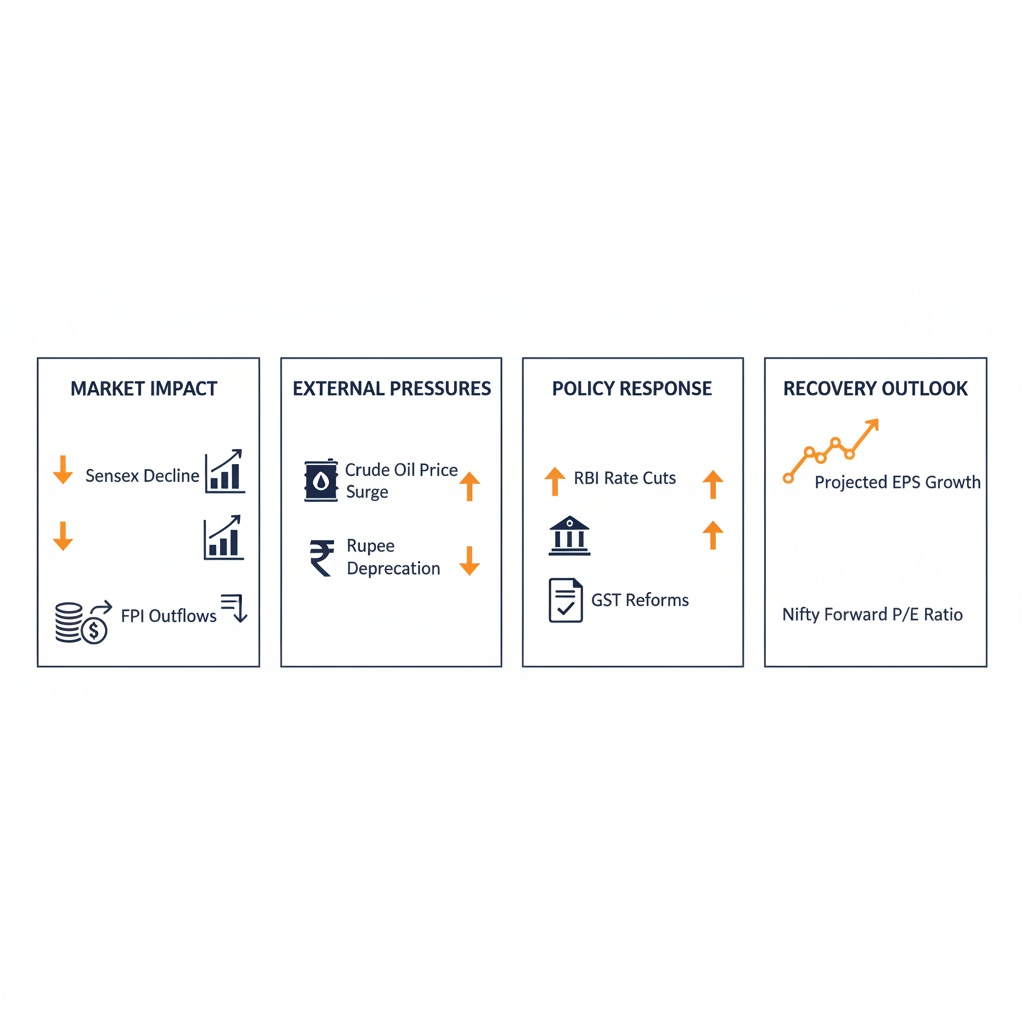
Infographic Image: Key Drivers and Outlook of Indian Equity Markets FY26
Against this backdrop, a comprehensive analysis is essential to unpack the interplay of external shocks and their direct impact on market valuations, sectoral performances, and capital flows. This report also delves into the domestic economic environment, highlighting policy responses, financial market dynamics, and structural strengths that underpin resilience amidst adversity.
The scope of this analysis encompasses a detailed review of external market disruptions, evaluation of India’s policy and economic responses, and forward-looking strategic guidance for investors. Utilizing quantitative data, sectoral insights, and macroeconomic forecasts, the objective is to illuminate pathways through which Indian equity markets can navigate current headwinds toward sustainable recovery and growth.
1. Impact of External Pressures on Indian Equity Markets
The performance of Indian equity markets in Fiscal Year 2026 was significantly shaped by a complex web of external pressures that heightened volatility and suppressed investor confidence. Against a backdrop of escalating geopolitical tensions, particularly in the Middle East, the markets grappled with uncertainty affecting capital flows, currency stability, and sectoral valuations. The widening conflict involving Iran, the United States, and their regional allies not only disrupted global energy supplies but also unsettled global financial sentiment, exerting direct downward pressure on Indian benchmark indices. This interplay of global geopolitical events and economic indicators forms the foundational context necessary to understand the constraints faced by Indian equities during this period.
Coinciding with these geopolitical disruptions was a pronounced surge in crude oil prices, a critical external economic factor given India’s dependency on energy imports. Brent crude prices soared by approximately four percent, touching the $105 per barrel range during March 2026 and contributing to cost-push inflationary pressures within the Indian economy. The oil price spike directly affected sectors with elevated energy consumption, exacerbating input costs and feeding through to broader market apprehension. In parallel, foreign portfolio investors (FPIs) intensified equity offloading, collectively withdrawing over ₹83 billion from Indian markets in short order, which further compounded market instability and amplified rupee depreciation. These external pressures collectively undermined market sentiment and performance, establishing the adverse external environment faced by Indian equities in FY26.
Geopolitical Events and Their Market Implications
The escalation of conflict in the Middle East, particularly the extension of the Iran confrontation into neighboring countries such as Cyprus, Sri Lanka, Turkey, and Azerbaijan, triggered heightened risk aversion across global markets in FY26. Notable was the disruption of shipping lanes through the Strait of Hormuz, a chokepoint for approximately 20% of the world’s crude oil trade. Repeated closures and shipping uncertainties threatened prolonged supply shocks, placing inflationary expectations and energy security at the forefront of investor concerns. The U.S.’s strategic military engagements and open-ended timelines added layers of uncertainty, contributing to fluctuating risk premia and a pervasive sense of caution among global asset allocators.
In India, this geopolitical turmoil translated into elevated volatility spikes in both equity and currency markets. The Sensex and Nifty indices experienced marked declines during periods of intensified hostilities, with the Sensex losing over 7% and the Nifty 50 retreating by more than 5% over the fiscal year. The most affected sectors included real estate, which plunged by approximately 23.6%, alongside IT and energy-intensive industries. The short-term outlook was further clouded by the absence of clear diplomatic resolutions and the persistence of hawkish monetary signals from the U.S. Federal Reserve, which heightened global interest rate uncertainty and risk-off sentiment. Domestic investors and analysts noted that this geopolitical backdrop was a primary driver of intermittent bouts of risk aversion, overriding otherwise supportive domestic economic indicators.
Percentage decline of key indices amid geopolitical tensions in FY26.
Quantitative Market Performance and Sectoral Impacts in FY26
FY26 saw Indian equity markets grappling with broad-based weakness marked by diverging sectoral performances. The Nifty 50 index declined approximately 5.1%, while the broader Sensex index contracted by 7.1% over the fiscal year. Mid-cap stocks managed a modest gain of around 1.9%, reflecting selective resilience, whereas small-cap stocks declined roughly 6%, underscoring heightened risk aversion towards more volatile segments. This uneven performance was driven largely by external factors, as the rising crude oil costs and geopolitical uncertainties disproportionately affected cyclical and export-oriented sectors.
Crude oil’s swift climb above the $100 per barrel threshold injected inflationary pressures that dampened investor enthusiasm for sectors sensitive to energy costs, notably transportation, metals, and manufacturing. For instance, BSE Power and BSE Oil & Gas indices faced double-digit declines, exacerbated by fears of sustained input cost inflation and margin compression. Foreign institutional investors exacerbated the market stress by withdrawing net amounts exceeding ₹83 billion during peak uncertainty phases. Contrastingly, domestic institutional investors stepped in with purchases close to ₹71.7 billion, cushioning some of the downward price pressures. The rupee’s depreciation relative to the U.S. dollar, driven by the widening current account deficit and foreign outflows, amplified imported inflationary pressures and contributed to further market nervousness.
Foreign Investor Outflows and Currency Depreciation Dynamics
The nexus of geopolitical uncertainty and commodity price inflation fomented an adverse environment for foreign portfolio investors, who reduced their India exposure sharply throughout FY26. The cumulative net foreign equity outflows surpassed ₹83 billion, marking a significant reversal from prior periods of capital inflow. This trend was influenced not only by risk aversion linked to geopolitical developments but also by broader shifts in global monetary policy and risk sentiment, particularly emanating from the U.S. and Europe.
The withdrawal of foreign capital exerted downward pressure on Indian equity valuations, magnifying market volatility amid fragile investor confidence. Additionally, sustained foreign selling contributed to exchange rate depreciation, with the Indian rupee weakening over the course of the fiscal year to record lows against the U.S. dollar. This depreciation compounded cost pressures for Indian importers and import-reliant industries, reinforcing inflationary dynamics already aggravated by climbing crude prices. The confluence of foreign outflows and currency weakness thus created a feedback loop that further challenged market stability. Domestic investors’ partial counterbalancing buying reflected a defensive strategy aimed at stabilizing markets, but it could not fully offset the external headwinds.
2. Domestic Resilience and Policy Measures Supporting Recovery
India’s demonstrated domestic economic resilience amid FY26’s external shocks underscores the critical role of targeted, multifaceted policy actions and structural strengths in shaping the recovery blueprint. The combination of monetary easing, expansive fiscal stimulus, and comprehensive tax reforms—including GST rationalization—provides a robust platform for stimulating demand, investment, and corporate profitability. These policies enhance liquidity, reduce input costs, and foster consumption growth, which collectively counterbalance adverse global pressures.
Crucially, a vibrant domestic investor base has stepped in to support equity markets, with mutual funds and retail participation reaching unprecedented levels despite marked foreign outflows. Key sectors such as financial services, infrastructure, and consumption-linked industries demonstrate resilience and are poised to drive medium-term growth. Financials benefit from attractive valuations and improving credit dynamics, infrastructure from structural reforms and rising capital expenditure, and consumption from increased household spending power facilitated by fiscal incentives.
Medium-term earnings projections reinforce this recovery narrative, with expected double-digit growth reflecting both an economic rebound and the fruits of policy reforms. Valuation metrics confirm market readiness to stabilize and recover, offering a strategic inflection point absent in many peer economies. Together, these factors showcase a uniquely Indian pathway to market recovery — one rooted firmly in domestic fundamentals rather than reliance on the uncertain external environment.
As the market prepares to shift gears from coping with external headwinds toward harnessing internal strengths, these domestic policy measures and economic dynamics lay the groundwork for informed and strategic investor engagement. The forthcoming analysis in the next section will build upon this foundation by outlining how investors might best position themselves to capitalize on these evolving market conditions and the pathways to sustained recovery.
Proactive Economic Policies: Monetary Easing, Fiscal Stimulus, and Tax Reforms
The monetary and fiscal policy stance over the past year has been instrumental in cushioning India’s economy from the pressures of rising crude oil prices and destabilizing external market shocks. The Reserve Bank of India’s cumulative repo rate reductions totaling 100 basis points, alongside a historic 150 basis point cut in the Cash Reserve Ratio, have markedly improved liquidity conditions. These policy moves, implemented amidst global uncertainty, have aimed to lower borrowing costs, stimulate credit growth, and bolster aggregate demand. They also signal a more accommodative monetary environment that reverses the previous tightening cycle initiated to contain inflationary pressures in earlier years.
Parallel to monetary easing, fiscal stimulus initiatives reinforce this supportive backdrop. The government’s concerted effort to accelerate public spending, especially in infrastructure and social sectors, addresses both short-term growth imperatives and long-term capacity expansion. Despite concerns over fiscal prudence, strategic allocation of funds toward capital expenditure — including transport corridors, digital infrastructure, and renewable energy projects — drives multiplier effects that invigorate private investment and consumption. This is consistent with the broader governmental objective to transition India into a $5 trillion economy, emphasizing quality GDP growth supported by infrastructure-led expansion.
A significant complementary policy lever has been the overhaul of the Goods and Services Tax (GST) framework, marking the largest revision in eight years. The GST Council’s tax rate rationalizations effective from late 2025 have lowered levies on essentials and aspirational goods, thereby reducing the tax burden on consumers. For instance, rates for key fast-moving consumer goods have been trimmed from 12-18% to a more accessible 5%, while auto categories saw reductions that are expected to rejuvenate demand in entry-level and premium vehicle segments. Such calibrated tax reforms are designed not merely to spur consumption but also to enhance corporate profitability by improving margins and reducing promotional pressures. Additionally, exempting health and life insurance premiums from GST and lowering taxation on pharmaceuticals underscores a balanced approach toward social equity and economic growth. Together, these measures are pivotal in reviving disposable incomes and sustaining consumption momentum.
Rising Domestic Investment and Sectoral Performances: Financial Services, Infrastructure, and Consumption
Despite the adverse external environment and significant foreign institutional outflows—recorded at approximately ₹83 billion (INR) in FY26—domestic investors have emerged as staunch market backers, dampening volatility and providing stability. Mutual funds, pensions, and other retail investors increased their footprint substantially, with mutual fund ownership of equities reaching historic highs in early 2025. Domestic purchases totaled around ₹71.7 billion, reflecting a persistent domestic appetite for equities and growing financialisation of household savings. This structural shift away from traditional asset classes like gold and real estate is critical, as domestic investment flows tend to be less volatile and more aligned with India’s economic fundamentals than foreign portfolio movements [Table: Foreign Institutional Investor Activity in FY26].
Sectoral analysis further demonstrates the underlying strength and prospective drivers of recovery. Financial services have shown resilience and invite cautious optimism; banking stocks trade at significant discounts to historic valuations, making valuations attractive for medium-term investors. With banks commanding price-to-book multiples around 1.4 times (FY28 estimates), this 31% discount to their 10-year median signals an undervalued segment. The power and infrastructure sectors, propelled by government reforms such as the anticipated New Electricity Amendment Bill, stand out as structural beneficiaries. These reforms target unbundling of distribution companies, rationalization of tariffs, and enhancements in operational efficiency, which will collectively stimulate capex and demand. The data center-driven surge in power requirements further diversifies demand streams, offering a robust outlook for utilities and infrastructure-linked equities.
Consumption-driven sectors complete the triad of domestic market strength. Tailwinds from tax reductions and improved disposable incomes, combined with the approaching festive and wedding seasons, underpin a positive demand outlook. Consumer staples and discretionary segments, notably FMCG, beverages, apparel, and consumer durables, have witnessed improved sales volumes, margin expansions, and reduced promotional intensity, allowing companies to strengthen their earnings profiles. The GST-induced cost savings and higher consumption propensity are expected to translate into a 4.4% contribution from consumption growth to GDP by end-2026. This sustained domestic demand acts as a powerful lever mitigating external uncertainties and supporting earnings expansion.
Medium-Term Earnings Growth Projections and Valuation Assessments Supporting Market Stabilization
Underpinning the recovery narrative are solid medium-term earnings growth projections that reflect both cyclical rebound and structural reforms’ beneficial impact. Despite short-term earnings pressure due to a high base effect and tariff-related uncertainties, consensus estimates anticipate earnings per share (EPS) growth in the range of 12 to 15% over the medium term. Historical data demonstrates a robust correlation between nominal GDP growth and corporate earnings, and with India's projected GDP growth hovering around 6.5% for FY26 and FY27—nearly double the global average—earnings growth is expected to follow suit. Importantly, large-cap companies exhibit more earnings resilience amidst macroeconomic headwinds, lending further credibility to an equities recovery primarily driven by quality and scale.
Valuations have adjusted downward to levels below their 10-year averages, positioning the market within what experts describe as a “bounce zone.” The Nifty index’s forward price-to-earnings ratio has dipped to approximately 17.3 times, noticeably beneath the 10-year historical average of 18.6 times, indicating an attractive entry point for discerning investors. This valuation retracement reflects a market correction that has absorbed external shocks without eroding the fundamental value of equities. Comparatively, the MSCI India premium over other emerging markets has normalized from extreme highs seen in 2024, aligning India’s valuation with its earnings growth potential and macroeconomic stability. Such valuation repositioning, combined with medium-term earnings recovery, creates a foundation for market stabilization and gradual upward trajectory.
Further, sector-specific earnings upgrades are anticipated following GST reforms and consumption revival, particularly in auto, consumer durables, and insurance industries. The expected pick-up in earnings in the second half of 2026 and beyond corroborates the thesis that domestic economic policies, corporate balance-sheet strength, and rising investment flows collectively form a resilient ecosystem capable of countervailing external shocks. While uncertainty remains around global trade dynamics and inflationary pressures, these domestic fundamentals offer a substantial buffer, underpinning market confidence and anchoring recovery expectations.
3. Strategic Investor Responses and Market Recovery Outlook
As Indian equity markets emerge from a challenging fiscal year marked by external shocks and heightened volatility, the focus decisively shifts toward actionable investor strategies and a grounded recovery outlook. The previous analysis underscored the robustness of India's domestic economic framework and corporate fundamentals, laying a critical foundation. Building on these insights, this section delineates how investors can pragmatically respond to prevailing market conditions—capitalizing on valuation reprieves and domestic sectoral resilience—while navigating inherent uncertainties. Investor acumen now hinges on recognizing recovery signals embedded in current market valuations and aligning portfolios accordingly to harness medium- to long-term growth potential.
The evolving investment landscape in FY26 and FY27 presents a nuanced opportunity set driven by attractive entry valuations, sectoral realignments favoring domestically oriented businesses, and a cautiously optimistic macro backdrop. However, mitigating residual risks through disciplined allocation and risk management remains paramount. This balance between optimism anchored in data and prudence shaped by ongoing external uncertainties defines the strategic response imperative for stakeholders committed to Indian equity markets.
Valuation Landscape and Entry Points Signaling Recovery Potential
Indian equity valuations reflecting market corrections during FY26 now suggest compelling entry points for investors positioned to benefit from a recovery phase. The trailing price-to-earnings (PE) ratio for the Sensex has declined to approximately 20 times—down from a five-year average near 24—while the Nifty 50’s market capitalization relative to nominal GDP has contracted from 152% in late 2024 to 109% as of early 2026. These adjustments indicate the market is no longer overextended and valuation multiples have reverted closer to historical norms, enhancing the attractiveness of Indian equities relative to fixed income and regional peers.
This valuation re-rating is further supported by sector-specific insights: large caps, particularly within financial services, consumer discretionary, and select infrastructure-related sectors, exhibit healthier earnings growth expectations and steadier fundamentals compared to the small and mid-cap universe, where earnings downgrades have been more pronounced. Despite macroeconomic headwinds, consensus medium-term earnings growth forecasts remain robust at 12–15%, suggesting that market prices may have already absorbed much of the economic slowdown, creating asymmetrical upside potential for investors adopting a selective approach. This backdrop reinforces market entry readiness, especially for those emphasizing quality and resilience over speculative gains.
Historical market cycles, reinforced by quantitative modeling presented in recent analyses, show that early fiscal year market declines have frequently preceded sustained rallies as domestic reforms and consumption rebounds gain traction. Though risks linked to crude oil price volatility and geopolitical tensions persist, valuation metrics provide a solid foundation for positioning portfolios for recovery starting in the second half of FY27.
Recommended Asset Allocation Strategies and Sectoral Focus on Domestic Resilience
In navigating the FY27 market environment, diversification within a domestically-driven investment framework emerges as a prudent strategy, balancing growth aspirations with risk containment. Emphasis should be placed on large-cap and high-quality mid-cap stocks underpinned by resilient business models and strong balance sheets. These typically include financial services firms with robust asset quality and earnings consistency, consumer discretionary companies poised to benefit from GST-driven demand stimulus, and infrastructure enterprises strategically positioned to capture government-backed investment acceleration.
Domestic consumption-oriented sectors especially warrant investor attention given anticipated tailwinds from recent GST tax rate reductions, income tax relief, and pent-up demand manifesting post-pandemic. For instance, GST revisions lowering rates for auto components, fast-moving consumer goods (FMCG), and consumer durables are expected to boost volume growth and margins, thereby enhancing corporate earnings trajectories within these sectors. Investors should also consider nuanced exposure to healthcare and insurance segments, where GST changes and increasing penetration dynamics create a durable growth runway.
Allocation strategies should balance direct equity exposure with systematic investment plans (SIPs) to mitigate volatility and capitalize on rupee cost averaging over time. Fixed income instruments, such as enhanced-yield fixed deposits currently offering attractive real returns between 6.25% and 6.5%, maintain relevance for conservative portfolio segments amid persistent inflationary pressures. Tactical rebalancing—reducing cyclical and export-dependent sector weights unfavorable under ongoing global uncertainties—further complements a risk-aware, domestically anchored portfolio schema. Notably, the real estate sector suffered the most pronounced decline in FY26, accounting for 23.6% of sectoral downturns, highlighting its heightened vulnerability amid external economic pressures and underscoring the rationale for cautious exposure in this area [Chart: Sectoral Declines in FY26].
Moreover, diversification across market capitalizations remains advisable, but with a heightened emphasis on quality within small and mid-caps, given their greater earnings vulnerability in the near term. Investors are encouraged to adopt a selective stock-picking approach in these segments, focusing on companies exhibiting strong corporate governance, robust cash flows, and market leadership within niche domains.
Medium- to Long-Term Market Outlook: Balancing Optimism with Risk Management
Looking beyond FY26, the medium- to long-term outlook for Indian equity markets remains cautiously optimistic, grounded in projected economic recovery trajectories and augmented by policy support. Consensus forecasts project GDP growth moderating to approximately 6.1–7.2% in FY27 due to elevated energy costs and global uncertainty but anticipate an earnings recovery catalyzed by renewed private capex and consumer demand surges from late 2026 onward. Market consensus earnings growth is forecasted at 13–16% in calendar years 2025 and 2026, respectively, signaling strengthening corporate profitability.
These positive undercurrents, however, are counterbalanced by risks that demand vigilant risk management. Persistent high crude oil prices, potential RBI interest rate adjustments to temper inflation, expansion of the current account deficit, and geopolitical volatility underscore the necessity for investor flexibility and disciplined portfolio monitoring. Investors should maintain dynamic asset allocation frameworks that integrate scenario-based planning and stress testing to mitigate downside impacts and capitalize on upside opportunities as recovery narratives unfold.
Strategically, an investor mindset attuned to valuation discipline, sector rotation towards domestically resilient themes, and calibrated risk exposure will be pivotal in navigating market volatility. Emphasizing sectors aligned with India’s structural growth drivers—including infrastructure modernization, financial inclusion, consumer market evolution, and technological adoption—will likely yield sustainable returns over the coming years.
Eventually, India’s equity market is expected to ascend from its subdued FY26 valuations in a phased recovery, supported by improved domestic consumption, reform-driven efficiency gains, and expanding global integration. For long-term investors weathering near-term turbulence, this environment offers a compelling mix of risk-adjusted return prospects, provided engagement is anchored in rigorous analysis and adaptive investment strategies.
Conclusion
The Indian equity market’s experience in FY26 underscores the significant influence of global geopolitical tensions, commodity price shocks, and foreign capital volatility on market performance. However, these external pressures have not diminished the fundamental strengths of the domestic economy. Proactive monetary and fiscal policies, sectoral reforms, and robust corporate earnings profiles collectively form a strong counterbalance, reinforcing the market’s capacity for recovery.
For investors, embracing a strategic approach that emphasizes domestic-sector resilience, valuation discipline, and diversified asset allocation is critical in navigating the ongoing volatility. The medium-term outlook remains cautiously optimistic, supported by expected earnings growth, improving market valuations, and expanding domestic participation.
Looking ahead, continuous monitoring of geopolitical developments, commodity price trends, and policy responses will be essential. Further analysis should focus on scenario-based assessments integrating macroeconomic, sector-level, and investor-behavior variables to refine and adapt recovery strategies. Through informed engagement and tactical positioning, stakeholders can contribute to and benefit from the evolving trajectory of India’s equity markets.
Glossary
- Foreign Portfolio Investors (FPIs): Investment entities from outside India that hold financial assets like stocks and bonds in Indian markets, whose inflows and outflows significantly impact market liquidity and valuation.
- Goods and Services Tax (GST): A comprehensive indirect tax system in India that replaced multiple cascading taxes, aimed at simplifying tax structure and enhancing economic efficiency; recent reforms have adjusted rates to stimulate consumption.
- Price-to-Earnings (PE) Ratio: A valuation metric comparing a company's current share price to its earnings per share, used to assess whether a stock is over- or undervalued relative to historical norms or peers.
- Monetary Easing: A central bank policy action that lowers interest rates and increases money supply (e.g., by reducing repo rate or Cash Reserve Ratio) to stimulate economic activity and liquidity.
- Repo Rate: The rate at which the Reserve Bank of India lends short-term funds to commercial banks; adjustments influence borrowing costs and overall monetary policy stance.
- Cash Reserve Ratio (CRR): The percentage of a bank's total deposits that it must keep as cash reserves with the central bank, affecting liquidity available for lending.
- Sensex and Nifty 50: Benchmark stock market indices in India; Sensex tracks 30 prominent companies on the Bombay Stock Exchange, while Nifty 50 represents 50 major companies listed on the National Stock Exchange.
- Current Account Deficit (CAD): A measure of a country's trade balance where imports of goods, services, and transfers exceed exports, often influencing currency depreciation and foreign exchange dynamics.
- Market Capitalization: The total market value of a company's outstanding shares, used to classify stocks into large-cap, mid-cap, and small-cap categories indicating relative size and risk.
- Capital Expenditure (Capex): Funds spent by a company or government on acquiring or upgrading physical assets such as infrastructure, equipment, or property to drive future growth.
- Inflationary Pressures: Economic conditions leading to a sustained increase in the general price level of goods and services, often fueled by rising input costs like crude oil prices.
- Risk Aversion: Investor behavior characterized by a preference for lower risk investments, often triggered by geopolitical uncertainty or market volatility.
- Systematic Investment Plans (SIP): A disciplined investment approach allowing investors to contribute a fixed amount periodically into mutual funds, helping mitigate market volatility through rupee cost averaging.
- Financialisation of Household Savings: A trend where households increasingly allocate savings towards financial assets like equities and mutual funds instead of traditional assets such as gold or real estate.
- Valuation Re-rating: A market process where investors adjust their valuation multiples (like PE ratios) for stocks or indices, often reflecting changed outlooks on earnings growth or risk.
References
- Global markets in transition: India stands resilient amidst volatility! – Geojit Insights
- Indian Markets May Open Lower Amid Oil Surge, Global Tensions -
- Indian equities – spotting opportunities amidst global uncertainties
- India Stocks Hit by FY26 Slump, Eye FY27 Rebound Amid FD Lure | Whalesbook
- ETMarkets Smart Talk | Nifty in ‘bounce zone’ as valuations fall below 10-year average; de-escalation key: Harendra Kumar - The Economic Times
- [PDF] April 2026
- What is the outlook for India’s stock market? | J.P. Morgan