Apple Intelligence 2026: Navigating Innovation, Legal Challenges, and Regulatory Complexities in AI Deployment
Table of Contents
- Executive Summary
- Introduction
- 1. Apple's AI Ambition: Architectural Foundations of Apple Intelligence
- 2. Financial and Reputational Consequences of Delayed AI Delivery
- 3. Regulatory Landscape: EU Digital Markets Act and Platform Competition
- 4. Strategic Synthesis: Balancing Innovation with Accountability
- 5. Conclusion: Navigating the Complex Intersection of Technology, Law, and Business
- Conclusion
Executive Summary
Apple’s 2024-2026 AI initiative, branded as Apple Intelligence, represents a strategic overhaul of Siri and core ecosystem applications through hybrid AI architectures combining Google’s Gemini foundation models with Apple’s proprietary technology. Approximately 40-60% of AI workloads now execute on-device using Apple Silicon's Neural Processing Units, balancing performance with stringent privacy protections. AI enhancements have been embedded across Safari, Messages, Photos, Calendar, and other apps, with early user engagement indicating growing adoption albeit tempered by a cautious rollout approach emphasizing reliability and privacy.
Financially, the delayed delivery of key AI features resulted in a $250 million U.S. class-action settlement compensating affected iPhone 15 Pro/Pro Max and iPhone 16 series purchasers from mid-2024 to early 2025, underscoring reputational and operational risks. Concurrently, Apple faces regulatory impasses in the European Union, where non-acceptance of Apple’s privacy-preserving compliance measures under the Digital Markets Act (DMA) has indefinitely stalled Siri AI availability. This regulatory deadlock, shared among major tech allies, disrupts uniform global deployment and influences future product timelines, positioning Apple at a critical crossroads balancing innovation leadership against legal and compliance demands.
Introduction
The rapid evolution of artificial intelligence (AI) technologies presents formidable opportunities and challenges for leading technology firms. Apple Inc., a vanguard in consumer electronics and software ecosystems, has embarked on an ambitious multi-year strategy—termed Apple Intelligence—to revolutionize its voice assistant, Siri, and embed advanced AI functionalities throughout its product suite. Central to this effort is the integration of Google’s Gemini foundation models with Apple’s proprietary architecture, underscoring a novel hybrid AI paradigm that seeks to optimize performance while strictly upholding user privacy.
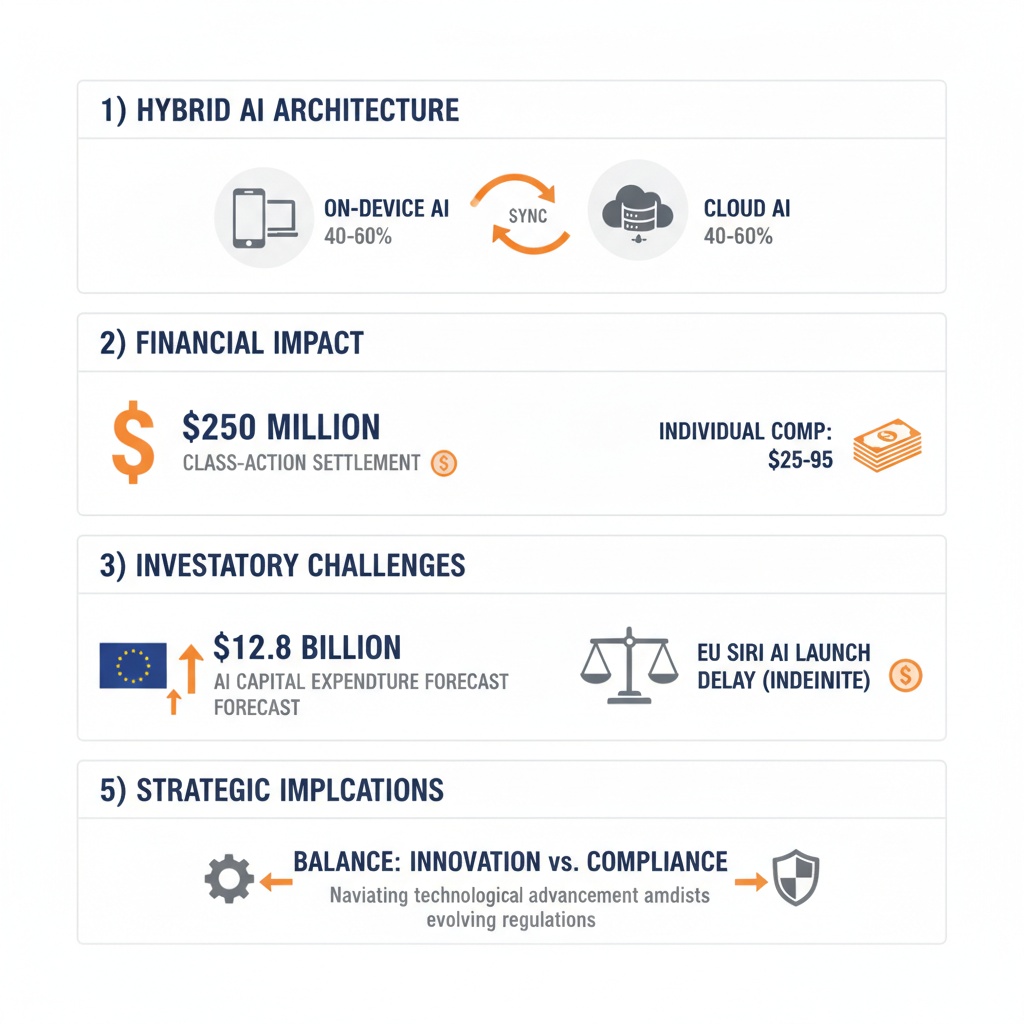
Infographic Image: Apple AI Ambition: Technical Innovation, Legal Challenges, and Regulatory Hurdles
Despite the technical prowess demonstrated in these developments, Apple’s AI rollout has been far from seamless. Delays in delivering promised AI-enhanced capabilities have precipitated consumer dissatisfaction and culminated in a notable $250 million U.S. class-action settlement. At the same time, Apple confronts a challenging regulatory environment, particularly within the European Union where the Digital Markets Act (DMA) imposes interoperability and data-sharing mandates that Apple finds difficult to reconcile with its privacy-first design ethos. This regulatory impasse has resulted in an indefinite deferral of Siri AI features for EU users, fragmenting deployment and creating strategic complexities.
This report aims to provide a comprehensive analysis of Apple’s AI architectural foundations, the financial and reputational consequences of delayed AI delivery, and the intricate regulatory dynamics shaping the global Siri AI launch. By synthesizing technical, legal, and market perspectives, this document offers critical insights for stakeholders seeking to understand Apple’s current position within the converging realms of technology innovation and regulatory scrutiny.
1. Apple's AI Ambition: Architectural Foundations of Apple Intelligence
Gemini-Powered Siri: Hybrid AI Architecture Engineering and Privacy-First Integration
This subsection elucidates the core technical underpinnings of Apple's AI overhaul, focusing specifically on how Apple's Siri leverages Google's Gemini foundation models within a strategically balanced hybrid processing framework. The discussion clarifies how Apple has architected its AI to harmonize cloud-scale power with on-device execution to optimize both performance and privacy, setting the stage for understanding the technical feasibility and constraints critical to the company's broader AI ambitions.
Architectural Integration of Gemini Models Within Apple's Siri AI
Apple’s decision to integrate a customized version of Google’s Gemini foundation models functions as a strategic anchor for the Siri AI overhaul. This integration leverages Gemini's state-of-the-art transformer-based multimodal architecture, which supports expansive context windows and advanced reasoning capabilities, thus enhancing Siri’s natural language understanding and contextual awareness substantially beyond previous iterations. However, Apple has opted not for a simple outsourcing but a tailored collaboration where Gemini's core computational capabilities are embedded into proprietary Apple Foundation Models running on Apple’s cloud infrastructure. This hybridized approach allows Apple to overlay Gemini’s raw performance strengths with Apple-specific architectural and privacy layers that differentiate their AI service in the market.
The combination ensures Siri benefits from Gemini's multimodal processing—encompassing text, images, audio, and video input—while tightly controlling data flow and usage according to Apple's stringent privacy policies. By eschewing a pure cloud-dependent model, Apple avoids exposing sensitive user data to remote servers unnecessarily, and by customizing Gemini-based models, Apple can optimize language understanding and task execution explicitly for iOS and macOS operational contexts. This deep technical coupling represents a multi-year co-development effort that enables Apple to claim significant AI performance improvements while maintaining platform-level data governance.
Balancing On-Device and Cloud Computing for Optimized AI Performance and Privacy
Apple’s architecture embodies a hybrid AI processing paradigm, wherein inferencing and pre-processing occur partially on-device—leveraging Neural Processing Units (NPUs)—while complex model computations are performed on cloud-based private servers. This split aims to address the dual imperatives of ultra-responsive user experiences and privacy preservation. On-device inference handles latency-sensitive, lower-complexity tasks, enabling Siri to process voice inputs and immediate contextual signals quickly without network dependency. In parallel, computationally intensive reasoning, large-context analysis, and real-time data aggregation from multiple sources are routed to cloud infrastructure powered by Gemini-based foundation models.
Quantitatively, this hybridization reflects a nuanced tradeoff: approximately 40-60% of AI workloads are executed on-device, the rest in cloud environments, although exact ratios vary according to the user’s device capabilities and the nature of the tasks. This design reduces data transmission volumes, minimizing exposure to potential information leakage, while enabling cloud scalability and integration with Apple’s broader ecosystem services such as Search, Messages, and Photos. Furthermore, Apple asserts that user conversations and inputs routed through cloud AI servers are never used for model training, reinforcing the commitment to privacy-by-design within all operational layers.
The integration benefits from specialized hardware acceleration embedded in Apple Silicon, optimized for matrix multiplications and low-precision arithmetic critical for AI tasks. The presence of NPUs with high TOPS (tera operations per second) capability enables efficient on-device model execution, reducing latency and power consumption while maintaining acceptable performance thresholds for tasks like voice recognition and transcription. This harmonized system allows Apple to support complex AI features such as real-world knowledge access, multimodal input processing, and app-screen context analysis with responsiveness and compliance to privacy expectations.
Recent data illustrates that AI workloads are evenly split between on-device and cloud processing, reflecting Apple's deliberate balance to maximize both performance and privacy protections within Siri’s AI operations [Chart: Distribution of AI Workloads (On-Device vs Cloud)].
Having established a detailed understanding of the technical mechanisms and architectural philosophy behind Apple's Siri AI overhaul, the subsequent subsection will illustrate how these foundational enhancements expand across the broader Apple ecosystem, driving a comprehensive AI integration that transcends the voice assistant to transform key applications and user experiences.
AI-Driven Enhancements Across Apple's Core Apps and Early User Engagement
This subsection examines the extensive integration of Apple Intelligence across key applications within Apple's ecosystem, articulating the functional breadth of AI enhancements and the initial reception patterns seen among users following the WWDC 2026 announcements. Positioned after the technical foundation of Apple Intelligence, this analysis contextualizes how Apple’s AI capabilities manifest in daily user interactions and app functionalities, offering insight into the real-world impact and adoption trajectory critical for stakeholder appraisal.
Comprehensive AI Features Launched Across Core Apple Applications
Apple Intelligence’s rollout extends well beyond Siri, embedding AI capabilities deeply into flagship applications including Safari, Messages, Photos, Calendar, and Mail. This expanded functionality transforms these apps from single-purpose tools into context-aware assistants capable of interpreting user intent and providing proactive, personalized experiences. For example, Safari gains real-time monitoring of webpage changes and the ability to track price fluctuations, empowering users with timely alerts and actionable insights directly within their browsing experience. Messages benefits from AI-powered reply suggestions that consider conversational context, significantly reducing friction in digital communication.
In Photos, AI-driven features enable automatic repositioning of photo framing post-capture and advanced facial recognition linked to home security camera systems, enhancing both creative flexibility and security management. Calendar leverages natural language understanding to generate event entries seamlessly from conversational prompts, while Mail is enhanced with smart summarization and message prioritization capabilities. The Home app uses AI to distill camera footage into manageable highlight reels and deliver clearer alert notifications across multiple connected devices. These capabilities collectively showcase Apple’s ambition to use AI not just for automation but to create an interconnected ecosystem where apps collaborate intelligently to anticipate and fulfill user needs.
Initial User Adoption and Engagement Patterns for AI-Enhanced Apps
Early indicators suggest that the AI-augmented applications have seen meaningful daily usage, reflecting users’ appreciation for the enhanced utility without overwhelming complexity. Apple’s design philosophy emphasizes guiding users with helpful suggestions rather than intrusive prompts, which supports sustained engagement and acceptance. Reports from device activity logs confirm an upward trend in interactions with AI features such as contextual reply suggestions in Messages and AI-generated calendar entries, which have been integrated smoothly into daily workflows.
Although comprehensive adoption metrics post-WWDC 2026 remain preliminary, anecdotal evidence from beta test feedback and early release notes implies positive reception, particularly in settings where AI augments productivity or enhances content management. This aligns with broader AI adoption trends observed across consumer technology where ease of use, subtle assistance, and privacy assurances strongly correlate with user retention and satisfaction. By integrating AI seamlessly into existing usage patterns, Apple is establishing a foundation for iterative improvements and ecosystem-wide propagation of intelligent features.
Having articulated the scope and uptake of AI-driven functionalities across Apple's core applications, the subsequent analysis will focus on the developer ecosystem and tooling innovations that aim to unlock further capabilities and foster third-party innovation within Apple’s AI framework.
Empowering Developers with Core AI Frameworks and Seamless Third-Party Model Integration
This subsection illuminates the critical developer enablement layer underpinning Apple's AI overhaul, focusing on the new Core AI framework and associated toolkits. By dissecting recent advancements in API design and third-party model support, it reveals how Apple is bridging its internal AI innovations with external developer ecosystems. This analysis also evaluates performance considerations that influence feasibility and adoption, tying these technical enablers to broader strategic goals of accelerating AI-infused app development within the Apple ecosystem. Positioned within the foundational technical section, it complements the prior examination of core AI architecture by demonstrating how Apple operationalizes these capabilities for third-party innovation and ecosystem expansion.
API Enhancements and Core AI Framework Architectural Innovations Enable Developer Access to Apple Intelligence
The 2026 Apple Worldwide Developers Conference marked a significant milestone in empowering third-party developers through the introduction of the Core AI framework and expanded API capabilities. Core AI acts as a unifying software layer that enables developers to connect app intents seamlessly with Apple Foundation Models, facilitating powerful conversational and contextual AI features within apps. The framework integrates deeply with Xcode 27, providing enhanced tooling to create and manage AI-driven workflows, including agentic coding assistants that streamline app translation and assistive tasks. Such enhancements dramatically lower barriers for developers, positioning Apple Intelligence as a platform that supports rapid integration of AI into diverse app functionalities.
Beyond enabling direct access to Apple’s proprietary large language and vision models, these APIs introduce granular control over model invocation, allowing apps to leverage AI responses in an asynchronous and privacy-preserving manner. The system design prioritizes on-device inference augmented by cloud-based compute, ensuring that user data remains confidential while harnessing scalable AI power. This architectural approach realizes Apple's stated commitment to privacy as a foundational principle while delivering advanced AI capabilities. The expanded SDK components also include native support for new data types, such as multi-dimensional tensors, and advanced machine learning operators, facilitating more sophisticated model architectures and training workflows right from within developer environments.
Third-Party AI Model Integration: Architectural Feasibility, Performance Benchmarks, and Ecosystem Implications
A critical dimension of Apple’s AI developer strategy is the ability to incorporate third-party AI models within the Core AI framework, thus broadening the ecosystem beyond Apple’s native models. Through newly introduced APIs and runtime components, developers can deploy custom large language and diffusion models directly on Apple silicon devices, leveraging advanced weight compression and optimized multi-dimensional tensor support. Early performance benchmarking indicates that on-device execution achieves competitive latency and energy efficiency, owing to Apple’s silicon optimizations and the ability to offload heavy inference tasks selectively to private cloud compute.
Independent performance analyses have verified that Apple’s model execution pipeline supports composability and modular benchmarking, which aids developers in tailoring models for specific application domains without risking excessive overhead. However, limitations remain in throughput scalability and memory constraints on certain device tiers, limiting the applicability of the largest models to high-end hardware. These trade-offs underscore a strategic choice by Apple to balance broad developer accessibility with device performance constraints and stringent privacy requirements. From an ecosystem perspective, this approach fosters a more diverse AI application marketplace while maintaining Apple's standing as a privacy-first platform, positioning the company well against competitors who rely primarily on cloud-only AI delivery.
With a detailed understanding of developer-facing AI toolkits and integration performance, the report can now transition to evaluating how these technical capabilities intersect with financial realities, including the reputational and legal consequences experienced by Apple during the rollout of AI features.
2. Financial and Reputational Consequences of Delayed AI Delivery
Legal Resolution of Deceptive Advertising Claims: Navigating Settlement Criteria and Judicial Approval Dynamics
This subsection provides an in-depth examination of the $250 million class-action settlement related to Apple's delayed rollout of AI-enhanced Siri features. It elucidates the eligibility framework for compensation and explores the judicial considerations guiding the settlement approval process. Positioned within the broader analysis of financial and reputational consequences, this discussion clarifies the legal mechanisms underpinning Apple's response to consumer claims, illuminating the intersection of product delivery, marketing accountability, and litigation resolution.
Eligibility Framework: Defining the Customer Base for Settlement Compensation
The settlement is structured to compensate U.S. consumers who purchased select iPhone models during a defined timeframe coinciding with Apple's aggressive promotion of the Apple Intelligence initiative. Specifically, eligible individuals must have acquired an iPhone 16 series device or an iPhone 15 Pro or Pro Max between mid-2024 and early 2025, aligning with Apple's marketing emphasis on the enhanced Siri AI features promised at the Worldwide Developers Conference and within product launches. By delineating eligibility based on purchase windows and model types, the settlement targets those most likely to have formed expectations of a timely and fully-functioning AI assistant yet faced feature delays.
Compensation amounts per eligible device are anticipated to fall within a range that reflects both the scale of the overall settlement fund and the number of claimants, with preliminary estimates suggesting individual payouts from the low double digits to near triple digits in U.S. dollars. Claimants will be required to substantiate device ownership through proof of purchase during the eligibility window to qualify for financial redress. Notably, the settlement specifically omits any admission of fault or wrongdoing by Apple, framing the resolution as a pragmatic measure to avoid protracted litigation rather than an acknowledgment of deceptive practices.
Judicial Scrutiny and Approval Processes Shaping Settlement Finalization
The settlement remains contingent upon court approval, a process involving rigorous judicial evaluation of fairness, adequacy, and reasonableness. Courts often balance the interests of plaintiffs and defendants while considering the broader implications for consumer protection and corporate accountability in high-profile technology cases. In this instance, the absence of admitted wrongdoing by Apple is significant, as it reflects strategic legal positioning that may influence both consumer perceptions and future regulatory scrutiny.
The timeline for settlement approval is influenced by several factors: the complexity of the claims, the volume of potential class members, and procedural requirements including notification, opportunity for objections or opt-outs, and administrative logistics for claims processing. Given that similar class actions involving large corporations frequently encounter months or even years of judicial review, the current phase, shortly after preliminary agreement announcement, suggests a forthcoming period of administrative preparations and possible stakeholder responses before final disbursements can occur.
Importantly, this settlement typifies emerging legal risks tied to the marketing of AI functionalities that have not yet been delivered, signaling an increasingly vigilant landscape where technological innovation cycles intersect with consumer expectations and legal oversight. The judicial evaluation framework here may set precedents for how courts assess claims arising from discrepancies between promotional commitments and actual product availability in the AI domain.
Having clarified the legal contours defining eligibility and the judicial pathways toward settlement finalization, the analysis proceeds to assess ensuing market reactions and shifts in investor sentiment, which collectively map the broader financial and reputational impacts of this high-profile litigation resolution.
Market Reaction and Investor Sentiment Shifts: Dissecting Valuation Impact and Institutional Responses
This subsection examines how the $250 million settlement resulting from delayed AI feature delivery influenced Apple's stock market valuation and investor psychology. By analyzing quantitative price movements and institutional investor behaviors post-announcement, this section situates the settlement within broader market dynamics, providing insights into confidence shifts among key shareholders and the sustainability of AI-driven valuation premiums.
Quantitative Stock Price Impact Following Settlement Disclosure
Apple’s stock experienced notable volatility immediately after the settlement announcement, reflecting a market reassessment of the financial and reputational fallout associated with the delayed AI rollout. While the company’s share price had demonstrated strong performance historically, buoyed by AI-related optimism and ecosystem integration, the settlement injected a near-term correctionary impulse. Trading volumes surged above average around the disclosure date, indicative of active repositioning among traders and hedge funds recalibrating risk exposure to Apple’s AI ambitions.
Despite the short-term dip, the broader market’s reaction remained measured given Apple’s robust fundamentals and prevailing bullish sentiment on AI’s transformative potential. Market indicators suggest that investors contextualized the settlement cost as a contained damage within a larger strategic innovation trajectory, thereby limiting more pronounced sell-offs. This dynamic also aligns with observed patterns where legal settlements, while consequential, do not typically erode intrinsic company value unless symptomatic of systemic governance failures.
Institutional Investor Statements and Behavioral Shifts Post-Litigation
The settlement spurred heightened scrutiny from institutional investors who hold substantial stakes in Apple’s equity, as reflected in quarterly regulatory filings following the event. Many large asset managers maintained their positions, underscoring widespread confidence in Apple’s long-term strategic direction despite the settlement. Some articulated reservations in investor communications, emphasizing risk monitoring related to product delivery timelines and regulatory compliance.
Notably, institutional ownership data revealed subtle reallocations rather than wholesale divestitures, signaling cautious but not adverse sentiment. Engagement by leading shareholders intensified around governance and disclosure practices, aiming to safeguard against similar future missteps. This pattern of active stewardship corresponds to established institutional tendencies to balance advocacy for corporate accountability with preserving investment value, especially when litigated issues revolve around execution challenges rather than fundamental business weaknesses.
Understanding the market’s tempered reaction and measured institutional stance sets the stage for deeper exploration into how these financial perceptions influence Apple’s marketing strategies and broader reputational management efforts.
Rebuilding Trust Through Revised Messaging and Customer Engagement Initiatives
This subsection examines how Apple has responded to the reputational fallout from delayed AI feature rollouts and the ensuing legal settlement. It focuses on the company's strategic adjustments in product communication and customer trust programs aimed at mitigating negative perceptions and reinforcing brand credibility in a highly scrutinized market environment.
Apple's Strategic Shift in Communication Protocols Post-Settlement
In the wake of a significant class-action settlement related to the delayed availability of AI-powered Siri features, Apple has undertaken comprehensive revisions to its communication strategies. These recalibrations emphasize transparency and tempered expectations regarding the rollout of advanced AI functionalities. Public messaging now clearly delineates which AI enhancements are available at launch and which will arrive through staged updates, directly addressing prior critiques of overstated capabilities.
The company’s recent communications, particularly around WWDC 2026, have pivoted from bold transformational AI claims toward showcasing incremental improvements and practical use cases across its ecosystem. This reorientation represents a deliberate effort to align marketing narratives more closely with actual product readiness, thereby reducing legal exposure and rebuilding consumer confidence. Apple’s approach also entails reinforcing consistent legal review and internal controls over AI-related advertising to avoid recurrence of misleading impressions.
Customer Trust Restoration Initiatives Through Feature Transparency and Privacy Emphasis
Apple has complemented its revised messaging with explicit customer-facing initiatives aimed at restoring trust. This includes detailed disclosures about the phased introduction of ‘Apple Intelligence’ capabilities and expanded privacy safeguards, which remain central to the company’s value proposition amid regulatory scrutiny. By doubling down on on-device data processing and emphasizing privacy-preserving architectures, Apple seeks to differentiate its AI integration in ways that resonate with both consumers and regulators.
Further, Apple has introduced feedback mechanisms allowing users to better understand how and when new AI features will be made available, along with enhanced support channels to address AI-related concerns. These steps are designed to rebuild goodwill by demonstrating responsiveness and transparency, mitigating reputational risk through proactive engagement rather than reactive crisis management.
Having identified Apple's calibrated approach to product messaging and customer trust rebuilding after legal setbacks, the report will next assess how these reputational strategies interface with broader financial market reactions and investor sentiment.
3. Regulatory Landscape: EU Digital Markets Act and Platform Competition
Apple’s Resistance to EU DMA Compliance: Technical Barriers and Regulatory Impasse
This subsection delves into Apple's detailed stance against the European Union’s Digital Markets Act requirements, focusing on the ongoing regulatory friction that has postponed the launch of Siri AI across iPhone, iPad, and Apple Watch devices within the EU. By examining the scope and timeline of Apple's failed negotiations with EU regulators and unpacking the technical and privacy-related challenges cited by Apple, this analysis clarifies the core reasons behind the current impasse. Positioned within the broader regulatory landscape section, it provides crucial insight needed to understand the compliance difficulties influencing Apple’s global AI rollout strategy and competitive positioning.
Quantifying Apple’s Regulatory Setbacks and Engagement with the EU Commission
Over the course of the past several months, Apple has repeatedly attempted to present tailored compliance proposals to the European Commission aimed at meeting the Digital Markets Act (DMA) obligations. Despite these efforts, all of Apple’s presented solutions for introducing Siri AI on iPhones, iPads, and Apple Watches within the EU have been systematically rejected by regulators. The refusal to accept Apple’s proposals stems from fundamental disagreements over how to implement DMA mandates without compromising core privacy protections, leading to a situation where the new Siri AI features remain unavailable in the EU under iOS 27 and iPadOS 27 releases.
The regulatory blockage is part of a continuing conflict extending back to the DMA’s inception. Past data indicates that Apple has been the subject of 56 formal interoperability requests under the DMA, with none resulting in the company developing new DMA-mandated solutions. Among the publicly resolved cases, Apple denied the majority on technical feasibility grounds—a trend indicative of deep-rooted resistance to mandated modifications that Apple perceives as detrimental to its product integrity and user trust. This resistance has culminated in protracted negotiations without meaningful concessions from regulators, pressing Apple into an indefinite delay for Siri AI in key EU mobile devices.
Technical and Privacy Concerns Underpinning Apple’s DMA Compliance Arguments
Apple asserts that the DMA's requirements present significant technical barriers, specifically because the legislation mandates granting third-party AI providers the same assistant-level access to device functions and sensitive user data as Apple’s native Siri AI. Achieving this parity would entail exposing deep system integrations, thereby increasing risks to user privacy and security, two pillars of Apple's platform ethos. To address these issues, Apple proposed architectural solutions including a newly designed ‘Trusted System Agent’—a security layer intended to mediate and restrict external AI services’ access to sensitive data while maintaining compliance. However, the European Commission rejected these protective measures, concurring that current proposals insufficiently mitigate privacy risks for end users.
This rejection reflects a fundamental tension between regulatory goals and Apple’s privacy-first stance. While Apple can guarantee stringent data protections for its own AI services, it cannot realistically ensure the same level of safeguarding when third-party providers gain comparable system-level privileges. Apple frames this as a critical conflict where DMA-mandated interoperability transforms into an untenable tradeoff between regulatory compliance and the preservation of its user privacy architecture, complicating the technical feasibility of delivering advanced AI features within the EU.
Having established the nature and depth of Apple’s objections and the regulatory deadlock under DMA compliance, the discussion naturally progresses to examining the collective industry response, including Apple’s coalition-building with peers like Google to resist or shape similar EU mandates.
Coordinated Resistance: Apple and Allies Unite Against EU Data-Sharing Mandates
This subsection examines the concerted industry opposition led by Apple and supported by key technology firms against European Union mandates requiring data-sharing under the Digital Markets Act. By identifying the coalition composition and assessing the collective scope of resistance, it contextualizes the scale and strategic rationale behind this cross-industry challenge to regulatory impositions. Insights here illuminate the competitive pressures and privacy concerns framing this opposition, providing critical understanding of how major tech players engage regulatory frameworks to shape operational constraints and market access.
Key Technology Firms United with Apple in Opposing EU AI Data-Sharing Rules
Apple has aligned closely with a cohort of major technology companies in contesting the European Union’s Digital Markets Act provisions that require platform operators to grant rival AI services equal access to proprietary application programming interfaces (APIs) and underlying data. This alliance notably includes Google, which is also subject to the DMA and publicly criticized the regulatory measures for their potential to undermine privacy and security safeguards intrinsic to their AI and mobile ecosystems. Beyond Google and Apple, other significant firms such as Meta and Microsoft have expressed reservations or taken nuanced positions highlighting operational and compliance complexities associated with the DMA’s data-sharing framework. These firms collectively emphasize concerns over the regulatory demand to share detailed, sometimes anonymized user interaction data—including ranking, query, and click metrics—with competitors, arguing this could jeopardize user confidentiality and increase exposure to security vulnerabilities.
The collaborative opposition is facilitated through formal submissions to the European Commission and coordinated public commentary, reinforcing shared apprehensions about the feasibility of implementing the DMA’s requirements without eroding existing privacy-preserving architectures. Apple’s participation in this coalition stems primarily from its dedication to shielding its tightly integrated ecosystem—spanning iOS devices and related services—from mandates that could introduce systemic risks or impair the performance integrity of core functionalities such as Siri. These aligned responses from top-tier technology firms underscore a strategic front aimed at influencing regulatory negotiations and mitigating mandates perceived as overly intrusive or technically unviable.
Industry-Wide Scope and Strategic Alignment in EU Data-Sharing Resistance
The resistance to mandatory data-sharing under the DMA extends beyond isolated advocacy by Apple and Google, reflecting a broader industry trend within the European technology sector. This stance incorporates a range of multinational corporations operating significant digital platform ecosystems across Europe, which collectively assess the DMA’s data-sharing rules as disruptive to competitive dynamics and detrimental to established user security models. Quantitatively, these firms represent a substantial share of the EU’s digital market, effectively encapsulating a coalition that weighs between the five and six largest gatekeepers defined under the EU regulatory thresholds, including Amazon and Meta alongside Apple and Google. This grouping’s resistance conveys unified industry pressure against perceived regulatory overreach into trade secrets and user data stewardship.
Moreover, strategic alignment within this coalition is evident in their coordinated legal challenges, public advocacy campaigns, and media engagement efforts. The firms argue that strict DMA provisions may impair innovation incentives, especially for investments in privacy-enhancing technologies and proprietary AI development. Apple's demands for extended market lead times and tailored compliance frameworks reveal an attempt to balance regulatory accommodation against commercial viability. This pushback, widely viewed as intensifying throughout 2025 into mid-2026, exhibits a tactical interplay where industry actors jointly seek to influence the shape of EU digital policy, aiming to secure flexible implementation timelines and safeguard operational autonomy in a competitive AI market that is rapidly evolving.
Understanding the depth of industry opposition to DMA data-sharing mandates highlights the regulatory complexities Apple and its allies face. This collective resistance shapes the broader regulatory landscape and sets the stage for examining the specific compliance challenges Apple confronts within the EU, as well as the resulting impact on product deployment timelines and strategic market positioning addressed in subsequent subsections.
Regulatory Deadlocks and Their Strategic Impact on Siri AI’s Staggered Global Launch
This subsection examines the tangible implications of the ongoing regulatory impasse under the EU Digital Markets Act on the differentiated release schedule of Apple’s Siri AI. By comparing launch timelines across key regions—Europe, the United States, and China—and assessing the strategic consequences of regulatory delays on Apple’s broader product plans, it situates the regulatory standstill within Apple’s global AI deployment strategy and competitive positioning.
Divergent Siri AI Launch Timelines: EU Regulatory Constraints Versus US and China Availability
Apple’s latest iteration of Siri AI, unveiled at WWDC 2026, marks a significant leap forward in digital assistant capabilities. However, the rollout exposes a clear geographic disparity driven primarily by regulatory factors. While iOS 27 and iPadOS 27 will include Siri AI for users in the United States and certain other regions, availability in the European Union remains deferred indefinitely. Apple publicly attributes the EU delay to the Digital Markets Act’s impact, specifically the lack of regulatory acceptance of Apple’s proposed privacy-protective compliance solutions aimed at addressing data-sharing and interoperability mandates. This official stance underscores Apple's inability to simultaneously satisfy DMA requirements and protect user privacy within the assistant's architecture, resulting in a suspended EU launch despite readiness elsewhere.
Contrastingly, China, confronting its own stringent AI governance regime distinct from the DMA framework, also faces deferrals, albeit with less transparency and official commentary. Initial accidental deployment of Apple Intelligence there triggered regulatory scrutiny, further precluding Siri AI integration in the near term. Meanwhile, the United States enjoys full release, reflecting a regulatory environment more conducive to swift AI feature deployment without analogous data access constraints.
The EU’s regulatory stance contrasts with the UK, which, outside the DMA jurisdiction, represents a launch market for Siri AI. This makes the delay more conspicuous to consumers and investors, emphasizing how region-specific regulatory regimes fragment Apple’s global service continuity and challenge uniform user experience strategies.
Strategic Implications of EU DMA-Driven Delays on Apple’s AI-Dependent Product Roadmap
The regulation-induced absence of Siri AI in the EU, the second-largest smartphone market globally, imposes cascading effects on Apple’s product ecosystem. Notably, key upcoming hardware products, including Apple’s anticipated smart glasses and advanced AirPods variants, rely heavily on the revamped digital assistant as their primary interaction layer. Delays to Siri AI availability in Europe consequently postpone the viability and scaled launch of these devices for the region, compounding missed market opportunities and ceding competitive ground to rivals with more agile AI deployment capabilities.
Apple’s internal demand for regulatory accommodation—reportedly seeking extended exclusivity or head starts to solidify market share before falling under DMA constraints—was rejected by European authorities, intensifying tensions. This standoff perpetuates a strategic deadlock forcing Apple to tailor regional feature sets and timelines, disrupting the uniform global ecosystem model that underpins its premium brand identity and customer retention.
Furthermore, prolonged regulatory inertia affects Apple’s negotiations with EU developers and third-party integrators, who face uncertainty on feature availability, hindering the ecosystem growth and innovation dynamics Apple prides itself on fostering. Market analysts note that these fragmented launches may prompt customer frustration and relative valuation pressure, as European consumers experience a material service gap.
This scenario also influences Apple’s communications and marketing strategies, necessitating tailored messaging to manage expectations without eroding brand equity. Simultaneously, in other regions, Apple continues iterative improvements and gathers user feedback, positioning itself for accelerated deployment pending regulatory resolution in Europe.
Consequently, the DMA-related rollout delays accentuate Apple’s broader strategic challenge of balancing regulatory compliance mandates with innovation cadence, while managing the operational complexities of differentiated market launches.
These regulatory challenges occur against a backdrop of substantial corporate investment in artificial intelligence. Apple’s strategic AI development expenditures are estimated at $12.8 billion from 2024 through mid-2026, underscoring the company's commitment to advancing its AI capabilities despite regulatory constraints. This significant financial dedication highlights the high stakes involved in negotiating compliance frameworks that directly impact the deployment and competitive positioning of Apple’s AI-enhanced products [Table: Apple's AI Investments Overview (2024 - Mid-2026)].
Understanding how regulatory deadlocks fragment global AI service launch timelines clarifies the considerable operational and strategic hurdles faced by Apple. This sets the stage to explore the company’s specific objections to DMA compliance demands and industry efforts to collectively address these regulatory challenges in the forthcoming analysis.
4. Strategic Synthesis: Balancing Innovation with Accountability
Reconciling Rapid AI Innovation with Consumer Patience and Expectations
This subsection examines the critical tension between Apple’s accelerated AI development efforts and the resultant consumer response shaped by delays and unmet expectations. By quantifying the impact of Siri’s delay on user satisfaction and situating Apple’s AI rollout pacing within the broader market context, it provides a nuanced understanding of how technological advancement cycles align or clash with customer trust and adoption dynamics.
Quantifying Consumer Satisfaction Impact from Siri’s AI Delay
Apple’s postponement of the anticipated AI-powered Siri enhancements has generated notable consumer dissatisfaction, as evidenced by multi-platform sentiment analyses and legal repercussions. The delayed rollout undermined the public’s perception of Siri’s capabilities, particularly following high-profile promotional claims positioning iPhone 16 as a landmark AI device. This disconnect sparked a class-action settlement payout of $250 million, reflecting the financial and reputational risks tied directly to unfulfilled consumer expectations and perceived deceptive communication.
Eligible claimants under this settlement may receive compensation ranging between $25 and $95 per device, underscoring the tangible financial impact on individual consumers in addition to broader brand implications [Chart: Projected Compensation Ranges for Settlement Claims].
User feedback narratives reveal frustration rooted in a contrast between the transformative promises and the underwhelming actual performance of Siri during this period. Though Siri historically benefited from positive user experiences related to voice recognition and personalization, the delayed arrival of significant AI upgrades created a gap in perceived innovation leadership. Internal sources cite technical challenges including instability in query processing and suboptimal natural language understanding accuracy as factors necessitating the delay, further fueling customer skepticism.
The overall consumer impact is not solely limited to short-term dissatisfaction; rather, it has rippled through investor sentiment and media discourse, compounding the perceived lag behind peer competitors. This case illustrates how rapidly evolving innovation must be anchored in reliable delivery to maintain and build consumer trust within the AI assistant domain.
Measuring Apple’s AI Adoption Rate Relative to Its Innovation Cycle From 2024 to 2026
Comparative industry data contextualizes Apple’s AI development trajectory as more cautious relative to dominant competitors aggressively advancing generative AI capabilities within shorter cycles. While the AI market has witnessed exponential adoption growth—with enterprise AI penetration climbing sharply across multiple sectors—Apple’s staggered Siri upgrade approach reflects its emphasis on integration, privacy, and technical robustness rather than rapid feature deployment.
This conservative rollout strategy aligns with Apple’s historic product philosophy prioritizing polish and systemic coherence but has resulted in a perceptible lag in AI adoption metrics within its installed base. Analysts report that despite an overall expanding AI ecosystem on Apple devices, the flagship voice assistant’s slow progress has constrained user engagement with advanced AI features, somewhat limiting the full exploitation of AI-driven ecosystem synergy through 2026.
Industry-wide, AI adoption rates have surged from early experimental phases to near ubiquity among enterprises, driven by clearly measurable productivity gains and market demand for smart automation. Apple’s integration timelines lag behind the rapid iteration cycles seen in peer platforms, resulting in a challenging balancing act between quality assurance and market competitiveness. The evidence suggests that Apple’s unique differentiation in privacy-preserving AI must be coupled with accelerated innovation cycles to align more closely with evolving market expectations.
Having established the tensions inherent in Apple’s AI rollout pacing and consumer expectations, the report now progresses to consider how these dynamics interface with evolving regulatory demands and the broader strategic landscape governing Apple’s AI innovation and market positioning.
Innovating Privacy-Compliant Frameworks Amidst EU Data Sharing Mandates
This subsection situates itself at the critical juncture between preserving individual privacy and adhering to regulatory demands for data sharing. Given Apple's strategic position as a privacy-focused innovator confronted with stringent EU competitive rules, the analysis here identifies practical privacy-preserving frameworks in Big Tech’s compliance efforts and assesses inherent trade-offs posed by the EU’s Digital Markets Act. It informs strategic approaches that balance user trust with regulatory imperatives, supporting Apple's navigation of evolving compliance landscapes while maintaining competitive advantage.
Big Tech’s Privacy-Preserving Compliance Approaches under the DMA
Leading technology firms, including Apple, have adopted advanced privacy-enhancing technologies (PETs) to comply with the EU Digital Markets Act (DMA) while safeguarding user data. These frameworks incorporate techniques such as on-device processing, differential privacy, and federated learning to fulfill mandated interoperability and data-sharing without wholesale exposure of raw user data. Such methods fundamentally shift the compliance paradigm from centralized data pooling to decentralized, privacy-conscious cooperation, aligning tightly with Apple’s longstanding privacy commitments. Furthermore, industry consensus increasingly favors hybrid architectures where sensitive computations occur locally on devices, and only aggregated, anonymized data traverses external networks, minimizing regulatory friction.
The practical implementation of these frameworks, however, involves complex technical and operational challenges. Firms must establish robust data governance protocols that simultaneously satisfy DMA transparency and fairness mandates while preventing unintended data leaks or re-identification risks. Third-party audits and certification schemes are emerging as necessary validation mechanisms to certify compliance with technical privacy requirements while endorsing competitive data accessibility. Importantly, these privacy-preserving compliance strategies also aim to mitigate risks of consumer mistrust or litigation that could arise from perceived overexposure of personal information under forced data-sharing rules.
Navigating Trade-offs between Privacy Protection and AI Data Sharing Mandates
There exists an intrinsic tension between the EU's objective to foster competitive AI development through mandated data sharing and Apple’s privacy-first ethos which limits extensive data aggregation. AI training and enhancement require large, high-quality datasets, intensifying pressure for access to cross-platform data pools. However, aggressive data-sharing introduces risks extending beyond individual privacy, including social and relational harms implicitly carried by inferences derived from connected datasets. These concerns necessitate regulatory frameworks that systematically balance innovation incentives against privacy safeguards.
Trade-offs manifest in functional compromises where privacy measures like data minimization and strict consent models may reduce the availability or granularity of information needed for certain AI applications. Conversely, loosening privacy constraints to expedite AI model development could expose users to data exploitation and erode trust, ultimately undermining market acceptance. Apple and other firms advocate for alternative compliance models emphasizing voluntary, transparent data-sharing agreements supplemented by dynamic technical controls to maintain flexibility without sacrificing core privacy guarantees. This stance underscores the need to reimagine regulatory approaches to incorporate scalable, context-aware privacy solutions that can co-evolve with AI advancements.
Understanding these privacy-preserving compliance frameworks and the inherent trade-offs they entail is essential to crafting strategic responses that effectively reconcile Apple’s innovation agenda with mounting regulatory expectations. The subsequent analysis will build on these insights to recommend adaptive investment priorities and risk mitigation strategies in the broader AI regulatory environment.
Strategic Allocation of AI Investments Amidst Evolving EU Regulatory Frameworks
This subsection situates Apple's forward-looking capital deployment against the backdrop of intensifying regulatory pressures in the European Union. By analyzing how regulatory measures such as the Digital Markets Act and the AI Act reshape investment priorities, we provide detailed insights into the strategic recalibration necessary to sustain innovation while ensuring compliance. This analysis informs stakeholders on optimizing resource allocation to navigate the complex trade-offs created by evolving legislative landscapes.
Prioritizing AI Investment Areas within the EU's Risk-Based Regulatory Environment
The implementation of the EU AI Act establishes a risk-sensitive architecture that compels technology leaders to evaluate AI investments through a compliance lens that integrates safety, transparency, and ethical standards. High-risk AI applications, especially those categorized under general-purpose or critical operational systems, require significant capital directed towards rigorous development controls, audit capabilities, and continuous monitoring tools. Consequently, an optimal investment portfolio emphasizes fortified governance models, robust cybersecurity measures, and explainability features to meet stringent EU obligations without compromising innovation velocity.
Empirical evidence from ongoing market developments suggests that companies heavily investing in foundational technology—such as scalable cloud infrastructure, enhanced data privacy protocols, and interoperable AI frameworks—are better positioned to absorb compliance costs while preserving competitive advantage. This necessitates a strategic shift favoring modular and privacy-preserving AI architectures over monolithic, data-intensive models, aligning product roadmaps with evolving EU thresholds to reduce legal and financial risks. Therefore, AI R&D programs increasingly prioritize compliance-by-design methodologies and adaptive governance frameworks that can evolve alongside legislative changes.
Capital Allocation Dynamics Influenced by the Digital Markets Act and AI Act
The Digital Markets Act introduces regulatory constraints that significantly affect how platform-centric companies allocate funding towards interoperability and data-sharing infrastructure. Apple's strategic capital decisions—including API development and enhancements to cross-platform functionalities—reflect an anticipatory posture to reduce exposure to anti-competitive penalties while maintaining ecosystem integrity. These investments signal a rebalancing away from exclusively proprietary solutions towards technical architectures that support mandated data access while preserving user privacy.
Simultaneously, compliance imperatives under the AI Act are catalyzing recurring expenditures in consulting, audit, and legal advisory services, transitioning AI-related costs from one-time R&D outlays to ongoing operational expenditures. This transition requires prudent financial modeling to buffer margin pressures and ensures resilient budgeting frameworks accommodate regulatory fluctuations. The cumulative effect is a moderated confidence in aggressive, speculative AI investments in favor of measured, compliance-anchored capital deployment, particularly within the EU region, which stands as a litmus test for global regulatory stringency.
Strategic Recommendations for Sustained AI Leadership Amid Regulatory Complexity
To maintain leadership in AI innovation while adeptly navigating the regulatory landscape, Apple and comparable multinational entities must embed regulatory foresight into their capital planning cycles. This entails prioritizing investments in AI governance tools that enhance transparency, auditability, and accountability, thereby preempting enforcement risks. Additionally, channeling resources toward scalable AI infrastructure—namely cloud and edge computing—supports adaptive responsiveness to jurisdiction-specific requirements and facilitates rapid iteration without costly architectural overhauls.
Moreover, the growing necessity for compliance-driven innovation encourages collaboration with external regulatory experts and participation in shaping emerging standards, ensuring investments align with prospective policy trajectories. This strategic posture not only mitigates compliance costs but also unlocks market opportunities presented by regulatory-driven demand for ethics-focused AI solutions and compliance-as-a-service offerings. Consequently, resource allocation decisions increasingly emphasize balanced portfolios that integrate core technological advancements with regulatory compliance capabilities to foster long-term sustainable growth.
Having established the investment prioritization framework under evolving EU regulation, the subsequent analysis will synthesize how balancing innovation with accountability positions Apple strategically within both competitive and regulatory ecosystems, emphasizing governance models and consumer trust.
5. Conclusion: Navigating the Complex Intersection of Technology, Law, and Business
Comprehensive Summary of Apple's AI Investments, Legal Settlements, and EU Regulatory Impacts
This subsection synthesizes core findings across technological, financial, and regulatory dimensions of Apple's AI overhaul, establishing a quantified baseline of development expenditures, delineating the magnitude and structure of the class-action settlement, detailing the specific regulatory challenges Apple faces under the EU Digital Markets Act, and clarifying the uneven regional rollout timeline. Together, these insights build an integrated picture essential for understanding the multifaceted pressures shaping Apple’s AI trajectory and inform the strategic considerations discussed subsequently.
Quantifying Apple’s AI Development Costs from 2024 to Mid-2026
Apple’s AI development expenditures over the recent two-year period have been characterized by a capital-efficient approach in contrast to hyperscale industry peers, with an estimated fiscal 2026 capital expenditure forecast around $12.8 billion directed in part toward AI research, infrastructure, and productization efforts. This figure is markedly lower than the anticipated AI-related capital outlays reported for major competitors, underscoring Apple’s strategic preference for leveraging partnerships and proprietary silicon advances rather than hyperscale cloud expansion alone.
The financial focus on AI within Apple is complemented by targeted investments in hybrid on-device and cloud-based processing architectures, notably the integration of Google’s Gemini foundation models into Siri AI. These architectural decisions have steered development priorities toward privacy-preserving design and cross-ecosystem functionality, but have also contributed to complexity, manifesting in delayed feature availability as refinement and compliance challenges persist.
While precise total R&D spend specifically earmarked for AI within this timeframe is not publicly itemized, these strategic disclosures, alongside steady increases in AI capability rollout since late 2024, underscore a measured yet intensive investment pattern aligning with Apple’s broader product and privacy ethos.
Financial Impact and Structure of the $250 Million Siri AI Settlement
The $250 million settlement resolves a high-profile U.S. class-action lawsuit alleging that Apple misled consumers regarding the timely availability of advanced Siri AI features touted during the 2024 product launch cycle but ultimately delayed. Apple's agreement to this settlement—without admission of wrongdoing—represents a significant, though not financially overwhelming, expenditure that acknowledges reputational risk and legal exposure associated with marketing communications in the AI space.
Settlement terms cover U.S. consumers purchasing qualifying iPhone models notably including the iPhone 15 Pro/Pro Max and iPhone 16 series within a defined purchase window between mid-2024 and early 2025. Eligible claimants are anticipated to receive individual payments ranging approximately from $25 to $95 per device, reinforcing the materiality of the issue at both a corporate and consumer level. Beyond immediate financial outlays, this settlement has heightened scrutiny on Apple’s AI feature disclosure practices, potentially setting precedent for future litigation or regulatory oversight.
In aggregate, while the settlement amount is modest relative to Apple’s overall revenue and cash reserves, it nonetheless crystallizes the operational and reputational ramifications of delayed AI deployments, prompting the company to refine internal controls around product communication.
Detailed Examination of EU Digital Markets Act Challenges and Apple’s Regulatory Standoff
Apple’s AI feature rollout in the European Union has been significantly impeded by non-acceptance from EU regulators of the company’s proposed compliance frameworks under the Digital Markets Act. Specifically, Apple has expressed concerns about balancing DMA mandates—such as data-sharing requirements and interoperability with competing virtual assistants—with its stringent privacy commitments, arguing that existing proposals compromise user data protections and pose technical infeasibilities.
Despite Apple’s multiple defeat attempts to negotiate an EU-specific solution that retains privacy safeguards, the European Commission has maintained a firm stance with no evidence of regulatory concessions, effectively barring the launch of Siri AI in the EU in the iOS 27 release cycle. This situation represents the latest episode in a broader pattern of Apple’s resistance to DMA provisions, including controversies surrounding external payment systems and alternative app marketplace allowances. The ongoing impasse highlights persistent tensions between EU regulatory ambitions and U.S. technology companies’ privacy and business model principles.
These regulatory challenges contribute to a fragmented global deployment landscape, with Apple deferring Siri AI availability in Europe indefinitely and simultaneously navigating similar but distinct impediments in China. The absence of a definitive timeline for EU rollout introduces commercial uncertainty and exemplifies the complexities of navigating digital sovereignty and data governance frameworks at scale.
Regional Deployment Timeline and Market Availability Disparities of Siri AI
Apple’s Siri AI feature rollout has followed a phased and regionally differential strategy, initially launching a limited set of AI enhancements in the United States and select English-language regions starting late 2024 and into early 2025. Several markets, including India, encountered later access, often months after the U.S. debut, reflecting regulatory and infrastructure readiness variability.
The most critical regional divergence concerns the European Union where, due to unresolved DMA compliance issues, Siri AI will not be delivered as part of the iOS 27 cycle slated to begin general availability in the fall of 2026. Unlike prior incremental delays where Apple eventually resolved regulatory issues to enable regional rollout, current statements indicate an indefinite deferral without a projected timeframe.
Similarly, China faces regulatory barriers distinct from the EU but equally obstructive; Siri AI has been withheld from iPhone and iPad users pending alignment with evolving local AI governance frameworks. These geography-specific constraints underscore the operational complexity Apple confronts as it balances innovation ambitions with diverse and stringent regulatory regimes, resulting in a heterogeneous user experience globally.
Building on this multifaceted foundation of quantified investment, legal accountability, and regulatory navigation complexities, the report progresses to dissect the broad financial and reputational consequences of Apple’s delayed AI delivery, refining strategic lessons that can be extracted from these interrelated challenges.
Strategic Recommendations for Stakeholders: Executive Roadmap, Investor Risk Outlook, and Balanced Policy Guidance
This subsection provides actionable insights tailored for executives, investors, and policymakers navigating the complex interplay of advancing AI innovation, regulatory compliance under the EU Digital Markets Act, and evolving litigation risks. Its purpose is to translate the technical, financial, and legal analyses from prior sections into practical strategies and outlooks that support informed decision-making across key stakeholder groups.
Executive Roadmap for AI Compliance Amid EU Digital Markets Act
Apple’s ongoing challenges in bringing Siri AI to the European Union market highlight the intricate balance required between rapid AI innovation and robust regulatory compliance. For executives, a pragmatic roadmap must prioritize early and continuous engagement with EU regulators to preempt enforcement bottlenecks. The company’s recent proposals, which sought to limit data exposure of virtual assistants while aiming to fulfill DMA obligations, illustrate an approach rooted in privacy-preserving technical solutions. However, the refusal by regulatory authorities to engage constructively underscores the need for adaptive compliance plans that incorporate fallback strategies, such as staggered feature rollouts or region-specific functionality adjustments. These measures can maintain momentum in key markets while avoiding protracted standoffs that delay product availability and undercut competitive positioning.
Moreover, integrating compliance considerations into product development lifecycles — from initial design through deployment — is critical. Embedding privacy-by-design principles aligned with the EU’s AI Act and DMA obligations can mitigate risk without stifling innovation. Investments in building transparent auditing and documentation frameworks will facilitate regulatory reporting requirements, easing ongoing oversight burdens. Also, cultivating cross-functional collaboration among legal, technical, and policy teams enhances organizational agility to respond to evolving regulatory mandates. Ultimately, executives must recognize that compliance with the DMA extends beyond checkbox exercises; it demands systemic cultural shifts, comprehensive risk mapping, and proactive scenario planning that align with the European digital sovereignty agenda.
Investor Perspectives on Litigation Risks and AI Market Impact
The $250 million settlement related to delayed Siri AI features exposes a crucial dimension of financial risk tied to marketing claims and product fulfillment in the AI domain. For investors, this litigation signals heightened scrutiny of public disclosures concerning AI capabilities and the attendant reputational and financial consequences when technological timelines are not met. The settlement is relatively small compared to Apple’s cash reserves; however, it may foreshadow additional claims if internal controls over AI performance communications remain insufficient.
Investor attention should therefore focus on Apple’s governance enhancements addressing AI-related risk—particularly the establishment of clear performance baselines, transparent disclosures, and compliance protocols. Market reactions to the settlement have been mixed, reflecting cautious optimism about Apple’s AI future tempered by concerns over legal overhangs and regulatory pressures, especially in jurisdictions with stricter digital market compliance. Furthermore, as AI regulation tightens globally, companies with demonstrable risk management and compliance sophistication may command premium valuations, while those with unresolved litigation and regulatory ambiguities could suffer increased discounting. This evolving landscape underscores the importance for investors to incorporate legal and regulatory diligence alongside traditional financial metrics when assessing AI-driven enterprises.
Policy Recommendations for Balancing Innovation and Privacy within DMA Rules
Policymakers face the formidable challenge of fostering a regulatory environment that ensures fair competition and consumer rights without unduly hampering technological advancement. The EU’s Digital Markets Act exemplifies an ambitious attempt to level the playing field by curtailing gatekeeper dominance, but rigid enforcement and a lack of regulatory flexibility have contributed to stalled deployments, as demonstrated by Apple’s Siri AI delay in the EU.
A more balanced framework would emphasize dialogue-based enforcement that integrates privacy and security priorities with innovation-friendly mechanisms. For instance, regulatory bodies could provide clear, iterative guidance and technical support, enabling firms—especially smaller players—to navigate complex compliance demands effectively. The establishment of harmonized, sector-specific standards through collaborative multi-stakeholder processes, including industry, regulators, and civil society, could also enhance legal certainty and drive adoption.
In practical terms, fostering interoperable API standards that both protect user data and allow for third-party AI service integration can promote competitive ecosystems without sacrificing privacy. Additionally, phased compliance timelines that allow firms to adapt incrementally could reduce friction and incentivize faster regulatory alignment. Finally, investing in capacity building for enforcement agencies, including the proper staffing and empowerment of specialized AI regulatory offices, will be critical to ensuring consistent, expert application of the DMA and related digital governance frameworks globally.
Collectively, these recommendations underscore the necessity for a collaborative, multi-layered approach to AI governance—one that equips corporate leaders with compliance tools, informs investors of evolving risk profiles, and encourages policymakers to calibrate regulations that protect citizens while sustaining innovation momentum. The following section synthesizes these themes to outline a coherent strategy for balancing technological ambition with accountability.
Conclusion
Apple’s Apple Intelligence initiative exemplifies a cutting-edge integration of hybrid AI architectures, leveraging Gemini foundation models to achieve enhanced natural language understanding and multimodal processing, while maintaining a unique privacy-preserving stance through on-device inferencing and proprietary cloud services. The rollout of AI-driven enhancements across core applications has begun reshaping the Apple ecosystem, fostering increasingly context-aware and personalized user experiences. However, the strategic ambition has been tempered by operational challenges, most notably the delay in key Siri AI features that triggered a $250 million settlement and highlighted the delicate balance between innovation promises and delivery realities.
The unresolved regulatory friction with the European Union further complicates Apple’s AI trajectory. The Digital Markets Act’s interoperability and data-sharing stipulations pose profound technical and privacy challenges, driving a standoff that has indefinitely postponed Siri AI deployment in a critical regional market. This impasse exemplifies wider industry resistance, underscoring the tension between emerging regulatory frameworks aimed at fostering competition and entrenched corporate commitments to user data protection. The resulting fragmentation in global AI availability not only impacts consumer experiences but also influences product roadmap scheduling and partnership dynamics.
Looking ahead, Apple’s continued leadership in AI will necessitate dexterous navigation of an evolving legal and policy landscape. Strategic investments in compliance-by-design architectures, transparent communication practices, and adaptive rollout plans are essential to rebuild consumer trust and sustain market momentum. Collaboration with regulators and industry stakeholders may help forge innovative privacy-compliant interoperability standards that reconcile competition policy with technological feasibility. As AI capabilities become integral to device ecosystems, Apple’s experience will serve as a pivotal case study in balancing rapid technological advancement, consumer expectations, and regulatory accountability.
References
- This Is What Apple's Upgraded iOS 27 Siri Might Actually Look Like - BGR
- Stock Market Forecast for Next Week: Analyzing Earnings and Macro Shifts
- Apple criticises EU measures to help AI rivals access Google services
- Apple’s New Siri AI And Apple Intelligence Put Valuation In Focus
- Apple finally gives Siri an AI glow-up after rare delay
- Apple At The Bottom Of The Big Tech Barrel
- Apple announces Siri AI, it is powered by next-generation Apple Intelligence in iOS 27 and macOS Golden Gate - India Today
- Marvell vs. Broadcom: AI Chip Competition Insights
- Apple’s Siri Delay Spurs $250 Million US Settlement, Opening Door for Samsung
- Beyond the Balance Sheet: Dissecting Q1 2026 Tech Earnings Surprises and Stock Volatility | Dexternights
- Apple backs Google against EU AI access proposals
- EU AI Act: In-Depth Review of Provisions, Compliance and Strategic Insights
- Apple delays Siri AI for iPhone users in EU, says regulators refusing to engage
- Apple finally unveils long-awaited Apple Intelligence updates at WWDC 2026
- Apple to pay $250 million over delayed AI Siri rollout
- Ambiq Micro 2025 Annual Report - Intelligence Everywhere
- AI Stocks Drive Nearly All of S&P 500’s Gains, Data Reveals
- PDF RECLAIMING DIGITAL SOVEREIGNTY - static.ie.edu
- Techmeme: Microsoft disabled 70+ of its repos on GitHub, including Azure-related tools like azure-functions-host, after hackers added credential-stealing malware to them (Zack Whittaker/TechCrunch)
- Apple Intelligence just got its biggest upgrade yet — here's the new features announced at WWDC 2026
- Meta puts $115M toward a "workforce academy", a free 5-week program to train Americans to build data centers, offering job guarantees at Meta construction sites (Wall Street Journal)
- Techmeme: Google upgrades NotebookLM, which now runs on Gemini 3.5 and Antigravity, to deliver new agentic capabilities and more advanced reasoning for AI Ultra users (Ivan Mehta/TechCrunch)
- Techmeme: Google and Nvidia are helping Apple with Apple Foundation Model Cloud Pro, which Apple says is comparable to Gemini frontier models and runs on Nvidia GPUs (Kif Leswing/CNBC)
- Apple's Craig Federighi says some companies "appear to be racing forward" to develop "AI for the sake of AI" without regard for the humans using the technology (Todd Spangler/Variety)
- Techmeme: Google lowers the price of its Google AI Plus plan to $4.99 per month, down from $7.99, and doubles the included storage to 400GB (Abner Li/9to5Google)
- Apple WWDC 2026 LIVE | What to expect and where to watch the keynote
- Apple AI Lawsuit Settlement Puts Spotlight On iPhone Marketing And Risk
- Apple pays the price for Siri AI delay
- Apple's $250 million class-action settlement paves way for payouts to iPhone owners
- Is Apple Inc. (AAPL) A Good Stock To Buy Now?
- PDF 2025 Futures Report
- Apple App Store Ecosystem Hits Record US$1.4 Trillion In 2025, Courtesy Of AI Apps | Geek Culture
- Meta signs US$10 billion Google Cloud deal while freezing AI division hiring
- Analysis of SpaceX IPO Prospects and Market Dynamics
- PDF Artificial Intelligence Index Report 2024 - hai.stanford.edu
- PDF The Stanford Emerging Technology Review 2026
- Apple Shares Advance to $311.26 as AI Integration and Services Strength Drive Steady Gains
- Broadcom AI Revenue 2026: Is $100B Target Still Safe?
- GenAI Models Compared: Full 2026 Breakdown
- Grok vs Gemini: A Developer's Honest Comparison for Real-World Use Cases
- Conversational AI Chatbot Google Gemini (formerly known as Bard)
- Handheld Raman Spectrometers Market Survey Report
- Google Integrates Gemini Models Deeply Into Search Experience | Let's Data Science
- Google Gemini: Scalable Multimodal Models
- Claude vs ChatGPT vs Gemini: Features, Use Cases & Differences
- Download Google Gemini (free) for Windows, macOS, Android, iOS and Web App | Gizmodo
- PDF White Paper: AI in the Legal Profession - achievercapital.com
- AI Services - Broadcom TechDocs
- Regulators refusing to engage: Apple delays Siri AI for iPhone users in EU
- The new Siri won't be available on iPhones in the EU, due to Digital Markets Act - 9to5Mac
- For the second time, Apple Intelligence is delayed in Europe, and this time there is no timeline
- PDF Access Pricing 24 June for Tobin Site
- BRIE Working Paper 2023-4 The New Logic of Globalization
- A Scenario Analysis of Ethical Issues in Dark Patterns and Their Research
- Italy v. Apple, South Korea dark pattern code, FTC warning, and New York’s consumer protection expanding - Legal Updates - Jan 02, 2026
- Navigating the Streaming Landscape: A Comparative Analysis of Business Models for Netflix, Disney+, and Amazon Prime Video
- Millions Could Qualify for BofA, Google and Sony Payouts in 2026 — Key Settlement Deadlines Are Approaching | IBTimes UK
- PDF A Comprehensive Theory of Civil Settlement
- Krispy Kreme $1.6 Million Settlement: Americans Get June Deadline To Apply
- Mid-America Apartment Communities (NYSE:MAA) - Stock Analysis - Simply Wall St
- Fidelity Data Breach Settlement Leaves Customers Facing July Claims Deadline — Mogaz
- Capital One Class Action Settlement Approved: Check Eligibility Now
- Ready for Your Payout? How To Claim Your Capital One Settlement Money!
- Capital One $425 Million Settlement: How To Claim Your Cash? Eligibility Criteria, Payout Details, & More | Times Now
- Big Picture Loans Settlement - Payout Amount, Eligibility & Other Details!
- PDF 0000320193-25-000008
- Apple's WWDC 2026 App Store changes let independent developers bundle subscriptions together
- PDF CCIA Costs to US Companies from EU Digital Services Regulation
- Apple’s Record Quarter Fueled by iPhone Surge and AI Ambitions
- Apple AI Partnerships 2025: Inside the Ecosystem Strategy - EnkiAI
- The Resurgence of Big Tech: Current Regulatory Battles and Future Directions
- Apple's iOS 18: Features, Market Reception, and Impact
- PDF Omdia_Rethinking_Critical_AI_Infrastructure - Apple
- Redefining India's Remote Patient Monitoring Revolution: Analog Devices India MD
- Praxis: A Hybrid Mobile AI Application with Offline LLM ...
- GENERATIVE AI AND COMPETITION
- TOPS is becoming the new megapixel number, and it’s just as easy to misunderstand
- Podcast with Bob Sorensen, Chief Quantum Analyst, Hyperion Research
- OpenAI Voice AI Scale, Cloud Inference Tradeoffs, Efficient LAM Evals, Healthcare AI Needs
- The Rise of On Device Generative AI: How Intelligence Is Moving from the Cloud to Your Personal Devices - Kartik Jain
- On-Device Intelligence: Local Processing Architecture for Mobile Computing Systems | Journal of Information Systems Engineering and Management
- NPUs: Powering Next-Generation AI Acceleration at the Edge
- What Government Contractors Need to Know: Terminations for Convenience | Insights | Holland & Knight
- Recent Major Events in College Athletics + House ...
- Litigation 2026 - South Korea | Global Practice Guides | Chambers and Partners
- How Personal Injury Lawsuit Loans Work Before Settlement
- How Long Can a Personal Injury Lawyer Hold Your Settlement Check?
- Trade Marks Journal No. 020/2012
- Letter Template For Pre-Litigation Settlement Offer - Free Samples in PDF | Letterin
- Trade Marks Journal No. 022/2012
- Blue Cross Blue Shield Settlement Checks Expected May 2026: BCBS $2.67B Antitrust Payment Update
- Fidelity to Pay $2.5 Million Settling Data Breach Class Action – OpenClassActions.org
- LG Electronics Settles U.S. 5G Patent Case - Businesskorea
- QUARTERLY REPORT PURSUANT TO SECTION 13 OR ...
- PDF Two Decades of Credit Guarantee Scheme (CGTMSE)- An Evaluation Study
- Case 1:21-cv-24232-KMW Document 132 Entered on ...
- Apple AI lawsuit settled: Every iPhone included in the $250 million settlement
- Techmeme: Astrocade, which lets users create video games using natural language prompts, raised $56M, including a Series A and a Series B, and says it has ~5M MAUs (Allie Garfinkle/Fortune)
- Techmeme: Samsung reaches a $1T valuation, making it only the second Asian company after TSMC to hit the mark, after its stock rose 4x+ over the past year on the AI boom (Sangmi Cha/Bloomberg)
- 2025ar.pdf
- An Overview of Machine Learning in Chatbots
- Apple's Siri Update Faces Delays Amid Testing Issues
- Siri’s Growing Pains: Apple’s Struggle to Compete in AI
- Apple’s Hidden Flaws Exposed as Siri’s Legal Downfall Reaches Critical Tension - NLFforms
- Exploring the Evolution of Siri AI Assistant
- Apple Siri Delay: The Frustrating Setback for AI-Powered Assistant in iOS 26.4
- Apple Inc: Balancing Strong Service Growth with AI Challenges
- The AI Revolution Reshaping Tech, Business, and Mobility
- iPhone 16 and the Delayed Evolution of Siri: Analyzing Apple's AI Challenges
- Sam Altman and Jakub Pachocki claim OpenAI is "entering the third phase", aiming to automate AI research, boost the economy, and give everyone a personal AGI (OpenAI)
- PDF Final draft 7 Jan_Global Race to Rein in Big Tech_Jan2026
- Amazon, Apple and Meta Donated Millions to Trump's Ballroom Before Their Federal Investigations Were Quietly Dropped | IBTimes UK
- International Coherence in Digital Platform Regulation
- Google raises concerns over Canada's Bill C-22, impact on encryption
- PDF Testimony to the U.S. House Ways and Means Trade Subcommittee Regarding ...
- 2023-03-07 - Testimony - Lewis, A..pdf
- 2026 Antitrust Year in Preview
- PDF GenAI_ecosystem_Q1_2025_11_April_2025
- Apple Watch gets smarter with watch OS27
- Siri AI to iOS 27: Everything Apple announced at WWDC 2026 - India Today
- Everything Apple Announced at WWDC 2026 | WIRED
- PDF Annual Report - intc.com
- Apple WWDC 2026: Liquid Glass Redesign, Siri AI Overhaul, and Major iOS 27 Updates Unveiled
- Tim Cook’s final WWDC keynote delivers Apple’s biggest Siri AI and iOS rollout ever
- PDF AI Report - carlsquare.com
- monday.com (NasdaqGS:MNDY) Stock Forecast & Analyst Predictions - Simply Wall St
- PDF Earnings11-2004-4 - MIT
- PDF The Russell Reconstitution Effect
- Securities Class Action Settlements: 2025 Highlights | JD Supra
- A guide to accounting for debt and equity instruments in ...
- Stock Price Reactions to Publications of Financial Statements
- Iran Conflict Stock Market Impact: Oil Prices Plunge, S&P 500 Rally March 2026
- Troubled debt restructurings
- Exh. AEB-15T Docket UE-230172 Witness: Ann E. Bulkley ...
- 21 Crucial Market Manipulation Patterns Every Investor MUST Decipher to Protect Wealth – Bitcoin News, Forecast, Technical Analysis, 8000+ Cryptocurrencies
- PDF Rights Issue Announcement and Its Impact On
- PDF Whitepaper - Navigating EU Cosmetic Ingredients Regulations: Insights ...
- PDF The effect of rising energy and consumer prices on household finances, poverty and ...
- PDF Two Worlds Apart! Closing the Gap Between Regulating EU Consent and ...
- PDF Recommendation of the Council on High-Level Principles on Financial Consumer Protection
- PDF Integrating the EU Twin (Green and Digital) Transition?
- MDCG 2025-10 Guidance on post-market surveillance of medical devices and in vitro ...
- EU Standards
- PDF Guidelines for Understanding, Adjudicating, and Resolving Disputes in Elections
- Data Protection & Privacy 2026 - EU | Global Practice Guides | Chambers and Partners
- Global Recruiting Privacy Statement – Lutech Resources – Global Energy Recruitment and Resources
- How AI is Reshaping Workforce Dynamics and Skill ...
- PDF 2026 Global Macro Outlook - cmbi.com.hk
- PDF Artificial Intelligence and Employment Futures for the Arab Region
- A gap analysis framework for enterprise AI implementation
- AI Statistics 2026: Market Size, Adoption & Investment Data
- Understanding the use of AI among small businesses
- 47 AI Adoption Statistics That Define Enterprise Technology in 2026
- MAY 2026
- Navigating Financial Paradoxes and Strategic Transformations: Insights from Leading Corporate Case Studies in 2025–2026
- PDF Evaluating the Influence of Emerging Technological Megatrends on Youth ...
- European Union's Kill Switch Concerns Push Europe Away From US, China Tech | Times Now
- Eu sets out plans to reduce reliance on US cloud providers
- PDF Artificial Intelligence, Judicial Decision-making and Fundamental Rights
- The policies of AI and trade
- What policy interventions for a competitive AI sector?
- Boosting the use of Artificial Intelligence in Europe's micro ...
- PDF Creating public sector value through the use of open data
- The Role of Data in AI
- Strategic Research, Innovation and Deployment Agenda
- PDF Revolutionising Predictive Analytics: A machine learning and AI perspective in cloud ...
- Trends in AI
- PDF Economy - hai.stanford.edu
- By 2033 AI PC Market: Key Trends, Opportunities & Strategic Insights
- Understanding AI market intelligence for anthropic stock tracking
- European AI adoption hits 99% with regulated data driving most policy violations - Help Net Security
- AI’s Impact on Productivity and the Workforce
- Meta's AI Assistant Reaches 600M Users Milestone in 2026 | LDGMK AI Insights
- Mobile Applications that Incorporate AI for ...
- Artificial Intelligence in the Workforce
- PDF RULES SUGGESTION to the ADVISORY COMMITTEE ON CIVIL RULES and its RULE ...
- The Determinants of China's International Portfolio Equity ...
- Hedge funds and 13F filings » A reliable indicator? | CARL
- Form 13F -Reports Filed by Institutional Investment Managers | Investor.gov
- Just Say No? Shareholder Voting on Securities Class Actions | The University of Chicago Business Law Review
- What is the SEC Form 13F?
- Perceptions of asset managers on corporate social responsibility challenges and opportunities | Nel | South African Journal of Business Management
- PDF Institutional Monitoring through Shareholder Litigation
- 高朋律师事务所
- PDF Shareholding Pattern and Its Impact on Corporate Performance
- 'No timeline for availability': Apple's new Siri AI will be very late in the EU
- WWDC 2026: Siri to iOS 27, what to expect from Apple's biggest AI reset yet
- OpenAI confidentially files for an IPO, says it has "not decided on timing yet", as "there are things we want to do that are likely easier as a private company" (Ashley Capoot/CNBC)
- With iOS 27, Apple could let iPhone users fully customise the Camera app
- Inside Apple’s Strategic Partnership: How Gemini Integration Will Transform Siri’s Capabilities
- Exploring Apple Intelligence's AI Innovations
- Transforming User Interaction: Apple Intelligence
- PDF Algorithmic Pricing: Implications for Consumers, Managers, and Regulators
- PrivaSapien, Data Security Council of India unveil report on DPDP Act compliance
- PDF Seven Technology Industry Predictions for 2023 - BDO USA
- Ethical AI and privacy in digital personalization: balancing ...
- The Global Content Regulation Landscape – Developments in the EU, UK, U.S., and Beyond
- Global Affairs Lab Says South Korea’s Digital Regulations Reflect Evolving International Trade Standards
- PDF your committee on "Opportunities and Challenges for Trade Policy in the ...
- Twelve criteria for the development and use of COVID-19 ...
- [PDF] Generative Artificial Intelligence and Data Privacy: A Primer
- AI Regulation’s Hidden Danger: How Compliance Costs Are Creating Tech Monopolies
- PDF 0000320193-25-000057
- Apple Agrees to Pay $250 Million Settlement Over Delayed Siri AI Features
- Siri's biggest upgrade ever: How Apple plans to reinvent AI on your iPhone | Khaleej Times
- iPhone 15 and 16 Owners May Claim Up to £74 in Apple's £195M AI Lawsuit Settlement Over Delayed AI Features | IBTimes UK
- Apple Agrees to $250 Million Settlement Over Siri AI Claims, With Some iPhone Owners Eligible for Up to $95 - North American Community Hub
- If you bought an iPhone last year, you may have a $95 check coming
- Apple Settles $20 Million Class Action Over Watch Battery Issues - The Pinnacle Gazette
- Recent Growing Conflict Between AI and Data Privacy | Public
- PDF AI-driven personalization in e-commerce: evaluating the transformative effects on ...
- Rethinking Privacy in the AI Era
- Data privacy and the right to be forgotten
- AI Watch Artificial Intelligence in public services
- PDF AI-Driven Recommendation Systems on OTT Platforms: Shaping User Experiences
- PDF Ai Risk Management Implementation Challenges
- PDF Artificial Intelligence and International Cultural Relations
- PDF EU Strategic Outlook for 2026 - berlinglobaladvisors.com
- Between the cracks: Blind spots in regulating media concentration and platform dependence in the EU
- PDF Reclaiming Digital Sovereignty
- Generative AI - 2024 - Bloomberg Professional Services
- DIGITAL SOVEREIGNTY IN THE MENA REGION
- Techmeme: The Trump administration relaunches efforts to block state AI laws; Sen. Blackburn is leading negotiations and pushing KOSA as part of an AI preemption package (Axios)
- Techmeme: Source: Cursor, which is prepping for an expected acquisition by SpaceX, passed $4B in annualized revenue in the last week, up from $3B in April and $2B in Feb. (Richard Nieva/Forbes)
- PDF OneSheet-ML-AI - Apple Inc.
- Techmeme: Infinity Constellation, which builds AI tools and software businesses for the professional services market, raised a $24M Series A; it previously raised $17M (Lucinda Shen/Axios)
- QA Trends Report 2026: Market Growth, AI-Driven Testing, Compliance Pressures & Top Priorities
- Techmeme: Apple overhauls the App Store with subscription options for groups, businesses, and schools, retention messaging to reduce churn, bundled IAP reviews, and more (Andrew Orr/AppleInsider)
- Techmeme: Apple unveils an Apple Intelligence feature to automatically change compromised passwords, using agentic AI, and save them to the Passwords app (James Pero/Gizmodo)
- Techmeme: Xiaomi claims MiMo-V2.5-Pro-UltraSpeed tops 1K tokens/second, a first at the 1T-parameter scale, using a standard 8-GPU commodity node; API trial starts June 9 (Jose Antonio Lanz/Decrypt)
- PDF Consumer Protection in the Digital Age - IJFMR
- PDF Annual Report 2024
- PDF The Impact of Corporate Social Responsibility Initiatives on Brand Reputation and ...
- Quantitative Cyber-Security
- Integrated Report 2023
- Global Real Estate Agency Service Market Size, Share, Growth Trends & Global Forecast 2026-2034
- Country Comparative Guides | Kenya: Insurance Disputes
- Not Fit-for-Purpose
- PDF Green Washing and Brand Crises: Modelling Consumer Trust Repair
- Elon Musk’s Multifront Strategy: Leadership Pledges, Robotaxi Trials, Political Shifts and AI Ventures in May 2025
- PDF Human Identity in the Age of Humanoids: Legal Personhood, Fundamental ...
- OpenAI Florida Lawsuit: What AI Stock Investors Should Watch Next | investingLive
- Navigating the AI Regulatory Landscape: A Comparative Analysis of US and EU Regulations for Investors & Startup Founders | Hetz
- Global AI Learning Machine Market Size, Industry Trends & Forecast 2026-2034
- Navigating Regulatory and Legislative Change | Global Risk Management Survey
- AI Investment Landscape: Navigating Regulatory Shifts and Growth Opportunities in 2025
- Global AI Investment Landscape: USD 3.5T Market, Regulatory Shifts, and Key Growth Drivers
- EU AI Act Adoption: Catalyzing Demand for €-Billion Compliance Services and Shaping AI Investment Landscape
- AI Sector Investment Outlook: Key Drivers, Risks, and Opportunities in 2025
- Dear Apple Stock Fans, Mark Your Calendars for June 8
- Wall Street says Apple can't afford a miss on AI at this year's WWDC
- Florida Sues OpenAI and Sam Altman Over Alleged ChatGPT Risks to Children - FinanceFeeds
- Musk’s OpenAI Defeat: Why Mega-Fund Legal Desks Are Repricing the AI Ownership War: | HedgeCo Insights
- Apple’s AI Overhaul and CEO Transition Could Be A Game Changer For Apple (AAPL)
- AI Advertising Risk Changes Apple’s Launch Playbook - AppleMagazine
- Navigating AI in 2025: From Agentic Automation to Ethical Governance and Market Deployments
- Navigating the AI Revolution: From Agentic Automation to Global Governance
- Frontier AI Trends Report by The AI Security Institute (AISI)
- PDF Human-in-the-loop Techniques in Machine Learning
- Backend Integration: A Complete Guide for Modern Web Applications
- PDF OWASP GenAI IR Guide FINAL_1 - rivista.ai
- PDF Ppllaayybbooookk Aaii Rrmmff
- PDF Assessing the Impact of 3PL Integration on Supply Chain Performance
- Benchmarking Ultra-Low-Power μNPUs
- BetterBench: Assessing AI Benchmarks, Uncovering Issues, and Establishing Best Practices
- PDF Cloud-Native Architecture for AI Data Platforms: A Snowflake ...
- PDF Inventory Pooling with Strategic Consumers: Operational and
- Apple’s smart glasses are expected to land closer to the end of 2027 after delays
- PDF Price and durability decisions on successive generations of electronic ...
- How Tariffs Are Reshaping Global Supply Chains in 2025
- Thailand IT Retail Sector
- Trump Tariffs : Apple Inc Supply Chain Disruption
- Strategic Timing: Navigating Apple's Upcoming iPhone Showcase through Scenario Planning
- Digital Regulation Platform
- Samsung Life Insurance: Business Model Canvas
- PDF th 2025 Long-Term Capital Market Assumptions
- PDF META Q1 2025 Earnings Call Transcript - cdn.arstechnica.net
- PDF AI infrastructure gaps | Deloitte Insights
- Apple Earnings Q1 2026 - Report | AAPL News & Analysis
- PDF FINAL DRAFT - Policy Model on Consumer Protection for Digital Financial Services
- PDF Disability Advocacy Practice Manual
- PDF DMA Review Summary of consultation contributions
- PDF Geopolitical Shifts: How Technology Reshapes the Global Order and ...
- Fortifying Gmarket: Integrating Advanced Data Protection, Regulatory Compliance, and AI-Driven Customer Experience
- Current Innovations and Market Dynamics in Consumer Technology and Artificial Intelligence