Navigating the Nexus of AI-Driven Growth and Geopolitical Energy Risks: U.S. Economic and Market Dynamics in Mid-2026
Table of Contents
- Executive Summary
- Introduction
- 1. Diagnostic Overview: Identifying Core Economic Indicators and Market Symptoms
- 2. Root Cause Analysis: Tracing Underlying Drivers of Economic Momentum and Market Volatility
- 3. Strategic Synthesis: Developing Balanced Portfolios for the AI-Geopolitical Nexus
- 4. Scenario Assessment: Evaluating Alternative Futures for U.S. Economic Trajectory
- 5. Implementation Roadmap: Building Adaptive Decision Frameworks for Mid-2026
- 6. Synthesis and Final Recommendation: Maintaining Equilibrium in Turbulent Times
- Conclusion
Executive Summary
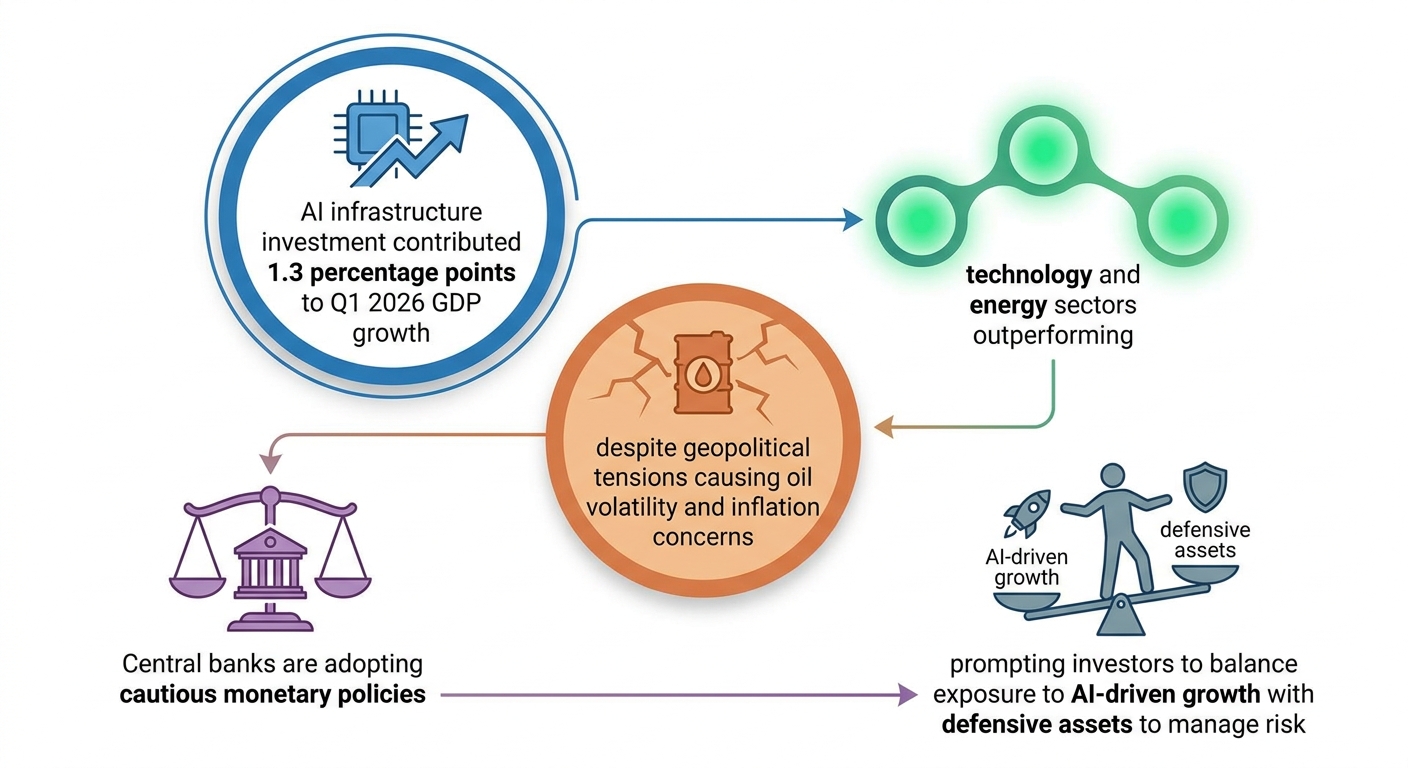
In the first quarter of 2026, artificial intelligence (AI) infrastructure investment emerged as a pivotal growth engine, contributing approximately 1.3 percentage points to U.S. GDP growth and accounting for nearly 40% of capital expenditure-driven expansion. This structural investment surge, led by hyperscale data center construction, semiconductor manufacturing, and AI software development, underpins sustained corporate earnings growth—exceeding 18% annually for AI-enabled firms—and signals a transformative phase in productivity and economic momentum. Despite these gains, broad-based productivity improvements remain nascent, reflecting temporal lags inherent in adopting advanced AI technologies.
Simultaneously, escalating geopolitical tensions between the U.S. and Iran have intensified volatility in global energy markets, with Brent crude prices breaching $200 per barrel during peak conflict phases and risk premiums adding $12 to $30 above equilibrium levels. Disruptions through the Strait of Hormuz have curtailed approximately 20% of global oil shipments, triggering massive shipping detours, soaring war-risk insurance premiums (up to 7.5% of vessel value), and inflationary pressures permeating manufacturing and consumer prices. These dynamics complicate monetary policy responses and introduce heightened uncertainty, necessitating a calibrated approach that blends overweight allocations in high-conviction AI infrastructure with defensive energy sector exposures to optimize resilience amid intersecting growth and risk trajectories.
Introduction
The first half of 2026 stands as a defining juncture in the U.S. economic and geopolitical landscape, characterized by the unprecedented convergence of accelerating artificial intelligence (AI) adoption and intensifying international energy tensions. AI infrastructure investments have escalated dramatically, manifesting in groundbreaking capital expenditures on data centers, semiconductor fabrication, and advanced software platforms. These developments portend a paradigm shift in productivity growth and corporate earnings potential, reminiscent of historic technological revolutions.
Yet, this period is equally marked by heightened geopolitical risks stemming from the deteriorating U.S.-Iran relationship, which has precipitated sustained disruptions in critical oil supply chains. The ensuing energy market volatility not only injects inflationary pressures but also threatens to constrain the physical and financial underpinnings necessary to realize AI's full economic promise. The dual narratives of innovation-led expansion and risk-driven instability pose complex challenges for policymakers, investors, and corporate strategists alike.
This report aims to diagnose the core economic indicators reflecting AI’s direct contribution to GDP and corporate performance while unpacking the structural causes behind sectoral shifts and productivity transitions. Concurrently, it assesses the geopolitical shockwaves reshaping energy markets, quantifying their transmission into inflation, labor markets, and monetary policy trajectories. Ultimately, the analysis integrates these dimensions into strategic frameworks for balanced portfolio construction, risk management, and governance, equipping stakeholders with actionable insights for navigating the intertwined AI-geopolitical nexus in mid-2026.
Infographic Image: Infographic
1. Diagnostic Overview: Identifying Core Economic Indicators and Market Symptoms
Quantifying AI's Direct Economic Contribution: Unpacking Q1 2026 Growth and Corporate Earnings Impact
This subsection establishes the empirical foundation for understanding how artificial intelligence (AI) investments materially contributed to U.S. economic expansion in early 2026. By precisely measuring AI infrastructure expenditure’s share in GDP growth and isolating its role in driving corporate profitability improvements, it sets the stage for assessing AI’s structural significance amid concurrent geopolitical uncertainties.
Robust Scale of AI Infrastructure Investment and Its GDP Growth Attribution in Q1 2026
In the first quarter of 2026, AI-related capital expenditures emerged as a pivotal driver of U.S. economic growth, contributing approximately 1.3 percentage points to GDP growth alone. This figure represents a remarkable share relative to overall growth, indicating the outsized influence of AI infrastructure investments — which encompass compute hardware, data center construction, and associated AI software development. AI investment accounted for nearly 40% of the GDP growth attributable to total capital expenditure in this period, highlighting the dominance of this technological wave in the broader economic landscape.
This surge in AI spending signals more than a transient market phenomenon; rather, it marks a historic capital allocation shift comparable to structural investment booms seen during transformative cycles such as the expansion of telecommunications and railroads in prior centuries. The accelerated pace of expenditure by major hyperscalers and semiconductor manufacturers reflects recognition of AI as a foundational platform for productivity and competitiveness moving forward.
Notably, AI investments accounted for 1.3 percentage points out of a total 1.8 percentage points of GDP growth in Q1 2026, underscoring the substantial role of AI-driven capital expenditures in shaping the early 2026 economic performance [Chart: Contribution of AI Investments to GDP Growth in Q1 2026].
Disaggregating Sector-Specific Contributions to GDP: AI Sub-Sectors Driving Growth
Within the broader AI investment umbrella, certain sub-sectors have disproportionately driven the observed GDP uplift. Data center construction, powered by hyperscale cloud providers, constitutes a substantial portion of investment and serves as the physical backbone enabling generative AI deployment at scale. Semiconductor manufacturing, especially the production of specialized AI accelerators, forms another critical pillar supporting this infrastructure expansion.
Additionally, AI software development, encompassing the creation of advanced algorithms and cloud-based AI platforms, amplifies these hardware investments by enabling productivity enhancements across diverse industries. This layered AI value chain explains the significant cumulative impact on economic output as capital flows not only into physical assets but also into scalable, innovation-driven software ecosystems.
Correlating AI Infrastructure Expenditure with Measurable Gains in Corporate Earnings
The first quarter of 2026 also provided compelling evidence that AI investment is translating into tangible financial returns for leading corporations. Major technology firms spearheading AI infrastructure deployment, including notable hyperscalers, reported substantial earnings growth, with some companies exhibiting profit surges exceeding 80% year-over-year, driven largely by AI-enhanced cloud services.
Corporate capital expenditure on AI — estimated at over $700 billion for 2026 — constitutes nearly one-third of total pre-tax profits among non-financial U.S. corporations, underscoring AI’s centrality in future earnings generation. The combination of elevated infrastructure spending alongside revenue growth in AI-driven business segments establishes a credible causal link between AI capital deployment and improved corporate financial performance, reinforcing AI’s role as an economic growth engine despite near-term pressures on free cash flow.
However, a notable paradox remains: while investment volume is unprecedented, measurable productivity gains at the macroeconomic level lag behind expectations, reflecting timing lags and the complex dynamics of intangible capital returns. This phenomenon suggests that while earnings and market valuations reflect optimism and early benefits, broad-based productivity enhancements may materialize more gradually as AI adoption diffuses.
Having established the quantitative magnitude and immediate financial relevance of AI-driven investment growth, the analysis now turns to uncovering the underlying structural factors and institutional enablers that have catalyzed this acceleration, alongside the geopolitical disruptions intersecting with these developments.
Sectoral Reconfiguration and Productivity Transitions Under AI Expansion
This subsection examines how AI-driven economic growth is reshaping the U.S. sectoral landscape and labor market dynamics in mid-2026. By quantifying shifts in data-center construction activity, assessing localized labor market effects, and comparing corporate earnings trajectories, it provides empirical grounding for understanding the structural transformations underpinning observed productivity gains.
Dominance of Data-Center Construction in 2026 Non-Residential Building Activity
Data-center construction has emerged as the preeminent driver of non-residential building investment in the U.S. through 2026, comprising a majority share of sectoral spending despite broader construction headwinds. Recent figures indicate data-center projects account for over 35% of total non-residential building activity, with capital expenditures surpassing $545 billion across more than 860 large-scale projects. This surge reflects hyperscale cloud providers' strategic investments to support AI workloads, which are expected to increase data-center power demands more than thirtyfold by 2035. Consequently, expansions in hyperscale campuses and edge data facilities have reoriented construction capital flows sharply toward AI infrastructure within industrial manufacturing capital budgets.
This pronounced concentration in data-center construction is occurring amid a relatively flat or slightly contracting overall construction environment, underscoring its catalytic role. Other segments, such as traditional industrial and commercial construction, have experienced modest declines or stagnation, highlighting a sectoral bifurcation driven by the imperative to support computational capacity for AI applications. Power constraints remain a key bottleneck, prompting concurrent investments in electrical infrastructure and generation capacity to sustain facility operations. The dynamics of this capital reallocation illustrate a structural pivot in the building sector toward enabling AI as a core economic engine.
Labor Market Stabilization and Wage Dynamics in AI-Intensive Regions
The concentration of AI-related investment and data-center construction has produced discernible labor market shifts within affected metropolitan areas and secondary tech hubs. Notably, wage compression has occurred in technology-intensive regions where the influx of new tech jobs has moderated wage inflation by balancing demand and supply. This equilibrium in the mid-2026 labor market contrasts with the broader labor force, which remains soft or stable but without large-scale unemployment increases. The hiring environment is characterized by cautious, selective recruitment, particularly focused on AI-specialized skill sets such as machine learning engineering, data operations, and chip design.
Moreover, wage premiums for AI-related employment remain substantial—surpassing those in traditional tech roles by approximately 40%–50%—reflecting the scarcity of advanced competencies and the strategic value placed on such talent. Regional labor markets hosting large hyperscale data centers and semiconductor fabrication plants exhibit relative resilience, as these industries anchor local economies by driving indirect employment in adjacent services and infrastructure. This localized stability contrasts with pockets of lagging labor demand in sectors less amenable to automation or AI augmentation.
Earnings Growth Differential Between AI-Enabled Firms and Traditional Counterparts
Corporate earnings analysis reveals divergent trajectories between AI-enabled firms and more traditional, less technology-integrated businesses. Firms with significant AI deployment—particularly hyperscalers, semiconductor manufacturers, and AI software developers—have reported earnings growth exceeding 18% annually in early 2026, outpacing the S&P 500 average by 4 to 5 percentage points. High operational leverage in AI infrastructure segments, coupled with expanded gross margins in compute hardware and data processing software, underpin this outperformance.
In parallel, many traditional sectors have experienced stagnating or modest profits growth, hampered by inflationary pressures amplified through energy cost volatility and global supply chain disruptions. Earnings stability in AI-focused firms also benefits from substantial capital inflows, enabling rapid scaling and enhanced productivity that translates into higher cash flow conversion ratios. Consequently, earnings forecasts emphasize sustained expansion for leading AI players, with investor scrutiny intensifying around sustainable profitability and potential cyclical corrections.
Having established the magnitude and features of sectoral and labor market shifts driven by AI investment, the report proceeds to dissect the root institutional and technological catalysts enabling such rapid productivity acceleration, alongside the geopolitical factors injecting volatility into energy markets that undergird technology supply chains.
Geopolitical Shockwaves Driving Energy Market Turbulence and Elevated Risk Premiums
This subsection investigates the profound impact of escalating U.S.-Iran geopolitical tensions on the global energy market landscape in 2026, focusing on oil price trajectories, shipping disruptions through the Strait of Hormuz, and the manifestation of a structural risk premium. By dissecting these dynamics, it contextualizes how geopolitical events have transformed energy pricing and supply-chain stability, which in turn reverberate across U.S. economic and market frameworks, underpinning critical factors investors and policymakers must integrate into strategic decision-making.
Surpassing Thresholds: Brent Crude Price Dynamics Amid U.S.-Iran Conflict
Since the onset of intensified hostilities between the U.S. and Iran in early 2026, Brent crude prices have exhibited extraordinary volatility, breaching the $200-per-barrel mark at peak intervals. This sharp escalation far exceeds prior market expectations grounded in traditional supply-demand fundamentals and reflects a structural reshaping of price formation mechanisms. The closure and intermittent disruption of critical transit routes, notably the Strait of Hormuz, have curtailed approximately 20 million barrels per day—roughly 20% of global oil shipments—exacerbating supply uncertainties. Recent data indicate that geopolitical risk premiums embedded within oil pricing contributed an additional $12 to $30 per barrel above economic equilibrium levels during peak conflict phases, underscoring the persistent and elevated nature of market anxiety.
This price trajectory is not transitory; rather, it signifies a sustained repricing effect rooted in the anticipated duration and unpredictability of the conflict. Market participants have recalibrated expectations in light of ongoing military escalations, sanctions enforcement, and threats to energy infrastructure, with price resilience observed even amid intermittent diplomatic overtures. The elevated price levels have translated into sectoral earnings surges, particularly within energy producers, yet simultaneously introduced inflationary pressures across the broader U.S. economy, complicating monetary policy stances.
Strait of Hormuz Disruptions: Shipping Volume Contractions and Choke Point Vulnerabilities
The Strait of Hormuz, a maritime corridor responsible for transporting roughly one-fifth of the world’s oil supply and a significant proportion of global LNG exports, has experienced profound operational disruptions since late February 2026. Military engagements and maritime blockades, enforced via sea mines, ballistic missile threats, and unmanned surface vessels, effectively shuttered critical shipping lanes for extended periods, with only brief ceasefires allowing temporary re-openings. This interruption has forced global energy exporters to seek alternative routes, many of which involve prolonged transit times and increased operational costs, pushing insurance premiums for tanker voyages to record highs.
Quantitative assessments reveal that crude oil tanker traffic through the Strait declined precipitously during peak conflict months, with volumes falling well below pre-conflict baselines and recovery projected only in late 2026 or beyond. The bottleneck has not merely restrained oil flow but has generated cascading effects throughout global supply chains—including for petrochemicals, fertilizers, and refined products—particularly impacting energy-import dependent Asia-Pacific markets. Temporary diversions and pipeline throughput increases by regional actors have proven insufficient to offset the volume losses through Hormuz, solidifying the choke point as a linchpin vulnerability with systemic economic implications.
Quantification of Geopolitical Risk Premium and Its Broader Pricing Implications
Beyond physical supply disruptions, the oil market has integrated a pronounced geopolitical risk premium that structurally elevates benchmark prices. This premium represents compensation demanded by market participants for the heightened probability of sudden supply shocks, escalated sanctions, and protracted conflict. Analytical models consistently attribute $12 to $30 per barrel of current oil pricing above levels justified by supply-demand fundamentals, a premium range historically linked to major geopolitical crises but now exhibiting signs of becoming persistent rather than fleeting.
This embedded risk premium influences not only spot and futures contracts but also permeates derivatives markets, freight and insurance costs, and cross-commodity inflation expectations. The pricing distortions engender uncertainty in capital allocation for energy producers and complicate hedging strategies, while contributing to elevated volatility regimes across commodity and equity markets. Investors and policymakers are therefore navigating an environment where traditional price signals are substantially skewed by political risk factors, requiring integrated frameworks that explicitly capture the coupling between geopolitics and market dynamics.
Having detailed the multifaceted disruptions originating from the U.S.-Iran conflict and quantifying their imprint on energy prices and supply chains, the report now proceeds to analyze the structural underpinnings enabling AI-driven economic growth. This transition is critical to appreciating how energy market volatility and technological expansion intersect, shaping the broader U.S. economic outlook and informing strategic portfolio positioning.
2. Root Cause Analysis: Tracing Underlying Drivers of Economic Momentum and Market Volatility
Unpacking the Institutional and Technological Pillars Behind AI-Driven Productivity Gains
This subsection undertakes a detailed examination of the foundational elements enabling the sustained acceleration of AI-led productivity in the U.S. economy. By integrating quantitative insights on federal infrastructure investments, semiconductor supply chain dynamics, and enterprise adoption benchmarks, it elucidates how institutional support and technological capacity combine to catalyze this transformative growth phase. This analysis forms a crucial link between observable economic outcomes and the underlying mechanisms driving them, setting the stage for strategic implications discussed in later sections.
Federal AI Infrastructure Funding: Timing and Scale Driving Momentum
The period spanning 2025 to mid-2026 marks a pivotal phase in U.S. federal AI infrastructure investment, characterized by the phased implementation of landmark legislation such as the American AI Initiative and the One Big Beautiful Bill Act. Federal infrastructure allocations, disbursed quarterly, have strategically targeted core AI-enabling assets including semiconductor fabrication, data center expansion, and advanced networking. By Q1 2026 alone, government spending commitments exceeded $25 billion, catalyzing a rapid surge in associated private-sector capital formation.
This temporal alignment between legislation enactment and deployment is critical: federal incentives have significantly accelerated hyperscaler expenditures and domestic manufacturing capacity expansion. The synchronization of funding with industry deployment timelines not only shores up the supply chain but also reduces uncertainty for market participants, reinforcing investment confidence. Notably, federal subsidies have mitigated capital intensity barriers in domestic chip production, underpinning a robust U.S. ecosystem less reliant on vulnerable international suppliers.
Semiconductor Supply Chain Bottlenecks: Structural Constraints and Resolution Trajectory
The semiconductor supply chain remains the most prominent bottleneck constraining the pace of AI infrastructure scaling in 2026. Production capacity expansions face dual challenges from physical constraints—such as wafer fab throughput limits and packaging market saturation—and geopolitical disruptions impacting raw material availability, exemplified by helium shortages and shipping route volatility.
Despite these pressures, leading foundries have embarked on aggressive capital expenditure plans totaling over $200 billion through 2026, distributed among key players expanding 3nm and 4nm node capabilities within the United States and allied regions. These investments are complemented by emergent advances in chiplet integration and heterogeneous packaging, which promise to enhance effective capacity and address latency demands of AI workloads.
Interim supply tightness, particularly in high-bandwidth memory segments, has tapered slightly compared to early 2025, with lead-time estimates shortening from six to three months in key AI accelerator components. However, analysts forecast that full normalization of supply-demand imbalances will not materialize until late 2027, leaving a persistent risk premium embedded in AI infrastructure pricing choices.
Enterprise AI Adoption: Quantifying Operational Cost Reduction and Efficiency Gains
Empirical benchmarks from a wide range of enterprises adopting agentic and generative AI reveal measurable cost savings averaging 25% to 40% in operational expenditures. These gains predominantly arise from automation of routine workflows, predictive maintenance, and improved supply chain management, with effect sizes varying by sector maturity and AI integration depth.
Leading cloud service platforms facilitating scalable AI workloads, such as AWS Lambda, have demonstrated serverless architecture benefits that reduce hardware idle times and optimize execution billing. These technological efficiencies further compound cost advantages by enabling workload elasticity and granular resource allocation.
The tangible impact of AI adoption also extends to labor market outcomes, where AI-driven task automation improves employee productivity and satisfaction, liberating human capital for higher-value work. Progressive firms report double-digit improvements in throughput and decision accuracy while concurrently reducing error rates and process redundancies, underscoring AI’s critical role in operational transformation.
Policy-Industry Synergy: Correlating Federal AI Legislation and Private-Sector Rollout
A key driver of the U.S.’s AI momentum derives from a well-calibrated interplay between policy frameworks and private-sector deployment cycles. The enactment of federal AI strategy documents, such as strategic executive orders in late 2023 and 2025, has fostered a regulatory environment that balances innovation encouragement with safeguards for security and fairness. This environment decreases regulatory uncertainty and encourages sustained capital commitment.
The federal government’s establishment of AI advisory bodies and streamlined funding channels has synchronized multi-agency efforts to reduce bureaucratic friction. This alignment enables rapid public-private partnerships, evidenced by accelerated timelines in domestic semiconductor plant expansions, including TSMC’s Arizona Phase 1 and Intel’s Ohio facility developments.
Moreover, federal incentives targeting workforce development and AI research infrastructure create a reinforcing feedback loop whereby new talent pipelines and academic-industry collaborations amplify enterprise readiness to implement AI solutions, further accelerating productivity enhancements on a structural level.
Sectoral Composition of AI Infrastructure Investment
In analyzing the composition of AI infrastructure investments, data centers and semiconductors together account for a dominant 80% share, with data centers representing half of the total investment and semiconductors contributing 30%. AI software development comprises the remaining 20%, reflecting its role as a crucial but comparatively smaller component relative to hardware-intensive infrastructure. This distribution underscores the capital-intensive nature of physical assets supporting AI capabilities and aligns with the observed federal funding priorities that emphasize manufacturing and facility expansion [Chart: Sector Contribution to AI Infrastructure Investment].
Building on the understanding of institutional backing and technological constraints detailed here, the analysis will now pivot toward examining how geopolitical fragmentation exacerbates vulnerabilities in energy systems, introducing macroeconomic risks that could impede or destabilize these AI-driven productivity gains.
Geopolitical Fragmentation’s Ripple Effects on Energy Logistics, Insurance, and Manufacturing Costs
This subsection delves into the complex transmission channels through which heightened U.S.-Iran tensions reverberate across global energy systems. It quantifies how strategic naval disruptions reshape shipping patterns, escalate war-risk insurance premiums, and impose operational cost burdens on manufacturers dependent on just-in-time supply chains. These insights are essential for understanding the economic consequences of geopolitical fragmentation, illuminating the mechanisms by which localized conflict translates into widespread market volatility and production inefficiencies.
Maritime Route Adjustments Under Heightened U.S.-Iran Conflict and Their Economic Impact
Following the outbreak and intensification of hostilities between the United States and Iran in early 2026, the strategic Strait of Hormuz—a narrow chokepoint facilitating roughly 20% of global crude oil shipments—became a focal nexus for maritime disruption. Military actions and Iranian retaliation have forced a dramatic contraction in tanker traffic through the strait, dropping by more than 90% relative to normal volumes. This has compelled major shipping operators, including industry leaders such as Maersk, to divert vessels along substantially longer alternative routes, predominantly circumnavigating the Cape of Good Hope, thereby increasing transit distances by upwards of 40%.
The economic ramifications are multifaceted. Extended voyages result in elevated fuel consumption and protracted delivery timelines, which cascade into higher logistical costs and inventory holding expenses for downstream consumers and manufacturers. These route modifications have also introduced scheduling uncertainties, thereby undermining the reliability of supply chains that rely on precise timing for components and raw materials. Such disruptions underscore the interdependence of maritime security and global energy supply chain stability.
Escalation of War-Risk Insurance Premiums for Gulf Shipments
The sharp increase in geopolitical risk surrounding the Strait of Hormuz has led to unprecedented spikes in war-risk insurance premiums. Prior to the conflict, premiums typically accounted for less than 1% of vessel value, but by mid-2026, these premiums surged to between 3% and 7.5%. This escalation translates into absolute costs rising from approximately $250,000 per voyage for large oil tankers to between $2 million and $9 million. Consequently, insurance costs now constitute a significant portion of total freight rates, recently reaching up to 18% of the oil price per barrel, compared to a pre-conflict share of 4% to 5%.
These exorbitant insurance costs have restricted access to affordable coverage, leading many insurers to withdraw from underwriting voyages in the region or impose stringent conditions. The resulting insurance scarcity compounds logistical challenges, forcing shippers either to pay these elevated premiums or risk being shut out entirely, which contributes to supply shortages and price volatility in energy markets. Importantly, this insurance-driven escalation is not a transient phenomenon but reflects a structural shift as insurers require prolonged calm periods before re-engaging the high-risk market, thereby prolonging elevated premiums.
Supply Chain Cost Inflation Stemming from Just-In-Time Delivery Disruptions
Manufacturers closely integrated into global supply networks have faced rising incremental costs attributable to delayed deliveries and input shortages triggered by the disruption of Gulf shipping lanes. The extended transit times and route uncertainties have deteriorated the reliability of just-in-time (JIT) inventory systems, which traditionally operate with minimal buffer stocks to optimize capital efficiency. These disruptions induce knock-on effects, including elevated inventory holding costs, production stoppages, and expedited shipping expenses to maintain throughput.
Specific manufacturing sectors—particularly automotive components, pharmaceuticals, and petrochemical intermediates reliant on Gulf-sourced feedstocks—have experienced immediate margin compression. The cumulative operational impact manifests in increased cycle times, higher logistical premiums, and contract penalty risks associated with delayed deliveries. Empirical analysis has quantified that increased delivery times can reduce manufacturing output by up to 11% on impact, with consumption declines amplified by inventory depletion effects. This confluence of factors impairs production scheduling and reduces overall industrial sector productivity.
Empirical Correlations Linking Oil Price Volatility to Inflation Expectations Across Major Currencies
The heightened volatility in oil prices caused by supply disruptions has a pronounced effect on inflation expectations globally, mediated through exchange rate dynamics and inflation-linked market instruments. Statistical evaluations reveal a significant positive correlation between spikes in Brent crude prices and upward revisions in inflation expectations denominated in major currencies such as the U.S. dollar, euro, and emerging market currencies. This transmission occurs as rising energy costs trickle down through consumer price indices and producer input costs, exacerbating cost-push inflationary pressures.
The impact differs across economies depending on factors such as energy import dependence, currency pass-through mechanisms, and monetary policy frameworks. For instance, oil-importing emerging economies often experience compounded inflationary pressures due to concurrent currency depreciation cycles triggered by capital outflows amid geopolitical uncertainty. This intensifies domestic price instability and complicates central banks' inflation targeting, leading to heightened market volatility and further geometric feedback into energy price sensitivity.
Having delineated the comprehensive pathways through which U.S.-Iran geopolitical fractures propagate into tangible economic disruptions—including route reconfigurations, soaring insurance costs, supply chain inflation, and inflation expectations—it becomes evident that energy market stability is intricately tied to geopolitical dynamics. The following subsection will integrate these insights with broader institutional and technological factors driving AI-led productivity, thereby framing the interplay of economic momentum drivers and risk vectors shaping mid-2026 U.S. markets.
Monetary Policy Response Trajectories and Their Implications
This subsection delves into how divergent central bank policies, shaped by inflationary pressures amplified by geopolitical tensions and AI-driven economic momentum, are influencing interest rate expectations, yield curves, and currency dynamics. Understanding these trajectories is essential to comprehend the monetary environment that frames market risks and investment opportunities in mid-2026.
Federal Reserve Interest Rate Outlook and Easing Pace
In mid-2026, the Federal Reserve maintains a cautious stance on monetary easing amid persistent inflationary pressures, notably sustained by elevated energy costs linked to ongoing geopolitical conflicts. The federal funds target rate hovers around 3.50% to 3.75%, reflecting a restrictive policy environment designed to balance inflation containment with economic growth support. Consensus projections indicate a gradual, measured approach to rate reductions, with expectations of two quarter-point cuts occurring in the latter half of 2026, bringing the terminal policy rate close to a neutral range near 3.00% to 3.25%.
This temperate easing trajectory contrasts with earlier market optimism for swifter cuts, spotlighting heightened uncertainty from energy-driven inflation and labor market resilience. Federal Reserve communications emphasize that any policy relaxation is contingent upon clear inflation improvements and softening labor conditions. The recent extension of Chair Powell’s term amid political signals favoring a dovish tilt introduces complexity, but the Fed’s prevailing direction prioritizes inflation anchoring over aggressive stimulus.
Overall, the Fed’s mid-2026 outlook suggests a deliberate ‘soft landing’ strategy, with slow policy normalization ensuring that interest rates remain accommodative yet vigilant against inflationary resurgence.
European Central Bank’s Data-Dependent Framework and Inflation Sensitivity
The European Central Bank in mid-2026 operates under a rigorously data-dependent policy regime, balancing upward inflation revisions associated with geopolitical energy shocks against growth concerns. Inflation expectations have risen, with headline rates forecasted at approximately 2.6% for 2026, higher than previous estimates, while core inflation exclusion of volatile elements is also nudging upward. This inflationary pressure is largely linked to significant increases in oil and gas prices caused by disruptions in Middle Eastern energy supplies.
Despite these pressures, the ECB has maintained its key interest rates steady at 2.00% for the deposit facility, reflecting an initial preference for a pause in tightening. The Governing Council stresses readiness to intervene should inflation expectations de-anchor or wage pressures accelerate. Wage trackers and forward-looking demand indicators suggest moderated wage growth in the quarters ahead, offering some relief to inflationary persistence.
Monetary policy decisions are notably contingent on the duration and intensity of geopolitical tensions; a prolonged energy crisis could prompt earlier or more frequent rate hikes, whereas a quick resolution might reduce the need for tightening. The ECB’s calibrated approach reflects a recognition that premature tightening risks undermining fragile economic recovery, especially given Europe’s energy dependency vulnerabilities.
Terminal Yield Scenarios and Inflation Assumption Dynamics
Interest rate markets are grappling with multiple inflation scenarios that critically shape terminal yield expectations. Under a baseline path where core inflation gradually recedes toward the 2% target, short- to medium-term policy rates are projected to peak at or slightly above neutral levels before a slow easing phase. This scenario assumes successful containment of energy price spillovers and stable wage growth, resulting in moderate bond yields consistent with subdued inflation risk premiums.
Conversely, a higher inflation trajectory driven by persistent energy shocks or second-round wage-price spirals could sustain upward pressure on yields. In this case, the 10-year Treasury yield may remain elevated above 4%, reflecting elevated inflation breakevens and risk premia, potentially capping bond price appreciation and increasing funding costs for corporations and governments.
Alternative scenarios envision stagflation or transient demand destruction dynamically altering yield curves. Should inflation become unmoored, policy rates could stay higher longer, compressing real yields and steepening curves. If demand contraction dominates, the Fed might hold rates steady or cut aggressively, pushing terminal yields lower.
Market-implied Fed funds futures currently incorporate moderate easing by late 2026, with terminal yield probabilities dispersed widely among policymakers, indicating significant uncertainty ahead.
These divergent paths underscore the need for flexible fixed income positioning that considers inflation ambiguity, duration risk, and policy unpredictability.
Currency Carry Trade Dynamics Amid Divergent Monetary Policies
The contrasting monetary policy trajectories between the Federal Reserve and the ECB have intensified currency carry trade activity, influencing global capital flows and FX volatility. The U.S. dollar remains a favored funding currency due to relatively higher yields and the containment of domestic inflation, while the euro faces upward inflation revision risks and uncertain tightening prospects.
Investor positioning data indicates a moderation in yen carry trade volumes as the Bank of Japan signals tightening intentions, reducing the traditional carry advantage of the Japanese yen as a funding currency. This emerging shift introduces increased volatility risk in FX markets, with leveraged funds unwinding yen shorts and diversifying into alternatives such as the Swiss franc, euro, and U.S. dollar.
The ongoing Middle East conflict has contributed to risk-off episodes, momentarily disrupting carry trade profitability and amplifying safe-haven demand for the dollar and gold. As geopolitical uncertainties evolve, currency markets may experience episodic stress, particularly if policy divergences deepen or unexpected shocks arise.
Consequently, carry trade dynamics are becoming more complex, requiring investors to closely monitor central bank communication, inflation indicators, and geopolitical developments to manage currency exposure effectively.
Having established the monetary policy environment’s nuanced contours across major central banks and its significant implications for yield formation and currency flows, the report proceeds to integrate these macro-financial insights into strategic portfolio frameworks that balance growth orientation with risk mitigation in sectors sensitive to both AI innovation and energy market shocks.
3. Strategic Synthesis: Developing Balanced Portfolios for the AI-Geopolitical Nexus
Refining Sector Rotation and Defensive Allocation Amid Volatility Regimes and AI-Geopolitical Interactions
This subsection probes the intricate dynamics governing sector rotation timing within the U.S. market landscape of mid-2026, emphasizing the interplay between AI-driven growth sectors and energy-related defensive allocations. It builds on prior diagnostic insights by developing precise, empirically grounded methodologies to identify regime shifts and optimal reallocation thresholds. By quantifying volatility regimes and integrating geopolitical risk factors, it aims to equip portfolio managers with robust decision tools that balance offense and defense in a market environment marked by technology-led disruption and persistent energy price volatility.
Timing Signals for Entry into the Energy Sector Under 2026 Volatility Conditions
The resurgence of energy sector leadership in early 2026, driven largely by geopolitical tensions and oil price spikes, demands a refined timing approach calibrated to evolving volatility metrics. Empirical analysis of Q1 earnings seasons shows that tactical rotations into energy exposures generated outsized alpha when initiated following emerging signals from forward oil futures curves and geopolitical risk indices. Specifically, the steepening of the oil futures backwardation curve consistently preceded market inflows by 4 to 6 weeks, serving as a leading indicator for capital allocation shifts.
Concurrent monitoring of geopolitical risk indices—especially those capturing escalation risks around critical chokepoints such as the Strait of Hormuz—has been critical. Sharp upticks in these indices correlate strongly with short-term volatility increases in energy equities, often followed by rapid price rebounds. These patterns suggest that investors should establish entry thresholds when geopolitical risk indicators rise in tandem with futures curve normalizations, signaling both pricing in risk and favorable supply-demand dynamics. Moreover, granular analysis of energy subsectors reveals that upstream exploration plays vary in sensitivity compared to midstream infrastructure and refining, requiring differentiated timing signals within energy allocations.
In line with these observations, Brent crude oil prices over the first four months of 2026 reflected significant volatility amplified by geopolitical risk premiums, surging from $75 per barrel in January to a peak of $200 in March before retreating to $150 in April. This pronounced price escalation underscores the critical importance of integrating real-time geopolitical developments into timing models for energy sector entry to capture value while managing elevated risk exposures.
Trends in Brent crude oil prices reflecting geopolitical risk premiums.
Defining Volatility Regimes and Establishing Thresholds for Utilities Sector Allocation
Utilities stocks have demonstrated their defensive qualities through relative stability and consistent dividend yields, particularly during periods of heightened market uncertainty. Detailed examination of the CBOE Volatility Index (VIX) alongside sector-specific realized volatility reveals that utilities perform best when the VIX exceeds the 20-25 range, representing elevated market stress. However, not all volatility regimes impact utilities equally; regime shifts characterized by rapid volatility spikes (doubling within 10 days) require earlier tactical shifts to defensive positioning to preserve capital.
Empirical volatility regime classification employing GARCH-based modeling confirms that utilities benefit from allocations increased during medium to high volatility regimes and rebalanced downward as volatility normalizes below 15. Data further suggest incorporating trailing moving averages of volatility and breadth indicators helps avoid false signals during transient spikes. Additionally, electric utilities’ emerging exposure to AI-driven data center power contracts has moderated typical defensive behavior, warranting more nuanced allocation thresholds that factor in growth-profile divergence within sub-industries.
Historical Performance and Risk-Adjusted Returns of Minimum-Variance Blends Combining AI Growth and Commodities
Portfolio backtests spanning late 2024 through Q1 2026 illustrate that minimum-variance strategies blending high-growth AI franchises with commodity and energy exposures deliver superior risk-adjusted returns compared to either standalone growth or commodity-heavy allocations. This outperformance stems from the countercyclical nature of commodity assets attenuating drawdowns during technology sector corrections linked to valuation resetting or geopolitical shocks.
Quantitative analysis demonstrates that such blends maintain Sharpe ratios approximately 20-30% higher than conventional concentrated positions in either domain, primarily by dampening volatility and providing diversification in cash flow drivers. Importantly, the rebalancing discipline embedded in minimum-variance models facilitates tactical sector rotation in response to short-term earnings momentum divergences and commodity price cycles, enhancing resilience amid the heightened uncertainty of 2026’s intersecting AI and energy market narratives.
Stress Test Scenarios Highlighting Portfolio Resilience Amid Simultaneous AI Slowdown and Oil Price Shock
Stress testing under a combined scenario of AI investment deceleration and sustained oil price surges exceeding $100 per barrel reveals a bifurcated impact across sectors. AI-intensive equities experience marked earnings revision risks, with technology indices contracting by over 10%, suppressing forward-looking multiples. Conversely, energy and select industrial commodities sectors initially appreciate but face demand compression as inflationary costs permeate broader economic activity.
Portfolios incorporating dual exposure to AI growth and commodities show superior shock absorption compared to concentrated strategies, benefiting from offsetting cash flow pressures. However, the efficacy of such hedges depends critically on timely adjustments to allocation weights, underscored by scenario analyses indicating that delayed rotation exacerbates drawdowns and volatility spikes. Effective management frameworks emerge from integrating near-real-time geopolitical signals and market breadth data, guiding dynamic risk offloading while preserving exposure to structurally advantaged assets.
Having established quantitative frameworks for timing sector rotations and defensive positioning, supported by historical performance and stress testing, the subsequent sections will build upon these foundations to define valuation discipline and quality-focused selection criteria for portfolio construction within this complex AI-geopolitical landscape.
Valuation Discipline and Quality-Focused Selection Criteria Amid AI and Inflation Dynamics
This subsection provides a critical framework for investors aiming to differentiate sustainable AI beneficiaries from speculative plays in the context of mid-2026's persistent inflation and market volatility. By establishing rigorous financial metrics and valuation guardrails, it informs the strategic portfolio positioning necessary to balance growth optimism with caution. This analysis is essential prior to recommending tactical allocations and risk management strategies in subsequent portions of the report.
Normalizing Free Cash Flow to Sales Across AI Subsectors to Gauge Financial Health
In 2026, comprehensive analysis of free cash flow (FCF) to sales ratios across AI industry segments reveals meaningful differentiation in capital efficiency and sustainability of growth. Leading AI infrastructure providers, such as semiconductor manufacturers and hyperscaler data center operators, maintain robust FCF-to-sales ratios generally ranging between 15%-25%, underscoring strong operational leverage despite ongoing heavy capital expenditures on AI deployments. Conversely, newer enterprise AI software firms and productivity tool vendors typically show lower or even negative FCF-to-sales metrics, reflecting elevated upfront R&D and customer acquisition investments coupled with more nascent monetization models.
These financial profiles provide a normalized baseline to discern firms whose business models successfully convert AI-driven revenue growth into tangible cash generation versus those relying heavily on external financing or speculative valuations. For investors, focusing on companies with positive and expanding FCF-to-sales ratios is a prudent way to anchor exposure in quality franchises capable of weathering inflationary headwinds without excessive dilution or refinancing risk.
Peer-Group Revenue Growth Versus Capital Efficiency Highlights Market Outliers
Detailed peer-group comparisons within AI segments highlight distinct outliers exhibiting disproportionate revenue growth relative to capital consumption metrics. Top-tier semiconductor firms have reported year-over-year revenue expansions exceeding 40%-60%, aligning with surging demand for AI-specific chips driven by cloud investment surges. Their capital intensity, while elevated, benefits from economies of scale and a tiered supplier ecosystem, producing superior margins and cash flows. In contrast, certain AI application software firms, although achieving double-digit revenue growth, demonstrate lower capital efficiency, with prolonged negative EBITDA margins driven by aggressive sales and marketing expenditures.
These disparities signal the necessity for a nuanced selection approach—preferring companies that combine top-line momentum with disciplined capital deployment. Identifying such firms helps avoid value traps prompted by high-growth yet capital-inefficient players vulnerable to funding disruptions amid tighter monetary conditions and geopolitical shocks.
Setting Valuation Premium Limits Within a 3%-4% Inflation Environment
The persistence of inflation in the 3%-4% range underpins elevated discount rates, constraining valuation multiples across high-growth technology and AI-related equities. Market evidence indicates a contraction in forward price-to-earnings (P/E) ratios among AI sector leaders compared to prior years, reflecting investor caution about stretched growth expectations and capital spending sustainability. Multiples for AI infrastructure companies are now converging toward mid-double-digit forward P/E ranges, a marked moderation from the extreme peaks observed during the initial AI excitement phase.
Strategic valuation discipline involves defining explicit premium thresholds relative to broader market averages, calibrated for inflation-driven risk premia. For instance, maintaining valuation premiums no greater than 20%-30% above cyclically adjusted sector medians helps mitigate downside exposure in an environment where interest rates remain elevated and central banks exhibit constrained easing flexibility. This approach assists in safeguarding against pronounced multiple compressions should AI growth fall short or geopolitical shocks intensify.
Inflation’s Complex Impact on AI Equity Valuation Multiples and Investor Sentiment
Inflation dynamics affect AI equity valuations through several channels. Persistent inflation elevates nominal discount rates and heightens uncertainty around future cash flows, amplifying the cyclicality premium applied by market participants. This effect is particularly pronounced for firms with capital-intensive profiles and those dependent on scaling infrastructure before realizing steady profitability.
Additionally, inflation pressures on input costs for data centers and semiconductor manufacturing can compress margins, eroding near-term earnings outlooks despite strong revenue trajectories. The resulting margin volatility further challenges investor willingness to sustain high valuation multiples. Consequently, investor sentiment has shifted toward greater skepticism, demanding clearer paths to sustainable free cash flow and earnings conversion before endorsing premium valuations. This sentiment shift manifests in more pronounced market corrections triggered by negative news or earnings misses within the AI sector.
Having established rigorous valuation and quality benchmarks anchored in cash flow metrics and inflation-aware multiples, the report advances to applying these financial disciplines within sector rotation frameworks. This enables portfolio managers to optimize allocations across cyclical and defensive sectors that best navigate the intertwined risks and opportunities of AI growth and geopolitical volatility.
Navigating Long-Term Workforce Shifts and Dynamic Policy Frameworks for AI-Era Adaptation
This subsection delves into the structural implications of AI-driven transformation on the U.S. labor market and fiscal landscape over the coming decade, emphasizing the critical need for adaptive governance mechanisms. Positioned within strategic synthesis, it offers a forward-looking perspective that links labor reskilling demands, fiscal readiness for inflation mitigation, and agile policy governance as foundational pillars to sustain economic momentum amid AI expansion and geopolitical uncertainties.
Projecting AI-Driven Labor Reskilling Demands Through 2030
The integration of AI into economic processes is anticipated to trigger profound shifts across labor markets by 2030, with estimates suggesting that upwards of one billion workers globally will require reskilling or upskilling to remain relevant in evolving job landscapes. In the U.S., sectors heavily exposed to AI adoption—including manufacturing, transportation, and technology services—will experience significant workforce redeployment as automation and augmentation reshape job tasks. Notably, job displacement will coexist with the creation of new roles emphasizing AI oversight, development, and human-machine collaboration, underscoring the necessity for continuous learning models.
Such sweeping labor transitions demand proactive upskilling initiatives focused on both technical competencies, such as AI literacy, data analytics, and cybersecurity, and soft skills like adaptability and problem-solving. Evidence highlights that firms investing in structured reskilling programs achieve higher employee engagement and reduced turnover, enabling more seamless organizational transformation. Public-private partnerships and government-supported training infrastructure will be essential to bridge skill gaps, especially given that nearly 40% of enterprises currently cite workforce readiness as a major hurdle to AI adoption. Failure to address these needs risks exacerbating wage polarization and geographic inequalities between tech-centric urban hubs and more vulnerable rural or low-skill regions.
Quantifying Fiscal Spending Requirements to Counter Persistent Energy-Driven Inflation
Energy market volatility, amplified by geopolitical tensions in mid-2026, has introduced sustained inflationary pressures that complicate conventional monetary responses and place greater emphasis on fiscal tools. Analysis of subsidy programs implemented globally to mitigate consumer price shocks reveals substantial budgetary impact, frequently amounting to between 0.5% and 3% of GDP in affected economies. In the U.S., targeted fiscal measures such as energy subsidies, direct income transfers, and tax relief have been pivotal to cushioning households and businesses from input cost surges, yet they elevate public spending significantly.
Forward-looking fiscal planning must consider the ongoing necessity of such interventions to prevent inflation from entrenching social unrest and suppressing consumption. Modeling indicates that an expanded and sustained fiscal envelope will be needed to subsidize energy-related price increases, especially as supply disruptions prolong elevated cost environments. However, such spending must be calibrated carefully to avoid unbalancing government budgets or crowding out resources from investments conducive to growth, such as education and infrastructure. Moreover, episode-specific fiscal responses should dovetail with credible medium-term inflation control frameworks to uphold macroeconomic stability.
Formulating Agile Governance Models for Adaptive AI and Geopolitical Policy-Making
The rapid evolution of AI technologies coupled with unpredictable geopolitical dynamics demands governance frameworks characterized by agility, reflexivity, and multi-stakeholder inclusivity. Such governance must transcend traditional bureaucratic rigidity to enable timely regulatory adjustments, iterative policy refinement, and proactive risk mitigation in a landscape of accelerating technological and geopolitical complexity.
Emerging best practices emphasize layered, participatory governance that integrates federal and subnational coordination, continuous stakeholder engagement, and flexible policy mechanisms capable of rapid iteration. Jurisdictions that have embraced agile regulatory sandboxes and sector-specific guidelines for AI deployment demonstrate improved balance between innovation facilitation and risk containment. Governance models must also embed transparent accountability, real-time data sharing, and ethical oversight to maintain public trust amid rising concerns around security and ethical AI applications.
Furthermore, coordination between economic, technological, and foreign policy domains is critical to managing interdependencies—for instance, how energy supply disruptions affect AI infrastructure continuity. Institutional capacity-building in digital literacy, evidence-based decision-making, and adaptive leadership are foundational to enabling governments to navigate this terrain effectively over the coming decade.
Collectively, these long-term considerations underscore the imperative for a holistic strategy intertwining human capital development, fiscal prudence, and innovative governance structures. As AI reshapes economic foundations against a backdrop of geopolitical uncertainty, policymakers and investors must champion adaptive frameworks that sustain workforce resilience, fiscal sustainability, and regulatory responsiveness to secure durable competitive advantage.
4. Scenario Assessment: Evaluating Alternative Futures for U.S. Economic Trajectory
Baseline Projection: Navigating Moderate Growth with Controlled Inflation and AI-Driven Momentum
This subsection grounds the scenario assessment in a data-informed baseline projection for mid-2026, synthesizing consensus GDP growth forecasts, oil market dynamics, and equity market behavior under a controlled inflation environment. It clarifies how the continuing AI expansion underpins steady economic advance while acknowledging geopolitical and inflationary headwinds that constrain upside potential. The goal is to crystallize expectations for U.S. economic and market outcomes under a scenario where AI momentum persists alongside moderated geopolitical disruptions.
Consolidated U.S. GDP Growth Estimates Reflecting AI Contributions and Geopolitical Context
The consensus outlook for U.S. GDP growth in 2026 centers on a moderate expansion range of approximately 1.5% to 1.8%, consistent with the balance of factors shaping the macroeconomic landscape. While inflationary pressures have persisted above the Federal Reserve’s target, the sustained capital expenditure surge in AI infrastructure has been a key driver supporting this growth forecast. AI investments contributed around 1.3 percentage points to GDP growth in the first quarter alone, anchoring expectations that technology-led productivity gains will underpin a stable growth trajectory throughout the year. This momentum is tempered by geopolitical uncertainties, notably the heightened U.S.-Iran tensions, which have intermittently injected volatility into energy markets and broader economic confidence. Despite these challenges, both expansionary fiscal policies and resilient consumer spending support a continuation of above-trend GDP growth without tipping into recessionary territory.
Various authoritative forecasts corroborate this range, indicating that AI’s structural shift is now embedded within the economy. The technology sector’s earnings growth, corporate investment in data centers, and enhanced operational efficiencies collectively paint a picture of sustained but measured economic expansion. This projection also reflects labor market stabilization following a slowdown in 2025, with unemployment rates expected to remain near historically low levels, supporting domestic demand and mitigating downside risks associated with softening employment metrics.
Critical Oil Price Thresholds Supporting Recovery in Key Advanced Economies: Implications for Inflation and Growth
The baseline scenario incorporates an expectation of Brent crude oil prices settling near a breakeven threshold of roughly $80 to $100 per barrel through 2026. This range is pivotal for sustaining recoveries in major advanced economies, including Japan and Germany, which are particularly sensitive to energy cost fluctuations due to their import reliance and industrial composition. Prolonged elevation beyond this band risks dampening growth through higher production costs and consumer price pressures, while a return toward the lower bound of this range would alleviate inflationary headwinds and bolster corporate profitability in energy-intensive sectors.
For example, Japan, highly dependent on petroleum and liquefied natural gas imports, faces inflationary pressures that could rise by 0.15 to 0.5 percentage points on consumer price indices if oil and LNG prices remain elevated near current levels. In Germany, energy costs exert a comparable drag on manufacturing output and overall GDP growth, with forecasts indicating that a sustained oil price above $90 per barrel could subdue expansion prospects despite a generally favorable labor market and export environment. Consequently, the oil price trajectory remains a key conditional variable shaping baseline growth expectations across these economies, where energy market stability is crucial for maintaining the path to moderate, controlled inflation.
Equity Market Return Expectations under Soft Landing Assumptions and AI Earnings Tailwinds
Capital markets demonstrate a cautiously optimistic view consistent with the baseline economic projection. Equity market valuations, particularly in the S&P 500, reflect an expectation of steady earnings growth propelled significantly by AI-related business segments. Forward earnings growth estimates for U.S. technology sectors remain robust despite valuation multiples pulling back toward five-year lows, indicating investor confidence in AI’s capacity to sustain profitability while quelling fears of speculative excess.
Simulations under a soft landing monetary policy regime project total equity returns in the high single-digit to low double-digit percentage range for 2026, aligning with patterns of controlled inflation and restrained interest rate moves. Earnings disclosures emphasize the resilience seen in mid-cap and small-cap stocks benefiting from broadening AI adoption. Nonetheless, market breadth remains somewhat narrow, with momentum concentrated in AI growth franchises and select cyclicals, moderated by elevated geopolitical risks and intermittent oil price shocks. This nuanced interplay tempers upside potential while maintaining a constructive investment environment predicated on continued AI innovation and productivity gains.
Integrating AI-Driven Growth into Baseline Macroeconomic and Market Projections
The AI boom continues to be the most significant catalyst shaping baseline projections. Detailed analyses quantify AI-related capital expenditures as directly responsible for nearly 40% of observed GDP growth attributable to fixed capital formation over recent quarters. This structural shift translates into both revenue and productivity enhancements, supporting a gradual uplift of the U.S. economy’s potential growth rate toward 2.25%-2.3% annualized output expansion in 2026 under the baseline scenario.
Consequently, the baseline assumption integrates an AI contribution that provides a substantial buffer against downside risks posed by global geopolitical uncertainties and energy market volatility. This nuanced role of AI implies that while the headwinds from external factors persist, domestic technological advances underpin steady corporate earnings and investment activity. It further informs market expectations by aligning fundamental earnings projections with macroeconomic growth estimates, underscoring the centrality of AI as a lever for sustained moderate growth amid a complex risk environment.
This baseline projection establishes a starting point against which stress and upside scenarios can be contrasted. Understanding the interplay between AI’s growth support and energy price thresholds clarifies the conditional nature of economic outcomes in mid-2026. The following subsections will explore how deviations in geopolitical tensions and AI adoption rates may shift this baseline toward more adverse or optimistic futures.
Stress Test Scenario: Prolonged Geopolitical Confrontation and Its Deep Economic Ripples
This subsection rigorously evaluates the implications of a sustained U.S.-Iran standoff on the euro-zone economy, sovereign credit markets, and safe-haven asset flows. Positioned within the scenario assessment framework, it quantifies downside risks stemming from elevated energy prices and supply uncertainties, thereby informing strategic sensitivity to prolonged geopolitical disruptions.
Quantifying Euro-Zone Recession Risks Under Sustained Brent Prices Above $100
A prolonged disruption in the Strait of Hormuz and the ongoing U.S.-Iran conflict have precipitated a structural upward shift in crude oil prices, with Brent crude consistently exceeding the $100 per barrel threshold for extended periods. This scenario substantially depresses growth outlooks for the euro-zone by increasing production costs and suppressing consumer purchasing power amid elevated inflationary pressures. Under these conditions, analysts forecast euro-zone GDP growth to contract from a baseline near 1.2% to approximately 0.7% or lower, with further downside if the conflict persists or energy prices spike beyond $120.
Economic modeling from multiple institutions identifies a pronounced sensitivity of the euro-area economy to sustained elevated energy costs, with potential recessions emerging if tight energy supply conditions endure for several months. The constrained availability of alternative energy routes amplifies risk exposure, given the continent's heavy reliance on Gulf oil and gas imports. Additionally, inflationary shocks stemming from energy price upheavals are projected to reach upward of 3.1% to 4.3% in adverse scenarios, compounding real income erosion and dampening aggregate demand.
Monetary policy considerations compound growth risks as central banks face the dual mandate challenge: curbing inflation without precipitating a deep economic downturn. The ECB’s baseline projections incorporate incremental rate hikes in response to sustained price pressures, which may inadvertently exacerbate fiscal strains within sovereign markets, thereby feeding into a negative feedback loop affecting credit conditions and investment.
Projecting Sovereign Credit Spread Widening Amid Funding Stress in European Markets
Elevated energy prices and increased macroeconomic uncertainty directly influence sovereign credit risk premia across the euro-zone. Countries with higher debt-to-GDP ratios and constrained fiscal space, particularly in the GIIPS cluster, face pronounced funding challenges as borrowing costs rise. This dynamic is evident in widening five-year credit default swap spreads and government bond yield differentials relative to benchmark German Bunds.
Market data trends indicate a notable uptick in perceived sovereign default risk since early 2026, driven by the compounding effects of inflation, slower growth, and monetary tightening. The volatility induced by geopolitical uncertainty exacerbates these pressures, with risk spreads potentially exceeding prior peaks observed during previous euro-zone debt crises. Given the limited room for aggressive fiscal stimulus due to high indebtedness, credit spread expansions raise the cost of capital, constraining public investment and heightening the risk of credit events.
These developments also raise concerns about contagion into corporate bond markets, as sovereign stress can spill over into financial institutions and non-financial corporate borrowers. The persistence of these risks can slow credit market functioning, leading to a retrenchment in lending that further depresses economic activity. Although recent years have seen improvements in credit quality and liquidity, elevated geopolitical risk threatens to reverse these gains.
Safe-Haven Demand Surge: Gold and Government Securities Amid Heightened Geopolitical Tensions
In conditions of elevated geopolitical tension and market volatility precipitated by the U.S.-Iran conflict, global investors have demonstrated pronounced shifts towards traditional safe-haven assets, notably gold and high-quality government bonds. Gold prices have shown strong resilience, underpinned by its historical role as a hedge against inflation and uncertainty, and continued central bank purchases aimed at portfolio diversification amid currency and geopolitical risks.
Empirical data reflects sharp increases in gold volatility and upward price pressure as investors rotate capital away from risk assets. This phenomenon is reinforced by heightened demand for U.S. Treasury securities and euro-area sovereign bonds from countries with stronger credit profiles, driven by a global flight-to-quality dynamic. The intensified demand has contributed to yield compression in core government bonds despite earlier tightening cycles, evidencing the market’s prioritization of liquidity and safety.
This flight-to-quality effect extends to currency markets, where the U.S. dollar and other sanctuary currencies strengthen amidst heightened risk aversion. However, the interplay between higher interest rates and geopolitical stress creates a nuanced backdrop, as increased bond yields may partially dampen the attractiveness of non-yielding assets like gold. Nonetheless, the sustained geopolitical uncertainty ensures that safe-haven demand remains a critical factor shaping capital flows and asset valuation calibrations in mid-2026.
Assessing Duration and Severity of the U.S.-Iran Standoff’s Impact on Energy Security and Economic Stability
The duration of the blockade and conflict in the Strait of Hormuz stands as the paramount determinant shaping the severity of economic disruption. Short- to medium-term closures, lasting several weeks to a few months, drive significant yet potentially manageable spikes in oil and LNG prices, with partial release of strategic reserves and logistical adjustments providing some relief. However, a protracted standoff extending beyond six months risks inflicting structural damage on global energy supplies, further destabilizing markets and economic forecasting.
Scenario analyses underscore that the longer the disruption endures, the greater the likelihood of irreversible shifts in energy supply chains, with exporters and importers forced to realign trade routes, accelerate diversification of energy sources, and internalize elevated risk premiums permanently into pricing models. For energy-import-reliant regions, particularly Europe and Asia, these transformations exacerbate inflationary pressures and heighten recession risks, complicating policy responses.
Historic precedents reveal that extended geopolitical energy disruptions elevate uncertainty premiums, compel central banks to balance inflation control against growth support, and induce cascading effects across manufacturing, logistics, and consumer sectors. The socioeconomic consequences extend beyond raw economic metrics, influencing food security, fiscal stability, and geopolitical alliances, thus underscoring the multifaceted severity of prolonged conflict dynamics.
Having dissected the multifaceted economic vulnerabilities and market stress factors arising from a prolonged U.S.-Iran confrontation, the analysis now transitions to exploring adaptive strategies for investors and policymakers to navigate this volatility-laden landscape while preserving upside capture from concurrent AI-driven growth trajectories.
Upside Scenario: AI Productivity Surge Exceeding Expectations
This subsection explores the most optimistic trajectory for the U.S. economy driven by a rapid and broad-based acceleration in AI-driven productivity. It quantifies the potential GDP uplift achievable if AI adoption outpaces current projections, analyzes the corresponding impacts on fixed income markets through inflation and yield dynamics, assesses implications for the U.S. dollar’s strength amid shifting capital flows, and identifies the equity sectors poised to benefit most from this scenario. This analysis informs strategic positioning by highlighting the scale and sectoral contours of economic expansion under a best-case AI breakthrough scenario.
Quantifying GDP Uplift from Achieving 3% Real Growth Driven by AI Breakthroughs
A scenario in which AI technologies significantly exceed current productivity expectations could raise the U.S. real GDP growth rate toward 3% per annum, substantially above mid-2026 baseline estimates around 2.25%. This uplift reflects an intensification of AI adoption across sectors, resulting in accelerated capital investment, automation, and innovation diffusion that collectively boost output. The magnitude of this potential growth surge parallels historic technology waves such as the late-1990s information technology expansion, suggesting a transformative structural shift rather than transitory dynamics.
Modeling this 3% GDP growth scenario indicates that AI would act as the primary catalyst, with the share of work hours augmented by AI rising sharply, potentially reaching or exceeding 30% by the end of the decade. Such penetration would drive tangible improvements in labor productivity, capital efficiency, and value-added production. The resulting GDP uplift—estimated to be approximately 0.7 to 0.8 percentage points above current baseline projections—translates into trillions of dollars in incremental economic output over the medium term, reinforcing AI’s role as a sustained growth engine beyond mere cyclical effects.
Assessing Bond Yield Trajectory in the Context of Inflation Reduction from AI-Efficiency Gains
The anticipated productivity gains from accelerated AI adoption would exert downward pressure on inflation by enabling cost reductions, supply chain optimization, and greater output with the same or fewer inputs. This disinflationary effect, however, would coexist with elevated demand dynamics and ongoing geopolitical inflationary pressures, resulting in a complex interplay affecting bond yields.
In this upside scenario, real yields on long-term government bonds, particularly the 10-year Treasury, would likely trend modestly higher as investor confidence in stronger economic growth solidifies and equilibrium yields adjust upward reflecting improved productivity. Nevertheless, breakeven inflation rates could stabilize or even decline slightly due to technological deflationary force, tempering nominal yield increases. Historical analogies to late 1990s productivity surges support expectations of moderate yield upticks—potentially a 1 to 2 percentage point rise over several years—balanced by restrained inflation expectations under AI-driven efficiency.
Evaluating U.S. Dollar Strength and Emerging Market Capital Flows Amid Rapid AI Growth
Under a scenario of sustained 3% real GDP growth driven by AI, the U.S. dollar is likely to maintain or even strengthen its global reserve currency status, supported by differing interest rate trajectories and robust economic fundamentals. Stronger growth coupled with moderate inflation would attract foreign capital seeking exposure to the U.S. technology and innovation sectors, reinforcing demand for dollar-denominated assets.
At the same time, emerging markets could experience heightened capital outflows as global investors prioritize growth and risk-adjusted returns offered by the U.S. market. However, this dynamic might be partially offset by purposeful diversification flows and improving fundamentals in select emerging economies with AI and technology adoption prospects. In aggregate, the dollar’s relative strength would tighten global dollar funding conditions and potentially compress carry trade opportunities, influencing currency and bond markets worldwide.
Identifying Equity Sectors Most Sensitive to Accelerated AI-Driven Productivity Gains
Equity sectors that stand to benefit most under a rapid AI productivity surge include information technology, communication services, and selected segments within financials and healthcare. These sectors combine high AI adoption rates, scalable business models, and strong free cash flow conversion, positioning them to outperform in an environment marked by efficiency gains and innovation-led revenue growth.
Conversely, more traditional industries with slower AI diffusion—such as basic materials, utilities, and energy—may lag due to relative structural inertia. Within technology, companies focused on AI infrastructure such as semiconductor manufacturing, cloud data centers, and AI-enabled software platforms represent the key leverage points. Healthcare equities incorporating AI diagnostics and digital health stand to realize accelerated earnings growth driven by productivity and cost-saving innovations.
While the upside scenario highlights the transformative potential of AI-driven economic acceleration, the intertwined geopolitical and energy market complexities continue to present substantial risks. The following sections will juxtapose these optimistic outcomes against stress scenarios, underscoring the necessity of balanced, adaptive strategy frameworks going forward.
5. Implementation Roadmap: Building Adaptive Decision Frameworks for Mid-2026
Precision Portfolio Construction: Strategic Weighting, Volatility-Responsive Stops, and Timed Rebalancing for Mid-2026
This subsection operationalizes portfolio design principles by translating high-level strategic insights into concrete tactical actions. It addresses how asset allocation between AI growth sectors and energy/commodities should be calibrated in the current environment, details a volatility-adaptive stop-loss framework to protect capital amid ongoing turbulence, and prescribes a disciplined calendar-based rebalancing schedule aligned with central bank communication cycles. Together, these elements form a robust decision framework enabling portfolio managers to dynamically balance growth and risk amidst the intersecting forces of technological innovation and geopolitical uncertainty.
Calibrating Tactical Asset Weights Between AI Growth and Energy Exposure
Given the pronounced sector rotation observed in early 2026, portfolio construction mandates a deliberate allocation balance that captures secular AI-driven growth while hedging against geopolitical energy shocks. Evidence from recent market performance underscores that energy equities surged approximately 30% due to heightened U.S.-Iran tensions, creating attractive entry points in high-quality integrated energy firms with strong dividends and capital discipline. Meanwhile, AI infrastructure companies—especially leaders with proven earnings resilience—have seen compressed valuations, now offering favorable risk-reward profiles for patient growth investors seeking to maintain exposure to transformative technology trends. Notably, AI-enabled firms are currently experiencing earnings growth of 18%, outpacing traditional firms at 14%, underscoring the structural advantage and growth potential within this sector [Chart: Earnings Growth of AI-Enabled Firms vs Traditional Firms].
A tactical allocation in the range of 60% to AI growth franchises to 40% in energy and commodity-related sectors reflects a balanced barbell approach. This blend leverages AI’s structural contribution to productivity gains and corporate earnings, while anchoring portfolio downside risk in defensive, inflation-protected energy assets. Within the AI segment, weighting should overweight infrastructure providers delivering tangible cash conversion and income growth, avoiding overly speculative or unprofitable names. On the energy side, concentration should favor integrated majors with demonstrated dividend raising histories and prudent capital allocation practices. This ratio is further adjustable based on evolving geopolitical signals but provides a disciplined starting point for mid-2026 positioning.
Designing Volatility-Regulated Stop-Loss Parameters Leveraging VIX and ATR Indicators
Amid ongoing market volatility driven by geopolitical risk and AI sector revaluation, dynamic risk control mechanisms are paramount. Employing volatility-sensitive stop-loss orders calibrated through combined use of the CBOE VIX index and instrument-specific Average True Range (ATR) metrics offers a nuanced approach to capital preservation without excessive trade-triggering noise. Empirical analyses suggest that stop-loss thresholds should expand in concert with rising VIX levels and increased ATR readings, thereby accommodating legitimate price fluctuations while guarding against outsized drawdowns.
In practical terms, stop-loss buffers can be set between 6% and 8% below entry price under moderate volatility conditions (VIX range 20–25), widening when VIX spikes above 30 to approximately 10%. The ATR provides intraday and daily volatility context, ensuring stops adapt to the underlying asset’s specific price behavior rather than relying on fixed percentages alone. Trailing stops calibrated on ATR multiples refined by volatility regimes further improve trade management by locking in gains during favorable trends yet exiting promptly on sharp reversals. Such volatility-responsive stop strategies minimize downside risk and emotional trading, particularly critical in sectors where AI and energy market dynamics inject pronounced uncertainty.
Implementing Calendar-Based Quarterly Rebalancing Aligned with Central Bank and Economic Event Cycles
Maintaining strategic asset allocations amid rapid market shifts mandates a systematic rebalancing discipline. Calendar-based quarterly rebalancing synchronized with major central bank communication and earnings reporting schedules minimizes ad hoc decisions while maximizing information incorporation. Recommended rebalancing checkpoints occur in March, June, September, and December, coinciding with Federal Reserve and ECB policy updates as well as critical sector earnings announcements, especially within technology and energy spaces.
A 5% deviation tolerance threshold around target weights should trigger portfolio adjustments during these quarterly reviews to balance transaction costs and minimize drift-induced risk. This cadence enables timely capture of market trends influenced by evolving geopolitical developments and AI investment cycles without incurring excessive turnover. Supplementing calendar rebalancing with threshold-based triggers for significant interim deviations—particularly during acute geopolitical shocks or extreme volatility surges—provides additional flexibility. Altogether, this hybrid framework facilitates disciplined portfolio maintenance essential for navigating the intersecting complexities of mid-2026 investment landscapes.
Synthesizing precise tactical allocation guidelines with adaptive risk controls and disciplined portfolio maintenance sets the foundation for robust execution. These protocols equip investors to carefully navigate the nuanced risk-return trade-offs imposed by persistent geopolitical energy risks and transformative AI-driven growth, a balance critical for resilient portfolio performance in the current environment.
Risk Monitoring Protocol: Advanced Early-Warning Systems for Geopolitical and AI-Energy Volatility
This subsection develops a robust risk monitoring framework tailored to the intersecting vulnerabilities of AI-driven markets and geopolitical instability impacting energy prices. It establishes concrete, quantifiable parameters for early-warning alerts, emphasizing the integration of high-frequency geopolitical intelligence with real-time market volatility indicators. The protocol is designed to empower portfolio managers with actionable, timely insights to preempt risk events, enhance situational awareness, and sustain adaptive decision-making amidst rapidly evolving mid-2026 conditions.
Quantifying Heat-Map Alert Criteria for Geopolitical Risks
Effective geopolitical risk monitoring requires objective, data-driven metrics that capture emerging tensions with sufficient lead time to guide portfolio adjustments. Advanced heat-map systems employ composite indices synthesizing indicators such as conflict intensity, alliance volatility, critical resource exposures, and frequency of geopolitical threat articles in major international media. Alert thresholds are calibrated with historical precedent, triggering warnings when aggregated geopolitical risk scores display abrupt spikes exceeding two standard deviations above baseline volatility. This empirical approach permits granular country- and sector-specific sensitivity analyses, aligning risk surveillance with actual market impact potentials.
In mid-2026, real-time geopolitical monitoring capitalizes on natural language processing of over 10,000 daily news sources, enabling the isolation of subtle but material shifts in U.S.-Iran relations and other flashpoints. Integration of these AI-powered analytics with traditional geopolitical risk indices provides a multidimensional signal that gauges both threat escalation and actuation probabilities, ensuring meaningful differentiation between transient headline noise and substantive risk exposures. This rigor supports enhanced predictability of energy market disruptions and downstream supply chain volatility critical for stable AI infrastructure investment.
Defining Abnormal Correlation Thresholds Between AI Stock Volatility and Oil Futures
Cross-asset correlation analysis between AI sector equities and oil futures has emerged as a key diagnostic for macro-financial contagion amid intertwined technology and energy dynamics. Mid-2026 data reveal a baseline low to moderate correlation, consistent with largely distinct fundamental drivers. However, stress episodes tied to acute geopolitical shocks induce rapid co-movement bursts, reflecting simultaneously heightened risk aversion and input cost pressures.
Establishing statistically significant abnormal correlation thresholds involves calculating rolling window Pearson correlations and applying z-score normalization relative to historical distributions. An alert is triggered when the correlation coefficient surpasses the 95th percentile of its historical range, persisting over a multi-day horizon to avoid false positives driven by transient noise. This methodological rigor aids in identifying regime shifts where oil volatility begins to materially impair AI stock performance, providing foresight to rebalance exposure ahead of potential margin compression or supply chain disruption events.
Central Bank and Congressional Speech Schedules for Macro Event Tracking in Q2 2026
Macro-policy events remain critical drivers of market sentiment and volatility, demanding synchronized monitoring within the risk dashboard. For Q2 2026, the Federal Reserve schedules key Federal Open Market Committee meetings spanning mid-April, mid-June, and late July, typically accompanied by press conferences articulating monetary policy outlooks under evolving inflation and growth assessments. These junctures often serve as volatility inflection points, particularly given the Fed Chair transition underway in May, injecting additional uncertainty into forward guidance.
Complementary to monetary policy, Congressional activity—including the new 120th Congress's first session beginning January and subsequent appropriations deadlines—frames the legislative environment influencing economic stimulus and regulatory posture. Notably, early February highlights the State of the Union Address, a pivotal communications event with potential implications for fiscal policy and geopolitical strategy, especially regarding U.S.-Iran developments. The integration of these calendared events into an automated alert framework ensures that shifts in political risk, policy adjustments, or unexpected statements rapidly propagate into actionable intelligence, maintaining decision-makers’ proactive posture.
Building on quantified geopolitical and market volatility indicators, the risk monitoring protocol forms the backbone of adaptive portfolio management. The subsequent section will leverage these real-time insights to inform sector rotation timing and defensive asset allocation, ensuring resilience as economic and geopolitical landscapes evolve.
Crafting Coherent Narratives: Aligning Stakeholder Perspectives on AI Growth and Geopolitical Risks
This subsection focuses on the critical task of harmonizing communication efforts across internal and external stakeholders to ensure consistent understanding and confidence in the strategic approach to AI-driven growth amid persistent geopolitical uncertainty. Effective messaging serves as the linchpin for aligning executive leadership, clients, and board members on the rationale behind portfolio positioning and risk mitigation strategies during mid-2026’s complex market environment.
Executive Briefings: Positioning AI as a National Strategic Asset
Communicating the strategic importance of AI to executive leadership requires framing it not merely as a technology driver but as a foundational asset underpinning national security, economic resilience, and global competitiveness. Messaging should emphasize how sustained federal and private-sector investments create a durable AI infrastructure, reinforcing U.S. leadership in critical sectors such as defense, telecommunications, and cybersecurity. This narrative must integrate AI’s role in reducing operational costs and enhancing decision-making efficiency, thereby justifying ongoing capital allocation amid competing budget priorities.
To strengthen executive buy-in, briefings should incorporate measured risk assessments highlighting AI’s potential vulnerabilities and the necessity for governance frameworks that balance innovation with controls. Contextualizing AI investment within broader geopolitical dynamics—especially considering energy market volatility and associated operational risks—enables leaders to appreciate the interconnected nature of technological and geopolitical factors. By anchoring AI as a critical pillar in economic and security planning, these briefings promote a unified strategic vision that transcends short-term market fluctuations.
Client-Facing Presentations: Reconciling Growth Drivers with Market Volatility
Clients’ concerns often revolve around reconciling robust AI-powered growth forecasts with persistent market volatility driven by geopolitical tensions, notably in energy supply and pricing. Presentations must therefore adopt a balanced tone, transparently acknowledging upside opportunities from AI acceleration alongside risks stemming from external shocks. This dual narrative builds credibility, fostering trust and reducing client anxiety by demonstrating comprehensive awareness.
Effective client communications leverage data-driven insights that highlight AI’s outsized contribution to GDP growth and corporate earnings, while simultaneously clarifying mechanisms through which geopolitical events influence inflation, supply chains, and sector performances. Visual tools such as scenario matrices or stress-test outputs illustrate potential outcomes, empowering clients to understand trade-offs and validate the rationale for diversified allocations blending AI growth franchises and defensive energy exposures. Emphasizing flexibility in tactical portfolio adjustments reassures clients that responsiveness to emerging developments remains a core management principle.
Internal Memos: Structured Sensitivity Analyses for Board-Level Review
Internal communication with boards and risk committees necessitates precise, standardized summaries of sensitivity and scenario analyses that illuminate the resilience and vulnerabilities of current strategic positions. Memos should distill complex modelling outputs into actionable insights, focusing on key sensitivities such as AI growth rate assumptions, oil price thresholds, and monetary policy shifts. This approach aids boards in assessing whether portfolios maintain appropriate buffers and optionality amid volatility.
Templates for these memos must integrate quantifiable risk metrics, highlight contingency triggers for rebalancing, and explain the interplay between AI infrastructure deployment and energy market dynamics. Including clear exposition of monitoring frameworks further demonstrates governance rigor. By embedding sensitivity results alongside recommended action pathways, internal memos support informed decision-making and reinforce confidence in the ongoing strategic approach despite external uncertainties.
With stakeholder narratives clearly calibrated and aligned, the subsequent imperative lies in integrating these communication strategies within adaptive portfolio construction and risk monitoring frameworks, ensuring coherent execution across management, clients, and governance bodies.
6. Synthesis and Final Recommendation: Maintaining Equilibrium in Turbulent Times
Converging Dynamics of AI-Led Growth and Escalating Energy Risks in Mid-2026
This subsection consolidates critical diagnostic insights into the dual forces shaping the U.S. economic and market landscape in mid-2026: the transformative yet paradoxical surge in AI-driven growth alongside persistent and elevated geopolitical pressures disrupting energy markets. By quantifying AI’s tangible GDP contributions and cross-sector impacts while simultaneously updating the current oil price outlook and geopolitical risk implications, it forms the analytical bedrock for balanced strategic decision-making.
Precise Quantification of AI’s Economic Expansion Contribution Amid Mid-2026 Conditions
Recent data firmly establish artificial intelligence infrastructure investment as a dominant driver of U.S. GDP growth in early 2026. Capital expenditures tied to AI, spanning compute hardware, data centers, and sophisticated software, contributed approximately 1.3 percentage points to GDP growth in the first quarter alone. This level of contribution markedly exceeds conventional technology investment waves, reflecting a structural shift of historic proportions. Across 2025 and into 2026, AI-related investments consistently accounted for close to 40% of GDP growth attributable to capital expenditure, underscoring the outsized weight AI holds in growth dynamics.
Despite this massive capital inflow, macroeconomic productivity gains attributable to AI remain disproportionately muted in current aggregate data, a paradox highlighted across independent analyses. While private sector firms, particularly in technology and industrial sectors, report clear productivity uplifts and earnings improvements linked to AI adoption, these remain to be fully captured in official productivity statistics. This lag suggests that while AI’s foundational infrastructure is rapidly scaling, the translation into broad-based productivity—especially spillover effects into non-technology-intensive sectors—is still evolving, indicating growth potential remains ahead.
Additionally, robust corporate earnings metrics from AI-enabled firms offer confirmation of AI’s transformative impact beyond pure GDP measures. Firms leading in AI deployment exhibit above-average revenue growth, expanding free cash flow margins, and elevated investment-to-earnings conversion rates. These patterns, in turn, reinforce forecasts for sustained U.S. economic expansion at an annualized rate in the 2.25% to 2.3% range for 2026, with AI investment as a key underpinning.
Updated Oil Price Projections and Geopolitical Risk Factors Shaping Energy Market Volatility
Mid-2026 oil markets remain in a state of elevated structural volatility driven principally by escalated U.S.-Iran tensions and broader instability in the Middle East. Brent crude prices breached $200 per barrel briefly during heightened conflict phases, reflecting not only real supply disruptions but also a pronounced structural risk premium embedded by market participants amid persistent uncertainty. Even following a temporary ceasefire, price levels stabilized well above historical norms, sustained by tight supply fundamentals, constrained storage, and heightened risk aversion among market actors.
Disruptions to critical chokepoints, especially the Strait of Hormuz, exacerbate these dynamics by injecting uncertainty into global shipping patterns and insurance costs, which cascade through multiple layers of the supply chain. The resultant elevated transportation and logistical expenses have driven up raw material costs, impairing manufacturing competitiveness both domestically and internationally, and contributing to renewed inflationary pressures. These inflation dynamics are now deeply intertwined with geopolitical risk perceptions, complicating traditional demand-supply pricing mechanisms.
Forecasts project that unless geopolitical tensions materially de-escalate, oil prices may sustain a volatile range between $100 and $150 per barrel for the near term, balancing between supply restrictions and demand-side adjustments. This elevated baseline cost environment imposes tangible headwinds on sectors reliant on energy inputs and complicates central bank efforts to stabilize inflation without curbing growth excessively.
Cross-Sectoral AI Investment Impact and Its Interaction with Energy Market Stressors
AI’s economic influence extends beyond GDP headlines, reshaping sectoral productivity patterns and corporate earnings landscapes in fundamental ways. High-capex activities in data center construction and semiconductor manufacturing concentrate in technology-intensive hubs, driving localized wage stabilization and labor market shifts amid modest wage compression effects. Productivity gains from AI adoption are especially pronounced in firms leveraging generative AI models to streamline workflows, enhancing profitability and competitive positioning.
However, the AI investment cycle’s deep reliance on stable and affordable energy inputs introduces a complex interdependence. The rapid rise in energy prices driven by geopolitical conflicts imposes operational cost pressures across the AI value chain, from semiconductor fabrication facilities’ power demands to cloud service availability. These energy-related constraints risk throttling the pace of AI infrastructure expansion and could delay the realization of anticipated productivity dividends if not mitigated.
Moreover, elevated logistic costs and supply chain disruptions associated with energy volatility disproportionately affect downstream AI-dependent sectors that integrate hardware with software solutions, such as automotive and industrial automation. This reinforcing feedback loop between energy market instability and technology sector growth underscores the imperative for strategic investment and risk frameworks to holistically address both domains.
Having synthesized precise quantitative measures of AI’s contribution to economic expansion alongside updated oil price forecasts contextualized by geopolitical risk, the report will proceed to analyze the institutional and technological underpinnings enabling these economic momentum forces. Concurrently, it will explore how geopolitical fragmentation is transmitted through the energy system, thereby completing the causal analysis necessary for informed portfolio construction and risk management.
Strategic Imperatives for Mid-2026: Calibration of AI Overweights, Defensive Energy Postures, and Diversification Beyond the Magnificent Seven
This subsection distills the critical tactical guidelines for portfolio positioning in mid-2026, balancing robust conviction in AI infrastructure equities with prudent defensive allocations amid geopolitical volatility. It further addresses approaches to dilution of concentration risk outside the dominant mega-cap technology cohort, enabling adaptable strategies within an environment characterized by simultaneous AI-driven growth acceleration and heightened energy market uncertainties.
Specifying Overweight Targets Within AI Infrastructure Stocks Emphasizing Cash Flow Visibility
In the current phase of AI's economic ascendancy, portfolio emphasis must prioritize infrastructure providers with demonstrable free cash flow conversion, resilient competitive moats, and scalable business models. Evidence supports overweighting key players that anchor the AI value chain, notably semiconductor fabricators, specialized AI hardware manufacturers, and cloud infrastructure companies with solid earnings histories and transparent capital allocation. These businesses benefit from structurally growing hyperscaler capital expenditures, which are forecasted to expand at rates exceeding 70% year-over-year, underpinning sustained demand for AI-optimized compute capacity and associated components.
Leading firms demonstrate capacity to deploy capital efficiently toward expanding AI data center footprint, advanced memory solutions, and robotics automation, thus translating top-line momentum into bottom-line expansion. Investment rigor demands exclusion of highly speculative AI software ventures lacking profitable operations or opaque revenue streams. Instead, focus should be on entities with validated revenue growth, strong customer relationships, and high barriers to entry, facilitating durable cash flow trajectories essential to withstand market cyclicality and episodic geopolitical risk shocks. A deliberate overweight range of 60-70% within high-conviction AI infrastructure exposure aligns with maintaining a compounder-centric core, capitalizing on structural secular growth while managing execution risk.
Establishing Defensive Allocation Thresholds in Energy and Utilities Under Uncertainty
Heightened geopolitical tensions, particularly the ongoing U.S.-Iran standoff and resultant energy market volatility, mandate maintaining meaningful defensive allocations in traditional energy and regulated utilities sectors. Energy equities provide critical inflation hedging characteristics and stable dividend income streams appreciated during periods of commodity-driven inflation and supply chain disruptions. Tactical overweighting of upstream oil and gas producers with low-cost reserves serves both as a hedge against elevated oil price trajectories and a source of portfolio income resiliency under inflationary pressures.
Utilities exposure offers essential downside risk mitigation during market drawdowns given its lower beta and historically stable cash flow generation, especially from regulated entities with limited earnings volatility. A calibrated defensive threshold in the range of 20-30% across energy and utilities balances income preservation and inflation protection without ceding participation in growth sectors. The allocation should be dynamically managed in response to evolving energy price signals and geopolitical developments, incorporating stress-testing against scenarios of prolonged elevated crude benchmarks exceeding $100 per barrel.
Mitigating Concentration Risk Through Diversification Beyond the Magnificent Seven Technology Stocks
The disproportionate market influence of the so-called Magnificent Seven mega-cap technology stocks has intensified portfolio concentration risk, limiting upside in case of sector rotation or regulatory scrutiny impacting these names. Consequently, active diversification strategies must target mid- to large-cap technology companies beyond this cohort, alongside thematic exposures in emerging AI enablers such as neocloud providers, robotics, and semiconductor niche players not captured by broad-cap weighted indices.
Quantitative screens focusing on normalized free cash flow-to-sales ratios and capital efficiency metrics enable identification of quality AI beneficiaries distinguished by superior operating leverage and defensible market positions. Peer-group analyses reveal underappreciated names with sustainable double-digit revenue growth and scalable margins, offering attractive risk-adjusted returns. In addition to emphasizing quality, diversification should extend across strategically synergistic sectors—including materials supporting semiconductor manufacturing, alternative energy infrastructure critical to AI data center operations, and next-generation communication services—thereby reducing idiosyncratic risks inherent in concentrated mega-cap holdings.
Implementing systematic rebalancing protocols, supported by metric-based valuation thresholds adjusted for inflationary environments, contributes to maintaining portfolio robustness. This multi-dimensional diversification approach not only tempers downside risk but also captures the broadening market leadership as AI integration matures across the economy.
These strategic imperatives coalesce into an integrated portfolio framework that emphasizes high-quality AI infrastructure exposure accompanied by calibrated defensive placements and broad diversification, setting the foundation for adaptive deployment in subsequent implementation phases.
Conclusion
The empirical evidence confirms that AI infrastructure investment stands as a transformative driver of U.S. economic growth in 2026, contributing significantly to GDP expansion and corporate earnings outperformance. This structural capital formation transcends traditional technology adoption waves, embedding AI deeply within the economy’s productive fabric. However, the macroeconomic productivity benefits remain partially latent, underscoring the gradual diffusion of AI’s full value across sectors and the critical time horizons necessary for realizing broad spillover effects.
Conversely, the pervasive geopolitical tensions manifesting in the U.S.-Iran conflict have materially disrupted energy supply chains, introducing enduring risk premiums and market volatility that complicate economic stability. Elevated oil prices, augmented shipping costs, and soaring insurance premiums reverberate through manufacturing, logistics, and inflation dynamics, necessitating vigilant policy and fiscal tools to mitigate adverse outcomes. These energy market headwinds intersect fundamentally with AI infrastructure's dependency on stable and affordable power, underscoring the interrelated nature of technological advancement and geopolitical stability.
Strategically, navigating this complex environment requires an investment framework that deliberately balances overweight positions in high-quality AI infrastructure firms exhibiting strong free cash flow conversion against defensive allocations in energy and utilities that provide inflation hedging and income stability. Diversification beyond megacap technology leaders remains essential to mitigate concentration risks and capture the broadening adoption of AI across emergent thematic sectors. Additionally, robust risk monitoring protocols incorporating geopolitical heat maps, volatility regime analyses, and macroeconomic event tracking are pivotal to dynamic portfolio recalibration amid evolving uncertainties.
Looking forward, sustaining AI’s growth trajectory while managing energy-related risks demands agile governance models and coordinated policy-industry cooperation. Investments in workforce reskilling, fiscal planning to address persistent inflation, and adaptive regulatory frameworks will underpin resilience and opportunity capture over the coming decade. As these forces continue to coevolve, stakeholders equipped with integrated diagnostic insights and strategic synthesis will be better positioned to harness AI’s promise while prudently mitigating geopolitical vulnerabilities.
References
- [PDF] Markets Tested as Iran Conflict Continues
- U.S. Economy's Exceptional Growth Drivers
- Q1 2026 Investment Landscape: Navigating AI Disruption, Geopolitical Risks, and Crypto Market Dynamics
- Jim Cramer’s Q1 2026 Market Review: AI Disruption Risks and Geopolitical Commodity Gains
- AI Infrastructure Investment Fuels a Transformative Growth Wave Across Technology and Industrial Markets
- Navigating Dual Frontiers: AI Innovation and Geopolitical Tensions Reshape U.S. Markets and Energy Transition in Q1 2026
- PDF Cytonn Q1'2026 Markets Review Executive Summary: Global Markets Review ...
- Best AI Stocks to Buy in 2025 - Intellectia AI™
- PDF Actively Managed Portfolio of High-dividend Yield and Dividend-growth ...
- IMF Warns Of Potential Global Recession Amid High Oil Prices | OilPrice.com
- [PDF] Global Market Outlook - Crude expectations - Standard Chartered
- Stock Market Insights: Five reasons U.S. stocks remain resilient amid the Iran War and oil shock
- [PDF] Q1 2026 Active Fixed Income Outlook: Crowding out? - L&G Blogs ...
- 2026 Market Outlook: AI, volatility and opportunity | Alpari
- AI Exuberance: Market Risks & Rewards | Vanguard
- Oil and gas in 2026: geopolitics reshaping energy markets
- PDF Vanguard economic and market outlook for 2026
- Stock Market Forecast 2026: S&P 500 Hits All-Time High
- Top 10 2026 Global Economic Transformations and Opportunities Amid Moderating Growth, Persistent Tariff Pressures, and Geopolitical Volatility
- AI and the Economy: How Artificial Intelligence Is Reshaping Jobs, Productivity, and Growth - maseconomics
- Global Outlook 2026 - Lazard Asset Management
- U.S. Stock Market Forecast 2026: Iran Peace Talks in Washington, D.C. and Oil Price Volatility Shape Outlook – LMLS News
- Will Macro Financial And Economic Issues Impact AI Development In 2026?
- Cite.Community on Instagram: "The Market Pulse - AI bolsters US outlook, energy inflation pressures persist globally (March 23, 2026): TITLE: AI bolsters US outlook, energy inflation pressures persist globally (March 26, 2026) Context: Global economic outlooks shifted today. S&P Global substantially raised 2026 inflation forecasts and cut
- Geopolitical Tensions and Investment Strategies
- PDF RATES, RULES, AND REALITY Q1 2026 - bny.com
- PDF 2026 Key Issues and Outlook for Korea - yulchonllc.com
- Navigating the economic and regulatory landscape in 2026
- Expectations and realities: 12 predictions for the year ahead in energy
- Tech Investment Driving US Growth in 2026 | Capital Analytics Associates
- AI Investment in 2026: Historic Record and the Rise of AI in Defense | Qaleon Blog
- PDF Global AI Pulse Q1 2026 - assets.kpmg.com
- PDF Venture Pulse Q1 2026 - assets.kpmg.com
- AI Market 2026: The Complete Industry Analysis with Data, Trends and Forecasts - Fungies.io
- AI Absorbs $242 Billion in Q1 Venture Funding, Exceeding All of 2025 Combined
- AI Startups Capture $242B As Global Funding Hits $300B In Q1 2026
- 5 Index Funds Beating Inflation in 2026
- Q1 2026 Shatters Venture Funding Records As AI Boom Pushes Startup Investment To $300B
- Artificial Intelligence startups attracting record investments in 2026
- Beyond the Data Center Headlines: Identifying Opportunities in the AI Value Chain
- 2026 Outlook: Managing Wealth in an Age of Massive ...
- 2026 US Equity Outlook Great Potential
- From USD 69.44 Billion to USD 1,248.60 Billion by 2032 AI Infrastructure Market Enters Hyper-Growth Phase Globally
- PDF The AI Infrastructure Investment Shift: From Hype to ROI
- AI Infrastructure Spending Caps Historic Year at ~$90 Billion in Q4 2025; 2029 Spending to Eclipse $1 Trillion
- Omdia: Global cloud infrastructure spending rose 29% in Q4 2025 as hyperscalers scaled AI infrastructure investment
- Omdia: Global Cloud Infrastructure Spending Hits US$110.9B in Q4 2025 Amid AI Demand Surge
- Global cloud infrastructure spending rose 29% in Q4 2025 – Omdia
- AI Infrastructure Market Size, Share | Growth Report [2034]
- 2026 US Economic Outlook: Solid Growth, Low Inflation, Shaky Labor Market
- PDF 2026 Outlook - fa.wellsfargoadvisors.com
- Market Review & Outlook April 2026 (as at 31 March 2026)
- PDF Oil 2024 - .NET Framework
- PDF Quarterly Economic Review
- AI exuberance: Economic upside, stock market downside
- Quarterly Economic and Trade Report: Spring 2026
- PDF First Quarter 2026
- PDF Quarterly Economic Review - centralbank.ae
- Economy Watch April 2025
- Enhancing Resilience to Global Shocks: Economic Prospects ...
- Artificial Intelligence Market Size & Growth Report | CAGR 32.40%
- Production Forecasts for the Global Electronics and ...
- PDF Navigating the New Economy: The sectoral and regional effects of GenAI
- PDF Presentation - Capital Group
- PDF The Productivity J-curve: How Intangibles Complement General Purpose ...
- Contents
- AI Job Market 2025: Impact on Employment & Future Workforce Trends - Cognitive Today :The New World of Machine Learning and Artificial Intelligence
- AI Innovations and Market Trends 2024
- Current Trends and Challenges in Artificial Intelligence and Generative AI (2024)
- Investment Outlook 2026 | Insights | Coutts Crown Dependencies
- 2 forces are driving US economic growth, and the Iran war threatens to derail both, BofA says
- World Economic Outlook, April 2026; Chapter 1: Global ...
- PDF Readiness for AI adoption of Philippine business and industry: The ...
- MAR 2026
- The impact of Artificial Intelligence on businesses. The case of ...
- Global economy to slow in 2026, and outlook clouded by war, other uncertainties
- Transformative Change / JAN 2026 / page 3
- OUTLOOK 2026 Promise and Pressure
- Historical Semiconductor Market Data — Wafer Prices, HBM & DRAM Pricing
- The Semiconductor Market is Outpacing its Talent Pipeline
- PDF Semiconductor Supply Chain Analysis - Aranca
- The great data center delay: Why your AI chips are stuck in 2026
- The global memory shortage: The hidden bottleneck behind the AI boom
- PDF Global Semiconductor Industry Outlook 2026: AI, Edge Computing, and Sustainability to ...
- TechInsights Outlook Summit Series 2026 | TechInsights
- US Semiconductor Market Size, Share & YoY Growth | 2035
- The Slow Recovery of Semiconductor Supply Chains
- Semiconductor Supply Chain Crisis: 2026 Geopolitical Bottleneck Analysis | News | informedclearly
- PDF The State of Energy Innovation 2026
- How Sector Weighting Impacts Portfolio Performance
- AI stocks flat as energy surges 30% in 2026
- Iran War Oil Prices 2026: Energy Market Investment Strategy & Stock Picks
- 5 ways to invest in AI
- AI as a Catalyst for Decarbonization: Integrating Artificial ...
- This Unstoppable Vanguard ETF Is Beating the S&P 500, the Nasdaq-100, and the Dow Jones in 2026
- Q2 2026 US stock market outlook: Don’t panic, readjust
- Q2 2026 Stock Market Outlook: Don’t Panic, Readjust
- AI: The great disruptor and where smart money is moving - The Economic Times
- 2019 Annual Report
- TUV Rheinland Corporate Report 2014
- Factors Affecting Firm Competitiveness: The Case of Greek ...
- Japan economic outlook, April 2026
- PDF Outlook for Economic Activity and Prices (April 2026) - 日本銀行
- PDF Oil Price and Economic Growth of Oil-importing Countries: a ... - Usc
- World Bank Document
- Economic Diversification in Oil-Exporting Arab Countries
- The Effects of Oil Price Shocks on the Iranian Economy
- Oil Price Shocks: Why Energy Crises Keep Coming Back - maseconomics
- Navigating Mixed Earnings Amid Geopolitical Volatility and Regulatory Transformation: Strategic Outlook for Energy and Pharmaceutical Leaders in 2026
- RECITALS
- Q1 2026 Earnings Outlook: Sectoral Divergence, AI-Powered Tech Leadership, and Strategic Market Positioning
- PDF Wakefield Research Whitepaper for Pathward
- Earnings Momentum Shapes Near-Term Outlook for Leading U.S. Stocks Across Sectors
- PDF What 2025-2026 Tells Us About the Future of Global Energy
- US-Iran Ceasefire Impact on Oil Prices & Stock Market 2026
- Founders Fund, Peter Thiel back $50m for nuclear startup
- Antelope Enterprise Announces Entry Into the Energy Supply Business to Meet High Expected Demand
- Navigating the AI Revolution: Strategic Investment Insights on Big Tech and AI Stocks in 2026
- Tech Giants Report Strong Q1 2026 Earnings Amid AI-Driven Growth and Heavy Capex Investment
- Stunning US profit strength ignites stocks' charge to record peaks
- 1 Unstoppable Vanguard ETF to Buy and Hold for the Next Decade
- Q1 2026 Corporate Earnings: Navigating Robust Growth Amid Geopolitical Turbulence and Strategic National Security Imperatives
- How Might AI Change the Workplace? Evidence from Corporate Executives
- Navigating the Q1 2026 Economic Crossroads: Corporate Earnings Resilience Amid Federal Reserve Policy and Geopolitical Volatility
- An equity investor’s guide to 2026 | BlackRock
- PDF Artificial Intelligence, Productivity, and the Workforce: Evidence from ...
- Artificial Intelligence, Productivity, and the Workforce: Evidence from Corporate Executives
- Combining Breakout Strategies with Technical Analysis – Day Trader Business
- Role of Real Estate with Stocks | 2026 Income Mix
- Harnessing ATR-Based Volatility Intelligence for Adaptive Risk Management and Breakout Validation in Multi-Asset Markets
- South Korea’s Equity Market Surge 2025-2026: Foreign Capital Inflows, Sectoral Leadership, and Structural Reforms Driving Historic Highs
- How to minimize stop-loss risk during volatile markets – Day Trader Business
- Setting Stop-Loss and Take-Profit Levels in Automated Strategies – Blog
- S&p 500 Vix Short-term Futures Index (0930-1600 Est) Stock Price Forecast. Should You Buy VILX.L?
- [PDF] Analysing technical indicators combinations for profitable trading
- The Role of "Psychological Levels" (e.g., $1000) in Stock Prices - Business News Wire
- What Is a Leveraged Volatility ETF?
- Factors and Trends Analysis of International Crude Oil ...
- Base Oil Prices 2026: Trends, Forecast & Price Index
- PDF The Effects of Geopolitical Oil Price Shocks
- Oil in 2025: Prices, Reserves, and Economic & Geopolitical Factors
- PDF The Effects of Geopolitical Oil Price Shocks Th
- Oil Prices Surge: Tight Gas Outlook and Conflict Risks Drive Market Volatility | MEXC News
- Assessing the impacts of US-China tensions on the oil market
- PDF Geopolitical risks and oil returns volatility : a GARCH-MIDAS approach
- Oil Price Volatility: Geopolitical Tensions Drive Critical Market Risks in 2025 – Rabobank Analysis | Forex News Finance | CryptoRank.io
- The Rise in Oil Prices and Its Economic Impact in 2024 - uSMART SG
- The Market Rundown with OTIQ
- PDF Valuation uncertainty - NHH
- PDF Predicting VIX Spikes: Evidence from Macro Uncertainty, GARCH, HAR, and ...
- PDF Capital Markets Commentary and Quarterly Report: 1st Quarter 2024
- Utilities Sector
- Characteristics and dynamic evolution of inter-industry volatility spillovers in China’s stock market
- VOSTF Summer NM Package
- PDF Sector wise stock market volatility estimation
- PDF Equity Sectors: Essential Building Blocks for Portfolio Construction
- Fund sector definitions
- PDF 2026 Industrial Outlook
- PDF JLL 2026 Global Data Center Outlook
- Data Center Construction Market Size & Share Analysis 2035
- Data Center Construction Market Size | Industry Report, 2033
- Global Data Center Construction Project Insights, Q4 2025 Report: $2.3 Trillion in the Pipeline - Google, Microsoft, Amazon, Continue to Invest Substantially in Hyperscale Facilities and Cloud Service
- Construction industry - Industry trends and commodities outlook for 2026 - Americas
- 2026 PCL Construction Industry Outlook: Key Trends, Data and Sector Insights
- Construction Industry Outlook 2026: Challenges and Opportunities Ahead
- Data Center Market Size, Share, Growth Report, 2033
- Construction Spending Forecast to Rise 1% in 2026 as Growth Varies by Sector
- Q4 2024 Equities Outlook: Navigating Volatility, Rate Cuts, and Global Growth Trends - Alchemy Markets
- Market Outlook for 2026: Positioning Portfolios for What Comes Next
- PDF Corporate Earnings Monitor
- Target-Date Retirement Funds:
- Quarterly Outlook
- PDF Casinos and Gaming - Industry Report - University of Iowa
- Time to Upgrade Your Defence? | Man Group
- PDF Weekly Commentary
- PDF 4Q 2023 Global Asset Allocation Viewpoints - Principal Financial Group
- Empowering the Future: Strategic Insights on AWS Infrastructure and the Agentic AI Workforce Landscape in 2026
- Navigating Currency Risk and Capital Efficiency: Integrated Strategies for Diversified Portfolios and DSCR Financing in 2026
- How to Integrate AI Agents into Business: A Step-by-Step Guide
- EDB Offers New Paradigm to Slash Data Center Emissions
- PDF AI Transformation in the Airline Industry: Technical Perspectives
- Artificial Intelligence Applications and Logistics Cost Control in Enterprises: Evidence from Chinese Listed Companies
- Understanding the Cost of AI Development
- PDF AI and Human-AI Collaboration in Enterprise Integration and Document ...
- Cybersecurity in AI: Bridging SaaS Protection and Intelligent Systems
- SEI Launches Generative AI Framework to Enhance Operational Excellence | SEIC Stock News
- How Much Are Firms Spending on AI (and What Will Happen to Headcounts)?
- Industries Most Affected by AI in 2026: How Artificial Intelligence Is Changing Work
- Navigating the Nexus of Geopolitics and AI: Strategic Market Insights Amid US-Iran Dynamics and Technological Disruption in 2026
- AI as Catalyst and Challenge: Transforming Mobile Development, Investment, and Creative Arts in the Age of Responsible Innovation
- AI + Automation: Why AI is the Next Step for Automation
- PDF Navigating the Future of Cybersecurity With Artificial Intelligence
- PDF Impact of AI-Related Debt Financing on the Corporate Bond Market
- Advancements and Safety Measures in Artificial Intelligence: Focus on OpenAI and Safe Superintelligence Inc.
- Evaluating the Influence and Challenges of Tesla and Elon Musk Across Various Industries
- PDF NBER WORKING PAPER SERIES - National Bureau of Economic Research
- PDF Are You Really Capturing the Right Factors? - MSCI
- PDF Diversification Strategies and Portfolio Management in Stock Markets
- Catalysts and Constraints in AI Compute and Blockchain Infrastructure: Forecasting Nvidia's Blackwell Leadership and Ethereum’s Institutional Integration Through 2030
- ETF Portfolio Rebalancing: Maintain Your Target Allocation
- ETF Rebalancing, Hedge Fund Trades, and Capital Market
- ETF Portfolio Rebalancing: Calendar vs Threshold, IBKR Cost & Tax Drag
- How Often to Rebalance ETF Portfolios | 2026 Guide
- Rebalancing your portfolio: How to rebalance | Vanguard
- Your recession survival checklist
- PDF Economy - hai.stanford.edu
- Economic Policy Statements to TBAC: 2026 - 2nd Quarter
- Impact of Artificial Intelligence on IT Industry Jobs ... - ESP JETA
- PDF A year of divergence: 5 key economic forces shaping 2026 - Visa
- Artificial Intelligence Index Report | Stanford HAI
- AI and the Future of Office: Quantifying Workforce Change and Space…
- When Did India’s Demographic Dividend Become a Demographic Debt? | Kashmir Life - Latest News & Breaking News from Kashmir
- Analysis of Artificial Intelligence Exposure Across Industries in South Korea and the United States
- 150K+ Tech Jobs Cut in 2026 — Who's Next? [Updated]
- U.S. Office Market Stabilizes as Demand Concentrates in Leading Markets and Supply Continues to Contract | US | Cushman & Wakefield
- AI Infrastructure Expansion: Fueling Market Optimism Through Strategic Partnerships and Earnings Momentum
- 2026 Strategic Synergies: Harnessing Knowledge Management, Intellectual Property, Inventor Support, and M&A for Innovation Leadership
- PDF AI Capex: A Vertiginous Dialectic - alliancebernstein.com
- Global Economic and Financial Implications of Artificial ...
- Scenario-based forecasting of the global energy demand and carbon footprint of artificial intelligence
- PDF Catalyzing economic growth through capital investment in GenAI
- Challenges and Opportunities for US-China Collaboration ...
- New Article from Our Research Team on U.S. AI Policy and Law | Edmond & Lily Safra Center for Ethics
- Navigating the AI Employment Landscape in 2026: Considerations and Best Practices for Employers
- A New Era for U.S. AI Policy: How America’s AI Action Plan Will Shape Industry and Government | Alerts and Articles | Insights | Ballard Spahr
- PDF GAO-24-107332, Artificial Intelligence: Agencies Are Implementing Management and ...
- PDF GAO-24-105980, ARTIFICIAL INTELLIGENCE: Agencies Have Begun Implementation but Need to ...
- PDF 2024 Artificial Intelligence Regulatory Resource Guide - AHIMA
- gloabl-ai-bulletin-april-2026
- CHAPTER 7: - AI Policy and National Strategies
- The complex patchwork of US AI regulation has already arrived
- PDF 517561727465726c7920436f6d6d656e74617279844172746973616e20496e7465726e6 ...
- Vanguard Total World Stock ETF (VT) Analysis: Navigating Global Equity Dispersion
- AI as the new performance divide
- Investment Analyst's Guide to Portfolio Performance Analysis
- PDF Gold as a tactical inflation hedge and long-term strategic asset
- PDF Black Ice_Low Volatility Investing in Theory and Practice
- How Generative AI is Revolutionizing ETF and Index Fund Analysis: A Practical Guide to Enhanced Investment Decisions – Taylor Amarel
- PDF Comparative Analysis of Optimal Strategies Based On 6 Stocks
- Create Presentations from Your Files in Clicks with Powerdrill Bloom
- Brookfield Corporation Looks More Like Berkshire Hathaway Every Year. Is It Time to Buy?
- AI-Powered Semiconductor Renaissance: AMD's Strategic Ascent Amid Market Rally
- Hedge Funds Reposition Around AI and Tech Volatility: | HedgeCo Insights
- Best ETF Strategies to Gain AI Exposure Without Picking Stocks
- Deep Dive - The US power supercycle: 30 stocks to own through 2030
- 3 AI Infrastructure Stocks With 100% or Greater Growth Rates
- Investors Explore Private Infrastructure For AI Growth
- Investing in AI infrastructure’s promising future
- Navigating AI-Driven Market Dynamics: Palantir’s Growth, Tech Giant Valuation Challenges, and AI Hardware Innovations
- Navigating Long-Term Investment Trends: AI Stocks and IPO Dynamics 2025
- PDF The Paradox of Progress: AI Adoption, Workforce Restructuring, and ...
- From Seats to Agents: Early Evidence on the Future of Work in the Agentic AI Era
- Artificial Intelligence – Bubble or Boom?
- The Real Cost of AI Software Development in 2026
- PDF The Rise of Industrial AI in America: Microfoundations of the ...
- 2026 Global AI in Financial Services Report – Adoption, Impact and Risks
- PDF Artificial Intelligence - Bubble or Boom?
- The Ultimate Guide to AI Integration Costs in 2025
- Geopolitical Tensions and Their Impact on Investment Risks in the Energy Sector
- Navigating Investment Risks in Energy Sectors Amid Geopolitical Tensions
- PDF HIVE Digital Technologies Ltd. Management's Discussion and Analysis of Financial ...
- PDF The Pricing of Geopolitical Tensions over a Century
- The Impact Of Geopolitical Risk On Stock Market | Read Our Blogs- Motilal Oswal Mutual Funds
- PDF TAC ECONOMICS - Geopolitics Risk
- What is the geopolitical risk and how it impacts market
- Understanding Geopolitical Risk in Investments | MSCI
- Iran conflict 2026: Disruption to Strait of Hormuz increases energy and food production risks
- Middle East Tensions: Implications for Thailand’s Economy and Industries
- Iran-US-Israel War’s Naval Lessons
- US-Iran Conflict: Diplomatic Efforts and Economic Impact — WARFRONT
- Iran joins United States, Panama, China and India for energy route alert as Hormuz disruption pushes US crude exports through Panama Canal in 2026 - Travel And Tour World
- US-Iran War Market Impact: Investment Strategies for the Strait of Hormuz Crisis (2026)
- The Saudi Arabia-UAE ‘cold war’ in Yemen – GIS Reports
- Escalating Middle East conflicts have caused multiple supply shocks - CGTN
- Historical and Strategic Significance of the Strait of Hormuz in Global Trade - Defence Journal
- The Strait of Hormuz: Why a Narrow Maritime Corridor Still Shapes Global Energy Markets - PA Global
- Iranian Conflict, the Strait of Hormuz, and its Impact on the Markets and Economy
- PDF Middle East conflict impact on growth and inflation in the euro
- The Commodity Markets Outlook in eight charts
- Oil Above $100: Investment Plays for High Energy Prices and Recession Risk (April 2026) - News and Statistics - IndexBox
- Oil Prices Forecasts: 2026 Oil Price Prediction | Plus500
- IMF cuts growth outlook, warns world already drifting toward more adverse scenario - The Hindu
- Strait of Hormuz Constraints Keep Oil Prices Elevated | OilPrice.com
- ECB staff macroeconomic projections for the euro area, March 2026
- Reflections [Expanded version] | RecessionAlert
- Hormuz crisis sends oil higher, raises global inflation fears
- Carbon market linkage of China, Japan and Korea and its ...
- Carbon Markets
- Korea Emissions Trading System (K-ETS) | International Carbon Action Partnership
- Oil vs. Solar Showdown: The 7 Essential Renewable vs. Traditional Energy Investments for Explosive Growth and Income – Gov Capital Investor Blog
- PDF The Business Cycle Approach to Equity Sector Investing
- US Stock Market Sectors - Updated Chart | LongtermTrends
- PDF Equity market volatility - From chaos to clarity - sc.com
- Rising geopolitical tensions are beginning to weigh on ...
- Iran War Impact on Oil Prices: Economic Risks Rise
- Traders point to suspicious activity in the oil market on Wednesday
- PDF The impact of artificial intelligence on regulatory compliance in the ...
- PDF AI Advertising Affects Consumers' Emotions and Impulsive Buying Behavior
- Commodity Markets Outlook -- April 2026 -- Sprecial Focus
- PDF The Impact of AI on Market Volatility: A Multi-Method Analysis Using ...
- Are Investors Ready for a True Oil Shock? Analysis and Outlook
- 2026 U.S. Business Investment Outlook: Larger than AI
- Measuring AI-Driven Risk with Stock Prices
- PDF The US-Israel-Iran Conflict seven weeks later Economic, market, and ...
- PDF Short-Term Energy Outlook
- Prospect of prolonged Iran war disruption drives oil forecasts higher
- PDF Dollars & Sense - economics.td.com
- Oil Prices Surge on Iran Conflict - How High Could Crude Go? | Canadian Mining Report
- An Analysis of the Global Economic Fallout of the West Asian ...
- Short-Term Energy Outlook
- Addis Standard - Oil prices jump after #US announces...
- Hormuz Tensions Fuel Oil Price Rally
- PDF US-Iran Conflict Update: Oil market impact assessment
- French aircraft carrier heads to Gulf | Semafor
- Industry Trends Archives
- Top 10 insurance trends for 2026
- Emerging Maritime Supply Chain Disruptions in 2025-2026 – Ship Universe
- 2026 Geopolitical Outlook
- Hormuz Under Insurance Pressure as ‘War Premiums’ Violate Int’l Laws
- “Strait Under Fire: Global and Indian Macros & Markets at the ...
- [PDF] “Strait Under Fire: Global and Indian Macros & Markets at the ...
- State of Hormuz: How a strait has become Tehran toll booth
- Safe Passage Through Strait of Hormuz: Risk Guide
- 'Bending, not breaking': Goldman Sachs explains why the war in Iran hasn't derailed the global economy
- PDF Identifying an Optimal Foreign Currency Reserve
- Q2 Corporate Bank Quarterly
- PDF Stress Testing Credit Portfolios under Geopolitical Risk∗
- Why the Strait of Hormuz matters to AI
- How West-Asia war could reshape the AI race
- [PDF] Developing Derivative-Based Hedging Strategies to Manage ...
- Investment Risk Analyst Interview Questions and Answers
- Iran war punctures favoured strategy of ‘Sell America, Buy Asia’
- PDF Equity Risk Premiums (ERP): Determinants, - New York University
- PDF Global Economic Prospects -- June 2023 - World Bank
- Global Economic Prospects - Documents & Reports
- Global Economic Prospects
- PDF Office of Financial Research Annual Report 2023
- 50238 - World Bank Document
- Ultra-low or negative interest rates: what they mean for ...
- Asset Allocation Insights - March 2026
- PDF US Monetary Policy and International Bond Markets
- Market-making and proprietary trading: industry trends, ...
- PDF Investment Strategy Guide: *OWFDUJPOTEJWFSHF - UBS
- Magnificently Concentrated
- Comparator Drug Sourcing Market Size, Growth and Analysis Report - 2033
- Diversification Strategy - Rajiv Gopinath
- Capital concentration: Meaning, Criticisms & Real-World Uses
- AI AND TECHNOLOGY - Generali Investments
- 2026 Investment Outlook: Riding the Tailwinds | Lord Abbett
- What's in Your International Portfolio?
- Global Portfolio Diversification for Long-Horizon Investors Luis ...
- 2026 U.S. Political Calendar - Complete Timeline
- Statistical Calendar
- The Fed: FOMC Search
- FOMC Meeting Schedule 2025 & 2026 | FedRateCalc
- PDF Survey of Market Expectations March 2026
- PDF Quarterly Brief - International Valuation Newsletter 29th Edition
- PDF Calendar of monetary policy decision press releases (monetary policy ...
- Stablecoins: framing the debate
- PDF PNC Economics Research - 2026 Economic Outlook - January 2026
- April 2026
- PDF mpwr20251231_10k_v1
- PDF 2023 Annual Report on Form 10-K - Rockwell Automation
- NOV (NOV) Q1 2026 Earnings Call Transcript | The Motley Fool
- PDF Ijrti - Ijcrt
- PDF Supply Chain Delays - National Bureau of Economic Research
- Why Growing Businesses Need ERP Software
- Hormuz Shipping Toll: Global Economic & Legal Impact
- Cost and Benefit Analysis of Predictive Maintenance Service
- PDF Industrial IoT: Cost and Benefit Analysis of Predictive Maintenance Service
- Oil Prices, War and Logistics: How Global Conflicts Shape Energy Markets
- Hormuz Crisis Triggers Global Supply Chain Shock Affecting Food, Flights, and Industry
- U.S.–Iran Conflict Market Impact: Energy, Supply Chains & Global Industries
- Strait of Hormuz Crisis 2026: Impact on Global Shipping, Oil Prices, and Supply Chains - 20Cube Logistics
- Strait of Hormuz Crisis Impact on Global Economy
- US-Iran War Impact on Strait of Hormuz: Oil Crisis
- Strait of Hormuz Tensions Raise Global Alarm Over Trade and Energy Supply
- Oil Markets See Disruption As Iran Closes Strait Of Hormuz
- Strait of Hormuz Disruption 2026: Impact on Fuel Prices and Global Freight Costs
- Strait of Hormuz Shipping Disruption | Impact on Global Trade
- Hormuz shipping disruptions raise concerns about ripple effects: UN report-Xinhua
- Gold Price Today | Price of Gold Per Ounce | Gold Spot Price Charts
- Gold & Silver: Prices, Volatility, What's Next | BlackRock
- PDF Financial Stability Review, May 2025 - European Central Bank
- Geopolitical Tension's Impact on Indian Economy. - RADIANCE STOCK ANALYZER – 🤖 AI Powered Stock Market Analysis & Financial Insights 📊
- Gold buyers are choosing this over jewellery
- Adapting investment portfolio to reduce geopolitical risk
- 01E250511134Important 1..1
- Geopolitical Risk Explained: Why Markets React to Global Events | EBC Financial Group
- Gold Market Volatility: Forces Behind Price Swings
- PDF US Iran 2 - fpam.org.my
- RadNet Reports Fourth Quarter 2025 Results, Including Record Revenue and Adjusted EBITDA⁽¹⁾ and Releases 2026 Financial Guidance | RadNet Inc
- The Next Phase of the AI Boom Could Be Even Kinder to the Pick-and-Shovel Plays
- Emerging Litigation Risks in AI Data Centers
- Leading Companies Reinforce Their Roles in the Artificial Intelligence Systems Spending Market
- Thomson Reuters (TRI) Q1 2026 Earnings Transcript | The Motley Fool
- SpaceX 2026 Profit Outlook & IPO
- F5 (FFIV) Q2 2026 Earnings Call Transcript | The Motley Fool
- Big Tech's $650B AI Capex Surge Reshaping the Economy [2026]
- Navigating Turbulence: The 2026 U.S.-Iran Conflict’s Impact on Oil Markets and U.S. Economic Resilience
- Energy at the Crossroads: Navigating the 2026 U.S.-Iran Conflict and Its Global Market Reverberations
- AI-Driven Transformation and Sectoral Dynamics: A Comprehensive Analysis of Q1 2026 Financial Performance and Strategic Outlook
- PDF Geopolitical Risk Premium: Pricing Volatility in 2026
- Q1 2026 Oil Market Transformation: Navigating the Hormuz Disruption, OPEC Restructuring, and Geopolitical Risk Premiums
- Navigating Turbulence with Innovation: Q1 2026 Sectoral Resilience in Pharmaceuticals, Cruise Lines, and Heavy Equipment
- PDF The 2026 Iran Conflict: Geopolitical Rupture, the Strait of Hormuz ...
- Strait of Hormuz Blockade: Global Energy Market Impact
- WEF maps path to AI-driven cybersecurity, calls for structured deployment, continuous monitoring, human control - Industrial Cyber
- World Economic Forum report highlights growing role of AI in cybersecurity operations | Digital Watch Observatory
- PDF Artificial Intelligence Strategic Plan, January 2026 Update
- PDF Think Tank - Public Policy eBook Geopolitics in the 21st Century
- Mythos - what's the real story?
- PDF Managing Artificial Intelligence-Specific Cybersecurity Risks in the Financial ...
- OPM Addresses Federal Retirement Delays, Points to Outdated Systems
- Army Launches New AI, Machine Learning Officer Career Track
- Strategic Integration of AI in Security: 7 Key Areas for Implementation in Business
- Prolonged Oil Market Disruptions: A Catalyst for Global Economic Turbulence and Inflation
- PDF Comparative study of the impact of oil price shock on inflation with ...
- Mega-Cap Tech Earnings and AI Infrastructure Expansion: Navigating Market Dynamics Amid Inflationary and Geopolitical Headwinds
- Navigating the 2026 Strait of Hormuz Crisis: Global Oil Supply Shocks, Market Cascades, and Macroeconomic Implications
- 12, Issue No: 2, Year: 2025 (July-December) Peer
- ANOTHER PASS-THROUGH BITES THE DUST? OIL ...
- Impact of Crude Oil Price Fluctuation on Inflation in India
- PDF Association Among Cpi, Iip and Crude Oil Price in India
- Trends in Emerging Markets, Globalization, Economic ...
- All-Cap Value & Large-Cap Value 2025 Third Quarter ...
- SK Telecom Reports Q1 2026 Earnings with Strong Growth in AI Data Center
- Apple emerges as Magnificent 7 outlier as earnings highlight AI discipline
- Tech giants ramp up AI spending, but returns remain uncertain: Jefferies
- Tech giants ramp up AI spending, but returns remain uncertain: Jefferies - The HinduBusinessLine
- PDF NORTH AMERICA - af.net
- CFOs of 12% of market cap on AI, growth, and transformation
- Navigating the SaaS Inflection: From Hypergrowth to Sustainable Profitability in a Maturing Market
- Forecasting The Future: 5 Analyst Projections For Tempus AI
- AI API Market Size, Growth Report, 2033
- Shock, Adaptation and Resilience: The Global Economic Fallout of the 2026 Hormuz Crisis | International Institute for Iranian Studies
- Hormuz Strait Closure Triggers Oil Surge and Global Chemical Supply Shock - Blooming
- Energy Security Returns to the Forefront as a Prolonged U.S.-Iran War Forces a Global Energy Reset - African Energy Chamber
- The US–Israel–Iran Conflict: Energy, Climate & Food-Water Impacts - ORF Middle East
- PDF Research Article Geopolitical Risk Transmission from US Iran Tensions ...
- Six Key Assessments of Global Financial Markets Amidst the US-Iran Conflict – China-CEE Institute
- Energy and Conflicts: The Impact of the US-Iran Crisis on Asian Balance
- Global Energy Disruption: The Impact of the Iran War on Oil Markets | Headlines
- Global Economic and Strategic Impact of the Iran–Israel–USA War
- Iran Conflict Causes Global Energy Market Volatility and Supply Disruptions
- Kakao Games Corp Q4-2025 Earnings Call
- PDF Client Risk Profile Questionnaire
- Should You Invest in a Headlight Restoration Startup?
- PDF Guidelines - European Securities and Markets Authority
- Top Five Sales Challenges Costing MSPs Cybersecurity Revenue
- Brand Finance Global 500 2025
- Sustainable Investing Roadmap - PART II
- PPT PowerPoint Presentation
- Featured Scripts — Scripts for Trading and Investing — TradingView
- Earnings call transcript: Interactive Brokers beats Q4 2024 estimates By Investing.com
- PDF External Equity Financing Shocks, Financial Flows, and Asset Prices
- Q1 2026 Earnings Surge: Semiconductor-Led Growth Amid Macrovolatility and Strategic Realignment
- Divergent Cash Flow Dynamics and Market Sentiment Shifts in Q1 2026: Implications of Accelerated AI Investment on Sector Rotation and Valuation Paradigms
- Navigating Turbulence: Geopolitical Risks, Oil Market Volatility, and Strategic Market Recovery in 2026
- Asia Volatility Forces Institutional Pivot to Quality Factor as Inflation Risks Reshape Portfolio Construction
- PDF Monetary policy in the liquidity trap and after: A reassessment of ...
- Global Energy Shock and Economic Turbulence: Navigating the 2026 Iran Conflict and Its Multidimensional Fallout
- DCF Model Checklist: 10 Checks Analysts Must Complete Before Submission - Investment Banking Analysts
- 2026 Investment Outlook
- Goldman Sachs Pushes Fed Cut Outlook To Late 2026 As Energy Shock Keeps Inflation Elevated | IBTimes
- Navigating Fixed-Income Investments in 2026: Strategic Responses to Monetary Policy Shifts and Yield Curve Dynamics
- Will Rates Fall in 2026? A Deep Dive Into Fed Policy and Market Expectations
- PDF Economic Commentary - central1.com
- Market Outlook: Top Ten Investment Themes for 2026
- When is the next FOMC meeting? | Equals Money
- Fed cuts interest rate for third time this year, signals only one cut in 2026
- Fed Just Cut Interest Rates But Signaled Fewer And Slower Future Cuts
- Scott Galloway warns US stock market crashes within the next two years, as 40% of the S&P is exposed. Protect your money
- PDF Vanguard economic and market outlook for 2026: AI exuberance: Economic ...
- Trump’s former AI czar says the quiet part out loud on the economy: ‘Stopping progress in AI would be equivalent to halting the U.S. economy’
- AI Isn’t the Boom, or the Bust, Many Expect. Here’s What That Means for Investors
- GDP rose at 2% annual rate in first quarter as U.S. economy rebounds
- AI Infrastructure Investment Risk Analysis: A Quantitative Assessment of Factors Threatening Exponential Growth – The Gemini Brief – Investment Deep Dives
- Narratives and facts support non-US stock markets
- PDF The Impact of Artificial Intelligence on Inflation: Empirical ...
- The impact of artificial intelligence on output and inflation
- The AI Market’s Rollercoaster Ride: Palantir Technologies and the Challenges of AI Investment
- Crypto Calm or Chaos? XRP Faces Uncertain Future Amid Economic Turbulence
- India is susceptible to global market fluctuations, says analyst
- US presidential debate and inflation update could rock the markets
- High-Performance Frequency Counter/Calibrators
- Free Memo Template for Word
- PDF Practical methods for projecting the costs of national strategic plans for HIV and beyond
- PDF Effective Writing In The Public Sector - cdn.bookey.app
- Professional business templates | Microsoft Word
- How to Use AI to Write Better Reports, Memos, and Briefs — Build AIQ
- Memo 4. Recommendations for Modeling Best Practices
- Memo Templates — 3k+ Free & Editable Designs
- AI Watch: Google Publishes 68-page Booklet on Prompt ...
- 8.6.4 Reaching Settlement and Securing an Appeals Agreement Form | Internal Revenue Service
- Quarterly Market Outlook 2Q2026
- The ECB Survey of Professional Forecasters - Second quarter of 2026
- Crude disruption
- Macroeconomic Outlook – April 2026
- Global Macro Outlook
- Implications of Middle East escalation
- Economic Dialogue with Commissioner Dombrovskis
- PDF ECB staff macroeconomic projections for the euro area
- ECB holds interest rates steady as Middle East war clouds outlook | Cyprus Mail
- [PDF] UBS House View
- Market analysis | April 27, 2026
- US stocks rise to records after a solid jobs report overshadows higher oil prices
- Horizon Kinetics Inflation Beneficiaries ETF
- 2026 Outlook
- PDF Think Future 2026 - HSBC Singapore
- ReelMind - Open Source AI Video Models Community
- [PDF] The transformative power of generative AI
- Citadel Securities Warns of an “AI Intelligence Crisis” | HedgeCo Insights
- MIT economists surprised by bond market reaction to AI - OMFIF
- PDF A Study on Upskilling and Reskilling: Hr Strategies for The
- PDF Reskilling and Upskilling in the AI Era
- PDF REGIONAL LONG-RANGE GROWTH & TRANSPORTATION SCENARIOS - Metro Vancouver
- Development and validation of an artificial intelligence anxiety scale: an initial application in predicting motivated learning behavior
- AI for Good Impact Report 2nd edition
- NBER WORKING PAPER SERIES AI AGENTS FOR ...
- Navigating the AI Revolution: Impacts on Employment and Policy in the Labor Market
- AI-Fueled Industrial and Workforce Transformation: A 2025 Global Outlook
- AI Automation: Future Job Market Trends
- Diffusion Transformer (DiT) Models: A Beginner’s Guide
- Republic of Korea: 2024 Article IV Consultation-Press Release
- Inflation Risk
- Hedging with Different Financial Risks by Constructing ...
- PDF Market Outlook_New Year 2026_E
- PDF Indexing wages to inflation in the EU: fiscal drag and benefit erosion ...
- Economic Compass - Running on Empty?
- PDF Market Outlook New Year 2026 E - institutional.rbcgam.com
- INTERNATIONAL JOURNAL OF CENTRAL BANKING
- Post-crisis monetary policy reform: Learning the hard way
- A look at how higher bond yields, lower equity valuations, ...
- PDF Global exchange rate adjustments: drivers, impacts and policy implications
- EM is back, India is next: Why the 2025 underperformance is the perfect setup for a 2026 comeback - The Economic Times
- The International Monetary System
- IUX Releases New Analysis on Fed Leadership and Dollar Strength Impacting Global Markets
- PDF The US dollar and capital flows to EMEs - Bank for International ...
- PDF Understanding the Strength of the Dollar - University of California ...
- PDF Understanding the Strength of the Dollar - NYU Stern
- Global Financial Stability Report, April 2026, Chapter 1
- USD/INR Exchange Rate Surges as RBI Withdraws Crucial Rupee Support Measures | MEXC News
- India slips to 6th-largest economy: What IMF’s latest data shows
- Dollar’s Depreciation and Rebound | Morgan Stanley
- PDF Q1 2026 Results - kerry.com
- PDF Q1 2026 Announcement - GSK
- PDF BIS Quarterly Review
- PDF Global FX markets when hedging takes centre stage
- PDF Corteva Reports First Quarter 2026 Results
- PDF 2026_04_23_Sanofi_Q1_2026_Press_Release_EN1
- Bybit FX Insight: Yen Carry Trade Outlook for 2025 and the Future of the Popular Funding Currency - Crypto-News.net
- Bybit FX Insight: Yen Carry Trade Outlook for 2025 and the Future of the Popular Funding Currency | Taiwan News | Feb. 20, 2025 20:15
- Evaluating the Effectiveness of Fiscal and Monetary ...
- Oil at $100 a Barrel: Fiscal Strain and Risks of Social Unrest
- PDF TheEconomicsofClimateInnovation:Technology, ClimatePolicy ...
- Redirecting Our Energy
- impact of the global crisis on neighbouring countries of the ...
- PDF Managing an Energy Shock: Fiscal and Monetary Policy
- [PDF] Inflationary Trends and Their Influence on India's Economic Stability
- INDONESIA: PROSPECTS FOR ECONOMIC STABILITY | CIA FOIA (foia.cia.gov)
- Why Apple's €14 billion is bad timing for Govt's budget planning
- 10 Risks of Generative AI & How to Mitigate Them
- PDF Why Businesses Are Slow to Adopt AI: An Economic Perspective
- Nearly 700,000 Malaysian workers at high risk from AI and automation, with adaptability now key to sustainability, says TalentCorp | Malay Mail
- 2026 Macro Outlook
- Accenture Report: Artificial Intelligence Has Potential to Increase Corporate Profitability in 16 Industries by an Average of 38 Percent by 2035
- From Adoption to Tomorrow: An Analytical Journey Through AI’s Evolution, 2023–2025
- Productivity, growth and employment in the AI era: a literature review
- AI Usage Can Add Upto $600 Billion To India's GDP - Trak.in - Indian Business of Tech, Mobile & Startups
- PDF Role of Government Ministers Minister of Environment: Climate Policy ...
- The Geopolitics of AI Governance: From Cooperation to Competition, and a Path to Stability | NUS Law Research Blog
- Corporate Governance Meets Data and Technology
- Bridging Economies: The Future of Trade, Investing and ...
- PDF The new governance: 10 trends - DXC Technology
- DIGITAL INCLUSION AND GOVERNANCE EQUITY IN THE AGE ...
- Strategic Governance Practices for Local Governments Course
- PDF United Nations System CEB Chief Executives Board for Coordination
- The Obsolescence of the Human - Medium
- What would be the impact of AGI on society with a focus on UN's Sustainable and Development goals?
- PDF Innovative AI Regional Economic Development Driven by Information System Innovation ...
- PDF 12. Artificial intelligence and international peace and security
- PDF Preparing for AI Agent Governance - Partnership on AI
- AI Adoption, Mutual Fund Short-Termism, and Real Investment
- Potential futures for the IPCC’s approach to artificial intelligence - Communications Earth & Environment
- PDF Discussion: The impact of artificial intelligence on
- The AI Infusion in Baking: Assessing the Potential for Human-Machine Coexistence
- Mindfulness and Meditation: Strategic Integration for Holistic Well-being