AI-Driven Memory Supercycle: Strategic Transformations and Market Dynamics in the Semiconductor Industry
Table of Contents
- Executive Summary
- Introduction
- 1. AI-Driven Memory Surge: From Commoditized Input to Strategic Bottleneck
- 2. Market Transformation: Pricing Power, Profitability, and Downstream Disruption
- 3. Winning the Memory War: Competitive Advantages and Strategic Partnerships
- 4. Financial Implications and Valuation Divergence
- 5. Risks and Limitations: When the Super-Cycle Might Reverse
- 6. Future Trajectory and Strategic Imperatives
- 7. Synthesis and Actionable Insights
- Conclusion
Executive Summary
The semiconductor memory market is undergoing a fundamental transformation propelled by AI-driven demand surges, with hyperscale AI data centers expected to account for approximately 70% of global memory chip consumption by 2026. This unprecedented growth, especially in high-bandwidth memory (HBM) and NAND flash, has induced a structural supply deficit, pushing DRAM and NAND prices up by over 600% and 800% respectively within an 18-month horizon. The rapid reallocation of fabrication capacity toward AI-centric memory segments and multi-year co-investment contracts with hyperscalers are redefining traditional pricing, contract frameworks, and market stability.
This report identifies the pronounced impact of these developments on downstream consumer electronics, where smartphone average selling prices surged by up to 19% year-over-year in some regions due to inflated memory costs, resulting in shipment declines of up to 12% among cost-sensitive OEMs. Concurrently, leading memory manufacturers such as SK Hynix, Samsung, and Micron have realized record gross margins exceeding 70%, underpinning extraordinary stock market returns surpassing those of broader semiconductor and technology indices. Nonetheless, the high customer concentration risk among hyperscale cloud providers and potential oversupply from aggressive capacity expansions underscore critical vulnerabilities in this supercycle, necessitating disciplined risk management and strategic foresight.
Introduction
The exponential rise of artificial intelligence (AI) workloads, particularly within hyperscale data centers, has triggered a profound disruption in the semiconductor memory sector. Traditional cyclical demand patterns driven by consumer electronics and enterprise computing are giving way to a structurally elevated and sustained consumption paradigm. This shift is fueled by the insatiable requirement for high-bandwidth memory (HBM) and advanced DRAM and NAND storage technologies that underpin large-scale generative AI models and inference engines.
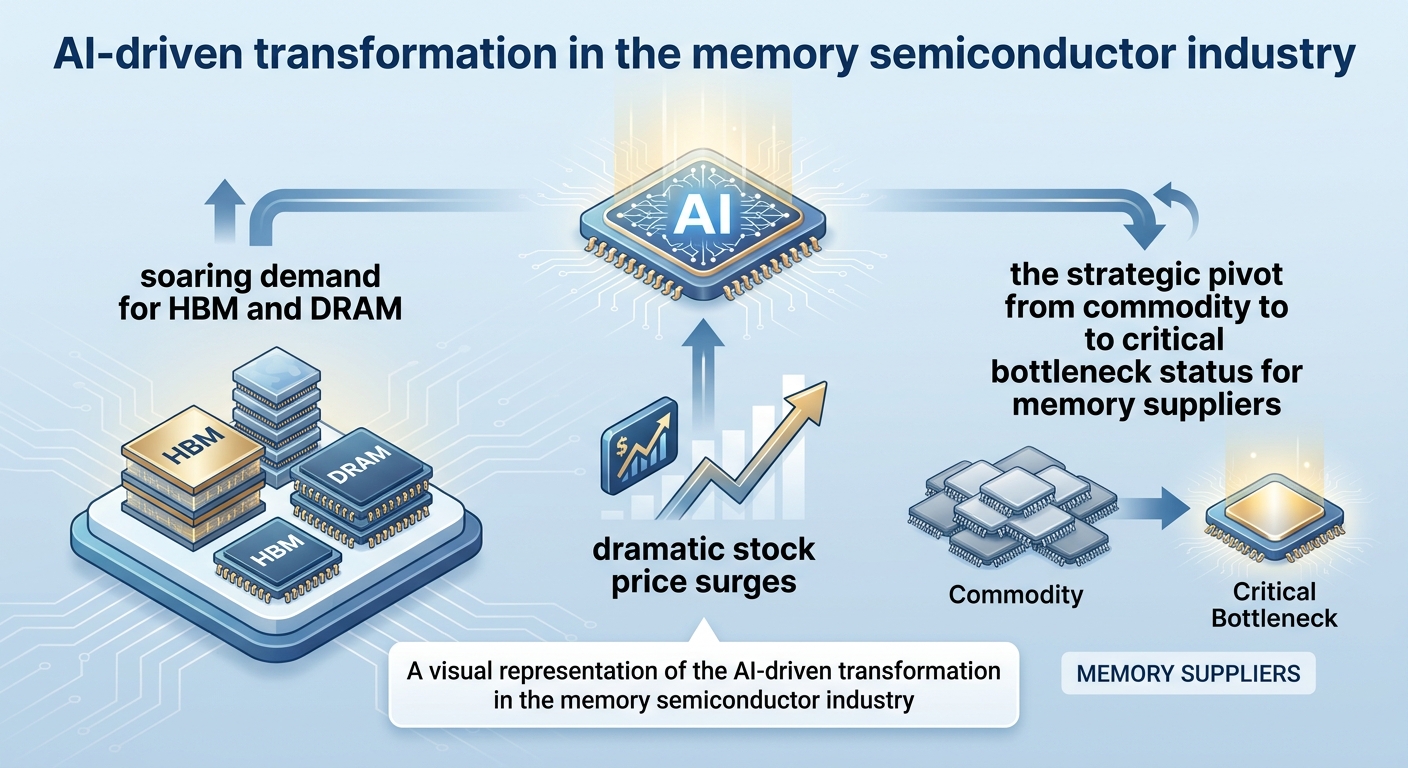
Amidst this backdrop, memory chips have transcended their historical role as commoditized semiconductor components to become strategic bottlenecks critical to AI infrastructure performance and scalability. Structural supply constraints, driven by fabrication capacity reallocations and unprecedented procurement models including co-funded fab expansions and long-term volume commitments, have engendered significant price inflation and volatility, reshaping market power dynamics and investment strategies.
This report aims to elucidate the multifaceted dynamics of the current AI-driven memory supercycle, provide a granular assessment of market transformations in pricing and contract models, quantify downstream impacts on consumer products and industry profitability, and analyze emerging technological and geopolitical forces shaping memory manufacturing. The scope extends through mid-2026, capturing the latest commercial ramp-ups of next-generation memory architectures, key financial trends, and risk factors threatening to recalibrate the trajectory of this landmark industry evolution.
Infographic Image: Infographic
1. AI-Driven Memory Surge: From Commoditized Input to Strategic Bottleneck
Hyperscale AI Memory Demand Explodes Amid Acute Supply Constraints
This subsection establishes the foundational dynamics behind the unprecedented memory shortage observed in 2025–2026. It quantifies the dominant role hyperscale AI data centers now play in memory consumption and delineates how supply constraints—exacerbated by capacity reallocations within fabs—have driven memory pricing to historic highs. This sets the stage for understanding subsequent shifts in market structure, valuation, and strategic responses highlighted in later sections.
Dominance of Hyperscale AI Data Centers in Memory Consumption
Hyperscale AI data centers have emerged as the primary driver of memory demand, accounting for approximately 70% of global memory chip consumption by 2026. This disproportionate share underscores a seismic shift from traditional usage patterns, where consumer electronics and enterprise IT previously constituted the largest segments. The unparalleled demands stem from AI workloads' insatiable appetite for high-bandwidth DRAM and NAND storage, essential for both model training and inference operations. These data centers utilize advanced GPUs and specialized AI accelerators requiring massive quantities of stacked high-bandwidth memory (HBM) and dense NAND flash.
Such concentration of demand has created a structurally elevated baseline for memory consumption, decoupling it from prior cyclical behaviors aligned with PC and smartphone sales. Notably, the growth trajectory of AI data center memory capacity outpaces that of traditional compute infrastructures by a factor of four or more per annum, resulting in a novel supercycle within the memory market.
Fabrication Capacity Reallocation and NAND Cannibalization Intensify Supply Tightness
The surge in DRAM and HBM demand has precipitated a strategic reallocation of semiconductor fabrication capacity, especially within shared wafer fabs where NAND Flash and DRAM production compete for limited tooling and process space. Approximately 15–20% of existing NAND wafer fab capacity has been cannibalized or repurposed to increase DRAM and HBM production to fulfill AI-driven orders. This reallocation disproportionately impacts NAND supply, whose underinvestment and legacy production challenges had already constrained availability prior to AI acceleration.
Consequently, NAND pricing inflation has outpaced DRAM, with increases approaching 800% over an 18-month span, compared to DRAM price rises exceeding 600%. This divergence is partly driven by NAND’s lower starting price base, varying elasticity of demand, and its critical role as persistent storage for AI model weights and large-scale data sets. The cannibalization effect means memory supply chains must navigate delicate capacity-balancing acts, limiting the ability to rapidly scale NAND output without significant capital expenditure and lead times.
Severity of the Current Supply Deficit Compared to Historical Memory Crises
The present memory supply deficit surpasses all prior memory shortages in recent decades, both in magnitude and duration. Inventory levels reached critical lows by late 2025, with backlogs extending for multiple quarters and lead times for HBM modules stretching beyond six months. Price volatility has doubled compared to pre-2025 benchmarks, highlighting intensified market tightness driven by restrained capital expenditure during earlier years of uncertainty.
Unlike previous cycles driven primarily by consumer demand fluctuations, this supply-demand imbalance is largely structural, underpinned by the unique demands of the AI ecosystem that are less prone to sudden contractions. Production disruptions—such as labor strikes and export restrictions—further magnify supply risks. Industry leaders have publicly acknowledged the persistence of the shortage well into the late 2020s, signaling a fundamental transformation in memory chip market dynamics that demands new strategic investments and supply chain approaches.
Having quantified the unprecedented scale of AI-driven memory demand and the acute supply constraints underpinning the current price surge, the analysis now moves to consider how these forces are reshaping traditional memory value chains and altering the strategic interaction between suppliers and hyperscale customers.
From Cyclical Swings to Structural Scarcity: Redefining Memory Pricing and Industry Contracts Amid AI Demand
This subsection dissects the transformation of the memory chip market dynamics from historical cyclical price fluctuations to a newly entrenched paradigm of structural scarcity driven by AI-induced demand. It examines how pricing volatility patterns have evolved in recent years and how hyperscale customers and suppliers have renegotiated relationships through contract innovations. Additionally, it contextualizes how investors and market participants have adopted the 'memory as oil' analogy to frame memory chips as a strategic commodity, reflecting its critical role in modern AI infrastructure.
Transitioning Memory Pricing from Cyclicality to Enduring Structural Scarcity
The memory chip market, traditionally characterized by pronounced cyclical price swings tied to capacity expansions and contractions, has entered a distinct phase where scarcity is structurally embedded rather than transient. Beginning in 2024 and intensifying through 2025-2026, AI workloads, particularly those powering large-scale generative models and inference engines, have created unprecedented demand for high-bandwidth memory (HBM) and related DRAM products. This demand surge outpaces supply growth, leading to sustained multi-hundred-percent price escalations for DRAM and NAND segments, unlike previous cycles that exhibited more rapid price normalization post-expansion. Notably, price volatility has increased, but the underlying cause is a fundamental realignment between supply capacity and AI-driven consumption rather than standard end-market demand variability.
Supply constraints have been exacerbated by manufacturing complexities inherent in advanced memory architectures required for AI acceleration. Capacity reallocation towards premium HBM production has cannibalized volumes of mainstream memory chips, further restricting supply available to non-AI applications. Additionally, geopolitical factors and supply chain disruptions have contributed to production bottlenecks, intensifying the scarcity picture. Consequently, pricing behavior now reflects a paradigm shift: memory is no longer a commoditized, fungible input but a strategic bottleneck with prolonged upward price momentum underpinned by structural demand-supply imbalances.
Evolution of Hyperscaler-Driven Long-Term Contracts and Co-Investment Frameworks
The acceleration of AI infrastructure rollouts has compelled hyperscale cloud providers to fundamentally recalibrate procurement approaches for memory components. Conventional spot purchasing has been supplanted by multi-year, volume-committed contracts underpinned by prepayment structures and co-investments in fabrication equipment and capacity expansion. These arrangements mitigate supplier risk while providing hyperscalers with prioritized access amid constrained global supply, effectively institutionalizing a form of strategic partnership that divorces the market from historical transactional dynamics.
These contractual shifts have significant implications. From the supplier side, memory manufacturers can secure financing reliability, justify capital expenditures, and stabilize revenues in an otherwise volatile sector. For hyperscalers, locking in supply enables continuity in AI service delivery and shields against pricing disruption. This mutual dependence embeds a feedback loop reinforcing scarcity-driven pricing power and marks a decisive departure from cyclical vendor-buyer relationships toward collaborative ecosystem models with shared risk and reward components.
The ‘Memory as Oil’ Investment Narrative: Strategic Value Recognition and Market Implications
Investment discourse surrounding memory chips has embraced the analogy of 'memory as oil,' framing advanced memory not merely as a semiconductor commodity but as a strategic resource essential to powering the modern AI economy. This narrative captures how memory's relative scarcity and indispensable role in enabling high-performance AI workloads parallel oil's historical status as a critical input underpinning industrial and economic activity.
This perspective has influenced capital allocation decisions, driving elevated valuations for leading memory manufacturers that dominate high-end HBM production. Market participants increasingly view memory stocks as 'picks and shovels' in the AI infrastructure rush, emphasizing durability of demand rather than traditional cyclicality. Nonetheless, this framework also instills caution, highlighting parallels in supply concentration and geopolitical sensitivity, which may manifest in episodic price shocks and require continuous strategic investment to secure supply resilience. The analogy thus encapsulates both the new-found importance of memory chips and the attendant risks inherent in their criticality.
Having established the structural transformation in pricing dynamics and supplier-customer relationships, the subsequent section will explore how these market changes translate into altered pricing power, profitability trajectories, and downstream impacts across consumer electronics and enterprise segments.
2. Market Transformation: Pricing Power, Profitability, and Downstream Disruption
Extreme Price Elasticity Amid Record Margin Pressures in DRAM and NAND Markets
This subsection examines the recent extraordinary price movements within the DRAM and NAND segments driven by AI-related demand surges. It situates these price dynamics within the broader context of semiconductor market transformations, exploring how pricing elasticity manifests under acute supply constraints and what implications arise for manufacturer profitability and volatility profiles. The analysis is critical for investors and strategists aiming to reconcile rapid price escalation with long-term margin sustainability amid ongoing market tightness.
Quantifying DRAM Price Elevations and Their Market Implications, 2024–2026
Since early 2024, DRAM pricing has undergone an unprecedented upward trajectory, reflecting the market’s acute supply-demand disequilibrium catalyzed by AI infrastructure expansion. Where traditional DRAM price cycles exhibited moderate volatility with some seasonal softness, the recent surge is historic: over 2025 and into the first half of 2026, contract prices for DDR4 and DDR5 variants have increased cumulatively by 90–130%, with the price of DDR5 chips, for instance, rising from under $7 per unit in late 2025 to upwards of $27 by Q1 2026. This level of inflation is beyond any cycle in the past decade and highlights both the heightened scarcity of legacy and next-gen DRAM components and the reallocation of wafer capacity toward high-bandwidth memory segments favored for AI workloads.
The impact of these steep price gains extends beyond raw contract numbers. The inversion of traditional value hierarchies – where DDR4 spot prices momentarily eclipsed those of DDR5 due to legacy capacity constraints – underscores the distortion within the memory supply chain. Manufacturers have increasingly prioritized AI-centric server DRAM, intensifying shortages in consumer and automotive DRAM segments. This reprioritization has sharply skewed pricing power toward memory suppliers, enabling margin expansions that more than offset the rising costs of raw wafers and advanced packaging. However, this also imposes significant budgeting challenges downstream, especially for OEMs dependent on predictable memory input costs.
Detailed Drivers of NAND Flash Price Volatility Under AI Demand Pressures
NAND flash memory prices have exhibited an even more striking escalation than DRAM, with contract prices rising over 600% since late 2024. This surge reflects constrained supply compounded by sharply elevated demand from AI training deployments, SSD rollouts, and mobile device upgrades. Large-scale hyperscalers have secured substantial long-term supply commitments, further tightening spot market availability and accelerating price spikes.
Notably, market concentration among a handful of dominant producers—Samsung, Micron, and SK Hynix—limits competitive pricing pressures, affording suppliers greater freedom to maintain elevated price points. Strategic production discipline, including deliberate reductions in NAND output by major fabs during late 2025, has exacerbated supply scarcities. As Q2 2026 progresses, NAND contract prices continue to outpace DRAM on a quarter-over-quarter basis, driven by enterprise SSD demand that shows no signs of abating. The introduction and ramp of QLC NAND architectures partially ease supply constraints but primarily benefit enterprise clients first, while consumer markets lag on availability and bear the brunt of high pricing.
This price volatility creates significant downstream pressures. Consumer electronics manufacturers face compressed margins as memory costs constitute a growing proportion of Bill of Materials (BOM), especially in premium smartphones and SSD-equipped laptops. The inflationary environment encourages cautious procurement strategies and compels brands to negotiate new supply arrangements to mitigate exposure to continued price escalations.
Having established the magnitude and drivers of extreme price elasticity and margin compression in both DRAM and NAND markets, the report next shifts focus toward assessing how these pricing dynamics are reshaping profitability profiles across the semiconductor value chain and impacting downstream consumer electronics sectors.
Downstream Consumer Electronics Vulnerability Assessment: The Hidden Toll of AI-Driven Memory Price Surges
This subsection focuses on quantifying and analyzing how surging memory chip prices, fueled by AI demand, are reshaping the economics of consumer electronics—especially smartphones. It connects upstream supply constraints and pricing shocks to tangible impacts on device pricing, shipment volumes, and profitability across key original equipment manufacturers (OEMs). This downstream view is critical for investors and strategists to anticipate market disruptions and brand vulnerabilities amidst persistent cost inflation and shifting consumer behavior.
Quantifying Smartphone ASP Increases Triggered by Memory Cost Inflation in Early 2026
In the first quarter of 2026, memory component costs surged dramatically, with DRAM prices increasing by over 50% quarter-on-quarter and NAND flash costs jumping nearly 90%. This escalation alone caused smartphone average selling prices (ASPs) to rise by an estimated 3% to 5%, with some regional markets experiencing even sharper hikes. In Southeast Asia, for instance, ASP hit a record $349, up 19% year-on-year, driven primarily by inflated memory costs imparting a disproportionate share—up to 43%—of the bill of materials in budget smartphone segments. The pace and magnitude of price increases have outstripped supply chain buffering capacities, prompting OEMs to pass most of the cost burden to consumers in order to maintain margin integrity.
This inflation is not uniform across price tiers. Budget and mid-range smartphones have borne the brunt of cost pressures because memory comprises a larger proportional cost of their total bill of materials. For example, low-end phones priced below $200 have seen memory costs surge by up to 25% quarter-on-quarter. The resulting ASP increases are sufficiently material to alter consumer purchasing decisions, intensifying affordability concerns in emerging markets where price sensitivity is acute.
Estimating the Downward Pressure on 2026 Smartphone Shipment Volumes from Elevated Chip Prices
Escalating memory prices have contributed to considerable shipment declines in the global smartphone market. Industry forecasts converge around a 5% to 7% decline in global smartphone shipments in 2026, with some regional markets, such as China and Southeast Asia, experiencing downward volume adjustments exceeding 9%. In India, the market decline is projected at 10-12%, reflecting intensified cost pressures combined with currency depreciation. These shipment contractions stem chiefly from demand elasticity responses to rising retail prices and overall consumer hesitation amidst inflationary pressures on device costs.
OEMs struggling with reduced volumes have responded by prioritizing premium segment offerings, postponing or simplifying lower-margin budget and mid-tier product launches, and leveraging refurbished device channels to soften overall shipment declines. The memory shortage and resultant production prioritization toward AI-focused data center components have further constricted available supply for consumer devices, exacerbating shipment pressures. This supply-demand imbalance creates a feedback loop, where higher costs reduce consumer uptake, which then amplifies risks for OEM revenue growth and supply chain stability.
Identifying OEMs Facing the Sharpest Margin Compression and Volume Headwinds Across 2025-26
Not all OEMs are equally exposed to memory cost inflation. Brands with substantial low-end and mid-range portfolio shares, such as Xiaomi, OPPO, Vivo, and Transsion, have faced pronounced margin squeezes and shipment declines ranging from 10% to as high as 27% year-over-year. These companies operate on thinner margins and less favorable supply agreements, making it difficult to absorb cost increases without aggressive price hikes that suppress volume. Xiaomi’s Q1 2026 earnings highlighted a notable shipment contraction of 12% coinciding with a higher ASP, confirming this trade-off. Similarly, Vivo reported a 27% decline as it scaled back low-margin device production.
Conversely, Apple and Samsung have fared relatively better in this environment. Apple’s tighter control over its supply chain and dominance in premium segments allowed it to increase ASPs by approximately 11% to 12% while experiencing only a modest shipment decline. Apple’s ASP reached a new high near $908, supporting profitability despite memory components comprising a greater portion of costs. Samsung maintained its leadership in Southeast Asia with market share gains, leveraging strong demand for flagship models capable of absorbing higher component prices. This differentiation underlines the widening competitive gap between premium-focused OEMs and cost-sensitive volume players as memory inflation persists.
Having established the considerable downstream repercussions of soaring memory costs on consumer electronics pricing and volumes, the report will next examine how these pressures are reshaping competitive dynamics among memory suppliers themselves. Understanding these vulnerabilities informs the broader valuation and strategic positioning landscape of associated tech stocks.
3. Winning the Memory War: Competitive Advantages and Strategic Partnerships
Technology Differentiation and Manufacturing Capability Gap in Next-Gen HBM
This subsection rigorously evaluates the technological advancements and manufacturing progress that underpin the competitive moats of leading memory producers in high-bandwidth memory (HBM). It focuses on production volumes, yield improvements, R&D investments, and market adoption patterns of HBM3E, HBM4, and emerging HBM4E and hybrid memory cube (HMC) architectures. By illuminating the technical and operational disparities among industry leaders, it clarifies how these factors sustain market dominance and impact strategic positioning amidst the AI-driven surge in memory demand.
Current Production Volumes and Yield Leadership in HBM4 and HBM3E
The latest production data underscores a significant lead by SK Hynix and Samsung in ramping next-generation HBM variants, with Micron trailing but closing gaps through accelerated yield improvements. SK Hynix began mass production of HBM4 in April 2026, delivering 12-high stacks with 36GB capacity and bandwidth exceeding 2 TB/s, meeting robust demand from major AI customers including Nvidia and Broadcom. Yield ramp rates have notably outpaced those of HBM3E, facilitated by mature 1b-node DRAM processes and internal innovations in base die design, resulting in faster time-to-volume and improved reliability.
Samsung commenced HBM4 mass production earlier in 2026, leveraging its advanced 1c nano DRAM process and 4-nanometer logic base die, yielding superior speed and energy efficiency relative to competitors. Samsung’s product performance variants, including 11.7 Gbps pin speeds and 16-high stacking configurations, translate to bandwidth capacities up to 3.3 TB/s in advanced models, securing premium pricing and full allocation into 2026. Both SK Hynix and Samsung’s manufacturing capacity plans are tightly booked with backlogs driven by hyperscale AI deployments, reflecting constrained supply and premium market positioning.
Micron's more recent HBM4 ramp benefits from lessons learned in HBM3E production, implementing a 10nm-class 1-beta DRAM core with internally optimized base die integration, achieving improved yields at a rate approximately double the HBM3E cycle. However, limited historical volume and slightly later product introductions have dampened immediate market penetration compared to Korean peers. The company projects mass production capacity scaling in late 2026, poised to capture incremental share as overall market volumes expand.
R&D Investment Scale and Its Role in Sustaining Technological Moats
Substantial and escalating R&D expenditures are the foundation of sustained edge in next-generation memory technology, with Samsung Electronics investing $30 billion in 2023 across advanced DRAM, packaging, and process innovation, while SK Hynix allocated roughly $9 billion in the same period, emphasizing specialized AI memory portfolios such as HBM4 and GDDR7. Both companies maintain sizeable engineering workforces with tens of thousands of dedicated R&D personnel, underscoring the capital-intensive nature of competing at the technology frontier.
These R&D efforts target persistent challenges such as TSV yield optimization, thermal management in taller stacks, and hybrid bonding technologies that erase microbumps to improve density and efficiency. Samsung’s aggressive pursuit of leading-edge process nodes (1c DRAM and 4nm logic) and SK Hynix’s integrated development of in-house base dies create differentiated product offerings that are difficult to replicate, reinforcing barriers to entry. Additionally, increased collaboration with hyperscale customers fuels co-development models that facilitate tight alignment of product features with evolving AI workload demands.
Micron’s R&D scale, while significant, remains dwarfed by the Korean incumbents, impacting its ability to accelerate next-generation HBM variants at the same pace. Nevertheless, its strategic use of U.S. CHIPS Act incentives and focused investments in manufacturing yield enhancement and process stabilization enables competitive entry into HBM4 production soon. The divergence in R&D investment intensity directly correlates with time-to-market lead and sustained innovation cycles, further widening the manufacturing capability gap.
Market Adoption and Commercialization Timelines for HBM4, HBM4E, and Hybrid Memory Cube
HBM4 has emerged as the flagship memory standard driving AI accelerator performance, with commercial shipments ramping in early 2026 from Samsung and SK Hynix. The transitional HBM3E remains prevalent for fleets deployed since 2023 but is being incrementally supplanted by HBM4 due to over 60% higher bandwidth and 20% lower power consumption, critical for scaling trillion-parameter machine learning models. Both Korean leaders foresee HBM4 constituting over 50% of HBM sales volumes by late 2026.
HBM4E, representing the forthcoming leap positioned for 2027 mass production, pushes capabilities further with pin speeds projected at 16 Gbps and system bandwidths approaching 4 TB/s per stack. SK Hynix intends to leverage 1c DRAM nodes combined with advanced TSMC 3-nanometer logic dies for the base layer in HBM4E, catering predominantly to custom-memory variants co-designed with strategic customers. Samsung plans to begin sampling HBM4E in mid-2026 with broader production slated later the same year, emphasizing hybrid copper bonding technology to enable higher stack counts and performance gains.
Hybrid Memory Cube (HMC) adoption remains more niche, given ongoing development complexities and specialized use cases in HPC and networking, but demonstrates notable improvements in signal integrity and power efficiency. Though HMC accounts for a smaller share relative to HBM, it serves as a complementary architecture in highly parallel AI workload environments. The commercial availability of these next-generation memory technologies is timed to coincide with GPU launches from leading AI chipmakers in 2026 and beyond, maintaining a close technology-product synchronization essential for customer acquisition and premium pricing.
The technological differentiation and manufacturing capabilities discussed here directly influence competitive positioning and market share dynamics. These advances support premium pricing power and enable strategic partnerships with hyperscale customers, themes that are elaborated in the subsequent section focusing on cloud provider capital commitments and co-investment models.
Hyperscalers' Strategic Capital Deployment and Co-Funded Memory Expansion Models Redefining Industry Dynamics
This subsection examines the unprecedented scale and strategic nature of cloud service providers' investments in memory chip manufacturing during the AI-driven demand surge. By quantifying capital commitments and dissecting contractual frameworks, it elucidates how hyperscalers are reshaping supply chain configurations, enabling memory makers to accelerate capacity expansion while locking in supply. The analysis contextualizes these developments within broader industry consolidation trends, highlighting potential implications for competitive positioning and investment risk profiles.
Trillions in Multi-Year DRAM Prepayments Establish New Supply Assurance Paradigm
Hyperscale cloud providers have fundamentally altered memory procurement strategies by signing multi-year DRAM agreements with chip manufacturers worth trillions of South Korean won over three-year horizons. This scale of prepayment represents a historic departure from the traditionally quarterly contract cadence that dominated the volatile DRAM market. The priority has shifted from cost minimization to absolute supply security amid explosive AI-driven demand growth and acute supply shortages.
These up-front payments serve a dual function: securing prioritized wafer allocation and providing semiconductor producers with critical capital to underwrite aggressive capacity expansion projects. For industry leaders like SK Hynix and Samsung, these funds finance fab construction and equipment acquisition without relying solely on traditional capital markets, accelerating ramp timelines critical to meeting hyperscalers' requirements.
Such long-term capital commitments reduce producers' exposure to short-term price fluctuations, effectively stabilizing revenue streams. However, this model introduces new dynamics where customer concentration risk increases, with a handful of cloud giants wielding outsized influence on memory manufacturers’ financial health and future product roadmaps.
Notably, despite these prepayments aiming to secure supply, price inflation trends between 2025 and 2026 reveal that NAND prices have increased by 800 basis points between Q1 2025 and Q1 2026, markedly outpacing DRAM price inflation which rose by 600 basis points over the same period. This disparity reflects sharper tightening in NAND supply but also underscores pricing power retained by memory producers in both segments during this surge [Chart: Price Inflation of DRAM and NAND (2025-2026)].
Strategic Investment in Equipment: Cloud Giants Underwrite Advanced Lithography and Manufacturing Tools
The strategic partnership model extends beyond simple procurements; cloud providers are now directly investing in semiconductor manufacturing equipment purchases, notably financing the acquisition of critical assets like ASML’s Extreme Ultraviolet (EUV) and high-numerical aperture lithography machines. This co-investment approach is a critical development, reflecting hyperscalers’ urgency in securing cutting-edge process node capacity essential for next-generation high-bandwidth memory (HBM) production tailored for AI workloads.
By underwriting expensive equipment with multi-billion dollar price tags and long lead times, hyperscalers help mitigate financial risks for memory producers and ensure preferential access to constrained manufacturing throughput. In doing so, cloud providers effectively influence capacity allocation and process technology prioritization within fab roadmaps, blurring traditional boundaries between customer and supplier roles.
Additionally, this involvement reassures capital markets and stakeholders about demand visibility, smoothing financing conditions for fab expansions that require sustained and predictable revenue. Nevertheless, this tight integration introduces operational complexity and potential lock-in that may reduce suppliers’ strategic autonomy.
Contractual Frameworks: Multi-Year Capacity Agreements Reshape Pricing and Industry Stability
Long-term contractual frameworks with durations spanning three to five years have become industry standard among leading hyperscalers and memory manufacturers, encompassing upfront deposits ranging between 10% to 30% of the contract's face value. These agreements diverge sharply from the past industry's preference for highly flexible, short-term contracts that sought to exploit price fluctuations but left suppliers vulnerable to demand swings.
Such agreements secure guaranteed volume commitments for both general-purpose and AI-specific memory components, including DRAM and HBM variants, often tied to minimum purchase obligations and defined escalation clauses. The contractual lock-in enhances forecasting accuracy for both parties, facilitating precise capacity planning and investment prioritization on product development pipelines that meet AI infrastructure specifications.
The shift toward these durable commitments dampens traditional cyclicality effects in the memory market, embedding a more structural pricing regime. However, downside risks arise if AI infrastructure capital expenditures slow or are recalibrated, potentially leaving suppliers exposed with underutilized capacity and locked-in pricing terms unfavorable during demand troughs.
Scale and Prevalence: Co-Funded Fab Expansions Define the New Industry Normal
In 2025-26, multiple new memory fab expansions involve direct capital participation from hyperscale customers, marking a proliferation of co-funded projects unprecedented in scale and scope. Industry leaders have announced several initiatives where cloud providers either co-invest equity in new wafer fabrication facilities or engage in joint ventures, underpinning capacity growth with sustained capital injections and risk sharing.
This prevalence confirms hyperscalers’ strategic intent to secure sovereign access to critical memory supply chains, particularly for high-margin, high-performance memory products integral to AI accelerators, such as HBM4. The integration of hyperscaler capital into these projects shortens build cycles and enhances supply chain resilience in a period of global geopolitical uncertainty and demand volatility.
While beneficial in improving capacity utilization visibility and reducing investment uncertainty, the deepening financial integration also raises questions about concentration risks if a dominant buyer’s demand trajectory falters or its strategic priorities pivot.
Industry Consolidation Accelerated by Locked-In Capital and Strategic Partnerships
The mutual dependence formed through extensive multi-year contracts and capital co-investments is contributing to accelerated consolidation trends within the memory chip industry. The locked-in nature of the supply agreements limits market competition and discourages marginal new entrants due to the substantial upfront capital and long lead times required to compete on capacity and technology.
Leading memory manufacturers solidify oligopolistic market power, supported by predictable revenue streams and capital reinvestment mechanisms driven by hyperscaler partnerships. This dynamic enhances pricing power but simultaneously embeds systemic risk related to customer concentration and potential contractual inflexibility.
For investors and strategists, the consolidation imposes a dual mandate: to monitor the evolving balance of power between chipmakers and hyperscaler customers and to incorporate scenario analyses for possible demand shocks, contractual renegotiations, or technology shifts that could recalibrate the current equilibrium.
This deep dive into hyperscalers’ capital deployment and co-investment models establishes the financial underpinnings that support the current memory chip supercycle. With supply secured through unprecedented collaborations, the subsequent sections will evaluate how these dynamics translate into financial performance, valuation divergences, and evolving competitive advantages within the marketplace.
4. Financial Implications and Valuation Divergence
Record Earnings and Unprecedented Stock Appreciation in AI-Driven Memory Markets
This subsection quantitatively captures the exceptional financial performance of leading memory chipmakers amid the AI boom, linking operational excellence and market dynamics to their extraordinary stock returns. It benchmarks their equity appreciation against key market indices, decodes the drivers behind revenue and margin expansions, and addresses the apparent valuation divergences within the context of prevailing macroeconomic uncertainties.
Exceptional Annualized Returns of Memory Chipmakers from 2023 to 2026
Memory chip manufacturers have delivered unprecedented annualized stock returns throughout 2023 to mid-2026, fundamentally reshaping semiconductor equity narratives. Micron Technology, as a primary example, recorded a staggering 360% surge in its stock price over the past 12 months alone, reflecting intense market enthusiasm grounded in surging AI-related demand. Across the memory sector, sustained earnings momentum driven by supply constraints and pricing power have elevated equity valuations well beyond traditional cyclicality limits.
This stock appreciation outpaces nearly all other semiconductor players, including marquee AI infrastructure beneficiaries. While Nvidia's five-year CAGR has been notable, recent memory-focused companies have demonstrated a sharper equity trajectory between 2023 and 2026 by capitalizing directly on high-bandwidth memory shortages. Their returns mark a paradigm shift, reflecting the critical bottleneck role memory now plays in AI compute stacks.
Outperformance Relative to Nasdaq-100 and Broader Tech Benchmarks
When benchmarked against broader technology indices, notably the Nasdaq-100, top memory chipmakers have exhibited superior performance during the AI-driven market surge. The Nasdaq-100 itself has experienced robust gains, buoyed by dominant mega-cap tech and AI semiconductor players, achieving annual gains exceeding 38% year-over-year and nearly doubling over three years. However, leading memory vendors have outpaced this benchmark segment substantially, with Micron and SK Hynix exhibiting stock price growth multiples significantly surpassing the Nasdaq-100's compound returns, underscoring the unique supply-driven dynamics in memory markets.
This divergence is noteworthy given the Nasdaq-100’s emphasis on growth technology stocks. The memory segment’s outperformance amid a period of macroeconomic uncertainty and geopolitical risks highlights its transition from a cyclical commodity industry to a strategic, high-margin growth sector, driven by AI infrastructure investments.
Direct Correlation Between Revenue Growth, Margin Expansion, and Stock Market Gains
Underlying the stock market surge is a robust quantitative link between rapidly increasing revenues and expanding gross margins of memory chipmakers. Leading firms have reported sequential DRAM revenue increases exceeding 70%, alongside gross margin expansion moving into the rarefied 70-80% territory, a performance level eclipsing historical semiconductor records. For instance, SK Hynix set a new quarterly gross margin record at around 79%, outstripping the margin achievements of even elite compute chip companies.
This profitability leap is directly attributable to supply imbalances in the high-bandwidth memory segment, coupled with strategic wafer reallocation away from commodity DRAM/NAND toward AI-critical products. Revenue growth statistics align closely with equity returns, demonstrating that market valuations are, to a large extent, justified by underlying financial expansion rather than speculative excess.
Margin and Valuation Trends Amid Macroeconomic and Geopolitical Headwinds
Despite these strong fundamentals, valuations of memory chip companies appear paradoxically attractive compared to other AI-related tech stocks when adjusted for cyclicality and macroeconomic risks. Forward-looking price-to-earnings ratios, while reflecting rapid earnings growth, remain moderate or even declining due to higher absolute earnings and cautious investor appraisal on sustainability beyond the AI supercycle.
This valuation discrepancy can be attributed to cautious market sentiment shaped by persistent geopolitical tensions, inflationary pressures, and potential oversupply concerns in the mid-to-long term. However, the memory sector’s demonstrated ability to convert pricing power into durable margin expansion, reinforced by long-term contracts with hyperscale customers, lends credence to the current equity valuations being underpinned by tangible financial resilience rather than speculative hype.
Having established the extraordinary earnings and stock performance metrics underpinning memory chipmakers’ market leadership, subsequent sections will dissect the sustainability of this momentum by analyzing sector profitability metrics in relative terms and assessing the risks that could precipitate a reversal of the current supercycle.
Valuation Dynamics in AI-Driven Memory: Distilling Profit Margins, P/E Divergence, and Sector Strength
This subsection delves into the financial standing of leading memory chipmakers amidst the ongoing AI-driven demand surge. It benchmarks forward-looking valuation multiples against related technology subsectors, decodes the paradox of declining price-to-earnings ratios amidst robust earnings growth, and assesses the sustainability of elevated gross margins. Understanding these dynamics is critical for investors and strategists aiming to navigate the rapidly evolving competitive and risk landscape of the semiconductor memory industry in mid-2026.
Sharper Valuation Contrast: Forward P/E Ratios Reveal Memory Stocks’ Relative Attractiveness
As of mid-2026, leading memory companies exhibit notably lower forward price-to-earnings (P/E) ratios compared to their compute-centric technology peers, despite record earnings growth. The forward P/E for prominent memory firms clusters below 10x, with Micron at approximately 7.6x and Sandisk around 24x, contrasted sharply by AI-driven semiconductor leaders such as Nvidia trading above 20x. This valuation gap underscores a market perception that memory stocks have yet to fully price in the long-term transformative impact of AI workloads.
This divergence reflects a cautious investor stance arising from cyclical apprehensions historically associated with memory markets and uncertainties around sustained demand beyond the current supercycle. In parallel, broader technology sectors exhibit forward P/E ratios in the 20-30x range, influenced by expectations of persistent software-driven revenue growth and higher scalability. Over the next 12 to 18 months, the memory segment’s undervaluation relative to growth peers presents a potential entry opportunity, provided downside supply risks are managed prudently.
Unprecedented Gross Margin Resilience Amid Surging Revenues Highlights Structural Market Shift
Memory chipmakers are recording gross margins surpassing historical highs, largely attributed to the AI-driven spike in demand for specialized products such as high-bandwidth memory (HBM) and server DRAM. Margins have routinely exceeded 70%, with some firms like SK Hynix and Samsung projected to reach operating margins between 75% and 80% in 2026, eclipsing even traditionally high-margin peers in foundries and GPU makers. This margin expansion is supported by tight supply chains, intensive capital requirements for advanced packaging, and the premium pricing power memory suppliers have attained.
These robust margin profiles attest to a structural transformation from the memory industry’s typical boom-bust cycle. Revenues are decoupling from cost of goods sold due to pricing power gained from constrained capacity and multi-year supply contracts with hyperscale AI customers. However, this level of profitability also places heightened emphasis on operational execution and capacity discipline, as margin contraction risks emerge if supply rapidly outpaces demand.
Decoding P/E Ratio Declines Despite Revenue and Earnings Upswings: Investor Sentiment and Risk Adjustments
The observed decline in forward P/E ratios among memory companies, even as revenue and net income reach unprecedented levels, signals a nuanced market recalibration rather than a fundamental contradiction. This phenomenon primarily reflects investors’ adjustment for heightened cyclicality, geopolitical uncertainties, and customer concentration risks. Effectively, market participants are pricing in the possibility of supply gluts post-supercycle and potential margin compression despite near-term earnings momentum.
Additionally, the memory sector’s stock beta remains elevated relative to broader tech peers, reflecting amplified sensitivity to macroeconomic shifts and inventory adjustments in downstream industries. While AI demand offers a durable structural tailwind, the memory market’s inherent volatility disciplines valuations, resulting in more tempered multiples relative to software or cloud infrastructure companies with more predictable cash flows.
Operating Income and Cash Flow Strength Underpin Valuation Premium with Caution Flags
Operating income margins for major memory vendors have expanded sharply through 2025 into 2026, frequently surpassing 40-50%, a rarity in capital-intensive manufacturing sectors. Such profitability drives strong free cash flow generation, enabling aggressive reinvestment in capacity and R&D while supporting shareholder returns through dividends and buybacks. These factors underlie the sector’s relative valuation strength, distinguishing memory firms from lower-margin semiconductor segments impacted by commoditization.
Nevertheless, the robust profitability metrics coexist with emerging concerns regarding sustainability. High capital expenditures for next-generation memory technologies and geopolitical shifts requiring domestic reshoring create a complex investment environment. The market’s cautious attitude is reflected in valuation multiples that incorporate a premium for profitability yet adjust downward for execution and supply risks, reinforcing the need for active risk management strategies.
Comparative Beta and Market Risk Positioning: Memory Stocks Amid Elevated Volatility
Memory chip equities currently exhibit higher market beta than many software and service-oriented tech peers, indicating a more volatile risk-return profile. The cyclical nature of memory demand, coupled with supply chain uncertainties and customer concentration primarily among large hyperscalers, contribute to this elevated systematic risk. Despite their margin robustness, these firms are more susceptible to abrupt market corrections when macroeconomic or geopolitical shocks occur.
From a portfolio management perspective, this elevated beta necessitates careful weighting and dynamic monitoring of key industry indicators such as capital expenditure trends, pricing trajectories, and AI infrastructure spending patterns. Investors should balance memory exposures with diversifying assets to optimize risk-adjusted returns, especially given the sector’s outsized contribution to overall semiconductor growth forecasts in 2026.
Broader Market Impacts of Memory Cost Inflation: Smartphone ASP Pressures
The surge in memory pricing extends beyond semiconductor equities, notably affecting consumer electronics markets such as smartphones. Early 2026 data reveal that average selling prices (ASPs) of smartphones have increased globally by approximately 3%, with Southeast Asia experiencing a pronounced 19% ASP rise. Budget smartphone segments face the steepest impact, with 43% of models reflecting increased pricing due to memory cost inflation.
These cost pressures illustrate the downstream consequences of constrained memory supply and elevated chip pricing, potentially dampening volume demand growth in price-sensitive regions. This dynamic also reinforces memory chipmakers’ pricing power but highlights the risk of demand elasticity affecting end markets amid ongoing cost pass-throughs.
The valuation landscape of memory chipmakers embodies a complex interplay of strong fundamental earnings growth, unprecedented margin expansion, and cautious risk pricing that tempers forward multiples. This nuanced financial environment reflects market recognition of the transformative impact of AI on memory demand, coupled with mature appraisal of cyclical and structural risks. The following section will explore these vulnerabilities in greater detail, focusing on concentration exposures and the likelihood of potential supply-demand rebalancing that could unsettle current valuations.
5. Risks and Limitations: When the Super-Cycle Might Reverse
Concentration Risk and Customer Dependency: Fragility in the AI-Driven Memory Ecosystem
This subsection critically examines the vulnerabilities stemming from the heavy reliance of memory chipmakers on a small cadre of hyperscale cloud providers as key customers. Understanding this dependency is vital to assessing systemic risk within the AI-driven super-cycle, as fluctuations in AI infrastructure investment from these dominant buyers could rapidly destabilize memory demand and supplier financial health.
Quantifying Hyperscaler Market Share Thresholds and Systemic Vulnerabilities
The memory chip industry’s current boom is tightly intertwined with a handful of hyperscale cloud providers who collectively command a disproportionately large share of AI infrastructure spending. Industry data indicates that the top five hyperscalers collectively account for upwards of 70-80% of high-bandwidth memory demand dedicated to AI workloads. This concentration generates a systemic fragility whereby any material reduction in capital expenditure by one or more of these customers would exert outsized effects on memory manufacturers’ revenue streams.
Analyses of market share thresholds suggest that when any single hyperscaler’s memory consumption approaches or exceeds roughly 15-20% of a supplier’s total output capacity, the risk of dependency-induced volatility escalates sharply. At these levels, supplier fortunes become extremely sensitive to the investment cadence and strategic priorities of that customer. The current environment features such elevated dependency metrics for major memory suppliers, reinforcing vulnerability to shifts in hyperscaler AI budgets or broader macroeconomic factors impacting AI spending plans.
Modeling the Impact of AI Capital Expenditure Slowdowns on Memory Demand and Financial Stability
Scenario modeling reveals that even modest deceleration in hyperscale AI capex growth—whether due to economic headwinds, strategic recalibration, or realization of diminishing returns on incremental AI hardware investments—can rapidly depress memory demand and create supply gluts. With hyperscalers representing the lion’s share of AI memory consumption, their investment trajectories directly modulate industry-wide revenue and pricing dynamics.
Financial impact simulations estimate that a 10-15% reduction in hyperscaler AI spending growth could translate into a 20-30% correction in memory chip revenue within a single fiscal year, intensifying margin pressure and forcing manufacturers into rapid inventory adjustments. Such shocks may also provoke cascading negative effects through supply chain partners reliant on steady memory demand. While players currently benefit from pricing power and favorable contract structures, lengthened supply visibility and lead times amplify sensitivity to sudden downturns in AI infrastructure buildout.
Prepaid Financing Structures and Embedded Counterparty Credit Risk Analysis
A significant proportion of memory manufacturers’ capacity expansions are backed by prepaid contracts or long-term capacity reservations from major hyperscalers, entrenching strong but potentially risky financial linkages. While these arrangements provide upfront capital for manufacturers and some demand certainty, they embed counterparty credit risk tied to the financial health and strategic continuity of hyperscale customers.
Credit risk assessments highlight that the prolonged horizon and high dollar value of prepaid financing expose memory makers to pronounced vulnerability should a hyperscaler encounter liquidity stress or dramatically alter capital allocation priorities. Market and debt analysis currently show robust balance sheets across top hyperscalers, but evolving macroeconomic uncertainties and the considerable scale of projected AI expenditure raise the odds of credit events that could disrupt contract fulfillment. Therefore, suppliers must maintain prudent risk mitigation protocols and stress testing scenarios to manage potential default or renegotiation outcomes.
Concentration risk and customer dependency are central to understanding when the current memory super-cycle might lose momentum. The following subsection will build on this foundation by evaluating the probability and triggers of a structural oversupply reversal, further exposing cyclical vulnerabilities masked by the current AI-driven demand surge.
Structural Oversupply and Cyclicality Recurrence: Analyzing Risks and Mitigation Amidst the AI Memory Boom
This subsection critically examines the risk that the current AI-driven memory chip supercycle may ultimately revert into a traditional downcycle, driven by capacity overexpansion and demand fluctuations. It situates these concerns within the broader memory market’s well-documented cyclical history, highlighting quantitative signals and early warning indicators that investors and strategists must monitor. The analysis is essential for understanding how emerging supply-side dynamics and potential demand slowdowns could precipitate margin pressures and necessitate strategic contingencies.
Quantitative Analysis of Capacity Additions Versus Demand Downturn Risks
The memory market’s current trajectory features unprecedented capital deployments targeting expansion of DRAM, NAND, and high-bandwidth memory (HBM) production capacities to satisfy AI-driven demand surges. However, historical patterns warn of a critical imbalance when supply growth outstrips consumption, catalyzing price corrections. Notably, extensive industry data indicate that by 2027, chip production capacities—particularly at mature technology nodes—could exceed demand by over twofold, a scale of overcapacity not seen in recent decades. This is compounded by the multi-year lead times for building fabs and the momentum from contracted hyperscale cloud provider orders, which incentivize aggressive scaling despite evolving demand signals.
While AI workloads exhibit structural growth distinct from prior consumer electronics cycles, the capacity build-up remains vulnerable to shifts in hyperscalers’ procurement plans or broader macroeconomic pressures. Key metrics such as bit shipment growth versus profit growth are exhibiting early divergence, wherein memory vendors report growing volumes but slowing profitability expansion due to intensified pricing competition. These quantitative indicators forecast an inflection point where memory companies could face inventory accumulation and margin compression as supply overshoot manifests.
In essence, a thorough quantitative assessment of capacity versus demand trajectories reveals that despite short-term tightness, the risk of oversupply remains a central threat emerging within the 2026–2027 horizon, aligning with established cyclical tendencies in semiconductor memory markets. This nuanced outlook is also reflected in the strong market valuation trends, as memory chipmakers have significantly outperformed broader technology indices like the Nasdaq-100, with projected annualized stock returns rising from 100 in 2023 to 360 by 2026, compared to the Nasdaq-100’s 260 in the same period, underscoring investor optimism amid rising but increasingly vulnerable demand fundamentals [Chart: Annualized Stock Returns of Memory Chipmakers vs. Nasdaq-100 (2023-2026)].
Identifying Early Warning Signs of Overexpansion in the Memory Sector
Market participants should closely monitor specific indicators signaling premature capacity scaling. Rising inventory levels at memory manufacturers and downstream customers serve as a primary warning, reflecting a mismatch between supply additions and real-time demand. Additionally, subtle softening of memory pricing trends—especially in premium segments like HBM and enterprise SSDs—may presage increased competition and margin erosion.
Disruptions in end-customer revenue growth, including dampened spending by major hyperscalers or representatives of AI infrastructure development, represent crucial alarm signals. For example, reports of shipment adjustments or cost-driven product portfolio changes in client sectors such as smartphones and PCs indicate broader market sensitivity to elevated memory pricing.
Another leading sign is the dampening of profit growth despite sustained or rising shipment volumes, highlighting that bit growth alone no longer guarantees earnings momentum. Analyst discussions also warn of overhyped technology transitions where expectations outpace sustainable demand, often resulting in a ‘digestion phase’ characterized by reduced order backlogs and heightened inventory risk.
Together, these early warning signs provide a comprehensive framework for investors and managers to anticipate and mitigate market corrections before they fully crystallize.
Developing Strategic Contingency Plans to Mitigate Margin Erosion Risks
Given the cyclical nature of memory markets and the complex interplay of supply-demand dynamics intensified by AI-driven demand shocks, companies and investors must proactively devise risk mitigation strategies. Operationally, manufacturers can adopt more flexible capacity management, cautiously pacing expansions to avoid inventory gluts and implementing more stringent order book scrutiny to align production with confirmed demand.
On the financial front, diversifying the customer base beyond a handful of hyperscalers can reduce concentration risk and buffer against sudden shifts in procurement patterns. Incorporating margin protection mechanisms such as tiered pricing contracts and volume commitments with penalty clauses can protect earnings during volatile cycles.
From an investor perspective, scenario-based transaction frameworks that identify entry and exit triggers based on demand inflection points and inventory metrics are advisable. Moreover, maintaining vigilant supply chain oversight can help detect early disruptions or overstocking tendencies, enabling timely portfolio adjustments.
Lastly, companies should continue investing selectively in next-generation memory technologies with longer-term market potential to maintain competitive advantage while balancing near-term capacity prudence. A disciplined approach to innovation combined with rigorous market intelligence will be pivotal in navigating the impending supercycle turning points.
Having explored the structural risks that could precipitate a supercycle reversal, the report will next assess strategic imperatives and technological trajectories that memory manufacturers must pursue to sustain competitive advantages and capitalize on emerging opportunities in this evolving market landscape.
6. Future Trajectory and Strategic Imperatives
Next-Generation Memory Architectures and Commercialization Timelines: Defining the AI Memory Frontier
This subsection delineates the evolving technological landscape and market introduction of advanced memory architectures pivotal to sustaining AI-driven demand surges. It quantifies precise commercialization milestones for HBM3E and HBM4 generations, details projected market penetration rates, and evaluates R&D investment commitments by key industry players, offering a foundational understanding of the memory technology trajectory crucial for strategic forecasting and investment decisions.
Concrete Commercialization Milestones and Market Penetration of HBM3E and HBM4
The transition from HBM3E to HBM4 represents a generational leap in memory technology characterized by increased stack densities, wider data interfaces, and integration of advanced logic base dies. HBM3E, already in mass production since early 2024, remains the dominant memory solution powering current AI infrastructure, particularly in GPUs like NVIDIA’s H200. With shipment volumes scaling rapidly, HBM3E accounted for over 41% of AI server memory modules by 2024 and remains essential through 2025 into early 2026.
HBM4 commercialization is actively unfolding, with staggered mass production timelines among leading suppliers. Samsung Electronics initiated mass production of HBM4 by early 2026, fulfilling orders for major AI accelerator platforms such as NVIDIA’s Vera Rubin. SK Hynix has established an HBM4 production line with volume shipments commencing in Q4 2025 and a full ramp expected into 2026, targeting 70% supply share for key platforms. Notably, recent industry adjustments have slightly delayed aggregate mass ramp expectations to late Q1 or early Q2 2026, accommodating specification upgrades and Nvidia’s strategic changes.
Market-share forecasts to 2028 anticipate significant adoption expansion. High-bandwidth memory’s total addressable market is projected to grow from roughly $35 billion in 2025 to approximately $100 billion by 2028, reflecting a compound annual growth rate (CAGR) near 40%. HBM variants, especially HBM3E and HBM4, are forecast to exceed 30% revenue contribution of total DRAM by 2026 despite their modest wafer production share, underscoring their strategic premium status. Leading manufacturers expect HBM4 to capture roughly 54% of the HBM market share in 2026, with Samsung and Micron holding 28% and 18%, respectively.
Strategic R&D Commitments and Investment Intensity in HBM4 Development
The aggressive acceleration of AI applications has fueled unprecedented R&D and capital expenditures by key memory makers to secure technology leadership in next-generation HBM architectures. Samsung’s 2025 R&D expenditure hit a record $25.6 billion, with focused investments in advanced DRAM process nodes (including 1c nm technology for HBM4) and TSV enhancements underpinning its HBM4 production ramp. The company’s early shipment of HBM4 chips in Q1 2026 confirms the maturity of its high-performance, power-efficient designs.
SK Hynix has similarly intensified its innovation pipeline, increasing R&D spending by over 65% year-over-year to above 2.5 trillion won per quarter in early 2026, alongside ramped capital expenditures exceeding 7 trillion won per quarter to expand front-end process and advanced packaging facilities. Mass production of HBM4 technology utilizing 12-nanometer process technology and collaboration with foundry partners like TSMC for base die manufacturing have enabled SK Hynix to maintain over 50% market share in HBM and to win approximately 70% of NVIDIA’s HBM4 orders for the Vera Rubin platform.
The R&D trajectory also includes evolving memory architectures incorporating embedded logic for enhanced processing capabilities at the base die level, alongside emerging hybrid memory cube (HMC) configurations. These initiatives demonstrate a strategic priority on differentiating product performance with higher bandwidth, lower power consumption, and improved system integration to meet growing AI system requirements toward 2027 and beyond.
Hybrid Memory Cube Viability and Adoption Forecasts Through 2030
While High-Bandwidth Memory dominates the AI-driven memory surge, Hybrid Memory Cube technology remains a complementary architecture with distinct advantages in energy efficiency and throughput. The HMC market, valued at approximately $2.4 billion in 2025, is expected to grow at a CAGR exceeding 20% through 2034, reaching over $13 billion, driven primarily by demand in high-performance computing and cloud data centers.
HMC leverages 3D stacking through silicon vias paired with a memory controller die, offering up to 15 times increased bandwidth relative to DDR3. However, it faces commercial challenges as it is incompatible with standard DDR interfaces and has experienced slower adoption than initially anticipated. Despite this, energy-conscious enterprises focusing on operational cost reductions and sustainability factors are anticipated to accelerate HMC deployment in edge computing, autonomous driving, and data-center acceleration applications.
Forecast adoption rates for hybrid memory cube solutions suggest a gradual penetration approaching 20% market share by 2028 and increasing to over 35% by 2030 in next-generation memory segments, enabled by ongoing product innovations and industry collaborations involving major players. Hybrid bonding techniques, expected to represent over one-third of HBM processes by 2028, further promise to enhance HMC competitiveness via improved integration and scalability.
Having established concrete production timelines and investment commitments for next-generation memory technologies, the following section will examine how geopolitical forces and domestic policy incentives are reshaping manufacturing footprints and supply chain strategies, vital for contextualizing future market dynamics.
Geopolitical Realignment and Strategic Shifts in Semiconductor Manufacturing Incentives
This subsection examines the evolving geopolitical landscape shaping semiconductor manufacturing, focusing on the influence of the CHIPS Act, tariff policies, and domestic capacity expansion plans. These factors collectively redefine global production footprints and investment priorities, directly impacting the memory chip sector and broader technology supply chains amid the AI-driven demand surge.
Current Status of CHIPS Act Funding and Its Impact on Domestic Manufacturing Expansion
As of mid-2026, the CHIPS and Science Act remains the cornerstone of U.S. semiconductor policy, having authorized $52.7 billion for semiconductor manufacturing incentives, research, and workforce development. By July 2025, approximately $30.9 billion had been awarded to 19 companies through 40 projects, signaling substantial federal commitment to expand domestic semiconductor capacity, particularly in leading-edge fabrication and advanced packaging.
This infusion of federal funding has catalyzed significant investment in new fabrication facilities and capability upgrades, with industry leaders like Intel progressing on multiple projects across Arizona, New Mexico, Ohio, and Oregon. These initiatives are poised to increase the U.S. share of global leading-edge chip manufacturing potentially to 20% by 2030, marking a critical shift toward reducing reliance on Asian manufacturing hubs.
Despite the strong financial backing, implementation challenges persist, including the timely disbursement of funds and meeting milestone completions. The rapid pace of awards necessitates vigilant oversight to mitigate risks such as improper payments or unintended benefits to foreign entities. Additionally, workforce development remains a strategic bottleneck, with a focused $65 million subset of CHIPS funding dedicated to cultivating a sufficiently skilled semiconductor talent pipeline to support these expansions.
Comparative Tariff Landscape and Economic Pressures on Semiconductor Supply Chains
Tariff policies between the U.S. and China remain a crucial variable influencing semiconductor manufacturing decisions. The layered tariff structure in 2026 results in an average effective U.S. tariff rate on Chinese imports approximating 33%, incorporating multiple simultaneous tariffs including MFN, Section 301, and other legislated layers. This elevated tariff environment increases production cost pressures for memory components imported from China or relying on Chinese supply chains.
Such tariff-induced cost escalations incentivize manufacturers to accelerate reshoring initiatives and diversify supply chains away from China. However, tariffs also complicate supply chain planning, as companies must weigh cost increases against logistical complexities of new production sites. These trade frictions partly underpin the urgency of domestic investments supported by the CHIPS Act and reinforce strategic prioritization of U.S.-based fabrication despite inherent cost premiums.
Nevertheless, tariff impacts are uneven across sector players and product categories. The semiconductor sector is specifically targeted under various trade restrictions, leading to preemptive stocking and supply chain realignments observable since late 2023. The situation creates a complex economic calculus where mitigation of supply risk and tariff burden must be balanced against escalated operational expenses.
Projected Domestic Fab Capacity Growth and Cost Differentials Through 2028
The pipeline of new semiconductor fabrication facilities in the U.S. reflects an upward trajectory enabled by CHIPS Act subsidies and private sector commitments. Notable among these is Intel's ongoing construction and operation of advanced fabs in Arizona and surrounding states, alongside Samsung and TSMC’s high-profile investments in Texas and Arizona, respectively. Collectively, these projects underpin a multi-billion-dollar expansion in domestic capacity targeting advanced logic and memory processes, including emerging high-bandwidth memory (HBM) technologies critical to AI workloads.
However, cost differentials between U.S. fabs and Asian counterparts remain substantial. Estimates indicate that total cost of ownership for U.S.-based fabs can be 25-50% higher than in Asian manufacturing clusters due to elevated labor, construction, regulatory compliance, and utilities costs. While equipment costs are broadly similar across geographies, the relative scarcity of semiconductor manufacturing clusters and ecosystem maturity in the U.S. limit the full realization of scale efficiencies currently enjoyed by Asian operations.
To maximize return on investment and supply chain resilience, industry consensus favors co-locating front-end wafer fabrication with back-end advanced packaging facilities domestically. This integrated approach is encouraged through CHIPS funding structures and is essential for streamlining production flow for complex memory components.
In balancing costs and geopolitical risk, manufacturers are advised to adopt geographically diversified production footprints that capture domestic incentives while remaining strategically positioned within established Asian supply hubs to mitigate prolonged lead times and capacity constraints.
Overall, the geopolitical reshaping of semiconductor manufacturing through robust U.S. policy incentives juxtaposed against considerable tariff-induced trade frictions is redefining global competitive dynamics. While domestic production expansion is bolstered by significant capital inflows and policy support, cost differentials and execution risks necessitate nuanced strategic planning. These developments set the stage for subsequent analysis of next-generation memory architectures and their commercialization pathways within a complex geopolitical and economic environment.
7. Synthesis and Actionable Insights
Balancing Opportunity Recognition with Risk Management in AI Memory Investments
This subsection integrates the multifaceted analysis of AI-driven memory stock dynamics by focusing explicitly on how investors can navigate the current landscape, balancing the substantial growth prospects against inherent cyclical and concentration risks. It synthesizes quantitative risk assessments with actionable investment frameworks, providing professionals with a strategic toolkit to make informed entry and exit decisions amid ongoing volatility.
Quantifying Cyclical Risk Impact on Memory Stocks Amid AI Demand Surge
Despite the structural uplift in memory demand driven by hyperscale AI workloads, the semiconductor memory sector remains subject to its historic cyclical tendencies. Industry data indicates that the current supercycle, while fueled by unprecedented AI-related capital expenditure, still bears sensitivity to capacity expansion timing and demand fluctuations from key hyperscalers. Model-based scenario testing reveals that supply overshoot resulting from aggressive capital investment can precipitate rapid price corrections, mirroring traditional downcycles but potentially with amplified amplitude due to concentrated end-market exposure.
Financial performance reviews of leading memory chipmakers corroborate this elevated cyclicality risk. Earnings and margin expansions observed through 2025 and early 2026, while record-setting, are anticipated to face potential erosions if capital deployments accelerate indiscriminately or if AI infrastructure spending decelerates selectively. This dynamic underscores that although AI demand signals a paradigm shift, it does not immunize memory equities from standard semiconductors’ volatility patterns, necessitating cautious cyclicality risk quantification in valuation modeling.
Defining Objective Thresholds for Price Correction Alerts and Exit Triggers
Effective risk management requires precise, quantitatively supported thresholds to trigger investor action and prevent loss entrenchment. Recent analytical frameworks propose actionable price correction thresholds anchored to both absolute valuation multiples (e.g., P/E, EV/EBITDA) and technical market indicators such as volatility-adjusted moving averages and momentum oscillators. Specifically, implementing stop-loss levels at predetermined drawdown percentages—typically in the range of 10-15% below peak valuations—tied with volatility-based bands enhances responsiveness without succumbing to market noise.
Complementing price alerts, monitoring fundamental signals—such as hyperscaler AI capex revisions, contract renewal delays, or early signs of inventory buildup—integrates forward-looking caution signals into exit frameworks. These combined triggers form a robust decision matrix that balances patience during cyclical peaks with disciplined capital preservation, ensuring investors do not overstay favorable market conditions amidst rising downside risk.
Modeling Cash Flow Stability and Resilience Under Fluctuating AI Infrastructure Spending
Cash flow projections underpinning valuation and risk assessments are markedly influenced by the variable cadence of AI infrastructure investments by dominant cloud providers. Scenario analyses incorporate stochastic AI spending trajectories to assess their impact on memory manufacturers’ revenue visibility and free cash flow volatility. Results indicate that long-term supply contracts with upfront prepayments substantially mitigate downside cash flow risk by smoothing revenue streams and de-risking capex recoveries.
Meanwhile, marginal exposure remains for suppliers reliant on spot market sales or those with limited contractual protections. Advanced financial simulations employing regime-switching and volatility forecasting models affirm that companies with diversified customer bases and longer contract durations exhibit stronger cash flow stability, reinforcing the strategic imperative to favor memory stocks embedded in deep, multi-year partnership ecosystems.
Assessing Hyperscaler Customer Concentration Risk and Its Investment Implications
The concentration of AI memory demand among a handful of hyperscale cloud providers represents a double-edged sword—while enabling secured revenues through large-scale, long-term contracts, it simultaneously imposes high customer dependency risks. Earnings calls and capex forecasts from these hyperscalers serve as critical barometers for future memory consumption, with any strategic pivots or macroeconomic headwinds among this group directly impacting demand forecasts.
Systemic risk models indicate that a 10-15% reduction in AI-related spending by any of the top four hyperscalers could translate into disproportionate declines in memory vendor revenues, exacerbated by limited alternative markets for HBM-class products. Accordingly, prudent portfolio strategies include caps on sector weightings and diversification into complementary segments to hedge against concentrated counterparty risk.
Establishing Benchmark Criteria for Entry Multiples and Scenario-Based Exit Signals
Valuation discipline is paramount amid the prevailing euphoria surrounding AI memory equities. Forward-looking price-to-earnings multiples presently compress relative to historical cycles, partially reflecting rapid earnings growth. However, these multiples must be evaluated against volatility-adjusted risk premiums and scenario-implied margin normalization under oversupply conditions.
A data-driven screening approach recommends initiating positions at valuation levels exhibiting a margin of safety of 15-20% below modeled fair value under baseline scenarios, while setting tiered exit signals tied to adverse shifts in capacity additions, margin compression beyond threshold levels, or early ESG-related operational challenges. Backtesting of such frameworks demonstrates enhanced risk-adjusted returns and timely mitigation of drawdowns during volatile phases.
Designing Real-Time Monitoring Protocols to Detect Market Regime Shifts and Volatility Inflections
Given the rapid pace of technological and market shifts in the AI memory space, continuous monitoring backed by quantitative early warning systems is critical. Advanced analytics combining volatility indicators, momentum oscillators, and regime-switching algorithms provide probabilistic insights into emergent market regime transitions. Such tools enable investors to differentiate transient noise from meaningful structural shifts, facilitating agile portfolio adjustments.
Operationalizing this involves tiered alert systems based on statistical process control and threshold-crossing triggers, which integrate both price and fundamental metrics such as contract renegotiation signals or supply-chain disruptions. An effective monitoring dashboard should also incorporate AI-driven trend analysis to predict impending inflection points, thus empowering investors to preempt adverse market moves with calibrated tactical responses.
With a detailed framework outlining risk quantification, threshold setting, and dynamic monitoring, investors are equipped to navigate the volatile yet opportunity-rich terrain of AI-driven memory stocks. The following sections will build upon these insights to inform practical portfolio construction and strategic allocation decisions tailored for sustained success in this evolving market.
Conclusion
The AI-driven surge in memory demand has catalyzed a paradigm shift in the semiconductor landscape, elevating memory chips—particularly next-generation HBM variants—as indispensable pillars of modern AI infrastructure. Hyperscale data centers’ dominant consumption profile, supported by multi-year co-investment frameworks, has enabled memory suppliers to achieve historically unrivaled pricing power and profitability metrics, with DRAM and NAND prices increasing more than sixfold in recent periods. This structural transition challenges the conventional cyclicality characterizing the memory market and introduces a higher baseline of sustained demand.
However, this epochal growth is accompanied by significant systemic risks. Customer concentration within a small group of hyperscalers exposes suppliers to volatility from capital expenditure shifts, while rapid capacity expansions raise the specter of oversupply and margin erosion within the next 12-24 months. Downstream industries, notably consumer electronics OEMs, face acute cost pressures that compress margins and depress shipment volumes, disproportionately impacting budget-oriented segments and intensifying competitive disparities among manufacturers.
Looking forward, technological leadership in advanced memory architectures such as HBM4 and HBM4E, complemented by emerging memory-compute hybrids like Hybrid Memory Cube, will be pivotal in sustaining competitive moats and market differentiation. Governmental interventions, including the U.S. CHIPS Act, and geopolitical realignments are accelerating domestic manufacturing expansions albeit with cost premiums and supply chain complexities.
Strategic imperatives for industry stakeholders involve balancing aggressive investment in next-generation capacity with prudent risk management to preempt the consequences of oversupply and shifting demand. For investors, disciplined valuation frameworks emphasizing scenario-based triggers and careful monitoring of hyperscaler spending patterns are essential to navigate this volatile environment. Ultimately, the AI memory supercycle represents both a historic opportunity and a complex challenge, demanding nuanced understanding and agile responses to capitalize on its evolving contours.
References
- Ultimate Guide to High Bandwidth Memory
- Memory Chip Market Outlook 2025-2032
- Before the Next Nvidia-Style Run, Here Are 3 AI Stocks Worth Watching
- How Micron Technology Is Surging Past Nvidia in Revenue ...
- MAY 2026
- Deepening memory chip crunch widens gap between stock winners, losers
- Microsoft, Google Pursue 3-Year SK Hynix DRAM Deals Worth Trillions
- AI Arms Race Heats Up: Tech Giants Court SK Hynix With Cash Offers for Expansion — BigGo Finance
- JPMorgan Raises South Korea's Kospi Target to 10,000, Citing AI-Driven Memory Chip Supercycle
- The Profit Margins for These 3 AI Infrastructure Stocks Are Off the Charts
- AI Boom Pushes SK Hynix Toward $1 Trillion Market Value
- Is AI a smart investment? Exploring growth stocks, risks, and ethical concerns
- Semiconductor Volatility and AI Hardware Demand Risk
- Memory Chip Market Analysis 2026: HBM Trends & Sourcing Strategies
- Samsung and SK Hynix See Profits Soar, Why Are Their P/E Ratios Less Than Half of TSMC’s?
- Surge in Memory Chip Prices Pressures Consumer Electronics Amid AI Demand
- Industry-Wide Memory Constraints Grow as AI-Driven Supply Shift Reshapes Market - Semiconductor Digest
- Global Dram And Nand Market Outlook 2025–2026: Ai Demand Sparks New Wave Of Price Hikes
- High-bandwidth Memory Market Size & Trend | CAGR of 24.42%
- Chip Price Surge Threatens Global Smartphone Market Growth in 2026: Key Impact and Trends Explained
- HMC & HBM Market Size, Growth | Report [2035]
- HMC and HBM Market Size, Trend | Forecast Report [2035]
- AI Memory Stocks Analysis 2026: Top Picks in the Data Center Boom
- From Chips to Champions: How AI propelled Samsung to $1 trillion club - The Big Milestone
- United States High Bandwidth Memory (HBM) Market Set to Reach USD 8.89 Billion by 2035, Driven by Explosive Demand for AI, Data Centers, and High-Performance Computing Applications
- Micron Stock Surges 597%: Why AI Memory Demand Is Fueling The Rally
- Samsung, SK Hynix Pivot to 3-5 Year Long-Term Agreements in Bid to Break Memory ‘Cycle Curse’—What Stocks Will Benefit?
- “AI Stocks vs Semiconductor Stocks: Where Smart Investors Are Placing Their Bets in 2026” - Rhino Tech Media
- Micron Technology Stock Outlook: Can MU Stock Rally Above $1,000 in 2026?
- AI-Driven Semiconductor Supercycle Ignites Global Markets—Should Investors Chase the Rally Amid Heightened Volatility? — BigGo Finance
- SK hynix (000660)
- Micron Stock Price MU 2026: 5 Exciting Facts About the AI Memory Supercycle
- Samsung Electronics Target Price Hits 330,000 Won — Hanwha Securities Says Memory Chip Shortage Will Worsen Next Year — BigGo Finance
- AI Memory Stocks Analysis 2026: Top Picks in the Data Center Boom
- DRAM Roundhill Memory ETF
- SK Hynix Surpasses 1.1 Million Won, Setting New All-Time High... Brokerages Set Target Prices Up to 2 Million Won — BigGo Finance
- Samsung Electronics Valuation | Leverage Futures
- The Value of Micron Technology
- AI Data Center Market Outlook 2026-2034
- Data Center AI Chip Market Outlook 2026-2034
- Data Center GPU Market Trends | Future Outlook & Opportunities 2032
- AI Data Center GPU Market Size, Share & 2031 Growth Trends Report
- Optical Interconnect in AI Data Centers Market - 2026-2033
- High Performance Computing (HPC) Memory Market Size, Share & Forecast 2035
- High Performance Computing (HPC) Memory Market to Reach USD 40.4 Billion by 2035
- AI Data Center Market Size, Share & Growth Report by 2034
- Next Generation Memory Market Size, Growth Analysis 2035
- AI is killing the cheap smartphone. The memory that powers your phone now goes to data centres instead.
- Why Samsung, Micron, And SK Hynix Are Printing Money In 2026
- 3 Overvalued Stocks to Take Profits In and 3 Undervalued Stocks to Buy Instead
- No relief for consumers? Memory shortage may not normalise till 2027 - India Today
- 2026 global semiconductor industry outlook: Delloite - DQIndia
- Memory Chip Market Size, Growth | Industry Report [2035]
- PDF Company Overview - babson.edu
- HBM Three-Way War: SK Hynix, Samsung & Micron in the AI Memory Supercycle — Landscape and Investment Thesis
- Micron HBM3E shocks SK hynix with NVIDIA H200 AI GPU
- The Brief
- SK Hynix HBM4 Supply Price Rises 50% - SmBom
- SK Hynix Inc. (GDRs) (HY9H.SG) Q1 FY2026 earnings call transcript
- PDF Samsung Electronics Q4 Earnings Call
- HBM3e and HBM4: IC design guide for next-generation high bandwidth memory
- Samsung to begin mass production of HBM4 chips later this month: sources | Yonhap News Agency
- HBM4 Mass Production Delayed to End of 1Q26 By Spec Upgrades and Nvidia Strategy Adjustments :: I-Connect007
- HBM4 mass production delayed to end of 1Q26 by spec upgrades and Nvidia ...
- Micron's HBM4 Ramp-Up Progressing Smoothly, HBM4E Mass Production Set for Next Year - The Elec Inc.
- Samsung Electronics Co Ltd (SMSDL.XC) Q1 FY2026 earnings call transcript
- SK hynix Announces FY25 Financial Results… Posts Record-High Results and Delivers Highest Shareholder Returns - PR Newswire APAC
- High Bandwidth Memory (HBM) Market Set to Record US$ 29.65 Billion by 2035., Asia Pacific 30% Market Share | Leading Companies 2026 - NVIDIA., Micron Technology Inc., SK hynix., SK HYNIX INC., RM Holdings PLC ADR
- SK hynix (KOSE:A000660) - Stock Analysis - Simply Wall St
- HBM3e and HBM4: IC design guide for next-generation high bandwidth memory
- SK Hynix Starts HBM4 Mass Production April 2026
- Corporate – Samsung Global Newsroom
- Tech News: SK hynix Net Profit Surges 117% in 2025
- NVIDIA CORP (NVDA) - Current Students
- Global Financial Stability Report, April 2026, Chapter 1
- Guinness Global Innovators
- SK Hynix Q1 2026 — Revenue 52.6T KRW, 72% Operating Margin: HBM Is Redefining the Semiconductor Cycle — InverseOne
- PDF Hyperscale meets hyperlocal: Value maximization in the data centre ... - EY
- PDF Eye on the Market
- Has the AI boom turned into a bubble?
- Cerebras vs Nvidia 2026: $26.6B IPO vs $2.9T GPU King | TechStackIPO
- Cerebras IPO: $510M Revenue, $10B OpenAI Deal, $23B Valuation [2026]
- AI Hyperscaler Risks 2026: Debt Market Analysis on Oracle, Microsoft, Alphabet - News and Statistics - IndexBox
- PDF The Unintended Consequences of Rebalancing
- A Hidden Markov Model to Detect On-Shelf Out-of-Stocks ...
- PDF Rare Earth Elements
- Advanced Trend and Volatility Indicator with Alerts by Zaimon by Zaimon
- Free Stock Buy/Sell Threshold Calculator — Action Signals & Risk/Reward | Ultimate Finance Calculator
- MARKET STABILITY MECHANISMS IN EMISSIONS ...
- Cloud Cost Per Customer: The FinOps Metric Your Dashboard Is Missing
- Setting Environmental Monitoring Limits and Action Levels in QC Labs – Pharma GMP
- PDF wrir014044_112602.fm - USGS
- PDF The crucial role of environmental monitoring in your contamination ...
- Memory & NAND Flash Crisis: May 2026 Update
- Computer Memory Prices 2026: DRAM Up 130% — RAMageddon
- DRAM Price Trend 2026: Upward Surge Explained
- PDF Overview of Global Semiconductor Memory Market
- Stellar Market Research
- Memory Prices Soar Higher Than Gold: AI Demand Sparks Industrial DRAM Shortage - Blog - Forlinx Embedded Technology Co., Ltd.
- Domestic Semiconductor Equipment's Significant Foray into HBM
- [PDF] Zhejiang Zentel Memory Technology Co., Ltd.* 浙江力積存儲科技 ...
- Technology - 2026 Outlook
- PDF HBM Memory Future
- Is the Nasdaq 100 the Best Proxy for Mega-Cap Growth Stocks? | Wisdomtree
- Is Nasdaq 100 ETF a Good Investment? Growth, Risks, and Analysis
- US Blue-Chip Stock Indices Outperform European Counterparts Across Time Horizons, New APME FX Study Shows
- Market Outlook: Nasdaq 100 seen as a top AI investment play, Citi says
- Nasdaq-100 Index Faces Challenges Amid AI Concerns
- When Performance Matters:
- UNIVERSITA' DEGLI STUDI DI PADOVA
- PDF When Performance Matters - Nasdaq
- COVID-19 Archives | Page 4 of 6 | CD Wealth Management
- Autocallable Nasdaq‑100‑linked note priced by Citigroup (NYSE: C) with high contingent coupon
- THE PHYSICAL WORLD UNDERNEATH AI
- Tech (OVERWEIGHT)
- Micron Technology: The AI Platform Moat Wall Street Has Yet to Fully Price | Investing.com
- PEG Ratio Picks: Undervalued AI Chip Stocks in 2026
- United States High Bandwidth Memory (HBM) Market 2026 | Growth Drivers, Trends & Market Forecast, Competitive Landscape & Investment Opportunities
- JPMorgan Raises SK Hynix Target Price to 1 Million Won, Fueled by HBM4 and Potential US Listing
- AI Tailwinds and Memory Shortages
- CFA Institute Research Challenge
- High-Bandwidth Memory Market | Size, Share, Growth | 2026 - 2030
- High Bwidth Memory HBM Market Outlook 2025-2032
- Samsung vs SK Hynix: Which AI Memory Stock to Buy in 2026 Boom?
- Hudbay Minerals (HBM) — Buy and sell stocks commission-free on Robinhood
- Asia-Pacific High Bwidth Memory HBM Market Outlook 2026-2034
- Micron Q2 2026: Record Revenue on AI Boom [Analysis]
- High Bandwidth Memory (HBM) Modules Market latest Statistics on Market Size, Growth, Production, Sales Volume, Sales Price, Market Share and Import vs Export - Staticker
- SK Hynix: The Memory Bottleneck Powering the AI Economy
- Narrative: NAND Market Report Q4 2025 | TechInsights
- NAND Flash Market Outlook 2025-2032
- Micron’s $2.8 Billion Options Bet: Traders Stampede Into Memory Maker as Supply Grip Tightens
- American AI Companies Can’t Get Enough Chips
- Fab-Tracker-October-2025.pdf
- PDF SILICON SELLOUT - Roslyn Layton
- EarningsCall · SSNLF Q4 2025
- How AI Broke the Memory Market: Inside the 2024–2026 DRAM & NAND Crunch
- India smartphone market surges 8% on-year by value in 2025, led by Apple, Samsung: Counterpoint
- Political, Strategic, and Economic Trajectories in 2026
- Economic outlook 2026-27:Stretching the limits
- Tail Risk for Banks Posed by Investments in Generative Artificial Intelligence - Federal Reserve Bank of Chicago
- PDF System Dynamics Analysis of AI's Socioeconomic Impact: Policy Insights ...
- PDF Nomura Asset Management Investment Outlook
- Columbia Global Technology Growth Fund
- PDF The Productivity J-Curve: How Intangibles Complement General Purpose ...
- Tracking Trillions: The Assumptions Shaping the Scale of the AI Build-Out
- FSR 50 - Good AI – bad for banks?
- AI Investment Cycle Insights: Key Takeaways from Megacap Earnings Analysis – Archyde
- Constraining market capitalization weighted indices to ...
- Optimal Investment in the Presence of Market Resilience
- PDF A multiple indicators model for volatility using intra-daily data
- PDF A Multiple Indicators Model For Volatility Using Intra-Daily Data
- PDF QUARTERLY INSIGHTS - quantica-capital.com
- Battery storage: Strategies for revenue stacking and investment success | Institutional Investor | Macquarie Asset Management | Macquarie Group
- PDF Exploring Volatility: Evolution, Advancements, Trends, and Applications
- PDF Equity market volatility - From chaos to clarity - sc.com
- Exit Strategies: How to and When to Exit a Trade | zForex
- Multiples for Valuation Estimates of Companies in the ...
- North America NAND Flash Market Outlook 2026-2034
- NAND Flash Market Size | Global Report [2035]
- NAND Flash Memory Market Size & Industry Analysis [2035]
- Memory & NAND Flash Crisis: May 2026 Update - NAND Research
- Global Dram And Nand Market Outlook 2025–2026: Ai Demand Sparks New Wave Of Price Hikes
- NAND Flash Memory Market 2033: Latest Trends, Growth Potential & Future Forecast
- Enterprise SSD Market Size, Share & Trends Analysis, 2035
- Riding the AI Supercycle: Navigating the 2026 Memory & Storage Market
- NVIDIA Corporation (NVDA)
- Navigating Financial Paradoxes and Strategic Transformations: Insights from Leading Corporate Case Studies in 2025–2026
- PDF The Influence of Income Diversification and External Risk on Financial ...
- PDF Venture Capital Valuation - New York University
- Quarterly Revenue Growth: Insight into Earnings
- ICLUBcentral - Industry Averages Stock Watch List
- IonQ vs. D-Wave: Which Quantum Computing Stock Has Greater Upside? - April 10, 2025 - Zacks.com
- Earnings Preview and Market Sentiment Across Construction, Personal Care, Financials, and Consumer Goods
- Understanding Quarterly Revenue Growth in Finance: Analyzing Trends and Identifying Opportunities - FinanceFacts101
- IonQ vs. D-Wave: Which Quantum Computing Stock Has Greater Upside? — TradingView News
- Korean Chip Industry Statistics: 2026 Market Report
- SK hynix Ranks First in Management Evaluation for Second Year... Samsung Electronics Maintains Second Place - The Asia Business Daily
- Samsung Begins HBM4 Shipments as SK Hynix Lags and a 50,000-Worker Strike in Five Days Threatens the AI Chip Supply
- Samsung and SK Hynix Ramp Up AI Memory R&D - Businesskorea
- AI Memory Giants Face Off: Samsung vs SK Hynix Stock Comparison for 2026 | MEXC News
- Samsung vs SK Hynix: Which AI Memory Stock Is the Better Bet Right Now? - CoinCentral
- AI Memory Giants Face Off: Samsung vs SK Hynix Stock Comparison for 2026 - Blockonomi
- LPDDR5 DRAM Market Research Report 2034
- Samsung vs. SK Hynix: A Widening Gap of 99% vs. 88% Gains Leaves Retail Investors in a Dilemma — BigGo Finance
- South Korea's New Samsung and SK Hynix Leveraged ETFs Are a Trap - the Stocks Themselves Are the Buy
- SK Hynix Rapidly Narrows Gap in Market Cap with Samsung - Businesskorea
- SK Hynix Secures 70% of Nvidia's HBM4 Orders - Semicon electronics
- SK Hynix beats estimates on AI semiconductor sales - Taipei Times
- SK Hynix’s profit jumps on soaring prices of AI memory chips
- Applied Materials and SK hynix to collaborate on AI memory
- Samsung Electronics spent $25.6 bil. on R&D in 2025 - The Korea Times
- Snap-on-2024-Annual-Report.pdf
- PDF PowerPoint Presentation
- Expected Credit Loss (ECL) - KPMG agentic corporate services
- PDF Bank Compensation for the Penalty-Free Loan-Prepayment Option: Theory ...
- PDF hhx140 - UCLA Anderson School of Management
- PDF A Study of Mortgage Prepayment Risk
- PDF Closing of The 2022 Financial Statements and Financial Statements ...
- PDF Explainable AI For Credit Risk Assessment: Integrating Machine Learning With Business ...
- Securitization Markets: CMBS and ABS Analysis and Investment Strategies | HL Hunt Financial
- PDF Installment Lending, Comptroller's Handbook
- PDF Letter to DoC - H200 Rule - HBM Shortage 1.14.26 - FINAL
- Samsung Cuts Wafer Inputs Ahead Of Strike - Businesskorea
- Deepening memory crunch widens gap between stock winners, losers
- From computation to environmental cost the resource burden of artificial intelligence - Communications Earth & Environment
- American AI Companies Can’t Get Enough Chips
- Semiconductors-Increasing-Governmental-and-Regulatory ...
- Global Semiconductor Memory Sales Market Report, Competitive Analysis and Regional Opportunities 2025-2031
- Global and South Korea Semiconductor Memory Market Report & Forecast 2024-2030
- Monthly Thematic Series The Fintech Industry
- PDF Insights Building the AI Backbone - uniqus.com
- advances in artificial intelligence: implications for capital ...
- Why bond investors can’t ignore the AI revolution - Top1000funds.com
- Investing in AI Infrastructure: Beyond Data Centers | Foley & Lardner
- PDF Artificial Intelligence in SME financial decision-making: Tools for enhancing ...
- PDF The Impact of AI on Market Volatility: A Multi-Method Analysis Using ...
- US Market Update and Outlook 2026 - Mirae Asset Mutual Fund
- PDF Advanced Financial Modeling Techniques for Small and Medium-Scale ...
- Pension Fund Cash Flow Analysis for Pension Analysts
- Xiaomi Q1 2026 Earnings Show Smartphone Shipment Decline but Higher Average Selling Price
- Omdia: Southeast Asia Smartphones Decline in Volume but Reach All-Time High in Value
- Southeast Asia smartphone market declines as rising memory costs push up prices - Developing Telecoms
- AI-driven memory inflation pushes India's budget smartphones out of reach
- Smartphone market led by Apple's iPhone in post-holiday sales
- Memory Accounts for 43% of Budget Smartphone Costs - Businesskorea
- Counterpoint warns of rising retail prices for smartphones in 2026 as memory costs explode - GSMArena.com news
- Smartphone shipments fall amid memory constraints - Procurement Pro
- Budget Smartphone Era Ends: AI Memory Surge Forces Price Hike
- Commentary: AI server ODMs face margin squeeze as memory costs soar
- This Time It's Different! Memory Chips Shed "Cyclical" Label to Reap "AI Infrastructure Super-Dividends"
- A journey Into The Eighties
- Memory Chip Market Size, Share & Trends Forecast to 2034
- Marvell vs. Micron: Which AI Chipmaker Is the Better Buy Right Now? | The Motley Fool
- Semiconductor Memory Market Share & Trends [2035]
- TPRO report.pptx
- High Bandwidth Memory Market Report, Industry and Market Size & Revenue, Share, Forecast 2024–2030
- PDF Global Memory Market
- High Bandwidth Memory (HBM) Market Size, Growth | Industry Report [2035]
- High-bandwidth Memory Market Size & Trend | CAGR of 24.42%
- “Will Invest $73.1 Billion” Samsung Electronics Accelerates After Seizing HBM4 Leadership, Piling Pressure on SK Hynix
- Advanced Packaging Hybrid Bonding Equipment Motion System - Advanced Packaging - Shanghai YiNGUAN Semiconductor Technology Co., LTD
- Next Generation Memory Market Size, Share | Forecast 2034
- Next Generation Memory Market Size & Share Report, 2030
- PDF Global Next-generation memory Industry Overview
- Hybrid Memory Cube Market Size, Share Report 2026-2034
- Next Generation Non-Volatile Memory Market Size & Share 2032
- Hybrid Memory Cube and High-Bandwidth Memory Market: Focus on Application, End Use, Memory Type, Capacity, and Regional and Country-Level Analysis - Analysis and Forecast, 2023-2033
- Hybrid Memory Cube
- Tearing Down the Memory Wall
- Artificial Intelligence and Its Effects on Semiconductor ...
- SK Hynix Inc. R (HY9H.MU) Q1 FY2026 earnings call transcript
- SK Hynix Inc. R (HY9H.HM) Q1 FY2026 earnings call transcript
- Google’s TurboQuant Algorithm Compresses AI Memory Without Accuracy Loss - THE ELEC, Korea Electronics Industry Media
- Micron (MU) and SanDisk Memory Chip Stocks Plunge Amid Iran Tensions - What Analysts Are Saying - MoneyCheck
- Memory Chip Prices Are Exploding: Inside the 90% Surge Reshaping the Semiconductor Supply Chain
- Memory Mania: How a Once-in-Four-Decades Shortage Is Fueling a Memory Boom
- Memory makers brace for hydrogen fluoride pricing shock as Hormuz blockade impacts supply chain — key etching and cleaning material faces sharp cost increase amid trade disruption
- Samsung Electronics Co. Ltd. (G (SSU.SG) Q1 FY2026 earnings call transcript
- Zeron Rexian on Instagram: "As of early 2026, the global memory market is navigating a period of extreme price volatility, driven by an insatiable demand for high-bandwidth memory (HBM) for AI applications. This has caused standard consumer and server RAM prices to skyrocket, with average global prices for high-end kits (32GB–64GB DDR5) of
- Memory Pricing Report – January 2025 | TechInsights
- Global Memory Market 2026: Supply Chain Impact on Pricing
- All chips in! Would a fall in AI-related asset valuations have financial stability consequences?
- PDF The National Water-Quality Assessment Program—Science to Policy and ...
- North Anna Power Station Unit Nos. 1 & 2, Summary of ...
- DISPOSAL OF CHEMICAL AGENTS AND MUNITIONS ...
- Financial Condition Examiners Handbook
- ADMIN SCCS Notes of Guidance for the Testing of ...
- [PDF] IMPACTS OF PLASTIC POLLUTION IN THE OCEANS ON MARINE ...
- [PDF] r-Lactones in wine: Synthesis, quantification and sensory studies
- Apple, Samsung could gain market share as ‘ultra-cheap smartphone’ era comes to an end: Report | Mint
- Tech Forum 2026: As notebook and smartphone sales slow, AI devices take a larger share
- Markets News, May 7, 2026: Stocks End Lower, Oil Prices Rise; S&P 500, Nasdaq Retreat From Records
- India smartphone supplies to decline 10-12 pc in 2026, Vivo tops Q1 chart, says CMR
- Smartphone Shipments To Decline In 2026 As Apple & Samsung Battle For Growth – channelnews
- Omdia: AMOLED Smartphone Display Shipments Expected to Decline Sharply in 2026
- Chinese smartphone brands step up game despite slump in shipments - Chinadaily.com.cn
- Morgan Stanley warns of 16% drop in Android phone shipments
- Private Equity and Venture Capital Trendbook 2026
- PDF Pulse of Private Equity - assets.kpmg.com
- NEW ECONOMY, THE EQUITY PREMIUM AND STOCK ...
- Integrated Report 2025
- PDF A Macroeconomic Perspective on Stock Market Valuation Ratios
- Q2 2026 U.S. economic outlook: Sturdy under strain
- Interim Report IR-15-002 Governance of risks in financing ...
- An Introduction to Valuation
- PDF Cross-border DCF valuation: discounting cash flows in ... - EconStor
- 2026 Investment Strategy: Banking, IT, Energy and Commodities to Outperform amid Geopolitical Turmoil
- SAMSUNG ELECTRONICS CO. LTD. R (SSUN.F) Q1 FY2026 earnings call transcript
- SAMSUNG ELECTRONICS CO. LTD. R (SSU.F) Q4 FY2025 earnings call transcript
- SAMSUNG ELECTRONICS CO LTD (ATT (SMSD.IL) Q4 FY2025 earnings call transcript
- Samsung Electronics 'HBM4' mass production officially announced Securing yield and performance
- HBM3E vs HBM4: Complete Comparison of Next-Generation High Bandwidth Memory - AIChipLink
- CSR-2024-25-Full-Report.pdf
- U.S. Department of Commerce Proposes $2 Billion CHIPS Investment Across Nine Quantum Hardware and Foundry Developers - Quantum Computing Report
- PDF Community Colleges and the Semiconductor Workforce
- Agency Financial Report - DOC OIG
- Science and Technology Issues for the 118th Congress
- U.S. Semiconductor Manufacturing Workforce Data (2026)
- PDF Department of Defense Fiscal Year (FY) 2026 Budget Estimates
- How the CHIPS Act 2025 Impacts U.S. Semiconductor Distributors – Vyrian
- Semiconductors and the Semiconductor Industry
- President Biden Signs CHIPS and Science Act into Law | White & Case LLP
- The looming labor crisis in chip design - Lux Capital
- China semiconductor capex adds to overcapacity risks
- Chinese chipmakers’ lofty valuations prompt investor caution
- Rising Demand from Overlooked Chipmakers Seen as Critical to AI’s Long-Term Growth
- Is the Semiconductor Rally Sustainable, or Are We Nearing a Peak
- AI Memory Boom Drives Historic Semiconductor Supercycle as Samsung Profits Surge 49x + Video - UNDERCODE NEWS
- Retail investors split over Samsung, SK hynix as KOSPI hits record high - The Korea Times
- The HBM Wars: SK Hynix's Dominance, Samsung's Roadmap, and the Looming Threat of Cyclicality
- hearing on dominance by design: china shock 2.0 and the ...
- Top semiconductor stocks in 2026 — Grokipedia
- PDF 2026 Emerging Technology Trends - JPMorgan Chase & Co.
- Palantir Technologies SWOT Analysis
- Cisco AI Infrastructure for Powering AI Cloud Services
- Supply Chain Contracts Market Outlook 2025-2032
- Uniti Group Inc. (UNIT): SWOT Analysis [Apr-2026 Updated]
- PDF Inference demand drives continued AI buildout
- PDF "Look on every exit as somewhere else - mufgamericas.com
- PDF Hyperscalers' Capex Above $600 Bn in 2026
- NVIDIA H200 Deep Dive: Specs, Pricing, Best Uses, and Where to Run It (2026) - Fluence
- WaveMaster 8000HD Oscilloscopes (20 GHz-65 ...
- PDF Gold Market Q1 2026 Strategic Analysis - scireonadvisory.com
- Squaring Venture Capital Valuations with Reality
- 1 Water Resources Management Issues and Challenges in ...
- The Rise of Startups and Venture Capital in Latin America and ...
- Exit Timing Analysis for Head of Investments
- Navigating Divergent Innovation Pathways: A Comparative Analysis of GT Biopharma’s Clinical-Stage Growth and Roblox Corporation’s Platform Resilience in 2026
- PDF Technical Line: Reminders on reporting and filer status ... - EY
- PDF Financing Infrastructure with Private Participation
- Why Bitcoin Hyper Is Being Called the Next Big Cryptocurrency of This Cycle
- Automotive Profitability: How OEM and Supplier Margins Are Faring
- 3D Printing in Automotive Market Global Trends, Top Players Insights and Growth Outlook 2026 to 2035 – Algeria News Club
- Hyundai Engineering SWOT Analysis
- Stellar Market Research
- Asia-Pacific Major Home Appliance Market - Size, Share & Industry Trends Analysis
- North American vehicle sales and production outlook 2026
- Omdia: Global smartphone market grew 2% in 2025, while memory headwinds set the stage for a challenging 2026
- Apple tops smartphone market in Q1 as overall shipments drop - 9to5Mac
- Industry Credit Outlook 2026
- Technology Health Check Report
- Micron's Major Investment in India Amid Market Downturn | Intellectia
- SK Hynix to Invest $13 Billion in Memory-Chip Facility: Implications for Micron Stock.
- FactSet Earnings Insight
- PDF Quarterly Sector and Investment Research Update | Q2 2026 | Fidelity ...
- estimated - FactSet Earnings Insight
- mi-guide-to-the-markets-us.pdf
- Guide to the Markets - Asia - J.P. Morgan Asset Management
- Samsung Electronics
- Memory Outlook Report 2026 | TechInsights
- Price Effects of US–China Trade Wars CAMA Working Paper ...
- The Fiscal and Economic Effects of the Revised April 9 Tariffs
- State of U.S. Tariffs: April 8, 2026
- Trump, Xi to weigh tariff cuts on US$30 bil of imports in managed trade push
- Global Trade Outlook and Statistics - March 2026
- Administration Policies on Advanced AI Chips Codified, with Reverberations Across AI Ecosystem | Insights | Mayer Brown
- China-US Tariffs 2026: Current Rates, Sectors & Strategy
- State of U.S. Tariffs: May 23, 2025
- [SMM Analysis] Impact of US Tariffs on China on the Export Methods and Prices of China's ESS Battery Cells to the US - Exploring Three Methods: "Direct Export from China, Re-export via Malaysia, and US Domestic Production" (Part II) - Shanghai Metals Market (SMM)
- When Will RAM Prices Drop? Global Memory Market Outlook 2024–2026
- Samsung's 50,000-Worker Walkout Begins May 21 — AI Memory Bonus Dispute Puts $43 Billion at Risk
- South Korea’s HBM4 Leadership and the Global Memory Supercycle | Asiatiqa
- Samsung Electronics Annual Report 2005
- PDF Flamm_Moore_11_12 - National Bureau of Economic Research
- PDF Measuring Moore's Law: - National Bureau of Economic Research
- 'DRAM Pricier Than Gold' Poised to Lift Samsung Electronics to No. 2 and SK hynix to No. 4 Among Global Big Tech
- For Samsung and SK hynix, long-term deals with Big Tech offer stability in churning chip cycles
- SK hynix Eyes Record 40 Trillion Won Operating Profit in Q1 on AI Chip Boom
- SK Hynix in talks with Microsoft, Google for long-term DRAM supply - KED Global
- PDF Coastal Erosion: Causes, Consequences, and Mitigation Strategies
- PDF Coastal Erosion Control a Review of Structural and Ecological Control ...
- PDF The Future of Nickel Mining Industry Study at PT VALE
- Margin compression squeezes corporate earnings
- PDF Advanced Methods for Multidisciplinary Research
- PDF Nature-based Solutions to address forest disturbances under climate ...
- Business Model Innovation: A Guide for 2026 | StartUs Insights
- Trump’s semiconductor tariffs threaten CIO budgets with up to 80% cost surge
- Effective Risk Mitigation in the Steel Industry | EOXS
- Avoid Margin Erosion: Strategies for Profit Protection | Vendavo
- Risk premium, price of risk and expected volatility in the oil ...
- Can the Asia Equity Rally Continue?
- Investing in the Architecture of AI’s Future
- History is Prologue OAG360 Series: But only if behavior repeats
- PDF Brent--Dubai oil spread: Basic drivers
- Samsung Faces Union Risk Amid Semiconductor Boom
- [Morning 2026-03-05] SK Hynix HBM4 Production Strategy: Leading the AI Memory Race - Kstocks.net
- IDC Point of View: First Look at the War in the Middle East and Its Impact on IT Spending in the Region and Globally
- If you missed big international stock market rally in 2025, it's not too late to start making money overseas
- Financial Analysts impact on Stock Volatility. A Study on ...
- Leveraging Predictive Analytics for Wealth Management Decisions
- Harnessing artificial intelligence for monitoring financial ...
- PDF Predictability of Bull and Bear Markets: A New Look at Forecasting ...
- PDF Regime Switching Models in Finance and Economics: Traditional ...
- PDF When Do Stop-Loss Rules Stop Losses? - chesler.us
- Evaluating Historical Performance Data in Trading Algorithms | Breaking Alpha Insights
- PDF Financial Liberalization
- Derivatives and Risk Management in the Petroleum ... - Stanford
- Algorithmic Trading Strategies: Trend Following, Mean Reversion, and More | TradeAlgo
- Micron Technology (MU) Stock Analysis & Earnings Preview
- Controversy grows as Samsung Elec union demands $31bn in bonuses : MK ESG
- Memory chip makers are looking at a 'supercycle' and 'windfall gains.' The stocks jumped 30% in one week
- Next Generation Memory Market Size, Trends, Share, Growth, and Opportunity Forecast, 2025 – 2032 Global Industry Analysis By Type (Non-volatile Memory, Volatile Memory, Hybrid Memory), By Application (Consumer Electronics, Enterprise Storage, Industrial Systems, Automotive Electronics), By End User (IT and Telecom, Healthcare, Aerospace an
- LPDDR Chips Market Size, Share, Trends and Forecasts 2031
- Samsung Electronics Co Ltd (WBO:SSUN) Q1 2026 Earnings Call Highlights: Record Revenue and ...
- Samsung Electronics Co., Ltd. Earnings Call Transcript Q2 2021
- Fab-Tracker-February-2026.pdf
- GlobalWafers (6488TT) Q1 2023 Earnings Call
- Rising AI infrastructure demand and delayed semico...
- Selling the Forges of the Future - Select Committee on the CCP |
- PDF Semiconductor Supply Chain Analysis - Aranca
- Semiconductor Foundry Market Size, Trends & Forecast, 2026-2033
- Korean memory giants ready for 2026 peak as HBM boom spills into commodity DRAM | AJU PRESS
- Annual General Meeting of ASML Holding NV
- Semiconductors in EU–Taiwan Relations: Bridging Gaps, ...
- This is Why ASML Holding NV (ASML) is One of the Top Tech Stocks in Billionaire Ken Fisher’s Portfolio
- Tata Electronics, ASML Partner To Support India’s First Commercial Semiconductor Fab In Gujarat's Dholera
- Apple Intel Foundry Talks Put ASML At Center Of Chip Shift
- Top 10 Chip Equipment Manufacturers : Global Leaders in Semiconductor Tools - JUNR-Wuxi Junr Technology Co., Ltd.
- Global Semiconductor Manufacturing Market Size & Growth (2025-2034)
- Aixtron
- Photomask Lithography Equipment Market | Size & Outlook 2035
- Top 10 Undervalued Stocks with High Potential for 2026 and Beyond - Equity Capital Market
- PDF Comparative Analysis of Financial Ratios of Selected Semiconductor ...
- PDF Portrait - IFG Progress
- Price to Earnings Ratio | Meaning, Formula & Analysis - Lesson | Study.com
- PDF Selected geographical issues in the global listed equity market
- PDF 2026 EDITION Outlook - Capital Group
- Planet Fitness Stock Plunged Following Earnings. Should You Buy? | The Motley Fool
- PDF Market Newsletter First Quarter 2026
- User
- Canada PM Carney spoke with the Premier of China, Li Qiang | investingLive
- An Insurance Policy for Dependence of US Supply Chains ...
- PDF Establishing Leadership in Advanced Logic Technology
- PDF CSET- Re-Shoring Advanced Semiconductor Packaging
- Semiconductor Manufacturing Industry: 2026 Verified Stats
- PDF NVIDIA Corporation Equity Valuation Report
- COST SAVINGS ANALYSIS OF SEMICONDUCTOR ... - EECS
- Technology Rivalry and Resilience Under Trade Disruptions
- BIS Quarterly Review, March 2026
- October 27, 2025
- Applied Digital Announces New U.S. Based High Investment-Grade Hyperscaler Tenant at Delta Forge 1, a 430 MW AI Factory Campus
- PDF Markets recalibrate amid shifting currents
- CAT: Will CAT's total backlog decline below $48B by end of Q2 2026?
- Cipher Digital Gears Up to Report Q1 Earnings: What's in Store?
- SK Hynix to fast-track fab openings as AI memory demand spikes, confirms $13B P&T7 facility - Gizmochina
- PROPWR Inks 60 MW Power Deal for Hyperscaler Data Center
- SK Hynix Shares on Track for Another Record High, Driven by AI Boom
- AI Memory Supercycle 2026: Why HBM, DRAM and NAND Are Becoming Strategic Infrastructure
- Memory Devices Market Size, Share, Growth | Forecast [2026]
- SK Hynix jumps 12% as Big Tech doubles down on AI memory
- PDF The Silicon Supercycle: How AI Infrastructure Is Rewriting Asia's ...
- Samsung, SK Hynix Post Combined Q1 Operating Profit of approximately $61.8 Billion — Racing to World's Top Spot for Profitability on AI Boom — BigGo Finance
- 2026 Global Semiconductor Industry Outlook
- SK Hynix US Listing: HBM Leader's Valuation Strategy
- Samsung Electronics (005930 KS) Deep Dive: Investment Thesis & Fair Value Analysis
- Chip Industry Statistics | Verified 2026 Data
- CapEx Up for Foundry, Memory – SC-IQ: Semiconductor Intelligence
- Opportunities in Semiconductors
- Semiconductor capex to jump 20 percent in 2026 - Bits&Chips
- US Semiconductor Market Size, Share & YoY Growth | 2035
- Semiconductor in numbers: Global fab construction timelines, from breakthroughs to breakdowns | Insights | UltraFacility
- Navigating Growth in Semiconductor Manufacturing: AI, Regional Hubs and Workforce Solutions
- PwC: Data Centres to Drive $1.5tn Chip Boom by 2030
- Patent analytics reveal top 10 players in emerging MRAM market
- "No AI Without K-Memory… Korea to Lead the Korea-U.S.-Japan Chip Alli"
- Stock market today: S&P 500, Nasdaq hit record highs as tech rallies despite strong inflation data
- Memory Crunch Deepens Chasm Between Stock Winners and Losers
- MLQ.ai | AI for investors
- Micron and SanDisk continue rally as demand for memory expected to persist
- Cementing Relationships: Vertical Integration, Foreclosure, ...
- PDF 2025 2 - s24.q4cdn.com
- PDF A Dynamic Model of Global Value Network Governance
- Industrial Manufacturing Mergers and Acquisitions Multiples & Deal Trends | M&A Insights Blog
- A dynamic spatial model of global governance structures
- PDF The M&A dance: Orchestrating synergies and value creation in public ...
- The Macroeconomic Effects of Mergers and Acquisitions in ...
- The M&A dance: Orchestrating synergies and value creation ...
- United Airlines CEO Reportedly Floats Merger Idea With American Airlines in Potential Industry Shake-Up | IBTimes
- Smart Construction Tech: Will an 11.3% Market Uptick Drive Construction Stocks Higher?