Navigating Divergent Corporate Earnings and Regulatory Challenges: An In-Depth Review of Indian Industry Q4 FY26
Table of Contents
- Executive Summary
- Introduction
- 1. Executive Summary: Diverse Corporate Earnings Highlights and Legal Setbacks in Indian Industry – Q4 FY26 Review
- 2. Diagnostic Framework: Understanding Mixed Sectoral Performance Patterns
- 3. Case Studies: Standout Performers and Struggling Entities
- 4. Legal and Regulatory Landscape: Beyond Formal Violations
- 5. Forward-Looking Analysis: Sustaining Momentum Amid Challenges
- 6. Synthesis and Strategic Recommendations
- 7. Conclusion: Navigating Complexity Toward Resilient Growth
- Conclusion
Executive Summary
The Q4 FY26 corporate earnings season in India showcased a pronounced dichotomy in sectoral performance, with aggregate revenues rising by 13.7% year-on-year across 650 companies, accompanied by a 17.8% profit growth surge. Leading sectors such as Information Technology (IT), Metals, and Engineering propelled this expansion, delivering revenue growth upwards of 15-27% and leveraging robust demand cycles, operational efficiencies, and strategic fiscal incentives. Conversely, industries including Pharmaceuticals, Oil & Gas, and select manufacturing faced significant headwinds arising from patent expiries, supply disruptions, and cost inflation, engendering revenue contractions and margin compressions of approximately 60-70 basis points.
Legal and regulatory challenges intensified during the quarter, ranging from ongoing investigations and compliance shortfalls to asset impairments that adversely impacted corporate valuations and investor sentiment. Notably, sectors sensitive to governance risks such as fintech and banking experienced heightened scrutiny, translating into valuation multiple adjustments despite overall earnings resilience. Geopolitical volatility, particularly in West Asia, further exacerbated supply chain disruptions and crude price shocks, complicating margin sustainability and driving cautious market outlooks heading into FY27.
Introduction
The corporate landscape of India in Q4 FY26 presents a compelling tableau of heterogeneous earnings outcomes shaped by an interplay of robust sectoral growth, inflationary pressures, legal complexities, and geopolitical uncertainties. Against a backdrop of recovering domestic demand and a strategic push towards digitalization and infrastructure development, firms have navigated divergent trajectories that underscore the nuanced fabric of India's industrial ecosystem.
This report aims to deliver a comprehensive analysis of the Q4 FY26 earnings season, emphasizing the variability in sectoral performance patterns, the evolving legal and regulatory environment, and the macroeconomic and geopolitical variables influencing corporate profitability. By dissecting key drivers behind revenue expansions and margin shifts, and integrating forward-looking considerations on risk exposures and strategic responses, the report seeks to equip stakeholders with actionable insights for informed decision-making.
In scope are detailed examinations of standout sectoral performers—such as IT, metals, and capital goods—as well as entities grappling with structural and cyclical headwinds. The discussion extends to explore compliance dynamics and their valuation implications, followed by an assessment of macro profiles including crude price volatility, currency depreciation, and geopolitical tensions. Ultimately, the report charts a forward-looking strategic framework designed to sustain growth and resilience amid prevailing complexities.
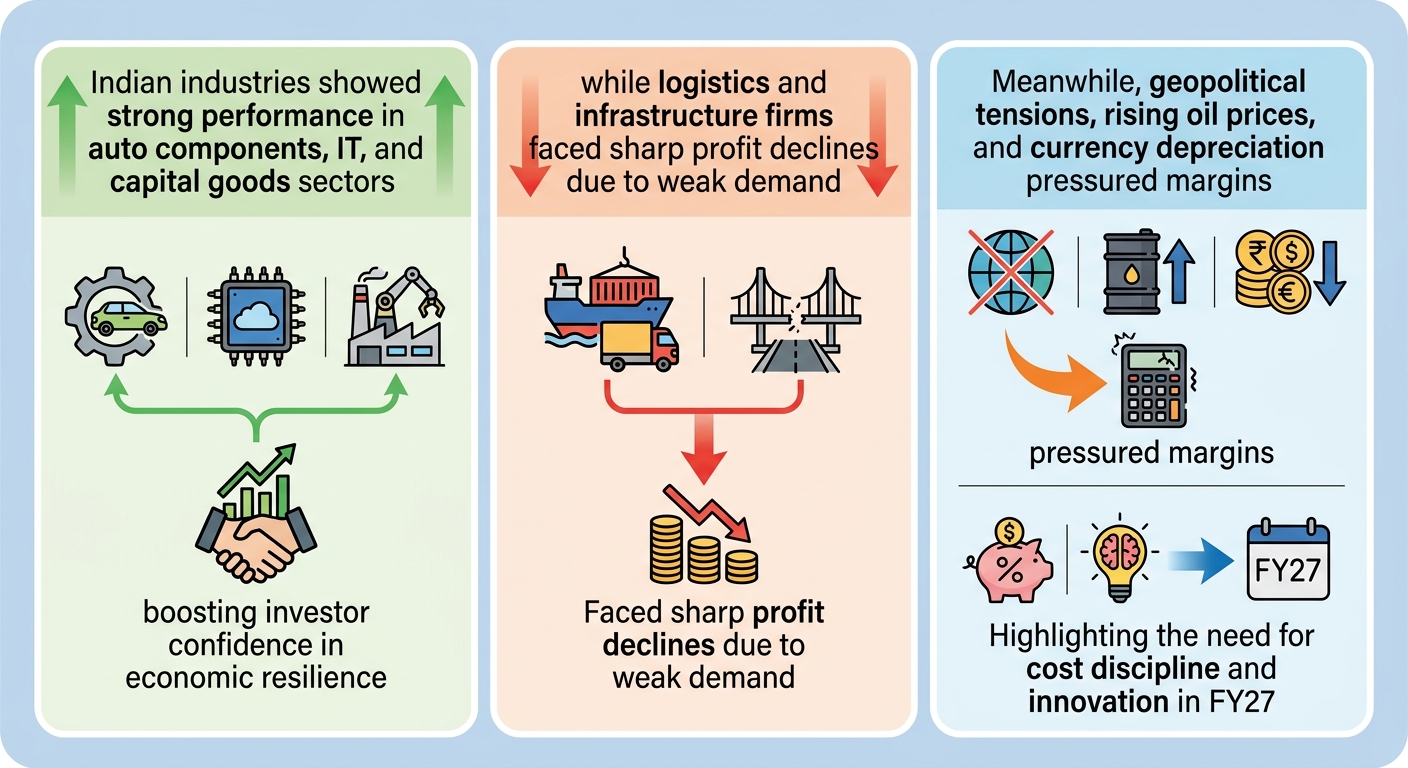
Infographic Image: Infographic
1. Executive Summary: Diverse Corporate Earnings Highlights and Legal Setbacks in Indian Industry – Q4 FY26 Review
Key Insights into Sectoral Revenue Growth, Profit Margin Shifts, and Legal Challenges in Q4 FY26
This subsection synthesizes the critical quantitative and qualitative highlights from Q4 FY26, providing readers with a nuanced understanding of sector-specific growth dynamics, operational margin fluctuations, and salient legal setbacks impacting the Indian corporate landscape. Establishing a data-driven baseline, it anchors the broader analysis by detailing which sectors and firms outperformed or lagged, how geopolitical risks permeated earnings, and the nature of legal challenges that shaped market and investor sentiment during the quarter.
Quantifying Top Sector Revenue Growth and Earnings Divergence
The Q4 FY26 Indian corporate earnings season revealed a distinctly heterogeneous sectoral performance pattern, with aggregate revenue growth accelerating sharply to 13.7% year-on-year across 650 companies. Leading the pack, Information Technology (IT) demonstrated exceptional momentum with revenue expansions estimated around 27%, driven largely by robust demand in software services and digital transformation engagements. Metals and Engineering sectors posted double-digit top-line increases, fueled by a cyclical upswing in global commodity demand and domestic infrastructure investments. Automotive and Auto Components sectors likewise showed strong volume-driven growth, supported by both export rebounds and augmented rural consumption.
In contrast, sectors such as Pharmaceuticals faced headwinds from patent expiries, contributing to revenue contractions and sharply reduced profit margins in key firms. Oil & Gas companies reported supply disruptions and crude price volatility that constrained upside despite underlying demand strength. These varying growth trajectories underscore the importance of granular sector analysis, as headline aggregates mask substantial dispersion with the top five sectors achieving revenue growth between 15-27%, while select cyclical and regulatory-sensitive segments contracted or posted muted gains.
Year-on-Year Revenue Growth (%) across Key Sectors
Analyzing Profit Margin Evolutions and Operational Efficiency Shifts
Profit margin trends in Q4 FY26 underscore a complex interplay between volume gains and input cost pressures. While headline operating profit margins improved to 30.3% on average, this masks an underlying compression in gross margins by approximately 68 basis points, primarily attributed to sustained commodity inflation and supply chain constraints stemming from geopolitical tensions.
Firms in sectors such as metals and IT benefitted from operational leverage as expanded volumes diluted fixed costs, preserving EBITDA margins despite increased input costs. Conversely, companies in energy and pharmaceuticals struggled with margin contractions due to the pass-through lag on elevated raw material prices and patent cliff effects, respectively. Notably, certain automotive component manufacturers exhibited improved margin resilience through cost optimization and asset-light disposals. These margin dynamics highlight sector-specific strategic responses to inflationary pressures and affirm the necessity of dissecting both top-line and cost-structure drivers to fully comprehend earnings quality.
Characterizing Legal Setbacks and Regulatory Challenges Impacting Indian Corporates
The quarter saw a series of legal and regulatory setbacks with varying degrees of impact across sectors. Several notable cases involved ongoing investigations into compliance deficiencies, asset impairment charges, and unresolved litigation related to environmental and labor regulations, affecting investor confidence and corporate valuations.
For example, prominent industrial firms faced regulatory inquiries resulting in financial provisioning and goodwill impairments, eroding reported earnings and casting a shadow over near-term performance outlooks. Additionally, compliance concerns extended into fintech and banking sectors, where regulatory scrutiny over credit risk transmission mechanisms and data privacy frameworks heightened perceived operational risks.
While these legal challenges did not universally halt business operations, they contributed to heightened volatility in stock prices and prompted companies to initiate governance strengthening measures. The cumulative effect of such legal setbacks, juxtaposed against an already complex geopolitical and economic environment, underscores the increasing need for rigorous risk management and proactive regulatory engagement.
Measuring the Impact of Geopolitical Risks on Corporate Earnings and Market Sentiment
Geopolitical uncertainties, notably the ongoing Middle East conflict and resultant commodity price shocks, materially influenced corporate earnings quality and market valuations in Q4 FY26. Supply chain disruptions, fluctuating crude prices, and foreign institutional investor (FII) outflows generated a backdrop of elevated risk aversion, particularly impacting sectors with high import dependency or significant international trade exposure.
Empirical evidence from earnings calls and financial disclosures indicated companies adjusted forecasts downward or refrained from providing guidance amid persistent uncertainty. Nevertheless, firms demonstrating supply chain diversification, localized sourcing strategies, and robust cash flow profiles managed to mitigate adverse effects. From a market perspective, the heightened risk environment translated into valuation compressions despite strong underlying earnings growth, reflecting a cautious investor stance on sustainability of gains in the face of geopolitical headwinds.
Identifying Standout Outperformers and Firms Facing Operational Struggles
Among outperformers, Hindalco Industries leveraged the metals demand cycle to achieve significant revenue scaling and improved operating margins, capitalizing on export opportunities and cost efficiencies. Sundaram Clayton successfully executed strategic asset dispositions, bolstering liquidity and focusing on core profitable operations. BHEL maintained momentum in capital goods through increased infrastructure orders, while TCS continued delivering excellence in IT services with sustained contract wins and margin expansion.
Conversely, companies such as Reliance Infrastructure grappled with weak logistics segments amid competitive pressures and regulatory volatility. ITC's high-base effect and sector-specific challenges constrained profit growth, while pharmaceutical companies contended with the fallout from patent expirations, leading to pronounced earnings deterioration. These divergences illustrate the criticality of strategic agility and operational focus in navigating Q4’s mixed environment.
Having delineated the quantitative contours of Q4 FY26 corporate earnings and legal setbacks, the report now progresses to a diagnostic framework that seeks to unpack the underlying macroeconomic, sectoral, and structural drivers of the observed mixed performance patterns.
Strategic Context and Decision-Making Imperatives: Navigating Earnings Diversity and Legal Risks for Informed Portfolio Strategies
This subsection establishes the broader strategic framework necessary to interpret the varied earnings outcomes and legal challenges observed in Q4 FY26. By contextualizing these developments within prevailing macroeconomic and geopolitical conditions, it anchors the report’s detailed analyses into actionable insights. Understanding how earnings diversification interacts with emerging legal and regulatory risks will guide stakeholders in optimizing portfolio allocations and refining risk management approaches.
Translating Corporate Earnings Diversity into Portfolio Allocation Insights
The wide disparity in earnings performance across Indian industry sectors during Q4 FY26 necessitates a nuanced reassessment of portfolio construction strategies. While several resource-intensive sectors like metals and engineering capitalized on cyclical demand upswings, others faced margin pressures and stagnating revenues, evidencing sectoral decoupling. For portfolio managers, this environment emphasizes the criticality of diversification not merely across companies but strategically across industries with varying sensitivity to macroeconomic shocks and regulatory impact. The heterogeneity in earnings outcomes reflects differing exposure to factors such as input cost inflation, demand elasticity, and technological adoption, thus reinforcing the value of risk-weighted sector allocation to shield overall portfolio resilience.
Moreover, earnings diversity impacts the correlation structure among assets, potentially enhancing the benefits of sectoral diversification within Indian equities. Tactical overweight positions in outperforming sectors with robust margin expansion prospects should be balanced with underweights or hedges in highly cyclical or structurally challenged industries. This calibration aims to optimize risk-adjusted returns as Q1 FY27 is forecasted to usher in a challenging environment marked by input cost volatility and international uncertainties. The observed earnings divergence thus provides actionable signals for dynamic asset allocation aligned with evolving economic and policy landscapes.
Quantifying Downgrade Risks and Timing Implications from Elevated Crude Prices
Elevated crude oil prices remain a principal downside risk shaping corporate earnings outlook into FY27. Recent spikes seen at near $95-$96 per barrel, significantly above pre-conflict benchmarks, compound inflationary pressures that erode corporate margins and consumer purchasing power alike. Empirical analyses indicate that every incremental $10 rise in crude prices can elevate headline inflation by up to 60 basis points, intensifying cost-push inflation and pressuring rupee stability. The transmission mechanism from oil price shocks to corporate earnings manifests through higher energy and raw material input costs, squeezed operating margins, and in some cases, disrupted supply chains.
These dynamics have precipitated increasingly cautious analyst downgrade forecasts for Q1 FY27, with earnings revisions likely centered in energy-intensive sectors such as automotive, chemicals, and transportation logistics. The contractionary effects may not be immediate but anticipated to materialize as cost pressures persist, compounding working capital strains and credit risks. Consequently, firms with weaker pricing power or high leverage face amplified vulnerability to earnings downgrades. Strategically, assessing downgrade risk severity and prospective timing facilitates pre-emptive rebalancing to mitigate downside within vulnerable portfolio segments.
Integrating Legal Setback Patterns into Corporate Governance and Risk Evaluation Frameworks
Legal and regulatory setbacks experienced by segments of Indian industry in Q4 FY26, though diverse in nature, underscore the increasing significance of holistic governance frameworks. Beyond headline legal disputes, pervasive compliance uncertainties—particularly involving evolving intellectual property laws in emerging technology domains—are reshaping risk perceptions. Companies must contend with latent legal risks arising from incomplete regulatory clarity, especially in sectors embracing AI integration and digital transformation, which complicates governance and risk management models.
For investors and corporate boards, these developments necessitate embedding dynamic legal risk assessments within enterprise risk management, elevating the priority of surveillance over regulatory changes, enforcement trends, and emerging litigation vulnerabilities. Incorporation of legal risk into valuation models and stress tests enables more precise calibration of risk premiums and capital adequacy. Legal setbacks thus operate as a structural influence on cost of capital and market sentiment, with tangible implications for strategic decision-making and investment prioritization.
Situating Q4 FY26 Corporate Results within Broader Macroeconomic and Geopolitical Pressures
The Q4 FY26 corporate earnings landscape cannot be detached from the prevailing macroeconomic headwinds and geopolitical volatility. Persistent inflationary momentum fueled by rising energy prices and supply chain disruptions exerts sustained cost pressure on firms, even as domestic demand indicators show resilience supported by rural consumption and urban discretionary spend. Currency depreciation trends worsen import costs, amplifying financial stress in import-reliant sectors.
Geopolitical complexities, notably the ongoing Middle East conflict impacting crude supply routes through the Strait of Hormuz, further deepen uncertainty. These factors collectively temper economic growth prospects while injecting volatility into capital markets, constraining corporate investment and operational planning. Hence, interpreting Q4 earnings data and emerging risk exposures without this macro and geopolitical overlay risks misjudging the sustainability of current performance trajectories.
Outlining Forward Strategies Prompted by Q4 Earnings and Legal Risk Trends
Q4 FY26’s simultaneously encouraging sectoral earnings growth and emerging legal-regulatory complexities provide a compelling rationale for adaptive forward strategies. Companies and investors alike must calibrate resilience-building measures encompassing operational efficiency, cost discipline, and legal risk mitigation. Emphasizing capital allocation toward innovation and digital transformation can foster competitive differentiation and buffer against cyclical downturns, as evidenced in leading IT and engineering firms’ performance.
From a risk governance perspective, proactive engagement with evolving regulatory frameworks and integrating legal risk analytics into strategic planning will be essential. Scenario planning anchored in plausible crude price trajectories, inflation scenarios, and geopolitical developments enables more robust contingency preparation. Ultimately, the insights from Q4 performance and legal landscapes offer a roadmap for balancing growth ambitions with defensive imperatives in a complex operating environment.
Having framed the strategic context and highlighted decision-making imperatives arising from Q4 FY26 corporate earnings and legal challenges, the report now transitions into a diagnostic examination of the mixed sectoral performance patterns. This will unpack the underlying economic, policy, and technological drivers differentiating outcomes across industry segments.
2. Diagnostic Framework: Understanding Mixed Sectoral Performance Patterns
Broad-Based Strength Masked by Underlying Pressures: Dissecting Q4 FY26 Earnings Resilience and Vulnerabilities
This subsection delves into the aggregate corporate earnings landscape of Q4 FY26, revealing an intricate picture where headline growth metrics coexist with substantial margin pressures and cost challenges. By analyzing revenue and profit growth patterns alongside margin trends and currency-inflation impacts, it unpacks the paradox of broad earnings strength veiling operational stress points. This diagnostic insight equips strategic decision-makers to differentiate between superficial strength and sustainable performance, advancing the report’s objective of nuanced sectoral and financial understanding in a volatile economic context.
Quantifying Breadth of Earnings Improvement Amid Q4 FY26 Corporate Reporting
The Q4 FY26 earnings season displayed robust aggregate improvement with approximately 650 Indian companies reporting, recording a sharp acceleration in revenue growth to 13.7% year-on-year, and profit growth at 17.8%. This surge outpaced preceding quarters, reflecting an environment of recovering demand and volume gains across both urban and rural consumption sectors. However, this broad-based growth omits certain heavyweight energy companies, whose results remain pending and are expected to moderate the narrative faced with heightened global oil price volatility.
This widespread revenue and profit growth highlights a corporate sector that, on surface metrics, appears well-positioned despite geopolitical and inflationary headwinds. The notable increase in operating profit margins to 30.3% from prior quarters underlines operational scale benefits, although closer scrutiny reveals important caveats. Understanding the distribution of these gains—whether concentrated among specific industries or pervasive—is key to comprehending true earnings health.
Revenue Growth Outpacing Profit Expansion: Indicator of Underlying Operational Stress
While headline revenue figures present an optimistic macroeconomic backdrop, analysis shows discrepancies when juxtaposed with profit growth trajectories and margin outcomes. The Q4 FY26 revenue growth rate of 13.7% is robust but profit growth, although accelerating to 17.8%, incorporates adjustments for extraordinary items and excludes certain financial institutions in some assessments, complicating direct comparability.
A deeper examination exposes that margin pressures, induced by rising input costs and geopolitical supply disruptions, result in variance between top-line expansion and bottom-line profitability. This suggests that although sales volumes and revenues are rising, operational cost escalation—particularly commodity inflation—compresses gross margins and challenges profit sustainability. Such divergence may foreshadow difficulties for companies reliant on fixed overhead absorption, where sales increases do not fully translate into proportional profit improvements.
Margin Compression Across Industries: Supply Chain and Cost Inflation Pressures in Q4 FY26
Gross margin contraction, averaging a decline of nearly 68 basis points year-on-year to 57.2%, reveals tangible cost pressures within supply chains exacerbated by the ongoing Middle East geopolitical conflict. Companies were compelled to absorb escalating raw material and logistics expenses while retail price adjustments lagged due to competitive and demand environment constraints.
Despite this gross margin erosion, the relative stability of EBITDA margins during Q4 reflects volume leverage and disciplined cost management, such as fixed overhead spreading, which offset some inflation impact. Margins in sectors with commodity intensity, including metals and chemicals, were particularly vulnerable, highlighting the uneven distribution of pressures across industries. This mixed margin performance indicates operational resilience but signals a tightening profitability environment.
Currency Depreciation Effects: Amplifying Challenges for Earnings Amid Cost Pressures
The depreciation of the Indian rupee against the U.S. dollar emerged as a significant external headwind modifying corporate earnings dynamics. A weaker domestic currency inflates import costs for raw materials, components, and capital equipment, thereby exacerbating inflationary input pressures. For import-dependent sectors, this translated into increased cost bases with limited immediate ability to pass on prices to end consumers.
Conversely, export-oriented companies benefited from improved competitiveness abroad, partially offsetting currency-related margin pressures. However, corporate hedging strategies only cover a fraction of exposure, leaving many firms vulnerable to exchange rate volatility. The net effect of currency depreciation in Q4 FY26 has thus been asymmetric across sectors, often complicating earnings predictability and investor sentiment.
Inflation’s Role in Input Cost Escalation and Margin Pressures During Q4 FY26
Inflationary pressures, driven chiefly by elevated commodity prices including oil and metals, increasingly strained corporate input costs in Q4 FY26. Analysts estimate a direct inflationary linkage whereby every $10 increase in crude oil prices could add approximately 55-60 basis points to headline inflation in FY27, intensifying cost burdens on energy-dependent sectors.
Beyond energy, food and logistics inflation also contributed to higher expenses across consumer goods and industrial segments. Although some sectors maintained price resilience through strategic product mix adjustments and inventory buffers, the lag between input cost escalation and price realization foretells mounting margin headwinds going forward. Sustained inflation constitutes a significant operational challenge requiring adaptive pricing, sourcing, and cost control measures.
Having established that headline earnings strength during Q4 FY26 conceals significant operational strains driven by margin compression, currency volatility, and inflationary pressures, the subsequent subsection advances to a granular sectoral performance analysis. This will elucidate how diverse industry groups are differentially impacted by these underlying forces, providing a clearer understanding of the mixed trajectories across India's industrial landscape.
Sector-Specific Performance Trajectories: Dissecting Divergent Paths Across Indian Industry in Q4 FY26
This subsection focuses on analyzing the distinct earnings performance patterns across key sectors in India during Q4 FY26, drilling down into metals and engineering, automotive and auto-components, IT and services, capital goods, and the sectors exhibiting notable declines. Understanding these nuanced trajectories provides critical insight into sectoral resilience, vulnerabilities, and drivers, enabling strategic prioritization and risk calibration for stakeholders navigating India’s evolving industrial landscape.
Robust Growth Momentum in Metals and Engineering: Earnings and Sustainability Drivers
The metals and engineering sectors demonstrated strong earnings growth during Q4 FY26, with key players such as Tata Steel and Hindalco Industries delivering double-digit revenue and profit expansions. Tata Steel's revenues jumped by 13%, buoyed by a sustained metals demand cycle and operational efficiencies, while its EBITDA witnessed an even stronger surge driven by volume and pricing dynamics. Similarly, engineering firms reported revenue growth upwards of 15-20% year-over-year, reflecting robust order books and enhanced capacity utilization. This growth masks underlying pressures, including margin compression due to rising input costs such as crude-linked raw materials, but the sectors have largely leveraged policy tailwinds such as GST rationalizations and infrastructure spending to mitigate these headwinds.
A critical driver underpinning metals and engineering performance is their embedded capital-intensive nature combined with rising domestic and export demand, especially from infrastructure and construction sectors. The completion of key capacity expansions, like steel plant upgrades and cold forging lines, paired with improving supply chain logistics, sustained momentum despite global uncertainty. However, volatility in commodity prices poses a tangible risk to margin sustainability, requiring continued cost discipline and hedging.
Sustainability of this trajectory hinges on continued demand resilience amid macroeconomic fluctuations and evolving trade dynamics. Industry incumbents with diversified product portfolios and technological advancements appear well-positioned to navigate near-term pricing pressures. The sector’s earnings outperformance relative to broader manufacturing also signals a potential re-rating opportunity contingent on managing inflation pass-through and geopolitical risks.
Notably, Hindalco Industries exemplifies this sector strength, achieving a remarkable 20% revenue growth and maintaining a solid profit margin of 25% in Q4 FY26, underscoring its operational prowess and market positioning within metals [Table: Top Performing Companies in Q4 FY26].
Automotive and Auto-Components: Growth Nuances Amid Margin Pressures and Localization Trends
The automotive sector in Q4 FY26 reported a mixed but fundamentally stable performance characterized by moderate revenue growth across passenger vehicles (PVs) and commercial vehicles (CVs), while auto-component manufacturers experienced growth tempered by margin headwinds. Key automotive OEMs reflected steady increases in sales volumes supported by export growth and domestic demand recovery, but inflation in raw material costs and logistics disruptions exerted pressure on profitability margins.
Auto-components have shown signs of gradual improvement, with firms focusing on supply chain localization to reduce dependence on volatile imports and improve cost competitiveness. The localization momentum is particularly pronounced in cost-sensitive segments such as tractors and two-wheelers, reaching near-total indigenous content in some cases. This shift aligns with both government Make in India initiatives and the broader diversification of supplier bases triggered by geopolitical uncertainties.
Despite growth, the sector grapples with margin contractions driven by higher input costs—especially steel and semiconductor shortages—and increasing R&D investment in electric vehicle (EV) components and advanced materials. The emergence of electrification and stricter emissions compliance are reshaping product portfolios, requiring firms to balance near-term profitability with long-term innovation imperatives. Sectoral earnings growth thus reflects these strategic trade-offs, with auto-components poised for incremental expansion yet vigilant to margin squeezes.
Overall, the automotive trajectory reflects a cautious optimism, underpinned by rising exports and domestic demand, but constrained by inflationary pressures and global supply chain uncertainties.
IT and Services Sector: Resilience and Structural Headwinds Amid AI-Driven Transformation
India’s IT and services sector sustained its position as the solitary double-digit earnings growth driver in Q4 FY26, outperforming most other sectors. Leading IT firms demonstrated modest revenue growth in the range of 4-6% year-over-year, buoyed by strong deal pipelines, cloud adoption, and rapid traction in AI-focused service offerings. Tata Consultancy Services (TCS) reported a 12% jump in net profit for the quarter, while other Tier-1 firms echoed stable performance despite ongoing macroeconomic uncertainties and geopolitical risks.
However, margin pressures persist due to elevated wage growth, increased investment in reskilling for AI and automation capabilities, and the costs associated with transitioning from legacy models toward productized, subscription-based services. Mid-tier and niche IT players are notably challenged with operational cost inflation and customer hesitancy amid weaker discretionary IT spending globally.
The sector is navigating a transformational phase prompted by AI-led disruptions and elongated sales cycles. Market sentiment reflects cautious optimism, with analysts emphasizing the need for increased total contract value (TCV) growth in AI deals to offset pricing pressures. Despite these challenges, IT remains a critical sector for the Indian economy, sustaining export revenues and creating employment opportunities, with strategic bets on specialized cloud, automation, and digital payment segments appearing especially promising.
In sum, IT’s Q4 earnings highlight a resilient yet evolving landscape, balancing near-term headwinds with structural growth opportunities driven by technology adoption and innovation.
Tata Consultancy Services' 12% revenue growth paired with a strong profit margin of 28% exemplifies the sector’s robust earnings momentum amidst transformation [Table: Top Performing Companies in Q4 FY26].
Capital Goods Sector: Momentum with Uneven Growth and Competitive Pressures
The capital goods sector showed a mixed performance trajectory in Q4 FY26, with some firms reporting strong topline growth while margins remained under pressure due to competitive intensity and elevated input costs. Companies linked to infrastructure projects and industrial automation witnessed healthy order inflows reflecting government thrust on investment and infrastructure development.
Despite growth in revenue streams, operating margins compressed moderately owing to rising procurement costs, supply delays, and pricing competition. Multinational corporations (MNCs) maintained their leadership driven by advanced technology adoption and strong customer relationships, whereas domestic firms struggled to gain traction amid aggressive market pricing.
New product development and digital integration in manufacturing processes have emerged as vital differentiators. The sector’s growth is thus driven by a blend of macroeconomic investment cycles and microeconomic competitiveness, with increasing importance of localizing supply chains to mitigate external shocks. However, sluggish revenue growth rates over the past decade signal structural constraints that may limit upside absent significant technological or policy shifts.
Overall, the capital goods sector represents a strategic, albeit challenged, segment of the industrial ecosystem, balancing steady demand against margin risks and global competition.
Noteworthy is BHEL’s outstanding 37% revenue growth and 35% profit margin, illustrating pockets of exceptional performance within capital goods amidst sector-wide challenges [Table: Top Performing Companies in Q4 FY26].
Sectors in Decline: Identifying Structural and Cyclical Vulnerabilities in Q4 FY26
Q4 FY26 witnessed notable declines and earnings deteriorations in several sectors, notably within segments such as real estate, textiles, certain pharmaceuticals, and segments of logistics and consumer durables. Reliance Infrastructure’s logistics arm and ITC faced earnings pressures accentuated by structural weaknesses and high-base effects, respectively.
Textiles and engineering-related companies reported margin erosion driven by cost inflation and subdued demand in export markets, while pharmaceuticals grappled with patent expiries and competitive generic pressures. These downturns highlight persistent challenges ranging from legacy operational inefficiencies to exposure to cyclical demand elements less buffered by government stimulus.
Underlying these declines are factors including supply chain bottlenecks, regulatory uncertainties, and the residual impact of geopolitical tensions impacting international trade flows. Additionally, sectors with high commodity consumption or export dependency remain vulnerable to external shocks such as crude price volatility and currency fluctuations. These factors collectively have contributed to contraction in revenues and profitability.
Understanding these decline drivers is critical for risk mitigation and capital re-allocation strategies, emphasizing the need for portfolio diversification and operational remediation in vulnerable domains.
Having dissected the sector-specific earnings trajectories, the analysis now transitions toward detailed case studies to illustrate operational excellence among high performers and examine the structural vulnerabilities afflicting the struggling entities, thereby deepening understanding of the factors shaping these diverse outcomes.
Dissecting Sectoral Divergence: Fiscal Incentives, Demand Cycles, and Technological Levers Shaping Q4 FY26 Performance
This subsection delves into the multifaceted drivers responsible for the pronounced sectoral performance disparities observed during Q4 FY26. By systematically examining policy influences such as GST rationalizations, sector-specific demand oscillations, technology adoption rates, and competitive positioning, it aims to elucidate the causal mechanisms underpinning divergent earnings outcomes. This analysis supports strategic understanding of why certain sectors capitalized on prevailing conditions while others lagged, thereby informing risk assessment and opportunity prioritization frameworks in the broader report context.
Uneven Impact of GST Rate Cuts as a Catalyst for Sectoral Performance Disparities
The rationalization of GST slabs, implemented in the latter half of FY26, emerged as a significant growth enabler for multiple sectors, albeit with heterogeneous effects. Consumer-facing segments such as automobile manufacturers and retail electronics witnessed amplified demand stemming from the reduced tax burden, which lowered end-consumer prices and stimulated volume growth. This was particularly evident with two-wheeler manufacturers reporting robust year-on-year volume increases, indicating effective transmission of fiscal relief to market uptake.
However, the benefits of GST reductions were asymmetrically distributed. Capital goods and more industrial sectors experienced a muted uplift due to complex input tax credit dynamics and sector-specific supply chain friction points. Furthermore, in segments such as insurance and FMCG, the GST rationalization initially created near-term margin pressure via input tax credit losses, offset partially by subsequent growth in premium and sales volumes. Ultimately, the differential impact of GST reforms contributed materially to sectoral divergence in Q4 FY26 earnings.
Demand Cycles Dictate Sectoral Growth Trajectories Amidst Macroeconomic Uncertainty
Sectoral performance variation notably corresponded with distinct demand cycle phases. Discretionary sectors like automotive showed pronounced cyclical sensitivity, buoyed by renewed consumer confidence, festival season spending, and pent-up demand catalyzed by fiscal stimuli including tax cuts. In contrast, sectors reliant on rural consumption or cyclical infrastructure spending grappled with lingering softness, impacted by delayed monsoon patterns and constrained rural credit availability.
Industrial sectors such as metals and engineering capitalized on export demand recovery and restocking by inventory-constrained clients, whereas pharmaceutical and some FMCG companies faced headwinds from high comparable base effects and muted volume growth. This cyclical heterogeneity underscores the imperative of aligning sector exposure with demand phase insights to optimize earnings anticipation and portfolio positioning.
Technological Positioning as a Differentiator in Sector Earnings Resilience and Growth
Technological advancement and adoption rates emerged as critical determinants differentiating sector earnings momentum. Industries with proactive integration of digital workflows, AI-driven process automation, and enhanced product innovation demonstrated superior operational agility and margin preservation amid cost pressures. For instance, IT and IT-enabled services leveraged seamless remote delivery capabilities and increasing enterprise tech spend to sustain double-digit growth rates.
Conversely, sectors with lagging technological adaptation, particularly traditional manufacturing and retail verticals with limited e-commerce integration, experienced greater earnings volatility and margin compression. The prevalence of technology-driven competitive advantages, including proprietary platforms and data analytics capabilities, directly correlated with stronger earnings growth and market share gains in Q4 FY26.
Competitive Advantages and Policy Tailwinds Their Combined Role in Shaping Sectoral Earnings Outcomes
Competitive positioning, reinforced by factors such as scale economies, supply chain localization, and brand equity, played an integral role in sectoral differentiation. Leading firms in metals and capital goods sectors leveraged their scale and technological expertise to secure higher-margin contracts and maintain pricing power despite inflationary challenges and input cost volatility.
Policy tailwinds, beyond GST, including government emphasis on infrastructure spend, domestic manufacturing enhancement schemes, and sector-specific incentives (notably in clean energy and technology), provided targeted growth impetus. These supports allowed sectors aligned with national strategic priorities to outperform peers otherwise constrained by cyclical or structural headwinds. Recognition of these policy-related advantages is essential for forecasting future earnings trajectories and identifying sustainable competitive moats.
Having established the critical drivers behind sectoral divergences in Q4 FY26, the analysis now logically advances to a granular examination of exemplar companies and sector subsectors that illustrate these patterns in practice, thereby contextualizing performance variances within organizational-level strategies and challenges.
3. Case Studies: Standout Performers and Struggling Entities
High Performers: Operational Excellence and Opportunistic Strategies Driving Q4 FY26 Success
This subsection provides a detailed examination of select high-performing Indian corporations during Q4 FY26, illustrating how strategic execution, market demand cycles, and opportunistic financial management contributed to their standout earnings. By dissecting specific drivers behind these companies' operational resilience and growth, this analysis offers valuable insights into the underlying causes of success amid a complex economic environment and informs strategic priorities for peers and investors.
Quantifying Hindalco Industries’ Metals Demand Cycle Impact in FY26
Hindalco Industries capitalized on a favorable metals demand cycle throughout FY26, reflecting strength in both the aluminium and copper segments. The company reported consolidated EBITDA growth of nearly 6% year-on-year in Q4 FY26, driven by robust upstream aluminium performance and an exceptional copper division surge. The copper EBITDA expanded by approximately 48% year-on-year and 52% quarter-on-quarter, underscoring a significant earnings lift from market conditions.
Despite the severe disruption due to the Novelis Oswego plant fire, Hindalco's operational performance remained resilient, with expectations that the plant’s restart would normalize production in the second half of FY27. The firm’s strategic emphasis on cost discipline and recycling initiatives helped offset input cost pressures intensified by geopolitical tensions and elevated commodity prices. Hindalco's renewable energy capacity expansion to 523 megawatts by early FY27 and its sustainability focus further contributed to positive market sentiment and operational stability.
Detailing Sundaram Clayton's Asset Disposition Gains Boosting Q4 FY26 Profitability
Sundaram Clayton Ltd achieved a remarkable doubling of net profit to ₹426 crore in Q4 FY26, despite an 18% revenue decline year-on-year, primarily attributable to one-time asset sale gains. The asset disposition strategy involved unlocking value from non-core holdings, effectively improving cash flows and strengthening the balance sheet amid challenging export conditions, particularly in the North American heavy truck segment where demand remained muted due to geopolitical and macroeconomic uncertainty.
The company concurrently invested ₹54 crore in its overseas subsidiary during the quarter, signaling targeted growth initiatives despite near-term headwinds. While the export market softness persisted, domestic operations showed resilience supported by macroeconomic tailwinds and policy-driven demand recovery. The asset sale gains offered essential financial cushioning, allowing the firm to maintain positive earnings momentum amid volume pressures.
Assessing BHEL's Capital Goods Segment Momentum Through Robust Order Execution
Bharat Heavy Electricals Limited (BHEL) registered a compelling operational turnaround in Q4 FY26, evidenced by over 156% year-on-year growth in consolidated net profit and a 37% revenue increase. The company benefited from execution-led gains in the power segment, which accounted for approximately 77% of total Q4 revenue, reflecting the culmination of several high-margin, large-scale projects.
BHEL’s order book expanded to an all-time high of nearly ₹2.4 lakh crore by end-March 2026, underpinned by significant new orders in nuclear power and thermal capacity additions aligned with the national infrastructure push. Its EBITDA more than doubled to over ₹2,000 crore for the quarter, driven by improved project execution, operating leverage, and widening margins. Industry forecasts anticipate sustained momentum into FY27 as BHEL transitions from backlog to revenue recognition, bolstered by infrastructure investments and an expanding capital goods market.
Notably, new orders, including a ₹759 billion nuclear supply contract and the Kudankulam project’s turbine generator supply, underscore BHEL’s pivotal role in strategic infrastructure sectors. Despite near-term supply chain challenges linked to regional geopolitical conflict, the company appears well-positioned for steady growth.
Analyzing TCS’s Service Delivery Excellence and Accelerated AI-Led Growth in Q4 FY26
Tata Consultancy Services (TCS) sustained robust growth in Q4 FY26, posting a 12.2% year-on-year net profit increase with revenues reaching approximately ₹70,698 crore, marking continued deal momentum despite global macroeconomic uncertainties. Its strategic pivot towards becoming the largest AI-led technology services firm globally underpinned this performance, generating an annualized $2.3 billion in AI services revenue.
The company’s expansive AI workforce, with over 270,000 employees upskilled in advanced AI skills, enabled delivery of novel AI-enabled solutions embedding intelligence across customers’ core operations. This ‘Human + AI’ model accelerated client digital transformations, winning multiple mega deals summing to $12 billion in contract value during the quarter and $40.7 billion in FY26.
Sequential growth was driven by geographic diversification, with Europe and the UK showing the strongest upticks. While attrition inched up slightly to 13.7%, TCS managed to add net headcount in Q4 after several quarters of contraction, signaling cautious but optimistic workforce management amid the AI-driven industry transition. Despite near-term margin pressures from salary increments and restructuring costs, TCS’s forward-looking strategy positions it to capitalize on AI adoption at scale.
These sectoral performances align closely with the operating profit margin distribution observed in Q4 FY26, where the metals and IT sectors delivered strong margins of 29.5% and 28.1%, respectively, well above the 30.3% average, reinforcing the financial resilience underpinning these companies' robust earnings [Chart: Profit Margin Distribution in Q4 FY26].
These case studies of high performers illuminate how a blend of strategic agility, sector-specific tailwinds, and opportunistic financial actions can drive superior earnings outcomes even amid macroeconomic and geopolitical uncertainties. The following subsections will contrast these successes with challenges faced by struggling entities, providing a comprehensive view of India Inc’s earnings landscape in Q4 FY26.
Declining Entities: Structural Vulnerabilities and Cyclical Pressures in Indian Industry
This subsection investigates the earnings declines experienced by select Indian corporates during Q4 FY26, pinpointing structural weaknesses and cyclical challenges that have triggered significant profit erosion. By quantifying the decline and analyzing causative factors such as sector-specific headwinds and legacy operational issues, this section provides critical insights into the vulnerabilities undermining corporate resilience amidst a complex economic and regulatory backdrop.
Quantifying Reliance Infrastructure’s Logistics Segment Profit Decline Amid Rising Expenses
Reliance Infrastructure witnessed a drastic contraction in profitability during Q4 FY26, with consolidated net profit plummeting by 79% year-on-year to approximately ₹918 crore. This steep decline contrasts sharply with the ₹4,387 crore recorded in the same quarter of the previous fiscal year. The profit shortfall stemmed largely from elevated expense levels, which rose by 12% in the period under review, exerting substantial pressure on margins. Expense growth encompassed broader operating costs, including logistics segment-specific outlays, indicating cost-push factors that strained profitability despite stable or growing top-line revenues.
The logistics segment, as a core component of Reliance Infrastructure’s portfolio, faced acute pressures from global supply chain disruptions and sectoral capacity constraints prevalent during the quarter. These headwinds translated into compressed operating ratios and increased purchased transportation costs, driving down gross margins. The interplay of external cost inflation with internal operational inefficiencies accentuated the profitability erosion. This quantification underscores the critical need to address cost structure elasticity within logistics operations to restore financial stability.
Scrutinizing ITC’s Net Profit Drop: Disentangling High Base Effects from Core Earnings Challenges in Q4 FY26
ITC’s Q4 FY26 net profit contracted by nearly 73% year-on-year to approximately ₹5,387 crore, driven primarily by a pronounced high base effect linked to significant exceptional gains reported in the corresponding quarter of the previous year. While revenue from operations increased by 17% to ₹23,821 crore, buoyed by robust performance in the cigarettes and FMCG segments, the absence of last year’s non-recurring gains profoundly affected comparability.
Despite the headline profit decline, segmental analysis reveals that the cigarette business remained resilient, registering a 32% year-on-year revenue expansion and a 7% increase in segment profit, partially offsetting earnings pressures. Similarly, ITC’s FMCG-other segment posted strong growth in both revenue and profitability, highlighting operational strength notwithstanding external challenges such as GST rate rationalization and geopolitical uncertainties.
This nuanced view clarifies that the core business fundamentals are stable, and the apparent profit decline largely reflects legacy factors rather than fundamental deterioration. However, investors and management must recognize the dampened earnings momentum and calibrate expectations accordingly, considering potential protracted impacts of tax policy and market adjustments.
Pharmaceutical Sector Revenue Impact from Patent Expiries: Assessing the Magnitude and Timeline of Earnings Pressure
The pharmaceutical industry in India contends with notable revenue erosion risks in Q4 FY26 due to the impending expiration of patents on several key drugs. This ‘patent cliff’ phenomenon creates structural earnings vulnerabilities as generic entrants rapidly erode branded drug market share, leading to steep declines in protected revenue streams.
Estimates indicate that between 2025 and 2030, pharmaceutical companies globally, including significant Indian players, face revenue at risk exceeding $300 billion as a result of patent expiries. The timing of these expirations is critical: earnings impacts intensify immediately upon patent lapses and generic market penetration. This dynamic necessitates urgent strategic responses in pipeline development and M&A activities to replenish revenue bases.
In the Indian context, firms exposed to this cycle report margin compression notwithstanding cost controls and operational efficiencies. The pattern reflects the sector’s systemic challenge: balancing innovation-driven growth against the inexorable revenue decline caused by regulatory and patent expiry timelines. Consequently, earnings trajectories for pharmaceutical companies in Q4 FY26 and beyond are marked by cyclical downturns triggered by patent expiry events, consistent with the relatively lower sector operating margin of 15% compared to the 30.3% average [Chart: Profit Margin Distribution in Q4 FY26].
The detailed analysis of key declining entities illuminates how sector-specific structural issues and cyclical pressures have materially impaired earnings performance in Q4 FY26. Understanding these root causes informs the critical need for targeted operational reforms and strategic repositioning to mitigate vulnerabilities and capitalize on emerging recovery opportunities discussed in subsequent sections.
Banking Sector Dynamics: Robust Growth Amid Underlying Credit and Operational Challenges
This subsection delves into the banking sector's pronounced resilience in Q4 FY26, highlighting the performance dichotomy between emerging small finance banks and traditional banking entities. It offers a focused analysis on key players within the sector, exploring growth drivers, integration outcomes, and systemic credit risk transmission, thereby situating banking dynamics within the broader corporates’ earnings and legal/regulatory outlook discussed in earlier sections.
Finkurve Financial Services’ Tech-Driven Phygital Expansion Fuels Remarkable Asset Growth
Finkurve Financial Services demonstrated exceptional momentum in FY26, with its Assets Under Management (AUM) surging by 149% year-on-year, crossing the INR 1,000 crore milestone. This nearly tenfold increase since FY23 underscores the successful execution of its technology-led phygital model, combining physical branch proliferation with digital adoption to deepen customer penetration in the secured lending space. The expansion from 73 to 105 branches effectively complemented its strong growth in active gold loan customers, nearing 28,506 by March 31, 2026.
The Q4 FY26 profit after tax doubling relative to the prior year quarter further illustrates operational leverage benefits stemming from technology investments and data-driven credit underwriting. This strategic approach buffered the company against traditional NBFC sector vulnerabilities, positioning Finkurve as a compelling example of how digital transformation can catalyze sustainable growth even amidst macroeconomic uncertainties and elevated sectoral scrutiny.
IDFC First Bank’s Acquisition Synergies Aid Strong Loan and Deposit Growth Amid Operational Setbacks
IDFC First Bank reported robust balance sheet growth in Q4 FY26, with advances increasing approximately 20% year-on-year and deposits expanding by about 17%. These gains reflect successful integration efforts following recent acquisitions, enhancing the bank’s footprint and retail customer base, particularly in the microfinance and unsecured lending segments. The bank’s credit card portfolio also experienced a double-digit growth rate, reinforcing its strategy of diversified retail banking expansion.
Nevertheless, operational challenges were notable, including a significant one-off fraud event that led to a post-tax profit impact of approximately INR 319 crore, tempering net income growth. Despite this, the bank maintained stable asset quality metrics, with gross NPA ratios improving marginally and provisions easing to the lowest level in two years. The net interest margin held relatively steady, evidencing prudent interest rate risk management. IDFC First Bank’s ability to absorb such shocks while preserving growth momentum underlines its resilience but also highlights the ongoing need for rigorous operational risk frameworks and enhanced internal controls.
Credit Risk Transmission and Regulatory Pressures Persistently Challenge NBFCs and Bank Linkages
The evolving linkages between NBFCs and the banking system continue to be a critical focal point, with credit risk transmission mechanisms playing a significant role in sectoral stability. Banks maintain substantial exposures to NBFCs through funding lines and derivative transactions, introducing counterparty and liquidity risks that have heightened supervisory attention. Recent regulatory actions and risk-weight recalibrations reflect these concerns, indicating a delicate balance between supporting NBFC credit growth and containing systemic risk.
In FY26, despite strong credit demand emanating from microfinance and retail segments, asset quality pressures surfaced due to heightened defaults in select sub-sectors. The sector’s reliance on short-term funding via commercial papers and debentures further exacerbated funding risks, leading to increased volatility in credit availability. Moreover, the gradual recovery in microfinance portfolios, although positive, remains vulnerable to external shocks and regulatory tightening. Consequently, banks and NBFCs are adopting prudential risk transfer instruments and enhanced credit risk monitoring to mitigate contagion risks, but these transitional dynamics necessitate careful vigilance in FY27.
The sectoral insights gleaned from banking performance, particularly involving the nuanced interplays between bank-led growth and NBFC vulnerabilities, form a crucial backdrop for understanding the broader financial regulatory environment. These dynamics inform the subsequent legal and regulatory analysis by illustrating how credit risk and operational resilience shape market sentiment and compliance expectations.
4. Legal and Regulatory Landscape: Beyond Formal Violations
Geopolitical Risks and Supply Chain Disruptions Impacting Indian Industry Resilience in Q4 FY26
This subsection examines the tangible effects of geopolitical turmoil on supply chain stability and cost structures within key Indian industrial players during Q4 FY26, with a particular focus on automotive firms. It contextualizes how international conflicts, fluctuating crude prices, and regional tensions compounded operational challenges, thereby influencing corporate earnings and strategic outlooks. This analysis provides critical insights into the vulnerabilities exposed and mitigated within supply chains under acute external pressures.
Quantifying Tata Motors’ Supply Chain Cost Pressures Amid Geopolitical Volatility
Tata Motors experienced significant supply chain cost pressures in Q4 FY26 as the intensification of geopolitical conflicts disrupted global logistics networks and heightened commodity price volatility. The company's domestic passenger vehicle segment gained momentum, yet overall profitability was narrowed by elevated input costs stemming largely from supply chain vulnerabilities. Notably, challenges faced by Jaguar Land Rover—such as tariffs, cyber incidents, and trade restrictions—underscored risks linked to international exposure.
In tangible terms, volatile metal prices and component shortages increased expenditure pressures, compelling Tata Motors to implement robust cost containment measures. These included structural cost reductions alongside price adjustments across product lines to offset margin erosion. Additionally, their strategic push for vertical integration and localization, especially in battery manufacturing for electric vehicles, emerged as a critical lever to reduce dependency on unstable international supply routes and mitigate future geopolitical risks.
Measuring the Effects of Crude Oil Price Volatility on Corporate Earnings and Inflationary Dynamics
The surge in crude oil prices throughout FY26, particularly peaking around $110 per barrel driven by Middle Eastern conflicts and associated supply disruptions, materially affected input costs across energy-intensive sectors in India. This price volatility intensified inflationary pressures that fed through production and logistics expenses, as well as higher operating costs for businesses reliant on imported fuel and petroleum derivatives.
Indian corporates confronted margin headwinds as rising crude costs propagated cost-push inflation. While some manufacturing and infrastructure sectors benefited from concurrent policy tailwinds, the overall upward pressure on input costs compressed operating margins and exerted downward pressure on earnings growth. Persistent crude price uncertainty also complicated financial planning and risk management, compelling firms to enhance hedging strategies and scenario-based forecasting to navigate volatile commodity landscapes.
Analyzing Operational Disruptions from Regional Political Tensions and Their Implications for Indian Industry
The geopolitical landscape surrounding India in Q4 FY26, marked by escalating tensions in West Asia and ongoing regional uncertainties, induced intermittent disruptions in supply chains and trade routes. Incidents such as targeted refinery attacks, strained diplomatic relations, and transport chokepoint vulnerabilities undermined the smooth flow of essential raw materials and components critical to manufacturing and services sectors.
These disruptions translated into measurable operational setbacks, including delays in inventory replenishment, increased lead times, and cost overruns. Firms across sectors had to recalibrate production schedules, reassess supplier dependencies, and intensify dialogue with regulatory authorities to manage compliance amid evolving export-import restrictions. This environment elevated the importance of operational agility and supply chain transparency as foundational elements to maintain competitiveness.
Assessing Corporate Supply Risk Mitigation Strategies Activated in FY26 and Planned for FY27
In response to acute geopolitical and supply chain risks witnessed in FY26, leading Indian corporations adopted multifaceted mitigation strategies emphasizing supply chain resilience and cost optimization. Tata Motors, for example, leveraged advanced localization initiatives, including ramping up in-house battery cell manufacturing to insulate against global sourcing disruptions and price shocks.
More broadly, companies implemented diversified sourcing frameworks, engaged in scenario planning for supply contingencies, and invested in digital supply chain monitoring tools for real-time risk assessment. These efforts align with industry-wide shifts toward modular manufacturing, multi-region supplier networks, and enhanced inventories to buffer against future geopolitical shocks. The strategic orientation for FY27 prioritizes consolidation of these adaptations to sustain operational continuity and profitability amidst persistent uncertainty.
Having explored the multifaceted influences of geopolitical risks on operational costs and supply chain stability, the report will next delve into how regulatory perceptions and compliance considerations are shaping market sentiment and corporate valuations in the Indian industrial landscape.
Compliance Perceptions, Regulatory Impact, and Market Sentiment Dynamics in Q4 FY26
This subsection explores the nuanced role of regulatory compliance perceptions on Indian corporate valuations and investor sentiment during Q4 FY26. Moving beyond explicit legal violations, it examines how evolving regulatory expectations and compliance challenges have shaped market pricing, credit risk profiles—particularly within fintech—and sector-specific valuation shifts. This analysis deepens understanding of the legal and regulatory landscape’s indirect yet powerful influence on market behavior and valuation dynamics, integrating investor confidence as a key channel.
Regulatory Compliance Influence on Valuation Multiples across Indian Sectors
In Q4 FY26, Indian companies navigated a complex regulatory environment where compliance perceptions increasingly influenced valuation multiples beyond tangible legal infractions. Firms demonstrating rigorous adherence to emerging regulatory standards and proactive compliance strategies commanded premium market valuations, reflecting investor confidence in sustainable governance practices. This premium was particularly evident among companies with robust transparency measures, governance disclosures, and risk management frameworks, which collectively reduced perceived regulatory and operational risks.
Evidence suggests that investors are differentiating between companies that merely meet minimum compliance requirements and those that embed compliance into strategic risk management. The latter group attracted higher price-to-earnings multiples, driven by expectations of reduced litigation exposure, smoother regulatory approvals, and stronger stakeholder trust. Conversely, firms with unclear compliance records or perceived lapses—albeit without formal sanctions—suffered valuation discounts, indicating that regulatory uncertainty adversely affects market perceptions even in the absence of formal enforcement actions.
Credit Risk Transmission and Sentiment Impact in the Fintech Sector Amid Regulatory Ambiguity
The fintech segment in India continued to grapple with regulatory ambiguity in Q4 FY26, where evolving compliance requirements influenced credit risk profiles and market sentiment. Despite robust profit growth and core lending expansion, fintech firms faced heightened scrutiny over regulatory adherence, particularly in digital lending, data privacy, and anti-money laundering norms. This scrutiny has translated into increased caution among credit investors and rating agencies, moderating valuations even as operational metrics improved.
Moreover, the transmission of regulatory risk into credit costs was evident through more conservative underwriting practices and increased provisioning levels. Market reactions have further manifested in valuation multiples, with fintech firms exhibiting greater volatility relative to traditional banks, reflective of regulatory uncertainty and the sector's dynamic risk exposure. The relationship underscores that compliance perception functions as a critical non-financial factor shaping credit and equity market outcomes in this rapidly evolving domain.
Sector-Specific Valuation Shifts Driven by Regulatory Landscape Evolution
Sectoral valuation shifts in Q4 FY26 highlight the differentiated impact of regulatory changes across industries. For instance, the pharmaceutical sector, facing ongoing patent expiries and pricing reforms, experienced selective valuation compression reflecting investor wariness about heightened regulatory risks. In contrast, IT services and technology firms benefited from relatively stable regulatory frameworks and investor optimism around compliance with data privacy and export control norms, sustaining premium valuations despite geopolitical uncertainties.
Furthermore, industries exposed to environmental and digital governance regulations, such as manufacturing and telecommunications, are undergoing recalibrations in market valuations that factor in anticipated compliance costs and operational adjustments. Evidence indicates that investors are increasingly incorporating forward-looking regulatory compliance trajectories into valuation models, emphasizing the significance of adaptive governance in preserving corporate value amid shifting regulatory paradigms.
These sectoral valuation nuances also correspond with operational performance trends, as highlighted by several companies that faced significant revenue and profit challenges in Q4 FY26. For example, ITC in consumer goods reported a 73% revenue decline with a corresponding negative profit impact, Reliance Infrastructure in logistics saw a 79% revenue drop severely affecting earnings, and a key pharmaceuticals company experienced a 40% revenue decline alongside severe profit impairment [Table: Companies Facing Operational Struggles in Q4 FY26]. Such financial stresses underscore how regulatory concerns and compliance complexities compound operational vulnerabilities, influencing market valuation outcomes.
Investor Sentiment Fluctuations Linked to Regulatory Compliance Perceptions
Investor sentiment throughout Q4 FY26 revealed heightened sensitivity to compliance signals, even absent direct enforcement outcomes. Market participants exhibited increased risk aversion towards firms flagged for potential regulatory lapses or disclosed compliance shortcomings, driving short-term share price volatility and tightening credit spreads. Conversely, companies articulating transparent compliance roadmaps and demonstrating responsiveness to regulatory guidance stabilized investor confidence and mitigated downside risk.
This dynamic suggests that compliance perception acts as a proxy for governance quality, influencing capital allocation decisions and market liquidity conditions. It also drives a feedback loop wherein improved compliance frameworks enhance investor trust, which in turn supports valuation durability and access to capital. The interplay emphasizes the strategic importance for corporates to proactively manage regulatory narratives and embed compliance as a core facet of investor relations.
Having analyzed how compliance perceptions shape market valuations and sentiment, the subsequent subsection will examine the interplay of geopolitical risks and supply chain disruptions, highlighting additional external legal and operational challenges impacting Indian corporates in Q4 FY26.
Policy Tailwinds and Emerging Regulatory Frontiers: Catalyzing Infrastructure Growth and Digital Payment Evolution Amid New Environmental Mandates
This subsection explores the vital role governmental policy initiatives and regulatory reforms have played in shaping the Indian corporate landscape in Q4 FY26. It particularly focuses on the fiscal stimulus provided by accelerated infrastructure spending, the transformational regulatory changes in digital payment systems, and emergent environmental compliance obligations. Understanding these factors offers strategic insight into how policy tailwinds can sustain corporate earnings momentum, while new regulatory frontiers pose evolving compliance challenges requiring proactive navigation.
Surge in Government Infrastructure Spending as a Growth Stimulus
The fiscal year FY26 witnessed an unprecedented scaling up of government capital expenditure, with budget allocations increasing more than fourfold over recent years. This surge positioned infrastructure development as a principal growth driver in the Indian economy. Expansion across multiple verticals—ranging from highways, railways, and aviation to power generation—has markedly enhanced connectivity and production capacity. For instance, the national highway network expanded by approximately 60% over the past decade, coupled with near-complete railway electrification, catalyzing reductions in logistics costs and improving supply chain resilience.
Such infrastructure investments have created durable tailwinds for sectors directly linked to construction, engineering, and capital goods. Additionally, the multiplier effects extend into consumer markets by boosting employment and stimulating demand in ancillary industries. Importantly, these fiscal approaches counterbalance cyclical headwinds from global uncertainties and domestic economic adjustments, fostering an environment conducive to diversified corporate earnings growth. The scale and continuity of spending signal government commitment to long-term structural transformation, a crucial consideration for corporate strategists assessing sectoral investment opportunities.
Digital Payment Regulations Fueling Innovation and Market Stabilization
Parallel to physical infrastructure development, FY26 saw significant regulatory evolution within the digital payments ecosystem, reinforcing India’s position as a global leader in fintech innovation. Regulatory bodies introduced comprehensive frameworks that strengthened operational security, consumer protection, and systemic stability, while fostering a fertile ground for emerging technologies such as stablecoins and tokenization. Enhanced licensing regimes and sandbox environments enabled payment service providers to trial innovations under supervised conditions, thereby reducing market entry barriers and accelerating product rollout.
The regulatory environment also encouraged private sector participation, evident in robust investments supporting initiatives like the Unified Payments Interface (UPI). These developments not only widened financial inclusion but also improved interoperability and user experience. Despite operational challenges such as technical glitches and data privacy concerns, continuous regulatory refinement aims to build investor confidence and underpin sustainable sectoral valuations. Consequently, compliance with evolving payment norms has become a critical strategic imperative, shaping how companies position themselves in a rapidly digitizing economy.
Rising Environmental Compliance Costs Reshape Industry Margins and Strategic Planning
Environmental regulations emerged as a growing influence on corporate cost structures and competitive dynamics in Q4 FY26, with mandates intensifying across sectors. Policies targeting carbon emissions, resource circularity, and pollution control introduced compliance burdens that vary substantially across industries. For example, manufacturing, chemicals, and metals sectors face relatively high environmental compliance costs, potentially exceeding significant proportions of net profits for smaller enterprises. These costs encompass both direct expenditures for pollution control technology and indirect impacts such as energy price escalations.
Alongside compliance cost considerations, firms must navigate a fragmented regulatory landscape characterized by overlapping jurisdictional requirements at national and subnational levels. This complexity necessitates enhanced governance frameworks and can lead to operational inefficiencies if not proactively managed. However, early movers investing in sustainable practices and circular economy principles may capture first-mover advantages, including access to preferential financing and improved stakeholder trust. Overall, heightened environmental focus compels companies to integrate regulatory risk management into strategic planning and capital allocation decisions.
Nascent Regulatory Domains Requiring Strategic Vigilance and Adaptive Responses
Beyond established policy corridors, Q4 FY26 saw the emergence of new regulatory areas warranting close monitoring by corporate decision-makers. These include tightening governance requirements for charitable trusts and not-for-profit entities, as well as increased scrutiny of data privacy and cybersecurity within financial services. For instance, legislative changes impacting institutional trusts underscore the evolution toward greater accountability and transparency, which, while challenging legacy structures, present opportunities for governance modernization and value unlocking.
Moreover, advancements in digital finance are now intersecting with cross-border regulatory harmonization efforts, particularly in fintech and crypto asset domains. Companies must anticipate growing expectations related to operational risk management and consumer safeguards. Given the accelerating pace of regulatory shifts worldwide, implementing agile compliance and risk frameworks will be critical to maintaining market access and investor confidence. Strategic foresight in these frontier areas enables firms to transform compliance challenges into competitive differentiation.
Having established how policy tailwinds have underpinned growth while new regulatory frontiers introduce complexity, the report will next delve into how these dynamics interact with legal and compliance challenges, situating corporate earnings outcomes within the broader legal landscape.
5. Forward-Looking Analysis: Sustaining Momentum Amid Challenges
Macroeconomic Headwinds and Their Implications on Indian Corporate Earnings in FY27
This subsection delves into the critical macroeconomic factors shaping the outlook for Indian corporations as they transition from Q4 FY26 into FY27. By examining projected crude oil price trajectories, inflationary pressures, currency depreciation, and foreign investment flows, it provides a comprehensive understanding of the external and internal economic shocks businesses are set to confront. This foundation is essential for contextualizing sector-specific earnings projections, risk management needs, and strategic planning outlined in subsequent sections.
Projected Crude Oil Price Trends and Quarter-by-Quarter Variability in FY27
Crude oil prices stand as a principal determinant of cost dynamics and inflationary pressures for Indian industry. Consensus forecasts for FY27 suggest Brent crude will exhibit significant quarterly volatility, reflecting both geopolitical tensions and fluctuating global demand. Analysts project prices could range approximately between $90 and $115 per barrel across the fiscal year, with a peak expected in the first half near $110 to $113, largely influenced by ongoing Middle East conflicts and supply constraints. The latter half of FY27 may see a gradual price correction as supply adjustments take hold and demand softens seasonally.
Such price oscillations translate to material input cost volatility for oil-importing sectors, intensifying margin uncertainty. Given India's heavy dependence on crude imports, even incremental $10 per barrel increases bear a direct inflationary footprint, estimated at 55 to 60 basis points per $10 rise, alongside amplified current account deficits. This erratic oil price environment compels companies to adopt agile cost management and hedging strategies to mitigate margin erosion risks.
Projected crude prices for FY27 indicate a declining trend after a Q1 peak of $110 per barrel, dropping to $95 in Q2, a slight rise to $100 in Q3, and diminishing back to $90 by Q4. This quarter-by-quarter volatility underscores the margin pressures and operational challenges companies will face throughout the year [Chart: Crude Oil Price Trends Impact on Earnings].
Inflationary Impact on Corporate Margins and Operational Costs in FY27
Inflation forecasts for FY27 indicate sustained pressures on corporate margins, primarily driven by persistent energy price upticks and second-round effects on wages and raw material costs. Consumer Price Index inflation is expected to moderate somewhat compared to FY26 but remain elevated in the 2.0-3.0% range during FY27, with core inflation anchored near 2.0-2.5 percent. This suggests continued but gradually easing input cost headwinds for firms, particularly in energy- and commodity-intensive industries.
The inflation environment compounds the squeeze on profit margins as companies face lagged pass-through of rising costs to end customers amid competitive market conditions. While firms possessing strong pricing power and operational flexibility may navigate these pressures effectively, those in sectors with rigid cost structures or exposed to global supply chain bottlenecks risk margin compression and diluted earnings growth. Moreover, inflation-induced input cost escalation influences capital allocation decisions, potentially restraining discretionary spending and investment.
Magnitude and Timing of Rupee Depreciation: Effects on Importers, Exporters, and Capital Markets
The Indian Rupee has weakened to historic lows against the US dollar, recently breaching levels near 96.9 per dollar, marking a depreciation exceeding 10% within months. This depreciation, fueled by strong dollar dynamics, elevated commodity prices including crude oil, and geopolitical uncertainties, exacerbates input costs for import-dependent Indian companies and raises foreign currency debt servicing burdens.
Import-heavy industries such as petroleum refining, automotive components, and technology hardware confront marked cost inflation resulting from currency depreciation. Conversely, exporters may gain competitiveness, yet the net impact hinges on sectoral exposure and hedging efficacy. The steep rupee decline further inflames inflationary pressures domestically, reinforcing cost and pricing challenges. Simultaneously, capital markets adjust to these dynamics, as foreign institutional investors recalibrate portfolios in response to currency volatility and macroeconomic risk perceptions.
Quantifying FII Outflow Risks and Capital Market Stability in Early FY27
Foreign Institutional Investors (FIIs) have persisted in net equity sell-offs entering FY27, albeit with moderated intensity relative to prior years. Q4 FY26 witnessed sizable capital outflows, amounting to billions of dollars, primarily from sectors sensitive to foreign investment such as IT, financial services, and consumer goods. This trend reflects geopolitical uncertainties, valuation concerns, and currency volatility.
Sustained FII withdrawals impose downward pressure on equity valuations and may induce liquidity constraints, potentially elevating market volatility. The resultant weakening of market sentiment risks prolonging capital cost inflation for corporations dependent on equity funding. However, domestic institutional investors have partially cushioned these effects. The trajectory of FII flows remains a key variable underpinning capital market stability and corporate financing conditions in FY27.
Widening Current Account Deficit and External Sector Vulnerabilities
India's current account deficit is projected to widen markedly in FY27, potentially reaching around 2% of GDP under prolonged geopolitical tensions that sustain elevated crude prices. The spike in oil import bills, coupled with increased fertiliser and energy prices, expands the trade deficit, while export growth faces headwinds from global demand softening and logistic disruptions.
This deterioration in the external balance heightens foreign exchange market pressures, exacerbating currency depreciation. The wider current account deficit underscores vulnerabilities in India's external financing position and necessitates calibrated policy responses to maintain macroeconomic stability. The combined effect of these factors constrains earnings recovery prospects across import-reliant and energy-sensitive sectors.
Anticipated Policy Responses to Mitigate Inflation and Stabilize Economic Momentum
In light of mounting inflationary and external pressures, the government and monetary authorities are expected to deploy a calibrated blend of fiscal prudence and monetary tightening. Interest rate adjustments by the Reserve Bank are anticipated to contain core inflation while safeguarding growth trajectories. Concurrently, targeted subsidies and price controls on critical commodities may be employed to cushion consumer impact without aggravating fiscal deficits.
Trade policies may adjust to alleviate supply chain bottlenecks and support exporters, while infrastructure investments aim to enhance economic resilience. The policy calibration will be crucial to balance inflation containment with sustained consumption, investment, and industrial growth in FY27 under the prevailing headwinds.
Understanding these macroeconomic headwinds is vital to interpreting sector-specific earnings trajectories and corporate strategies addressed in the following subsections. The interplay of volatile commodity costs, currency dynamics, inflationary pressures, and capital flow shifts creates a complex operating environment. This necessitates a nuanced approach to strategic mitigations and opportunities exploration, which will be elaborated in subsequent strategic imperatives and technology transformation discussions.
Strategic Imperatives for Sustainable Growth: Balancing Cost Discipline, Innovation Investment, and Diversification in FY27
This subsection critically examines the strategic priorities necessary for Indian industries to sustain growth momentum amid persistent macroeconomic and geopolitical headwinds in FY27. It addresses how organizations can optimize commodity cost management, allocate capital efficiently for innovation—especially in traditional sectors—and implement diversification to reduce earnings volatility. Together, these imperatives form a tripartite framework that supports resilient performance and competitive positioning in a dynamically challenging environment.
Sector-Specific Commodity Cost Discipline Targets for FY27
Effective cost discipline on commodity expenditures emerges as an urgent priority for sectors heavily reliant on raw materials and energy inputs. For metals, automotive, and capital goods industries, tightly managing base metal and energy input expenses will be critical to preserving margins as crude oil and aluminum prices face upward pressure. Firms must refine procurement strategies, pursue supplier negotiations, and implement operational efficiencies to absorb inflationary pressures while delaying or minimizing price pass-through to end customers. Setting measurable targets—such as achieving double-digit percentage reductions in cost per unit of key commodities or maintaining cost of goods sold growth below revenue expansion rates—will be paramount for FY27.
Furthermore, aligning cost control initiatives with real-time commodity price monitoring and hedging programs can mitigate volatility risk. For example, automotive original equipment manufacturers should calibrate aluminum consumption against price outlooks while sustaining emissions compliance investments. Similarly, cement and aluminium companies face emerging carbon compliance costs adding to commodity-related expenses, underscoring the need for integrated cost management frameworks that combine raw material, energy, and environmental compliance expenditures.
Capital Expenditure Priorities for Innovation Investment in Traditional Industries
Sustaining growth in traditional manufacturing sectors requires calibrated capex allocation toward innovation-driven modernization. Despite historically incremental innovation patterns, there is growing consensus that step-change investments in R&D, process automation, and digital transformation are necessary to maintain competitiveness and meet evolving regulatory standards. Projects aimed at smart factory automations, integration of renewable energy sources, and advanced material development should be prioritized in capex plans to deliver medium- and long-term returns.
Organizations must also establish benchmarks to measure innovation spending relative to FY26 baselines—targeting incremental increases in R&D intensity as a percentage of sales and ensuring these funds focus on high-impact areas such as emissions reduction technologies, AI-enabled production optimization, and product portfolio enhancement. Public-private partnership schemes and government research incentives provide opportunities to amplify capex effectiveness, particularly for industries like chemicals, cement, and metals where environmental compliance costs will rise. A deliberate shift from purely incremental product improvements to selective breakthrough innovations can unlock new market opportunities and safeguard against obsolescence.
Diversification Strategies to Mitigate Earnings Volatility in Cyclical Sectors
For firms operating in cyclicality-exposed industries such as automotive, metals, and chemicals, strategic diversification remains a vital lever to reduce vulnerability to demand shocks and input cost fluctuations. Approaches include geographic expansion to capture emerging market growth, product portfolio broadening into higher-margin or less-cyclical segments, and capability diversification through technological adjacencies, such as entering adjacent service ecosystems or aftermarket components.
Successful diversification requires close alignment with organizational capabilities and market trends; misaligned or unrelated diversification can dilute focus and increase operational complexity. Empirical evidence suggests that related diversification—expanding into adjacent technologies and markets—generally delivers more consistent returns and operational synergies in the short to medium term compared to unrelated diversification. Furthermore, developing flexible business models that can flex production and supply chain footprints dynamically in response to scenario-tested volatility assumptions is increasingly indispensable.
Organizations should incorporate scenario planning to stress-test diversification strategies against geopolitical supply chain shocks, regulatory changes, and commodity price swings. Leveraging emerging data analytics and AI tools can enhance the robustness of these plans, enabling timely pivoting of diversification initiatives based on real-time market intelligence.
Setting Measurable Cost-Saving Benchmarks and Tracking KPIs for FY27
To translate strategic imperatives into actionable outcomes, firms must establish clear, quantifiable cost-saving benchmarks and related KPIs. These may include targets such as reducing commodity cost per unit by a set percentage, enhancing operational EBITDA margins in commodities-intensive segments, or lowering overall capex-to-sales ratios below industry medians while increasing R&D spend as a percentage of revenue.
Key performance indicators should also encompass innovation outputs—patent counts, time-to-market for new products, and percentage of revenues derived from enhanced or new offerings—as well as diversification outcomes such as geographic revenue mix shifts or contribution from new product lines. Incorporating financial and operational KPIs into a balanced scorecard framework facilitates dynamic monitoring and accountability, enabling course correction early in FY27.
Scenario plans addressing geopolitical supply risks should specify thresholds for strategic inventory levels, alternate supplier identification, and hedging coverage ratios. Regular quarterly reviews with senior leadership, leveraging real-time data dashboards, are critical to maintain focus and ensure alignment with evolving external conditions.
Having outlined strategic imperatives centered on cost discipline, innovation investment, and diversification, the subsequent analysis will explore how technology transformation opportunities can further enhance these efforts by driving efficiency gains, competitive differentiation, and resilience in Indian industries for FY27 and beyond.
Technology Transformation Opportunities: Leveraging AI, Digital Payments, and Phygital Banking for Competitive Edge
This subsection focuses on how Indian industries, particularly banking, fintech, manufacturing, and services sectors, are harnessing emerging technologies such as artificial intelligence (AI), digital payments infrastructure, and hybrid physical-digital (phygital) models to enhance operational efficiency, drive growth, and secure sustainable competitive advantages in a rapidly evolving market environment. It analyzes current adoption patterns, market penetration metrics, investment priorities, and regulatory considerations shaping technology transformation in FY26 and projecting into FY27.
AI Adoption Trajectories Across Traditional and Legacy Sectors: Progress and Barriers
Artificial intelligence integration is advancing unevenly across Indian industries, with knowledge-intensive sectors like information technology and financial services leading adoption by a substantial margin. Recent data indicate adoption rates nearing 18-20% in IT and professional services compared to sub-5% penetration in manufacturing, construction, and transport sectors where legacy system inertia and operational complexity constrain widespread deployment. Manufacturers and telecom companies have begun scaling AI-powered solutions in areas such as predictive maintenance, robotic automation, and customer personalization, but full-scale industrial transformation remains nascent.
Notably, early adopters in manufacturing report operational benefits including up to 20% productivity gains and significant capacity unlocking. However, challenges related to skill shortages, small and unlabeled data sets, and deployment scalability continue to slow diffusion in capital and labor-intensive industries. These sectoral disparities suggest that targeted policy incentives and skill development programs are crucial for bridging adoption gaps and enabling inclusive technological modernization beyond the digital-native IT domain.
Digital Payment Ecosystem Expansion: Market Scale, Transaction Growth, and Consumer Penetration
The Indian digital payments landscape continues its robust expansion trajectory, reinforced by infrastructure scaling, growing merchant acceptance, and consumer behavioral shifts towards cashless transactions. Unified Payments Interface (UPI) volumes surpassed 228 billion transactions in 2025, achieving over 34% year-on-year increases, driven by rising QR code deployments and point-of-sale terminals. Merchant payments and recurring payment models such as bill pay and subscriptions are supporting ecosystem maturity, pointing to ongoing increases in transaction value and penetration across urban and rural geographies.
Market analyses project sustained CAGR upwards of 15-22% through the mid-2030s, underpinned by government initiatives and financial inclusion programs that have catalyzed over 90% mobile wallet penetration among Indian consumers. The intersection of fintech innovation, consumer convenience, and regulatory facilitation has solidified digital payments as a strategic growth pillar, with emerging trends such as embedded finance and BNPL further integrating payments into everyday commerce and financial services.
Phygital Banking Models as Catalysts for Customer Engagement and Market Penetration
Indian financial institutions, including small finance banks and NBFCs, increasingly adopt phygital strategies that blend digital innovation with physical presence to optimize customer experience and expand outreach. Firms like Finkurve Financial Services exemplify successful execution, scaling Assets Under Management by over 149% in FY26 through branch network expansion alongside technology-led service delivery enhancements. The combination of AI-driven personalization, biometric authentication, and seamless digital onboarding is transforming traditional banking paradigms, promoting convenience while preserving critical human touchpoints.
This hybrid model addresses diverse customer segments, particularly in tier-2 and tier-3 cities where digital literacy varies, enabling inclusion without compromising service quality. Regulatory frameworks encouraging open banking and API integration facilitate interoperability and innovation within the ecosystem. Looking ahead, phygital banking continuity and scalability are poised as key competitive differentiators amid intensifying fintech competition.
Cost-Benefit Considerations and Competitive Advantages from Tech Investments
Investments in AI, digital payments infrastructure, and phygital models present compelling cost-benefit profiles for Indian corporates, evidenced by operational efficiencies, enhanced customer acquisition, and revenue growth. While the upfront capital and training costs remain significant, especially for SMEs and legacy-heavy sectors, the long-term returns—such as reduced manual intervention, heightened process agility, and improved customer retention—justify progressive adoption.
Competitive advantage manifests not only through cost savings but also via product personalization, faster time-to-market, and risk management improvements afforded by advanced analytics and real-time data insights. Firms that strategically couple technology with workforce upskilling and governance measures achieve sustainable differentiation. The evolving regulatory environment also incentivizes compliance-driven innovation, reinforcing market leadership for early-adopting firms.
Regulatory Landscape and Forecast: Enablers and Challenges for Technology Transformation in FY27
The regulatory environment in FY26-27 remains in flux but largely supportive of fintech and digital innovation growth, with open banking mandates, data privacy rules, and digital payment norms evolving rapidly. Regulatory bodies balance fostering innovation with strengthening consumer protections, anti-money laundering frameworks, and systemic risk monitoring. This dynamic introduces both compliance complexity and opportunities for firms that proactively align their strategies.
Fintech firms and banks anticipate continued emphasis on artificial intelligence governance, cybersecurity frameworks, and digital identity standards. Policymakers are also expected to refine guidelines for embedded finance, digital lending, and cross-border payment interoperability. Navigating this landscape will require robust risk management architectures, scalable compliance systems, and adaptive business models to exploit emerging market opportunities while mitigating legal and reputational risks.
Having outlined the multifaceted landscape of technology adoption and its strategic significance, subsequent analysis will examine sector-specific case studies, illustrating how industry leaders operationalize these opportunities while managing attendant risks to sustain performance momentum.
6. Synthesis and Strategic Recommendations
Strategic Prioritization Framework for Resource Allocation in Indian Industry – Data-Driven Capital Deployment Insights
This subsection establishes a comprehensive prioritization framework to guide capital deployment decisions for FY27, aligning resource allocation with sector-specific growth prospects and risk profiles. By integrating quantitative and qualitative metrics, it enables strategic decision-makers to focus investments where returns are maximized and vulnerabilities minimized. This analytical foundation supports the report’s broader goal of sustaining momentum amidst sectoral divergence and regulatory complexities.
Ranking Sectors by FY27 Revenue Growth Prospects
A critical element of effective resource allocation is the robust ranking of sectors based on their projected revenue growth for FY27. Examining earnings trends and forward-looking forecasts reveals that Information Technology, Communication Services, and Financials are poised to lead revenue expansion, each expected to achieve double-digit growth rates. Emerging industry drivers include the acceleration of digital transformation, AI implementation, and fintech innovations, whereas sectors such as Energy and Pharmaceuticals face headwinds tied to market saturation and regulatory cycles.
In gauging sectoral growth potential, it is imperative to incorporate contextual factors such as geopolitical conditions, input cost inflation, and evolving consumer behavior. For example, metals and engineering demonstrate cyclical strength driven by infrastructure spending, but their trajectories remain tied to commodity price volatility. Conversely, automotive and auto-components are expected to recover moderately, supported by localization strategies and supply chain recalibrations. This nuanced ranking helps identify sectors with sustainable expansion paths versus those with transient or uncertain growth.
Assessing Top 5 Sectors’ Risk-Adjusted Returns for Balanced Investment
Prioritization cannot rely solely on growth metrics; risk-adjusted returns provide vital insight into the variability and downside potential inherent in each sector. By analyzing volatility, regulatory exposure, currency fluctuation sensitivity, and geopolitical risk factors, a more balanced view emerges. For instance, while the IT sector offers robust top-line growth, exposure to global demand cycles and currency risk necessitates disciplined risk management. Metals and industrials, despite strong earnings, face margin compression risks due to raw material cost inflation and supply chain disruptions.
Utilizing risk-adjusted metrics such as Sharpe ratios or sector-level volatility-adjusted returns enables capital allocators to identify segments where growth prospects are attainable without disproportionate exposure to systemic shocks. Banking and financials demonstrate relative resilience with manageable credit risks and improving asset quality, bolstering their appeal. Meanwhile, sectors linked to energy imports and geopolitically sensitive supply chains require careful weighting to avoid over-concentration of portfolio risk.
Establishing Capital Deployment Screening Criteria for Effective Decision-Making
To operationalize resource prioritization, screening metrics must extend beyond headline growth and volatility measures to include qualitative factors such as regulatory compliance readiness, innovation adoption, and supply chain robustness. Key criteria include EBITDA margin stability, debt servicing capacity, exposure to foreign exchange fluctuations, and litigation or compliance risk intensity. Additionally, strategic fit considerations—such as alignment with government infrastructure pushes or digital economy initiatives—enhance screening precision.
Dynamic capital screening frameworks should integrate early warning indicators from operational and market data streams to preempt emerging risks. Such multi-dimensional criteria elevate investment discipline, enable recalibration under shifting macro conditions, and prioritize capital flows to agile sectors able to absorb shocks while executing growth strategies. This refinement supports sustainable portfolio construction aligned with India’s complex industrial environment.
Defining Quantitative Thresholds for Early Warning Indicators to Mitigate Emerging Risks
An effective prioritization framework incorporates quantitative thresholds serving as triggers for proactive intervention. Metrics such as margin erosion beyond defined percentages, sudden shifts in credit quality, debt-to-EBITDA ratios breaching safe limits, and adverse movement in foreign institutional investor flows are critical early warnings. These thresholds enable timely risk mitigation, including hedging strategies, portfolio rebalancing, or escalating due diligence on operational and legal vulnerabilities.
For instance, monitoring crude oil price increases beyond incremental $10 benchmarks informs expected inflationary and margin pressure on commodity-dependent sectors. Currency depreciation crossing defined limits signals imported inflation risks affecting production costs. Likewise, defined thresholds for compliance incidents or regulatory investigations provide actionable alerts to adjust investment stances. Embedding such quantitative triggers in decision frameworks enhances governance, preserves capital, and sustains confidence in volatile environments.
Having established a data-driven prioritization framework, the next section will delve into risk mitigation architectures designed to build layered resilience against identified vulnerabilities and market uncertainties.
Risk Mitigation Architecture: Fortifying Corporate Resilience Against Financial Volatilities and Geopolitical Shocks
This subsection critically examines the frameworks and instruments employed by Indian corporations to hedge against currency fluctuations, commodity price volatility, and geopolitical uncertainties. Situated within the strategic recommendations section, it aims to illuminate how layered risk mitigation strategies can be structured to bolster financial stability and regulatory compliance as businesses navigate FY27's complex operating environment.
Quantifying Currency Exposure Impact in FY26–FY27: Assessing Vulnerabilities and Volatility
Indian corporations faced significant currency risks during Q4 FY26 due to persistent rupee depreciation and tightening global monetary conditions. The foreign exchange exposure, particularly against the US dollar, euro, and British pound, has manifested in marked variations in net earnings across sectors with international operations or imported inputs. Quantitative analyses reveal that a 5% adverse movement in key currency pairs can negatively affect reported earnings by substantial percentages, influencing both top-line revenue translation and cost structures.
Moreover, sectoral sensitivities vary: export-oriented IT companies benefit from dollar appreciation, while manufacturing and commodity-reliant firms endure margin pressures through import-linked cost escalation. Despite ongoing use of currency forward contracts, the residual risk from timing mismatches and uncovered exposures remains material. This duality necessitates continuous refinement of currency risk measurement models, integrating rolling volatility analyses and scenario simulations to forecast impact ranges accurately for FY27 planning.
Evaluating Commodity Price Hedging Effectiveness: Navigating Margin Pressures in a Volatile Market
The surge in crude oil prices during Q4 FY26, driven by geopolitical tensions in the Middle East, exposed firms to intensified input cost volatility. While many Indian corporates engaged in commodity hedging, evidence indicates that current strategies predominantly concentrate on short-term price stabilization rather than comprehensive long-term exposure mitigation. This results in partial protective effects, often insufficient to neutralize price spikes, particularly for petroleum and commodity-intensive sectors such as metals and transportation.
Advanced hedging instruments, including options and futures, were employed selectively, with efficacy contingent on alignment between hedge ratios and actual commodity consumption timing and volumes. The complexity introduced by basis risk—a divergence between hedging instruments and underlying cash flows—further challenges the net benefit realization. Going forward, enhanced governance frameworks and improved data integration for real-time exposure visibility are critical to elevate hedging effectiveness and protect margins against sustained commodity price volatility.
Defining Scenario Plans for Major Geopolitical Shocks: Building Preparedness and Contingent Response
Given ongoing geopolitical volatility, Indian industrial players are increasingly embedding scenario planning into their risk management protocols. Structured foresight exercises generate multiple plausible geopolitical outcomes—ranging from protracted Middle East conflicts and supply chain disruptions to tariff escalations and regional trade realignments. These scenarios inform contingency planning, enabling firms to delineate priority mitigation actions such as supplier diversification, inventory buffering, and strategic stockpiling.
Robust scenario frameworks incorporate quantitative stress-testing using proxy model approaches that simulate dynamic commodity price and currency exchange rate reactions to geopolitical shocks. Such proactive modeling fosters agility in capital allocation and operational adjustments and promotes alignment across executive decision-makers. Nonetheless, frequent updates to assumptions and cross-functional coordination are needed to maintain relevance and responsiveness as geopolitical narratives evolve rapidly.
Recommending Governance Enhancements for Compliance Oversight: Strengthening Controls and Accountability
In parallel with financial risk mitigation, institutional governance structures warrant urgent elevation to manage escalating regulatory and compliance complexities. Best practices include formalizing independent internal audit functions to oversee the integrity of risk control mechanisms and establishing regular coordination with external auditors to ensure transparency and adherence to evolving legal requirements. Emphasis on comprehensive board-level risk committees enhances oversight of compliance, financial reporting, and strategic risk appetite calibration.
Embedding governance programs that integrate continuous control monitoring, clarified role definitions, and comprehensive training cultivates an organizational culture attentive to risk. Leveraging emerging technologies such as AI-driven analytics and secure digital governance platforms can further enhance real-time risk visibility and facilitate prompt corrective actions. These governance upgrades fortify the first line of defense against operational and reputational risks, thereby sustaining stakeholder confidence amid an increasingly stringent regulatory environment.
By quantitatively assessing exposure levels, evaluating hedging efficacy, and reinforcing governance mechanisms, this architecture presents a multi-dimensional defense strategy. As the report advances towards actionable implementation frameworks, these insights provide a solid foundation to tailor responsive pathways that uphold corporate resilience in FY27 and beyond.
Implementation Roadmap for Strategic Priorities in FY27: Phased Milestones, Accountability, and Adaptive KPI Frameworks
This subsection outlines a detailed, time-bound execution plan for FY27 designed to translate the strategic recommendations into actionable steps. It focuses on establishing clear milestones, defining precise ownership and accountability for execution, and implementing a robust KPI framework to enable ongoing performance tracking and adaptive management. By embedding feedback loops within the roadmap, organizations can ensure dynamic responsiveness to emerging challenges and insights, enhancing their capacity to sustain growth and mitigate risks in a complex business environment.
Phased Milestones with Quarterly Targets to Ensure Timely Execution
A successful FY27 implementation roadmap demands a granular breakdown of strategic objectives into quarterly milestones, enabling continuous progress assessment and course correction. Early milestones should prioritize foundational actions such as resource mobilization, detailed project planning, and initial capacity building, effectively setting the stage for more complex initiatives in subsequent quarters. For instance, Q1 can focus on finalizing cross-functional project charters and governance structures, while Q2 advances towards pilot deployments and baseline KPI establishment. Q3 and Q4 would then emphasize full-scale rollouts, performance optimization, and consolidation.
Structuring milestones in this phased manner supports manageable workload distributions, realistic target setting, and transparency across organizational levels. It also aligns well with fiscal planning cycles and external reporting requirements, facilitating stakeholder engagement and confidence. This approach inherently encourages iterative assessment at defined intervals, preempting delays and enabling preemptive problem-solving before issues escalate.
Assigning Accountability and Ownership to Drive Effective Implementation
Clearly delineating roles and assigning accountability anchors each activity within the roadmap to responsible individuals or units, fostering ownership and reducing execution ambiguities. The deployment of a RACI (Responsible, Accountable, Consulted, Informed) framework is instrumental in clarifying these roles, ensuring each milestone and task has a designated responsible party with decision-making authority. Accountability mechanisms should include escalation protocols for unresolved bottlenecks and periodic performance reviews anchored on milestone deliverables.
A best practice is to align accountability with organizational hierarchies while empowering frontline managers and project leads to make timely decisions within their remit, accelerating response times and encouraging proactive management. Providing these owners with adequate resources, authority, and cross-functional support is essential to translating accountability into tangible outcomes.
Embedding accountability also benefits from formal documentation within project charters and operational plans, complemented by robust communication of expectations and consequences. Integrating continuous stakeholder engagement, including leadership oversight and transparent progress reporting, further reinforces individual accountability.
Designing and Integrating a KPI Framework for Performance Tracking and Adaptive Management
Establishing a comprehensive KPI framework is critical for objectively tracking progress, enabling early detection of deviations and facilitating data-driven decision-making. KPIs selected must be strategically aligned, measurable, and actionable, encompassing leading and lagging indicators relevant to financial performance, operational efficiency, risk control, and stakeholder satisfaction.
The framework should incorporate both quantitative metrics (e.g., revenue growth, cost savings, project completion rates) and qualitative measures (e.g., employee engagement, compliance adherence) to provide a balanced view of progress. Leveraging technology to build dashboards offering real-time visibility empowers stakeholders at all levels with timely insights, facilitating agile responses.
Crucially, designing feedback loops into the KPI system enables continuous learning and adaptation. Regular performance reviews informed by these KPIs should trigger iterative refinements to plans and resource allocations. This cyclical approach ensures that execution remains responsive to shifting internal dynamics and external market conditions, enhancing resilience and positioning the organization to capitalize on emerging opportunities.
Embedding Feedback Loops for Continuous Improvement and Adaptive Execution
Incorporation of structured feedback loops throughout the implementation process is vital for fostering a culture of continuous improvement and adaptive management. These loops can take the form of scheduled checkpoint meetings, real-time data analysis, stakeholder feedback mechanisms, and scenario reassessments triggered by defined thresholds or unexpected events.
Feedback integration ensures that lessons learned, operational hurdles, and environmental changes are promptly communicated and incorporated into revised action plans. This iterative cycle enhances organizational agility, shortens reaction times to emerging risks or opportunities, and reduces the likelihood of execution failures.
Moreover, embedding feedback at multiple organizational levels—from frontline teams to executive management—promotes alignment, transparency, and shared ownership of outcomes. This dynamic approach advances not only tactical execution but also strategic recalibration, essential for navigating the uncertainties characterizing the current Indian industrial and regulatory landscape.
With a comprehensive and adaptive implementation roadmap in place, anchored on clearly defined milestones, robust accountability structures, and a dynamic KPI-driven feedback mechanism, organizations can confidently proceed towards realizing strategic priorities in FY27. The following sections will integrate these execution insights within broader risk mitigation and resource optimization frameworks to further solidify resilient growth trajectories.
7. Conclusion: Navigating Complexity Toward Resilient Growth
Summary of Key Insights: Quantifying Sectoral Divergences and Legal Impacts in Q4 FY26
This subsection synthesizes critical empirical findings from the Q4 FY26 earnings season, providing a data-driven recapitulation of sectoral profit growth disparities, the influence of legal and regulatory challenges on market valuations, and the role of geopolitical tensions in compressing corporate margins. It serves as a factual foundation supporting the strategic discourse in the concluding section of this report.
Quantifying Sectoral Profit Growth Divergences in Q4 FY26
The Q4 FY26 corporate earnings display pronounced sectoral disparities in profit growth trajectories across the Indian industry landscape. Aggregate data reveal a broad-based revenue growth acceleration to approximately 14%, while overall profit growth elevated near 18%, signaling healthy topline momentum. However, this aggregate masks uneven performances at the sector level. Capital-intensive segments such as metals and engineering leveraged a robust demand cycle, achieving operating profit margins exceeding 30%, despite persistent commodity inflationary pressures. Information technology benefitted from currency tailwinds and strong global demand, contributing disproportionately to net profit expansions.
Conversely, industries exposed to structural challenges and cyclicality, including oil & gas and select manufacturing sub-sectors, faced stagnated or declining profitability. Margin compression occurred notably within fuel-dependent sectors and those grappling with volatile crude prices, exacerbated by supply chain interruptions. Pharmaceuticals confronted patent cliff effects that materially eroded earnings in select entities, while consumer-facing businesses encountered intensified competition and cost inflation. Quantitative assessments reveal that gross margins contracted by approximately 60-70 basis points in certain sectors, despite volume growth, underscoring cost pressures’ material impact.
Assessing Legal and Regulatory Impacts on Market Valuations
Legal and regulatory developments in Q4 FY26 exerted a nuanced but significant influence on corporate valuations, even where formal violations were not present. Heightened regulatory scrutiny, coupled with evolving compliance expectations, contributed to valuation adjustments in sectors sensitive to governance and operational transparency. Investor sentiment showed increased sensitivity to perceived regulatory risks, especially within fintech and banking segments, where credit risk transmission concerns emerged amid a shifting policy landscape.
Moreover, regulatory signals surrounding environmental standards and digital payment frameworks introduced additional uncertainty, leading to sector-specific valuation divergences. The specter of prolonged legal entanglements and compliance costs prompted cautious investor positioning, translating into a multiple contraction for companies in high-risk regulatory environments. These effects compounded ongoing valuation pressures induced by external geopolitical events, collectively challenging market buoyancy.
Detailing Geopolitical Effects on Margin Compression Amidst Supply Chain Disruptions
The escalation of geopolitical tensions, particularly the West Asia conflict, emerged as a critical factor shaping corporate margin profiles in Q4 FY26. The conflict precipitated increased crude oil price volatility and logistic uncertainties, directly inflating input costs for several energy-intensive industries. Supply chain disruptions manifested in extended lead times and higher freight expenses, eroding operating leverage gains realized from volume growth.
Empirical analysis shows that despite volume recoveries, gross margins declined by approximately 0.7 percentage points year-over-year across affected sectors. Automotive and auto component manufacturers reported heightened cost structures linked to supply interruptions and insurance premiums. Energy firms faced delayed cost pass-throughs to end consumers, compressing retail fuel marketing margins. Collectively, these dynamics contributed to a cautious market outlook and a moderated earnings recovery narrative heading into FY27.
Having established a clear and quantified understanding of earnings heterogeneity and the multifaceted influences of legal and geopolitical factors, the report naturally progresses toward discussing forward-looking strategic imperatives and implementation pathways to navigate the identified challenges and opportunities.
Final Thoughts for Strategic Leaders: Embodying Adaptive Leadership and Balanced Risk-Reward in a Dynamic Indian Corporate Landscape
This subsection distills key reflections on leadership approaches demonstrated by Indian industry players throughout Q4 FY26, focusing on adaptive leadership effectiveness, strategic management of risk-reward tradeoffs, and the institutionalization of continuous learning within organizations. These insights aim to guide senior decision-makers in reinforcing leadership qualities essential for navigating persistent market volatility, legal complexities, and evolving economic challenges.
Measuring Adaptive Leadership Success Among FY26 Indian Firms
Adaptive leadership has emerged as a critical differentiator underpinning corporate resilience and operational agility during Q4 FY26. Firms that scored high on leadership adaptability exhibited pronounced capabilities in timely decision-making, responsiveness to market disruptions, and effective communication across hierarchical levels. Such leaders displayed tolerance for ambiguity, proactively engaged in problem-solving, and fostered open feedback cultures, enabling rapid pivoting amid shifting inputs like inflationary pressures and geopolitical tensions. Quantitative and qualitative assessments reveal that businesses embedding these leadership traits achieved stronger team performance, elevated client-centric mindsets, and enhanced organizational cohesion, directly correlating with improved financial and reputational outcomes.
Specific examples from the Indian industrial landscape illustrate this phenomenon: companies that navigated supply chain uncertainties and regulatory adjustments most effectively were those whose leadership demonstrated cognitive flexibility and strategic foresight. Such leaders leveraged domain expertise not only to interpret complex scenarios but also to implement agile practices that mitigated emergent risks. Conversely, firms lacking these adaptive capabilities faced extended recovery timelines, diluted stakeholder confidence, and constrained innovation pipelines, underscoring the tangible value of adaptive leadership as a strategic asset.
Evaluating Risk-Reward Balance Frameworks amidst Sectoral and Regulatory Complexities
Throughout Q4 FY26, Indian firms confronted an intricate risk landscape—marked by fluctuating commodity prices, currency volatility, and evolving regulatory expectations—that demanded a refined approach to balancing risk and reward. Organizations that successfully integrated structured frameworks prioritizing hedging strategies, scenario planning, and governance enhancements demonstrated superior resilience in earnings outcomes and maintained investor confidence despite external shocks.
This strategic risk-reward calibration involved establishing clear risk appetite boundaries aligned with sector-specific dynamics and macroeconomic indicators. For instance, commodity-intensive sectors implemented rigorous cost discipline while selectively investing in innovation to buffer margin pressures. Concurrently, firms operating under heightened regulatory scrutiny adopted proactive compliance and transparency measures, mitigating reputational risk and stabilizing valuation multiples. These integrated approaches highlight the necessity for governance models that dynamically reconcile opportunity pursuit with risk mitigation, particularly in the face of mounting geopolitical and supply chain uncertainties.
Identifying Continuous Learning Mechanisms Driving Post-Q4 Strategic Agility
The evolving complexity of India’s corporate environment emphasizes the strategic necessity for continuous learning frameworks embedded within organizational culture. Post-Q4, firms that institutionalized mechanisms—such as after-action reviews, knowledge capture systems, and iterative feedback loops—demonstrated accelerated strategic agility and operational refinement. These practices enabled rapid assimilation of lessons from market disruptions, legal challenges, and internal decision-making missteps.
Effective continuous learning also hinged on leadership’s willingness to tolerate appropriate risk-taking and encourage experimentation, fostering innovation while managing downside exposure. In addition, companies investing in skill development initiatives to enhance workforce adaptability positioned themselves to respond more fluidly to technological transformations and regulatory shifts. Such learning architectures supported a virtuous cycle of improvement, propelling firms beyond reactive resilience toward anticipatory agility and shaping influence in their respective markets.
These reflections set the stage for concluding remarks by reaffirming adaptive leadership and balanced strategic action as imperatives for Indian corporate leaders aiming for sustained growth amid persistent uncertainty and complexity in FY27 and beyond.
Conclusion
The Q4 FY26 earnings cycle elucidates a clear divergence across Indian industry sectors, reflecting both the opportunities and vulnerabilities embedded within a complex operating environment. While aggregate growth figures appear robust—with overall revenue growth of 13.7% and profit growth nearing 18%—these topline metrics mask significant disparities. Leading sectors, buoyed by strong demand cycles, technological innovation, and government policy tailwinds, demonstrated capacity for margin expansion and earnings uplift even amid elevated input costs. In contrast, select industries contended with competitive, regulatory, and structural challenges that compressed profitability and dampened investor confidence.
Legal and regulatory factors have increasingly emerged as pivotal determinants of valuation and operational risk, extending beyond formal violations to encompass broader compliance and governance perceptions. The heightened scrutiny and evolving policy landscape underscore the criticality for firms to integrate robust risk management and dynamic governance frameworks to mitigate potential setbacks and preserve market trust. These challenges, coupled with persistent geopolitical tensions that fuel crude price volatility and supply chain disruptions, create an environment demanding vigilant scenario planning and adaptive resilience strategies.
Looking forward into FY27, sustaining momentum will necessitate a balanced approach emphasizing cost discipline—particularly in commodity-exposed sectors—targeted innovation investments that leverage AI and digital transformation, and strategic diversification to offset cyclical vulnerabilities. The adoption of forward-looking risk mitigation architectures, inclusive of enhanced hedging mechanisms, scenario modeling, and governance enhancements, can fortify corporate defenses against financial and regulatory shocks. Equally important is the institutionalization of continuous learning and agile leadership to navigate rapidly evolving market conditions with decisiveness and foresight.
In sum, the Q4 FY26 review highlights that Indian corporates stand at a juncture where embracing adaptive leadership, integrating comprehensive risk frameworks, and aligning capital allocation with nuanced sectoral insights are imperative for achieving resilient and sustainable growth in a volatile yet opportunity-rich landscape.
References
- India Inc’s Q4 glow masks a downgrade nightmare
- Sensex today | Stock Market Live: Markets open flat as Nifty remains stuck in consolidation range
- Editorial. Future shock
- Divi's Labs slips 3% on margin worries; analysts positive on growth outlook
- 6 ‘Buy’ recommendations by Motilal Oswal, with up to 35% upside potential.
- Q4 Results Highlights Today: Tata Steel, ITC Hotels, Alembic Pharma post strong gains; Welspun Living, Jain Irrigation report declines
- Sundaram Clayton Ltd Q4 net profit more than doubled to ₹426 crore on asset sale gains
- Q4 Results Today Live: JSW Steel, Hindustan Aeronautics, Muthoot Finance, IRFC, Tata Motors PV, United Spirits, Vishal Mega Mart, Voltas, Apollo Tyres to announce Q4 results, Cipla, Bharti Airtel & NLC shares climb, Kaynes Tech tumbles, Tata Motors & TVS in red
- Q4 Results Today Highlights: AXIS Bank, IDFC First Bank, India Cements, RBL Bank, SBFC Finance, UCO Bank announce Q4 results
- PL Capital sees Nifty at 27,080; flags geopolitical risks, crude-led pressures
- Oil Spike, Geopolitical Worries Dampen Indian Market Gains
- India Inc. Q4 Earnings: Geopolitics, FII Outflows Hit Mixed Sector Performance | Whalesbook
- Small finance banks set for strong Q4FY26; Outlook hinges on FY27 macro trends: Report
- Muted Q4FY26 earnings are unlikely to impact the broader market in FY27: Expert
- India Inc weathers the early impact of geopolitical crisis in style
- Google Trends: ITC, BEL, LIC among 5 most searched companies in Q4 earnings season
- Tata Motors PV guns for a turbocharged FY27
- Google Trends: TCS, Infosys, HCLTech among 5 most searched companies in Q4 earnings season
- Q4 Results Today Highlights: Adani Green Energy Q4 con. profit soars, Shriram Finance, Hindustan Zinc, IndusInd & Chennai Petroleum Q4 profit rise, Reliance, M&M Financial, Lodha Developers announce Q4 results, Infosys, Adani Energy, Cyient shares fall after Q4
- PDF Q4FY26_Auto_Preview
- NTPC Green Energy PAT declines 15% YoY to Rs 197 cr despite 47% rev rise
- Nykaa Shares: Is It a Good Buy After Its Q4 Results?
- Sensex today | Stock Market Highlights: Nifty, Sensex close marginally lower amid inflation worries, IT stocks shine
- Sensex today | Stock Market Live: Sensex rises over 300 points, Nifty holds above 23,700 in range-bound trade
- JB Chemicals posts 30% drop in Q4 PAT, declares Rs 9.30 per share dividend - The HinduBusinessLine
- NVIDIA CORP (NVDA) — Investment Research by Semper Signum
- Leadership in the Age of Digital Transformation: Why Strategic Tech Fluency Is Now Essential
- What's the Buzz Around Q1 2026 GDP and Why Does it Matter
- PDF S&P 500 Q2 2024 Quarterly Earnings Analysis - consello.com
- S&P 500 Earnings Season Update: May 1, 2026
- estimated - FactSet Earnings Insight
- PDF S&P 500 Q2 2025 Quarterly Earnings Analysis - consello.com
- PDF S&P 500 Q1 2025 Quarterly Earnings Analysis - consello.com
- PDF Strategic Sector Selector Trav & Leis Implied dividend growth ... - Invesco
- S&P 500 Earnings Season Update: April 24, 2026
- FactSet Earnings Insight
- Earnings Insight
- Peter's Stock Market Blog
- Hindalco Industries Ltd (FRA:HID) Q4 2026 Earnings Call Highlights: Strong EBITDA Growth Amid ...
- Hindalco Industries likely to gain from high aluminium, copper prices
- Hindalco sees steady Novelis earnings, strong domestic demand in 2027
- Sensex today | Stock Market Live: Nifty holds near 24,000, Sensex surges 850; GAIL shares up 5%
- Sensex today | Stock Market Highlights: Sensex jumps over 1,000 points as easing crude prices lift Nifty above 24,000
- Hindalco Q4 net halves on one-time expense of ₹4,171 cr at Novelis
- Hindalco Q4 Results: Profit falls 51% YoY to Rs 2,597 crore; co declares Rs 5 dividend - The Economic Times
- Global steel demand set to rise despite West Asia conflict risks
- Stock Market Live: Sensex surges 1200 pts, Nifty crosses 24,200 on strong global cues
- United States Primary Aluminum Market (2026-2033) | Smelting Expansion, Low-Carbon Production & Supply Chain Growth | 4.59% CAGR
- Working Paper 34984
- The Path to European Sovereignty: Defense
- 2026 Industry Statistics - Nonferrous Metal Rolling, Drawing, and Extruding - Market Size, Trends, Financial Ratios and Research
- Technology leads gains as earnings season begins
- PDF Russell US Indexes Spotlight Octber 2025 - lseg.com
- FactSet Earnings Insight
- Indian IT firms face subdued fourth quarter as war, AI concerns persist; weak rupee helps earnings
- Software & Services: Purchase Donnelley Financial and Red Violet | Bitget News
- 3M India Reports 17% Revenue Growth, Net Profit Jumps 202% In Q4 FY26
- Earnings Boom: 10 stocks with over 100% profit growth in Q4FY26 - High profit growth stocks | The Economic Times
- Q4 results 2026: L&T to Hero Motocorp among companies to declare Q4 results toda
- Q4 Results 2026: L&T, M&M, Swiggy Earnings Week | Market News & Analysis
- SIS Limited posts 28% PAT growth in FY26, revenue surges 31% in Q4 - The HinduBusinessLine
- Sensex today | Stock Market Highlights: Sensex, Nifty close in red as market breadth turns sharply negative
- Q4 results 2026: Bajaj Finance to Vedanta among firms to declare Q4 results
- Q4 results 2026: Infosys to Tata Capital among firms to declare Q4 results today
- Navigating nature-related data: metrics, sources and uses
- Board of Trustees Retreat Day 2 - March 18 2026 Meeting ...
- Markel Group reports 2025 financial results
- Economic Impact On Real Estate Values
- Valuation transfer pricing and tax | Grant Thornton
- Bitcoin's Unexpected Strength: A Deep Dive into the March 21, 2025 Market Dip | Cryptodamus
- PDF DP24/4: Regulating cryptoassets - Admissions & Disclosures and Market ...
- KOSPI Outlook: Assessing the Impact of Fed Rate Hikes on South Korea’s Top Stocks
- Iron Man Comics: Can Rarity and Cultural Momentum Drive Prices Above $1M?
- Seoul Apartment Market Trends 2025: Navigating Volatility and Strategic Investments
- Oil Market Report: Q1 2025
- EXHIBIT 6
- Crude Oil Price Forecast for 2026, 2027, 2028–2030 and Beyond: WTI and Brent Outlook – LiteFinance
- PDF Outlook for Economic Activity and Prices (April 2026) - 日本銀行
- Outlook for Economic Activity and Prices (April 2026)
- Economic and fiscal overview | Spring Economic Update 2026
- Quarterly Monetary Policy Report - January to March 2025
- Crude Oil Price Forecast 2026-2030: Brent & WTI Price Predictions | Libertex.com
- WTI Oil Price Forecast & Predictions for 2026, 2027, 2028–2030, 2040 and Beyond | LiteFinance
- Oil Price Prediction 2026-2027: Scenarios, Forecasts &
- Sellers' inflation, profits and conflict: why can large firms ...
- how to think like benjamin graham and invest like warren ...
- Skillsoft Corp. revenue, current and other financial ratios and comparison analysis
- Corporate Earnings Monitor
- FactSet Earnings Insight
- PDF Corporate Earnings Monitor
- PDF Inflation, Profits and Market Power
- PDF Box B: Have Business Profits Contributed to Inflation?
- Revealed: How powerful companies are amplifying inflation through their profit margins | IPPR
- PDF Financial Stability Review, May 2025 - European Central Bank
- PDF The Evolution of 3D Printing in the Automotive Industry: Case Study ...
- Additive Manufacturing of Slow-Moving Automotive Spare ...
- Integrated Report 2023
- Tata Motors PV stock up 8% post Q4 results; should you buy, hold or sell?
- Tata Motors Q4 profit surges 69.6%: Can CV growth survive the 2026 oil squeeze?
- 2026 Semi-Annual Financial Statements and Additional ...
- Tata Agratas India & UK battery plants enter 18-month phase ahead of 2027 rollout
- Hyundai Motor India Announces 1% Price Hike Across Car Portfolio Effective May 1
- EV Market at the Close of 2025: Tesla’s Delivery Slump, Infrastructure Triumphs, and Emerging Competitors
- VinFast’s Grand Strategy for India’s EV Revolution
- Q4 Results Today Highlights: EID Parry posts Q4 loss, Marksans Pharma & Astra Microwave profit up, AIA Engineering profit down, ONGC, Brainbees, JK Tyre, GIC, IRCTC, Gujarat Gas, Sumitomo Chemical announce Q4 results
- Sundaram Finance continues to focus on diversification as consolidated net up 10 per cent in FY26
- Sundaram Finance continues to focus on diversification as consolidated net up 10% in FY26
- Volume buzzers: Nazara, Sheela Foam, Pricol, Saregama zoom up to 20%
- Sensex today | Stock Market Live Updates: Markets opens positively, Sensex up 110 pts; Nifty up 43 pts to 23,732.85
- TVS Motor reports 17% increase in consolidated net profit to ₹819 crore in Q4 of FY26
- Sobha shares rocket 10% after Q4 profit soars 124% YoY to Rs 92 crore - The Economic Times
- Q4 Results Today Highlights: Trent Q4 profit up y-o-y, Tech Mahindra & Havells Q4 profit rise, SBI Life profit dips y-o-y, Tata Comm profit falls, LTTS profits up 6.7%
- ICICI Pru AMC Q4 results: Profit rises 10% YoY to Rs 763 cr; co declares Rs 12.4 dividend - The Economic Times
- The Determinants of China's International Portfolio Equity ...
- Debt structure and its impact on financial performance
- The Landscape of Sentiment Factors and Its Effects on ...
- Top Risks 2026 - Unlocking Opportunity
- PDF Geopolitical Risk and Stock Returns
- Mirae Asset Global Discovery Fund
- PDF National Bureau of Economic Research What Segments Equity Markets?
- PDF 2025 China Stock Market Forecast Analysis and Strategy Suggestions Based on Huangji ...
- Characteristics and dynamic evolution of inter-industry volatility spillovers in China’s stock market
- PDF A Review of Bank Funding Cost Differential - NYU Stern
- NVIDIA Corporation (NVDA)
- EPS Growth Rate Formula: Calculate Earnings Growth
- Revenue growth: strategies that last | KAIZEN™ Article
- Net Sales vs. Revenue: Key Differences Explained
- Difference Between Sales and Revenue: Known the Key Differences
- Revenue vs. Profit: Understanding the Difference and the KPIs that Matter
- Top 10 Financial Metrics: Every Corporate Strategist Must Know in 2026
- PDF Analysis of Financial Performances for Walt Disney: Based on Comparison ...
- Profit vs. Revenue: Understanding the Critical Difference
- Key Metrics for Analyzing Financial Performance - FasterCapital
- PDF Working Paper - OFCE
- Micron Technology Stock (MU) Great Growth and Good Value (Q1 2026 Earnings)
- PBAT Degradable Material Market Size, Trends, 2026-2033 Forecast & Market Values
- Margin compression squeezes corporate earnings
- PDF Exxon Mobil Corporation 2024 Annual Report 24Report Annual
- LG Household & Health Care SWOT Analysis
- India Energy Disruption: Economic & Policy Impacts
- Automotive Power Management IC Sales Market Size & Forecast [2034]
- Market Volatility: BSE Sensex Dips as Oil Prices Surge Amid Tensions in the Gulf - The Tech Edvocate
- PDF The West Asia Conflict and Its Impact on The Indian Economy
- Bhavish Aggarwal to Ola Electric shareholders: Forgive the burn, focus on the gigafactory
- PDF Performance Update - Q4 FY26 and FY26 - fractal.ai
- Sensex today | Stock Market Highlights: Sensex closes flat, Nifty ends at 23,650 as Iran war worries offset IT gains
- Solid Stone Company Q4 FY26: Strong Quarter Masks Deeper Profitability Concerns
- Bharat Forge Q4 results: Cons PAT falls 17% YoY to Rs 233 crore, revenue up 18% - The Economic Times
- Shell plc publishes first quarter 2026 press release
- NSE IPO countdown: Exchange tight-lipped on timeline; Q4 profit jumps 19% amid trading surge
- Lucid Q1 2026 slides: revenue rises 20% as losses widen, stock falls By Investing.com
- 2025 Year-End U.S. Legal & Regulatory Developments
- Firefly Aerospace Earnings Q1 2026 - Report | FLY News & Analysis
- Champion Homes, Inc. Q4 2026 Earnings Call Summary
- Accounting for post-pandemic inflation in the US: profit ...
- PDF Accounting for post-pandemic inflation in the US: profit margins ...
- PDF On corporate margins and inflation rates - Invesco
- How do I analyze the impact of inflation on corporate earnings? - BrandMakes
- PDF Investment decisions in a high-inflation environment
- Levi Strauss & Co. 2024 annual report
- India Inc’s credit quality in FY27 expected to be broadly stable but cautious: Rating agencies - The HinduBusinessLine
- 13 May 2026
- Brent Crude Oil Price Forecast 2026: Analysis & Investment Strategy
- Oil Price Forecast 2026: What Experts Expect for Brent and WTI Crude Next
- Quantifying the impact of the Iran war on US inflation
- Presentation on Results for FY2024
- Spandex Market Trends, Share and Opportunities 2026-2033
- monetary-policy-announcement-march-2026. ...
- Financial Results for the year ended December 31, 2025
- Oil Prices Forecasts: 2026 Oil Price Prediction | Plus500
- 4 Nuclear Power Stocks with Solid Order Book
- SC slams 'inhuman' bail conditions in Odisha
- BHEL shares' 85% returns, strong earnings fuel ownership churn as retail trims while FIIs, MFs raise exposure - The Economic Times
- BHEL shares jump 3%, rally 10% in two days after Q4 results. What Morgan Stanley, other brokerages say
- Explained: Why BHEL share price jumped 10% to hit upper circuit today - India Today
- Maharatna PSU stock BHEL sets board meeting date to declare dividend for FY26
- BHEL shares rally 5% after reporting 18% YoY rise in FY26 provisional turnover - The Economic Times
- BHEL: JM Financial sees 35% upside as Rs 2.5 trillion order book may offset war risks
- Locally Hosting AI Solutions and Large Language Models A Comprehensive Technical Guide - Comstice
- PDF Annual Report 2025 - softwarecircle.com
- Guidance for Investors
- SFP Optical Module Specifications: Standards & Performance
- Surface Mounted Film Capacitor Market Size, Trends, 2026-2033 Forecast & Market Values
- Sports Market Size, Trends, 2026-2033 Forecast, Valuations & Key Drivers
- Investment Analysis in Semiconductor Manufacturing
- Investigating Benefits and Challenges of Converting Retiring ...
- IRR Scenarios in Venture Capital — Allied Venture Partners
- PDF CGC Narrative Proposal - U.S. Environmental Protection Agency
- Private banks' return on equity moderates in FY26 amid NIM pressure, treasury losses
- Is the IT bull run over? Why Kotak warns AI deflation could squeeze FY27 growth
- Bajaj Housing Finance Ltd (NSE:BAJAJHFL) Q4 2026 Earnings Call Highlights: Strong AUM Growth ...
- Unicommerce eSolutions Q4 FY26: Sharp Profit Decline Raises Concerns Despite Revenue Growth
- Sanghi Industries Q4 Results 2026: Date, Revenue, PAT and Analyst Outlook
- Earnings outlook: Reliance Industries' Q4 earnings expected to be weak amid rising costs - The HinduBusinessLine
- Calm Q4 earnings may hide storm from war-led costs
- Consumer durables face margin pressure despite steady Q4FY26 growth outlook
- DECISIONMAKING B2B0237XQ STUDENT HANDOUT
- Empowering Business Success in 2026: Strategic Planning, Digital Transformation, and Leadership Excellence
- PDF The Power of Human Adaptive Leadership in Times of Change and ...
- PDF GLF 2025 Report - stevenarmstrong.ca
- Workforce Transformation In The AI Era
- PDF Strengthening Organizational Continuity Through Strategic Leadership ...
- PDF Leading Supply Chains Through Uncertainty: Strategies for Resilient and ...
- Why Projects Fail in 2026: Key Risks, AI Gaps & Fixes Now
- Deloitte study: change fatigue, the new challenge faced by employees globally. A third of them have gone through more than 15 major changes in the last year alone
- PDF A Hand Book on Strategic Management
- How to manage supply chain risk during geopolitical unrest
- PDF EY and Institute of International Finance Bank Risk Management Survey
- ANNUAL FINANCIAL REPORT
- PDF Stress Testing Credit Portfolios under Geopolitical Risk∗
- PDF Navigating geopolitical risk - Ifaci
- How Does Geopolitics Affect Financial Markets?
- PDF Monetary Policy Report
- [PDF] Measuring Geopolitical Risk - Matteo Iacoviello
- [PDF] Geo-Political Risk and Strategic Decisions in Current Global Business
- PDF How Does Geopolitics Affect Financial Markets?
- Investigating the Asymmetric Impact of Oil Prices on GCC ...
- China - Korea Archives - Comparative Connections
- China - Russia Archives - Comparative Connections
- International Journal of Korean Unification Studies
- Identity, Peace, and Unification on the Korean Peninsula
- PDF Quarterly Economic and Market Review - Hancock Whitney Bank
- PDF FIXED INCOME | Q1 2026 Short Duration Commentary
- M.A. IN CONFLICT ANALYSIS AND PEACE BUILDING
- PDF Bank of England Monetary Policy Report November 2024
- Rupee falls to record low of 96.90 against U.S. dollar in early trade
- stabilizing the exchange rate along its fundamental
- The EU and China are stumbling into a trade war
- Amul to raise milk prices by ₹2 per litre across India starting tomorrow
- Rupee sinks to a record low
- Why the rupee has fallen steeply
- Tariffs, Oil, and the Rupee: India's External Reckoning
- Indian Rupee at 90 Reasons for Depreciation, RBI Strategy and Economic Impact
- PDF 3. Rupee Depreciation - Economy
- PDF Depreciation of Indian Rupee: Causes and Impact
- Financial Stability Report
- World Bank Document
- Preventing Dropout in Secondary Schools
- PDF CONTINGENCY PLANNING GUIDEBOOK - storage.googleapis.com
- PDF The ESRB handbook on operationalising macroprudential policy in the ...
- PDF World Bank Document
- Risk Metrics and KRIs for Investment Management
- PDF Department of Defense Risk, Issue, and Opportunity (RIO) Management ...
- #MOBILITY LIFE BALANCE Annual R eport
- Protecting and Creating Value through Operational Risk ...
- TCS Repositions As AI-Led Digital Transformation Partner, Focuses On Full-Stack AI Solutions & 'Human + AI' Model: Chairman N Chandrasekaran
- TCS aims to be world's largest AI tech firm; 130 top AI clients onboarded: CEO Krithivasan
- TCS CEO Krithivasan takes home ₹28 crore as remuneration in FY26; Chandrasekaran waives commission
- Why IT services firms are loosening their purse strings amid AI shift
- LIC bought shares worth $2 billion in these 10 companies in Q4. Do you own any? - Portfolio watch | The Economic Times
- TCS posts solid Q4, but growth concerns remain. Should you buy? - India Today
- TCS spent Rs 1,268 cr in layoffs, headcount dropped 23,460 in a year – Expert explains road ahead
- TCS going all-in on AI as $2.3 billion revenue takes shape. 5 takeaways from Q4 results - The Economic Times
- TCS Q4 results: 5 key takeaways from a steady quarter - India Today
- Exchange Rate Flexibility and Economic Recovery of Korea
- Financial Reports
- PDF Exchange Rates and Local Labor Markets
- Risks related to EME corporate balance sheets
- 2025-Annual-Report.pdf
- hyundai steel
- Exchange Rate Effects on Firm Performance: A NICER ...
- PDF Algerian Dinar : a comparison of Classical Time Series and Deep ...
- Why is China so Attractive for FDI? The Role of Exchange ...
- The Role of a Nominal Anchor
- PDF Operational risk: proactively controlling the unavoidable - EY
- PDF NASA Risk Management Handbook
- Risk and Reward: A Deep Dive into Market Dynamics
- Digital financial services and risk management
- Independent Evaluation Guidelines for Public Sector ...
- PDF How to Analyze Crypto Whitepaper Metrics
- Anthropic's Claude Mythos: The AI Too Powerful for Public Release | AI News
- Comprehensive Guide to Risk Assessment in Finance and Investment - FinanceFacts101
- iOS vs Android: Cybersecurity Showdown
- 4 Strategies to Achieve Market Dominance, Even During a Downturn | Entrepreneur
- PDF Some Facts about Dominant Firms
- Finding Value in Corporate Turnarounds - Olstein Funds
- Assessment of the Financial Competitiveness of Publicly Listed Indian Real Estate Companies Using the Entropy Method
- 20 COMPETITIVE METRICS EVERY BUSINESS NEEDS ...
- The impact of human capital on economic growth: a review
- Research Affiliates
- Survival of the fittest? Financial and economic distress and ...
- Emerging Global Trends in Advanced Manufacturing
- The Power of Comparison by Leveraging Financial Benchmarking for Business Excellence
- 2026 NVIDIA Corporation Annual Review
- PDF Annual Report 2025 - goodfellowinc.com
- Fiscal 2025 Annual Report
- Financial Results Explanatory Material - Nintendo
- Fiserv Reports First Quarter 2026 Results
- PDF Air-Liquide_FY_2025_Presentation_EN
- FINANCIAL REVIEW
- PDF The TJX Companies, Inc. Fourth Quarter & Full Year Fiscal Year 2026 ...
- PDF Q1 2026 Announcement - GSK
- Labcorp Q1 2026 slides: beats forecasts, raises full-year guidance By Investing.com
- PDF Reversestresstestingforsupplychains
- PDF State of Florida Long-Range Financial Outlook
- PDF Energy: Fossil vs. Renewable Sources - Zenodo
- PDF Navigating Trade Tariffs and Protectionism: Strategic Supply Chain ...
- Supplier Market Analysis: Everything You Need to Know When Assessing Supplier Market Analysis Skills
- Supply Chain Disruption from the Russian Invasion of Ukraine - interos.ai
- PDF National critical infrastructure protection via supply chain security ...
- Supply Chain Risk Management Market Expansion Strategies
- Catering International & Services: Business Model Canvas
- PDF Mitigating risks in supply chain management: A strategic guide for ...
- What is FII in Stock Market? Meaning, Role & Impact – My Finance Gyan
- Foreign investor share falls to 14-year low; DII ownership rises to steady markets
- FII ownership hits 14-year low to 14.7%; DII cushions Indian markets with 18.9% rise: Report
- The Great FII Sell-Off: Impact on Indian Stocks & Investors
- Nifty 50 loses valuation cushion after recent rally: Emkay flags correction risk
- PDF EM BOP Capital Flows Monitor - imfconnect.org
- PDF Spillover Effects of FII Investments: A Quantile Regression Approach
- Week ahead: US-Israel-Iran conflict, rising crude oil prices, RBI MPC meeting among key market triggers to watch
- What are foreign institutional investors (FIIs)?
- The Global Outlook Amid the Iran War
- Mexico Economic Outlook
- May Revision
- Brewing a growth story
- PDF MONTHLY ECONOMIC REVIEW - dea.gov.in
- PDF NCCI MEDICAL INFLATION INSIGHTS January 2026
- Economic Policy Statements to TBAC: 2026 - 2nd Quarter
- PDF Survey of Market Expectations March 2026
- PDF Survey of Market Expectations January 2026
- RInfra Q4 net profit falls to ₹918 cr; company appoints Vijesh Babu Thota as CEO - The HinduBusinessLine
- PDF Futureˆready Retail, Redefine
- Annual Report 2022
- L&T Q4 Results: Profit dips 3% YoY to ₹5326 crore; ₹38 dividend declared
- Meta Platforms 10K 2024 Annual report | META Filing
- KT Corporation - myqcloud.com
- Reliance Industries shares dip over 1% after Q4 results. What are Goldman Sachs, Morgan Stanley, others saying? - The Economic Times
- Reliance Industries announces Rs 6 dividend for FY26; check payout details and key highlights
- [8-K] Knight-Swift Transportation Holdings Inc. Reports Material Event | KNX 8-K Filing
- PDF POSCO HOLDINGS INC. Form 6-K Current Event Report Filed 2025-03-17
- PDF LLM Agents for Education: Advances and Applications
- Roadmap on Neuromorphic Photonics - Strathprints
- PDF Beyond Recall: Evaluating Forgetting Mechanisms for Multi-Modal Episodic Robotic Memory
- PDF When Large Language Models Meet Speech: A Survey on Integration Approaches - ACL Anthology
- PDF Government AI Landscape Assessment 2026 Research Report
- REPORT-The-AI-Transformation-of-B2B-Go-to-Market- ...
- PDF (Enclosure to DepEd Order No. , s. 2022)
- PDF Federal Register /Vol. 90, No. 133/Tuesday, July 15, 2025/Notices 31641 - GovInfo
- Small but Mighty: A Technical Deep-Dive into 1.58-bit Quantization
- PDF Nasdaq Dorsey Wright
- Bond Investing, Beyond Yield— A Deeper Dive
- PDF Hymans Robertson Investment Services (HRIS) Portfolio diversification ...
- 1690434354Financial Risk Management in a Volatile ...
- A GARCH-EVT-Copula approach
- Expected Return (ER) Of a Portfolio | Calculation and Limitations
- Income diversification: Meaning, Criticisms & Real-World Uses
- PDF Beyond Interest Income: Revenue Diversification and Financial Stability ...
- VOSTF Summer NM Package
- PDF Exploring Portfolio Diversification for Investments for Reducing Risk and Maximizing ...
- Portfolio Diversification and Its Benefits
- UNITED STATES SECURITIES AND EXCHANGE COMMISSION ...
- Development of Options Hedging Strategies with Case Analysis - Bembew Economics
- PDF A Guide to Hedge Accounting - Rsm Us
- PDF Estimating Time-Varying Hedge Ratios with A Range-Based
- PDF Hedging Effectiveness as an International Financial Risk Management ...
- Commodity and FX Risk Management – An Integrated Approach | Treasury Management International
- The new commodity reality for middle market companies I RSM US
- PDF Risk Management Strategies in Global Trade and Commerce - IJIREM
- PA NGS APPLICATION FOR HSBS (L0478335.DOC;1)
- Nasdaq Inc. (NDAQ) Analysis: Acquisitions, Compliance, and Valuation in 2025
- A Strategy? Ioannis Ioannou and George Serafeim Abstract
- Circle Stock Analysis 2026: Arc Blockchain Drives 36% Gains
- PDF Geopolitical Shifts: How Technology Reshapes the Global Order and ...
- PDF EY Regulatory Alert
- The Impact of AI on SaaS: A Risk Framework for Investors
- Best Tech Stocks to Buy in 2026: Magnificent Seven & Beyond
- Ultimate Guide to AI-Powered Startup Valuations
- AI Investing Strategies for 2026 - Wealth From AI
- Increasing Exit Multiples: IP and AI Asset Management in M&A Transactions - Ocean Tomo
- Downside risks to economy have begun materializing with West Asia conflict: Crisil
- Oil price shock to widen current account deficit, push inflation higher as US-Iran war continues: Expert - The Economic Times
- PDF Algeria Economic Update
- Gold taxes & rate hikes: Kotak explains why PM’s ‘austerity appeal’ warns of deepening West Asia fallout
- Morocco Economic Update - Documents & Reports - World Bank
- Algeria: Country File, Economic Risk Analysis | Coface
- European Commission - European Union
- West Asia crisis may push India’s current account deficit to 2% of GDP: Crisil
- ADB raises India FY27 growth to 6.9%
- CAMBODIA - Documents & Reports
- ITC shares turn ex-dividend today: Check Rs 8 final dividend record date, eligibility details
- Should you buy ITC if India doesn't smoke cigarettes?
- ITC Q4 fails to cheer Street; analysts cautious on cigarette volume growth
- Stocks to watch today: ITC, Maruti Suzuki, Nykaa, LIC, LG Electronics
- Q4 Results Today Live: Sun Pharma, Hindalco, Eicher Motors, Torrent Pharma, NTPC Green, Fortis Healthcare, Colgate, 3M India, Ramco Cements to announce Q4 results, ITC, LIC, GAIL, Emami, Max Health, JSW Cement, Va Tech, WeWork in focus
- Q4 Results Today Live: ITC Q4 profit rises, JSW Cement & WeWork profit up, Emami profit declines, LIC profit up, LG Electronics profit falls, Max Healthcare profit rises
- ICICI Prudential AMC shares slip over 3% after Q4 results. Check details - The Economic Times
- GST-led ITC loss, market swings to test insurers' profitability in Q4 FY26 | Finance News - Business Standard
- Super Sales India Reports Profit Of ₹3.6 Crore Despite Q4 Loss
- Tata Steel Q4 Results: Cons PAT soars 147% YoY to Rs 2,965 crore, revenue jumps 13% - The Economic Times
- M&B Engineering Q4 Profit Slips 5% To ₹27 Crore, Revenue Jumps 27%
- Lloyds Enterprises Q4 Profit Rises 49% QoQ To ₹40.7 Crore, Revenue More Than Doubles Year-On-Year
- Q4 Results Today Live: Kotak Mahindra Bank, Avenue Supermarts, APL Apollo Tubes, Epigral, Netweb Tech to announce Q4 results
- 2026 Year-Ahead Outlook
- Impact of Oil Price Volatility on GCC economies, markets and businesses | Marmore
- PDF Annual Report 2024
- India fuel retailers face credit strain as high oil prices persist, says Fitch
- 2020 - Form 10-K
- Global Implications of Lower Oil Prices
- Piramal Finance reports surge in quarterly profit amid strong growth, one-off gains - The HinduBusinessLine
- Asia-Pacific firms face credit pressure from Iran war energy shock, S&P says
- Quarter 1 2026 Market Overview and Outlook - Professional Planning Group
- Oil price shock loading: How India's strong economic fundamentals will cushion the blow
- PDF Annual Report Sinopec Shanghai Petrochemical C
- Rapid7: Key Emerging Cybersecurity Threats and Challenges for 2025 and Beyond
- Geopolitical Risks: How Global Events Impact Financial Markets
- The Geopolitics of Hydrogen
- PDF BCG's Guide to Cost and Growth - Boston Consulting Group
- PDF Scenario Modeling in Demand-Constrained Semiconductor Supply Chains
- Commodity Markets Outlook -- April 2026 -- Sprecial Focus
- Effective Semiconductor Supply Chain Scenario Planning
- PDF Conflict And Commerce in A Post-Pandemic World: Unraveling the Impacts of The Russia ...
- PDF Effective stakeholder and risk management strategies for large-scale ...
- PDF 2026 Geostrategic Outlook - EY
- Market Charts
- Financial Stability Report May 2025
- PB Fintech shares in focus after Q4 net profit jumps 54% to Rs 261 crore; revenue up 36% - The Economic Times
- PB Fintech Q4: Profit Jumps 54% To ₹261 Cr
- PDF First Quarter 2026 Fixed-Income Sector Views
- PDF Transformed Intermediation: Credit Risk to NBFIs, Liquidity Risk to Banks
- Part 2A of FORM ADV Firm Brochure
- PDF Real-time financial monitoring systems: continuous oversight
- a-systematic-literature-review-on-the-impact-of-fintech- ...
- Fintech Industry Market Trends, Share & Forecast, 2026-2033
- FactSet Earnings Insight
- Q1 2026 Earnings Preview: Core Insights Across Financial, Industrial, and Consumer Sectors
- PDF The scenario-based equity price impact induced by greenhouse gas emissions
- Navigating Vietnam 2H24
- A Strong and Steadily Improving Earnings Picture
- 4 Industrial Stocks Set to Outshine Q1 Earnings Estimates
- Average salary in South Korea
- Information, Analysts, and Stock Return Comovement
- Predicting Future Earnings Changes Using Machine Learning ...
- Alternative Investments Outlook 2026
- How Pharma Companies Track IND/NDA Dates to Win Global Patent Extensions
- Competition policy brief
- Future Trends Shaping the Healthcare and ... - Goover
- Patent Term Restoration vs. Adjustment: The $300 Billion Clock Pharma Can’t Afford to Misread
- PDF Global Life Sciences Industry Trends 2025
- PDF Pharma Licensing of the Future - EY
- Turn Abandoned Patents Into Profit
- Forecasting Generic Entry: Combining FDA Orange Book with Paragraph IV Notice Letters
- When the Patent Wall Crumbles: Secondary Abandonment and the Death of Drug Evergreening
- The auto component industry in India: Preparing for the future
- Auto Parts Market Report: Size, Growth, Trends & Forecast (2025–2033)
- Auto Parts and Accessories Market Size & Forecast To 2033
- Auto Parts Manufacturing Market Size Growth Report, 2034
- Cold Forging Machines Market Forecast Points Higher Toward 2035, Driven by Automotive Lightweighting and Precision Fastener Demand - News and Statistics - IndexBox
- Mild Steel Market Forecast Points Higher Toward 2035, Driven by Infrastructure Renewal and Automotive Lightweighting - News and Statistics - IndexBox
- Global Automotive Parts And Components Market Size, Share | Industry Trend & Forecast 2024-2030
- Top 10 Auto Parts Manufacturing Companies Worldwide
- Automotive Parts and Components Market Report, [2025-2034]
- Automotive Parts and Components Market Size, Report 2030F
- A Conceptual Model to Guide AI Risk Governance Strategies
- Is AI Training Infringement? – AI, Media & Democracy Lab
- Using Agent-Based Models for Analyzing Threats to ...
- Market Risk Modeling | RMA Blog
- PDF Post-crisis international financial regulatory reforms: a primer
- Hedge Funds, Leverage and the Lessons of Long-Term Capital Management: Report of the President's Working Group on Financial Markets
- PDF AI-driven risk management and regulatory compliance in banking with SAP ERP
- Global Insurance Market Report (GIMAR)
- Global Investment Outlook 2026 - Shifting Currents - Enterprise
- Supervisory Boards Explained: Structure, Duties, and Challenges
- PDF Selected geographical issues in the global listed equity market
- HYUNDAI CONSTRUCTION EQUIPMENT
- Demystifying the Risk-Based Approach to Cloud Computing
- PDF 20250220_JPP Final Report v4 - mptf.undp.org
- PDF Preventing Corruption in Public Procurement - Institute on Governance
- 公司公告_华润微:15、上网-华润微:2025年度可持续发展报告(英文版)新浪财经_新浪网
- PDF Framework Foundations: NIST CSF v2.0 Solution Brief - Cisco
- KRX Releases Analysis of Listed Firms’ Governance Compliance after 2025 Report Disclosure - Kim & Chang
- Milestones in Future Mobility, Annual Report 2018
- PDF Outlook 2026: A Sector-By-Sector Deep Dive (Summary)
- Global economic outlook, financial stability risks, stablecoins and central bank independence
- Public Policy Impact Analysis in Real Estate
- PDF Macroeconomic Highlights Q3 2025 - westendadvisors.com
- Digital Regulation Platform
- PDF The technology sector's dramatic 2023 rebound opens up opportunity in ...
- Regulatory Shifts in the Cryptocurrency Landscape: An In-Depth Analysis - trakinvest.ai
- Artificial Intelligence Sector: Navigating USD 3.5 Trillion Market Growth Amid Regulatory Shifts
- The Role of Market Trends in Shaping Business Valuation
- The Impact of Fiscal Policy on Inflation Expectations
- FRB: Monetary Policy Report, February 24, 2009 - Part 2: Recent Financial and Economic Developments
- Geopolitical Risk, Supply Chains, and Global Inflation
- PDF Inflation in India: Causes and Remedies - Inspira
- PDF Inflation and Unemployment: The Dual Mandate of Macroeconomic Policies
- Evaluating the Effectiveness of Fiscal and Monetary ...
- PDF Inflation Sources and Their Impact on The Indian Economy
- PDF World Bank Document
- PDF The Impact of Inflation on Consumer Spending
- impact of the global crisis on neighbouring countries of the ...
- Q4 Results Today Live: ONGC, EID Parry, Brainbees, JK Tyre, GIC, IRCTC, Gujarat Fluorochemicals, AIA Eng, Gujarat Gas, Sumitomo Chemical to announce Q4 results, Shriram Properties, Suzlon, NBCC, Yatharth Hospital, Ajmera Realty shares in focus
- Sensex today | Stock Market Live: Negative opening seen for Indian stocks
- Sensex today | Stock Market Highlights: Sensex falls 479 points, Nifty slips below 23,950 as rupee weakens
- Sensex today | Stock Market Highlights: Sensex rises 231 pts, Nifty ends at 23,719 led by banks, positive global cues
- Outlook for FY25–26 corporate earnings
- Digitide Solutions Q4 Revenue Rises 9.3% to ₹800 Cr as Losses Widen to ₹12.7 Cr
- Q4’26 consolidated PAT grew by 25.0% QoQ and 21.4% YoY. Sonata Software recommends final dividend of 415% for FY’26.
- Indian Stock Market Trends Today (May 4, 2026): Sensex, Nifty 50, Economy & Top Stock Picks — Your Complete Monday Market Briefing - Dailyfinancial
- Microsoft Q3 Earnings Beat Estimates as Cloud and AI Drive Results
- IT sector Q4 results review: Is IT a sector to avoid?
- 2026 Year-Ahead Outlook
- IT sector likely to report muted quarter in Q4
- IT sector Q4 results preview: Expect muted earnings growth, stable margins
- Nokia Corporation Financial Report for Q4 and full year 2023 | GlobeNewswire by notified
- 2025 Annual Report 2026 Proxy Statement
- Target Corporation 2024 Annual Report (Bookmarked)
- Investment Plan Committee Meeting-05-12-2026
- Investment Plan Committee Meeting- ...
- TMC the metals company (TMC) Stock Forecast: Navigating Regulatory Milestones and EV Metal Demand
- Meta Reports Fourth Quarter and Full Year 2024 Results
- NANO DIMENSION LTD.
- Descriptions of Supervisory Models
- Future Market Networks Q4 Results 2026: Date, Revenue, PAT & Analyst Outlook
- AMENDED WORK PROGRAMME and BUDGET 2026-2027
- Corporate Business Plan
- Corporate Value-up Plan
- PDF Overview - FY 2027 Department of War Budg
- September 2025 Quarter
- Eaton Earnings Q1 2026 | ETN News & Analysis
- Growing shareholder value: a reset bp | News and insights | Home
- Characteristics of Semiconductor Production Equipment ...
- PDF FY 2026-2027 Annual Performance Plan - U.S. Office of Personnel Management
- PDF Stockpile Stewardship and Management Plan - Biennial Plan Summary
- PDF 2025 State of the Corporate Law Department Report
- PDF India Tech FY 2025-26 Report
- Morgan Stanley Bitcoin Fund Wallet Receives Over 467 BTC From Coinbase Prime | MEXC News
- Road to Global AI Company
- Navigating Divergent Innovation Pathways: A Comparative Analysis of GT Biopharma’s Clinical-Stage Growth and Roblox Corporation’s Platform Resilience in 2026
- Columbia Global Technology Growth Fund
- Tesla’s 2026 Transformation: AI Investments, Robotaxis, and Market Challenges
- Navigating the AI Frontier: Agents, Industry Transformations, and Societal Impacts in 2025
- AI-Driven Adult Education: Capturing High-Growth Potential Amid Ethical Challenges
- Crypto Investment Regulations in 2025: Key Changes and Impacts Explained
- ESG VALUE & IMPACT
- Kyndryl Holdings, Inc. Q4 2026 Earnings Call Summary
- Littelfuse, Inc. Q1 2026 Earnings Call Summary
- Net-Zero Banking Alliance 2024 progress report
- PESTLE Analysis of Posco International
- Carbon costs for cement and aluminium to rise as India's new climate rules tighten by FY2027: ICRA ESG
- April-2026-India-Development-Update. ...
- September 2024 Quarter - ValuePickr Forum
- M&A trends in financial services
- IDFC First Bank vs IndusInd Bank: The Q4 report card – Margins plateau while credit costs drive earnings divergence
- IDFC First Bank Ltd (BOM:539437) Q4 2026 Earnings Call Highlights: Strong Loan Growth Amidst ...
- IDFC First Bank Q4 profit up 5% on lower provisions; fraud hits ops 42% - The Economic Times
- IDFC First Bank shares jump over 3% as Q4 net profit rises 5%, NII up 16% to Rs 5,677 crore - The Economic Times
- IDFC First Bank: Net profit dips 36% QoQ – Rs 319 crore hit from Chandigarh branch fraud
- The impact of exchange rate shocks on sectoral activity and ...
- PDF Green Macoeconomics - Boston University
- annual report 2025 - for tomorrow. today.
- PDF Evolution of the Concept of Capital- A Historical Perspective
- Trade Policy and Structural Change∗
- Updated employment multipliers for the U.S. economy
- PDF Capital Structure Decisions and Their Impact on Financial Stability of An Organization
- Economic Activity Index for the Republic of Korea
- EU productivity and competitiveness: An industry perspective
- INDIA DAILY
- PDF Investment Research Update | Q2 2023 | Fidelity Investments
- MoFo Global PE Trends 2025 and Outlook for 2026
- Implications of War on the Global Economy
- Renaissance
- Market forecasts
- Research Reports - 2026
- Hydrogen Annealing Services Market Evolution & 2033 Outlook
- Marketing strategies for Chinese auto premium brands
- PDF Capital Group Global Equity Study
- Q4 2024 Equities Outlook: Navigating Volatility, Rate Cuts, and Global Growth Trends - Alchemy Markets
- Project Administration Manual - Asian Development Bank
- Project Inception Report
- Recommendations and Implementation Plan
- The Ultimate Roadmap to Avoiding Project Delays: 14 Reasons Why Projects Miss Deadlines | PPM Express
- Get on Track with These Project Management Examples - Vibe CMS
- Project Management Team: Structure, Roles & Responsibilities
- Who Is Responsible For Corrective Actions In A Quality Management System?
- How to Choose the Right Project Management Method | Spur Reply
- PDF GAO-23-105460, Evidence-Based Policymaking: Practices to Help Manage ...
- Deloitte Consulting, LLP - Tennessee General Assembly
- highlights: economic survey 2025-26
- Economic Bulletin Issue 2, 2026 - European Central Bank
- Medium-Term Plan for the period 2026-2030 and Draft ...
- THAILAND INDUSTRY OUTLOOK 2024-2026
- PDF 2026 Budget: Government Targets Ambitious, Tech-focused Investment
- PDF Annexure D - treasury.gov.za
- Capital and Repair Expenditure Survey (2026)
- PDF Infrastructure in the UK, investment and net stocks
- PDF Half-Built Britain: Unlocking the nation's infrastructure growth plans
- 10 Macroeconomic Trends in 2026
- Union Budget FY 2026-27: Manufacturing Sector Driving ...
- Working Paper Series 647 (ISSN 1211-3298) Innovations ...
- India needs to raise R&D spending to 2 pc of GDP by 2035 to boost manufacturing: Report
- The Global Cement Market Analysis: Trends, Challenges, and Opportunities in 2024
- Aromatherapy Market Insights 2026 to 2035
- Working Paper 7223
- Maximizing client-focused outcomes in a Total Portfolio ...
- PDF Growth and innovation in chemicals - Accenture
- Innovation - American Chemistry Council
- Turbocharger Market Growth: Top Drivers and Opportunities 2026 - 2035
- Eurosystem response to EU Commission's consultation on ...
- Prioritise impact-readiness over future-readiness
- UAE-OPEC break and Iran’s leadership vacuum
- Global size via bank consolidation
- BIS Quarterly Review, March 2026
- NBFCs continue to dominate CP issuances in March; CD borrowings may moderate in FY27: Ind-Ra
- Editorial. Micro management
- Upper-layer NBFCs seek risk-weight rejig amid heightened regulatory scrutiny
- Gold loans surge 50% in FY26: Why more Indians are borrowing against gold - India Today
- Pathways to Recovery: Navigating Indian Equity Markets through External Pressures
- Microfinance sector posts Q4FY26 growth after eight quarters of decline
- Retail investors, HNIs shifting from holding direct stocks to mutual funds. Here’s why - The Economic Times
- March IIP growth slows to 5-month low of 4.1%; manufacturing, power drag
- PDF China Economic Monitor: 2026 Q1 - assets.kpmg.com
- Motilal Oswal sees 6% Q4 earnings growth for Nifty 50 amid Iran-US tensions - The Economic Times
- Investment Attraction Strategy
- Navigating the Digital Frontier: AI, Analytics, and Transformation Strategies for Business Success in 2026
- What is Key Control Indicator (KCI)? Definition, Process & Key Metrics
- KPIs and performance management: Measure what matters in HR | Workleap
- From KPIs to Council Conversation: Embedding Performance Data in Local Government Decision-Making
- Semantic Representation of Key Performance Indicators ...
- PDF Chapter 01: Comercial Prospecting in The B2b in The Digital Era
- AI/ML-assisted healthcare performance management: From KPI overload to predictive intelligence
- Renewable Energy Software: Complete 2025 Guide & Best Solutions
- Samjin Pharma: Leveraging R&D KPIs to Drive University Collaboration Success
- PDF Financial Services Regulatory Newsletter - August 2025
- PDF Faster digital payments: global and regional perspectives
- PDF Digital Digital Threat Threat Report Report 2024 2024
- PDF 0001326801-25-000017
- CFPB Proposes Rule to Supervise Digital Consumer ...
- regulating digital payment services and e-money
- CBDCs in emerging market economies
- PDF DIGITAL FINANCIAL SERVICES REGULATION - afi-global.org
- Second amendment to Universal Registration Document
- ALTERNATIVE INVESTMENTS: A PRIMER FOR ...
- PDF Strategic diversification: Unlocking new revenue horizons for ... - EY
- Strategic Diversification and its Influence on Financial ...
- Manage Risk in Your Retirement Investments
- Strategies against market volatility: Why diversification works best
- PDF Strategies to Mitigate Risk in Turbulent Market Conditions
- Nature Index Technological Diversification and Firm Performance
- PDF The Impact of Diversification Strategy on Firms' Performance
- Managing Your Assets - Asset Management - Private Clients | IFB | Premier Offshore Banking & Wealth Management
- Mining Capital Project Viability Concerns & Solutions
- Electronics Mart India Ltd (BOM:543626) Q4 2026 Earnings Call Highlights: Strong Revenue Growth ...
- Non-Life Premiums Hit Rs 3.4 Lakh Crore as Health Leads ...
- Q3`FY26 Earnings Release
- Will the GST rate cut bring back foreign investors to Indian stock market?
- PDF Future Shock: Anticipating and Overcoming Business Challenges
- PDF AReviewofAI-DrivenAutomationTechnologies:LatestTaxonomies,Existing Challenges ...
- Vibration Analysis and Control in Building Construction
- PDF Applications, and a Case Study of OpenClaw
- How to Overcome Execution Challenges with Traditional Planning: A Manager's Guide | Simio
- PDF Indirect Roles of Embassies - thameezacademy.com
- PDF Agentic Design Patterns
- Stakeholder Satisfaction and Program Effectiveness of ...
- PDF Unlocking Smart Supervision in the Pacific
- PDF Evaluating pilot programs
- Measuring leakage risk - California Air Resources Board
- PDF The Business Case for A Un Treaty on Plastic Pollution
- PDF China'S Carbon Emission Trading System: Past, Present, and Future
- SEVENTH mAL mFOWATION TRNSFER MEET~G ...
- Globalization and the Environment
- Permit-Required Confined Spaces
- PDF Committee Parliament, the Council and The European Economic and Social Communication ...
- impacts of environmental regulations on small business
- The Risks of Divergence Between Global ESG Reporting ...
- Plastics and Sustainability:
- Commodity Markets Outlook -- April 2026
- PDF Benchmark-based allocation in emissions trading systems: Experiences to date and ...
- Inclusive Green Growth - Documents & Reports - World Bank
- PDF SBTi Aligning Corporate Value Chains Scope 3 Discussion Paper
- PDF Keys to Unlocking Merger Value: Cost Synergies
- World Economic Outlook, October 2025; Global Economy ...
- PDF Energy Price Shocks, Conflict Inflation, and Income Distribution in a ...
- World Bank Document
- PDF Discretionary Spending is the Cycle, and Why it Matters for Monetary Policy
- PDF Structural Reforms for Boosting Economic Growth
- Equity Sector Rotation Algorithms for Institutional Portfolios | Breaking Alpha Insights
- Innovation-driven Growth in Regions: The Role of Smart ...
- Economic Growth and Innovation System: Regional ...
- Catching the Wave: Why Secular Growth Matters
- PDF Cetera Sector Insights
- PDF Global Energy Crisis and Its Impact on Indian Economy
- Key Trends In PFAS Regulation And Litigation For 2026
- Oracle Corporation - Cloudfront.net
- Industrial Safety Market Report: Size, Growth, Trends & Forecast (2025–2033)
- A complete guide to circular economy policies targeting EU ...
- Tata Trusts Legal Action Puts Tata Sons Listing in Jeopardy | Whalesbook
- PDF CFO Commentary on Fourth Quarter and Fiscal 2026 Results
- PDF Oracle Announces Fiscal Year 2026 Third Quarter Financial Results
- LG Electronics India Posts ₹41.14 Billion Revenue In Q3 FY26
- 2026 Trends Shaping Investment Products - BlackRock
- UKRI corporate plan update 2025 to 2027
- Federal Research and Development (R&D) Funding: FY2026
- PDF Research and related activities overview
- Merck & Co., Inc., Rahway, N.J., USA Announces First-Quarter 2026 Financial Results; Highlights Significant Regulatory Approvals and Clinical Milestones - Merck.com
- Merck & Co., Inc., Rahway, N.J., USA Announces First-Quarter 2026 Financial Results; Highlights Significant Regulatory Approvals and Clinical Milestones - MSD
- PDF The State of Energy Innovation 2026
- UNDER SECRETARY OF DEFENSE
- Life Science and Chemical Instruments Market To 2035 Driven by Stringent Global Regulatory Requirements for Quality and Safety - News and Statistics - IndexBox
- PDF Budget of the U.S. Government: Analytical Perspectives FY 2027
- Patent Boxes Design, Patents Location and Local R&D
- ANTITRUST AND INNOVATION Daniel F. Spulber
- 2026 Key Themes
- Examining the North America Industrial Inkjet Printer Market Globally: Latest Trends, Segmentation, and Geographical Analysis from 2026 to 2033 with 7
- PDF Technological Uniqueness and Competitive Advantage
- International Trade and Finance, Part 1
- The Evolution and Structure of Industrial Clusters in Japan
- Analog In-Memory AI Chips Slash Power Use by 50%, Paving the Way for Enhanced Battery Efficiency
- Stay Ahead of Geopolitical Supply Chain Risks
- Econ 4.0: How secure is your supply chain? | KLSE Screener
- Econ 4.0: How secure is your supply chain?
- What is the geopolitical risk and how it impacts markets | StoneX EN
- Geopolitical Risk Assessment: How To Analyze, Monitor, And Mitigate Geopolitical Threats To Your Business | Risk Publishing
- Investment Opportunities in the Electric Vehicle Market: A Strategic Guide
- What is the geopolitical risk and how it impacts markets | StoneX
- Untitled
- PDF POULTRY report for web - productivitysa.co.za
- PDF 10-K - 02/22/2023 - Exxon Mobil Corporation
- PDF The Influence of Corporate Earnings Announcements on Stock Market ...
- CHAPTER 7 COMPETITIVE ADVANTAGE IN ...
- Analyzing Industry Trends: Identifying Profitable Investment Sectors - StockBrokerReview.com
- PDF Strategic Management: Concepts & Process
- Competitive advantage
- Combined Management Report and Consolidated ...
- Effect of Strategic Management on Financial Performance
- PDF II_2022_09_Oubrahim_Sefiani_Happonen - Acta logistica
- How Do You Measure Turnaround Strategy Success? [5 Key KPIs Explained] - Turnaround
- Agency Financial Report - DOC OIG
- KPIs and KEIs: Tracking Strategic Planning Effectiveness
- Emerging Startups Shaping India’s Business Landscape in 2026
- Roundtable on Impact of Paraquat on Public Health in India
- Budget Allocation Prioritization
- State of Delaware
- PDF Global Asset Allocation Insights - fidelityinternational.com
- asean
- 2026 Market Outlook Part 3: Seeking alpha from China's innovation breakthroughs and 15th Five Year Plan
- Sector Market Perspectives: Q2 2026 | State Street
- Global Adult Education Market Size, Industry Share & Forecast 2026-2034
- Construction Industry Outlook 2026: Key Trends and Expert Insights
- The Rise of Green Energy Stocks: Is Now the Time to Invest? – bedim
- Neural Processing Unit Market Insights: Growth, Trends, and Strategic Opportunities
- Corning Incorporated (GLW) Stock Plunges 8.5% — Key Reasons Behind the Selloff
- Understanding the use of AI among small businesses
- PDF The Impact of AI Adoption on Productivity Across FinTech, Retail, and Advanced ...
- PDF Why Businesses Are Slow to Adopt AI: An Economic Perspective
- Economy
- AI uptake lags in transport and manufacturing, NAB data shows - MHD
- The Robot Renaissance — China Investment, Global ...
- AI Adoption Statistics Q1 2026: All Figures
- PDF Readiness for AI adoption of Philippine business and industry: The ...
- PDF Vanguard economic and market outlook for 2026: AI exuberance: Economic ...
- PDF Adoption of Digital Payment Methods in Vietnam: Key Determinants and ...
- PDF E-Wallets and Cashless Payment Systems: Opportunities and Challenges in ...
- Annual Report 2018–19
- PDF Banking - Capgemini
- PDF World Bank Document
- Payments Ecosystem Transformation: Evolution, ...
- UPI processes 228.5 billion transactions in 2025, reshaping India’s payments landscape
- Why digital payments account for over 32% of the UK fintech market - TechBullion
- Digital Payment Market Size, Share & Future Trends Report, 2034
- Payment Security Global Market Report 2026
- Annual Report 2023 According to Financial Supervisory ...
- BD Reports Fourth Quarter and Full Year Fiscal 2025 Financial Results
- PDF Axis Bank Q1FY26 - Investor Presentation
- BFSI Sector Earnings To Bottom Out In FY26, Rebound Likely Fr0m FY27: Report
- PDF Business Case For BFSI Industry - inductusgcc.com
- Open Banking Market Size, Share, Trends | Growth Report, 2034
- Why fintech accounts for 16% of all global unicorn companies - TechBullion
- Global Banking Outlook 2026: Comprehensive strategic summary & action plan
- Earnings growth to double from FY27 as BFSI sector stabilises: MOSL Report
- Atlas: School AI Assistant
- Cost Benefit Analysis: Decision Making in the Public Sector | Business and Management | Research Starters | EBSCO Research
- Advances in risk-based inspection technologies: Mitigating asset ...
- Risk Analysis and Public Policy | Business and Management | Research Starters | EBSCO Research
- A brief survey of studies on costs and benefits of non-handicapping environments | Independent Living Institute
- PDF The Economic Appraisal of Investment Projects at the EIB
- PDF CCTV Video Surveillance and Crime Control: The Current Evidence and Important Next Steps
- PDF Economic Perspectives on Infrastructure Investment
- PDF TECHNOLOGY COMMERCIALIZATION CHALLENGES IN THE ... - Department of Energy
- Financial Impact Analysis of Healthcare Technology Investments
- How External Factors Influence the Cost of UI/UX Projects
- Why Delaying AI Adoption Puts Growth at Risk
- Leveraging Innovation and Global Value Chains ...
- Role of Innovation and Technology Adoption in Growth of ...
- Physical AI Market Transforming Business Automation and AI Adoption in 2026
- Competitive advantage and innovation: How to Leverage Technology for Competitive Advantage - FasterCapital
- What are AI Agents? | UiPath
- Types of Competitive Advantage and Analysis
- CAN COMPETITIVE ADVANTAGE BE ACHIEVED THROUGH ...
- PDF UNPATENTABLE Industry Impact Analysis TRANSPORTATION & MOBILITY ...
- Innovation to Impac
- PDF Bancassurance: Revolutionizing Financial Services through Strategic
- PDF Influences on Young Adults' Financial Behavior and Literacy Through Innovative ...
- PDF Digital transformation in finance: A review of current research and ...
- B2C E-commerce Market Size, Share | Industry Report, 2033
- Digital Transformation in Banking: 2026 Guide & Trends
- The Future of Digital Banking: 2025 Trends & Insights | HL Hunt Financial
- PDF Future-proofing banking: The enterprise transformation imperative - KPMG
- PDF Digital Transformation and Customer satisfaction: A study on HDFC Bank
- Top 20 Trending Research Topics for Business Students in 2025
- PESTEL Analysis of Yuanta Financial Holding
- Impact of AI on Financial Services Sector Workforce
- Crypto Regulation in 2026: What Changed and What’s Ahead
- Regulatory Strategy
- Fintech Industry Report 2024: Trends, Insights & Analysis
- FinTech and Foreign Trade in Algeria: Opportunities, Challenges, and Strategic Imperatives for the Banking Sector | Globalization and Business
- Financial Services Market Analysis 2024
- Quarterly Regulation Outlook Report - 2Q25
- US Fintech Growth: From $58 Billion in 2025 to $66.82 Billion in 2026 - TechBullion