Memory Scarcity and Architectural Shifts: Unraveling Micron, Intel, and CoreWeave’s Strategic Ascendancy in the AI Semiconductor Era
Table of Contents
- Executive Summary
- Introduction
- 1. Memory Bottleneck: How Structural Scarcity Is Reshaping Semiconductor Economics
- 2. Architectural Evolution: From GPU-Centric to CPU-Orchestrated AI Systems
- 3. Cloud Infrastructure Disruption: CoreWeave's Scaling Challenge and Strategic Dependencies
- 4. Convergence of Forces: Integrating Memory, Compute, and Cloud in the New Semiconductor Landscape
- 5. Strategic Implications: Building Sustainable Advantages in the AI Semiconductor Era
- Conclusion
Executive Summary
The semiconductor industry is undergoing a fundamental transformation driven by AI workloads that impose unprecedented demands on memory bandwidth, compute architectures, and cloud infrastructure scalability. High-Bandwidth Memory (HBM), particularly 3D-stacked designs with Through-Silicon Vias (TSVs), has emerged as the critical bottleneck, with HBM4 delivering bandwidths exceeding 2.8 TB/s—over tenfold DDR5 capabilities. Micron’s dominance in HBM supply is underscored by record fiscal Q2 2026 revenues of $23.86 billion (+196% YoY) and net income surpassing $13.7 billion, supported by multi-year contracts that insulate pricing and supply amid structural scarcity.
Intel’s strategic repositioning centers on heterogeneous AI compute platforms leveraging Xeon CPUs as orchestration anchors alongside GPUs and IPUs, complemented by advanced foundry nodes (18A and 14A) featuring RibbonFET and PowerVia technologies. Despite capital intensity and yield challenges, Intel’s foundry revenue is poised for mid-teens annual growth, fueling architectural innovation supportive of edge and cloud AI demands. Meanwhile, CoreWeave has scaled rapidly as a GPU-optimized AI cloud provider, with Q1 2026 revenues of $2.08 billion (+112% YoY) and a backlog approaching $99.4 billion. However, CoreWeave’s heavy reliance on NVIDIA, including exposure to Blackwell GPU delays and Microsoft’s insourcing of AI chips, introduces significant execution and market risks. Together, these dynamics articulate a semiconductor landscape shaped by memory scarcity, compute-coordinated innovation, and cloud infrastructure evolution.
Introduction
The advent of large-scale artificial intelligence workloads has precipitated profound shifts throughout the semiconductor industry, catalyzing a reevaluation of memory, compute, and cloud architectures. At the heart of this transformation lies an acute memory scarcity, primarily centered on High-Bandwidth Memory (HBM), which underpins the throughput requirements for emergent AI applications such as large language models and multimodal systems. This evolving demand environment poses substantial challenges and opportunities for leading industry players, notably Micron Technology, Intel Corporation, and CoreWeave — entities positioned distinctly at the nexus of supply, architectural innovation, and infrastructure deployment.
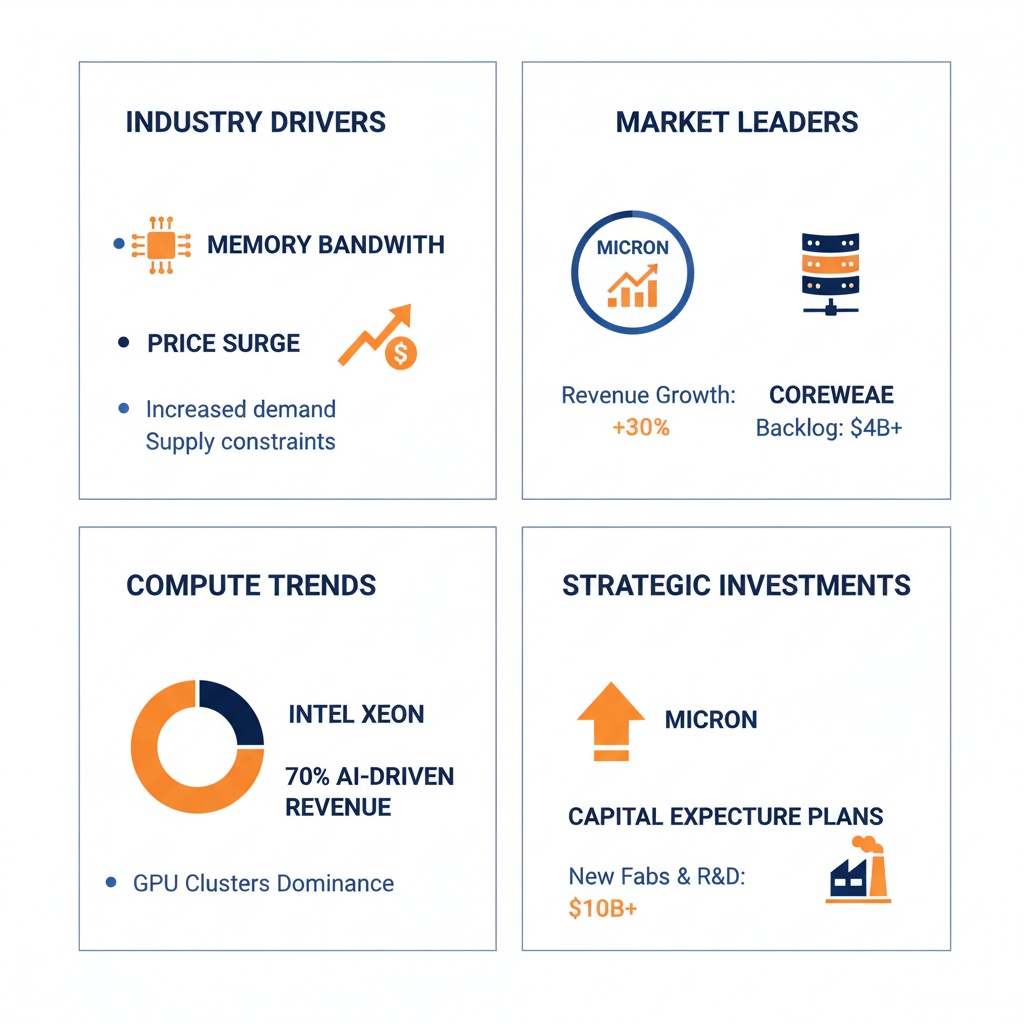
Infographic Image: AI Semiconductor Landscape: Memory, Compute, and Cloud Dynamics
Micron’s stewardship over advanced HBM production has conferred unprecedented pricing power, as the company capitalizes on a structural bottleneck induced by complex 3D-stacking manufacturing paradigms and surging AI-driven memory consumption. Simultaneously, Intel’s strategic pivot toward heterogeneous CPU-GPU-accelerator architectures and its ramp-up of state-of-the-art foundry nodes seek to address emerging compute orchestration imperatives amid capital expenditure pressures and competitive foundry landscapes. In the cloud domain, CoreWeave exemplifies rapid scaling within the GPU-accelerated AI infrastructure segment but faces systemic dependence on NVIDIA hardware and concentration risks with hyperscale customers like Microsoft.
This report investigates these intertwined dynamics to elucidate how memory scarcity, architectural shifts, and evolving business models converge to reshape semiconductor economics and market positioning. It presents a detailed analysis of technical bottlenecks, financial performances, strategic contracts, and ecosystem interdependencies. The scope encompasses the technical underpinnings of memory bottlenecks, the architectural evolution triggered by AI workload demands, and the transformative impact on cloud infrastructure providers, culminating in strategic considerations imperative for sustainable competitive advantage in the AI semiconductor era.
1. Memory Bottleneck: How Structural Scarcity Is Reshaping Semiconductor Economics
High-Bandwidth Memory Emerges as the Critical Constraint in AI Compute Scalability
This subsection focuses on establishing High-Bandwidth Memory (HBM) as the pivotal bottleneck in contemporary AI workloads, particularly in large language model (LLM) training and inference. Establishing the technical nuances and quantification of memory bandwidth demands underscores why HBM scarcity directly shapes semiconductor economics and strategic positioning—setting the stage for understanding Micron’s dominant role and the broader industry impacts discussed in subsequent sections.
Fundamental Technical Superiority of 3D-Stacked HBM with TSVs Over Traditional DRAM Architectures
High-Bandwidth Memory uniquely addresses the escalating data throughput demands of modern AI workloads through vertically stacked DRAM dies interconnected by thousands of Through-Silicon Vias (TSVs). This 3D integration enables ultra-wide memory buses and drastically reduces the physical distance between the memory and compute units, yielding bandwidth capacities that exceed traditional planar DRAM by over an order of magnitude. For example, recent HBM4 implementations deliver bandwidths exceeding 2.8 TB/s per stack, compared to the sub-256 GB/s limits typical of DDR5 modules. This architectural advantage is critical given that conventional DRAM bandwidth growth is constrained by planar scaling bottlenecks, signaling overhead, and increased power inefficiency.
The intricate packaging and manufacturing processes required for TSV-enabled HBM stacks necessitate advanced thermal management and precise fabrication tolerances. These complexities underscore why scaling HBM supply involves significant technical risk and capital intensity, distinguishing it from more mature, simpler DRAM fabrication methods.
Quantitative Analysis of Memory Bandwidth Requirements Propelled by Large Language Models and Multimodal AI
The memory bandwidth requirements for AI models have surged with the rapid growth in model parameter counts and longer context windows. Leading LLMs such as GPT-3 and its successors with hundreds of billions of parameters mandate hundreds of gigabytes to terabytes of high-speed memory to maintain effective training and real-time inference performance. These requirements scale not only with parameter size but also with batch size and sequence length, which determine the parallel data throughput needed.
For instance, a trillion-token context window for a large-scale multimodal model can push memory bandwidth demands well beyond 2 TB/s, a threshold only achievable with the latest HBM generations. These demands differentiate AI workloads fundamentally from traditional computing tasks, where conventional DDR capacities and speeds create bottlenecks that escalate latency and energy consumption. The explosive data movement necessitates memory architectures capable of handling continuous terabyte streams without degradation, reinforcing HBM as indispensable for AI accelerator designs.
HBM’s Role as the Defining Bottleneck Driving Structural Scarcity in AI Semiconductor Demand
The sharp divergence in achievable data throughput between HBM and traditional memory solutions positions HBM as the gatekeeper of AI system performance. As model sizes and inference complexities grow, memory bandwidth, rather than raw compute, increasingly limits scaling efficiency and energy consumption. This criticality has transformed HBM supply dynamics into a structural bottleneck. Unlike cyclical semiconductor supply constraints, HBM scarcity results from the confluence of sophisticated manufacturing processes, yield challenges in TSV integration, and the surging capital requirements for scaling advanced 3D packaging.
Consequently, the memory bottleneck manifests as an enduring industry-wide constraint. This impacts entire semiconductor design strategies, from architectural choices to vendor selection, placing companies controlling advanced HBM capacity at a marked competitive advantage. Understanding this technical and market context is essential to decode why memory supply tightness fundamentally reshapes pricing power, contractual models, and investment priorities across the AI semiconductor ecosystem.
Having elucidated why and how HBM constitutes the critical technical and commercial bottleneck in AI-driven semiconductor demand, the report next examines how this structural scarcity confers pricing power and strategic advantages to leading memory providers, notably Micron.
Micron's Pricing Power and Contractual Advantage Amid AI-Driven Memory Surge
This subsection analyzes how Micron’s constrained supply of high-bandwidth memory has strategically repositioned the company within the semiconductor memory market. It explores the financial magnitude of Micron’s Q2 2026 performance and how contractual innovations, including a shift toward multi-year agreements, have fortified pricing power and margin stability. These developments exemplify a structural transformation in memory economics driven by unprecedented AI workloads and supply-demand imbalances.
Validation of Micron’s Record-Breaking Fiscal Q2 2026 Revenue Performance
Micron’s fiscal second quarter of 2026 marked a historic inflection point with revenue soaring to $23.86 billion, a 196% increase year-over-year. This surge was primarily fueled by AI-driven demand for high-bandwidth DRAM and NAND memory, reflecting a market shift toward data center and cloud infrastructure investment. The revenue figure not only surpassed analyst expectations but also more than doubled sequentially from the prior quarter, underscoring an accelerating structural growth cycle rather than a typical cyclical inventory buildup.
Alongside top-line expansion, the company reported net income exceeding $13.7 billion, translating to over sevenfold profitability growth compared to the same quarter a year prior. Gross margins expanded to historic highs near 75%, while operating margins approached 68%, a remarkable leap in a traditionally volatile memory sector. This elevated profitability is a direct function of Micron’s dominant role as a primary supplier of high-demand AI-optimized memory products and successful capture of premium pricing amid constrained supply.
Structural Shift from Short-Term Contracts to Multi-Year Supply Agreements
Micron has strategically transitioned away from the conventional quarterly contract cadence toward securing multi-year customer agreements, typically spanning three to five years. These long-term contracts lock in supply commitments and pricing, mitigating the historically unpredictable cyclical swings of the memory market. By moving to multi-year arrangements, Micron provides its key hyperscaler and AI infrastructure customers with enhanced supply visibility essential for large-scale capital allocation and AI deployment planning.
This contractual evolution represents a fundamental shift from price competition toward supply security as the battleground. The multi-year contracts have been integral in building a price alliance among leading memory manufacturers, sustaining pricing power despite ramping production capacity only expected in 2027 and beyond. The predictability enabled by these agreements also supports reduced volatility in Micron’s revenue streams and more stable margin profiles, shielding the company from spot market fluctuations inherent in DRAM and NAND markets.
Impact of Capacity Commitments on Margins and Financial Resilience
Micron’s capacity commitments under long-term contracts have directly contributed to unprecedented margin expansion and financial resilience during the AI-driven memory supercycle. The company’s sold-out HBM capacity through 2026, including next-generation HBM4 products, ensures a locked-in revenue base insulated from typical industry price erosion. This structural scarcity enables 30% to 50% price uplifts over prior cycles for certain AI-focused memory segments, amplifying gross margin leverage.
High contractual visibility has allowed Micron to project gross margins approaching 81% in upcoming quarters—figures previously considered unattainable within the commodity-like DRAM business. This margin strength supports robust free cash flow generation, reinforcing Micron’s capacity expansion investments exceeding $25 billion planned for the fiscal year. However, while the financial momentum is extraordinary, the concentration of supply to a limited number of hyperscale customers underscores an operational risk dimension that requires ongoing capacity and customer diversification management.
Having established Micron’s commanding financial position and evolving contracting framework amid the structural AI memory shortage, the report next explores how this scarcity affects broader semiconductor industry dynamics, shaping design decisions, pricing trends, and strategic partnerships across the value chain.
Industry-Wide Implications of Memory Constraints: Ripple Effects on Design, Pricing, and Strategic Alliances
This subsection explores how the persistent scarcity of memory resources, particularly high-bandwidth memory (HBM) and DRAM, cascades across the semiconductor ecosystem. Building upon the foundational technical and commercial bottlenecks previously discussed, it examines how supply limitations compel chip designers to adapt their architectures, fuel sustained price escalations industry-wide, and catalyze strategic corporate behaviors such as partnerships and acquisitions. Understanding these systemic repercussions clarifies why memory scarcity is not an isolated supply challenge but a transformational force reshaping semiconductor market dynamics and competitive positioning.
Architectural and Design Adaptations in Response to Memory Scarcity
Chip designers are recalibrating their product architectures to accommodate persistent memory shortages and elevated costs. Faced with constrained availability of high-bandwidth memory and DRAM, design teams increasingly prioritize memory-efficient algorithms and incorporate alternative memory hierarchies, such as integrating caches and on-chip SRAM, to mitigate external memory dependency. This adjustment transcends incremental optimization; it reflects a strategic imperative to sustain performance targets amid tighter supply conditions and pricing pressures.
In AI accelerators and datacenter-class processors, the memory bottleneck has triggered shifts towards tighter memory-compute co-design. Designers are exploring heterogeneous integration and chiplet-based approaches to embed more specialized memory units closer to compute cores, effectively reducing reliance on scarce off-chip HBM supplies. Moreover, some vendors are extending product lifecycles by adapting legacy designs that require less memory bandwidth, aiming to navigate lead-time uncertainties and buffer against supply volatility. These adaptations demonstrate how scarcity compels innovation not only in process technology but predominantly in system-level design.
Memory Price Escalation: Quantifying Industry-Wide Economic Impact
The structural scarcity of memory has instigated a sustained and substantial increase in prices across multiple segments, including both DRAM and NAND flash components. Empirical pricing data indicates that quarter-over-quarter price surges of 40-60% in DRAM modules are now commonplace, significantly outpacing conventional cyclical trends. Consumer electronics and PC manufacturers face notable cost inflation, with memory representing up to 30-40% of smartphone bill of materials in some cases, thereby pressuring device pricing and product viability, particularly in lower-margin tiers.
This pricing pressure has amplified lead times and order backlogs, with 62% of memory buyers reporting extended delivery windows and over 80% experiencing rising costs to varying degrees. The compounding effect is a constriction on production planning flexibility and margin resilience throughout the electronics manufacturing value chain. As AI demand continues to grow unabated, memory production growth is failing to keep pace, reinforcing upward pricing momentum. This phenomenon has led to a bifurcation in market access, wherein hyperscale AI consumers secure prioritized contracts at premium pricing, leaving insufficient capacity for traditional OEMs.
Strategic Partnerships, Mergers, and Market Realignments Driven by Memory Scarcity
The enduring memory supply-demand imbalance is reshaping corporate strategies, prompting a wave of strategic partnerships, contractual realignments, and consolidation moves. To secure scarce memory resources, technology firms are transitioning from volatile quarterly procurement arrangements to multi-year, capacity-committed contracts that provide greater pricing stability and supply assuredness. This contractual evolution reflects a risk mitigation response to supply instability and is increasingly becoming a competitive differentiator.
Concurrently, the scarcity environment drives heightened merger and acquisition activity as companies seek to vertically integrate or diversify access to memory technologies and manufacturing capacity. Industry leaders prioritize alliances that can enhance supply chain resilience, such as investments in memory producers or secure sourcing agreements with foundries specialized in memory assembly. These strategic actions underscore a market trend where control over scarce memory resources translates directly into sustained competitive advantage, influencing not only product cost structures but also long-term positioning in an AI-driven semiconductor landscape.
Having delineated the broad industry repercussions of memory scarcity—spanning design adaptations, pricing inflation, and strategic repositioning—the report now advances to examining how these memory-centric constraints intersect with and influence compute architectures. In particular, the subsequent discourse focuses on Intel’s architectural evolution amid these supply challenges, highlighting how compute and memory considerations jointly drive semiconductor innovation.
2. Architectural Evolution: From GPU-Centric to CPU-Orchestrated AI Systems
The Rising Importance of CPUs as Orchestration Anchors in Modern AI Workflows
This subsection explores the increasingly pivotal role of central processing units within AI compute infrastructures, challenging the conventional GPU-centric narrative. By detailing Intel's strategy around its Xeon processors and the adoption of heterogeneous architectures, it provides crucial context on how CPU innovations and orchestrations drive AI inferencing workloads and edge computing efficiency. This analysis bridges memory constraints and cloud infrastructure discussions by emphasizing compute-layer architectural shifts critical to the AI semiconductor market transformation.
Intel Xeon CPUs as Strategic Orchestration Layers in AI Inferencing Scale
Intel’s Xeon processors have shifted from traditional server workloads into becoming principal components orchestrating heterogeneous AI systems, especially in large-scale AI inferencing deployments. Recent expansions in Intel’s partnership with major cloud providers emphasize multi-generational Xeon platforms powering AI inference and general compute workloads in distributed environments, invoking the CPU as the critical control plane rather than merely a compute co-processor. This reflects a market evolution where AI training remains GPU-dominated, but inference demand has increased reliance on CPUs for scheduling, data movement, and workload partitioning.
Data from first-quarter 2026 results show that Intel’s AI-driven business accounts for approximately 60% of total revenues, with data center sales, heavily Xeon-dependent, growing more than 20% year over year. The shifting GPU-to-CPU ratios—traditionally seven to eight GPUs per CPU during training—are now declining to around three to four GPUs per CPU for inference workloads, underlining increased CPU intensity. This change confirms that CPUs are indispensable for scaling AI beyond training, reinforcing Intel’s narrative around Xeon’s enduring relevance in AI infrastructure.
CPU Efficiency and Market Shifts in Edge AI Deployments
Edge AI applications increasingly favor CPUs due to superior energy efficiency, latency characteristics, and flexibility compared to GPUs in constrained environments such as retail, healthcare, and industrial automation. Unlike data center GPUs optimized for large batched throughput, CPUs excel at managing multiple low-latency inference tasks in parallel, critical for real-time decision-making at the edge. Intel’s roadmap with enhanced Xeon 18A-based processors explicitly targets this domain by integrating AI inference accelerators with strengthened core architectures tailored for edge network workloads, including enhanced security and connectivity features to deploy AI across 6G and beyond.
Complementary advances in platform design and software integration support these efficiencies by enabling heterogeneous workloads dynamically balanced between CPUs and accelerators. The emergence of heterogeneous architectures with optimized power-performance trade-offs facilitates AI workloads at the edge where power budgets and latency limits are stringent, further validating an architectural shift from GPU-only solutions toward CPU-orchestrated, mixed compute environments.
Market Adoption of Heterogeneous CPU-GPU Architectures in AI Systems
Industry trends reveal accelerated adoption of heterogeneous architectures combining CPUs, GPUs, and domain-specific accelerators to meet the demands of evolving AI workloads. Architectures integrating multi-core Xeon processors managing multiple GPU or IPU accelerators optimize cost, energy, and throughput simultaneously. This approach contrasts with prior monolithic GPU-focused systems by explicitly recognizing the orchestration complexity AI workloads require, including data pre-processing, model partitioning, and network stack optimizations.
Such hybrid designs are especially effective in next-generation data centers and cloud AI service platforms where service-level agreements demand consistent inference latency, workload isolation, and scalable resource allocation. Intel’s strategy aligns with this model, co-developing infrastructure processing units with hyperscalers while leveraging Xeon CPUs as foundational compute units, positioning itself as a key enabler of heterogeneous AI computing ecosystems amid ongoing market transformations.
Having established the strategic and technical rationale for rising CPU significance in AI workflows, the next subsection examines how Intel translates these architectural shifts into competitive advantages via foundry capacity expansion and process technology leadership, framing compute evolution within broader industry dynamics.
Intel's Foundry Ambitions and Process Leadership: Navigating Advanced Node Scale-Up Amid Capital Constraints
This subsection dissects Intel’s strategic pivot toward becoming a major foundry player through its advanced 18A and 14A process nodes. It addresses Intel’s manufacturing scale, capacity expansion plans, and the capital expenditure trade-offs shaping near-term profitability versus long-term competitive positioning. The analysis reveals how this dual focus on internal product excellence and external foundry partnerships aims to reposition Intel within a market traditionally dominated by established foundries yet challenged by complex AI-driven demand dynamics.
Assessing the Scale and Capacity of Intel’s 18A and 14A Node Production in 2026
Intel’s 18A node represents the company’s leading-edge manufacturing milestone, entering high-volume production in early 2026 at the Arizona fab with wafer starts estimated near 10,000 per week. This 1.8-nanometer-class node introduces foundational innovations such as RibbonFET transistor architecture and PowerVia backside power delivery, which collectively offer up to 15% performance-per-watt improvement and 30% increased transistor density over previous generations. The ramp of 18A capacity is concurrently serving Intel’s internal flagship processors like Clearwater Forest and Panther Lake, indicating robust in-house utilization while allowing incremental volume for select external customers. Early yields, rising from approximately 60% to over 75%, demonstrate promising manufacturing maturation, an essential factor given the historical yield challenges Intel faced at leading nodes. Meanwhile, the 14A node, a 1.4-nanometer-class process, is in early customer engagement and development phases, with production capacity expansion contingent on firm external volume commitments. This node features high-NA EUV lithography and further transistor-level advancements, aiming to enhance competitive parity against global leaders and cater to specialized AI workloads.
Despite significant technical progress, Intel’s capacity at these nodes currently represents a fraction of market-leading foundries, with TSMC producing over 140,000 wafers monthly at 2nm technology by late 2026. This gap underscores Intel’s strategic decision to tightly align capacity buildout with confirmed external demand, contrasting prior overexpansion trends. The company’s foundry investments focus on incremental capacity delivery through advanced packaging and chiplet integration capabilities, appealing particularly to AI and cloud infrastructure clients requiring heterogeneous compute systems.
Foundry Revenue Growth Outlook: Measuring Intel's Contribution to Market Transformation Through External Manufacturing
Intel’s foundry business is transitioning from a prolonged loss-making phase toward a scalable growth model, driven by AI demand's explosive wafer consumption and heightened interest from hyperscalers and automotive OEMs. The segment contributed progressively increasing revenue through 2024–2026, fueled by initial internal high-margin node deployments and emerging external customer wins, including Tesla via the Terafab joint venture. Market analysts forecast foundry revenue growth in the mid-teens percentage range annually, with AI-focused wafer demand underpinning sustainable expansion.
Strategically, Intel’s foundry leverages differentiated integration of advanced packaging technologies (EMIB, Foveros) to complement its process nodes, offering clients tailored chiplet architectures critical for AI and high-performance workloads. The emphasis on heterogeneous compute, combining CPUs, GPUs, and domain-specific accelerators, aligns with Intel’s wider architectural vision. Intel’s roadmap anticipates accelerating customer engagement on 14A beginning in late 2026 into 2027, potentially unlocking additional revenue streams contingent on managing tight supply constraints. However, Intel currently holds less than 5% global foundry market share, highlighting the uphill effort required to materially challenge incumbents.
This steady increase in foundry service revenue is pivotal for Intel’s broader IDM 2.0 strategy, aiming for vertical integration benefits while enabling third-party access to its manufacturing ecosystem. Successful foundry scaling could counterbalance cyclical semiconductor market fluctuations and diversify revenue beyond internal product cycles.
Capital Expenditure Pressures: Balancing Investment in Fab Capacity Against Negative Free Cash Flow Risks
Intel’s foundry investment phase exerts considerable pressure on its financial liquidity, with capital expenditures in 2025 projected near $5 billion quarterly, leading to negative adjusted free cash flow in multiple quarters despite positive operating cash flows. This capital intensity reflects investment not only in advanced process node fabrication but also in expanding advanced packaging capabilities and supply chain resilience.
Management’s stated financial discipline emphasizes aligning capacity additions with contracted demand to avoid previous pitfalls of overcapacity and margin dilution. The CHIPS Act support of approximately $7.9 billion in direct funding further mitigates investment risk by subsidizing key US domestic manufacturing expansions. This government backing aligns with national strategic objectives to reduce supply chain vulnerability amid geopolitical tensions.
Nonetheless, these substantial capital commitments have compounded near-term liquidity constraints, necessitating vigilant operational execution and margin management. The trade-offs inherent in quantum fabrication technology scaling include delayed profitability from the foundry business, with a multi-year runway anticipated before meaningful free cash flow contributions materialize. Investors thus balance confidence in Intel’s technological roadmaps with caution over capital return timing.
Having examined Intel’s manufacturing capabilities, capacity scaling, revenue growth outlook, and capital expenditure dynamics, the report will next explore how architectural innovation and strategic custom silicon efforts further differentiate Intel within AI semiconductor ecosystems, reinforcing its evolving competitive stance amidst GPU and accelerator-dominated paradigms.
Leveraging Custom Silicon: Intel’s Strategic Edge Through IPUs and Hyperscaler Alliances
This subsection evaluates Intel’s deployment and scaling of custom silicon solutions, particularly infrastructure processing units (IPUs), as a critical differentiator in the AI semiconductor ecosystem. By examining shipment volumes, strategic partnerships—most notably with Google—and the effects on customer loyalty and retention, this analysis contextualizes how Intel is shifting from commodity CPU competition toward bespoke AI hardware innovation. It underscores the competitive landscape realities where custom silicon and co-development with hyperscalers are becoming decisive factors in market positioning.
Intel’s IPU Shipment Growth and Market Penetration in 2025-2026
Intel has significantly expanded its IPU offerings across 2025 and into 2026, with shipments scaling in response to growing demand for AI infrastructure balancing compute, data movement, and infrastructure offload functions. The company’s targeted release schedule aligns with multiple Xeon generation launches, supporting next-generation cloud deployment scenarios where IPUs manage networking, storage, and security tasks previously handled by CPUs. The volume of IPU units shipped has risen steadily, marking Intel’s emergence as a key supplier in the heterogenous computing stacks favored by hyperscalers and large cloud providers.
This volume growth is underpinned by Intel’s ability to integrate IPUs tightly with its broader Xeon portfolio, optimizing data center workflows and improving total cost of ownership for customers. Concurrently, the adoption of these accelerators has broadened beyond experimental stages into production environments, signaling market acceptance. Intel's roadmap indicates further innovation and scaling potential as AI workloads increasingly require specialized control and orchestration silicon optimized for energy efficiency and critical latency pathways.
The Strategic Value of Intel’s Partnership with Google in Custom Silicon Development
Intel’s multi-year expanded collaboration with Google exemplifies how strategic alliances with hyperscale cloud providers translate into bespoke silicon co-design. This partnership focuses not only on Xeon CPUs but also on custom IPU development, enabling Google’s infrastructure to meet evolving AI workload demands more efficiently. The collaboration delivers mutual benefits: Google obtains optimized hardware tailored to its AI model orchestration needs, while Intel secures a substantial, long-duration demand commitment and validation of its custom silicon strategy in a fiercely contested AI landscape.
By positioning its IPUs as integral components within Google Cloud’s service offerings—including inference, general-purpose workloads, and infrastructure acceleration—Intel reinforces its competitive differentiation beyond commodity processors. This collaboration also signals broader industry trends favoring vertically-integrated hardware-software co-optimization, setting a high bar for rivals seeking parity. Moreover, the partnership strengthens switching costs, as deep integration over multiple hardware generations and software stacks elevates customer retention prospects.
Impact of Custom Silicon on Customer Retention and Market Differentiation
Custom silicon deployment, including Intel’s IPUs, increasingly functions as a pivotal tool for enhancing customer loyalty in the AI semiconductor sector. Tailored accelerators address AI system bottlenecks more effectively than general-purpose hardware, delivering superior efficiency and performance gains that tightly lock customers into specific technology stacks. This creates substantial switching costs, as migrating to alternative suppliers often involves non-trivial re-architecting of software and infrastructure.
Such silicon customization also facilitates differentiated service offerings, enabling Intel and its partners to deliver AI solutions optimized for specific workload profiles—ranging from inference orchestration to hybrid cloud-edge deployments. Consequently, Intel’s strategic push into IPUs and related ASICs differentiates its competitive posture, moving it away from commoditized CPU markets toward value-added segments with higher margin potential and longer-term contract stability.
Taken together, these factors illustrate how Intel’s investment in custom silicon, exemplified by IPUs and anchored by deep hyperscaler partnerships, forms a cornerstone of its architectural evolution strategy. This trajectory not only supports differentiated market positioning amid the intensifying AI compute arms race but also embeds Intel within critical customer ecosystems where high barriers to entry and switching costs enhance sustainable competitive advantage.
3. Cloud Infrastructure Disruption: CoreWeave's Scaling Challenge and Strategic Dependencies
GPU-Optimized Cloud Platforms Fuel Rapid Adoption and Scale in AI Infrastructure
This subsection examines CoreWeave’s rapid revenue expansion and capacity growth as a specialized AI-centric cloud provider. By detailing its financial performance, infrastructure capabilities focused on advanced NVIDIA GPU architectures, and integration with Kubernetes orchestration, the analysis highlights CoreWeave’s emerging role as a key enabler of AI workloads at scale. This insight is critical to understanding how cloud infrastructure models are evolving in response to surging AI demand, complementing the broader semiconductor value chain transformations.
CoreWeave’s Exceptional Revenue Growth and Strategic Backlog Expansion
CoreWeave has experienced explosive revenue growth, with first-quarter 2026 sales reaching $2.08 billion, marking a year-over-year increase of 112%. This performance notably outpaced the previous year’s benchmark and underscored strong market traction driven by enterprise, hyperscaler, and AI lab adoption. Sequential growth was also robust at approximately 32%, reflecting ongoing momentum rather than solely one-time contract effects.
The company’s revenue backlog surged to nearly $99.4 billion, up close to 50% quarter-over-quarter and quadruple the year-ago figure. This backlog reflects signed customer commitments for AI compute services, many of which are multi-year agreements averaging around five years in length. Notably, 36% of this backlog is expected to convert into revenue within two years, with as much as 75% materializing inside four years, underscoring durable, predictable revenue streams and a strong foundation for capacity expansion.
Key client engagements anchor this backlog, including a landmark $21 billion multi-year commitment from Meta and expanded contracts with AI companies such as Anthropic. These relationships not only validate CoreWeave’s positioning in AI infrastructure provision but also signal sustained demand for specialized GPU cloud platforms calibrated to AI training and inference workloads.
Advanced GPU Infrastructure Capabilities: Blackwell, Hopper, and Ada Architectures in Service
CoreWeave’s infrastructure leverages the latest NVIDIA GPU architectures—specifically Blackwell, Hopper, and Ada Lovelace series—to deliver optimized performance for large-scale AI workloads. The addition of Blackwell GPUs, characterized by a dual-die design and unprecedented compute with 208 billion transistors, enables CoreWeave to support trillion-parameter models with increased throughput and memory bandwidth. These technological advantages make Blackwell the premier choice for frontier AI training and inference scenarios.
Complementing Blackwell, the Hopper GPUs continue to serve as reliable accelerators for production-grade AI model deployments, balancing performance and cost for a broad spectrum of clients. The Ada GPUs further enable flexible configurations, suitable for developmental workflows and smaller-scale inferencing tasks, offering CoreWeave the ability to tailor resource allocations precisely to customer needs.
Integration of these GPU families into CoreWeave’s platform is underpinned by a high-throughput storage system and regional infrastructure expansions, including new clusters designed for rapid scaling and regional proximity to key clients. This strategic capacity building ensures low-latency, high-utilization environments critical for demanding AI pipelines.
Kubernetes Integration and Flexible Resource Orchestration Empower Scalable AI Cloud Services
CoreWeave employs Kubernetes container orchestration extensively to enable dynamic provisioning and workload mobility across its GPU clusters. This approach facilitates seamless scaling of AI compute resources in response to fluctuating customer demands, supporting heterogeneous deployments from single-GPU instances to multi-node NVLink and InfiniBand-enabled clusters with up to eight GPUs.
By coupling Kubernetes’ mature ecosystem with tailored AI cloud features such as high-throughput checkpoints, integrated monitoring, and workload observability, CoreWeave enhances operational efficiency and reduces both provisioning latency and resource fragmentation. This flexibility is especially important for generative AI training, fine-tuning, and inference workflows which require diverse and often unpredictable resource footprints.
Moreover, CoreWeave’s platform includes purpose-built observability tools within its Mission Control environment, allowing detailed runtime insights on scheduling behavior, bottlenecks, and resource utilization patterns. This complements the inherent orchestration benefits with feedback loops that help optimize both infrastructure performance and customer experience.
Having established CoreWeave’s rapid growth and highly optimized GPU cloud infrastructure, the following subsection will evaluate the inherent risks posed by its heavy reliance on NVIDIA GPUs and the strategic implications of such vendor dependencies within the AI infrastructure supply chain.
NVIDIA Dependency Introduces Systemic Risk: Ownership Influence, Blackwell GPU Delays, and Microsoft’s Chip Strategy
This subsection examines the inherent risks CoreWeave faces due to its concentrated reliance on NVIDIA’s technology and investment. It analyzes how NVIDIA’s significant equity stake shapes CoreWeave’s strategic trajectory, the operational impact of delays in rolling out NVIDIA’s Blackwell GPUs, and the potential demand shifts caused by major customers like Microsoft developing in-house AI chips. Understanding these dynamics is critical to assessing CoreWeave’s sustainability amid the evolving competitive environment and supply chain challenges.
NVIDIA’s Equity Stake and Its Strategic Governance Impact on CoreWeave
NVIDIA’s growing equity position in CoreWeave, rising to approximately seven percent following rounds of investments including a $2 billion equity injection in early 2026, has become a defining factor in CoreWeave’s operational and strategic outlook. This stake, which ranks NVIDIA as a top shareholder, substantially influences CoreWeave’s access to cutting-edge GPU technology and capital resources. The close partnership ensures that CoreWeave receives priority supply of NVIDIA’s newest AI chips, underpinning its ability to maintain cloud infrastructure competitiveness amidst the scramble for accelerated compute resources.
This ownership stake extends beyond financial investment and into governance and ecosystem alignment, positioning CoreWeave as a quasi-exclusive channel for NVIDIA’s AI GPU deployments in specialized ‘neocloud’ environments. NVIDIA actively supports CoreWeave’s capital raises and infrastructure expansion plans, effectively reducing financing risks and fostering rapid capacity scaling. However, this relationship also increases CoreWeave’s vulnerability to shifts in NVIDIA’s product roadmap, supply chain constraints, and strategic priorities, tethering CoreWeave’s growth and fortunes closely to NVIDIA’s business execution.
Operational and Timing Disruptions from Blackwell GPU Design Flaws and Rollout Delays
The rollout timetable of NVIDIA’s next-generation Blackwell GPUs has encountered significant hurdles due to intrinsic design flaws in the processor die that interconnects chiplets on the flagship GB200 units. These flaws, identified during manufacturing tests and publicized by NVIDIA’s CEO, have forced at least a three-month delay beyond original launch projections, compressing deployment timelines for hyperscale cloud providers reliant on these chips for AI acceleration.
For CoreWeave, whose data center expansion and contracted backlog depend heavily on timely delivery of Blackwell GPUs, these postponements have created operational bottlenecks. The delay impacts both capacity scaling and revenue recognition, as customers await upgraded hardware to run increasingly complex AI workloads. The cooling and power infrastructure challenges accompanying Blackwell’s heightened thermal output further complicate rapid adoption, leading to cautious ramp-ups and postponement of full-scale cluster deployments across CoreWeave’s facilities.
These cascading effects extend into supply chain management, with semiconductor foundry interruptions and necessary redesign efforts underpinning the delayed mass production. CoreWeave’s ability to fulfill long-term contracts and maintain competitive pricing power is contingent on overcoming these interrelated technical and logistical constraints.
Microsoft’s In-House AI Chip Development Risks Eroding CoreWeave Demand
Microsoft’s strategic pivot toward designing and integrating proprietary AI chips into its Azure cloud infrastructure poses a material risk to CoreWeave’s customer concentration and growth trajectory. Historically a major consumer of NVIDIA GPUs via CoreWeave and other cloud providers, Microsoft has allocated approximately $80 billion in 2025 towards AI infrastructure, with a growing share directed at in-house silicon development partnerships, notably with AMD.
This internalization reduces Microsoft’s dependency on third-party GPU cloud platforms, threatening to diminish CoreWeave’s revenue base substantially given that Microsoft accounted for over 70% of CoreWeave’s recent quarterly revenue. While NVIDIA continues to be a critical component in Microsoft’s AI hardware ecosystem, the diversification of chip sources introduces competitive uncertainty and pricing pressure for external cloud providers reliant on NVIDIA-powered capacity.
In this evolving landscape, CoreWeave’s ability to mitigate demand erosion hinges on broadening its customer portfolio, accelerating deployments of alternative accelerator architectures, and deepening ecosystem partnerships. Nonetheless, the Microsoft shift exemplifies how dominant hyperscalers’ vertical integration strategies add complexity to the business model of specialized AI infrastructure providers with concentrated client bases.
Collectively, these factors highlight how CoreWeave’s dependence on NVIDIA as a technology and financial partner, coupled with supply chain uncertainties and shifting customer dynamics, introduces systemic risks that could hinder its scalability and market resilience. Addressing these vulnerabilities is crucial for CoreWeave to sustain its current growth momentum and to navigate the increasingly intricate AI semiconductor ecosystem.
Adaptive Pricing Dynamics Amid Compute Scarcity: CoreWeave’s Strategic Shift to Long-Term Contracts and Premium Rates
This subsection delves into how CoreWeave, as a leading AI-focused cloud infrastructure provider, is recalibrating its pricing strategies in response to acute GPU compute resource scarcity. It complements the broader examination of CoreWeave’s growth trajectory and operational challenges within the AI semiconductor ecosystem, illustrating how shifting market conditions are driving a move from on-demand consumption toward secured, pre-allocated capacity models. Analyzing CoreWeave’s pricing adaptations offers critical insight into emerging cloud economics trends that impact vendor profitability, customer engagement, and competitive positioning.
Magnitude and Rationale of CoreWeave’s 2026 Price Increases Amid Record Demand
In 2026, CoreWeave has enacted multiple price adjustments reflecting the intensifying scarcity of high-end GPU capacity driven by soaring AI workloads. These increases are not marginal; industry reports indicate double-digit percentage uplifts across key service tiers, with peak demand windows commanding the highest premiums due to constrained supply. The necessity of these hikes stems from prolonged procurement cycles and supply bottlenecks affecting NVIDIA GPU availability, the core of CoreWeave’s infrastructure, necessitating a pricing premium to ration limited resources effectively and sustain ongoing capital expenditures for capacity expansion.
CoreWeave's leadership frames these price changes as essential for preserving margins and funding their ambitious growth plans amidst a market environment where compute resource availability is no longer reliably elastic. The strategic pricing recalibration also accounts for inflationary cost pressures on data center power and real estate, alongside component shortages that have inflated infrastructure build costs. This assertive approach to pricing signals a departure from prior models where on-demand compute was largely commoditized, marking a conscious pivot toward value-based pricing aligned with scarce compute capacity.
Expansion and Characteristics of CoreWeave’s Long-Term Contracting Model
CoreWeave has concurrently shifted from reliance on predominantly short-term, on-demand usage agreements to adopting long-term supply contracts ranging from one to several years, with some extending notably into the late 2020s. These multi-year agreements are increasingly favored by both CoreWeave and its hyperscaler clients, including major AI firms and technology leaders, who seek guaranteed access to scarce GPU resources amid a tightening market. This model replaces variable spot pricing with fixed or formula-linked rates that often reference broader market indices or negotiated benchmarks to provide pricing predictability and contractual stability.
These contracts typically include volume commitments with clauses for price escalations tied to market conditions or supply-demand imbalance indicators, offering CoreWeave enhanced revenue visibility and improved forecasting accuracy. Long-term contracting has also enabled the company to better align capital investment in infrastructure scale-up, particularly in data center power provisioning and rack-level GPU deployments. This model reduces customer churn risk and cultivates stronger strategic partnerships, solidifying CoreWeave's role as an indispensable infrastructure partner for AI workloads.
Industry Benchmarking: CoreWeave’s Pricing Strategy Within Broader Cloud Market Trends 2025-2026
CoreWeave’s pricing evolution mirrors a broader industry-wide trend wherein cloud providers increasingly treat high-end compute, especially GPU capacity, as a scarce, premium resource rather than an instantly elastic commodity. Major players across AI infrastructure markets have moved toward pre-allocated compute shares and multi-year contracts, reflecting widespread supply constraints and rising demand volatility. This transformation is evidenced by rising cloud service price indices for GPU instances, often exceeding traditional on-demand rates by 20-50% in peak periods.
Relative to hyperscale providers, CoreWeave’s pricing adjustments are at the upper end of the spectrum, justifiable by its specialization in AI-optimized workloads and bespoke service levels. This positions CoreWeave uniquely as a nimble ‘neocloud’ that delivers premium performance and capacity assurances to AI-centric clients, contrasting with broader cloud providers that still balance a wider range of offerings and customer segments. Such dynamics highlight CoreWeave’s strategic positioning advantage but also expose it to risks related to client sensitivity over cost and the threat of direct hyperscaler chip development, reinforcing the need for continuous value differentiation.
Building on CoreWeave’s adaptive pricing and contracting strategies, the forthcoming analysis will address the critical vulnerabilities embedded in its heavy reliance on a single GPU vendor and the associated systemic risks to its supply chain and service delivery model.
4. Convergence of Forces: Integrating Memory, Compute, and Cloud in the New Semiconductor Landscape
Critical Interdependencies: Memory Scarcity, Compute Architecture, and Cloud Scale Dynamics
This subsection synthesizes the complex interplay between memory constraints, emerging compute architectures, and the evolution of cloud infrastructure, elucidating how these factors collectively shape AI semiconductor demand and strategic market positioning. By examining these interdependencies, it becomes clear why isolated resource shortages or architectural choices cascade into systemic impacts on AI deployment scalability and supplier strategies.
Quantifying Memory Shortage Impact on Cloud Provider Scalability by 2026
The structural shortage of high-bandwidth memory has emerged as a principal bottleneck limiting cloud providers’ ability to scale AI infrastructure through 2026. With data centers expected to consume over 70% of all memory chip demand this year, hyperscalers are allocating vast portions of DRAM and HBM inventory, causing supply scarcity outside this privileged segment. This has forced cloud service operators to ration memory resources carefully, prioritizing core AI training and inference workloads that require ultra-high throughput. As a result, expansion plans for new data centers and compute clusters have faced delays or have been implemented with constrained scale, diminishing potential revenue realization in the short term.
Quantitative data from market forecasts shows that memory pricing nearly doubled in Q1 2026 compared to the previous quarter, driving escalating costs for cloud providers and incentivizing the conversion of on-demand offerings into long-term reserved contracts. Specifically, DRAM prices surged by 40-60% quarter-over-quarter in both Q4 2025 and Q1 2026 [Table: Memory Price Trends]. CoreWeave’s rapid backlog growth and multi-gigawatt power commitments further reflect these dynamics, as access to scarce memory directly governs their ability to meet contracted capacity. Consequently, memory availability effectively caps cloud scalability, underscoring its gatekeeper role in AI infrastructure deployment across major regions including North America, Europe, and Asia.
Bandwidth Demands Driven by Compute Architecture and AI Workload Characteristics
The choice of compute architecture intricately drives variations in memory bandwidth needs, tightly coupling semiconductor supply chains with cloud service scalability. AI workloads, particularly training of large language models and multimodal systems, impose unprecedented demands for synchronized data flows with extremely low latency. Architectures employing heterogeneous compute, combining CPUs, GPUs, and specialized accelerators, require disparate memory bandwidth profiles, complicating procurement and capacity planning.
For instance, CPU-centric orchestration of AI workloads relies on coherent interconnects with high aggregated bandwidth to coordinate GPU clusters, raising throughput requirements placed on memory subsystems. Simultaneously, edge and inference scenarios often prioritize sustained bandwidth efficiency over peak capacity, influencing memory integration choices such as 3D-stacked HBM and embedded DRAM. The emergence of next-generation packaging and photonic interconnect chiplets further accentuates these bandwidth imperatives, binding compute design innovation to memory technology evolution and shaping vendor capabilities across the semiconductor ecosystem.
Cloud-Native Procurement Trends Reflect Strategic Integration of Memory and Compute
Cloud service providers are increasingly adopting integrated procurement strategies that reconcile semiconductor supply chain realities with evolving AI workload demands. Strategic moves toward multi-year, volume-guaranteed contracts with leading memory manufacturers like Micron, coupled with foundry partnerships and access to custom silicon, demonstrate an industry trend of vertically coordinated sourcing. This alignment optimizes cost structures, reduces lead times, and enhances the ability to customize hardware stacks for specific AI models and deployment environments.
Within AI neocloud providers such as CoreWeave, long-term commitments with hyperscalers and AI enterprises ensure reserved access to critical memory and compute resources, facilitating capacity expansion amid scarcity. These contract structures often include price escalators tied to semiconductor supply conditions, reflecting both the scarcity premium on high-bandwidth memory and the capital intensity of AI infrastructure. Market data indicates that these integrated procurement approaches contribute significantly to margin resilience and revenue visibility in an otherwise volatile semiconductor market.
Growth Rates and Investment Scaling Across Memory, Compute, and Cloud Segments
Investment growth exhibits a tightly coupled trajectory across memory, compute, and cloud infrastructure facets, underscoring their interdependency in enabling AI semiconductor market expansion. Memory markets are forecasted to grow at a compound annual growth rate surpassing 20%, reflecting both capacity scarcity and technology advancement in high-bandwidth memory architectures. Compute investments, particularly in heterogeneous CPU-GPU-accelerator platforms, similarly exhibit doubledigit growth fueled by escalating AI workload complexity.
Cloud infrastructure spending outpaces traditional IT investment categories, with neocloud providers like CoreWeave demonstrating triple-digit revenue growth year-over-year and power capacity expansion plans exceeding gigawatt scales. Collectively, these segments create a feedback loop where memory constraints limit compute utilization, which in turn caps cloud capacity expansion, compelling coordinated capital allocation strategies that align fab expansions, chip design roadmaps, and data center buildouts toward synchronized growth.
Having established the profound interactions among memory supply constraints, compute architectural choices, and cloud infrastructure evolution, subsequent analysis will consider how these dynamics translate into competitive differentiation and strategic positioning for key industry players navigating the AI-driven semiconductor surge.
5. Strategic Implications: Building Sustainable Advantages in the AI Semiconductor Era
Long-Term Viability Factors for Micron, Intel, and CoreWeave in the AI Semiconductor Era
This subsection synthesizes key strategic and operational factors that will determine the enduring competitiveness and market positions of Micron, Intel, and CoreWeave as the semiconductor industry evolves under AI-driven demand. By assessing their capacity management, technology roadmaps, supply chain strategies, and ecosystem partnerships within the context of rising AI workloads and structural market shifts, we provide a robust framework for evaluating their sustainability and growth potential through 2030.
Micron’s Geographic and Capacity Diversification Enhances Supply Resilience Amid AI Memory Demand Surge
Micron’s strategic expansion beyond traditional hubs underscores its commitment to mitigating geopolitical and supply chain risks that could impair its ability to meet exponentially growing AI memory demand. The company has initiated large-scale capacity buildouts in the United States, Japan, and India, with aggressive capital expenditure targeting fiscal 2026 to 2030 exceeding $100 billion. This expansion includes a major new fab complex in New York and a facility in India, designed to augment high-bandwidth memory (HBM) output, especially HBM3E and HBM4, which currently underpin the AI supercycle.
This geographic dispersion addresses vulnerabilities arising from global tensions and supply concentration by reducing reliance on single locations, enabling operational flexibility and continuity despite external disruptions. Furthermore, Micron’s rigorous capacity commitment approach, where production for the entirety of 2026’s HBM supply has been contracted, lends remarkable revenue visibility uncommon in the cyclical memory sector. While capital-intensive, these investments align Micron’s growth trajectory with anticipated tripling of AI-driven memory needs over the next several years, positioning it at the nexus of memory scarcity and accelerating demand.
Intel’s Foundry Conversion and AI Architecture Roadmap: Execution Risks and Opportunity Horizons
Intel’s pivot to a foundry-centric business model through IDM 2.0 represents a foundational shift aimed at capturing a broader portion of the semiconductor value chain amid AI’s proliferation. The company’s rollout of the 18A process node with RibbonFET and PowerVia innovations, entering high-volume manufacturing by late 2025, allows it to target AI workloads with enhanced energy efficiency and transistor density. Complementing this, the 14A node is progressing with external customer engagements slated to accelerate in 2026 and 2027.
However, Intel’s aggressive capital plans—forecasted to range between $18 billion and $26 billion annually through 2026—carry execution risks balanced by significant government support including over $8 billion from the CHIPS Act. The company is consciously prioritizing capital discipline, cost optimization, and aligning capacity growth directly to firm external commitments, a marked departure from past overexpansion. Despite these efforts, milestones such as breakeven in foundry operations could be delayed due to yield ramp challenges and depreciative pressures of newly deployed fabs.
Parallel to manufacturing, Intel is investing in architectural innovation by expanding AI accelerator integration within its Xeon and Core product lines to orchestrate complex AI workflows, targeting inference and edge computing segments. Sustained execution against these roadmaps, alongside ecosystem development—including progress on oneAPI and software maturity—will be determinative in recapturing competitiveness amid pressure from dominant foundry peers and GPU-centric competitors.
CoreWeave’s Rapid Scaling Challenged by Hardware Concentration and Partner Ecosystem Dependencies
CoreWeave’s exponential growth in AI-focused cloud infrastructure has been powered by a hyper-specialized GPU compute platform primarily dependent on Nvidia hardware, notably H100 and Blackwell GPUs. Revenue doubled year-over-year to over $2 billion in early 2026, with a backlog exceeding $99 billion driven by long-term contracts with major AI developers such as Meta and Anthropic. This scaling is also supported by substantial investments, including a strategic stake held by Nvidia and capital infusions for data center expansion totaling billions of dollars.
CoreWeave's revenue more than doubled from $0.98 billion in Q1 2025 to $2.08 billion in Q1 2026, while its revenue backlog grew by 50% to $99.4 billion, underscoring strong demand and committed pipeline visibility in AI compute services [Chart: CoreWeave's Revenue Growth] [Table: CoreWeave's Revenue Backlog Details].
Nonetheless, this dependency on a single dominant GPU supplier introduces systemic supply chain risks that could impair delivery capabilities and pricing stability. Nvidia’s recent Blackwell chip design flaws have delayed shipments, directly impacting CoreWeave’s fulfillment timelines. Furthermore, large hyperscale customers like Microsoft investing in in-house chip development threaten to curtail future external cloud demand and intensify competitive pressures. CoreWeave’s current lack of significant hardware diversification intensifies exposure to such upstream vulnerabilities.
To counterbalance these risks, CoreWeave is actively diversifying its customer base beyond Microsoft, growing partnerships across finance, AI research labs, and enterprise sectors, while expanding its ecosystem through software and service enhancements. Its financing strategy, though heavily geared with debt servicing challenges, underpins aggressive power capacity growth targets aiming for over 8 gigawatts by 2030. The firm’s ability to prudently manage capital structure while expanding its hardware portfolio and partner network will be critical to its sustainable viability.
Strategic Supply Chain Risk Mitigation and Capital Discipline as Common Threads
Across all three entities, supply chain risk mitigation forms a pivotal dimension of long-term sustainability. Micron’s multi-regional fab footprint and increasing use of predictive analytics for demand visibility set a high standard for risk reduction in memory production. Intel’s deliberate capital spending cadence, with a focus on asset efficiency and yield improvement, minimizes exposure to fab underutilization and technology deployment delays. CoreWeave’s challenge lies in managing dependency on Nvidia’s GPU supply and debt-funded expansion while ensuring operational agility to respond to hardware availability fluctuations.
Capital discipline further compounds these mitigation efforts. Micron’s significant yet phased investment in advanced DRAM and HBM fab capacity reflects a balancing act between capturing the AI-driven supercycle and avoiding cyclical overcapacity. Intel’s cost reduction initiatives, workforce adjustments, and cautious fab ramp strategies represent a strategic reorientation to preserve shareholder value amid protracted foundry buildout timelines. CoreWeave’s funding model places emphasis on long-term contracts to secure pricing power amid a scarce compute resource environment, albeit risking leverage-related financial pressures.
These convergent strategies highlight the increasing complexity of competing sustainably in the AI semiconductor landscape—requiring not just innovation but also resilient supply chains, disciplined capital allocation, and diversified ecosystems.
Having established the critical success parameters guiding each company’s medium- to long-term prospects, the report will next integrate these insights to illustrate how memory constraints, compute innovations, and cloud infrastructure dynamics converge to collectively reshape competitive advantage and industry structure under AI’s transformative impact.
Conclusion
The synthesis of technical, financial, and strategic analyses underscores memory scarcity—particularly in HBM supply—as the pivotal constraint redefining AI semiconductor economics. Micron’s commanding position through contracted HBM capacity and sustained pricing power exemplifies how complex manufacturing barriers translate into durable competitive moats. This scarcity instigates broad ripple effects, compelling architectural adaptations prioritizing memory efficiency and fostering market realignments centered on long-term contracts and supply assurance. Intel’s response, melding process innovation with heterogeneous compute and foundry service expansion, highlights a pragmatic pursuit of vertical integration balanced against capital discipline and near-term execution risks.
CoreWeave’s rapid ascent as a specialized AI cloud provider illustrates the lucrative yet vulnerable niche created by GPU compute scarcity and hyperscale demand concentration. Its strategic alignment with NVIDIA and long-term contracting model provide resilience but also expose it to supplier risks and competitive pressures emerging from hyperscalers’ growing in-house silicon capabilities. The interconnectedness of memory, compute, and cloud segments signals a semiconductor ecosystem where end-to-end coordination—from wafer fab to AI workload delivery—is essential.
Looking forward, stakeholders should prioritize investments and strategies that navigate these intertwined constraints by enhancing supply chain resilience, advancing heterogeneous integration, and cultivating diversified customer and partner ecosystems. For Micron, expanding geographic and capacity footprints while sustaining contractual discipline will be key. Intel must execute foundry scaling and architectural innovation with rigorous capital management. CoreWeave’s viability hinges on deepening customer breadth and mitigating singular hardware dependencies. Collectively, these approaches will define leadership in an AI semiconductor landscape where technical complexity and strategic agility are inseparable.
Ultimately, the era characterized by memory bottlenecks, compute orchestration complexity, and cloud infrastructure scarcity presents both challenges and unparalleled growth opportunities. The companies that most effectively harness technical innovation, financial discipline, and strategic alignment across the semiconductor value chain will shape the future trajectories of AI compute deployment and the broader digital economy.
References
- Advanced Semiconductors Market - Global Opportunity Analysis and Industry Forecast (2026-2036)
- AMHS in the Semiconductor Market Report: Trends, Forecast and Competitive Analysis to 2031
- Comparative Market Performance of SanDisk and Micron
- Promising Stocks That Could Double Your Investment
- Intel’s AI Revolution: The Strategic Pivot That Could Redefine the Semiconductor Industry
- AI-Powered Semiconductor Renaissance: AMD's Strategic Ascent Amid Market Rally
- AI Infrastructure Expansion: Fueling Market Optimism Through Strategic Partnerships and Earnings Momentum
- Intel, Google Expand AI Infrastructure Pact Around Xeon and Custom IPUs
- Micron's AI-Driven Memory Supercycle and Its Implications for the Semiconductor Sector
- Semiconductor Market | Size, Share, Growth | 2024 - 2030
- This Stock Will Be More Profitable Than Amazon and Meta by 2027
- PDF 8-K - 04/02/2024 - Intel Corporation
- AI Boom Hits a Wall As Computing Power Runs Short And Costs Surge: Report | IBTimes
- CoreWeave Continues Blackwell Expansio
- Microsoft’s AI Cloud Shift Leaves CoreWeave in Precarious Position Before IPO - WinBuzzer
- Intel Stock Analysis 2026: INTC Investment Outlook & Terafab Impact
- Intel Q1 2026 Earnings Analysis: AI Demand Supports Growth as Foundry Losses and Restructuring Weigh on Profitability
- Intel Q1 2026 presentation: sixth straight beat on AI demand surge By Investing.com
- AI Semiconductor Market CAGR, size, share, trends, growth, value, key players analysis | Stratistics MRC report
- Micron Stock Analysis: AI Memory Boom Faces First Real Test
- 10 Leading AI Cloud Providers for Developers in 2026 | DigitalOcean
- Micron Capitalizes on AI Memory Supercycle with 2026 HBM Capacity Fully Committed
- CoreWeave’s AI Cloud Push With Cline Integration And NVIDIA GTC Momentum
- AI Drives Semiconductor Industry Growth
- Neocloud Spending Surge Set to Accelerate
- Wells Fargo revamps CoreWeave stock price target for 2026
- Techmeme: Sources: SK Hynix's big customers have been proposing a range of offers to secure memory chip supplies, including investing in dedicated chip production lines (Reuters)
- CoreWeave Doubles Revenue to $2.1B as AI Cloud Backlog Nears $100B
- Techmeme: Filings: Baidu's AI chip unit Kunlunxin is planning a dual IPO on Shanghai's STAR Board and in Hong Kong; Baidu holds a 58% stake in Kunlunxin (Bloomberg)
- Techmeme: Fintech app Toss, used by ~66% of South Korea's 51M people, says its FacePay service, available at 330K retail outlets, has attracted 4.8M users since September (Financial Times)
- Techmeme: Sources: White House unease over Mythos has left some administration officials fearful that the change represents a reversal of its hands-off AI policy (Wall Street Journal)
- Techmeme: Instructure disables its Canvas edtech platform, used by thousands of schools and universities, amid a data extortion attack claimed by ShinyHunters (Brian Krebs/Krebs on Security)
- CoreWeave Owes $21 Billion. Its Customers Are Its Biggest Risk.
- Barclays Downgrades CoreWeave (CRWV) to Equal Weight, Lifts PT
- Q1 2026 Earnings Snapshot: Navigating Energy Volatility, Semiconductor Surge, and Sectoral Divergence Amid Global Uncertainty
- Latest RAM Memory Technology Trend 2026
- The global memory shortage: The hidden bottleneck behind the AI boom
- CPU, SSD, and HDD Supply Constraints as AI and Data Centers Scale in 2026
- Memory Chip Shortages Hit Peak in Q1 2026, Delaying AI Infrastructure Rollouts
- Global Memory Chip Shortage Peaks in Q1 2026, Stalling AI Infrastructure Across Markets
- New Momentum, Old Problems: Transatlantic Export Control Considerations
- Memory shortage doesn't have to spell disaster for IT budgets
- SHI Insights – The impact of the 2026 memory shortage on data center buyers
- RAM Prices Stabilize at Record Highs in 2026 Amid AI-Driven Shortages
- Micron Stock Forecast: Can the AI Memory Super-Cycle Drive MU to $3,000 by 2030?
- Rebellions Secures $400M for U.S. Expansion Ahead of IPO
- Samsung Electronics Union Rally Signals Strike Risk
- Is the Memory Supercycle Already Priced In? What the Data Says About Micron Stock. | The Motley Fool
- Micron sits at the center of a red-hot chip rally
- Micron Technology (MU) — Company Research
- Micron Technology, Inc. Stock (MU) - Quote Nasdaq- MarketScreener
- Micron’s Massive AI Memory Buildout Tests Multi Year Investment Thesis
- I Called Micron's Surge a Few Months Ago. Here's How High I See the AI Stock Going This Year.
- Micron Technology (MU) Stock: AI Demand and Tight Memory Supply Boost Forecasts - Parameter
- Techmeme: Google releases Multi-Token Prediction drafters for its Gemma 4 models, which use a form of speculative decoding to guess future tokens for faster inference (Ryan Whitwam/Ars Technica)
- Techmeme: Instacart reports Q1 revenue up 14% YoY to $1.02B, GTV up 13% to $10.29B, and orders up 10%, compared with a 16% growth a year earlier; CART drops 11%+ (Neil J Kanatt/Reuters)
- Techmeme: Following its SpaceX deal, Anthropic doubles Claude Code's five-hour rate limits for paid plans and removes peak hours limit reduction for Pro and Max plans (Anthropic)
- Techmeme: Nvidia invests $500M in Corning, which will grow its US optical connectivity capacity by 10x and expand its US fiber production capacity by 50%+; GLW jumps 15%+ (Nicholas G. Miller/Wall Street Journal)
- Techmeme: Uber reports Q1 revenue up 14% YoY to $13.2B, below $13.3B est., Gross Bookings up 25% YoY to $53.7B, trips up 20% YoY to 3.6B, and a $1B revenue UK tax law hit (Financial Times)
- Crypto miner Hut 8 signs a lease worth $9.8B+ over 15 years to provide computing power to a "high-investment-grade company" at its Nueces County, Texas campus (Dina Bass/Bloomberg)
- Prediction: The Great Rotation Will End Before 2026 Does. These Are the Best Artificial Intelligence (AI) Growth Stocks to Own When It Does. | The Motley Fool
- NVIDIA vs Intel Stock Battle 2026: AI Leader or Turnaround Star – Which to Buy Now? | IBTimes
- Intel Unveils Clearwater Forest "18A" Xeon+ CPU Performance: Designed For 6G & Edge AI
- Intel Scores an Agentic AI Win
- What is LPDDR? Meaning, Comparison
- PDF LPDDR at Scale: Enabling Efficient LLM Inference Through High-Capacity Memory
- HBM4 | Micron Technology Inc.
- PDF SETR 2026: Semiconductors
- GDDR6 vs HBM - Different GPU Memory Types | Exxact Blog
- HBM Market Insight
- ON HETEROGENEOUS COMPUTE AND MEMORY ...
- The AI-Driven Memory Supercycle: Surge in DRAM and NAND Prices, Industry Impacts, and the Emergence of HBF Technology
- Trusted by Global Top 3 Semiconductor AI Memory Leader for HBM
- HBM Ultimate Guide: Architecture, Evolution, and Applications
- Quanta Stock Climbs 36% in a Month: Should You Buy Now or Wait?
- Fluence (FLNC) Stock Soars 27% Tonight As Hyperscaler Orders Steal the Show
- PDF For the three months ended March 28, 2026 Q1 Report 2026
- Eaton (ETN) Q1 2026 Earnings Call Transcript | The Motley Fool
- Eaton Corporation, PLC (ETN) Q1 FY2026 earnings call transcript
- INVESTOR PRESENTATION
- Fluence Corp Ltd (EMFGF) Q1 2026 Earnings Call Highlights: Navigating Growth Amid Challenges
- PDF 2025 ANNUAL REPORT - d18rn0p25nwr6d.cloudfront.net
- GE Vernova lifts 2026 outlook as AI boom fuels power equipment demand
- Can Enbridge's $50 Billion Investment Pipeline Fuel Your Portfolio Growth Through 2030?
- Navigating the AI and Space Frontier: Strategic Investment Insights on Semiconductors, Alphabet, AppLovin, and Space IPOs
- How STL is Powering the Digital Highways of Tomorrow
- AI Infrastructure Sovereignty
- AI Data Centers Explained: Why Network Infrastructure Defines Performance – Jaze Networks
- AI Vulnerabilities, Maturity Models, and Influencer Culture
- CPU vs GPU Selection Guide for AI Servers | Lenovo US
- Accelerating AI and HPC With AMD Instinct™ MI300X
- Understanding AI Server Cost and Pricing Factors - Blog QuickRef
- High Bandwidth Memory for AI Market -
- Intel Showcases New Fully Integrated Optical Compute Interconnect Chiplet
- PDF Annual Report - intc.com
- Intel Stock Faces 64% Drop, Eyes Turnaround in 2025
- Too Big To Fail Goes High-Tech
- THE SEMICONDUCTOR INDUSTRY: MAIN PLAYERS ...
- Report - Investor Relations :: Intel Corporation (INTC)
- Intel Partners with Tesla and SpaceX on Terafab | NextBigFuture.com
- [PDF] Passage of the CHIPS Act - Years in the Making - Needham Funds
- Intel Outlines Financial Framework for Foundry Business, Sets ...
- Stratechery by Ben Thompson
- AI Chip Market Revolution: Intel’s CPU Orchestration and Cerebras’ Wafer-Scale Disruption Reshape Industry Dynamics
- Qualcomm’s 70% Rally May Be Just the Start
- Sovereign GPU Cloud for National Competitiveness in the ...
- What Is a GPU? Graphics Processing Unit Explained
- Optimizing Large Language Model Inference: A Comprehensive Evaluation of Distributed Architectures, Software Stacks, and Sustainable Deployment Strategies
- Benchmarking Edge AI Platforms for High-Performance ML Inference
- Who Are the Top 11 AI Chips Companies in 2026? Global Leaders Powering a USD 85–95 Billion Market Growing at 25–30% CAGR
- Npu Cpu Insights for Ai Chips - Restack
- Transforming Edge AI: How GPUs Deliver Real-Time Performance
- CPU vs GPU vs NPU: Brains behind modern computing - India Today
- NVIDIA CORP (NVDA) — Investment Research by Semper Signum
- docs-content/pages/gpu/reference-content/blackwell-vs-hopper-choosing-the-right-architecture.mdx at main · scaleway/docs-content
- NVIDIA Blackwell Architecture Technical Brief - catalogone.com
- PDF NVIDIA Professional Graphics Solutions | NVIDIA
- NVIDIA Blackwell GPU Architecture
- NVIDIA Stock Analysis 2026: Blackwell Scale-Out, the Rubin Roadmap, and the AI Factory Decade
- The Evolution of Nvidia Blackwell GPU Memory Architecture
- NVIDIA B200 vs H100: GPU Specs, Use Cases & Performance
- GPU Benchmark Complete Guide 2026: Performance Comparison & Selection
- NVIDIA RTX A6000 vs. NVIDIA A100 40 GB (PCIe)| GPU Benchmarks for AI/ML, LLM, deep learning 2025 | BIZON
- PDF AMD Q1'25 Earnings - cdn.prod.website-files.com
- SK Hynix Shares Outlook, AI Semiconductor Growth, and Global Technology Trends | Trader
- Stellar Market Research
- SSD Controllers Market Trends & Global Industry Analysis 2035
- PDF IDC FutureScape: Worldwide Artificial Intelligence andAutomation 2024 ...
- PDF Redefining Semiconductor Growth
- Server Memory Market Size, Trends & Forecast 2035 - Wiseguy
- PDF KPMG Global Semiconductor Industry Outlook 2025
- Competitive landscape working paper
- It’s Time for AI Policy to Get Serious About the AI Adoption Gap
- AI growth acceleration versus distributional fairness | Brookings
- PDF Hospital Trends in the Use, Evaluation, and Governance of Predictive AI, 2023-2024
- PDF The Rise of Industrial AI in America: Microfoundations of the ...
- PDF International AI Safety Report 2026
- Empowering Sustainable Business Practices Through AI, Data Analytics and Blockchain: A Multi-Industry Perspectives
- Edge AI Hardware Market - Global Industry Size, Share, Trends, Opportunity, and Forecast, 2021-2031
- Artificial Intelligence Ai Hardware Market is Going To Boom | Intel, AMD, Google, IBM
- Heterogeneous Mobile Processing and Computing Market Size Forecasted to Exceed USD 382 Billion by 2032 | Persistence Market Research
- Global AI Chips Market Size, Trends, Share, Growth, and ...
- CoreWeave stock sinks 10% on weak revenue guidance, increased spending forecast
- CoreWeave’s Stunning Rally Creates Prove-It Moment for Earnings
- Unlocking the Economic Potential of the US Generative AI ...
- The Nasdaq Is on Fire. Here Are the 2 Best Artificial Intelligence (AI) Growth Stocks That Still Look Cheap. | The Motley Fool
- Middle East Peace Prospects Boost Tech Stocks
- The Top 5 AI Stocks Set for Hypergrowth in 2026
- Jane Street Commits $7 Billion To CoreWeave In Expanding AI Infrastructure Push
- Nvidia Has 74% of Its Portfolio Invested in 2 Artificial Intelligence (AI) Stocks - The Globe and Mail
- PDF Exploring Model Compression Techniques for Efficient Inference of Large ...
- Large Language Model
- Serving Large Mixture of Experts (MoE) models using Edge GPU
- PDF PIP: Perturbation-based Iterative Pruning for Large Language Models
- Research Guides: Machines and Society: What Large Language Models Are
- Accelerating large language model inference with HBM3E
- CLONE: Customizing LLMs for Efficient Latency-Aware Inference at the Edge
- Determining GPU Memory Requirements for Serving Large Language Models (LLMs)
- PDF Democratizing LLMs: An Exploration of Cost-Performance Trade-offs in Self-Rened Open ...
- Run AI Locally: The Best LLMs for 8GB, 16GB, 32GB Memory and Beyond
- Intel (Nasdaq:INTC) - Stock Analysis - Simply Wall St
- US Semiconductor Market Size, Share & YoY Growth | 2035
- Intel Lands Tesla As First Major Customer For 14A Chip Technology - Slashdot
- Zacks Investment Ideas feature highlights Nvidia, Taiwan and Intel
- Intel’s new Wildcat Lake chips take aim at the MacBook Neo with AI as the differentiator
- Can Intel Break the Monopoly by Joining Elon Musk's Terafab Project for Joint Chip Manufacturing?
- Intel Makes A Surprise Foundry Announcement: 18A Is Now Ready
- Intel, Biden Announce $8.5 Billion in Direct Funding to Advance US Chip Manufacturing | Tech Times
- NVIDIA and IREN Partner on 5GW Global AI Factory Buildout
- Techmeme: Google launches a Gemini Mac app, featuring a keyboard shortcut, screen sharing for better context, image generation with Nano Banana, and more (Abner Li/9to5Google)
- Zacks Investment Ideas feature highlights: CoreWeave, Meta Platforms and NVIDIA
- CoreWeave Keeps Soaring: What's Going On?
- Techmeme: Survey: only 35% of Virginia voters are comfortable with new data center construction, down from 69% in 2023, and just 37% support data center tax breaks (Washington Post)
- Nvidia invests $2 billion in CoreWeave to expand US AI data centers
- NVIDIA Increases Stake as CoreWeave
- Nvidia quietly buys more stock in AI infrastructure favorite CoreWeave - TheStreet
- CoreWeave (CRWV) Surges after Nvidia Revealed a Larger Stake in the Company - TipRanks.com
- Quantitative Investment Market Size, Report Growth By 2035
- Cloud Market Growth Rate Rises Again in Q3; Biggest Ever Sequential Increase | Synergy Research Group
- PDF The Transformative Impact of AI on Enterprise Cloud Integrations and ...
- Unprecedented Q1 2026 Earnings Surge: Innovation, Sector Dynamics, and Strategic Excellence Driving Market Leadership
- LPDDR5 DRAM Market Research Report 2034
- High-Bandwidth Memory Market Size to Hit USD 69.75 Billion by 2035
- PDF A comparative analysis of cloud providers for scalable and reliable systems
- The State Of AI Infrastructure: Demand, Costs, And Custom Silicon
- The volume of the global cloud market for AI tasks for the year exceeded $25 billion
- Top 16 Information Technology Companies in Global 2025 | Global Growth Insights
- Ultimate Guide to High Bandwidth Memory
- HBM4 Thermal Simulation And Reliability Modeling For Dense Memory Stacks
- Domestic Semiconductor Equipment's Significant Foray into HBM
- HBM3e and HBM4: IC design guide for next-generation high bandwidth memory
- How HBM4 Improves Latency And Energy Efficiency For AI Inference?
- PDF Comparative Study of Thermal Dissipation in Increasing DRAM Layers of ...
- HBM4 Board-Level Integration: Stack Placement And Airflow Design
- HBF: The Next Memory Layer for AI Accelerators
- HBM4 to HBM8 Roadmap: Architecting the Future of AI Compute
- Technologies that Change the World
- Up 5x In A Year, How Risky Is Intel Stock?
- FORM 10-Q NVIDIA CORPORATION
- FORM 10-K NVIDIA CORPORATION
- May/June 2024 - Electronic Design
- Nvidia's Rubin GPUs hit the brakes as HBM4 memory drought threatens Jensen’s supply chain magic: report
- What are issues faced by NVIDIA’s GB200 rack-mounted solution? - InfotechLead
- Overheating Issues Could Cause Delays for Nvidia’s Blackwell AI Chips
- Nvidia just showed how hard it is to be the AI king
- Nvidia delays Blackwell GPUs, impacting hyperscaler data center plans - report
- Navigating the AI Investment Frontier: Semiconductor Leadership and Memory Market Dynamics in 2026
- Global Partnership on Artificial Intelligence (GPAI) | STIP Compass
- PDF The Transformative Impact of Artificial Intelligence on US Labor ...
- 2026 Goals for AI & Technology Leaders | IBM
- undp-rbap-the-next-great-divergence.pdf
- US Department of the Interior Information Management and ...
- The U.S. Is Counting on Intel to Fuel Its AI Ambitions. Here’s What to Know.
- Intel Bets on Qualcomm’s GPU Architect to Fix Its AI Problem—Will It Work? - techovedas
- Intel's 2025 Restructuring: Can Cost-Cutting Sustain Competitiveness Amid Margin Pressures?
- Intel vs. The World: Can It Reclaim Leadership in Semiconductor Innovation?com
- PDF A Strategic and Valuation Analysis of Intel Corporation Amidst Industry Disruption
- Foundry 2.0 Market Opportunity - myqcloud.com
- Weekly Top Ten Archives | Page 12 of 56 | Smartkarma
- France Foundry Market (2025-2031) | Share & Industry
- Semiconductors - Foundry – AI
- Foundry Market Size, Share, Trend Analysis, Scope To 2035
- Foundry Market Size, Forecast and Analysis Report 2034
- Semiconductor Foundry Market Share And Forecast [2034]
- Semiconductor Foundry Service Market Outlook 2026-2032
- Should You Buy CoreWeave Stock Before May 7?
- CoreWeave Has a Massive $88 Billion Revenue Backlog. Here's Why the Stock Could 10x in 5 Years.
- Is CoreWeave the Best AI Buildout Play?
- 5 Reasons Investors Should Not Bet Against CoreWeave Stock | The Motley Fool
- CoreWeave (CRWV) Stock Jumps 10.9%: Will It Continue to Soar?
- CoreWeave (CRWV) Is Up 24.0% After Securing US$21 Billion Meta AI Cloud Deal – What's Changed
- CoreWeave and Meta Deepen AI Partnership With $21 Billion Infrastructure Deal
- Want $1 Million in Retirement? Invest $10,000 in These 3 Stocks and Wait 20 Years. | The Motley Fool
- Micron Technology (MU) Is Up 28.6% After Launching 245TB SSD Amid AI-Driven Memory Tightness
- AI Memory Stocks Analysis 2026: Top Picks in the Data Center Boom
- Micron's AI Memory Supercycle: A Flow Analysis of Record Growth and Valuation
- Micron Falls 5%, SanDisk Drops 7%: Are Memory Stocks Finally Taking a Breather After a Historic Run?
- Is Micron Technology Riding the AI Wave to New Heights
- Micron (MU) vs SanDisk (SNDK): Memory Stock Showdown for 2026 Investors - MoneyCheck
- “Operating Profit Up 810%” — What Micron’s Strong Earnings Signal, and Whether It Can Cement Its Edge in HBM Supply
- Micron Q2 2026: Record Revenue on AI Boom [Analysis]
- CoreWeave's 84% Rally Faces A Major AI Compute Test
- With Earnings Ahead, Wait for a Dip Before You Buy CoreWeave Stock
- Is CoreWeave a Buy 1 Year After Its IPO?
- 2 Popular Artificial Intelligence (AI) Stocks to Sell Before They Each Drop Up to 75%, According to Certain Wall Street Analysts | The Motley Fool
- Better Artificial Intelligence (AI) Stock: CoreWeave vs. Nvidia
- Better Artificial Intelligence (AI) Stock: CoreWeave vs. Nvidia | The Motley Fool
- What can a ministry of finance do to improve health ...
- VOLUME 2A
- PAVING THE PATH TO DEBT-FREE COLLEGE
- Business IT Services Buyer’s Guide: What SMBs Should Demand From a Modern Provider
- Part 17 - Special Contracting Methods | Acquisition.GOV
- Hedging with Crypto Futures: Advanced Risk Management Techniques — CryptoFutures — Trading Guide 2026
- Exploring Hedging Strategies in Bitcoin and Ethereum Futures — CryptoFutures — Trading Guide 2026
- PDF VOLUME 2A, CHAPTER 1 - U.S. Department of Defense
- World Bank Document
- PDF Deploying Storage for Power Systems in Developing Countries
- Partner Ecosystem Strategy: A Framework for Scalable Business Growth
- Top 10 Monetization Strategy Templates with Samples and Examples
- PDF Digital Platform Ecosystems in Insurance:
- CoreWeave (CRWV) Partners with Anthropic to Provide Infrastructure for Claude AI Models
- CEO Jensen Huang Says NVIDIA Was ‘Top of the List NOT to Make It.’ Here’s the Lesson He Learned
- Should You Forget Palantir and Buy 2 Artificial Intelligence (AI) Stocks Right Now? | The Motley Fool
- AI Titans Clash: CoreWeave and Nvidia Vie for Investor Attention in 2025
- Markets News, July 7, 2025: Stocks Drop from Record Highs Amid Fresh Tariff Uncertainty; Tesla Shares Slide as Musk Launches Political Party
- AME Q1-2026 Earnings Call
- Navigating the Dual Frontiers of AI-Driven Growth and Infrastructure Constraints: A 2026 Strategic Outlook on Tech Leadership and Emerging Market Challenges
- Divergent Cash Flow Dynamics and Market Sentiment Shifts in Q1 2026: Implications of Accelerated AI Investment on Sector Rotation and Valuation Paradigms
- PDF Q1 2025 report - akzonobel.com
- SpaceX Stock Analysis: Valuation Metrics and Financial Health | AI Stocks
- Meta Platforms 10K 2024 Annual report | META Filing
- Korea Electric Power Earnings Q4 2025 | KEP News & Analysis
- PDF Built for Growth Stanley Black & Decker 2024 Annual Report
- Meta Capital Expenditures vs Operating Cash Flow | Fundamental Data And Statistics For Stocks
- Helix Reports Fourth Quarter and Full Year 2024 Results
- Supply Chain Disruption from the Russian Invasion of Ukraine - interos.ai
- Memory Chip Market Analysis 2026: HBM Trends & Sourcing Strategies
- PDF Mitigating risks in supply chain management: A strategic guide for ...
- PDF Risk Management In Global Supply Chains
- Supply Chain Risk Management: A Literature Review, Case ...
- A world where everyone can communicate
- MRP and Hazardous Materials Management: Efficient Solutions for Manufacturing
- Micron's $130B Memory Gamble: How Supply Chain Constraints Are Reshaping AI Infrastructure
- Nvidia’s $500 billion supercomputing push: Automation, ecosystem, and the AI race
- Micron Technology, Inc. (MU): PESTLE Analysis [10-2024 Updated]
- What's Driving Construction Partners' Momentum Ahead of Q2 Earnings
- Key Tronic (KTCC) Q3 2026 Earnings Transcript
- Saudi Pharmaceutical Market
- Innodata Before Q1 Earnings: Should You Buy, Sell or Hold the Stock?
- PDF 0001558370-23-018601
- Glossary and Acronyms
- NVIDIA CORPORATION
- Full Transcript: Knight-Swift Q1 2026 Earnings Call - Knight-Swift (NYSE:KNX)
- [8-K] Knight-Swift Transportation Holdings Inc. Reports Material Event | KNX 8-K Filing
- CoreWeave stock sinks after forecast miss
- CoreWeave can rally on updates to OpenAI, Perplexity deals, Wells Fargo says
- CoreWeave Inc. (CRWV) Appears Attractive with Recent Large-Scale Contracts
- The Top 5 AI Stocks Set for Hypergrowth in 2026 | The Motley Fool
- CoreWeave Stock Soars 10% After Major Upgrade on Meta AI Deal
- Top Growth Stocks With High Insider Ownership In March 2026
- Palantir vs CoreWeave: Which is the Better Buy, According to Wall Street? | The Motley Fool
- CoreWeave, Inc. (CRWV) Stock Analysis & Key Metrics | KoalaGains
- 1 Nvidia-Backed AI Stock to Buy Before It Soars 122%, According to a Wall Street Analyst
- NOTICE
- 89243323CFE000074 - National Energy Technology Laboratory
- PDF Fixing Aerospace's Supply Chain: Casting and Forging | BCG
- MARKET INQUIRY INTO THE LPG SECTOR FINAL REPORT
- 10. LPG supply agreements with refineries
- Typical Construction Contract Clause (full text)
- PDF Global Gas Security Review 2024
- PDF Handbook: Inventory
- PDF Handbook: Financial statement presentation
- PDF Handbook: Inventory - KPMG
- Nvidia, AMD and Intel starve the PC market to feed the AI boom
- AI Chip Packaging Constraints Create an Opening for Intel’s EMIB Technology
- AMD stock soars on Q1 earnings beat, better-than-expected outlook
- AMD stock soars on Q1 earnings beat, better-than-expected outlook amid strong AI chip demand
- Semiconductor Vacuum Pump- Global Market Share and Ranking, Overall Sales and Demand Forecast 2025-2031
- Intel vs. TSM: Which Semiconductor Stock Looks Like the Better Investment?
- Google launches Ironwood TPU and previews eighth-gen split into training and inference chips at TSMC 2nm
- Mizuho revamps Intel stock price target for rest of 2026
- ‘RAMageddon’: is the era of cheap phones and laptops over?
- Samsung Electronics stock surges as $1tn valuation puts AI memory in focus
- AI Data Center Boom Leaving Consumer Electronics Short of Chips
- Semiconductor Memory Market to Reach USD 252.44 Billion by 2032 | Growth & Trends
- Tesla may use Shanghai plant to make humanoid robots
- What’s Next for VLSI Technology? Trends You Need to Know – MOSart Labs
- Exclusive-Samsung to double AI mobile devices to 800 million units this year
- [News] Memory Crunch Ripples Across Chip Supply Chain: SMIC, NVIDIA, Device Makers Feel the Hit
- Why BofA remains cautious on Intel stock despite ongoing rally
- PDF Semiconductor Supply Chain Analysis - Aranca
- Intel Capitalizes on CPU Renaissance as AI Workloads Shift, Delivers Sixth Consecutive Beat
- Intel (NasdaqGS:INTC) Stock Forecast & Analyst Predictions - Simply Wall St
- News Release
- Taiwan's chipmaker TSMC reports 58% jump in profit, warns about Iran war impacts
- TSMC sees no signs of the AI boom slowing for at least two or three years
- Is Intel Stock a Hidden AI Winner?
- Intel says its 'no wafer left behind' days are over
- TSMC and Intel Boost Their 2025 Capital Spending to Lead in the AI Era | TrendForce Insights
- Japan Coordinate Measuring Machine (CMM) Market (2025-2032) | CMM Trends, Aerospace Metrology, Precision Engineering Growth, Semiconductor Inspection, Automotive Manufacturing Growth & Japan Expansion
- PDF The Global Marketing Outlook 2026 - omnimediaconsulting.com
- PDF FY2025 Survey on Business Conditions of Japanese- Affiliated Companies Overseas ...
- PDF Private Infrastructure: 2026 Outlook
- PDF Overview of Global Semiconductor Memory Market
- Industry Intelligence: Meeting Trends and Event Data Every Planner Needs to Know | Meetings Today
- PDF BEAUTY
- Top 10 insurance trends for 2026
- Food Subscription Box Market, Global Market Analysis Report - 2036
- How Much Does the H100 GPU Cost in 2026?
- Alphabet's 160% rally in a year reflects value of owning 'most of the stack' in AI
- Anthropic-Google $200B Deal, Samsung Hits $1T Cap
- 3 Semiconductor Stocks Poised to Gain as Google Eyes $190B AI Buildout
- Semiconductor Sector Overview: Inside the 18-Day Win Streak Reshaping AI's Silicon Landscape
- Zacks Investment Ideas feature highlights Broadcom, Meta ,IGM,QQQ,AIQ
- The Meta-Broadcom AI Chip Deal: A Shift From Nvidia Dependence, Not Displacement - Advanced Micro Devices - Benzinga
- Anthropic Hits $30 Billion Revenue Run Rate in AI Land Grab – Startup Fortune
- Broadcom Solidifies AI Dominance with Continued Google TPU Partnership, Shaping the Future of Custom Silicon | StreetInsider.com
- Broadcom Solidifies AI Dominance with Continued Google TPU Partnership, Shaping the Future of Custom Silicon
- Surging Memory Prices in 2025: AI Demand and Market Dynamics Uncovered
- Samsung, LG raise laptop prices amid global memory chip shortage
- Industry-Wide Memory Constraints Grow as AI-Driven Supply Shift Reshapes Market - Semiconductor Digest
- Industry-Wide Memory Constraints Grow as AI-Driven Supply Shift Reshapes Market Industry-Wide Memory Constraints Grow as AI-Driven Supply Shift Reshapes Market
- Rare Earth Shortage and Auto Demand Strain Semiconductor Supply - Astute Group
- Ingenico | Global Memory Market Update: Impact on Supply and Pricing
- Here's why RAM prices are skyrocketing and SSDs and GPUs could soon follow suit
- Micron confirms memory price hikes as AI and data center demand surges | Tom's Hardware
- Ai In The Life Insurance Industry Statistics 2026
- PDF AI Customization for Business Growth: Building Personalized Solutions ...
- PDF Subscriptions as a Revenue Model: Evolution, Comparisons, and the ...
- 67 customer churn statistics you need to know in 2026
- PDF Vol. 8, No. 01 Jan-Feb; 2026 Page. No. 50-71
- The Role of AI in Improving Customer Interaction Strategies
- Europe's Best Growth Story The Next Chapter
- Intel Soars After an Earnings Blowout. Did This Legacy Tech Company Just Become Wall Street's Newest Artificial Intelligence (AI) Darling?
- Journal of Intercultural Communication (JICC)
- Natural Resources in 2020, 2030, and 2040
- Guinea: Country mining Guide
- Climate and Environmental Change in the Mediterranean Basin
- Dynamic Capabilities and Strategic Management David J. Teece
- Economic Growth and Innovation System: Regional ...
- PDF Scenarios and infrastructure industry - GI Hub
- PDF Think Tank - Public Policy eBook Geopolitics in the 21st Century
- THESIS LIFE CYCLE ASSESSMENT AND ECO-EFFICIENCY ...
- Rainwater Harvesting Systems Market 2024: Trends & Forecast to 2033 In The New Analysis By Leading Research Firm