2026 MacBook Product Series Analysis and Market Update
Table of Contents
Executive Summary
Apple's 2026 MacBook lineup comprises three models—the MacBook Air, the M5 Pro MacBook Pro, and the recently introduced MacBook Neo—catering to diverse user needs amid ongoing supply chain challenges.
The MacBook Air faces significant availability issues due to a global RAM chip shortage, resulting in delivery delays of over a month, while a rare $240 discount on the M5 Pro MacBook Pro at Amazon aims to boost demand for this premium segment.
With anticipated product updates in September 2026 potentially addressing supply constraints and performance, Apple should consider leveraging these innovations alongside ongoing promotions to maintain market competitiveness and alleviate consumer access difficulties.
1. Overview of the Current MacBook Lineup
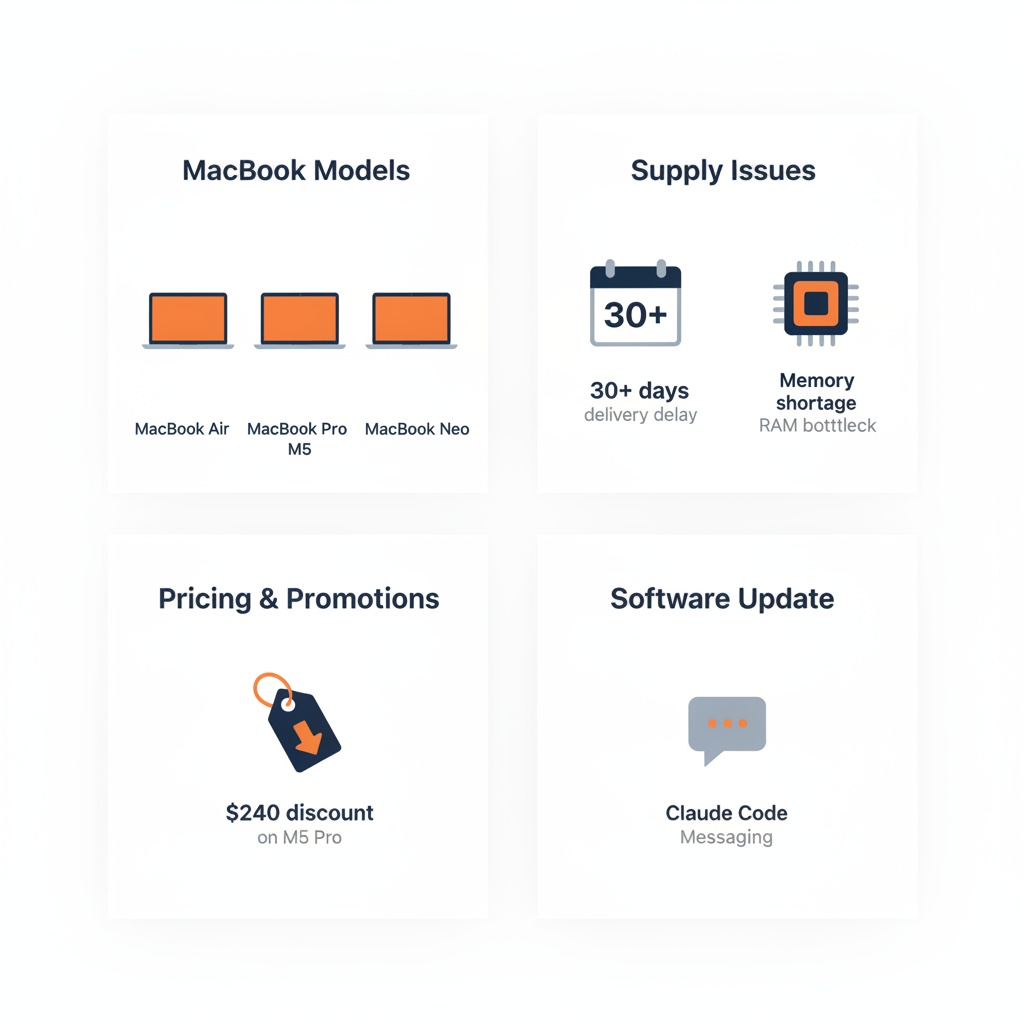
2026 MacBook lineup faces chip shortages and rare discounts with upcoming updates.
Apple's 2026 MacBook lineup prominently features three distinct models: the MacBook Air, the MacBook Pro equipped with the new M5 Pro chip, and the recently introduced MacBook Neo. This diversified portfolio addresses varying consumer needs—from ultra-portable everyday use to high-performance demands and budget-conscious buyers, particularly in education. The lineup reflects Apple's strategy to balance innovation with accessibility amid ongoing supply challenges.
MacBook Air: Features and Market Position
The MacBook Air remains Apple’s most popular laptop model in 2026, known for its lightweight design and sufficient power for general users. However, its availability has been severely impacted by a growing supply shortage linked primarily to a global memory chip deficit, especially in RAM supply. Delivery times have stretched up to a month, highlighting supply chain pressures that may push consumers toward alternative PC options. Despite these constraints, the MacBook Air continues to hold a strong market position as a reliable and stylish ultraportable device favored by students and professionals.
MacBook Pro with M5 Pro: Performance and Advancements
The MacBook Pro with the M5 Pro chip represents Apple’s cutting-edge offering for power users demanding high performance in creative and professional workflows. Recent price promotions have made this model more accessible, including discounts of up to $240, reflecting market strategies to stimulate sales. The M5 Pro chip delivers significant performance uplifts over previous generations, targeting users who require enhanced processing power for tasks such as video editing and software development. This positions the MacBook Pro as a premium workhorse amid a competitive landscape.
Introduction to MacBook Neo
The MacBook Neo is Apple's newest addition to the lineup, introduced in 2026 with a focus on affordability and education markets. Priced attractively—around $499 with education discounts—it aims to provide accessible MacBook experiences to students and budget-conscious consumers. The Neo combines innovative design cues with practical features, positioning itself as a compelling option compared to more expensive models. Its entry reshapes Apple’s offer range by expanding reach while maintaining MacBook brand values.
2. Recent Price Changes and Promotional Offers
Recent weeks have seen notable price adjustments across the MacBook product lineup, reflecting Apple's strategic efforts to stimulate demand and manage supply constraints amid ongoing challenges. One of the most prominent promotions is a $240 discount offered on the M5 Pro MacBook Pro at Amazon, marking a rare and significant reduction on this high-performance model. This price cut not only makes the MacBook Pro more accessible to a wider range of professionals but also signals Apple's response to competitive pressures in the premium laptop segment in 2026.
Discount on M5 Pro MacBook Pro
The $240 discount currently available on the M5 Pro MacBook Pro through Amazon represents a substantial saving compared to the model's standard pricing. Such a promotion is considered rare, especially for premium configurations that typically maintain stable pricing. This price drop is likely to increase market demand by attracting buyers weighing performance needs against cost, creating a timely opportunity for those interested in acquiring a powerful MacBook Pro without paying full price. The promotion also reflects broader retail dynamics where online marketplaces play a significant role in influencing consumer purchasing decisions.
Price Trends Across the Lineup
Beyond the M5 Pro MacBook Pro promotion, the MacBook series has experienced varied pricing fluctuations throughout 2026, including periodic discounts and offers tied to bank and credit card promotions in key regions like India. For example, after recent price hikes, Apple introduced up to a Rs 15,000 discount on select MacBook Air and Pro models in India, helping to offset increased costs for buyers on tighter budgets. These adjustments indicate Apple's attempt to balance premium pricing with accessible offers to maintain competitive positioning across different markets and consumer segments.
Overall, the pricing trends in the current period reveal a market environment where Apple combines controlled discounting with strategic promotions to address factors such as supply constraints—most notably the worsening shortages of the MacBook Air driven by memory chip issues—and competitive pressures. Such dynamics suggest cautious optimism for buyers looking to invest in new MacBooks, especially if timed with ongoing promotions, but also highlight the importance of monitoring availability and discount periods closely.
Significant discounts have been offered on multiple MacBook models in 2026 to boost sales amid supply constraints.
| Model | Discount | Source/Date |
|---|---|---|
| M5 Pro MacBook Pro | $240 off | Mashable 2026-08-13 |
| M5 Pro MacBook Pro | Up to $500 off | 9to5Toys 2026-08-01 |
| Base MacBook Air | $170 off | 9to5Mac 2026-07-29 |
| MacBook Pro and Air (India) | Up to Rs 15,000 discount | IndiaToday 2026-07-27 |
Summary of Recent MacBook Discount Deals in Mid-2026
3. Supply Chain and Inventory Status
In 2026, Apple is facing increasing supply chain constraints that are significantly impacting the availability of its MacBook lineup, particularly the MacBook Air. Delivery estimates for the MacBook Air now extend up to a month or more, reflecting worsening supply challenges. These issues stem primarily from a global shortage of memory chips, with RAM components being the chief bottleneck. As memory chips are essential for MacBook Air production, the shortage leads to delays in manufacturing and stock depletion in retail channels, posing notable difficulties for consumers seeking immediate purchase.
The root cause of these MacBook Air shortages is tied to a surge in demand for AI and high-performance memory chips across the tech industry, which has strained production capacities worldwide. Apple’s attempts to diversify its memory chip sourcing, including plans to procure from Chinese manufacturers like CXMT and YMTC, have encountered regulatory and logistical barriers, further complicating the supply chain response. Consequently, the RAM shortage is expected to persist for some time, forcing buyers to consider alternatives or endure longer wait times.
MacBook Air Shortages and Causes
The supply crunch for the MacBook Air has intensified over recent months, driven primarily by the ongoing global RAM shortage. This issue causes Apple to face longer delivery windows and patchy inventory availability in both physical Apple Stores and online marketplaces. As the MacBook Air remains Apple’s most popular and entry-level laptop offering, the supply delays have a pronounced effect on overall MacBook sales and consumer sentiment. The shortage's severity has pushed some potential buyers to consider Windows laptops as alternatives due to the scarcity and extended wait times.
Adding to the challenge is the fact that the memory shortage is not just a logistical hiccup but reflects a structural imbalance in chip manufacturing capacities, especially for specialized AI-compatible memory. Apple’s flagship MacBook Air models, which leverage such advanced memory technologies, are consequently the most affected. The shortage is currently the most significant limitation on production output, overshadowing other potential supply bottlenecks. This scenario highlights the vulnerability of Apple’s supply chain to specific component constraints in a highly competitive semiconductor market.
Overall Supply Chain Challenges for Apple
Beyond the MacBook Air’s RAM issues, Apple’s broader MacBook production and distribution in 2026 is being affected by complex supply chain challenges. These include difficulties in securing consistent supplies of key components amid rising global demand and geopolitical trade complexities. Attempts to mitigate risks by diversifying component sourcing have met with mixed success, as regulatory hurdles and tariffs complicate procurement from new vendors, especially in China. These factors combine to create an environment where supply chain agility is paramount but difficult to achieve.
The resulting impacts manifest as intermittent stock shortages, delayed shipments, and occasional price adjustments or promotions designed to balance inventory levels. Apple’s supply chain management strategies must navigate these challenges while maintaining product quality and meeting consumer expectations. The ongoing supply limitations underscore the importance for buyers to plan purchases carefully, especially for models known to be affected by component shortages. For Apple, these constraints emphasize the critical need to innovate not only in product design but also in supply logistics to sustain competitive advantage.
| Cause | Details |
|---|---|
| Memory Chip Shortages | Global RAM shortage worsened by AI and high-performance chip demand |
| Supply Chain Constraints | Difficulty sourcing chips from Chinese suppliers CXMT and YMTC amid barriers |
| Demand Surge | Increased MacBook Air demand driven by AI workloads and performance needs |
Causes of MacBook Air Supply Shortages in 2026
4. Notable Software Updates and Ecosystem Enhancements
In August 2026, Apple’s macOS platform has seen notable software advancements that enhance the MacBook user experience and deepen ecosystem integration. These updates include innovative communication features designed to improve productivity by allowing seamless interaction across different instances of apps and devices. Such enhancements reflect Apple’s ongoing commitment to fostering a connected ecosystem, making MacBooks more versatile tools for both personal and professional use.
Claude Code Messaging on macOS
A key highlight among recent macOS updates is the introduction of cross-session messaging through Claude Code, which now enables communication between active sessions on macOS devices. This feature allows users to message their other Claude Code sessions directly, supporting continuity and fluid multitasking across MacBooks. By bridging otherwise isolated sessions, this innovation reduces workflow friction and elevates the collaborative capabilities of the software environment on Apple laptops.
This cross-session messaging capability is significant as it addresses a common limitation in decentralized messaging apps where separate sessions operate in silos. The update, rolled out in early August 2026, enhances user convenience by maintaining ongoing conversations and seamlessly syncing messages among different sessions without interruption. For MacBook users, this means improved efficiency, especially for professionals who juggle multiple tasks or projects concurrently, leveraging the full power of Apple’s macOS ecosystem.
Other Significant macOS Enhancements
Beyond Claude Code, other important macOS updates have been released to enhance productivity and system integration for MacBook users. These include performance optimizations that improve app responsiveness, better management of memory resources essential amid ongoing hardware supply constraints, and refinements to native apps that support creativity and communication. Collectively, these enhancements reinforce Apple’s strategy to provide a cohesive and efficient user experience that leverages hardware-software synergy.
Such system improvements align with a broader industry trend of making user interfaces smarter and more context-aware, which helps users focus on tasks without technical distractions. Apple’s macOS updates in 2026 also show the company’s responsiveness to user feedback and the competitive need to maintain MacBooks as premium productivity machines. As a result, users benefit from smoother workflows and greater ecosystem harmony, underpinning the value of choosing MacBooks within Apple’s broader product lineup.
5. Upcoming Apple Announcements and Market Outlook
Expected September 2026 Announcements
Apple is anticipated to host a major event in September 2026 where updates relevant to the MacBook line could be unveiled. While no official details have been fully disclosed, industry observers expect potential product refreshes including new MacBook Pro and MacBook Neo models that might incorporate emerging hardware improvements. This aligns with Apple's typical annual cycle, making September a likely time for innovations that could address current supply constraints or performance upgrades.
The expected announcements also come amid supply challenges, particularly the worsening shortage of MacBook Air devices due to memory chip scarcity. Any new releases or updates could potentially mitigate these shortages by introducing refreshed components or adjusted production strategies. Additionally, software advancements such as enhanced macOS features — exemplified recently by updates like cross-session messaging on macOS — may be further highlighted to complement hardware improvements during the event.
Market Positioning and Consumer Advice
Consumers considering MacBook purchases in late 2026 face a mixed market environment marked by ongoing MacBook Air shortages and variable pricing across other models. Discounts remain available on select MacBook Pro models powered by the M5 Pro chip, with promotions offering savings up to $240, presenting an opportune moment for buyers prioritizing performance and value. Conversely, the supply crunch in Air models may lead prospective customers to explore alternative options or delay purchases until inventories stabilize.
Given the anticipated September event, buyers weighing between immediate acquisition versus waiting should consider their usage needs and budget. Those needing immediate performance might benefit from current deals on MacBook Pro models, while customers less time-sensitive and interested in potential new features or updated designs may prefer to wait until later this year. Furthermore, understanding ongoing component shortages and price fluctuations can enable more informed decisions as Apple’s product lineup evolves towards the end of 2026.
Glossary
- MacBook Air — Apple’s lightweight, popular laptop model aimed at everyday users, facing RAM chip shortages in 2026.
- MacBook Pro (M5 Pro) — High-performance MacBook model featuring the new M5 Pro chip, targeted at professionals.
- MacBook Neo — Recently introduced budget-conscious MacBook model, focusing on education markets.
- M5 Pro chip — Apple's advanced processor powering the 2026 MacBook Pro for enhanced performance.
- Claude Code Messaging — New macOS feature enabling cross-session messaging between active MacBook devices.
- Memory chip shortage — Global deficit in RAM components disrupting MacBook Air production and availability.
- Supply chain constraints — Production and delivery delays for MacBooks due to global shortages and high tech demand.
- September 2026 Apple event — Upcoming Apple announcement expected to unveil MacBook refreshes and hardware updates.
References
- MacBook Air shortages are getting worse, here’s where to buy one
- The iPhone X is obsolete now, and so is that aging MacBook Pro
- Rare Apple drop: Get $240 off the M5 Pro-powered MacBook Pro right now at Amazon
- Claude Code now lets sessions talk to each other on macOS - 9to5Mac
- Claude Code Adds Cross-Session Messaging on macOS - MacRumors
- Message your other Claude Code sessions - Claude Code Docs
- Apple's MacBook Air supply is worsening, and unsurprisingly RAM is to blame
- MacBook Air Faces Supply Crunch as AI Memory Chip Demand Surges
- Apple MacBook Air hits supply shortage – Here are 5 strong alternatives you can buy now
- This MacBook Pro just fell below its pre-price-hike MSRP (Save $500) - 9to5Mac
- This weekend's best Apple discounts: M5 MacBook Air $240 of, M5 Pro $500 off, AirPods Pro 3, AirTag 2, much more
- Deals: M5 MacBook Pro $320 off, base MacBook Air $170 off, AirPods Pro 3, TechWoven case 32% off, Apple cables, more
- Here are the best MacBook deals right now: July 2026 Buyer’s Guide
- Lenovo IdeaPad leak shows a new laptop with strong MacBook Neo vibes
- watchOS 27 will add two new apps to your Apple Watch - 9to5Mac
- Early-season apples hit market in Zhaotong, China's Yunnan -Xinhua
- Lenovo’s answer to the MacBook Neo could be a peppy Vibe laptop
- Apple's plan to source memory from China's CXMT and YMTC hits snags amid dual barriers
- Why Did Apple Stop Making White MacBooks? The MacBook Air Might Be The Culprit
- Microsoft Erased Its 32GB RAM Guidance Twice; $849 Surface Fails Its Own Copilot+ Standard
- iPhone 20 Pro’s all-glass design spotted in supply chain, says leaker
- A look at "Spiralism", a quasi-spiritual movement that grew in 2025 from human-AI conversations after sycophantic GPT-4o updates and expanded ChatGPT memory (Hayden Field/The Verge)
- How to qualify for Apple's education discount - and get a $499 MacBook Neo for school | ZDNET
- Apple now offering up to Rs 15,000 discount on MacBook Pro, Air weeks after price hike
- Deals: MacBook Pro $500 off, rare MacBook Air discounts, AirTag 2, charging gear, MagSage Battery, more