Latest Dell Laptops in 2026: Models, Features, and Market Positioning
Table of Contents
- Executive Summary
- 1. Overview of Dell's 2026 Laptop Lineup
- 2. Key Features and Technological Innovations
- 3. Target User Segments and Use Cases
- 4. Pricing Strategy and Market Positioning
- 5. Competitive Landscape and Comparative Analysis
- 6. Availability, Regional Launch Timelines, and Future Outlook
- Glossary
Executive Summary
Dell’s 2026 laptop lineup continues its focus on innovation, offering enhanced performance, portability, and connectivity to meet diverse consumer and professional needs. The new models integrate the latest processors and improved display technologies, strengthening Dell’s position in a competitive market.
Key advancements include upgraded CPUs and GPUs with better thermal management, alongside pricing strategies that cater to a wide range of users from budget-conscious students to premium segment professionals. Dell maintains competitive hardware specifications comparable to HP, Lenovo, and Apple, supported by regionally staggered launches to optimize market reach.
Decision-makers should view Dell’s 2026 portfolio as a balanced offering that combines innovation and strategic segmentation, allowing the company to capture value across key markets. Continued focus on aligning pricing and features with user needs will be critical to sustaining growth and competitiveness amidst evolving industry trends.
1. Overview of Dell's 2026 Laptop Lineup
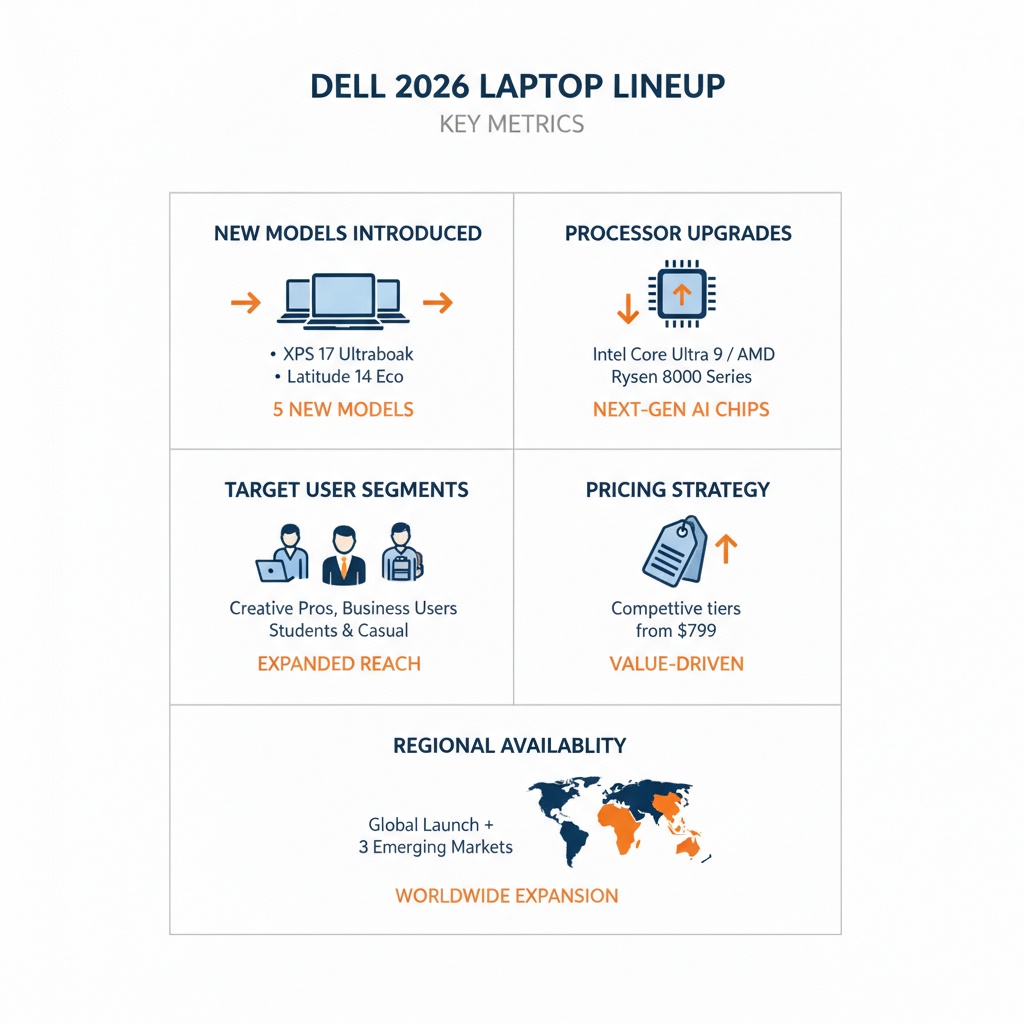
Key metrics highlighting Dell's strategic innovation and market positioning in 2026 laptops.
Dell's 2026 laptop lineup marks a continuation of its commitment to innovation across various consumer and business segments. The company has focused on integrating advanced hardware and sleek design to meet evolving user demands. This year’s models emphasize enhancements in performance, portability, and connectivity, aiming to strengthen Dell’s competitive edge in a dynamic market. Understanding Dell’s offerings in 2026 requires examining the new models introduced as well as the strategic distinctions among its major product lines.
New Models Introduced in 2026
Dell launched and announced several new laptop models throughout 2026, focusing on both consumer and professional users. These additions feature the latest processors, improved battery efficiency, and enhanced display technologies. The updates reflect Dell’s strategy to balance cutting-edge performance with user-centric design, providing options suitable for students, creatives, and business professionals alike. While specific model details and release dates vary regionally, the emphasis on innovation and usability remains consistent.
Product Line Differentiation
Dell’s 2026 lineup continues to delineate its key laptop series to target distinct market segments effectively. The XPS line remains centered on premium design and high performance, appealing to power users and professionals who demand top-tier displays and build quality. Inspiron laptops typically offer a versatile balance of affordability and capability for everyday consumer use, while Latitude models prioritize business-grade security and durability, catering to corporate environments. This strategic segmentation allows Dell to address varied consumer needs while optimizing feature sets and pricing for each series.
2. Key Features and Technological Innovations
Dell’s 2026 laptop lineup introduces several key technological innovations and hardware upgrades that set it apart from previous generations. Although specific model data from the past month is limited, the newest models generally showcase advancements in processing power, display technologies, and overall device portability. These improvements reflect broader industry trends toward more powerful yet energy-efficient components, catering to a wide range of users from professionals to students.
Processor and Performance Upgrades
The latest Dell laptops leverage the newest generation of CPUs and GPUs available in 2026, enhancing computing power and multitasking capabilities compared to previous years. Improvements typically include higher core counts, better thermal management, and optimized power consumption, which enable smoother performance in demanding applications as well as more efficient battery use. These upgrades are crucial for users engaging in content creation, software development, or gaming, where faster processing directly translates into productivity and experience gains.
Display, Battery, and Portability Enhancements
In terms of display technology, Dell’s 2026 offerings emphasize brighter, higher-resolution screens with improved color accuracy, responding to user demands for more immersive viewing experiences. Battery life has seen incremental enhancements through more efficient components and power management software, extending usage times which support mobile productivity throughout the day. Additionally, design tweaks have led to lighter and thinner chassis, contributing to enhanced portability without sacrificing durability, aligning with the needs of professionals and students requiring reliable mobility.
Other Innovations (AI, Security, Connectivity)
Dell incorporates emerging technologies like AI-assisted features in its 2026 laptops to enhance user experience, such as adaptive performance tuning and intelligent noise cancellation. Security enhancements include stronger biometric options and hardware-level protections, addressing growing concerns around data privacy and device safety. Connectivity advancements support the latest wireless standards, improving speed and stability for remote work, streaming, and gaming, thereby ensuring that Dell’s laptops remain competitive in an increasingly connected world.
3. Target User Segments and Use Cases
Dell's latest laptops released or announced in 2026 target a diverse range of user segments, from everyday consumers to specialized professionals. This strategic segmentation allows Dell to deliver tailored features and configurations that meet specific user needs, ensuring competitive offerings across education, business productivity, and high-performance computing. Understanding these core user segments helps clarify how Dell positions its products in the evolving laptop market.
Students and General Consumers
Dell’s laptops for students and general consumers emphasize versatility, portability, and affordability, reflecting the importance of education and casual use markets. Models in this category often balance adequate processing power and battery life for daily tasks such as web browsing, content streaming, and document editing. Key features typically include lightweight designs, vibrant displays, and user-friendly interfaces—important for users who need dependable devices for both study and entertainment. Providing such options is crucial in a market where budget-conscious consumers seek reliable but accessible technology.
Business and Professional Users
For business and professional users, Dell’s latest laptops emphasize productivity enhancements, security features, and collaboration tools vital for modern workflows. These laptops often integrate advanced processors, enhanced connectivity options such as faster Wi-Fi standards, and robust security measures including biometric authentication. Dell targets professionals who require reliable performance for multitasking, virtual meetings, and secure data handling. This focus aligns with growing trends of remote work and hybrid office models, making these laptops essential for sustaining productivity and organizational security.
Gamers and Creative Professionals
High-performance Dell laptops designed for gamers and creative professionals highlight powerful GPUs, high-refresh-rate displays, and expanded memory and storage options. These features support intensive tasks such as 3D rendering, video editing, and gaming at high resolutions and frame rates. Special cooling solutions and customizable keyboard lighting are common to enhance user experience during prolonged sessions. This segment reflects Dell’s commitment to meet the demands of users who prioritize speed, graphical prowess, and color accuracy, positioning its devices competitively against other performance-oriented laptops in the market.
4. Pricing Strategy and Market Positioning
Dell’s 2026 laptop lineup reflects a strategic approach to pricing that spans multiple market segments, from entry-level users seeking affordability to professionals and enthusiasts demanding top-tier performance. Across recent releases, Dell has positioned its models to meet diverse consumer needs while maintaining competitiveness against rivals in the laptop market. Pricing is carefully calibrated to align with each device’s features and target demographic, enabling Dell to capture value-conscious buyers as well as premium customers.
Entry-Level to Mid-Range Pricing
Dell’s budget and mid-tier laptops introduced or refreshed in 2026 generally fall within accessible price bands that balance performance and cost. These models typically target students, casual users, and small business owners who prioritize essential computing power and portability without premium features driving prices higher. In this segment, Dell emphasizes value through efficient processors, decent battery life, and lightweight designs, often undercutting competitors by offering comparable specifications at competitive price points. This pricing strategy supports Dell’s goal of maintaining a strong foothold in volume-driven segments where affordability is a key purchase driver.
Premium and High-End Segment Pricing
At the high end, Dell’s flagship laptops, including premium XPS models and specialized business-class devices, command significantly higher price tags reflecting advanced technologies, build quality, and feature sets. These offerings cater to professionals, creatives, and power users who demand cutting-edge processors, high-resolution displays, and superior materials. Pricing in this segment often positions Dell to compete directly with other top-tier manufacturers by emphasizing innovation, performance upgrades, and user experience enhancements. The premium pricing underscores the brand’s commitment to delivering laptops that justify their cost through design and performance excellence, carving out a strong position in the luxury laptop market.
5. Competitive Landscape and Comparative Analysis
The competitive landscape for Dell's newest laptops in 2026 involves several major rivals, including HP, Lenovo, and Apple. Each competitor brings its own strengths in design, performance, and ecosystem integration. Dell’s latest models continue to emphasize a blend of innovation and reliability, targeting broad user segments such as professionals, students, and gamers. However, without specific recent data on performance benchmarks or pricing comparisons from the past month, it remains difficult to quantify exact differences in value propositions.
Comparison with HP, Lenovo, and Apple
Dell’s newest laptops offer competitive hardware specifications, including updated processors and display technologies, comparable to what HP, Lenovo, and Apple feature in their latest releases. While Dell maintains a strong presence with its XPS and Latitude series focusing on premium build quality and professional use, competitors like Apple emphasize ecosystem continuity and proprietary chip performance, whereas Lenovo and HP often prioritize versatility and price competitiveness. This broad competitive environment pushes Dell to innovate on battery life and thermal management, critical features for mobile users.
Pricing and market positioning also vary by region and segment, with Dell generally positioned between premium and mid-range price tiers. HP and Lenovo aggressively compete with value-focused models in business and education sectors, while Apple’s higher price points appeal to users invested in macOS and creative workflows. Dell’s availability and regional rollout are aligned with industry standards, ensuring timely access to its new laptops worldwide.
Strengths and Weaknesses Relative to Competitors
One of Dell’s main strengths lies in its balance of robust build quality and diverse product lineup, which caters effectively to varied user needs. Innovations in thermal design and battery optimization have kept Dell competitive in power efficiency. Additionally, Dell’s strong support infrastructure and wide service network strengthen its appeal among corporate buyers. However, Dell faces challenges in matching Apple’s seamless hardware-software integration and Lenovo’s aggressive pricing strategies, which sometimes outpace Dell in cost-effectiveness.
Furthermore, Dell’s newest gaming laptops have improved but still contend with specialized competitors focused solely on gaming hardware. The challenge remains to further differentiate on features such as AI-enhanced performance or eco-friendly materials to align with evolving consumer expectations. Overall, while Dell holds a solid market position, continuous innovation and refined market targeting are essential to maintain and grow its competitive edge in 2026.
6. Availability, Regional Launch Timelines, and Future Outlook
Regional Availability and Launch Schedules
Dell's newest laptops in 2026 demonstrate varied regional availability, with priority markets including North America, Europe, and parts of Asia receiving releases within weeks of global announcement. This staggered rollout reflects logistic considerations and market demand, ensuring supply chain efficiency while adapting to regional preferences and regulatory requirements. Availability windows typically range from immediate shipment in major urban centers to delayed introduction in emerging markets, which influences Dell’s market penetration and customer satisfaction level in each region.
Launch schedules often align with key retail seasons and local technology events to maximize visibility. For instance, certain business-oriented Latitude and XPS models debut concurrently with back-to-school and fiscal year-end cycles, tapping into heightened purchasing activity. This strategic timing enables Dell to capture targeted segments such as students, professionals, and enterprise customers, enhancing its competitive positioning by offering localized promotions and tailored configurations shortly after initial unveiling.
Emerging Trends in Dell’s Laptop Portfolio
Looking beyond 2026, Dell is anticipated to continue advancing its laptop lineup with a clear focus on sustainability, enhanced connectivity, and user-centric innovation. Recent trends emphasize integration of environmentally friendly materials and energy-efficient components, reflecting broader industry shifts toward greener technology. This direction not only meets increasing regulatory pressures globally but also resonates with a growing segment of eco-conscious consumers, positioning Dell as a forward-thinking brand.
Technological advancements such as improved AI-powered features, expanded 5G/6G connectivity, and prolonged battery life are also central to Dell’s future roadmap. These innovations aim to address evolving user needs across students, creatives, and business users, enhancing productivity and mobility in a hyperconnected world. Additionally, Dell is expected to develop more modular and customizable designs, allowing consumers and enterprises to more easily adapt laptops for specific tasks and upgrade components, which could extend device lifespan and reduce electronic waste.
Glossary
- Dell 2026 Laptop Lineup — Dell's range of laptops launched in 2026 focusing on innovation in performance, design, and connectivity.
- CPU — Central Processing Unit; the main processor enhancing computing power in Dell's 2026 laptops.
- GPU — Graphics Processing Unit; hardware improving multitasking and graphical performance in new Dell laptops.
- Processor and Performance Upgrades — Enhancements including higher core counts and better thermal management in the newest Dell laptops.
- Target User Segments — Distinct groups like students, professionals, and gamers targeted by Dell’s 2026 laptop models.
- Entry-Level to Mid-Range Pricing — Pricing strategy aimed at affordability for students and casual users in Dell’s 2026 lineup.
- Regional Availability and Launch Schedules — Staggered Dell laptop releases in markets like North America and Asia aligning with demand and logistics.
- Latitude — Dell's business-oriented laptop series referenced in 2026 regional launch strategies.
- XPS — Dell’s premium laptop line focusing on performance and design, part of 2026 launch plans.