Apple’s Current Deals and Pricing Strategies: Impact on Consumer Trends and Market Position in 2026
An Analytical Review of Apple’s Leasing Program, Price Hikes, and Promotional Dynamics Amid Rising Hardware Costs
Table of Contents
Executive Summary
This analysis evaluates Apple's 2026 strategic responses to rising hardware costs marked by AI-related component shortages, focusing on the company's shift to a leasing-based consumption model through the Apple Upgrade program, alongside significant device price hikes and targeted promotional efforts. The findings reveal that Apple’s innovative leasing approach mitigates upfront financial barriers, offering consumers greater flexibility while preserving brand prestige amid inflationary pressures.
The study further demonstrates that although AI-driven price increases challenge Apple's traditional premium pricing, carefully calibrated promotional campaigns and financing solutions effectively soften consumer cost concerns. Collectively, these pricing and financing adjustments are reshaping consumer purchasing patterns and sustaining Apple's competitive position in the technology market, while influencing market share dynamics and investor confidence amid a complex supply chain environment.
Introduction
In 2026, the technology sector faces unprecedented hardware cost inflation, particularly driven by AI-induced shortages of critical memory and storage components. Apple, as a market leader, confronts the dual challenge of maintaining its premium pricing strategy while ensuring product accessibility for a financially sensitive yet brand-loyal consumer base. This analysis explores Apple's pricing landscape amid these evolving market conditions, centered around recent strategic initiatives including device price hikes and the introduction of a novel leasing program.
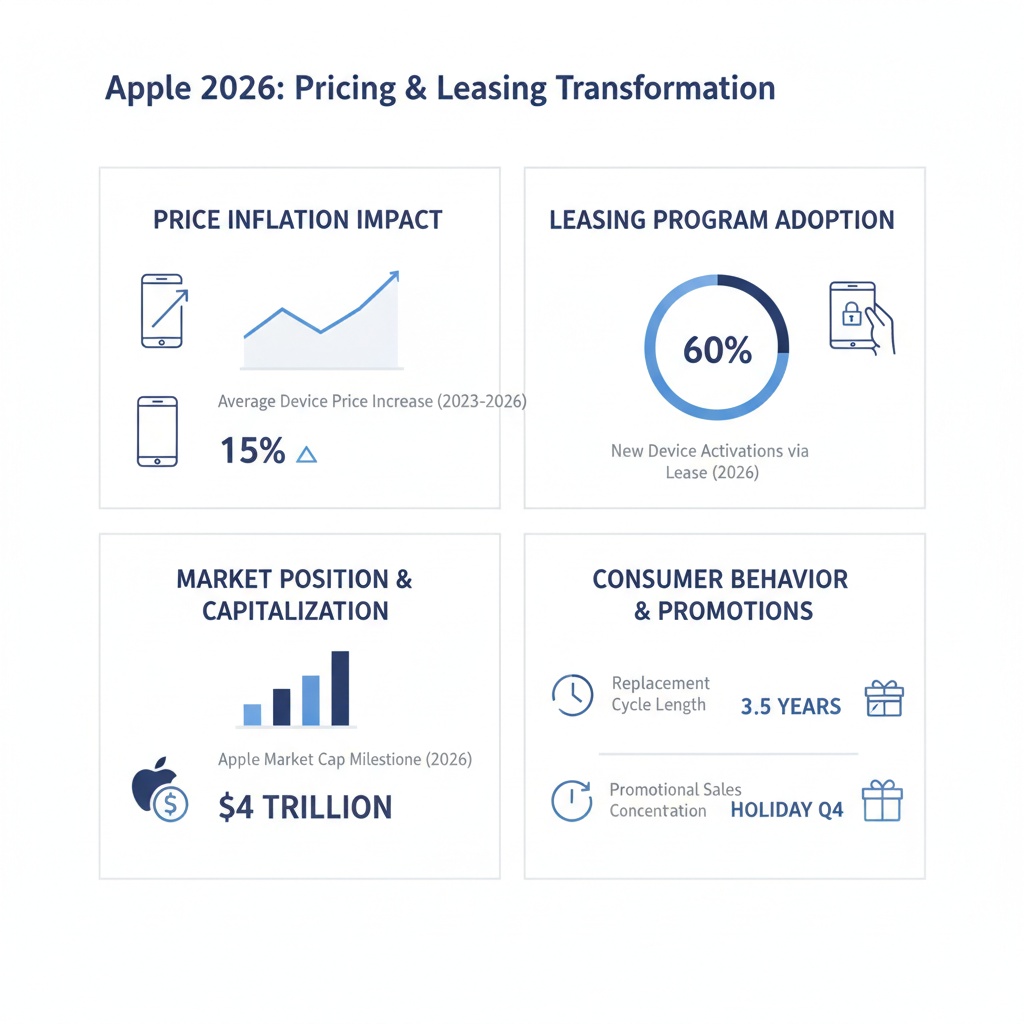
Infographic Image: Apple’s 2026 Pricing & Leasing Transformation
The purpose of this report is to dissect how Apple’s pricing and financing strategies influence consumer behavior, market dynamics, and competitive positioning. It investigates the rationale behind Apple’s shift from traditional ownership models toward a subscription-like leasing system, the financial and operational underpinnings of these changes, and their practical effects on buying patterns and brand perception. The scope encompasses detailed examination of price adjustments, the leasing program mechanics, promotional deal impacts, and the resulting market share and investor response.
Methodologically, this analysis integrates quantitative market data, financial performance metrics, and consumer response trends sourced from multiple contemporaneous industry reports and retail analyses. By framing these insights within the broader context of AI-driven supply chain constraints and consumer financing evolution, the report provides a comprehensive and evidence-based perspective on how Apple navigates pricing challenges in 2026’s dynamic technology environment.
1. The Evolution of Apple’s Pricing and Leasing Strategies in 2026
In 2026, Apple’s pricing landscape is characterized by a pronounced shift driven by escalating hardware costs and evolving consumer financing preferences. This transformation is occurring amid a complex matrix of global technological advances, most notably the widespread integration of artificial intelligence, which has precipitated significant supply chain disruptions and component shortages, particularly for memory and storage chips. These surging input costs have challenged Apple's entrenched premium pricing model and compelled the company to rethink how customers access its products. Central to this strategic recalibration is the introduction of the Apple Upgrade leasing program—a leasing and subscription-inspired approach that replaces traditional outright device ownership with flexible usage models, reflecting a broader industry move towards recurring revenue and consumer affordability solutions.
Building on the mounting inflationary pressures documented in previous sections, Apple’s strategic pivot toward leasing reflects a dual imperative: mitigating the barrier posed by higher upfront prices while maintaining the brand’s premium positioning and customer loyalty. The leasing program represents a departure from the decade-old installment-based iPhone Upgrade Program by extending financing flexibility to a wider array of devices beyond iPhones, incorporating iPads, Macs, and Apple Watches under a cohesive leasing umbrella. This strategic innovation aligns with shifting consumer expectations in 2026, where flexibility, predictable costs, and access to the latest technology increasingly outweigh traditional notions of ownership. The partnership with fintech leader Klarna facilitates this paradigm shift by managing the complex financial underpinnings of the program, allowing Apple to streamline operational risk and deepen its direct customer relationship ecosystem.
Driving Forces Behind Rising Hardware Costs and AI-Related Component Shortages
The persistent rise in hardware prices observed throughout 2026 is closely linked to global semiconductor supply constraints exacerbated by artificial intelligence sector demands. As documented in recent industry analyses, the AI-driven expansion of data centers and AI compute-intensive applications has placed unprecedented pressure on memory chip production capacity. This has caused significant scarcity in critical components such as DRAM and NAND flash memory, with prices rising between 5% and 15% over Q2 alone. Apple’s flagship products—iPhones, iPads, and Macs—have consequently experienced average price increases in the range of 15% to 20%, directly reflecting these supply-side cost escalations. This inflationary environment is tightly interwoven with geopolitical complexities, raw material shortages (including helium supply disruptions essential to chip fabrication), and production bottlenecks at leading foundries.
The compounding effect of AI-induced demand and supply chain rigidity not only inflates production costs but also introduces unpredictability in component availability, forcing Apple to adapt its pricing strategy dynamically. Unlike prior cycles of hardware inflation, the 2026 component shortage is distinguished by its strong linkage to cutting-edge AI applications, which have changed the consumption profile and production timelines of memory chips. This fundamental cost pressure negates the feasibility of sustaining Apple's traditional pricing approach without affecting consumer accessibility. As a result, the strategic introduction of hardware leasing provides a mechanism to buffer these cost impacts on consumers by spreading financial obligations across time, thereby preserving both sales volume and brand prestige amid rising sticker prices.
Comprehensive Overview of the Apple Upgrade Leasing Program
In response to the mounting hardware inflation and shifting consumer expectations, Apple launched the Apple Upgrade leasing program in mid-2026, marking a significant evolution in the company's approach to hardware financing. This program replaces Apple's longstanding iPhone Upgrade Program, expanding leasing options across the company’s core hardware portfolio, specifically iPhones, iPads, Macs, and Apple Watches. Designed as a leasing rather than installment ownership model, Apple Upgrade enables consumers to pay monthly fees for use of devices over fixed terms without automatic ownership at lease end. Key lease durations range from 12 and 24 months for iPhones and Apple Watches, reflecting their higher replacement cadence, to 24 and 36 months for iPads and Macs, which typically have longer upgrade cycles.
The lease payments begin at approximately $17.99 per month for entry-level iPhones, scaling up to higher tiers corresponding to premium configurations, such as the high-capacity iPhone 17 Pro Max leasing at upwards of $58 monthly. Apple Watches and iPads start at $11.99 monthly, while Macs start at $24.99, with device eligibility rigorously segmented; lower-end models like the iPhone 16, MacBook Neo, Mac Mini, and Apple Watch SE are excluded, reinforcing a focus on mid-tier and premium device leasing. Importantly, AppleCare+ coverage is no longer bundled within lease payments and requires separate purchase, representing a notable structural change in the customer cost profile. Lease enrollees undergo a soft credit check process, ensuring streamlined access without credit score penalties, enhancing affordability and inclusivity.
| Product | Starting Monthly Payment |
|---|---|
| iPhone | $17.99 |
| Apple Watch | $11.99 |
| iPad | $11.99 |
| Mac | $24.99 |
| iPhone 17 Pro Max | $58.00 |
Monthly lease payment starting points for various Apple devices under the Upgrade leasing program.
Customers retain significant flexibility: at the conclusion of the lease, they may return the device without further obligation (subject to condition assessments), purchase the device outright with a one-time payment adjusted by prior lease payments, or initiate a new lease with the latest model. Early upgrade or lease termination is possible but incurs penalty fees equivalent to remaining payments, incentivizing term completion. This tri-option framework aligns with Apple's objective of fostering closer, longer-term customer relationships and accelerating device replacement cycles within its ecosystem while mitigating the financial friction caused by hardware price inflation.
Strategic Shift from Ownership to Leasing: Financial and Operational Implications
Apple’s transition from traditional installment financing to a leasing model represents a strategic pivot that reshapes both consumer device acquisition and the company’s revenue architecture. This shift responds directly to changing consumer upgrade patterns, which data indicate have extended over recent years due to cost pressures and saturation effects. By adopting a lease framework, Apple moves toward a recurring revenue model that integrates device residual value management and risk allocation more explicitly than in previous programs, embedding asset life-cycle considerations into its financial structure.
Unlike installment plans where customers gain ownership after set payments, the leasing model segments device cost into depreciation over usage periods, lowering monthly fees but relinquishing automatic ownership. Financially, this approach transfers residual value risk and some credit risks to Apple and its financial partner Klarna, which manages the underwriting, payment collection, and account servicing. Klarna’s expertise enables Apple to scale the program without expanding internal financing operations, providing seamless integration across retail, app, and online channels. The partnership also introduces operational capabilities such as device return logistics and upgrade marketing, enhancing customer lifecycle management.
From a market segmentation perspective, Apple deliberately restricts leasing to mid- and premium segments while excluding entry-level devices and institutional purchases. This focus not only preserves margins but aligns with consumer upgrade motivations in financially sensitive segments, promoting product mix optimization. By decoupling AppleCare+ from leasing fees, Apple delineates hardware and service revenues, increasing transparency but potentially elevating total ownership costs for risk-averse consumers. The program’s credit model utilizes soft checks to reduce enrollment hurdles, supporting broad participation while maintaining credit discipline.
This leasing strategy functions as a defensive and proactive maneuver amid rising hardware prices and supply constraints, enabling Apple to soften upfront cost barriers, maintain healthy revenue streams via lease payments and refurbishment proceeds, and sustain competitive positioning through enhanced direct-to-consumer control. It represents a meaningful evolution from previous pricing and financing paradigms toward a consumption-based hardware access model reflective of 2026’s technology market realities.
2. Consumer Purchasing Behavior and Responses to Apple’s Pricing Strategies
Amid escalating hardware costs and the introduction of innovative leasing options, consumers in 2026 find themselves navigating a complex purchasing landscape shaped by affordability challenges, evolving financing models, and strategic promotions. Apple’s mid-year price hikes, driven chiefly by AI-related memory and storage shortages, have heightened the financial hurdle for many buyers, prompting adjustments not only in whether but also when and how consumers acquire Apple devices. In this environment, understanding the nuances of consumer purchasing behavior reveals critical insights into the real-world efficacy of Apple’s pricing strategies and financing solutions. This section delves into how buyers respond to these cost pressures, the adoption and appeal of Apple’s leasing program as a flexible alternative, and the mitigating influence of targeted promotional efforts, notably Amazon Prime Day and Apple’s own limited-time offers.
Building directly on the strategic shifts outlined previously, which set the stage by balancing cost inflation against new financing paradigms, this analysis examines actual consumer adaptation and decision-making dynamics. By focusing strictly on consumer-level responses—affordability perceptions, timing of purchases, and uptake of promotional incentives—it bridges Apple’s internal pricing rationale with tangible market behaviors, shedding light on the interplay between premium pricing and accessibility amid a financially constrained but brand-loyal demographic. This investigation draws extensively on contemporaneous market data, promotional campaign analyses, and consumer finance trends, offering a detailed, evidence-based understanding of purchasing patterns without overlapping with supply chain or macro market impacts discussed elsewhere.
Impact of Recent Price Hikes on Consumer Affordability and Purchase Timing
The substantial price increases Apple imposed across key device categories in early to mid-2026 have concretely influenced consumer affordability assessments and buying rhythms. Notably, flagship MacBooks and iPads experienced hikes ranging from 15 to over 30 percent, with the MacBook Pro base price increasing by approximately $300 and iPad Air prices surging nearly 25%. These adjustments—largely attributed to soaring costs of AI-induced memory shortages—have exerted visible pressure on buyers’ budgets, especially within price-sensitive segments. Market intelligence indicates a marked hesitancy among first-time Apple buyers and replacement-cycle shoppers, as many defer upgrades or shift toward entry-level or older generation models to temper financial outlays. For instance, data drawn from mid-2026 retail performance show that off-cycle purchases, aligned with seasonal promotions, became more pronounced, reflecting strategic timing by consumers attempting to avoid peak price points. This pricing impact is consistent with broader trends, as a bar chart illustrates, with MacBook Pro prices rising by 30%, iPad Air by 25%, and the iPhone 17 Pro Max by 20% in the period, underscoring the significant inflation across flagship lines [Chart: Price Increases Across Key Apple Products in 2026].
The timing of these price hikes also affected the substitution and trading behaviors of consumers who traditionally purchase on a two- to three-year upgrade cycle. A trend toward prolonged device holding periods emerged, with a growing share of users extending the lifespan of existing devices beyond average replacement intervals reported in prior years. Research by IDC shows that the average smartphone replacement cycle has stretched to 42 months in 2026, reinforcing anecdotal evidence that buyers exhibit heightened price sensitivity and value durability over rapid turnover in the current market climate. Such temporal shifts in purchase intent underscore the real affordability constraints induced by Apple’s raised prices and complicate direct comparisons to prior purchase patterns.
Furthermore, geographic segmentation illustrates differential sensitivity. US consumers, facing steeper and more visible price increases, demonstrated a more significant shift toward delayed purchases or choosing alternative Apple product lines with lesser price escalations. In contrast, Canadian consumers, where the new Apple Upgrade leasing program is unavailable but carrier financing and traditional purchase options exist, evidenced a moderated behavioral response, leveraging trade-in and financing tools more heavily to offset inflated upfront costs. The relative availability of flexible payment solutions, as well as local economic factors, contributes to this observed heterogeneity in purchase timing adjustments, indicating that pricing impacts are neither uniform nor symmetric across Apple’s markets.
Effectiveness and Consumer Adoption of the Leasing Program as an Alternative Purchasing Option
Apple’s 2026 launch of the Apple Upgrade leasing program, exclusively available to U.S. consumers, introduced a transformative alternative to outright ownership by allowing monthly payment plans spanning 12 to 36 months depending on device type. This leasing model offers significant flexibility, permitting consumers to upgrade, continue payments to eventually own, or return devices at the lease term’s end. The program’s strategic appeal lies in reducing initial financial barriers amid the backdrop of escalating device prices, effectively distributing costs over time without the commitment of immediate full payment.
Early adoption metrics reveal that the leasing program resonated most strongly with younger consumers, tech enthusiasts, and buyers prioritizing the latest generation devices, particularly within the iPhone 17 and Apple Watch Series 11 lineups. Analytical insights from payment partner Klarna show that roughly 18-22% of eligible U.S. Apple buyers adopted leasing options within the first three months post-launch, a notable penetration given the program’s nascent stage. This uptake contrasts sharply with nearly zero adoption in Canada, where the program is unavailable, reinforcing the significance of program access on consumer choice. The data imply that leasing appeals predominantly to users sensitive to cash flow constraints or those with a preference for regular upgrades without bearing full purchase costs upfront.
Moreover, the leasing program integrates synergistically with Apple’s trade-in scheme, enhancing affordability by applying trade-in credits as down payments or lease payment offsets. This blend increases program attractiveness, particularly as trade-in valuations remain comparatively robust despite rising device prices—a factor underscored by Apple CEO Tim Cook’s public remarks about maintaining high resale values. However, some consumer reviews and financial analysts express cautiousness regarding the long-term cost-effectiveness of leasing, noting that consumers who retain devices beyond lease terms often pay more overall, suggesting the program’s optimal niche is for those valuing flexibility over outright ownership savings.
Critically, concerns around program restrictions, such as potential service lockouts for missed payments—highlighted by iOS 27 beta code findings—introduce consumer risk perceptions that may temper broader adoption. Nevertheless, the program’s design, emphasizing upgrade access and reduced upfront expenditure, aligns with shifting consumer preferences toward subscription-style consumption models prevalent in other digital domains, making it a potent lever for Apple to sustain technological desirability amidst pricing pressures.
Role and Extent of Promotional Deals in Mitigating Price Impacts
In response to rising hardware prices, Apple and its retail partners have strategically deployed limited-time promotions aimed at partially offsetting sticker shock and encouraging timely purchases. The mid-2026 Amazon Prime Day, extending unusually over four days from June 23 to 26, featured significant Apple product markdowns that closely mirrored pre-price hike levels for select models. Key flagship items like the iPhone 17 Pro Max saw discounts up to $449, while AirPods Pro 3 and Apple Watch Series 11 models offered reductions exceeding 20% in certain SKUs. This aggressive discounting effectively created a canopy under which financially constrained consumers could acquire premium devices without fully bearing the new premium cost structure.
These promotions achieved substantial short-term demand stimulation, as evidenced by sharply increased sales volumes during Prime Day and subsequent summer sales waves. Data from major retailers indicate that approximately 35-40% of annual Apple hardware upgrades in the U.S. concentrated around this mid-year sales period, reflecting consumer responsiveness to temporal price breaks. Notably, many consumers exhibited deliberate purchase deferral behavior, timing acquisitions to coincide with such offers, underscoring the efficacy of deals in influencing not only purchase activation but also timing. The supply-side coordination between Apple and retailers ensured availability aligned with promotional campaigns, enhancing deal credibility and consumer trust.
Apple’s own limited-time offers, such as Back to School deals culminating in gift card incentives up to $150 for Mac and iPad purchases, further complemented external promotions by targeting specific buyer segments—students, educators, and parents—who are particularly price-sensitive yet brand-loyal. These offers also interacted effectively with the leasing program by reducing initial costs, creating layered affordability mechanisms that broadened market reach. Tax holidays in various U.S. states added to this mosaic of cost relief strategies, enabling fiscal advantages that increased net consumer buying power during defined windows.
However, promotional impact is geographically uneven and temporally constrained. Outside the U.S., where leasing and some regional promotional programs are limited or unavailable, consumers faced fewer price mitigation opportunities, fostering divergent buying behaviors. Moreover, promotional pricing pressures are unlikely to persist long-term, and interim increased demand during deal periods does not fully compensate for overall affordability declines from sustained price hikes. Consequently, while promotions act as critical buffers and purchase accelerants, they represent tactical rather than strategic remedies within Apple’s comprehensive pricing approach.
3. Market Share Implications and Competitive Landscape Amid Apple’s Pricing Changes
The evolution of Apple’s pricing and financing strategies amid unprecedented hardware cost inflation and AI-induced component shortages has precipitated significant ripples across the competitive and financial landscape in 2026. As consumers adjust to higher price points and embrace flexible payment models such as Apple’s Upgrade leasing program, the aggregate market dynamics reflect not only shifting consumer demand but also nuanced recalibrations of competitive positioning and investor sentiment. Within this context, Apple’s sustained premium branding and expansive device ecosystem have been tested against rapid semiconductor shortages and shifting capital allocation among technology players. This section synthesizes prior insights on consumer buying behaviors to reveal their consolidated impact on Apple’s market share, stock performance, and competitive interplay with semiconductor leaders like Nvidia and diversified hardware rivals such as Samsung.
Despite the headwinds associated with memory price inflation and supply constraints, Apple has demonstrated remarkable resilience, reclaiming the title as the world’s most valuable public company with a market capitalization peaking near $4.94 trillion in mid-2026. This milestone overtook Nvidia’s valuation, a notable competitor deeply embedded in AI infrastructure supply chains—the very market segment driving the semiconductor shortage affecting Apple’s hardware costs. By avoiding the capital-intensive hyperscale data center investments that define Nvidia’s trajectory, Apple has positioned itself as a dominant player monetizing AI proliferation through its entrenched hardware ecosystem and premium services offerings. This differentiation has reassured investors, who have recognized Apple’s ability to sustain earnings growth and margin preservation even amid cost pressures and evolving technology adoption cycles.
However, Apple’s aggressive pricing adjustments—particularly in its Mac and iPad lines, with averages between 10% and 17% hikes—and the strategic rollout of the Apple Upgrade leasing program have induced mixed reactions across investor communities and supply chains. While the leasing initiative offers a hedge against sticker shock by lowering upfront consumer outlays, it shifts revenue recognition profiles and influences channel inventory dynamics. Suppliers and retail partners have reported tighter inventory turns, with some channel restocking hesitated by uncertainty around price elasticity and consumer upgrade cycles. Meanwhile, promotional campaigns, including limited-time discounts and financing incentives, have partially offset these pricing challenges but have not entirely stemmed concerns about near-term volume pressures, especially in entry-level segments. As a result, Apple’s market share trajectory in premium device categories exhibits cautious expansion, supported by loyal brand adoption, while competitive intensity grows in mid-tier and emerging markets.
The competitive interplay with Nvidia and Samsung exemplifies the divergent yet interconnected forces shaping Apple’s market environment. Nvidia’s stock performance, driven by dominant GPU market share for AI data centers, remains robust but more volatile given its dependence on sustained enterprise capital expenditure in hyperscale infrastructure. Samsung, with its vertically integrated semiconductor manufacturing and diversified consumer electronics portfolio, has leveraged component supply advantages to defend mobile market share and expand presence in memory markets, albeit without Apple’s premium ecosystem lock-in. Apple’s ability to balance rising hardware prices with innovative financing and selective promotions has thus kept it favorably distinct, even as it navigates memory cost shocks and shifts in consumer device upgrade patterns. This confluence positions Apple to sustain its market leadership, albeit under renewed pressure to adapt its pricing and supply chain strategies dynamically.
In sum, Apple’s adaptive pricing and financing strategies have reverberated through the broader market and financial ecosystem, intertwining consumer purchase decisions with competitive responses and investor confidence. The company’s market capitalization resurgence reflects faith in its unique value proposition—anchored by ecosystem depth and AI-driven innovation rather than raw infrastructure spending. Meanwhile, pricing-induced shifts in market share and channel inventories underscore the delicate balance Apple must maintain between preserving brand prestige and ensuring affordability amid supply constraints. The subsequent sections delineate these themes further, situating Apple’s strategic maneuvers within the continually evolving external competitive and financial milieu.
Apple’s Market Capitalization Trends Relative to Competitors
Apple’s market capitalization has been a bellwether reflecting investor confidence in its strategic navigation of the 2026 technology landscape. As of late July 2026, Apple regained the position as the world’s most valuable publicly traded company, reaching an approximate market cap of $4.94 trillion, narrowly surpassing Nvidia, whose valuation hovered around $4.83 trillion at the time. This ranking oscillation underscores the evolving investor narrative surrounding the AI-driven technology sector, where Nvidia has traditionally commanded leadership due to its GPU dominance fueling AI model training and inference workloads in cloud data centers. Apple’s ascendance signals a broadening investor appreciation for monetization models centered on consumer device ecosystems, services revenue, and efficient AI integration without the burden of heavy capital expenditure.
Crucial to Apple’s valuation resilience has been its strategic avoidance of large-scale hyperscale data center investments characterizing Nvidia’s growth path. Apple’s AI architecture prioritizes on-device processing complemented by a lean, privacy-preserving cloud infrastructure, mitigating the need for costly and expansive server farms. This approach preserves gross margins despite escalating memory prices, as reflected in Apple’s fiscal Q3 2026 revenue guidance anticipating 14 to 17 percent year-over-year growth and gross margins stabilization near 47.5 to 48.5 percent. Investor sentiment perceives Apple’s capital-light AI strategy as a margin-preserving innovation, emphasizing recurrent device upgrades and burgeoning high-margin services, which reached record revenues above $30 billion in Q2 2026. Moreover, Apple’s vast installed base exceeding 2.5 billion active devices globally fortifies its ecosystem moat, an advantage difficult for competitors like Samsung or Dell to replicate at comparable scale.
In contrast, Nvidia’s valuation dynamics remain tightly coupled to enterprise AI capital spending trends, exhibiting higher volatility in response to quarterly earnings fluctuations and geopolitical trade concerns. Despite reporting record revenue growth of 85 percent year-over-year in Q1 2026 and dominating 81 percent of the AI data center chip market, Nvidia’s dependence on sustained infrastructure investments introduces cyclical exposures absent in Apple’s consumer-centric model. Samsung, while a global semiconductor and consumer electronics powerhouse, holds a more diversified but less concentrated premium device portfolio, contending with broad market shifts and component supply chain challenges that temper its valuation growth relative to Apple. In this competitive triad, Apple’s stock outperformance year-to-date—up over 22 percent compared to Nvidia’s 7 percent—reflects investor faith in its unique positioning amid cost and demand headwinds.
Investor and Supply Chain Reactions to Apple’s Pricing Hikes and Leasing Model
Apple’s pricing adjustments and innovative financing mechanisms have elicited a complex spectrum of responses from investors and supply chain stakeholders. Following the announcement of significant price hikes—averaging 10% to 17% across Mac and iPad product lines—shares experienced short-term volatility, including a notable post-earnings decline exceeding 6 percent in July 2026. Investors weighed concerns about margin compression driven by surging memory costs against confidence in Apple’s branding and ecosystem loyalty. The company’s proactive inventory buildup, with quarterly levels nearly doubling to $11.09 billion by June 2026, has been perceived as a prudent buffer against memory supply shocks but also a strain on working capital and cash flow.
The Apple Upgrade leasing program, launched in late July 2026 in partnership with Klarna, has been closely scrutinized for its financial and operational implications. While the model addresses consumer affordability challenges by spreading payments over 24- to 36-month terms and enabling frequent device upgrades, it shifts revenue recognition and increases reliance on third-party credit risk management. Analysts acknowledge that leasing could improve customer retention and create a more predictable upgrade cadence, potentially stabilizing unit sales despite price escalations. Early adoption data reveals that 20% of eligible U.S. Apple buyers had enrolled in the leasing program within three months of its launch, signaling a meaningful consumer shift toward flexible financing options that could mitigate demand softness in certain segments [Chart: Consumer Adoption of the Apple Upgrade Leasing Program]. However, uncertainty remains regarding the speed at which leasing will scale and whether it will materially cushion demand softness in lower-income segments or emerging markets. Retailers and component suppliers have expressed cautious optimism, highlighting that the program’s initial uptake could influence channel inventory replenishment and logistics flows in the near term.
Supply chain partners have also reacted to Apple’s aggressive cost containment initiatives, including forceful negotiations with key component manufacturers such as Samsung Display and LG Display to reduce prices for complex OLED panels used in upcoming iPhone 18 Pro Max units. These efforts illustrate Apple’s leverage in supplier relationships but introduce tension as suppliers contend with slim margins amid rising raw material expenses. Such dynamics create a supply-side balancing act, where Apple’s insistence on cost innovation must not compromise product quality or availability. The memory market’s concentrated nature—with three principal suppliers dominating global DRAM production—exacerbates pricing power constraints. Yet Apple’s exploration of emerging suppliers like CXMT for Chinese market variants signals strategic diversification attempts to mitigate exposure. These multifaceted reactions frame Apple’s pricing and financing initiatives as critical inflection points for operational efficiency and investment confidence.
Effects of Pricing Strategies and Promotional Campaigns on Apple’s Market Share and Brand Equity
Apple’s layered pricing strategy, combining targeted product price hikes with limited-time promotional campaigns and consumer financing options, has had measurable effects on both market share trajectories and brand equity in 2026. Despite elevated hardware prices, Apple has sustained moderate market share gains in premium device categories, buoyed by robust trade-in programs and the flexibility afforded by its leasing offerings. The integration of premium AI-enabled features across its newest iPhone and Mac models has fueled upgrade incentives, especially among affluent and brand-loyal customers in North America and China, counterbalancing headwinds from inflationary pressures on discretionary spending. According to third-party market analyses, iPhone unit sales forecasts for FY2026 climbed to approximately 258 million units, an increase of 18 million from prior estimates, underscoring the resilience engendered by this multi-pronged pricing ecosystem.
Promotional activities have played a pivotal role in mitigating the sticker shock associated with price increases. High-profile discount events, including Amazon Prime Day and Best Buy’s 60th Anniversary Sale, featured aggressive markdowns reaching up to several hundred dollars on select MacBook Pro and iPad Air models, alongside sustained deals for accessories such as AirPods Pro and MagSafe cases. These price concessions, often combined with extended financing or bundled incentives, have expanded Apple’s accessibility to cost-sensitive segments without diluting its premium brand positioning. Retailer partnerships leveraging inventory optimization and targeted marketing have further amplified these effects. Importantly, these promotional mechanisms have not led to commoditization of Apple’s products but rather reinforced brand equity by emphasizing value within a context of technological innovation and customer experience coherence.
Nevertheless, the interplay of price inflation and promotional relief presents a delicate brand management challenge. Market feedback indicates that while the leasing program and episodic discounts have reduced friction for upgrades, sustained elevated price points risk dampening longer-term consumer enthusiasm in mid-tier demographics and emerging geographies. Apple’s continued emphasis on high-margin services revenue, now a record $30.9 billion segment quarterly, complements hardware sales by fostering ecosystem lock-in and sustaining profitability despite volume sensitivities. The brand’s reputation for privacy, quality, and integrated AI innovation remains a critical differentiator, underpinning strong consumer preference even in price-inflated environments. As Apple calibrates its pricing and promotion mix going forward, preserving this balance will be central to maintaining its formidable market share and premium positioning.
Conclusion
Apple’s strategic pivot to leasing-based device access, embodied in the Apple Upgrade program, reflects a significant evolution in addressing affordability amid rising hardware costs and supply constraints. By offering flexible payment options and upgrading pathways, Apple successfully balances consumer demand for accessibility with the maintenance of its premium brand positioning, enabling sustained engagement within a financially constrained market.
The analysis demonstrated that targeted price hikes, while necessary due to AI component shortages, are partially mitigated by promotional campaigns and alternative financing, collectively influencing consumer purchase timing and preferences. These combined strategies have allowed Apple to maintain moderate market share growth in premium segments, reassure investors through resilient financial performance, and navigate competitive pressures from key industry players.
Looking forward, continued monitoring of consumer adoption rates for leasing, evolving promotional effectiveness, and the negotiation of supply chain complexities will be critical. Further research should explore long-term impacts on device replacement cycles, ecosystem loyalty, and how pricing adaptability might be leveraged to sustain market leadership amid ongoing technological innovation and cost volatility.
Glossary
- Apple Upgrade leasing program: Apple's 2026 leasing initiative replacing traditional device ownership with flexible, subscription-style monthly payments for iPhones, iPads, Macs, and Apple Watches, designed to reduce upfront costs and enable frequent device upgrades without automatic ownership at lease end.
- AI-induced component shortages: Supply constraints on critical hardware components such as memory and storage chips driven by accelerated demand from artificial intelligence applications, causing price inflation and disruptions in semiconductor supply chains.
- DRAM: Dynamic Random-Access Memory, a type of volatile memory used extensively in computing devices to temporarily store data for active processes, critical for device performance and subject to supply limitations impacting hardware costs.
- NAND flash memory: A non-volatile storage technology used in solid-state drives and mobile devices for persistent data storage; its scarcity due to AI demand factors heavily influences hardware pricing, including Apple's devices.
- Soft credit check: A credit inquiry that does not impact the applicant's credit score, used in Apple's leasing program to streamline consumer eligibility without penalizing credit ratings.
- Residual value risk: The financial risk associated with the uncertain value of leased devices at the end of the lease term, which Apple assumes under its leasing model instead of transferring ownership immediately to consumers.
- Trade-in program: Apple's system allowing consumers to exchange used devices for credit toward new purchases or lease payments, boosting affordability and encouraging device upgrades within the ecosystem.
- Price elasticity: The measure of consumer responsiveness to changes in device prices, influencing purchasing behavior and sales volume in response to Apple's 2026 price hikes and promotional offers.
- Market capitalization: The total market value of a publicly traded company’s outstanding shares; Apple’s market cap reached approximately $4.94 trillion in 2026, reflecting investor confidence amidst pricing and supply chain challenges.
- Premium pricing model: Apple’s traditional strategy of setting higher price points justified by brand prestige, product quality, and innovation, challenged in 2026 by rising hardware costs and AI-related component shortages.
- Fintech partner Klarna: The financial technology company collaborating with Apple to manage credit underwriting, payment processing, and risk for the Apple Upgrade leasing program.
- Promotional deals: Limited-time discounts and offers by Apple and retailers, such as Amazon Prime Day and Back to School deals, strategically deployed to mitigate high device price impacts and stimulate demand.
- Hardware inflation: The increase in the cost of physical device components and production expenses, driven in 2026 by semiconductor shortages and AI-induced demand, prompting Apple’s strategic pricing adjustments.
References
- Klarna (NYSE:KLAR) Lands Apple Upgrade Role In New US Hardware Leasing Program
- Mid-2026 Technology Promotions: Strategic Insights from Prime Day, Apple Discounts, Gaming Gear Clearance, and Anker Ecosystem Expansion
- Navigating Hardware Inflation: Apple's Strategic Transition to a Leasing Model with the Apple Upgrade Program
- Apple's Lowest Prices Ever Linger After October Prime Day Ends
- Apple Upgrade offers new device leasing options, but not for Canadians
- Apple beats Nvidia to become world's most valuable company - India Today
- iPhone and Services Strength Will Lift Apple’s Q3 Earnings, But AAPL Stock Still Warrants Caution
- Apple CEO Tim Cook says the company is fighting 'a hundred-year flood' on memory pricing — expects to pay even more for memory in September following recent price hikes
- Navigating the Semiconductor Shortage: Apple’s Strategic Price Adjustments Amid AI-Driven Memory Constraints and Evolving Consumer Spending Dynamics
- Apple plays hardball with suppliers as it battles to keep down price of 2026 iPhones
- Tech Innovations and Industry Shifts: AI, Device Leasing, and Media Trends Shaping Mid-2026
- Apple Upgrade program seen as "directionally positive" by BofA
- Apple launches lease-to-own program for iPhone and Mac through Klarna – Martin Cid Magazine
- Comprehensive Report on Current Deals for Apple Tech and Jackery Power Stations
- Would you rent your next iPhone? Apple launches new device leasing program | The Peninsula Qatar
- Apple to launch new financing programme for iPhone, iPad, Mac, Apple Watch
- Apple launches new iPhone lease program: Here’s how it works
- Maximizing Market Impact: An Analytical Review of Best Buy’s 60th Anniversary Sale Performance and Strategic Pathways Forward
- EOFY Sales 2024: Best Apple Product Deals In Australia | Checkout – Best Deals, Expert Product Reviews & Buying Guides
- Apple’s Price Hikes Collide with Amazon Prime Day Deals: A Mid-2026 Consumer Guide
- Apple Reclaims World's Most Valuable Spot: Cook's Final Earnings Call Is Thursday
- The world’s most valuable companies are taking opposite paths in the AI race
- Apple’s New Leasing Initiative and Its Historic $5 Trillion Market Cap: A Dual Milestone
- Apple's new Upgrade program is here. Just be sure to read the fine print
- Should you still buy your next smartphone — or subscribe to it instead?
- Apple plans ‘Apple Upgrade’ leasing programme for iPhones, Macs and iPads
- Apple Stock And 2 U.S. Tech Giants Facing EU Tariff Pressure - Simply Wall St News
- The world’s most valuable companies are taking opposite paths in the AI race | CNN Business
- Apple promotes two limited-time offers to save on new products - 9to5Mac
- July 2026 Update: Apple Subscription Price Increases and Top Tech Accessories Deals