US-Iran Interim Deal Reconfigures Global Energy Markets, US Stock Dynamics, and Consumer Prices: A Comprehensive Analytical Review
Table of Contents
- Executive Summary
- Introduction
- 1. Executive Summary: US-Iran Interim Deal Signals Structural Shift Across Energy, Equity, and Inflation Landscapes
- 2. Part 1: Anatomy of the US-Iran Interim Agreement – Scope, Duration, and Implementation Mechanics
- 3. Part 2: Immediate Market Reactions – Energy, Equities, and Risk Assets
- 4. Part 3: Transmission Channels – How Geopolitics Shapes Monetary Policy Expectations
- 5. Part 4: Inflation and Consumer Price Trajectories – Short-Term Relief Versus Long-Term Uncertainty
- 6. Part 5: Sector-Level Disruption Maps – Winners, Losers, and Adaptive Strategies
- 7. Part 6: Cross-Border Spillover Effects – Regional Equity Markets and Trade Flows
- 8. Part 7: Scenario Projections and Strategic Decision Pathways
- Conclusion
Executive Summary
The June 2026 US-Iran interim agreement has precipitated a pronounced shift across global energy markets, equity valuations, and inflation expectations. Brent crude and West Texas Intermediate (WTI) prices corrected sharply, declining approximately 4.7% and 5%, respectively, with benchmarks retreating from conflict-era peaks above $100 per barrel to near $80. This reflects the removal of a sizable geopolitical risk premium following the reopening of the Strait of Hormuz and anticipated Iranian supply normalization—with total seaborne throughput rising from 9.6 million barrels per day (bpd) in May to roughly 12 million bpd by early June. The International Energy Agency projects a supply surplus exceeding 5 million bpd by 2027 contingent on deal durability.
US equity markets responded robustly: the S&P 500 advanced 1.7–2.5%, Nasdaq Composite gained 2.8–3.1% marking its strongest day since March, and technology giants (Alphabet, Nvidia, Micron) collectively added over $300 billion in market cap. Investor repositioning favored growth and tech sectors amid easing inflation fears, offsetting declines in energy service firms due to margin compression. Meanwhile, headline consumer price inflation moderates from 4.2% to an anticipated 3–3.5% by Q4 2026, driven by energy price relief, although persistent core inflation components, notably shelter and food, mitigate full disinflation. The Federal Reserve’s rate hike probability for December 2026 decreased substantially from 69% to 48%, reflecting recalibrated policy expectations amid labor market resilience.
Introduction
The US-Iran interim deal announced in June 2026 represents a pivotal juncture in a protracted geopolitical impasse, encompassing a fragile 60-day negotiation period aimed at de-escalating hostilities and restoring stability in a strategically vital region. This memorandum of understanding principally mandates the immediate reopening of the Strait of Hormuz—a critical chokepoint accounting for nearly 20% of global seaborne oil trade—and suspends overt conflict whilst establishing groundwork for broader nuclear negotiations. However, the agreement’s provisional nature, ambiguous enforcement mechanisms, and limited formal treaty status underscore inherent uncertainties about its durability and concrete operationalization.
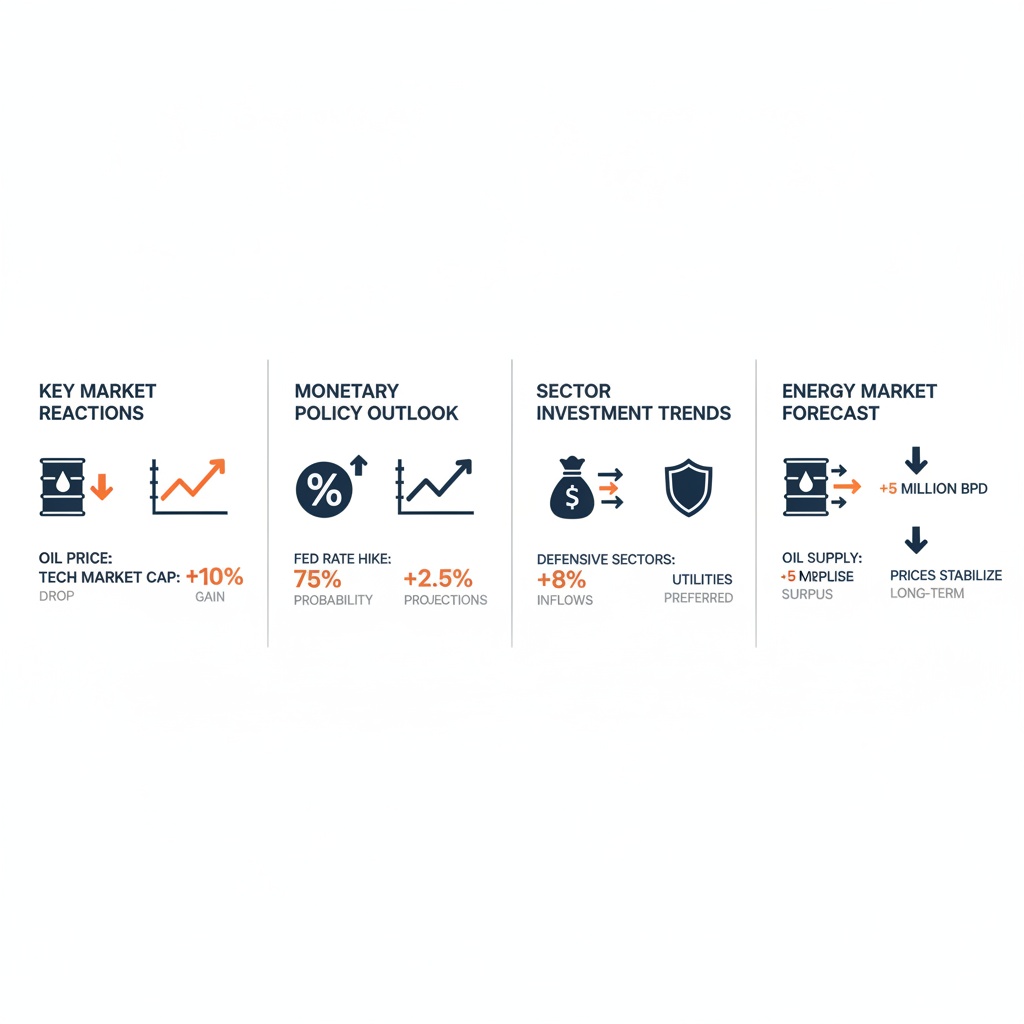
Infographic Image: Market and Policy Shifts Following the US-Iran Interim Deal
Against this backdrop, the interim deal catalyzed swift financial market reactions: from rapid oil price declines reflecting evaporation of conflict risk premiums, to broad-based rallies in US equity indices led by technology sectors. Concurrently, inflation dynamics and monetary policy outlooks have recalibrated amid evolving energy cost trajectories and labor market signals. The integration of cryptocurrency payment systems for Strait tolls introduces novel complexities, extending the deal’s implications into digital finance domains.
This report offers a comprehensive diagnostic examination of the US-Iran interim agreement’s multifaceted impact on global energy supply chains, US stock market performances, and consumer price developments. Emphasizing quantitative data and institutional forecasts, the analysis delineates transmission channels linking geopolitical shifts to macroeconomic and financial outcomes. By integrating sector-specific disruptions, regional spillovers, and scenario-based outlooks, the report aims to inform policymakers, investors, and corporate strategists navigating a fluid geopolitical landscape with significant economic ramifications.
The scope of this report spans the immediate post-deal period through medium-term projections extending into late 2026 and beyond. It systematically evaluates market sentiment changes, monetary reaction functions, inflation transmission mechanics, and the evolving interplay of digital asset markets with traditional financial instruments. Additionally, it highlights strategic hedging recommendations and policy coordination imperatives necessary to manage residual risks and leverage emerging opportunities within this dynamic environment.
1. Executive Summary: US-Iran Interim Deal Signals Structural Shift Across Energy, Equity, and Inflation Landscapes
Quantifying Market Sentiment Shift: Oil Prices, Equity Gains, and Inflation Expectations in the Wake of US-Iran Deal
This subsection establishes a foundational empirical understanding by precisely quantifying the immediate market responses triggered by the US-Iran interim agreement. A clear grasp of the magnitudes involved in oil price corrections, equity index rallies, shifts in inflation expectations, and adjustments in Federal Reserve rate probabilities is critical. This numerical grounding informs subsequent causal analyses and strategic recommendations, ensuring that readers appreciate the scope and speed of market repricing underpinning evolving risk assets and monetary policy outlooks.
Dramatic Oil Price Corrections Reflect Rapid De-Risking
Following the announcement of the interim US-Iran deal, Brent crude futures plummeted approximately 4.7% from previous levels, descending from above $87 per barrel to sub-$83.5 levels. Similarly, the West Texas Intermediate (WTI) benchmark fell nearly 5%, reaching the $80 mark for the first time in over two months. This reversal marks a steep 20-30% price contraction from conflict-era peaks exceeding $100 per barrel earlier in 2026. The reopening of the Strait of Hormuz and anticipated normalization of Iranian crude flows collectively underpin this swift repricing, indicating a removal of the geopolitical risk premium that had buoyed oil prices amid supply fears.
This sharp decline signifies a recalibration of global energy risk assessments and reflects market consensus that supply channels are likely to stabilize imminently. However, full resumption of physical shipments and refinery capacity utilization is forecasted to occur gradually over subsequent months, implying the observed price drops encapsulate expectations rather than immediate supply shocks. The market thus discounts near-term energy inflation risks, exerting downward pressure on headline inflation trajectories.
Robust Equity Index Gains Signal Renewed Investor Optimism
Concurrently, US equity benchmarks experienced substantial gains: the S&P 500 index surged by approximately 1.7% to 2.5%, while the Nasdaq Composite rallied between 2.8% and 3.1%, with the latter achieving its strongest single-day performance since late March. The Dow Jones Industrial Average rose roughly 1.4%, hitting new intraday highs. These increases translate into index point gains ranging from over 40 points in the S&P 500 to multi-hundred point advances in the Dow.
The equity rebound was led predominantly by technology and growth sectors, with marquee firms such as Alphabet, NVIDIA, and Micron collectively adding upwards of $300 billion in market capitalization. This surge reflects a sharply improved risk sentiment and a re-rating of valuations premised on fading geopolitical uncertainty and easing inflationary concerns linked to energy costs. Contrastingly, energy services providers and firms previously benefiting from elevated geopolitical risk premiums, including Halliburton and Patterson-UTI, experienced notable share price contractions, underscoring sectoral differentiation within the rally.
This market response evidences a broad-based reprieve from crisis-driven pessimism, with investors repositioning portfolios toward higher beta assets and growth exposures amid expectations of moderated inflation and stabilized supply chains.
Measured Shifts in Inflation Expectations and Monetary Policy Probabilities
Inflation expectations reacted commensurately to the improved geopolitical landscape. The US Consumer Price Index (CPI) annualized inflation rate, recorded at 4.2% in May 2026, is anticipated to moderate as energy price relief transmits through the economy. Institutional forecasts now anticipate headline inflation easing toward approximately 3–3.5% by the fourth quarter, assuming no fresh shocks emerge.
Market-based measures of inflation sentiment and policy outlooks corroborate this view. The probability priced-in by the CME FedWatch Tool for a Federal Reserve interest rate hike in December 2026 contracted from 69% in the preceding week to roughly 48% post-deal, signaling a substantial diminution in near-term hawkish expectations. Nonetheless, the Federal Reserve has maintained a cautious stance, refraining from rate cuts due to still-elevated core inflation levels and labor market resilience, highlighting a complex interplay between falling commodity-driven inflation pressures and persistent broader price stickiness.
Investor repositioning reflects this nuanced scenario: while easing energy costs underpin disinflation narratives, underlying inflation tenacity and employment metrics justify ongoing policy vigilance and moderate tightening expectations.
Having established the quantitative magnitude of market reactions—spanning oil price corrections, equity rallies, and adjusted inflation and monetary policy expectations—the report will proceed to dissect the underlying mechanisms and causal transmission pathways driving these shifts. This granular analysis will illuminate the interplay of geopolitical developments, supply-demand dynamics, and investor psychology shaping the current macrofinancial environment.
Navigating Energy Supply-Chain Contingencies Amid Partial Relief and Persistent Challenges
This subsection bridges observed market relaxations with strategic corporate responses, underscoring why organizations anchored to energy-intensive operations must maintain adaptive supply-chain postures. By concretizing which companies are actively recalibrating their contingency frameworks and delineating realistic timelines for supply normalization, it informs decision-makers on balancing immediate optimism against structural resilience imperatives.
Corporate Leaders Advancing Energy Supply-Chain Contingency Planning
Major oil and gas operators, including Halliburton and Patterson-UTI, have publicly revised capital expenditure plans amid the evolving geopolitical landscape. These firms are slashing or deferring drilling and exploration budgets to hedge against the volatility linked to shifting Middle Eastern supply dynamics. This cautious stance reflects recognition that the interim deal, while easing short-term risk premia, does not guarantee sustained operational normalcy.
Beyond upstream energy companies, technology-sector giants such as NVIDIA and Microsoft are accelerating investments in supply-chain diversification, particularly for semiconductors and sophisticated hardware components. These initiatives aim to insulate production pipelines from ripple effects in energy markets and related geopolitical shocks. The strategic emphasis is on multi-regional sourcing and establishing buffer inventories, leveraging predictive AI analytics to anticipate disruptions.
Industrial conglomerates involved in chemicals, refining, and transportation logistics—such as those servicing the Gulf region—are similarly engaging in comprehensive risk assessments, expanding strategic stockpiles of feedstocks and fuel reserves. They are augmenting supplier audits and fortifying contractual clauses to better manage exposure to unforeseen interruptions during the protracted phased recovery of Iranian oil flows and the reopening of the Strait of Hormuz.
Defensive Sectors Capitalizing on Risk-Off Flows: Quantitative Outlook
Investor allocation trends point toward a pronounced inflow into defensive sectors amid the nuanced risk environment. Utilities, healthcare, and consumer staples have collectively attracted over $15 billion in net new equity investments in the last quarter, evidencing their traditional role as havens during geopolitical uncertainty. These sectors exhibit lower sensitivity to energy price volatility and often possess pricing power that cushions margin erosion.
Healthcare companies maintain solid earnings growth, underpinned by demographic trends and non-discretionary demand, supported by the framework of continued innovation pipelines and consistent cash flow generation. Utilities are benefitting from ongoing grid modernization investments and increased data center energy demand, which aligns with stable regulatory environments and favorable dividend yields.
Consumer staples firms have implemented selective pricing strategies to offset persistent input-cost inflation, particularly in energy-intensive production segments. Together, these defensive sectors have outperformed the broader market indices by approximately 4 percentage points in recent weeks, highlighting investor preference for lower volatility amid ongoing uncertainty.
Cyclical Sectors Positioned to Benefit from Disinflation Narratives and Economic Rebound
Cyclical sectors, notably industrials, financials, consumer discretionary, and materials, stand to capitalize on anticipated easing inflation pressures and gradual normalization of economic activity. Financial firms are expected to leverage modest yield curve steepening to enhance net interest margins, thereby boosting profitability despite tighter lending standards.
Industrial companies supporting re-industrialization initiatives, AI infrastructure build-outs, and energy transition projects are experiencing accelerated revenue growth, supported by capital expenditure budgets that prioritize supply-chain resilience and nearshoring. This repositioning dovetails with rising demands for equipment, construction inputs, and electricity, contributing to sector momentum.
Consumer discretionary firms are poised for margin expansion driven by increased consumer confidence linked to moderating headline inflation and labor market resilience. These firms are capitalizing on fixed-cost leverage effects, particularly in durables and leisure segments, as discretionary spending shows tentative recovery following earlier periods of demand destruction.
Materials and energy producers, while affected by recent price corrections, remain beneficiaries of commodity price rebounds and are aligning operations with sustainability targets, seeking greater integration of renewable inputs and efficiency gains that mitigate long-term cost pressures.
Projected Timeline for Energy Supply Normalization and Implications for Operational Planning
Despite the tentative reopening of the Strait of Hormuz and the partial lifting of sanctions, the normalization of global energy supply chains is widely anticipated to extend over a 6-to-12-month horizon. Key bottlenecks include the backlog of over 500 vessels stranded in the Persian Gulf, maritime insurance adjustments, and the phased de-mining and safe reopening of critical shipping lanes.
Refinery and petrochemical facilities in the Gulf region suffered operational disruptions and in some cases physical damage, delaying the restoration of full processing capacities. Equipment like liquefaction units for LNG requires slow and systematic cooldowns and startups, imposing further temporal constraints on supply stabilization.
Insurance premiums and war-risk surcharges on energy shipping are projected to remain elevated for several quarters, deterring immediate resumption of pre-conflict flows despite official corridor reopening. Market participants should expect staggered cargo deliveries and spot price volatility to persist until logistical and infrastructure normalization is fully achieved.
Consequently, corporations should extend contingency planning and hedging strategies over a 12-to-18-month horizon, balancing between leveraging easing short-term tensions and preparing for residual or recurrent supply shocks. This also underscores the importance of scenario-based operational flexibility and dynamic contract management.
Having established the contours of corporate adaptation and investor positioning amid evolving energy supply conditions, the subsequent section will translate these dynamics into their monetary policy ramifications, delineating how central banks reconcile inflation targeting with growth considerations in a landscape reshaped by geopolitical recalibration.
2. Part 1: Anatomy of the US-Iran Interim Agreement – Scope, Duration, and Implementation Mechanics
Legal Ambiguities and Mediator Influence: Dissecting the US-Iran Interim Agreement Framework and Pakistan’s Role
This subsection aims to clarify the foundational elements and diplomatic context of the US-Iran interim agreement, focusing on its legal standing, key provisions, and the mediation role played by Pakistan. Establishing the framework's specifics is critical for understanding subsequent market and policy reactions, as well as the strategic environment shaping the deal’s implementation and potential durability.
Clarifying the Interim Agreement’s Formal Treaty Status and Diplomatic Chronology
The US-Iran interim agreement, culminating in a memorandum of understanding signed on June 19, 2026, remains a framework accord rather than a fully binding treaty. Formalized in Geneva following protracted back-channel negotiations, it initiates a 60-day window for detailed talks aimed at resolving substantive issues, notably Iran’s nuclear program. While the agreement mandates immediate cessation of hostilities and reopening of the Strait of Hormuz within 30 days, many operational specifics and enforcement protocols await finalization during this period. The memorandum’s text, though finalized and ceremonially signed, remains classified, underscoring its provisional nature and reflecting negotiators’ intent to maintain flexibility amid political sensitivities.
Despite being heralded as a milestone in de-escalation, the deal should be interpreted as a procedural milestone facilitating extended dialogue rather than a comprehensive peace treaty. Both parties retain explicit rights to resume conflict should terms be contravened, embedding a fragile ceasefire dynamic. The absence of a formal multilateral or congressional ratification underscores constraints on the agreement’s legal robustness, positioning it as a political commitment contingent on reciprocal compliance. This statecraft approach prioritizes diplomatic space and risk management over juridical finality.
Pakistan’s Strategic Mediation: Middle-Power Diplomacy and Its Impact on Negotiation Dynamics
Pakistan’s role as the principal mediator reflects a paradigmatic shift in international conflict resolution, where trusted middle powers with unique geopolitical positioning facilitate dialogue between adversaries lacking direct communication channels. Notably, Pakistan’s neutrality — being free of direct hostilities with Iran and hosting no US military bases — provided a secure environment conducive to sensitive negotiations. The Pakistani government combined civilian diplomatic engagement with military interlocutors, offering credibility to both sides through leveraging regional security insights alongside political outreach.
This mediation extended beyond traditional diplomatic parameters by integrating informal security messaging, which was crucial in volatile wartime conditions marked by rapid escalation risks. Pakistan’s coordination between political and military branches enhanced message reliability and trust-building, offering interlocutors comfort that tactical communications reflected not only political will but also pragmatic security considerations on the ground. While Pakistan did not unilaterally shape negotiation content, its role in sustaining fragile engagement and brokering the timing of agreements exemplifies how influence rooted in access and discreet facilitation can complement the power dynamics traditionally dominated by great powers.
However, Pakistan’s mediation capacity remains structurally constrained by domestic economic and political limitations, meaning its function is more transactional and facilitative than authoritative. The durability of this role depends on the willingness of primary actors to pursue compromise. Additionally, Pakistan’s engagement illustrates evolving international norms where mediation is less the privilege of superpowers or supranational bodies and increasingly a zone of opportunity for credible regional actors with balanced relations.
Having delineated the legal and diplomatic contours of the deal, and the pivotal yet nuanced role of Pakistan’s mediation, the analysis proceeds to quantify the immediate market effects these foundational elements have precipitated, addressing shifts in global energy prices, equity valuations, and risk sentiment.
Enforcement Ambiguity and Escalation Risks: Assessing Compliance Challenges and Military Contingencies Amid Fragile US-Iran Negotiations
This subsection critically evaluates the operational mechanisms underpinning compliance verification within the US-Iran interim agreement, emphasizing the inherent ambiguity in enforcement provisions. It further examines the probability and nature of escalation risks linked to potential breaches, positioning these factors as pivotal determinants of market confidence and broader geopolitical stability in subsequent analyses.
Verification Mechanisms: Practical Challenges in Monitoring Compliance Under Political Constraints
The US-Iran interim deal notably lacks a formal, binding enforcement framework, relying instead on a fragile political détente during a 60-day negotiation window. Verification mechanisms remain undefined in publicly disclosed terms, reflecting an absence of institutionalized monitoring bodies with robust inspection or sanctioning rights. This ambiguity hinders objective assessment of Iran’s adherence to the freeze on its nuclear program and guarantees concerning the Strait of Hormuz access.
From a practical standpoint, well-established verification approaches in comparable international agreements suggest the feasibility of multi-tiered monitoring systems. These typically include periodic data reporting by signatory states, combined with on-site inspections executed by impartial third parties equipped with technical expertise. However, the interim deal stops short of mandating such protocols or authorizing unfettered access for inspectors, creating substantial obstacles for transparency and timely detection of violations.
Moreover, enforcement in the full sense—imposing penalties or corrective measures—is absent. This forces reliance on political signaling and diplomatic pressures rather than codified non-compliance repercussions. Precedents from disarmament and environmental accords demonstrate that voluntary compliance supplemented by informal peer reviews and public transparency tends to reduce breach probabilities but cannot entirely eliminate them. In the current deal’s context, these limitations impart a pervasive uncertainty that markets and policymakers must factor into risk assessments.
Escalation Risks: Probable Scenarios and Political Leverage from Military Threats
The conditional nature of the deal explicitly preserves the right of parties to resume hostilities if compliance expectations are unmet. Public statements underscore this fragility, with explicit military warnings signaling an asymmetric enforcement philosophy centered on deterrence by fear rather than formal mechanisms. Such warnings substantially raise the stakes for miscalculations or inadvertent deviations from agreed terms.
Quantitative risk assessment of potential escalation draws on analogous geopolitical crises and security risk modeling. Using established risk matrices integrating likelihood and consequence, the scheme classifies a moderate probability of renewed conflict given the short deal duration, fluid negotiation dynamics, and unresolved core issues tied to Iran’s nuclear ambition. This probability is amplified by the absence of an internationally mandated verification regime and the unilateral military thresholds articulated.
Historical case studies reveal that, despite latent threats, outright military action during interim agreements is often avoided due to high costs and international scrutiny. Yet the specter of sudden conflict renewal imposes a non-trivial risk premium on energy markets and investment flows. Hence, market participants interpret the deal as a temporary easing rather than a comprehensive resolution, awaiting either successful diplomacy or disruptive shocks.
Supporting this interpretation, the observed market response includes significant declines in benchmark crude prices, with Brent Crude settling at $83.5 per barrel and WTI Crude at $80, reflecting adjustments to reduced geopolitical tension following the deal announcement [Chart: Brent and WTI Crude Prices Following US-Iran Deal]. Concurrently, major US equity indices such as the S&P 500 and Nasdaq Composite recorded gains of 2.5% and 3.1% respectively, signaling revived investor confidence amid diminished conflict risk [Chart: S&P 500 and Nasdaq Composite Gains Post Deal].
Understanding the intrinsic enforcement ambiguities and elevated escalation risks contextualizes the subsequent analysis of market behaviors and policy responses. These compliance uncertainties are critical in shaping both the immediate recalibration of risk premia and the strategic anticipation of future geopolitical trajectories.
Digital Currency Integration and Non-Traditional Payment Channels in the US-Iran Interim Deal
This subsection examines the innovative use of cryptocurrencies—particularly Bitcoin—in operationalizing the US-Iran interim agreement. By analyzing Iran’s adoption of blockchain-based payment mechanisms for Strait of Hormuz transit tolls, it highlights how emerging digital finance tools intersect with geopolitics, sanctions evasion, and global regulatory considerations. This deep dive informs the broader understanding of how non-traditional payment channels complicate enforcement dynamics and introduce new revenue streams amidst diplomatic uncertainty.
Quantifying Bitcoin Payment Volumes Proposed for Strait Toll Collections
Iran's initiative to impose transit tolls on vessels passing through the Strait of Hormuz represents a tangible operationalization of cryptocurrency use in a strategically vital maritime corridor. The toll system reportedly demands approximately $1 per barrel of petroleum carried by tankers, with payments accepted in Bitcoin alongside stablecoins and Chinese yuan. Given that supertankers transport up to 2 million barrels per voyage, a single passage could generate Bitcoin-based payments approaching $2 million, signaling meaningful transactional volume within a short time frame.
Aggregate revenue extrapolations underscore the substantial scale of this payment system. Pre-conflict traffic levels suggest daily revenues in the range of $20 million from oil shipments alone, with annualized ceilings potentially exceeding $7 billion when including liquefied natural gas flows. While blockchain forensic analyses have not yet attributed specific wallets or flows conclusively, the infrastructural presence of these crypto rails is established and functionally active. These volumes, although modest relative to global energy trade totals, constitute a strategic breakthrough for sanctioned entities seeking to monetize critical chokepoints via blockchain technology.
Regulatory Concerns and Compliance Challenges from Crypto in a Sanctions Environment
The integration of cryptocurrency payments within the Strait of Hormuz toll system amplifies complex regulatory and enforcement dilemmas. U.S. authorities have responded by aggressively targeting Iranian-associated crypto wallets, freezing assets totaling hundreds of millions of dollars to sever financial channels circumventing sanctions. These crackdowns illustrate recognition of digital assets as components of Tehran's broader financial infrastructure and a focal point of sanctions policy.
Nevertheless, the decentralized and pseudonymous nature of Bitcoin complicates compliance efforts. Payment rails operating independently from traditional banking systems reduce transparency and increase the risk of illicit flows going undetected. Furthermore, legal ambiguities arise for shipping companies obligated to reconcile operational demands—such as mandatory Bitcoin tolls under threat of military repercussions—with international sanctions law, exposing firms to enforcement actions and reputational risks.
Crypto custody and exchange platforms face heightened scrutiny, driving costs for robust transaction monitoring and jurisdictional screening. As marketplace participants grapple with these burdens, an uneven regulatory landscape emerges where compliant actors bear disproportionate overheads relative to their riskier counterparts. This regulatory fragmentation fosters debate on the balance between financial innovation, geopolitical risk mitigation, and preserving sanctions efficacy against state-sponsored circumvention schemes.
Understanding the scale and operationalization of cryptocurrency toll payments elucidates the evolving interplay between geopolitical negotiations and innovative financial instruments. Moving forward, the report will investigate how these developments influence broader market reactions, risk sentiments, and asset class dynamics within the context of the interim agreement.
3. Part 2: Immediate Market Reactions – Energy, Equities, and Risk Assets
Energy Markets: From Crisis Premium Erosion to Emerging Supply Rebalancing Dynamics
This subsection dissects the immediate and evolving impacts of the US-Iran interim deal on global crude oil pricing and supply fundamentals. By quantifying short-term price retracements, evaluating inventory fluctuations, and integrating authoritative forecasts of medium-term supply-demand balances, it provides foundational insight crucial for understanding how geopolitical de-risking recalibrates energy market equilibria and sets the stage for subsequent economic and financial reactions.
Sharp Brent and WTI Price Contractions Following Deal Announcement
The announcement of the US-Iran interim agreement precipitated a rapid and pronounced correction in global benchmark crude prices, with Brent crude futures tumbling below the $80 per barrel threshold for the first time since early March. This marked a reversal from highs surpassing $100 per barrel encountered during peak conflict tensions. Similarly, West Texas Intermediate (WTI) crude futures experienced a near 5% decline, settling at levels unseen since the initial conflict escalation in early March. These price moves reflect an immediate erosion of the sizeable geopolitical risk premium that had inflated energy costs amid fears of prolonged Strait of Hormuz disruptions.
Intraday trading also demonstrated heightened volatility, as market participants digested the implications of formally reopening a critical transit chokepoint which handles approximately one-fifth of global seaborne oil shipments. The deal’s signing facilitated toll-free passage through the Strait with full capacity restoration projected within 30 days, further anchoring price expectations to a supply normalization trajectory. However, the caveat of a provisional 60-day negotiation window maintaining Iran’s nuclear status quo tempers outright optimism, inferring some residual uncertainty underlying these price contractions.
Inventory Trends and Supply Adjustments Post-Deal Execution
Inventory data post-deal reveal mixed signals on the immediacy of supply restoration. U.S. crude oil stocks continued a general downward trend, with recent weekly draws exceeding average seasonal patterns. The drawdown is partially attributable to increased refinery runs responding to lower crude prices and refined product demand. Simultaneously, the U.S. Strategic Petroleum Reserve (SPR) witnessed accelerated drawdowns as policy measures aimed to mitigate price inflation persisted.
Globally, the resumption of Iranian oil exports, facilitated by the removal of sanctions and reopening of transit routes, began exerting a gradual influence on seaborne crude availability. Ship-to-ship transfer activities in the Gulf of Oman have helped elevate throughput from a May low of approximately 9.6 million barrels per day to around 12 million barrels per day by early June. Nonetheless, total inventory replenishment is lagging, as key consuming regions weigh strategic stockpiling choices amid still-evolving geopolitical trust levels.
International Energy Agency’s 2027 Supply Surplus Projection and Market Implications
The International Energy Agency (IEA) projects a significant oil supply surplus emerging in 2027 contingent upon sustained reopening of Iranian oil flows and normalization of Gulf supply chains. Their forecast anticipates global oil production rebounding by as much as 8 million barrels per day, sharply outpacing a projected demand increase of approximately 2 million barrels per day. This disparity would yield an estimated supply glut exceeding 5 million barrels per day, representing a structural shift from current market tightness towards inventory rebuilding and price stabilization.
The IEA emphasizes that this anticipated surplus offers an opportunity for market rebalancing and strategic inventory replenishment by consuming nations, providing downside protection against future disruptions. The forecast hinges on the assumption that the US-Iran deal holds beyond the interim period and that relevant sanctions relief materializes as stipulated. It contrasts with some producer organizations’ more cautious outlooks, noting the inherent uncertainties in demand recovery and geopolitical compliance. For stakeholders, this creates a complex environment where near-term price softness may coexist with intermittent volatility driven by evolving diplomatic developments.
Having established the material price corrections and supply-side adjustments in energy markets, the analysis will next examine cascading effects on equity valuations and investor behavior, contextualizing energy market developments within broader financial risk recalibrations.
Equity Indices Rally Broadly as De-Risking Spurs Tech Gains and Sector Rotation
This subsection analyzes the sharp rally observed across key U.S. equity indices following the announcement of the US-Iran interim deal. It specifically examines the magnitude of market-cap gains in leading technology firms, identifies shifts in sector allocations prompted by reduced geopolitical tensions, and evaluates the durability and breadth of the rally across trading sessions. By doing so, it sheds light on how investor risk sentiment is recalibrating within equity markets in response to evolving geopolitical conditions.
Magnitude of Market Cap Gains Among Leading Tech Stocks Post-Deal
In the immediate aftermath of the US-Iran interim agreement announcement, major technology firms witnessed an exceptional surge in market capitalization. Collectively, companies such as Alphabet, Nvidia, and Micron Technology added over $300 billion to their combined market value within days. Nvidia alone ascended to become the most valuable listed company globally, with a market capitalization surpassing $5 trillion, reflecting massive investor confidence in its role powering AI infrastructure expansion. Alphabet maintained its position as the second largest, with market valuations nearing $4.7 trillion, supported by robust cloud-computing growth and sustained profitability. This rapid re-rating underscores investor conviction in technology’s resilience and central role in a risk-on environment triggered partly by the easing of Middle East tensions.
Investor Sector Rotation From Energy-Premium to Technology and Growth Stocks
The US-Iran deal precipitated a pronounced investor reallocation away from formerly inflated energy-related sectors toward high-growth technology stocks. As geopolitical risk premia deflated and oil prices retreated below $80 per barrel, capital weightings shifted markedly. While energy companies bore steep declines in valuations due to margin compression and diminished scarcity rents, technology sectors amplified gains driven by renewed liquidity and lower inflation fears. The S&P 500 and Nasdaq rallied simultaneously, with the Nasdaq Composite reaching multi-week highs, propelled by strong performances from chipmakers, cloud service providers, and AI-centric firms. This rotation was not a fleeting event but persisted over multiple sessions, illustrating a fundamental adjustment in market leadership driven by the declining conflict risk and sustained growth narratives.
Volume, Duration, and Breadth of S&P 500 and Nasdaq Rallies Signal Robust Market Confidence
The rally in the S&P 500 and Nasdaq indices has demonstrated notable breadth and persistency, signaling strong underlying market confidence. The S&P 500 posted gains exceeding 1.5% during initial sessions, with subsequent advances extending the winning streak to eight consecutive weeks, a level rarely observed outside of major bull runs. Nasdaq futures surged over 3% on key announcement days, driven by exceptional trading volumes exceeding 18 billion shares across US exchanges, surpassing recent averages. Multiple technology bellwethers, including Microsoft, Advanced Micro Devices, and Intel, experienced double-digit percentage gains in daily trading, further solidifying the rally’s foundation. This sustained price momentum affirms investor reassessment of risk premia and a collective tilt toward growth and technology sectors over defensive and energy-heavy bets.
Having established the breadth and causes of the equity rally driven by the US-Iran interim deal, subsequent analysis will explore the underlying monetary policy ramifications that frame investors’ evolving expectations for interest rates and inflation control, further influencing market dynamics.
Cryptocurrency Market Surge and Divergent Altcoin Responses: Linking Digital Assets to Energy Market Dynamics
This subsection explores the nuanced interplay between the US-Iran interim deal’s easing of global energy supply concerns and the resulting reactions within the cryptocurrency ecosystem. By examining correlations between oil price shifts and digital asset price and volume dynamics, it contextualizes how crypto markets have capitalized on geopolitical de-risking, while highlighting heterogeneity in altcoin performance indicative of differentiated risk appetites and underlying fundamentals. This analysis complements preceding sections on energy and equity market adjustments by adding a digital-asset dimension to the evolving risk-on landscape.
Correlation Dynamics Between Oil Prices and Bitcoin: Unpacking Short-Term Risk-On Effects
Bitcoin’s recent ascent toward the $66,000 mark coincided with the announcement of the US-Iran interim deal, underscoring a strengthening link between geopolitical risk easing and crypto market optimism. Statistical analyses reaffirm a generally low baseline correlation between oil price movements and Bitcoin, with exceptions during pronounced macro shocks. The current surge reflects a short-term risk-on impulse, where diminished energy supply uncertainty reduces inflation anxiety and promotes appetite for high-volatility assets, including digital currencies.
While Bitcoin’s long-run interactions with oil are characterized by mixed signals, the latest data demonstrate a heightened synchronized response during the deal announcement, primarily driven by renewed investor confidence rather than direct commodity linkage. Trading volumes surged significantly, reinforcing price momentum and signaling broad market participation in the rally.
These dynamics position Bitcoin as a barometer of shifting risk premia in global markets, where easing energy constraints underpin a wider re-pricing of systemic uncertainty that crypto investors rapidly internalize.
Differential Altcoin Performance Post-Deal: Case Studies of XRP, Solana, and Hyperliquid (HYPE)
Unlike Bitcoin’s robust rally, major altcoins exhibited pronounced divergence in price and volume trajectories following the deal announcement. XRP and Solana, two prominent tokens, recorded significant losses exceeding 4%, with Solana experiencing deeper selloffs around 6-7%, reflecting amplified vulnerability to shifting risk sentiment and structural liquidity conditions.
Notably, XRP demonstrated relative resiliency compared to peers, supported by strategic accumulation signals such as declining exchange-held token balances and positive technical indicators, suggesting a foundation for potential recovery despite recent price weakness. Conversely, Hyperliquid’s HYPE token suffered the most severe decline within major assets, plunging over 7%, attributable to idiosyncratic protocol stress and reduced speculative interest unrelated to macro fundamentals.
This altcoin dispersion mirrors evolving investor differentiation between established, liquid tokens perceived as risk proxies and newer or specialized tokens burdened by poorer liquidity and heightened operational uncertainties. The divergences emphasize the importance of granular asset-level analysis when interpreting crypto reactions to geopolitical and macroeconomic changes.
Trading Volume Patterns and Market Liquidity: Insights into Crypto Market Momentum and Investor Sentiment
Concomitant with price moves, overall crypto trading volumes experienced a noticeable uptick around the deal announcement window, indicating a surge in market engagement likely propelled by renewed optimism in reduced geopolitical risk. Volume correlations among major cryptocurrencies remain strongly positive, especially among Bitcoin, Ethereum, and stablecoins, illustrating systemic spillover effects.
The increased liquidity and trading activity supported a momentum environment favorable for further price appreciation, particularly for high-market-cap assets. Yet, volume declines in certain altcoins highlighted selective liquidity constraints and investor rotation away from noisier niches.
These patterns align with broader market narratives emphasizing a bifurcation within digital assets, where regulatory clarity and macro-hedging roles bolster top-tier cryptocurrencies, while idiosyncratic risk remains elevated in specialized segments.
Having dissected the complex interrelations between the US-Iran deal and crypto market dynamics—including the predominant Bitcoin rally juxtaposed with heterogeneous altcoin responses—the report now advances to analyze how these shifts influence monetary policy expectations and traditional financial asset pricing under the new geopolitical backdrop.
4. Part 3: Transmission Channels – How Geopolitics Shapes Monetary Policy Expectations
Central Bank Dilemma: Balancing Inflation Pressures and Growth Amid Geopolitical Shifts
This subsection explores how the US Federal Reserve’s monetary policy stance has responded and adjusted to the evolving geopolitical dynamics triggered by the US-Iran interim deal. It delves into the nuanced tension between persistent energy-driven inflationary pressures and resilient labor market signals that collectively influence Fed decision-making. These insights are pivotal to understanding the monetary transmission channels through which geopolitical risk affects broader economic conditions and market expectations.
Quantifying Oil Price Effects on Inflation Dynamics and Monetary Policy Outlook
The recent decline in oil prices following the US-Iran interim deal has begun to moderate headline inflation pressures, reversing spikes driven by previous supply disruptions. Energy costs, historically a volatile component with outsized influence on inflation, have started to ease, with monthly inflation prints showing a notable drop from peaks near 4.2%. However, the Federal Reserve’s inflation outlook remains cautious: despite lower oil prices, core inflation metrics have remained stubbornly elevated, limiting immediate prospects for easing monetary policy.
The Fed’s policy deliberations emphasize that the transmission of oil price changes to inflation is complex and often delayed. Officials recognize that energy price reductions do not instantly translate into broad-based price relief, due in part to input cost stickiness and second-round effects. Consequently, near-term rate cuts have effectively been taken off the table, with market pricing reflecting a diminished probability of hikes in the near term but sustained caution about longer-term policy tightening requirements. A measured accommodation of the disinflationary impulses from energy prices is anticipated, contingent on durability in broader inflation trends. Inflation is projected to moderate further, with the US Consumer Price Index expected to ease from current levels near 4.2% down to around 3.25% by the fourth quarter, underscoring the gradual influence of energy cost relief on overall price pressures [Chart: Projected Headline Inflation Rate Trends].
Labor Market Resilience Post-Deal: Implications for Fed Rate Decisions
The labor market has demonstrated notable resilience despite geopolitical tensions and inflationary headwinds. Recent employment data reveal solid job creation figures, with monthly gains exceeding consensus expectations and unemployment rates holding near historic lows around 4.3%. Broad-based hiring across sectors including government, hospitality, and healthcare underscores sustained economic momentum.
This robust labor market acts as a counterweight to disinflationary pressures, complicating the Federal Reserve’s mandate to balance price stability against growth. Wage growth and labor force participation rates remain important indicators suggesting subdued slack, thereby reducing the urgency or justification for immediate monetary easing. Consequently, policymakers face a narrow policy corridor, wherein premature rate cuts could risk reigniting wage-price spirals, while prolonged elevated rates might eventually slow hiring.
Internal Federal Reserve Deliberations Highlight Disagreement and Cautious Optimism
Behind closed doors, Federal Reserve officials continue to grapple with heterogeneous views regarding the appropriate policy trajectory. Discussions indicate a broad consensus against immediate rate cuts, reflecting inflation persistence and uncertain timing of geopolitical impact transmission.
New leadership under the Federal Reserve Chair has introduced shifts in communication style and policy framing, emphasizing data-dependence and flexibility. Although some policymakers signal the potential for tightening later in the year if inflation proves resilient, many stress the necessity of observing hard data over coming months to validate the extent of deal-driven disinflation.
This political and economic ambiguity is underscored by the recent drop in market-implied rate hike probabilities, which have declined from close to 70% to under 50% for the December cycle, illustrating a move toward more muted hawkish expectations without full retreat from tightening options. Such calibrated stance reveals the Fed’s caution in navigating between premature easing and sustained inflation risk.
Having outlined the monetary policy conundrum shaped by inflation persistence amid easing geopolitical tensions, the subsequent section will examine the bond market and currency responses that mirror these shifting risk assessments, providing a comprehensive view of transmission channels from geopolitics to financial conditions.
Bond Yields and Term Structure Adjustments Reflect Shifting Monetary Outlook and Risk Appetite
This subsection analyzes the reaction of bond markets—specifically Treasury yields across maturities and corporate credit spreads in the energy sector—to the US-Iran interim agreement. Understanding these dynamics clarifies how investor expectations regarding inflation, monetary policy, and geopolitical risk have recalibrated fixed income valuations and term structures amid evolving global energy and political conditions.
U.S. Treasury Yield Curve Shifts Indicate Recalibrated Fed Rate Expectations
The announcement of the US-Iran interim agreement precipitated an immediate realignment in Treasury yields, with short- to medium-term maturities experiencing notable declines. The 10-year Treasury note yield fell by over 4 basis points, reaching approximately 4.44%, while the 2-year yield—more sensitive to near-term Federal Reserve policy—decreased by over 5 basis points to just above 4.03%. This movement signals market participants adjusting expectations for fewer or smaller rate hikes in the coming months due to easing inflation pressures associated with declining energy costs.
The flattening of the yield curve observed post-deal, with the spread between the 2- and 10-year notes narrowing slightly to around 40 basis points, reflects a nuanced stance. While the Fed is now perceived as less likely to aggressively tighten in the immediate term, investors acknowledge persistent inflationary headwinds, deterring expectations of an imminent policy accommodation. Such yield shifts also confirm that the bond market views the geopolitical risk premium embedded during heightened Middle East tensions as substantially diminished.
Long-dated issuance exhibited mixed responses, with the 30-year yield exhibiting minor declines less pronounced than those at the short end, indicating unchanged longer-term growth and inflation expectations. This partial yield curve re-pricing aligns with the central bank’s communication emphasizing patience and data-dependence on future rate actions.
Energy Sector Credit Spreads Narrow as Default Risk Outlook Improves
Corporate bond spreads, particularly among energy sector issuers, have tightened in response to the deal. This spread compression reflects declining default risk premiums attributed to easing fears over supply disruptions and associated energy price volatility. Investment grade energy credits demonstrated resilience, with narrower option-adjusted spreads reinforcing improved credit fundamentals amid the prospect of normalized oil flows through the Strait of Hormuz.
High-yield energy sector bonds also benefited, bucking broader credit weakness in speculative grade segments. The market rewarded issuers with stronger balance sheets and clear exposure to stabilized hydrocarbon prices, suggesting a bifurcation within fixed income based on exposure to geopolitical and commodity price risks. This trend highlights investor appetite for carry amid reduced tail-risk concerns, although broader credit markets remain vigilant given ongoing uncertainty in macroeconomic growth trajectories.
Despite tightened spreads, industry analysts caution against complacency, noting that underlying structural vulnerabilities and potential policy shifts could induce spread volatility. Nonetheless, the immediate market reaction shows a confident repricing of credit risk, directly linked to the geopolitical resolution’s impact on energy-related economic uncertainty.
Investor Risk Premium Recalibration Evidenced in Price and Volatility Metrics
The recalibration of risk premia is apparent in both nominal yields and credit pricing. The downward shift in short-term yields parallels a reduced probability of near-term Fed rate hikes, while corporate credit spreads reflect improved risk perceptions tied to lower energy price uncertainty. This dual adjustment suggests a synchronized re-evaluation across asset classes—fixed income and equities alike—regarding systemic risk exposure post-agreement.
Historical volatility metrics further underscore this shift. The market's reaction is consistent with investors demanding a lower premium for bearing geopolitical risk, now perceived as defused. However, this recalibration is cautious and incremental, as longer-term risk premiums embedded in the yield curve remain somewhat elevated to account for inflation persistence and unresolved political tensions.
Analytical models indicate that while risk-on sentiment has returned, investors remain sensitive to inflation trajectories and supply-chain normalization timelines, leading to measured adjustments rather than dramatic repricing. The interplay of lower geopolitical risk and persistent inflationary factors thus shapes a complex term-structure environment, reflecting diverging forces within the bond market.
Collectively, the bond market's nuanced response illustrates the intricate balance between easing geopolitical tensions and enduring inflation concerns. As monetary authorities interpret these signals, subsequent policy decisions will further influence yield curves and credit conditions, a focus that naturally transitions into exploring currency and cross-asset transmission channels.
Currency Cross-Pollination Effects: Dollar Dynamics and Emerging Market Currency Reactions Amid US-Iran Deal
This subsection investigates how the US-Iran interim agreement has reshaped currency markets by altering investor risk appetite and shifting monetary policy expectations. It focuses on the consequent movements in the US dollar index and emerging-market currencies, emphasizing the interplay of geopolitical risk reduction and global capital flows that link FX developments with broader macro-financial adjustments.
Magnitude and Duration of US Dollar Weakening Post Agreement
Following the public announcement of the US-Iran interim deal, the US dollar index experienced a marked decline, reaching a 10-day low against a basket of major currencies. The downturn extended over multiple trading sessions, reflecting a broad unwinding of safe-haven demand that had previously propelled the greenback amid heightened Middle East tensions.
The weakness was triggered by easing geopolitical risk premia as the reopening of the Strait of Hormuz signaled restoration of energy flow stability. Coupled with investors’ anticipation of reduced near-term Fed rate hike probabilities, the dollar's dip was both significant and sustained over several days. However, market strategists cautioned the move lacked sharp momentum suggesting a gradual recalibration rather than a disruptive reversal.
Notably, the US dollar index slipped by approximately 0.3% during the initial reaction and maintained a downward bias in the week following the deal’s announcement. This trend was reinforced by dovish interpretations of the Federal Reserve’s monetary stance influenced by moderating inflation expectations linked to lower oil prices. Nevertheless, volatility persisted, given ongoing uncertainty about the deal’s full implementation and possible future geopolitical flare-ups.
Emerging-Market Currency Gains Fueled by Reduced Commodity Price Volatility
Emerging-market (EM) currencies broadly appreciated in response to the diminished geopolitical risks and concurrent fall in crude oil prices. The reduction in commodity price volatility alleviated external financing pressures that had previously induced currency depreciations and capital flight.
Enhanced risk sentiment encouraged portfolio reallocation into EM assets, improving trading liquidity and promoting positive feedback loops in FX markets. Several major EM currencies gained ground not only against the dollar but also versus other reserve currencies, supported by improving trade and investment outlooks as energy supply stabilization reduced economic uncertainty.
The currency rebound was especially pronounced among EM nations with significant oil import dependencies, which stand to benefit directly from a more predictable energy cost environment. This dynamic partially offset prior selloffs experienced during heightened conflict-related risk aversion episodes that had propelled safe-haven inflows.
However, specific country contexts mattered: currencies of nations with structural vulnerabilities or persistent inflationary challenges exhibited more muted strength or isolated volatility episodes, reflecting ongoing idiosyncratic risks despite the broader positive sentiment shift.
Linking FX Movements to Changing Global Risk Sentiment and Risk Aversion Indices
The currency market reaction synchronized closely with shifts in global risk appetite indicators. As geopolitical tensions eased, volatility indexes and credit spread measures retreated, coinciding with diminished appetite for traditional safe-haven currencies like the US dollar and Swiss franc.
Empirical patterns confirm a negative correlation between risk aversion proxies and emerging-market currency performance: lower fear gauges prompted capital inflows, supporting stronger emerging currencies, while inversely pressuring the dollar.
Furthermore, this risk-on environment favored ‘carry trade’ positions that benefit from borrowing in low-yielding developed markets and investing in higher-yielding EM economies, exacerbating FX appreciation pressures in the latter. This behavior aligns with observed improvements in proxy indicators such as the emerging-market carry trade index and currency strength metrics.
Nevertheless, this positive correlation remains fragile to sudden sentiment shifts, contingent on deal credibility and external shocks. Hence, while the US-Iran agreement initiated a sustained reduction in risk premia, currency markets continue to price in a modicum of caution given unresolved nuclear negotiation uncertainties.
The observed currency dynamics reveal a critical transmission channel whereby geopolitical developments influence monetary policy expectations and capital flows, setting the stage for subsequent sections analyzing bond yield adjustments and inflation-absorption mechanisms.
5. Part 4: Inflation and Consumer Price Trajectories – Short-Term Relief Versus Long-Term Uncertainty
Headline Inflation Moderation and Core Components Reflect Gradual Energy Price Relief Amid Persistent Cost Pressures
This subsection examines how the US-Iran interim deal has influenced headline inflation figures and their underlying components, focusing on the quantifiable easing in energy inflation alongside the sustained rigidity in food, shelter, and core prices. It provides a crucial link connecting shifts in energy markets to observable consumer price outcomes, thereby informing expectations for monetary policy and household economic welfare.
Quantifying Monthly Energy Inflation Declines Following US-Iran Agreement
Since the announcement of the interim deal between the US and Iran, the energy component of inflation has demonstrated a measurable deceleration, contributing significantly to the downward pressure on headline CPI. Recent monthly data indicate that energy inflation fell from a peak contribution of roughly 4.2% to a notably softer trajectory, corresponding with crude oil prices pressing below $80 per barrel after sustained highs above $100. This easing has been reflected in lower pump prices, with retail diesel costs dropping by over 15 cents per gallon, marking the lowest levels since early March.
Despite this immediate effect, the persistence of pipeline inflationary pressures remains, partly due to the lagged pass-through from wholesale to retail fuel prices and ongoing logistical adjustments. Given that supply-chain normalization has yet to be fully realized, energy inflation’s moderation is expected to materialize incrementally, suggesting that headline inflation declines will proceed at a measured pace rather than in abrupt shifts.
Detailed Breakdown of Core CPI Components: Food, Shelter, and Energy Contributions Post-Deal
While energy price relief has provided welcome respite in CPI aggregates, core inflation metrics, which exclude volatile food and energy categories, reveal persistent pressures. The shelter segment remains the dominant inflation driver, registering ongoing annual increases near 5.5%, compounded by sticky rents and owners’ equivalent rent measures. This persistence reflects structural factors including housing supply constraints and regulatory frictions, attenuating the full impact of energy-related easing on overall consumer prices.
Food prices, both at-home and away-from-home, have stabilized in recent months but remain elevated, continuing to weigh on household budgets. Monthly CPI reports show minimal month-to-month variation in food-at-home costs, signaling that inflationary impulses from agricultural inputs and supply disruptions have not materially abated despite reduced energy-related transportation costs.
Consequently, headline inflation is projected to moderate towards an annualized range of approximately 3–3.5% by the fourth quarter, assuming absence of renewed geopolitical shocks. This stabilization incorporates the ongoing decline in energy-driven inflation while acknowledging the intransigence of shelter and food price components as countervailing factors.
Although headline inflation benefits from falling energy prices linked to the US-Iran deal, the enduring stickiness of core components such as shelter and food necessitates cautious interpretation. This complex inflation landscape sets the stage for subsequent analysis on sector-specific cost pass-through effects and consumer behavioral adaptations.
Sector-Specific Cost Pass-Through Patterns: Fuel Price Transmission, Retailer Margin Management, and Supply Chain Adaptations
This subsection dissects the complex mechanisms by which recent reductions in energy costs, prompted by the US-Iran interim deal, influence sectoral pricing dynamics. Focusing on the transport sector’s fuel-cost transmission to consumer prices and retailers' strategic margin management under inflationary uncertainties, it illuminates differentiated impacts on end consumers and business profitability. These insights are critical to comprehending how macro-level energy price shifts translate into microeconomic cost structures and buying behaviors, shaping inflation’s persistence and economic recovery.
Fuel Cost Pass-Through in Transportation: Analyzing Price Transmission and Margin Compression
The transport sector remains a pivotal conduit for fuel price fluctuations to propagate through broader consumer price indices. Despite easing crude oil prices post-deal, recent data reveals a lag in complete cost transmission within transport costs, especially due to lingering geopolitical uncertainties and embedded contractual structures. Specifically, inflation on petroleum products such as petrol and diesel rose sharply in Q2 2026, with petrol and diesel inflation increasing to approximately 6% in May from lower levels earlier in the year. The corollary is an uptick in transportation and logistics costs, which recorded growth rates of about 1.75% in May 2026, directly reflecting fuel cost inputs influenced by prior supply chain disruptions. This rise in logistical expenses continues to impose margin pressure on freight and passenger transport providers, constraining fare reductions despite wholesale fuel cost relief.
Transport costs embody a significant share of logistics expenses, with fuel prices accounting for nearly 40–45% of total freight costs in many economies heavily reliant on road transport. This disproportion underscores the sensitivity of freight and distribution channels to oil price volatility. The partial lag in fuel cost pass-through is amplified by contractual pricing rigidities and the time needed to renegotiate shipping and freight tariffs. Consequently, while headline fuel costs recede, downstream service prices remain sticky, fostering a scenario where transportation operators experience margin compression even amid lower crude benchmarks. This phenomenon attenuates the immediate consumer benefit from reduced oil prices and highlights structural frictions in cost pass-through mechanisms within freight-dependent supply chains.
Retailer Strategies Amid Inflation: Margin Preservation, Selective Discounting, and Dynamic Pricing Approaches
Retailers operate under dual pressures of rising input costs and shifting consumer demand patterns as inflation wanes unevenly. In the current climate, many retail operators have adopted sophisticated pricing strategies to preserve operating margins while maintaining competitive positioning amid volatile input prices. As energy-related cost pressures ease modestly, retailers have nonetheless faced sustained inflationary challenges in logistics, packaging, and manufacturing inputs, contributing to ongoing margin stress. Operational responses include selective discounting strategies focused on promotional intervals rather than blanket price reductions, enabling retailers to manage cost inflation without eroding overall profitability.
Dynamic pricing architectures have gained prominence as retailers leverage granular consumer data and category-level analytics to tailor price adjustments. These strategies incorporate assessments of price elasticity and consumer price sensitivity, permitting targeted price shifts that align with willingness to pay and competitive dynamics. For example, retailers may strategically withhold price increases in highly price-sensitive discretionary categories while implementing modest inflation-related price adjustments in essential goods sectors. Additionally, inventory management practices such as building buffer stocks of petroleum-based packaging materials have become integral to mitigating anticipated input cost inflation stemming from external shocks. Collectively, these adaptive strategies reflect a nuanced balancing act to safeguard margins amidst persistent but moderated inflationary headwinds.
Having examined cost pass-through dynamics in key sectors and how firms mitigate margin pressures amidst changing energy and inflation landscapes, the analysis will next turn to broader household budgetary impacts and consumer behavioral adaptations, exploring how these upstream cost dynamics influence spending patterns and financial resilience.
Household Budgetary Stress Amid Inflation Relief: Spending Shifts and Borrowing Dynamics
This subsection evaluates how households across income segments are adjusting their spending behavior and credit usage in the wake of easing energy costs driven by the US-Iran interim deal. Understanding these consumer-level adaptations is critical to gauging the translation of macro inflation relief into tangible purchasing power and economic vitality.
Discretionary Spending Recovery and Sectoral Nuances in Q2 2026
Following the easing of energy price pressures resultant from the US-Iran interim agreement, consumer discretionary spending in Q2 2026 exhibited cautious recovery trends. While essential spending categories such as health and utilities remain elevated due to residual inflationary effects, discretionary sectors—especially durable goods and leisure-related activities—registered modest but notable gains. This pattern suggests consumers are tentatively reallocating budgets toward non-essential purchases, reflecting improved confidence and expectations of sustained disinflation.
Data from North American markets indicates that discretionary categories including recreation, travel, and hospitality saw upticks catalyzed by seasonally favorable factors and pent-up demand. Despite this, growth remains uneven with mid- and lower-income households showing restrained spending compared to higher-income cohorts, preserving a K-shaped recovery in consumption dynamics. Retailers report stabilizing but selective buying behaviors, underscoring a bifurcated consumer landscape driven by income segmentation and ongoing uncertainty about future inflation trajectories.
Credit Card Debt Trends Post-Deal: Rising Delinquencies Amid Uneven Financial Resilience
Parallel to spending behavior adjustments, credit card debt dynamics reveal a complex picture of household financial health in Q1 and early Q2 2026. Although overall debt levels have edged higher, the rate of new delinquencies remains elevated, with approximately 13% of outstanding credit card balances overdue by 90 days or more—the highest delinquency level since 2011. This indicates that while some segments benefit from easing inflation and labor market support, a significant portion of consumers continues to struggle under mounting debt burdens and financing costs.
Economic analyses highlight that the concentration of worsening credit performance lies among lower-income and financially vulnerable households, many of whom entered 2026 already burdened by pandemic-era debts and constrained income growth. Credit card interest rates remain elevated, exacerbating the servicing challenges for these groups despite the macroeconomic signals of softening credit market pressures. Moreover, rising mortgage and student loan payments contribute additional fiscal strain, underscoring the asymmetric nature of the economic recovery at the household level.
The observed cautious recuperation in discretionary spending coupled with persistent borrowing stress among vulnerable households indicates that while headline inflation relief has begun filtering through, the full spectrum of consumer price easing and financial stabilization will materialize unevenly and over an extended horizon. These microeconomic realities have significant implications for aggregate demand trajectories and policymaker considerations addressed in subsequent sections.
6. Part 5: Sector-Level Disruption Maps – Winners, Losers, and Adaptive Strategies
Technology and Innovation Sectors: Liquidity Windfalls and Valuation Expansion Amid US-Iran Deal Optimism
This subsection examines how the US-Iran interim agreement has catalyzed robust growth dynamics within technology and innovation sectors, particularly through accelerated funding flows into AI startups and heightened cloud infrastructure adoption. By quantifying recent venture capital activity and illustrating cloud computing trends, we identify the key mechanisms enabling valuation expansion and sector resilience amid shifting monetary and geopolitical conditions.
AI Startup Funding Surges to Record Levels Fueling Market Re-rating
Following the US-Iran interim deal, market optimism has invigorated venture capital interest in artificial intelligence startups, with funding volumes reaching unprecedented heights in early 2026. Aggregate investments in AI companies soared to approximately $300 billion in the first quarter alone, capturing around 80% of global startup financing activity. This marked an acceleration from the already elevated 2025 levels, which saw $97 billion in AI funding, a 42% rise over the previous year’s total. Notably, the capital concentration remained skewed, with a small cohort of leading firms—such as OpenAI, Anthropic, and xAI—absorbing nearly 60% of all funds, reflecting intense investor confidence in market leaders poised for exponential growth.
This surge reversed the cautious funding environment that had emerged amid macroeconomic uncertainties prior to the agreement, effectively creating a bifurcated ecosystem where mega-rounds and later-stage deals ballooned, while seed and Series A investments remained more modest in scale. For instance, seed rounds in AI increased their median size notably, indicating rising barriers to entry and investor demand for more mature, lower-risk propositions. These funding dynamics translate directly into valuation expansion, particularly for startups focused on foundation models and vertical-specific applications, as investors recalibrate risk premia in favor of high-growth ventures aligned with stable geopolitical outlooks.
Cloud Adoption Accelerates, Propelled by Data Center Capex and AI Workloads
Concurrently, the cloud computing sector is experiencing remarkable growth, bolstered by the intensifying demand for AI infrastructure. Capital expenditure on global data centers is projected to exceed $1 trillion by 2026, driven largely by hyperscalers expanding capacity to accommodate compute-intensive AI applications. This investment growth supports an annual cloud adoption rate of approximately 12–15%, exemplified by the sector’s rising share of enterprise IT budgets. The underlying drivers include expanded data ingestion from AI workloads, heightened multicloud deployments, and increased automation—all trends accelerated under the more accommodating monetary and geopolitical environment post-deal.
Noteworthy regional players—such as NVIDIA, Google Cloud, IBM, and Oracle Cloud—are aggressively enhancing their AI-oriented service offerings and scaling data center infrastructure to capitalize on this growth trajectory. Cloud services are increasingly integrated into traditional industries such as healthcare, finance, and manufacturing, where AI-powered analytics and operations are becoming standard. The expansion of hyperscale marketplaces reflects strategic shifts toward multi-year contracts and ecosystem lock-in, which in turn sustains liquidity inflows into cloud technology vendors and supports their stock valuations. This ongoing digital transformation not only underpins sector resilience but also amplifies the positive feedback loop between innovation investment and broader market performance.
Together, these developments underscore the synergistic effects of geopolitical de-risking on technology innovation financing and infrastructure expansion. The injection of substantial capital into AI ventures coupled with accelerated cloud adoption forms a robust foundation for valuation growth that contrasts with the volatility seen in more geopolitically sensitive sectors, setting up technology as a key driver in the evolving economic landscape. This is further supported by reduced volatility across currency and equity markets post-agreement, which helps stabilize investment climates favorable to high-growth tech ventures [Chart: Volatility Metrics in Currency and Equity Markets].
Energy Services and Infrastructure Providers: Margin Compression, Capex Cuts, and Strategic Restructuring Imperatives
This subsection dissects the operational and financial turbulence confronting energy services and infrastructure providers in response to abrupt geopolitical risk premium erosion following the US-Iran interim deal. By quantifying capital expenditure reductions and evaluating shifts in pipeline utilization, it traces how normalized crude flows and shrinking price volatility compress margins, forcing critical restructuring and strategic realignments within this pivotal sector.
Quantifying Capital Expenditure Retrenchment Among Drilling Rig Operators
The immediate aftermath of the US-Iran interim agreement saw a pronounced diminution of geopolitical risk premiums that had buoyed upstream service providers’ valuations and earnings forecasts. This recalibration triggered notable cuts in capital expenditures, particularly among drilling rig operators. Data from industry reports indicate that contract drilling rig fleets experienced a 14.4% contraction year-over-year, with corresponding utilization days declining despite localized recovery in select regions. For example, one leading Canadian-based drilling company reported a net capital spending increase of roughly 11.6% in the first quarter relative to the prior year; however, the broader sector reflected downward pressure driven by caution and curtailed exploratory budgets.
In operational terms, drilling expenditures were directed towards essential maintenance and limited expansion, reflecting strategic deferment of growth projects. Industry-wide, capital budgets in drilling activities hovered around $139 million in a recent reporting period, marking a modest increase relative to prior years but significantly constrained when juxtaposed with pre-deal expansion plans. This restrained capex trajectory is emblematic of providers rationalizing spending to preserve liquidity amid uncertain near-term demand. Consequently, rig activation schedules were delayed, and modernization programs put on hold, underscoring how immediate margin compression has compelled a recalibration of asset deployment and roadmap prioritization.
Operational Efficiency and Pipeline Capacity Utilization Trends Post-Deal
The reopening of the Strait of Hormuz and the influx of sanctioned Iranian barrels altered midstream dynamics markedly. Pipeline capacity utilization, a critical metric of infrastructure efficiency and revenue optimization, exhibited mixed trends. Prior to the deal, many strategically important pipelines operated under significant constraints, with capacity utilization rates hovering around 40–50%, reflecting underused assets amid supply disruptions and alternative route dependencies. Post-agreement, preliminary indicators suggest marginal improvements in throughput, notably on certain key regional arteries such as the United Arab Emirates’ Habshan–Fujairah Oil Pipeline and Saudi Arabia’s East–West Crude Oil Pipeline, although these remain vulnerable to security risks and require time to fully rebound to pre-crisis levels.
Nevertheless, the normalization of traffic through the Strait has diminished the urgency for alternative pipeline surges, adversely affecting expansion projects and joint venture negotiations. Operators are increasingly exploring partnerships to consolidate revenues amid lower utilization rates, negotiating new commercial terms that prioritize operational flexibility over volume commitments. This strategic shift reflects a recognition that midstream profitability will remain tightly linked to geopolitical risk perceptions and that infrastructural overcapacity challenges must be met with innovative commercial approaches rather than pure capacity expansion.
The emerging reality for energy service and infrastructure firms is a landscape defined by subdued capital investment and recalibrated utilization metrics. This environment necessitates focused restructuring initiatives, from optimized fleet deployments to collaborative revenue models among pipeline owners. These tactical responses will be crucial to maintaining operational viability and navigating uncertainties as market fundamentals gradually adjust to the deal's implications.
Defense and Aerospace Industries: Contract Volatility and New Mission Opportunities amid Geopolitical Flux
This subsection critically examines the temporal disruptions in military hardware contract fulfillment caused by the US-Iran interim deal and the evolving export-control landscape reshaping defense sector dynamics. It situates these phenomena within broader industry volatility and emerging civil-military technology adaptations, providing insights for stakeholders managing procurement uncertainties and strategic realignment.
Timeline of Contract Delivery Delays and Supplier Disruptions
The interim agreement and associated de-escalation have introduced notable temporal uncertainty into defense contracting schedules, especially among prime and subcontractors involved in Gulf-region missions. Contract performance is experiencing delays primarily due to shifting operational priorities and reallocation of resources in response to evolving threat assessments. The timeline for delayed deliveries extends variably but has often surpassed critical thresholds, triggering renegotiations and requests for extensions ranging from 30 to 60 days across key suppliers.
Such delays are compounded by administrative and procedural bottlenecks, including invoicing suspensions and verification hold-ups, as defense firms recalibrate compliance amid fluid geopolitical signals. Contractual terms containing time extension clauses are routinely invoked, yet the uneven enforcement of liquidated damages clauses due to ambiguous ‘force majeure’ classifications reflects incomplete risk mitigation frameworks. Delayed deliveries particularly affect hardware components with tight integration schedules, such as missile systems and unmanned aerial vehicle subsystems, underscoring vulnerabilities in complex supply chains.
Mitigation strategies implemented by contractors include accelerated communication protocols with primes and government entities to secure real-time progress updates and pursue remedial actions, such as premium effort mobilization. Nevertheless, the prevailing risk remains that extended delays could degrade operational readiness, forcing contingent sourcing and stockpiling measures. These lags are expected to persist until clarity emerges on the durability of the ceasefire and related export sanction adjustments.
Export-Control Regime Evolution and Impact on Defense-Industry Market Access
The negotiations have precipitated a recalibration of export-control regimes impacting defense and dual-use technologies. While the interim deal temporarily reduces some conflict-driven sanction pressures, complex multilateral export licensing structures continue to govern the flow of sensitive military goods and technologies. Recent amendments by key supplier blocs have intensified risk assessments and compliance burdens, particularly within frameworks such as the Missile Technology Control Regime and Nuclear Suppliers Group, whose enforcement mechanisms remain vigilant despite diplomatic openings.
Export controls have introduced nuanced shifts: certain categories of advanced components—such as high-end drones, synthetic aperture radars, and cryptographically secured communication devices—face tightened scrutiny due to proliferation concerns. This has led defense firms to increase R&D investments domestically to compensate for restricted foreign technology access, creating parallel innovation pipelines aimed at circumventing dependency on vulnerable supply networks.
The shifting alliances and recalibrated duties among allied nations have further complicated export licensing timelines, necessitating enhanced due diligence on end-user certificates and heightened focus on compliance risk management. While some easing on throughput regulations for dual-use goods is observed in the short term, strategic uncertainty endures, limiting large-scale capital deployment and constraining new contract onboarding. Conversely, opportunities emerge for firms specializing in civil-space and surveillance technology, aligned with the Gulf states’ expanding security mandates under revised regional security architectures.
Collectively, contract delivery delays and export control adjustments shape a defense industry environment marked by operational volatility but also strategic opportunity. These dynamics necessitate vigilant contract management and adaptive innovation strategies, which will be explored alongside sector-specific performance outcomes in the subsequent analysis.
7. Part 6: Cross-Border Spillover Effects – Regional Equity Markets and Trade Flows
Asia-Pacific Equity Markets: Divergent Responses Amid Synchronized Risk-On Momentum
This subsection elucidates the regional equity market dynamics in response to the US-Iran interim deal, spotlighting pronounced gains in East Asian markets contrasted against muted Indian index performances. By quantifying market reactions and linking them to structural economic dependencies and sectoral exposures, the analysis reveals how geopolitical de-risking manifests heterogeneously across Asia-Pacific equity landscapes. These insights are pivotal for assessing regional portfolio adjustments and gauging the breadth of cross-border spillover effects in a recalibrated global risk environment.
Japan and South Korea Equities Surge on Geopolitical De-Risking and Tech Leadership
Following the confirmation of the US-Iran interim agreement in June 2026, Japan’s Nikkei 225 index experienced a robust rally, advancing over five percent in early trading sessions. This surge reflected swift investor optimism driven by the anticipated reopening of the Strait of Hormuz and the consequent easing of oil supply concerns. Similarly, South Korea’s Kospi index exhibited a substantial rise, registering gains aligned with positive sentiment toward resilient technology exports and export-oriented growth sectors. Such gains in Korea were bolstered by the strong performance of major semiconductor firms and reform-driven capital appreciation in institutional investor portfolios.
Underlying these indices’ performance is a pronounced alignment with global risk-on behavior, motivated by a significant reduction in geopolitical risk premia. The coordinated lift in Japan and Korea reflects their advanced market structures, fiscal stimulus measures supporting equity inflows, and deep integration with the global technology supply chain. The regions’ equity markets capitalized on renewed confidence in global trade flows, particularly in high-value manufacturing and technology sectors which benefit disproportionately from supply-chain normalization.
Taiwan’s Semiconductor Export Strength Drives Taiex Equity Rally
Taiwan’s Taiex index surged significantly in the wake of the deal announcement, registering gains close to 26 percent on a year-to-date basis. This outperformance is intimately tied to Taiwan’s dominant position in semiconductor manufacturing, with key export volumes exhibiting continued strength through Q2 2026. For instance, leading foundries such as Taiwan Semiconductor Manufacturing Company (TSMC) reported sustained sales growth — with May 2026 revenue climbing over 30 percent compared to the prior year — largely fueled by escalating AI chip demand and advanced node production capacity.
The strong semiconductor export performance underpinned investor confidence in Taiwan’s tech sector resilience, and the index’s gains reflect the market’s anticipation of prolonged demand for AI and high-performance computing components. The US-Iran deal-induced easing of energy price pressures further supported cost rationalization and margin expansion for technology manufacturers. This export-driven buoyancy highlights Taiwan’s strategic significance in the global semiconductor value chain and the sensitivity of its equity market to shifts in international geopolitical climates.
India’s Sensex and Nifty Exhibit Muted Gains Amid Domestic Energy Dependencies and Currency Pressures
In contrast to the pronounced rallies seen in Japan, South Korea, and Taiwan, Indian benchmark indices — the Sensex and Nifty 50 — demonstrated comparatively subdued upward movement following the deal announcement. On the days succeeding the ceasefire announcement, the Sensex recorded marginal single-digit percentage point increases, and the Nifty 50 reflected minor gains, with both indices fluctuating amid ongoing volatility related to domestic macroeconomic factors and persistent foreign institutional investor outflows.
This muted performance can be attributed to India’s higher sensitivity to oil price fluctuations as a major crude importer, coupled with recent currency depreciation trends which have amplified inflationary pressures. While the reduction in geopolitical risk lowered some cost-headwinds, domestic concerns such as elevated fiscal deficits and cautious consumer spending tempered market enthusiasm. Furthermore, sectoral leadership remained fragmented with gains concentrated in select banking and FMCG stocks, indicating selective investor rotations rather than broad-based market recovery.
Volatility indices corroborate this restrained response, as the India VIX experienced only a modest decline relative to broader Asian volatility benchmarks, reflecting ongoing uncertainty. These dynamics underscore India’s partially insulated but still distinct reaction to the evolution in Middle Eastern geopolitics, arising from its unique structural dependencies and capital flow environments.
The observed divergence in Asia-Pacific equity market responses underscores the heterogeneous nature of regional economic structures and their differential exposure to geopolitical and supply-chain factors. While export-centric East Asian markets capitalized on the deal-induced risk repricing, India’s more domestically driven market exhibited caution. This contextualizes subsequent analyses on cross-border trade flow adjustments and the broader implications for regional supply security.
Trade Balance Adjustments and Import Dependency Reduction Efforts
This subsection examines how key global regions have realigned their trade structures and diversified their energy imports in response to the US-Iran interim deal. By quantifying Europe’s continued pivot from Russian fossil fuels, assessing Brazil’s biofuel export dynamics, and evaluating ASEAN’s aggressive renewable energy expansion, it highlights the strategic interplay between geopolitical developments and regional trade- and energy-security imperatives.
Europe’s Accelerated Diversification: Quantifying Reduced Russian Energy Dependence
In the aftermath of escalating Middle East tensions and the onset of the US-Iran interim deal, Europe has decisively advanced its diversification away from Russian fossil fuel imports. As of early 2026, Russian crude oil constitutes less than 5% of the EU’s overall oil imports, a dramatic decrease from nearly 25% in 2021. This structural shift stems from deliberate policy initiatives, including EU-wide bans on Russian coal and oil imports, compensated by increased LNG imports, chiefly from the United States, Norway, and Qatar.
Specifically, LNG imports from the U.S. to Europe surged by over 140% between 2021 and 2023, signaling a permanent reorientation in sourcing strategies. Concurrent investments in gas import terminals, storage capacity enhancement, and renewable infrastructure have supplemented direct fossil fuel substitution. The share of renewables in the EU’s electricity mix has grown from 44.9% in 2023 to 47.3% in early 2026, with wind and solar replacing a significant portion of fossil-fueled generation. These combined shifts have mitigated supply risks arising from Middle East instability and the US-Iran deal’s potential market disruptions, contributing favorably to Europe’s trade balance by reducing reliance on geopolitically sensitive routes and suppliers.
Brazil’s Ethanol Export Growth as a Strategic Crude Oil Substitute
Brazil’s role as an energy exporter has been accentuated in 2026, leveraging its status as the world’s largest ethanol producer to partially offset crude oil import vulnerabilities intensified by the US-Iran deal. Despite logistical and tariff challenges affecting ethanol flows to Europa in early 2026, Brazil recorded a 30% year-on-year increase in ethanol consumption domestically for 2024 and anticipates further growth into 2026 driven by corn ethanol production expansion.
Exports to key markets like South Korea, the United States, and the Netherlands remain sizeable, underpinning Brazil’s capacity to serve as a biofuel supplier that can mitigate crude oil dependency in importing nations. Brazil’s trade surplus surged by nearly 48% in Q1 2026, largely fueled by crude oil export gains to China and other Asian markets, notwithstanding disrupted fertilizer imports. However, the ongoing conflict has also highlighted Brazil’s dual exposure to commodity price swings, with biofuel exports providing a strategic complement rather than full replacement for traditional fossil fuel flows in affected regions.
ASEAN’s Renewable Energy Push: Meeting Ambitious 2026 Targets Amid Geopolitical Shifts
The ASEAN region has accelerated its transition towards renewable energy in direct response to energy security concerns amplified by the US-Iran interim deal. Member states aim to increase renewables' share of installed power capacity from around 35% in 2023 to 45% by 2030, supported by heightened investments in solar, wind, and hydropower projects. By 2026, substantial progress includes annual additions of approximately 6.4 GW in renewables capacity and expanded cross-border power grid interconnections.
Policy initiatives such as competitive auctions, direct power purchase agreements, and net-metering schemes have strengthened market mechanisms for clean energy deployment. Despite challenges posed by climate-related risks and capital costs, ASEAN’s renewable investments, backed by multilateral financing, are projected to reduce future fossil fuel import dependency substantially. This strategic energy diversification effort aims to buffer the region from prolonged disruptions related to Strait of Hormuz intermittency and broader Middle East instability.
These regional trade and energy diversification strategies collectively illustrate the broader global response framework adapting to the US-Iran interim deal’s disruption. Understanding these efforts sets a foundation for assessing how near-term supply adjustments and long-term structural transitions will influence consumer prices and inflation dynamics addressed in subsequent sections.
8. Part 7: Scenario Projections and Strategic Decision Pathways
Base Case Scenario Modeling: Oil Price Stabilization, Equity Market Adjustment, and Federal Reserve Rate Policy Trajectory
This subsection delineates a foundational forecast scenario premised on successful, albeit partial, implementation of the US-Iran interim agreement. It synthesizes projected oil price trajectories, equity market valuation consolidations, and central bank policy stances through the end of 2026. By grounding expectations in the latest energy supply-demand analytics, financial market responses, and official monetary projections, this analysis sets the stage for comparative assessment against downside and upside risks in subsequent sections.
Oil Price Trajectory and Volatility: Forecasting Stabilization in the $70–$80 Per Barrel Range by Q3 2026
Following the de-escalation signaled by the US-Iran interim deal and anticipated reopening of the Strait of Hormuz, major energy forecasts converge on a near-term normalization of crude prices with Brent crude settling between $70 and $80 per barrel by Q3 2026. This represents a marked decline from early 2026 peaks exceeding $100 driven by prior supply disruptions and geopolitical risk premiums. Key institutions project supply restoration and inventory replenishment from OPEC+ and U.S. shale producers as central to this correction, although the persistence of constrained spare capacity and the delicate geopolitical equilibrium limit downside elasticity, resulting in moderate price volatility within this band.
Price forecasts from leading banks indicate a cautious outlook: Goldman Sachs revises Q4 Brent estimates downward to about $80 per barrel, while Morgan Stanley anticipates averages near $75–$80 for late 2026 and into 2027. Industry forecasts highlight an evolving supply glut emerging post-recovery, with the International Energy Agency forecasting global oil supply recovery to 110 mb/d in 2027, surpassing 2026 levels. This structural oversupply expectation tempers price upside but underscores inflation-moderating potential from sustained lower energy costs.
Despite expected supply improvements, intrinsic market vulnerabilities remain due to the erosion of spare OPEC+ capacity and reduced strategic stockpiles, which could amplify price shocks from unforeseen disruptions. Consequently, while the base case assumes stabilization within the $70–$80 range, the bracket’s lower boundary is unlikely to be breached absent robust and sustained diplomatic progress.
Equity Market Recalibration: Valuation Consolidation and Sector Leadership Amid Lowered Geopolitical Risk
In the wake of the US-Iran deal, U.S. equity markets have incorporated reduced geopolitical risk premia, enabling valuations to consolidate modestly above pre-conflict levels. Market capitalization rebounds, particularly in technology and innovation sectors, suggest investors are recalibrating risk appetite to favor cyclically sensitive assets benefiting from improving macro stability and disinflationary signals.
Equity indices such as the S&P 500 and Nasdaq Composite have exhibited sustained gains, with sector rotation favoring semiconductors, cloud computing, and artificial intelligence firms supported by resilient earnings forecasts and an abundant liquidity backdrop. Valuation multiples appear to have settled approximately 10–15% above levels prior to the conflict escalation, reflecting both improved risk sentiment and adaptive expectations for corporate profitability under subdued but stable inflation conditions.
Nonetheless, the reassessment remains tempered by caution around energy and defense sectors, where profit margin pressures and contract uncertainties persist. Investors increasingly deploy selective overweighting strategies toward sectors exhibiting pricing power and innovation momentum, while trimming exposure in names subject to residual geopolitical or input-cost risks.
Federal Reserve Policy Outlook: Maintaining Elevated Rates with Limited Cuts Through Late 2026
Monetary policy projections anchored by Federal Reserve communications and market pricing signal a broadly ‘higher-for-longer’ stance on the federal funds rate into late 2026, underpinned by persistent inflation concerns despite easing energy price pressures. The Fed’s median official forecast anticipates the funds rate remaining near 3.8% at year-end 2026, reflecting a slight upward revision from earlier expectations and a departure from previous market bets on multiple cuts.
Financial markets and futures contracts corroborate this cautious policy environment, pricing in a roughly equal probability of unchanged rates or a modest hike by the end of 2026, with rate cuts largely deferred into 2027 or beyond. This posture aligns with Fed leadership messaging emphasizing data dependency and the need for sustained inflation containment, with energy cost moderation providing limited near-term relief insufficient to pivot policy decisively.
The anticipated policy trajectory supports a scenario of gradual economic growth around 2.3% in 2026, stable labor markets, and inflation hovering modestly above target levels at approximately 3.5%. Such conditions are expected to delay significant monetary easing until credible, broad-based price stability signals emerge, anchoring a measured approach to risk and credit cost normalization.
Having established a baseline scenario underscored by oil market rebalancing, equity market consolidation, and a cautious Federal Reserve policy stance, ensuing sections will explore alternative trajectories emphasizing downside escalation risks and upside diplomatic breakthroughs. These comparative analyses will elucidate vulnerabilities and opportunities across interconnected economic and financial domains, informing adaptive strategic postures for stakeholders.
Downside Shock: Renewed Hostility or Sanctions Escalation and Systemic Market Disruptions
This subsection delineates the worst-case scenario implications stemming from a breakdown in the fragile US-Iran interim agreement. By grounding assumptions of extreme oil price spikes, cryptocurrency crashes, and emerging-market currency crises in historical precedent and recent empirical data, it provides a rigorous framework to assess systemic vulnerability. This analysis is critical for risk managers, policymakers, and portfolio strategists aiming to prepare for adverse geopolitical flashpoints that could abruptly reverse the initial optimism and derail ongoing normalization trends.
Historical Context and Magnitude of Oil Price Surges Above $110 per Barrel
The scenario of oil prices breaching the $110 per barrel threshold, as feared with renewed Iran hostility or sanctions escalation, finds solid grounding in historical episodes characterized by geopolitical stress. Past spikes—most notably in 1979 following the Iranian Revolution and in 2008 amid global financial turmoil intertwined with supply constraints—witnessed oil surges to comparable or even higher nominal and inflation-adjusted levels. Such spikes were frequently triggered by acute supply-chain disruptions, embargoes, or wars affecting major Middle East producers and critical transit chokepoints like the Strait of Hormuz. While these price elevations inflicted pronounced economic drag by elevating cost-push inflation and curtailing consumption, they also incited market volatility and at times catalyzed recessions.
More recent oil price behavior during prior conflict episodes demonstrates a pattern of rapid ascents followed by precipitous corrections, underscoring the oil market’s responsiveness to physical supply fears and speculative positioning. The current geopolitical framework—with nearly 20% of seaborne oil transiting the Strait of Hormuz—remains highly susceptible to disruptions. A re-escalation could unexpectedly amplify the effective risk premium embedded in prices, pushing them well above $110 per barrel for sustained periods. Considering supply chain inertia and investment hesitancy, the duration of such spikes could extend beyond typical short-term shocks, intensifying inflationary pressures worldwide.
Quantification of Cryptocurrency Market Losses During Geopolitical and Conflict-Induced Shocks
Cryptocurrencies have increasingly mirrored risk-on and risk-off asset behaviors, albeit with heightened volatility and leverage-driven feedback loops. Historically, significant geopolitical flare-ups involving Iran and other conflict zones have precipitated sharp declines in crypto market capitalizations, with drawdowns ranging from 20% to over 50% during acute stress periods. For example, in prior Middle East escalations, the total crypto market capitalization shrank by billions within only days as investor risk aversion surged and margin calls intensified forced liquidations.
The 2026 US-Iran crisis interim deal initially gave rise to crypto rebounds, particularly in flagship assets like Bitcoin approaching $66,000, reflecting short-lived relief rallies. However, any return to conflict or sanctions tightening would likely trigger swift reversals as speculative activity unwinds, exacerbated by the sector's structural fragilities including leverage concentration and regulatory uncertainties. Selloffs in altcoins such as XRP, Solana, and Hyperliquid’s HYPE during earlier tensions exemplify asymmetrical vulnerabilities within the digital asset ecosystem, further complicating risk quantification.
Modeling stress scenarios suggests that during renewed hostilities, crypto markets could lose half or more of their value within weeks, with persistent volatility hindering recovery and potentially inducing longer-term investor skepticism in digital assets as hedges against geopolitical risk.
Emerging-Market Currency Depreciation and Capital Flight Triggers in Renewed Crisis Scenarios
Emerging-market (EM) currencies demonstrate acute sensitivity to spikes in geopolitical risk premium and commodity price shocks, particularly within energy-importing economies burdened with external deficits and dollar-denominated debt. Historical episodes of Middle East conflict and oil price escalations have precipitated rapid currency depreciations ranging from 5% to over 10% within short windows, paralleled by capital flight and heightened sovereign risk premiums. For example, the Egyptian pound’s approximate 10% depreciation in early 2026 amid worsening Middle East tensions exemplifies vulnerability linked to energy import dependence and fiscal fragility.
Renewed hostility or sanction intensification would amplify these pressures by triggering risk-off shifts in global portfolio allocation, prompt central bank defensive rate hikes, and increase debt-servicing costs for corporates and governments with substantial foreign currency exposure. The resulting feedback loop constrains monetary policy flexibility, raises inflation through higher import prices, and exerts downward pressure on growth.
Moreover, financial-sector and firm-level vulnerabilities escalate under exchange rate depreciation shocks, especially where foreign currency borrowings dominate liabilities. This could further magnify balance sheet stress, precipitate credit contractions, and ignite broader systemic risks. Quantitative stress modeling for a 10% to 20% currency depreciation in this context indicates meaningful GDP shocks and elevated debt service challenges across the EM landscape, with disproportionate impacts on smaller or more externally vulnerable economies.
Having detailed the severe downside risks associated with the collapse of the interim deal and resulting geoeconomic shocks, the report now proceeds to evaluate potential upside catalysts and strategic policy responses that could mitigate these negative outcomes or unlock opportunities for market stabilization and growth.
Upside Catalyst: Accelerated Nuclear Diplomacy, GCC Engagement, and Green Energy Investment Surge
This subsection evaluates the optimistic scenario whereby expedited Iranian concessions on nuclear enrichment, enhanced regional diplomatic cooperation involving Gulf Cooperation Council (GCC) states, and substantial green energy investments converge to reshape geopolitical and economic trajectories. It provides detailed assessments of timelines for verifiable nuclear limitations, identifies GCC countries increasingly engaging in dialogue, and quantifies the potential expansion of multilateral environmental financing tied to Iran’s carbon-neutral targets. Together, these dynamics offer a plausible pathway for sustained regional stability and economic revitalization, crucial for scenario-based strategic planning.
Timelines for Verifiable Iranian Enrichment Limits and Nuclear Constraints
The ongoing 60-day negotiation window following the interim US-Iran agreement aims to achieve verifiable constraints on Iran's nuclear enrichment capabilities, focused primarily on the management of enriched uranium stockpiles, particularly those enriched up to 60 percent purity. Given Iran's substantial stockpile representing the bulk of the separative work already completed, limiting further enrichment steps to weapons-grade levels remains the crux of diplomatic leverage. Technical assessments indicate that the majority of enrichment effort is already expended, meaning that verification efforts must rigorously monitor this existing inventory to prevent rapid breakout scenarios.
Historical precedents and current declarations from Iranian leadership signal firm political resistance to capping enrichment levels permanently; nuclear authorities emphasize their right to peaceful enrichment as a 'red line.' Nevertheless, the present draft agreement negotiates interim limits centered on existing enriched uranium quantities and enhanced International Atomic Energy Agency (IAEA) surveillance—including the provisional implementation of the Additional Protocol with continuous monitoring technologies. While short-term verification protocols could be instituted within the 60-day window, full normalization and a binding long-term framework will likely extend beyond this period, reflecting both Iran’s strategic patience and international demand for robust, enforceable inspection regimes.
Gulf Cooperation Council Countries Advancing Regional Talks and Diplomatic Engagement
Regional dynamics surrounding the US-Iran accord have seen a marked shift with several GCC member states transitioning from cautious observers to active participants in diplomatic initiatives. Saudi Arabia, the United Arab Emirates, Qatar, Kuwait, Bahrain, and Oman have publicly endorsed dialogue frameworks aimed at broad-based de-escalation, emphasizing the urgency of negotiated solutions that go beyond nuclear issues to encompass missile proliferation and proxy conflicts.
Oman continues to serve as a pivotal neutral facilitator, leveraging its balanced diplomatic posture to host and mediate indirect talks between Washington and Tehran. The inclusivity of Gulf states in evolving peace efforts reflects recognition that sustainable stability requires integrated regional cooperation. This pragmatic shift opens avenues for expanded market access to western firms through improved Gulf-Iran economic linkages and provides diplomatic cover for incremental confidence-building measures. While GCC unity on Iran policy remains nuanced, increasing inter-state coordination signals potential for cohesive frameworks that could underpin prolonged peace and economic cooperation.
Projected Green-Energy Investments Related to Iran’s Carbon-Neutral Commitments and Multilateral Capital Flows
Iran’s announced commitment toward carbon-neutral targets constitutes a significant pivot that both complements and leverages the interim peace agreement’s economic implications. Investment projections suggest that Iran, supported by governmental policies and international cooperation, will channel substantial capital towards renewable energy infrastructure—including solar, wind, and small hydropower projects—aligned with its national development plans and emissions reduction goals for 2030 and beyond.
These ambitions dovetail with broader regional and global green finance trends, where multilateral development banks and private equity players are increasingly directing resources toward sustainable energy assets. The agreement’s de-escalation of geopolitical risk enhances Iran’s attractiveness as a destination for green capital, especially in collaboration with GCC states and international investors pursuing stable returns within the frame of energy transition commitments. Quantitative estimates indicate potential influxes in the order of several hundred million to billions of dollars over the next five years, underpinning grid modernization, renewable generation capacity expansion, and technology transfer initiatives that collectively support economic diversification and environmental resilience.
While accelerated nuclear diplomacy combined with broader GCC regional participation and environmentally driven investment flows create a compelling upside scenario, subsequent sections will analyze the balance of risk factors that could temper or derail these prospects, enabling a comprehensive appraisal of strategic contingencies and policy responses.
Calibrated Stakeholder Strategies: Tactical Hedging, Sector Tilts, and Coordinated Policy Frameworks
This subsection translates the prospective scenarios of the US-Iran interim deal into pragmatic, actionable strategies for key stakeholders—corporate managers, portfolio investors, and government policymakers. By focusing on optimized hedge durations for energy procurement, targeted equity sector allocation adjustments, and institutional coordination protocols, this analysis provides a precise roadmap enabling resilience and opportunity capture amid evolving geopolitical and market dynamics.
Optimal Energy Hedging Duration: Balancing Risk Exposure and Cost Efficiency Over 12–18 Months
In light of the projected gradual restoration of oil and gas supplies following the US-Iran interim agreement, stakeholders should calibrate hedging strategies to a medium-term horizon of 12 to 18 months. This timeframe aligns with expert anticipations that full normalization of energy flows—factoring in logistical constraints, insurance reinstatement, and asset operational readiness—will unfold over several quarters. Hedging at shorter durations risks frequent exposure to price volatility spikes, while longer tenors pose liquidity and premium cost challenges amid credit-constrained energy markets.
Empirical data from recent market behaviors suggest that futures contracts within this 12–18-month band offer the optimal liquidity and price transparency to effectively smooth input cost fluctuations. Energy consumers, particularly those in aviation, manufacturing, and logistics sectors heavily dependent on fuel price stability, should structure layered contracts to stagger maturities and mitigate rollover risks. This approach strikes a critical balance between avoiding margin compression and preserving financial flexibility in an environment bracketed by geopolitical uncertainties and nascent supply recovery.
Strategic Equity Sector Overweights and Underweights: Positioning for Disinflation and Structural Shifts
Investor portfolios should pivot toward defensive and quality sectors that historically demonstrate resilience during periods of elevated uncertainty and moderated inflation. Recommended overweight sectors include utilities and healthcare, which offer stable cash flow profiles and limited cyclicality, thereby providing downside protection should geopolitical tensions re-escalate or inflation prove stickier than anticipated.
Simultaneously, select cyclical sectors with validated exposure to economic stabilization and infrastructure spending—such as industrials and capital goods—merit a modest overweight given potential fiscal stimulus linked to post-crisis recovery efforts. Conversely, pure-play energy equities warrant trimming due to compressed profit margins stemming from the removal of geopolitical risk premiums and the accelerated energy supply normalization reducing fuel and service prices.
Quantitative models and institutional research indicate that communication services and technology sectors, especially firms with cloud and AI-driven revenue streams, retain growth momentum and liquidity support, justifying maintained or slight overweight allocations. Sector rotations should remain fluid, incorporating continuous macroeconomic signal monitoring and corporate fundamental reassessments as inflation trajectories and monetary policy parameters crystallize.
Policymaker Coordination Protocols: Enhancing Monitoring Transparency and Contingency Frameworks
Government stakeholders must prioritize establishing robust interagency coordination mechanisms to monitor deal compliance and swiftly address potential deviations. This necessitates clear delineation of responsibilities among diplomatic, security, and financial regulatory bodies, supported by interoperable communication platforms capable of real-time intelligence sharing across domestic and international agencies.
Transparency is critical to fostering multinational confidence, requiring standardized reporting frameworks and independent verification processes involving third-party observers or neutral mediators. Given the interim nature of the agreement’s 60-day negotiation horizon, contingency-response plans should embed escalation ladders specifying graduated diplomatic and, if necessary, calibrated deterrent actions to manage compliance breaches without precipitating full-scale conflict.
Policymakers are further advised to institutionalize scenario-based drills and adaptive governance protocols that incorporate lessons learned from prior geopolitical flashpoints. Aligning efforts through regional partner coalitions and integrating economic sanctions with incentive-based diplomacy optimize leverage while attenuating the risk of miscommunication or unintended escalation. These collective approaches support a disciplined policy posture aligned with strategic stability objectives.
The recommended stakeholder strategies converge on a common theme of measured adaptability: hedging frameworks that accommodate ongoing volatility, sector allocations that balance growth and defense, and government protocols designed for transparency and rapid, proportionate response. Together, these tactical pathways equip actors across the spectrum to navigate the balance of opportunity and risk presented by the US-Iran interim deal and its cascading market reverberations.
Conclusion
The US-Iran interim agreement has initiated a structural reconfiguration of global energy markets, equity valuations, and inflation expectations, pivoting the international financial system from a high-risk paradigm dominated by geopolitical conflict toward cautious optimism. Oil prices have reversed precipitous upward spikes, reflecting anticipated supply augmentation from Iranian crude flows and the reopening of the Strait of Hormuz, with the International Energy Agency projecting a significant 2027 supply surplus. These developments underpin diminishing energy-driven inflation pressures that contribute to moderating headline CPI trajectories, albeit within an environment where core inflation remains resilient due to shelter and food sector dynamics.
Equity markets have broadly embraced the de-risking narrative, driving considerable gains in technology and growth sectors, with marquee firms capturing considerable market capitalization uplifts fueled by renewed investor confidence and sustained liquidity. Concurrently, defensive sectors and energy services exhibit differentiated performance reflective of evolving margin profiles and strategic capital expenditure recalibrations. Monetary policy frameworks display a nuanced balance between acknowledging easing energy costs and recognizing persistent inflation and labor market tightness, resulting in a ‘higher-for-longer’ interest rate stance and deferred rate cut expectations.
The deal’s provisional status, constrained verification protocols, and conditional ceasefire underscore ongoing escalation risks that necessitate sustained vigilance from market participants and policymakers alike. Digital currency integration within the Strait toll collection system introduces novel operational and regulatory challenges, reaffirming the multifaceted complexity of modern geopolitical-economic interactions. Cross-border spillover effects reveal asynchronously evolving equity market trajectories, influenced by regional energy dependencies and currency developments.
Looking forward, strategic stakeholders must adopt calibrated approaches, incorporating medium-term energy hedging strategies aligned with projected 12-to-18-month normalization horizons, alongside selective equity sector tilts favoring quality and cyclical recovery plays. Policymakers are advised to enhance interagency coordination, transparency frameworks, and contingency protocols to manage compliance uncertainties and preempt escalation scenarios. Should diplomatic negotiations yield accelerated nuclear constraints and strengthened regional cooperation, upside potentials linked to green energy investments and economic integration stand to reshape the broader strategic landscape, fostering durable financial and geopolitical stability.
References
- Crypto News Today: US-Iran Hormuz Deal Sends Oil Lower as Crypto Sells Off Sharply
- Gold Rebounds as U.S.-Iran Agreement Supports Safe-Haven Demand
- Gold rallies, oil prices retreat on optimism over US-Iran peace deal - India Today
- U.S. and Iran Reach Peace Deal, Boosting Markets
- Stocks leap worldwide and oil prices drop after U.S. and Iran reach a deal to end war
- S&P 500 and Nasdaq 100 Post Record Highs on US-Iran Truce Reports
- Stocks Finish Mostly Higher on Iran Peace Progress
- Geopolitical Shifts and Their Impact on Cryptocurrency Markets | Value The Markets
- Halliburton, Patterson-UTI, and Talos Energy Shares Plummet, What You Need To Know
- Oil falls as International Energy Agency forecasts supply glut next year after U.S.-Iran deal
- Stock market today: Dow, S&P 500, Nasdaq futures edge up after US and Iran sign interim deal
- Rate cuts likely off the table as Fed confronts inflation and global headwinds
- South Korea's Stock Market Faces Brutal Reality Check Amid AI Selloff
- How the US-Iran Deal Could Affect Oil Prices | Goldman Sachs
- Impacts of US-Iran Peace Agreement on Energy Markets and Crypto Investments | Value The Markets
- Bitcoin Rises After U.S, Iran Agree Deal
- Stock Market Today: Sensex Jumps 1,207 Points, Nifty50 Nears 24,000 After Oil Prices Drop
- Oil drops, gold jumps after US-Iran deal
- Global markets rise as US-Iran peace deal eases energy, inflation fears
- Trump-Iran Peace Deal Ignites Crypto Rally as Oil Prices Tumble - HOKANEWS.COM
- Crude oil price today: Oil rates slip as US-Iran deal raises hopes for Strait of Hormuz's reopening
- Oil and gas supplies could take months to return to normal after Iran deal, energy experts say
- US Iran Ceasefire Deal: Impact on Global Financial Markets 2026
- Stock Futures Surge, Oil Prices Fall as US, Iran Reach Peace Deal
- Stocks Rebound Amid News of a US-Iran Deal
- Iran war splits global markets into clear winners and losers | Reuters
- US equities surge as Iran deal momentum builds
- Federal Reserve holds interest rates as Iran war triggers inflation fears
- US-Iran Agreement and Its Impact on Crypto Markets | Value The Markets
- Why is Bitcoin Price Up Today?
- Stock Markets Surge and Oil Falls as US And Iran Confirm Historic Deal to End War and Reopen Strait of Hormuz | IBTimes UK
- Rising Oil Prices Are Expected to Double Inflation: Experts Forecast Economic Impact
- The Strait of Hormuz and the Global Economy - Politics Today
- PDF Market Analysis 6-8-2026 - U.S. Bank
- Market Minute: Are you experienced?
- Crude oil prices drop 4.7% after US-Iran agreement to end war and reopen Hormuz: Here's what experts say
- Oil prices fall after US-Iran peace deal as Strait of Hormuz set to reopen
- Oil prices tumble after U.S.-Iran peace deal announcement – One America News Network
- Oil prices drop over 4%; Japan's Nikkei, South Korea's Kospi surge after US-Iran peace deal reached
- LAPD dog shooting: Heartbreaking video of owner hugging Jameson sparks outrage, dept. issues statement
- Iran will never have nuclear weapons, not today and not tomorrow: Netanyahu
- Will Iran get access to frozen assets after deal signing on June 19? Vance says 'Tehran will be welcomed if they...'
- Oil prices plunge as Strait of Hormuz to reopen under US-Iran deal
- Oil Prices Plummet After U.S. And Iran Reach Tentative Deal To End The War | IBTimes
- Oil prices edge lower after Israel-Lebanon ceasefire agreement
- PDF Hard-Cover_Landscape-Template - Capgemini
- PDF Hyundai Corporation and Subsidiaries
- KKR sees corporate reform unlocking Korea's valuation potential
- PDF LX International Corp. AND ITS SUBSIDIARIES
- PDF 234Q_LXI_Audit_Report_Con FS_DTT_Draft_v8 - Leonardo Xavier
- PDF Samsung SDS 2024 YE Consolidated vF Sa
- Independent Accountants' Review Report
- HYUNDAI MOTOR COMPANY
- INNOVATE TODAY, CREATE TOMORROW
- 2020 Interim Business Report
- Advisory Opinion of 19 July 2024 | INTERNATIONAL COURT OF JUSTICE
- Lavrov reaffirms Iran support, Russia’s readiness to assist in conflict settlement - Russian Politics & Diplomacy - TASS
- Iran raises stakes, says Israel must exit Lebanon to end war with US after Netanyahu rejects demand
- ‘Trump has sold us out’: Israelis react with anger and anxiety to new Iran deal — RT World News
- US-Iran To Sign Peace Deal On June 19, Hold Final Negotiations During 60-Day Period
- Iran-US deal offers immediate economic relief, long term strategic lessons for India, says GTRI
- The Six Key Things the US and Iran Agreed in Their Peace Deal — From Nuclear Dismantlement to the Strait of Hormuz | IBTimes UK
- Trump says US-Iran peace pact is complete; Switzerland to host signing ceremony on June 19
- Islamabad Memorandum - Wikipedia
- The Korean Provisional Government's International Legal Status and Legitimacy
- Bank of England holds main interest rate at 3.75% as inflation pressures eases
- As diesel falls, key agency forecasts what’s next following peace deal
- Worst of US inflation may be over if Iran peace deal sticks
- Fuel Tax Changes Hit Six States As Energy Inflation Accelerates
- Stocks Pressured by Weakness in Energy Producers and Cybersecurity Stocks
- European Economic Forecast. Spring 2026
- UK borrowers warned about 'waiting for perfect time' after new change
- Inflation drops back by more than forecast as energy offsets Iran war fuel hit
- Why UK inflation has gone down and what experts say will happen next
- World-scale calamity looms as oil experts warn Trump 'we're living on borrowed time' - Raw Story
- The Recent Steepening of Phillips Curves - Federal Reserve Bank of Chicago
- PDF JAAFR Journal - rjwave.org
- PDF Insights into Import of Crude Oil and International Crude Oil prices
- Quantifying the impact of the Iran war on US inflation
- PDF The Monetary and Fiscal History of Venezuela, 1960{2016
- Is the profitability of Islamic and conventional banks driven by the same factors?—A study of banking in the Middle East
- FRB: IFDP Notes: The relationship between oil prices and inflation compensation
- The Great Plunge in Oil Prices: Causes, Consequences, and ...
- Have Rising Oil Prices Become a Greater Threat to ...
- Oil prices surge 56% on U.S.-Iran tensions: Will Brent crude hit $140 or crash below $100 amid global market volatility? Here’s current oil and gas price analysis, latest market movement, and global energy outlook
- 2026 prospects | Oil and gas industry “A New Dawn Ahead"
- PDF The U.S. Economic Outlook for 2025-2026 - prod.lsa.umich.edu
- Banks Slash Oil Price Forecasts After U.S.-Iran Breakthrough
- Brent crude oil to remain range-bound in the $90-$115 range, says analyst
- Crude oil outlook: Brent seen in $90 - $115 range as supply strains persist
- Strait of Hormuz closure: Tight LNG markets, oil prices could soar to $200
- Brent to stay volatile amid US-Iran talks; $89-98 range in focus: Analyst
- Oil price forecast | Brent and WTI crude oil outlook | Capital.com
- Short-Term Energy Outlook
- AI Startups Raised $97 Billion in 2025 and Most of It Went to Five Companies | a3i
- PDF AxCypo - public.bnbstatic.com
- Top 99 AI Startups in 2026 The Definitive Ranking by Valuation, Revenue, and Real-World Impact
- AI is crushing startup valuations for companies that raised before ChatGPT existed
- PDF A Fixed-Effects Panel Study - ijfmr.com
- Unlocking the Economic Potential of the US Generative AI ...
- AI dominates venture capital funding in 2024
- AI Startups Raised $364B in May 2026 — VC Funding Breakdown
- US AI Funding: 17 Mega Rounds Recorded in Early 2026 | Finance Intelligence Brief
- 6 Charts That Show The Big AI Funding Trends Of 2025
- Stocks rise on Wall Street, erasing much of their loss from a day earlier
- Oil Prices Slide After U.S. and Iran Sign Ceasefire Agreement
- Oil prices hit lowest level since March after US-Iran ceasefire deal
- World leaders welcome U.S.-Iran deal as Europe signals sanctions relief, urges Hormuz reopening
- Oil Prices Plunge as U.S. and Iran Reach Deal to Reopen Strait of Hormuz
- Why crude oil is falling fast today: Oil prices crash below $88 as US-Iran peace deal hopes send Brent crude, WTI oil and energy markets lower
- Oil Prices Maintain Stability as US-Iran Deal Hangs in the Balance - Caspianpost.com
- DAILY UPDATE May 25, 2026
- Why Brent and WTI Crude Price Movements Are Diverging Today
- Oil drops 1% as US, Iran pledge to continue talks - Daily Times
- PDF Quantitative easing and inequality - EconStor
- PDF 20260317-lhfg-one-report-2025-en-v04
- PDF Impact of Equity Market Performance on Allocation Choices Among NPS ...
- PDF Rebalancing as a component of efficient portfolio - CIBC
- Vanguard Investments Funds ICVC - Fund Communication Solutions
- Point and Figure Charting
- MSCI US Equity Indexes Methodology
- PDF Setting the record straight: The truths about index fund investing
- PDF 2026 Global Equities Outlook - Broadening Underway? 6 Equity Ideas For 2026
- PDF Vanguard economic and market outlook for 2026: AI exuberance: Economic ...
- PDF A study on stock markets correlation among major global economies ...
- Sensex sustains over 74,400 level: HUL, ICICI Bank, Axis Bank lead gains as markets defy weak global cues
- Sensex rises 395 points, Nifty closes above 23,200; broader markets outperform - The Economic Times
- PDF Analysis of Stock Market Reactions to Corporate Announcements: An Event ...
- Sensex, Nifty end flat ahead of RBI policy; Titan jumps 3%, Infosys among top drags - India Today
- Market wrap: Sensex closes flat, Nifty holds 23,400; Titan, Eternal lead gains - The Economic Times
- Stock Market Update: Nifty 50, Sensex Likely to Open On a Muted Note, Key Levels to Watch
- Sensex slips 142 points, Nifty ends flat as auto and metal stocks support market - India Today
- PDF The Impact of Macroeconomic Variables on Stock Market Volatility in ...
- PDF Comparative Analysis of risk and return of Nifty 50, Nifty PSU ... - JETIR
- Global inflation: the role of food, housing and energy prices
- Accurate total consumer price index forecasting with data augmentation, multivariate features, and sentiment analysis: A case study in Korea
- PDF RCLCO Fund Advisors - Monthly Macroeconomic Indicators
- PDF Macroeconomic Review
- US CPI Inflation: volatility and weights - EFGAM New Capital
- monetary-policy-report-november-2025. ...
- PDF Getting to the Core: Inflation Risks Within and Across Asset Classes
- US Inflation Rate Today: Expert Analysis of 2026 CPI Data, Historical Trends, and Federal Reserve Policy Implications for Traders - PrimeFinanceLab|Your Trusted CFD & Investment Guide
- Consumer Price Index - March 2024
- April inflation comes in hotter than expected: CPI data breakdown
- Pakistan signs Islamabad MoU as guarantor for US-Iran West Asia peace
- Road to US-Iran deal ran through Pakistan - Asia Times
- Pakistan and law of mediation
- Pakistan’s Mediation Between the U.S. and Iran Reflects Profound Evolution of the International Landscape - International Observation - Think Tank - International Cooperation Center
- Pakistan’s Strategic Mediation in the US–Iran War: Diplomacy, Ceasefire Politics, and the Strait of Hormuz Crisis | Inverge Journal of Social Sciences
- China, Iran, and the Limits of Strategic Partnership Amid War
- Domestic policy: power behind effective global mediation
- Unfinished Iran war: Are there any winners? | The Jerusalem Post
- Pakistan’s role as US–Iran mediator
- Pakistan rising: the power of mediation in global conflict | The Express Tribune
- PDF fin15 - Gleim Exam Prep
- PDF ESR Group Limited Annual Report 2023 - hkexnews.hk
- 2024
- PDF Annual Securities Report
- PDF FM11 - Marciniak
- Nature Index Equity Valuation Models and Financial Analysis Techniques
- Please find attached a revised submittal of the renewal ...
- PDF WORKING PAPER · NO. 2025 04 Interest Rate Risk in Bankin
- A 2026 cross-asset investment outlook from Natixis Investment Managers and affiliates | Natixis Investment Managers
- Navigating Startup Liquidity: IPOs, Exits, M&A, and Funding in 2025–2026
- Employers added 172,000 jobs last month as US job market shows resilience despite Iran war
- Employers Added 172,000 Jobs Last Month As U.S. Job Market Shows Resilience Despite Iran War
- Employers added 172K jobs last month as US job market shows resilience despite Iran war
- U.S. job market is strong, but many Americans still frustrated by prospects and rising prices
- US employers likely added 105,000 jobs in May with labor market stable despite costly Iran war - ABC News
- US job openings climbed to 7.6 million in April despite economic fallout from the Iran war
- Tax refunds and AI investment help US economy absorb high oil prices | Cyprus Mail
- All eyes on job market as Fed's rate-cut window narrows
- Fed Rate Cuts in Focus: US Job Market’s Impact and Outlook
- US Jobs Report to Show Resilience in the Wake of Iran War | Financial Post
- Which Are the Top 15 AI Data Center Companies in 2026? NVIDIA, Google Cloud, Oracle Cloud, IBM, AMD & More Insights
- Anomaly Detection Market Report, Industry and Market Size & Revenue, Share, Forecast 2024–2030
- PDF Embracing serverless microservices: A decoupled, scalable, and event ...
- PDF Artificial Intelligence and Cloud Computing in Healthcare: Innovations ...
- Cloud Application Security and Vulnerability Management Market Insights: Trends, Drivers, and Future Outlook by 2034
- DNA Data Storage Market Size, Share, Trends and Forecast by Technology, Deployment, End-User, and Region, 2025–2033
- Hyperscaler cloud marketplace sales to hit $163 billion by 2030
- PDF Optimize Cost, Increase Agility, and Drive Innovation with Cloud Storage
- Cloud Computing Market Size & Growth Analysis 2026
- IT Market Size, Share & Growth Trends Report 2035
- PDF Short-Term Outlook - U.S. Energy Information Administration (EIA)
- U.S. Oil Inventories Continue Slide as Refiners Boost Runs
- US Crude Oil, Gasoline Inventories Keep Sinking, but Prices Don’t Care
- PDF Short-Term Energy Outlook
- PDF EXHIBIT 7 - Department of Energy
- US Crude Oil, Gasoline Inventories Continue Freefall
- US Crude, Gasoline Inventories Continue to Sink
- EXHIBIT 6
- Oil prices mixed as U.S. military strikes against Iran cloud Middle East peace prospects
- Semiconductor Manufacturing: 2025 Q1
- Taiwan Semiconductor (TSM) Posts Strong May Sales, UBS Names Stock a Top Pick on Agentic AI Outlook
- Top 10 Semiconductor Foundries in the World
- TSMC’s Monthly Sales Rise 30% Thanks to Sustained AI Chip Demand
- TSMC’s monthly sales up 30% on sustained AI chip demand
- AI Boom Sends TSMC Sales Soaring 30% as Chip Appetite Explodes
- Is Taiwan Semiconductor Stock a Buy Before July?
- 2025 Semiconductor Outlook
- The Evolution of Taiwan's Trade Linkages With the U.S. and ...
- The Global Microchip Conflict: The Semiconductor Fault Line Through Taiwan
- Operational Guidance on Monitoring and Verification
- PDF IEA Bioenergy T45 project report compliance and verification
- Implementing peace accords sustainably:
- Checklist for international Treaties, Agreements and other ...
- Improving Compliance Mechanisms of the International ...
- IV Curve Analysis: Key to Quality Semiconductor Manufacturing
- Carbon Compliance
- CMMC Solutions & NIST Compliance for Small Business - ValiantCEO
- Compliance Mechanisms for Disarmament Treaties
- PDF Role of International Law to Protect the Outer Space from Degradation
- PDF Oil 2023 - .NET Framework
- Upstream Leaders Shaping Industry Prospects
- Oil and petroleum products - a statistical overview Statistics ...
- PDF Energy Outlook and Energy-Saving Potential in East Asia 2023 - ERIA
- Forecast of Biomass Demand Potential in Indonesia
- Retail inflation at 16-month high of 3.9% as food items get dearer
- Power capacity jumps 8.5% to 49,651MW
- India's EV revolution gains pace with record sales
- Petrol, diesel may need another Rs 5/litre hike as OMC losses persist
- MEPC 82-INF.8 - Report of the Comprehensive impact ...
- PDF Inflation and Options Volume 1, Through the Lens of Spx Options
- PDF Here we go again? Assessing the inflation risks of the recent energy ...
- PDF The Financial Instability - Monetary Policy Nexus: Evidence from the ...
- The inflationary impact of energy prices
- Short-Term Inflation Expectations Increase as Gas Price Growth Expectations Spike - FEDERAL RESERVE BANK of NEW YORK
- PDF Seemingly Anchored Inflation Expectations
- Job Search, Wages, and Inflation
- Did the Federal Reserve Break the Phillips Curve? Theory ...
- An IS-LM Analysis of the Zero-Bound Problem
- Monetary Policy Report April 2026
- Chairman Warsh abstains from giving rate forecast as several members signal a hike in 2026
- Federal Reserve holds interest rates steady but leaves door open to hike
- Federal Reserve policy outlook 2026: Rates and Trends | Wall Street Economicists
- FOMC June 2026 Preview: The Decision Is Settled, the Dot Plot Isn't
- Fed Holds Rates June 2026; Dot Plot Flips to a Hike
- PDF ey-us-economic-outlook-sample-june-2024
- PDF U.S. Economic Outlook: June 2025
- Bitcoin traders brace for Federal Reserve decision as hold odds hit 98%
- PDF PNC Economics Research - FOMC Minutes - 20 May 2026
- PDF J.P. Morgan Asset Management
- Kevin Warsh takes Fed pulpit with immediate challenges, longer-term agenda - The Economic Times
- PDF Central Bank Credibility and Global Spillovers: Revisiting the Policy ...
- PDF Tough Talk: The Fed and the Risk Premium
- How the Fed makes decisions: Disagreement, beliefs, and the power of the Chair
- June Fed Rate Decision Preview: Next Step Toward a Hawkish Hike?
- Warsh’s real Fed 'regime change' may happen deep inside Wall Street's plumbing
- Abstracts of Working Papers in Economics
- PDF Changing Perceptions and Post-Pandemic Monetary Policy
- A Decisive Moment: The Federal Reserve's September 2024 Meeting
- PDF Transocean Ltd.
- Form 10-K
- Full Year 2024 Financial Results
- Dredging Market Trends and Growth Analysis Report To 2035
- PDF Global Methane Tracker_Documentation - 2024 Version
- PDF Cost and Performance of Woody Biomass Size Reduction for Energy Production
- PDF 10-K - 02/22/2023 - Exxon Mobil Corporation
- PDF 13 August 2025 - iea.blob.core.windows.net
- Precision Drilling Announces 2026 First Quarter Unaudited Financial Statements | Financial Post
- Magnolia Oil & Gas Reports 2025 Fourth Quarter and Full-Year
- IEA Sees Major 2027 Oil Overhang as Supply Outpaces Demand: What Does it Mean for Crypto?
- IEA forecasts massive oil surplus in 2027 after Hormuz recovery
- Oil slips again as U.S., Iran sign peace deal
- OPEC chief dismisses IEA supply glut forecast as 'critical' Strait of Hormuz reopens
- IEA Sees Massive Oil Surplus In 2027 As Middle East Supply Returns
- IEA sees significant 2027 oil surplus after Hormuz recovery
- World facing a glut of oil after Iran peace deal
- EIA Sees Oil Deficit Widening in 2026
- PDF March 2026
- THE TRANSATLANTIC ECONOMY 2025
- The Transatlantic Economy 2025
- PDF Balancing Energy Security, Decarbonization, and Competitiveness in ...
- PDF POLICY ANALYSIS 10 / July 2025 - oiip.ac.at
- Iran: Its politics, economy, and impact
- Russia's Energy Pivot: Strategic Reorientation Toward Asia ...
- PDF Russia's Energy Pivot: Strategic Reorientation Toward Asia Amidst ...
- Energy diversification - Energy Education
- How does the current global oil crisis compare with the 1973 oil embargo? | US-Israel war on Iran News | Al Jazeera
- A study on limited pre-sale strategy with consideration of consumer regret
- Eggs Market Size & Share, Industry Growth Analysis, 2035
- PDF Pricing Strategies and Consumer Price Sensitivity in E-Commerce ...
- Cost pressures squeeze UK retailers trying to keep prices low
- PDF Competition and profitability in the groceries sector - GOV.UK
- Building a B2B pricing strategy for sustainable growth
- Ecommerce Delivery Benchmark Report 2023
- PDF Inflection ahead: Anticipating the consumer downcycle
- The Impact of Inflation on Retail Trade Margins in New York and Sydney: An Analysis
- The Influence of Inflation on the Technology Sector and Investments
- Fed hike odds hit 63% as May jobs data and 4.2% CPI forecast upend 2026 rate-cut bets
- U.S. Indexes Are Dropping After a Strong Jobs Report. Is the Labor Market a Problem for the Stock Market?
- PDF Active Fixed Income Perspectives Q1 2026: Income in Focus
- New Federal Reserve Chair Sworn In, but Rate Cut Odds Remain at 0
- PDF RATES, RULES, AND REALITY Q1 2026 - bny.com
- Vantage Point: Q1 2026 Rates Rules Reality
- Markets are suddenly eyeing the possibility that the Fed could hike interest rates in the next year — Real Estate Investor MBA
- Fed rate hike is back on the table as markets fear sticky inflation
- Markets are suddenly eyeing the possibility that the Fed could hike interest rates in the next year
- Iran war is making it harder for the Federal Reserve to cut interest rates
- PDF Interim Market Report - Middle East Conflict - macnicol.com
- Whither Hotelling: Tests of the Theory of Exhaustible Resources
- PDF 2024 Division of Petroleum Market Oversight Annual Report
- Oil Price History: From $3 in 1970 to Today - Price of Oil
- PDF Decoding Structural Shocks in the Global Oil Market. Documentos ...
- PDF Geopolitical Oil Price Risk and Economic Fluctuations
- Crude Volatility
- PDF Oil Prices, Monetary Policy and Inflation Surges - WPMU DEV
- PDF World Bank Document
- Japan's Unconventional Monetary Policy and the ...
- Treasury Yields Slide as Iran Deal Shifts Rate Expectations
- Treasuries Rally as Traders Trim Fed Hike Bets After Iran Deal
- 10-year Treasury yield slides as Iran deal drives rethink on Fed interest rate hikes
- Markets celebrate U.S.-Iran deal as both sides confirm this time is real. Trump says oil will flow and ‘I never cared about regime change’
- Yields rise as traders weigh Iran peace prospects, Fed leadership transition
- Burlington, Victoria's Secret, and Genuine Parts Shares Skyrocket, What You Need To Know
- PDF Financial Market Effects of FOMC Communication: Evidence from a New ...
- Do Markets Believe in Transformative AI?
- Bond duration 101: A guide for investors | iShares
- The U.S. Gas Pipeline Transportation Market
- Mergers, Product Prices, and Innovation: Evidence from the ...
- PDF Financing the energy transition: Strategic cost modeling for clean tech ...
- 49 CFR Part 192 Subpart O -- Gas Transmission Pipeline Integrity Management
- Global Non-CO2 Greenhouse Gas Emission Projections & ...
- National Energy Policy Development Group (NEPDG) file ...
- PDF Valuation Methodology and Framework for Estimation of Right-of-Way Value
- GLOBAL GAS: BATTLING THE NEXT CRISIS
- PDF Mphasis Q1FY26 Earnings Transcript
- The strait of Hormuz crisis: Global supply chain risks and ...
- The world's biggest companies list has a new winner and it's not Apple, Amazon or Microsoft
- PDF June 2026 Russell US Indexes reconstitution - lseg.com
- Stocks making the biggest moves midday: Cerebras, Marvell, Intel, Corning & more
- Comparative Performance Analysis Report
- FTSE Russell Begins June 2026 Semi-Annual Russell US Indexes Reconstitution
- This Dominant Hedge Fund's Top 3 Holdings Are Genius Buys Now | The Motley Fool
- Big Tech companies are screwing the average investor — here's how
- Peter Schiff: The $1 Trillion AI CapEx Bubble Is Hiding a Massive Capital Misallocation
- Top 50 Largest Companies in the World by Market Cap (2026)
- Alphabet stock surge positions it to overtake Nvidia as largest company
- PDF Machine Safety Risk Assessment_Safety II [Compatibility Mode] - CMAFH
- PDF COMMUNICATION FROM THE COMMISSION Commission Guidelines on prohibited artificial ...
- PDF Public Financial Management Risk Assessment Framework (PFMRAF) Manual
- PDF Risk Assessment Applications for The Marine and Offshore Industries
- PDF Allocative Efficiency and Regulation - economic-policy.org
- PDF Resilient Power Best Practices for Critical Facilities and Sites
- Methodologies and tools for a vulnerability management ...
- PDF A Mathematical Model of Risk of Nuclear Terrorism
- Integrated Ship Defense
- Application of Explosive Detection Systems Steps for Fielding
- Ethanol Prices & Trends - GuideTrends | 5639
- Brazilian ethanol flows start slow under EU-Mercosur | Latest Market News
- HORMUZ AND THE INVISIBLE FRACTURES
- PDF Enforcement; Intellectual Property Protection; Ethanol Market Access ...
- Chapter 1: Global Prospects and Policies; April 14, 2026
- Cereal Secrets: The world's largest grain traders and ...
- PDF 2025 | 12th Edition GLOBAL BIOENERGY STATISTICS REPORT
- PDF Country Analysis Brief: Brazil
- Ethanol 2-Pagers 2026 Market Summaries
- Brazil’s Trade Surplus Surges To A Record $14.2 Billion Amid High Oil Prices
- PDF Australia Economic Outlook Q1 2026 - assets.kpmg.com
- PDF GCG Q2 2025 Consumer Discretionary Industry Update
- PDF GLOBAL MARKETS RESEARCH - OCBC Bank
- Retailers under attack from weak demand, rising costs | PerthNow
- The Regional Side of the Story: K-Shaped Pattern in Region, Wider Gap in Gas Spending - Liberty Street Economics
- Economic Bulletin Issue 2, 2026 - European Central Bank
- US consumer confidence remains weak as retail spending shifts
- U.S. Consumer Spending Loses Altitude as Policy Turbulence Spikes
- Canada: TD Credit & Debit Card Spending - TD Economics
- 10 Top Trends in Homeowner Readiness to Spend on Home Improvement Projects in 2025 and 2026
- India Inc's new supply chain strategy: Replacing efficiency with resilience
- PDF 2025 Futures Report
- PDF Geopolitical Risk and Investor Sentiment: Analysing the Impacts on FTSE ...
- New Dynamics of Global Supply Chain Systems and ...
- Systemic risks in supply chains: a need for system-level ...
- [PDF] SAUDI ARAMCO APPROACHES TO MITIGATE SCM DISRUPTIONS
- PDF Strategic supplier management for optimized global project delivery in ...
- Reliable energy requires resilient supply chains
- US Iran Ceasefire Talks Stall Amid Energy Crisis
- U.S.-Israel-Iran War Impact on Global Supply Chains | GEP Blog
- Bitwise: Crypto Markets Rebound On Easing Geopolitical Risks As Relief Rally Emerges Amid Fragile Macro And Liquidity Conditions | Metaverse Post
- Oil prices extend declines on potential US-Iran peace deal
- Cryptocurrency Market Size, Trends, Growth & Forecast Report to 2030
- Crypto Outflows Reflect Sentiment Shock, Says CoinShares - Blockonomi
- Crypto Markets Tumble as Geopolitical Tensions Shake Investors – Bitcoin News, Forecast, Technical Analysis, 8000+ Cryptocurrencies
- 2026 Crypto Crash Causes: Why Bitcoin Prices Broke Through Key Levels? Future Trends and Key Support Level Predictions
- Understanding the Impact of Geopolitical Tensions on Financial Markets and Cryptocurrency | Value The Markets
- PDF Crypto currencies: A Profitable Potential for International Portfolio ...
- Bitcoin Plunges Below $75K as US-Iran Tensions Wipe Out $945M in Crypto Leveraged Bets - Blockonomi
- Geopolitical Tensions Impacting Crypto Market Amid US-Iran Conflict
- PDF Presentation - Capital Group
- PDF Qi Macro Factor Equity Risk Model: Motivation, Methodology and ...
- PDF Fixed Income Insights North America - January 2026
- PDF Fixed Income Insights - April 2025 - US - lseg.com
- PDF Shifting to defensive portfolio positioning as our macro framework ...
- Treasury Yield Plus Risk Premium
- Clean Energy Investing - Microsoft .NET
- Q1 Recap: Income Remains Attractive Despite Rate-Driven Headwinds | CI SBH
- PDF The dynamics of bond spreads and credit metrics
- PDF Table of Contents
- PDF Performance Audit of Permanent Supportive Housing Funds Administered by ...
- Code of Practice for Project Management for Construction ...
- Free Quotation Analysis Template to Edit Online
- Changes, Delays, and Other Claims — Fullerton & Knowles, P.C.
- MAGIRUS EQUIPMENT
- Prime-Subcontractor relationships
- PROJECT PROCUREMENT STRATEGY FOR ...
- PDF Contract General Terms and Conditions Table of Content Chapter Title
- EP 415-1-260 - Area/Resident Engineer Management Guide
- PDF Draft IRR of R.A. 12009 as of 10 February 2025
- Low Volatility Investing: Year in Review and Look Ahead
- Weekly Economic Commentary
- PDF BambooSignal Intelligence
- PDF Sector Rotation - A Review
- PDF Sector Rotation - masterstrokeonline.com
- PDF Sectoral Momentum And Mean Reversion: An Empirical Analysis Of SPX Etfs
- Stock Market Sector Rotation 2026 Explained: Why Money Is Leaving Tech and Where It's Going
- Sector Rotation Strategy: How Money Flows Between Industries During Market Cycles – Blog – ChartMini
- Sector Rotation: A Guide to the S&P 500 Momentum Status | Investing.com
- Markets Brief: The Big 2026 Sector Rotation as AI Disrupts the Disruptors
- U.S. Confiscates $1 Billion in Crypto Assets From Iran in Expanding Sanctions Push - Blockonomi
- Iran crypto crackdown deepens as US targets IRGC wallets
- Analyzing the US-Iran Negotiations and Their Implications for Crypto Investors | Value The Markets
- Gulf markets surge on US-Iran peace deal expectations
- Washington Targets Iran’s $7 Billion Crypto Network To Cut Off Financial Channels—FOX
- Iran eyes Bitcoin linked insurance model for Strait of Hormuz shipping: report
- State of Play: Bitcoin, the Strait of Hormuz, and the War in Iran | Bitcoin Policy Institute
- Iran Is Collecting Hormuz Tolls in USDT and Bitcoin. The Infrastructure Works. The Governance Does Not. - Strait of Hormuz News and Views
- Iran demands $1-per-barrel Bitcoin toll for tankers in Strait of Hormuz | News.az
- E S G ASEAN Korea:
- ASEAN Renewable Energy Assets Worth US$165 Billion Face Rising Climate Risks, Zurich Insurance Warns - SolarQuarter
- PDF [PUBLIC AND DELEGATES' CALENDAR] ASEAN 2026 Notional Calendar
- Virtual Power Plant Market Size, Share | Growth Report [2034]
- Decarbonization in Indonesia's Power Sector
- Record of Proceedings
- Accelerating Renewables Growth in ASEAN
- executive summary - renewable energy outlook for asean
- PDF ASEAN Low-carbon Energy Technologies Roadmap (ALERT) Phase I: ASEAN s ...
- Nuclear Energy Developments in Southeast Asia
- New Fed chairman holds US interest rates despite Trump pressure
- Iran has lost its fear of war
- PDF 2023 Consumer Credit Card Market Report
- PDF Vanguard s guide to financial wellness
- How to pay down credit card debt amid rising inflation, according to experts
- Mortgage Rates Today, Wednesday, May 27: A Little Lower - NerdWallet
- Consumer Credit Market in Korea after the Economic Crisis
- PDF 2024 Economic and Capital Markets Outlook: What's Next After the "Fed ...
- What could cause mortgage rates to decline this May?
- Mortgage approvals soar as house buyers seek to avoid higher rates
- Stock Market Correction 2026: Smart Investment Strategies for Volatile Times
- PDF Iran Escalation: Oil, Gold, and Portfolio Hedging in 2026
- Defensive sectors see inflows during risk-off rotations
- Defensive Factor Strategies
- Defensive Sectors | Cycle Sensitivity and Sector Rotation
- PDF Moving to a maximum underweight in the US dollar and neutral ... - Invesco
- PDF Upgrading Small Caps on Developing Rotation
- PDF Geopolitical Shocks and Asset Pricing: Global Cross-Sectional Evidence ...
- USD/KRW Exchange Rate: What It Means for Korea’s Economy and the KOSPI
- PDF Treasury and Federal Reserve Foreign Exchange Operations
- PDF Exchange Rate Fluctuations and Firm Leverage National Bureau of Economic Research
- PDF Exchange Rate Exposure and Firm Dynamics
- PDF THE COMING DEBT CRISIS - FinDevLab
- PDF Real Exchange Rates and the Global Financial Cycle
- PDF Government Debt Management: Designing Debt Management Strategies - World Bank
- Corporate Sector Leverage From Financial Stability ...
- PDF International Capital Flow Pressures and Global Factors
- Not all Emerging Markets are equal: Hormuz, triple deficits, and the new energy risk premium
- Dollar Strength and Its Impact on Emerging Markets
- PDF Chapter 9, The Capital Asset Pricing Model - George Mason University
- PDF Picking the Right Projects: Investment Analysis
- Recovering Investor Expectations from Demand for Index ...
- Performance Analysis and Attribution with Alternative ...
- Risk measurement and systemic risk - European Central Bank
- ALTERNATIVE INVESTMENTS: A PRIMER FOR ...
- Renewable Asset Price Volatility and Its Implications for ...
- PDF Information Asymmetry, Market Participation, and Asset Prices
- Discount and capitalization rates in business valuations. (includes appendices)
- PDF Estimating Equity Risk Premiums Aswath Damodaran Stern School of ...
- PDF Nuclear Regulatory Taskforce Interim Report, 2025 - GOV.UK
- PDF SIPRI Yearbook 2026, Summary
- PDF Export Controls and Innovation in Sanctioned Countries
- PDF Food Import and Export Inspection and Certification System
- PDF 52213 Rules and Regulations Federal Register - GovInfo
- Space Due Diligence: How to Run Commercial and Technical CDD/TDD on a Space Company
- PDF The impact of US export controls on Korean semiconductor exports
- PDF Navigating Trade Restrictions - India's approach to Sanctions and Export Controls
- Key Changes and Updates to Chinese Export Controls in 2023 | Insights | Mayer Brown
- Nuclear Regulatory Review 2025
- Understanding the Nasdaq 100 and its volatility index
- The Stock Market Just Flashed an Ultra-Bullish Signal Seen Only 7 Times Before. History Says This Will Happen Next.
- S&P 500 (SP500) - Technical Analysis - World Indices - Investtech
- US-Iran Peace Deal Fuels S&P 500's 0.54% Rise; Intel Jumps 6.5% on AI Chip Demand
- Technical Assessment: Bullish in the Intermediate-Term
- SpaceX top? Major IPOs don't typically flag a bull market peak, history shows
- I Have Been Patiently Waiting For This Market Meltdown | Seeking Alpha
- Only 4% Of The S&P 500 Is At New Highs: BofA's Hartnett Calls That A March 2000 Echo
- NVIDIA's Anticipated Visit Boosts Expectations for LG and Semiconductor Stocks | AJU PRESS
- S&P 500 and Nasdaq notch records; AMD results spark AI stock rally
- Crypto Compliance and Sanctions: Key Cases and Best Practices
- Crypto Currency References - Jack M. Wilson
- Crypto Snapshot: Bitcoin Pressure, Japan’s Stablecoin Push and Wall Street’s Digital Asset Pivot
- FixedFloat suspends Huobi funds, but did UK sanctions go too far?
- PDF Patterns and Determinants of Global Cryptocurrency Flows
- Is Upbit Safe to Use? How to Read the WikiBit Review Before You Trade - BlogWikibit
- Iran and cryptocurrency: Opportunities and obstacles for the regime - Middle East Institute
- Iran's Crypto Mining Crisis: Energy Drain, Seizures, and the Future of Digital Currency | Cryptodamus
- UK Cracks Down on Russia-Linked Crypto Firms and Exchanges
- Bitcoin Market Segmentation and Regulatory Effect - CEPS
- PDF Changing Narratives, Continued Opportunity
- How to Navigate a Rising Interest Rate Environment | Global X
- PDF Investment Research Update | Q2 2023 | Fidelity Investments
- Lowe's Companies, Inc. (LOW) Stock Forecasts
- Macroeconomic Monitor
- Equity Sector Rotation Algorithms for Institutional Portfolios | Breaking Alpha Insights
- The Defensive Playbook Isn’t Your Average Inflation Roadmap | J.P. Morgan
- Sector Rotation Analysis & Predictions 2026 | Westmount Fundamentals
- Rupee falls 21 paise to 94.71 against U.S. dollar in early trade
- Dollar Slips as U.S.-Iran Peace Deal Optimism Boosts Risk Appetite Ahead of Fed Decision - EconoTimes
- Dollar hits 10-day low as US, Iran reach peace deal
- Dollar falls to 10-day low on US-Iran war deal
- Dow hits record high on Iran deal optimism, lower oil prices
- US Dollar Heads for Weekly Loss as Iran Peace Deal Hopes Boost Risk Appetite - EconoTimes
- Dollar firm as traders weigh prospects for Iran ceasefire
- Dollar Suffers Worst Day Since May 6 on Trump Iran Remarks
- Dollar heads for weekly loss on reports of US-Iran ceasefire deal
- What do Iran and the US stand to gain from their deal?
- Iran and the May 12th Deadline
- US-Iran Deal Finalised: What's Agreed, What's Still Pending
- The Joint Comprehensive Plan of Action (JCPOA) at a Glance | Arms Control Association
- UN watchdog loses track of Iran's nuclear material after US-Israeli 2025 strikes
- Trump keeps negotiating while Iran plays the long game America keeps missing
- A Conversation on the Iran Nuclear Deal With Senator Tom Cotton | Council on Foreign Relations
- US-IRANIAN COMPETITION: THE GULF MILITARY ...
- Iran's Stockpile of Highly Enriched Uranium: Worth Bargaining For? - Center for Arms Control and Non-Proliferation
- Analysis of IAEA Iran Verification and Monitoring and NPT Safeguards Reports — September 2025 | ISIS Reports | Institute For Science And International Security
- PDF Macro-Financial Parameters Influencing Bitcoin Prices ... - Érudit
- How oil prices affect the development of Bitcoin
- PDF The Impact of US Macroeconomic Factors on Bitcoin Prices: A Vector Auto ...
- France refuses to tap oil reserves without clarity on Iran war, and crypto markets are feeling the heat
- Bitcoin Price Analysis May 2026: BTC Breaks $80K as ETFs See $700M Inflows
- PDF The Impact of Oil on Bitcoin - public.bnbstatic.com
- PDF Dynamic Connectedness between Bitcoin, Gold, and Crude Oil Volatilities ...
- Oil Prices vs Bitcoin: Is There a Hidden Correlation in Global Markets?
- Implied volatility estimation of bitcoin options and the stylized facts of option pricing
- Oil prices continue slide amid hopes for peace, opening of Strait of Hormuz
- 500 ships hit by Hormuz disruption; trade recovery may take up to 6 months
- US-Iran peace deal likely to ease India’s energy supplies, full recovery still a year away, say analysts- Moneycontrol.com
- European Gas Prices Tumble 6% On US-Iran Peace Deal
- Gambia: Good Morning Mr President - Urgent Remedy Needed to Sort Out the Electricity Headache - allAfrica.com
- Economic Watch: Experts see slow energy market recovery even under best-case scenario-Xinhua
- Climate Resilience Strategy for California Agriculture
- Spring 2026 Economic Forecast: Slowdown in growth as energy shock drives up inflation
- Q1 2026 Economic & Market Outlook: Uncertainty as a Feature | Trillium Asset Management
- PDF On the Use of Currency Forwards: Evidence from International ... - CFA
- PDF Quarterly equity market insights - Capital Group
- PDF Tracking Spillovers During the Taper Tantrum - JPMorgan Chase & Co.
- Financial Stability Review - European Central Bank
- Currency Strength Indicator for Forex Pair Selection
- PDF NATIONAL BUREAU OF ECONOMIC RESEARCH 1050 Massachusetts Avenue
- PDF The Role of Quantitative Monetary Policy Tools in Achieving Monetary ...
- PDF Global Roles of Currencies - European Central Bank
- The Sovereign-Bank Nexus in Emerging Markets in the ...
- Currency Crisis Risk: Emerging Markets in Focus
- Australia joins Israel, Lebanon, UAE, Bahrain, Qatar, Kuwait and more countries in a high-impact travel warning overhaul as the US–Iran peace deal triggers a fragile calm, Gulf stability shifts, high-impact travel warning overhaul as the US–Iran peace deal triggers a fragile calm, Gulf stability shifts, broader security reassessments acros
- Modi, Trump meet at G7 summit in France after 16 months; bilateral talks due Wednesday - The Economic Times
- Omani cabinet welcomes US-Iran agreement | The Peninsula Qatar
- Regional Economic Integration and Investment Remain Critical to Stability and Prosperity
- Escalating Tensions and Diplomatic Gambles: The US-Iran Nuclear Talks in 2026 | International Institute for Iranian Studies
- PDF Foreign direct investment, global value chains and regional economic ...
- India-Oman CEPA takes effect: 98% duty-free access opens doors for textiles, pharma, MSMEs: Piyush Goyal
- PDF The Gulf Without Illusions Power and Competition among Saudi Arabia ...
- PDF Beyond Mediation: Rethinking Peacebuilding in a Transnational Middle East
- The GCC Will Not Unify on Iran - Middle East Council on Global Affairs
- Bitcoin falls after Fed implies 2026 rate hike
- Bitcoin (BTC) Slides 3% as Federal Reserve Adopts Hawkish Tone on Inflation - Blockonomi
- What Is the Best Crypto to Buy Right Now in 2026: Bitcoin, XRP, Solana, or Hyperliquid?
- Ripple's (XRP) Potential, Solana (SOL) Price Predictions, and More: Bits Recap June 12
- How XRP Price Beat Bitcoin, Ethereum, and Solana in a Falling Market
- XRP price news: What next for Ripple-linked token as it sinks to four-month lows
- Crypto Crash Today: Why Bitcoin, Ethereum, XRP, and Solana Are All Down Double Digits
- Ripple Frees 1 Billion XRP, Solana Leads Top 10 With 11% Price Jump, Musk Compares Anthropic CEO to SBF — U.Today Crypto Digest - U.Today
- Bitcoin Holds $65,800 as Altcoins Face Deeper Corrections - CryptoDnes EN
- Bitcoin Drops to $65,000; Solana, XRP, and Dogecoin Fall 6% - El-Balad.com
- Exchange Rates Dynamics with Long-Run Risk and ...
- Global Interest Rate Differentials: Impact on Capital Flows
- PDF Exchange rates, expected returns and risk: what can we learn from Asia ...
- PDF IDA FS & MD&A FY25-Q4 - thedocs.worldbank.org
- PDF Exchange Rate Risk Exposure Measurement and Hedging Strategy Optimization for ...
- Recent patterns in global risk behaviour in financial markets
- Oil shocks and portfolio hedges
- Indian markets brace for sharp selloff as oil surge and global tensions rattle sentiment
- Forex and Geopolitics: How Geopolitical Events Affect Forex Markets
- PDF SK Securities Sustainability Report 2025 Sustainability and Beyond
- 2020-2021 ESG REPORT
- KKR's Future and Secrets: A Behind-the-Scenes Look at 2030 | ABITA LLC&MARKETING JAPAN
- CASPIAN SEA
- Mideast War Reshaping National Energy Strategies — IEA • Channels Television
- World Energy Transitions Outlook 2023: 1.5°C Pathway
- From fossil fuels to photovoltaics: energy's role in human development and sustainability - EES Solar (RSC Publishing) DOI:10.1039/D5EL00039D
- Social media as a driver of the use of renewable energy
- The OSCE's Contribution to Energy Governance in the ...
- Global landscape of energy transition finance 2025
- Decoding the Fed's Impact on Crypto Markets: 2025 Case Study | Cryptodamus
- PDF The Rise and Fall of Cryptocurrencies
- Why Is Official Trump (TRUMP) Price Pumping? Analyst Warns Against Chasing the Rally - CaptainAltcoin
- New Crypto Exchange Listings 2026: Track Every Token Launch
- PDF Cryptocurrency Market Volatility: A Comparative Study with Traditional ...
- Deciphering crypto interconnections using a multi- ...
- Bitcoin's Price Surge: Unveiling the Secrets Behind the Rally & Navigating the Risks | Cryptodamus
- Impact of the BTC 2025 Conference on Market Fluctuations
- Trump’s Critique of Powell: Ripple Effects on Bitcoin and Cryptocurrency Markets
- Investment Insights on Emerging Technologies and Market Trends
- Hedging the Crack Spread during Periods of High Volatility ...
- Financing Nuclear Energy - World Nuclear Association
- PDF The Global ESCO Market
- Oil Strategy: Phantom Liquidity & Implications for the Next ...
- Modeling Financial Markets with Heterogeneous Agents
- 10-Q - 04/23/2026 - Southwest Airlines Co.
- Current and Future Costs of Renewable Energy Project ...
- PDF Optimizing Hedging Strategies v1 - Datapred
- PDF Hedging in the electricity market - a large user perspecti
- Renewable Energy Integration for Factories — Guide 2026
- 2024 Investment Outlook: Thread the Needle | Morgan Stanley
- Where are markets headed? Top brokerages predict Nifty and Sensex moves for FY27
- PDF The Hyperscaler Capex Supercycle - penncapital.com
- PDF 2026 US Equity Outlook: Great Potential - cfsrating.com
- PDF Argus Research Sector Weighting Process - Fidelity Investments
- PDF Maintaining defensive portfolio positioning, favoring fixed income over ...
- Viewpoint
- Warsh Fed Regime: Policy Shifts & Treasury Market Impacts
- PDF Adaptive Scheduling and Coordination in Project Management
- PDF Strategy note risk management frameworks Feb 2021
- Uganda: Ebola - Institutions Step Up Health Precautions As New Semester Begins - allAfrica.com
- 7 Key Strategic Planning Skills for Business Success
- Top Strategies for Effective Labor Strike Security
- PDF bcrup 2026 - uneca.org
- PDF Risk Management in Global Supply Chains Amid Geopolitical Uncertainties
- Public Safety Insights: Crowd Control & Event Management