SpaceX's Historic IPO: Financial Dynamics, Market Transformation, and Strategic Implications for Passive Investors and Retirement Portfolios
Table of Contents
- Executive Summary
- Introduction
- 1. SpaceX's Record-Breaking IPO: Mechanics and Significance
- 2. Passive Investment Transformation and Risk Distribution
- 3. Retirement Account Exposure and Governance Concerns
- 4. Technological Convergence and Strategic Value Assessment
- 5. Financial Performance Metrics and Valuation Critique
- 6. Geopolitical Dimensions and Systemic Economic Impact
- 7. Strategic Decision Framework for Stakeholders
- Conclusion
Executive Summary
SpaceX’s initial public offering (IPO), scheduled for June 12, 2026, marks a transformative milestone in capital markets with an unprecedented offering of approximately 555.6 million Class A shares at a fixed price of $135 per share. This pricing strategy targets a monumental $75 billion capital raise, potentially increasing to $85.7 billion, and positions SpaceX at a market capitalization near $1.75 trillion, eclipsing previous mega-IPOs such as Saudi Aramco and Alibaba by a significant margin. The IPO float represents only 4.2% of outstanding shares, entrenching founder and insider control, with Elon Musk retaining 85% voting power via a dual-class structure.
This IPO subsequently triggers rapid passive investment inflows due to newly implemented accelerated index inclusion rules by Nasdaq and FTSE Russell, with combined forced ETF demands projected between $8 billion and $30 billion shortly after listing. The restricted free float, amplified by regulatory float multipliers, intensifies liquidity pressures and compels broad portfolio rebalancing across technology-heavy ETFs. Simultaneously, retail investors gain unprecedented participation opportunities via an expanded 20%-30% retail allocation supported by fractional share offerings, though this heightens early trading volatility. The strategic integration of SpaceX’s aerospace infrastructure with artificial intelligence (xAI) assets informs its lofty valuation amidst persistent operating losses and complex governance challenges, raising notable considerations for fiduciary risk, retirement account exposure, and long-term investor protections.
Introduction
On June 12, 2026, SpaceX is set to execute one of the most consequential and highly anticipated initial public offerings (IPOs) in corporate history. With an offering size eclipsing all prior records, this event is not only a watershed moment for the aerospace and technology sectors but also a paradigm shift in how mega-cap companies navigate public markets, index inclusion, and investor engagement. The sheer scale of fundraising and the unique structural intricacies embedded within SpaceX’s IPO strategy command a comprehensive analysis that extends beyond headline valuations to encompass regulatory, market, and investor impact dimensions.
SpaceX’s IPO is characterized by several unprecedented components, including a fixed share price offering, a minimal free float retention approach, and accelerated index inclusion mechanisms newly implemented by major exchanges. These regulatory innovations dismantle traditional seasoning periods and rebalancing conventions, resulting in swift and sizable capital flows into passive investment vehicles. Given that index-tracking funds underlie a substantial share of U.S. retirement savings, the rapid infusion of SpaceX shares into these portfolios raises significant questions regarding risk exposure, portfolio management challenges, and fiduciary responsibilities.
Beyond financial mechanics, the IPO is anchored in a remarkable strategic narrative: the convergence of leading-edge aerospace infrastructure with burgeoning artificial intelligence capabilities via SpaceX’s xAI division. This integration underpins an aggressive valuation premised on a total addressable market exceeding $28 trillion, setting a high bar for operational execution amidst persistent operating deficits. Moreover, the IPO’s dual-class share governance structure entrenches founder control and limits shareholder influence, compounding complexities for investors seeking both growth and governance accountability.
This report aims to dissect the multifaceted dimensions of SpaceX’s historic IPO—delivering insights into the offering’s structure, rapid index inclusion policy shifts, resultant passive investment dynamics, retail market participation, governance implications, and broader economic and technological impacts. Special emphasis is placed on the ramifications for retirement investors and asset managers navigating a compressed timeline of forced capital reallocations within evolving equity market mechanisms.
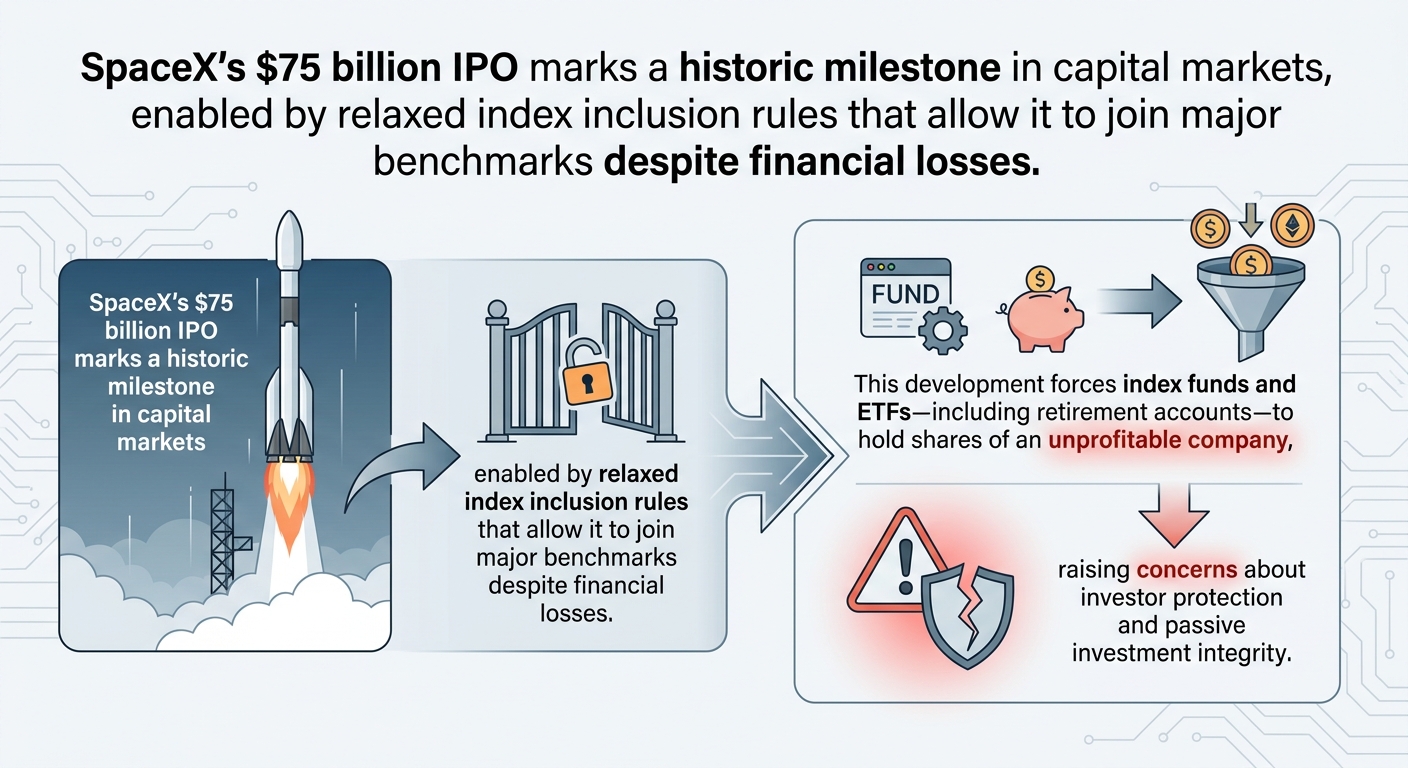
Infographic Image: Infographic
1. SpaceX's Record-Breaking IPO: Mechanics and Significance
Dissecting SpaceX’s IPO Scale: Valuation Benchmarks, Share Structure, and Strategic Intent
This subsection establishes the foundational financial and structural context of SpaceX’s IPO, detailing the valuation and share issuance parameters that underpin its record-breaking market debut. Understanding these quantitative facets is essential to assess the IPO's scale relative to historic precedents and to decode the strategic considerations influencing SpaceX’s approach. This analysis sets the stage for subsequent discussions on regulatory adaptations and broader market effects.
Precise IPO Share Count and Pricing Schedule: An Unprecedented Offering
SpaceX’s IPO comprises an offering of approximately 555.6 million new Class A shares priced firmly at $135 per share, scheduled for public trading debut on June 12, 2026. This fixed pricing — atypical given most IPOs employ price ranges to gauge demand — underscores management’s confidence and a desire to control market perception and valuation. The fixed-price approach departs from conventional book-building methods, favoring price certainty over iterative demand discovery.
The offering size reflects a gross raise of around $75 billion, with underwriters holding options to increase issuance, potentially pushing proceeds closer to $85.7 billion. This magnitude more than doubles the prior record set by Saudi Aramco’s 2019 IPO, positioning SpaceX at a historic capital raise level that reshapes expectations for mega-IPOs.
Market Capitalization Metrics and Valuation Rationale
The IPO targets a market capitalization near $1.75 trillion, situating SpaceX among the largest global public companies upfront. This valuation surpasses all prior U.S. IPO records by a substantial margin, more than tenfold greater than prominent tech IPOs such as Alibaba’s $169 billion debut. Despite the lofty figure, the valuation reflects SpaceX’s vertically integrated business model encompassing reusable launch systems, satellite broadband via Starlink, and emergent artificial intelligence initiatives.
This estimated market cap corresponds to a price-to-sales ratio approaching 94 times 2025 revenue estimates, inviting scrutiny of valuation multiples relative to both historical mega-IPOs and current technology sector norms. The large valuation predicates on projections of a total addressable market (TAM) in excess of $28 trillion across aerospace, connectivity, and AI segments—asserting unmatched scale but challenging near-term fundamental validation.
Historical Contextualization: SpaceX’s IPO Amid Mega-Listings
In historical context, SpaceX’s IPO ascends well beyond previous titans, such as Saudi Aramco at $1.7 trillion and the largest U.S.-based IPO by Alibaba. Its capital raise ambition at $75 billion eclipses established records markedly, underscoring shifting capital market appetites for transformative technology corporations.
Notably, the IPO float represents a mere 4.2% of shares outstanding post-listing, with founder and insiders retaining control of nearly 96% of equity and Elon Musk wielding an outsized 85% voting power via a dual-class share structure. Such concentrated ownership differentiates SpaceX from prior mega-IPOs and signals strategic retention of control during the public transition, aligning market entry with long-term visionary governance.
Strategic Purpose Driving IPO Parameters and Market Entry Timing
SpaceX’s choice of IPO parameters—fixed share price, limited float percentage, and rapid index inclusion pathways—reflects a deliberate strategy to harness capital market momentum while preserving founder control and enabling swift passive fund inflows.
The fixed pricing eliminates traditional uncertainty but also limits price discovery, implying a calculated balance between market signaling and valuation defense. The modest public float aims to maintain long-term business agility, while management’s timing leverages regulatory innovations facilitating expedited index inclusion, guaranteeing institutional exposure upon listing. Moreover, the influx of a substantial strategic investment from partners shortly before pricing reinforces investor confidence and valuation support.
Having rigorously defined SpaceX’s IPO mechanics and strategic underpinnings, the report now advances to examine the concomitant regulatory adaptations that have enabled this accelerated market integration, setting a precedent for future mega-IPOs within the evolving technological landscape.
Transforming Index Inclusion: Fast-Track Rules Reshape Market Entry Dynamics
This subsection elucidates the pivotal regulatory adaptations by leading index providers that have accelerated the timeline for mega-IPOs like SpaceX to enter major benchmarks. Understanding these changes is fundamental to grasping the downstream effects on passive investment flows, market liquidity, and broader portfolio risk profiles. By dissecting Nasdaq's and FTSE Russell's revised criteria and contrasting them with traditional processes, this analysis frames the structural shift underpinning SpaceX's rapid market integration.
Nasdaq’s 15-Day Fast-Track Inclusion Rule: Mechanics and Rationale
Nasdaq has instituted a groundbreaking rule allowing newly public mega-cap companies ranked among the top 40 by market capitalization on its exchange to be included in the Nasdaq-100 index as soon as 15 trading days after IPO, a drastic reduction from the previous minimum season of approximately three months. This quick entry mechanism eliminates the traditional 12-month public trading requirement and removes prior free float minimum thresholds for this category of firms. The accelerated timeframe responds to market realities where large companies increasingly remain private for extended periods, rendering the longstanding seasoning period outdated for accurately representing the investable market.
The rule mandates that companies meet all general eligibility criteria, such as being a non-financial issuer and complying with continued listing standards, but critically prioritizes the total market capitalization across both listed and unlisted shares to determine ranking. This holistic valuation approach ensures that companies with significant unlisted share classes are not unfairly excluded. The fast-track rule also incorporates a 3x float cap adjustment to mitigate disproportionate index weightings resulting from low public float. Ultimately, this framework is designed to improve the index’s relevance and reflect current market capitalization dynamics more promptly.
FTSE Russell’s Accelerated Five-Day IPO Index Inclusion Framework
Parallel to Nasdaq’s developments, FTSE Russell has introduced an accelerated index admission process tailored for sizeable IPOs with investable market capitalizations exceeding established thresholds. This new protocol permits eligible companies to be added to applicable Russell U.S. indexes within five trading days post-listing, notably compressing the traditional waiting periods that often spanned several months. This expedited inclusion is contingent on criteria involving minimum free float percentages, liquidity requirements, and market capitalization breakpoints reflecting the Russell Top 500.
The five-day rule aligns with FTSE’s broader strategic adjustments to its Global Equity Index Series, seeking to enhance responsiveness to market structure changes while balancing liquidity and tradability considerations. FTSE Russell also maintains discretionary powers to adjust percentages modestly during market reviews to better capture investable market profiles. This approach demonstrates a calibrated effort to accommodate mega-IPOs’ unique float and governance features without compromising investability standards or index integrity.
Traditional Versus New Inclusion Timelines: Market Implications
Historically, major indexes imposed extensive seasoning periods, commonly requiring at least 12 months of public trading, sustained liquidity, and in some cases profitability before eligibility. These barriers were instituted to ensure adequate price discovery, reduce initial volatility, and allow for meaningful assessment of a company’s standing within the investable universe. For mega-IPOs, this often meant a lag of up to a year or more before index-tracking funds gained exposure, resulting in deferred passive ownership and muted immediate capital inflows linked to index rebalancing.
The transition to rapid inclusion rules marks a profound shift in index governance philosophy. The compressed timelines remove the buffer designed to moderate forced buying from passive funds, raising the likelihood of accelerated demand shocks that can swiftly alter portfolio compositions. Consequently, investors tied to index funds will encounter near immediate exposure to mega-cap entrants, intensifying dynamics around liquidity management, price volatility, and market equilibrium during the initial post-IPO phase. While this evolution enhances benchmark representativeness, it also amplifies mechanical buying pressure and potential dislocations at listing.
Index Provider Methodology Evolution and Governance Considerations
The fast-tracking of mega-IPOs like SpaceX necessitates significant methodological recalibrations by index providers. The shift requires integrating unlisted share classes alongside listed ones to calculate total market capitalization, reflecting complex corporate capital structures more accurately. This change elevates governance importance around data fidelity, weighting adjustments, and float multipliers aimed at preventing outsized index concentration from thin public floats. Additionally, index providers must vigilantly monitor liquidity thresholds to ensure that index additions do not undermine tradability or inflate turnover unnecessarily.
Governance frameworks have adapted to incorporate stakeholder feedback emphasizing the balance between index representativeness and investability risk. Providers have deployed tailored exclusion rules and are consulting extensively on dual-class share structures, voting rights, and governance criteria to preserve shareholder protections within benchmark constructs. These efforts collectively represent a recalibration of index inclusion standards, acknowledging the growing prevalence of highly valued companies with unconventional public ownership parameters and seeking to deliver indices that accurately mirror the evolving equity market landscape.
Having established the regulatory framework shifts enabling SpaceX’s rapid entry into major indices, the next subsection will explore how these accelerated inclusions translate into tangible capital flows within passive investment vehicles, reshaping risk exposures across retail and institutional portfolios.
2. Passive Investment Transformation and Risk Distribution
Magnitude and Mechanics of Passive Fund Demands Post SpaceX IPO
This subsection examines the scale and operational details of passive investment flows triggered by SpaceX's unprecedented IPO. By quantifying expected ETF demands, expected index weights, and consequent capital reallocations within technology-focused portfolios, it elucidates the substantial market forces passive investors will exert immediately following the listing. These insights are critical for understanding how the IPO reshapes portfolio compositions and sector capital distributions on a broad scale.
Quantifying Immediate Passive ETF Inflows and Their Scale
Following SpaceX's projected IPO valuation near $1.75 trillion, passive index funds are expected to face extraordinarily large mandates to acquire shares in a compressed timeframe. Estimates converge on immediate post-listing ETF demands ranging from $8 billion to $12 billion, representing a significant liquidity injection focused squarely on SpaceX shares. These inflows stem primarily from automatic rebalancing requirements of leading benchmarks such as the Nasdaq-100, S&P 500, and FTSE Russell indices, all of which have implemented regulatory adaptations to permit faster inclusion of mega-cap IPOs.
The magnitude of these passive flows should be contextualized against the relatively constrained free float SpaceX is anticipated to offer at IPO, likely between 8% and 18%. This low float intensifies the impact of forced buying since the tradable share pool is limited, amplifying price sensitivity. Furthermore, index providers are applying float multipliers — for example, Nasdaq’s threefold float multiplier — artificially inflating the index weight representation beyond actual available free float, thereby increasing the mechanical capital demand on passive funds.
On a percentage basis, initial reliable estimates place SpaceX’s share in the S&P 500 at approximately 0.5%, a seemingly modest figure that masks the enormous absolute dollar volumes involved given the trillions benchmarked to this index. For example, leading S&P 500 ETFs with assets exceeding $800 billion will be compelled to purchase upwards of $5 billion of SpaceX shares to maintain index consistency, a non-discretionary flow that actively reshapes portfolio allocations on a historic scale.
Index Weight Sensitivities to Free Float Assumptions and Regulatory Multipliers
The determination of SpaceX’s index weightings depends critically on free-float assumptions and index provider-specific weighting methodologies. Under standard index construction rules, constituents’ weights correspond to float-adjusted market capitalization, excluding restricted or insider shares from the investable universe. SpaceX’s float, expected under 20%, restricts its initial index weight, constraining the amount passive vehicles must allocate at IPO.
However, recent regulatory reforms enacted by Nasdaq and others have introduced mechanisms that diverge from traditional float-based weighting. Nasdaq applies a threefold multiplier to SpaceX’s actual float to calculate index weight, effectively increasing the passive buying requirement. This means that a 4% real float could be represented as a 12% float equivalent for index inclusion, dramatically expanding capital inflows from passive funds forced to purchase under index-tracking mandates.
Such practices, while supporting rapid index inclusion, carry the potential for disproportionate market impact due to concentrated liquidity demand on a limited share base. It further compels portfolio rebalancing across major technology holdings as funds adjust holdings pro-rata to accommodate SpaceX, triggering secondary effects on existing large-cap tech stocks with which SpaceX competes for investor capital.
Capital Redistribution: Rebalancing Within Tech ETFs and Broader Market Impact
The influx of billions into SpaceX through passive investment vehicles will necessitate substantial portfolio rebalancing, particularly within technology-heavy ETFs and large benchmark funds. To fund purchases of SpaceX in correct index proportions, index-tracking funds will sell shares proportionally across their existing holdings, impacting giants like Apple, Microsoft, Amazon, and Nvidia. This mechanically reallocates capital within the technology sector, amplifying turnover and altering sector leadership dynamics in the near term.
Such rebalancing activity can lead to elevated trading volumes and increased volatility as fund managers execute mandated trades within limited windows dictated by index reconstitution schedules. Market participants should anticipate cascade effects where funds selling large stakes in prominent tech names to raise SpaceX allocation may drive short-term price dislocations, potentially favoring investors employing active management or hedging strategies during the transition.
Additionally, space-themed and technology infrastructure ETFs may experience inflows reflecting both direct holdings of SpaceX and spillover enthusiasm generated by the IPO’s thematic significance. This confluence of forced buying and thematic positioning contributes further to capital flow complexity, broadening market ripple effects beyond benchmark index rebalancing alone.
Having established the scale and mechanics of passive investment demand following SpaceX’s IPO, the next logical step is to delve into how these forces intersect with investor demographics, particularly retail participation, and the potential consequences for market volatility and ownership dispersion.
Retail Investor Surge and the Volatility Shockwave in SpaceX's IPO
This subsection explicates the significant role of retail investor participation in SpaceX’s IPO, emphasizing how an unprecedented retail share allocation alters traditional market dynamics. It situates the analysis within the broader report by linking retail ownership patterns to amplified volatility risks and behavioral finance phenomena, which are critical for understanding risk dispersion and potential destabilizing effects on both market stability and retirement portfolio valuations.
Unprecedented Retail Allocation of 20%-30% in SpaceX IPO
SpaceX’s IPO disrupts conventional public offering models by earmarking a significant 20% to 30% of its initial free float for retail investors, far exceeding the typical 5% to 10% retail allotments seen in mega-IPOs. This deliberate retail inclusion strategy is designed to democratize access beyond institutional heavyweights, enabling widespread individual participation from the moment of listing. The scale of this retail float equates to an estimated $15 billion to $22.5 billion of equity allocated directly to individual investors, a figure unrivaled in historical IPO contexts.
This allocation approach reflects not only SpaceX’s reliance on strong consumer enthusiasm for its technological narratives but also a structural evolution in IPO marketing and distribution strategy, leveraging the established retail investor base cultivated across Elon Musk’s ventures. Brokerage platforms such as E*Trade, Fidelity, Robinhood, and SoFi have been strategically engaged to facilitate retail participation at IPO price parity with institutional buyers, ensuring broad accessibility. The expansive retail share contrasts sharply with typical IPOs and sets a novel benchmark for capital raising approaches.
Volatility Amplification Driven by Retail Influx and Market Behavior
The sheer magnitude of retail ownership fuelled by SpaceX’s IPO is anticipated to exacerbate early trading volatility, a phenomenon well documented in behavioral finance and observed in prior high-profile listings with strong retail interest. Retail investors tend to engage more actively and frequently in trading, often influenced by momentum rather than fundamental valuation metrics. This inclination heightens price fluctuations, particularly in the debut trading window when liquidity is initially constrained and speculative fervor peaks.
Analysts and market strategists uniformly expect heightened price swings immediately post-IPO, stemming from retail traders’ propensity to chase narratives and react emotionally to short-term market stimuli. The IPO filing itself has acknowledged the risk of “significant volatility and wide fluctuations,” underscoring the signaling effect of substantial retail participation. Moreover, rapid inclusion of SpaceX shares in major indices within 15 trading days compounds volatility pressures due to mechanical passive fund rebalancing, which interacts with retail-driven price movements. This coalescence of factors creates a feedback loop amplifying trading volume and price variance in the nascent public market phase.
Behavioral Finance Risks: Retail Trading Psychology and Market Stability
From a behavioral finance perspective, retail investor dominance introduces complexities that challenge market equilibrium. Retail investors are disproportionately influenced by cognitive biases such as overconfidence, herd behavior, and loss aversion, often leading to impulsive and trend-chasing trades. These behaviors exacerbate noise trading and can cause price deviations disconnected from intrinsic value, thereby undermining price discovery mechanisms and increasing systemic risk.
Empirical studies demonstrate that retail trading surges correlate with elevated short-term momentum effects and reversals, reflecting the bounded rationality within this investor cohort. Retail investors' enthusiasm surrounding high-visibility IPOs like SpaceX, amplified by social media and direct-to-consumer communication channels, can produce inflated demand and subsequent sharp corrections, intensifying market volatility. This pattern poses challenges for portfolio managers and advisors tasked with managing client exposure, especially in retirement accounts sensitive to abrupt valuation swings.
Given the identified volatility pressures stemming from amplified retail participation, the next subsection will examine the structural impact of index inclusion obligations and passive investment flows, further detailing how these funding dynamics compound risk distribution and influence market behavior post-IPO.
3. Retirement Account Exposure and Governance Concerns
Compressed Index Inclusion Windows Heighten Retirement Plan Risk Exposure
This subsection delves into how the accelerated index inclusion timelines introduced for SpaceX's IPO significantly compress the adjustment period for defined contribution retirement plans. By quantifying the impact on 401(k) fund reallocation limits and illustrating the constraints faced by plan sponsors, it provides a nuanced understanding of the operational and governance challenges imposed on retirement vehicles by these unprecedented market mechanics.
Speed of SpaceX Index Inclusion and Its Compressive Impact on Retirement Plans
The introduction of expedited index inclusion rules by Nasdaq and FTSE Russell—reducing required seasoning periods from several months to as few as five to fifteen trading days—forces defined contribution plans to implement near-immediate portfolio adjustments. This rapid timetable sharply contrasts with traditional windows that allowed multiple quarters for orderly fund rebalancing, thereby compressing retirement plans’ flexibility to accommodate significant new positions, such as SpaceX’s historic IPO, into their existing allocations.
This truncated timeframe increases operational strain for 401(k) plan administrators and asset managers, who must respond swiftly to index reconstitution requirements. The mandatory purchases by broad market index tracking funds inevitably translate to forced reallocations of capital from existing holdings, often under suboptimal market conditions, exposing retirement portfolios to heightened execution risk and potential tracking error during volatile market episodes.
Quantitative Boundaries of Rebalancing and Forced Exposure in 401(k) Funds
Typical defined contribution plans operating within 401(k) frameworks adhere to strict investment policies and contribution limits governed by regulatory and fiduciary standards. Industry models estimate that forced SpaceX-related inflows into index funds tied to major benchmarks could amount to between $8 and $12 billion over the initial inclusion window. This magnitude corresponds to a sizable reallocation from incumbent technology sector equities and diversified assets.
Given contribution limits—currently set around $24,500 for employee deferments and a combined employer-employee cap near $66,000 annually—the influx induced by index inclusion often surpasses the voluntary contribution scales within a quarter. This disproportionate capital demand means plan participants indirectly incur significant exposure to SpaceX shares without direct consent or active choice, complicating individual risk profiles within pooled defined contribution portfolios.
Constraints on Plan Sponsors’ Ability to Mitigate Sudden Exposure Shifts
Plan sponsors administering defined contribution vehicles face concrete constraints in moderating the risk introduced by rapid IPO-induced reallocations. The accelerated index seasoning rules sharply reduce the time available to implement protective measures such as tactical cash buffers or temporary suspension of index tracking mandates. Additionally, fiduciary duties limiting discretionary asset sales restrict the capacity for anticipatory risk mitigation.
Operationally, plan sponsors are hampered by vendor system update lags and regulatory reporting obligations that disallow wholesale portfolio overrides on short notice. The mandated automatic enrollment and contribution rules embedded within 401(k) products amplify this challenge by limiting participants’ ability to opt out of affected index funds swiftly. Collectively, these factors amount to forced acceptance of SpaceX exposure, risking misalignment with participant retirement objectives and increasing potential for intra-plan volatility.
Having established how truncated index inclusion periods impose systemic exposure risks and operational hurdles for defined contribution plans, the following subsection will evaluate governance challenges intrinsic to SpaceX’s corporate structure that compound fiduciary complexities facing retirement account beneficiaries.
Dual-Class Stock Dynamics and Fiduciary Risks: Control, Compensation, and Regulatory Oversight Challenges
This subsection critically examines the implications of SpaceX's dual-class stock structure on shareholder governance and fiduciary protections. By analyzing the distribution of voting rights, executive compensation oversight, and current regulatory enforcement precedents, it illuminates inherent risks borne by retail shareholders and institutional investors post-IPO. Positioned within the broader context of retirement account exposure and governance concerns, this analysis underscores the structural limitations in shareholder influence and the corresponding fiduciary vulnerabilities that complicate investor protection.
Restrained Shareholder Influence Under Dual-Class Voting and Governance Structures
SpaceX’s IPO introduces a dual-class share structure that profoundly limits public shareholders’ voting power, creating a significant governance asymmetry. In this arrangement, founders and insiders retain disproportionately high voting rights—often magnitudes greater than their economic stake—effectively ensuring unilateral control over board appointments and strategic decisions. Public investors are confined to shares with minimal or no voting rights, obstructing their ability to influence critical corporate governance actions such as executive selection, board composition, and company policies.
The implications are that even a majority economic stake by public shareholders does not translate into commensurate control. Mechanisms common in well-governed firms, such as proxy battles or shareholder resolutions, become nearly ineffectual against entrenched management. This structural entrenchment can suppress market discipline and diminishes accountability, exemplified by the impossibility of reversing strategic priorities—such as ambitious long-term visions like multiplanetary colonization—that may not align with near-term financial returns. The governance framework thus enables a founder-driven agenda insulated from shareholder intervention.
Executive Compensation Oversight Gaps Amidst Extraordinary CEO Pay Packages
SpaceX’s governance model coincides with executive compensation patterns characterized by limited external scrutiny. CEO pay arrangements, particularly those linked to equity incentives, often escape rigorous shareholder approval due to the skewed voting power favoring insider control. This has resulted in compensation packages for executives that are decoupled from traditional pay-for-performance paradigms, undermining the alignment between executive rewards and shareholder value creation.
The risk is heightened given that SpaceX’s executives, including the CEO, wield outsized influence over compensation committees and board nominations. Without independent board oversight or accountable shareholder voting, there exists an elevated potential for excessive pay arrangements and governance failures in monitoring executive performance. This dynamic exacerbates fiduciary risk for investors, especially when executive compensation packages rival some of the largest in corporate America, reflecting a concentration of economic upside with scant shareholder recourse.
Regulatory Enforcement Landscape and Disclosure Challenges in Dual-Class IPOs
Regulatory bodies face complex challenges in enforcing disclosure and fiduciary standards within the context of dual-class IPOs like SpaceX’s. The Securities and Exchange Commission’s core mission to protect investors is complicated by the limited transparency inherent in concentrated control structures and related-party transactions. Enforcement precedents indicate heightened scrutiny on material disclosures related to governance risks, conflicts of interest, and executive compensation practices when the balance of power is skewed.
Although recent SEC initiatives have advanced requirements for detailed disclosures concerning executive relationships and financial arrangements, enforcement remains reactive and dependent on detected violations. The magnitude and novelty of SpaceX’s IPO, coupled with rapid index inclusion, amplify concerns over whether adequate regulatory frameworks are in place to mitigate risks stemming from restricted voting rights and potential self-dealing. Notably, SpaceX’s substantial government business—highlighted by $6.45 billion in defense satellite contracts and a total government contract portfolio valued at $22 billion—underscores the critical nature of transparency and oversight in areas intersecting public interest and corporate governance [Table: Government Contracts Secured by SpaceX]. The regulatory imperative includes adapting disclosure rules and monitoring mechanisms to expressly address asymmetric governance risks faced by retail and institutional investors alike.
Understanding the profound limitations dual-class share structures impose on shareholder agency and governance monitoring sets the stage for evaluating the broader retirement account risks that arise when such shares enter widely held passive investment vehicles. The following subsections will explore the concrete ways these governance gaps translate into fiduciary vulnerabilities for retirement investors and institutional asset managers.
4. Technological Convergence and Strategic Value Assessment
Strategic Integration of AI and Aerospace Infrastructure Driving Unprecedented Growth Trajectories
This subsection elucidates how SpaceX’s integration of artificial intelligence and aerospace technologies creates a unique infrastructure ecosystem that fundamentally alters its valuation and strategic positioning. By quantifying the AI revenue contributions, examining Starlink's operational role in supporting distributed computing workloads, and forecasting capital expenditures targeting communication infrastructure, it provides a critical technological context to the IPO's market implications. This analysis bridges the technological convergence theme with economic outcomes, enabling stakeholders to comprehend the structural foundations underpinning SpaceX’s projected growth and competitive advantage.
xAI’s Revenue Contribution and Its Strategic Weight in SpaceX’s IPO Narrative
SpaceX’s artificial intelligence division, following its integration with xAI, is projected to become the dominant revenue driver by 2030, significantly overshadowing its legacy aerospace segments. Private market forecasts indicate that xAI-generated revenues will surge from a modest $3.2 billion in 2025 to an astounding $322 billion by 2030, representing a hundred-fold increase within five years. This extraordinary growth trajectory forms the core of SpaceX’s valuation strategy, positioning the AI business as the principal engine behind its historic IPO valuation near $1.75 trillion and the targeted capital raise of $75 billion.
The strategic acquisition of xAI and its alignment with SpaceX’s broader technology platform signifies a deliberate shift from traditional aerospace pursuits toward high-margin, high-growth AI infrastructure services. The AI division leverages state-of-the-art GPU training clusters, including over 200,000 H100-class chips, underscoring the capital-intensive nature of this expansion. Despite ongoing operating losses in the AI segment, the trajectory reflects strong investor confidence fueled by Wall Street’s forecast of positive free cash flows after 2030, validating SpaceX’s ambition to eclipse established AI giants by capturing a substantial share of the growing artificial intelligence market.
Starlink’s Role as a Critical Enabler for Distributed AI Workloads and Global Connectivity
Starlink’s satellite internet constellation acts as a foundational communication backbone directly supporting the growth and scalability of SpaceX's AI infrastructure ambitions. Its expansive network, covering over 164 countries and serving more than 10 million subscribers, ensures low-latency, high-bandwidth connectivity essential for real-time AI data transmission and distributed computing workloads, both terrestrial and orbital.
The capacity enhancements planned through next-generation Starlink V3 satellites—featuring terabit-per-second throughput and increased customer speeds—are designed to support intensive data center operations in orbit and on the ground. Partnerships with orbital data center initiatives demonstrate Starlink’s capability to enable a distributed cloud architecture in space, providing persistent, high-speed intersatellite laser links with throughput up to 25 Gbps. This infrastructure addresses critical bottlenecks in AI training and inference workloads, creating a competitive edge in global AI service delivery and justifying significant future revenue contributions beyond conventional consumer broadband services.
Capital Expenditure Forecasts and Infrastructure Investment as Value Drivers Through 2030
SpaceX’s capital expenditure (capex) plans underscore the enormous scale at which it intends to expand its aerospace and AI infrastructure. Projections indicate that capex related to communication and AI infrastructure will exceed $360 billion by 2030, with total investment surpassing $700 billion by 2031. This investment pace reflects a commitment to massive satellite deployment, orbital data centers, AI compute capacity, and enhanced network capabilities.
The dual focus on traditional rocket launch capacity, which complements AI infrastructure build-out, and Starlink’s network scaling is crucial. The aggressive reinvestment strategy maintains technological leadership and expands competitive moats needed to sustain growth amidst intensifying market competition. This capital intensity, while a source of near-term financial pressure, is a critical strategic lever enabling SpaceX to assert dominance across converging aerospace and artificial intelligence ecosystems well beyond the IPO horizon.
Having detailed the critical technological synergies and investment scale shaping SpaceX’s value proposition, the analysis will next examine how these dynamics catalyze capital market behaviors and investor risk distribution, particularly within passive investment frameworks and retirement planning contexts.
Sectoral Displacement and Thematic Opportunity Creation: Capital Shifts, Competitive Moves, and ETF Innovation in Space-Tech and AI Integration
This subsection examines how the SpaceX IPO acts as a catalyst accelerating capital reallocation from traditional pure-play software and tech stocks toward emerging hybrid platforms that integrate space infrastructure with artificial intelligence capabilities. By forecasting the timing and characteristics of specialized space-tech and AI-themed ETFs, analyzing the magnitude of inflows reshaping sector exposures, and mapping competitive positioning among leading players, this discussion situates SpaceX’s public listing within a broader transformation of investment themes and industry dynamics.
Timing and Characteristics of Emerging Space-Tech and AI-Themed ETFs
The SpaceX IPO is poised to become a landmark event that aligns with a broader thematic evolution evident in recent ETF launches focusing on space and AI infrastructure. Several new space-themed ETFs—including the Global X Space Tech ETF, Roundhill Space & Technology ETF, and Tema Space Innovators ETF—have debuted since early 2026, collectively recording significant year-to-date gains, with many portfolios exhibiting strong performance even prior to the IPO itself. This emergent wave anticipates investor appetite for hybrid technology platforms that blend space infrastructure with AI-driven data processing and connectivity solutions.
Notably, these ETFs vary in concentration and thematic purity, ranging from pure-play space exploration companies to broader aerospace and defense holdings with AI integration potential. The launch schedules of these funds suggest an industry-driven momentum building into and immediately following SpaceX’s public debut, with thematic ETFs set to capitalize on heightened retail and institutional enthusiasm. As thematic asset managers accelerate product rollout timelines, the market is primed for additional innovation in ETFs explicitly designed to capture interwoven space and AI infrastructure value chains.
Quantifying Capital Reallocation from Pure Software to Hybrid Space-AI Platforms
Investment flows in 2026 indicate a significant migration of capital away from traditional pure software stocks toward integrated space and AI infrastructure opportunities, spurred by the SpaceX IPO and the thematic resonance around AI-driven space technologies. The aggregate market capitalization influence exerted by SpaceX’s anticipated $1.75 to $2 trillion valuation dwarfs most private and public competitors, compelling index-adjusted capital shifts that are estimated to funnel upwards of $8 billion to $12 billion into ETFs holding SpaceX and related hybrid technology assets.
This reallocation is further evidenced by expanded holdings in aerospace technology companies producing advanced satellite communications and AI computation hardware, which have outperformed semiconductor and software benchmarks throughout 2026. The reframing of space-based platforms as foundational AI infrastructure—such as Starlink’s role in enabling distributed computing workloads—is attracting institutional and retail capital seeking exposure to these convergent growth drivers, creating upward volatility in capital demand that reshapes sectoral weightings and strategic asset allocation models.
Competitive Dynamics and Strategic Positioning in AI-Enabled Aerospace Markets
The SpaceX IPO catalyzes intensified competition among aerospace incumbents, AI innovators, and dual-use technology integrators seeking leadership in the nascent hybrid space-AI segment. Key industry players—including traditional defense contractors, tech giants, and specialized startup ecosystems—are collaborating or competing to capture emerging revenue pools tied to satellite-based AI workloads, edge computing in orbit, and spaceborne data center development.
Elon Musk’s strategic moves, such as integrating xAI technology with SpaceX’s satellite constellation capabilities, exemplify the platform approach disrupting pure software specialization. Rivals are responding with AI-powered aerospace initiatives, including proprietary satellite AI chipsets and autonomous systems for military and commercial applications. The competitive landscape is also shaped by ETF positioning, with fund managers actively curating holdings that reflect these innovation trajectories, anticipating that thematic products focused on aerospace-AI synergy will outperform conventional tech-centric portfolios. This environment encourages continuous capital influx to adaptable firms and thematic funds attuned to this convergence.
These thematic developments in capital flows and competitive positioning underscore the accelerating fusion of space and AI sectors, motivating new investment products and reshaping the technology landscape. This convergence lays the groundwork for deeper financial performance analysis and governance considerations addressed in subsequent sections.
5. Financial Performance Metrics and Valuation Critique
Profitability Challenges Amid Ambitious Market Claims: Dissecting the Financial Realities Behind SpaceX’s IPO
This subsection critically examines SpaceX's current financial performance juxtaposed against its expansive total addressable market claims. It contextualizes the company’s profitability trajectory and benchmarks its valuation against historical precedents within the tech IPO landscape. Understanding these dynamics is crucial for stakeholders to gauge the sustainability of SpaceX’s growth narrative and investment rationale.
Q1 2026 Financial Performance: Revenue Strength vs. Persistent Losses
SpaceX’s reported financials for 2025 and early 2026 reveal a company with robust revenue growth accompanied by significant operating losses typical of high-capital technology ventures. In 2025, SpaceX generated approximately $18.7 billion in revenue, marking a notable 33% increase year-over-year, primarily driven by its Starlink broadband segment which contributed $11.4 billion of that total. Despite this revenue expansion, the company recorded a net loss of $657 million for the year, indicating ongoing challenges in achieving profitability across its businesses.
Further spotlighting the profitability gap, preliminary data for the first quarter of 2026 indicate continued losses consistent with the intensive capital expenditure profile required to scale both hardware-heavy and AI-driven divisions. This aligns with SpaceX’s own disclosures about the early-stage status of its AI operations, which remain unprofitable and capital intensive due to substantial compute resource commitments and infrastructure investments. The disconnect between growing revenues and lack of net profits underscores the intrinsic difficulty of monetizing emerging technologies at scale within a reasonable time horizon.
Dissecting SpaceX’s Ambitious $28.5 Trillion Total Addressable Market Claim
SpaceX’s IPO filings ambitiously estimate a total addressable market (TAM) of $28.5 trillion, positioning this as the largest actionable market in human history. This figure aggregates prospective opportunities across aerospace launch services, global connectivity, and artificial intelligence infrastructure. However, critical appraisal reveals that $26.5 trillion of this valuation basis is attributed to nascent AI ventures integrated through the xAI business line, with the balance distributed between SpaceX’s connectivity and space sectors.
These TAM estimates significantly exceed conventional macroeconomic benchmarks, notably surpassing the GDP of major global economies such as Europe and China. Analysts characterize these projections as aggressive extrapolations that leverage speculative future adoption scenarios for AI and satellite-based data services. The company acknowledges inherent uncertainty and early developmental status of these emerging markets, highlighting that much of this value is contingent upon unproven scaling of AI infrastructure and Starship payload commercializations.
Valuation Comparisons: SpaceX’s Sales Multiples in Historical Tech IPO Context
SpaceX’s valuation targets translate to extraordinarily high price-to-sales (P/S) multiples when benchmarked against historical technology IPOs. At a contemplated market capitalization near $1.8 trillion and roughly $18.7 billion in annual revenue, the implied P/S ratio exceeds 90x, an order of magnitude above median tech IPO P/S levels outside market bubbles.
Comparative analyses show leading technology companies with sustained growth and market leadership rarely sustain P/S ratios above 30 prior to profitability phases. Established AI-centric firms with demonstrated revenue traction trade at markedly lower multiples, reflecting investor caution in assigning premium valuations without commensurate cash flow generation. Independent valuation assessments have posited that fair value estimates for SpaceX may approximate half the company’s IPO target, underscoring the potential for significant valuation compression post-listing absent rapid operational milestones.
Having delineated the financial performance realities and the breadth of market opportunity underpinning SpaceX’s valuation, the report now proceeds to analyze the impact of these valuation dynamics on investor risk profiles and long-term capital allocation decisions.
Multiples Compression Impact and Divergent Fair Value Perspectives on SpaceX IPO
This subsection rigorously examines valuation multiples associated with SpaceX’s IPO, contrasting these metrics with historical technology IPO benchmarks and integrating independent analyst assessments. It further explores the spectrum of institutional investor sentiment, illustrating the complex market reception to an unprecedented valuation scale and the inherent tension between narrative-driven premiums and underlying financial fundamentals.
Comparative Analysis of SpaceX’s Price-to-Sales Multiples Against Historic Mega-Tech IPOs
SpaceX’s initial public offering is poised to enter the market with a price-to-sales (P/S) ratio approaching 100 times, an exceptionally high multiple relative to traditional benchmarks. This marks a significant departure from prior large-scale tech IPOs, including prominent names whose multiples typically ranged far lower. For instance, previous mega-IPOs rarely exceeded P/S multiples in the 20s or 30s during early trading periods unless driven by extraordinary hype, and even then, enduring valuations frequently corrected sharply.
Historical data indicates that IPOs with P/S multiples above 100 tend to face severe valuation contractions post-listing. Past cases show an average peak-to-trough decline of approximately 75%, underscoring the speculative risk baked into such lofty multiples. This precedent places SpaceX in a precarious valuation category—compelling in narrative yet vulnerable from a purely fundamentals-based standpoint.
Independent Analysts’ Fair Value Estimates Reveal a Significant Valuation Discount
Third-party fair value assessments provide a more tempered perspective on SpaceX’s market worth. Leading analysts estimate the company’s intrinsic value to lie substantially below its targeted IPO valuation, with fair value approximations frequently clustering near $780 billion, representing roughly half the proposed $1.75 trillion market capitalization. This discrepancy stems primarily from rigorous discounted cash flow models that attribute substantial economic value to core segments like satellite communications and aerospace launch services, but discount speculative AI initiatives due to capital intensity and uncertain monetization pathways.
Such independent evaluations emphasize the gap between market enthusiasm and grounded financial projections. They encapsulate structural concerns including sustained losses, capital expenditure burdens, and indeterminate competitive moats within AI businesses integrated into the SpaceX ecosystem. Consequently, these prudent valuations serve as anchor points for conservative investors evaluating the risk-reward profile amid an IPO landscape dominated by high-growth narratives.
Institutional Investor Sentiment and Rating Distribution Highlights Market Polarization
Institutional sentiment towards the SpaceX IPO is notably divided, reflecting a broader tension between optimism around transformative technology prospects and caution regarding financial prudence. Recent data illustrates a predominant 'Hold' consensus from sell-side analysts, supplemented by a minority of 'Sell' stances, signaling substantial skepticism about immediate upside potential.
Within the investment community, aggressive accumulation by select hedge funds and large asset managers contrasts with insider sell-offs—indicating nuanced positioning strategies. For instance, some quantitatively oriented firms are dramatically increasing exposure, anticipating momentum-driven appreciation aligned with index inclusion mandates, while insiders capitalize on peak valuations. This duality suggests emerging concerns about an 'index trap' scenario, whereby passively managed portfolios incur forced purchases at premium prices that might not be sustainable long term.
The rating distribution also mirrors systemic market cautiousness given macroeconomic uncertainties and the IPO’s structural novelty. Divergent institutional views underscore the necessity of active risk management and differentiated engagement strategies for professional investors.
Having framed SpaceX’s valuation in both historical and current market contexts, the following section will delve into the company’s profitability trajectory and operational performance metrics to assess the validity and sustainability of these valuation extremes.
6. Geopolitical Dimensions and Systemic Economic Impact
Strategic National Security Integration of SpaceX's Dual-Use Satellite Infrastructure
This subsection situates SpaceX's IPO within the broader context of U.S. national security priorities, focusing on how the company’s satellite and communications infrastructure underpin critical defense capabilities. By dissecting contract values, procurement patterns, and policy feedback loops, it elucidates how SpaceX’s commercial ambitions are deeply intertwined with government strategic interests, thereby influencing regulatory and geopolitical dynamics surrounding the IPO.
Quantifying the Scale and Value of SpaceX’s Defense-Linked Satellite Contracts
SpaceX’s Starlink constellation functions not only as a commercial broadband service but also as a cornerstone of U.S. defense communications architecture. In the months leading up to the IPO, SpaceX secured major contracts worth billions, underscoring this dual-use utility. Notably, the U.S. Space Force awarded two pivotal contracts: a $4.16 billion agreement to develop a constellation of satellite-borne airborne threat sensors set for prototype delivery by 2028, and a $2.29 billion contract establishing the company as the primary provider of secure, high-speed satellite communications infrastructure for the military’s low Earth orbit mesh network. These combined awards—totaling over $6.45 billion—reflect unprecedented commercial contractor engagement at a scale typically reserved for legacy defense primes.
Supplementing these flagship deals, SpaceX maintains over $22 billion in total government contracts as of 2024, spanning launch services, Starship development, and classified defense projects. The cumulative value illustrates the company’s entrenched role within defense space programs and institutional dependence on Starlink-based secure connectivity. With approximately one-fifth of its 2025 revenue sourced from U.S. government agencies, these contracts form a significant and stabilizing revenue pillar, mitigating exposure to commercial volatility and reinforcing the strategic import of its technology.
Analyzing U.S. Government Procurement Patterns and Strategic Partnerships with SpaceX
The U.S. Defense Department’s expanding investment into proliferated low Earth orbit (PLEO) satellite-based services exemplifies evolving procurement patterns that favor SpaceX. The PLEO program’s budget ballooned from an initial $900 million ceiling to a robust $13 billion within a short time frame, with SpaceX’s militarized Starlink ‘Starshield’ system receiving the lion’s share of task orders. Over 212 Starshield satellites are operational, supporting more than 550 service contracts across various U.S. defense entities, underpinning battlefield communications, maritime navigation, and aviation safety.
This procurement trajectory highlights a shift toward satellite constellations that enable resilient, jam-resistant communications. SpaceX’s ability to integrate space sensor payloads with secure communications meshes aligns with joint force priorities, catalyzing tighter partnerships with multiple military branches and agencies. Its certifications as the sole NASA-certified crew transportation system further cement SpaceX’s unique government trusted status, yielding diversified contract awards that span from technical launch services to advanced space-based threat detection.
Policy Feedback Effects from Commercial Deployments to National Security Strategy
The commercial deployment of Starlink and related satellite capabilities has induced significant shifts in U.S. national security policy and planning. The demonstrated battlefield utility of Starlink during recent conflicts has prompted the Department of Defense and Space Force to accelerate investment in satellite constellations as a backbone for future space-based command and control networks. This dynamic creates a policy feedback mechanism where commercial innovation informs defense priorities, which in turn drives increased procurement volumes and regulatory accommodation for SpaceX.
Post-IPO regulatory evolution reflects this confluence, with accelerated index inclusion rules recognizing the need to integrate SpaceX swiftly into capital markets, minimizing disruption while acknowledging its strategic significance. Moreover, SpaceX’s positioning at the nexus of civilian and defense domains influences spectrum allocation policies and reshapes U.S. approaches to space infrastructure governance. The IPO can thus be viewed as both a market event and a milestone signaling the maturation of dual-use space technologies that drive geopolitical leverage and economic security.
Understanding SpaceX’s embeddedness in national security frameworks provides crucial context for interpreting its capital market debut. The interplay between government partnerships and commercial ambitions not only elevates the company’s valuation narrative but also informs the systemic risks and opportunities this IPO presents to broader market participants and policymakers alike.
Global Capital Flows, Sovereign Wealth Engagement, and Retail Democratization in SpaceX’s IPO Landscape
This subsection delves into the international investment dynamics and broad investor participation trends that underpin SpaceX’s record IPO. By examining sovereign wealth fund involvement alongside evolving retail ownership models, it reveals how capital flows from diverse constituencies are reshaping access to high-profile tech assets and triggering ripple effects across related technology sectors. This analysis is crucial for understanding the macroeconomic reach and distributional consequences of SpaceX’s public debut within a shifting global investment ecosystem.
Sovereign Wealth Funds’ Strategic Allocation and Capacity for Absorbing SpaceX’s Offering
SpaceX’s landmark IPO has garnered significant interest from sovereign wealth funds (SWFs), particularly those within the Gulf Cooperation Council (GCC) region, where collective assets under management exceed $5.6 trillion. This immense capital base equips these funds to facilitate meaningful participation in the anticipated $75 billion capital raise without necessitating outsized portfolio reallocations. Analysts concur that the deal size aligns well within the absorptive capacity of GCC SWFs, underscoring the role these state-owned institutions play in anchoring demand for mega-tech IPOs with transformative sectoral implications.
Investment approaches by SWFs in this context are strategic and calibrated. Gulf SWFs and large family offices view the SpaceX offering not merely as a financial opportunity but also as a lever to bolster regional presence in cutting-edge technology ecosystems. Despite prevailing geopolitical fragilities, the scale and historic nature of the IPO is compelling enough to supersede temporary risk aversion, signaling a long-term commitment to exposure in aerospace, AI-driven innovation, and satellite infrastructure. This participatory pattern exemplifies an emerging paradigm where sovereign capital actively shapes the trajectory of frontier technology firms.
Innovations in Retail Ownership: Fractional Shares and Platform Accessibility
A notable shift characterizing the SpaceX IPO is the expanded allocation to retail investors, with the company targeting up to 30% of shares reserved for this segment—substantially higher than the typical 5-10% in major IPOs. This elevated retail participation is facilitated by brokerage platforms such as eToro, Fidelity, Charles Schwab, and Robinhood, which offer fractional share purchases, thereby lowering traditional barriers linked to price per share and enabling broader individual investor access.
The availability of fractional shares, combined with streamlined liquidity provision by designated market makers, creates a democratizing effect, allowing retail investors to gain unprecedented exposure to a historically institution-exclusive asset class. However, this inclusion also introduces new volatility dynamics due to behavioral tendencies among retail participants, including herding and sentiment-driven trading, potentially amplifying price fluctuations during initial trading phases. The entry of retail participants en masse exemplifies the interplay between technological innovation in trading infrastructure and capital market inclusiveness.
Spillover Effects: Capital Reallocation and Investment Flows into Adjacent Technology Sectors
The massive capital mobilization for SpaceX’s IPO is expected to induce significant portfolio rebalancing across institutional investors, which in turn affects adjacent technology segments. Given limited cash buffers among large asset managers and high-net-worth individuals, the demand for SpaceX shares likely necessitates divestments from existing holdings in major technology stalwarts. This dynamic may pressure valuations in sectors such as cloud computing, semiconductors, and software services as capital migrates toward hybrid aerospace and AI infrastructure companies.
Moreover, interest has surged in ETFs and special-purpose vehicles providing indirect exposure to SpaceX and related space-tech themes. Funds including NASA and XOVR have experienced elevated inflows fueled by investor anticipation of SpaceX’s public debut and its far-reaching technological ecosystem. This phenomenon signals broader thematic capital shifts beyond pure-play technology toward integrated platforms that combine satellite-based broadband, AI infrastructure, and next-generation aerospace capabilities. The diffusion of investment capital across these sectors suggests a multi-layered amplification in innovation financing driven by marquee IPOs like SpaceX.
While this subsection clarifies how global and retail investors are accessing SpaceX, the subsequent analysis turns to geopolitical factors that intertwine with these capital flows, addressing national security dimensions and systemic economic impacts of SpaceX’s emerging market influence.
7. Strategic Decision Framework for Stakeholders
Managing SpaceX IPO Passive Inflows: Scale, Hedging, and Rebalancing Dynamics
This subsection provides portfolio managers with focused insight into the magnitude of mandatory passive inflows triggered by SpaceX’s IPO, alongside practical strategies to hedge and rebalance effectively amid this unprecedented market event. Understanding these mechanics is crucial to mitigating concentration risk and maintaining portfolio stability during the rapid index inclusion and rebalancing phases.
Quantifying Passive Capital Inflows Triggered by SpaceX's IPO
SpaceX’s initial public offering is expected to catalyze immediate and sizable passive capital inflows due to recent regulatory changes enabling rapid index inclusion. Estimates place mandatory passive demand within the range of $8 billion to $12 billion shortly after the IPO, driven primarily by Nasdaq 100 index funds needing to replicate the security’s weighting in their portfolios. Additional index providers such as FTSE Russell and CRSP are poised to contribute between $10 billion and $25 billion in combined passive demand, projecting a total mechanical buying pressure approaching or exceeding $30 billion in the near term.
These passive flows arise despite SpaceX’s low public float, estimated at approximately 3% to 5%, a configuration which amplifies the impact of rebalancing due to concentration effects. This means funds tracking relevant benchmarks must divest holdings in existing constituents to fund purchases of SpaceX shares, intensifying turnover and adding to volatility in connected sectors. Longer term, if SpaceX achieves broader index inclusion, particularly in the S&P 500 after meeting profitability and float thresholds, passive inflows may scale dramatically into the hundreds of billions by early 2027.
Effective Hedging Instruments to Mitigate Mega-IPO Concentration Risk
Given the forced nature of passive purchases, portfolio managers face heightened concentration and liquidity risk. As such, employing hedging instruments is vital to controlling portfolio volatility and downside exposure. Derivative strategies including index options—especially SPY and QQQ options—are effective tools for dynamic risk management in this environment. Options allow managers to tactically offset delta and gamma risks generated by rapid influxes of newly issued shares with large price swings.
In addition to options, total return swaps and futures contracts referencing broad market indices can facilitate flexible, cost-effective positioning. Interest rate and currency swaps may be appropriate for globally diversified portfolios where currency and funding risks compound with equity stresses. Managers should consider layering both passive and active hedging frameworks aligned with risk tolerance, time horizons, and fund mandates, mindful of potential liquidity constraints during peak rebalancing windows.
Rebalancing Frequency and Monitoring Protocols for Post-IPO Index Adjustments
The compressed timeline for SpaceX’s inclusion, enabled by Nasdaq’s 'fast-track' rule granting entry into the Nasdaq 100 as soon as 15 trading days after listing, necessitates heightened monitoring and flexible rebalancing. Market participants should anticipate multiple rebalancing events: the immediate post-IPO index inclusion, subsequent share unlocks expanding float over the following months, and customary semi-annual index reconstitutions. Each phase will require proactive adjustment to avoid unintended overweight or tracking error.
Empirical evidence and simulations from similar large IPO events suggest that rebalancing frequency may be elevated from quarterly to monthly or even bi-weekly intervals during the six to twelve months after the IPO. Portfolio managers will benefit from establishing dedicated analytics frameworks to capture real-time index methodology changes, float updates, and shareholder structure evolution. Implementing alert protocols for index review dates and corporate actions will allow nimble responses to evolving passive flow pressures and volatility spikes.
Having delineated the mechanisms driving forced passive flows and tactical mitigants for portfolio managers, the report proceeds to examine how these developments translate into retirement account exposures and raise unique governance challenges for fiduciaries.
Navigating Client Risks and Communication Strategies Amid Forced SpaceX 401(k) Exposure
This subsection addresses the critical role of financial advisors in managing client expectations and concerns arising from mandatory inclusion of SpaceX shares in retirement accounts. Given the rapid index inclusion rules tied to SpaceX’s IPO, many investors may find themselves involuntarily exposed to a high-profile, yet controversial, equity allocation within their 401(k) portfolios. The content focuses on identifying key client risks, devising phased rollout plans for portfolio adjustments, and creating clear disclosure templates that articulate the complexity of this involuntary exposure. This analysis supports the broader report’s intent to empower advisors with practical tools for transparent and proactive client engagement.
Understanding and Mitigating Risks from Forced SpaceX Exposure in Retirement Accounts
The accelerated entry of SpaceX into major equity indexes will rapidly insert its shares into broad market funds that underpin a substantial portion of Americans’ 401(k) portfolios, irrespective of individual investor choice. This involuntary exposure presents unique risk profiles due to SpaceX’s unprecedented valuation exceeding $1.7 trillion despite a lack of long-term profitability. Retirement investors, typically risk-averse with long horizons, face challenges from this exposure including amplified portfolio concentration risks and heightened price volatility during early trading periods. Moreover, the speed of index inclusion—condensed to as few as five to fifteen days—provides limited adjustment time for plan sponsors and individual savers to react.
Plan sponsors and advisors must appreciate that investment mandates tied to passive index funds offer scant flexibility to exclude SpaceX once it qualifies for inclusion under updated indexing rules. The shrinking seasoning period reduces options for proactive portfolio rebalancing or transition into actively managed funds before the stock’s entry. Investors with low risk tolerance or income-driven objectives may find the sudden influx of a high-growth, speculative asset in their retirement allocations disconcerting. Educating clients on these risks, emphasizing the importance of strategic long-term perspectives, and differentiating SpaceX’s structural uniqueness compared to typical blue-chip constituents is crucial for trust maintenance.
Phased Implementation and Timeline Design for Advising Clients on SpaceX-Driven Portfolio Changes
Effective client communication requires a thoughtfully structured rollout timeline that acknowledges both regulatory index inclusion schedules and individual portfolio constraints. Advisors should develop phased approaches starting with early client education regarding the inevitability of SpaceX exposure via index funds, then progressing to collaborative portfolio reviews once the IPO date and index inclusion milestones are publicly confirmed. This timing allows clients to mentally and financially prepare without being blindsided by abrupt portfolio shifts.
Coordinating with plan sponsors or retirement product managers is essential to understand practical index fund adjustment dates and any discretionary windows for modifying underlying investments. Where feasible, advisors should explore gradual capital reallocation strategies post-inclusion to rebalance risk concentrations over quarters or years rather than abrupt exits that might trigger transactional costs or tax consequences. The phased schedule should reference specific market events, such as index reconstitution announcements and SpaceX’s initial trading window, to underpin tangible action points for clients.
Designing Transparent Disclosure Materials to Explain SpaceX IPO Complexities and Client Impact
Given the complex nature of SpaceX’s IPO—marked by founder-controlled dual-class shares, volatile retail allocation, and rapid index fund assimilation—clear, jargon-free communication materials are essential. Advisors need disclosure templates that succinctly explain why clients will own SpaceX shares without direct purchase action, what the potential risks and benefits are, and how this exposure fits into a long-term retirement strategy. Transparency about governance concerns, valuation controversies, and the accelerated timeline helps pre-empt misconceptions and anxiety.
These templates should incorporate easy-to-understand visual aids illustrating the index fund mechanics, the corporate structure’s implications on shareholder rights, and the expected volatility profile based on retail investor participation. Furthermore, risk assessment tools tailored to diverse retirement horizons—ranging from near-retirees to accumulation-stage savers—can help personalize the message. Providing clients with phased disclosure schedules that coincide with key IPO milestones strengthens informed consent and enables constructive dialogue around portfolio adjustments.
With advisors equipped to effectively communicate and manage client expectations regarding forced SpaceX exposure, the report now progresses to analyzing regulatory policy considerations that can safeguard investor interests and ensure transparency in this evolving IPO and index inclusion landscape.
Enhancing Investor Protections Through Proxy Voting Reforms and Governance Transparency
This subsection scrutinizes the regulatory safeguards critical to protecting retail and institutional investors amidst SpaceX's unprecedented IPO, focusing on proxy voting reform efficacy, mandated disclosures surrounding complex governance arrangements, and the need for longitudinal analysis of retirement funds’ performance following inclusion of such mega-IPOs. By addressing these themes, it anchors broader discussions on fiduciary responsibility and market integrity within evolving disclosure and voting frameworks.
Assessing Proxy Voting Reforms for Mega-IPOs: Balancing Control and Shareholder Influence
The rapid growth of mega-IPOs, exemplified by SpaceX’s forthcoming public offering, has spurred regulatory reconsideration of proxy voting mechanisms to better safeguard shareholder rights. Proxy voting functions as a pivotal tool for investors to influence corporate governance; however, existing frameworks show vulnerabilities when confronted with dual-class share structures and concentrated founder control. Recent proposals advocate for enhanced proxy transparency and more granular voting disclosures, aiming to mitigate the outsized influence retained by controlling shareholders in these landmark offerings.
Robust proxy reforms must address structural imbalances where voting power consolidation can disenfranchise minority shareholders and mute meaningful board accountability. The experience with large technology IPOs highlights risks of entrenched management overriding independent oversight. For SpaceX, the underlying governance model challenges traditional proxy agency assumptions, necessitating reforms that ensure proxy voting processes empower all classes of shareholders equitably and provide mechanisms to contest governance decisions that may conflict with investor interests.
Mandating Transparency on Dual-Class Governance Risks and Conflicts of Interest
The dual-class share structure in SpaceX’s IPO introduces pronounced governance complexity, where differential voting rights entrench founder control while sidelining retail investors. Disclosure requirements must be rigorous and explicitly outline the nuanced risks this structure poses, including asymmetric influence over key corporate decisions, executive compensation control, and limited board representation for public shareholders.
Regulatory emphasis on disclosing related-party transactions and material conflicts of interest is imperative, given the potential for founder-led companies to engage in self-dealing or preferential treatment. Strengthened disclosure protocols should encompass not only static governance frameworks but also dynamic monitoring of arrangements that could evolve post-IPO, thereby equipping investors with actionable intelligence for informed decision-making and enabling regulatory bodies to preemptively identify red flags.
Long-Term Impact Studies on Retirement Funds Post-IPOs: A Call for Empirical Vigilance
The accelerated inclusion of mega-IPOs like SpaceX in major indexes raises pressing questions about the sustained effects on retirement account performance, given mandatory passive fund exposures. There is a critical gap in empirical research tracking how such large scale IPOs affect defined contribution and other pension funds over time, considering valuation volatility, governance risks, and index rebalancing impacts.
Policymakers should champion comprehensive longitudinal studies designed to systematically assess the financial outcomes for retirement plan beneficiaries. These analyses must integrate governance quality metrics, market impact variables, and behavioral finance considerations to identify systemic vulnerabilities. Enhanced data transparency and cooperation between regulators, asset managers, and retirement plan administrators will be crucial to safeguarding retirement security in the context of evolving market dynamics introduced by transformative IPOs.
Together, these regulatory safeguards form the cornerstone for protecting investor interests in the wake of SpaceX’s IPO. Effective proxy reforms, rigorous governance disclosures, and evidence-based policy interventions collectively strengthen fiduciary oversight and market resilience. The following section advances this discourse by translating these regulatory considerations into actionable strategies for asset managers, advisors, and policymakers.
Conclusion
SpaceX’s 2026 IPO represents a landmark event that fundamentally redefines mega-IPO paradigms, capital market architecture, and passive investment landscapes. The offering’s extraordinary scale, elevated valuation multiples, and low public float, coupled with innovative regulatory accommodations facilitating near-immediate index inclusion, collectively generate unprecedented capital inflows. These forces compel broad-based portfolio rebalancing across major technology ETFs and retirement accounts, exposing investors to sizable, involuntary stakes in a founder-controlled entity characterized by asymmetric governance and challenging profitability dynamics.
The transformational regulatory fast-tracking of index inclusion exemplifies an adaptive market governance response to the new norm of mega-cap technology firms with complex capital structures and concentrated insider control. While this evolution enhances index representativeness and investor access, it simultaneously elevates market volatility risks, concentration exposure, and liquidity compression – particularly in the nascent trading phases marked by heightened retail investor activity. The expanded retail allocation democratizes ownership but exacerbates behavioral-driven price swings, necessitating robust risk monitoring and investor education efforts.
Strategically, SpaceX’s melding of aerospace infrastructure with AI innovations through its xAI division encapsulates a bold vision for industry convergence, motivating its lofty valuation despite ongoing operational losses and aggressive capital expenditure requirements. This positioning foreshadows a shifting competitive landscape wherein hybrid space-AI platforms emerge as critical thematic investment avenues, reshaping sectoral capital flows and ETF product innovation. Institutional skepticism reflected in tempered fair value estimates underscores the need for prudent risk management amid pronounced valuation ambiguities.
Looking forward, stakeholders—including asset managers, retirement plan sponsors, regulators, and investors—must calibrate their approaches to navigate the liquidity, governance, and valuation complexities intrinsic to SpaceX’s IPO and its market implications. Enhanced proxy voting reforms, improved disclosure on dual-class governance risks, and longitudinal studies on retirement fund outcomes are imperative to safeguarding investor interests. Moreover, ongoing surveillance of passive flows and volatility patterns will be crucial to maintaining market stability.
In sum, SpaceX’s IPO is emblematic of a new era in public equity markets—one characterized by mega-scale technology offerings, accelerated index integration, and a convergence of innovative thematic drivers that collectively reshape capital allocation frameworks, investor risk profiles, and economic strategic imperatives.
References
- Elon Musk and the 2026 Tech Frontier: AI Rivalries, EV Evolution, and SpaceX’s IPO Trail
- SpaceX IPO: Massive Valuation and Index Inclusion to Reshape Passive Investing
- Investors Eye SpaceX IPO Amid Market Speculation | AI Stocks
- Elon Musk Just Linked SpaceX, xAI, Tesla, and Nvidia Into 1 Trade. Here's How to Position Your Portfolio. | The Motley Fool
- S&P 500 Fast-Track IPO Rules Could Force $432–576B in Passive Inflows — What Leveraged Index Traders Must Know | CoinUnited.io
- SpaceX IPO 2026: $1.75 Trillion Valuation Target as Confidential Filing Looms
- Mega-cap IPOs: Implications for institutional investors and index managers
- SpaceX IPO is said to draw more orders than shares available
- SpaceX AI Revenue Could Hit $322 Billion by 2030
- SpaceX and Anthropic are about to go public—and your 401(k) may be forced to buy in
- SpaceX IPO is coming to your 401(k). Should you be concerned?
- Analysis of SpaceX IPO Prospects and Market Reactions
- How the SpaceX could blast right into your 401(k) - CGTN
- The Global Impact of a SpaceX Public Offering | AI Stocks
- SpaceX IPO: Aiming for Historic Market Debut
- SpaceX IPO Insider Selling Rules: Early Share Releases Explained
- SpaceX's IPO Filing Has Delivered A Revealing Case Study
- SpaceX files blockbuster IPO, posts $4.28 bn quarterly loss and targets $2 trillion valuation
- Buying SpaceX Stock Might Mean Owning It — Without Any Real Control And That's A Problem | IBTimes UK
- SpaceX IPO Could Trigger Immediate Passive Fund Inflows
- SpaceX IPO: Every ETF That Will Hold SPCX — and When
- Shockwave: The SpaceX IPO Effect | Summit Global Private Wealth
- SpaceX IPO: Why some investors and pension funds are raising red flags over Elon Musk's SpaceX IPO
- Nvidia Projects $1 Trillion in GPU Sales by 2027
- Goldman Sachs Guides SpaceX Toward Major IPO
- All eyes on SpaceX as upcoming IPO lures Gulf investor interest - Arabian Business: Latest News on the Middle East, Real Estate, Finance, and More
- SpaceX IPO: Market Impact & Tech Investment Opportunities
- With launch of SpaceX IPO, AI-related stock rally may lose momentum
- SpaceX employees prepare for multi-million-dollar windfalls ahead of expected record IPO | The Straits Times
- May 12, 2026 The Honorable Paul Atkins Chairman ...
- Wall Street Is Already Bending Its Rules to Suck More People Into SpaceX’s IPO
- SpaceX Stock Price: How Wall Street Quietly Rewrote the Rules for Elon Musk's IPO | IBTimes UK
- SpaceX blocked from early US benchmark index entry as S&P reaffirms existing rules
- SpaceX set for fast entry into US, global indexes under new FTSE rules
- SpaceX IPO 2026: How to Buy SPCX Stock & $1.75T Valuation Analysis
- Musk’s SpaceX is shaping up as biggest IPO on record
- Musk’s SpaceX is shaping up as the biggest IPO on record. It’s also bending the rules to do so
- 90% firms increased AI spending but only 12% can prove revenue impact: Comviva survey
- The future of AI transformation in 2026 | Zapier
- PDF Economy - hai.stanford.edu
- 40+ AI Assistant Statistics 2026: Adoption, Impact, and ROI
- 60 AI Statistics and Trends for 2026: The State of Artificial Intelligence
- AI Statistics 2026: Market Size, Adoption & Investment Data
- 52 Conversational AI Statistics You Need to Know in 2026
- NVIDIA CORP (NVDA) — Investment Research by Semper Signum
- Top Explainable AI Companies - Microsoft (US), IBM (US) and Temenos(Switzerland) | MarketsandMarkets
- A guide to investing in AI stocks
- PDF Russell U.S. Equity Indexes - Applied Finance
- SpaceX IPO Is Live: Timeline, Pricing, and How to Buy Shares
- SpaceX IPO: The numbers are in, and this rocket looks ready to fly
- More details emerge on SpaceX IPO
- SpaceX plans to set IPO price at US$135 per share, targeting US$75 bil raise — Reuters
- SpaceX to Update Prospectus Tomorrow, 1.75 Trillion 'Largest IPO in History' Locked at $135. Musk's Net Worth Approaches Trillion
- 2026 Recently Priced IPOs
- How Can Retail Investors Take Part in the SpaceX IPO?
- Who will benefit most from SpaceX IPO? Mostly Elon — and a few from his inner circle | TechCrunch
- Exclusive: Cerebras to raise IPO price range to $150-$160 as demand surges, sources say | Reuters
- Why did Micron stock fall 13% on Friday and should you buy the dip?
- Why SpaceX faces a longer wait to join S&P 500
- S&P Denies SpaceX Fast Index Entry, Delaying $14BN In Passive Inflows By At Least A Year | ZeroHedge
- SpaceX IPO Looms as Index Providers Rush Rule Changes, Passive Inflows Could Hit approximately $29.6 Billion — BigGo Finance
- SpaceX IPO: prepare for passive lift-off
- SpaceX IPO Index Inclusion: How Rule Changes for SPY, QQQ, and IWM Force Index Funds to Sell Stocks and Buy SpaceX
- SpaceX’s 2 Trillion IPO’s Potential Impact on Tesla Shareholders: Facts, Speculations and Three Verifiable Observation Signals
- SpaceX IPO Set to Trigger $221.7 Billion Liquidity Drain, Threatening Korean Semiconductor Stocks — BigGo Finance
- SpaceX IPO Could Pressure Nasdaq, S&P 500 Stocks as Passive Funds Shift - Yonhap Infomax
- SpaceX IPO Explained: Valuation, Index Demand and Market Impact
- $75 Billion. 3% Float. Zero Precedent. The IPO That Rewrites the Rules of Global Capital. - Bancara
- Elon Musk's SpaceX Just Landed A Massive $2 Billion Space Force Deal To Build America's Military Satellite Backbone
- PDF Space-x. Pre-ipo
- PDF Understanding the SpaceX-Era Economy - ilbolive.unipd.it
- SpaceX (SPCX) S-1 Analysis: Largest IPO in History at $1.75T — Initiating at Hold on Sum-of-Parts Math vs. Indicated Valuation
- SpaceX Stock Analysis: Valuation Metrics and Financial Health | AI Stocks
- Investing in the Final Frontier: Analyzing SpaceX’s Public Offering | AI Stocks
- 2025 Futures Report | Seizing opportunities in an era of ...
- How SpaceX Allocates Capital Over Time
- How Megacap IPOs in 2026 Could Reshape Global Benchmarks | MSCI
- Daily ETF Flows: DRAM Inflows Top $1B
- Solana's $1B ETF paradox: Why the price keeps falling
- Bitcoin Price Prediction 2026: Can BTC Hit $180K? Expert Analysis
- Surge in Space-Themed ETFs Ahead of SpaceX IPO
- PDF Worldwide Fund Flows 2024
- Pre-Market Trading and IPO Pricing - Websites
- Evidence from NYSE Closed-end Funds
- KOSDAQ Policy Triggers: Which 2026 Reforms Bring Real Money?
- BioPorto announces Interim Result for the First Quarter of 2026
- PDYN Transcript - FY2026Q1 AI Summary - Intellectia AI™
- PDF Management Discussion and Analysis Q1 2026 as of 31 March 2026 I 8 May 2026
- Karyopharm Reports First Quarter 2026 Financial Results and Completion of Phase 3 Endometrial Cancer Trial Enrollment
- BioHarvest Sciences Reports First Quarter 2026 Financial Results and Provides Business Update
- Strategy Announces First Quarter 2026 Financial Results
- Rackspace Technology Reports First Quarter 2026 Results
- Rackspace (Nasdaq: RXT) returns to profit and issues 2026 outlook
- Lumen Technologies Reports Solid First Quarter 2026 Results
- Axsome Therapeutics Reports First Quarter 2026 Financial Results and Provides Business Update | Financial Post
- What percentage should I contribute to my 401(k)?
- PDF 401(k) Plans for Small Businesses - U.S. Department of Labor
- Workplace Retirement Plan Contribution Limits (US|EN)
- 401(k) plan overview | Internal Revenue Service
- Brochure of Mutual of America Life Insurance Company ...
- Pub 126 How Your Retirement Benefits Are Taxed
- SCHEDULE 14A ADAPTIMMUNE THERAPEUTICS PLC
- Reverse Mortgage Calculator
- Chapter 7 Controlled and Affiliated Service Groups Overview
- Rebalancers and the Cross-Asset Transmission of ...
- 2025 Semi-Annual Financial Statements and Additional ...
- 2025 ANNUAL REPORT & 2026 PROXY STATEMENT
- PDF powered by differences? Deep Tech founders: united by similarities or Global Deep Tech ...
- PDF DWS Alternative Asset Allocation VIP - riversource.com
- PDF Handbook: Equity method of accounting - kpmg.com
- Research on emission reduction investment strategies for low carbon technology enterprises
- PDF Sorin Angel Capital, LLC
- DWS Small Mid Cap Growth VIP
- BlackRock weighs multibillion-dollar investment in SpaceX IPO, the Information reports | Reuters
- PDF 2025 Crypto Development Research Report and Rankings
- PDF FTSE Russell Market Consultation - IPO Fast Entry Consultation
- How Will Mega-IPOs Change the Face of the US Stock Market?
- SpaceX IPO Index Inclusion: How Rule Changes for SPY, QQQ, and IWM Force Index Funds to Sell Stocks and Buy SpaceX
- SpaceX IPO Is Forcing Changes To Index And Underwriting Rules
- SpaceX IPO, Index Funds and Lockup Periods | NextBigFuture.com
- When the Magnificent Seven Meet the Magnificent Few | Morningstar
- The SpaceX IPO Looks Expensive on the Surface. Here's What Investors Should Know.
- SpaceX IPO: Is This Space and AI Stock Really Only Worth $780 Billion?
- Content
- SpaceX IPO Nears as Musk Rejects Valuation Cut Report and AI Lease Questions
- SpaceX Just Lowered Its IPO Valuation Target by $200 Billion | The Motley Fool
- What Is Starlink’s Financial Performance?
- SpaceX has cut its IPO valuation target to $1.8 trillion as marketing begins next week
- SpaceX IPO: Why the $2 Trillion Valuation Doesn't Add Up
- SpaceX's IPO charts reveal a company spending like an AI giant: Chart of the Day
- Elon Musk's pay package reveals SpaceX actually is: a $1 trillion monster built to colonize Mars | Fortune
- How SpaceX's listing may enrich officials in the Trump administration | News24
- SpaceX IPO 2026 — Record $75 Billion Offering Hits Markets
- SpaceX just won a second Golden Dome contract. This one is $4.16 billion.
- SpaceX gets $4.16 billion US Space Force deal for airborne threats program
- SpaceX awarded $6.45B in Space Force contracts ahead of IPO | TechCrunch
- Cooper Testimony.pdf
- Mineral Supply Chains and Space Assets - Air University
- Expendables
- SpaceX reveals plans for what could be the biggest-ever initial public offering
- Critical Insights Days Before the SPACEX IPO | NextBigFuture.com
- Starcloud Taps SpaceX Starlink Laser Links for Orbital Data Centers
- SpaceX Market Sizes Are Replatforming - AI and Space Are Replatforming Telecom, IT and Business | NextBigFuture.com
- SpaceX Just Filed the Biggest IPO in History. Here Is What the Numbers Actually Say
- SpaceX IPO Guide: S-1 Breakdown, Valuation & Trading Strategy | BitMEX
- How To Invest In SpaceX IPO and What Investors Should Know Now
- Star Catcher | The orbital data center power problem — and how to solve it
- Elon Musk in Late 2025: From Historic Wealth to Bold Tech Ambitions and Public Controversies
- PDF Knpc Project Methodology
- Local Mitigation Planning Handbook
- Navigating Pension Risk: Strategies for a Volatile Market | USI Consulting Group
- PDF Framework for Pension Investment Management - World Bank
- PDF Emergency Planning for Water and Wastewater Utilities
- Risk Assessment and Mitigation Plan
- Leuven & Beyond European Capital of Culture 2030 ...
- PDF Department of Defense Risk, Issue, and Opportunity (RIO) Management ...
- Longevity and Liabilities: Bridging the gap - PGIM
- Financial Condition Examiners Handbook
- What’s Shaping Equity Issuance | Morgan Stanley
- PDF Insights into IFRS: An overview (2025) - assets.kpmg.com
- The SpaceX IPO Could Blow Up This Mega-Popular Investing Strategy
- PDF SET TO GROW - siltronic.com
- PDF FX debt and optimal exchange rate hedging
- PDF Addressing Exchange Rate Risk in Infrastructure Projects in EMDEs
- ENGINEERING EXPERTISE, EXPERTLY DELIVERED
- Currency Volatility: Hedging Global Portfolios
- Hot Mega IPOs Like SpaceX and Anthropic Could Land In Your Index Funds Sooner Than You Think
- PDF RW SpaceX IPO SEC 050426 - aft.org
- What the SpaceX IPO means for markets
- SpaceX reveals IPO plans, Elon Musk all set to turn trillionaire on June 12 - India Today
- SpaceX is aiming for the world's largest IPO. Texas communities could feel the impact for years.
- Elon Musk's SpaceX IPO plans reveal blockbuster spending on rockets and AI
- SpaceX IPO 2026: How to Buy SPCX Stock & $1.75T Valuation Analysis
- SpaceX Accelerates IPO to June 12 — Record-Breaking Fundraising Sends Related Stocks Soaring — BigGo Finance
- SpaceX's $1 Trillion IPO: Elon Musk's Vision for the Next Frontier | AI News
- SpaceX Set a Fixed IPO Price of $135. Is That a Red Flag or a Power Move?
- What SpaceX Downplays in Its $1.77 Trillion IPO Filing
- Mega-IPOs in Focus
- PDF News of initial public offerings (IPOs) by well-known private companies ...
- SpaceX Could Be the Ultimate Meme Stock -- Investors Should Avoid This Unprecedented IPO
- SpaceX Could Be the Ultimate Meme Stock -- Investors Should Avoid This Unprecedented IPO | The Motley Fool
- SpaceX sets IPO price at $135, becomes largest public offering in history
- SpaceX valued at just $780 billion by Morningstar, less than half its IPO target
- SpaceX IPO: Massive Valuation and Index Inclusion to Reshape Passive Investing
- Wall Street sees SpaceX’s AI revenue 100 times higher by 2030
- Morgan Stanley Sees SpaceX’s Revenue Reaching $3.4 Trillion in 2040
- SPCX IPO: Morgan Stanley Sees SpaceX Revenue Soar 182-Fold To $3.4 Trillion By 2040
- Wall Street Sees SpaceX’s AI Revenue 100 Times Higher by 2030
- SpaceX AI Revenue Could Hit $322 Billion by 2030 as Goldman Sachs Bets Big | IBTimes UK
- Goldman Sachs expects SpaceX's AI revenue to surge 100-fold by 2030, FT reports
- SpaceX's AI Revenue Could Eclipse Starlink — Goldman Forecasts 100-Fold Surge To $322B By 2030
- Musings on Markets: Revisiting the SpaceX Valuation: A Post-Prospectus Update!
- SpaceX's Projected $1.75 Trillion IPO Overvalues the Company By More Than 50%, According to This Wall Street Analyst
- SpaceX IPO Explained: Valuation, Index Demand and Market Impact
- There's now more ETFs than stocks: What investors should know
- Samsung, SK Hynix 2x Leveraged ETFs Debut; 140,000 Investors Rush In — BigGo Finance
- Interested in Investing in SpaceX Before the IPO? Check Out These 5 Funds That Already Hold Shares.
- SpaceX IPO June 12: How the SPCX Listing Impacts Tech & Aerospace Stocks
- The Market Pulse: Why Space ETFs Have Become One of Wall Street’s Fastest-Growing Infrastructure Themes
- SpaceX IPO Looms, Korean Investors Dump 1 Trillion Won in Tesla
- SpaceX to IPO in June, How Ordinary Investors Seize the Last Opportunity?
- Caution Ahead: Will SpaceX Be the Next Figma IPO?
- Description of Registrants Securities | RF Acquisition Corp. | Business Contracts | Justia
- Common Stock vs. Treasury Stock: Key Differences Explained – spellingmatters.blog
- The Life-Cycle of Dual Class Firm Valuations
- Preferred Stock, Series Z
- 12 CFR Part 239 -- Mutual Holding Companies (Regulation MM)
- ELO: Efficient Layer-Specific Optimization for Continual ...
- KB HOME
- S-1
- The Distribution of Voting Rights to Shareholders
- Dual-Class Stock
- SpaceX's IPO dream runs into Wall Street's oldest test: Chart of the Day
- 'Disrupted or dead': AI is crushing a generation of startups built before ChatGPT
- The future of the European space sector
- 7 Essential Investment Analysis Methods for 2025
- Alternative Investments Outlook 2026
- Secondary Scene
- Initial Public Offerings: Technology Stock IPOs
- summary
- Expect retail hype to make SpaceX stock especially volatile in early trading
- Maybe investors can wait to buy SpaceX after IPO: Lee Munson
- SpaceX IPO: How the 5% Float and Lock-Up Waiver Shape Retail Risk | The Insight Feed
- SpaceX IPO 2026: Date, $1.75T Valuation & How to Invest | TechStackIPO
- SpaceX Could Open 30% of Its IPO to Retail Investors. Here’s How You Can Buy It
- Hyundai IPO: Indian Market Impact
- SpaceX Stock Could Soar to $5 Trillion on IPO Day, According to a Wall Street Expert
- JPMorgan's Jamie Dimon to flex massive branch network in SpaceX IPO pitch
- SpaceX IPO Fever Sends NASA ETF To Record AUM – One Holding Could 'Dominate' The Space Race, Says Analyst
- The SpaceX IPO Could Blow Up This Mega-Popular Investing Strategy | The Motley Fool
- SpaceX IPO date countdown begins: When is the SpaceX IPO and how can you buy SpaceX stock before the biggest IPO in market history?
- Techmeme: IBM shares jump 9%+ after a six-month old video of Trump praising CEO Arvind Krishna was recirculated on X; IBM had surged ~40% in a little over two weeks (Matthew Griffin/Bloomberg)
- SpaceX Amended IPO Filing Signals Major Equity Strategy
- Goldman Sachs Expected to Lead SpaceX IPO Underwriting, Morgan Stanley to Follow
- SpaceX IPO Approaches, Increasing Investment Opportunities
- MiniMax Accelerates China IPO Plans to Battle AI Rival DeepSeek
- PDF Geopolitical Risk and IPO Outcomes
- Holding companies - The Stock Exchange of Thailand
- The Impact of the financial crisis on the role of government ...
- PDF Ipo Performance Analysis: Before Vs After Listing
- Exit Engineering: A Guide for VC's and Founders
- Investor Sentiment and the Cross-Section of Stock Returns
- Databricks IPO 2026: 34B Valuation, .4B Revenue [Analysis]
- Assessing Gemini’s IPO Filing: Market Impacts and Trading Strategy Implications
- PDF Russell US Indexes - Moving to a semi-annual index reconstitution frequency
- PDF Internet Appendix for "Index Rebalancing and Stock Market Composition ...
- At The Money: Is SpaceX IPO Breaking Capitalism? - The Big Picture
- Is There an S&P 500 Index Effect?
- KOSDAQ 150 to See Major Reshuffle With 15 Stock Swaps
- How Will Fast-Track Index Inclusion of Mega-IPOs Impact Your Portfolio?
- On leveraged and
- The 15-Day Countdown: Why Nasdaq’s May 1 Rule Change is a ‘Red Carpet’ for SpaceX and OpenAI
- The Zacks Analyst Blog Highlights ORBX, MARS, JEDI, AIS and UFO
- Index Fund Investing Has Been Flawless for 33 Years, but the SpaceX IPO Threatens to Break Everything
- Space ETFs Skyrocket in May: Can the Rally Last?
- Two months, $2.6 billion: How NASA ETF turned SpaceX IPO access into a hot retail trade
- VT Markets Adds 39 US Stocks and ETFs Spanning AI, Space, and Energy — TradingView News
- Investors Aren't Waiting for a SpaceX IPO. New Space ETFs Are Taking Off
- Investing in Artificial Intelligence With Funds, EMEA
- AI Investment Landscape: Balancing $3.5 Trillion Market Growth with Regulatory Risks
- PDF Board Remuneration In the Top Twenty-Five (25) Capitalised ... - KPMG
- PDF Future of Pay: Redefining pay through skills, performance, and ... - EY
- Examining the Corporate Profit Paradox: An In-Depth Analysis of Wage Disparity, Shareholder Prosperity, and Dwindling Worker Benefits – plicabl
- Elon Musk’s $132 Billion Tesla Pay Package Reignites CEO Pay Gap Debate Across Corporate America
- 2026 Proxy Resolutions and Voting Guide
- 2026-proxy-statement.pdf
- PDF Looking Ahead to Executive Pay Practices/ Design in 2025
- Proxy Voting Guidelines
- PDF Corporate Governance and Leadership: A Framework for Accountability and Ethical Behavior
- PDF The Role of Corporate Governance in Stock Market Valuation
- Why SpaceX, OpenAI, Anthropic IPOs are a pipe dream for Indian investors?
- PDF Nasdaq-100 Index Methodology Changes
- Here's when SpaceX could show up in major indexes and popular ETFs after its IPO
- SpaceX is set to join major indexes after its IPO as inclusion rules evolve to accommodate the mega IPO
- SpaceX IPO: Should I Buy It, Or Wait?
- Bull Bear Report: Week Of May 22, 2026
- AI IPO Tracker 2026: SpaceX, OpenAI, Anthropic, Databricks
- PDF SpaceX S-1 IPO Filing Review and Investment Considerations
- SpaceX IPO: How can I buy the stock?
- MEXC Launches SPACEX (PRE) Phase 2 Launchpad: 30% Off Subscription and Extra Airdrops for Stock Trading
- These 6 funds offer exposure to SpaceX ahead of its hotly anticipated IPO
- How to Buy SpaceX Shares
- As SpaceX eyes $2 trillion IPO, advisors weigh opportunity against “astronomical” valuations
- Investigating Momentum Effects in Home Prices: Evidence from Transaction-Level Data in South Korea*
- Retail Investors Flock to KOSDAQ Active ETFs Amid Policy Shifts and Volatility
- Retail Investors and Momentum
- What are VIX options?
- PDF A Study on Indian Stock Market Volatility
- How to Read “Market Sentiment” Data to Time Your Next Investment
- Retail Traders Love 0DTE Options... But Should They?
- AI can improve portfolios, but good investing still needs context: Geojit's Jones George
- Retail Investors’ Foreign Equity Investment: Characteristics and Implications | OPINION | PERIODICALS | KCMI
- SpaceX IPO: 2 Alarming Statistics Investors Must See Before Buying the Stock
- Major tech IPOs fetch mixed results — remember that as SpaceX, OpenAI listings loom
- Anthropic pulls ahead of OpenAI in high-stakes race for IPO riches
- Analysis-SpaceX debut draws a crowd, but few recent hot IPOs outpace the market
- SpaceX debut draws a crowd, but few recent hot IPOs outpace the market - The Hindu
- Impact of Demand Shocks on the Stock Market
- IPO Landscape: Surging SPACs and a Pandemic Boom Ahead
- PDF News Diffusion in Social Networks and Stock Market Reactions
- PDF AI Adoption in Retail: Challenges, Impact, and Strategic
- Stock Price Level Effect
- 2026 Consumer Goods Trends - Free Report | ITONICS
- U.S. Retail’s Renaissance?
- PDF Shared Ownership
- E-Commerce Impact on Traditional Retail
- PDF Institutional segmentation of equity markets: causes and consequences
- PDF Flows, Financing Decisions, and Institutional Ownership of the U.S ...
- PDF Securities Trading: Principles and Procedures Joel Hasbrouck
- PDF bit20250630_10q - BlackRock
- Investment Management Regulatory Update: February 2025
- PDF Board Structure and Composition - The New York Stock Exchange
- Disclosure Rule Enforcement Response and Penalty Policy
- PDF SEC Speaks 2026: Navigating the Future of Regulation
- PDF GFTN Global Digital Assets Report - web3unplugged.io
- PDF Regulatory & Compliance
- PDF GAO-26-107650, PROTECTIONS FOR WHISTLEBLOWERS AND OTHERS: Selected ...
- ftse-bursa-malaysia-index-series-ground-rules. ...
- Financial Stability Review - December 2003
- FTSE Global Equity Index Series Ground Rules
- CORPORATE GOVERNANCE BY INDEX EXCLUSION
- FTSE Russell Market Consultation - IPO Fast Entry ...
- PDF UK Listing Review
- PDF FAQ - UK Listing Regime and FTSE UK Index Series
- KOSPI — Grokipedia
- Key Financial Ratios to Analyze a Company: Complete Guide with Calculator
- Manuscript Details
- PDF The Impact of Cognitive Biases on Retail Investor Decisions During ...
- PDF Managing cryptocurrency risk exposures in equity portfolios: Evidence ...
- PDF The Inefficiency of Hostile Takeovers as a Disciplinary Mechanism: A ...
- PDF AI in Portfolio Management: Can Algorithms Outperform Human Fund Managers?
- PDF Guide To Investment Strategy PDF - cdn.bookey.app
- PDF From Algorithms to Emotions: Tracking the Shift in Fintech-Investor ...
- Investor Sentiment, Overconfidence, and Market Volatility
- PDF Losing is Optional: Retail Option Trading and Expected Announcement ...
- China's AI asset explosion: From the DeepSeek craze to the reconstruction of the industrial chain and investment opportunities
- Industrial ETFs: Riding the Physical AI Supercycle | ETF Trends
- PDF Can Capital Adjustment Costs Explain the Decline in Investment-Cash ...
- PDF A Comparison of the Current Ratio and the Cash Conversion Cycle in ...
- Global Coordinate Measuring Machine (CMM) Market to Reach US$ 8,369.46 Million by 2032 | AI-Driven Metrology, Inline Inspection Automation, and Smart Factory Integration Power 9.96% CAGR - DataM Intelligence
- PDF Efficiency analysis of implementing hybrid printing technologies
- PDF The Short and Long | 2026 Q2 Macro Investment View
- The Impact of Capitalizing Data on Productivity Growth in ...
- The Distributional Impact of the Minimum Wage in the Short ...
- Horizon Quantum Computing Pte. Ltd.
- A Look At Macy's (M) Valuation After Its Strong 1 Year Share Price Rebound
- Assessing Diamondback Energy (FANG) Valuation After Recent Mixed Share Price Performance
- A Look At Navitas Semiconductor (NVTS) Valuation After Nvidia AI Infrastructure Collaboration
- PDF Why SpaceX's Starship Needs a Big Splash Before
- 'Borderline dishonest': Analysts shred SpaceX's IPO filing, ringing alarm bells on its $1.77 trillion valuation
- A Look At Iridium Communications (IRDM) Valuation After Oppenheimer Upgrade And Recent Share Price Surge
- SpaceX IPO: Stellar opportunity or an investing misfire?
- Elon Musk’s SpaceX IPO could make him the world’s first trillionaire
- PDF Communication on the guidelines for a best-execution process for sales ...
- A fallen market leader, a Rs 1,750 crore PE bet, and a new team — Turnaround play or value trap?
- What is IPO Listing Time?
- Value a Biotech Like a Pro: The Metrics That Actually Move Price Targets
- SpaceX Files for $75B IPO at $1.75 Trillion Valuation - Equity Capital Market
- PDF IPOs in India- IPO Performance and Capital Market Highlights FY24
- PDF Study on FDI and regional development - Copenhagen Economics
- PDF americanamericanArtificial Intelligence and Firms' Systematic Risk
- NEW ECONOMY, THE EQUITY PREMIUM AND STOCK ...
- When Does Automating AI Research Produce Explosive ...
- NBER WORKING PAPER SERIES INDUSTRIAL POLICY ...
- PDF Volatiliy challenges risk-taking
- Models for National Technology and Innovation Capacity ...
- PDF Technology Gaps, Trade, and Income - London School of Economics
- Working Paper 15622
- List of companies by research and development spending — Grokipedia
- PDF The FDA Accelerated Approval Program: Data
- Impact of FDA Expedited Review Programs on New Drug Approval Time
- Fast Track, Breakthrough, and Accelerated Approvals: Impact on U.S. Clinical Trials – Clinical Research Made Simple
- PDF Evaluation of regional adoption agencies second report
- Regulatory Review Timelines Across Major Regions – Clinical Research Made Simple
- PDF Interactive Dashboards And Their Impact On Business Analytics ...
- How Young Children Evaluate People With and Without ...
- SpaceX’s $2 Trillion IPO: The Full Playbook Before the Biggest Listing in History
- ISO 27001 Implementation Roadmap: 30-60-90 Day & 12-Week Plan
- PDF Polarization in the Labour Market or Upgrading? A Review of ...
- PDF Supervising Failing Banks - Federal Reserve Bank of New York
- PDF Vintage Values: Vintage Values 2023 - Morgan Stanley
- PDF Microsoft Word - NLP-handbook-Liub-final.doc
- PDF BIS Working Paper 994: Capital flows and institutions
- PDF US Equity Strategy: Vintage Values 2024 - Morgan Stanley
- Do Institutional Investors Monitor their Large- Scale vs. ...
- generics- centred players flourishing, preparing to go global
- PDF Sentiment Analysis: A Comprehensive Review of Techniques and Applications
- Regulatory Hurdles for a SpaceX Public Offering | AI Stocks
- The Legal and Logistical Hurdles of a SpaceX IPO | AI Stocks
- SpaceX IPO: Legal Hurdles, Regulatory Landscape, and What Investors Need to Know
- Who Gets To Buy SpaceX IPO Shares? Global Investors Are Scrambling For Access | IBTimes UK
- Shareholder advocacy group challenges SpaceX governance ahead of blockbuster $1.75 trn IPO
- How Can Retail Investors Take Part in the SpaceX IPO?
- Top IPO, Weak Governance
- SpaceX IPO: Decoding the Securities Filing [2024]
- Micron Technology (NasdaqGS:MU) Stock Forecast & Analyst Predictions - Simply Wall St
- Micron Technology (Nasdaq:MU) - Stock Analysis - Simply Wall St
- Micron Technology (WBAG:MU) Stock Forecast & Analyst Predictions - Simply Wall St
- Artificial Intelligence in Modern Warfare Market to Reach USD 37.2 Billion by 2035 Amid Rising Defense AI Investments
- PDF Mapping the AI Investment Activities of Top Global Defense Companies
- Military Robotics Market Expected to Reach USD 34.82 Billion by 2032 Amid Rising Defense Automation and Autonomous Warfare Investments
- One Size Fits None: Naveen Chigurupalli on Why the Architecture Divide Between Airlines Will Define the Next Decade of Aviation AI
- PDF A Strategic Inflection Point: How Geopolitics and Technology
- Is the Transportation Analytics Market Expanding Rapidly with Smart Mobility and AI Adoption?
- Global Aerospace and Defense PCB Market Size, Share, Growth Analysis & Forecast 2026-2034
- PDF Impact Disclosure Guidance - icmagroup.org
- PDF 2026 Asset Allocation Report
- State Street® SPDR® S&P® Dividend ETF
- PDF Selected geographical issues in the global listed equity market
- PDF 497K - Data Center & Digital Infrastructure - April 2026 Annual Update ...
- PDF The Influence of Global Stock Market Indices on Investor Behaviour an ...
- Fidelity® Growth & Income Portfolio Semi-Annual Repor
- PDF iShares Semiconductor ETF - BlackRock
- Robert's Rules of Order, Voting
- MRSC - Abstentions, Proxies, and Other Unusual Legislative Body Voting Scenarios
- PDF Navigating the Finance Sector Net-Zero Transition
- SpaceX’s IPO Filing and the Expanding Use of Litigation Deterrence Provisions
- For SpaceX IPO Investors, a Long List of Unfriendly Shareholder Policies
- VALIC Company I SAI
- PDF 2025 Investment Company Fact Book: Chapter 2
- GIM Specialist Investment Funds
- PDF Manager Selection, Appointment and Monitoring
- PDF GASB Statement No. 83, Certain Asset Retirement Obligations
- PDF Best Practices for Asset Managers and Asset Owners
- PDF Technical Line: A closer look at accounting for financial ... - EY
- RBC Investor Services | Market Profiles
- Taiwan Stock Exchange - Rules & Regulations Directory
- PDF Portfolio Performance Evaluation
- 2004
- PDF How Do Public Pension Plan Returns
- Institutional Investors and the Performance of Private ...
- The Return Expectations of Institutional Investors*
- ࡿଳ ঃࠔଭ է୨૬ր ਓࢄ լ୪ߦଭ ୢۜ ตր
- PDF A Comparative Analysis of Financial and Operational Performance Pre - and Post-ipo ...
- PDF Evaluating the Financial Performance of Pension Funds