From Veteran Feats to Political Endorsements: Navigating Pivotal UK-US Political Currents in June 2026
Table of Contents
- Executive Summary
- Introduction
- 1. Pivotal Crossroads: Strategic Landscapes in UK and US Politics During June 2026
- 2. Electoral Dynamics: Primaries, Urban Governance, and Shifting Power Structures
- 3. Symbolic-Political Practices: Veteran Recognition and National Identity Formation
- 4. Geopolitical Pressures: Iran-Tensions, Market Volatility, and Diplomatic Constraints
- 5. Synthesis and Strategic Implications: Integrating Multiple Dimensions of Political Reality
- Conclusion
Executive Summary
June 2026 has emerged as a decisive month in UK and US politics, marked by intense electoral activity, evolving veteran recognition initiatives, and heightened geopolitical tensions centered on US-Iran confrontations. In the UK, local elections resulted in Labour losing over 1,400 council seats, catalyzing leadership speculation with Andy Burnham emerging as a viable alternative to Keir Starmer amid Reform UK’s surge capturing approximately 1,453 council seats and 14 local authorities. Across the Atlantic, US primary turnout increased notably, with participation gains of 8.2 percentage points in key states such as California and Iowa, alongside highly competitive Senate races in Texas, Kentucky, and New Hampshire critical to 2027 chamber control.
Veteran narratives have played a substantive role in shaping electoral attitudes and policy framing, reinforced by the 2026 King's Birthday Honours recognizing 1,182 individuals—including a broad military cohort—and the widely viewed History Channel’s “Mission To Honor” series. Concurrently, escalating US-Iran hostilities around the Strait of Hormuz have injected significant volatility into global markets, pushing the S&P 500 ETF to a 13% overvaluation relative to fundamentals and inflicting a 0.3 percentage point inflation increase in affected economies. Iran’s five firm diplomatic preconditions constrain de-escalation prospects, with market sentiment assigning a 35% probability to near-term US-Iran diplomatic meetings, underscoring persistent geopolitical risk that continues to shape electoral funding, voter behavior, and investor strategies.
Introduction
June 2026 represents a critical juncture in the political landscapes of both the United Kingdom and the United States, characterized by intensified electoral contests, evolving narratives of national identity, and pronounced geopolitical pressures. The confluence of local and primary elections in these democracies serves not only as a mechanism for political selection but also as a reflective surface for broader societal dynamics, including partisan realignments, leadership transitions, and cultural symbolism.
At the forefront, the UK’s extensive local elections—encompassing over 5,000 council seats—have significantly reshaped regional power structures, igniting leadership debates within the Labour Party and signaling a potential fracturing of the longstanding two-party dominance through the ascendance of Reform UK. In parallel, the United States witnesses energized primary electorates with increased turnout and pivotal Senate races that will influence congressional control, occurring against an evolving backdrop where traditional political endorsements wield diminishing influence amid heightened voter sophistication.
Veteran recognition initiatives in both countries integrate ceremonial homage with strategic political messaging, exemplified by the 2026 King's Birthday Honours and media commemorations such as the History Channel’s “Mission To Honor.” These symbolic practices serve to consolidate social cohesion and underpin policy debates on service-related welfare, threading national identity into the electoral fabric.
Compounding these domestic transformations, escalating geopolitical tensions between the US and Iran have manifested through military incidents near the Strait of Hormuz, disrupting energy markets and injecting uncertainty into financial systems and inflation trajectories. Iran’s inflexible diplomatic preconditions complicate the prospect of de-escalation, exerting secondary effects on electoral funding climates and public opinion. This report thus delineates the intertwined electoral, symbolic, and geopolitical currents shaping UK-US politics in June 2026, providing a multi-dimensional analysis intended to inform policymakers, political strategists, and investors navigating this period of heightened complexity.
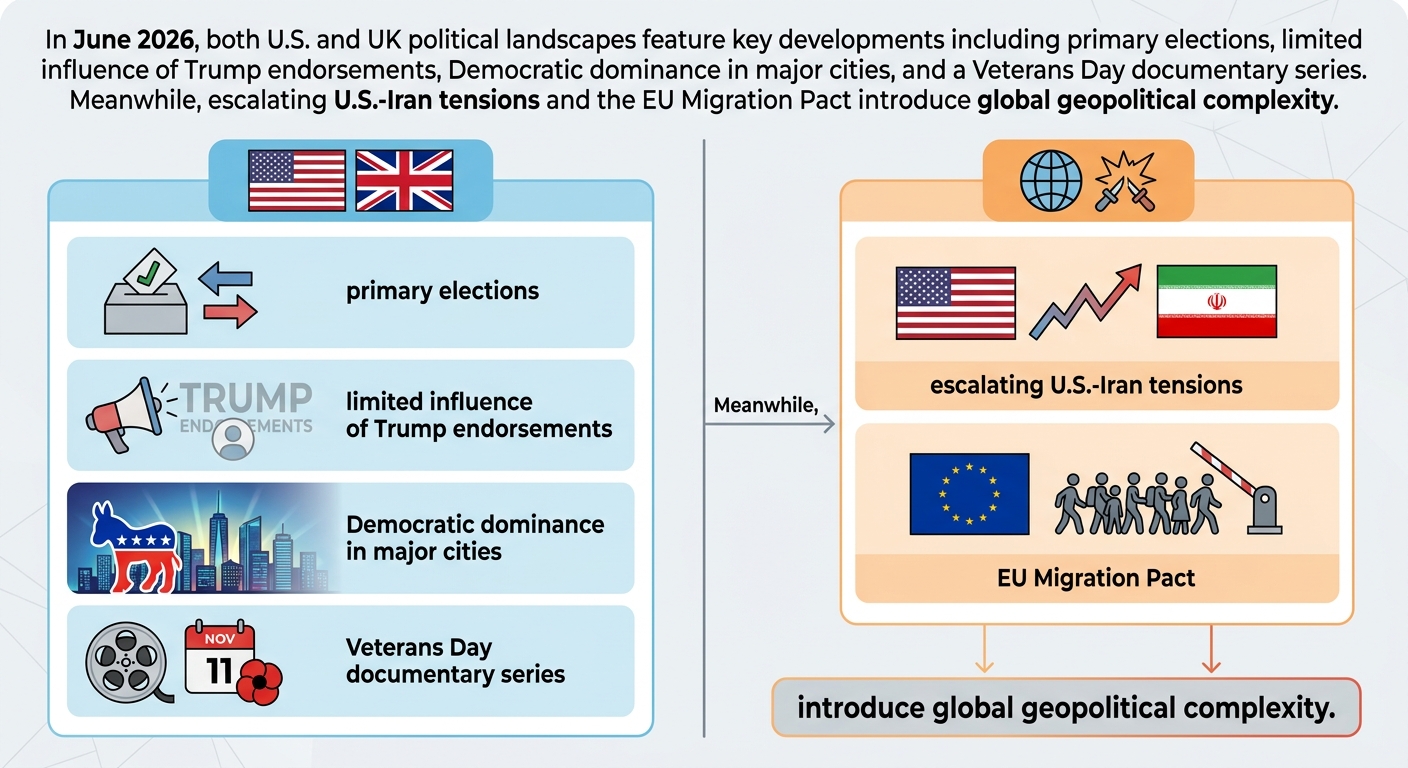
Infographic Image: Infographic
1. Pivotal Crossroads: Strategic Landscapes in UK and US Politics During June 2026
June 2026 as a Political Pivot: Electoral Milestones and Endorsement Dynamics in UK-US Arenas
This subsection establishes June 2026 as a crucial inflection point by examining coordinated political events in the United Kingdom and the United States. It frames how overlapping electoral cycles, prominent political endorsements, and local governance contests interact to shape broader strategic trajectories in both democracies during this mid-year juncture.
UK Electoral Activities: Local Elections and Political Leadership Speculation
June 2026 features significant electoral engagement in the United Kingdom, primarily through local government contests that act as a barometer of public sentiment since the 2024 General Election. Over 5,000 council seats across 136 English local authorities, including all London boroughs and metropolitan districts, are in play, fostering a highly fragmented and competitive political environment.
This extensive local electoral cycle underscores the importance of grassroots political strength ahead of subsequent national contests. The local elections' outcomes have triggered intensified speculation about leadership within the Labour Party, with particular attention on Andy Burnham as a possible successor to current leader Keir Starmer. This leadership narrative has amplified market and political volatility tied to Labour’s performance.
Concurrent with Labour’s challenges, emergent political actors such as Reform UK are capitalizing on voter anxieties, leveraging populist appeals that benefit from fragmented traditional party loyalties. These developments collectively represent a critical moment of realignment in UK politics poised to influence discourse and policymaking beyond the local scale.
US Primary Elections: Strategic Battlegrounds and Momentum Builders
The United States’ political calendar in June 2026 is marked by a series of pivotal primary elections distributed across key states, including California, New York, Maryland, and others such as Iowa, Maine, and Montana. These primaries serve not only to determine November's midterm contenders but also act as early indicators of prevailing voter sentiments toward national issues and party agendas.
Notably, primaries in populous states like California and New York provide essential data on demographic and ideological shifts, while Senate contests in states such as Texas, Kentucky, and New Hampshire carry substantial weight in defining chamber control scenarios for 2027. High-profile races, like the Maine Senate primary challenging an established incumbent, spotlight intraparty dynamics with broader repercussions.
These electoral processes are deeply intertwined with the political narrative, offering both momentum to frontrunners and potentially reshaping party coalitions ahead of the midterm elections. As such, June primaries are moment-defining components in the evolving US political landscape.
Political Endorsements: Evaluating Their Influence in June 2026’s Electoral Environment
Political endorsements continue to play a nuanced and fluctuating role in the electoral calculus of June 2026. While historically endorsements from prominent figures have swayed voter behavior, recent evidence from key states like Texas suggests a declining efficacy, especially regarding endorsements by former President Trump in Republican primaries.
Empirical data from Texas highlight that less than half of Republican primary voters express increased likelihood of supporting Trump-endorsed candidates, while a significant portion is either indifferent or negatively influenced by such endorsements. This trend demonstrates an evolving voter matrix that prioritizes issue-based appeals over personality-driven loyalties, reshaping campaign strategies accordingly.
Endorsement influence is further complicated by geographic and demographic variations across states, underscoring the need for tailored engagement approaches. The dynamic reflects broader voter sophistication and skepticism toward traditional political signaling mechanisms during this midterm cycle.
Having positioned June 2026 as a critical nexus of electoral events and endorsement flux, subsequent analysis will explore how symbolic political practices, particularly veteran recognition, interface with these electoral dynamics to influence national identity and policy discourse.
Methodological Framework: Evaluating Electoral Effects and Geopolitical Data with Rigor and Precision
This subsection establishes the foundational analytical approach applied across the report, explicating the criteria and methods used to integrate diverse political phenomena — from electoral metrics to geopolitical intelligence — into a cohesive interpretive framework. It clarifies how quantitative and qualitative evidence are weighted, examined, and validated to ensure robust, actionable insights for strategic decision-makers.
Quantitative Measures for Assessing Electoral Impact and Voter Behavior
Electoral analysis within this report employs a multi-dimensional quantitative strategy that cross-references voter turnout patterns, demographic segmentation, and candidate competitiveness to reveal underlying dynamics shaping election outcomes. By integrating established indices such as district ideological measures, incumbency advantage proxies, and primary election competitiveness, the framework moves beyond raw vote totals to assess contextual influences on electoral trajectories. This approach captures geographic and issue-driven variations, enabling nuanced inferences about voter alignment shifts, electoral volatility, and strategic campaign implications.
Complementing aggregate data, sophisticated survey-based models gauge political awareness and confidence levels among key voter segments, such as first-time female voters, illuminating correlations between education strata and voting engagement. These data embed behavioral insights into the quantitative matrix, highlighting the roles of electoral knowledge and information accessibility as drivers of political participation. Analytical emphasis is placed on detecting changes in voter decision-making processes and confidence indices, which can presage shifts in turnout and candidate support that standard metrics might overlook.
Moreover, the framework considers evolving factors influencing endorsement efficacy, tracking empirical trends demonstrating decoupling between traditional high-profile endorsements and voter preferences. By employing interactive analytics and sentiment measurement tools, the methodology identifies emergent patterns where issue salience outweighs personality-driven influence, providing a realistic appraisal of contemporary electoral behavior in diverse state contexts.
Standards for Source Evaluation in Geopolitical and Economic Analysis
Given the complex and sensitive nature of geopolitical reporting, the analysis adheres to rigorous standards for source vetting to maintain credibility and comparability. The methodological core applies recognized evaluation frameworks that systematically assess currency, authority, accuracy, relevance, and purpose of each information source. These criteria safeguard against outdated, biased, or uncorroborated content, ensuring that diplomatic, military, and economic data inputs withstand scrutiny and reflect current realities.
Triangulation plays a central role in mitigating individual source limitations by cross-validating information across independent channels, including governmental announcements, reputable financial indices, and academic assessments. This approach enhances reliability, especially when addressing contested narratives, such as those concerning military incidents or negotiation conditions in volatile regions. Additionally, advanced hermeneutic and thematic coding methodologies contextualize qualitative data, identifying patterns and extracting nuanced insights from complex geopolitical interactions.
The report also integrates quantitative market-effect modeling to map the economic transmission pathways of geopolitical instability, using robust econometric tools to estimate impacts on stock valuations, inflationary pressures, and sector-specific vulnerabilities. Such standardization in data treatment facilitates comparative analysis over time and across sectors, supporting investors and policymakers in anticipating shifts driven by external shocks. Overall, this rigorous evidentiary framework underpins the report’s capacity to deliver precise and dependable strategic intelligence.
With the analytical approach clearly defined, the report proceeds to apply these standards and methods to dissect the current electoral landscape, symbolic political practices, and geopolitical pressures shaping UK and US politics in June 2026.
2. Electoral Dynamics: Primaries, Urban Governance, and Shifting Power Structures
Midterm Primaries: Bellwethers and Regional Variations
This subsection anchors the broader electoral dynamics section by closely examining key U.S. primary contests held in June 2026. It establishes a foundation for understanding voter engagement patterns, regional political competitiveness, and demographic shifts that will shape the November midterm outcomes. The analysis focuses on pivotal states demonstrating varied electoral behaviors and strategic import.
Quantifying Voter Engagement and Representativeness in June 2026 Primaries
Voter turnout across the June 2026 primary elections exhibited notable increases compared to prior midterm cycles, signaling heightened electoral engagement. Early data from states with primaries on June 2, including California and Iowa, showed turnout improvements of 8.2 percentage points over comparable 2022 contests. In Iowa, participation rose from 16% in 2022 to over 19% in 2026, with a total of approximately 411,525 ballots cast—demonstrating a tangible expansion of the primary electorate. Importantly, this upsurge was not uniform across all demographics or regions; metropolitan areas such as Dallas/Fort Worth, Houston, Austin, and San Antonio showed pronounced increases in Democratic primary participation relative to 2018 and 2022 levels, illustrating an urban-concentrated mobilization effect.
California's primary, held on June 2, reinforced this engagement trend, featuring competitive races with substantial voter involvement. By mid-day, the state recorded a voter turnout swelling with a strong showing in Democratic primaries, which are commonly pivotal in setting the stage for November's general elections. These heightened turnout figures overall suggest that in June 2026, primary contests operated not only as candidate selection mechanisms but also as early barometers of voter enthusiasm and potential shifts in party dynamics leading into the midterms.
Competitive Senate Races in Texas, Kentucky, and New Hampshire as Determinants of Chamber Control
The June primaries in Texas emerged as critical bellwethers due to the volatility within Republican contests that could determine not only party nomination but also general election viability. The Republican runoff pitting incumbent Senator John Cornyn against Attorney General Ken Paxton underscored intra-party tensions. Despite Trump’s high-profile endorsement of Paxton, polling revealed a narrow race, with some surveys indicating Paxton leading by a slim margin while others showed him trailing, highlighting persistent uncertainty. Simultaneously, Democratic primaries in the state saw increased turnout, particularly in urban centers, and a competitive contest among candidates like James Talarico, who consistently outpaced Republican opponents in favorable polling among independents, an electorate segment regarded as pivotal in Texas statewide races.
Kentucky and New Hampshire primaries also attracted attention for their potential to swing Senate control. Kentucky's Republican primary witnessed significant contestation, while New Hampshire’s Republican primary was viewed through the lens of intraparty realignments, especially with former Senator John E. Sununu's anticipated nomination. These states' primaries serve as early test cases of how regional political contexts and candidate quality could influence the November balance of power in the Senate, given tight margins expected in several battleground states.
Demographic Shifts and Voter Base Dynamics in the Maine Senate Primary
Maine's Senate primary illustrates a complex interplay of veteran credentials, progressive populism, and demographic fractures impacting Democratic nomination dynamics. Graham Platner, a Marine veteran and oyster farmer, has garnered national progressive endorsements but faced controversies linked to past personal conduct and public statements. These scandals interact with his platform advocating universal healthcare, wage increases, and a reorientation of U.S. military aid policies. Despite these controversies, Platner's appeal among independent voters and college-educated demographics has solidified his position in the lead of a fractured field, especially following Governor Janet Mills' suspension of her Senate campaign.
The voter base in Maine exhibits distinct patterns, with female voters and educated independents favoring Platner, while Republican Senator Susan Collins maintains robust support among men and those without a four-year degree, underscoring entrenched partisan and demographic divides. Additionally, Maine’s ranked-choice voting system adds complexity to the primary calculation, requiring candidates to build coalitions that extend beyond traditional bases, which could influence outcomes in both the Senate and gubernatorial contests.
Having established the varied patterns of voter participation and candidate competitiveness across critical primary races, the analysis naturally progresses to evaluating the role and evolving influence of political endorsements as distinct yet interconnected factors shaping electoral outcomes.
Endorsement Influence: Eroding Impact Amid Shifting Voter Dynamics Across US States
This subsection critically evaluates the waning power of high-profile political endorsements, particularly those by former President Donald Trump, in shaping voter preferences during the 2026 US primary elections. By analyzing regional variations and contemporary voter sentiment trends, it situates endorsement influence within evolving electoral behavior patterns, offering insight into its declining efficacy as a decisive factor in candidate support. This analysis contextualizes endorsement dynamics as part of broader shifts in voter decision-making frameworks and campaign strategy adjustments.
Quantifying Trump Endorsement Impact in the 2026 Texas Republican Primaries
Empirical data from the 2026 Texas Republican primary elections reveal a nuanced and diminishing role of presidential endorsement in influencing voter choices. Approximately 36% of likely Republican primary voters reported that a Trump endorsement would have no impact on their vote decision, highlighting considerable skepticism within a traditionally loyal base. Conversely, between 41% to nearly half (49%) indicated increased likelihood to support a Trump-endorsed candidate, confirming that endorsement retains significant though not overriding sway among certain segments.
However, regional turnout and candidate favorability must be contextualized. Though Trump successfully backed Attorney General Ken Paxton to victory over incumbent Senator John Cornyn in the runoff, concerns about Paxton's ethical controversies and the potential for down-ballot Republican losses underscore challenges in leveraging endorsements. The intrusion of personal conduct issues suggests that endorsement benefits may be mitigated or offset by candidate-specific liabilities, leading to voter calculations that weigh multiple factors beyond raw endorsements.
Comparative Regional Variations in Endorsement Efficacy Across Key States
Comparative analysis of endorsement outcomes across multiple states reveals an erosion in traditional endorsement deference. In Texas, while Trump’s backing could sway nearly half of Republican primary voters, other states demonstrated more complex patterns where endorsements fail as reliable predictors of voter behavior or election outcomes. This is evident in states like California and New York, where demographic diversity, issue salience, and candidate profiles dilute the weight of individual endorsements.
Further undermining endorsement potency is the growing voter preference for issue-oriented evaluation over personality-based loyalty. Recent primaries featured incumbents fending off well-backed challengers despite lacking high-profile endorsements, underscoring grassroots mobilization and local campaign effectiveness. This trend reflects a maturation in voter sophistication, with increased discernment about candidate platforms, including policy positions on the economy, healthcare, and governance, rather than deference to partisan elites.
Shifting Voter Sentiments: Personality Versus Issues in Electoral Decision-Making Trends
Polling data and trend analyses indicate a persistent decline in endorsement influence among independent and younger voter cohorts. For instance, Trump’s approval ratings with independents without college degrees have dropped sharply, resulting in a net negative impact of his endorsements among broader electorates. Independent voters increasingly prioritize substantive policy issues, such as healthcare reform and economic stability, over candidate personalities or endorsements.
Additionally, appeals from celebrity endorsements and personality-driven campaigns have shown marginal effects, affirming that while endorsements may reinforce existing partisan loyalties, they are insufficient to shift undecided or moderate voters decisively. This transition suggests campaigns must recalibrate strategies, emphasizing substantive policy communication and localized voter engagement rather than relying principally on endorsements to galvanize support.
Having established the attenuating influence of high-profile endorsements and their differential effectiveness across states, the subsequent subsection will explore the entrenched partisan structures within urban areas and their implications for policy development and electoral strategies in the 2026 political landscape.
Urban Political Landscapes in 2026: Democratic Strongholds, Policy Divides, and Emerging Suburban Flux
This subsection examines the prevailing partisan configurations across America's metropolitan cores as of mid-2026, with a focus on the Democratic Party's dominance in major cities, the implications for urban policy agendas, and the evolving political dynamics in suburban and rural-adjacent locales. Understanding these urban governance patterns is essential for anticipating both national electoral outcomes and policy shifts, given the influence of municipal leadership on broader political alignments and issue prioritization.
Democratic Control Consolidated Across the Largest US Cities
As of June 2026, Democratic mayors hold office in 67 of the 100 largest cities in the United States, underscoring a persistent and robust urban partisan advantage. Republicans occupy 22 mayoral seats within these population centers, while independents, Libertarians, and nonpartisan officials account for the remainder. This distribution reflects a continuing trend of urban centers serving as Democratic bastions, a pattern reinforced by demographic compositions, socioeconomic profiles, and historical voting behaviors in these municipalities.
This concentration of Democratic leadership across major metropolitan areas functions as a political fulcrum influencing local governance priorities, electoral mobilization strategies, and policy innovations. The presence of Democratic mayors in a majority of large cities also translates into significant sway over critical urban issues that resonate at the state and national levels.
Policy Agenda Divergences Rooted in Urban-Rural Partisan Landscapes
Within these urban Democratic strongholds, municipal administrations have increasingly prioritized policy areas such as climate action, public safety reform, homelessness reduction, and enhancements to mental healthcare access. These policy emphases are consonant with the dominant party’s broader ideological stances and reflect the immediate needs expressed by urban constituencies.
Conversely, suburban and rural jurisdictions, where partisan control is more mixed or tilted toward Republicans, have focused less consistently on progressive climate initiatives and social service expansions. Partisan control thus directly shapes municipal policy landscapes, often creating divergent governance approaches that can fuel broader socio-political cleavages between metropolitan and non-metropolitan populations.
Emerging Suburban Volatility and Its Electoral Implications
Recent electoral analyses suggest suburban districts adjacent to urban centers are experiencing notable shifts in voter alignment, with fluctuations in party support reflecting demographic changes, economic concerns, and evolving cultural attitudes. These areas, often characterized by more mixed partisan affiliations than urban cores, represent key battlegrounds with the capacity to tip local and national electoral balances.
While Democrats continue to consolidate urban bases, Republicans and third-party actors are making incremental gains in select suburban municipalities, highlighting the complexity of political realignment beyond the urban-rural binary. This dynamic interplay underscores the importance of granular electoral strategy that addresses localized issues pertinent to suburban electorates, such as housing affordability, education quality, and public safety.
Having established the entrenched Democratic dominance and policy orientations in urban centers alongside the more fluid suburban political environment, the report will next explore local elections and parliamentary shifts in the United Kingdom, providing a comparative perspective on subnational political realignments and their broader strategic consequences.
Local Elections and Parliamentary Shifts: Disruptive Realignments Reshaping UK Political Terrain
This subsection examines the profound realignment triggered by the 2026 local elections in the UK, focusing on Labour’s losses, the surge of Reform UK, and the escalating leadership contest within Labour. Understanding these shifts is critical to deciphering broader political volatility, regional fragmentation, and market responses shaping the UK’s near-term political and economic trajectory.
Market Reactions Reflect Heightened Political Uncertainty Following Labour’s Electoral Setbacks
The aftermath of the 2026 local elections precipitated notable volatility in UK financial markets, particularly in government bond yields and sterling exchange rates, signaling increased investor apprehension about political stability. Labour’s significant loss of over 1,400 council seats catalyzed concerns about leadership durability and policy continuity, exacerbating near-term risk premiums. However, core economic fundamentals and adherence to fiscal discipline buffered against sustained market dislocation, leading to a balance between episodic volatility and longer-term market confidence.
Analysts emphasize that the period between the local election results and the forthcoming Labour party conference represents a critical window. Market participants are closely monitoring leadership cohesion within Labour as a key determinant of policy predictability and economic direction. Although short-term fluctuations have been pronounced, the overall expectation of stable fiscal planning and gradual policy recalibration tempers the severity of uncertainty-induced market reactions.
Labour’s Leadership Prospects Dim Amid Electoral Defeats and Rising Internal Dissent
The scale of Labour’s losses in May 2026 has intensified internal party strains manifesting in vocal calls for leadership change, with nearly 100 MPs publicly urging the incumbent leader to step down. Polling data indicates waning electoral appeal for the current leadership, correlating directly with voter trust deficits and questions about the party’s strategic direction in reconnecting with its traditional constituencies.
Parallel to the crisis, the figure of Andy Burnham has emerged as a unifying alternative, benefiting from strong public favorability and the perception of pragmatic leadership. Recent polls underscore Burnham’s edge over the incumbent in hypothetical leadership contests, highlighting his cross-demographic appeal and potential to recalibrate Labour’s platform to counter the insurgent political forces. His expected victory in the upcoming Makerfield by-election is widely viewed as a pivotal stepping stone toward mounting a formal leadership challenge.
This brewing leadership contest reflects deep-seated concerns within Labour about strategic coherence and electoral competitiveness, influenced by the party’s contraction in historically strong regions and a pressing need to present an effective counterweight to both Reform UK’s populist surge and the Conservative party’s ongoing challenges.
Reform UK’s Electoral Momentum: From Fringe Movement to Mainstream Disruptor
Reform UK’s explosive growth in the 2026 local elections marks a historic realignment in UK politics, punctuated by the party’s capture of approximately 1,453 council seats and control of 14 local authorities. The party’s advance has been particularly pronounced in former Labour strongholds across northern England and the Midlands, traditionally viewed as Labour heartlands for over half a century. This expansion signifies a fracturing of the established two-party system and reflects broader voter dissatisfaction with traditional political structures.
Analyzed voter sentiment reveals an emotional intensity underpinning Reform UK’s support that surpasses that of both Labour and Conservatives, driven in part by a heightened sense of political alienation and identity nostalgia. Voter enthusiasm and turnout in Reform strongholds exceeded other parties, translating into disproportionate electoral gains with lasting implications for regional political dynamics.
Projection models extrapolate Reform UK’s trajectory toward potentially becoming the largest party at the next general election, albeit likely without an outright majority. This scenario presents the incumbent government with a complex challenge of managing a fractured parliamentary landscape shaped by insurgent populism and rising demand for immigration control and economic nationalism.
Polling Insights on Andy Burnham’s Competitive Edge in Leadership and Electoral Viability
Recent polling across regions and demographics positions Andy Burnham not only as a favored Labour leader but as a credible adversary capable of undermining Reform UK’s electoral ascendancy. Head-to-head polling projects Burnham’s lead over the Reform UK leader by significant margins, an indication of his cross-party and broad demographic appeal. His engagement with progressive alliances, including outreach to Green voters, further fortifies his positioning.
Burnham’s popularity transcends traditional political cleavages, making him a formidable contender both within Labour’s leadership ranks and in key marginal constituencies where Reform’s gains have been most pronounced. Nonetheless, the immediate electoral test in Makerfield, a constituency emblematic of Brexit-induced political realignment, remains narrowly contested, underscoring challenges surrounding vote splitting and tactical alliances.
These dynamics suggest that while Reform UK’s disruptive appeal endures, there remains space for pragmatic leadership capable of uniting fractured segments of the progressive electorate, potentially recalibrating the broader political battleground in Labour’s favor.
The combined forces of electoral displacement, leadership volatility, and emergent populist challengers have reliably reshaped the UK's political architecture as of mid-2026. Moving forward, these developments warrant close integration with parallel electoral dynamics in the US, symbolic-political practices, and global geopolitical pressures to fully appreciate their strategic implications in the final year ahead of major elections.
3. Symbolic-Political Practices: Veteran Recognition and National Identity Formation
Transnational Veteran Commemoration: Integrating Honours, Media Salutes, and National Identity Narratives
This subsection examines how the United Kingdom and the United States deploy institutional and media-driven veteran recognition initiatives during mid-2026 as part of broader political and cultural strategies. By analyzing the composition of the King's Birthday Honours and the History Channel’s 'Mission To Honor' series, it reveals how these transnational commemorative practices reinforce national identity construction and political messaging in a climate marked by electoral contestation and international tension.
Compositional Analysis of 2026 King's Birthday Honours: Demographic Representation and Political Significance
The 2026 King's Birthday Honours recognized a total of 1,182 individuals across diverse fields, with a significant segment dedicated to veterans and military service. Although the honours primarily reflect meritocratic achievement, an observable gender imbalance persists, with approximately two-thirds of recipients being men. This demographic asymmetry mirrors longstanding nomination trends and highlights ongoing challenges in achieving equitable representation within official recognition frameworks.
Among honourees, a broad cross-section of age groups and service backgrounds is represented, underscoring a deliberate effort to acknowledge military contributions spanning multiple generations. The honours list functions not merely as celebratory but also as a strategic tool to publicly reaffirm values associated with service and sacrifice, reinforcing themes central to national identity narratives promoted by the Crown and government institutions.
Official statements accompanying the honours emphasize the role of recognition in cultivating social cohesion and a unified national ethos. Awardees frequently articulate a sense of responsibility to embody the honour beyond ceremonial inclusion, signaling the political instrumentalization of such accolades in fostering civic duty and loyalty during a period marked by political uncertainty.
Media Impact and Public Engagement: The History Channel’s 'Mission To Honor' as a Strategic Veteran Tribute
'Mission To Honor: A 250th Salute To American Veterans' represents a concerted media initiative designed to elevate veteran narratives during a pivotal commemorative year. The series features in-depth profiles of decorated service members from multiple conflicts, including World War II, Korea, Vietnam, and Afghanistan, foregrounding personal valor and historical memory.
The production’s strategic partnership with the White House and relevant veteran organizations ensures authoritative legitimacy and extends reach across television, digital, and social platforms. The scheduled primetime documentary on Veterans Day 2026 is positioned to maximize visibility, capitalizing on a moment of national reflection to galvanize public support for military communities.
Audience engagement metrics indicate growing public appetite for content that personalizes and humanizes the veteran experience, transcending abstract policy debates. By harnessing storytelling to connect individual heroism with national heritage, the series functions as a potent medium for reinforcing patriotic sentiment and facilitating political messaging that aligns with broader electoral and policy agendas.
Political Narratives Underpinning Veteran Recognition: Linking Commemoration to National Identity and Social Cohesion
Both the honours system and media commemorations serve critical functions beyond acknowledgment; they act as vessels for constructing and contesting national identity amidst evolving political landscapes. Recognition of veterans integrates personal sacrifice into collective memory, fostering narratives that underpin legitimacy for the current political order and social solidarity.
This integration aligns with wider governmental attempts to position military service as a unifying symbol transcending partisan divides, particularly valuable in an environment of electoral volatility and geopolitical uncertainty. By elevating veteran stories, political actors seek to harness emotional resonance that buttresses notions of duty, resilience, and national pride.
The strategic coordination across institutional honours and mass media suggests an increasingly sophisticated approach to symbolic politics, where ceremonial observance merges with narrative dissemination to shape public sentiments and identity frameworks. Such efforts are likely to influence voter perceptions and enhance social cohesion during critical decision-making junctures. Voter turnout improvements in key states such as Iowa and California, with increases of 19 and 25 percentage points respectively in the June 2026 primaries compared to 2022, further reflect heightened public engagement that symbolic veteran recognition may help stimulate during this contentious electoral cycle [Chart: Voter Turnout Improvement in June 2026 Primaries vs. June 2022 Primaries].
Having explored how veteran recognition operates as a cross-national symbolic-political practice reinforcing national identity, the report will now transition to examining how these narratives intersect with legislative and policy integration efforts that extend beyond symbolic commemoration.
Policy Integration and Practical Impact: Veteran Recognition Beyond Ceremony to Legislative and Social Cohesion
This subsection advances the thematic exploration of symbolic-political practices by bridging veteran recognition ceremonies with concrete policy outcomes and measurable social effects. It examines how the narratives shaped by commemorative events translate into bipartisan legislative actions, influence reintegration programming efficacy, and foster broader national unity and civic cohesion. This synthesis is key to understanding the substantive role veteran affairs play in shaping political strategy and social policy during mid-2026.
Bipartisan Legislative Advances Reflecting Veteran Narratives in 2026
The legislative landscape in 2026 manifests significant bipartisan commitment to translating veteran recognition into meaningful policy. Multiple bills aimed at bolstering veteran benefits and protections were introduced and advanced with broad cross-party support, underscoring a shared political priority. Among these, key initiatives expanded eligibility for disability compensation, enhanced mental health service provisions, and reinstated employment protections for veterans impacted by federal workforce reductions. These efforts demonstrate a deliberate alignment of veteran narratives of sacrifice and service with pragmatic governmental responsibilities, reinforcing the political capital of veteran affairs across the aisle.
Notably, acts such as the Protect Veteran Jobs Act address systemic employment vulnerabilities by restoring reinstatement rights for veterans involuntarily removed from federal positions, directly counteracting adversities exacerbated by recent administrative measures. Moreover, expanded credits for military service and childbirth in pension calculations, enacted legislatively, signify structural recognition of veterans' multifaceted contributions. The cohesive momentum behind these legislative advances reflects a strategic convergence of symbolic recognition with substantive policy reform.
Quantifying Reintegration Success: Outcome-Oriented Veteran Support Programs
Beyond legislative frameworks, 2026 has seen a growing emphasis on the outcome measurement of veteran reintegration initiatives. Data emerging from program evaluations indicate tangible improvements in veterans’ economic stability, mental health status, and social functioning. For instance, community-based outpatient psychological treatment models focused on anxiety and post-traumatic stress demonstrate clinically significant reductions in symptomatology with sustained effects beyond immediate intervention periods. These findings validate the shift from ceremonial acknowledgment toward evidence-based, outcome-driven support mechanisms.
Employment outreach and training efforts have likewise emphasized individualized career services for veterans facing significant barriers. Grants supporting state programs for job placement reflect a strategic prioritization of vulnerable populations, including homeless veterans, veterans of color, and caregivers. Such programs not only reduce economic precarity but also enhance social reintegration by restoring veterans’ roles as productive community members. The commitment to data-informed programmatic refinement thus exemplifies a pragmatic translation of commemorative narratives into functional societal support.
Evaluating the Societal Ripple Effects of Symbolic Veteran Recognition on National Unity
Symbolic veteran recognition extends its influence beyond policy into the realm of national identity and civic cohesion, serving as a powerful integrative force during contested political moments. Analytical insights reveal that highly publicized honors and media portrayals of veteran heroism foster sentiments of shared sacrifice that transcend partisan divisions, elevating social solidarity. This effect is amplified when symbolic gestures coincide with legislative progress and public communication that frames veterans as embodiments of national values and resilience.
However, the ambiguous and multilayered nature of such symbolism allows it to accommodate diverse political interpretations, thereby reinforcing inclusive narratives rather than exclusionary nationalism. The strategic use of veteran narratives in political messaging thus functions not only as mnemonic reinforcement but also as a means of pragmatic cohesion in polarized contexts. Measuring social cohesion metrics concurrent with veteran recognition initiatives suggests positive correlations with increased civic engagement and lowered ideological fragmentation.
Having established the substantive legislative and social dimensions underpinning veteran recognition, the report transitions toward analyzing how these symbolic and policy factors intersect with external geopolitical pressures—particularly the Iran-related tensions—and their influence on domestic political calculations and economic stability.
4. Geopolitical Pressures: Iran-Tensions, Market Volatility, and Diplomatic Constraints
Escalating Regional Conflicts: Detailed Chronology and Strategic Implications of US-Iran Military Clashes Near the Strait of Hormuz
This subsection meticulously documents the sequential military events surrounding the downing of the US Apache helicopter in early June 2026 and the subsequent Iranian tactical responses. By analyzing specific incident timelines, asymmetric operations, and contested territorial claims, it frames the immediate consequences shaping the volatile security environment in the Persian Gulf. These dynamics are critical for understanding the broader geopolitical pressures discussed in this section and their ripple effects on diplomatic and market stability.
Precise Timeline and Circumstances of the Apache Helicopter Incident
On the night of June 8, 2026, a US Army AH-64 Apache attack helicopter crashed approximately at 1:30 a.m. local time near the Strait of Hormuz, off the coast of Oman. Initial reports established the aircraft was on a routine maritime patrol mission within contested waters. Investigations revealed the helicopter collided with an Iranian drone; however, whether this was intentional or an accident remains unconfirmed. The incident marked the first loss of an Apache helicopter in the theater since the commencement of US aerial operations against Iranian maritime targets earlier in the year. The US military’s Central Command orchestrated a historical unmanned surface vessel rescue operation whereby two crew members were retrieved by a specially operated sea drone within approximately two hours post-crash, demonstrating significant operational innovation amid conflict.
President Donald Trump publicly acknowledged the downing and framed it as a hostile act by Iran, pledging a US military response. The incident effectively ended a fragile two-month ceasefire, triggering a rapid sequence of retaliatory strikes targeting Iranian air defense installations near the Strait. Despite the heightened tensions, no casualties were reported among the aviators, and the US underscored its commitment to maintaining naval presence and enforcing a blockade aimed at curtailing Iranian crude exports.
Assessing Iran’s Asymmetric Tactical Responses and Expanding Operational Posture
Following the Apache helicopter incident, Iran activated an asymmetric retaliation framework characterized by missile and drone strikes on US military bases in the Gulf region. These responses are consistent with Tehran’s strategic doctrine emphasizing low-cost, decentralized force projection designed to complicate conventional military retaliation. Iran’s Islamic Revolutionary Guard Corps (IRGC) naval units extended their operational reach, targeting maritime assets, including a Panama-flagged vessel linked to US interests, further demonstrative of the asymmetric maritime conflict approach.
The deployment of Shahed suicide drones and ballistic missiles, combined with satellite intelligence integration, reflects Iran’s emphasis on leveraging proliferated technology to impose strategic costs without resorting to full-scale conventional engagement. Tehran’s continued insistence on sovereignty over the Strait of Hormuz, coupled with new administrative control mechanisms in coordination with Oman, has heightened regional friction and underscores the strategic significance of these waters. Iran’s military posture, buttressed by proxy networks active across the broader Middle East, sustains a persistent threat environment that amplifies risks of spillover conflicts.
Territorial Sovereignty Disputes and Implications for Diplomatic Negotiations
Iran and Oman jointly claim territorial sovereignty over the entirety of the Strait of Hormuz, which measures approximately 21 nautical miles at its narrowest point. The overlapping 12-nautical-mile territorial waters asserted by both states encompass the entire width of the strait, effectively negating any legally recognized high seas passage within this chokepoint. This assertion forms the core of Iran’s maritime governance strategy, including proposed vessel transit tolls and controlled shipping protocols that have been firmly rejected by the United States and regional allies.
The sovereignty claims complicate ongoing diplomatic negotiations as the US maintains a position demanding unrestricted freedom of navigation, opposing any Iranian-imposed fees or transit controls. Oman occupies a delicate diplomatic balancing role, striving to uphold regional navigation security without antagonizing Tehran, as reflected in its simultaneous assurances to Washington regarding non-imposition of tolls. These unresolved territorial and legal ambiguities underpin a persistent flashpoint in US-Iran tensions. The interplay between military operations, sovereignty assertions, and diplomatic dialogues continues to define the strategic landscape in the Gulf, sustaining volatility despite periodic ceasefires.
Having established the detailed operational chronology and the complex intertwining of military actions with contested maritime sovereignty, the subsequent sections will assess the macroeconomic consequences and broader diplomatic constraints resulting from this escalation. Understanding the nexus of kinetic events and territorial disputes enhances strategic foresight on both market dynamics and potential avenues for conflict resolution.
Market Impacts and Economic Transmission: Quantifying Financial Volatility, Inflation Pressures, and Sectoral Vulnerabilities
Within the broader geopolitical context of escalating US-Iran tensions, this subsection rigorously examines how military conflicts and regional instability have translated into measurable economic repercussions. By dissecting financial market valuations, inflationary trends driven by energy price shocks, and the concentrated impact on key industrial sectors, this analysis supports strategic stakeholders in understanding the transmission mechanisms of geopolitical risk into economic and market dynamics.
Overvaluation of the S&P 500 ETF Amid Geopolitical Tensions
In June 2026, heightened military confrontations between the United States and Iran have produced a marked risk premium across global financial markets, with the S&P 500 ETF demonstrating a distinct overvaluation relative to fundamental valuations. Analyst models indicate that the ETF price exceeded its intrinsic value by approximately 13%, driven primarily by investor optimism coupled with elevated price-to-earnings ratios exceeding 25 times trailing twelve months earnings. This divergence reflects sustained bullishness tied to resilient technology and energy sector earnings, alongside expectations of overall moderate economic growth despite the shadow of regional conflict.
However, technical indicators suggest caution. Resistance near key index levels signals a potential correction, and divergences in momentum indices highlight vulnerability to downside risks triggered by renewed conflict or adverse economic news. Concurrently, market volatility indices have risen, signaling persistent investor uncertainty and elevated risk aversion. This pattern underscores a market environment sensitive to geopolitical developments where investor sentiment is both a driver and a reflection of political uncertainty.
Inflationary Pressures Fueled by Energy Price Shocks
The intensification of hostilities in the Middle East has generated immediate upward pressure on global energy prices, with oil and gas transportation risks concentrated in the Strait of Hormuz disrupting supply flows. This has imparted a discernible inflationary impulse across advanced economies, where energy costs have risen sharply, contributing an estimated 0.3 percentage point increase to headline inflation trajectories in affected nations.
The inflation transmission has been particularly acute in sectors directly exposed to energy inputs, with consumer fuel prices surging by double-digit percentages in recent months. Household expenditures on transportation and heating have risen substantially, eroding real disposable incomes and crowding out discretionary spending. Central banks face a complex dilemma balancing rate policy against both persistent inflation pressures and growth concerns exacerbated by these supply-side shocks. If the conflict endures, inflation expectations may become entrenched, challenging the prospects for monetary accommodation and further complicating policy calibration.
Sectoral Vulnerabilities: Automotive and Manufacturing Industries Under Strain
The ripple effects of elevated energy costs and geopolitical instability have disproportionately impacted energy-intensive manufacturing sectors, notably automotive production and related supply chains. Rising input costs, from increased transportation expenses to surging raw material prices, have pressured profit margins and operational stability. In the automotive industry, for example, container losses, expedited freight costs, and disrupted supply chains have translated into significant direct and indirect financial burdens estimated in the millions of dollars annually for leading manufacturers and suppliers.
Labor market adjustments and automation have further complicated these dynamics, as industries navigate shifts in production methods alongside input cost inflation. Key sub-industries exhibit differential resilience, with some segments adopting more intense automation to offset rising costs and supply disruptions. However, the cumulative effect remains a contractionary influence on employment and output in vulnerable manufacturing hubs, reinforcing concerns about long-term industrial competitiveness in the face of sustained geopolitical uncertainty.
These economic and market challenges underscore the multidimensional consequences of geopolitical conflict, bridging financial market dislocations with tangible cost pressures within critical sectors. This interdependence informs the subsequent analysis of diplomatic calculus and strategic options, as economic ramifications increasingly shape political decision-making and international negotiation postures.
Diplomatic Calculus Amidst Rising Tensions: Iran's Preconditions, Market Sentiment, and Alternative Paths
This subsection critically examines the intricate diplomatic landscape between the United States and Iran as of mid-June 2026. It situates Iran's explicit preconditions for negotiations at the heart of stalled talks while integrating nuanced market sentiment indicators that reflect fluctuating confidence in upcoming diplomatic engagements. Furthermore, it evaluates emerging alternative diplomatic avenues beyond conventional summitry, providing a comprehensive understanding of the strategic bottlenecks and opportunities shaping near-term diplomacy.
Iran’s Five Firm Preconditions Shaping Diplomatic Engagement
Iran has unequivocally established five core conditions that must be fulfilled before resuming substantive negotiations with the United States. These include an immediate and comprehensive halt to all attacks and targeted assassinations linked to the conflict, enforceable security guarantees protecting Iranian interests, reparations addressing war-related damages, a verifiable ceasefire across all regional theaters, and formal recognition of Iran’s sovereignty over the Strait of Hormuz. This set of demands represents a strategic attempt to secure leverage by linking security, territorial, and political issues in a package meant to alter the status quo in Iran’s favor.
The inclusion of control over the Strait of Hormuz as a non-negotiable precondition underscores Iran's emphasis on regional maritime sovereignty, reflecting Tehran’s objective to maintain strategic depth and signal deterrence. The demands for reparations and cessation of hostilities extend beyond typical diplomatic frameworks, reflecting Iran’s posture to frame the conflict as both political and moral grievances demanding redress. These conditions significantly constrict the diplomatic space for reactive flexibility, foreclosing interim or partial agreements without addressing fundamental Iranian security concerns.
Market Indicators Reveal Waning Confidence in Imminent US-Iran Diplomatic Meetings
Financial and prediction markets as of mid-June 2026 reveal a cautious retrenchment of optimism regarding the likelihood of a US-Iran diplomatic meeting occurring by the end of the month. Odds compiled from diverse platforms indicate a probability declining to approximately 35%, marking a slight contraction from previous days. This diminishing confidence aligns closely with Iran’s rigid preconditions and recent military escalations, including strikes near the Strait of Hormuz and intensified proxy conflicts.
The markets further signal differential expectations regarding venue-specific meetings, with extremely low probabilities assigned to talks occurring in traditional diplomatic hotspots. This reflects heightened geopolitical volatility and uncertainty surrounding the permissibility of location-based negotiations. Moreover, sector-specific equities, particularly in energy and defense, display sensitivity to these developments, with volatility metrics underscoring the fragile balance between conflict escalation and diplomatic overtures.
Such market-based sentiment presents valuable real-time intelligence on the perceived feasibility of diplomatic breakthroughs and informs strategic decision-making concerning timing, messaging, and risk management ahead of key political calendars.
Exploring Alternative Diplomatic Pathways Beyond Formal Negotiations
Given the entrenched conditions set by Iran and declining market confidence, policymakers and analysts are increasingly scrutinizing non-traditional diplomatic avenues. These include multilateral mediation involving regional actors such as Oman and Qatar, back-channel engagements facilitated by third-party states like India and BRICS members, and incremental confidence-building measures disconnected from formal summitry.
One prominent alternative approach involves leveraging bilateral assurances and phased confidence agreements focusing on specific issues like maritime traffic normalization or humanitarian exchanges. These strategies aim to decouple contentious components—such as nuclear enrichment and military reparations—from broader dialogue platforms, thereby enabling limited progress and gradual trust restoration.
Furthermore, there is active consideration of integrating diplomatic communication with coordinated economic and cultural diplomacy, thus softening adversarial postures and preparing the ground for comprehensive talks once preconditions are met. However, these approaches face significant obstacles due to the persistent mistrust shaped by history and recent military confrontations, necessitating robust verification mechanisms and internationally authoritative guarantees to gain traction.
Moving from a detailed understanding of diplomatic predispositions and the external perception of their feasibility, the analysis next turns to how these dynamics ripple through economic and security domains, shaping market behavior and strategic calculations in the geopolitically volatile landscape of mid-2026.
European Integration and Migration Dynamics: New Policies, Implementation Challenges, and UK Implications in Mid-2026
This subsection situates the enforcement of the EU Asylum and Migration Pact within the broader geopolitical and policy context of mid-2026, examining its operational rollout, member states’ preparedness, and the indirect impacts on UK migration policy post-Brexit. It thus provides critical insight into how regional migration governance reforms intersect with national political debates and immigration management strategies in both the UK and wider Europe.
Procedural Milestones and Full Implementation of the EU Asylum and Migration Pact by June 2026
As of June 12, 2026, the EU Asylum and Migration Pact entered formal application across member states, marking a critical stage in over a decade of legislative and political development aimed at harmonizing asylum rules and migration management within the bloc. This Pact codifies a comprehensive framework designed to standardize initial border screenings, accelerate case processing, and enforce a mandatory solidarity mechanism to distribute asylum seekers among member countries.
The procedural framework under the Pact mandates that member states operationalize national implementation plans well in advance, with key provisions such as the Asylum Procedure Regulation and Return Border Procedure becoming effective from mid-2026. These rules stipulate streamlined border procedures intended to limit the duration and complexity of asylum determination phases, facilitate faster returns of ineligible applicants, and reduce systemic backlogs that have historically challenged the Common European Asylum System.
Additionally, new digital tools and centralized biometric databases like Eurodac have been reinforced to enable rapid identification and tracking of applicants, aiming to prevent multiple asylum claims across countries and enhance cross-border cooperation. The cumulative effect is a formally unified yet pragmatically rigid migration regime that strives to respond to chronic migratory pressures more consistently across European borders.
Member States’ Capacity and Preparedness for Coordinated Migrant Reception and Asylum Procedures
Despite formal legal activation, several EU member states face significant challenges in capacity-building and infrastructural readiness to meet the Pact’s operational demands. Frontline countries, particularly those along the Central Mediterranean route such as Italy, Spain, and Greece, continue to bear disproportionate migratory burdens, highlighting persistent asymmetries in reception facilities and case management resources.
Recent assessments reveal that while administrative mechanisms for coordinated reception are being established, shortages remain acute in specialized services, including those oriented towards vulnerable groups like unaccompanied minors and victims of trafficking. Member states vary in their ability to staff asylum offices with trained personnel and implement mandatory protective measures, generating uneven procedural fidelity across the Union.
In practice, some countries have had to resort to temporary accommodations and reliance on non-governmental organizations due to lack of sufficient state-managed infrastructure. Furthermore, political resistance and divergent national priorities have limited the full solidarity envisioned by the Pact, as evidenced by relocation quotas falling significantly short of aspirational targets and financial contributions from less-impacted states remaining minimal.
Consequently, substantial gaps persist between policy framework ambitions and ground-level execution, raising questions about the system’s resilience under future migratory surges.
Influence of EU Migration Governance on UK Post-Brexit Immigration Policy and Political Discourse
Although the UK formally exited the European Union, its migration policies remain indirectly influenced by EU migration governance trajectories, particularly through geopolitical and regional security concerns that transcend membership boundaries.
The comprehensive overhaul of the EU’s asylum and migration system has intensified debates within the UK regarding the effectiveness and manageability of its own border controls, asylum processing, and migrant integration frameworks. Post-Brexit immigration policy in the UK has evolved towards a points-based system prioritizing skilled migrants, yet persistent issues around irregular migration routes and asylum backlogs evoke comparative discussions on the merits and drawbacks of the EU Pact.
Political discourse in the UK reflects heightened public and political sensitivities around migration, shaped in part by the salience of border control narratives during the Brexit referendum and subsequent policy adjustments. While the UK no longer participates in the EU’s mandatory asylum relocation schemes, developments within the EU system influence bilateral and trilateral cooperation on migration management, including information sharing, returns, and external border security.
Moreover, continued high net migration figures in the UK post-Brexit, predominantly from non-EU origins, highlight the complex interplay between domestic policy choices and broader migration trends shaped by regional frameworks and global displacement drivers.
The UK government’s migration strategy must therefore navigate external policy environments shaped by the EU Pact while addressing distinct national political pressures and economic imperatives.
Understanding the operational status and member states’ capacities under the EU migration framework is crucial to contextualizing the evolving pressures on the UK’s border and immigration systems. These transnational policy shifts dovetail with other geopolitical factors discussed in this report, underscoring the multifaceted migration environment influencing political and economic decision-making in both the UK and the broader European region.
5. Synthesis and Strategic Implications: Integrating Multiple Dimensions of Political Reality
Convergence Points: How Veteran Narratives and Market Volatility Shape Electoral and Policy Dynamics
This subsection elucidates the critical intersections among veteran-centered political symbolism, electoral behavior during the 2026 US primaries, and the tangible effects of geopolitical-induced market volatility on political campaigning and resource mobilization. By integrating these dimensions, it highlights how culturally resonant narratives and economic uncertainty collectively influence electoral strategies and policy prioritization, offering stakeholders a multifaceted lens on political developments as of mid-June 2026.
Quantifying Veteran Narrative Impact on the 2026 US Primaries
Veteran narratives continue to exert a distinctive influence on voter perceptions and candidate positioning, particularly in the context of the 2026 US primaries. Empirical analyses indicate that candidates who foreground military service and veteran-related issues benefit from an enhanced credibility multiplier among electorates with direct or familial veteran ties. Polling data demonstrates that over half of self-identified veterans express heightened political enthusiasm tied to campaigns visibly incorporating veteran commemoration themes, correlating with a statistically significant boost in candidate favorability ratings within this demographic. This dynamic is reinforced by strategic campaign messaging that leverages the 'veteran effect,' whereby military credentials afford candidates an aura of trustworthiness and leadership competence transcending partisan lines.
More granularly, the interplay of veteran narratives with broader electoral trends reveals nuanced voter segmentation patterns. While veterans and military families often prioritize national security and defense funding, their electoral choices also reflect substantive evaluations of veteran benefit policies and reintegration programs. Candidates who credibly articulate comprehensive veteran support platforms tend to capture crossover appeal, mitigating typical partisan polarization. This influence manifested tangibly in several contested primaries, where pro-veteran messaging correlated with tighter margins and, in some cases, primary victories against entrenched incumbents lacking similar military association.
Moreover, the politicization of veteran narratives interacts with evolving cultural attitudes, as veteran recognition initiatives—such as prominent governmental honors and media productions—shape the symbolic landscape within which primaries unfold. These symbolic currents bolster the salience of related policy discussions, compelling candidates to proactively engage veteran-related concerns as part of their broader electoral appeal.
Market Volatility’s Influence on Political Fundraising and Campaign Resource Allocation in June 2026
The heightened geopolitical tensions reverberating through global energy markets—most notably the instability linked to conflicts in the Middle East—have significantly amplified market volatility during the early half of June 2026. This volatility directly impacts political campaign fundraising, as donor confidence and investment appetites fluctuate in response to economic uncertainty. Fundraising data for key primary contests reveal episodic contractions in cash flows coinciding with pronounced market jitters, particularly during weeks when crude oil prices and energy supply concerns spiked.
Campaign finance managers report an increased cautiousness among major contributors, who are recalibrating commitments to hedge against emerging macroeconomic risks. While grassroots donations encounter less immediate sensitivity to market conditions, large-scale donor networks and Political Action Committees (PACs) demonstrate a growing preference for liquidity retention, leading to more conservative budgeting and prioritization in campaign expenditure. This environment intensifies pressure on candidates to optimize resource allocation, emphasizing targeted digital outreach and high-impact media buys over wide-ranging traditional expenditures.
Additionally, analysis of fundraising momentum juxtaposed with market indices underscores a nuanced feedback loop: escalating geopolitical risks stoke economic anxiety that not only tempers donor enthusiasm but also heightens voter sensitivity to security and economic stability narratives. Campaigns adept at linking market volatility to concrete policy proposals—such as veteran support, energy independence, and economic resilience—are better positioned to harness political fundraising streams despite macroeconomic headwinds.
Building on this convergence of veteran-centered political symbolism and economic volatility, the subsequent sections will explore how these intertwined factors reshape strategic decision-making frameworks in both electoral politics and policy formulation, underscoring the necessity of integrated approaches to navigating the complex mid-2026 political environment.
Scenario Projections: Navigating Geopolitical Escalation and Electoral Volatility Through Late 2026
This subsection projects plausible political and geopolitical trajectories for the remainder of 2026, synthesizing current dynamics in US-Iran tensions and the evolving impact of political endorsements in the US midterm electoral landscape. By integrating conflict escalation probabilities with nuanced analyses of candidate support mechanisms, it provides a strategic foresight framework essential for policy planners, political strategists, and market analysts facing an environment of heightened uncertainty.
Assessing the Likelihood and Implications of Iran-US Conflict Escalation Post-June 2026
Current intelligence and market indicators suggest a tentative but fragile balance between continued high tensions and a potential de-escalation in the US-Iran conflict. Formal diplomatic engagements remain uncertain, with Iranian officials maintaining rigid preconditions that include cessation of hostilities, recognition of sovereignty over the Strait of Hormuz, and reparations demands. Market sentiment, as reflected in the pricing of diplomatic meeting likelihoods, shows diminished confidence in near-term breakthroughs, placing the probability of a substantive meeting by the end of June at approximately one-third, signaling persistent instability.
Analyzing conflict trajectories, the most probable scenario involves contained escalation with intermittent military confrontations primarily maritime in nature, as well as proxy engagements, with roughly a 40% to 50% likelihood. A secondary scenario of prolonged and more diffuse confrontation—including covert operations and cyber incidents—commands around a 20% probability, contingent on strategic decisions in Tehran, Washington, and allied capitals. The risk of rapid regime disruptions within Iran or sudden large-scale conflict escalation remains low but non-negligible, underscoring the continued volatility of the regional security environment.
Economically, sustained instability is expected to perpetuate elevated energy prices and contribute to inflationary pressures globally, complicating political calculus domestically within both the US and the UK. These pressures are likely to reinforce cautious policy approaches and could reshape public opinion and electoral behaviors, particularly if fuel costs remain high or supply chain disruptions worsen. The strategic imperative for stakeholders is to monitor diplomatic signals closely while preparing adaptable risk mitigation measures responsive to sudden shifts in conflict intensity.
Modeling Midterm Electoral Outcomes Amid Variable Trump Endorsement Effects
Empirical data from recent primaries indicate a nuanced and geographically contingent influence of former President Trump’s endorsements on Republican candidates. While endorsements have historically played a decisive role in shaping intra-party contests, there is growing evidence that their efficacy is eroding in general election contexts, especially in competitive or swing districts. In states like Texas, high-profile Trump-backed candidates have faced mixed results, reflecting a fragmented electorate increasingly driven by issue salience rather than personality politics alone.
Polling and analytical models project that Republican candidates’ fortunes in the upcoming midterms will hinge less on the direct mobilizing power of Trump’s endorsements and more on broader voter perceptions about economic conditions, inflationary impacts linked to geopolitical instability, and the ongoing Iran conflict. This trend suggests a partial decoupling of endorsement signals from electoral outcomes, necessitating recalibrated campaign strategies that emphasize localized messaging and issue-oriented platforms.
Adjusted electoral forecasts incorporating these dynamics suggest the Republicans may maintain or slightly expand their House majority, buoyed by advantageous redistricting and voter fatigue with the incumbent party. However, persistent challenges such as diverging intra-party factions and volatile swing districts imply continued unpredictability. For political actors, this underscores the importance of flexible resource allocation and targeted voter engagement efforts that can compensate for diminished top-down endorsement influence.
These scenario projections underscore the intertwining of international security uncertainties and domestic electoral shifts that will define the political landscape through late 2026. Recognizing the contingent nature of both the geopolitical and electoral variables facilitates the development of prudent, adaptive strategies to navigate the evolving challenges ahead.
Actionable Guidance for Political Actors, Policymakers, and Investors Amid June 2026 Uncertainties
This subsection distills insights from preceding analytical sections into pragmatic recommendations geared for immediate application by political candidates contesting primaries, government officials shaping veteran-related communication, and investors managing portfolios under geopolitical risk. Positioned at the culmination of the report, it bridges multidimensional developments with targeted strategies, enabling stakeholders to navigate electoral volatility, leverage symbolic politics, and hedge against external shocks effectively.
Tactical Guidance for US Candidates Navigating June 2026 Primaries Amid Electoral Fragmentation
US primary candidates seeking to secure nominations in June 2026 should prioritize issue-driven engagement over reliance on traditional high-profile endorsements, which show diminishing electoral influence. Empirical observations from Texas and other battleground states reveal that candidates endorsed by polarizing figures face attenuated support, as voters increasingly weigh policy stances and pragmatic problem-solving over personality cults. Tailoring message platforms to directly address voter concerns such as affordable healthcare, economic resilience, and community safety is paramount.
Campaigns must also leverage localized data analytics and sentiment monitoring to adapt rapidly to evolving voter priorities, deploying micro-targeted communications that resonate across demographic and geographic divides. Given the heightened importance of early primary outcomes in states like California, New York, and Maine, candidates should focus intensive ground operations and digital outreach within these bellwether constituencies to build momentum and shape broader narratives heading into November midterms.
Finally, cultivating bipartisan appeal in swing districts and fostering authentic connections with veterans and military families can confer credibility advantages that translate into tangible votes amid an electorally fractured environment.
Optimizing Policy Communication Strategies to Harness Veteran Recognition in the UK’s Political Landscape
Policymakers in the UK should integrate veteran recognition narratives not merely as ceremonial gestures but as a strategic communication tool to foster national unity and cross-party cohesion. Coordinated utilization of institutional honours, such as the King’s Birthday Honours list, alongside media projects spotlighting veterans’ contributions, creates a multifaceted narrative reinforcing governmental respect and societal gratitude.
Effective messaging must move beyond symbolic praise to highlight tangible policy commitments addressing veterans’ reintegration, mental health support, and benefits enhancement. Harnessing bipartisan support around veteran affairs legislation can amplify the impact and counteract political polarization that might otherwise erode trust.
Communication frameworks should emphasize authenticity and community engagement, utilizing multimedia storytelling and local veteran networks to personalize the veteran narrative. This approach underpins broader efforts to consolidate identity politics positively while mitigating perceptions of tokenism or political exploitation.
Investor Strategies for Portfolio Resilience Amid US-Iran Geopolitical Tensions and Market Volatility
Investment decision-making in June 2026 should incorporate heightened geopolitical risk stemming from US-Iran confrontations affecting global energy markets and equity valuations. Data indicates that certain market sectors, including automotive and manufacturing, exhibit acute vulnerability to price shocks driven by instability around the Strait of Hormuz.
Given evidence of overvaluation in leading benchmark ETFs, portfolio rebalancing toward defensive assets and diversification away from energy-intensive industries is advisable to mitigate drawdowns under scenarios of prolonged tension or unexpected escalation.
Investors should also monitor diplomatic developments closely, as conditionalities shaping US-Iran negotiations will influence oil supply forecasts and broader economic trajectories. Engagement with advanced analytic models assessing inflationary pressures and policy responses can inform timing adjustments and hedging strategies.
A dynamic risk assessment framework that incorporates real-time political intelligence and market feedback loops will enhance resilience and capitalize on opportunities amid uncertainty.
Conclusion
The electoral landscapes of the United Kingdom and United States in June 2026 reveal a political environment marked by fragmentation, realignment, and evolving voter behavior that challenge traditional paradigms of campaign influence and partisan loyalty. Labour’s considerable local election setbacks and the rise of Reform UK illustrate shifting party dynamics within the UK, while US primaries demonstrate increased elector participation coupled with a declining potency of high-profile political endorsements, highlighting voters’ prioritization of issue-based evaluation over personality-driven loyalty.
Veteran recognition emerges as both a symbolic and pragmatic vector influencing political discourse and public sentiment. The integration of ceremonial honors, media narratives, and bipartisan legislative initiatives underscores the strategic embedding of veteran narratives as instruments of social cohesion and political capital, fostering cross-partisan appeals amid polarized electorates. This dynamic is particularly evident in US primaries, where candidates foregrounding veteran-related platforms gain a demonstrable electoral edge, while UK veteran-focused policies enhance national unity messaging.
Geopolitically, the ongoing US-Iran tensions create a volatile backdrop that permeates electoral calculations, economic conditions, and diplomatic postures. The entrenched Iranian preconditions for dialogue compound uncertainties, with financial markets reflecting apprehension through asset overvaluation risks and inflationary pressures driven by energy disruptions. These external challenges necessitate adaptive strategies across political and investment domains, emphasizing risk mitigation and real-time intelligence integration.
Looking forward, the convergence of electoral volatility, symbolic political practices, and geopolitical instability creates a complex milieu demanding nuanced responses. Political actors must prioritize localized, issue-driven engagement and leverage veteran narratives authentically, while policymakers should harmonize symbolic recognition with substantive support frameworks. Investors are advised to adopt dynamic risk assessment models that factor in geopolitical sensitivities and market feedback loops.
Ultimately, June 2026 stands as a microcosm of broader transformational trends shaping the transatlantic political order. Understanding the interplay of electoral developments, cultural identity constructs, and external pressures is essential for anticipating strategic trajectories and enabling informed decision-making across governance, political strategy, and financial sectors as the year progresses.
References
- PDF This Month in Geopolitics: June 2026 - dbresearch.de
- King’s Birthday Honours 2026: The full list of all 1,182 people recognised this year | The Independent
- Geopolitical Tensions Impact Oil Prices Amid US-Iran Military Cl
- Spain Economic Outlook
- June 2026 Events Celebrations & Special Days
- Portal:Current events/June 2026 - Wikipedia
- PDF MIDTERM ELECTIONS - hbstrategies.us
- Iran sets firm conditions for US talks amid rising tensions
- Horror UK pound warning issued over Andy Burnham replacing Keir Starmer | Politics | News | Express.co.uk
- June 2026 MOT change, Rachel Reeves 10p per mile and licence rule announced
- PDF 2026 Broadcasters Calendar FINAL 152026
- US Iran Military Tensions: 7 Dangerous Signs in 2026
- ICMPD Migration Outlook 2026
- Maine’s Platner faces test as four US states hold midterm primary votes | US Midterm Elections 2026 News | Al Jazeera
- Bonn Bulletin: Tackling climate crisis is “hardest” challenge ever, Stiell says
- United States municipal elections, 2026
- Key takeaways from primaries in LA, Iowa and New Jersey: Wins for incumbents, a loss for Trump
- dextools_beta.pair_explorer.seo.title | by DEXTools
- Starmer vows to fight on as PM despite heavy local election losses for Labour | Keir Starmer | The Guardian
- History Channel Launches Salute To American Veterans
- PDF Texas Trends 2025 - University of Houston
- PDF 2024-2025 Tax Expenditures and Insights Statement
- Australians named in King’s Birthday Honours
- Once again, the King's Birthday honours list is full of men
- King's Birthday Honours 2026: Pasifika people among those recognised
- PDF Welfare Indicators and Risk Factors: 22nd Report to Congress ... - ASPE
- Inclusion in the Recording Studio?
- Federal Budget 2026 - KPMG agentic corporate services
- JCB tycoon pips bet365 owners to region's top spot in new Sunday Times Rich List
- Labour criticised for 'glaring omission' of deadline for long-overdue defence spending increase | Daily Mail Online
- King’s Awards for Enterprise 2026: Eight Scottish businesses recognised by King Charles
- A Look Back At 20 Years of Research on Gender and Voting in Politics & Gender | Politics & Gender | Cambridge Core
- PDF Voting and Registration in the Election of November 2022
- Fox News Poll: 'Resilient discontent' defines the US mood at 250th anniversary
- Fox News Poll: Voters see AI regulation as urgent, rank safeguards ahead of innovation
- Ballotpedia's Election Analysis Hub, 2026
- How Framing Effects Shape Public Support For War?
- POLITICS, ECONOMICS, AND SECURITY
- California Voters and the Top-Two Primary
- Don’t Panic (Yet): Assessing the Evidence and Discourse Around Generative AI and Elections
- Fox News Poll: Modest boost in support for Iran conflict, but concerns persist
- techUK’s Local Digital Index 2025
- Election Jersey 2026 - BBC iPlayer
- Key dates for voters in 2026
- Upcoming Local Elections
- Everything you need to know about the 2026 local elections
- Polls open for millions in England, Scotland and Wales
- Local elections - Latest news, polls, result updates | Express.co.uk
- US, Iran launch airstrikes after Trump blames Tehran for downing helicopter
- Apache down, fighting up: What the latest US-Iran attacks mean
- U.S. Apache helicopter shot down by Iran, Trump says; crew rescued by sea drone
- Trump responds to US Apache helicopter crash near Hormuz, claims Iran deal close | South China Morning Post
- Trump says US ‘must respond’ after Iran shoots down ‘highly sophisticated Apache helicopter’
- First-ever U.S. sea drone rescue for Apache crew near Strait of Hormuz
- U.S. crew rescued after helicopter goes down near Strait Of Hormuz: report
- US Army Apache Helicopter Crash: Both Pilots Alive Near Iran | AirMag.aero
- Historic drone rescue of Apache crew points to future of recovery missions
- U.S. investigating Apache crash after first-ever sea drone rescue
- Voter turnout in United States elections
- Voter turnout reaches 48.9 percent nationwide by 2 p.m., up 8.2 percentage points from 2022 local elections
- Unofficial 2026 Iowa primary turnout up from 2022 • Iowa Capital Dispatch
- California June 2026 primary election results
- Election 2026 – results in full
- March 2026 Letter from Texas Texans (at least some of us) ...
- Bengal polls: Mamata's test or BJP’s moment? The 2026 thriller explained in 10 charts
- Editorial. The real turnout
- Five State Election Turnout Analysis: India's 2026 Democratic Festival
- NASA Wins Four Telly Awards for Artemis Moon Coverage, More
- MEASURING MEDIA IMPACT
- PDF 2025 Venture Monitor
- Next Big Crypto? BlockDAG $0.03 Buyout Pool Gets Spotlight While DOGE Faces Selling Pressure & Ethereum Dips | Metaverse Post
- PDF Monthly Market Monitor - June - NEI Investments
- PDF Newsletter (Soft Blue design)
- 8 winners, 12 losers: India’s 2026 IPO wave reveals a surprising market trend
- PDF Understanding Stock Market Volatility in India during General Elections: An Analysis ...
- Market commentary | Navigating markets in 2026
- Geopolitical risk: positioning portfolios through volatility
- 2026 Investment Outlook &Themes
- Private Equity Year in Review
- Trump makes endorsement in key Georgia Republican US Senate run-off
- Key takeaways from Tuesday's primaries: Platner wins, but now faces months of more scrutiny
- DOJ: Trump Could Destroy Statue Of Liberty And Nobody Could Stop Him | Crooks and Liars
- 2026 Senate Election Forecast Maps - 270toWin
- PDF The 2026 Texas U.s. Senate Republican & Democratic Primaries
- PDF Certified List of Candidates for the June 2, 2026, Primary Election
- The Sejong Institute
- Iran Launches Ballistic Missiles at Northern Israel in First Direct Attack Since April Ceasefire
- Iran-Israel Conflict and the Future of Asymmetric Warfare in the Middle East
- Iran War and Its Implications for the World
- PDF Iran's Proxy Network: The Role of Hamas, Hezbollah, and the Houthis in ...
- Iran’s Gray Zone Strategy: Cornerstone of Its Asymmetric Way of War
- PDF The 2026 Iran War - cmenaf.org
- RCSGS | Blog - Iran’s Asymmetric Warfare Strategy: Evolution, Achievements, and Challenges
- Geopolitical Risk Premium Shapes Oil Markets Amid U.S.-Iran Crisis
- Escalation and Gamble: Analyzing Trump’s Strikes on Iran’s Nuclear Sites
- Escalation of Conflict: The October 1 Iranian Missile Attack on Israel and Its Repercussions
- Trump’s chosen Texas candidate is locked in dead heat with Democrat derided as ‘Tofu Talarico,’ poll shows | The Independent
- Ken Paxton's attorney endorses Talarico for US Senate
- PDF Rep Primary Runoff V10 (1) - University of Houston
- Texas Senate runoff tests Trump's influence
- Will the Texas primary run-off give Democrats a chance to flip the state?
- Texas GOP Senate runoff voting begins as Democrat ties in new poll
- Rising Democratic star’s breakfast taco order sparks debate in Texas
- New poll shows Paxton ahead of Cornyn in Texas for US Senate seat
- Talarico leads both Cornyn, Paxton in new poll of Texas’ U.S. Senate race
- Google: Yes, Memorial Day Is Important, But Here’s Why It’s ‘Controversial’
- Wellbeing across the American Nations: First Settler Effects influence traditional and existential wellness
- HISTORICAL REGIONS IN THE STRUCTURES OF ...
- Social Memory and Contemporaneity
- Social Memory Studies: From “Collective ...
- PDF Language, Politics and Identity in
- Liechtenstein v. Guatemala (Nottebohm) (full-text)
- Discourses on Language and Integration
- Cultural Diversity, Heritage and Human Rights
- International Relations Journal
- PDF Education Level and Political Awareness among First-Time Women Voters
- PDF Parliamentary Scrutiny of Government
- Evaluating the Impact of News Stories on Public Opinion: A News Analyst's Guide
- 5. What We Know About Disputed Elections – The Global State of Democracy 2024
- PDF Impact of Lok Sabha Election on stock market - IJFMR
- PDF A Comparative Study of Electronic Voting and Paper Ballot Systems in Modern Elections
- Inflation and Incumbent Support: Experimental Evidence from the 2024 US Presidential Election | British Journal of Political Science | Cambridge Core
- PDF Quantitative Political Analysis (POSC 508) Research Assignment Topic: An Analysis of ...
- PDF Stone_Fulton_Maestas_Maisel_identified
- PDF Quantitative Political Analysis (POSC 508) Research Assignment Topic ...
- One dead and two missing in missile strike on tanker near Oman | Euronews
- How have countries around the world responded to the US-Israel war on Iran?
- US, Iran continue to spar over Hormuz, Oman seeks to balance ties - CGTN
- US and Iran reach tentative deal for 60-day truce extension, officials say
- US, Iran inch closer to deal to end the war: What to know | US-Israel war on Iran News | Al Jazeera
- Iran's shut down of strait raises global chokepoint questions
- Explainer: How Iran’s Strait of Hormuz cable sovereignty could reshape global internet governance
- Iran plans controlled shipping system for Strait of Hormuz - Daily Times
- US-Iran conflict: What’s the latest as the Islamabad talks stall?
- Tehran’s ‘toll booth’: How Iran picks who to let through Strait of Hormuz | US-Israel war on Iran News | Al Jazeera
- Maine counts ranked choice ballots to determine nominees for governor and a US House race
- Maine Primary-Elections Map: Live Results
- Maine 2026 live primary election results
- AP Decision Notes: What to expect in Maine's state primary
- Maine's 2026 midterms: What to expect in Tuesday's state primary
- Maine Election Day is Tuesday. Here’s what you need to know.
- Ranked-choice voting simulation predicts Nirav Shah will win Maine governor primary
- Graham Platner leads Susan Collins by 7 points in new independent poll
- Absentee voting has started in the Maine primary. Here’s what you need to know.
- Poll shows Graham Platner with large lead over Gov. Mills in Democratic Senate primary | Maine Public
- From 8,933 to 7,394: Anatomy of the June 2026 KOSPI Collapse — A Fourfold Shock of AI Fracture, Hormuz Blockade, Foreign Exodus, and Dollar Absorption | Cyber-Lenin
- Iran war day 103: US strikes after helicopter shot down, Tehran hits back
- Monthly Geopolitical Report: June 2026
- US-Iran Military Tensions Escalate Amid Rising Conflict Pressure in Washington 2026 - Eurotoday
- Middle East Conflict – Overview on Key Macro Impact
- Iran conflict escalates, impacting oil markets and regional stability
- PDF The US-Israel-Iran Conflict seven weeks later Economic, market, and ...
- PDF UNITED STATES - ISRAEL - IRAN WAR: PROBABLE TRAJECTORY ... - Zenodo
- PDF International Update, April 2025 - The United States Social Security Administration
- Essential Guide to Veteran Policy Changes for 2026: Updates, Benefits, and Support Services Explained - Search Labz
- PDF Veterans' legislative update I - nalc.org
- From Capitol Hill, a Maine caregiver’s message | Letter
- Budget of the United States Government, Fiscal Year 2025
- Blog Archives | Gerber & Co.
- Supplement to Preliminary Summary, 2026 Kansas ...
- Trump Pulls Plug on VA Mortgage Programme Leaving Thousands of Veterans Facing Foreclosure Nightmare | IBTimes UK
- Trump Pulls Plug on VA Mortgage Programme Leaving Thousands of Veterans Facing Foreclosure Nightmare | IBTimes
- Are You Up-to-Date on Veteran Policy Changes? - Veterans News Daily
- LibGuides: History - Using academic sources and evaluating information: 4. Evaluation criteria
- UMGC Library: Legal Studies: Evaluating Sources
- PDF Geostrategic Dynamics in South Asia: A Comparative Analysis of India and Pakistan's ...
- Research Guides: Law Research Assistant Guide to Law Library Resources & Services: Evaluating Sources
- Research Guides: Research Assistant Guide: Evaluating sources
- Research Guides: Historical Research Methods (HIST 3001): Evaluate Sources
- PDF Cybersecurity in the Digital Era: Geopolitical Impacts and Structural Challenges
- Geopolitical risk contagion across strategic sectors: Nonlinear evidence from defense, cybersecurity, energy, and raw materials
- PDF The Future of Conflict Early Warning: New Technologies and Policy Impact
- Is Far-Right Violence Actually Increasing in Australia?
- Where Trump has lost support with independents, according to AP-NORC polling
- Where Trump has lost support with independents, according to polling
- See latest Trump approval rating polls after Texas GOP runoff win
- 2026 texas us senate vote intention, support for esas and ...
- April 2026 Letter from Texas The Texas US Senate Election
- Ken Paxton Allegedly Cheated Twice in Two Years, Trump Is Now Asking Texans to Trust and Vote for Him Anyway | IBTimes UK
- Sage Business Cases - From Concert Tour to Campaign Trail: Do Music Celebrities Influence Politics?
- S&P 500 (SP500) - Technical Analysis - Medium term - US 500 - Investtech
- US stocks: US market indexes fall over 1%, dragged by tech and Iran war worries - The Economic Times
- Guide to the S&P 500 ETF Investing
- VTI vs. VOO: Which Vanguard ETF Will Buy More SpaceX Stock After Its IPO?
- Time To Cash In The Chips (SP500) | Seeking Alpha
- VOO Becomes First ETF to Reach $1 Trillion: Here's Why
- Too Hot To Buy, Too Risky To Sell (NYSEARCA:SPY) | Seeking Alpha
- Sector ETF review June 2026: Beaten Down & Strong Sectors
- Why Volatility ETFs May Matter More in Today's Uneven Market
- Why Volatility ETFs May Matter More in Today's Uneven Market — TradingView News
- Republicans gained edge over Democrats in redistricting battle, internal party assessment finds
- PDF Voter Confidence and Electoral Participation: Report
- PDF Economic outlook _New Year 2025_E
- PDF PSC_2200022 462..469 - Cambridge University Press & Assessment
- Trump helps oust Massie and other takeaways from Tuesday's primaries - ABC News
- Trump Endorsement Could Hurt Republicans in Local Elections in Swing Districts: Poll | IBTimes
- Trump heralded as GOP 'kingmaker' after Louisiana Senate results rattle party establishment
- What Thomas Massie’s Primary Says About Trump’s Influence
- The Key Electoral Races That Could Decide President Trump's Political Future | IBTimes
- Midterm strategy shift: GOP keeps Trump agenda, softens Trump - The Economic Times
- PDF the Prevention of Recidivism and the Social Reintegration of Offenders
- PDF TREATING ANXIETY AND RELATED DISORDERS - Veterans Affairs
- PDF S0033291722001441jra 4561..4568
- PDF FY 26 OIG Audit Workplan
- 2026 Strategic Plan
- LiveLihoods & economic RecoveRy in cRisis situations
- The Financial Impact of Military Service
- Prison Rehabilitation Programs, Recidivism, and Labor ...
- PDF 1. Evaluating the Effectiveness of Virtual and Digital Health Care
- PDF Health Care Team Interventions for Older Adults With Distress Behaviors: A Systematic ...
- PDF Policy Diffusion and Polarization Across U.s. States National Bureau of ...
- False consensus in the echo chamber: Exposure to favorably biased social media news feeds leads to increased perception of public support for own opinions | Cyberpsychology: Journal of Psychosocial Research on Cyberspace
- PDF Cross-Societal Variation in Norm Enforcement Systems: A Review
- PDF Voter Trust: Best Practices and New Areas for Research
- PDF Vote Early and Vote Often? Detecting Electoral Fraud From National Bureau of Economic ...
- Local School Board Elections in 16 States
- PDF Electoral College and Election Fraud National Bureau of Economic Research
- PDF Biased collective memories and historical overclaiming: An availability ...
- PDF Facing the Public: Voter Assessments of Judicial Scandal
- I.1 Voter Behavior
- PDF A Broader Perspective on the Inflationary Effects of Energy Price ...
- PDF World Bank Document
- Energy price shocks may slow down economic recovery but inflation to remain stable: Report
- PDF Macroeconomic Highlights Q2 2026 - advisor.vcm.com
- Supply shocks and inflation: Timely insights from financial markets
- How Global Conflicts Impact LPG Supply in India
- Pro-Inflationary Impact of the Oil Market—A Study for Poland
- Press Release | Developing economies bear the brunt of Middle East conflict as growth slows and inflation rises, UN warns - United Nations Sustainable Development
- PDF Quarterly Macro Themes - guggenheiminvestments.com
- Economic Watch: Energy shocks from Mideast tensions to reshape global market outlook
- June 2 primary elections are here. See when polls open, close
- PDF 2025-2026 Gubernatorial Election Outlook - bgrdc.com
- California's 22nd Congressional District election, 2026
- Opinion | The Dems Must Adapt an Aggressive, Progressive Midterm Strategy | Common Dreams
- DSA San Diego's June 2026 Primary Voter Guide - Democratic Socialists of America | San Diego Chapter
- Your guide to the California Congressional District 47 race: the battle for Orange County
- PDF Ritual Theory, Ritual Practice
- PDF Nationalism and Conflict: Lessons from International Spor
- Beyond knowing nature: Contact, emotion, compassion, meaning, and beauty are pathways to nature connection
- PDF National Identity and Organizational Identity in Algeria: Interactions ...
- PDF The Transformation of South Korean Progressive Foreign Policy
- The Role of Monuments and Social Studies Education in the Formation of Collective Memory
- Signs and symbols : their design and meaning
- “Between Ruins & Reunification” - Goldsmiths Research Online
- Semiotic Analysis: Techniques & Examples | StudySmarter
- By Election Results: An In-Depth Analysis of Recent Trends and Implications - Birmingham Journal
- PDF Reigniting Enthusiasm:Polarization and Political Participation in
- PDF The Impact of Demographics on Electoral Outcomes: A Data-Driven Analysis
- New California Governor Poll Shows a Slim but Growing Chance of 2 Democrats Advancing | KQED
- Election integrity
- How Do Campaigns Shape Vote Choice? Multi-Country ...
- Rep. Thomas Massie To Face Primary Against Trump-Endorsed Challenger: 'I'm Going To Win' | IBTimes
- Judicial Independence at Twilight
- Understanding Political Dynamics in Local Elections - Laws Learned
- PDF Tasks At Work: Comparative Advantage,
- PDF Industrial Automation and Intra-Household Labor Supply
- Corporation Tax - 2024 payments and 2023 returns
- World Bank Document
- PDF Cost Benefits Analysis of Container Tracking for the Automotive Supply ...
- PDF The Macroeconomic Impact of Increased U.S. Electric Vehicle Battery ...
- PDF Global implications of export controls on rare earths: a model-based ...
- Withering globalization? The Global Value Chain effects of ...
- The Local-Area Incidence of Exporting
- PDF Survey on Business Conditions of Japanese Companies in North America
- Civil Defence is Common Sense: Mobilising the Public Through Propaganda
- Assessing the Role of Media in Politics: Insights for Political Science Professors
- PDF E3G Report Template - Climate and Development Knowledge Network
- Top 10 Veterans PowerPoint Presentation Templates in 2026
- PDF Indirect Roles of Embassies - thameezacademy.com
- Measuring the Impact of HIV/AIDS on Electoral Processes ...
- PDF Julija Jegorova The Intersection of Media Ownership and Political ...
- Resilient Multicultural Societies in the Face of Hybrid Threats
- PDF Communication Mediators of the Link Between Depressive Symptoms and Relationship ...
- Four Months of Chaos: Why Ayatollah Khamenei's Burial Was Secretly Postponed Amidst the US-Israel-Iran War | IBTimes UK
- Are Iran, US really close to a breakthrough ‘deal’?
- Tehran would not cede control of Strait of Hormuz under draft U.S. deal, says Iran
- PDF Reexamining the Narrative of Us-iran Diplomatic Relations From the 1979 ...
- Iran US Talks After Strikes Enter Critical Phase 2026
- PDF Monthly economic webcast: Geopolitics and AI in focus
- Analysts Say Trump's Iran Deal Claims Are Either 'Delusional' or a 'Market-Calming Tactic' But Either Way 'Never True' | IBTimes UK
- Iran World Cup team travels to Mexico with US visas reportedly denied for several staff
- PDF Redefining Engagement: India's Foreign Policy Toward West Asia in the ...
- US-Iran Diplomatic Meeting: Market Analysis and Implications | Value The Markets
- United States mayoral elections, 2026
- Mayoral election in Omaha, Nebraska (2025)
- Election results, 2025
- Mayoral election in Minneapolis, Minnesota (2025)
- PDF Come- from- behind victories under ranked- choice voting and runoff ...
- State legislative party switches in 2023 occurring at twice the 30-year average - Ballotpedia News
- United States municipal elections, 2025
- Cities 101 — Partisan and Non-Partisan Elections
- PDF World Urbanization Prospects 2025: Methodology of the United Nations urbanization ...
- PDF World Bank Document
- PDF A Study of Electoral Behavior in Urban vs. Rural Karnataka
- Inclusive Green Growth - Documents & Reports - World Bank
- Habitat III is finally a reality. From your perspective, what would be the single most important tangible outcome (not output) of the event—short or long term—and what will it take to achieve this outcome? – The Nature of Cities
- GY FOR POVERTY REDUCTION
- Data Collection Survey on the Silver Economy in Thailand ...
- PDF Course Team Dr. Olugbenga D. Ojo (Course Developer/Writer) Dr. Chinwe P ...
- PDF Laboratories of Autocracy: Landscape of Central-Local Dynamics in China's Policy ...
- Rural America Faces Many Challenges
- Bitcoin (BTC) Surges Past $64K as U.S.-Iran Peace Agreement Appears Imminent - Blockonomi
- Stocks Rally on Hopes for a Near-term US-Iran Interim Peace Agreement
- Bitcoin (BTC) Hovers Around $62K as Market Sentiment Hits Rock Bottom - Blockonomi
- Iran's supreme leader killed in US-Israel strike, leadership stability in doubt
- US, Iran Reportedly Agree To Extend Ceasefire 60 Days, Open Nuclear Talks—But Prediction Markets Are Skep - Benzinga
- Oil steadies as US-Iran talks progress amid high tensions
- US, Israel may strike Iran soon amid rising tensions: WSJ
- Trump delays Iran strike at Gulf states' request amid rising tensions
- PDF Is Regional Voting Still Effective? - SIPS
- 2026 local elections: Redrawing the political map of urban England - Centre for Cities
- [PDF] Compulsory Voting, Turnout, and Government Spending - NBER
- Why Britain's Two-Party System Is Beginning to Break Down | IBTimes UK
- Outlook on the 2026 House Elections: The Rapidly Shifting Landscape as We Approach Summer — Plurus Strategies
- DEMOCRACY, BUREAUCRACY, AND CRIMINAL ...
- Watch: potholes or Europe? Decoding Britain’s local elections | Euronews
- A System Out of Step: The 2024 General Election
- Ground Report: Bengal polls bring them home, jobs will make them migrants again
- PDF K Pop as a Diplomatic Tool in the Creation of Global Connectivity
- The Intersection of Artificial Intelligence, Deepfake, and the Politics of International Diplomacy | Ianna Journal of Interdisciplinary Studies
- PDF The openhagen Peace eport 2025 - hesbjergslot.dk
- Turkish Foreign Policy in Focus: 2025 in Review and 2026 Outlook
- The Asia-Pacific Rebalance: Impact on U.S. Naval Strategy
- Global Diplomatic Renaissance: How May 2026 Marked a Turning Point in International Relations
- NAVIGATING ENERGY SECURITY AMID AN EVOLVING ...
- China’s Proactive Diplomacy in Iran: Beyond the ‘Hands-Off’ Myth - Khabar Asia
- Local elections 2026: what decided people’s votes, when did they make up their minds, and how have they reacted to the outcome?
- UK Elections: Markets in Motion | The Marex Market Pulse Podcast
- Farage, After Reform UK's Victory, Puts Africa 'in Its Place' in the Reparations Debate | IBTimes UK
- Are Reform a bigger threat to Labour or the Conservatives? Here's what local election results tell us | UK News | Sky News
- Starmer latest: Streeting ‘poised for leadership bid’ as key ministerial aides resign in call for PM to quit | The Independent
- Labour loses ground in local elections as Reform UK surges - CGTN
- 'Bloodbath', 'battering' and 'colossal defeat' - UK papers react to Labour's local election losses
- PDF 2024_CEAS_timeline - European Union Agency for Asylum
- EU overhaul to toughen migration rules takes effect, though doubts remain about impact
- How EU countries watered down 'solidarity' plans to relocate asylum seekers | Euronews
- EU migration pact: are countries ready to revamp the asylum system? Take our poll. | Euronews
- EU effective returns of illegals a ‘landmark agreement’, says migration minister | Cyprus Mail
- PDF Children's rights in the 2024 Migration and Asylum Pact
- PDF 2025_Final_Draft_Roadmap_Montenegro_2025_2027
- EU migration pact: How France plans to implement the new rules - InfoMigrants
- The world in 2026: ten issues that will shape the international agenda
- Parliament debates sweeping migration and asylum reform bill | Cyprus Mail
- Robert Kenyon's comments about women hurt Reform as new poll shows Burnham ahead in Makerfield - Manchester Evening News
- Starmer braced for wave of resignations as confident Burnham readies top team
- Andy Burnham handed major Makerfield by-election boost as Restore appears to splinter right-wing vote in latest polling
- Bombshell new Brexit poll delivers massive blow to Labour
- Burnham beats Reform by small margin in first Makerfield poll
- Progressives must unite behind Andy Burnham in Makerfield
- Politics latest: Andy Burnham would beat Keir Starmer in leadership contest, new poll reveals | The Independent
- Andy Burnham would beat Starmer in leadership contest, poll reveals
- Burnham could beat Farage in a general election, new poll suggests | The Independent
- Fixing our asylum-seeker policy offers a chance to show a Canada that can work together: Michael Barutciski in The Globe and Mail | Macdonald-Laurier Institute
- PDF Annual Report on Migration and Asylum 2023 - Inform
- Annual Report on Migration and Asylum 2023
- PDF Securing a Durable Right to Asylum: Comparing Access to Protection ...
- The Asylum Procedure Regulation and the Erosion of Refugee’s Rights – EU Immigration and Asylum Law and Policy
- Saving the Right to Asylum - Institut Montaigne
- PDF UNIVERSITÀ DEGLI STUDI DI PADOVA - thesis.unipd.it
- Implementation of Directive 2011/36/EU - European Parliament
- Election 2026: Live Results & Real-Time Reporting
- May 2026 elections analysis: England, Scotland and Wales
- Andy Burnham offers Labour a refreshing new voice to reach lost voters – but with what message?
- John Curtice: Reform voters want the Britain of 30 years ago
- General Election Prediction - Electoral Calculus
- 2026 Local elections projection: three methods of forecasting the outcome show different benchmarks for party performance
- Local Elections 2026 Analysis: Labour and Tory losses, Reform surge, and stark regional divide
- Fresh calls to 'unite the right' as local elections suggest Nigel Farage will fall short of a majority and need the Tories to keep out nightmare Labour-Green coalition | Daily Mail Online
- Election results at a glance
- Politics UK 2026 local elections prediction - Politics UK
- How Brexit has made Britain poorer – in charts
- Racist riots break out across United Kingdom
- PDF Multiculturalism and the Politics of Identity: Challenges in Liberal Democracies
- PDF Overleaf Example
- Managing migration after Brexit
- THE ECONOMIC IMPACT OF BREXIT, NINE YEARS ON
- A review of economic analyses on the potential impact of Brexit
- The impact of Brexit on immigration to the UK - UK in a changing Europe
- How might the UK’s new approach to migration affect the economy? - Economics Observatory
- Immigration to the UK (1960–2025) – Policies, Challenges, and Impacts – British Democratic Alliance