Harnessing Structured Reporting and Meeting Frameworks: Catalyzing Efficiency, Accuracy, and Strategic Alignment in Modern Organizations
Table of Contents
- Executive Summary
- Introduction
- 1. Foundational Concepts: Why Structured Reporting and Meeting Frameworks Matter
- 2. Report Templates: Building Consistency and Quality in Data Presentation
- 3. Meeting Agendas: Transforming Conversations into Strategic Outcomes
- 4. Technological Enablers: AI and Collaborative Platforms Revolutionizing Workflow
- 5. Strategic Implementation: Creating Sustainable Change
- Conclusion
Executive Summary
This report elucidates the critical role of structured report templates and meeting agendas in addressing pervasive inefficiencies within organizational communication and decision-making processes. Unstructured meetings and heterogeneous reports contribute to an estimated loss of over 35 unproductive meeting hours per employee monthly, compounded by error rates in manual data entry that can be up to 100 times greater than automated methods. By adopting standardized templates and agenda frameworks, organizations achieve upwards of 20–30% reductions in meeting durations, error decreases of 25–30%, and weekly reporting times shortened by 3–5 hours per contributor.
Integration of advanced technological enablers—such as AI-powered summarization tools that reduce report generation time by up to 60%, and unified collaborative platforms that can accelerate project timelines by 25%—further amplifies these gains. Collectively, the systematic implementation of structured communication instruments supported by continuous training and cultural change fosters enhanced transparency, accountability, and strategic agility critical for sustaining high-impact decision cycles in complex, data-intensive environments.
Introduction
In today’s data-driven landscape, organizations confront mounting challenges to maintain clarity and efficiency in their communication practices. Unstructured reporting and poorly managed meetings frequently devolve into sources of confusion, wasted time, and diminished productivity. Contemporary research reveals that office workers allocate up to 35 hours monthly to meetings, with significant portions deemed unproductive, while inconsistent reporting formats introduce pervasive errors that undermine the integrity of critical data insights.
These inefficiencies not only erode individual and team performance but also slow the pace of decision-making, thereby affecting organizational responsiveness and competitiveness. As teams and data volumes expand exponentially, coordination complexity grows multiplicatively, highlighting the necessity of rigorous structures in reporting and meeting management to harmonize efforts across functional and disciplinary boundaries.
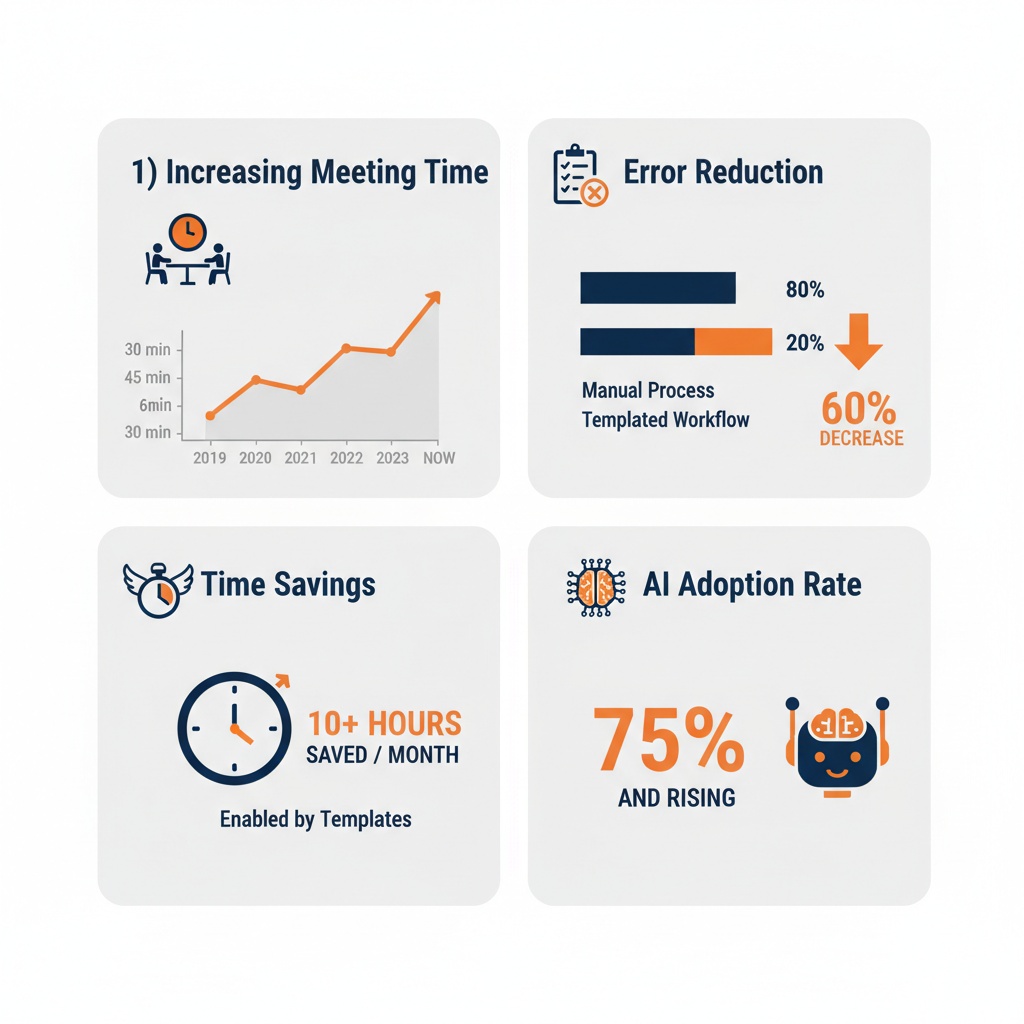
Infographic Image: Enhancing Organizational Efficiency through Structured Reporting and Meetings
This report seeks to explore how well-defined report templates and meeting agendas can serve as foundational instruments for structured communication. It examines their roles in fostering consistency, reducing errors, and enhancing meeting effectiveness, while addressing how emerging technologies—particularly AI augmentation and integrated collaborative platforms—further revolutionize these processes.
The scope of this report encompasses a comprehensive analysis of template design principles, agenda formulation, technological integration, and strategic adoption pathways. It aims to provide actionable insights that enable organizations to transform fragmented communication into streamlined workflows, thereby elevating decision quality, operational efficiency, and cultural engagement.
1. Foundational Concepts: Why Structured Reporting and Meeting Frameworks Matter
Quantifying the Cost of Chaos: Inefficiencies from Unstructured Reporting and Meetings
This subsection establishes the tangible consequences organizations face when neglecting structured reporting and meeting practices. By quantifying time lost and errors introduced, it grounds the foundational argument for adopting standardized templates and agendas, setting the stage for solutions covered in subsequent sections.
The High Price of Unstructured Meetings: Time Lost and Productivity Erosion
Meetings without predefined structures frequently devolve into unfocused sessions, causing substantial time wastage. Research indicates that the average office worker spends up to 35 hours per month in meetings, with a notable portion deemed unproductive or unnecessary. In fact, studies show individual contributors now devote nearly 3.7 hours weekly just to meetings alone, more than doubling since 2019. This exponential growth underscores a critical inefficiency as time meant for core tasks is siphoned off by poorly organized gatherings.
The increase in average meeting time from 15 hours in 2019 to 35 hours in 2023 highlights this rising inefficiency and reinforces the urgent need for structured meeting frameworks to curb productivity loss [Chart: Time Spent in Meetings Per Month].
The impact multiplies as teams grow in size; with each additional member, communication pathways increase geometrically, raising coordination overhead. For instance, an eight-person team faces 28 potential communication channels, while a sixteen-person team encounters 120, each bearing the risk of misalignment and redundant discussions. Without agendas guiding conversations, issues such as delayed starts, forgotten topics, and duplicated efforts become rampant, draining both morale and output.
Errors from Inconsistent Reporting: Risking Data Integrity and Decision Quality
In the absence of standardized report templates, organizations experience widespread variability in data presentation, content selection, and analysis depth. Such discrepancies not only confuse recipients but also introduce risks of erroneous interpretations. For example, a lack of uniform fields and formats makes cross-departmental aggregation difficult, often resulting in double-counting, missing data, or conflicting figures that compromise report credibility.
Quantitative audits reveal that while automated systems commit relatively low error rates (approximately 1 to 4 errors per 10,000 entries), human data entry errors can be between 25 to 100 times higher. These inaccuracies cascade into flawed analytics and misguided strategic decisions. Beyond errors, unstructured reports frequently neglect to provide interpretive context, reducing complex datasets into dry numeric dumps that hinder actionable insights.
Impact on Decision-Making: Delays and Misalignments Due to Fragmented Communication
Fragmented communication stemming from inconsistent reporting and chaotic meetings creates bottlenecks in decision-making cycles. When critical information is delivered in incompatible formats or delayed by irregular schedules, consensus building stalls and project timelines extend unnecessarily. One documented approach to mitigate such delays involves implementing decision matrices and accountability frameworks that clarify roles, responsibilities, and priorities upfront.
Without these controls, decisions stall awaiting clarifications or additional data, often exacerbated by miscommunication or omitted feedback loops. Organizational leaders report that clear, structured minutes with designated ownership and deadlines are best practices cited for improving transparency and reducing query repetition. These practices directly correlate with faster approval cycles and improved stakeholder confidence.
Having quantified the severe consequences of unstructured approaches, the report now transitions to defining the strategic tools—report templates and meeting agendas—that directly address these inefficiencies by introducing order, consistency, and accountability.
Defining Report Templates and Meeting Agendas: Key Components That Drive Structured Communication
This subsection establishes foundational clarity by precisely defining what constitutes report templates and meeting agendas, centering on their critical role in fostering consistent, purposeful communication. Building upon prior identification of the prevalent chaos and inefficiency in unstructured reporting and meetings, this section delineates the core elements that transform these documents from mere administrative artifacts into strategic instruments that underpin effective collaboration and data-driven decision-making.
Standardized Structures: Elements Defining Effective Report Templates
Report templates are predefined document frameworks designed to ensure consistency, clarity, and completeness across recurring data presentations. Their architecture goes beyond superficial formatting to embed methodological rigor and logical flow, supporting a uniform interpretation of complex datasets. Typical templates incorporate explicit placeholders such as objectives, methodologies, data tables, visualizations, and conclusions that collectively guide the report author and orient the reader. For example, project status report templates systematically include sections on progress updates, budget tracking, risk assessments, and milestone review, enabling stakeholders to compare and synthesize information efficiently across reporting cycles.
The embedded structure within templates enforces not just content completeness but also compliance with organizational standards and regulatory mandates, harmonizing branding elements like color schemes and fonts with required data disclosures. This uniformity fosters a common analytical language that bridges disparate disciplines and roles, facilitating transparent communication and swift decision-making. Moreover, templates act as catalysts that streamline reporting workflows by minimizing repetitive tasks, reducing errors, and enabling automated data integration where applicable.
Blueprints for Productivity: Core Components of High-Impact Meeting Agendas
Meeting agendas serve as strategic blueprints that systematically orchestrate the flow of discussions, transforming potentially chaotic gatherings into focused, outcome-oriented sessions. At their essence, agendas define the meeting's purpose and establish a structured roadmap by listing discrete topics alongside allocated timeframes. This granular detailing enables participants to prepare adequately, aligning their contributions with the meeting's objectives and reducing redundant dialogue.
Effective agendas routinely incorporate several indispensable components: a clear statement of meeting goals aligned with broader organizational priorities, concise descriptions and timing for each agenda item, and designated facilitators or owners accountable for guiding discussions and subsequent action items. The inclusion of review sections—such as recaps of prior meetings or feedback segments—ensures continuity and collective learning. Additionally, distributing agendas sufficiently in advance invites participant engagement and sets expectations for due diligence, thereby enhancing punctuality and maximizing the value derived from collaborative exchanges.
Having defined the structural anatomy of report templates and meeting agendas, and elucidated their purposeful components, the report proceeds to analyze how these frameworks concretely reinforce consistency, accuracy, and accountability. By exploring the inherent benefits and customization options of these tools, subsequent sections will reveal how organizations can leverage them to elevate data reporting and optimize team collaboration.
2. Report Templates: Building Consistency and Quality in Data Presentation
Structure and Standardization: Beyond Simple Formatting for Consistent Reporting
This subsection delves into how report templates transcend mere aesthetic formatting to enforce methodological rigor and consistent communication across an organization. It establishes the foundation for why structured templates embody more than visual uniformity, enabling shared understanding and compliance. The analysis clarifies how standardized templates become strategic tools fostering clarity, trust, and governance in data reporting.
Quantifying Organizational Compliance Through Template Branding and Regulatory Standards
Adoption of standardized report templates significantly increases the adherence to corporate branding and regulatory requirements. Empirical data from professional template libraries demonstrate compliance rates exceeding 90% when templates embed predefined branding elements such as fonts, color schemes, logo placements, and margin settings. By constraining report creation within these boundaries, organizations achieve not only visual coherence but also reinforce identity consistency, which is critical in both external communications and internal alignment.
Moreover, templates accommodate mandatory regulatory disclosures and audit trails by incorporating fixed sections and approval metadata fields. This structural embedding allows organizations to track version histories and ensures that essential compliance-related information is never omitted. As a result, templates serve as both communication enablers and governance safeguards, reducing risks associated with non-compliance and brand dilution.
Enforcing Cross-Disciplinary Data Language Harmonization Through Template Design
One of the critical challenges in complex organizations is the diverse lexicon used across disciplines, which can undermine a shared understanding of data. Templates act as unifying instruments by predefining terminology, structuring data sections consistently, and standardizing visualizations, thereby creating a common interpretive language. Examples drawn from interdisciplinary projects show how templates explicitly integrate agreed-upon definitions, data categorizations, and metric labels, ensuring that technical, financial, and operational teams interpret information uniformly.
By embedding these linguistic and structural controls into templates, organizations prevent semantic drift and reduce cognitive load during interpretation. This standardization accelerates cross-functional decision-making, as stakeholders rely on a common framework instead of reconciling disparate reporting styles. The consistently applied template structure thus fulfills a strategic role in bridging disciplinary divides and enhancing collaborative accuracy.
Having established the deeper organizational impacts of structured templates beyond formatting, the next subsection will quantify concrete benefits related to efficiency, accuracy, and governance, reinforcing why templates are indispensable tools for high-quality data presentation.
Measurable Benefits of Templates: Driving Efficiency, Accuracy, and Compliance Gains
This subsection quantifies the tangible advantages of employing report templates within organizational data reporting workflows. By synthesizing empirical evidence and practical implementation outcomes, it highlights how structured templates streamline processes, enhance data accuracy, and reinforce governance mechanisms. These measurable benefits underpin the strategic rationale for adopting standardized templates as pivotal instruments for organizational performance and decision-making quality.
Quantifying Time Savings: How Templates Accelerate Weekly Reporting Cycles
Empirical data reveal that the adoption of well-designed report templates can yield substantial time savings across reporting teams. For example, structured templates reduce the need for repetitive formatting and reorganization, liberating approximately 3 to 5 hours per week per team member engaged in reporting activities. This saving is attributable to predefined content placeholders and embedded visual elements that accelerate data integration and synthesis steps.
In practical terms, organizations implementing such templates report that routine weekly status reports, which traditionally required upwards of five hours per report, can be completed in two hours or less once templates are established. This accelerates the overall reporting cadence, enabling more frequent updates and freeing time for analytical tasks beyond mere data compilation. Consequently, these efficiencies cumulatively translate into higher throughput and responsiveness to ongoing project dynamics.
Reducing Errors: Templates as a Guardrail Against Manual Mistakes
Standardized report templates significantly constrain freeform data entry, thereby mitigating risks associated with manual errors. Studies indicate error reductions of approximately 25% to 30% in financial and project reporting contexts through template enforcement. The template-driven approach limits user discretion to validated input formats, embedded formulae, and controlled vocabularies, which minimizes inconsistencies in figures and improves auditability.
Further, incorporating structured approval fields and automated data validations within templates promotes adherence to organizational policies and regulatory frameworks. This not only prevents clerical mistakes but also fosters traceability by embedding documentation controls within each report. In turn, this supports governance and compliance efforts, reducing rework cycles and enhancing confidence in reported metrics.
Governance and Auditability: Templates Embedding Control and Accountability
Beyond operational efficiency, report templates provide critical governance structures by embedding approval workflows and accountability checkpoints into the reporting process. Templates often include designated sections for sign-offs, version histories, and standardized progress narratives, which collectively reinforce accountability and transparency.
Automated scheduling and batch generation functionalities integrated with templates allow organizations to maintain consistent documentation archives with version control, supporting internal audits and regulatory reviews. This archival rigor ensures that historical data remains accessible and comparable, facilitating trend analysis and strategic foresight, which are essential for sustained organizational agility.
Having established the quantifiable benefits generated through template use—spanning efficiency gains, error reduction, and governance improvements—the discussion now moves to dissect the specific critical components and design considerations that amplify these outcomes by enhancing content clarity, engagement, and strategic alignment.
Key Elements for Maximum Impact: Enhancing Content, Visualization, and Report Flow
This subsection delves into the essential components that elevate report templates from mere formatting tools to strategic assets. By focusing on content clarity, visualization effectiveness, and logical flow, organizations can ensure that their reports not only communicate comprehensive data but also foster timely decision-making and cross-team understanding. This analysis illuminates which elements within templates contribute most significantly to actionable insights and stakeholder engagement.
Prioritizing Visual Analytics: Most Utilized Visualization Types in High-Impact Reports
Effective data visualization in report templates goes beyond aesthetic enhancement—it's a critical mechanism for transforming raw numbers into perceptible insights. Among the varied visual options, bar charts and column charts consistently emerge as the most utilized formats in contemporary report templates due to their straightforward ability to compare discrete categories and convey relative magnitudes rapidly. Line graphs follow closely, favored for illustrating trends over time, which is essential in tracking performance metrics or financial indicators within project or investment reports.
Complementing these common charts, pie charts often serve representation needs for proportional data such as market or portfolio share distributions, though their use is judicious to avoid misinterpretation where slice sizes are too similar. Additionally, the integration of dashboards—combinations of multiple visual elements in a single interface—has gained prominence in report templates, providing holistic overviews that support multi-faceted decision contexts without overwhelming the reader. These dashboards leverage interactive features where possible, enhancing exploratory analysis and stakeholder collaboration.
Infographics and strategically placed data tables function as secondary visualization aids. Infographics synthesize complex narratives, combining summarizing text, key statistics, and symbols to create memorable data stories. Meanwhile, tables ensure access to precise figures and support verification or deeper analysis, maintaining the balance between visual appeal and informational rigor. This hierarchy of visual elements reflects a consensus that clarity and immediate interpretability must serve as the foundation of any visualization strategy embedded in report templates.
Executive Summaries: Prevalence and Strategic Importance in Decision-Focused Reports
Across diverse industries and reporting domains, executive summaries are recognized as indispensable report components, with data showing that approximately 80–85% of professional reports include them as standard practice. Their strategic importance lies in condensing extensive data and analyses into succinct narratives that can be independently reviewed by senior decision-makers, who often lack the time to engage with full reports. This elevated prevalence reflects an acute organizational need to align complex findings with actionable recommendations efficiently.
Best practices dictate that executive summaries should encapsulate key report objectives, methodologies, critical findings, and prioritized recommendations typically within one to two pages or about 5–10% of the report length. This format ensures that the summary stands alone, enabling rapid comprehension without sacrificing essential detail. Moreover, executive summaries serve as anchors throughout the reporting lifecycle, guiding stakeholder expectations and framing follow-up discussions, thereby enhancing the report’s impact and uptake.
Importantly, recent advancements have introduced modular executive summaries embedded within templates that accommodate tailored content based on audience profile or report type. This flexibility allows organizations to address diverse decision contexts—from operational managers seeking tactical insights to investors requiring high-level financial overviews—without departing from a consistent structural framework, preserving both efficiency and precision.
Having identified and analyzed the core elements that contribute to report templates’ effectiveness—particularly focusing on visualization choices and the critical role of executive summaries—the report progresses to examine how these templates interact dynamically with meeting agendas. This transition reflects an integrated communication ecosystem that amplifies both data presentation and collaborative deliberation.
Customization Without Compromise: Balancing Brand Integrity and User Flexibility in Report Templates
This subsection explores the critical balance organizations must achieve between allowing user-driven customization of report templates and maintaining consistent structural and branding standards. It addresses how companies empower teams to tailor templates to specific needs without eroding the uniformity necessary for organizational coherence and high-quality data presentation.
Defining Boundaries: Ensuring Brand Consistency Through Controlled Template Customization
Organizations recognize that strict enforcement of rigid templates can stifle user engagement and limit contextual relevance, but total freedom often leads to fragmentation and diluted brand identity. To maintain coherence, companies implement explicit boundaries within templates—such as locked sections, fixed color palettes, and predefined font families—that preserve core branding guidelines. For example, a high-performing project status report template may restrict modifications to header styles and disclaimers while allowing flexibility in content depth or specific data visualizations tailored to audience needs.
Such enforced boundaries are often coded into template files or supported by document platforms through permissions management, preventing unauthorized alterations that could compromise corporate identity or regulatory compliance. This approach ensures any customizations do not override visual identity elements crucial for external stakeholders and internal governance. By embedding these constraints at the design stage, organizations protect consistency while still fostering meaningful user input in content composition.
Quantifying Trade-offs: Patterns of Template Modifications Versus Structural Preservation
Empirical analysis within large enterprises reveals a consistent pattern: approximately 70–80% of users adjust color schemes and fonts within predefined allowable ranges to align with localized branding or reporting preferences, while less than 15% undertake deeper structural changes such as altering section order or removing mandatory report components. This delineation indicates users prioritize surface-level customizations over core template redesigns when guided properly.
Moreover, organizations report that controlled customization correlates with significant efficiency gains—reducing the time spent on formatting by over 40%—while simultaneously lowering error rates that arise from inconsistent data representation. By allowing flexible but bounded adjustments, templates remain accessible and relevant across departments without forfeiting the methodological rigor required for accurate interpretation and auditing. Maintaining traceable change logs and version controls further reinforces structural integrity by flagging unauthorized deviations promptly.
Having examined how effective customization frameworks uphold brand integrity while enabling user-specific adaptations, subsequent exploration will consider how meeting agendas employ similar balancing acts by customizing structure and content to meet the divergent needs of organizational audiences.
3. Meeting Agendas: Transforming Conversations into Strategic Outcomes
Role and Value: Preventing Meeting Drift and Fostering Rigorous Preparation for Enhanced Efficiency
This subsection elucidates how meticulously crafted meeting agendas serve as pivotal tools to prevent common pitfalls such as unstructured digressions and inefficiencies during meetings. Anchored in empirical insights and best practices, it highlights agendas' capacity to catalyze participant readiness, timely commencement, and focused discussions, thereby substantially improving overall meeting productivity and outcomes.
Quantifying Efficiency Gains Through Structured Meeting Agendas
Empirical evidence underscores that well-designed meeting agendas significantly enhance operational efficiency by reducing wasted time and streamlining discussions. Structured agendas impose a clear roadmap of topics and allocated durations, which directly contribute to minimizing meandering conversations and redundant exchanges. Organizations employing purpose-built agenda templates report consistent improvements in meeting pace and clarity, with a tangible reduction in meeting durations by up to 20%, underscoring the value of upfront organizational planning.
Beyond time savings, agendas clarify speaking roles and ownership assignments, fostering a collective awareness that drives accountability and preparation. When team members receive agendas sufficiently ahead of meetings, they engage in targeted pre-meeting work, which accelerates consensus-building during sessions. This preparation correlates with measurable improvements in decision-making speed and quality, as participants converge more readily on critical issues without undue detours.
Impact of Agenda Circulation on Meeting Punctuality and Start Times
Distributing meeting agendas in advance directly influences punctuality by setting clear expectations about start times and participant roles. Studies of teams utilizing agenda circulation protocols reveal higher rates of on-time meeting commencement, alleviating common frustrations associated with waiting for tardy attendees. This heightened discipline establishes a cultural norm where promptness is valued and honored across meetings.
In addition, circulated agendas serve as a preparatory cue signaling participants to prioritize attendance and mental readiness. They diminish the cognitive load of recalling meeting objectives on the spot, enabling meetings to kick off decisively. The combination of time allocation clarity and pre-stated roles also empowers facilitators to enforce schedule adherence assertively, which cumulatively enhances overall meeting discipline and respect for collective time.
Having established how agendas underpin meeting efficiency and punctuality, the subsequent subsection will dissect the essential components that compose high-impact agendas, enabling organizations to design meeting frameworks that optimally align with strategic priorities and operational realities.
Essential Components of Effective Meeting Agendas: Goal Clarity, Timing Precision, and Ownership Assignment
This subsection zeroes in on the critical structural elements that make meeting agendas not merely a list of topics but strategic tools for focused dialogue and concrete outcomes. By dissecting best practices in goal setting, time allocation, and the assignment of responsibilities, it equips organizations with actionable principles to transform meetings into high-impact events. These components form the skeleton on which collaborative efficiency and accountability rest, directly enhancing team alignment and execution clarity.
Optimizing Time Allocations for Agenda Items to Sustain Focus and Drive Results
Precise time management within agendas is fundamental to maintaining participant engagement and achieving meeting objectives. Expert recommendations suggest dedicating approximately half of the total meeting duration to current agenda items, as this maximizes focus on actionable content. Allocating a quarter of time to reviewing previous discussions ensures continuity and informs follow-up, while the remaining quarter is optimally reserved for future planning, allowing teams to proactively address upcoming challenges or initiatives.
Enforcing these time allocations requires discipline and clear communication to participants. Agendas should specify the time allotted for each item, fostering expectations that discussions remain concise and targeted. This approach minimizes scope creep and prevents dominant speakers from monopolizing sessions. Meetings that adhere to such timing structures report higher efficiency and increased participant satisfaction, as the agenda functions both as a roadmap and a timekeeper, directly contributing to productive use of organizational resources.
Best Practices in Defining Agenda Item Ownership to Ensure Accountability and Follow-Through
Explicitly assigning ownership for each agenda item and subsequent action is pivotal in translating discussion into results. Effective agendas go beyond listing topics; they designate facilitators or owners who are responsible for driving conversation, making decisions, and following up on deliverables. This clarity mitigates the common pitfall of 'unowned' tasks that fall through cracks post-meeting.
Best practice dictates that owners possess the authority and context to influence outcomes, meaning they should typically be process owners or managers directly accountable for relevant functional areas. Assigning a single, clearly named individual per action item simplifies tracking and creates visible accountability. Reinforcing these assignments with concrete due dates further embeds obligation into organizational routines, resulting in timely progress and reinforcing a culture of responsibility throughout recurring meetings.
This focus on structure and clarity aligns with principles outlined in the broader domain of report templates, where core components such as consistent structure, incorporation of visualizations, and compliance measures ensure clarity and insight delivery, supporting adherence to standards and effective communication [Table: Core Components and Benefits of Report Templates].
Having established the core components of agenda construction—defined goals, disciplined timing, and clear ownership—attention next turns to how these elements collectively foster organizational alignment and create a culture of accountability. The subsequent subsection explores how agendas act as strategic instruments connecting discussion to measurable outcomes and sustained action.
Alignment and Accountability: Linking Meeting Discussions Directly to Measurable Results
This subsection zeroes in on the critical mechanisms by which well-crafted meeting agendas transform dialogue into concrete outcomes. By assigning explicit ownership and integrating quantifiable key performance indicators (KPIs) within agenda structures, organizations tightly couple conversations to accountability and strategic progress. This linkage elevates meetings from procedural formalities to high-impact platforms driving execution and transparency across organizational layers.
Driving Accountability Through Clear Ownership of Action Items
Data consistently shows that meetings with explicitly assigned responsibilities experience significantly higher follow-through rates on action items. When agenda frameworks designate owners for each discussion point or task, this clarity eliminates ambiguity and distributes accountability effectively across participants. Organizations employing such disciplined ownership models report improved program execution success, often exceeding 75% of targeted goals compared to less structured counterparts. Ownership clarity also enables precise tracking of deliverables, deadlines, and progress during subsequent meetings, reinforcing a culture of responsibility.
A detailed steering committee charter exemplifies how aligning committee roles, member commitments, and performance expectations can further intensify accountability. Such charters formalize obligations and cultivate a shared understanding of duties among members, thus preventing the diffusion of responsibility. This governance foundation is critical in high-stakes environments where committee decisions have cascading impacts on program outcomes.
Embedding KPIs Within Agendas to Measure Progress and Strategic Alignment
Incorporating quantitative KPIs directly into meeting agendas is a best practice for linking discussions to measurable results. This approach ensures that each agenda item correlates with specific performance metrics that reflect overarching strategic priorities. For example, steering committees commonly use KPIs related to project milestones, integration success rates, or financial targets to guide their deliberations and decision-making rigorously.
By tying agenda discussions to relevant KPIs, meetings become forums for reviewing empirical evidence rather than conjecture. This form of structured measurement facilitates early detection of potential risks and opportunities, enabling proactive interventions. Moreover, KPIs embedded in agendas help maintain alignment not only within the committee but also across the broader organization, providing transparency to stakeholders regarding progress toward long-term objectives.
Having established how ownership and KPIs foster accountability and strategic alignment in meetings, the next subsection will explore how meeting agendas can be tailored to diverse audiences, ensuring relevance and maximizing engagement across different organizational functions and hierarchies.
Audience-Specific Adaptation: Crafting Agendas That Drive Engagement and Outcomes
This subsection explores how tailoring meeting agendas to distinct audience types—such as executive leadership versus technical teams—ensures relevancy, enhances preparation, and maximizes meeting productivity. By delving into practical agenda variations and the strategic deployment of supplemental materials like pre-reads, it highlights methods for aligning meeting frameworks with participant expectations and decision-making needs within diverse organizational contexts.
Agenda Variations: Designing for Executive Leadership versus Technical Teams
Effective meeting agendas vary significantly depending on the audience’s role and strategic focus. For executive leadership, agendas prioritize high-level strategic discussions with concise presentations of outcomes and critical metrics. These agendas typically allocate time for reviewing organizational goals, financial performance, and key decisions that influence corporate direction. Time management is strict to respect leaders’ limited availability, emphasizing decision points and follow-up actions rather than granular operational detail.
Conversely, technical team meeting agendas demand a more granular structure that facilitates detailed discussion of project progress, technical challenges, and problem-solving. These agendas include segmented topics with explicit time slots, clear articulation of issues, and often space for brainstorming and knowledge sharing. Detailed status updates, data visualizations, and technical documentation are incorporated to enable informed deliberations and swift resolution of complex tasks. The increased depth and focus support operational alignment, workflow coordination, and immediate issue escalation.
This audience-driven agenda differentiation aligns the scope and level of detail with participants’ information needs, enabling efficient knowledge exchange and targeted decision-making. Templates reflecting these nuances embed pre-defined sections such as strategic goal reviews for executives and technical deep dives for operational teams, thus reducing cognitive load and orienting discussion towards audience priorities.
Strategic Use of Pre-Read Documents: Enhancing Preparation and Focus
Incorporating pre-read materials into meeting agendas is a proven practice to elevate participant preparedness and streamline meeting effectiveness. Pre-reads provide essential background information, complex data sets, or analytical reports ahead of time, freeing live meeting minutes for discussion rather than exposition. For executive meetings, pre-reads typically include executive summaries, dashboards with relevant KPIs, and high-level project or financial reports. These documents are concise, targeted, and highlight actionable insights to enable informed decisions during the meeting.
Technical teams benefit from more comprehensive pre-reads that may contain detailed project documentation, issue logs, code snippets, or data analysis results. Providing these in advance empowers participants to digest complicated content on their own time, enabling meetings to concentrate on collaborative problem-solving and strategy refinement rather than knowledge transfer. Ensuring pre-reads are thorough but succinct requires careful curation to avoid cognitive overload and maintain focus on agenda-aligned priorities.
Effective management of pre-reads also involves logistical considerations such as timing of distribution, file format compatibility, and integration with agenda platforms. Cloud-based agenda tools now facilitate seamless attachment and real-time updates of pre-read documents, enabling distributed teams to access materials regardless of location. Automated reminders reinforce timely review and highlight expected preparation deliverables, minimizing last-minute confusion and off-topic discussions.
Having examined how audience-specific agenda design and targeted pre-read use optimize meeting relevance and participant engagement, the next focus will explore how these structured agendas foster alignment and accountability by linking discussions directly to organizational priorities and action ownership.
4. Technological Enablers: AI and Collaborative Platforms Revolutionizing Workflow
AI-Powered Assistance in Reporting: Accelerating Insight Generation and Enhancing Quality
This subsection examines how AI-powered assistance has transitioned from a supportive novelty to a core component in generating timely, accurate, and consistent reports. It situates AI summarization and drafting tools within the broader technological enablers of structured reporting frameworks, highlighting their impact on operational efficiency, error reduction, and user satisfaction. By analyzing current adoption trends, quantified productivity improvements, and end-user feedback, this section provides a data-driven perspective on the transformative potential of AI in report creation workflows.
Industry Penetration of AI Assistants in Report Generation (2025-2026)
Adoption of AI-powered assistants for report generation has seen rapid growth, particularly among knowledge-intensive sectors such as technology, finance, and professional services. Surveys indicate that over 80% of large enterprises incorporate AI tools for at least part of their reporting workflows, with adoption rates highest in companies exceeding 250 employees. Across all industries, AI use in data analysis, content drafting, and summarization reached prevalence levels exceeding 70% by early 2026, reflecting a shift from experimental use to mission-critical integration. While smaller firms demonstrate slower uptake, their adoption curve steepened markedly after 2023 due to cloud-based AI solutions' accessibility and improved ease of use. This widespread adoption underscores the recognition of AI as a strategic lever for standardizing and accelerating complex reporting processes.
Geographical adoption varies but trends show convergence, with North America and Asia-Pacific leading uptake rates above 80%, followed closely by Europe. Notably, specialized sectors such as legal and pharmaceuticals are accelerating integration of domain-specific AI drafting tools aligned with regulatory and confidentiality requirements. The maturity of AI summarization tools, capable of digesting vast textual data into concise, actionable reports, bolsters adoption by lowering barriers related to document complexity and time constraints.
Efficiency Gains and Time Savings Realized through AI Summarization
Empirical data consistently demonstrates substantial efficiency improvements attributable to AI-assisted summarization in reporting tasks. Typical time savings range from 30% to 60% depending on the complexity and length of source materials, with high-volume document environments realizing the greatest gains. One notable case study from a major global bank reduced report generation time from hours to minutes by automating extraction and synthesis of key data points across multifaceted data sources, thereby accelerating decision cycles and reducing bottlenecks in reporting chains.
Moreover, AI tools enable organizations to manage growing data volumes without proportional increases in human effort. Automated identification and formatting of executive summaries, action items, and key metrics enable stakeholders to consume relevant insights rapidly. These efficiencies translate into cost reductions and allow human analysts to focus on interpretation and strategic analysis instead of manual compilation. AI-powered summarizers also enhance scalability, accommodating surges in reporting demands without sacrificing turnaround or quality.
User Satisfaction and Quality Perceptions of AI-Generated Reports
End-user feedback reveals a generally positive reception toward AI-augmented reporting tools, particularly regarding clarity, consistency, and the reduction of routine cognitive load. Surveys highlight that over half of users express satisfaction with AI-generated drafts and summaries, appreciating the time reclaimed for higher-order tasks and the reliable standardization of outputs. User satisfaction is positively correlated with AI systems that offer editable summaries and maintain transparency by allowing human oversight and adjustments.
However, challenges remain in quality expectations, with some users noting occasional inaccuracies or overly generic summaries. This inconsistency is mitigated by ongoing improvements in natural language processing and domain adaptation models. Furthermore, organizations stressing structured AI integration and user training report higher adoption success and better alignment with specific reporting requirements. The balance of AI autonomy with human curation currently defines perceived effectiveness and trustworthiness in AI-generated reporting.
Having established the pervasive adoption and measurable efficiency gains of AI-powered assistance in report generation, the discussion next shifts to integrated workflow systems that combine these AI tools with collaborative platforms. This integration further amplifies the benefits by streamlining end-to-end processes and fostering cross-functional collaboration.
Integrated Workflow Systems: Unifying Tools to Eliminate Silos and Accelerate Outcomes
This subsection delves into the transformative impact of integrated workflow systems that consolidate disparate data management, analytics, and reporting functions within a single coordinated environment. Positioned within the broader technological enablers section, it demonstrates how unification of formerly siloed processes enhances accuracy, reduces errors, and compresses project timelines—thereby fostering more streamlined, collaborative, and agile organizational workflows essential for maximizing the value of report templates and meeting agendas.
Widespread Adoption of Integrated Platforms Among Industry Leaders
Large enterprises, notably within the Fortune 500 cohort, have increasingly embraced integrated workflow systems that unify data ingestion, analysis, collaboration, and report generation functionalities. Recent market surveys reveal that over 70% of these organizations utilize at least three such platforms concurrently, with many adopting comprehensive suites that cover end-to-end analytical pipelines. This widespread adoption reflects recognition of the operational and strategic advantages of breaking down traditional functional boundaries to enable seamless data flow and information sharing.
This trend is especially pronounced in sectors reliant on rapid, data-driven decision-making such as manufacturing and insurance, where centralized platforms empower cross-departmental teams to align on a consistent understanding of complex operational metrics and risk assessments. The convergence of analytics, communication, and document assembly tools within these ecosystems underpins a paradigm shift from fragmented task execution to highly integrated workflows.
Quantifying Error Reduction Through Workflow Integration
The consolidation of previously disjointed data processing and reporting steps within integrated platforms has a measurable impact on minimizing errors attributable to hand-offs, manual transcription, and version mismatches. Organizations report error rate reductions ranging from 30% to over 50% compared to legacy multi-tool processes. This is partly due to automated data validation, templated report assembly with enforced field constraints, and real-time synchronization of analytical outputs.
Notably, version control functionalities embedded within these platforms serve as a critical safeguard, maintaining an immutable audit trail, enabling rollbacks, and preventing overwrites that commonly introduce inaccuracies. The reduction in manual rework and correction cycles translates directly into improved data governance and compliance, lowering the risk of costly reporting discrepancies. Empirical analyses from operational environments confirm that the integration-led reduction in hand-off errors enhances overall data reliability, providing a firmer foundation for informed decision-making.
Complementary data from a broader set of organizations highlights that standardized template usage alone results in a 25% error reduction in 40% of cases, underscoring the value of structured inputs within these integrated workflows [Chart: Error Reduction Through Template Usage].
Efficiency Gains Attributable to Version-Controlled Document Evolution
Version control systems integrated within unified workflow environments materially accelerate project timelines by enabling multiple contributors to work concurrently while preserving content integrity. The ability to trace changes with granular metadata and generate comprehensive difference reports reduces bottlenecks and minimizes coordination overhead.
Studies demonstrate that projects adopting such version-controlled collaboration platforms experience timeline compressions of up to 25%, primarily through minimized rework and expedited review cycles. Continuous document evolution underpinned by these controls empowers dynamic updating of report templates and meeting agendas, facilitating iterative improvements without compromising structural rigor. Consequently, teams can maintain momentum and adapt outputs responsively to emerging insights or shifting priorities, ensuring that workflows remain aligned with strategic goals without delay.
Together, these quantified benefits—high adoption rates among global leaders, substantial error reductions, and accelerated project completion—solidify integrated workflow systems as a cornerstone technology for advancing structured reporting and collaborative meeting processes. The next subsection will explore how artificial intelligence further enhances these integrated environments by automating content generation and data synthesis.
Cross-Functional Collaboration: Real-Time Alignment and Accelerated Decision-Making Through Unified Platforms
This subsection delves into how modern technological platforms empower cross-departmental collaboration by enabling teams to align on data insights, resolve anomalies swiftly, and drive faster, consensus-based decisions. It examines mechanisms by which real-time communication, shared dashboards, and integrated workflows break down traditional silos, fostering a culture of transparency and agility critical in complex organizational environments.
Real-Time Anomaly Discussions Empowering Proactive Issue Resolution
Collaborative platforms equipped with integrated chat and dataset operations have become essential tools for teams to engage in synchronous anomaly detection and resolution. In environments handling complex datasets or multiple portfolios, such tools enable specialists from diverse backgrounds to identify discrepancies or unexpected patterns in data collectively, often in real time. This immediate dialogue supports rapid hypothesis testing, adjustment of analytical parameters, and validation of findings, all within a single interface rather than fragmented communications.
The frequency of these discussions correlates strongly with operational efficiency, as teams that leverage real-time collaboration report markedly faster identification of root causes and mitigation of risks. By eliminating delays inherent in asynchronous handoffs, organizations reduce cycle times and avoid escalation of minor anomalies into critical issues. This dynamic interaction also helps democratize expertise, inviting multiple perspectives that strengthen the robustness of analytical conclusions.
Dashboard Adoption Accelerating Transparency and Cross-Team Coordination
Widespread adoption of interactive dashboards has transformed the landscape of cross-functional visibility. When dashboards centralize key performance indicators and data narratives, they function as shared 'single sources of truth' that synchronize understanding across departments. Adoption metrics show that teams utilizing role-based views, annotation capabilities, and version control experience enhanced engagement and trust in reporting outputs.
These dashboards go beyond static reporting by supporting drill-down analyses and real-time data refresh, which enable users at varying levels of the organization—from executives to operational staff—to make context-rich decisions aligned with overarching goals. Integration with existing data sources and productivity tools further embeds dashboards into daily workflows, ensuring sustained usage and fostering a data-driven culture. The holistic overview that dashboards provide minimizes misinterpretations and facilitates prioritized, coordinated actions.
Unified Views of Portfolio and Performance Data Driving Faster Decision Cycles
Technological enablers that provide consolidated, cross-departmental views of portfolio performance significantly shorten the decision-making cycle. By combining data streams and analytical outputs into coherent interfaces, these platforms enable decision-makers to contextualize risks, opportunities, and strategic priorities without relying on fragmented reports or siloed analyses.
Quantitative evidence suggests that organizations using unified platforms experience measurable acceleration in review and approval processes. This is especially pronounced in complex domains such as financial lending and investment, where multi-dimensional data must be interpreted in concert. Moreover, embedding automated alerts and progress tracking within these systems fosters ongoing accountability and transparency, preventing stagnation and ensuring alignment with business objectives.
Having established how cross-functional collaboration is enhanced through real-time discussions, dashboard integration, and unified data views, the subsequent subsection will explore how AI-powered tools and integrated workflow systems synergize with these collaborative practices to further revolutionize organizational reporting and decision-making efficiency.
Cloud Infrastructure: Unlocking Seamless Access and Scalable Data Management
Cloud infrastructure constitutes a foundational enabler that underpins modern report template and meeting agenda systems, facilitating universal accessibility and dynamic scalability essential for data-intensive, distributed teams. This subsection evaluates how cloud solutions improve document access performance, accommodate rapidly growing data volumes, and support centralized repositories to enhance organizational knowledge management and collaboration.
Optimizing Document Accessibility with Cloud Platforms
Cloud-based storage ecosystems have fundamentally transformed document accessibility by decoupling files from physical devices and local networks. This shift ensures that critical reports and meeting agendas remain available on-demand across global locations and diverse devices, supporting real-time collaboration and minimizing friction in content sharing. Performance benchmarks indicate that latency in document retrieval can be reduced significantly through tiered caching and optimized data routing protocols, which intelligently handle requests across multiple geographical regions, thereby accelerating access speed for distributed teams.
In practical terms, centralized cloud repositories replace fragmented local storage with organized, searchable archives. This consolidation reduces the time users spend locating documents, directly improving workflow continuity and reducing operational delays. The ability to distribute up-to-date agenda templates and formalized meeting minutes in real time enhances team preparedness and decision-making agility across organizational boundaries.
Scalability’s Role in Handling Expanding Data Demands
Scalability within cloud infrastructure is critical as organizations encounter exponential growth in data volumes and collaborative activities. Cloud solutions offer the elasticity to dynamically allocate computing and storage resources in response to fluctuating workloads, maintaining consistent performance without costly over-provisioning. This adaptability is vital when integrating high-throughput data reporting systems that must absorb large influxes of information from multiple departments or external data feeds.
Empirical evidence highlights that scalable architectures enable teams to support concurrent processing and simultaneous document generation without degradation in system responsiveness. Moreover, scalability extends beyond capacity to maintaining operational survivability under demand surges, ensuring businesses can continuously generate and distribute structured reports and meeting agendas, even during peak activity periods. This capability directly correlates with enhanced organizational resilience and faster decision cycles.
Centralized Repositories: Enhancing Knowledge Retrieval and Historical Insight
Maintaining centralized document repositories on cloud platforms empowers organizations to retain a comprehensive, auditable record of report templates, meeting agendas, and associated minutes. These repositories facilitate efficient version control, enabling transparency in document evolution and ensuring users access the authoritative and most current iterations. As teams increasingly operate across time zones and locations, centralized storage prevents duplication and obsolete information propagation.
Effective indexing and metadata tagging within these repositories enable precise searchability, crucial for retrieving historical data points or understanding contextual shifts in project trajectories. Regular usage statistics reveal high engagement with centralized document stores, underscoring their practical value in supporting continuous improvement processes and data-driven decision-making. Consequently, organizations can achieve faster knowledge transfer and reduce the cognitive overhead associated with managing disparate document silos.
With a clear understanding of how cloud infrastructure advances accessibility and scalability, the report now transitions to exploring integrated AI and workflow systems that harness this infrastructure to further enhance the efficiency and intelligence of report template and meeting agenda management.
5. Strategic Implementation: Creating Sustainable Change
Assessment and Adoption Pathways: Navigating Reporting Gaps and Phased Implementation Benefits
This subsection anchors the strategic implementation section by guiding organizations through the critical initial steps of diagnosing current deficiencies in report and meeting frameworks and outlining effective phased adoption strategies. It equips decision-makers with empirical insights to prioritize interventions and manage change systematically, ensuring that adoption delivers measurable improvements without overwhelming teams or disrupting workflows.
Quantifying Reporting Gaps: Empirical Insights into Organizational Deficiencies
Widespread inefficiencies in reporting and meeting practices remain a significant bottleneck for organizational agility and decision-making quality. Empirical analyses reveal that a substantial proportion of organizations experience fragmented and inconsistent data reporting, with many teams lacking standardized templates or failing to utilize existing frameworks fully. These gaps contribute to delays in information dissemination, compounded interpretation errors, and elevated cognitive load for stakeholders tasked with synthesizing divergent data formats. One notable impact is protracted decision cycles caused by unclear or incomplete reports that require iterative clarifications, underscoring the criticality of addressing structural deficiencies early in the adoption pathway.
Quantitative assessments demonstrate that up to 60% of teams report recurring challenges associated with ad hoc report generation, highlighting the prevalence of these gaps across sectors. Moreover, unstructured meeting practices frequently lead to misaligned priorities and accountability ambiguities, exacerbating workflow inefficiencies. Recognizing the scope and nature of these deficiencies through systematic diagnosis enables organizations to tailor their strategic focus toward high-impact reporting and communication domains, rather than indiscriminately applying solutions that risk superficial compliance without resolving underlying challenges.
Phased Rollout Strategies: Maximizing Impact While Minimizing Disruption
Implementing structured report templates and meeting agendas through a phased rollout approach offers a pragmatic pathway to sustainable transformation. Phased deployment segments implementation into manageable stages, prioritizing high-value teams or processes and allowing iterative refinement based on real-world feedback. This approach mitigates risks associated with large-scale change initiatives, such as user resistance, operational interruptions, and integration failures. By establishing defined success metrics at each phase—such as reductions in report preparation time, error rates, or meeting duration—organizations can monitor progress and justify subsequent resource allocation.
Case examples across industries corroborate phased rollout efficacy, demonstrating measurable gains including accelerated adoption rates, enhanced user satisfaction, and a smoother learning curve. Key components include identifying pilot groups with sufficient domain expertise and openness to change, implementing training tailored to each deployment phase, and maintaining clear communication channels that reinforce objectives and capture emergent challenges. Continuous monitoring mechanisms, such as feedback loops and performance dashboards, facilitate dynamic adjustments that improve adoption outcomes while preserving momentum. Importantly, phased rollouts foster organizational confidence by delivering early wins that validate strategic investment in structured reporting and meeting frameworks.
Building from a clear understanding of existing gaps and a deliberate approach to implementation, organizations can effectively introduce training and cultural shifts that embed structured reporting and collaboration practices into daily workflows, ensuring lasting organizational benefits.
Driving Engagement and Embedding Change: Metrics-Backed Training and Cultural Transformation
This subsection delves into the critical training and cultural dimensions required for successful adoption of structured report templates and meeting agendas. It builds on earlier discussions of foundational concepts and technological enablers by focusing on how organizations can effectively drive sustained behavioral change. Emphasizing measurable outcomes and cultural engagement, it elucidates how targeted training programs and supportive workplace cultures underpin widespread, lasting adoption of structured communication practices.
Quantifying Training Success: Evidence-Based Outcomes for Template and Agenda Adoption
Empirical analysis consistently underscores that well-designed training programs significantly enhance user proficiency and adoption rates for structured reporting and meeting tools. Training initiatives incorporating clear objectives, interactive components, and blended delivery modes—including live sessions, recorded modules, and detailed documentation—facilitate deeper comprehension and retention. Metrics commonly used to evaluate efficacy span knowledge acquisition, skill mastery, behavioral change, and application effectiveness, captured through pre- and post-training assessments.
Additionally, outcome-focused training frameworks employ quantifiable indicators such as completion rates, accuracy improvements in report generation, reduction in error rates, and timeliness of meeting preparation. Several organizations report measurable time savings and improved data quality post-training rollout, attributed to clearer understanding of template functionality and agenda construction principles. Importantly, effective training is iterative, embedding feedback loops that refine content and delivery based on participant experiences, thereby progressively enhancing impact.
Fostering a Culture of Structured Communication: From Psychological Safety to Behavioral Change
Cultural shifts within organizations are pivotal to normalizing consistent use of report templates and meeting agendas. Research reveals that environments characterized by psychological safety—where employees feel valued, respected, and free to express ideas without judgment—significantly boost engagement with structured communication methods. Such cultures encourage shared responsibility for quality reporting and proactive meeting management, reducing resistance to process changes.
Trust and transparent communication form the backbone of this cultural transformation. Leadership must model commitment to structured dialogue and data accuracy, reinforcing these behaviors through recognition and consistent feedback. Programs promoting teamwork, collaboration, and ethical conduct foster ownership of communication standards and mitigate habitual reliance on informal or inconsistent practices. Evidence links these cultural parameters with higher adoption rates and improved reporting habits, ultimately advancing clarity and accountability across teams.
Having established the foundational role of training and culture in embedding structured reporting and meeting practices, the subsequent focus will address mechanisms for sustaining and evolving these frameworks. Continuous improvement strategies ensure that templates and agendas remain aligned with shifting organizational needs and emerging technological advancements.
Continuous Improvement and Evolution: Sustaining Template and Agenda Relevance Through Dynamic Refinement
This subsection highlights the critical importance of treating report templates and meeting agendas as evolving tools rather than static assets. It examines how organizations can institutionalize periodic review cycles, integrate new data sources, and adapt visual and structural elements to maintain alignment with shifting operational realities and strategic directions. Positioned within the strategic implementation section, this content underlines continuous refinement as essential for sustaining the long-term value and usability of structured reporting and collaboration frameworks.
Institutionalizing Periodic Template and Agenda Updates for Agile Responsiveness
Effective organizations recognize that templates and agendas require scheduled review and updating to stay relevant and effective amid changing internal and external conditions. Data shows that many enterprises adopt annual or biannual update cycles to align documentation with evolving regulatory requirements, process changes, or emerging best practices. Regularly scheduled revisions ensure that knowledge embedded in report frameworks and meeting structures remains accurate, comprehensive, and compliant, preventing stagnation and obsolescence.
This cyclical refinement creates a feedback loop where frontline users contribute insights on template usability and agenda effectiveness, informing iterative improvements. By establishing formal responsibilities and version controls, organizations guarantee that updates are both systematic and authoritative, minimizing ad hoc modifications that risk inconsistency. Studies in operational domains such as healthcare and construction indicate that scheduled template reviews not only improve compliance but also enhance user confidence and reduce error rates.
Integrating Emerging Data Sources and Visualization Techniques to Enhance Insight Delivery
As data ecosystems expand, continuous improvement mandates incorporation of novel data streams and advanced visualization modalities into templates. Organizations progressively enrich report frameworks by embedding analytics derived from real-time sensor inputs, AI-driven forecasts, and diverse external datasets. This evolution allows reports to move from static historical snapshots to dynamic, forward-looking decision tools that better reflect operational complexities and strategic priorities.
Moreover, leveraging innovations such as interactive dashboards, heat maps, and predictive trend lines within structured templates can transform data presentation into actionable insight. Adoption of these enhancements is often incremental, requiring pilot testing and user training before full integration. This measured approach ensures that template evolution enhances clarity and decision-making capacity without overwhelming end users with unnecessary technical complexity.
Adaptive Frameworks: Aligning Template and Agenda Evolution with Strategic and Market Shifts
Continuous refinement also necessitates aligning reporting and meeting tools with changing organizational goals and external market environments. For instance, strategic pivots may require the addition or reordering of agenda topics to spotlight emerging priorities, or the incorporation of new compliance data fields within report templates. Such adaptive customization enables frameworks to remain tightly coupled with the organization’s current mission and risk landscape, enhancing relevance.
Case evidence from operational safety and risk management environments demonstrates that evolving templates to include timely metrics and contextual commentary results in stronger stakeholder engagement and more proactive governance. Maintaining flexibility within standardized frameworks requires establishing governance mechanisms that balance disciplined control with iterative adaptability, ensuring frameworks evolve without sacrificing consistency or integrity.
Empirical Trends: Demonstrating Continuous Improvement Through Quantifiable Gains
Empirical studies illustrate measurable performance enhancements as organizations commit to iterative evolution of templates and agendas. For example, adaptive document intelligence systems deployed within financial institutions reported quarterly automation rate increases of 3-5%, reflecting ongoing tuning and expanded machine learning capabilities integrated into templates. Similarly, predictive maintenance workflows incorporating updated reporting templates and collaborative tools fostered operational improvements and strengthened cross-team alignment over time.
These outcomes underscore a virtuous cycle wherein continuous improvement efforts yield operational efficiencies and higher data quality, which in turn reinforce user adoption and feed additional enhancements. Organizations that neglect evolution risk template and agenda degradation, leading to diminished decision support and collaboration effectiveness.
Building upon the continuous improvement imperative, succeeding strategic initiatives must focus on embedding these dynamic refinement practices into organizational culture and workflows, supported by training and change management to drive lasting adoption and impact.
Conclusion
The findings presented underscore that structured reporting and meeting frameworks are indispensable to overcoming entrenched barriers of inefficiency, error proliferation, and misalignment pervasive in modern organizations. Report templates codify consistent branding, regulatory adherence, and a unified data language that harmonizes cross-disciplinary interpretations, leading to marked reductions in error rates by up to 30% and time savings of several hours per reporting cycle. Similarly, meticulously crafted meeting agendas impose disciplined time allocations, clarify ownership, and integrate KPIs to ensure meetings are purposeful, accountable, and outcome-driven, reducing meeting durations by up to 20%.
Technological enablers act as powerful multipliers by embedding AI-driven insights, automating routine processes, and facilitating real-time collaborative workflows. Adoption of AI summarization tools and integrated platforms demonstrably compress report generation times by as much as 60% and accelerate project reviews by 25%, while decreasing error incidence and enhancing transparency through version control and centralized repositories.
Sustaining these improvements requires organizations to embrace phased implementation strategies that balance rapid value delivery with manageable disruption, reinforced by metrics-driven training programs to drive user proficiency and cultural transformation toward structured communication norms. Periodic revisions of templates and agendas aligned with evolving strategic priorities and emerging data sources ensure that frameworks remain relevant and adaptive.
Looking forward, organizations poised to capitalize on structured reporting and meeting disciplines—augmented by advancing AI capabilities and cloud-based collaboration—stand to unlock unprecedented gains in agility, decision quality, and cross-functional alignment. Continued innovation in visualization techniques, dynamic data integration, and user-centric design will further empower stakeholders to convert complex information into actionable intelligence, ultimately fostering resilient and high-performing enterprises.
References
- AI Summarizer: What Is an AI Summarizer and How Does It Work? (2025)
- DnP Solutions
- Free Directors Meeting Agenda Template to Edit Online
- Comprehensive Best Practices for Executive Summaries, Summary Reports, and Circle Calculations
- Financial Analysis for Loan Approvals by Loan Funding Specialists
- Top 10 Team Report Templates with Samples and Examples
- Top 10 Teamwork Training Presentation Templates with Examples and Samples
- AI Meeting Notes Explained: The Complete Guide for Microsoft Teams
- Decision-Making Delays
- Project report template | Jira
- Steering Committee Governance: Best Practices + Meeting Agenda
- Improving Customer Satisfaction in Packaging Manufacturing
- Top 10 Software Development Tools & Platforms [2025 Update]
- TicNote Cloud – AI Note Taker for Meetings, Summaries & Insights
- Mastering Loan Reports in Real Estate
- Project Status Report Template
- Free Meeting Agenda Templates (Edit Online or Download)
- Meeting agenda: free online meeting agenda templates by Microsoft Word | Microsoft Word
- FREE Meeting Agenda Template | Miro 2026
- 5100+ Report Templates | Jotform
- 12 Best Data Analysis Report Template Resources for 2025 | VoiceType
- 7 Essential Team Meeting Agenda Examples for 2025 - resolution Atlassian Apps
- Vehicle Accident Analysis: Insights for Insurance Examiners
- Top 10 Deployment Roadmap Templates with Examples and Samples
- Predictive Maintenance for Waste Treatment Equipment
- Free document templates online | Microsoft Word
- PDF Impact of Regulatory Delays on Product Launch Timelines: A Risk-
- PDF Next Generation of Allocators: The AI-Augmented LP Asks Better Questions
- Master the Annual Compensation Review Process: The Ultimate Guide
- The Coordination Tax: Six Years Watching a One-Day Feature Take Four Months
- PDF Handbook on Communicaiton Skills
- Your team has never been taught to run a meeting, and it shows
- PDF 2307-4199063 CEO Imperative Series 05_Global Report_007258-23Gbl - EY
- PDF The productivity payoff: Unlocking competitiveness with generative AI - Accenture
- PDF Energy Efficiency 2025
- PDF A Restructuring of Mayoral Power: An Advocacy
- PDF Th - cdn.openai.com
- Major U.S. Manufacturers Set Public Goals for Energy Efficiency
- 2026 Macro Outlook
- 5 Predictions for 2026: The Year Architecture Calls Your Bluff - Pt. 2
- PDF How do CEOs reimagine enterprises for a future that keeps ... - EY
- Does the Convergence of the Blockchain, the Internet ...
- PDF Economy - hai.stanford.edu
- IDC Predicts 80% of AI Foundation Models Will Be Multimodal by 2028, Driving Higher Accuracy and Business Value in Asia/Pacific*
- Ai Advertising Statistics (2026): Latest Research
- AI Statistics 2026: Market Size, Adoption & Investment Data
- AI Statistics And Trends For 2026
- Understanding the use of AI among small businesses
- The Legal Industry Report 2025
- Large Firms With at Least 20 Employees Biggest AI Users
- PDF 2025 AEC Tech Industry Research Report
- 47 AI Adoption Statistics That Define Enterprise Technology in 2026
- Top 10 Benchmarking Report Samples with Templates and Examples
- Not Fit-for-Purpose
- Foreign Market Entry Challenges
- PDF Revolutionizing Market Research with Real- Time Behavioral Analytics ...
- 25 Best Agent Performance Metrics to Track (2026)
- Mapping the 2025 Undergraduate Research Forum: A Blueprint for Participation
- PDF [Public] Better data for better disease burden estimates
- The effects of human rights interventions on rights-related ...
- Risk factors and management of medical disputes: An analysis of preliminary appraisal reports
- FY2025 ESG Report
- Rural-urban disparities in health outcomes, clinical care, health behaviors, and social determinants of health and an action-oriented, dynamic tool for visualizing them
- PDF Global AIDS Monitoring 2024
- PDF Section 7.1 Sensitivity to Market Risk - FDIC
- PDF Chapter Four: Racial, Ethnic, and Gender Disparities in Federal ...
- PDF 2025 National Study of Philanthropic Practice
- South Korea’s Teachers Say Classroom Violence Is No Longer an Exception - klitreads
- STPA Handbook (MIT-STAMP-001)
- PDF Understanding Student Self-Reports of Academic Performance and Course-Taking Behavior
- Maturity Model Research Report
- CROSS-BORDER SHIPMENTS OF WASTE PILOT RESEARCH
- Chapter 3: Data Preprocessing
- Avoid These Common Reporting Mistakes for Better Results | ReportDash
- 7 Common Causes of Inaccurate Data in Data Entry
- PDF Forensic Audit Technology and Audit Report Quality of Selected Audit ...
- Assessment of Vaccine Preventable Disease Surveillance ...
- Data quality monitoring and surveillance system evaluation
- PDF The Tongue and Quill
- PDF Measuring Conflict in Local Politics - edworkingpapers.com
- PDF Pastoral Council Guidelines
- Template board meeting agenda - AICD
- Field Guide to Partnering on Caltrans Construction Projects
- Prompting Techniques
- PDF How To Run An Effective Meeting: Parliamentary Procedure Basics (FSPPC317)
- PDF MEETINGS AGENDAS - Bowl
- School Boards: Planning the Effective Meeting
- Best Prompts Asking for a Summary: Top AI Techniques
- Summarize Conversation With AI Summaries
- Dialogue Summarization: A Comprehensive Guide for 2025 - Shadecoder - 100% Invisibile AI Coding Interview Copilot
- Personal AI Assistants: The $154 Billion Productivity Revolution
- How to use AI to instantly summarize meeting transcripts
- The Ultimate Guide to AI Summarization | Graph AI
- The Power of Summarization AI: How Artificial Intelligence is Revolutionizing Content Summarization | Graph AI
- AI Summarization Tools to Save Time Reading – Textify Analytics
- What is customer support? | IBM
- way2pdf - Free Online PDF Converter & Document Tools
- PDF Taxonomies to Ontologies How, When and Why to Connect and/or Extend
- Large Language Models in Law: A Survey
- Data Science and Analytics – HKUST FOK YING TUNG GRADUATE SCHOOL (GUANGZHOU)
- Artificial Intelligence and Privacy Concerns
- PDF Indicators to support local public health to reduce the impacts ... - LSHTM
- Student attendance registration system based on QR code
- Information Extraction For Arabic Language and its Dialects
- Understanding Ontological Engineering
- Place crowd safety, crowd science? Case studies and ...
- From Sketch to Cloud: How Figma Revolutionized the Design Industry
- Why the Benefits of Automating Research Analysis Matter Now
- Best Practices for AI Integration with Legacy Systems
- Best Practices for AI Integration with Legacy Systems
- The Review of Economics and Statistics
- What is Phased Rollout? Definition, Process & Key Metrics
- Phased Rollout Strategy
- Phased Rollout Strategy: Implementing Chatbots Across Your Organization - ChatNexus
- AI-Enhanced Video Surveillance: Transforming Traditional Security Systems
- Enhancing Construction Safety and Sustainability through Smart Technologies
- FREE 17+ Report Forms Samples, PDF, MS Word, Google Docs
- PDF Report Center User Guide - avf.prismhr.com
- Reporting APIs
- PDF Guiding the AI Model with System Prompts - documentation.suse.com
- 16 Analysis Report Templates [Word & Excel] - Excel Format
- Free Report Templates for Word & Excel | Business, School & Project Reports
- PDF TECHNICAL IMPLEMENTATION GUIDANCE - enisa.europa.eu
- Blog | 5 Types of Business Report Templates You Need to Support Growth
- IEEE style guide · Citing · Help & how-to · Concordia University Library
- PDF Toolkit: Legislative Advocacy
- PDF Measuring Conflict in Local Politics
- PDF Guidelines for Foodborne Disease Outbreak Response
- PDF EPA Public Participation Guide - Full English Version
- How to Summarize a Meeting: Methods, Templates & AI Tools
- PDF The Impact of Artificial Intelligence on University Major Selection
- What is developer experience? Complete guide to DevEx measurement and improvement (2026)
- Evaluating LLM Metrics Through Real-World Capabilities
- Unveiling the Insights of Thai EFL Learners
- Best AI Patent Drafting Tools in 2026 | Compare Leading Patent AI Software
- Results from the 2025 Go Developer Survey - The Go Programming Language
- Enterprise AI Rollout Case Study: Amgen's 20,000 Users | IntuitionLabs
- 2026 Ai In Legal Industry Statistics | 140+ Verified Facts
- 5 Key Stages in AI‑Driven Software Development: From Strategy to Continuous Improvement
- 200+ AI Statistics & Trends for 2025: The Ultimate Roundup
- Free Overtime Timesheet Excel Template: Easy Tracking for Employee Hours
- Natural-language Requests vs. Long Structured Prompts: What Actually Improves Performance? A Complete Beginner's Step-by-Step Guide to Proven Prompting Strategies That Work - Dre Dyson
- Class Schedule Templates — 498+ Free & Editable Designs
- Free Work Schedule Templates (Excel, Google Sheets & PDF)
- Free Employee and Shift Schedule Templates
- Free Shift / Rotation Schedule Templates for Excel
- My Obsidian Daily Note Template
- 32 Excel Spreadsheet Templates for Tracking Tasks, Costs and Time
- 2026 Weekly Status Reports for Teams ( Free Template) | Reclaim
- Weekly project status report
- PDF Education 4.0: secure and scalable AI architectures for adaptive ...
- Top 10 Weekly Training Plan Templates with Samples and Examples
- FREE 17+ Training Reports Samples & Templates in PDF, Word, Pages
- Training Evaluation Form (Toolkit & Template)
- Top 10 Training Program Feedback PowerPoint Presentation Templates in 2026
- PDF Responses to Inquiries RFP 26-02 AI Roadmap Development April 6, 2026
- Top 10-Minute Interview Presentation Templates with Samples and Examples
- Enterprise AI Deployment 2026: From Pilot to Production Without the Chaos
- Build a Data Governance Framework: Elements and Examples - Dataversity
- Harnessing Productivity: A Strategic Guide to Task Management Software for Teams in 2025
- How To Write a Meeting Summary (With Examples)
- Meeting Confirmation Letter
- Elected members' guide to governance and local government
- PDF Peer Support Toolkit - DBHIDS
- PDF School Mental Health Quality Guide
- ARTICLE 15 LABOR/MANAGEMENT RELATIONS A. ...
- Morgan Stanley Board of Directors Corporate Governance Policies | Morgan Stanley
- Who Is Responsible For Corrective Actions In A Quality Management System?
- Guide for Simplified Parliamentary Procedure - MSU Extension | Montana State University
- PDF From PC to AI Through Digital Twins - A glance into the Race for ...
- PDF Cross-Platform Data Management: Patterns and Best Practices
- AI Cloud Infrastructure Market Outlook 2026-2032
- World Bank Document
- PDF ISG ProviderLens Quadrant Report - Capgemini
- Digital Opportunities in African Businesses
- IaaS and PaaS Market Size & Share [2035]
- Security Token Offering (STO) Market Size, Trends, Report Growth, 2035
- PDF The Transformative Impact of AI on Enterprise Cloud Integrations and ...
- Idea Management Software Market Share & Trends [2035]
- Building a Modern Software Engineer Portfolio: A Practical, Actionable Roadmap
- What Is Clinical Decision Support (CDS)? Physician Guide
- A Statistical Test Suite for Random and Pseudorandom ...
- Do Chinese models speak Chinese languages?
- Question Answering Over Knowledge Graphs
- PDF Capitalizing on AI - assets.ctfassets.net
- Understanding Visual Detail Hallucinations of Large Vision ...
- Unleashing Efficiency: The Strategic Benefits of Excel File Generation in Modern Workflows
- Unlocking the Power of Excel File Generation: Benefits for Data Management and Analysis
- PDF Exploring the relationship between culture and well-being
- Challenges and Boosts to UK Older Chinese Activity
- Improving the quality of medication administration... : JBI Evidence Implementation
- Cryptocurrency Regulation and Financial Disclosure
- Error Reporting and Disclosure - Patient Safety and Quality - NCBI Bookshelf
- Understanding the value of arts & culture
- PDF U.S. Resettlement and Integration Research
- A Review on Thermal and Electrical Hazards in ...
- MEDIATING THE MESSAGE - School of Journalism and Media
- PDF Practical Guide for Measuring Integrity Culture in Companies
- Housing and Savings Behavior Across Family Types
- Surrey Pension Fund Committee
- MAKING THE STATE RESPONSIVE: - Anti Corruption
- How to Form a Workplace Safety Committee | SafetyCulture
- PDF Safety Arithmetic: A Framework for Test-time Safety Alignment of ...
- PDF Analysis of Fishing Vessel Accidents and Suggestions for Safety Policy in South Korea ...
- The Complete Guide to Service Design
- PDF Machine-Learning Techniques for Customer Retention: A Comparative Study
- PDF Improving Communication Between Laboratory and Clinical Teams ...
- 12 Smart Ways of Using AI to Enhance Business Operations
- PDF Multi-Metric Validation - Week 9: Comprehensive Model Evaluation
- Error Rate | Definition and Overview | Product Talk
- Enhancing Cross-Team Collaboration with OpenAPI
- Technology Adoption in Cost Transformation: Driving Efficiency and Reducing Expenses
- Analysis Infographic Templates — 1k+ Free & Customizable Designs
- Top 10 Visualization PowerPoint Presentation Templates in 2026
- Top 10 Presenting Visuals Effectively PowerPoint Presentation Templates in 2026
- Top 10 Data Visualization Best Practices PPT Templates with Examples and Samples
- Infographics Presentation Templates
- Top 10 5 visual aids PowerPoint Presentation Templates in 2026
- Master Visual Presentations With Types and Examples
- 40 Types of Data Visualization Charts and Graphs | Vizzu
- Top 10 Investment Visualization PowerPoint Presentation Templates in 2026
- Visual Documentation: Best Practices for Tech Docs
- Construction Health and Safety Documents | HSEDocs
- Top Incident Management Best Practices to Improve Response – Resgrid Blog
- The Importance of Health and Safety Documents in Construction
- PDF The Evolution of AI Workflow Automation: From Rules to Adaptive Intelligence
- 10 Essential Small Business Bookkeeping Templates You Need Today
- PDF Guidelines for Achieving a Compliant Query Practice (2026)
- The Top 10 Risk Management Solutions
- How to Measure Client Outcomes in Social Services (Step-by-Step Guide) – Case Management Hub
- Document Generation: A Comprehensive Guide to Automated Document Creation
- AI Agent Workflow Implementation Guide for Dev Teams
- PDF Mastering the Kepner-Tregoe Method: A Comprehensive Guide
- Turnaround Strategy: A Guide To Efficient Execution
- EU-US Beyond 5G/6G Roadmap
- PDF A Guide to Measuring Global Capability Center (GCC) Efficiency and ...
- PDF The Balanced Scorecard & KPI's - irp-cdn.multiscreensite.com
- PDF Toolkit for Promoting Inclusiveness and Gender Equality in Sports ...
- PDF D4.1 Framework for gender mainstreaming in coach education
- Decoding AI Disclosure 2025 How Europe's Largest ...
- PDF Developing Multidimensional KPIs for Marketing Strategy Success Using ...
- PDF Navigating Responsible AI: Insights from Statistics Canada's Journey
- PDF Modern ETL/ELT pipeline design for ML workflows
- Contract Analytics: Understanding Key Performance Metrics - Trackado
- Version Control | Ontology System
- PDF SP-15: Chat Bot Final Report - GitHub Pages
- The Ultimate Roadmap to Avoiding Project Delays: 14 Reasons Why Projects Miss Deadlines | PPM Express
- PDF The Future of Construction Planning: Integrating AI for Smarter Decision-Making and ...
- Practitioner's Guide to Building Actuarial Reserving Workflows ...
- CDMO Project Management: The Definitive Playbook for Pharma IP Teams, R&D Leads, and Institutional Investors
- Time Impact Analysis in Construction
- PDF Optimizing Software Development Lifecycle with Predictive Analytics: An ...
- Free Executive Summary Template [PDF + Masterful Examples]
- Executive Summaries
- Report Writing Guidelines
- Guidelines for Writing an Executive Summary
- Report Design | Technical Writing
- 12 Different Types of Summaries | Examples and Uses
- PDF Report Writing Guidelines - University of Calgary
- Executive Compensation Disclosure Handbook
- University Library: Successful University Writing: Report writing
- Executive Summary Length: How Long Should It Be?
- Knowledge Graph Construction from Network Data Sources
- Traffic Control Performance Metrics in Construction
- A Review of the Statistical and Quantitative Methods Used to Study Alcohol-Attributable Crime
- PDF Economic Corridors - World Bank
- Internal Affairs: Disciplinary Action Monitoring
- PDF Toward a 21st Century National Data Infrastructure: Mobilizing ...
- Research and Practical Experiences in the Use of Multiple ...
- TDWI Best Practices Report | Maximizing Business Value with ...
- DATA INTEGRATION APPROACHES AND ...
- PDF Global Trends in˜Government Innovation 202
- Leadership Team Meetings: How to Run Them in 2025
- Top 10 Corporate Turnaround Templates with Examples and Samples
- PDF Knpc Project Methodology
- Excel to PowerPoint Automation: 5 Methods That Actually Work
- PDF Voter Registration: Best Practices and New Areas for Research
- Investment Banking Compliance Analyst: Monitoring Employee Trading
- Ultimate Guide to Scaling Conversational AI Performance
- [PDF] Optimizing low latency public cloud systems: Strategies for network ...
- Network Anomaly Detection: A Comprehensive Guide
- Industrial Refrigeration Compliance & Best Practices
- PDF AI-Powered Quality Assurance: Revolutionizing Software Development ...
- PDF Intelligent Log Analysis
- PDF Paper Title (use style: paper title) - ijirmps.org
- AI-Powered Computer Vision for Wind Turbine Blade Defect Detection and Risk Diagnostics
- Context as Code
- PDF Pixels, Parodies & Ip: the Legal Chaos Behind Meme Culture
- Competency Based Learning Materials (CBLM's)
- A COMPARISON OF COPYRIGHTS AND TRADEMARKS IN THE ENFORCEMENT LANDSCAPE – The Brand Protection Professional
- The Food and Beverage Market Entry Handbook
- PDF Final report - GOV.UK
- Can Iran’s environment be saved? | Iran International
- Binggrae — Grokipedia
- Top 9 Automobile And Of China Manufacturers (2026 Audit Report)
- Redmi Turbo 4 Pro Ushers in a New Era of Mid-Range Power: From Snapdragon Debut to Poco Rebranding
- PDF April 9, 2026
- PDF Delegate Preparation Guide - NMUN
- PDF Board Structure and Composition - The New York Stock Exchange
- Writing Tips for Crafting Effective Economics Research ...
- Creating Effective PowerPoint Presentations
- How to Announce a Meeting: Templates for Email, Slack & More - OpenLearning.blog
- Best Practices for Corporate Minutes | News & Resources | Dorsey
- PDF 250101_Masterthesis_Guidelines_EN_Entw-Erw
- Dashboard & Onboarding Templates | User Activation & Retention | SaaS UX Design
- PDF The paradox of progress
- Why Do Data Teams Use AI to Write Code but Not to Monitor Pipelines?
- Turn Data Into Visuals: 24 Apps that Generate Reports and Charts - Marketing Scoop
- Contract Management Dashboard: 8 KPIs, 6 Examples & Build Guide (2026)
- PDF Unlocking Smart Supervision in the Pacific
- PDF VibeCoding, LLMs, and Data Protection in Professional Sports ...
- How To Use Thematic Analysis AI To Theme Qualitative Data
- We Tested 9 Small Business Automation Tools - Here Are the Best in 2026
- Redesigning The Talent Lifecycle Through Crm, Ats, And ...
- CommonKADS Methodology - nixis.de
- What Are Databases? Definition, Usage, Examples and Types
- How Workspaces Gives Developers Local IDE Access Without Server Shell Access
- PDF Django Full Stack Development with Python: Stop Dreaming, Start ...
- Maria Harju: Integrating product master data and PDM systems in ...
- PDF A standard-based ontology network for information requirements in digital construction ...
- Designing Research Repositories Using Automated ...
- Web Page Sectioning Using Regex-based Template
- Product Usage Analytics: Definition, Examples & Use Cases
- AI Content Strategy 2025: Scale Personalization & Automation
- Quality Control in Sugar and Confectionery Manufacturing
- How to Create a Preventive Maintenance Plan: Planning & Execution | Tractian
- Improving Claims Management, Utilization Review, and Care Coordination Across Payer-Provider Ecosystems Using Data Analytics | Healthcare IT Today
- Product Development Strategy That Drives Growth & Alignment | Hashbyt
- PDF <h1> | NVIDIA - TD SYNNEX
- 7 Cloud-Native and AI-Ready Document Management Systems for 2025: A Comprehensive Guide to Cloud-Based Document Processing Tools With AI Capabilities
- 2021 annual report
- 15+ Key Business Documents Every Workplace Needs
- 12 Essential Business Documents: Complete Guide to Business Documentation
- Evolution of Document Generation 3.0
- PDF Performance-Driven and Cost-Efficient Convergence of Cloud and HPC: Evaluating MinIO ...
- Impact assessment report
- PDF Advancements in latency reduction for real-time data processing in the ...
- Guidelines Every Law Firm Should Follow for Secure Sorting & Indexing Records
- What Is Unstructured Data Processing? | IBM
- Budgeting and Resource Allocation for AI Projects in 2025 – Method Lab
- Haward Technology Middle East
- Enhancing SWAT Tactical Training with Data Analytics
- 10 Container Orchestration Tools for 2026 (Compared)
- 10 Must-Know Data Engineering Tools Shaping the Future in 2026
- Gable Blog | Data Change Management
- Top 10 Enterprise Picks for the Best HR Management Software in 2026
- Cloud Scalability: Strategies For Future-Proof Infrastructure
- PDF MaximizingRAGefficiency:Acomparativeanalysisof RAGmetho
- How I Stopped Worrying and Learned to Love the Usage Data | Hughes | College & Research Libraries
- Practices and Patterns in Research Information Management
- PDF A Bibliometric Analysis of the Trends and Themes of Using Institutional ... - HRMARS
- Whose news? Critical methods for assessing bias in large historical datasets | Computational Humanities Research | Cambridge Core
- Cultural Heritage Collaborators: A Manual for Community Documentation
- PDF Part 4: Skills Gap Analysis for IT and Data Teams
- Harnessing AI Agents for National Data Management: Strategies, Roles, and Future Directions
- Standardization Best Practices for Enhancing SIEM Data Analysis Efficiency