Real-World Benchmarks of AI Models in 2026: Performance, Cost, and Practical Impact
An Analytical Overview of Leading AI Models Across Industries and Deployment Scenarios
Table of Contents
Executive Summary
This analysis presents a comprehensive evaluation of AI model benchmarks in 2026, emphasizing real-world metrics such as latency, throughput, accuracy, and cost-efficiency across leading Western and Chinese AI offerings. Key findings reveal pronounced performance and pricing disparities, with Chinese AI models demonstrating superior latency profiles and significantly lower costs without substantial compromise on accuracy. The study highlights emerging complexities, including operational trade-offs between speed, cost, and reasoning depth, as well as the gap between traditional lab benchmarks and sustained, multi-step workflow performance.
Moreover, the insights underscore critical non-performance dimensions such as security risks and system durability, which are increasingly central to successful AI deployments. The transition from isolated benchmark scores toward integrated, domain-specific evaluations and durability engineering frameworks positions AI selection as a multifaceted challenge requiring balanced consideration of operational effectiveness, economic impact, and governance safeguards.
Introduction
The rapid evolution of artificial intelligence technology has propelled AI models into pivotal roles across industries worldwide. In 2026, the landscape of AI model evaluation has markedly shifted from conventional theoretical benchmarks toward more pragmatic, real-world performance indicators that directly influence enterprise adoption and deployment strategies. This report provides an analytical overview of the most influential AI models benchmarked in 2026, focusing on their operational metrics such as latency, throughput, cost structures, and practical impacts across various use cases and deployment environments.
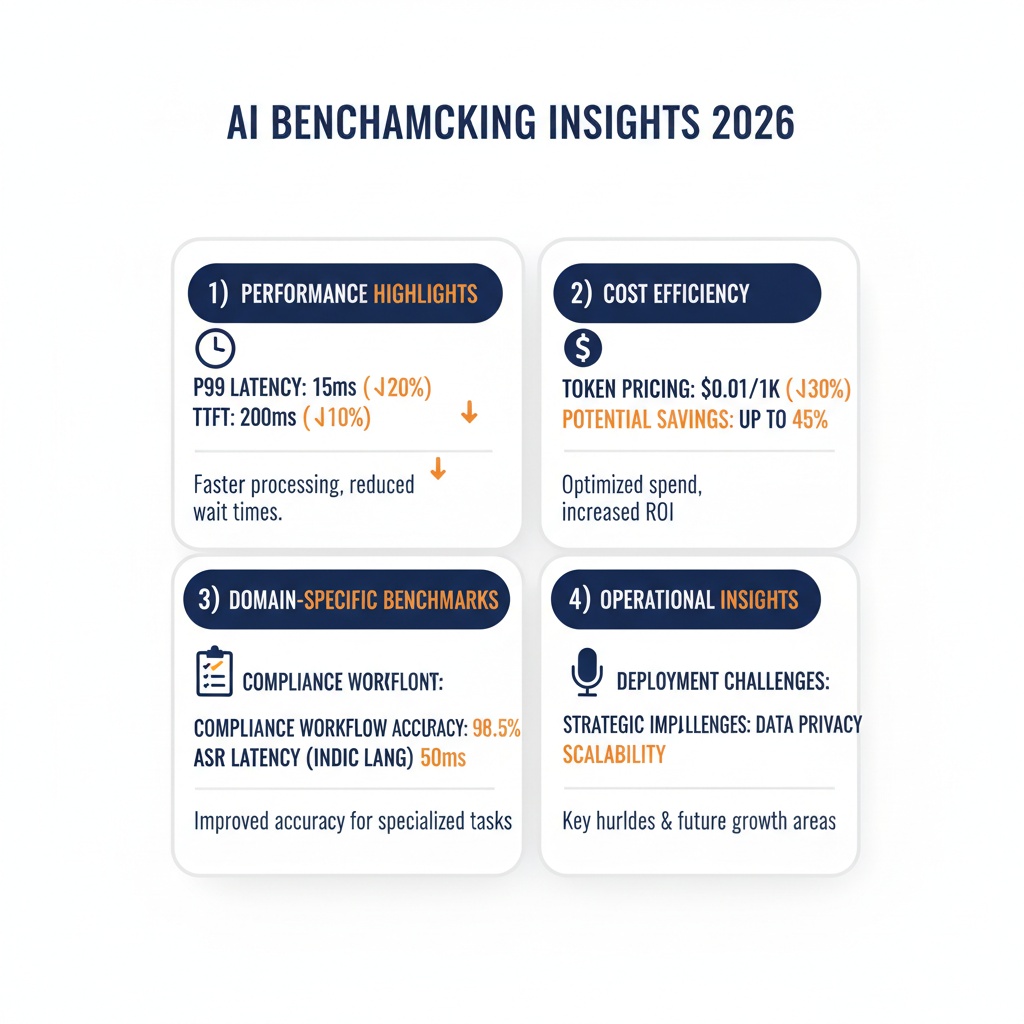
Infographic Image: AI Model Performance, Cost Efficiency, and Operational Maturity in 2026
The purpose of this analysis is to equip decision-makers and practitioners with a nuanced understanding of AI model capabilities beyond raw accuracy, emphasizing balanced trade-offs that reflect latency requirements, cost efficiency, and security considerations. By benchmarking both Western and Chinese AI ecosystems through extensive empirical data, the report sheds light on competitive dynamics and architectural innovations shaping the industry, including hardware independence and multi-agent orchestration.
The scope of this document integrates quantitative performance comparisons, domain-specific evaluation outcomes, and deployment challenges related to security and durability. Methodologically, it consolidates multi-region testing, cost analysis, and real-world use case assessments, serving a comprehensive lens for stakeholders to align AI integration approaches with business imperatives and evolving operational demands.
1. Benchmarking AI Model Performance and Cost Efficiency in 2026
In the rapidly evolving AI landscape of 2026, the metrics that define the viability of AI models have transcended traditional accuracy-focused benchmarks to emphasize operational realities crucial for large-scale deployment. Latency and throughput performance, paired with cost efficiency, form the cornerstone upon which real-world AI adoption strategies are built. These quantitative metrics provide a foundational framework for understanding how AI models translate theoretical capabilities into practical utility, directly influencing user experience and economic sustainability. As global providers vie for prominence, the intricate balance among responsiveness, throughput, and pricing disrupts conventional assumptions about premium models always commanding dominance, revealing instead a diversified ecosystem shaped by multifaceted trade-offs.
Establishing a rigorous, data-driven baseline of AI model performance and cost is essential for organizations aiming to optimize deployment architectures and align AI integration with business imperatives. This section examines benchmarking data drawn from extensive multi-region testing of leading AI offerings across Chinese and Western ecosystems, illuminating stark contrasts and nuanced capabilities that impact production decisions. The analysis grounds itself in real-world metrics such as Time to First Token (TTFT) and p99 latency under concurrent operation, complemented by a comparative cost structure disclosing pricing discrepancies reaching up to 40-fold. These elements collectively delineate the practical parameters within which AI systems must operate to ensure scalability, efficiency, and user retention—setting the stage for deeper evaluation of domain-specific applications and security considerations in subsequent analyses.
Latency and Throughput Benchmarking: A Comparative Analysis
Latency remains the pivotal performance indicator shaping AI user experience in 2026, with particular focus on the 99th percentile (p99) latency, reflecting tail-end delays that disproportionately degrade application responsiveness. Extensive benchmarking encompassing over half a million inference requests under sustained loads of up to 1000 requests per second reveals clear performance hierarchies. Chinese model DeepSeek V4 Flash demonstrates a compelling latency advantage with a p99 of approximately 0.9 seconds on long-context inputs (~128K tokens), contrasting sharply with Western flagship GPT-4o’s p99 latency of 3.2 seconds under comparable conditions. This represents a near 3.5-fold improvement, a critical factor in interactive domains where delays exceeding 800 milliseconds significantly impact user engagement metrics such as churn and session completion rates. The low-latency profile of models like DeepSeek V4 Flash and Step-3.5-Flash (with TTFT as low as 120 milliseconds and throughput nearing 80 tokens per second) enables near-instantaneous responsiveness, facilitating fluid conversational flows and real-time coding assistance scenarios.
Comparison of the 99th percentile latency in seconds for leading AI models under concurrent operations.
Conversely, models prioritizing complex reasoning capabilities, including Qwen3.5-397B, exhibit markedly higher TTFT values (exceeding 1200 milliseconds) and reduced throughput (~10 tokens per second), reflecting intensive pre-generation computation that trades immediacy for depth. This latency gradient necessitates strategic deployment architectures, where high-speed, cost-efficient models serve user-facing interactions while premium, slower models handle asynchronous or analytic workloads. Such tiered routing not only optimizes end-user experience but also underpins cost containment by aligning task complexity with suitable computational resources. Multiregional latency analysis further accentuates the importance of geographically distributed infra-structure, with Asian-hosted Chinese models consistently outperforming Western equivalents in regional TTFT metrics, underscoring the operational value of proximity and edge presence in global AI service architectures.
Cost Structures and Pricing Disparities: The Emerging Economic Landscape
Benchmarking data from 2026 rigorously exposes profound disparities in AI model pricing, with cost differences reaching up to 40 times between providers when normalized per million output tokens. Chinese offerings such as DeepSeek V4 Flash deliver competitive pricing at approximately $0.25 per million tokens, dwarfing Western model GPT-4o’s steep $10.00 per million tokens fee. This pricing gulf does not reflect a commensurate quality gap; DeepSeek V4 Flash achieves approximately 95% of GPT-4o’s performance on standard developer workflows, offering a compelling cost-performance nexus for enterprises. Similarly, Alibaba’s Qwen3-32B stands out with ultra-budget pricing of roughly $0.01 to $0.28 per million tokens depending on variant and deployment context, catering effectively to edge AI scenarios and less computationally intensive tasks.
The implications of these cost structures are transformative. For example, an enterprise with a moderate usage footprint of 10 million output tokens monthly could slash monthly AI expenses from $125 to under $5 by transitioning from GPT-4o to DeepSeek V4 Flash, scaling into thousands of dollars in annual savings at larger volumes. However, these economic advantages are nuanced by operational considerations including higher observed 429 error rates (retry triggers) in certain Chinese models—up to 3.2% during peak demand—requiring architecture designs resilient to intermittent throttling. Nonetheless, cost efficiency underpins emerging architectural patterns favoring hybrid deployment strategies that leverage the best attributes of diverse models, optimizing total cost of ownership without sacrificing responsiveness or accuracy. Developers increasingly adopt this economically astute model selection, orchestrating multi-tier infrastructure that balances premium quality demands with bulk AI processing needs.
Practical Deployment Implications: Balancing Latency, Throughput, and Cost
Interpreting the interplay between latency, throughput, and cost is paramount when architecting AI-enabled systems in 2026. Latency-sensitive applications, including conversational AI and interactive coding assistants, demand models with minimal TTFT and stable p99 latency to engender seamless user experiences. Models such as Step-3.5-Flash and DeepSeek V4 Flash provide optimal fits within these parameters, enabling sub-200 millisecond TTFT and throughput figures that support high-frequency user interactions. These performance characteristics, when integrated with regional endpoint optimizations, drive measurable improvements in retention and task completion rates, as evidenced by use cases demonstrating up to 15% retention gains and 10% higher session completions.
However, cost considerations inject a complex decision matrix. Premium models commanding high token costs necessitate judicious usage confined to tasks where superior reasoning or domain accuracy is indispensable, such as legal document analysis or financial audits. Conversely, mainstream workloads benefit from deployment of lower-cost, faster models without substantial compromise on output quality. The resultant architectural approach involves a hybrid multi-model routing scheme where latency-critical tasks are assigned to speedy, economical models, while batch or research-oriented requests route to slower, costlier models to optimize computational budgets. Further, geographic load balancing and endpoint selection ensure latency consistency and system resilience, vital to supporting global user bases with heterogeneous concurrency demands. This balanced architecture aligns operational responsiveness with financial prudence, reflecting a matured understanding of AI model economics that predicates sustainable, scalable deployment in 2026’s competitive ecosystem.
2. Domain-Specific Benchmarks and Real-World Use Cases of AI Models in 2026
The evolution of AI benchmarking in 2026 underscores a critical shift from isolated, raw performance metrics toward a nuanced understanding of contextual applicability within diverse industry domains and operational workflows. While previous analyses have laid the quantitative foundation—focusing on latency, throughput, and cost-efficiency—the practical successes and limitations of AI models increasingly depend on their real-world integration within multi-step workflows, linguistic diversity, and sector-specific regulatory frameworks. This section illuminates how leading AI models demonstrate differentiated value when tested against complex, domain-tailored scenarios, highlighting the growing gap between lab-based benchmark excellence and sustained, dependable production outcomes.
Building on the foundational benchmarking data, it is essential to grasp that the utility of AI models is no longer defined solely by their raw accuracy or throughput metrics but rather by their ability to support intricate operational demands such as compliance workflows, multilingual speech recognition under challenging acoustic conditions, and stringent production environments bound by regulatory oversight. As enterprises globally integrate AI into core workflows, understanding these domain-specific performance dynamics offers stakeholders a vital toolkit for selecting and deploying AI solutions that meet practical industry rigor without compromising efficiency or compliance obligations.
Multi-Step Compliance Workflow Benchmarks and Evolving Performance Trends
Compliance-related workflows present one of the most demanding contexts for AI model deployment, as they involve a sequence of interconnected cognitive tasks each requiring high precision, domain expertise, and contextual awareness. The EQS AI Benchmark Volume 2, released in early 2026, marks a pivotal moment by providing comprehensive results on multi-step compliance workflows, demonstrating how frontier AI models have approached a functional threshold where end-to-end automation is within tangible reach. This latest benchmark evaluated ten top-tier models on a wide array of 120 real-world compliance tasks, emphasizing multi-step processes such as classification, risk assessment, review routing, and mitigation strategy formulation within the Conflict of Interest procedural domain.
The results reveal a significant convergence of leading models—OpenAI’s GPT-5.4, Google’s Gemini 3.1 Pro, and Anthropic’s Claude Opus 4.6—all clustering within a narrow performance band around 86–88%. However, beyond raw scores, the more revealing insight lies in improved performance on open-ended compliance tasks, where models now shift outputs from "usable with heavy editing" to "usable with light review." GPT-5.4 notably achieved over 90% accuracy in each individual workflow step, indicating a robust capacity for supporting individual components of compliance pipelines reliably. Despite these encouraging gains, fully integrated, agentic multi-step workflows remain nascent, with seamless agent orchestration and contextual handoffs still requiring further refinement before large-scale enterprise adoption. These trends suggest that marginal differences in single-task model capabilities have become less decisive than architectural considerations for workflow connectivity and operational resiliency.
Furthermore, the rapid upward trend in multi-step performance underscores a critical inflection point: organizations are transitioning from traditional, segmented compliance reviews toward AI-augmented, end-to-end orchestration frameworks. This transition demands AI models not only excel in individual task accuracy but also maintain contextual consistency across sequential steps—a capability that is increasingly evaluated through simulated, workflow-driven benchmarking. Hence, multi-step compliance workflows serve as a bellwether for AI’s maturity in blending linguistic sophistication with procedural rigor, where performance stability over time and interpretability become pivotal deployment factors.
ASR Model Limitations with Indic Languages and Latency Challenges
Automatic Speech Recognition (ASR) remains a foundational technology for enabling voice-driven interfaces and services, particularly in markets with complex linguistic landscapes such as India. Despite considerable advances, recent findings from Gnani.ai's 2026 industry report illustrate persistent challenges that impede ASR model performance across Indic languages. The report, derived from surveys of over 800 voice AI developers and extensive real-world evaluations, indicates a striking 60% gap between benchmarked model accuracy and effective production deployment on Indian language inputs. This gap primarily stems from the mismatch between clean, laboratory-grade audio samples used in benchmarking and the noisy, code-switched, and often unpredictable acoustic environments encountered in actual phone calls and conversational contexts.
Critically, developers identify latency as a systemic bottleneck, with ASR processing times frequently exceeding 700 milliseconds—nearly double the acceptable real-time threshold for responsive voice agents. This elevated latency erodes user experience in live interactions, undermining the effectiveness of voice applications in high-volume customer support or mobile assistant scenarios where instantaneous feedback is expected. The challenge amplifies in the presence of background noise and rapid language switching among multiple Indic tongues within single utterances—conditions that drastically degrade model accuracy and consistency. While multilingual support remains a paramount selection criterion for developers, current models demonstrate uneven performance across the necessary minimum of eight Indic languages demanded by Indian production environments.
These insights highlight the pressing need for model architectures and training paradigms tailored explicitly for Indic languages and their acoustic realities. Unlike Western ASR systems predominantly trained on homogeneous, noise-controlled English datasets, practical deployments in India require models to incorporate robust noise adaptation, dialectal variability handling, and contextual language detection capabilities. Consequently, ASR vendors targeting Indic markets must prioritize deployment-aware optimizations over benchmark excellence alone, emphasizing low-latency architectures fused with domain-specific linguistic expertise. This realignment is critical for enabling voice AI applications that can scale reliably across diverse Indian user bases, further accentuating the gap between research benchmarks and sustainable field performance.
Industry-Specific AI Model Comparisons: Production Efficiency and Regulatory Alignment
Diverse industry verticals impose unique constraints on AI model performance, particularly concerning production efficiency and compliance with evolving regulatory environments. The technology and fashion industries exemplify sectors where AI adoption is rapidly reshaping workflows while demanding precision, adaptability, and regulatory foresight. Insights from the 2026 VIVATECH spotlight reveal how AI models underpinning domain-specific platforms drive differentiated impacts on operational KPIs and compliance adherence, underscoring the practical nuances of AI deployment in specialized contexts.
In the technology sector, Ninewatt’s Opti platform leverages AI to optimize energy management within smart buildings, achieving substantial reductions in electricity costs and carbon emissions without additional hardware investments. The platform’s AI backbone prioritizes tariff structure analysis and renewable energy integration, demonstrating that model selection strategies must accommodate realtime adaptation to external policy and pricing fluctuations. Similarly, Alibaba’s Qwen 3.7-Max and Baidu’s ERNIE 5.1 models are often chosen for manufacturing and retail workflows in China due to their proven hardware independence, cost efficiency, and compatibility with multi-agent orchestration—features critical for sustaining large-scale, cross-site operations subject to strict government standards on data sovereignty and operational transparency.
A comparative cost analysis emphasizes these points: for example, Chinese models such as DeepSeek V4 Flash and Qwen3-32B deliver dramatically lower operational expenses, costing only $0.25 and $0.14 per million output tokens respectively, compared to $10.00 for a representative Western model, GPT-4o [Chart: Cost Per Million Tokens for AI Models]. This cost efficiency aligns with performance advantages observed in throughput and latency, where DeepSeek V4 Flash and Step-3.5-Flash achieve time to first token (TTFT) as low as 120 milliseconds and throughput rates of 80 tokens per second—substantially outperforming the Qwen3.5-397B model that exhibits TTFT exceeding 1200 milliseconds and throughput limited to 10 tokens per second [Table: Performance Metrics of AI Models in 2026].
In fashion, Lab of Apparel’s Fashion OS harnesses AI to revolutionize apparel production by automatically transforming design images into detailed technical specifications, bills of materials, and development plans. This application emphasizes supply chain digitization and regulatory alignment, particularly adhering to regulations such as the European Ecodesign for Sustainable Products Regulation (ESPR). The model powering Fashion OS excels in multimodal processing and real-time material recommendation, significantly accelerating lead times from months to under 45 days and lowering defect rates. These improvements illustrate that in fashion, AI models integrating multimodal inputs and dynamic regulatory databases offer a tangible competitive edge by simultaneously advancing production efficiency and compliance.
These use cases collectively reveal that optimal AI model deployment in industry sectors transcends pure benchmark metrics, demanding tailored adaptability to operational criteria such as energy consumption patterns, supply chain responsiveness, and jurisdictional regulatory frameworks. Furthermore, the success of Chinese AI models in manufacturing and retail, centered on hardware independence and agentic orchestration, signals a paradigm where contextual flexibility and ecosystem integration become as crucial as raw model accuracy. Stakeholders must therefore evaluate AI solutions through a prism of domain-specific capabilities, ecosystem synergy, and regulatory readiness to secure sustainable technology and fashion industry transformations.
3. Security, Durability, and Practical Deployment Challenges of AI Models
As the transformative capabilities of AI models increasingly underpin mission-critical operations across industries in 2026, the spotlight shifts beyond mere performance metrics toward the operational reliability and trustworthiness of these systems. This maturation of AI adoption places a premium on aspects such as security, durability, and sustainable deployment methodologies—factors that dictate whether AI-driven solutions can be effectively and safely scaled in complex, real-world environments. Following a detailed exploration of benchmarking data and domain-specific model efficacy, it is imperative to address these non-performance facets that fundamentally underpin AI integration success. Without rigorous focus on security risks unique to AI-generated outputs, and the engineering disciplines ensuring long-term system coherence, the undeniable gains in speed and cost-efficiency risk being undermined by cascading operational failures or exploit exposures. Thus, this section anchors the global narrative by emphasizing practical governance and engineering frameworks that safeguard AI’s evolving roles while enabling durable, autonomous deployments in heterogeneous production settings.
Closing the chapter on raw benchmark and applied domain analysis, this discussion intersects with the pressing challenges encountered when AI models propagate errors or produce insecure outputs that standard software validation paradigms cannot easily detect or mitigate. It advances the conversation by introducing Harness Engineering as a critical architectural approach to achieve sustained model reliability over extended operational horizons. Additionally, innovations in physical AI reasoning models offer a glimpse into how integrated world understanding and action capabilities can support robust, interpretable automation workflows resistant to drift and failure. Collectively, these insights form a comprehensive perspective on how AI models transition from experimental tools to resilient infrastructure components—mandating a shift from classical performance-centric evaluation to holistic lifecycle governance and system durability.
Security Risks Unique to AI-Generated Outputs and Mitigation Strategies
Unlike traditional software artifacts, AI-generated outputs, particularly in code generation and decision-support contexts, carry unique security challenges that transcend conventional vulnerability and threat models. These include propagated biases, subtle semantic errors, and false confidence illusions—where AI outputs present plausible but incorrect or insecure constructs with high linguistic conviction. The difficulty lies not only in the outputs’ unpredictability but also in the limitations of existing static code analysis and manual review processes, which often fail to detect sophisticated AI-induced faults or security gaps. The prevalence of these weaknesses fundamentally elevates risk in AI-assisted development pipelines and operational environments that ingest AI outputs without comprehensive safeguard layers.
Mitigation frameworks adopted in 2026 pivot on multilayered guardrails embedding security at every stage of AI deployment. These strategies integrate deterministic constraint enforcement, context-aware validation, and ongoing auditing to curtail unsafe outputs before they propagate downstream. One emerging best practice involves automated enforcement of behavioral constraints analogous to architectural compliance rules: code or output fragments deviating from pre-approved patterns or exceeding operational boundaries are instantly flagged or rejected, effectively converting policy adherence from best-effort guidance into hard system guarantees. This parallels traditional access control but is extended into the semantic domain of AI output generation, adding a novel dimension to continuous security assurance.
Complementing enforced constraints, runtime monitoring systems now incorporate anomaly detection for AI-generated artifacts where deviations from normal operational profiles raise immediate alerts. Monitoring solutions leverage heuristics, context sensitivity, and statistical profiling to identify plausible hallucinations, unauthorized data exposure risks, or logic inconsistencies that might otherwise evade static checks. Furthermore, incorporating human-in-the-loop supervisory control remains vital, especially in initial deployment phases where human expertise augments automated systems. Over time, feedback loops from ongoing human validation inform retraining and model tuning cycles, continuously refining AI alignment with security objectives. These layered approaches collectively mitigate emerging attack surfaces unique to AI and strengthen trust in AI-assisted automation within sensitive environments.
Harness Engineering: Concept and Practical Application for System Durability
A defining challenge for enterprise AI in 2026 is not solely the raw intelligence or isolated accuracy of individual models, but their operational durability— the ability to sustain coherent, reliable output across long-running, multi-step workflows often spanning hundreds of sequential interactions. This issue, commonly known as model drift, manifests as gradual degradation in instruction adherence, compounding errors, and contextual inconsistency when deployed in autonomous or semi-autonomous pipelines. Harness Engineering emerges as the pioneering discipline addressing this problem, emphasizing that robust AI deployment necessitates an architectural framework that supports system-level coherence, error containment, and lifecycle management extending well beyond the model itself.
At its core, Harness Engineering reconceptualizes AI deployment architecture with an analogy to classical operating systems. The AI model functions as a computational core or CPU, while the context window behaves akin to RAM, holding transient state and information. The Agent Harness operates as the operating system—a management layer that orchestrates resources, enforces behavioral constraints, persists state across interactions, and orchestrates multiple sub-agents or tools. This fundamental separation allows AI applications—akin to user-level processes—to function dependably in a stable runtime environment, mitigating drift and failure modes that arise when models are used as stateless or loosely managed components.
Practically, Harness Engineering involves building and deploying a tri-layer architecture: First, Context Engineering ensures the agent operates on accurate, dynamically updated, and domain-relevant information rather than stale or generic data. This continuous enrichment of context includes real-time integration with codebases, execution logs, business rules, and organizational data. Second, Architectural Constraints implement automated, deterministic guardrails that prevent unacceptable outputs through compile-time or runtime validations, error recovery mechanisms, and enforced policy adherence. Third, Garbage Collection mechanisms are introduced—dedicated monitoring agents scan ongoing AI operations to detect inconsistencies, constraint violations, or quality degradation and autonomously trigger remediation. The cumulative effect of this layered, durable system design significantly prolongs AI operational viability, reduces manual intervention needs, and raises confidence in autonomous deployments.
Innovations in Physical AI Reasoning Models Supporting Robust Real-World Automation
Beyond challenges of textual AI outputs, 2026 has witnessed significant breakthroughs in physical AI reasoning models that underpin autonomous robotics, smart environments, and real-world automation workflows requiring integrated perception, prediction, and action capabilities. NVIDIA Cosmos 3 exemplifies this frontier, delivering an open-source foundation model architected specifically for physical AI: uniting vision-language multimodal reasoning with physics-aware scene generation and action planning within a coherent, dual-tower Mixture-of-Transformers architecture.
Cosmos 3’s reasoner tower interprets multimodal sensory inputs—images, videos, textual data—constructing a rich, contextual understanding of dynamic physical environments. This enables predictive reasoning about object interactions, motion states, and environmental changes in real time. Coupled with a generator tower employing diffusion techniques conditioned on reasoner outputs, the model synthesizes plausible future scenarios, action sequences, and video-based world states. Such integrated reasoning and generation support a variety of applications, ranging from autonomous vehicle navigation to warehouse robot manipulation and smart building management.
Crucially, this unification streamlines the development and deployment of physical AI systems by eliminating brittle multi-model orchestration commonly required in prior frameworks. Additionally, Cosmos 3’s open release of training recipes, datasets, and optimized microservice deployment stacks empowers enterprises to adapt these capabilities rapidly for their unique operational domains—fostering robustness and interpretability fundamental to scaled autonomous AI applications. The model’s superior performance on emerging benchmarks targeting physical reasoning, video generation quality, and anomaly detection substantiates its capacity to deliver resilient and trustworthy automation, thus addressing durability not only in cyber but also in the physical AI space.
Conclusion
In conclusion, the 2026 AI model benchmarking landscape reveals a maturing industry where pragmatic performance metrics—especially latency, throughput, and cost—have become decisive factors shaping deployment decisions. The pronounced cost advantages and responsiveness exhibited by Chinese AI models are redefining competitive paradigms, compelling a reassessment of traditional Western dominance in the AI space. However, these advantages coexist with nuanced challenges, including elevated error rates under peak demand and emerging security vulnerabilities intrinsic to AI-generated outputs.
Looking forward, embracing multi-model, hybrid deployment architectures aligned with domain-specific requirements will be essential to harness AI’s full potential. The development and adoption of engineering disciplines such as Harness Engineering offer promising frameworks to ensure long-term system durability and trustworthiness, extending the concept of AI evaluation beyond isolated benchmark scores towards sustained operational excellence. Further analysis is warranted to refine security guardrails, contextual adaptability, and physical AI reasoning models, fostering resilient AI ecosystems capable of safe and scalable enterprise integration.
Glossary
- Latency: The time delay between an input to an AI model and the model's output, critically impacting responsiveness in real-time applications.
- Throughput: A measure of how many tokens or units an AI model can process per unit of time, reflecting its capacity to handle workloads.
- Time to First Token (TTFT): Latency metric representing the time from the model receiving a prompt to the generation of the very first output token, indicating initial responsiveness.
- p99 Latency: The 99th percentile latency value, representing the maximum response time experienced by 99% of requests, highlighting tail-end delays affecting user experience.
- Multi-agent Orchestration: An architectural approach where multiple AI agents or models coordinate to perform complex tasks, improving efficiency and scalability.
- Harness Engineering: A system-level architectural discipline designed to maintain AI system durability by managing context, enforcing constraints, and preventing drift over extended workflows.
- Model Drift: The gradual degradation of AI model performance or adherence to instructions over time during prolonged or sequential deployments.
- Automatic Speech Recognition (ASR): Technology enabling AI systems to convert spoken language into machine-readable text, foundational for voice-driven interfaces.
- Agentic AI: AI systems capable of autonomous decision-making and multi-step task execution through orchestrated agent behaviors.
- Physical AI Reasoning Models: AI models combining multimodal inputs and physics-aware reasoning to understand and predict real-world environmental interactions for automation.
- Latency-Sensitive Applications: Applications requiring very low delay times from input to output, such as conversational AI and real-time coding assistants.
- Cost Efficiency: A measure comparing AI model performance relative to its operational or usage cost, guiding deployment choices for economic sustainability.
- Security Risks in AI-Generated Outputs: Unique vulnerabilities arising from AI outputs, including biases, false confidence, and unseen semantic errors that may compromise safety or integrity.
- Compliance Workflows: Structured, multi-step business or regulatory procedures that AI models assist with by automating risk assessment, classification, and mitigation.
- Multi-Step Workflows: Processes where AI systems perform sequences of interrelated tasks requiring consistency and contextual understanding across steps.
References
- EQS AI Benchmark Volume 2: Latest Frontier Models Make Agentic Compliance Workflows a Practical Reality
- Nvidia Cosmos 3
- Real-World Benchmarks and Practical Challenges of AI Models in 2026 Software Development
- What is Harness Engineering?
- Navigating the New AI Landscape in 2026: Balancing Performance, Cost Efficiency, and Security
- Innovations and Frontline AI Model Comparisons Shaping Tech and Fashion Industries in 2026
- Gnani.ai Releases India’s First Industry Report on the State of ASR Across Indic Languages
- Chinese AI Models 2026: The Agentic Revolution, Hardware Independence, and What It Means for Global Developers