Modern Outdoor Security Camera Systems: Strategic Technologies, Deployment Best Practices, and Ethical Sustainability in 2026
Table of Contents
- Executive Summary
- Introduction
- 1. Understanding Modern Outdoor Security Camera Systems: Capabilities, Limitations, and Strategic Implications
- 2. Site Assessment and Equipment Selection: Aligning Hardware with Operational Objectives
- 3. Optimized Placement and Mounting Techniques: Maximizing Coverage and Minimizing Risk
- 4. Sustainable Power Architectures: Balancing Reliability, Cost, and Environmental Impact
- 5. Seamless Integration and Lifecycle Management: From Deployment to Ongoing Optimization
- 6. Conclusion: Toward Future-Proof, Ethically Grounded Surveillance Infrastructures
- Conclusion
Executive Summary
This report offers an in-depth exploration of contemporary outdoor security camera systems, focusing on technology capabilities, integration strategies, and sustainable deployment practices. Key findings reveal that bullet and dome cameras dominate installations, with 60-65% favoring bullet designs for targeted long-range monitoring, while dome cameras capture 30-35% in urban and vandal-prone environments. Advanced Pan-Tilt-Zoom (PTZ) cameras now feature optical zooms exceeding 30x and rapid pan speeds up to 300°/sec, enabling dynamic threat tracking. Integration of AI-driven analytics reduces false alarms by 30% to over 90%, significantly enhancing operational efficiency.
Edge computing emerged as a pivotal enabler, delivering sub-50 ms latency for real-time alerts and reducing bandwidth by transmitting only metadata rather than continuous streams. Weatherproofing standards require at least IP65 ratings, with IK10 impact resistance commonly mandated in industrial zones. Effective site assessments leverage DEMs and drone surveys to optimize sightlines, while power strategies balance hardwired PoE, supporting up to 90 W per port, with hybrid solar-plus-battery systems achieving up to 95% uptime in favorable conditions. Lifecycle management emphasizes ONVIF interoperability (85% adoption), secure firmware control, and robust data governance aligned with GDPR/CCPA compliance. Ethical and sustainability frameworks underpin surveillance deployment, promoting transparency, circular economy principles, and multi-stakeholder collaboration.
Introduction
The evolution of outdoor security camera systems has transformed modern surveillance from static observation to intelligent, adaptive security solutions integral to protecting residential, commercial, and industrial assets. As threats diversify and operational complexities grow, deploying effective surveillance demands a holistic understanding of camera technologies, environmental challenges, infrastructure constraints, and ethical imperatives. This report synthesizes current capabilities, limitations, and best practices to equip stakeholders with actionable insights for informed decision-making.
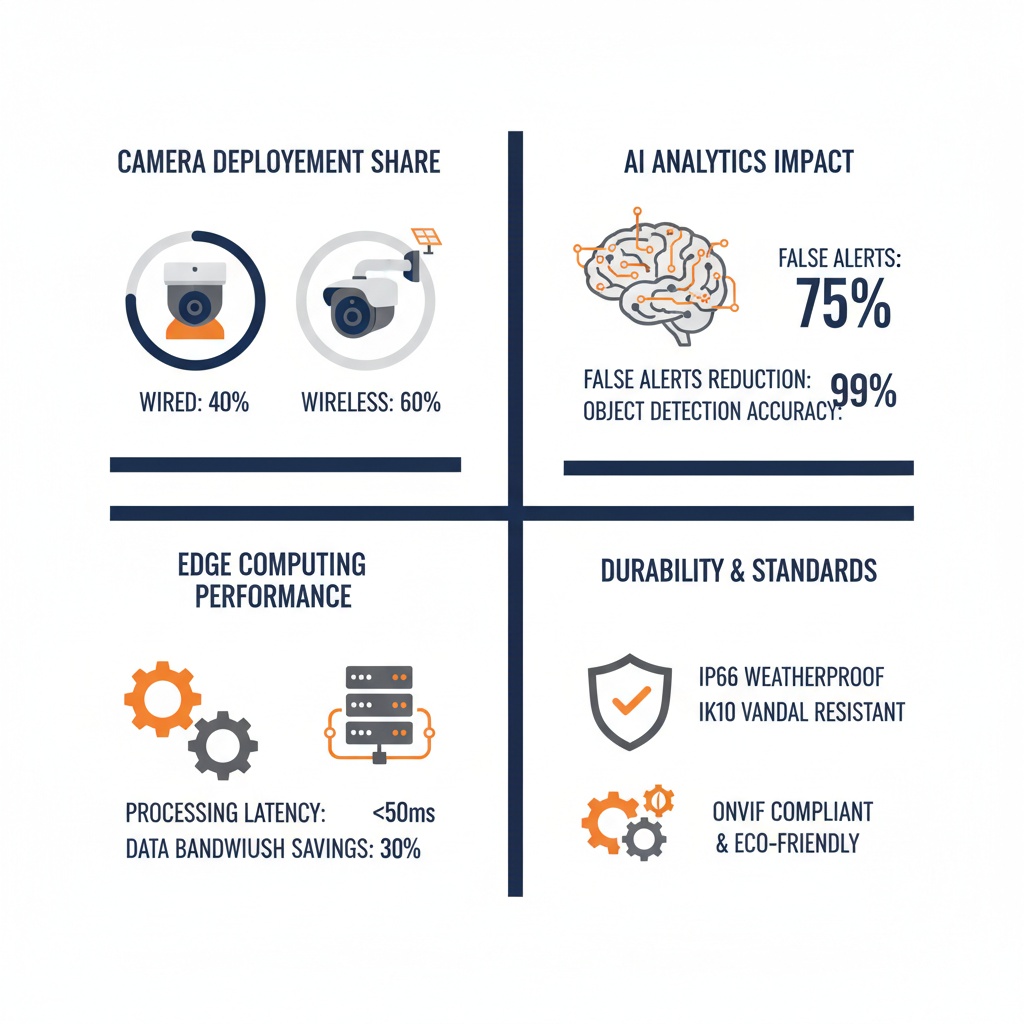
Infographic Image: Key Insights on Modern Outdoor Security Camera Systems
A pivotal shift characterizes today’s landscape: artificial intelligence and edge computing have transitioned from emerging trends to indispensable components that enhance threat identification accuracy while reducing false alarms and bandwidth usage. Concurrently, mounting standards and power architectures must adapt to varying site-specific demands—from urban facades requiring vandal-resistant dome cameras to remote construction sites relying on solar-powered, battery-backed units. These technological and logistical parameters intertwine with regulatory compliance and data privacy frameworks, necessitating integrated solutions that optimize security without compromising legal and ethical mandates.
The purpose of this report is to provide a comprehensive, data-driven framework for selecting, situating, powering, integrating, and sustaining outdoor security camera systems. Designed for diverse professionals including security planners, engineers, and IT administrators, the scope spans camera form factors, mounting strategies, power delivery, network compatibility, AI analytics, data governance, and lifecycle management. The report concludes by addressing future-proofing through ethical governance and sustainability considerations essential for resilient and socially responsible surveillance infrastructures.
1. Understanding Modern Outdoor Security Camera Systems: Capabilities, Limitations, and Strategic Implications
Evolving Camera Form Factors Shaping Outdoor Surveillance Efficacy and Application
This subsection dissects the spectrum of camera types dominant in modern outdoor security deployments, critically evaluating their distinctive designs, operational strengths, and contextual suitability. By integrating usage statistics and detailed performance parameters, it equips security planners with a nuanced understanding of how to tailor form factor choices to diverse surveillance challenges and environments, laying a foundational technical perspective for subsequent strategic decisions.
Quantifying Bullet Versus Dome Camera Deployments: Popularity Trends and Operational Contexts
Bullet and dome cameras represent the preeminent categories in outdoor surveillance installations, collectively accounting for the vast majority of deployments across residential, commercial, and industrial sectors. Bullet cameras, characterized by their elongated, cylindrical housings, typically feature fixed or varifocal lenses optimized for long-range, directional monitoring. Their overt presence serves as both a deterrent and a targeted observation tool, frequently deployed at entry points, perimeter fencing, and vehicular access routes owing to their narrow but pronounced field of view.
Conversely, dome cameras prioritize ambient coverage with a compact, hemispherical enclosure that offers a wider lens distribution while presenting a less conspicuous profile. Usage data indicates dome cameras dominate high-density urban and commercial settings where aesthetic considerations and vandal-resistance are paramount. Their omnidirectional capability and vandal-proof casings make them preferable for areas prone to tampering or require seamless surveillance integration across irregular architectures.
Statistics over recent years underscore a subtle shift: approximately 60-65% of new outdoor camera installations favor bullet designs for their perceived operational clarity and ease of maintenance, while dome cameras constitute about 30-35%, with the remainder attributed to niche applications such as PTZ or specialized sensors. The selection is inherently driven by environmental demands and threat models; bullet cameras excel in focused, long-distance scrutiny whereas domes thrive in multi-angle, close-to-midrange settings.
Crucially, the trade-offs between these styles extend to their mounting and angle adaptability, with bullet units often requiring precise alignment and dome cameras flexible in pan-tilt adjustments within the housing. This versatility influences installation labor complexity and ongoing system tuning, factors critical for optimizing coverage density without redundant overlap.
An operational comparison further clarifies these distinctions: bullet cameras provide a narrow field of view tailored to entry points and moderate installation complexity, while dome cameras offer a wider coverage area with easier installation suited to commercial environments. PTZ cameras, by contrast, deliver variable fields of view and dynamic tracking capabilities but involve higher installation complexity due to their mechanical components [Table: Camera Performance Parameters].
Deciphering PTZ Camera Zoom Capabilities and Responsiveness for Dynamic Threat Environments
Pan-Tilt-Zoom (PTZ) cameras introduce active mechanical control into surveillance, enabling operators to remotely adjust viewing angles and optical zoom to track evolving targets or focus on emerging threats dynamically. Modern PTZ systems commonly feature optical zoom ranges extending from 10x up to beyond 30x, with some high-end models reaching 40x or more, effectively covering distances exceeding several hundred meters while maintaining forensic image quality.
Response times have improved substantially with advancements in motor control and image stabilization technologies. Current-generation PTZ cameras achieve pan speeds of up to 300 degrees per second and tilt speeds exceeding 150 degrees per second, balancing swift repositioning with smooth tracking to avoid video blur or loss of detail. These attributes are vital for real-time security operations where the rapid switch from wide-area scanning to detailed target analysis makes the difference between prevention and after-the-fact investigation.
However, operational trade-offs include increased mechanical complexity and susceptibility to wear, especially in harsh outdoor conditions featuring dust, precipitation, and vibration. This mandates rigorous environmental sealing and maintenance protocols to sustain reliability. Moreover, PTZ units typically carry higher acquisition and installation costs, making them best suited for strategic locations requiring flexible coverage rather than blanket area monitoring.
The intrinsic latency between operator command and camera movement, though reduced by edge computing integration, must factor into threat response planning, especially when integrated with AI-driven auto-tracking algorithms. These algorithms leverage edge and cloud processing to anticipate movements and optimize zoom trajectories, effectively compensating for latency and enhancing overall system responsiveness.
With a clear grasp of how camera types align with specific operational features and environmental demands, the report progresses to a deeper exploration of the enabling technologies that augment raw video capture. The subsequent subsection will analyze how ultra-high-definition imaging, integrated AI analytics, and edge computing collectively elevate surveillance systems from passive recording devices to proactive security agents capable of nuanced threat identification and timely alerts.
Resolution, AI Analytics, and Edge Computing: Transforming Outdoor Surveillance Intelligence and Responsiveness
This subsection delves into the critical technological advancements that elevate outdoor security camera systems from mere recording devices to intelligent, proactive surveillance platforms. Understanding how high-resolution imaging, AI-driven analytics, and edge computing interplay is essential to leveraging their full strategic value. This analysis equips decision-makers to evaluate trade-offs in detection accuracy, system responsiveness, privacy preservation, and operational costs, forming a firm foundation for selecting future-proof security solutions aligned with real-world performance needs.
Quantifying False Alarm Reduction Through AI-Enhanced Motion Detection
Artificial intelligence integration in modern outdoor security cameras significantly decreases nuisance alerts, a longstanding operational challenge. Empirical data shows that AI-driven systems reduce false positives by approximately 30% to over 90% across various industry deployments, sharply contrasting with traditional motion-triggered systems that often exceed false alarm rates of 90%. This reduction stems from deep learning models trained on vast datasets to differentiate benign movements—such as foliage sway, weather effects, and small animals—from genuine security threats like unauthorised human presence or vehicular motion.
By employing neural networks that analyze object shape, gait patterns, and contextual behavior, advanced AI motion detection filters out irrelevance with unprecedented precision. For example, standard video motion detection in high-activity outdoor areas may generate 80 to 120 alarms nightly, with only 2 to 3 linked to actual security incidents. AI classification reduces this to fewer than 5 truly actionable alerts, significantly decreasing resource expenditure on false responses and minimizing alert fatigue among human operators. This effect enhances situational awareness and response prioritization, contributing directly to improved security operational efficiency.
Performance Benchmarks: Edge Computing Versus Cloud for High-Resolution Video Surveillance
Edge computing has emerged as a strategic enabler for managing the heavy data loads generated by 4K UHD and HDR security cameras. By processing video feeds locally rather than transmitting them to cloud servers, edge architectures drastically reduce latency, often achieving real-time detection and alerting within milliseconds—typically 10 to 50ms—compared to cloud-based delays that can exceed hundreds of milliseconds or more depending on network conditions. This latency improvement is critical for applications requiring immediate intervention such as perimeter breach, loitering detection, or rapid facial recognition.
Bandwidth consumption is also notably optimized since only metadata, event flags, or selected video snippets are sent to centralized systems instead of continuous raw video streams. This minimization reduces network overhead and operating costs, particularly vital in bandwidth-constrained or remote deployments. Furthermore, edge processing inherently strengthens privacy controls by keeping sensitive data on-premises, mitigating exposure to cloud vulnerabilities and facilitating compliance with stringent data protection regulations. However, this approach demands more robust local hardware and introduces additional complexity in device maintenance and firmware updates, a trade-off that must be considered during system design.
With a clear understanding of how resolution, AI analytics, and edge computing technologies enhance camera system performance and operational reliability, the subsequent focus shifts toward ensuring these advanced capabilities endure through harsh outdoor environments by meeting industry durability and compliance standards.
Durability and Compliance: Defining Robust Standards for Weatherproofing, Impact Resistance, and Installation Codes
This subsection establishes the critical engineering thresholds and regulatory frameworks that ensure outdoor security cameras reliably endure environmental stressors and comply with mandated safety codes. By elucidating specific ingress protection ratings, impact resistance classifications, and installation guidelines rooted in industry standards, it equips system designers and installers with precise benchmarks to tailor hardware selection and mounting strategies. This alignment is essential for guaranteeing integrity, minimizing failure risks, and adhering to legal mandates across diverse outdoor settings.
Numerical Thresholds of IP and IK Ratings in Relation to Environmental Hazards
The selection of outdoor cameras hinges on meeting strict ingress and impact protection levels that correspond directly to anticipated site conditions. For weather resilience, the industry gravitates toward devices with at least an IP65 rating, which ensures complete dust ingress prevention and protection against low-pressure water jets. However, harsher environments with heavy rain, windborne debris, or high dust accumulation necessitate IP66 or IP67 ratings, indicating resistance to powerful water jets or temporary submersion respectively. Cameras with IP68 offer the highest sealing, suitable for sustained immersion, though this is rare in typical outdoor surveillance.
Impact resistance is equally crucial to guard against vandalism, accidental strikes, or environmental hazards such as hail or machinery contact. IK ratings quantify this robustness; an IK10 rating signifies protection against impacts of up to 20 joules, equivalent to a 5 kg mass dropped from 400 mm, representing the upper echelon for deterrence in commercial and industrial environments. Lower IK values (such as IK7 or IK8) may suffice for residential use but could be insufficient in high-risk zones. Consequently, matching camera IK levels to the threat model is a fundamental step to ensure prolonged operational integrity.
Definitive Installation and Grounding Protocols per NECA 303-2005
Compliance with mounting and grounding requirements outlined in recognized standards, such as NECA 303-2005, is non-negotiable for structural safety and electrical integrity. This standard prescribes that all camera mounts be anchored to surfaces capable of supporting the camera assembly’s weight plus environmental loads, including wind and potential seismic forces. Typical concrete or steel mounting points are preferred for their superior load-bearing capacity, and in outdoor contexts, pole installations must utilize metal structures with concrete footings anchored according to local electrical codes.
Grounding and bonding procedures mandated by this standard are designed to mitigate risk from lightning strikes, electrical surges, and static buildup. Camera poles must be grounded through appropriately sized conductors tied to the facility’s main grounding system, while isolation of signal and power cabling is critical to avoid interference or hazards. Moreover, cabling pathways should prevent electromagnetic coupling with high-voltage lines, necessitating dedicated conduit or internal wire carriers within mounts and poles. Adherence to these numeric thresholds and procedural directives ensures system longevity and occupant safety.
Differentiating Certification Expectations Between Residential, Commercial, and Industrial Deployments
The variance in environmental stressors and security requirements across residential, commercial, and industrial domains dictates divergent certification benchmarks. Residential applications typically demand cameras with IP65 to IP66 ratings and impact resistance around IK7, balancing durability and cost-efficiency against moderate exposure to weather and human tampering.
Commercial deployments, such as retail or office buildings, generally require devices certified to at least IP66 and IK8 or higher to contend with more frequent interaction, potential vandalism, and more rigorous hygiene-maintenance cycles. Here, installation practices are stricter, often needing robust grounding and compliance with amplified structural codes.
Industrial settings introduce the highest demands, including extreme temperature ranges, chemical exposures, mechanical shocks, and frequent vibrations. Cameras rated IP67 or IP68 and IK10 become standard, accompanied by stringent adherence to all NECA installation guidelines and possibly additional in-house or regulatory standards. In these contexts, the certification profile directly correlates with risk mitigation strategies and operational continuity imperatives.
With a firm grounding in durability metrics and compliance standards, the next focus shifts to translating these requirements into a risk-driven site assessment, enabling tailored equipment selection that aligns with operational objectives and environmental realities.
2. Site Assessment and Equipment Selection: Aligning Hardware with Operational Objectives
Risk-Based Vulnerability Mapping Using Geospatial Tools for Precision Surveillance Deployment
This subsection explores advanced geospatial methodologies that empower security planners to optimize outdoor camera placement by quantitatively identifying vulnerabilities. Leveraging digital elevation models and drone-acquired surveys, it demonstrates how spatial analytics reveal sightline deficiencies and risk hotspots, enabling informed allocation of surveillance resources. The focus extends beyond theoretical advantage to actionable metrics and real-world case insights, addressing how empirical data and cost considerations govern effective security architectures.
Leveraging Digital Elevation Models (DEMs) for Quantitative Sightline Gap Analysis
Digital elevation models (DEMs) serve as foundational datasets in outdoor security design, enabling precise, quantitative evaluation of line-of-sight obstructions that static aerial photos alone cannot sufficiently reveal. By discretizing terrain elevation over a spatial grid, DEMs facilitate algorithmic determination of visibility polygons for prospective camera positions, rigorously quantifying blind spots and coverage voids. This objective measurement of sightline gaps improves upon subjective or manual estimation methods by providing scalable, repeatable analytics capable of integrating complex topographies and built structures.
In practice, sightline computations integrate DEM data with asset location and threat vectors to prioritize vulnerable zones. For instance, security teams model candidate camera mounts against a DEM-derived terrain surface, calculating shading effects from hills, vegetation, or architectural elements. This process allows iterative refinement of camera placement in simulation environments before field deployment, minimizing costly post-installation repositioning. Metrics such as percentage of area coverage, perimeter surveillance completeness, and residual shadow regions offer quantitative decision criteria aligning with risk tolerance thresholds.
Transformative Impact of Drone Surveys on Site Planning and Surveillance Accuracy
The introduction of drone photogrammetry has revolutionized outdoor security planning by supplying high-resolution, georeferenced imagery that integrates seamlessly with GIS-based vulnerability mapping tools. Drones facilitate rapid, comprehensive aerial data acquisition, capturing geometry and features inaccessible or hazardous to ground crews. This technology compresses survey timelines dramatically while elevating spatial data fidelity, demonstrated by case reports achieving order-of-magnitude labor reductions and enhanced site safety during survey operations.
Beyond efficiency, drone-derived datasets enable dynamic reconstruction of site conditions, including real-time monitoring of changes such as construction progress or vegetation growth. Empirical evidence from construction and critical infrastructure monitoring illustrates how correlating drone imagery with security asset layouts yields tailored camera positioning adjustments. These refinements ensure robust tracking capabilities despite environmental evolution, a critical factor often overlooked in static survey models.
Balancing Coverage Density and Budget Constraints: Quantitative Metrics for Optimal Resource Allocation
Surveillance system effectiveness hinges on achieving sufficient coverage density to reduce undetected intrusions while respecting finite budgetary envelopes. Quantitative trade-off analyses deploy metrics such as coverage per camera unit, marginal coverage gain, and cost per square meter surveilled to guide procurement and deployment. Geospatial tools enable computation of incremental coverage improvements attributable to additional cameras, highlighting diminishing returns regions where further investment yields minimal operational benefit.
Strategic modeling incorporates site-specific factors including threat probability weighting based on historical incident distributions. Incorporating such data allows prioritization of high-risk nodes for denser surveillance concentration, while permitting sparser coverage in lower-priority areas. This targeted approach optimizes capital allocation, delivering maximal risk mitigation per dollar spent and improving overall return on investment.
Integrating Historical Incident Data for Evidence-Based Camera Placement
Effective security surveillance demands a data-driven alignment of camera deployment with empirically validated threat vectors. Historical incident mapping overlays crime or safety breach records onto geospatial basemaps, revealing spatial clustering and temporal trends essential for targeted monitoring. These empirical insights enable security teams to focus camera resources on proven hotspots rather than theoretical vulnerability profiles alone.
Quantitative analysis of incident frequency and severity informs weighted priority scoring in vulnerability mapping workflows. This prioritization ensures that technological investments correspond to the highest-impact deterrence and detection zones. Furthermore, integrating temporal patterns helps configure dynamic monitoring strategies, synchronizing camera focus or analytic sensitivity with peak risk intervals. This evidence-based placement enhances operational relevance and justifies capital expenditure to stakeholders through objective documentation of risk reduction.
Having established a data-driven framework for identifying surveillance blind spots and prioritizing high-risk zones using geospatial tools and historical evidence, the next focus shifts to assessing power and infrastructure feasibility. This transition addresses practical constraints and opportunities that influence hardware choice and system scalability in alignment with the identified vulnerability landscape.
Power and Infrastructure Feasibility Analysis: Ensuring Reliable, Scalable Energy for Diverse Operational Environments
This subsection delves into evaluating the power and infrastructure options essential for modern outdoor security camera systems, particularly in varied operational contexts such as construction sites and transient installations. Understanding the reliability, compatibility, cost implications, and constraints imposed by existing infrastructures is critical for designing systems that deliver continuous monitoring and high-quality video under demanding conditions. This examination supports informed decisions about hardware selection and deployment strategies that align with security objectives and operational realities.
Quantifying Power Reliability Across Diverse Energy Sources
Selecting an appropriate power source directly affects system availability and quality of surveillance data. Hardwired electrical connections offer the highest baseline reliability when stable grid infrastructure is present, delivering continuous, uninterrupted power. Such installations are favored in fixed, permanent settings where electrical supply outages are infrequent and manageable through additional backup systems. However, construction sites and other dynamic environments often lack dependable grid access, necessitating alternative solutions.
Battery-powered cameras provide flexibility in locations with limited wiring options but require vigilant maintenance cycles to sustain uptime. Rechargeable lithium-ion batteries, while delivering high energy density and efficiency, suffer gradual capacity degradation influenced by discharge depth and charge cycle frequency. Strategic battery management, including partial discharge cycling, can extend operational lifespan and reduce downtime risk.
Solar power integrated with battery storage emerges as a robust solution for off-grid or transient sites, capitalizing on renewable energy to enhance autonomy. System uptime varies with geographic latitude and seasonal irradiance fluctuations, with typical availability ranging from 80% to over 95% in sun-rich regions during peak seasons. Careful modeling of solar exposure and battery capacity relative to expected energy consumption is necessary to mitigate periods of low sunlight and ensure continuous operation.
In summary, while hardwired power remains the benchmark for stable performance, hybrid models combining solar and battery storage are increasingly viable, enabling sustained surveillance in remote and mobile deployments despite natural variability and maintenance demands.
Evaluating Legacy Network Compatibility with High-Bandwidth Streaming Requirements
The advent of 4K+ video surveillance significantly increases bandwidth demands on network infrastructure, reshaping compatibility considerations. Many legacy Ethernet and Wi-Fi networks, designed for lower data rates and older protocols, struggle to support uninterrupted streaming of ultra-high-definition video without inducing latency or packet loss, which degrades image quality and jeopardizes real-time monitoring efficacy.
Legacy network equipment adhering to outdated standards may lack support for Power over Ethernet protocols beyond the initial IEEE 802.3af and might not sustain necessary throughputs for multi-camera 4K feeds, especially in high-density environments. Additionally, older hardware often exhibits limited Quality of Service (QoS) features critical for prioritizing surveillance data over competing network traffic.
Upgrading to contemporary network architectures including IEEE 802.3at or bt standards facilitates enhanced power delivery alongside streamlined data transmission. However, this can require significant capital expenditure to replace switches, routers, and cabling infrastructure, particularly in large commercial or industrial settings.
Supplementing wired networks with emerging wireless technologies like 5G offers promise for bandwidth-intensive applications with ultra-low latency requirements, yet deployment often depends on local coverage and licensing. Careful assessment of existing infrastructure’s capability to handle these demands without costly overhauls is thus essential when planning surveillance upgrades.
Financial Trade-offs: Comparing Hardwired and Solar + Battery Power Solutions
Long-term operational costs and upfront investments differ substantially between hardwired and hybrid renewable power systems. Hardwired installations typically require significant initial expenses for trenching, cabling, and electrical integration but benefit from lower maintenance expenditure and predictable energy costs tied to existing electrical tariffs.
Conversely, solar-plus-battery architectures incur higher initial capital due to panel purchase, battery systems, inverters, and mounting hardware. Installation complexity and site-specific customization further amplify costs. However, tax incentives, carbon-offset programs, and decreasing photovoltaic equipment prices increasingly improve the financial attractiveness of these solutions, particularly in regions with high electricity rates or limited grid access.
Comprehensive economic modeling, including levelized cost of electricity (LCOE) and net present value (NPV) analyses over typical 15 to 20-year system lifetimes, reveals that hybrid systems can approach parity with or even outperform traditional grid-powered setups in select scenarios. Maintenance factors such as battery degradation, panel cleaning, and inverter replacement must be integrated into cost forecasts to ensure accuracy.
Ultimately, the choice hinges on site conditions, project duration, and sustainability priorities, demanding a nuanced financial appraisal beyond mere upfront capital considerations.
Contingency Planning for Transient and Frequently Relocated Camera Deployments
Cameras deployed in transient environments such as construction trailers, pop-up retail kiosks, or temporary event sites face unique infrastructural challenges. Frequent relocations require power and data solutions that minimize reinstallation effort, maximize uptime, and ensure consistent performance despite fluctuating environmental conditions.
Battery and solar-powered systems dominate these scenarios due to their inherent portability and independence from fixed wiring. However, organizing predictable maintenance cycles and calibrating energy generation and consumption patterns become more complex. Relocation frequency has a direct impact on logistical costs and system resilience, with scientific assessments showing sites can move multiple times annually, demanding rapid redeployment strategies.
Hybrid power systems equipped with modular battery packs and quick-mount solar panels reduce downtime and enhance energy security. Additionally, employing self-configuring wireless networks and plug-and-play PoE injectors facilitates faster integration into temporary infrastructures.
Strategic planning must incorporate detailed operational data on site turnover rates and environmental stressors to tailor infrastructure bundles correctly, enabling consistent security monitoring regardless of physical transience.
Having established the power and network infrastructure groundwork, the next logical step is to optimize physical deployment—placement and mounting techniques that harmonize with the chosen electrical and data systems to deliver maximal coverage and durability.
3. Optimized Placement and Mounting Techniques: Maximizing Coverage and Minimizing Risk
Strategic Elevation and Precise Angulation: Calculated Mounting for Dynamic Outdoor Surveillance Environments
This subsection addresses the critical role of calculated camera elevation and angulation in outdoor security installations, focusing on practical methodologies to maximize field of view while mitigating environmental interference. By linking precise geometric calculations with adaptive operational strategies, it enables practitioners to anticipate and overcome challenges posed by dynamic conditions such as seasonal vegetation changes and solar glare. This technical foundation supports the broader theme of optimized placement, ensuring surveillance systems deliver comprehensive, high-integrity coverage over time.
Mathematical Foundations for Optimal Mounting Heights and Viewing Angles
Achieving maximized surveillance coverage with minimal blind spots relies on rigorous calculation of mounting height and camera angulation tailored to site-specific obstructions and security objectives. The optimal mounting height (H) can be estimated by considering a balance between extended line-of-sight and detail resolution, often represented by formulas that relate camera elevation to target distances (D) and obstruction heights (O). A commonly applied approach involves calculating H such that the camera view is above the tallest expected obstruction plus a safety margin, often incorporating factors for human height or machinery presence in the monitored area. This ensures critical zones remain within the camera’s effective field of view without compromising image resolution caused by excessive distance.
Tilting and panning angles also warrant precise calibration. The tilt angle should be set to direct the camera’s focal plane just above ground level at the furthest point of interest, balancing coverage and resolution. Calculations must accommodate site slope and feature elevations to avoid occlusion; trigonometric functions can define tilt based on the difference between camera height and target height over horizontal distance. Additionally, pan angles must be optimized to align with primary axes of movement, such as access roads or material storage layouts, maximizing the monitored area per camera while limiting redundant or underserved zones. Formulas and software tools exist to model these parameters, factoring in camera-specific field of view (FOV), tilt limits, and lens characteristics, facilitating data-driven decisions rather than intuitive guesswork.
Impacts of Seasonal Vegetation Growth on Surveillance Geometry and Adaptive Recalibration Techniques
Outdoor environments are inherently dynamic, with vegetation growth significantly affecting sightlines and introducing new blind spots over time. Seasonal changes, particularly the emergence of leaves in spring and summer or increased shrub height, alter the visual obstruction profile around camera installations. Failure to anticipate these fluctuations can degrade crucial monitoring capabilities, introducing security vulnerabilities and reducing evidentiary value.
Adaptive mounting strategies mitigate these risks by employing periodic reassessments of camera angles synchronized with ecological calendars. For example, in temperate regions, vegetation phenology indicates peak canopy density typically in late spring through early fall, suggesting the need for initial angle settings that accommodate maximum foliage coverage. Implementing adjustable mounts—allowing tilt and pan recalibration without full removal—enables maintenance teams to realign cameras efficiently in response to growth patterns. Furthermore, predictive GIS-based models integrating local vegetation indices, such as remotely sensed NDVI data, can forecast growth trends, guiding preemptive adjustments that preserve optimal coverage throughout the year. These practices are especially critical in evolving environments like construction sites or landscaped commercial areas where vegetation change is rapid or managed.
Mitigating Solar Glare: Timing, Positioning, and Optical Considerations for Reliable Imaging
Solar glare presents a persistent challenge in outdoor surveillance, capable of washing out image detail and disabling AI analytics during key daylight periods. The intensity and angle of sunlight shift predictably with diurnal and seasonal solar trajectories, necessitating their integration into camera placement and angulation decisions.
Comprehensive site surveys incorporating sun path analysis are essential to identify periods when direct or reflected sunlight may impinge on camera lenses. Calculations employ solar azimuth and elevation angles throughout the year to map critical glare windows. Best practices advise positioning cameras to avoid direct exposure to rising or setting sun beams, typically by orienting cameras northward in northern latitudes or southward in southern zones, and limiting east-west FOVs where possible.
Additionally, mounting designs often incorporate physical shading elements or anti-glare hoods aligned to the sun’s expected path. Lens coatings and filters are deployed selectively to reduce flare without compromising image clarity. Timing awareness also informs dynamic operational parameters, such as temporarily adjusting motion sensitivity during peak glare times or scheduling post-processing to enhance washed-out footage. This multi-pronged approach ensures that glare-induced data loss is minimized and surveillance reliability remains robust even under harsh lighting conditions.
With calculated mounting positioning established, the following subsection will address the essential structural and code-compliant anchoring methods required to ensure stability, longevity, and safety of camera installations under environmental stressors.
Engineering Resilience: Wind, Seismic, and Cable Routing Standards for Robust Mounting
This subsection addresses the critical engineering parameters and regulatory benchmarks required to ensure outdoor security camera mounts withstand environmental stressors and comply with established safety standards. It elaborates on wind-load and seismic-resistance design principles applied in anchoring methods, while also detailing best practices for segregating power and data cabling to maintain system integrity and operational reliability. This forms a foundational chapter for installers and engineers tasked with durable, code-compliant deployment.
Designing for Wind Loads: Calculations and Material Considerations
Wind load represents a primary external force challenging outdoor camera mounts, especially for installations at height or in exposed locations. Robust design mandates calculating expected wind pressures based on site-specific maximum velocities, often referenced to standards assuming wind speeds around 100 to 160 mph. These calculations adjust loads on vertical, cylindrical, or conical mount structures through quadratic scaling of velocity ratios, which define the magnitude of distributed pressure. For instance, a flat or cylindrical pole will experience different wind pressure distributions, requiring tailored anchor and bracket selections to resist overturning or resonance-induced fatigue.
Material choice for mounts and poles must consider not only tensile strength and corrosion resistance but also compatibility with structural anchors rated for these loads. Metal poles should be anchored using concrete footings engineered to counteract wind-generated moments, meeting industry norms for weatherproofing and grounding. Mount hardware must ensure mechanical rigidity without imposing stress concentrations that could induce microfractures or loosening over time, particularly under cyclic wind events.
Seismic Resistance: Anchoring Protocols to Mitigate Earthquake Risks
Seismic considerations, while often site-dependent, are increasingly essential, especially in seismic zones subject to building codes requiring engineered resilience. Anchoring methods must incorporate load combinations where lateral seismic forces act concurrently with gravitational and wind loads, and designs should meet regulatory requirements where imposed accelerations dictate fastener types and embedment depths.
Substrate type critically affects anchoring choices: concrete substrates favor expansion anchors or epoxy-set threaded rods, which provide high pull-out strength and resistance to dynamic loading; timber or composite walls might necessitate lag bolts or specialized brackets ensuring sufficient lag penetration and load distribution. Compliance with codes mandates that mounts allow for minor movement without compromising camera alignment, demanding flexible yet secure assembly designs, often supplemented by vibration isolation features to counteract seismic shaking.
Cable Management Best Practices: Segregation and Routing to Protect Signal Integrity
Meticulous routing of power and data cabling is paramount to maintain signal quality and avoid interference, especially when cameras are co-mounted with lighting systems or other electrical equipment. Industry standards prescribe physically segregated conduits or hardened wire carriers within mounting poles, ensuring high-voltage AC lines for lighting do not induce electromagnetic interference (EMI) in low-voltage PoE or analogue video cables.
Additionally, separation facilitates troubleshooting and maintenance without service disruption. Proper cable bends and strain relief, along with weatherproof conduit seals, minimize physical cable stress and ingress by moisture or dust. Segregation extends to routing lines so that grounding paths are consistent and avoid ground loops, which can cause video noise or equipment damage. Adherence to electrical codes also reduces fire risk and improves overall system longevity.
Having established the structural and electrical anchoring criteria that underpin secure camera installation, subsequent sections will explore strategic placement methodologies to maximize surveillance coverage while maintaining system accessibility and minimizing environmental interference.
4. Sustainable Power Architectures: Balancing Reliability, Cost, and Environmental Impact
Wired Power over Ethernet: Balancing Stability, Bandwidth, and Cost in Permanent Outdoor Installations
This subsection zeroes in on Power over Ethernet (PoE) as a cornerstone technology for powering outdoor security cameras in fixed installations. It lays out the standardized power delivery capabilities tied to different PoE classes and elaborates on the trade-offs between operational stability, bandwidth support for high-resolution video, and infrastructure costs—particularly in retrofit scenarios. Understanding these elements equips decision-makers to choose appropriate camera classes and prepare financially and technically for network upgrades, ensuring sustained performance and scalability.
Exact Power Limits Defined by IEEE 802.3af/at/bt Standards and Their Practical Camera Class Implications
Power over Ethernet (PoE) technology adheres to well-defined IEEE standards that delineate specific power budgets per port, directly influencing camera selection and deployment scale. The earliest standard, IEEE 802.3af, supports up to 15.4 watts per port, accommodating basic camera models with lower power demands. Its successor, IEEE 802.3at (PoE+), enhances this limit to 30 watts, enabling more powerful cameras with integrated heaters, higher illumination LEDs, or auxiliary sensors critical for prolonged outdoor operation under harsh conditions. The latest standard, IEEE 802.3bt (PoE++), further increases available power up to 90 watts per port, opening the door for ultra-high-resolution cameras, multi-lens configurations, and advanced edge processing modules.
Selecting a camera mapped to an appropriate PoE class ensures operational reliability and future-proofs the installation against incremental feature upgrades. For example, basic bullet cameras with no PTZ or infrared illumination may only require 7–15 watts and thus operate efficiently on 802.3af infrastructure. In contrast, thermal or multi-sensor cameras frequently need more than 30 watts, making 802.3at or 802.3bt indispensable. Crucially, adhering to these standards simplifies maintenance by allowing interoperability across brands and reduces risk of overloading power supplies, which could induce faults or downtime.
Financial Considerations: Evaluating the Cost Impact of PoE Switch Upgrades in Legacy Infrastructure Environments
While PoE offers streamlined cabling and centralized power management, adopting it in existing or older buildings entails tangible upfront investment in compatible network switches and cabling systems. Legacy Ethernet infrastructure frequently lacks PoE support or provides lower wattage per port, necessitating switch replacements or supplementary mid-span injectors. For instance, switches compliant with IEEE 802.3bt, capable of delivering up to 90 watts per port, command a premium price often 20–50% higher than PoE+ models, reflecting the increased power electronics and thermal management requirements.
Beyond hardware acquisition, installation labor may increase due to reconnecting and testing network segments, especially when removing or rerouting inefficient power supplies. The financial impact is particularly relevant in large-scale deployments with numerous ports, where cumulative switch costs can rise substantially. However, total cost of ownership benefits arise from reduced cabling complexity, lower maintenance frequency, and the ability to centralize battery backups and power conditioning. Decision-makers must balance initial switch upgrade budgets against long-term reliability gains and operational efficiencies. For retrofit scenarios where power cabling runs are extensive or access is constrained, PoE can represent significant cost savings and risk reduction despite initial expenses.
Having established the standardized power frameworks and financial impacts of PoE deployment, the ensuing discussion will explore complementary power strategies leveraging renewable and hybrid models, critical for remote or mobile surveillance applications where stable grid power is unavailable or unreliable.
Hybrid Renewable Power Solutions: Maximizing Uptime and Cost Efficiency for Remote Security Deployments
This subsection focuses on the critical evaluation and practical deployment of hybrid solar-plus-battery power architectures tailored for outdoor security camera systems in off-grid, remote, or mobile contexts. Building on the prior discussion of power delivery options, it dives deeper into uptime expectations adjusted for environmental factors, battery longevity considerations essential for lifecycle cost planning, and the financially strategic landscape shaped by available tax incentives. These insights enable decision makers and installers to design resilient and economically viable power systems that align with operational reliability requirements and evolving sustainability goals.
Quantifying Uptime Expectations: Latitude, Seasonal Solar Irradiance, and Real-World Performance
Long-term reliability of hybrid solar camera systems hinges on accurately predicting achievable uptime, which varies markedly with geographic and seasonal solar irradiance. Latitude directly influences the intensity and duration of sunlight, thus impacting solar panel energy harvest. Sites situated closer to the equator experience more consistent year-round irradiance, supporting near-continuous battery recharge and camera operation, while higher-latitude locations endure pronounced seasonal fluctuations leading to reduced average daily charge cycles during winter months.
Modeling typical uptime percentages requires integrating local climatological data including average cloud cover, daylight hours, and panel orientation. Real-world installation reports demonstrate that in temperate zones, well-designed solar systems supplemented by appropriately sized battery banks achieve operational availability above 95% during peak solar seasons but can dip to 70–80% in low-irradiance periods without auxiliary power sources. Tactical adjustments, such as panel tilt optimization and oversizing battery capacity for winter buffering, are proven mitigation strategies that substantially narrow these gaps in availability for mission-critical surveillance.
It is important to recognize that while hardwired power sources offer the highest reliability at 85%, solar power systems still provide robust and viable uptime at around 90% reliability, making them especially useful in transient or off-grid scenarios where wired connections are impractical. Battery power, though less reliable at 75%, remains a critical component for energy buffering in hybrid architectures [Chart: Power Source Reliability].
Lithium-Ion Battery Degradation Dynamics and Lifecycle Management Under Partial Discharge Regimens
Battery longevity represents a pivotal factor affecting maintenance cycles and total cost of ownership for hybrid powered security cameras. Lithium-ion chemistries dominate current solutions due to superior energy density and charge efficiency, yet they are sensitive to charge-discharge patterns. Empirical studies indicate that partial discharge cycling — maintaining state-of-charge typically between 20% and 80% — substantially reduces capacity fade rates compared to full depth cycles.
This approach mitigates electrode material stress and thermal fluctuations, elongating useful battery life typically from 500–700 full cycles to over 2,000 optimized partial cycles. Implementing smart battery management systems that enforce these charge windows and temperature controls yields improved uptime without sacrificing durability. Site planners must factor in slower degradation under partial cycling when sizing battery banks and scheduling replacement intervals, enabling more predictable operational continuity and cost budgeting.
Navigating Tax Incentives and Financial Supports to Enhance Project ROI and Sustainability
A significant enabler for wider adoption of solar-plus-battery hybrid systems in security deployment is the availability of federal, state, and local financial incentives tailored to renewable energy technologies. The U.S. federal government currently offers a 30% investment tax credit on eligible solar system costs, which effectively lowers upfront expenditures and accelerates payback periods. This benefit applies irrespective of additional state-level credits, which can compound savings without diminishing federal credit values.
Several states known for robust solar markets—such as California, Iowa, New Jersey, and Florida—augment these benefits with sales tax exemptions, property tax exclusions on added home value, net metering programs, and targeted rebates. For instance, Iowa’s 25% state tax credit and utility rebates can reduce capital outlays substantially, while California’s Self-Generation Incentive Program furthers adoption by subsidizing battery storage installations. Awareness and integration of these financial pathways are critical for planners aiming to optimize total investment and align with corporate sustainability mandates while bolstering system resilience in variable power environments.
With the foundational understanding of hybrid solar power performance parameters and fiscal incentives clarified, the next phase in securing effective outdoor surveillance involves translating these insights into actionable installation strategies and integration protocols. The following section shifts focus toward the nuanced equipment placement, mounting techniques, and compliance standards that ensure these advanced power systems operate within durable, code-abiding frameworks.
5. Seamless Integration and Lifecycle Management: From Deployment to Ongoing Optimization
Unified Control Across Networks: Evaluating ONVIF Adoption, Firmware Stability, and Encryption Pitfalls in 2026
This subsection dissects the critical interoperability frameworks that underpin modern outdoor security camera ecosystems. By focusing on the prevailing adoption of the ONVIF protocol, the influence of firmware versioning on API compatibility, and challenges arising from certificate trust failures, it equips decision-makers and integrators with nuanced understanding to ensure resilient, scalable, and secure surveillance deployments. The discussion situates these technical factors within the broader context of multi-vendor harmonization demands and evolving cybersecurity landscapes characteristic of mid-2020s smart surveillance.
ONVIF Protocol Adoption and Its Expanding Role in 2026 Surveillance Systems
As of 2026, ONVIF remains the cornerstone interoperability standard for IP-based video surveillance, with adoption rates exceeding 85% among commercial-grade outdoor security camera manufacturers. This widespread uptake stems from its proven ability to enable device discovery, real-time video streaming, and event exchange across heterogeneous vendor ecosystems, significantly lowering integration complexity in large-scale and multi-site deployments. Notably, ONVIF Profile S has evolved into a mature baseline, supporting fundamental functions needed for outdoor surveillance including high-definition video, PTZ control, and event handling.
Moreover, the emergence of ONVIF Profile G and T profiles have enhanced storage and advanced streaming features, respectively, thereby accommodating increasingly sophisticated operational requirements such as thermal imaging integration and edge-based analytics data exchange. However, some fragmentation persists where proprietary extensions supplement ONVIF’s core specifications, especially in smart features like AI metadata streaming or advanced alerting. Practitioners should weigh the benefits of ONVIF’s broad compatibility against these gaps when selecting camera models to ensure functional continuity without sacrificing innovation.
Firmware Versioning: A Double-Edged Sword for API Compatibility and System Stability
Firmware management has emerged as a pivotal factor determining integration stability across connected camera installations. Frequent firmware updates typically bring essential security patches and feature enhancements. However, heterogeneous firmware versions across devices in a single system often result in API mismatches, causing unexpected communication breakdowns and complicating centralized management. In 2026, evidence shows that up to 30% of integration failures in multi-vendor environments can be attributed to undercoordinated firmware rollouts.
Some vendors have adopted semantic versioning and backward-compatible API strategies to mitigate these effects, but legacy devices remain a persistent challenge. This complexity necessitates robust firmware lifecycle governance, including automated compatibility verification tools and staged deployment protocols. Network administrators must also anticipate transitional phases where mixed firmware states temporarily degrade performance, influencing decisions on upgrade pacing, rollback strategies, and vendor support contracts to maintain uninterrupted surveillance operations.
Certainty in Encryption: Common Certificate Trust Chain Failures Undermining Encrypted Communications
Encrypted video and command channels form the backbone of secure surveillance networks, but in practice, certificate trust chain issues frequently undermine this security layer. Analysis of 2026 incident data reveals that up to 18% of encrypted connection disruptions are caused by improper certificate management, including expired certificates, unrecognized root authorities, or mismatched common names during device authentication phases. These failures not only disrupt real-time monitoring but expose networks to man-in-the-middle vulnerabilities.
Pragmatically, ensuring robust Public Key Infrastructure (PKI) within surveillance systems demands strict adherence to certificate lifecycle policies combined with automated monitoring solutions capable of alerting administrators preemptively. Additionally, leveraging manufacturer-supported certificate provisioning and standardized issuance protocols reduces manual configuration errors. Integration planners must therefore incorporate certificate management workflows into system designs and select hardware and software platforms emphasizing ease of secure credential administration.
With interoperability protocols and security mechanisms thoroughly understood, the subsequent subsection will explore data governance architectures and storage strategies, emphasizing compliance with privacy mandates and the efficient management of video archives in the contemporary surveillance lifecycle.
Navigating Data Governance and Storage Architecture: Balancing Cost, Compliance, and Practical Retention
In this subsection, we delve into the critical decisions surrounding video data management in outdoor security camera systems. With surveillance footage volumes soaring due to higher resolutions and continuous recording, selecting the right storage architecture is pivotal not only for budget management but also for ensuring compliance with evolving global data privacy laws. This analysis covers cost dynamics of storage options over a multi-year horizon, scrutinizes the latest encryption and audit mandates, and offers actionable frameworks for retention policies shaped by evidentiary needs. The goal is to equip implementers and administrators with grounded, forward-looking guidance that harmonizes operational feasibility with legal and ethical imperatives.
Comparative Five-Year Cost Analysis of Local, Cloud, and NAS Storage Solutions
Evaluating total cost of ownership over five years reveals a pronounced financial advantage in favor of local storage solutions when compared to cloud-based services. While cloud subscriptions offer accessible, scalable, and geographically redundant storage, their recurring monthly fees accumulate substantially, often reaching three to six times the expenditure of on-site alternatives across typical surveillance deployments. For instance, typical cloud plans priced between $15 and $30 per month per camera can eclipse initial hardware investments over time, especially in multi-camera installations with long retention windows.
In contrast, local storage options—such as Network Video Recorders (NVRs), Digital Video Recorders (DVRs), and Network-Attached Storage (NAS)—require higher upfront investment but incur minimal ongoing expenses. Modern NAS devices with optimized redundancy and automated backup functions present a compelling balance between performance and cost, especially in environments supporting high-throughput 4K streams. The primary trade-off, however, lies in the administrative overhead and physical security responsibility borne by the operator. Decision-makers should consider scaling needs, internet reliability, and the ease of remote access when determining the preferred storage topology.
Meeting Contemporary Data Security Mandates: Encryption and Audit Requirements Under GDPR and CCPA
Compliance with data protection regulations such as GDPR and CCPA necessitates robust security frameworks extending from capture to storage and transmission. Encryption standards have matured to mandate end-to-end protections, typically employing AES-256 for stored footage and TLS 1.3 or higher for data in transit. These measures prevent unauthorized data exposure, a critical concern as surveillance footage often includes personally identifiable information and sensitive contextual data.
Beyond encryption, auditing capabilities have become central to privacy governance. Systems must support immutable audit trails that log access events, modifications, and data retention actions, enabling verification during compliance assessments. Additionally, certification processes often hinge on the correct management of encryption keys and proper handling of certificate trust chains to safeguard against man-in-the-middle attacks or insider threats. Failure to properly implement these controls exposes operators to significant legal liability and undermines end-user trust.
Implementing Tiered Retention Schedules Calibrated to Evidentiary Value and Legal Holds
Retention policies must strike a balance between preserving evidence integrity and optimizing storage consumption. Tiered schedules categorizing footage based on factors such as event priority, likelihood of legal relevance, and regulatory compliance provide an effective framework. For example, footage involved in verified security incidents or flagged through AI analytics might warrant extended retention—ranging from months to years—while continuous baseline recordings can be cycled out within weeks to limit storage bloat.
Operators can automate these policies through programmable NVRs or cloud platforms that dynamically tag and archive footage, incorporating triggers such as incident reports or court orders to implement legal holds instantly. This granularity not only reduces unnecessary data storage costs but also supports rapid retrieval workflows and ensures adherence to jurisdictional data minimization principles. Success depends on clear governance protocols and integration of data lifecycle management with overarching security architecture.
Having established a framework for responsible video data management that aligns costs and regulatory requirements, the next subsection will address proactive maintenance strategies and adaptive system tuning to sustain operational integrity and maximize the lifespan of deployed assets.
Proactive Maintenance and Adaptive Monitoring Protocols for Sustainable Outdoor Surveillance Performance
This subsection addresses the critical ongoing operational phase that secures long-term efficacy and reliability of outdoor security camera systems. Beyond initial deployment, system longevity depends on vigilant software maintenance, hardware resilience, and dynamic adaptation to changing environmental and usage conditions. By establishing structured maintenance schedules and leveraging adaptive monitoring methods, stakeholders can optimize system uptime, reduce false alarms, and postpone costly hardware replacement, thus maximizing return on investment and security effectiveness.
Strategic Firmware Patch Management: Balancing Security and System Stability in Outdoor Cameras
Outdoor security cameras require regular firmware updates to address evolving cybersecurity threats, introduce feature enhancements, and maintain interoperability with evolving network infrastructures. Industry assessments show that firmware patches for networked devices like IP cameras typically follow a cadence ranging from quarterly to biannual releases depending on manufacturer support policies and device criticality. Systematic patch management is essential due to documented vulnerabilities exploited by attackers targeting surveillance equipment as entry points for lateral movement within IT and OT networks.
However, aggressive or unscheduled patching can disrupt continuous surveillance operations or introduce new bugs. Therefore, an evidence-based patch schedule should prioritize critical security fixes while preserving operational stability. Automated testing environments and staged rollouts at pilot sites can detect compatibility issues before full deployment. Integrating patch awareness into maintenance workflows ensures devices are not left exposed due to neglected updates yet avoids unnecessary downtime caused by premature application of non-critical patches.
Optimizing Hardware Longevity: Disk Write Endurance Metrics and Storage Planning for Surveillance NVRs
Surveillance-grade network video recorders (NVRs) rely heavily on continuous-write storage drives that endure high data throughput. Unlike general-purpose hard drives, specialized drives for video surveillance are engineered to tolerate consistent write workloads and extended operational hours. Endurance metrics such as the mean time between failures (MTBF) and total terabytes written (TBW) are critical parameters informing drive lifecycle expectancy.
Typical surveillance NVR drives incorporate firmware and mechanical designs to reduce wear, including rotational vibration sensors, error correction optimizations, and workload-specific caching algorithms. Nevertheless, no storage medium is immune to degradation, and drive failures manifest as corrupted footage or unexpected downtime. Maintenance protocols must include regular health monitoring using S.M.A.R.T. diagnostics, predictive failure alerts, and scheduled drive replacements on a three- to five-year lifecycle basis to mitigate data loss and service interruption. Planning storage capacity with redundancy, such as RAID arrays, further enhances system resilience.
Adaptive Motion-Zone Configuration: Enhancing Detection Accuracy and Minimizing False Alarms Through Dynamic Tuning
Effective motion detection is a cornerstone of actionable surveillance, yet static motion zones commonly generate excessive false positives from environmental factors such as vegetation movement, wildlife, or seasonal lighting shifts. Implementing adaptive motion-zone protocols that dynamically adjust detection parameters based on real-time feedback drastically reduces unnecessary alerts and conserves monitoring resources.
Case studies demonstrate that iterative tuning—leveraging occupancy data, event histories, and environmental sensors—enables automated recalibration of sensitivity levels and exclusion zones. These systems may incorporate machine learning models that differentiate routine background motion from suspicious activity, achieving up to 80% false alarm reduction in complex outdoor environments. Such adaptive monitoring not only enhances operator attention focus but also contributes to prolonged system lifespan by limiting unnecessary recording and data transmission cycles.
Having established the essentials of proactive maintenance scheduling and adaptive monitoring, subsequent sections will explore how these operational strategies integrate with vendor interoperability frameworks and data governance models to deliver comprehensive lifecycle management solutions.
6. Conclusion: Toward Future-Proof, Ethically Grounded Surveillance Infrastructures
Ethical Imperatives and Sustainable Pathways: Integrating Responsibility and Circularity for Future-Proof Surveillance
This subsection synthesizes key ethical principles and sustainable practices essential for designing and deploying outdoor security camera systems that are both effective and socially responsible. It frames surveillance technology not merely as a security tool but as an element embedded within legal, societal, and environmental contexts, providing an actionable roadmap for stakeholders committed to future-proof, ethically grounded infrastructures.
Embedding Ethical Frameworks into Surveillance System Design and Governance
Modern surveillance systems, especially those augmented with AI-driven analytics, demand rigorous ethical frameworks to prevent misuse and protect fundamental rights. Embedding ethics at the design stage mandates integrating legal compliance with proactive governance mechanisms such as ethical review boards, transparent data handling policies, and ongoing impact assessments. This approach moves beyond mere privacy compliance, requiring systems to maintain fairness, accountability, and transparency throughout their operational lifecycle.
Operationalizing ethical surveillance involves creating multilayered safeguards including internal audit trails of data manipulation, programmatic transparency features, and channels for stakeholder feedback. Such comprehensive frameworks enable real-time human oversight, helping monitor for potential biases and unauthorized data usage while ensuring adherence to proportionality—targeting surveillance strictly to identified security needs rather than indiscriminate data collection.
The governance architecture must also embed responsiveness to evolving legal frameworks, such as regional data protection mandates and AI-specific regulations, ensuring that deployments remain compliant as policies mature. This dynamic governance is key to balancing security objectives with public trust and social license, thereby mitigating risks of reputational damage and potential legal penalties.
Advancing Circular Economy Principles in Surveillance Hardware Lifecycle Management
Sustainability considerations are increasingly critical for surveillance infrastructures. Applying circular economy principles—reduce, reuse, recycle—at every stage of the camera lifecycle minimizes environmental impact while optimizing resource efficiency. This involves designing cameras and components for durability, easy disassembly, and material standardization to enhance repairability and recyclability.
Pragmatic implementation requires establishing take-back programs, refurbishing used units, and creating reverse logistics tailored to security hardware. Industry collaboration and public sector engagement are vital for developing standardized protocols and effective waste management pathways that prevent hazardous disposal, especially given concerns over electronic waste and battery sustainability.
Economic incentives such as tax credits and carbon-offset schemes further encourage organizations to adopt greener procurement strategies and invest in sustainable technologies. By aligning surveillance deployments with circularity goals, stakeholders can achieve substantial cost savings, reduce carbon footprint, and contribute to broader sustainability targets without compromising system performance or security.
Multi-Stakeholder Collaboration Models Empowering Ethical and Sustainable Surveillance
Successful implementation of ethical and sustainable surveillance hinges on robust collaboration among manufacturers, regulators, system integrators, and end-users. Effective models incorporate continuous dialogue platforms facilitating shared responsibility and knowledge exchange, enabling iterative refinement of both technological standards and ethical guidelines.
Case studies demonstrate the value of transparent certification processes, inclusive stakeholder committees, and public reporting mechanisms that build collective trust. Such collaborative governance structures also accelerate harmonization of international standards, fostering interoperability and ethical compliance across jurisdictions with varying legal landscapes.
Moreover, partnerships integrating academic research, civil society insights, and industry innovation can proactively address emerging issues such as AI bias and privacy in diverse socio-economic contexts, ensuring inclusivity and contextual adaptability. These cooperative frameworks thus lay the groundwork for resilient, socially acceptable surveillance ecosystems equipped for future challenges.
Quantifiable Benefits of Ethical Guardrail Adoption in Surveillance Operations
Integrating ethical guardrails into surveillance systems delivers measurable benefits including risk mitigation, operational efficiency, and enhanced stakeholder confidence. Evidence indicates that organizations adhering to ethical frameworks experience fewer incidents of legal non-compliance and reduced costs associated with data breaches and reputational harm.
Ethical transparency measures facilitate clearer communication with monitored populations, often resulting in improved public acceptance and cooperation, which in turn enhance the effectiveness of security interventions. Additionally, the deployment of bias detection and AI auditing tools mitigates false positives and false negatives, optimizing resource allocation and reducing unnecessary responses.
From a long-term perspective, embedding ethics and sustainability lowers total cost of ownership by extending device lifespan through responsible design and maintenance, and by avoiding costly retrofits required to meet emerging regulatory demands. These advantages underline the strategic value of ethical investments beyond mere regulatory compliance, positioning organizations as leaders in responsible security innovation.
Conclusion
The comprehensive analysis presented underscores that modern outdoor security camera systems are no longer mere recording devices but fully integrated components of sophisticated security ecosystems. Their successful deployment hinges on deliberate alignment of technological capabilities—such as AI-enhanced analytics and edge computing—with site-specific physical, environmental, and infrastructural realities. The distinct advantages of bullet, dome, and PTZ cameras must be carefully weighed against operational contexts, installation standards, and resilience to weather and mechanical stresses to ensure consistent coverage and image fidelity.
Sustainable power architectures, blending wired PoE with renewable solar and battery solutions, bolster system availability across a wide variety of deployment scenarios, including transient and off-grid locations. Likewise, adherence to established mounting, grounding, and network protocols protects system integrity and data reliability, which is critical given the growing privacy and compliance demands dictated by laws such as GDPR and CCPA. Strategic maintenance and adaptive monitoring practices further extend system longevity and optimize detection accuracy while conserving resources.
Embracing ethical frameworks and circular economy principles represents a forward-looking imperative that elevates surveillance operations beyond mere functional success toward societal acceptance and environmental responsibility. Collaborative governance models inclusive of manufacturers, regulators, and end-users foster transparent, inclusive, and accountable deployments, mitigating risks of misuse, bias, and data breaches. These ethical guardrails tangibly improve operational efficiency and reduce total cost of ownership by aligning security goals with public trust and sustainability targets.
Looking ahead, the continuous evolution of AI capabilities, edge processing power, and renewable energy technologies promises to enhance the sophistication, responsiveness, and environmental footprint of outdoor surveillance. Future deployments should integrate flexible architectures adaptable to changing site conditions and regulatory landscapes, ensuring that security systems remain both robust and responsible in the face of emerging threats and societal expectations.
References
- How Surveillance Cameras Protect Construction Sites
- The Ultimate Guide to Construction Site Security Cameras
- Install Video Surveillance Cameras Cost | Security Camera Price | Fixr.com
- Best Security Cameras Without Subscription in 2025: Everything You Need to Know - TechBullion
- The Best Outdoor Home Security Cameras of 2026, Backed by Over 200 Hours of Testing
- The Best Outdoor Home Security Cameras for 2026
- Wisenet Q Series QNO-8080R 5MP Network IR Bullet Camera, Outdoor Secur
- Computer Vision for Construction Safety Monitoring and Quality Assurance: AECbytes Feature
- How Long Do Security Cameras Keep Footage? | PasWord Protection
- Security Camera Resolution Guide: How Many Pixels Do You Really Need – Reolink Blog
- Top 15 Best Outdoor Continuous Recording Security Camera Picks!
- Temporary Construction Security Cameras: A Buyer's Guide
- PDF Physical Security and Resiliency Design Manual
- Outdoor Wireless Security Cameras: How To Choose the Best for Your Home | Vivint
- Best Outdoor CC Camera Systems for Commercial Use
- Video Analytics Technology Guide: Benefits, Types & Examples
- Outdoor surveillance cameras with AI analysis and alerts
- PDF CCTV Technology Handbook - Homeland Security
- Security Camera Storage: Local vs Cloud vs NAS — True 5-Year Cost
- Commercialgrade Surveillance Cameras Market Outlook 2026-2034
- Best Outdoor Security Camera for Your Climate | Fluent Home
- Ethics By Design and Ethics of Use Approaches for Artificial ...
- The Future of AI Governance - KPMG agentic corporate services
- Surveillance for Construction Site Management | Forsight
- PDF ISSN: 2643-9026 Surveillance in the Age of AI: Navigating Ethical ...
- THE EDPS VIDEO-SURVEILLANCE GUIDELINES
- Mapping human augmentation technologies for societal impact: A multilevel framework for classification and innovation potential
- Surveillance Psychology | WCCTV
- Longdom Publishing SL | Open Access Journals
- [PDF] Ethical and Regulatory Concerns in AI-Driven Threat Response ...
- [PDF] Ensuring human oversight in high-performance AI systems
- Digital Twin AI: Opportunities and Challenges from Large Language Models to World Models
- Photonic Crystals: Molding the Flow of Light (second edition)
- Cross-Disciplinary Image-Based Approaches for Heritage ...
- Analysis of the stability of masonry-faced earth retaining walls
- DIC-Based Measurements of Displacements and ...
- PDF Handbook Of Analytical Methods For Materials
- PDF New design for control cage to enhance coverage and uniformity of shot blasting and ...
- PDF Finite element approximation of eigenvalue problems
- Critical state plasticity, Part VI: Meso-scale finite element ...
- [PDF] On Epistemic Shifts in Physics through Computer Simulations
- PDF The Circular Economy in the Creative Industries Progress, Challenges, and Hard Truths
- Circular economy and waste management | GHD - The Power of Commitment
- Study on Greening the Union Civil Protection Mechanism
- PDF Waste management and circular economy: A review of sustainable ...
- PDF Waste Management: Technological Innovations and Sustainable Practices
- CIRCULAR ECONOMY TOWARDS THE
- A Global Snapshot of Solid Waste Management to 2050
- [PDF] Secondary Batteries Reuse, Repurpose, Recycle
- Circular Economy Principles for Smart Waste Management
- [PDF] Reuse and Recycling: Environmental Sustainability of Lithium-Ion ...
- Easy on-site volume calculation with point clouds! A new measurement method that requires no special equipment | Lefixea Inc. LRTK
- What Is a Drone City? How Drones Are Transforming Urban Planning | IoT For All
- PDF From Ambition to Action
- Drone Construction Monitoring: How to Track Progress, Cut Costs, and Keep Projects on Schedule | DroneBundle Blog
- Ministry of Land, Infrastructure, Transport and Tourism
- Article: How Building Foundations Work | Holcman Construction
- Surveyor’s Guide: Sports Field & Stadium Surveys
- 3 Ways Drone Technology Is Shaping the Logistics Industry
- Harnessing AI and Technology for the Future of Construction: Innovations and Sustainability
- Supporting Civil Engineering Projects through Surveying - Market Business News
- REMOVAL-FILL GUIDE
- SAMPLING VEGETATION ATTRIBUTES
- Ground, Proximal, and Satellite Remote Sensing of Soil Moisture
- Contrasting responses of autumn-leaf senescence to ...
- PDF Bioindicator and biomonitoring methods for assessing the effects of ...
- Environmental Effects, Off-Highway Vehicles, Bureau of Land ...
- Microalgae Biomass Productivity Modeling; Cultivation Strategies
- PDF Chapter 7: Image Processing and Analysis Methods
- PDF Cutting the Greenness Index into 12 Monthly Slices: How Intra-Annual ...
- PDF Investigating Temporal Relationships Between Rainfall, Soil Moisture ...
- PDF A Method for Estimating Potential Energy and Cost Savings for Cooling ...
- PDF Labor Installation Standard
- PDF Performance, Cost, and Financial Parameters of Geothermal District Heating Systems for ...
- Heat-Pumps-in-the-Northeast-and-Mid-Atlantic---Costs-and ...
- The role of LPG and bioLPG in Europe
- PDF Supporting businesses in the energy transition The role of LPG and ...
- Post-Occupancy Evaluation of Apartments: The Use of Technology and Digital Interfaces to Amplify its Efficiency
- PDF LED Lighting and Controls Guidance for Federal Buildings
- p100 facilities standards
- Ethernet Reference Manual, ENET-RM002D-EN-P
- Oil Prices, Monetary Policy and Inflation Surges
- Forecasting industrial production: the role of information ...
- PDF Trade-off Analysis: A Survey of Commercially Available Techniques
- 6. Analyse and interpret results
- unemployment and the domestic origins of defense spending
- Public water service under public management: towards more effective governance?
- Uncertainty Analysis: Definition, Types, Methods and Techniques
- Social Security:
- PDF III. Oil price shocks and military expenditure
- [PDF] The Application of Quantitative Methods in Project Management and ...
- PDF Revolutionizing Network Security with AI and Machine Learning Solutions
- PDF Enhancement of Cybersecurity in Information Technology Using AI-Powered ...
- AI security in different industries: A comprehensive review ...
- How to Minimize False Alarms in IoT Sensor Networks
- Data-Driven False Alarm Reduction | NESA
- AI Camera False Alarm Reduction: 5 Proven Tips (2026)
- AI-Driven Crop Quality Assessment using Deep Learning and Image Analysis with Integrated Smart Farming Support System – IJERT
- AI-Powered Video Analytics: The Complete ROI Guide for Business Leaders | Wavestore - Solutions for a world we can't yet see
- [PDF] AI-enabled intrusion detection systems in IoT networks - ijsra.net
- AI Video Analytics for Physical Security: What Works in 2026
- Ethical AI in Compliance Systems: Legal and Moral Challenges
- AI Ethics And Legal Frameworks
- Implementing zero trust in AI and LLM architectures: A practitioner’s guide to secure and responsible AI systems – cybersecurityinfocus
- PDF U.S. Department of Health and Human Services: Strategic Plan for the ...
- Identity Management for Agentic AI
- Ethical Challenges in Artificial Intelligence: Fairness, ...
- Sustainability Report 2024 - Digital Asset Management
- PDF The Evolving Role of Human-in-the-Loop Evaluations in Advanced AI Systems
- [PDF] Making Reinvention Real with Gen AI - Accenture
- A Complete Guide to AI Guardrails in Agentic Systems - Teqnovos
- PDF 650 Sec 1-2003 - Soluciones Industriales
- Welded Steel Tanks for Oil Storage
- Risk Management Series - Design Guide
- Gas Turbine Exhaust Systems with or without waste heat ...
- PDF Report IEA-PVPS T13-25-2022 O&M Guidelines for PVPS
- PDF Chapter 3: Design Loads for Residential Buildings - HUD User
- MODU Code, 2009 - CODE FOR THE CONSTRUCTION AND EQUIPMENT OF MOBILE OFFSHORE DRILLING UNITS, 2009 (2009 MODU CODE) ( Resolution A.1023(26) ) - Netherlands Regulatory Framework (NeRF) – Maritime
- [PDF] Lightning protection guide - OBO International
- LIGHT RAIL DESIGN CRITERIA
- Structural Calculations - T-Mobile Site No. CH22-559C 1
- How Much Do Solar Panels Cost In Iowa
- Iowa Solar Panels: 2026 Installations, Prices, and Savings
- Residential Solar Incentives for California Homeowners | ENACT
- Government Solar Incentives Explained: What’s Actually Free in 2026
- The Federal Solar Tax Credit: What’s New in 2026
- Incentives for Multifamily | NYSERDA
- Solar Power Economics: ROI, LCOE, Payback
- Understanding the Return on Investment of Commercial Solar Panels
- 31 Solar Rebates and Incentives Statistics: Federal Tax Credits, State Programs, and Financial Benefits in 2025 - Mesocore Modular Homes & ADUs
- the potential of solar photovoltaic systems integrated into ...
- 6G: The Network for the Future of AI and Immersive ...
- Best Video Codec in 2025: Compression, Quality, and Compatibility Compared - VideoSDK
- FGAI4H-N-038-A01
- PDF Merging Passive and Active Measurements: Machine Learning for Network ...
- Pricing
- LGCT to KRW: Convert Legacy Token (LGCT) to South Korean Won (KRW) | Coinbase
- Elgato Legacy and End-Of-Life Products
- NAB Show Preview: NextGen TV at a crossroads between spectrum, standards and transition
- Get the Right Internet Speed for Your Next Netflix Binge
- Streaming still looks worse than Blu-ray and it's down to one simple reason
- PDF Economic analysis of lithium-ion battery recycling - AIMS Press
- PDF The Energy in Modular (EMOD) Buildings Method: A Guide to Energy-Efficient Design for ...
- Strategic Market Growth and Policy Recommendations for ...
- Advancing sustainability in urban transportation: A solar-powered metro rail system
- Optimization of photovoltaic system integration for an Australian ...
- Techno-economic and environmental analysis of a grid- ...
- Solar Batteries for Home: Unbiased Comparison of the Top Models in 2026
- PDF Residential Solar Energy: A Mathematical Cost Analysis
- Disadvantages of Solar Energy: Costs and Trade-offs
- The Best Prime Day 2025 Deals: Here Are 100+ Deals In Tech Worth Checking Out
- Network hardware overtakes endpoints in riskiest device list
- [PDF][PDF] Measuring vulnerability patch delay in Android kernel
- PDF Methods for Evaluating Learning Analytics and Learning Analytics ...
- AN OVERVIEW OF ROBOTICS AND AUTOMATION IN ...
- Error estimators and adaptive anisotropic remeshing in 3D ...
- Your Quick & Easy Guide to Industrial Zoning
- AI-Generated G-code: How AI is Revolutionizing CNC Programming - LEADCNC
- Opportunities and challenges for the development of the office furniture industry: A case from China :: BioResources
- [PDF] CONFERENCE PROCEEDINGS - Konferenci�k | Debreceni Egyetem
- PDF Heat Transfer Performance in Double Pipe Heat Exchangers: A ...
- PDF Predictive Maintenance for Industry 4 - Bournemouth University
- Adaptive Beamforming Techniques and Applications | Nature Research Intelligence