Harnessing AI-Driven Growth Amid Market Volatility: Strategic Investment Roadmap for Tech Leadership
Table of Contents
- Executive Summary
- Introduction
- 1. Diagnostic Framework: AI-Driven Growth and Strategic Investment Imperatives
- 2. Scenario Planning: Alternative Futures for AI-Driven Markets
- 3. Strategic Imperatives: Decision Pathways for Executives
- 4. Roadmap to Implementation: Near-, Mid-, and Long-Term Actions
- 5. Synthesis and Conclusion: Strategic Alignment Matrix
- Conclusion
Executive Summary
This report comprehensively examines the pivotal role of artificial intelligence (AI) as a core engine driving global economic growth and productivity enhancements from 2023 through 2026 and beyond. AI adoption has contributed an estimated 0.2 to 0.3 percentage points annually to global GDP growth, elevating projected expansion rates to 3.3% by 2026, outperforming earlier decade trends. Firms integrating AI technologies report nearly double the sector-average revenue growth and EBIT margin expansions averaging 15%, underscoring AI’s transformative impact on corporate earnings and operational efficiency.
Despite robust opportunities, the analysis highlights key challenges, including intensifying market concentration with AI-linked stocks comprising 45% of the S&P 500’s market capitalization, elevated sector volatility influenced by regulatory shifts and monetary policies, and geopolitical risks affecting critical AI hardware supply chains. Strategic imperatives are developed for finance executives, recommending disciplined AI investment scaling, rigorous ROI benchmarks, and volatility-savvy portfolio construction. A forward-looking roadmap delineates near-, mid-, and long-term milestones, emphasizing accelerated infrastructure deployment, application innovation, and adaptive organizational models to ensure sustainable competitive advantage in an evolving AI-driven economy.
Introduction
Artificial intelligence stands at the forefront of a technological revolution reshaping global economies, corporate strategies, and investment landscapes. Over the past few years, AI have transitioned from emerging technologies to fundamental catalysts underpinning productivity gains and new growth pathways across industries. Yet, this rapid ascent also coincides with unprecedented market volatility and complex regulatory and geopolitical dynamics, compelling strategic decision-makers to calibrate investments prudently while seizing growth opportunities.
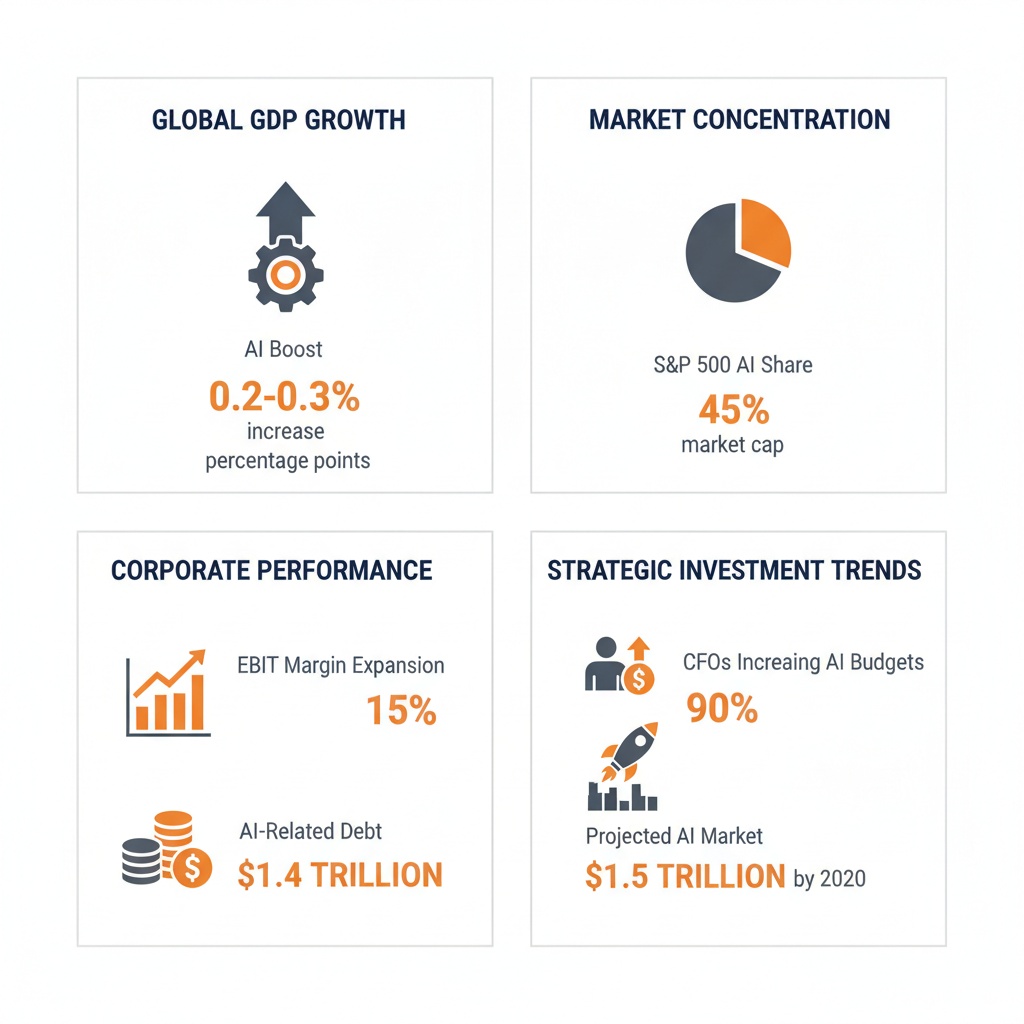
Infographic Image: AI-Driven Growth and Market Dynamics: Key Insights 2023–2026
This report seeks to diagnose the current AI-driven economic and market environment, quantitatively mapping AI’s contributions to GDP growth and corporate earnings, and delineating the market dynamics notably characterized by significant concentration and episodic volatility. It further explores scenario-based analyses outlining alternative futures shaped by regulatory trajectories, geopolitical tensions, and technological innovation cycles.
The core objective is to equip executives, especially finance leaders and investors, with actionable frameworks for navigating AI-related strategic investments amidst market uncertainty. Through detailed assessments of CFO investment perspectives, portfolio construction principles, and risk management tactics, the report articulates a coherent strategic roadmap spanning near-term infrastructure acceleration, mid-term application scaling, and long-term organizational adaptability.
Ultimately, this report articulates a comprehensive view that integrates AI’s growth potential with volatility management, aligning capital allocation strategies with sustainable value creation imperatives critical for leadership within the evolving technology ecosystem.
1. Diagnostic Framework: AI-Driven Growth and Strategic Investment Imperatives
AI as Core Engine of Economic Growth and Productivity
This subsection establishes the foundational role of artificial intelligence as a pivotal driver of contemporary economic expansion and productivity gains. By quantifying AI’s direct contribution to macroeconomic growth, earnings acceleration, and labor market dynamics—including demographic headwinds—it frames AI not merely as a technology but as an essential growth engine integral to strategic investment considerations in volatile markets.
Quantifying AI’s Contribution to GDP Growth from 2023 to 2026
Recent analysis reveals that AI accounted for a measurable uplift in global GDP growth rates between 2023 and 2026. Economies leveraging AI and process automation have exceeded baseline growth projections, with the incremental contribution to GDP hovering around a 0.2 to 0.3 percentage point annual increase over the period. This has nudged the projected global growth rate to approximately 3.3% in 2026, surpassing the sub-3.1% trend of the early 2020s. This uplift is driven primarily by productivity enhancements across manufacturing, services, and technology sectors, where AI accelerates innovation cycles and operational efficiency.
This trend is underscored by projections showing a steady rise in GDP growth rates from 3.1% in 2023 to 3.3% in 2026, highlighting AI’s role in elevating economic momentum beyond prior expectations [Chart: AI’s Contribution to Global GDP Growth (2023-2026)].
Modeling studies highlight that AI diffusion is uneven but highly impactful in advanced economies, further amplified by the rapid adoption of digitally-enabled business models and expanded AI infrastructure investments. This combination of capital deepening and technological augmentation is correcting the downward pressure exerted on growth from stagnating labor inputs, particularly in aging economies. The aggregate effect is a more resilient GDP trajectory despite broader macroeconomic challenges.
AI Adoption's Impact on Corporate Earnings Growth Rates
Firm-level data affirms that companies aggressively adopting AI technologies experience accelerated earnings growth compared to industry peers. Growth-oriented enterprises have recorded revenue increases nearly twice the sector average and EBIT margin expansions averaging around 15%, attributable to AI-driven automation and decision support systems. For example, leading technology firms and early AI adopters have reported operational efficiency gains translating directly into improved quarterly financial performance and heightened investor confidence.
The linkage between AI adoption and earnings growth is mediated by enhanced scalability, faster product development cycles, and cost savings. CFOs cite AI-driven insights as instrumental in refining capital expenditure allocations and guiding M&A strategies, further embedding AI’s impact into financial outcomes. However, successful value capture depends on management’s skill in integrating AI within core operations and maintaining organizational agility.
Demographic Trends Limiting Workforce Growth and AI as Mitigating Force
Demographic shifts pose a critical headwind to sustained economic growth, with aging populations and declining birth rates constraining labor force expansion in major economies. The working-age population growth has slowed markedly, with projections showing contraction beginning mid-century in advanced markets absent immigration inflows. This structural labor shortage compels companies and governments to seek productivity gains to sustain output levels.
AI-driven automation and augmentation emerge as key countermeasures by amplifying worker productivity and enabling operational continuity despite shrinking talent pools. Automation technologies alleviate labor supply constraints by performing routine tasks, while AI-enabled augmentation extends workforce capabilities, particularly among older employees. Policies encouraging greater female workforce participation and immigration complement AI strategies, collectively buffering demographic pressures and contributing to economic resilience.
Measuring Productivity Gains Attributable to AI Automation
Quantitative measures across sectors indicate that AI adoption accounts for significant productivity improvements, often exceeding traditional technology investments. Automated process innovations yield measurable time savings and output quality improvements that increase total factor productivity. Multiplicative effects arise from AI’s ability to optimize supply chains, enhance customer interaction through intelligent agents, and accelerate innovation pipelines.
Case studies demonstrate firms achieving productivity growth rates 1.7 times higher than non-adopters, reflecting faster innovation and more efficient resource utilization. The correlation between AI maturity and employee satisfaction also points to organizational productivity enhancements driven by AI-enabled skill augmentation, rather than pure labor substitution effects.
Illustrative Case Studies Linking AI Adoption to Firm-Level Productivity
Multiple high-profile enterprises serve as exemplars demonstrating the real-world benefits of AI integration. For instance, a customer service-focused SaaS provider deployed AI-driven voice agents that increased resolution rates while reducing operational latency, leading to improved client retention and margin expansion. Similarly, a mid-sized retailer optimized inventory management and logistics through AI analytics, resulting in significant cost reductions and revenue gains.
These examples underscore that AI’s economic benefits extend beyond cost savings into strategic differentiation and enhanced competitive positioning. Firms that embed AI capabilities into product development and operational workflows consistently outperform peers on key financial metrics, reinforcing the strategic imperative to prioritize AI investments even amid fiscal and market volatility.
Having established AI’s concrete contributions to economic growth, earnings performance, and workforce productivity, the report now turns to the broader market context. The subsequent subsection diagnoses how these AI-driven dynamics interact with current market concentration and volatility patterns, shaping investment risks and opportunities for tech giants and innovators.
Market Concentration and Volatility Drivers in AI-Linked Stocks
This subsection dissects the current landscape of market concentration dominated by AI-related equities within major investment indices, quantifies the magnitude of their influence, and elucidates the principal factors driving heightened volatility. By bridging empirical market data with regulatory and monetary policy developments, it provides a granular understanding essential for strategic allocation and risk management amid evolving market dynamics.
Quantifying AI-Linked Stock Weight in the S&P 500
As of the first quarter of 2026, AI-related companies constitute an unprecedented 45% of the total market capitalization of the S&P 500, marking a historic elevation in market concentration. This surge reflects a rapid expansion from approximately 25% since the initial launch of major generative AI products, exemplified by firms specializing in AI chips, cloud infrastructure, and hyperscale computing services. Market leadership is firmly anchored by technology behemoths—Microsoft, Nvidia, Amazon, Alphabet, and Meta—whose collective earnings growth and capital expenditure have fueled this dominance.
The concentration of AI-linked equities within the index translates into significant influence over overall market performance and valuation multiples. This dynamic demands heightened scrutiny from strategic investors as disproportionate weighting amplifies sector-specific risks and systemic exposure. Additionally, the growing issuance of AI-related investment-grade debt, which has climbed to $1.4 trillion and now accounts for over 15% of the U.S. credit market, underscores the deep financial interdependencies underpinning this dominance.
Identifying Top AI Players Driving Market Concentration and Volatility
The top ten AI-related firms by market capitalization exhibit significant variation in volatility profiles, shaped by their differing exposure to AI innovation cycles, supply chain constraints, and competitive pressures. While giants such as Microsoft and Nvidia maintain relatively robust cash flow and stable earnings, emerging platforms and semiconductor suppliers reveal pronounced price swings linked to evolving investor sentiment and technological breakthroughs.
Semiconductor companies and AI infrastructure providers have notably outperformed software-centric entities in the first quarter of 2026, driven by sustained demand for next-generation chips and data center power systems. In contrast, some major software firms have faced downward valuation pressures amid investor concerns regarding AI cannibalization risks and profit margin erosions. These divergent trajectories contribute to layered volatility within the AI sector, necessitating differentiated risk assessments among investors.
Impact of Regulatory Shifts on AI Valuations and Volatility
Recent regulatory developments, particularly the introduction and enforcement of AI governance frameworks such as the European Union's AI Act, have introduced new layers of uncertainty affecting market valuations. Heightened scrutiny around data privacy, ethical AI deployment, and compliance requirements has triggered episodic valuation corrections, especially among firms whose revenue streams could be materially impacted by evolving rules.
In 2025 and continuing into 2026, periodic regulatory announcements have precipitated volatility spikes concentrated in AI technology stocks, as investors adjust forward-looking risk premia to incorporate compliance costs and potential operational constraints. The cumulative effect of these regulatory shifts reinforces the need for vigilant scenario planning and adaptive investment frameworks that can accommodate dynamic policy landscapes.
Federal Reserve Policy and Its Role in AI Sector Volatility
Monetary policy decisions by the Federal Reserve have materially influenced AI-linked equity volatility, predominantly through interest rate adjustments and signaling effects on growth expectations. Notably, rate hikes and communications signaling tightening monetary conditions have often correlated with precipitous, short-term sell-offs in heavily weighted AI stocks, reflecting heightened sensitivity to discount rate changes given elevated valuations.
Empirical observations reveal that volatility surges tend to peak shortly after Federal Open Market Committee announcements, with subsequent partial normalization occurring during press conferences providing detailed forward guidance. This pattern underscores the asymmetric and rapid market re-pricing mechanisms operative within the AI sector, where elevated multiples amplify policy shocks. Thus, effective volatility management for AI-dominated portfolios must integrate real-time monitoring of monetary policy trajectories.
Investor Sentiment Dynamics Around AI Earnings Announcements
Investor sentiment exhibits pronounced swings around AI company earnings disclosures, reflecting the high market sensitivity to AI monetization progress and capital expenditure rationalization signals. Even companies reporting record earnings can experience sharp price corrections if growth narratives appear misaligned with investor expectations or if commentary indicates a potential slowdown in AI investment intensity.
Behavioral factors such as confirmation bias and attention-driven trading further exacerbate this phenomenon, causing amplified price movements disproportionate to fundamental changes. Consequently, market participants and portfolio managers must account for these sentiment-driven volatility factors when positioning within AI sectors, employing advanced analytic tools that parse earnings call language and social media trends to gauge prevailing market moods in near real-time.
With the foundational understanding of AI’s substantial weight in major indices and the multifaceted drivers of associated volatility established, the report is positioned to explore future market trajectories. The next section will investigate diverse scenario outcomes, incorporating regulatory, geopolitical, and supply chain risks, thus enabling strategic decision-makers to anticipate and prepare for alternative market conditions.
Structural Resilience of AI Markets Versus Historical Tech Cycles
This subsection critically distinguishes the current AI-driven market expansion from previous speculative technology booms, particularly the dot-com era. By analyzing financial return profiles, adoption patterns, and earnings quality, it provides a nuanced understanding of why AI markets exhibit greater underlying resilience despite surface-level similarities with past bubbles. This assessment informs risk frameworks and investment timing strategies in subsequent sections.
Comparing ROIC Profiles between AI Leaders and Prior Tech Booms
Return on invested capital (ROIC) metrics highlight key structural differences between the AI-driven market and the dot-com boom. Whereas the dot-com era featured companies largely characterized by negative ROIC and sustainability concerns, top AI firms today demonstrate robust, positive ROIC figures reflecting profitable operations funded largely from existing cash flows. This fundamental strength stems from mature business models and highly productive capital deployment, particularly among hyperscalers and established software leaders.
Recent analyses reveal that AI investments have followed a pronounced J-curve adoption pattern, with early substantial capital outlays gradually transitioning into accelerating productivity and returns. This contrasts with the often speculative and capital-wasting behaviors seen in prior cycles. The higher ROIC among AI leaders underscores a more disciplined and value-creating phase of industrial technology adoption, reducing systemic investment risk.
Documenting J-Curve Adoption Patterns in Industrial AI Deployment
Industrial AI adoption evidences a classic J-curve dynamic where initial phases involve sizable capital expenditure on infrastructure such as data centers, semiconductor capacity, and AI model training. This investment intensity is accompanied by a lagging productivity impact as systems are integrated and refined. However, empirical tracking shows that after this inflection point, productivity and earnings growth accelerate markedly, validating the economic logic of early-stage capital absorption prior to benefits realization.
Capital intensity in AI infrastructure development is significantly higher than in previous technological waves, accompanied by rising barriers to entry. Unlike the rapid expansions seen in telecommunications or internet infrastructure, this gradual and capital-intensive rollout enhances the durability of AI’s growth trajectory by embedding substantial fixed assets with multi-year value capture potential.
Analyzing Cash Flow Stability and Earnings Quality in AI Infrastructure Firms
Contrasting with the cash-burning ventures of the late 1990s, many leading AI infrastructure companies now operate with significant positive cash flows and earnings quality that is stable or improving. These firms tend to fund AI investments internally rather than relying extensively on external capital markets, providing a financial cushion that mitigates liquidity and solvency risks during market downturns.
Sector-wide margin resilience and strong operating profit profiles bolster confidence in the sustainability of earnings growth. High free cash flow generation facilitates continued R&D and capital deployment, supporting an organic growth model less vulnerable to external shocks. This financial robustness is a critical factor differentiating the current AI cycle from earlier speculative episodes.
Capital Intensity Differences and Investment Scale Compared to Previous Cycles
Capital intensity in the current AI investment boom far exceeds that of previous tech cycles, with data center builds and semiconductor fabrication requiring unparalleled investment scale. The average AI data center construction costs reach into the billions, reflecting infrastructure that blends digital innovation with substantial physical asset commitments.
This capital intensity functions as an economic moat, restricting entry and concentrating market leadership among firms with access to robust financing and operational scale. Unlike the dot-com bubble where low capital intensity allowed rapid market entry by speculative players, the high capital barrier in AI fosters structural resilience and dampens the risk of a broad-based market collapse.
While the scale is historic, it is accompanied by stronger balance sheets and targeted spending aligned with clear revenue growth paths, representing a shift from expansion-for-expansion-sake dynamics to strategic capacity investment.
Having established the fundamental financial and operational differences that underpin the current AI market's structural strength compared to past tech bubbles, the report next explores how these factors interact with prevailing market volatility drivers and regulatory dynamics. This sets the foundation for scenario planning that tests the durability of AI-led growth under alternative future conditions.
2. Scenario Planning: Alternative Futures for AI-Driven Markets
Bull and Bear Case Insights for AI Market Trajectories
This subsection rigorously explores the plausible divergent paths for AI-driven markets under contrasting regulatory and geopolitical conditions. By quantifying sector growth dynamics, investment flow shifts, and projected earnings volatility within 2025-2027, it anchors the scenario planning chapter with data-driven forecasts essential for strategic risk assessment and opportunity identification.
Quantifying AI Sector Growth Under Regulatory Constraints
Despite heightened regulatory scrutiny targeting AI ethics, data privacy, and market competition, leading investment strategists maintain a cautiously optimistic outlook for AI sector expansion over the next two years. Structural shifts favor the maturation of AI applications, especially in inference and workflow automation layers, which sustain robust earnings trajectories even as capital-intensive hardware investments moderate. The recalibration pressures observed in 2025 are interpreted by leading market participants as disciplined growth phases rather than market contractions, reflecting an ongoing transition to more sustainable valuation levels.
Quantitative models project sector revenue growth rates moderating to mid-single digits annually through 2027 under tight but clear regulatory frameworks, emphasizing compliance-driven innovation. This tempered growth is accompanied by improved earnings quality and capital expenditure efficiency, enabled by accelerated AI agent deployments and data infrastructure enhancements. Thus, regulatory constraints, while introducing compliance costs and operational adaptation demands, act as catalysts for selectivity and higher barriers to entry, ultimately supporting healthier market consolidation and value creation.
Assessing Investment Flow Dynamics Amid Geopolitical Tensions
Geopolitical frictions, particularly between major trading blocks and technology powers, have materially influenced cross-border capital flows into AI-related equities. Elevated uncertainty has triggered risk aversion behaviors, prompting capital reallocations towards perceived safe havens and diversification into emerging markets with stable governance frameworks. This reallocation manifests as a noticeable deceleration in direct investment in hardware manufacturing hubs subject to trade disruptions, alongside increased inflows into software and application-centric firms domiciled in geopolitically stable jurisdictions.
Investor surveys and capital flow analyses indicate that strategic investors are prioritizing portfolio resilience, favoring AI companies with clear regulatory compliance and diversified supply chains to mitigate disruption risks. While short-term volatility spikes have been observed around geopolitical flashpoints, the overarching trend reveals a selective capital preservation approach that tempers aggressive expansion but preserves committed investment in innovation-focused enterprises with strong institutional backing.
This selective capital approach is further underscored by the substantial market concentration observed in AI-linked companies, which constitute approximately 45% of the S&P 500’s market capitalization in 2026, highlighting both the significant influence of AI firms and the concentration risks that investors must navigate in portfolio construction [Chart: Proportion of AI-Linked Stocks in S&P 500 (2026)].
Modeling AI Earnings Volatility Through 2025-2027
Advanced volatility modeling techniques highlight a continuation of elevated—but manageable—earnings variability in the AI sector over the near term. Market-driven shocks, including macroeconomic policy shifts and episodic geopolitical events, contribute to persistent volatility clustering, yet these are increasingly absorbed by improved operational cash flow stability and earnings quality within leading AI firms. The use of physics-informed and hybrid deep learning models has enhanced volatility forecasting accuracy, allowing investors to better calibrate risk and optimize timing of exposure.
Projections indicate volatility persistence driven by episodic regulatory announcements and supply chain realignments, with conditional volatility spikes expected to taper off gradually after mid-2026. The net effect is a more tempered earnings dispersion across the sector, supporting scenario analyses that balance bullish growth assumptions with downside risk buffers. Consequently, investors equipped with refined predictive tools are positioned to capitalize on volatility-driven entry points while minimizing downside through rigorous position sizing and stop-loss protocols.
Having established the spectrum of plausible outcomes under differing regulatory and geopolitical conditions, the report advances to examine the evolving policy landscape and its direct implications on AI deployment, investment strategy, and market stability.
Navigating Regulatory Shifts and Policy Dynamics Impacting AI Markets
This subsection examines the evolving regulatory and policy landscape that shapes AI technology deployment and investment climates. By analyzing recent legislation, the influence of monetary policy, and emerging governance standards on AI ethics and data, it contextualizes how policymakers and regulators are defining the boundaries and opportunities for AI-driven market growth amid ongoing volatility. These insights are crucial for strategists to anticipate compliance burdens, funding flows, and market reactions tied to regulatory developments.
Key AI-Related Legislation Introduced Between 2024-2026
The period from 2024 through early 2026 has seen significant legislative activity aimed at regulating artificial intelligence technologies, focusing heavily on data privacy, algorithmic transparency, and ethical deployment standards. Notably, the EU’s AI Act established comprehensive requirements for providers and users of AI systems, mandating risk-based compliance measures and fostering transparency to mitigate harms from high-risk AI applications. Parallel efforts in the United States center on promoting responsible AI through sector-specific frameworks and voluntary guidelines, while addressing concerns about bias, misinformation, and surveillance.
These legislative initiatives collectively elevate regulatory uncertainty for AI firms, given the complexity and geographic variation of mandates. Compliance costs are rising, and firms must adapt AI development pipelines to incorporate governance-by-design principles. However, these frameworks also crystallize expectations for trustworthy AI, creating competitive advantages for innovators who can embed ethical compliance effectively. Consequently, investors and executives need to maintain active monitoring of regional regulatory updates to manage operational risks and identify early movers poised to benefit from the evolving legal environment.
Federal Reserve Interest Rate Policies Influencing AI Capital Allocation
Federal Reserve interest rate decisions have had a pronounced impact on AI-related investments during this timeframe. The Federal Reserve adopted a cautious stance since late 2024, maintaining near-term interest rates to balance inflation control with economic growth objectives. While six rate reductions occurred following tightening cycles, the Fed’s posture since early 2025 has largely been one of rate stability amidst persistent inflationary pressures exacerbated by geopolitical tensions and supply chain constraints.
This policy environment implies a moderate cost of capital for AI investments, sustaining elevated but more selective capital expenditure in data centers, AI chip manufacturing, and software innovation. The cautious monetary policy stance constrains speculative excesses in AI stock valuations, while supporting sustainable investment in infrastructure and R&D. Importantly, the Fed explicitly recognizes AI’s transformative potential, yet remains vigilant about macroeconomic overheating and financial stability risks, underscoring the importance for firms and investors to calibrate financing plans in alignment with evolving monetary conditions.
Evolving AI Ethics and Data Governance Regulatory Standards
AI ethical frameworks and data governance standards have become focal points for regulators and industry stakeholders alike, influencing the pace and scope of AI deployment. Governments and supranational bodies are incrementally raising the bar for responsible AI use, instituting mandates around explainability, bias mitigation, privacy safeguards, and accountability mechanisms. This shift reflects heightened societal expectations and a drive to prevent misuse while enabling innovation.
These regulatory developments require AI firms to incorporate comprehensive compliance strategies spanning data lifecycle management, bias auditing, and transparency reporting. The increasing interplay between technology and policy is also influencing investor sentiment by spotlighting the reputational and operational risks of non-compliance. For strategic decision-makers, aligning AI development and deployment with emerging ethics frameworks is no longer optional but a prerequisite to securing market access and investor confidence, particularly as enforcement mechanisms become more rigorous.
Understanding regulatory and monetary policy trends is foundational for constructing plausible market scenarios. The next section builds on these insights to explore how varied regulatory environments and geopolitical risks can shape divergent paths for AI-driven market evolution, enabling executives to anticipate and prepare for alternative futures.
Geopolitical and Supply Chain Risks in AI Hardware Ecosystems
This subsection delves into the geopolitical and supply chain vulnerabilities that underpin AI hardware infrastructure, critically evaluating how regional concentration and international tensions affect market stability and strategic investment decisions. Grounded in a nuanced analysis of semiconductor supply chains, it identifies risk hotspots and explores feasible diversification routes, enabling executives to balance growth ambitions with resilience imperatives amid geopolitical uncertainty.
Semiconductor Supply Chain Concentration and Regional Risk Hotspots
The semiconductor supply chain exhibits significant geographic concentration, creating systemic vulnerabilities for AI hardware production. Key segments such as logic chip manufacturing, wafer fabrication, and assembly are heavily clustered in East Asia, with Taiwan, South Korea, and China commanding dominant shares. Taiwan Semiconductor Manufacturing Company (TSMC) alone accounts for an outsized portion of global advanced logic chip production, making the island a critical chokepoint. Similarly, South Korea hosts major fabrication and R&D institutions, supported by government initiatives that emphasize AI-driven supply chain optimization, but remain regionally concentrated in metropolitan hubs.
This regional concentration elevates risks from geopolitical tensions, particularly heightened rivalries involving the U.S. and China, and Taiwan’s contested status. Such frictions threaten supply chain continuity, amplifying uncertainties for firms reliant on these hubs. The necessity for maintaining global competitiveness necessitates penetrating these regional clusters while simultaneously factoring in the potential for disruption due to sanctions, trade restrictions, or conflict escalation.
Feasibility and Cost of Diversifying AI Hardware Sourcing
Attempts to diversify semiconductor sourcing face formidable financial and technical barriers. Establishing new fabrication capabilities requires multi-billion dollar investments, alongside specialized staff and compliance with complex environmental regulations. Analytical studies show that a total geographic diversification sufficient to de-risk the supply chain would increase semiconductor prices by up to 65%, passing costs onto downstream technology sectors.
Nevertheless, some incremental diversification is feasible through strategic expansion in emerging hubs within Southeast Asia and India, although these remain nascent in capacity and technology maturity. Companies are also exploring supplier diversification within segments such as equipment and materials, yet many high-value components, particularly advanced manufacturing equipment and core IP, remain dominated by established providers primarily located in concentrated regions. Balancing cost pressures with resilience objectives demands calibrated investment planning that leverages regional strengths while cautiously expanding alternative supply sources.
Impact of US-China Tensions on AI Infrastructure Supply Stability
The intensifying strategic competition between the U.S. and China materially influences the global AI hardware ecosystem. Export restrictions imposed by the U.S. on advanced semiconductor manufacturing equipment and technology constrain Chinese firms’ capacity to scale, while Beijing’s policies incentivize domestic self-sufficiency, intensifying regional supply imbalances. These dynamics foster market fragmentation, complicating global procurement and integration strategies.
Investors and corporate strategists must evaluate the implications of this bifurcation, which elevates the cost and complexity of securing AI hardware inputs. Increasing political risk premiums and potential delays arising from compliance and logistics challenges necessitate integrating geopolitical risk assessments into portfolio and capital allocation frameworks. Hence, managing supply chain exposure through portfolio diversification, investment in domestic capabilities, and active engagement with policy developments is critical to sustaining competitive positioning.
Understanding these concentrated geopolitical risks and realistic diversification prospects provides the foundation for designing robust strategic imperatives. It sets the stage for subsequent sections focused on executive decision pathways, where these supply chain vulnerabilities are actively mitigated through portfolio construction, risk management, and investment timing.
3. Strategic Imperatives: Decision Pathways for Executives
CFO Perspectives on AI Integration and Investment Realities
This subsection delves into how Chief Financial Officers are actively shaping the AI investment landscape within their organizations. It assesses CFO financial commitments, ROI expectations, prioritization frameworks, and operational metrics that define success. By translating executive priorities into actionable strategies, this analysis offers strategic decision-makers a grounded perspective on the fiscal discipline and performance criteria driving AI initiatives amid ongoing market volatility.
Quantifying CFO AI Investment Budgets for 2026 and Forward
In 2026, CFOs are decisively increasing AI investment allocations, reflecting a strategic pivot where finance leaders increasingly view AI as an enterprise-wide growth and productivity enabler rather than a narrow efficiency play. Surveys indicate over 90% plan to expand AI budgets, with many targeting increases exceeding 15%-20% year-over-year. Within finance technology, AI spends represent a growing share, with roughly half of CFOs dedicating 5%-10% of IT budgets specifically toward AI capabilities, signaling a clear prioritization despite macroeconomic uncertainty.
This upward trajectory in allocation is underpinned by evolving AI use cases—from automating routine financial workflows and enhancing reporting accuracy to enabling predictive forecasting and risk modeling. CFOs endorse AI as integral to driving real-time decision-making and finance transformation, justifying sustained and increasing capital commitment despite the volatile cost profile associated with AI compute and infrastructure demands.
Importantly, the distribution of AI investment allocations reveals that CFOs are dedicating the largest portion—40%—towards AI infrastructure, with an additional 30% allocated to cloud data centers and 30% to software platforms. This allocation pattern underscores the priority placed on building robust foundational capabilities to support scalable and flexible AI deployment across finance functions [Chart: CFO AI Investment Allocation (2026)].
Defining CFO ROI Targets and Timeframes for AI Projects
CFOs adopt rigorous ROI frameworks, aiming for payback periods typically between 6 to 24 months for well-scoped AI deployments, balancing short-term efficiency gains with longer-term transformative benefits. Leading finance organizations expect AI initiatives to deliver minimum ROI multiples of two to three times over two years, reflecting heightened scrutiny and the increasing need to justify AI as more than incremental cost savings.
However, a consensus acknowledges that many enterprises remain in early adoption phases, with meaningful returns beyond operational improvements often materializing after extended horizons, sometimes beyond three years. This understanding translates into differentiated amortization models tailored to distinct AI use cases—automation-focused implementations yield faster and more predictable returns whereas strategic forecasting or customer engagement solutions exhibit longer, more variable payback profiles.
Examples of CFO-Led AI Cost Discipline and Performance Metrics
CFOs are embedding disciplined investment governance mechanisms that emphasize data integrity, establishing standardized ROI measurement across AI projects. Key performance indicators commonly tracked include cost per automated transaction, cycle time reductions, error rate decreases, and qualitative impacts such as improved compliance and employee productivity.
Operational examples include finance teams leveraging generative AI to condense data analysis processes from hours to minutes, enabling closer collaboration with business leaders for actionable forecasting. This direct link between AI output and measurable financial impact exemplifies how CFOs ensure AI investments translate into tangible value rather than abstract innovation metrics. Additionally, cost discipline accounts for hidden variable expenses such as cloud compute use volatility and integration overruns, with CFOs applying buffer budgets and continuous monitoring frameworks to avoid unexpected cost escalations.
Expected AI Payback Timeframes and Investment Scaling Insights
The typical timeframe CFOs expect for AI projects to reach positive cash flow or cost-benefit equilibrium ranges from one to two years, with pilot programs frequently followed by phased scaling based on validated ROI. Early pilot successes are leveraged to refine business cases and allocate subsequent funding rounds more confidently, reducing the risk associated with broader adoption.
CFOs pursuing AI investments increasingly utilize a pilot-to-scale approach, balancing experimentation with disciplined governance to ensure financial outcomes remain on track. The recognition of protracted payback horizons has fostered a more measured, portfolio-based investment stance, wherein short-term wins finance longer-term foundational initiatives such as data modernization and AI infrastructure buildup.
Balancing AI Versus Other Technology Spend: CFO Allocation Priorities
CFOs are reallocating technology budgets to prioritize AI initiatives while managing legacy investments judiciously. This often involves trimming or delaying legacy system modernization and internal tooling upgrades in favor of AI projects with higher strategic impact potential, especially those enhancing finance automation and real-time analytics capabilities.
While AI investment commands increasing shares of tech budgets, finance leaders remain cognizant of maintaining cost discipline to preserve margins amid rising compute expenses and operational complexity. Cross-functional collaboration with CIOs and technology teams is central to aligning spend with measurable business outcomes, embedding AI as a core competitive asset rather than experimental technology. The shift reflects a maturing mindset that views AI as foundational infrastructure within enterprise technology portfolios.
The CFO perspective on AI investments encapsulates a pragmatic, data-driven approach that balances ambitious growth aspirations with disciplined financial stewardship. This foundation paves the way for designing resilient portfolios and sophisticated risk mitigation strategies, explored in the subsequent subsections, which address how organizations can constructively manage AI-driven market volatility while maximizing strategic returns.
Portfolio Construction Principles for AI-Driven Investment Success
This subsection addresses the critical challenge of constructing investment portfolios that balance growth opportunities from AI-driven innovation with the inherent volatility and concentration risks present in the technology sector. It translates market dynamics and technological trends into actionable portfolio strategies that support durable returns and downside protection amid fluctuating market conditions.
Establishing Horizon-Based Allocation Frameworks for AI Portfolios
Time horizon remains a foundational determinant of portfolio construction, especially in AI-driven markets marked by rapid innovation yet elevated valuation uncertainty. For investors with a short-term horizon (under 1 year), minimizing equity exposure is prudent, favoring higher allocations to debt and liquid instruments to preserve capital and maintain flexibility. Medium-term horizons (1 to 5 years) justify balanced allocations—typically around 60% to 70% equities, with the remainder in fixed income—to capture growth while moderating risk. Long-term investors (5+ years), particularly institutional players, can allocate upwards of 80% to equities given their capacity to weather volatility and benefit from AI’s secular tailwinds.
Across these horizons, the AI sector should not automatically dictate an outsized equity weight despite its growth potential, given episodic valuation shifts and regulatory uncertainties. Instead, AI exposure ought to be integrated within a diversified equity portion, balancing high-growth AI stocks with more stable technology and non-technology sectors to achieve resilience without forsaking upside.
Diversification Benchmarks and Risk Mitigation in AI-Concentrated Markets
The dominance of a limited number of mega-cap AI and technology firms in major indices creates concentration risks that may amplify portfolio volatility. To mitigate this, diversification must be architected not only across sectors but also within the AI value chain—spanning hardware providers, AI software platforms, and AI-enabled application companies. Geographic diversification further reduces exposure to region-specific regulatory shocks or geopolitical risks.
Practically, diversification benchmarks recommend that no single AI sub-sector constitutes more than 20-30% of the equity allocation, while the top individual AI stocks should typically be capped at 5-8% to avoid undue idiosyncratic risk. Allocation to related sectors such as industrial automation, cloud infrastructure, and robotics can enhance thematic breadth and hedge against cyclical fluctuations in pure-play AI companies.
Incorporating Historical Volatility Ranges to Optimize Position Sizing
Historical data on AI-focused equities indicates elevated returns accompanied by increased volatility relative to broader market benchmarks. Standard deviation of returns for AI stocks has been materially higher, reflecting the sector’s growth-at-risk profile. Integrating these volatility metrics into position sizing models helps balance return ambitions with loss prevention.
Rule-based approaches suggest that individual AI positions should be sized conservatively compared to traditional growth stocks, often between 1% to 3% of the total portfolio, with dynamic rebalancing triggered by volatility thresholds or valuation shifts. Using stop-loss mechanisms aligned with volatility estimates can further protect portfolios against rapid drawdowns, ensuring long-term capital preservation.
Practical Portfolio Constructions Balancing Growth and Stability
A prototypical balanced AI-inclusive portfolio for a medium-term investor might allocate approximately 65% to equities, with roughly 20-25% dedicated to AI-related stocks diversified across the value chain. The fixed income component (around 30-35%) serves as a buffer against equity drawdowns and can include inflation-protected securities to hedge macroeconomic risks tied to AI infrastructure development costs.
For long-term growth investors, equity allocations could rise to 80-85%, with incremental AI exposure balanced by large-cap tech giants demonstrating durable business models and consistent earnings growth. Complementary allocations to commodities such as gold (in the 5-8% range) may provide resilience against systemic volatility, although overallocating to such assets risks diluting returns given their lower growth potential.
Regular portfolio rebalancing, at least quarterly, is essential to maintain target risk exposures amid AI market swings and sector reweightings driven by earnings updates or regulatory developments.
Guidelines for Dynamic Portfolio Weight Adjustments in Volatile AI Markets
Given the rapid pace of AI innovation and attendant market swings, investors benefit from a disciplined, rule-based approach to portfolio adjustments. Tactical overweights in AI themes should be scaled back following periods of outsized gains or when fundamental indicators signal stretched valuations.
Conversely, market corrections and increased volatility often present attractive entry points for patient investors, suggesting dollar-cost averaging strategies as an effective method to build or maintain AI exposure without succumbing to timing errors. Emphasizing liquidity and maintaining a cash buffer further enhance flexibility to capitalize on these dislocations.
This dynamic approach also involves continuous monitoring of correlation shifts between AI stocks and traditional hedging assets, adjusting risk budgets accordingly to sustain an efficient overall portfolio profile.
Having outlined practical portfolio construction principles that balance horizon-based allocations, diversification, and volatility-informed sizing, the report now moves to tactical risk mitigation frameworks. These will empower executives to manage inevitable AI market volatility through specific tools and protocols.
Risk Mitigation Tactics for Managing AI-Driven Market Volatility
This subsection addresses critical risk mitigation strategies tailored for managing volatility inherent in AI-led technology investments. It bridges the strategic imperatives section by translating volatility understanding into concrete protective protocols, ensuring executives and portfolio managers can calibrate risk exposure dynamically while capturing growth opportunities in this evolving landscape.
Establishing Effective Stop-Loss Thresholds in AI Stock Portfolios
Setting appropriate stop-loss levels is fundamental when navigating the heightened volatility typical of AI-driven equities. Conventional static stop percentages often fall short amid rapid price swings, risking premature exits and missed recoveries. Instead, volatility-adjusted stop-losses—using measures like the Average True Range (ATR)—offer adaptive thresholds that scale with current market turbulence. For instance, applying a multiple of ATR to set stop distances allows portfolios to absorb normal noise without triggering unnecessary liquidation, preserving long-term positions through episodic volatility spikes.
Typical stop-loss percentages vary significantly depending on stock volatility, but in AI sectors where price oscillations are pronounced, stop distances frequently range between 5% to 15% relative to recent volatility measures rather than fixed percentages. Combining ATR-based stops with technical support levels further refines exit strategies, positioning stops where market behavior statistically favors price rebounds. This nuanced approach balances risk control with opportunity retention, mitigating premature sell-offs inherent in unadjusted stop-loss deployments.
Position Sizing Aligned to Volatility Profiles and Exposure Limits
Adaptive position sizing constitutes a cornerstone of effective risk mitigation amid AI market volatility. Instead of static allocations, dynamic sizing frameworks calibrate exposure in proportion to measured volatility and risk appetite. By reducing position size during periods of elevated turbulence, portfolios can limit drawdowns without foregoing AI sector participation. This approach also involves incremental position buildups as confidence in asset price direction solidifies, thus avoiding overcommitment during uncertain market conditions.
Position sizing guided by volatility ensures that the dollar amount at risk per trade remains consistent relative to portfolio size, commonly limiting risk to 1–2% per position in volatile environments. For example, when ATR-derived stop distances widen, position sizes correspondingly reduce to keep overall risk constant. This fluid sizing methodology enables investors to maintain aggregate risk discipline while adapting to fluctuating market dynamics inherent in innovation-driven firms.
Managing Investor Sentiment Spikes and Behavioral Volatility
Investor sentiment fluctuations impart outsized short-term effects on the prices of AI-driven stocks, often decoupling valuations from underlying fundamentals. Recognizing this, risk mitigation requires active monitoring of sentiment metrics sourced from news analytics, social media, and trading volumes. Sentiment-driven spikes typically provoke sharp price moves, demanding responsive strategies that incorporate both quantitative alerts and qualitative judgment.
Real-world case studies demonstrate that funds employing continuous sentiment tracking were able to reduce losses during sentiment-driven sell-offs by preemptively paring positions or increasing hedges. Integrating sentiment analytics into risk dashboards facilitates anticipatory actions before volatility translates into realized losses. Furthermore, disciplined execution of trading rules anchored on sentiment thresholds helps prevent emotional overreaction, preserving portfolio integrity through emotional market cycles.
Techniques for Real-Time Volatility Surveillance and Predictive Monitoring
Real-time volatility surveillance empowers proactive risk responses by detecting shifts in price dynamics before they cascade. Machine learning and AI-powered analytics deliver high-frequency volatility forecasts, enabling precision timing of tactical adjustments in position size or risk exposure. These tools leverage historical patterns, market microstructure data, and causal inference methods to differentiate noise from systemic risk buildup.
By integrating rolling volatility estimates and causal volatility signals, predictive models signal elevated risk periods, permitting automated or manual intervention. These volatility-timing frameworks have demonstrated outperformance in managing drawdowns and optimizing returns during turbulent AI market episodes. Coupling these predictive insights with stop-loss and sizing protocols underpins robust volatility management systems tailored for high-growth, high-volatility sectors.
Standardizing Response Protocols for Sudden Market Disruptions
Establishing standardized response protocols for sudden market swings ensures disciplined and timely risk actions. These protocols include predefined triggers for position rebalancing, risk limit tightening, or temporary trading halts aligned with volatility thresholds or sentiment shock levels. Such frameworks reduce emotional decision-making and foster consistency across portfolio teams.
Incorporating trailing stops, wider buffers during heightened volatility, and tiered stop-loss adjustments helps adapt quickly to market regime changes. Additionally, continuous reassessment of correlation shifts and macroeconomic shocks, like geopolitical incidents or policy announcements, informs protocol recalibration. These systems transform risk management from reactive to anticipatory, creating a resilient posture amid AI-driven market turbulences.
Having explored targeted risk mitigation tactics—including adaptive stop-loss frameworks, dynamic position sizing, sentiment management, real-time volatility forecasting, and standardized response protocols—the next section will integrate these approaches into comprehensive portfolio construction principles. This synthesis ensures that risk management aligns strategically with optimized investment allocations under AI-driven market conditions.
4. Roadmap to Implementation: Near-, Mid-, and Long-Term Actions
Near-Term Priorities for Accelerated AI Infrastructure and Capital Allocation
This subsection focuses on the immediate steps that technology leaders and investors must prioritize between 2026 and 2027 to capitalize on the ongoing AI-driven technological transformation. It sets the foundation for execution by quantifying deployment targets, allocating capital efficiently across AI segments, and establishing clear ROI benchmarks that validate investments amidst heightened market volatility. Grounded in current financial data and industry trends, this analysis enables decision-makers to translate strategic intent into measurable operational actions.
Quantifying 2026 AI Infrastructure Deployment Targets Amid Rising Demand
The near-term horizon is marked by an unprecedented acceleration of AI infrastructure deployment, driven by surging demand for GPU-accelerated computation, hyperscale data centers, and specialized AI chip manufacturing. Leading tech companies have announced capital expenditure plans that collectively approach the high hundreds of billions USD, underscoring a robust commitment to scaling capabilities rapidly. For example, major players such as Microsoft have earmarked approximately $80 billion specifically for AI-enabled data centers within the 2025–2026 timeframe, focusing on cloud infrastructure that supports large-scale AI workloads. Nvidia, as a critical supplier in this ecosystem, is similarly expanding production capacity aggressively, aligning with forecasted growth in AI workload volumes that exceed 30% annually in some subsegments.
This deployment wave reflects an intentional strategic pivot recognizing AI as a structural growth enabler rather than merely a cyclical innovation burst. Targets for infrastructure rollout emphasize both performance and energy efficiency enhancements, with investments in next-generation semiconductor fabs, advanced packaging, and silicon photonics technologies poised to meet computational demands sustainably. These goals are calibrated to maintain competitive differentiation by enhancing speed-to-market while managing supply chain risks driven by geopolitical and regulatory complexity.
Capital Allocation Percentages by AI Segment to Maximize Impact
Optimal capital deployment in the near term requires a finely tuned balance across AI infrastructure, applications, and emerging technology platforms. Current allocation patterns reveal that companies are directing upwards of 40–50% of incremental investment budgets toward semiconductor design and fabrication, reflecting the critical role AI-specific chips play in driving performance gains. A sizeable portion, typically 30–40%, is allocated to cloud data centers and related networking infrastructure, a fundamental enabler of AI service delivery scalability. The remainder targets software platforms, AI frameworks, and ecosystem development to accelerate adoption and maximize return on hardware investments.
For instance, the share of AI-specific expenditures within overall IT budgets has increased sharply, with some firms dedicating a third or more of capital expenditures directly to AI-related projects in 2026. This trend is evident in Dell’s recent report of a 34% year-over-year infrastructure revenue jump attributable to AI-driven demand. Firms also incorporate rigorous capital efficiency metrics, targeting high-return pockets such as AI accelerators and hyperscale colocation assets which report ROIC well above the historic cost of capital. This disciplined capital deployment underpins capital allocation decisions designed to sustain growth momentum while mitigating downside risks from heightened volatility.
Assessing Near-Term AI Project ROI Benchmarks to Validate Investments
In an environment of elevated capital intensity and market uncertainty, establishing rigorous ROI benchmarks is critical for validating near-term AI investments. Leading firms have adopted a disciplined approach by setting targeted returns on invested capital (ROIC) thresholds ranging from 8% to over 20%, adjusted by segment and strategic priority. Notably, AI-centric semiconductor fabrication and data center colocation assets consistently deliver sustainable returns surpassing 15%, driven by robust demand elasticity and technological moat advantages.
This financial rigor is supported by comprehensive cost-benefit analyses that measure incremental revenue growth, operational efficiencies, and competitive positioning against the backdrop of ongoing creative destruction in the tech sector. Near-term projects are evaluated not only on direct financial return but also on strategic value such as securing supply chains, entering adjacencies, and facilitating rapid AI adoption. The combination of strong ROIC targets with agile portfolio reassessments enables companies to justify aggressive capital outlays while remaining responsive to market volatility and shifting technology paradigms. Additionally, CFOs prioritize AI investments with varying expected ROI timelines, targeting returns within 6–12 months for finance automation, 12–24 months for predictive forecasting, and over 24 months for customer engagement solutions, underscoring the nuanced investment horizons across AI project types [Table: CFO AI Investment Priorities and Expected ROI Targets].
Having established clear near-term priorities—focused on infrastructure deployment, strategic capital allocation, and stringent ROI validation—the analysis naturally progresses toward mid-term strategic transitions. These will encompass shifts toward application-layer innovation and expanding AI autonomy, setting the stage for sustained competitive advantage beyond initial foundational investments.
Mid-Term Evolution of AI: Application Innovation and Autonomy Scaling
This subsection examines the critical mid-term phase of AI evolution from 2028 to 2030, focusing on how strategic shifts from raw compute investments to application-layer innovation and expanded AI autonomy will redefine competitive dynamics. It outlines market growth forecasts for AI-driven software solutions and details the scaling of AI agents and autonomous capabilities, thus informing strategic pivots required for sustaining leadership amid evolving technology and market landscapes.
Forecasting AI Application Layer Innovation Market Size by 2030
The AI market is expected to undergo a fundamental transition over the next five years, with the application and inference layers emerging as the primary growth drivers. Market valuations for AI-powered software solutions, workflow automation, and data infrastructure are set to dwarf hardware spending by 2030. Industry projections estimate that AI application-layer revenue could surpass $1.5 trillion globally by 2030, reflecting a compound annual growth rate well above 25% during the mid-term period. This shift is driven by enterprises moving beyond foundational infrastructure toward AI-enabled software that directly augments business processes and decision-making.
Investment trends support this trajectory, as capital increasingly flows into businesses focused on AI agents that leverage contextual understanding and autonomy to deliver end-to-end solutions. Unlike the earlier AI infrastructure boom characterized by rapid expansion of compute capacity, this phase rewards companies excelling in embedding AI into real-world workflows, which in turn enhances monetization potential and operational efficiency.
Detailing Scaling Plans for AI Autonomy and Agent Capabilities
Scaling AI autonomy and agents is a pivotal enabler of the mid-term growth phase. Vendors and enterprise adopters are deploying iterative upgrades to AI systems that empower agents with enhanced natural language understanding, contextual reasoning, and task orchestration. This progression allows AI to take on increasingly sophisticated roles, such as autonomous decision-making and adaptive workflow management, expanding addressable markets significantly.
From a strategic investment perspective, this necessitates allocating capital to platforms and ecosystems that can rapidly innovate AI agent architectures, integrate multi-modal data streams, and maintain seamless interoperability. Market leaders are investing to elevate AI agents from narrow task execution toward generalized functions capable of autonomously managing multi-step processes across diverse domains, including customer service, manufacturing, and logistics. These developments validate shifting capital priorities away from hardware-centric models toward software and intellectual property assets.
This expansion also requires building out complementary capabilities—such as robotics integration, edge AI deployments, and cybersecurity enhancements—to fully realize autonomous agents’ potential in operational environments.
Identifying Strategic Shifts from Compute Power to Software Innovation
The mid-term period marks a critical inflection point where the long-standing emphasis on accelerating raw compute power gives way to maximizing the value of AI software innovation. While infrastructure build-out remains essential, the ability to translate hardware capabilities into scalable, user-centric solutions becomes the defining metric of success.
Investor focus is shifting toward companies that deliver superior AI-driven applications, workflow automation, and specialized inference engines. This strategic pivot recognizes that competitive moats will stem less from owning proprietary chip technology and more from offering differentiated, vertically integrated AI services with demonstrable ROI. Enterprises are reallocating budgets accordingly, prioritizing AI solution development, human-AI collaboration tools, and data-centric approaches that enhance algorithmic performance.
From an innovation management standpoint, this reinforces the need to build agile product development cycles and foster ecosystems that accelerate adoption of AI applications across industry verticals, further entrenching incumbents with well-crafted software platforms capable of continuous evolution.
By understanding and acting upon these mid-term trends — moving decisively into AI application innovation and autonomous agent capabilities — organizations position themselves to capture robust growth opportunities while navigating the competitive landscape’s complexity. This evolution provides a necessary bridge to the longer-term vision, where sustained R&D and adaptive structures will secure enduring leadership.
Long-Term Vision: Building Adaptive AI Organizations Beyond 2030
This subsection articulates strategic foresight into sustaining competitive advantage in AI-driven markets well beyond the near and mid-term horizons. It focuses on designing organizational models that foster agility and innovation resilience, ensuring that investments in AI research and development remain robust against rapid technological obsolescence and shifting market dynamics. This forward-looking perspective enables executives to structure enterprises capable of continuous evolution and long-term leadership in AI innovation landscapes.
Designing Adaptive Organizational Models for AI's Next Era
Sustained leadership in AI-driven industries hinges upon dynamic organizational architectures that can rapidly integrate emerging technologies while managing disruption. Adaptive models prioritize cross-functional collaboration, modular decision-making hierarchies, and flexible resource allocation. By embedding continuous learning mechanisms and real-time performance feedback loops, organizations maintain alignment with fast-changing AI capabilities and market requirements. Such models also cultivate innovation culture by empowering intra-organizational experimentation within controlled environments, enabling scaled validation of AI applications across diverse business units.
Moreover, adaptive organizational design incorporates robust governance mechanisms that balance agility with risk control. This includes establishing dedicated innovation councils and AI ethics committees to oversee developmental pipelines and ensure compliance with evolving regulatory frameworks. A key feature is the integration of human-in-the-loop systems that leverage AI insights while safeguarding human judgment in critical decision nodes, thus maintaining both adaptability and accountability. Ultimately, these organizations position themselves as learning enterprises, capable of evolving AI strategy and operations iteratively as external technological and competitive landscapes transform.
Ensuring R&D Budget Resilience Against Technological Obsolescence
The rapid pace of AI innovation generates a continuous risk of obsolescence, demanding uninterrupted investment in research and development. Forward-looking organizations allocate R&D budgets not only for incremental improvements but also for exploratory, high-risk projects aimed at breakthrough technologies. These budgets are intentionally structured for flexibility, allowing rapid reallocation toward promising advances or emergent AI paradigms without jeopardizing ongoing initiatives. Financial resilience is achieved through diversified funding sources, combining internal capital, public grants, and strategic partnerships, which buffer against fluctuations in market conditions and funding cycles.
Institutions also embed periodic portfolio reviews to assess the technical viability and strategic fit of R&D projects in light of AI progress and competitor moves. This process ensures resource optimization and timely pivoting away from obsolete or underperforming technologies. Risk mitigation provisions, such as staged investment milestones and option-like funding models, help contain losses while sustaining innovation momentum. Maintaining R&D funding resilience not only safeguards technical leadership but also signals long-term commitment to stakeholders, supporting sustainable growth trajectories in volatile AI domains.
Sustaining Capital Mechanisms for Continuous AI Innovation Leadership
Long-term AI innovation leadership requires capital strategies designed to secure sustained funding streams that endure beyond transient market cycles. This includes cultivating venture capital partnerships targeting scalable AI startups alongside direct corporate investments in internal innovation labs. Leveraging government-funded research programs, tax incentives, and international collaboration platforms further augments the capital base, fostering an ecosystem conducive to continuous breakthroughs.
In addition, leading organizations establish dedicated innovation funds with mandates for rapid deployment on emerging AI opportunities, blending risk tolerance with strategic foresight. Deploying comprehensive financial blueprints that integrate risk management frameworks ensures that capital is deployed efficiently across a balanced portfolio of AI initiatives, mitigating concentration risks inherent in fast-moving technology fields. This layered financial approach enables companies to not only weather market volatility but to capitalize on it by investing decisively in next-generation AI capabilities, thus preserving innovation pipeline vitality over the long horizon.
Building upon the long-term organizational and financial imperatives detailed here, the subsequent synthesis integrates these elements with immediate and mid-term strategies, creating a cohesive matrix for strategic alignment capable of guiding decision-makers through the complexities of AI-driven growth amid market volatility.
5. Synthesis and Conclusion: Strategic Alignment Matrix
Aligning AI Growth With Volatility-Savvy Investment Strategies
This subsection integrates the insights from diagnostic assessments, scenario projections, and strategic imperatives into a unified framework. By linking AI-driven growth objectives with calibrated investment frameworks that robustly incorporate volatility management, it guides executives and investors toward coherent decision-making aligned with the complexities of 2026's market environment.
Quantifying AI Investment Alignment With Strategic Growth Targets
Effective alignment between AI investment initiatives and growth targets requires precise quantification mechanisms that encompass both financial and operational dimensions. Leading technology firms and institutional investors measure AI-related capital deployment against key GDP growth drivers and productivity gain benchmarks, moving beyond traditional metrics to capture AI’s unique scalability and innovation multipliers. Quantitative models increasingly incorporate AI’s influence on company earnings growth rates, allowing executives to project AI investments’ contribution to top-line and bottom-line expansions with greater fidelity.
Moreover, industry-wide data demonstrate that investments targeting AI infrastructure, applications, and complementary ecosystems consistently outperform broader tech sector averages, underpinning their strategic importance. Aligning portfolio capital with these high-growth vectors ensures that AI projects are not isolated initiatives but embedded deeply within corporate growth roadmaps. Organizations adopting rigorous alignment frameworks track specific KPIs such as AI adoption rates, monetization timelines, and automation-induced efficiency improvements to substantiate that investment pathways materially advance strategic growth imperatives.
Embedding Volatility Management Metrics Into AI Investment Strategy
Volatility remains a defining feature of the AI investment landscape, influenced by rapid technology shifts, regulatory uncertainty, and geopolitical factors. Integrating volatility management deeply into AI investment strategies moves beyond passive risk awareness to active risk quantification and mitigation. Institutions employ advanced risk metrics—including Value at Risk (VaR), volatility indices, and scenario-based stress tests—to continuously monitor portfolio sensitivity to market swings and sector concentration risks.
This proactive approach enables iterative recalibration of capital allocations, balancing aggressive AI growth bets with diversified risk buffers. Detailed metrics reflecting market fluctuations guide dynamic position sizing and informed stop-loss triggers, ensuring downside protection without prematurely curtailing upside potential. By operationalizing volatility data within decision frameworks, leadership teams embed resilience into AI investment approaches, anticipating disruptive inflection points and softening the financial impact of sudden market contractions.
Assessing Capital Allocation Effectiveness in AI-Driven Initiatives
Capital allocation to AI initiatives demands rigorous evaluation frameworks that measure both immediate returns and long-term strategic positioning. Effectiveness assessments combine financial outcomes such as ROI and EBITDA impact with less tangible benefits including intellectual property generation, talent acquisition, and ecosystem influence. Portfolio management theories adapted to AI investments emphasize diversification across technological approaches and application domains, reducing correlation risks and fostering sustainable innovation pipelines.
Leading organizations establish Centers of Excellence and governance models to ensure consistent monitoring of AI spend effectiveness, applying agile methodologies to pivot investments in response to market feedback and competitive dynamics. By embedding continuous feedback loops, firms optimize resource allocation, avoiding overcommitment to moonshots with uncertain payoffs while capitalizing on incremental automation opportunities that reinforce operational robustness. These evaluative practices are critical to achieving an optimal balance between transformative aspirations and disciplined fiscal stewardship in volatile markets.
Building upon this integrated alignment, the next section outlines practical implementation steps framed by temporal priorities, guiding decision-makers in translating strategic cohesion into actionable milestones amid evolving market conditions.
Conclusion
The findings underscore AI’s unequivocal role as a transformative growth engine, delivering measurable GDP uplift and materially enhancing corporate earnings and productivity. This impact is predominantly realized through advanced economies’ accelerated adoption of AI-enabled business models, automation of routine tasks, and augmentation of workforce capabilities amid demographic challenges. Notably, firms with embedded AI strategies consistently outperform peers financially, validating the strategic imperative to prioritize AI investments.
However, the confluence of intense market concentration in AI-linked equities, elevated earnings volatility driven by regulatory policies, investor sentiment shifts, and geopolitical complexities within critical hardware supply chains presents material risks. The current AI investment cycle distinguishes itself from prior technology booms through robust ROIC profiles, stable cash flows, and unprecedented capital intensity, conferring structural resilience but also necessitating sophisticated volatility-aware investment approaches.
Strategic imperatives articulated herein advocate for disciplined CFO-led investment governance emphasizing rigorous ROI targets, multi-horizon portfolio diversification, and adaptive risk mitigation measures such as volatility-adjusted stop-loss frameworks and real-time volatility surveillance. These principles enable portfolio robustness without diluting exposure to AI’s secular growth trajectory.
Looking ahead, the roadmap charts a phased evolution—from near-term infrastructure scale-up exceeding $100 billion in capital deployment, to mid-term expansion of AI application innovation and autonomy capabilities, culminating in long-term development of adaptive organizational models resilient to technological disruption. Sustained R&D investment resilience and proactive capital mechanisms will be crucial to maintaining leadership amid continuingly dynamic landscapes.
In sum, navigating AI-driven growth alongside market volatility demands integrated strategies that harmonize strategic foresight, financial discipline, and operational agility. Executives and investors who embrace this holistic approach will be well-positioned to capitalize on AI’s transformative potential while safeguarding against inherent market risks, thereby ensuring enduring competitive advantage in the technology-led economy of the future.
References
- Unveiling Big Tech's AI Capital Expansion: Strategic Implications, Market Dynamics, and Economic Impact in 2026
- ReelMind - Open Source AI Video Models Community
- Investment Insights on the Impact of AI and Cryptocurrency Trends
- PDF How CFOs plan to leverage AI for growth and productivity in 2026 - EY
- AI Adoption, Mutual Fund Short-Termism, and Real Investment
- AI, volatility and the case for long-term investing
- The Digital-AI Convergence: An Investment Perspective - BCI
- Big Tech AI infrastructure spending overtakes oil and gas production investment in data centre expansion race
- Top 10 Artificial Intelligence Stocks for May 2025 and Beyond – Gov Capital Investor Blog
- Investigating the impact of investor attention on AI-based stocks: A comprehensive analysis using quantile regression, GARCH, and ARIMA models
- Market outlook remains promising amid shifting narratives
- Maximizing AI’s Potential: A CFO’s Guide To Driving Value & Strategy
- Unlocking AI: How Nvidia is Dominating the Tech Landscape Amidst Capital Expenditure Shifts - EWE’s Tech Kitchen
- Comprehensive Financial Blueprint for Strategic AI Investments
- Did The AI Bubble Burst? Wall Street Says The Real AI Boom May Be Ahead | IBTimes UK
- RGP (RGP) Q4 2025 Earnings Call Transcript
- Tech’s AI Bet: Transforming earnings and market trends - The Big Picture
- PDF Vanguard economic and market outlook for 2026
- The AI supply chain
- Target date strategies: Navigating uncertainty with a long-term ...
- BRinging Artificial INtelligence towards SMEs
- AI exuberance: Economic upside, stock market downside
- Investment Directions | BlackRock
- IVEP: The Driving Force Fueling AI’s $3 Trillion Infrastructure Expansion Is Finally Delivering Results | Bitget News
- Global Robotics Market Analysis 2025: Key Players and Investment Trends
- US Investment Strategy Outlook: H2 2025
- PDF 2026 Natixis Institutional Outlook Survey
- Investing in AI: Assessing the Investment Opportunities | U.S. Bank
- What is AI in Finance
- PDF Strategic IT / Business Alignment
- PDF AI in Investment Management
- PDF CSIRO
- PDF Private Equity: Value Creation in Portfolio Companies
- The AI ROI Reckoning: Why 95% of Enterprise Pilots Are Failing (And the 5% Framework That’s Delivering 627% Returns) – The Sentia AI Community
- AI Marketing ROI Guide: How CMOs Win CFO Budget Approval
- PDF 2026 CFO RESEARCH REPORT The AI Foundational Divide
- PDF Unit Economics of AI
- Gartner Says AI Projects in I&O Stall Ahead of Meaningful ROI Returns
- AI ROI: Measuring and Maximizing Your Return on AI Investments | Sombra
- AI Delivers $1.36 Return for Every $1 Invested, Study Reveals
- AI-Native Architecture Roadmap: From Legacy Systems to AI-Centric Platforms
- AI ROI: How to Measure and Maximize Return on Investment
- How to Monetize AI: Business Models, Pricing, and ROI
- Managing Portfolio Risk: Using AI in Asset Management
- PDF Financial Decision-Making And Risk Management In Times Of Market Volatility
- financial-market-volatility-and-risk-management- ...
- Modeling and Forecasting Realized Volatility
- Volatility and its Measurements
- Portfolio Risk Assessment for Investment Management: A Risk Manager's Guide
- PDF Volatility: Metrics
- Shinhan Financial Group Co., Ltd. and Subsidiaries
- Understanding Stock Price Volatility and Risk Management – Better Trades
- PDF Risk Management Strategies: Navigating Volatility in Complex Financial Market ...
- Q1 CY2026 Cross-Industry Financial Performance & Strategic Trajectories: Insights from Financial Services to AI-Driven Technology Ecosystems
- PDF The 2026 AI & Blockchain Convergence Report: How Asia Is Shaping the ...
- AI-Driven Semiconductor Revolution and Strategic Industry Transformation in 2026
- Adobe Unleashed: Why Nvidia's CEO Says This AI Giant Is the Future of Marketing
- PDF The Impact of Artificial Intelligence on Inflation: Empirical ...
- China closes the AI model gap but trails the U.S. on investment and influence
- AI/ML Platforms Stocks - BeyondSPX
- Arch Capital Group (ACGL) Delivers Record 2025 Operating Income and Robust ROE
- Nvidia becomes first company to hit $4t valuation
- AMD's AI Roadmap: A Multi-Billion-Dollar Revolution
- AI-Driven Transformation and Sectoral Dynamics: A Comprehensive Analysis of Q1 2026 Financial Performance and Strategic Outlook
- PDF The Effects of Geopolitical Oil Price Shocks
- The Impact of Geopolitical Tensions on Indian Equity Markets
- PDF The Impact of Geopolitical Conflicts on Foreign Direct Investment (FDI ...
- PDF IJNRD Research Journal
- How Does Geopolitics Affect Financial Markets?
- Chapter 3: Geopolitics and Financial Fragmentation
- Impact of geoeconomic tensions on international trade and financial flows
- Japan-China Territorial Disputes: Historical Legacies and Economic Stakes Amid $58 Billion Defence Spending
- Capital outflows: Exploring the Reasons and Implications - FasterCapital
- the-state-of-enterprise-ai_2025-report.pdf
- PDF Viewpoint - mlaem.fs.ml.com
- Impact of AI on Quarterly Earnings in Tech
- 2026 US Equity Outlook Great Potential
- Artificial Intelligence and Human Resources: innovative ...
- Global AI Impact: Economic Disparities | PDF | Monetary Policy | Artificial Intelligence
- Differences in AI adoption in Europe and the US: Explanations and implications for productivity growth
- International AI Safety Report 2026 | International AI Safety Report
- AI Adoption in America: Who, What, and Where - Census.gov
- Will we run out of data to train large language models?
- Seagate Technology Market Value 2026 | Stocks: STX - Macroaxis
- PDF Advanced deep learning approaches for forecasting financial market ...
- Hyundai Motor (005380.KS): 3‑year outlook as margins steady, cash flow and EVs in focus
- EVIDENCE FROM INDIAN STOCK MARKETS Dr Uday ...
- 10-K - 03/12/2025 - Marvell Technology, Inc.
- Global Financial Stability Report, April 2025; Chapter 1
- Catalysing Cyber Risk Transfer to Capital Markets
- PDF The Relationship of Tesla's Stock Price and Macroeconomic Indicators
- The AI Leadership Blueprint
- AI payoff remains distant as firms keep spending, PwC finds | CFO Dive
- CPG manufacturers brace for mounting production losses and see industrial AI as a critical competitiveness lever by 2030, Schneider Electric study finds
- PDF The AI-Powered Investment Firm
- Reruption
- Measuring AI ROI: How to Prove AI Is Actually Working - HospitalityOS
- Calculating ROI for AI Agent Projects
- CFOs want AI that pays: real metrics, not marketing demos | VentureBeat
- PDF EIU_Citi_GlobalCities_WEB.indd - Public Intelligence Blog
- PDF Bridging Generational Gaps: Reducing Conflict and Enhancing ...
- Linking human capital, labour markets and international ...
- PDF A year of divergence: 5 key economic forces shaping 2026 - Visa
- PDF PESTEL Analysis On Major Countries PESTEL Analysis on Japan
- Future of Jobs Report 2025
- Middle-aged and Older Workers in the Korean Labor Market: Current Status and Reform Measures Based on Task Analysis - KDI - Korea Development Institute - RESEARCH - Reports
- Humanoids: Investment Implications of Embodied AI
- 3. Skills outlook - The Future of Jobs Report 2025 | World Economic Forum
- PDF Bridging Generational Gaps: Reducing Conflict and Enhancing Collaboration in the Workplace
- PDF Wakefield Research Whitepaper for Pathward
- Navigating Market Volatility: Integrating Cryptocurrency Dynamics, AI Innovation, and Regulatory Evolution Amid Global Uncertainty
- 92% of CFOs Prioritizing AI Investments for Finance Automation, per Procol-Kearney
- Is AI creating value or just increasing your IT bill? - Spiceworks
- Most CFOs expect larger IT budgets, ‘collapsing’ staff growth: Gartner
- Salesforce research: CFOs zealous for agentic AI | Computer Weekly
- The Rise of the Multilingual CIO
- CFO Priorities for 2024: AI, Automation Investments, Tech Integration, and Strategic Hiring
- How AI debt financing impacts duration supply and interest rates
- Northern Trust Chief: AI Revolution Could Trigger 'Massive Disinflation' in the U.S.
- AI, Inflation and Interest Rates
- Analysis of Palantir's Future Growth Potential
- Micron Technology Faces Market Challenges and Opportunities
- The Fed Isn't Cutting Rates Anytime Soon. Here's What That Means for Your Artificial Intelligence (AI) Stocks in 2026.
- Fed's Barkin says 'fog' again obscuring economic outlook
- Fed trims main rate by a quarter point
- Shocking AI Developments Prompt Federal Reserve Alert on Wall Street
- Why Nvidia Earnings Matter More For The AI Stock Boom Than Fed Policy
- Gold and silver prices today, Friday, May 1: Prices slipping this morning, and down overall this week
- Case Analysis: Optimization of Allocation Ratio Between Bond Funds and Stock Funds - Bembew Economics
- Real wealth created via diversified equity funds, not index SIPs: Feroze Azeez
- PDF Contribution: Assessing Risk Tolerance for Asset Allocation
- » Asset allocation strategies for beginner stock market investors
- Guide to Retirement
- Virginia Tech Board of Visitors Meeting March 21-22, 2010
- 2015 - CAFR
- IBM 401(k) PLUS PLAN
- Stock market in deep red, gold prices volatile: Where should you put your money amid US-Iran war? 5 experts answer - The Times of India
- South Korea AI in Semiconductor Supply Chain Optimization Market
- PDF Emerging Resilience in The Semiconductor Supply Chain
- United States Semiconductor Market, Size, Share Report
- PDF National Semiconductor Strategy - CP 838 - GOV.UK
- Semiconductor Quartz Crucible Market Overview: Growth and Insights
- Implications of Technology Trends in the Semiconductor Industry
- Comparing Leading Semiconductor Manufacturers — TSMC vs. Intel vs. Samsung
- Global Used Semiconductor Equipment Market By Equipment Type, By Application, By End User, By Region, Opportunity & Forecasts 2024-31 | Pheonix Research
- Navigating the Complexities of the Semiconductor Supply Chain
- Q3 2025 U.S. earnings highlights | BlackRock
- AA-Omniscience: Knowledge and Hallucination Benchmark | Artificial Analysis
- The geography of AI firms
- PDF Sector Opportunities for Q2 2025 - ssga.com
- PDF Artificial Intelligence sector study 2023 - GOV.UK
- 1Q 2026 Global Market Perspectives
- Picking the Right Policy Solutions for AI Concerns
- Best Robotic Stock 2026: Top Automation & AI Robotics Investments
- Investment Directions | BlackRock
- 2026 Investment Outlook &Themes
- What's the Buzz Around Q1 2026 GDP and Why Does it Matter
- 1 in 4 S&P 500 Companies Can Now Prove AI Pays | PYMNTS.com
- PDF Actively Managed Portfolio of High-dividend Yield and Dividend-growth ...
- AI now dominates the S&P 500 like never before: US stock market concentration risk hits extreme levels: AI stocks surge to 45% of S&P 500 market cap in 2026— can $1.4 trillion AI-linked debt sustain this historic dominance? - The Economic Times
- AI stocks near 45% of S&P 500 weight, Goldman Sachs says (XLK:NYSEARCA) | Seeking Alpha
- The AI Story Continues in 2026 - KGI
- AI Stocks Q1 2026: Tech Shares Fall, Semiconductor & Infrastructure Gain - News and Statistics - IndexBox
- Yahoo Finance - Stock Market Live, Quotes, Business & Finance News
- C3.ai, Inc. (AI) Stock Price, News, Quote & History - Yahoo Finance
- PDF NORTH AMERICA - af.net
- PDF REPORT The Future of AI Governance - assets.kpmg.com
- The Future of AI Governance - KPMG agentic corporate services
- Energy and AI - Stanford
- Responsible and Ethical AI Framework for Virginia Tech [ ...
- Eclipse-AI-RFI-2025.pdf
- PDF Innovation Policy Pluralism in Practice: A Critical Review and ...
- Federal Research Investment and Innovation in Information Technology: A Virtuous Cycle – Communications of the ACM
- Is SoundHound AI Worth the Gamble Amidst Tumbling Tech Fortunes?
- The Promise of AI in Energy: Unlocking Energy Independence and Ensuring National Security - CRES Forum | Clean Energy Production = Clean Energy Jobs
- Investment Analysis: Techniques & Concepts | StudySmarter
- The Stock Market Sounds an Alarm for the First Time in 25 Years. Here's Where History Says the S&P 500 Is Headed Next. | The Motley Fool
- Best Robotic Stock 2026: Top Automation & AI Robotics Investments
- MasterQuant Launches Next-Generation Mobile App for AI-Powered Crypto Trading
- Is the AI Investment Frenzy About to Cool Down? A Wealth Manager Thinks So - Robots Rising
- The Surprising Stock Jim Cramer Thinks Is a Bargain Amid AI Sell-Off - Robots Rising
- New Opportunities in Tech Stocks! ARK's Latest Moves Surprise Investors
- PDF Stock Market Volatility: an Evaluation - Ijsrp
- High-Frequency Identification of Monetary Policy Surprises in ...
- A Mixed-Frequency Structural Approach Francesco Bianchi
- Interest rate volatility, the yield curve, and the macroeconomy
- PDF Optimal Nonparametric Range-Based Volatility Estimation
- Interest Rate Volatility: What Investors Need to Know| Russell Investments
- [PDF] Quantitative methods in economics and finance | EconStor
- [PDF] Causes of Changing Financial Market Volatility
- Not all market volatility is created equal
- What Market Volatility Really Measures: Beyond the Scary Headlines - BNO News
- US Stock Market: OpenAI growth concerns spark broad selloff in AI-linked stocks
- What corporate earnings calls reveal about the AI stock rally
- Mapping AI's Rate of Change
- The Executive's AI Reckoning
- PDF Invesco Global Systematic Investing Study 2024
- Software Companies Confront AI Cannibalization Threat as Market Reevaluates Profit Prospects | Bitget News
- Journal of Global Business and Trade
- Should investors buy TCS, Infosys ahead of Q4 results or AI risk too big to ignore? - The Economic Times
- AI Stock Trading App Development: Features, Cost & More
- 10 Dynamic Tips to Conquer High-Risk Leverage Trading! – Bitcoin News, Forecast, Technical Analysis, 8000+ Cryptocurrencies
- PDF Impact of Artificial Intelligence on Stock Market
- How can I improve timing in my trades to maximize returns and avoid losses? | Mezzi
- Volatility-Based Stops: How to Adjust Stop Losses for Market Conditions | Pro Trader Dashboard
- How to minimize stop-loss risk during volatile markets – Day Trader Business
- A Framework for Predictive Directional Trading Based on Volatility and Causal Inference
- Volatility forecasting and volatility-timing strategies: A machine learning approach
- Equity Outlook: Middle East War, Energy Shock Test Fragile Markets
- Cannon Trading Blog |
- Artificial Intelligence: paradigm shift or bubble? Maybe it's both
- Equity Market Perspectives - Fidelity Institutional
- The AI rally looks like the dot-com bubble. The companies do not.
- Financing the AI boom: from cash flows to debt
- Investment Outlook 2026
- PDF Artificial Intelligence, Productivity, and the Workforce: Evidence from ...
- Powering the AI Era
- Who Is Winning the Trade War? With Michael Batnick (Ritholtz Wealth Management) Podcast Summary with Nicole Lapin, Michael Batnick
- Strategies for Identifying Undervalued Large-Cap Stocks in Today's Market - Purely Investing
- PDF Leverage and Risk: Understanding the Balance in Capital Structure Choices
- Understanding Investor Psychology: How Emotions Shape Market Behavior | Wealthquest Library
- PDF Examining the impact of oil price fluctuations on the development of ...
- PDF Monetary Policy, Inflation Dynamics, and Stock Market Performance ...
- An Evidence During Covid 19 Pandemic
- Hedge Fund Market Predictions: Sentiment Analysis
- PDF The Role of Investor Sentiment in Stock Market Price Fluctuations
- PDF Behavioral Finance: The Impact of Investor Psychology on Stock
- THE FACTORS INFLUENCING STOCK MARKET ...
- Pacific Assets Trust plc - Annual Report for the Year Ended 31 January 2026 – Company Announcement - FT.com
- A Review of IPO Activity, Pricing, and Allocations
- US Market Update and Outlook 2026 - Mirae Asset Mutual Fund
- PDF Surprise! Higher Dividends = Higher Earnings Growth - AQR Capital
- Technology Sector Earnings & Financial Results | Most Recent Quarter
- Why we are not in a bubble... yet
- Bank Transparency and Deposit Flows
- Shifting sands in global equities: return drivers point to potentially higher volatility and dispersion
- 7 reasons Goldman says beaten-down tech stocks are now a buying opportunity
- PDF The use and effectiveness of macroprudential policies
- POLITECNICO DI TORINO
- PDF ZCG PE Insights - cdn.prod.website-files.com
- Enhancing Enterprise Competitiveness and SME Linkages
- PDF Capital Utilization - Umd
- The effect of COVID – 19 pandemic on global stock market ...
- EU productivity and competitiveness: An industry perspective
- Sensitivity to the common factor driving capital flows to ...
- [PDF] The Impact of Rising Oil Price on Remittances and Migrant Workers ...
- [PDF] Capital Flow Waves: Surges, Stops, Flight, and Retrenchment - NBER