Proven Psychological and Organizational Strategies for Shaping Public Opinion and Behavior
Integrating Persuasion Science and Organizational Dynamics to Drive Social Change
Table of Contents
Executive Summary
This analysis delineates key psychological and organizational strategies that effectively shape public opinion and behavior, integrating empirical findings, theoretical frameworks, and practical case studies. Foundational psychological influences such as social conformity, minority versus majority dynamics, Cialdini’s principles of influence, and moral conviction underpin individual and group behavior modulation. Building on these, organizational strategies emphasize group size, cultural considerations, leadership, and communication tactics to mobilize and sustain collective behavioral change.
Further enhancing these approaches, behavioral economics introduces choice architecture and nudging as subtle yet powerful tools that optimize decision-making environments without compromising autonomy. Evidence from diverse sectors demonstrates the efficacy of combining psychological insights, organizational frameworks, and economic behavioral techniques to drive compliance, attitude shifts, and long-term social change.
Introduction
Public opinion and behavior are shaped by complex interactions between individual cognition, social dynamics, and organizational contexts. Understanding these multifaceted processes is critical to designing effective influence campaigns that not only prompt attitude change but also foster sustained behavioral shifts. This analysis synthesizes contemporary psychological theories, organizational dynamics, and behavioral economics to provide a comprehensive framework for influencing public attitudes and actions.
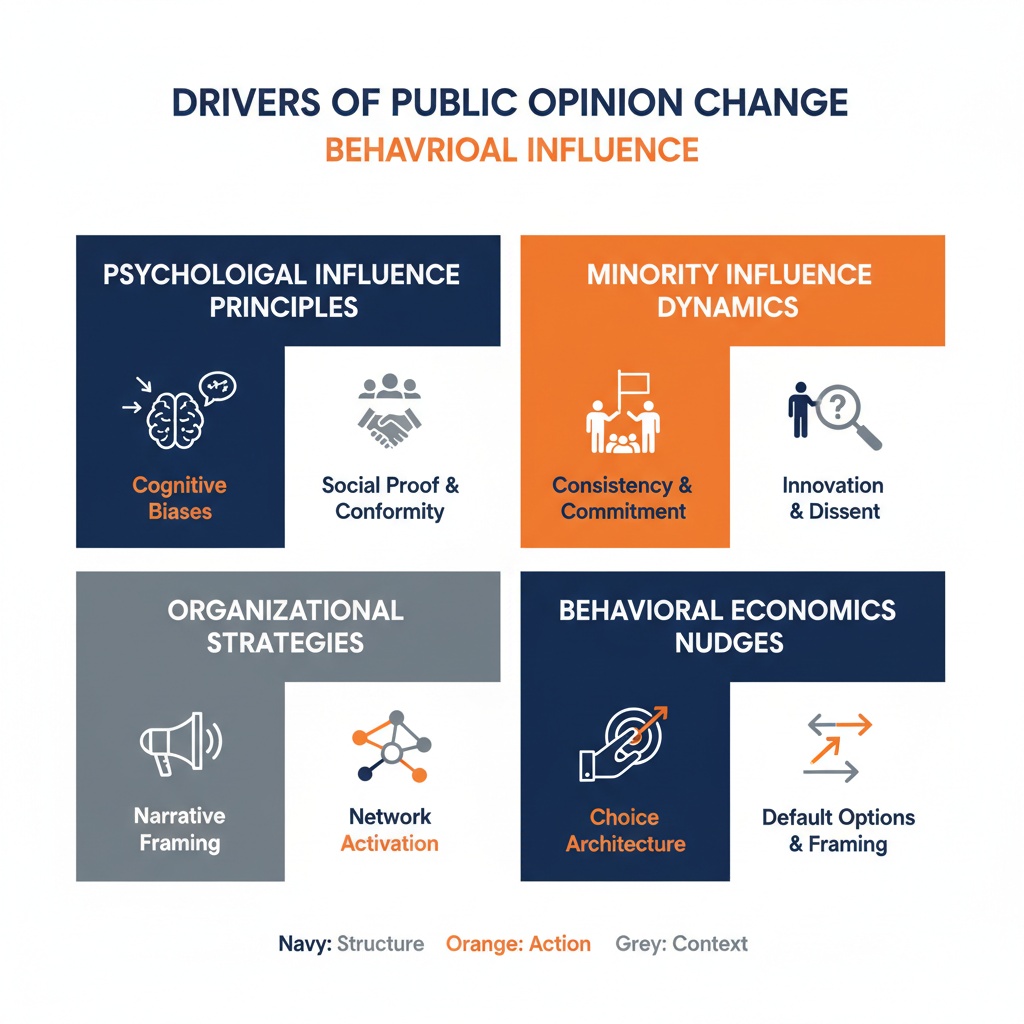
Infographic Image: Key Drivers of Public Opinion Change and Behavioral Influence
The scope of this examination spans micro-level psychological mechanisms—including cognitive biases, social proof, and persuasive communication principles—to macro-level organizational strategies involving leadership, culture, and coalition building. Additionally, the analysis incorporates behavioral economic concepts such as choice architecture and nudging to refine influence techniques. Methodologically, the work draws on a robust base of empirical studies, theoretical models, and real-world examples to elucidate effective interventions for social change.
By integrating these distinct yet complementary perspectives, this document aims to equip professionals and stakeholders with a nuanced understanding of how to craft influence strategies that are both scientifically grounded and practically viable. The findings highlight the synergy between psychological foundations, organizational tactics, and economic behavioral tools as pivotal to optimizing public influence outcomes.
1. Psychological Mechanisms Behind Public Opinion Change
Understanding the psychological underpinnings of public opinion change is fundamental to any effective strategy aimed at influencing societal attitudes and behaviors. At the core of these mechanisms are cognitive and social processes that govern how individuals perceive, interpret, and modify their beliefs when situated within social contexts. This section delves deeply into the mental frameworks and group dynamics that catalyze shifts in public opinion, laying the groundwork for more complex organizational and economic strategies addressed later. By exploring the nuanced interplay between minority and majority influences, the powerful sway of social proof, and the moral convictions that drive conformity, we anchor the discussion in empirically supported psychological insights that are pivotal for shaping collective perspectives in a pluralistic society.
Crucially, this analysis integrates Robert Cialdini’s foundational six principles of influence—reciprocation, commitment and consistency, social proof, liking, authority, and scarcity—providing a scientific lens through which the subtleties of persuasion can be better understood and ethically applied. These principles illuminate the psychological levers that amplify message effectiveness and behavioral compliance. Notably, among these principles, social proof and commitment and consistency demonstrate the highest effectiveness scores in influencing public opinion, with scores of 95 and 90 respectively, underscoring their critical role in persuasion strategies [Chart: Effectiveness of Cialdini's Principles on Persuasion]. Establishing this individual and group-level cognitive framework is essential not only for comprehending how attitudes evolve but also for justifying the subsequent organizational and behavioral economic interventions designed to harness these psychological processes for broader social change.
Minority Versus Majority Influence Dynamics Within Groups
The dynamics between minority and majority influence within groups constitute a cornerstone of understanding public opinion shifts. Traditional views emphasize the power of majority opinion in driving conformity, yet empirical research reveals that minority groups can exert profound influence under specific conditions. Minorities that consistently express divergent views may trigger deeper cognitive processing among majority members, encouraging reconsideration of prevailing norms. Two predominant processes have been identified: one where minorities initially conform to gain acceptance before introducing change by deviating thoughtfully, and another where persistent dissent without conforming fosters reevaluation through the stimulus of cognitive conflict.
For example, Richard M. Perloff’s analysis in "The Dynamics of Persuasion" highlights how minority influence is more effective when it is consistent, confident, and aligned with a moral or ethical framework, thereby increasing its perceived legitimacy. This moral conviction not only solidifies minority group identity but also enhances the psychological impact on majority members, who may feel social or cognitive dissonance by maintaining opposing views. Group size also plays a significant role; smaller, tightly-knit minorities can leverage social networks and alliances to amplify their presence, especially when they capture the attention of key influencers within the majority. This interaction between minority steadfastness and majority openness creates fertile ground for opinion change, blending social conformity with cognitive challenge.
Impact of Social Proof and Moral Conviction on Conformity
Social proof stands as one of the most robust psychological mechanisms driving conformity. Rooted in humans’ inherent reliance on observational learning, social proof assumes that individuals look to others’ behaviors to determine appropriate conduct, especially in uncertain situations. The presence of consensual behavior effectively acts as a heuristic shortcut, reducing the cognitive effort required for decision-making and reinforcing group norms. This phenomenon is potent in public opinion formation, as demonstrated by widespread acceptance of behaviors or attitudes that appear normative, even when individuals might privately hesitate.
The strength of social proof is amplified when intertwined with moral conviction. Moral conviction imbues attitudes with a normative force that transcends mere preference, prompting individuals not only to conform but to actively advocate for the sanctioned beliefs. As shown in document d1, moral conviction intensifies the psychological cost of dissent, increasing susceptibility to conformity pressures. This relationship complicates simplistic interpretations of social proof: while it can drive surface-level compliance, moral conviction solidifies internalization of the norm, leading to longer-lasting opinion change. The synergistic effect between these constructs underpins why movements grounded in moral narratives often achieve rapid and resilient shifts in public sentiment.
Robert Cialdini’s Six Principles of Influence
Robert Cialdini's six principles of influence provide a comprehensive framework to understand the psychology of persuasion that underlies public opinion change. Each principle leverages a distinct cognitive shortcut or social heuristic that individuals routinely apply, often subconsciously, to navigate social complexities. These principles—reciprocation, commitment and consistency, social proof, liking, authority, and scarcity—offer strategic insights into how messages can be crafted to maximize acceptance and compliance.
Reciprocation relies on the ingrained social norm that people feel compelled to return favors or concessions, creating a foundation for cooperative behavior. Commitment and consistency emphasize the human desire to act in accordance with prior statements or actions, such that public commitments foster durable attitude alignment. Social proof, as previously discussed, drives conformity by showcasing widespread acceptance. The principle of liking underscores how affinity, similarity, and positive associations between communicator and audience substantially improve persuasive outcomes. Authority taps into our tendency to defer to credible and knowledgeable figures, enhancing message legitimacy. Finally, scarcity creates perceived value through limited availability, motivating urgency in attitude or behavioral shifts.
Together, these principles form an integrated matrix that informs not only persuasion in interpersonal contexts but also mass communication and public campaigns. Their applicability across various domains has been validated extensively in experimental and field studies, underscoring their utility in designing influence strategies that resonate cognitively and emotionally with targeted populations.
2. Organizational Strategies for Mobilizing and Sustaining Behavioral Change
The capacity of organizations to shape public opinion and catalyze lasting behavioral change hinges on effectively scaling individual psychological influences into cohesive collective action. While the preceding analysis illuminated the cognitive and social processes driving persuasion at the individual and group levels, organizational strategies synthesize these mechanisms within structured social entities. This section elucidates how organizational dynamics—specifically the variables of group size, cultural context, leadership roles, allyship, and communication architectures—operate as critical levers to mobilize communities, empower minority positions, and institutionalize compliance with new behavioral norms. By examining these factors through empirical and theoretical lenses, we uncover the essential frameworks that enable social movements and organizations to convert intent into sustained action. A detailed comparison of these core strategies is outlined in the organizational strategy matrix, highlighting their distinct but interrelated roles in behavioral mobilization [Table: Organizational Strategy Comparison].
Extending foundational psychological principles, organizational frameworks must negotiate the complexity of varied audiences, competing viewpoints, and entrenched cultural values. The interplay between group composition and culture determines the fertile ground upon which persuasive appeals land or falter, while strategic leadership, charismatic allies, and targeted messaging create the scaffolding for minority opinions to permeate and sometimes supplant dominant narratives. The strategic orchestration of these components enhances the ability to generate not only initial agreement but durable compliance and active participation in social change efforts. This section, therefore, bridges micro-level psychological insight with macro-level organizational tactics, setting the stage for more nuanced behavioral economic enhancements discussed subsequently.
Influence of Group Size and Culture on Organizational Persuasion
Organizational persuasion dynamics are profoundly shaped by the size and cultural composition of the target group. Empirical findings emphasize that as group size increases, the modes and effectiveness of persuasion adapt to maintain efficacy. Small groups often foster deeper interpersonal connections and allow for more nuanced, dialogic exchanges, which can enhance trust and motivation to adopt new behaviors. Conversely, in larger collectives, persuasion strategies must rely more heavily on social proof and norm-setting mechanisms to influence behavior via perceived majority support or institutional endorsement, as individual interactions dilute in volume and intimacy.
Culture functions as both a filter and amplifier for organizational influence by mediating the interpretation of messages and the resonance of persuasive appeals. Collective values, social norms, and shared identities inform how new ideas are received and whether minority viewpoints gain traction. For example, organizations operating within collectivist cultures benefit from emphasizing group harmony and common goals, aligning behavioral change with cultural concepts of social responsibility. In contrast, individualistic cultures may respond better to appeals underscoring personal benefits or individual agency. Recognizing and adapting to these cultural contours is crucial; misalignment can provoke resistance or skepticism, undermining the mobilization effort.
Moreover, culture interacts with group size to influence conformity pressures and participation willingness. In tightly connected smaller groups with strong cultural congruence, minority influence can be more potent when allies enlist social identities that resonate with group members. Studies reveal that the integration of minority opinions—whether through initial agreement followed by principled dissent or consistent, unwavering positioning—can facilitate shifts in the majority’s stance, particularly when the minority leverages culturally salient arguments and demonstrates commitment. Organizational leaders who understand these group dynamics can tailor strategies to optimize persuasive impact and encourage sustained engagement.
Role of Allies and Leadership in Strengthening Minority Viewpoints
Leadership and strategic allyship are pivotal organizational tools in elevating minority perspectives within public discourse to effect behavioral shifts. Leaders embody both the symbolic and practical nexus between the organization’s objectives and its members, shaping message framing, fostering commitment, and aligning collective action. Effective leaders harness credibility, emotional intelligence, and adaptive communication to validate minority opinions, reducing social isolation of dissenters and enhancing their perceived legitimacy within the group.
Allies function as essential conduits and amplifiers of minority influence, serving to bridge the divide between minority and majority factions. Their presence can mitigate the risks of marginalization that minorities face and provide social proof that their views are not isolated anomalies. When allies coalesce around a minority position, they create a coalition effect, which increases the visibility and perceived viability of alternative perspectives. This coalition-building capability often determines whether minority opinions remain peripheral or become integrated into the group consensus and organizational culture.
Organizational case studies demonstrate that leadership teams that actively cultivate networks of supportive allies—both within and outside the primary group—enhance resilience against pushback and resistance. For example, social movements succeed when embedded leaders foster inclusivity of diverse viewpoints and facilitate the coordination of decentralized allies who can act as local champions, spreading adoption through ambient social influence channels. This distributed leadership model, validated by evidence in d1, contrasts with centralized command approaches and encourages organic growth and sustained behavioral change.
Communication Strategies Deployed by Organizations to Gain Compliance
Communication within organizational contexts transcends mere information dissemination; it is a tactical instrument for gaining compliance, constructing social reality, and fostering internal cohesion around behavior change goals. Organizations deploy multi-modal communication strategies tailored to audience segmentation, message framing, and channel selection, all designed to escalate persuasion while minimizing resistance.
The strategic use of normative messaging—highlighting prevalent behaviors and community expectations—serves as a central compliance-gaining tactic. By signaling what is typical or approved within a social group, organizations leverage conformity drives and social proof to induce voluntary adoption of desired behaviors. For instance, publicizing statistics on peer behaviors or endorsements by influential figures can substantively increase perceived normative pressure, as documented in d2’s analysis of persuasion patterns.
Furthermore, organizations employ both emotional appeals and rational arguments, calibrated according to the complexity of the behavioral change sought and the audience’s motivational orientation. Emotional narratives that connect on values and identity often catalyze intrinsic motivation and commitment, while rational framing and evidence-based messaging provide the cognitive groundwork for informed decision-making. Layered communication—deploying repetition, message variation, and interactive dialogue—reinforces messages and addresses emerging counterarguments.
Additionally, the framing of messages to emphasize benefits, reduce uncertainty, and offer clear behavioral steps enhances message uptake and compliance. Leaders and communicators trained in compliance-gaining techniques avoid power-assertive or coercive language, instead favoring styles that maintain autonomy and empowerment perceptions among recipients. These communicative nuances are instrumental in sustaining long-term organizational influence and behavioral normalization across diverse publics.
3. Behavioral Economics and Nudge Techniques to Enhance Public Influence
In the quest to shape public opinion and catalyze behavioral change, traditional psychological insights and organizational strategies provide the foundational frameworks that explain why individuals and groups respond in particular ways. However, as influence campaigns become increasingly sophisticated in an era of abundant information and complex social dynamics, integrating behavioral economics brings a transformative layer of intervention. This section explores how the application of choice architecture and nudging—core concepts of behavioral economics—offers refined, subtle yet powerful tools to guide public decisions ethically and effectively. These tools complement psychological triggers and organizational frameworks by designing environments that steer individuals toward desired outcomes with minimal resistance or cognitive burden.
Behavioral economics reshapes classical economic assumptions by acknowledging that human decisions often deviate from purely rational models due to bounded rationality, heuristics, and cognitive biases. By leveraging these predictable biases through thoughtfully designed choice environments, influence efforts can be significantly optimized. Choice architecture—the intentional organization of context, options, and information presentation—allows influencers to 'nudge' individuals subtly without restricting freedom of choice. As this narrative unfolds, we will examine how these economic behavioral tools intersect with persuasion principles, and present empirical evidence demonstrating the tangible impact of nudges on compliance and attitude shifts.
Fundamentals of Choice Architecture and Nudges
Choice architecture refers to the design and structuring of decision environments—whether physical, digital, or procedural—that influence the way choices are presented and made. Its premise is that the context and framing of options can drastically affect decision-making outcomes without coercion. Nudges are specific interventions within choice architecture that exploit cognitive biases or heuristics to encourage beneficial behaviors while preserving freedom of choice. For example, placing healthier foods at eye level in cafeterias or automatically enrolling employees in retirement savings plans with opt-out provisions illustrates nudging in practice.
These techniques rely on leveraging systematic behavioral patterns rather than overt persuasion or mandates. The power of nudging lies in its subtlety: a well-placed default option can bring about significant increases in compliance or behavior change. A striking example detailed in Thaler and Sunstein’s seminal work 'Nudge' involves organ donation rates. Countries that utilize opt-out defaults exhibit donation consent rates exceeding 90%, compared to opt-in countries where rates often fall below 20%. This dramatic difference stems purely from altering the decision architecture without changing individual preferences fundamentally.
Beyond defaults, framing effects, social norm nudges, and incentive structures are typical tools within choice architecture. For instance, communicating that “most people in your community recycle” activates conformity biases and social proof, encouraging greater participation in recycling programs. Indeed, social proof accounts for 40% of the key influences shaping group behavior, making it the dominant factor in fostering conformity and collective action [Chart: Key Influences on Group Behavior]. Economic incentives tied to immediate, tangible gains (such as small-scale rewards for energy savings) further capitalize on behavioral tendencies toward loss aversion and immediate gratification. The design of these nudges must be ethical and transparent to maintain trust and effectiveness, underscoring their role as facilitators rather than manipulators of choice.
Integrating Behavioral Economics with Traditional Persuasion Principles
While behavioral economics provides tools to optimize choice environments, these mechanisms are deeply intertwined with classical persuasion theories. Traditional persuasion principles such as those identified by Robert Cialdini—including reciprocity, commitment and consistency, social proof, liking, authority, and scarcity—are echoed in nudge strategies but employed through environmental structuring rather than direct messaging. For example, the principle of social proof is utilized not only in explicit messaging (‘everyone’s doing it’) but can be embedded in defaults or peer comparison feedback that nudges individuals to conform without forceful persuasion.
This integration highlights how behavioral economics serves as an extension and refinement of psychological influence, operationalizing persuasion through systematic design rather than standalone appeals. Where psychology explains the cognitive and social processes that drive behavior, behavioral economics offers practical frameworks to harness these processes in real-world settings by adjusting the 'choice architecture.' This creates synergy across the individual-level mental models of influence and the contextual, structural modifications that promote desired outcomes efficiently.
Moreover, behavioral economics addresses limitations in traditional persuasion by enabling scalable, low-cost interventions that maintain autonomy. For instance, while organizational campaigns might rely on leadership endorsements or complex communication strategies to shape behavior, nudges can provide complementary micro-interventions that lower the cognitive effort in decision-making. This reduces resistance and dropout in influence efforts, helping bridge the gap between attitude change and actual behavior adoption.
Evidence-Based Applications Demonstrating Enhanced Compliance and Attitude Shifts
Empirical research consistently validates that behavioral economics-led nudges significantly enhance the efficacy of influence interventions. A multitude of studies across health, finance, and environmental domains show that well-designed nudges increase compliance rates and positively shift attitudes toward behaviors aligned with public and social goals. For example, in public health campaigns, automatic scheduling of vaccination appointments with an opt-out choice architecture has been shown to increase vaccination rates by up to 20% compared to standard opt-in systems.
Financial behavior studies corroborate similar trends: automatic enrollment with default contribution levels in retirement plans dramatically amplifies participation and savings rates. In energy conservation, providing households with comparative consumption feedback relative to efficient neighbors prompted reductions in electricity use by as much as 10%. These outcomes derive from subtle yet quantifiable shifts in decision-making motivated by carefully crafted cognitive cues.
Additionally, research illustrates that nudges can induce attitudinal change alongside behavior shifts by reinforcing new norms and desirability perceptions. For instance, recycling programs that couple default bin placements with social norm messaging not only boost recycling rates but also cultivate a stronger environmental identity among participants, which sustains long-term habit formation. Such dual impact highlights the integrative power of behavioral economics when layered onto psychological foundations and organizational efforts.
Critically, these interventions have been effective across diverse populations and cultural contexts, demonstrating scalability and adaptability. However, their success hinges on rigorous pre-implementation testing and ethical considerations to avoid manipulation concerns. Transparency in nudge design and framing as supportive choice facilitation underpin sustained public trust and engagement.
Conclusion
The synthesis of psychological theories, organizational frameworks, and behavioral economics illustrates a multidimensional approach essential for effectively shaping public opinion and behavior. Psychological insights provide the foundational understanding of individual and social cognitive processes that underlie susceptibility to influence, while organizational strategies translate these insights into collective action through leadership, culture, and communication. Behavioral economics enriches this synergy by introducing choice architecture and nudging to subtly guide decisions in favor of desired outcomes.
Practitioners aiming to implement influence campaigns should consider this integrated model as a guide for designing ethically sound and strategically targeted interventions. Emphasizing transparency, cultural sensitivity, and empowerment within message framing and choice environments enhances both efficacy and public trust. Future analyses could further explore the longitudinal impacts of combined influence strategies and adaptations across varying cultural and technological contexts, deepening the evidence base for sustained social change.
Glossary
- Behavioral Economics: A field blending economics and psychology that studies how cognitive biases and heuristics influence decision-making, often deviating from purely rational models.
- Choice Architecture: The design and organization of environments in which people make decisions, aimed at influencing outcomes in a predictable way without restricting freedom of choice.
- Cognitive Bias: Systematic patterns of deviation from rational judgment, affecting how individuals perceive, interpret, and make decisions.
- Minority Influence: The process by which a smaller group or dissenting individuals affect the opinions or behaviors of the majority, often through consistency and confidence.
- Nudge: A subtle intervention within choice architecture that steers people toward desirable behaviors while preserving their freedom to choose.
- Organizational Culture: Shared values, beliefs, and norms within an organization or group that shape the reception and effectiveness of persuasive messages.
- Robert Cialdini’s Six Principles of Influence: A framework outlining six key psychological triggers that enhance persuasion: reciprocation, commitment and consistency, social proof, liking, authority, and scarcity.
- Social Proof: A psychological phenomenon where individuals copy the actions of others in an attempt to undertake behavior in a given situation, especially under uncertainty.
- Social Conformity: The act of matching attitudes, beliefs, and behaviors to group norms due to real or imagined group pressure.
- Leadership in Organizational Influence: The role of leaders in shaping group norms, validating minority viewpoints, and coordinating collective action to achieve behavioral change.
- Allyship: Support and coalition-building by individuals or groups who help amplify minority perspectives and reduce their marginalization.
- Compliance-Gaining Strategies: Communication techniques used by organizations to encourage voluntary acceptance and adherence to desired behaviors or norms.