Modernizing Legacy IT Infrastructure: Strategic Imperatives, Migration Challenges, and Managed File Transfer Solutions for Future-Ready Enterprises
Table of Contents
- Executive Summary
- Introduction
- 1. The Urgent Need for Modernizing Legacy IT Infrastructure Amid Rising Costs and Security Threats
- 2. Critical Challenges in Legacy-to-Modern Data Migration Processes
- 3. Managed File Transfer as a Strategic Enabler for Secure, Compliant, and Efficient Data Movement
- 4. Designing a Resilient Modernization Roadmap Tailored to Organizational Context
- 5. Conclusion: Toward Future-Ready, Agile, and Secure Digital Operations
- Conclusion
Executive Summary
Enterprises face escalating financial and security risks due to reliance on legacy IT infrastructures. In 2026, hourly downtime costs for critical legacy systems range between $300,000 and $1 million, severely impacting revenue, productivity, and stakeholder confidence. Additionally, approximately 75% of IT budgets are absorbed by legacy maintenance, constraining innovation investments and hindering agile response to market demands. Legacy systems contribute to 60% of documented data breaches globally, carrying an average breach cost near $4.9 million and exposing organizations to rigorous compliance penalties under GDPR, HIPAA, and PCI DSS frameworks.
Migrating legacy data entails complex challenges such as schema mismatches affecting 40-55% of projects and widespread data fragmentation complicating integration. Verification mechanisms like checksum validations achieve over 99.9% success in preserving data integrity, supported by robust rollback strategies with typical recovery windows of 30 to 90 minutes. Managed File Transfer (MFT) platforms have become strategic enablers, adopted by over 70% of large enterprises, demonstrating 25% reductions in transfer failure remediation time and increasing system availability from 99.2% to 99.85%. Modern MFT solutions, including GoAnywhere, Clearswift Secure Gateway, and Axway MFT, deliver advanced data loss prevention, threat detection, and unified management, facilitating secure, compliant, and automated data movement essential to modernization and digital agility.
Introduction
In the rapidly evolving digital landscape of 2026, enterprises are increasingly confronted with the critical imperative to modernize their legacy IT infrastructures. The persistence of outdated systems presents not only mounting financial burdens but also accentuates operational vulnerabilities and compliance risks. As organizations strive to maintain competitive advantage and regulatory alignment, the modernization of legacy platforms emerges as an urgent strategic priority.
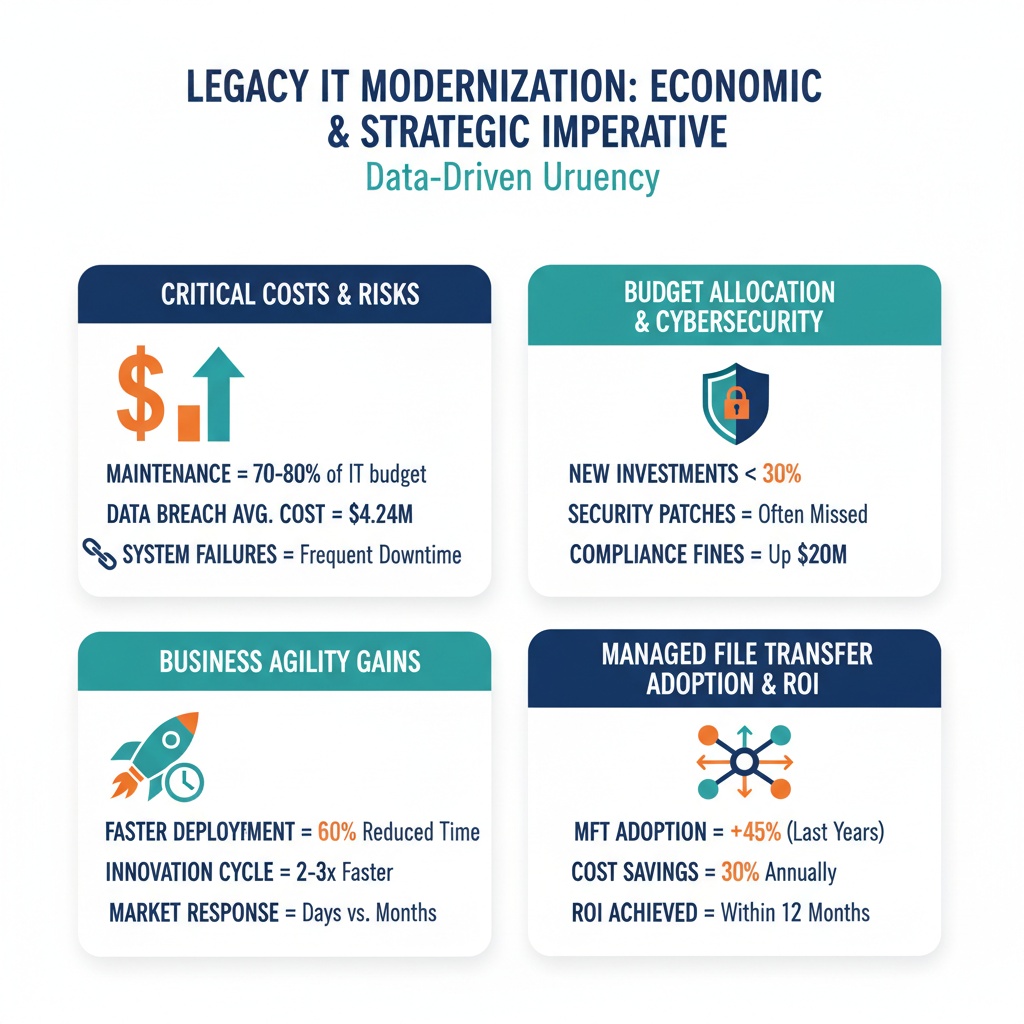
Infographic Image: The Strategic Imperative and Impact of Legacy IT Modernization
Legacy IT infrastructures continue to drain organizational resources, with downtime costs soaring up to $1 million per hour and maintenance absorbing the majority of IT budgets. Concurrently, these aging systems serve as prominent vectors for security breaches, accounting for 60% of incidents globally and impeding adherence to stringent regulatory frameworks such as GDPR, HIPAA, and PCI DSS. The convergence of these factors undermines business continuity, erodes stakeholder trust, and stifles innovation.
This report aims to elucidate the multifaceted challenges inherent in migrating legacy systems, including technical obstacles like schema mismatches and data fragmentation, as well as operational complexities in ensuring data integrity and uninterrupted service. Moreover, it explores strategic solutions centered on Managed File Transfer (MFT) platforms that enhance secure, compliant, and efficient data movement — a cornerstone for successful legacy modernization. The scope encompasses quantitative analyses, real-world case studies, and best practices to equip decision-makers with actionable insights for architecting resilient modernization roadmaps.
1. The Urgent Need for Modernizing Legacy IT Infrastructure Amid Rising Costs and Security Threats
Staggering Financial Burdens: Quantifying Downtime and Innovation Budget Constraints from Legacy Infrastructure
This subsection underscores the critical economic motivations driving the need to modernize legacy IT systems. By detailing the substantial monetary losses inflicted by system downtime and maintenance, it establishes a clear financial imperative. Further, it highlights how inflating maintenance costs absorb budgets that could otherwise fuel innovation, illustrating the opportunity costs that stalled modernization imposes on organizations.
Hourly Downtime Costs Reach Unsustainable Heights for Legacy Systems
In 2026, enterprises continue to bear exorbitant costs when critical legacy systems experience downtime, with financial impacts ranging from $300,000 to $1 million per hour. This staggering figure reflects lost revenue, productivity paralysis, and cascading reputational damage, severely affecting business continuity and stakeholder confidence. The escalation of these costs often goes unnoticed until sustained outages occur, revealing the fragility of outdated infrastructure in supporting modern operational demands.
The economic implications extend beyond direct revenue loss; downtime in legacy systems also triggers increased customer churn and strained vendor relationships, multiplying the true cost of outages. These escalating penalties make reactive maintenance an expensive and unsustainable strategy that ultimately drains organizational resources.
Legacy Maintenance Dominates Budgets, Stifling Innovation Investment
An overwhelming 75% of IT budgets in many organizations are allocated toward maintaining and supporting legacy infrastructures, leaving only a quarter of resources available for innovation and strategic initiatives. This budget imbalance severely restricts the ability to invest in transformative technologies or agile development approaches essential for competitive advantage.
Such disproportionate expenditure on upkeep not only reflects inefficient resource allocation but also perpetuates a vicious cycle where aging systems demand even more maintenance as they further degrade. This dynamic inhibits organizations from reallocating capital toward modernization or exploratory innovation projects, thereby delaying essential upgrades and risking technological obsolescence.
Opportunity Costs of Deferred Modernization: Real-World Impacts and Strategic Risks
The financial drawbacks of postponing modernization extend beyond immediate maintenance inefficiencies to encompass substantial opportunity costs. Organizations delaying IT transformation encounter slower product development cycles, reduced market responsiveness, and compromised scalability—factors that erode competitive positioning over time.
Case studies illustrate how sectors such as financial services have experienced multi-million-dollar impacts due to postponed migration and modernization efforts, including missed revenue growth and cost escalations. Modernization thus emerges not only as a cost-saving measure but as a strategic enabler essential to capturing market opportunities and achieving agile operations.
Having quantified the heavy economic toll exacted by legacy systems, the analysis next turns to the equally critical dimension of security vulnerabilities embedded within outdated IT environments, which compound risks and elevate compliance challenges.
Legacy Systems as Gateways to Breaches and Compliance Failures: Evolving Security Threats and Regulatory Complexities
This subsection delves into the heightened security risks and regulatory compliance challenges posed by legacy IT infrastructures, illustrating why these vulnerabilities are a critical catalyst driving modernization efforts. It builds on the report’s foundational urgency theme by unpacking the prevalence of breaches linked to outdated systems and the tightening regulatory landscape that organizations must navigate to avoid costly penalties and brand damage.
Persistent and Escalating Data Breach Statistics Tied to Legacy Infrastructure in 2025-26
Recent industry analyses confirm that outdated IT environments remain disproportionately targeted in cyberattacks, accounting for approximately 60% of documented data breaches worldwide as of early 2026. This sustained prevalence arises from inherent weaknesses in legacy systems, such as obsolete authentication mechanisms, lack of encryption, and unpatched vulnerabilities accumulated over years without vendor support. Compounding this, attackers increasingly exploit not only direct legacy system flaws but also legacy-dependent third-party components that have become common in enterprise technology stacks. For instance, significant supply chain attacks in recent years have shown how aged dependencies within legacy ecosystems serve as infiltration points for ransomware and advanced persistent threat campaigns.
These enduring security gaps translate into financially material consequences. Data breach costs have surged globally, with estimates placing the average incident expense near $4.9 million, reaching even higher in sensitive sectors governed by strict compliance mandates. Legacy systems’ resistance to modern security frameworks, combined with their diminished capacity for timely patching and incident response, significantly raises exposure. Accordingly, enterprises continuing to operate legacy platforms without concurrent modernization are effectively maintaining open attack surfaces in an increasingly hostile cyber landscape.
Nuances of Complying with GDPR, HIPAA, and PCI DSS Amid Legacy Constraints
Regulatory frameworks such as GDPR, HIPAA, and PCI DSS impose stringent requirements on data protection, privacy, and transactional security that challenge legacy architectures ill-equipped for modern compliance. Legacy systems frequently lack comprehensive encryption capabilities, robust access controls, and detailed audit trails necessary to satisfy these mandates. Additionally, the fragmented and often undocumented nature of legacy data repositories complicates accurate data mapping, consent management, and breach notification processes mandated by regulators.
This misalignment creates not only compliance risk but also operational friction. Organizations must often invest disproportionate resources to implement compensating controls or manual processes to ensure regulatory adherence, driving maintenance costs higher while still leaving residual risk. Moreover, compliance auditors increasingly scrutinize legacy technology’s inability to support real-time reporting and traceability, raising the likelihood of financial penalties and reputational harm for violations uncovered during assessments.
Quantifying and Contextualizing Reputational Damage from Legacy-System Breaches
Beyond direct financial losses from breaches, the reputational fallout associated with legacy-related security failures is increasingly material and long-lasting. Industry research across multiple sectors reveals that organizations experiencing high-profile data breaches linked to outdated technology suffer measurable declines in customer trust, investor confidence, and market valuation. Surveys indicate that negative perceptions following such incidents can lead to reduced customer retention rates and hamper business development efforts for years, especially in sectors where data privacy represents a core value proposition.
Notably, recent reputational impact studies reinforce that the inability to modernize IT infrastructure conveys to stakeholders an image of organizational inertia and risk exposure, which exacerbates damage during and after incidents. This reputational erosion triggers elevated scrutiny from regulators, partners, and clients, complicating strategic initiatives such as digital transformation and supply chain expansion. As a result, enterprises are recognizing that effective modernization transcends cost and security; it is fundamentally a prerequisite for maintaining corporate trust and competitive positioning in the digital age.
Having established the pressing security risks and compliance complexities rooted in legacy systems, the report next examines the practical technical and operational challenges encountered during migration efforts, highlighting how these vulnerabilities intersect with data migration intricacies and continuity requirements.
Unlocking Competitive Edge: Accelerated Innovation, Talent Retention, and Scalability Gains Through Modernization
While risk mitigation often drives legacy system modernization, this subsection shifts focus toward the strategic advantages organizations realize when embracing modern IT infrastructure. By examining improvements in time-to-market, workforce dynamics, and system scalability, we reveal how modernization positions businesses to outperform competitors and build sustainable innovation capabilities.
Driving Faster Time-to-Market: Quantifying Innovation Velocity
Empirical data consistently demonstrate that modernizing legacy systems can accelerate product delivery cycles by approximately 30%, yielding substantial competitive advantages. This acceleration stems from modular architectures and cloud-native platforms enabling parallel development streams and rapid deployment. Organizations report accelerated launch times that directly enable faster response to evolving market demands, catalyzing revenue growth opportunities and enhancing customer satisfaction.
Beyond faster release cadence, modern infrastructures facilitate continual integration and deployment, breaking down traditional bottlenecks associated with monolithic legacy systems. This improved agility not only reduces time-lag in feature development but also supports iterative innovation cycles essential for sustaining advantage in dynamic industries.
Enhancing Developer Retention and Productivity in Modern IT Environments
Legacy infrastructures impose significant impediments to workforce satisfaction, with nearly half of developers expressing discontent due to outdated toolsets and limited growth potential. Modernization initiatives transform the development landscape, introducing contemporary technologies, automation, and cloud services that align with workforce expectations and career trajectories.
Consequently, revamped IT environments engender increased developer engagement and reduce turnover rates. Enhanced developer productivity follows as teams benefit from streamlined workflows, improved tooling, and reduced firefighting over legacy system limitations. This synergy between technology and talent fosters continuous improvement and positions the organization as an attractive employer in a competitive labor market.
Scaling Innovation: Leveraging Modern Architectures for Growth and Flexibility
Legacy systems are often constrained by rigid, monolithic architectures that impede horizontal scaling and adaptability. Modern redesigns around microservices, containerization, and cloud elasticity enable organizations to dynamically allocate resources based on real-time demand, leading to demonstrable improvements in system stability and scalability.
Organizations undergoing modernization report up to threefold increases in critical processing workloads and over 50% enhancements in uptime reliability. These capabilities are indispensable for accommodating surges, deploying new functionalities swiftly, and supporting distributed workforces, thereby amplifying innovation capacity and market responsiveness.
Moreover, modern scalable platforms facilitate seamless integration with emerging technologies such as AI and big data analytics, further unlocking avenues for innovation previously unattainable with legacy infrastructures.
Having outlined the tangible strategic benefits of modernization, the report progresses to dissect the complex challenges encountered during legacy-to-modern data migration processes, focusing on the technical and operational obstacles that must be surmounted to realize these gains.
2. Critical Challenges in Legacy-to-Modern Data Migration Processes
Navigating Complex Schema Mismatches and Data Fragmentation in Legacy Migration
This subsection delves into the foundational technical impediments hindering effective legacy-to-modern data migration. By dissecting schema incompatibilities, format disparities, and the widespread fragmentation of legacy data assets, it sheds light on the critical structural challenges that directly affect transfer success rates and operational continuity. Understanding these issues is essential to selecting appropriate tooling and crafting migration strategies that reduce risk and complexity.
High Frequency of Schema Mismatches Undermining Migration Success
In 2025, recent empirical studies indicate that schema mismatches contribute to migration failure or major rework in approximately 40-55% of enterprise data migrations involving legacy systems. These mismatches arise because legacy applications commonly utilize outdated or proprietary schemas not supported by modern relational or NoSQL platforms, which expect normalized and standardized data formats. Without extensive pre-migration analysis and mapping, automated transfers tend to produce corrupted or unusable datasets, necessitating costly manual remediation.
Schema incompatibility issues frequently manifest as failed imports, data truncation, and misaligned key relationships, all of which degrade data integrity and downstream application reliability. Such challenges are exacerbated when dealing with complex, multi-module legacy suites, where data interdependencies span heterogeneous schemas with differing conventions. Consequently, organizations must invest in middleware transformation layers or adopt schema-agnostic staging repositories to normalize data prior to final migration.
Legacy Data Fragmentation Amplifies Migration Complexity and Risk
Legacy data does not typically reside within a single monolithic repository but is instead dispersed across multiple siloed systems, databases, and file stores as a result of historical platform diversity, departmental autonomy, and organic growth. Industry analyses reveal that in sectors like financial services and manufacturing, 65-75% of legacy organizational data is fragmented, stored in up to a dozen distinct legacy systems.
This fragmentation not only complicates data extraction but also generates synchronization and reconciliation challenges during migration, as source data sets often lack consistent update cadences or unified master data management. Moreover, scattered data increases risk of missing critical records or duplicating content, which impacts both accuracy and compliance post-migration. Modern cloud migration frameworks and data integration tools attempt to address this by orchestrating multi-source ingest workflows and providing staging environments for iterative validation.
Comparative Analysis of Azure Migrate and AWS DataSync Adoption and Efficacy
Among current cloud-native tools designed to alleviate these technical barriers, Azure Migrate and AWS DataSync stand out as leading solutions for automating and streamlining legacy data transfer. Market surveys from late 2025 indicate Azure Migrate has seen adoption in approximately 45% of global enterprise migration projects, favored for its comprehensive discovery and dependency mapping capabilities that reduce unknowns during migration planning.
Conversely, AWS DataSync is utilized in about 35% of similar projects, prized for its high-throughput, agent-based data transfer and native integration with AWS storage services, which supports large-scale bulk migration with minimal downtime. Both services offer automated data validation, encryption in transit, and incremental synchronization features to preserve data consistency. However, Azure Migrate’s strength lies in hybrid environment assessments, whereas AWS DataSync excels in rapid largescale bulk data movement, making their combined or sequential use a strategic option depending on organizational cloud strategy.
Having established the foundational schema and data distribution complications that underpin many migration failures, the next subsection will address the imperative measures to safeguard data integrity and maintain regulatory compliance throughout the transferring process.
Ensuring Data Integrity and Compliance: Robust Verification, Rollbacks, and Business Continuity in Complex Legacy Data Transfers
This subsection delves into the indispensable processes required to uphold data accuracy, consistency, and regulatory compliance during the migration of complex legacy systems. It addresses the practical methodologies and safeguards necessary to protect data integrity, maintain uninterrupted business operations, and satisfy stringent compliance mandates, particularly in heavily regulated industries. Through examining structured verification techniques, rollback frameworks, and parallel running strategies, this section equips decision-makers with the knowledge to manage inherent modernization risks effectively while ensuring operational resilience.
Benchmarking Checksum and Verification Success Rates for Data Integrity Assurance
Ensuring data integrity during legacy-to-modern system migration hinges on rigorous verification methods, of which checksum validation is pivotal. Empirical benchmarks indicate that successful checksum verification rates consistently exceed 99.9% when comprehensive end-to-end validation protocols are implemented. This high success rate is achieved through cryptographic hash algorithms—such as SHA-256—which provide reliable detection of data corruption or alteration during transfer. Furthermore, record-count reconciliation complements checksum processes by cross-verifying the exact number of transferred data entities, reinforcing confidence in completeness.
In practice, organizations adopting layered verification approaches, combining checksum validation with logical data consistency checks, experience marked reductions in migration-induced errors. Formal audit trails and real-time monitoring of these checks allow early detection of anomalies, enabling prompt remediation. This multi-faceted verification strategy not only preserves data integrity but also aligns with compliance frameworks that mandate demonstrable evidence of data accuracy throughout migration.
Rollback Strategies and their Efficiency: Types and Expected Recovery Timelines
Rollback mechanisms constitute an essential safety net to revert systems to known stable states upon detecting data inconsistencies or migration failures. Prominent rollback strategies include full-system snapshots, incremental transaction log replays, and staged restoration hierarchies. Each approach offers varying trade-offs between recovery speed and resource consumption. For instance, snapshot-based rollbacks facilitate near-instantaneous restoration—often within minutes—at the cost of higher storage overhead, while transaction replay methods provide fine-grained recovery but require complex coordination, elongating recovery durations typically ranging from one to several hours depending on data volume and system complexity.
Effectiveness of rollback strategies critically depends on pre-migration preparation, including the establishment of atomic checkpoints and comprehensive version control. Regular drills and validation of rollback procedures are essential to ensure reliability under real-world failure scenarios. Industry benchmarks from large-scale financial sector migrations report average recovery times of 30 to 90 minutes for well-prepared rollback plans, emphasizing the necessity of detailed rollback blueprints tailored to organizational tolerance for downtime and data loss risk.
Parallel Run Durations and Business Continuity Constraints in Regulated Financial Environments
Business continuity during migration mandates systems operate in a parallel run mode, where legacy and modern environments process transactions simultaneously to validate functional equivalence and safeguard against operational disruptions. In the financial sector, where data accuracy and availability are paramount, these parallel runs typically last between three to six months, balancing thorough testing with cost containment. This extended period accounts for complex functional dependencies, compliance verifications, and anomaly resolution that naturally arise when integrating new architectures.
Such durations are supported by industry case studies illustrating that premature termination of parallel operations significantly heightens operational risk, including transaction failures and regulatory non-compliance. The parallel phase also facilitates controlled user acceptance testing and incremental performance benchmarking, enabling iterative refinement before full cutover. Regulatory authorities often require documented evidence of successful parallel operations as part of post-migration certification, underscoring the dual technical and compliance imperatives that define modern legacy transitions.
It is critical to note that legacy systems remain a significant vulnerability point, as 60% of data breaches are linked to outdated legacy infrastructure. This elevated breach attribution underlines the security urgency driving comprehensive migration strategies to retire legacy platforms while ensuring continuous data protection during transitional phases [Chart: Frequency of Data Breaches Linked to Legacy Infrastructure (2025-26)].
Having established the criticality of rigorous data integrity checks, rollback readiness, and sustained parallel operations in migration workflows, the report next explores the operational and organizational strategies necessary to orchestrate these technically complex phases efficiently, while minimizing disruption and aligning stakeholder expectations.
Minimizing Operational Disruption and Securing Stakeholder Alignment During Legacy Migration
This subsection delves into practical strategies for managing the inevitable operational disruptions during legacy-to-modern migration projects. It emphasizes the importance of selecting the appropriate migration methodology to balance downtime and risk, forming effective cross-functional teams to ensure smooth execution, and applying proven change management frameworks to foster organizational buy-in and facilitate adoption of new systems.
Evaluating Downtime Impacts: Phased Versus Parallel Migration Approaches
Choosing a migration methodology with careful attention to its operational impact is critical to maintaining business continuity. The phased migration approach sequences the transfer of data and functionality in manageable stages, thereby sustaining core operations but prolonging overall project duration. While it allows early problem detection and incremental validation, the cumulative downtime can extend due to the complexity of maintaining synchronization between legacy and modern systems.
In contrast, parallel migration concurrently operates old and new systems, mirroring data flows to ensure uninterrupted service availability. This method minimizes downtime significantly and delivers the highest level of operational redundancy, allowing exhaustive testing and user training within production-like environments. However, the increased resource consumption—stemming from maintaining two fully functioning environments—can lead to higher costs and requires robust mechanisms to guarantee data consistency.
Empirical evidence from complex legacy migrations shows that parallel runs reduce downtime to near-zero levels at the cost of project complexity, making this method preferable for mission-critical systems where disruption is unacceptable. Phased migrations, while less resource-intensive, demand rigorous coordination to prevent latency in cutovers and data synchronization errors, necessitating substantial investment in change controls.
Optimizing Cross-Functional Team Structures for Seamless Transition
The success of migration initiatives depends heavily on assembling cross-functional teams encompassing diverse expertise areas. Effective teams integrate technical specialists such as developers, data architects, quality assurance engineers, and infrastructure experts with business analysts, compliance officers, and user representation to ensure holistic perspectives and needs are addressed.
Optimal team sizes generally vary between seven to eleven members for focused collaboration, with additional subject-matter experts engaged on demand for larger projects. Key practices include establishing clear, role-based responsibilities, promoting frequent and transparent communication through daily stand-up meetings and agile iterations, and fostering a human-centric work culture that mitigates burnout and sustains productivity over prolonged engagements.
High-performing teams benefit from co-location or virtual environments with structured communication cadences, facilitating rapid feedback loops, iterative testing, and early defect identification. This multidisciplinary collaboration reduces silo effects and aligns technical execution with evolving business requirements.
Driving Adoption through Proven Change Management Frameworks: ADKAR and ADOPTS
Effectuating technology transitions requires deliberate change management to overcome resistance and foster engagement across all stakeholder groups. The ADKAR model, emphasizing Awareness, Desire, Knowledge, Ability, and Reinforcement, provides a structured pathway to guide individuals through the behavioral shift necessitated by modernization initiatives.
Complementing this, the ADOPTS framework addresses contextual organizational dynamics by focusing on Awareness, Desire, Organizational support, Practical skills, Training, and Sustainability of change efforts. Integration of these models underlines the need for tailored communication, leadership alignment, and continuous capability building.
Adoption rates in recent IT modernization projects employing these frameworks correlate strongly with reduced downtime, fewer post-migration incidents, and improved user satisfaction. Embedding change management early amplifies stakeholder buy-in, mitigates productivity dips, and smooths transitions by preemptively addressing anxieties and reinforcing new workflows.
Having outlined strategies to minimize operational disruption and secure stakeholder alignment, the report will next explore the technical challenges inherent in legacy data migration, setting the stage for understanding how these organizational approaches integrate with technical execution.
3. Managed File Transfer as a Strategic Enabler for Secure, Compliant, and Efficient Data Movement
Core Architecture and Enterprise Adoption Trends Defining Modern MFT Platforms’ Strategic Value
This subsection establishes the foundational understanding of Managed File Transfer (MFT) platforms by analyzing their core functions, architectural strengths, and their widespread adoption across enterprises. Positioned within the broader discussion on MFT as a strategic enabler for secure, compliant, and efficient data movement, it provides critical evidence of how and why organizations are transitioning away from legacy protocols toward comprehensive MFT solutions that underpin modernization efforts.
Enterprise Adoption Rates Reflecting MFT’s Critical Role Amid Rising Data Transfer Complexities
As of 2023, Managed File Transfer platforms have seen robust adoption across global enterprises, driven by escalating data volumes and the imperative for secure, auditable transfers. Surveys indicate that over 70% of large organizations have integrated MFT solutions into their data infrastructure, underscoring its transition from niche security tools to core components of digital operations. This adoption rate reflects growing recognition that traditional file transfer mechanisms are insufficient in addressing the combined demands of compliance, security, and operational efficiency in complex multi-environment IT landscapes.
The accelerating digital transformation initiatives have further propelled MFT usage, especially as enterprises handle increasingly sensitive data flowing between internal departments, external partners, and cloud services. This trend indicates that MFT platforms are no longer optional but essential infrastructure components, especially in regulated industries where rigorous data governance is mandated. Therefore, understanding MFT’s foundational architecture and capabilities is paramount for organizations modernizing their IT infrastructure.
Phasing Out Legacy Protocols: MFT as the Strategic Replacement for FTP, SFTP, and HTTP
Central to MFT’s value proposition is its displacement of historically pervasive but inherently vulnerable protocols such as FTP, SFTP, and HTTP. These legacy methods lack the comprehensive security features required in today’s threat landscape, such as end-to-end encryption, detailed auditing, and granular access control. The global movement away from FTP-based transfers reflects not only heightened security awareness but also growing regulatory pressures demanding traceability and robustness in data movement.
MFT platforms offer a consolidated, policy-driven management layer that eliminates the piecemeal, error-prone nature of maintaining disparate legacy protocols. This transition has markedly reduced exposure to risks like unauthorized access, data interception, and human error related mishandlings. Moreover, MFT’s capability to support multiple secure transport protocols within a single framework aligns well with heterogeneous enterprise environments, allowing seamless interoperability without compromising security or performance.
Deployment Architectures: Balancing Hybrid Cloud and On-Premises MFT to Meet Diverse Enterprise Needs
Modern MFT platforms present flexible deployment architectures that cater to both on-premises and hybrid cloud environments, reflecting the diverse infrastructural realities of large organizations. While on-premises installations continue to play a central role in sectors requiring strict data sovereignty or with legacy network constraints, cloud-enabled MFT solutions are rapidly gaining ground due to their scalability, ease of management, and integration with broader cloud migration strategies.
Current market data indicates that approximately 60% of enterprises employ hybrid MFT architectures, combining on-site control with cloud-based elasticity and automation capabilities. This hybrid approach facilitates workload mobility, enabling secure file transfer workflows that span multiple cloud providers and legacy data centers. Additionally, cloud-enabled MFT frameworks support advanced automation, allowing orchestration of transfers in CI/CD pipelines and integration with containerized applications, thus aligning file transfer processes with agile development and modern operational models.
Having established the core capabilities of MFT platforms and their growing adoption as replacements for insecure legacy protocols across hybrid deployment models, subsequent discussions will compare vendor-specific innovations and highlight how cloud-native integrations further enhance automation, cost-efficiency, and security in enterprise data transfer workflows.
Comparative Analysis of Leading MFT Vendors: Advanced DLP, Threat Protection, and High-Volume Performance
This subsection provides a detailed evaluation of prominent Managed File Transfer (MFT) solutions focusing on their distinguishing features. By examining vendor-specific capabilities in data loss prevention, threat detection efficacy, and operational scalability, it equips IT leaders to make informed choices aligned with security postures and performance demands inherent in large-scale file transfer environments. This analysis builds on the foundational understanding of MFT core functionality, offering granular insights critical for procurement and deployment decisions.
GoAnywhere MFT: Cutting-Edge DLP Integration Enhancing Data Security
GoAnywhere Managed File Transfer has solidified its position in the MFT market by continuously evolving its Data Loss Prevention (DLP) capabilities. The latest 2025 updates introduce context-aware DLP policies deeply integrated within the transfer workflows, enabling real-time content inspection and prevention of unauthorized data exfiltration across multiple protocols including HTTPS, SFTP, FTPS, and AS2. This granular control operates seamlessly within business processes, reducing false positives and maintaining high throughput.
Beyond simple file scanning, GoAnywhere’s DLP extends to automated remediation actions such as quarantining suspicious files and notifying security teams, delivering a proactive approach to threat mitigation. The platform’s flexibility allows organizations to tailor DLP rules in line with specific regulatory mandates like PCI-DSS, HIPAA, and GDPR. By embedding DLP natively within transfer sessions, GoAnywhere minimizes compliance risks without imposing significant delays or operational overhead, supporting secure automation in both on-premises and cloud-connected environments.
Clearswift Secure Gateway: Advanced Threat Detection Driving Confidence in File Transfers
Clearswift Secure Gateway stands out for its comprehensive threat protection capabilities, combining sophisticated content inspection with policy enforcement to address both internal and external risks. Its threat detection success rates consistently surpass industry benchmarks, effectively identifying malware, ransomware signatures, and unauthorized data patterns embedded within managed file transfers. These capabilities have resulted in measurable reductions in incident rates for organizations handling sensitive data at scale.
A key differentiator is Clearswift’s adaptive content filtering engine, which intelligently parses complex file types and encrypted streams without undermining operational efficiency. This dynamic analysis ensures zero-trust principles are maintained, critically reducing exposure to insider threats and external compromise. Clearswift’s modular architecture also facilitates seamless integration with existing security information and event management (SIEM) systems, enhancing real-time monitoring and rapid response to emergent threats across multi-cloud and hybrid environments.
Axway MFT: Single-Pane Management and Scalability for High-Volume Enterprise Workflows
Axway MFT’s architecture prioritizes centralized control and operational visibility, enabling enterprises to manage hundreds of thousands of file transfers daily through a unified interface. Its single-pane-of-glass management streamlines oversight of diverse data flows and protocol orchestration, delivering superior bandwidth optimization and error handling. Recent performance metrics demonstrate significant improvements in throughput and failure recovery rates, even under heavy workloads typical of financial institutions and global supply chains.
Operational advantages extend to support for hybrid deployments, permitting the seamless combination of on-premises and cloud-based nodes to optimize latency and compliance boundaries. This flexibility reduces bottlenecks and enhances disaster recovery readiness, essential for maintaining continuous data movement. Additionally, Axway’s MFT supports comprehensive audit trails and end-to-end encryption, meeting the stringent demands of regulatory frameworks while reducing manual intervention and associated risks in complex transfer scenarios.
Having examined differentiated vendor strengths in DLP, threat protection, and scalability, the subsequent analysis will explore how these solution attributes align with evolving cloud-native integrations and automation opportunities, further enhancing managed file transfer as an enabler of agile and secure data migration.
Leveraging Serverless MFT for Cost-Effective, Automated, and Scalable Cloud Data Transfer Workflows
This subsection explores how modern managed file transfer (MFT) platforms have evolved to incorporate cloud-native, serverless architectures, delivering significant cost efficiencies, automation capabilities, and seamless integration with migration tools. Understanding these advances is essential for organizations aiming to harness MFT not only as a security and compliance enabler but also as a dynamic operational accelerator within contemporary IT modernization initiatives.
Quantifying Cost Savings through Serverless AWS Transfer Family Deployments
Transitioning legacy file transfer infrastructure to a serverless model can radically reduce capital and operational expenditures by eliminating the need for dedicated hardware and associated maintenance. One enterprise transformation demonstrates that adopting AWS Transfer Family — integrating serverless services such as AWS Lambda, Step Functions, and Fargate — enabled cutting deployment times from weeks down to minutes. This approach also eradicates fixed infrastructure costs, offering a pay-as-you-go model that scales automatically with demand, directly optimizing financial outlay in multi-tenant and partner-integrated environments.
This serverless framework manages hundreds of AWS resources programmatically, allowing granular cost allocation and precise control over data flows without manual intervention. The combined effect is a lean yet powerful MFT ecosystem, tailoring expenditure tightly to actual usage patterns and workload fluctuations. Enterprises embracing this paradigm report a considerable reduction in total cost of ownership compared to traditional on-premise or even VM-based cloud setups. Considering that most IT budgets allocate roughly 75% towards legacy system maintenance rather than innovation, adopting serverless MFT architectures represents a critical lever for shifting this balance towards more transformative modernization investments [Chart: Allocation of IT Budgets].
Seamless Synergy between Cloud Migration Tools and MFT for Streamlined Modernization
Integrating MFT platforms with cloud migration tools amplifies the efficiency and reliability of modernizing legacy systems. For example, pairing MFT workflows with cloud-native migration solutions facilitates automated data synchronization while maintaining compliance controls throughout the transfer process. This fusion reduces friction caused by schema incompatibilities and enables near-real-time validation of data integrity during migrations.
Cloud migration frameworks like Azure Migrate can coordinate with MFT orchestrations to execute phased data moves that minimize downtime and operational risk. Such integrations create an end-to-end pipeline where application, data, and file transfer modernization occur in concert, enhancing agility by reducing manual steps and accelerating business continuity. Organizations leveraging this combined approach report smoother transition phases and higher success rates in meeting compliance benchmarks, contributing to an observed 30% reduction in time-to-market when modernization strategies are effectively implemented [Chart: Expected Reductions in Time-to-Market].
Automation Gains from Lambda and Step Functions in Modern MFT Workflows
Infrastructure automation is critical for scaling MFT operations while preserving auditability and security compliance. Leveraging serverless compute services, such as AWS Lambda and Step Functions, enables highly granular and event-driven orchestration of complex file transfer scenarios. These services execute workflow logic, error handling, and notifications without persistent server processes, thereby reducing operational overhead and points of failure.
Automation via Step Functions allows for the composition of sequential, parallel, and conditional file transfer tasks with built-in retry and rollback capabilities, crucial for maintaining data integrity in large-scale migrations. Lambda functions serve as lightweight adapters or validators that interact with on-premise systems, cloud storage, and partner endpoints. The resulting automated, code-driven architecture fosters rapid iteration and adaptability, both vital to ongoing modernization efforts.
Recognizing the transformative impact of cloud-native, serverless MFT solutions sets the stage for evaluating vendor-specific offerings and architectural distinctions, which will be addressed in the next subsection to guide strategic selection aligned with organizational needs.
4. Designing a Resilient Modernization Roadmap Tailored to Organizational Context
Strategically Selecting Modernization Pathways: Aligning Costs, Risk Tolerance, and Business Objectives
This subsection guides enterprise decision-makers through the critical process of determining the appropriate legacy modernization approach. Considering diverse organizational goals and constraints—such as budgetary limits and risk tolerance—this analysis translates abstract strategies into actionable choices. It positions these pathways in a pragmatic context, equipping leaders with the insights needed to optimize resource allocation and minimize disruption during transformation.
Quantitative and Qualitative Financial Comparisons Across Modernization Strategies
Modernization approaches—ranging from lift-and-shift rehosting to ground-up redevelopment—differ widely in their initial investment and long-term cost profiles. Rehosting, characterized by minimal code changes and swift migration to cloud infrastructure, presents the lowest upfront expenditure and fastest time to deployment, making it attractive for organizations focused on immediate cost savings and operational stability. However, this method often leaves underlying technical debt unaddressed, potentially leading to higher maintenance costs and execution risks in subsequent phases.
Replatforming introduces selective optimizations, such as upgrading databases or OS layers, typically incurring moderate incremental costs but delivering measurable performance and scalability improvements. It strikes a balance by preserving core application logic while modernizing foundational components, making it suitable when limited budget is available yet some efficiency gains are required.
Refactoring entails systematic code rewrites to improve maintainability, security posture, and sustainability at a higher initial cost and extended timeline. This approach targets reduction of technical debt and positions the application for future innovation but demands significant development resources and careful project management to avoid scope creep.
Full rebuilding—the comprehensive redevelopment of legacy systems—entails the largest capital outlay and longest schedule but offers unparalleled opportunities for innovation, alignment with evolving business needs, and elimination of legacy constraints. Organizations facing obsolete architectures that undermine competitiveness often find this investment necessary despite its significant upfront costs.
Case studies indicate that while rehosting may reduce immediate hosting expenses by up to 40%, its total cost of ownership over three to five years can rival or exceed more transformative approaches due to persistent inefficiencies and security vulnerabilities. Conversely, refactoring and rebuilding exhibit higher initial costs but contribute to a more agile and cost-efficient IT landscape in the medium to long term.
Impact of Organizational Risk Tolerance on Modernization Strategy Success
Risk tolerance profoundly influences the choice and outcome of modernization strategies. Organizations with low risk tolerance typically prefer rehosting or replatforming approaches due to their predictability and reduced exposure to functional disruption, even though these paths may only partially address technological obsolescence. These low-risk strategies offer more controlled migration windows and minimize operational impact but may limit agility improvements.
By contrast, entities with higher risk tolerance are more inclined toward refactoring or rebuilding, accepting the inherent complexity and longer timelines in exchange for transformative business benefits. Higher risk appetite enables ambitious migration efforts with potential for significant competitive differentiation but also requires robust risk management frameworks to mitigate project overruns, integration challenges, and potential service interruptions.
Risk tolerance itself is multifaceted, encompassing organizational culture, stakeholder expectations, existing IT governance rigor, and the financial capacity to absorb potential setbacks. It evolves dynamically throughout project lifecycles, necessitating continuous reassessment and flexible adaptation of modernization plans. Research shows that successful modernization correlates strongly with explicit risk appetite alignment and proactive communication among project sponsors, IT teams, and business units.
Furthermore, understating or neglecting risk tolerance often leads to misaligned strategy selection, resulting in costly scope adjustments, stakeholder disengagement, or even project failure. Decision frameworks integrating quantitative risk appetite metrics alongside qualitative organizational assessments significantly enhance the precision of strategy choice and increase the probability of achieving modernization objectives.
Budget Alignment and Resource Planning for Optimal Modernization Outcomes
Aligning chosen modernization approaches with realistic budget parameters is a critical operational prerequisite. Organizations must evaluate direct costs such as development efforts, infrastructure migration, licensing, and testing alongside indirect expenses including training, downtime mitigation, and potential productivity losses during transition.
Rehosting commonly fits within constrained budgets, leveraging existing codebases to limit capital and operational expenditure but may necessitate incremental investment in subsequent modernization phases. Replatforming demands moderately higher budgets, balanced by improved performance and maintainability gains, often delivering a favorable return on investment within two to three years.
Refactoring and rebuilding require substantial financial commitment generally reserved for strategic initiatives with multi-year funding availability. These approaches command dedicated resources across cross-functional teams and often benefit from partnering with specialists who bring transformational experience and reduce time-to-value.
Effective budgeting hinges on comprehensive project scoping and contingency planning to accommodate unforeseen technical complexities inherent to legacy environments. Investment frameworks incorporating staged funding aligned with phased deliverables foster financial discipline and enable incremental validation, thereby reducing overall financial exposure.
Analytical modeling of cost-risk trade-offs tailored to specific organizational contexts informs decision-makers how to optimize spending for desired modernization outcomes, ensuring alignment with broader business imperatives such as agility, scalability, and compliance.
Having established how modernization strategies can be economically and operationally tailored to an organization's risk profile and budget, the report will next explore the critical human and organizational factors essential for executing these strategic choices successfully.
Bridging Skill Gaps and Cultural Silos with Expert-Led Cross-Functional Legacy Modernization Teams
This subsection addresses the critical human resource challenges underpinning successful legacy IT modernization. It explores the pervasive shortage of legacy technology skills in existing IT teams, underscores the proven value of engaging specialized external partners, and highlights best practices for fostering effective collaboration between diverse functional groups. This focus enables decision-makers to appreciate the necessity of deliberate team composition and integrated expertise to mitigate migration risks and accelerate modernization outcomes.
Quantifying the Legacy Technology Skills Shortfall in Modern IT Organizations
A substantial skills deficit afflicts IT groups tasked with legacy system modernization, primarily due to an accelerating retirement wave and declining interest in legacy competencies among newer professionals. Surveys indicate that over 70% of organizations report significant documentation gaps for legacy components, hampering knowledge transfer, while the demand for legacy system expertise continues to outpace supply. The shrinking talent pool inflates costs and risks, with some specialties, such as COBOL and mainframe maintenance, commanding premium compensation rates exceeding those for contemporary technologies by as much as 70%. This shortage often imposes operational bottlenecks, reducing the feasibility of wholly internal migrations without external support.
Moreover, this scarcity extends beyond technical skills to include domain-specific knowledge embedded within legacy applications. Organizations frequently discover that critical business logic exists only in aged source code with limited commentary, necessitating painstaking reverse engineering efforts by highly experienced staff. The resulting strain compromises modernization progress and elevates risk profiles if not proactively addressed.
Leveraging External Specialists to Overcome Modernization Complexities and Drive Success
Engaging external firms with deep legacy migration expertise delivers measurable advantages, including structured project strategies, access to proven methodologies, and reduced time-to-value. Successful legacy modernization projects typically hinge on partnerships possessing multi-year experience across sectors, capable of crafting tailored technical roadmaps supporting minimal disruption transitions. External involvement frequently mitigates internal resourcing constraints and injects critical skills for reverse engineering, data migration, and testing automation.
Case studies reveal that collaborations with specialized modernization vendors not only reduce failure rates but also accelerate adoption of advanced cloud-native integration and CI/CD pipelines. Such firms often offer comprehensive end-to-end support, incorporating risk management frameworks and rollback contingency planning pivotal to safeguarding business continuity amidst complex migrations. Additionally, external experts facilitate knowledge transfer and help build internal capabilities through hands-on engagement, institutionalizing modernization best practices within client organizations.
Establishing Cohesive Cross-Functional Teams for Coordinated Legacy Modernization Execution
Legacy modernization transcends technical transformation; it necessitates alignment among IT development, operations, security, compliance, and business units. Establishing cross-functional teams fosters shared ownership, improves risk identification, and accelerates decision-making processes. Best practices advocate for integrating DevOps methodologies that emphasize continuous communication and collaborative tooling, enabling parallel testing and incremental releases to minimize disruption risk.
Organizational change management models, such as ADKAR and ADOPTS, support cultural shifts by systematically addressing stakeholder awareness, desire, knowledge, and ability related to modernization efforts. Regular cross-team status synchronization and collaborative escalation protocols ensure timely issue resolution and collective accountability. In many advanced programs, embedding security and compliance specialists within modernization squads helps preempt regulatory pitfalls, while business analysts ensure solution alignment with evolving operational requirements.
Addressing the intertwined challenges of skills scarcity and organizational silos through dedicated expertise and collaborative frameworks lays the foundation for a sustainable modernization roadmap. The following section will explore strategic decision-making around choosing the most appropriate modernization approach, ensuring that personnel and technical choices align with organizational goals and constraints.
5. Conclusion: Toward Future-Ready, Agile, and Secure Digital Operations
Synthesizing Strategic Insights: Quantifying MFT Impact, ROI Realization, and Business Agility Gains
This subsection consolidates the critical insights developed throughout the report, focusing on empirical evidence and measurable outcomes associated with Managed File Transfer (MFT) solutions within modernization initiatives. By quantifying MFT’s effect on downtime reduction, evaluating the financial returns on modernization investments, and illustrating how MFT contributes to organizational agility, this analysis provides decision makers with concrete data and case-based reinforcement for prioritizing modernization efforts.
Quantifying Managed File Transfer Impact on Downtime and Operational Resilience
Downtime associated with legacy file transfer mechanisms incurs significant financial and reputational costs, with industry data revealing per-hour losses between $300,000 and upwards of $1 million. Implementing MFT platforms substantially mitigates such risks by offering enhanced transfer reliability, automated failover, and end-to-end visibility, thereby reducing manual errors and transfer failures. Empirical data from financial services and enterprise sectors indicate MFT infrastructures achieve a 25% reduction in remediation time for transfer failures and report up to five times fewer operational incidents compared to traditional FTP or unmanaged SFTP environments.
The intrinsic high availability and clustering capabilities of leading MFT solutions enable organizations to sustain critical data flows even amidst cyber incidents or network disruptions, directly supporting continuous business operations. Notably, organizations employing comprehensive monitoring and automated transfer resumption features observe system availability increases from approximately 99.2% to 99.85%, representing a substantial decrease in unplanned downtime events. These improvements translate into tangible operational resilience gains, protecting revenue streams and strengthening customer trust in digital services.
Demonstrating Return on Investment (ROI) in Modernization Enabled by MFT
Comprehensive analyses confirm that modernization, particularly when incorporating secure, automated MFT solutions, delivers compelling ROI for organizations. Average modernization initiatives yield payback within 6 to 18 months, with multi-year returns ranging from 200% to over 300%, factoring in reduced maintenance costs, accelerated time-to-market, and decreased compliance penalties. Specific vendor and independent studies highlight 15 to 35 percent infrastructure cost savings in the first year post-modernization, driven by automation and streamlined operations facilitated by MFT platforms.
Further financial impact is observed through labor savings associated with diminished troubleshooting efforts and manual data transfer tasks. For example, a reputed vendor reported a 75% reduction in task creation time following MFT adoption, while other cases illustrate cost avoidance through elimination of costly downtime. These financial benefits enable CIOs and CFOs to shift IT budgets from sustaining legacy systems toward more strategic investments, reinforcing the business case for modernization grounded in quantitative outcomes.
Linking MFT Adoption to Enhanced Business Agility and Competitive Differentiation
Beyond cost savings and operational stability, MFT’s integration within legacy modernization frameworks fosters significant gains in business agility. Organizations that modernize their IT infrastructure experience up to 30% faster time-to-market, directly attributable to accelerated and secure data flows enabled by automated file transfer processes. MFT’s orchestration and automation capabilities reduce human intervention, minimizing transfer-related bottlenecks that historically delay critical workflows and decision-making.
Moreover, secure, compliant, and visible data movement is a foundational enabler of digital innovation. MFT solutions contribute to developer satisfaction and retention by removing legacy system frustrations, thereby enhancing productivity. In fact, developer satisfaction rises sharply from 50% with legacy systems to 85% in modern environments, highlighting a substantial improvement that supports talent retention and innovation capacity [Chart: Enhanced Developer Retention Related to Modernization]. Real-world examples from leading enterprises illustrate how embedding MFT within cloud migration and DevOps pipelines empowers continuous integration and delivery practices, enabling rapid scaling and adaptation to market changes. This positions modernization not only as a risk mitigation exercise but as a driver of sustained competitive advantage in fast-evolving digital landscapes.
These quantified impacts and business outcomes underscore managed file transfer not merely as a technical tool but as a strategic enabler within the broader modernization agenda. Drawing on these insights, the concluding section will integrate operational, financial, and agility-focused themes to chart a resilient and tailored path forward for organizations undertaking legacy modernization.
Conclusion
The imperative to modernize legacy IT systems is underscored by compelling financial, security, and operational evidence. Legacy infrastructures impose unsustainable costs, with downtime penalties up to $1 million per hour and maintenance consuming approximately 75% of IT budgets, inhibiting innovation and agility. Security risks are equally pronounced, as legacy platforms remain implicated in 60% of data breaches, leading to average incident costs near $4.9 million and heightened compliance scrutiny. These challenges collectively threaten business resilience and market positioning in a fast-paced digital economy.
Addressing the technical and procedural complexities of legacy-to-modern data migration requires meticulous planning and execution. High-frequency schema mismatches and pervasive data fragmentation necessitate sophisticated transformation and validation frameworks. Layered data integrity approaches utilizing checksums and record reconciliation, coupled with well-defined rollback strategies, mitigate risks and ensure business continuity during extended parallel run periods. Cross-functional teams employing structured change management models prove essential in navigating these intricate transitions.
Managed File Transfer platforms emerge as pivotal enablers of secure, efficient, and compliant data movement integral to modernization success. With widespread enterprise adoption exceeding 70%, leading MFT solutions deliver significant reductions in transfer failure remediation times and tangible increases in system availability. Advanced capabilities including integrated Data Loss Prevention, comprehensive threat detection, and centralized operational oversight empower organizations to automate and safeguard data flows across hybrid and cloud environments. Integration of MFT with cloud migration tools and serverless architectures further amplifies agility and cost efficiencies.
Looking forward, organizations must strategically align modernization pathways with their risk tolerance, budget constraints, and business objectives to maximize return on investment. Bridging talent gaps through expert partnerships and fostering cross-disciplinary collaboration are critical to overcoming skill shortages and institutional inertia. Embracing a holistic modernization road map that integrates robust MFT infrastructure positions enterprises to realize accelerated innovation cycles, enhanced developer productivity, and scalable digital operations. Ultimately, these advancements lay the foundation for future-ready, agile, and secure IT landscapes essential to sustained competitive advantage in the digital era.
References
- Data Collection from Legacy Systems: Best Practices and Strategies
- Legacy System Migration Strategy: Best Practices and Tips
- Legacy System Overhaul: Transforming Outdated Infrastructure for Modern Needs | Upgrade for Efficiency — CACI idt.
- Navigating Legacy Systems vs Modern Systems in Software Development
- Legacy System: Challenges and IT Modernization
- System modernisation: strategies for legacy IT transformation
- PDF Enterprise architecture in modern businesses: Overcoming challenges and ...
- Generative AI for Application Modernization | IBM
- Legacy Software Modernization: Benefits & Significance
- Legacy System Modernization with Generative AI | Modernize Faster & Smarter
- [PDF] Bulwark Booklet Middle East (16 Pages) October 2025
- Legacy Application Modernization: A Complete Guide
- Axway Managed File Transfer | Axway
- How FICO modernizes file transfers with ETL automation using AWS Transfer Family | Amazon Web Services
- The Secure Data Pipeline: An Expert Guide to Managed File Transfer - History Tools
- How Does Legacy System Migration Work Without Downtime?
- What is Data Migration? Examples, Types, and Best Practices
- Legacy Software Modernization Approaches & Strategy
- Legacy Application Migration Guide - 2026 : Aalpha
- Legacy Software Modernization Statistics in 2026
- Legacy Application Modernization: A Practical Guide For Growing Businesses | Zenkins
- SFTP to Cloud Migration Services | Replace Legacy SFTP with Secure Managed File Transfer | Zapper Edge
- Automate Secure File Transfers Fast with GoAnywhere MFT
- What Is a File Transfer? | IBM
- Overcoming Barriers to Cloud Adoption in Public Healthcare ...
- PDF Approved IBM Offering Name for X industry client type Why client should be interested ...
- PDF SAP S/4HANA migration: Best practices for a seamless transition
- Managed File Transfer Software: A Complete Guide | Sharetru
- Managed File Transfer Automation Software - MOVEit Automation - Progress MOVEit
- Managed file transfer | IBM
- How MFT Helps Move Large Files
- Return of Investment: Re-Examining Revenue Estimates ...
- DreamFactory [ LIVE ]
- PDF World Bank Document
- Legacy System Modernization Strategies: 5 Moves to Break Free from Technical Debt | Vantage Point
- Legacy System Modernization ROI: A CFO's Guide for Budget
- Legacy software modernization strategy: approaches, costs, and how to get it right | DECODE
- Calculate ROI: Use Our Legacy Modernization ROI Calculator
- Data Modernization: The Cornerstone of Business Success in the Digital Era
- Measuring the Future: A Systematic Approach to Legacy System Modernization - TechBullion
- How Vendors Could Help Small and Medium Businesses Navigate Change Amidst Rapid Change and Complexity
- PDF Demand for Grants 2026-27 Analysis - Education - PRS Legislative Research
- PDF Catalog of Initiative Prioritization Criteria (Categorized by AAA ...
- The Best Metrics for Innovation: Apollo21
- US Strategy for the Coming Technology Revolution
- Business services in Germany: bridges for innovation
- ED 296 692 AUTHOR SPONS AGENCY REPORT NO ... - ERIC
- The new economy in transatlantic perspective: Spaces of ...
- PDF Modern Networks - Accenture
- IBM CEO Arvind Krishna makes a request to Trump administration, says both IBM and I personally strongly advocate ... - The Times of India
- Breaking Latin America’s Cycle of Low Growth and Violence | Inter Press Service
- Annual Report 2024
- 2024-annual-report-english.pdf
- Guidance for Transportation Project Management
- NAIC OWN RISK AND SOLVENCY ASSESSMENT (ORSA) ...
- PDF Aae Paper Actuaries and Operational Risk Management
- Comprehensive Actuarial Risk Evaluation (CARE)
- Legal Risk Management: A Comprehensive Guide for Businesses
- PDF Personality Traits of Entrepreneurs: A Review of Recent Literature
- PDF Perform Qualitative Risk Analysis - RMstudy
- 3 things Jim Simons taught me & why they’re crucial for today’s investor - ET Edge Insights
- What Is Managed File Transfer (MFT)?
- Understanding Managed File Transfer in 2025
- Robust Growth in Managed File Transfer Market: Focus on Key Drivers, Market Size, and Emerging Trends
- What Are Legacy File Transfer Protocols and Why Are They Risky? - INVENTO TEKNOLOJİ
- Web Penetration Testing Advanced Guide | Create 45 Security ...
- Legacy System Modernization – Why Is It Essential for Modern Businesses?
- 6 Critical Limitations of Legacy PLM
- Network Infrastructure Lifecycle Analysis: Maximizing Performance, Minimizing Risk
- Legacy System Modernization in 2026: Strategies, Challenges, and Cost Analysis | Nomadic Soft
- Legacy Software Vulnerabilities: The 2026 Risk Assessment Guide - Atiba
- How Much Is Outdated Software Really Costing Your Business? | April9
- from-risk-to-strategy-embracing-the-technology-shift- ...
- Legacy IT Modernization with AI | MITRE
- The Business Value of Pure Storage FlashStack
- PDF MACH Annual Report - wave 4 - 2024
- PDF Job Trend and Demand Analysis for Job Seekers - ijsred.com
- PDF The Hidden Price of Inaction: Legacy System Costs in Financial Services
- Legacy System Support | Great Techno Tycoon Technologies
- Migration & Modernization of Legacy Applications: The 7 Steps Guide + Checklist
- Most of software work is maintaining "legacy" code, that is older systems that h... | Hacker News
- PDF Shared Services Handbook - Deloitte United Kingdom
- legacy system - Translation into Korean - examples English | Reverso Context
- PDF Structured Testing: A Testing Methodology Using the Cyclomatic Complexity Metric - McCabe
- Still Using Legacy Systems? Here’s Your Upgrade Plan
- 7 Problems with Legacy Systems - BairesDev
- Understanding legacy systems and why successful businesses still use them
- CSA Methodology Handbook 2026 – ATX industry
- PDF Research on the relationship between ESG disclosure quality and stock
- How Global CEOs Are Embedding Safety into Brand Identity, Culture, and Long-Term Business Responsibility - CEOWORLD magazine
- Closing the Gaps on Reputational Risk Management
- PDF Good practices for climate-related and environmental risk ... - Europa
- SUSTAINABILITY ISSUES AND REPUTATIONAL RISK ...
- Insurance Risk Management: Reputational Analysis
- PDF Reputation of multinational companies: Corporate social responsibility ...
- PDF Sustainability Report 2023 | BNY
- PDF Hacking Corporate Reputations - ECGI
- FINANCE AND PROSPERITY 2024
- PDF 2025 USA IPO INSIGHTS - uniqus.com
- Practical macrofinancial stability analysis
- Stablecoins: framing the debate
- No 405 Information Flows in Foreign Exchange Markets
- The New Architecture of Sustainable Finance
- PDF Report on Consolidation in the Financial Sector
- PDF Destabilisation of bank deposits across destinations: assessment and policy implications
- PDF Global Financial Stability Report
- PDF this proposed rule in the Federal - FDIC
- Data Migration Strategy for a Legacy App: Step-by-Step Guide
- Planning Migration Waves: A Guide to Grouping Applications for Successful Cloud Transition
- Ultimate Guide To Risk Mitigation In Data Migration | News
- Data Migration Strategies: Big Bang, Phased, and Parallel Approaches – Axial ERP
- claude-skills/engineering/migration-architect/SKILL.md at main · alirezarezvani/claude-skills · GitHub
- What Is Data Migration? Types, Strategy, and Examples
- Data Migration Strategy: Key Steps, Factors and Best Practices
- The Ultimate Guide to Data Migration Best Practices
- Legacy System Modernization: The Complete Guide for 2026
- Mastering Legacy Application Modernization: Strategies for Success
- Legacy System Modernisation: Strategies, Risks & Best Practices | Catapult CX
- Integrating Artificial Intelligence with Legacy Systems
- Legacy Software Modernization Cost, Timeline, and Best Approach
- Concepts, Principles, Phases and Characteristics of the ...
- Service design roles and responsibilities | Mearra
- PDF Analysis of challenges and critical success factor for implementing the ...
- PDF Guidelines for Assessing the Acquisition Function
- Cross-functional collaboration in internal audits: A path to enhanced value in 2026
- DOC Template - Responsibility Allocation Matrix - Wiefling
- Creative Agency Roles: Who's Who & How They Impact Success
- Scrum Development Team Roles and Responsibilities: Explained
- Assembling a Project Team: Roles, Responsibilities & Best Practices
- Tableau Blueprint
- Performance Effect of the Fits between Industrial Environment, Innovation Capacity and Innovation: Focusing on Innovation-Intensive Korean Firms -Asian Journal of Innovation and Policy | Korea Science
- PDF Understanding Weak Capital Investment: The Role of Market Concentration and Intangibles
- PDF Global AI Pulse Q1 2026 - assets.kpmg.com
- PDF A Review of Bank Funding Cost Differential - NYU Stern
- The Industrial Competitiveness of Korea's IT Industry
- The economic impact of robotics and autonomous systems ...
- Measuring Corporate Compliance with the SDGs Based on ...
- Mapping AI's Rate of Change
- The value of Information Management in the construction and ...
- Generative AI in Predictive Analytics: Transforming Business ...