Strategic Market Dynamics and Investment Insights: Nvidia’s AI Dominance, SpaceX’s Record IPO, and Institutional Crypto Adoption in 2026
Table of Contents
- Executive Summary
- Introduction
- 1. Executive Overview: Tech Titans and Crypto Shifts Driving Strategic Decisions in May 2026
- 2. Deep Dive: Nvidia’s AI Chip Leadership and Strategic Positioning in 2026
- 3. Roadmap to IPO: SpaceX’s Ambitious Path Toward a $1.75–$2 Trillion Valuation
- 4. Institutional Crypto Adoption: From Speculation to Strategic Allocation Frameworks
- 5. Macro Environment and Cross-Sector Implications: Trade Tensions, AI Integration, and Stablecoin Evolution
- 6. Synthesis and Strategic Recommendations: Prioritizing Opportunities Amidst Complexity
- Conclusion
Executive Summary
This report presents a comprehensive analysis of three pivotal market trends shaping strategic investment decisions in mid-2026: Nvidia’s commanding growth in AI semiconductor infrastructure, SpaceX’s imminent record-breaking IPO, and the accelerating institutional adoption of cryptocurrencies. Nvidia’s fiscal Q1 2027 outlook projects revenues nearing $79 billion, a 77% year-over-year surge supported by strong demand for Blackwell architecture AI chips. Despite competitive and geopolitical pressures, Nvidia maintains an estimated 81% share of the AI data center market with forward P/E ratios ranging between 24x and 26x. The company’s partnerships with IREN and Corning underscore strategic vertical integration, including a targeted deployment of 5GW AI data center capacity and substantial optical connectivity manufacturing expansions.
SpaceX’s highly expedited IPO, anticipated on Nasdaq by June 12, 2026, targets an unprecedented $75 billion raise and a valuation between $1.75 and $2 trillion, reaffirming its leadership in aerospace and orbital AI computing. Critical milestones include the $60 billion acquisition of AI coding platform Cursor post-IPO and integration of xAI assets. However, execution risks persist around orbital data center deployment, regulatory licensing, and energy provisioning. Institutional crypto investment continues its maturation trajectory, evidenced by Bitcoin ETF inflows surpassing $56 billion in Q1 2026 and expanding altcoin engagement, particularly in Solana and XRP. Regulatory frameworks such as MiCA and evolving SEC policies have catalyzed institutional portfolio integration, supported by advanced volatility-targeting strategies, tail-risk hedging, and tokenized yield products.
Introduction
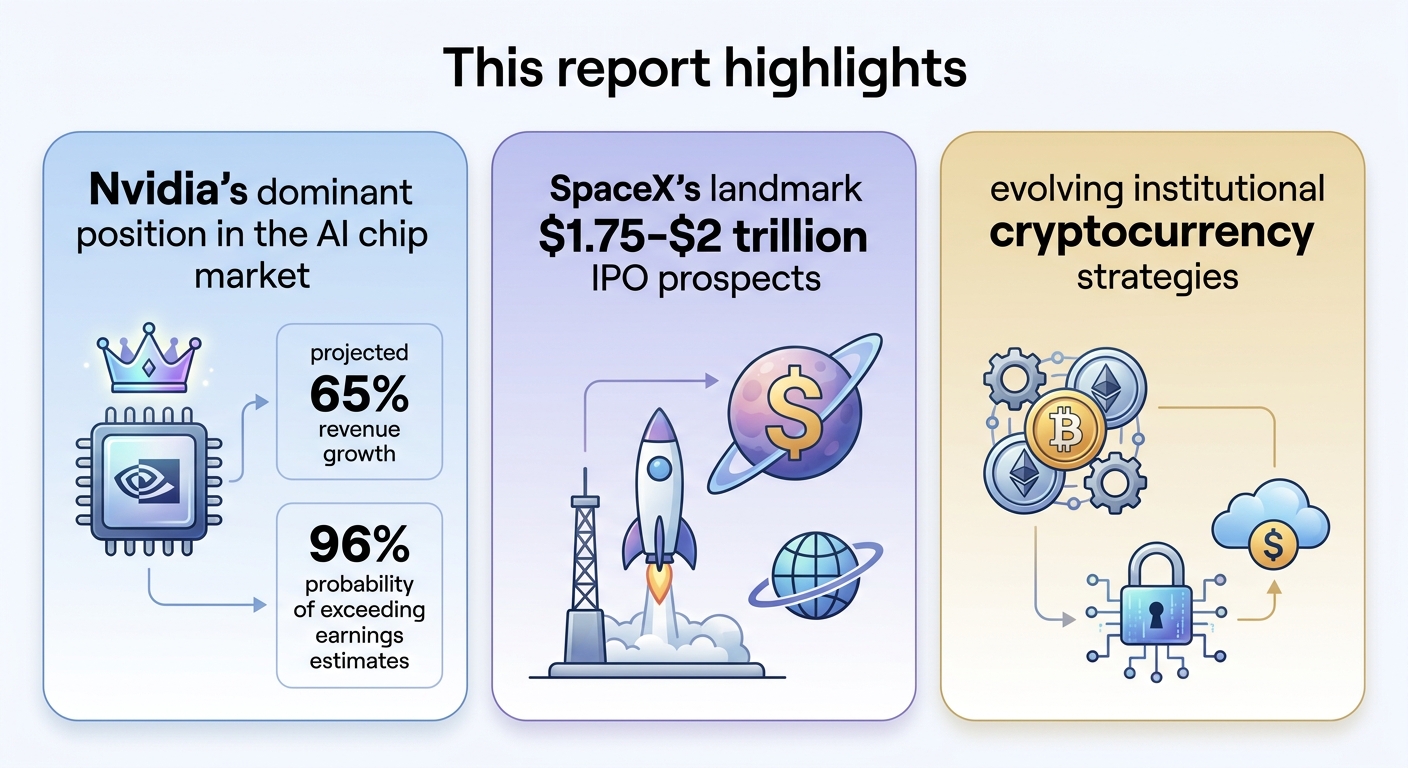
In the rapidly evolving landscape of technology and finance, 2026 stands as a landmark year marked by transformative developments spanning AI semiconductor innovation, aerospace investment, and digital asset adoption. This report synthesizes critical intelligence concerning Nvidia’s sustained leadership in AI data center chips, SpaceX’s strategic public listing, and the shifting paradigm of institutional cryptocurrency engagement. Collectively, these dynamics reflect the intersecting forces of technological advancement, regulatory evolution, and capital market innovation shaping investment decision-making in a globally interconnected environment.
Nvidia’s fiscal performance and strategic positioning epitomize the accelerating AI deployment cycle, fuelled by the unparalleled demand for specialized chip architectures. Concurrently, SpaceX propels the aerospace and AI cloud market fusion through an accelerated IPO process, underpinned by its ambitions to operationalize orbital data centers and integrate novel AI coding platforms. Parallel to these corporate narratives, institutional investors are transitioning cryptocurrency exposure from speculative to systematic portfolio components, enabled by robust regulatory frameworks and sophisticated risk management methodologies.
The purpose of this report is to deliver actionable insights across these focal points, offering quantitative data, market context, and risk assessments to inform portfolio construction, tactical timing, and strategic allocation decisions. We evaluate financial forecasts, valuation metrics, competitive threats, and macroeconomic influences—including the effect of easing U.S.-China trade tensions on AI-capex and crypto flows. By integrating these threads, the report equips professional stakeholders with a holistic framework to navigate complexity, capitalize on emerging trends, and mitigate material risks in a dynamic investment environment.
Infographic Image: Infographic
1. Executive Overview: Tech Titans and Crypto Shifts Driving Strategic Decisions in May 2026
Market Snapshot: AI Powerhouses, Mega IPOs, and Institutional Crypto Allocations Define 2026
This subsection establishes a foundational overview of the converging market forces in May 2026 that set the strategic context for the report. By synthesizing the latest financial forecasts for Nvidia, critical milestones for SpaceX’s landmark IPO, and quantifiable data on institutional cryptocurrency inflows, it frames the interplay among AI infrastructure growth, space-tech market evolution, and digital asset adoption that will shape investment and operational decision-making.
Nvidia’s Q1 2027 Financial Outlook and Earnings Expectations
Nvidia is positioned to report remarkable fiscal first-quarter results on May 20, 2026, reflecting sustained strength in AI-related demand. Market consensus projects revenues approaching $79 billion, anticipating year-over-year growth near 77%, driven largely by ongoing shipments of Blackwell architecture chips underpinning AI data center workloads. EPS estimates converge around $1.78 per share, marking a substantial increase relative to prior periods. Investor confidence centers on Nvidia's continued leadership in AI infrastructure, as the chipmaker fortifies its dominance with consistent earnings beats and bullish forward guidance.
The upcoming earnings call is viewed as a pivotal moment for reaffirming Nvidia’s growth trajectory amidst intensifying competitive pressures. Analysts and investors are closely monitoring management commentary for insights on the Vera Rubin GPU rollout timeline and the sustainability of hyperscaler spending, given recent indications of increased in-house silicon development by major cloud providers. Market derivatives imply elevated volatility around the earnings event, underscoring the critical nature of Nvidia’s disclosures in influencing near-term equity performance.
SpaceX IPO Timeline and Valuation Milestones
SpaceX is progressing rapidly toward one of the most significant initial public offerings in history, with regulatory filings expected imminently and a Nasdaq listing targeted for June 12, 2026. The company aims to raise approximately $75 billion within a valuation range estimated between $1.75 and $2 trillion, potentially eclipsing all previous IPO records in size and valuation. This accelerated timeline results from an expedited review process by the U.S. Securities and Exchange Commission, condensing the conventional multi-month cadence into a matter of weeks.
Critical events include a roadshow launch planned for early June and share pricing scheduled on June 11, positioning SpaceX’s public debut as a landmark transaction that underscores the growth prospects of combined aerospace, satellite communications, and integrated AI technology businesses. Analysts emphasize that the offering’s scale and valuation reflect confidence in SpaceX’s market dominance across global rocket launches and its strategic expansion into orbital data centers and AI-driven satellite services.
Institutional Crypto ETF Inflows and Evolving Market Adoption
Institutional adoption of cryptocurrency investment products continues to accelerate, with spot Bitcoin ETFs alone recording cumulative inflows exceeding $56 billion in the first quarter of 2026. This unprecedented capital inflow signals a transition from speculative trading toward broad-based portfolio integration. Notably, the launch of major new ETFs from established financial institutions, including Morgan Stanley’s Bitcoin Trust, underscores mainstream acceptance and the increasing regulatory maturation of digital asset markets.
While Bitcoin remains the cornerstone asset, there is marked enthusiasm for regulated altcoin exposures, led by assets such as Solana and XRP. Surveys indicate that a significant proportion of institutional investors currently hold Solana and plan to increase exposure, drawn by its scalable throughput and cost-effective transaction capabilities. Simultaneously, XRP benefits from clearer regulatory frameworks and strong enterprise partnerships, fostering confidence in its liquidity and adoption potential within institutional portfolios.
Having established the broad market landscape with strong fundamentals in AI hardware, groundwork for a historic space-tech equity offering, and the crystallizing pattern of institutional crypto integration, the report proceeds to a detailed examination of Nvidia’s financial performance and strategic positioning. This focus will dissect the nuances behind Nvidia’s growth and market capitalization, laying the foundation for understanding its influence on adjacent markets and investment frameworks.
Strategic Imperatives: Balancing High Growth with Execution Risks and Evolving Institutional Crypto Adoption
This subsection explores the critical strategic tensions that shape the investment landscape in May 2026, focusing on how leading technology players must navigate formidable execution risks amid robust growth trajectories, while institutional investors recalibrate cryptocurrency allocations from speculative ventures toward integrated portfolio components. By examining competitive pressures on Nvidia, regulatory and technical challenges confronting SpaceX, and the maturation of crypto investment frameworks, this analysis identifies key decision points for long-term positioning in converging tech and digital asset domains.
Competitive Pressures and Execution Risks in Nvidia’s AI Chip Leadership
Nvidia’s anticipated 65% year-over-year revenue growth underscores an exceptional expansion driven primarily by demand for its Blackwell AI chips and sustained data center investments. However, this growth narrative coexists with mounting competitive pressures from hyperscalers increasingly developing their own custom silicon to optimize AI workloads. These custom chips, designed to deliver significant cost and efficiency gains at hyperscale, pose a structurally disruptive threat by potentially eroding Nvidia’s long-term market share in key segments. While Nvidia’s entrenched CUDA ecosystem and integrated hardware-software stack remain formidable barriers to entry, the pace at which hyperscalers like Google and Amazon mature their in-house solutions will critically influence Nvidia’s margin sustainability and market leadership.
From a strategic risk perspective, Nvidia must also contend with customer concentration among hyperscale cloud providers, whose evolving chip strategies may reduce dependency on external suppliers. Concurrently, geopolitical dynamics, including U.S.-China export restrictions, threaten approximately one-fifth of Nvidia’s addressable market, compelling the company to innovate compliant product variants without compromising competitive advantages. These factors collectively introduce execution risks that could moderate the company’s exceptional growth projections, necessitating vigilant monitoring of hyperscaler chip adoption rates and regulatory developments to validate bullish investment theses.
SpaceX’s Orbital Data Center Ambitions: Regulatory and Technical Hurdles Impacting Valuation Trajectory
SpaceX’s anticipated IPO, targeting a valuation between $1.75 trillion and $2 trillion, hinges heavily on its ambitious orbital data center strategy. These data centers aim to harness space-based infrastructure for large-scale AI computing, a vision that could redefine the AI cloud market landscape. However, critical uncertainties surround the commercial viability of deploying and sustaining data centers in orbit. Technological challenges include ensuring hardware reliability under harsh radiation exposure, managing thermal dissipation in microgravity, and the absence of on-site repair capabilities, raising substantial execution risks.
Regulatory compliance compounds these technical challenges, with SpaceX requiring extensive coordination with U.S. and international agencies to manage spectrum use, orbital debris, and environmental impacts. Delays in securing FAA licenses or FCC approvals could materially affect launch cadence and infrastructure deployment, directly influencing investor confidence. Furthermore, partnerships like the high-profile contract with Anthropic represent significant revenue streams but include termination clauses that reflect the nascent and rapidly evolving nature of the AI compute market. Overall, while SpaceX’s roadmap reflects visionary potential, these intertwined regulatory and operational complexities warrant cautious valuation calibration and careful IPO risk assessment.
Institutional Cryptocurrency Allocation: From Speculation to Systematic Portfolio Integration
Institutional investors are transitioning from viewing cryptocurrencies as speculative instruments toward embracing them as strategic portfolio components that provide diversification and asymmetric return profiles. This maturation is exemplified by Bitcoin ETF inflows surpassing $56 billion and a notable shift toward regulated and compliant investment vehicles, accelerating adoption across pension funds, family offices, and hedge funds. Regulatory clarity, notably through frameworks like the EU’s MiCA and the U.S. SEC’s evolving stance on digital assets, has mitigated previously prohibitive compliance barriers, fostering greater institutional comfort and facilitating increased allocations.
Beyond Bitcoin, altcoins like Solana and XRP are gaining traction among institutional portfolios due to their scalability, utility in decentralized finance, and favorable regulatory outlooks. Surveys indicate that Solana leads altcoin allocations with substantial planned expansions, driven by its high throughput and low-cost transactions, which align with institutional scalability requirements. Sophisticated strategies, including volatility-targeting models, tail-risk hedging through out-of-the-money options, and yield overlays via tokenized money-market funds, exemplify the enhanced tactical complexity institutions now apply, reflecting a fully integrated and risk-managed engagement with the crypto ecosystem.
Having established the strategic tension between robust growth projections and execution risks across Nvidia’s AI chip dominance and SpaceX’s groundbreaking but technically nascent space infrastructure, alongside institutional crypto’s shift toward systematic adoption, the analysis proceeds to a detailed examination of Nvidia’s financial outlook and strategic positioning. This progression offers granular insights into how competitive dynamics and partnerships underpin Nvidia’s sustained leadership amidst evolving market challenges.
2. Deep Dive: Nvidia’s AI Chip Leadership and Strategic Positioning in 2026
Financial Performance and Investor Sentiment: Q1 FY2027 Outlook and Valuation Metrics
This subsection critically evaluates Nvidia's current financial trajectory and market valuation as it approaches the fiscal Q1 2027 earnings announcement. By synthesizing consensus revenue and EPS forecasts with detailed valuation ratios and market sentiment indicators, it offers insight into investor expectations and the broader implications of macroeconomic conditions, including Federal Reserve policies, on Nvidia's premium valuation. This analysis contextualizes Nvidia's financial positioning within the report’s broader strategic framework, setting the stage for assessing execution risks and competitive dynamics in subsequent sections.
Consensus Revenue and Earnings Projections Signal Sustained High-Growth Momentum
Nvidia is poised to report an extraordinary fiscal Q1 2027 performance, with consensus revenue estimates ranging between $78 billion and $81.6 billion. This represents a year-over-year increase exceeding 65%, driven primarily by surging demand for AI accelerators and data center infrastructure products. Analysts widely anticipate earnings per share to climb sharply, with estimates centering around $1.76 to $1.87, translating to approximately 77% year-over-year growth. This remarkable performance underscores the company’s central role amid an accelerating AI-driven capital expenditure cycle.
Market enthusiasm is underpinned by Nvidia's track record of consistently beating forecasts each quarter over recent years, solidifying investor confidence. The underlying growth is fueled by robust deployments of the Blackwell GPU generation and an expanding data center revenue base that now accounts for over 90% of Nvidia's total sales. Forward-looking guidance for Q2 FY2027 also remains buoyant, with revenue expected to approach $86–91 billion, further reflecting optimism among hyperscale cloud providers ramping AI infrastructure investments.
Valuation Metrics: Forward Price-to-Earnings and Market Sentiment Amid Fed Policy Influences
Nvidia's forward price-to-earnings (P/E) ratio currently hovers around 24x to 26x, reflecting a premium valuation relative to the broader semiconductor industry and the S&P 500 index. This premium is indicative of sustained investor confidence in Nvidia's dominant market positioning and growth trajectory. However, it also embeds expectations of continued robust earnings growth driven by AI-infused demand cycles. Market-implied volatility surrounding the May earnings event anticipates a single-day price move exceeding 10%, signaling heightened sensitivity to earnings outcomes and guidance.
Federal Reserve monetary policy remains a key external factor influencing Nvidia’s valuation. The prevailing 'higher-for-longer' interest rate environment applies downward pressure on growth stock multiples, including Nvidia. However, Nvidia’s earnings momentum and cash flow generation capacity have so far proven resilient against this macro backdrop. Analysts suggest any easing or pivot in Fed policy could catalyze multiple expansions, adding upward pressure to valuation. Conversely, sustained rate elevated levels would likely restrain valuation expansion despite strong fundamentals.
Investor sentiment also reflects cautious optimism balanced with competitive and execution risks. Options markets and prediction platforms currently assign a roughly 90% probability that Nvidia will beat revenue expectations, yet the magnitude of upside price reaction may be tempered given the substantial gains the stock has realized leading into earnings. Technical indicators show the stock trading within prior support zones, with resistance near $228–$240, and overbought signals tempered by strong fundamental catalysts.
Interplay of Fed Policy, Interest Rates, and Growth Premium: Navigating Valuation Complexities
Nvidia's valuation dynamic exemplifies the tension between high growth expectations and the restrictive financial conditions imposed by current Fed policy. Although value compression is typical under elevated interest rates, Nvidia’s sector-leading earnings growth partially offsets this effect, resulting in sustained premium pricing. The company's ongoing transition from Blackwell to Vera Rubin architectures adds a nuanced layer to market anticipation, where successful execution would validate future growth narratives and justify high multiples.
Macro factors such as inflation, geopolitical trade considerations, and interest rate trajectories shape investor risk tolerance and appetite for growth stocks like Nvidia. As a bellwether for AI sector momentum, Nvidia serves as both a beneficiary and barometer of broader market trends. The resilient demand for AI semiconductors amidst this environment supports a narrative that Nvidia’s premium valuation can be maintained, but the margin for upside surprises is narrowing compared to prior quarters. Strategic investors will therefore monitor not only reported financial metrics but also guidance tone and competitive disclosures for signals on sustainability.
Having established Nvidia’s robust financial outlook and valuation context, the analysis naturally progresses to exploring competitive pressures and margin sustainability challenges arising from emerging custom silicon initiatives and customer diversification strategies. Understanding these dimensions is essential for assessing the durability of Nvidia’s growth premium and its strategic posture within the AI semiconductor ecosystem.
Competitive Landscape and Margin Sustainability: Custom Silicon Disruption and Customer Diversification Risks
This subsection examines the evolving competitive dynamics in the AI chip sector as Nvidia confronts growing challenges from established rivals and hyperscaler-customized silicon initiatives. It quantifies the emerging market share shifts and evaluates margin pressures stemming from customer diversification, providing a critical lens on the sustainability of Nvidia's premium positioning and the credibility of its ambitious revenue projections.
Market Share Dynamics: AMD, Broadcom, and Hyperscaler Custom Silicon Adoption in 2026
Nvidia commands approximately 81% of the AI data center chip market, maintaining a dominant position but facing mounting competitive incursions. Advanced Micro Devices (AMD) has secured around 10% market share, reflecting significant gains propelled by its growing footprint in data center GPUs and AI accelerators. Broadcom has emerged as a formidable player in the custom AI chip niche, especially ASICs, witnessing a remarkable 106% year-over-year revenue growth in Q1 2026 and positioning to exceed $100 billion in AI chip revenue by 2027. Hyperscalers such as Google, Meta, and Amazon aggressively advance their respective in-house silicon strategies, deploying tailored ASICs and TPUs designed to optimize inference workloads and specific AI applications. These bespoke chips have achieved roughly 28–30% penetration of the AI chip market, rapidly shaping the landscape by offering up to 40–60% cost advantages over general-purpose GPUs.
The increasing adoption of custom silicon chips by major hyperscalers indicates a structural pivot in AI infrastructure procurement. IDC and independent market analyses forecast that hyperscaler in-house silicon adoption rates in data centers could surpass one-third of server AI chip deployments by the end of 2026. This shift challenges Nvidia to reinforce its product differentiation through performance leadership, ecosystem integration, and scalable architectures such as Blackwell and Vera Rubin. Alphabet’s TPU family, closely developed with Broadcom, exemplifies this trend, achieving substantial operational scale that encroaches on Nvidia’s traditional market segments. Despite this, Nvidia’s broad software ecosystem and its entrenched CUDA framework continue to serve as key barriers to rapid displacement.
Margin Pressure and Customer Diversification: Analyzing Risks of Hyperscaler Silicon Insourcing
The rise of hyperscaler custom silicon introduces tangible risks to Nvidia’s margin profile. While Nvidia’s data center GPUs enjoy gross margins in excess of 70%, bespoke chips operated by hyperscalers often come at significantly lower per-unit costs, optimized for specific workloads with aggressive cost-efficiency targets. This commoditization pressure jeopardizes Nvidia’s pricing power, particularly in inference domains where custom silicon has demonstrated up to 30% improved performance-per-dollar ratios in lab benchmarks. Industry insiders highlight that inference workloads constitute the majority of production AI compute, where margin erosion is expected to materialize over the next two to four years as customers diversify supply chains.
Customer concentration risk likewise intensifies. Nvidia’s top hyperscaler clients account for the majority of its AI chip revenue, but the same customers now operate competitive silicon programs or partner with rivals like Broadcom for custom ASIC development. This creates a duality where Nvidia remains a preferred vendor but is exposed to potential volume reallocations or contract term renegotiations. Market data indicates that approximately 20% to 25% of AI data center revenue historically linked to China has been impacted by export controls, compelling Nvidia to further adjust product portfolios and pricing strategies. Despite these headwinds, Nvidia’s integrated hardware-software approach, combined with anticipated revenue exceeding $1 trillion from Blackwell and Vera Rubin chip families, signals a robust long-term growth narrative. However, ongoing execution in product innovation and customer retention will be pivotal to offset emerging margin and share pressures.
Validating the $1 Trillion Revenue Forecast: Assumptions Behind Nvidia’s Blackwell and Vera Rubin Platforms
Nvidia’s forecast of over $1 trillion in cumulative revenue for its Blackwell and Vera Rubin architectures across 2026 and 2027 embodies both strong demand validation and aggressive scaling assumptions. This projection rests on a combination of factors: accelerating hyperscaler AI-capex cycles, adoption of next-generation GPUs capable of handling larger and more diverse AI workloads, and sustained expansion beyond hyperscale data centers into edge computing and enterprise deployments. Blackwell-based systems have demonstrated strong early traction, contributing upwards of $11 billion in recent quarterly revenues, with Vera Rubin expected to deliver substantial performance uplifts that justify premium pricing levels.
Analysts consider Nvidia’s estimation credible though challenging, factoring in projected shipment volumes approximating tens of thousands of Blackwell racks globally. These calculations imply that Nvidia will capture a significant portion of the growing AI infrastructure spend, which itself is forecast to exceed $720 billion in 2026. Nonetheless, sensitivity analyses caution that the forecast’s realization hinges on successful counteraction of competitive incursions, maintenance of supply chain robustness, and regulatory landscape stability. Margins could compress if hyperscaler silicon adoption accelerates beyond current estimates or if geopolitical trade restrictions exacerbate market fragmentation. The guiding principle for investors and strategic decision-makers remains vigilance in monitoring customer migration trends and continuous innovation cycles tied to Nvidia’s advanced GPU architectures.
Having dissected Nvidia’s competitive pressures and margin dynamics, the subsequent section will explore how the company is leveraging strategic partnerships and vertical integration initiatives to fortify its AI cloud platform leadership and mitigate these risks.
Securing AI Cloud Dominance: Evaluating IREN Partnership, Optical Capacity Expansion, and Strategic Financing in NVIDIA’s 2026 Blueprint
This subsection analyzes critical strategic expansions underpinning NVIDIA’s leadership in AI infrastructure. It dissects the scope, timeline, and financial underpinnings of the landmark IREN partnership for large-scale AI data center deployment, alongside the ambitious Corning optical manufacturing capacity increase. The evaluation highlights how these vertical integration initiatives enhance NVIDIA's supply chain resilience and market control amidst intensifying AI compute demand.
Tracing the Scale and Timeline of IREN’s 5GW AI Infrastructure Deployment
NVIDIA's strategic alliance with IREN represents a cornerstone in securing critical AI compute infrastructure, targeting deployment of up to 5 gigawatts (GW) of DSX-aligned AI capacity across IREN’s global data center network. This buildout centers on a staged expansion, with initial focus on the pivotal 2GW Sweetwater campus in Texas, anticipated to become the hallmark site exemplifying NVIDIA’s DSX AI factory architecture. While the partnership does not commit to immediate full-scale deployment, the gradual ramp is planned over the next five years, aligning with market demand and supply chain maturation.
IREN’s transition from cryptocurrency mining to high-performance AI computing resources signifies a strategic pivot, leveraging its 23,000 GPU fleet and access to 3GW of renewable-driven power in North America. The company’s vertically integrated model—from power procurement to GPU cloud operations—positions it to serve as an AI infrastructure hub for both startups and enterprise clients. However, execution challenges persist, including the complex coordination of power allocation, land acquisition, and GPU supply chain dynamics across diverse geographies. Near-term milestones, such as completion of the Horizon 1 liquid-cooled facility and Sweetwater energization targeted for 2026, will serve as critical performance barometers.
The partnership also grants NVIDIA a five-year warrant option to invest up to $2.1 billion in IREN equity, exercisable under specified regulatory and milestone conditions. This financial commitment solidifies NVIDIA's stake in the partnership’s success, enhancing collaboration incentives while providing capital to accelerate expansion phases.
Unpacking Corning’s Optical Capacity Expansion: Investment Scale, Manufacturing Timelines, and Strategic Significance
In tandem with computational infrastructure growth, NVIDIA’s investment in Corning underscores a decisive push to fortify optical connectivity capacity—a critical component enabling high-bandwidth, low-latency AI data center operations. Corning’s planned tenfold increase in U.S.-based optical connectivity manufacturing, alongside a greater than 50% expansion in fiber production capacity, addresses escalating demand driven by AI workloads that generate unprecedented data transmission requirements.
This massive scale-up hinges on construction of three advanced manufacturing plants strategically located in North Carolina and Texas. Although exact completion timelines are undisclosed, standard industry benchmarks project a 24 to 36-month horizon to reach full production capacity. The endeavor is expected to create over 3,000 new U.S. manufacturing jobs, reflecting not just technological ambition but also substantial economic and employment impact.
NVIDIA's embedded investment includes an initial $500 million prepayment and equity investment rights totaling up to $3.2 billion, including warrants to acquire shares at elevated strike prices. This financial structure both secures supply chain exclusivity and aligns incentives for innovation in fiber optic materials tailored for AI factory demands. The partnership effectively accelerates the transition away from legacy copper wiring to optical solutions, mitigating heat dissipation and resistance constraints that impair contemporary data center scalability.
Assessing the Financial Terms: Warrants, Service Contracts, and Multiyear Strategic Commitments
The financial architecture underpinning these strategic expansions reflects a layered approach combining equity options, long-term service contracts, and operational synergies. NVIDIA’s warrant rights over IREN—exercise price set at $70 per share for up to 30 million shares over five years—equip the firm with potential to deepen capital commitment contingent on regulatory approvals and performance milestones, mitigating risk while preserving option flexibility.
Complementing equity stakes, NVIDIA has secured a $3.4 billion AI cloud services contract with IREN, spanning five years and encompassing GPU cloud management and AI compute services. This contract aligns with IREN’s infrastructure expansion, providing recurring revenue stability and fostering a tightly integrated supply chain reflecting full-stack AI infrastructure control.
Similarly, the Corning partnership’s financial design includes a $500 million advance payment along with rights to invest up to $3.2 billion in stock acquisitions and warrants, collectively anchoring supply chain access. The multiyear collaboration signals a long-term commitment to co-developing optical communication technologies optimized for NVIDIA’s AI processor ecosystem, critical for sustaining platform differentiation and margin preservation against rising competitive pressures.
These strategic expansions with IREN and Corning illustrate NVIDIA's deliberate progression beyond silicon design into owning critical components of the AI infrastructure stack. The combined execution of large-scale AI cloud deployments and optical connectivity manufacturing provides NVIDIA with a defensible moat, integrating hardware production with expansive service contracts and equity exposure. This foundation sets the stage for assessing competitive threats and margin sustainability, topics examined in subsequent subsections.
3. Roadmap to IPO: SpaceX’s Ambitious Path Toward a $1.75–$2 Trillion Valuation
Timeline and Structural Highlights: From SEC Filings to Nasdaq Listing in a Record-Breaking IPO
This subsection provides a granular analysis of SpaceX’s accelerated IPO timeline and unique structural elements that underpin the offering’s historical significance. It anchors the broader discussion of SpaceX’s $1.75–$2 trillion valuation pathway by clarifying critical milestones, financing tranches, regulatory facilitation, and listing mechanisms. This precise timing and share structure context is essential for institutional investors and market strategists preparing for anticipated market impact and allocation management.
Confirming the Accelerated IPO Timeline and Key Date Milestones
SpaceX has established a compressed and accelerated timeline for its highly anticipated initial public offering. The company is expected to publicly release its IPO prospectus as early as the week of May 18, 2026, allowing for a narrow window to conduct due diligence before investor engagement. Subsequently, the investor roadshow is scheduled for the week commencing June 4, 2026, with the formal pricing anticipated as soon as June 11, and public trading poised to begin on Nasdaq on June 12, 2026. This timeline reflects a significant acceleration from typical IPO processes owing primarily to a faster-than-expected review and approval pace by the Securities and Exchange Commission (SEC), which has facilitated this unprecedented schedule.
The advancement in filing and approval processes is exceptional, as IPO reviews historically span several months. Confidential filings occurred in early April 2026, with public disclosures mandated to precede the roadshow by at least 15 days, consistent with regulatory requirements. The rapid progression from confidential to public filing and from roadshow to listing compresses key market windows but enables SpaceX to capitalize on favorable market sentiment and investor appetite in mid-2026.
Deconstructing the $75 Billion Offering and Tranche Allocation Strategy
SpaceX plans to raise up to $75 billion in what is projected to be the largest IPO ever conducted globally. This capital raise would place the company's valuation range between $1.75 trillion and $2 trillion, a figure surpassing all prior global IPO records by a wide margin, including Saudi Aramco’s $29.4 billion raise in 2019. The offering size magnifies SpaceX’s market footprint instantly, elevating it to the top echelon of public companies by market capitalization.
The planned share sale is structured across multiple tranches to balance investor demand and facilitate broad market participation, while also maintaining strategic allocations. Notably, a sizable retail tranche aims to allocate approximately 20% to 30% of the offering to retail investors, markedly higher relative to typical mega-IPOs. Institutional participation is orchestrated through a syndicate of 23 underwriters led by Goldman Sachs and Morgan Stanley, ensuring robust placement across asset managers, pension funds, and sovereign wealth entities. This tranche strategy plays a pivotal role in managing subscription risk and price stability during the early trading phase.
Nasdaq Listing and Share Class Structure: Founder Control and Investor Rights
The IPO will see SpaceX list under the ticker symbol SPCX on the Nasdaq exchange. The company has adopted a concentrated dual-class share structure designed to preserve founder control post-listing. Specifically, Class B shares, held predominantly by Elon Musk and close insiders, carry ten votes per share, while publicly offered Class A shares confer one vote per share. This governance framework grants Musk approximately 79% voting power despite holding around 42% economic equity, effectively centralizing decision-making authority.
This dual-class arrangement, while consistent with trends among leading tech IPOs, raises considerations regarding limited shareholder influence over corporate governance, strategic direction, and potential activist interventions. In addition to concentrated voting power, the governance framework includes provisions that limit shareholder litigation rights, mandate arbitration for disputes, and restrict venue to specified jurisdictions, further circumscribing investor control. From a liquidity perspective, the single security representing multiple business lines—satellite internet, launch services, government contracts, and AI platforms—offers a diversified exposure but complicates pure-play investment theses.
Regulatory Factors Accelerating IPO Pace and SEC Review Considerations
A critical enabler of SpaceX’s accelerated timeline has been an unusually rapid review process by the SEC. The confidential S-1 registration occurred in early April, with public filings scheduled for mid-May, squeezed between standard regulatory disclosure minimums. The SEC’s prioritization reflects both the significance of the offering and broader institutional reforms aimed at streamlining IPO approvals for strategically important technology companies.
Nonetheless, the compressed review cycle presents potential risk vectors, including last-minute SEC comment letters or data requests that could temporarily delay pricing or issuance. The company’s extensive disclosures on multi-billion-dollar capital expenditures for AI infrastructure and orbital data centers also attract enhanced regulatory scrutiny. Market participants should monitor for any material developments in the subsequent two weeks leading into the roadshow to assess whether regulatory factors could influence pricing or initial trading volatility.
With the IPO timeline, capital structure, and regulatory context clearly delineated, the next subsection will examine SpaceX’s strategic acquisitions and technological synergies. This will deepen understanding of how these corporate maneuvers enhance SpaceX’s core competencies and position it for sustained growth post-listing.
Strategic Acquisitions and Technological Synergies: Cursor and xAI Integration
This subsection evaluates the timing, financial implications, and strategic rationale behind SpaceX’s $60 billion acquisition option for Cursor, alongside the integration of xAI’s AI capabilities. These moves are pivotal in positioning SpaceX as a leader in converging AI and aerospace technologies, directly influencing its IPO valuation and future operational profile.
Clarifying the $60 Billion Cursor Acquisition Timeline Post-IPO
SpaceX has structured the acquisition of AI coding platform Cursor to occur approximately 30 days following its planned public listing, which is slated for Nasdaq debut in mid-June 2026. This deliberate sequencing aims to avoid premature regulatory complexity and the need to amend IPO disclosures while enabling the company to utilize freshly issued public shares as consideration for the transaction. The separation between the IPO event and acquisition closing stabilizes investor sentiment by preserving valuation clarity during the offering period and facilitates smoother capital allocation post-listing.
Cursor’s rapid valuation ascent—from $2.5 billion eighteen months ago to a negotiated $60 billion price tag—as well as its strong customer base generating substantial recurring revenue, underscore the strategic value of this acquisition. The timing also ensures that SpaceX can focus investor attention on the IPO before integrating Cursor’s advanced AI coding capabilities into its broader space and data infrastructure ecosystem.
Understanding the $10 Billion Breakup Fee: Deal Certainty and Financial Risk
The acquisition agreement includes a $10 billion breakup fee payable by SpaceX to Cursor if the acquisition right is not exercised by year-end 2026. This sizable contingent liability acts both as a strong incentive for deal consummation and as financial protection for Cursor against deal failure after significant joint development efforts. The breakup fee encompasses a $1.5 billion termination component plus an $8.5 billion deferred fee, reflecting the substantial value of collaboration and lock-in achieved during the IPO and post-offering period.
From a risk perspective, the $10 billion breakup fee represents a material cash or stock outflow that could impact SpaceX’s liquidity post-IPO, particularly given the expected capital expenditures necessary for orbital data center projects. Nonetheless, given SpaceX’s approximately $25 billion anticipated cash position at IPO and its strategic prioritization, market consensus strongly favors deal completion, rendering the fee a strategic deterrent rather than a probable loss. This mechanism also preserves IPO timeline integrity by preventing acquisition-related delays or costly financial restatements.
Quantifying xAI’s Integration Impact on Orbital Data Center Ambitions
The incorporation of xAI, acquired by SpaceX earlier in 2026, into SpaceXAI consolidates AI development efforts and enhances the company’s capability to develop and deploy large-scale generative AI workloads optimized for space-based data centers. This vertical integration reduces fragmentation across Musk’s AI ventures and contributes a highly sophisticated LLM infrastructure (including Grok AI models) directly linked to Starlink’s satellite network, enabling real-time AI inference in orbit.
xAI’s operational costs, projected at approximately $1 billion per month, reflect the magnitude of compute power being marshaled, complementing Cursor’s rapid-growth AI coding tools. Such integration enhances the feasibility of SpaceX’s orbital compute objectives by aggregating software innovation, hardware deployment, and network connectivity. While xAI’s revenue contribution remains under $1 billion for 2026, its synergy effects substantially increase the strategic optionality associated with orbital data centers, feeding into investor expectations for long-term value creation above and beyond SpaceX’s core launch and satellite businesses.
Assessing AI Tool Deployment Timelines and Execution Risks in Aerospace Operations
Deploying advanced AI coding tools like those developed by Cursor and integrated with xAI into aerospace workflows represents a multi-year initiative marked by considerable complexity. The aerospace domain demands highly reliable AI solutions capable of processing voluminous engineering data, regulatory documents, maintenance records, and safety-critical information under stringent traceability and compliance requirements.
Effective deployment requires continuous model retraining and specialized AI/ML operations infrastructure to ensure performance stability amid evolving aerospace protocols and regulatory frameworks. Moreover, integrating AI-generated outputs into operational and maintenance decision-making imposes high staffing overhead and risk mitigation costs. Given the nascent state of AI in aerospace and orbital environments, timeline estimates currently span several years, with early adoption focusing on knowledge management and decision support before extending to real-time autonomous operations.
These execution risks—ranging from technical integration hurdles to regulatory constraints—underscore the necessity of phased rollout strategies, robust security protocols, and stakeholder alignment, which directly influence SpaceX’s IPO valuation assumptions and future investor confidence.
With the Cursor acquisition framework and xAI’s integration dissected, the analysis naturally progresses to assessing how these technological synergies and strategic investments interface with SpaceX’s broader IPO roadmap, risk profile, and market reception.
Risk Assessment and Market Reception: Orbital Data Centers and Defense Contracts
This subsection provides a critical evaluation of the risks related to SpaceX’s orbital data center ambitions alongside an examination of tangible external validations—particularly the strategic U.S. Department of Defense partnership—that underpin investor sentiment and valuation dynamics ahead of the upcoming IPO. By quantifying energy demands, dissecting defense contract implications, and assessing regulatory sensitivities, this analysis contextualizes the sustainability challenges and strategic endorsements shaping market reception and investment risk calculus.
Quantifying Energy Consumption and Sustainability Challenges for Orbital Data Centers
SpaceX’s visionary deployment of orbital data centers aims to leverage continuous solar energy to power large-scale AI compute in space, targeting a capacity potentially exceeding 100 gigawatts. However, this ambitious infrastructure faces formidable power supply constraints. Without advanced orbital energy solutions, gigawatt-scale facilities would require terrestrial-scale solar arrays exceeding several hundred football fields, imposing prohibitive capital and supply chain costs. Power storage, thermal regulation, and radiation-hardened hardware further compound these energy challenges, threatening margin sustainability and deployment timelines.
Emerging innovations such as orbital energy grids promise to amplify solar flux intensity by a factor of up to ten, thus increasing efficiency and enabling near-constant operation with optimized thermal management. Yet, these technologies remain nascent, and the path to scalable, cost-effective energy provisioning remains fraught with technical, financial, and regulatory uncertainty—introducing significant execution risk that investors must weigh when considering SpaceX's IPO valuation projections.
Strategic Validation through U.S. Department of Defense Partnership and Contract Scale
The U.S. Department of Defense’s endorsement via a high-profile partnership enhances SpaceX’s credibility, offering meaningful external validation ahead of its public market debut. This collaboration focuses on integrating AI capabilities into secure military communications and battlefield decision systems, providing SpaceX with substantive defense revenue visibility and reputational capital.
SpaceX’s reported contract with Anthropic epitomizes the tethered revenue streams anticipated from enterprise AI clients, with commitments of approximately $15 billion per year through 2029 for access to SpaceX’s Colossus AI training centers. Concurrently, cooperative efforts within the DoD’s broader AI initiatives signal a robust, multi-year contract pipeline. This partnership portfolio is reflected in high strategic evaluations indicating strong financial health and capability to deliver advanced technology solutions across defense sectors, bolstering investor confidence.
Nonetheless, contracts include exit provisions and capacity ramp-up phased fee reductions, underscoring the sector’s volatility and the need for contending with technological, geopolitical, and procurement risk factors.
Regulatory Delays, Infrastructure Approval Challenges, and Valuation Sensitivities
Orbital infrastructure development is subject to rigorous regulatory oversight across agencies governing space traffic management, telecommunications, and environmental impact, all of which intricately influence deployment schedules and capital expenditures. Delays in obtaining necessary licenses for orbital satellites, laser communications, and inter-satellite networking can stall revenue generation and dampen market valuations.
SpaceX’s valuation and IPO timing exhibit high sensitivity to these regulatory timelines. Bottlenecks in securing approvals for constellation expansion or orbital data center operations could defer cash flows by months or years, amplifying discount rates applied by investors and instigating valuation downward revisions. Market signals post-DoD partnership announcements reflect cautious optimism but highlight increased volatility in response to regulatory news flow and infrastructure progress updates.
Further, the scalability and economic viability of orbital data centers hinge on overcoming these regulatory barriers in tandem with technical maturation, reiterating that SpaceX’s ambitious valuation range is conditioned upon execution against a complex approval landscape.
Investor Sentiment and Market Reception Following U.S. Defense Endorsement
Investor sentiment towards SpaceX has notably improved subsequent to formal announcements of its defense contracts and AI infrastructure partnerships. The DoD’s high financial strength score and robust strategic interest serve as critical green lights for institutional investors assessing risk-reward profiles of the forthcoming IPO.
Market reactions also reflect awareness of SpaceX’s dual-sector positioning—both as a pioneering aerospace enterprise and as a provider of cutting-edge AI compute infrastructure. This bifurcated narrative enhances the company’s attractiveness by offering diversified revenue streams and aligning with key technological megatrends. However, prudent investors remain cognizant of the execution risks inherent in pioneering orbital data solutions and the regulatory hurdles that may cause valuation variability.
Overall, the confluence of U.S. defense validation and innovative, albeit high-risk, orbital data center ambitions creates a nuanced market reception characterized by guarded enthusiasm, conditional on forthcoming regulatory progress and operational milestones.
AI Infrastructure Market Outlook and Comparative Validation
Supporting this optimistic investor stance is the broader AI infrastructure market momentum evidenced by leading sector incumbents. Nvidia’s projected revenue growth for Q1 2027, estimated between $78 billion and $81.6 billion, signals sustained demand and expansion in AI compute capabilities, which are integral to SpaceX’s orbital data center positioning.
This market backdrop provides a comparative validation of SpaceX’s technological and commercial aspirations, underscoring the plausible scalability of AI-driven infrastructure ventures within aerospace contexts and strengthening investor confidence in SpaceX’s multi-trillion-dollar valuation ambitions.
Building on the in-depth risk and market analysis of SpaceX’s orbital data center strategy and defense partnerships, the report now transitions to examining institutional cryptocurrency trends, which complement the portfolio considerations tied to emerging technological investment themes explored herein.
4. Institutional Crypto Adoption: From Speculation to Strategic Allocation Frameworks
ETF Inflows Surge Amid Regulatory Maturation: Bitcoin Cementing Institutional Portfolio Roles
This subsection details the robust momentum in Bitcoin ETF inflows throughout early 2026, examining how regulatory developments, particularly under Europe's MiCA framework and evolving SEC policies, have transformed crypto from a speculative asset into a core institutional allocation. Understanding these dynamics is essential to appreciating institutional shifts towards systematic crypto exposure and the broader impact on portfolio construction strategies.
Sustained Bitcoin ETF Inflows Validate Growing Institutional Confidence
Bitcoin exchange-traded funds (ETFs) have experienced accelerated capital inflows in the first half of 2026, establishing a strong institutional presence that underpins market stability. Cumulative net inflows into U.S. spot Bitcoin ETFs surpassed $56 billion by April, with monthly inflows reaching approximately $2 billion in April alone, the highest in 2026. This surge reflects a transition from episodic speculative interest to sustained strategic allocation within diversified institutional portfolios. Notably, leading products such as BlackRock’s iShares Bitcoin Trust maintained dominance, accounting for over 60% of ETF market share, highlighting concentration in trusted vehicles favored by asset managers and wealth custodians.
April and May inflows were further buoyed by new market entrants like Morgan Stanley’s Bitcoin Trust ETF, which rapidly captured over $160 million without recorded outflows during the initial launch weeks. Daily inflow patterns have shown resilience even amidst short-term market volatility, with institutional investors leveraging ETFs as efficient, regulated vehicles to obtain Bitcoin exposure without the operational complexities of direct custody. This trend fortifies Bitcoin’s role as a foundational digital asset within mainstream investment frameworks.
MiCA Regulation Catalyzing Institutional Transition from Speculation to Strategic Adoption
The full enforcement of the European Union’s Markets in Crypto-Assets (MiCA) regulation by mid-2026 marks a pivotal regulatory milestone that has accelerated institutional adoption of cryptocurrency. MiCA’s comprehensive framework harmonizes compliance standards across member states, creating legal clarity and investor protections critical to institutional risk management. This regulatory certainty has expanded the pool of crypto-asset service providers vetted for operational integrity, directly supporting regulated investment products like ETFs and fostering greater confidence among pension funds, insurers, and wealth managers.
MiCA’s requirements for mandatory white papers, licensing, custody standards, and governance have reduced fragmentation and mitigated the operational and reputational risks historically associated with digital assets. Consequently, institutions have moved beyond purely speculative positions into deliberate and sizable crypto allocations embedded within diversified portfolios. The regulatory momentum has also encouraged innovation, enabling the growth of Ethereum and other asset-linked ETFs and promoting integration with traditional finance infrastructure.
This progression from experimental exposures to strategic portfolio components is evident in asset allocation surveys revealing heightened institutional preference for regulated Bitcoin products, consistent with risk-adjusted mandates and long-term digital asset theses.
U.S. SEC Rule Changes Facilitate Larger ETF Adoption and Broaden Market Access
In the United States, regulatory advances have substantively lowered barriers for institutional engagement with bitcoin exposure via ETFs. The SEC’s adoption of streamlined rulemaking for ETFs, including Rule 6c-11 under the Investment Company Act, has created a more consistent and transparent regulatory environment. These rules eliminate the need for individual exemptive reliefs, reducing product launch times and compliance costs, which leads to greater competition, innovation, and variety of Bitcoin ETF offerings.
Additionally, the recent removal of 25,000 contract position limits on options tied to major Bitcoin and Ether ETFs by NYSE Arca and NYSE American in early 2026 has unleashed substantial liquidity in crypto derivatives markets. This expansion allows institutional investors to establish larger hedging and risk management positions, deepening the derivatives landscape surrounding ETF products and enhancing market efficiency.
The outcome is a reinforcing feedback loop whereby enhanced product availability and regulatory clarity attract more institutional capital, which in turn strengthens price stability and widens acceptance of Bitcoin as a mainstream asset class. Notwithstanding these gains, some innovative crypto ETF categories, including prediction market products, face regulatory delays as the SEC carefully assesses risks associated with novel derivatives, reflecting a calibrated approach balancing innovation and investor protection.
Having established Bitcoin’s foundational role through ETF inflows and regulatory clarity, the report proceeds to examine institutional diversification beyond Bitcoin, focusing on altcoin preferences and the strategic rationale shaping secondary digital asset allocations.
Diversification Beyond Bitcoin: Altcoin Preferences and Utility Drivers
This subsection delves into the evolving preferences among institutional investors as they expand their cryptocurrency allocations beyond Bitcoin, focusing on altcoins with distinct utility and growth profiles. By examining recent data on Solana and XRP, this analysis reveals how technological strengths, ecosystem development, and shifting regulatory landscapes influence portfolio construction strategies. Understanding these dynamics is essential for institutions seeking diversified exposure with an optimal risk-return balance in an increasingly mature crypto market.
Institutional Surveys Highlight Solana’s Dominance and Increasing Allocation Plans
Recent comprehensive surveys among large institutional investors indicate a clear momentum toward diversifying crypto portfolios beyond Bitcoin and Ethereum. Solana stands out as the leading altcoin choice with a notable existing institutional footprint and aggressive plans for expansion. Approximately 36% of surveyed firms currently hold Solana exposures, while an additional 38% intend to increase holdings during 2026. This level of engagement indicates a shift from experimentation toward strategic incorporation in institutional vaults and treasury allocations.
The appeal of Solana among institutions is primarily driven by its combination of high transaction throughput and cost-efficiency, making it a viable platform for decentralized finance, gaming, and NFT ecosystems. Institutional investors increasingly recognize Solana’s rapid finality and scalable infrastructure as core components that reduce operational friction and enhance portfolio diversification benefits. Furthermore, the expansion of institutional-grade staking and yield products tailored for Solana has been a critical factor in attracting long-term, risk-managed investments.
Quantifying Solana’s Technical Edge and Its Portfolio Impact
Solana’s technical architecture, featuring a hybrid Proof-of-History consensus mechanism combined with Proof-of-Stake, enables throughput exceeding 600,000 transactions per second, placing it among the fastest Layer 1 blockchains. This performance translates into meaningful competitive advantages for institutional users aiming to deploy scalable decentralized applications with minimal latency and transaction costs.
Empirical data demonstrates that Solana’s ecosystem supports over 41% of decentralized exchange volume in early 2026, with daily active dApp usage reaching unprecedented levels. Market capitalization recovery and growing Total Value Locked (TVL), which soared from just over $1 billion in late 2025 to approximately $9 billion by Q1 2026, underscore robust developer activity and capital inflows. These technological and economic metrics align with increased institutional allocations, as investors seek assets with proven utility and adoption trajectories rather than purely speculative profiles.
Regulatory Clarity Spurs Renewed Institutional Interest in XRP as a Payment-Centric Asset
XRP’s institutional allure is closely tied to recent milestones in regulatory clarity and enterprise adoption, positioning it distinctly as a blockchain optimized for cross-border payments and real-world asset tokenization. Following the conclusion of the long-standing legal dispute with the U.S. Securities and Exchange Commission, XRP was classified under more favorable regulatory designations, significantly alleviating prior uncertainties that limited institutional deployment.
The launch and sustained growth of multiple XRP spot ETFs have been pivotal in legitimizing institutional market access, with cumulative inflows surpassing $1.3 billion by early 2026. Adoption by major financial institutions and integration into tokenized asset frameworks contribute to XRP’s narrative as a practical, payment-focused digital currency. Surveys indicate that while only 18% of institutions currently hold XRP, 25% plan to initiate or increase exposure contingent upon further regulatory developments, signaling cautious yet growing confidence in XRP’s role within diversified crypto portfolios.
Comparative Risk-Return Profiles: Solana’s Growth Potential Versus XRP’s Stability and Utility
From a strategic asset allocation standpoint, Solana and XRP represent complementary exposures with differentiated risk-return profiles. Solana’s comparatively smaller market capitalization and dynamic developer ecosystem suggest higher upside potential driven by innovation and ecosystem expansion. Its ability to support emerging use cases in DeFi, stablecoins, and NFT infrastructure caters to investors targeting aggressive growth within the altcoin segment.
Conversely, XRP offers relatively greater stability anchored by its entrenched payment use cases, regulatory momentum, and real-world assets integration. The institutional embrace of XRP is underpinned by expectations of its consolidation as a core settlement and liquidity layer in global finance, reducing speculative volatility risks. Market experts advocate for portfolio frameworks that balance these dimensions, leveraging Solana for convexity and XRP for stable cash flow-like crypto exposure.
Having examined institutional preferences for altcoins beyond Bitcoin, with particular attention to Solana’s technical scalability and XRP’s evolving regulatory and enterprise profile, the subsequent section will explore advanced allocation strategies. This includes dynamic volatility targeting, tail-risk hedging, and yield generation techniques that institutions increasingly adopt to optimize crypto portfolio performance.
Advanced Strategies: Dynamic Volatility Management, Tail-Risk Hedging, and Institutional Yield Enhancements in Crypto Portfolios
This subsection examines the sophisticated risk mitigation and yield optimization techniques increasingly adopted by institutional investors integrating cryptocurrency assets. Building on the growing institutional embrace of digital assets covered earlier, it delves into how portfolio managers actively manage crypto volatility, hedge against extreme downside events, and enhance returns through layered yield overlay strategies. Understanding these advanced approaches is essential for strategic allocation decisions that balance crypto’s asymmetric upside with disciplined downside control in volatile market regimes.
Growing Penetration of Volatility Targeting Models in Institutional Crypto Portfolios
The persistence of elevated and clustered volatility in cryptocurrency markets has driven institutions to adopt volatility-targeting allocation frameworks as a core risk management strategy in 2026. These models dynamically adjust exposure weights based on real-time and forecasted volatility regimes, aiming to stabilize portfolio risk contributions and enhance risk-adjusted returns across full market cycles. Survey data from leading asset managers indicate that nearly 70% of institutional crypto desks incorporate either rule-based or AI-enhanced volatility targeting algorithms, a significant increase compared to prior years.
These strategies often leverage advanced econometric models such as Exponential GARCH variants that capture the nonlinear, autocorrelated nature of crypto volatility, providing nuanced inputs for tactical weighting decisions. The institutional embrace reflects improved data availability and computational capacity, allowing for sophisticated regime detection and proactive position sizing. This dynamic approach reduced drawdowns during the crypto market turbulence of early 2026, enabling investors to maintain strategic crypto exposure while managing portfolio risk budgets effectively.
Institutional Usage and Effectiveness of Out-of-the-Money Bitcoin Options for Downside Protection
Out-of-the-money Bitcoin (BTC) options have emerged as a prominent tail-risk hedging tool employed by sophisticated institutional investors during Q1 2026. Usage statistics reveal that over 45% of surveyed institutional portfolios with crypto exposure include systematically purchased protective put options, primarily on BTC, designed to cap losses during severe market drawdowns while preserving upside participation.
These option overlays benefit from the deepening liquidity and maturities available on regulated derivatives venues, which have matured alongside increasing institutional demand. The ability to finely calibrate strike prices and maturities has enabled managers to execute cost-efficient hedges aligned with specific risk tolerance and portfolio mandates. Data shows that these hedges became particularly active during heightened volatility spikes in Q1 2026, mitigating realized losses during rapid BTC price corrections.
Portfolio stress tests incorporating these options consistently demonstrate improved Value at Risk (VaR) metrics and Sharpe ratios, underscoring their effectiveness in managing asymmetric downside risks while supporting strategic crypto allocation longevity.
Adoption of Tokenized Money-Market Fund Overlays to Enhance Yield and Liquidity Profiles
Tokenized money-market funds (MMFs) have gained rapid traction among institutional investors as a complementary yield overlay within crypto portfolio strategies. These instruments, often backed 1:1 by short-dated U.S. Treasury securities and high-quality commercial paper, provide on-chain yield generation with minimal credit or liquidity risk, effectively bridging traditional fixed-income characteristics into crypto-native portfolios.
Market analysis indicates that issuance and assets under management in tokenized MMFs more than doubled in the first five months of 2026. Institutional adoption rates reached 35% among digital asset desks, reflecting a rising preference for secure, cash-like instruments to manage portfolio buffer allocations or reduce overall volatility.
Integrating tokenized MMFs allows investors to monetize idle capital within crypto wallets while maintaining rapid liquidity for opportunistic redeployment during market dislocations. This approach enhances systemic portfolio resilience, smoothing emission curves of returns and enabling a multi-dimensional yield overlay complementary to staking or lending activities.
Having explored these sophisticated strategies for volatility management, downside protection, and yield enhancement, the report will next broaden the lens to assess how macroeconomic and regulatory dynamics influence cross-asset implications and portfolio construction frameworks.
5. Macro Environment and Cross-Sector Implications: Trade Tensions, AI Integration, and Stablecoin Evolution
U.S.-China Trade Truce Catalyzes Market Rally and Crypto Stabilization in Mid-2025
This subsection situates the pivotal geopolitical event of May 2025 within the broader market context, demonstrating how the temporary de-escalation in U.S.-China trade tensions served as a catalyst for robust equity gains in AI-driven technology stocks and triggered renewed institutional confidence in digital assets. Understanding this phase is critical to framing the macroeconomic environment that underpins current valuations and investment flows addressed later in the report.
Quantifying the May 2025 S&P 500 and Nasdaq Surge Linked to Trade Policy Easing
The announcement of a tentative U.S.-China trade truce in May 2025 marked a decisive inflection point for equity markets, particularly in the technology sector. During the five-day period following May 12, the S&P 500 Index experienced a cumulative gain of approximately 4.5%, with the initial spike on May 12 alone registering a 3.26% increase. Concurrently, the Nasdaq Composite outpaced the broader market with a gain exceeding 6% across the same timeframe, reflecting concentrated buying interest in tech-related equities.
These gains effectively erased earlier losses incurred in 2025, signaling restored investor optimism amid the reduction in tariff-related uncertainties. The rally was characterized not merely by breadth but by a renewed concentration of capital into technology leaders, especially those with direct exposure to AI chip manufacturing and cloud infrastructure, setting the stage for sustained sector dominance.
Tariff Adjustments and Export Policy Reform Boost AI-Capex and Semiconductor Stocks
Integral to the market uplift was the substantive easing of tariffs implemented by both the U.S. and China as part of the trade truce agreement. Tariff rates on critical technology components and semiconductor exports were reduced from an effective peak of approximately 24% to 10% for a provisional 90-day window, alleviating immediate cost pressures on key supply chains and enabling freer movement of goods essential to AI hardware production.
Export control relaxations additionally facilitated new deals, notably enabling Nvidia to secure a landmark order for 18,000 AI chips from Saudi Arabia. This contract underscored the growing international demand for AI hardware and accentuated the critical role U.S. export policy plays in sustaining the global expansion of American semiconductor firms. The resulting stabilization of supply chains allowed technology firms to accelerate capital expenditure plans, fueling the AI infrastructure buildout.
Institutional Crypto ETF Inflows: A Consequence of Improved Market Sentiment Post-Trade Truce
The improved macroeconomic backdrop fostered by the trade truce translated beyond equities into digital asset markets via renewed institutional confidence in regulated crypto investment vehicles. Aggregate inflows into Bitcoin ETFs surged, with net contributions reaching tens of billions of dollars in the months following the announcement, including a significant $18.7 billion inflow in the first quarter of 2026 alone.
This influx was driven largely by institutional reallocations favoring regulated crypto exposure amidst ongoing regulatory clarity and the maturation of digital asset frameworks globally. The truce alleviated risk premia and stabilized capital flows, enabling larger institutional players to increase their footprint in the crypto space with a growing preference for flagship assets such as Bitcoin and Ethereum, while maintaining vigilance over geopolitical and systemic risks.
Correlating AI Sector Equity Resurgence With Eased Trade-Related Export Restrictions
The relief from trade tensions directly correlated with pronounced rebounds in AI-capex driven stocks, led by Nvidia and other semiconductor manufacturers. After previous half-year stagnations attributed partly to export control uncertainties, prices surged over 3% immediately post-announcement, buoyed by contract wins and announcements of expanded buyback programs by competitors.
This resurgence played a pivotal role in sustaining the broader technology index rallies, with the 'Magnificent Seven' tech leaders driving over 60% of S&P 500 gains during this period. The impact underscored the market’s growing dependence on AI innovation as a growth engine and its sensitivity to geopolitical developments affecting supply chains and export regulations.
Having established the catalytic role of the U.S.-China trade truce in powering AI-centric equity rallies and institutional crypto inflows, the following sections delve into the financial and strategic dynamics of key technology players and crypto market participants operating within this evolving macroeconomic framework.
Tokenization and Stablecoin Integration: Institutional Cryptocurrency’s Bridge to Traditional Finance
This subsection explores the accelerating integration of tokenized assets and stablecoins within institutional portfolios, emphasizing how these technologies serve as critical conduits linking conventional financial systems and digital asset frameworks. By dissecting XRP’s institutional adoption, evaluating stablecoin volumes supporting decentralized finance on-ramps, and analyzing crypto-denominated debt instruments, this analysis contextualizes the evolving regulatory environment that facilitates seamless capital flows and broadens institutional crypto exposure in 2026.
XRP's Rising Institutional Adoption and Market Penetration in 2026
XRP has solidified its status as a pivotal asset within institutional digital finance through marked increases in ETF inflows and adoption by leading financial entities. By early 2026, XRP-linked ETFs amassed over one billion dollars in net assets under management, underscoring growing institutional appetite supported by clearer regulatory classification as a digital commodity. Several top-tier institutions, including prominent global banks, maintain significant XRP ETF positions, emphasizing sustained conviction in XRP's role as a settlement asset. Quantitative blockchain data reinforce this trend, with transaction volumes on the XRP ledger surging by more than 60% year-over-year, signaling heightened on-chain economic activity linked to enterprise usage and liquidity provisioning.
Market participant surveys further validate institutional interest, revealing that a growing segment of asset managers plans to increase XRP allocations contingent on regulatory clarity and compliance advancements. Key catalysts include the successful rollout of stablecoin variants tied to the XRP ledger and partnerships with major payment and banking institutions, which collectively anchor XRP's expanding utility in cross-border settlements and decentralized finance protocols.
Stablecoin Volumes Powering DeFi On-Ramps and Institutional Market Entry
Fiat-backed stablecoins have become the backbone of institutional cryptocurrency entry, facilitating efficient and reliable on-ramp/off-ramp mechanisms across DeFi and broader digital asset ecosystems. Transaction volumes for leading stablecoins such as USDT and USDC have exceeded $5 trillion annually in 2026, rivaling traditional payment processors and effectively serving as ‘digital dollars’ in markets with limited banking access. This immense throughput is bolstered by institutional adoption of transparent, fully backed stablecoin variants that align with compliance standards.
Stablecoins' integral role in decentralized finance extends to lending, borrowing, and treasury operations, where their near-instant settlement and stability reduce counterparty risk and improve liquidity management. The rapid expansion in stablecoin market capitalization and usage underscores their function as critical instruments for traditional financial institutions navigating digital asset adoption. Moreover, algorithmic stablecoins and crypto-collateralized variants offer a spectrum of risk-return profiles, enabling nuanced portfolio construction and risk mitigation within institutional frameworks.
Growth in Crypto-Denominated Debt Instruments and Tokenized Securities
Institutionally focused crypto lending markets have experienced significant growth, particularly in tokenized asset-backed debt instruments, which now account for tens of billions of dollars in outstanding loan volume. These instruments provide new avenues for portfolio diversification and yield generation while harnessing blockchain’s transparency and efficiency benefits. Crypto-collateralized loans underpin much of this market, with stablecoins dominating as collateral, enabling firms to access liquidity without traditional credit intermediaries.
Simultaneously, regulatory progress has paved the way for tokenized securities that represent traditional equities and fixed income on blockchain platforms. Jurisdictions such as the United States and South Korea are advancing legal frameworks to standardize issuance, trading, and settlement of these assets, enabling 24/7 market access, fractional ownership, and reduced settlement latency. The anticipated launch of SEC-compliant tokenized stock trading platforms later in 2026 is expected to catalyze institutional participation, with key financial players integrating these instruments into treasury management and issuance pipelines. This convergence of real-world assets and crypto infrastructure marks a transformational step in embedding digital assets within mainstream financial ecosystems.
Regulatory Advances Underpinning Tokenized Finance Accessibility
The maturation of regulatory frameworks around tokenization has been pivotal to institutional adoption, enabling secure and compliant access to digital securities. Key developments include the SEC’s upcoming rules permitting third-party issuance of tokenized stocks without issuer consent, effectively lowering barriers for market entry and fostering innovation in securities trading infrastructure. South Korea’s legislative reforms have cemented blockchain-based securities as recognized financial instruments, setting comprehensive standards for custody, issuance, and investor protections.
Globally, regulatory bodies continue to adopt a ‘same risks, same rules’ approach for tokenized assets, ensuring these instruments adhere to existing securities laws despite their technological wrapper. Enhanced risk management requirements around technology, custody, and cybersecurity further reinforce investor safeguards. As tokenized securities move from experimental stages to institutional-grade assets, regulatory clarity provides the confidence necessary for traditional financial institutions to allocate capital and integrate tokenized products into their strategic frameworks.
Having established how tokenization and stablecoins are bridging the divide between traditional finance and digital assets through institutional adoption, regulatory advancements, and robust market infrastructure, the report will now transition to synthesizing these insights with broader macroeconomic factors and strategic portfolio implications to inform decision-making in a complex investment landscape.
6. Synthesis and Strategic Recommendations: Prioritizing Opportunities Amidst Complexity
Portfolio Construction Frameworks: Balancing Growth, Stability, and Convexity
This subsection provides actionable portfolio design guidelines emphasizing the optimal integration of Nvidia, SpaceX, and institutional cryptocurrencies. The focus is on quantifying target allocations and dynamic rebalancing triggers that address asymmetric growth potentials, timeline uncertainties, and regulatory risks across these distinct but interconnected assets. It equips professional investors with a coherent framework that balances the pursuit of alpha from tech frontiers with prudent convexity and downside risk management amid evolving macro and sector-specific challenges.
Quantifying Ideal Nvidia Allocation Percentage Range
Nvidia’s status as a core holding in growth-oriented portfolios is underpinned by its dominant AI infrastructure market share, projected 65% year-over-year revenue growth, and a robust balance sheet enabling aggressive share buybacks. Current consensus places Nvidia’s weight roughly between 8% and 10% in major technology-focused indices, reflecting both its market capitalization and influential sector presence. Independent portfolio optimization studies recommend positioning Nvidia exposures within a 7-12% range in balanced growth portfolios to capture upside potential while containing concentration risk. Allocations exceeding 12% increase vulnerability to sector-specific volatility, particularly semiconductor cycle downturns or competitive pressure from hyperscaler custom silicon designs. On the other end, sub-7% exposures risk under-participation in the AI-driven capital expenditure wave that Nvidia proxies. Thus, the 7-12% window offers a prudent balance between dominant growth exposure and volatility moderation.
Further, tactical overweighting can be justified near Nvidia earnings announcements or following visible acceleration in AI spending signals, while underweights may be warranted during periods of regulatory tightening in China or macro uncertainties. Given Nvidia’s 78% active fund manager ownership and 8.3% weight in the S&P 500, portfolio managers should also consider liquidity constraints and position sizing impact to avoid adverse price impact during rebalancing events.
Defining Trigger Thresholds for Dynamic Rebalancing
A dynamic rebalancing approach utilizing a hybrid time-and-threshold model optimally balances risk control with transaction cost efficiency. Academic and industry research converges on threshold bands of 5-6% deviation from target allocations as effective triggers for equity rebalancing, with quarterly or semiannual monitoring to avoid excessive turnover. For portfolios incorporating volatile tech holdings like Nvidia, trigger bands on the tighter side (circa 5%) are advisable to maintain intended risk exposures during rapid market shifts.
For institutional portfolios combining equities with cryptocurrencies, threshold-based rebalancing should also account for crypto market volatility, prompting slightly wider buffers (7-10%) to avoid noise-triggered trades. Quarterly reviews aligned with earnings releases for Nvidia and SpaceX IPO milestones combine a calendar schedule with event-driven checks, facilitating proactive asset adjustment. Setting rebalancing triggers relative to fundamental indicators—such as Nvidia revenue beat rates exceeding 65%, or SpaceX roadshow feedback—can further optimize responsiveness.
Tax-efficient execution strategies leveraging limit orders near midpoints of bid-ask spreads and AI-powered risk tools can sharpen timing decisions, while monitoring implied volatility through options markets informs anticipated price swings that might warrant tactical defensive positioning.
Notably, Bitcoin ETF inflows surged dramatically during Q1 2026, increasing from $10 billion in January to $26 billion in March, reflecting strong institutional demand and justifying wider rebalancing thresholds in crypto to accommodate heightened liquidity and momentum shifts [Chart: Institutional Bitcoin ETF Inflows for Q1 2026].
Assessing Portfolio Impact of a 3-Month Delay in SpaceX IPO
A delay in SpaceX’s IPO by three months exerts meaningful short-term portfolio implications, especially for institutional investors allocating per the $1.75–$2 trillion anticipated valuation. Predictions place approximately 60% likelihood on a mid-2026 IPO, with the remainder favoring postponement into late 2026 or beyond, predominantly triggered by further Starship testing delays or adverse equity market conditions. A deferral compresses the timeline for liquidity events and anticipated equity inflows, temporarily suspending expected asymmetrical upside and necessitating interim capital deployment into substitutes.
Portfolio simulations suggest that during IPO delay scenarios, reallocations toward established growth equities or selective crypto assets with convex payoff profiles may partially offset the opportunity cost. Delays also increase portfolio vulnerability to broader market volatility and regulatory revisions, emphasizing the importance of flexible, scenario-driven allocation plans that preserve optionality. While the long-term thesis for SpaceX’s disruptive innovation remains intact, the near-term beta contribution is deferred, warranting calibrated position sizing and stress testing for downside scenarios in portfolio risk models.
Modeling Portfolio Response to Crypto Regulatory Crackdown Scenarios
Cryptocurrency allocations face elevated tail-risk exposure from sudden regulatory clampdowns, which can induce sharp asset price drawdowns, exchange disruptions, and liquidity shocks. Institutional players mitigate such risks through diversified crypto holdings spanning large-cap assets and stablecoins, layered with advanced volatility-targeting overlays and tail-risk hedging using out-of-the-money Bitcoin options that offer protective asymmetry.
Scenario-based Monte Carlo simulations calibrated to historical regulatory shocks reveal that portfolios incorporating minimum 20-30% hedge ratios via options or tokenized money-market instruments reduce drawdown severity by approximately 35-50%, while preserving upside capture during bull regimes. Tokenization and jurisdictional diversification further dampen systemic regulatory risks.
Regular stress-testing incorporating emerging crypto policies, combined with dynamic rebalancing triggered by weekly Bitcoin ETF inflows crossing $1 billion thresholds, can proactively adjust crypto weightings. Stop-loss mechanisms on speculative altcoins, such as Solana and XRP, complemented by robust compliance monitoring, significantly curtail downside exposure in adverse regulatory developments.
Quantifying Convexity Contribution of Solana and XRP in Institutional Portfolios
Solana and XRP occupy unique convexity roles within institutional crypto allocations, driven by their technology fundamentals, market adoption, and regulatory clarity. Solana’s high-throughput, low-cost infrastructure appeals to scalability-focused mandates, with approximately 38% of surveyed institutions holding or planning to increase its weight, reflecting its embedded growth optionality. XRP offers convexity through its emerging regulatory maturity, facilitating enterprise use cases and participation in tokenized finance applications, evidenced by significant ETF inflows and growing total value locked in DeFi ecosystems.
This is consistent with current institutional holdings distribution, where Solana accounts for 36% and XRP for 18% of altcoin allocations, highlighting their significant engagement and importance within diversified crypto portfolios [Chart: Institutional Investors' Current Altcoin Holdings].
Portfolio risk-return analyses using sensitivity and value-at-risk models demonstrate that moderate 10-15% allocations to Solana and XRP materially enhance tail-risk-adjusted returns by amplifying upward potential during cyclical altcoin rallies without excessive correlations to Bitcoin. Their low to moderate correlation with large-cap crypto and traditional tech assets additionally improves portfolio diversification. Institutional strategies often pair these assets with volatility-targeting overlays to harness convexity while managing drawdowns.
Continued legislative and technological developments, such as the CLARITY Act framework advancements, likely further increase these assets’ convexity benefits through expanded institutional integration.
Comparing Risk/Return Tradeoffs with Altcoin Stop-Loss Strategies
Employing calibrated stop-loss strategies on altcoins materially affects risk-return profiles by capping downside while potentially limiting extreme upside capture. Backtesting of traditional and trailing stop-losses between 5% and 15% thresholds across volatile altcoins shows consistent reduction in maximum drawdowns with modest reduction in average returns. The optimal stop-loss levels cluster around 10-15% for balancing loss containment and upside participation, based on historical crypto price behavior and realized volatility patterns.
Institutions deploying stop-loss rules often complement them with systematic portfolio reallocation to stablecoins or Bitcoin, effectively shifting risk exposures during adverse market regimes. These strategies are more effective when integrated with volatility-based stop-loss adjustments that expand during heightened market turbulence, thereby reducing premature position closures due to noise.
In practice, using stop-loss mechanisms within broader strategic overlays, including volatility targeting, tail-risk hedging, and periodic rebalancing, enhances portfolio resilience and optimizes risk-adjusted returns relative to buy-and-hold altcoin exposures.
Having outlined an actionable portfolio construction framework that balances growth exposure, convexity, and risk mitigation among Nvidia, SpaceX, and institutional crypto holdings, the report now advances to concrete execution protocols. The next subsection will delineate a detailed checklist of monitoring triggers, key event dates, and decision gates that enable tactical navigation of unfolding market developments and investment inflection points.
Execution Checklist: Critical Triggers, Metrics, and Risk Controls for Tactical Investment Decisions
This subsection provides a precise and actionable monitoring framework tailored to dynamic investment positions in Nvidia, SpaceX, and institutional cryptocurrency markets. It targets portfolio managers and strategists by breaking down essential performance thresholds, key event dates, inflow signals, regulatory-sensitive stop-loss criteria, and macroeconomic stability markers, enabling timely and disciplined decision-making in a volatile market environment.
Defining Nvidia’s Revenue Beat Threshold and Implications for Tactical Positioning
Nvidia’s upcoming Q1 FY2027 earnings report, scheduled for May 20, constitutes a pivotal market event. Tactical adjustments should hinge on achieving or surpassing a revenue growth rate exceeding 65%, with consensus estimates currently centered around 77% to 79%. Historical data and market sentiment analyses reveal that surpassing this threshold consistently triggers substantial upside momentum in Nvidia’s stock, often correlating with forward guidance improvements on AI infrastructure demand.
A revenue beat above 65% not only validates ongoing Blackwell and Vera Rubin platform deployment but is also interpreted as a green light for reaffirmed growth narratives amid intensifying competitive pressures. Conversely, underperformance around this critical threshold would likely amplify volatility and could lead to short-term price reversal, prompting portfolio reallocation. Therefore, defining and monitoring this precise benchmark enables quantifiable entry and exit signals aligned with Nvidia’s evolving fundamentals.
Timing and Interpretation of SpaceX IPO Roadshow Feedback for Investment Decisions
The SpaceX IPO roadshow is slated to commence in the week of June 8, with institutional investor engagements critically shaping final pricing and share allocation, effectively concluding by June 11. Investors should focus on analyzing roadshow reception metrics during and immediately following this period, as institutional sentiment feedback constitutes a leading indicator of pricing strength and underwriting confidence.
Specific areas requiring scrutiny include demand elasticity for the $75 billion share offering, views on dual-class share structures affecting Elon Musk’s control, and reception toward orbital AI data center risks. Any signs of softening demand or increased conditionality could pressure underwriting strategies and valuation expectations. Establishing real-time channels to capture qualitative and quantitative roadshow signals is essential for timely tactical shifts, especially given the unprecedented scale and strategic novelty of this IPO.
Establishing Bitcoin ETF Inflow Levels as Portfolio Shift Catalysts
Bitcoin ETF inflows serve as a critical barometer for institutional appetite and market liquidity dynamics. An inflow consistently exceeding $1 billion per week has emerged as a validated trigger threshold signaling robust demand and positive momentum for Bitcoin allocations within diversified portfolios. This level of inflow correlates strongly with sustained upward price pressure and improved sentiment, forming an actionable benchmark for increased portfolio exposure.
Monitoring inflow velocity and directional consistency is key, as volatile or declining ETF inflows despite price gains may foreshadow liquidity contractions or risk-avoidance shifts. Thus, integration of ETF capital flow analytics into allocation models allows for responsive overweighting or tactical scaling back of crypto exposure, depending upon flow strength and market context.
This is supported by recent data from Q1 2026, which recorded sharply accelerating institutional inflows—from $10 billion in January to $26 billion in March—underscoring the validity of the $1 billion weekly inflow threshold and reinforcing its role as a critical trading signal [Chart: Institutional Bitcoin ETF Inflows for Q1 2026].
Stop-Loss Guidelines for Altcoins Reflecting Regulatory Uncertainty and Market Volatility
Given the heightened regulatory scrutiny and intrinsic volatility in the altcoin market, establishing disciplined stop-loss levels is vital to safeguard capital and maintain strategic flexibility. Evidence suggests that a stop-loss boundary set between 12% to 15% below entry prices effectively balances downside protection and noise filtering, especially for institutional-scale positions in high-conviction altcoins such as Solana and XRP.
Moreover, stop-loss parameters should be dynamically adjusted in response to regulatory announcements, with tighter thresholds considered during periods of regulatory uncertainty or adverse policy developments. Integrating real-time regulatory sentiment indicators with technical support zones facilitates proactive risk mitigation, reducing forced exits triggered by transient volatility spikes while preserving exposure to upside potential.
Macroeconomic Stability Criteria for Activation of Tactical Decision Gates
Macroeconomic stability serves as a critical background condition influencing risk appetite and overall market behavior. Tactical decision-making frameworks should incorporate specific criteria tied to inflation trends, interest rate trajectories, and trade relations, focusing on stability or improvement as prerequisites for aggressive positioning.
Key criteria include sustained CPI inflation within target ranges (e.g., 2-3%), the Federal Reserve signaling no imminent rate hikes or signaling cuts, and no significant escalation in geopolitical tensions affecting trade channels, particularly U.S.-China relations. Breaches or deteriorations in these metrics warrant heightened caution or defensive shifts, as they tend to precipitate increased volatility and capital flight. Thus, integrating macroeconomic metric monitoring into event-driven strategies enhances portfolio resilience.
Key Crypto Market Data Release Dates and Their Strategic Implications
Alignment of portfolio monitoring with scheduled crypto market data releases ensures timely insight into evolving liquidity and flow dynamics. Notable recurring reports include weekly Bitcoin ETF flow updates published every Monday, monthly fund flow reports from major crypto asset managers released mid-month, and quarterly institutional survey data on altcoin preferences and crypto adoption trends.
Event-tied information such as SEC regulatory announcements, major exchange trading volume disclosures, and U.S. Congressional hearing dates concerning crypto legislation also serve as potential market catalysts. Establishing a calendar of these high-impact release dates enables pre-positioning and rapid response, essential in an environment characterized by fast information absorption and reaction.
Having defined a comprehensive set of measurable triggers and decision gates encompassing company earnings, IPO progress, capital flow metrics, risk controls, and macroeconomic indicators, the subsequent strategic synthesis will integrate these inputs into actionable portfolio construction and execution frameworks designed to optimize return-risk profiles amidst uncertainty.
Conclusion
This analysis underscores the confluence of breakthrough innovation, expansive capital deployment, and evolving regulatory landscapes that collectively define the strategic frontiers in AI chips, aerospace public offerings, and institutional cryptocurrency adoption. Nvidia’s projected 65–77% revenue growth and over $1 trillion cumulative revenue opportunity from advanced GPU architectures highlight a sustained growth engine tempered by emerging competitive and geopolitical challenges. The company’s comprehensive partnerships and integrated AI factory initiatives position it to maintain technological leadership amid intensifying hyperscaler silicon insourcing and regulatory complexities.
SpaceX’s expedited IPO and ambitious $1.75–$2 trillion valuation reflect market confidence in a disruptive vision that spans orbital data centers and next-generation AI compute infrastructure, though the execution pathway remains fraught with technical, regulatory, and sustainability uncertainties. The integration of Cursor and xAI assets consolidates AI capabilities, yet operationalizing these within aerospace and defense applications demands meticulous risk management and multi-year strategic execution.
Institutional cryptocurrency investment has advanced decisively from nascent speculation toward structured allocation frameworks, exemplified by Bitcoin ETF inflows exceeding $56 billion, the regulatory maturation under MiCA and the SEC, and growing altcoin incorporation focused on Solana and XRP. Enhanced risk controls—including volatility targeting, tail-risk hedging, and liquidity overlays via tokenized money-market funds—embody a paradigm shift in managing asymmetric return profiles within volatile digital asset markets.
Looking ahead, sustained market leadership for Nvidia will depend on its ability to innovate faster than hyperscaler custom silicon adoption erodes margins, while SpaceX’s IPO trajectory requires regulatory navigation and operational milestones to justify lofty valuations. Meanwhile, institutional crypto strategies must adapt dynamically to regulatory developments and market volatility to protect capital and unlock value. This triad of transformative trends mandates diligent monitoring of earnings results, IPO roadshow signals, ETF inflow data, and policy shifts to inform timely, evidence-based portfolio adjustments that balance growth, risk, and convexity in a complex macro-financial landscape.
References
- NVIDIA's Impact on Market Dynamics
- NVIDIA Q1 Revenue Climbs 85% Amid Agentic AI Proliferation
- Stock market today: Dow jumps 600 points, S&P 500 and Nasdaq rally as oil falls in countdown to Nvidia earnings
- Nvidia Stock Analysis May 2026: AI Chip Giant Faces Critical Earnings Test
- NVIDIA Earnings Preview May 2026: AI Chip Demand Drives $78B Revenue Expectations
- Nvidia Earnings: Live Updates and Commentary May 2026
- Nvidia Stock Up 1,500% in Five Years; Amazon Surges 30% Since March 2026 on AI and AWS - News and Statistics - IndexBox
- When will SpaceX officially announce an IPO | Octagon AI
- SpaceX IPO: What we know about the initial public offering as the eagerly awaited stock listing date nears
- Understanding the Forces Shaping Global Financial Market Dynamics in Early 2026
- Ron DeSantis Praises Elon Musk's 'Pro-Human' AI Vision After SpaceX-Anthropic Partnership
- SpaceX IPO Project Unlimited Analysis Reviews Reported S-1 Timeline, Orbital AI Data Center Risks, and Infrastructure Market Context
- Navigating Market Trends, AI-Driven Tech Growth, Healthcare Innovation, and Premium Finance: May 2026 Insights
- AI and Tech Giants Propel Market Surges Amid Strategic Shifts in Bitcoin and Space IPOs
- Q1 2026 Investment Landscape: Navigating AI Disruption, Geopolitical Risks, and Crypto Market Dynamics
- Anthropic is paying $15 billion a year for access to Elon Musk’s data centers | The Verge
- Nvidia reports 85 pct revenue growth for Q1 of fiscal year 2027-Xinhua
- Surge in Semiconductor Stocks Raises Market Concerns
- Nvidia (NVDA) Stock Forecast 2026: AI Capex Boom, Hyperscaler Spending & Strategic Partnerships Drive NVDA Price Surge
- Crypto 2025: Trends, Regulations, and Institutional Outlook
- May 2025: Trade Truce Fuels Market Rally Amid Tech Shifts and Emerging Crises
- Crypto markets predict Nvidia stock price for May 31, 2026
- NVIDIA (Nasdaq:NVDA) - Stock Analysis - Simply Wall St
- Will NVIDIA Beat Quarterly Earnings?
- CoreWeave CEO Says Nvidia Must Expand AI Capacity Or Risk Losing Customers To AMD As IREN Deal Boosts Infrastructure
- XRP Price Surge April 2026: Why Ripple is Leading the Altcoin Rally
- PDF 2026 Digital Asset Outlook: Dawn of the Institutional Era
- Using Crypto Market Analysis to Achieve Long-Term Portfolio Growth
- Institutional Survey Reveals Strong 2026 Crypto Allocation Plans: Solana Leads XRP and Dogecoin
- Trade Truce Sparks Tech Surge and Crypto Rally: Market Reactions to US–China Tariff Easing
- Top 10 Cryptocurrencies for Investment in 2026: Trends, Logic, and Risks | KuCoin
- SpaceX Solidifies Mid-2026 IPO Timeline, Outlines Record-Breaking Structure | Octagon AI
- How to Build a Crypto Portfolio in 2026: The Institutional Playbook
- US Defense Department Partners with Tech Giants for Military AI
- 2026 Global Capital Market: Potential Mega IPOs in Technology and Cryptocurrency | KuCoin
- Bitcoin Market Outlook 2026: ETF Inflows, Regulations and Price Structure Explained
- Bitcoin (BTC) ETFs Hit $1 Billion in a Week: Strongest Institutional Demand in 4 Months
- XRP ETFs Record $81.59M Inflows as Institutional Demand Grows - Blockonomi
- Bitcoin Holds $78K as ETF Inflows Return and Ethereum Outflows Persist - Blockonomi
- Bitcoin News Today May 2026: ETF & On-Chain | Spoted Crypto
- Bitcoin ETFs Pull $2B in April, Marking Highest Inflows of 2026 - Blockonomi
- Crypto News Today: Bitcoin Inflows, BitMine Acquisition, and Asteroid Shiba Surge
- Bitcoin ETFs Pull $186M as BlackRock’s IBIT Leads Surge
- ETF Flows News April 2026:Institutional $411M Inflow | BYDFi
- Bitcoin ETF Outflows Explained: Flow Data, Trends & What It Means (2026)
- Investors might be penalizing Nvidia for not boosting cash returns like its Big Tech peers
- Nvidia (NVDA) Q1 Earnings: Here’s What Top Bank of America Analyst Expects - TipRanks.com
- NVIDIA Stock Calculator: Track Returns & Plan Strategy 2025
- Nvidia Earnings Preview Q1 FY27: What Traders are Watching | BitMEX
- Prediction: This Could Be Nvidia's Stock Price By the End of 2027 | The Motley Fool
- Create Presentations from Your Files in Clicks with Powerdrill Bloom
- Two Use Cases on Portfolio Optimization
- Should You Buy the Invesco QQQ ETF With the Nasdaq at a Record High? Here's What History Says.
- Should You Buy the Invesco QQQ ETF With the Nasdaq at a Record High? Here's What History Says. | The Motley Fool
- The Best Artificial Intelligence (AI) Growth Stocks on the Nasdaq That Wall Street Loves Right Now | The Motley Fool
- May Revision
- S&P 500 Hits Record High Despite Inflation: May 2026 Market Analysis
- S&P 500 and Nasdaq notch records, boosted by AI and earnings optimism
- S&P 500 Price Predictions and Market Insights for May 2026 | Value The Markets
- 'Sell in May' has been a bad strategy this century: Chart of the Day
- Politics & Policy / JUL 2025 / page 3
- PDF The Comeback of the Magnificent Seven - armstrong-cap.com
- PDF Market Digest - Interactive Brokers
- Stock Market Forecast 2026: S&P 500 Hits All-Time High
- PDF Marketing communication - For professional investors THE SHIFTING ...
- Time for Spring Cleaning: The SEC Proposes Amendments to Declutter Public Company Filer Categories | JD Supra
- FOUR Stock Price, News & Analysis
- Investment Firm Sells SaaS Stock Worth $14.2 Million, According to Recent SEC Filing
- PDF EDGAR Filing Calendar
- Microsoft Stock Analysis | Stocks: MSFT - Macroaxis
- Red Cat Announces Pricing of Public Offering of Common Stock
- May 2026 tax deadlines: These key TDS, TCS dates taxpayers should not miss - India Today
- Self-Regulatory Organizations; Nasdaq MRX, LLC; Notice of Filing of Amendment Nos. 3 and 4, and Order Granting Accelerated Approval of a Proposed Rule Change, as Superseded by Amendment No. 3 and Modified by Amendment No. 4, To Adopt New Options Rule 3B To List and Trade Binary Broad-Based Index Options
- PDF Gibson Dunn - SEC Filings Deadline Calendar Template (rev. 06-02-21)
- Woori Financial Group (KRX: WF) to acquire remaining Tongyang shares in exchange
- U.S. Stocks Surge Back to Record Highs Amid Market Volatility
- Techmeme: OpenAI says an internal general-purpose reasoning model has disproved the Erdős unit distance conjecture, a central problem in discrete geometry posed in 1946 (OpenAI)
- Nvidia Reports Earnings on May 20. Here's the One Number That Matters Most. | The Motley Fool
- Nvidia Reports Earnings on May 20. Here's the One Number That Matters Most.
- Prediction: Nvidia Will Deliver Another Blowout Earnings Report on May 20, but It Won't Move the Stock in a Big Way | The Motley Fool
- Wall Street Wants to See $78.8 Billion in Revenues from Nvidia on May 20. Can It Pass the Test? | The Motley Fool
- Will Nvidia Beat Q1 Earnings on May 20? Here's What Prediction Markets Think. | The Motley Fool
- Intel Stock Is Soaring, Leaving Nvidia Shares in the Dust This Year. But Which Stock Is a Better Buy Today? | The Motley Fool
- NVDA Q1 Deep Dive: Data Center Growth, Segment Realignment, and AI Infrastructure Expansion - StockStory
- Nvidia (NVDA) Tops Q1 Earnings and Revenue Estimates
- NVIDIA (NasdaqGS:NVDA) - Earnings & Revenue Performance - Simply Wall St
- Nvidia Reports $44.062B Revenue in Q1 FY2026, Net Profit Up 26% Year-Over-Year
- Nvidia Earnings on May 20: What History Tells Us About Nvidia Stock's Post-Earnings-Release Moves
- NVIDIA (NVDA) Earnings Date and Reports 2026 $NVDA
- Nvidia Stock Hit Record Highs on Huang’s China Visit. Q1 Earnings Could Take NVDA Even Higher.
- Nvidia's Next Earnings Report on May 20 Could Send the Stock Soaring. Here's Why. | The Motley Fool
- Nvidia Q1 Fiscal 2027 Earnings: Revenue, Guidance, and Vera Rubin Transition - News and Statistics - IndexBox
- PDF Digital Assets Regulation: Insights from Jurisdictional Approaches
- 7 Game-Changing Crypto Derivatives Strategies for 2025’s Dynamic Market – Bitcoin News, Forecast, Technical Analysis, 8000+ Cryptocurrencies
- PDF Does Spot Bitcoin ETF Matter? Evidence from Four Perspectives
- MiCA Regulation: What Crypto Projects Must Know For 2026 Compliance
- PDF GFTN Global Digital Assets Report - web3unplugged.io
- PDF WHITE PAPER JANUARY 2024 EXECUTIVE SUMMARY Regulating NFTs
- PDF Cryptocurrency Adoption and Financial Stability: Risks, Opportunities ...
- Non-EU countries' regulations on crypto-assets and their ...
- Cryptocurrency Market Overview: Navigating Volatility and Institutional Adoption
- Navigating 2025 Crypto Regulations: Key Changes Impacting Your Investments
- How Often to Rebalance ETF Portfolio: Finding the Optimal Strategy | OnePortfolio Blog
- Rebalancing an investment portfolio - Standard Chartered
- AI-Powered Risk Management.docx
- Dividend.com
- PDF NBER WORKING PAPER SERIES - National Bureau of Economic Research
- PDF Rebalancing as a component of efficient portfolio - CIBC
- PDF Getting back on track: A guide to smart rebalancing
- ETF Portfolio Rebalancing: Calendar vs Threshold, IBKR Cost & Tax Drag
- When to rebalance: Portfolio strategies for long-term wealth planning
- Diversifying Your Crypto Portfolio: A Guide to Maximizing Returns and Minimizing Risk - ChainAware.ai
- Monetary Policy Report April 2026
- PDF Economic and Monetary Review 2025 - investmalaysia.gov.my
- United States and China Negotiate One-Year Trade Deal
- PDF Presentation Investor Relations Q1 2026 - ourbrand.asml.com
- Fuel and Food Price Subsidies: Issues and Reform Options
- Aoued, Ahmed (1992) The impact of the World Bank on legal ...
- Private Equity and Venture Capital Trendbook 2026
- Press Release Financial Results Q1 2026
- PDF Accounting and Disclosure Considerations Related to Evolving Tariff ...
- ASML reports €8.8 billion total net sales and €2.8 billion net income in Q1 2026
- SpaceX IPO filing lays bare losses and Musk control
- Inside Musk's Trillion-Dollar IPO
- Inside SpaceX's IPO: Goldman Sachs takes prestigious lead spot while Morgan Stanley plays a major role for retail investors
- Musk's SpaceX discloses filing for blockbuster IPO - CGTN
- SpaceX Is Lining Up a Huge IPO. The Numbers Show That Big Deals Don't Guarantee Big Returns
- South Korea’s Citizen Participation Growth Fund Launches May 22, With 5-Year Lockup as Key Hurdle — BigGo Finance
- SpaceX’s $1.75T IPO Filing: How the World’s Largest Listing is Re‑Rating Space Equities
- Exhibit II-39
- Private Market Update: SpaceX IPO and April 2026 Trends - Forge
- SpaceX IPO at $750B: Should You Buy In? [2026]
- NVIDIA Corporation (NVDA) Is a Trending Stock: Facts to Know Before Betting on It
- Nvidia’s on a new path, and if you own an S&P 500 index fund your money is riding on it
- Investors Heavily Search NVIDIA Corporation (NVDA): Here is What You Need to Know
- Key Capital Management INC Makes New $514,000 Investment in NVIDIA Corporation $NVDA
- NVIDIA's Gross Margin Hovers Near 75%: Can NVDA Maintain This Level? — TradingView News
- NVIDIA's Robotics Push: Will AI Robotics Drive a New Growth Phase? — TradingView News
- Nvidia's Dramatic Stock Rise via AI
- Nvidia's Unprecedented Market Surge Analyzed
- SpaceX Accelerates IPO to June 12 — Record-Breaking Fundraising Sends Related Stocks Soaring — BigGo Finance
- SpaceX Accelerates IPO to June 12 Nasdaq Listing, Effectively Shutting Out South Korean Retail Investors — BigGo Finance
- SpaceX Files for the Largest IPO Ever Since Absorbing a $4.94 Billion Loss From Its xAI Merger | IBTimes
- SpaceX Files for the Largest IPO Ever While Absorbing a $4.94 Billion Loss From Its xAI Merger
- SpaceX heads into a record-shattering IPO with the ‘deepest moat that exists today’ as investors vow to ‘never bet against Elon’
- Exclusive-SpaceX accelerates IPO timeline, targets June 12 listing on Nasdaq, sources say
- SpaceX accelerates IPO timeline, targets Nasdaq debut by mid-June
- Exclusive-SpaceX accelerates IPO timeline, targets June 12 listing on Nasdaq, sources say By Reuters
- Exclusive: SpaceX accelerates IPO timeline, targets June 12 listing on Nasdaq, sources say | Reuters
- SpaceX scrubs launch of upgraded Starship V3 from Texas | PerthNow
- High-stakes SpaceX rocket launch delayed due to mechanical woes
- Elon Musk's SpaceX postpones Starship launch as mega share sale looms
- The Global Impact of a SpaceX Public Offering | AI Stocks
- SpaceX IPO bets $2 trillion on Musk's ambitious rockets-to-AI vision | Reuters
- Elon Musk's SpaceX postpones Starship launch - MyJoyOnline
- SpaceX quietly whispers the risk of its ambitious AI data centers in space
- Cathie Wood's ARK Invest Backs SpaceX's $1.75 Trillion Valuation Ahead Of IPO: 'Grounded In Plausible…'
- SpaceX: Valuing the Final Frontier of AI Infrastructure
- SpaceX IPO Targets $1.75T Valuation, but History Signals Risk of Early Stock Dip
- SEC chief Atkins pumps the brakes on prediction-market funds
- BNB ETF Could Be Next Big Crypto Breakthrough, Says Bloomberg Analyst
- Allow gold ETFs to unlock vaults
- PDF S&C Publication: Amendments to Forms N PORT and N CEN and Liquidity ...
- SEC's New ETF Rule Is a Win for Issuers, Investors
- SEC Cracks Down on ETF Issuers Over Leverage Limits: What You Need to Know – Shine Magazine
- The SEC Stepped Back — What 2026's Regulatory Reset Means for Crypto
- 2025 U.S. Equities Year in Review | Cboe
- BlockDAG News: DeepSnitch AI Outperforms BDAG As Investors Are Disappointed by Layer 1 Performance - CaptainAltcoin
- NYSE lifts crypto ETF options limits on 11 funds
- Bitcoin ETFs Bleed $1.04B as Six-Week Inflow Streak Ends
- BTC, ETH & XRP Top Institutional Flows As Crypto Rebound Strengthens
- BlackRock And Fidelity Lead $532 Million In Institutional Bitcoin ETF Inflows As Demand Soars Following Ceasefire » The Merkle News
- Crypto ETFs See $334M Inflow Surge Despite Mixed Institutional Sentiment
- Is Bitcoin’s 4-Year Cycle Dead? What 2026 Shows So Far
- Bitcoin funds take in $933 million as crypto ETFs hit highest AUM since February
- Bitcoin ETF Flows 2025–2026: $782M Outflows, BTC at $87K, $220B AUM in Sight
- Institutional Inflows Reshape Crypto Market Dynamics - Coinwy
- How Institutional Clients Powered Recent Crypto ETF Outflows
- SpaceX IPO (SPCX) Explained: What Retail Investors Need to Know Before June 11
- CONSTRAINING DUAL-CLASS SHARES
- PDF Nasdaq-100 Index®
- Corporate Governance and Dual-Class Shares
- Listing Guide: Exchange-Traded Products
- Essential Nasdaq Listing Requirements: A Comprehensive Guide
- PDF UK Listing Review
- PDF Nasdaq Initial Listing Guide
- PDF A CURRENT GUIDE TO DIRECT LISTINGS - Gibson Dunn
- Sidus Space (NASDAQ: SIDU) grows space business but posts larger 2025 loss
- China’s Push Against Nvidia: How Discouraging Local Purchases Could Shape AI and Market Dynamics
- NVIDIA Corp (NVDA) Intrinsic Value Analysis
- Nvidia Stock Price Forecast: Will NVDA Reach a New High in 2026? What About the Next 5 Years?
- UNIVERSITA' DEGLI STUDI DI PADOVA
- PDF Company Valuation for Nvidia Based on Multiple Valuation Methods
- PDF NVidia Fall 2025
- Micron Stock Crashes After Jobs Shock and Rising Geopolitical Tensions
- Navigating the AI-Driven Market: Key Trends, Top Picks, and Thematic Watchlists as of May 2025
- Nvidia's AI Market Surge
- Bitcoin Price Analysis April 2026: Key Levels, Institutional Surge & Outlook
- US Spot Bitcoin ETFs Post $500M Net Outflows In Q1 2026
- Q1 2026 Crypto Market Structure Report — Q:XS
- XRP Sees Strong Institutional Momentum in 2026 Amid Price Lag - Blockonomi
- Crypto inflows slowed sharply in first quarter as investor demand weakened, says JPMorgan
- Bitcoin ETFs Gain as Institutional Demand Continues to Support Flows | Investing.com
- Binance Case Study: Bitcoin Price Is Decoupling From the Fed and ETFs in 2026
- Bitcoin ETFs end Q1 in the red as early outflows outweigh March gains
- Deepseek's Launch Market Reaction on American ...
- AI Stocks Drive Nearly All of S&P 500’s Gains, Data Reveals
- AI in Stock Trading: Benefits, Use Cases & Future Trends
- Navigating Long-Term Investment Trends: AI Stocks and IPO Dynamics 2025
- US Stock Market Today: Wall Street Rises as AI Chip Stocks Gain and Energy Shares Fall on Oil Drop
- The Effect of AI Development on Stock Prices | Polygence
- Explained: Why stock markets are rising even as crude oil remains above $100
- Investigating the impact of investor attention on AI-based stocks: A comprehensive analysis using quantile regression, GARCH, and ARIMA models
- Nvidia Nears $5 Trillion Valuation as AI Boom and Geopolitical Signals Drive Growth
- Grok AI Predicts Ripple’s XRP Price as RWA Growth Crushes Ethereum and Solana - CaptainAltcoin
- Goldman Sachs Offload, ETH, XRP, SOL ETF For Bitcoin
- XRP vs Solana (SOL): Which Cryptocurrency Offers Better Returns in 2026? - Blockonomi
- Top 10 Altcoins to Buy in May 2026 as Bitcoin Recovers
- Anchorage Fires Up Institutional SOL Staking, SoFi Flips XRP Deposits Live, and Pepeto Outpaces Solana and XRP
- XRP ETFs Hit $1.53B With Goldman as Top Holder
- Next Crypto to Explode in 2026: Pepeto Presale Attacks Three Problems While Goldman Holds $108 Million in Solana ETFs and XRP Gains 7% - CaptainAltcoin
- Top 5 Altcoins April 2026: Data-Backed Picks as BTC Dominance Hits 57%
- Quantifying Crypto Portfolio Risk: A Simulation-Based Framework Integrating Volatility, Hedging, Contagion, and Monte Carlo Modeling
- Crypto Risk Management Essential Strategies | Austin Werner
- How to Perform a Comprehensive Risk Analysis for Cryptocurrency Investment. – Bitcoin News, Forecast, Technical Analysis, 8000+ Cryptocurrencies
- 2025 Crypto Shift: Gold & XRP Triumph, Bitcoin's 'Safe Haven' Fails | Cryptodamus
- Crypto Portfolio Diversification: Strategies for Risk Management
- PDF How to Analyze Crypto Whitepaper Metrics
- Minnesota Lawmakers Propose Ban on Bitcoin and Crypto ATMs Amid Scam Concerns | Flash News Detail
- The Twists and Turns of Crypto Volatility Explained
- Navigating 2025: Key Crypto Regulatory Changes and Market Trends
- Crypto Market 2025: Key Developments and Emerging Trends
- The first privacy coin ETF: inside Grayscale's Zcash filing
- PDF SEC market risk disclosures - EY
- AI Financial Disclosure Rules Tighten Under SEC 2026 - AI CERTs News
- Institutional Cryptocurrency Adoption 2025: Bitcoin ETF Boom, Corporate Treasuries, and DeFi–RWA Growth Report
- Interactive Brokers Launches Access to Korean Equities
- Artiva Biotherapeutics (NASDAQ: ARTV) advances AlloNK with cash runway into 2027
- FirstEnergy Announces First Quarter 2026 Financial Results, Reaffirms Guidance and Capital Plan to Deliver Value to Customers, Communities and Investors
- A Resource Guide for Establishing an ESG Program for ...
- Strategic Investment Insights: AI Market Leaders and UK Stock Opportunities Amid Economic Challenges
- Artificial Intelligence Chip Market Report: Size, Growth, Trends & Forecast (2025–2033)
- AI Market Share By Company Statistics 2026
- Is Broadcom (AVGO) The Best AI Chip Stock in Billionaire Philippe Laffont’s Portfolio?
- Artificial Intelligence (AI) Chips Market Size | CAGR of 36.6%
- Nvidia's AI Chip Dominance Challenged by Alphabet's Custom TPUs and Axion Processors - News and Statistics - IndexBox
- Who Are the Top 11 AI Chips Companies in 2026? Global Leaders Powering a USD 85–95 Billion Market Growing at 25–30% CAGR
- Forget GPUs: Custom AI Chips Are the Next Trillion-Dollar Opportunity. Here Are 2 Stocks to Buy Now.
- Prediction: Broadcom Stock Will Trade at This Price in 2030 | The Motley Fool
- 2026 Chip Wars: TSMC, AMD, or Broadcom — Who Wins Big? - techovedas
- AMD vs Nvidia AI Chip Battle Intensifies, MRVL Joins Rally
- Nvidia Stock Analysis May 2026: AI Chip Giant Faces Critical Earnings Test
- What Is Broadcom? The Unknown Company Building the AI Chips Powering Google, Anthropic, OpenAI and Meta | IBTimes
- TSMC (TSM) Is Dominating the AI Boom. I’m Still Bullish despite the Risks - TipRanks.com
- NVIDIA CORP (NVDA) — Investment Research by Semper Signum
- NVIDIA Stock Analysis 2026: Blackwell Scale-Out, the Rubin Roadmap, and the AI Factory Decade
- 15 Unstoppable S&P 500 Growth Stocks for 2026: The Ultimate Watchlist for Explosive Gains - WalletInvestor Magazin - Investing news
- NVIDIA Corporation (NVDA): Powering the AI Revolution and Beyond – A Deep Dive
- User | thepilotnews.com - NVIDIA Corporation (NVDA): Powering the AI Revolution and Beyond – A Deep Dive
- Ripple (XRP) Gains Momentum as CEO Confirms Traditional Finance Is "All-In" on Crypto - Blockonomi
- Ripple price prediction | Treasury Pilot and ETFs | Capital.com
- XRP Price Prediction 2025, 2030: How High Can XRP Go? • Benzinga
- XRP Las Vegas 2026 Kicks Off with Major Marketing Push
- XRP ETF News: April Sees Record Inflows as Institutional Demand Accelerates
- XRP Price Analysis 2026: Ripple Institutional Growth Guide
- How High Can XRP Go? XRP Price Prediction Shows $2.50 Target or $0.53 Risk
- Solana ETFs Attract $1.5B Despite Major Price Crash
- Jito Foundation and Solana Company (NASDAQ: HSDT) Announce Strategic Partnership to Expand Institutional Solana Infrastructure Across Asia-Pacific Region
- Solana price today, SOL to USD live price, marketcap and chart | CoinMarketCap
- Hedera (HBAR) - Investment Analysis May 2026 | CoinStats AI
- 7 Top Cryptos To Invest In Before The Next Bull Run As DOGEBALL Draws Early Buyers
- How Much Will 1 Solana (SOL) Be Worth in 2030? Price Prediction Guide
- Solana Price Prediction: Will SOL Outshine Other Cryptos in 2026? - Impakter
- Bitcoin Halving Sparks Altcoin Surge: Key Trends and Strategies for the Next Bull Run
- Ruvi AI: Pioneering Healthcare Transformation Through AI-Enhanced Blockchain
- Bitcoin Dominates The Most Visited Cryptocurrencies On CoinMarketCap
- Asset & Liability Management in Modern Banking
- Financial Fragility in the COVID-19 Crisis
- Bank geographic diversification and funding stability
- PDF Interest Rate Risk
- CLARITY Act Momentum Drives Altcoin Rally: XRP ETF Narrative, Solana, Cardano, SUI Lead Gains
- 😸 Cursor just hit $3B. Elon wants it.
- SpaceX Finally Filed and the S-1? Well, She’s a Lot
- Techmeme: Filing: SpaceX reports 2025 revenue of $18.7B, up 33% YoY, a $4.9B loss, vs. a $791M profit in 2024, and $20.7B in capital expenditures, up from $11.2B (New York Times)
- Stock market today: Dow, S&P 500, Nasdaq gain as oil prices fall, bond sell-off eases
- 3 Key Takeaways From SpaceX's Potential $60 Billion Deal With Cursor Leading Up to Its IPO
- xAI Holds Talks With Mistral and Cursor to Chase Anthropic
- SpaceX Lines Up $60 Billion Cursor Deal to Recast Itself as an AI Powerhouse Ahead of IPO - TipRanks.com
- SpaceX Cursor Deal: $60B Buy Option, $10B Partnership Alternative
- SpaceX Eyes $60B Cursor Deal, Signaling New AI Coding Era
- Earnings Results for the Fiscal Year ended March 31, 2026
- US NVIDIA H200 AI Chip Sales and Market Impact
- State of AI Report 2023 - AI Unplugged
- PDF 2026 Emerging Technology Trends - JPMorgan Chase & Co.
- High Bandwidth Memory Market Report, Industry and Market Size & Revenue, Share, Forecast 2024–2030
- How to Invest in Data Centers: AI Infrastructure Profits
- PDF JLL 2026 Global Data Center Outlook
- Photonics & Optical Interconnect Chip Market Size, Trends and Forecasts
- Microsoft Maia 200 Challenges Nvidia's AI Chip Dominance with 30% Performance Advantage
- The AI Chip Showdown: Intel’s Gaudi Accelerators Challenge NVIDIA’s H-Series Dominance
- Can Anthropic Redefine Success for Elon Musk’s xAI?
- SpaceX Stock Value: Valuation, IPO Outlook, and Market Impact
- SpaceX and Google mull massive partnership on Musk’s orbital data dream: report
- PDF Federal Communications Commission DA 24-1193 Before the Federal ...
- Mirae Asset Set For Windfall As SpaceX IPO Nears
- SpaceX warns orbital AI data centers may not be viable at all
- SpaceX’s Orbital Data Centers: Why Musk’s AI-in-Space Dream Faces Major Technical and Financial Hurdles - World Today Journal
- Trillion-Dollar Flip-Flop? SpaceX Says Orbital Data Centers May Never Make Money
- SpaceX's Rocketing Rise: Could It Eclipse Tesla as Elon Musk's Star Project? | AI News
- What is Growth Strategy and Future Prospects of SpaceX Company?
- Stablecoins vs. Cryptocurrencies: Key Differences Explained
- BIS Papers No 170: The impact of stablecoins on the ...
- Crypto Market Analysis: BTC, ETH, DeFi & Altcoin Outlook
- The April 2026 Crypto Report: A KuCoin Strategic Insight
- PDF Stablecoins & Tokenized Assets Report January 2026
- PDF Stablecoins Report
- The April 2026 Crypto Report: A KuCoin Strategic Insight| KuCoin
- Stablecoin rails slow 19%, but dollar tokens quietly keep compounding
- Stablecoin Surge: Regulatory Battles and Mainstream Adoption Propel Digital Dollars in 2026
- Navigating 2025: Trends and Regulations Shaping the Cryptocurrency Market
- ChatGPT Predicts XRP’s Price if Ripple’s 40B Escrow Gets Deployed Into AMM Pools - CaptainAltcoin
- Top XRP Influencers Shaping the Crypto Space in 2026
- XRP Outlook: ETFs, Ripple Legal Clarity and Bullish Price Momentum
- Banks Adopting XRP Ledger: What This Means for XRP Price and Growth
- XRP ETF News: April Sees Record Inflows as Institutional Demand Accelerates
- Cardano News Today: ADA Holds Key Levels, XRP Gains Momentum, and APEMARS Presale Surges as Best Crypto To Buy Now with 150% Extra Tokens
- XRP hits three-week high as ETF inflows rise, eyes $1.55 breakout
- Everything You Should Know About Ripple's Treasury Management System and What It Means for XRP
- Unveiling the Future of Cryptocurrency: Growth Potential of XRP, SUI, and Toncoin Amidst Regulatory Changes
- The Value of Stop Loss Strategies Adam YC Lei
- Investment Strategy in an Inflationary Environment
- Stop-Loss Placement for Stocks: A Practical Guide
- High-Leverage Crypto Trading: Risks, Rewards & Expert Strategies | Cryptodamus
- Impact of Risk Management on Spot Trading and Futures Trading in Crypto| KuCoin
- Stock Screener with Back test function | Quant Investing
- PDF Option Profit and Loss Attribution and Pricing:
- Stop-loss strategies explained: manage risk effectively | Capital.com
- Bitcoin Vs. Altcoin Season: Is Your Crypto Portfolio Ready for the Shift? - Saint Augustines University
- 65 APPENDIX L-1020.1-1 Procedures for Complex ...
- Gateway cofounder detailed his romantic relationship with Ghislaine Maxwell in House testimony | Ghislaine Maxwell | The Guardian
- amended guidelines for the conduct of asset sales
- Unit 7: Hertz/Avis Budget/Dollar Thrifty Classes 7-8
- section 363 sales and the alternatives
- PDF Volpara Health enters into scheme implementation agreement
- PDF Letters of Intent in The Acquisition or Sale of The Privately Held Company
- Debtor's Motion for Entry of an Order (I) Authorizing Sale of ...
- united states bankruptcy court
- PDF Financing Provisions in Acquisition Agreements - Gibson Dunn
- Nvidia Projects $1 Trillion in GPU Sales by 2027
- Assessing Nvidia (NVDA) Valuation After A Powerful Run In Shareholder Returns
- Amazon and Google Challenge Nvidia With 81% AI Chip Share — Goldman Sachs Nvidia Stock Analysis - El-Balad.com
- NVDA’s Blackwell Platform Drives Revenue Growth: What to Expect Next? - WallStreet Waves
- Navigating 2025 AI cloud investment - myqcloud.com
- FORM 10-Q NVIDIA CORPORATION
- NVIDIA Corp NVDA QQQ26 Feb 2025 22:27, UTC
- Prediction: This Artificial Intelligence (AI) Stock Will Be Worth Twice as Much by the End of 2026 | The Motley Fool
- NVIDIA Blackwell Platform Set to Drive Massive Data Center Revenue Growth Through 2026
- NVIDIA: Analyzing Stock Potential Amidst Strong Market Demand and Growth Projections
- Institutional Bitcoin Investment: 2025 Sentiment, Trends, and Market Impact
- PDF Annual Global Crypto Hedge Fund Report 2025
- Digital Assets in 2026 and Beyond: From Volatility to Adoption - Asian Wealth Management and Asian Private Banking
- PDF Gaining Ground: how institutional investors plan to approach ... - EY
- Singapore Institutions Deepen Crypto Exposure as the Question Shifts from If to How
- Almost 80% of Japanese institutional investors are eyeing crypto for their portfolios by 2029
- The Institutional Pivot: Why 80% of Global Firms are Allocating to DeFi and Digital Assets in 2026| KuCoin
- Nomura survey shows rising institutional crypto adoption driven by regulation and diversification
- Decoding Ark Invest's Crypto Strategy
- Stablecoins and monetary policy transmission
- PDF OFR Brief: Who Participates in Cleared Repo?
- PDF Crypto Assets Monitor
- PDF Institutional Demand for Cryptocurrencies - Crypto Research Report
- Bitwise-Crypto-Market-Review-Q3-2025.pdf
- G20 Crypto Asset Policy Implementation Roadmap
- PDF 2026 State of Fintech Report_vDesign
- PDF Digital Assets 2023 - Web3 Unplugged
- SHODH SAGAR®
- PDF 2026 Crypto Investment Outlook
- Abstract
- PDF Risk Management Strategies in Cryptocurrency Trading: An Analytical ...
- PDF cryptocurrency investment The ups and downs of investing in cryptos
- PDF The Cryptocurrency Market Through the Scope of Volatility Clustering ...
- Institutional Adoption of Cryptocurrencies: Catalysts, Strategies, and Implications
- Shaping the Crypto Frontier: AI Implications and Market Evolution in 2025
- Institutional Crypto Investment: Trends & Insights
- 2026 NVIDIA Corporation Annual Review
- Nvidia or AMD: Billionaire Steve Cohen Opens the Checkbook for One Top AI Stock - TipRanks.com
- 10 Best Semiconductor Stocks to Buy in 2026 | Tradestie
- NVIDIA Stock Price at $198–$201: Breakout or Pause Ahead?
- Samsung Electronics Q1 Profit Soars Eightfold Amid AI Boom
- NVIDIA Announces Financial Results for First Quarter Fiscal 2026
- Is AMD's 17% Decline a Warning for Nvidia Shareholders Ahead of Feb. 25? | The Motley Fool
- SpaceX IPO 2026: Top Space Stocks & ETFs to Watch
- SpaceX's historic IPO filing is here. Here's what investors should know.
- Pixxel, Sarvam partner to build India’s first orbital data centre satellite; launch eyed by Q4 2026
- SpaceX 2026 Profit Outlook & IPO
- Was Cathie Wood's Ark Invest Too Conservative With Its SpaceX Valuation? | The Motley Fool
- SpaceX S-1 Filing Sets Stage for Largest IPO in History - New Space Economy
- Elon Musk Reacts With 'Interesting' as China Backs Startup With $8.4 Billion for Orbital Data Centers | IBTimes
- SpaceX IPO at $750B: Should You Buy In? [2026]
- SpaceX IPO 2026: $1.75T Valuation, SEC Filing & How to Invest 2026
- Nvidia strategic partnership with IREN targets 5G Watts AI infrastructure buildout + $2.1B investment option – IEEE ComSoc Technology Blog
- NVIDIA and IREN Form 5-Gigawatt AI Infrastructure Partnership
- NVIDIA and IREN Announce Strategic Partnership to Accelerate Deployment of up to 5 Gigawatts of AI Infrastructure
- IREN (IREN) Earnings Report: Key Numbers & Transcript Summary
- IREN Nvidia deal worth $3.4B over five years
- NVIDIA and IREN Partner on 5GW AI Infrastructure Deployment Initiative - HPCwire
- NVIDIA, IREN Announce Strategic Partnership to Deploy Large-Scale AI Infrastructure
- NVIDIA and IREN Partner on 5GW Global AI Factory Buildout
- NVIDIA IREN Partnership Boosts AI Cloud Backlog | InsiderFinance
- NVIDIA And IREN Partner To Expand Global AI Infrastructure Capacity
- SEC Tokenized Stocks Framework May 2026: Wall Street's Onchain Revolution
- SEC Moves to Approve Tokenized Stocks on Crypto Platforms
- SEC to ready plan for trading crypto versions of stocks
- SEC Prepares Framework for Tokenized Stocks on Crypto Platforms - Blockonomi
- South Korea to Launch Tokenized Securities Rules This July
- Security Token Offerings - Documents & Reports - World Bank
- ?? Hong Kong’s Competitive Leap: Fueling Tokenization Growth Across Asia
- New York Stock Exchange Moves Closer To Tokenized Stock Trading
- Argentina Unveils Tokenization Reform To Expand Digital Asset Markets And Broaden Capital Access
- South Korea Legalizes Tokenized Securities and Advances Comprehensive Digital Asset Act
- Sovereign Wealth Funds Double Down on Bitcoin While Elite Universities Retreat - Blockonomi
- Bitcoin Market Structure and Institutional Flows Shaping the Next Cycle
- PDF Forecasting Institutional Flows to Bitcoin in 2025/2026
- Bitcoin Institutional Adoption: Key Drivers & 2026 Outlook - Cryptothreads
- Q1 2026 Digital Asset Review
- Q1 2026 in 10 Stories | Investing.com
- SpaceX IPO Date Set for June 12 at a $1.75 Trillion Valuation - Everything You Need to Know About SPCX
- SpaceX IPO prospectus could land as soon as next week, sources say
- The SpaceX IPO Timeline: Every Important Date and Time Frame You Need to Know
- SpaceX IPO 2026: Everything You Need to Know About the Largest IPO in History | New Space Tracker
- SpaceX IPO: How to buy SpaceX shares? | Stake
- SpaceX IPO 2026: Musk Targets $1.75Trn Valuation with Record Retail Allocation – Outlook Business
- SpaceX IPO plans: timeline, valuation, and investor opportun
- Artificial Intelligence Technologies for Aircraft Maintenance | International Journal of Prognostics and Health Management
- Implicit for Aviation and Aerospace MRO
- PDF Measuring AI's Economic Reach: A Multi-Dimensional Task Taxonomy
- Vibe Coding Guide - Master AI-Assisted Development with Claude Code
- PDF AI Transformation in the Airline Industry: Technical Perspectives
- PDF Leveraging AI for Predictive Product Costing in Manufacturing
- Aviation Software Market Size, Share & Growth Report, 2030
- Aerospace Artificial Intelligence Market Trend | Analysis 2033
- Revolutionizing Aerospace Manufacturing: Key Innovations Shaping the Future of Flight
- PDF Strategic Shifts: The Impact of AI on Aerospace & Defense ... - Cypris
- Optical Fiber Market Size, Share, Trends & Growth [2032]
- Corning Stock Drops 10% Despite Strong Q1 Earnings Report
- Glass Substrates Tackling AI’s Biggest Heat Challenge Become Flashpoint in Global Race for Technological Dominance
- What’s up with… Vodafone & AWS, Corning & Nvidia, vendor swap-out costs
- Nvidia ramps up optical ambitions with Corning investment
- Corning to Build Three New Manufacturing Plants After $500 Million NVIDIA Investment
- NVIDIA and Corning Launch Massive U.S. AI Optics Manufacturing Push
- Fiber Optic Cable Manufacturing Plant Cost, DPR 2026
- Corning, Meta launch $6 billion AI boom in Hickory - Business North Carolina
- Corning, Meta break ground on cable manufacturing facility
- ONDO's Three-Product Protocol Hits $3.778B TVL as Institutional Giants Join Settlement Pilots - Blockonomi
- Investor Sentiment, Institutional Ownership, and ...
- Quantitative Investment Market Size, Report Growth By 2035
- PDF Institutional Usage of North America ETFs
- PDF The Institutional Investors Digital Asset Survey
- 7 Genius Inflation-Protected Bonds to Supercharge Your Savings Before 2025 Rate Hikes – Bitcoin News, Forecast, Technical Analysis, 8000+ Cryptocurrencies
- Institutional Investor Digital Assets Study: Key Findings
- Exploring Institutional Interest in Blockchain Applications ...
- PDF The Institutional Integration of Bitcoin via Spot ETFs
- Bitcoin Reclaims $80K as ETF Inflows Return, But Rally Lacks Full Conviction - Blockonomi
- Bitcoin ETF News: April Inflows Hit $1.9B Despite Late-Month Outflows
- Bitcoin ETFs fuel institutional surge, 21Shares' CIO sees $100K possible by year-end
- Bitcoin ETF Inflows: Decoding Their Impact on Market Dynamics and Investor Sentiment
- BTC 2025 Conference: How Institutional Inflows, Whale Movements, and Market Sentiment Drive Price Fluctuations
- Star Catcher | The orbital data center power problem — and how to solve it
- India joins global race for space-based computing with Pathfinder mission
- Solar Powered Data Centers (2026) | 8MSolar
- Electricity 2025 - Microsoft .NET
- United States Data Center Energy Usage Report | Systems & Energy Technologies Analysis
- AI-Powered Data Center Power Monitoring: Architectures, ...
- PDF Carbon Emission Reduction through AI-Based Energy Optimization in Data Centers
- Unlocking cross-industry value: Strategic ways to enhance data center power needs | Arthur D. Little
- Orbital data centers, part 1: There’s no way this is economically viable, right? - Ars Technica
- Samsung Electronics Co., Ltd. and its Subsidiaries NOTES ...
- SK TELECOM CO., LTD. Separate Financial Statements
- SK TELECOM CO., LTD.
- US Federal Contract Spending Data Visualization :: Pitch Interactive, Inc.
- PDF 0001639920-25-000003
- PDF 0001558370-23-018601
- BofA Finance LLC
- SK Telecom Co., Ltd.
- PDF 10-K - 04/14/2025 - Emmaus Life Sciences, Inc.
- Samsung Electronics Co., Ltd. and Subsidiaries NOTES TO ...
- Partnering for the Future: Priorities for US-UK Defense ...
- How Investors Are Reacting To Oracle (ORCL) Deepening AI And U.S. Defense Cloud Partnerships - Simply Wall St News
- U.S. DoD Increases SM-3 Naval Missiles Investment to Strengthen U.S. and Allied Maritime Defense
- PDF Extended Deterrence and Allied Assurance: Key Concepts and Current ...
- PDF ASEAN Regional Forum Annual Security Outlook 2024
- Defense Outlook - A Global and Regional Analysis: Focus on Key Enabling Technologies, Geo-Political Risks, and Country - Analysis and Forecast, 2023-2033
- PDF FY 2025 Security Cooperation Justification Book - 20240311 - OMB Cleared+fixes
- Forging Stronger Alliances: How the US–South Korea Trade Agreements Bolster Security Partnerships
- Linking Trade to Security: How the US–Korea Trade Agreement Reinforces Strategic Partnerships
- Economic Integration Fuels US–Korea Security Partnerships
- Best Stop Loss Strategy: 4 Pro Methods to Protect Capital
- Ethereum Whale Sell-Offs: Market Crash or Strategic Play? Exclusive Analysis! | Cryptodamus
- Avoiding Liquidation: Proven Risk Management Strategies for Crypto Traders
- Liquidation Cascades in Altcoin Futures Trading: How Advanced Traders Anticipate and Profit from…
- Most Volatile Cryptocurrencies in April 2026 - Mudrex Learn
- Altcoin Season: Understanding the Cycles, Signals, Opportunities, and Risks Behind Crypto’s Most Profitable Phase
- What Is Altcoin Season? Altseason Explained
- 2024 NVIDIA Corporation Annual Review
- What Are Microcap Stocks?
- PDF Assessing the Economic Impact of Delays in Drug Approvals
- PDF Competitive Advantage Beyond Compliance: Turning Regulatory Strategy into
- Navigating Divergent Innovation Pathways: A Comparative Analysis of GT Biopharma’s Clinical-Stage Growth and Roblox Corporation’s Platform Resilience in 2026
- CASE STUDY - AI Leaders Project
- Naver Financial Eyes Public Listing Within Five Years Following Dunamu Merger - Blockonomi
- Oklo Earnings Q1 2026: Key Takeaways for Investors
- Celltrion SWOT Analysis
- Cross-Border M&A Valuation Under Geopolitical Risk 2026 | US, UK & Australia | Synpact
- PDF Evaluating Experimental Designs
- The great financial crisis - European Central Bank
- PDF Inflation Targeting and Financial Stability - National Bureau of ...
- PDF Ethiopia's Climate Resilient Green Economy
- Society for Conservation Biology | Social Science Disciplines - Economics
- assessing fiscal soundness theory and practice
- PDF 2030 Vision and 10-Year Socio-Economic Development Strategy (2016-2025)
- World Bank Document
- Rethinking development in the age of discontent
- Global Investment Competitiveness Report 2019/2020
- Commercial and VC-Led or federally funded R&D
- Asian Market Sense - Things to know before trading Asia on Monday. S Korea, HK, UK and US Markets closed; expect light trading volumes. US/Iran peace talks ongoing?
- Why MP Materials (MP) Is Down 11.3% After Apple and Pentagon Rare Earth Magnet Deals
- Hyperliquid Price Explodes After Coinbase Deal—Is HYPE Preparing for a Massive Breakout Above $50?
- Investment Strategy for the Office of Strategic Capital
- NH Investment & Securities Lifts KOSPI Target to 9,000, Says Earnings Strength Overpowers War Risks — BigGo Finance
- Anthropic Pentagon Contract Collapse: The Stunning AI Ethics Battle and Why Fierce Competition is Vital | MEXC News
- The Future of Defense Technology: Innovations, Market Trends, and Key Players
- Aerospace & Defense Sector: Evaluating Growth Amid Budget Increases and Operational Challenges
- how does stock price increase or decrease — Explained
- Fintech: Overview of Financial Regulators and Recent Policy Approaches
- An Investor's Guide to Crypto
- Key Crypto Market Events to Monitor This Week: Regulation, Bitcoin, and Coinbase - Blockonomi
- Crypto's AI Talent Flow: A Liquidity Test of the "Job Apocalypse
- PDF Banks' exposures to cryptoassets - a novel dataset
- Trading Moment: With the Fed decision imminent, the gold and silver frenzy continues, and Bitcoin surges towards $90,000. | PANews
- Crypto Investment Regulations in 2025: Key Changes and Impacts Explained
- Crypto 2025: Trends and Technological Drivers Shaping the Market