Nvidia’s AI Ascendancy in a Fragmented World: Navigating Market Supremacy Amid Geopolitical Crosswinds and Intensifying Competition
Table of Contents
Executive Summary
As of early 2026, Nvidia continues to dominate the AI data center GPU market with an unparalleled 92% share, underpinned by its comprehensive CUDA ecosystem and strategic integration of hardware, software, and networking solutions. This dominance fuels over 80% of the company's revenue from its data center segment, which has experienced explosive growth exceeding 150% year-on-year, driven primarily by hyperscale cloud providers and enterprise adoption of AI workloads.
However, Nvidia faces substantial headwinds from U.S. export controls that effectively exclude its high-performance H20 AI chips from the $50 billion Chinese market, historically accounting for nearly 25% of its global data center revenue. The resultant $5.5 billion impairment charge underscores the tangible financial impact, while intensified competition from AMD, Intel, and hyperscaler custom ASICs progressively erodes Nvidia’s market share, projecting a potential stabilization near 75% in the medium term. In response, Nvidia pursues strategic regional diversification, innovation in next-generation architectures like Blackwell, and expanded enterprise platforms to sustain growth amid geopolitical and market disruptions.
Introduction
In the rapidly evolving landscape of artificial intelligence, Nvidia has emerged as an indispensable pillar of AI infrastructure, commanding dominant market share and shaping the trajectory of AI hardware innovation. The company’s GPUs power the vast majority of AI model training and inference workloads across hyperscale data centers, establishing a near-monopolistic position that few competitors have challenged. Yet, such market supremacy comes with formidable challenges, as geopolitical tensions and evolving regulatory landscapes introduce unprecedented complexities that threaten to recalibrate global AI supply chains and market accessibility.
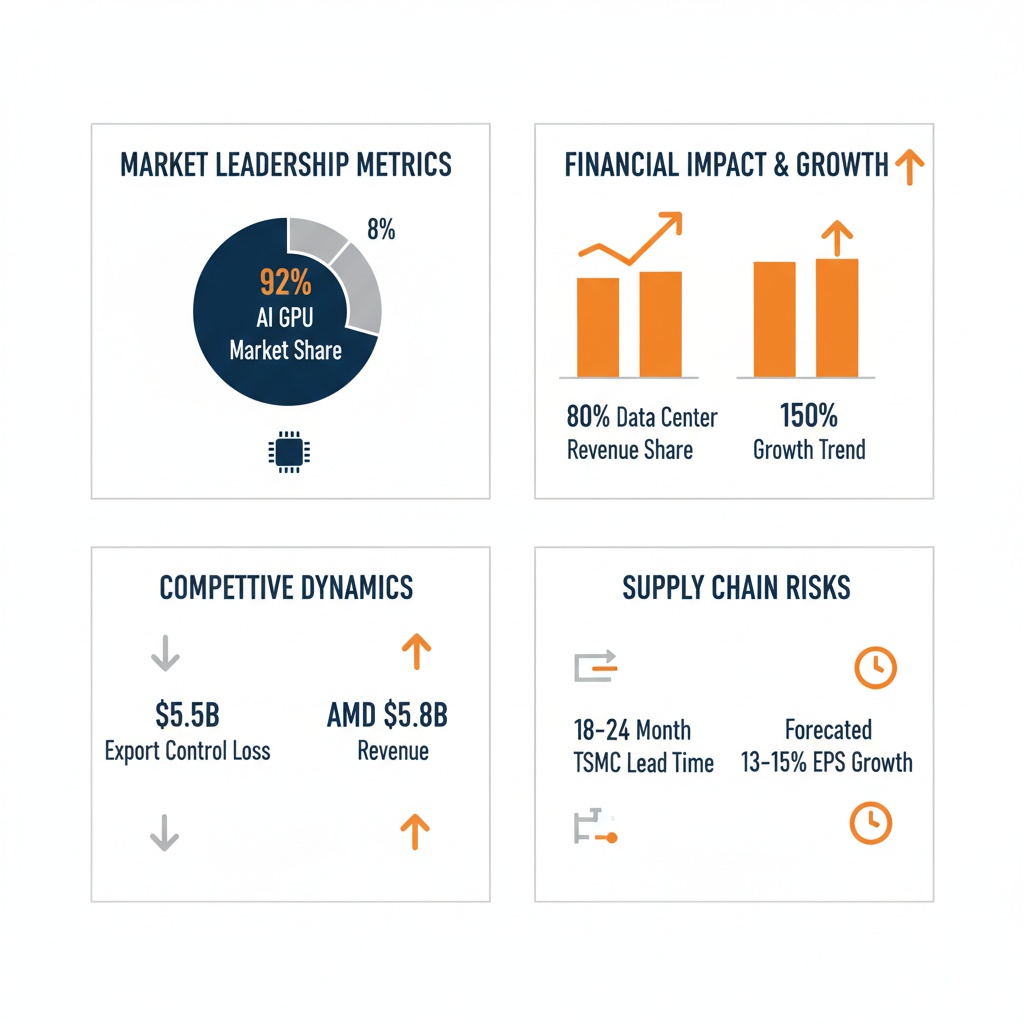
Infographic Image: Nvidia's AI Leadership and Strategic Resilience Amid Geopolitical Challenges
The imposition of U.S. export controls restricting Nvidia’s most advanced AI chips—particularly its H20 series—in China has disrupted previously steady revenue streams and accelerated shifts in regional market shares. Coupled with intensifying competitive pressures from AMD’s advancing MI300/MI450 product lines, Intel’s integrated AI silicon, and the growing deployment of custom AI ASICs by major hyperscalers, Nvidia’s strategic resilience is being tested at multiple fronts. This dynamic environment compels a holistic examination of Nvidia’s market position, the undercurrents driving change, and the adaptive mechanisms steering its sustained growth.
This report aims to provide a comprehensive analysis reflecting Nvidia’s AI dominance amidst shifting geopolitical undercurrents and a fragmenting competitive landscape. It synthesizes core market data, regulatory impacts, and innovation trajectories to assess Nvidia’s strategic posture and delineate pathways for future resilience. By mapping the multifaceted risk-benefit equations and operational strategies, this study offers decision-makers a nuanced understanding of Nvidia’s evolving role in the AI ecosystem and the critical levers to uphold its leadership in a volatile global context.
1. Nvidia's AI Dominance Amidst Shifting Geopolitical Landscapes
Unrivaled Market Command Fueled by Integration and Ecosystem Advantages
This subsection establishes Nvidia's dominant positioning within the AI-driven semiconductor market, specifically highlighting its commanding share in data center GPUs. By dissecting foundational strengths such as proprietary ecosystem lock-in and the software-hardware co-design model, it sets the stage for understanding both the sources of Nvidia's competitive moat and the structural market dynamics enabling sustained growth. This framing prepares the reader for subsequent analysis of external pressures and strategic responses.
Current Titan: Validating Nvidia's AI Data Center GPU Market Supremacy
As of early 2026, Nvidia commands an extraordinary 92% share of the AI data center GPU market, underscoring its near-monopolistic status within this critical segment. This overwhelming dominance reflects both the breadth and depth of its adoption across hyperscale data centers worldwide, where Nvidia GPUs have become the de facto hardware standard for AI model training and inference workloads. Despite intensifying competition, Nvidia’s market share has only marginally receded from previous peaks, attributable more to rapid market expansion and new entrants than erosion of core customer loyalty.
Nvidia commands 92% share of the market, showcasing its dominance.
Crucially, Nvidia’s hold is more pronounced in high-end AI acceleration hardware used in intensive computational tasks rather than across all AI hardware categories, which include CPUs and custom ASICs. The scale of Nvidia's penetration illustrates the entrenched dependency of AI infrastructure providers and enterprises on its GPU technology for both generative AI and large language model (LLM) deployments, which continue to drive exponential demand.
Revenue Composition Reveals Data Center as the Powerhouse Behind Explosive Growth
A granular dissection of Nvidia’s revenue streams reveals a disproportionate concentration of earnings from its data center segment, which constitutes approximately 80% of total revenue as of 2025-2026. This shift marks a decisive transformation from its traditional gaming-centric origins to becoming the linchpin of AI infrastructure. Data center computing—the segment encompassing AI training GPUs, Ethernet networking, and software integrations—has exhibited explosive year-on-year growth exceeding 150%, dwarfing slower growth in consumer-facing graphics and professional visualization products.
Significant portion of Nvidia's revenue is derived from the data center segment.
Emerging data further indicates that a substantial portion of this segment’s revenue is directly tied to hyperscale cloud providers and enterprise customers investing heavily in AI deployments. The strategic focus on data centers maximizes Nvidia’s exposure to recurring capital expenditure cycles driven by advances in AI and cloud computing adoption, establishing a virtuous revenue growth loop linked intimately to evolving AI workloads.
CUDA and Software Integration: Building a Fortress of Switching Costs and Developer Loyalty
Nvidia’s proprietary CUDA software ecosystem is the cornerstone of its competitive advantage, delivering immense lock-in that extends far beyond hardware sales. CUDA’s design as a mature, comprehensive parallel computing platform has become the preferred development environment for AI researchers and engineers globally, with major machine learning frameworks prioritizing CUDA optimization. This entrenched software dependency exponentially raises switching costs for customers considering alternative GPU or accelerator vendors.
Beyond mere compatibility, Nvidia’s integration of software libraries, performance tools, and AI model optimization frameworks creates an ecosystem effect that sustains customer engagement and impedes commoditization of its hardware offerings. This ecosystem synergy, combined with Nvidia’s full-stack hardware solutions—encompassing GPUs, networking components, and AI-focused infrastructure—yields superior end-to-end performance, enabling sustained premium pricing and margin preservation even under competitive pressure.
Strategic Partnerships and Supply Chain Leverage Amplify Market Moats
Nvidia’s dominance is further entrenched through strategic alliances and preferential access to supply chain capabilities. Close collaboration with leading semiconductor foundries and packaging specialists, notably TSMC’s CoWoS and advanced node capacities, ensures Nvidia secures prioritized production of its cutting-edge chips. This supply advantage effectively creates a chokepoint difficult for competitors to bypass, limiting their ability to match Nvidia’s scale and cadence of innovation.
Simultaneously, partnerships with hyperscalers, cloud providers, and AI startups not only broaden Nvidia’s reach but also create feedback loops that inform product development and accelerate adoption. These institutional alliances, including investments in promising AI ventures and long-term collaborations with industry leaders, reinforce Nvidia’s ecosystem and product leadership.
Having established Nvidia’s market supremacy rooted in structural strengths and ecosystem lock-in, the analysis now turns to the external geopolitical headwinds and regulatory challenges imperiling this trajectory. Understanding these pressures is critical to evaluating Nvidia's strategic resilience and adaptive capacity.
Navigating Heightened Export Restrictions: Nvidia’s Revenue Impact and Strategic Countermeasures
This subsection analyzes the direct financial repercussions of U.S. export controls on Nvidia’s H20 AI chip sales to China, quantifies the resulting market share erosion, and evaluates the effectiveness of Nvidia's response mechanisms, including regional diversification and the establishment of localized R&D hubs. It provides a rigorous assessment of how geopolitical constraints translate into operational and revenue challenges, setting the foundation for understanding Nvidia’s broader strategic adaptations.
Quantifying Revenue Loss from U.S. Export Controls on China AI Market
The imposition of restrictive U.S. export controls has thrust Nvidia into a significant revenue contraction, primarily driven by the barring of its high-performance H20 AI chips from the Chinese market. Historically commanding approximately 95% of China's AI GPU market, Nvidia faced a near total exclusion that precipitated an immediate market share collapse to effectively zero within months. This dramatic shift is critical given China's valuation as a $50 billion AI chip market segment, which historically contributed about one quarter of Nvidia's global revenue.
Nvidia directly disclosed a $5.5 billion charge reflecting both excess inventory and unfulfilled purchase commitments tied to the H20 series, underscoring the profound financial impact of the regulatory environment. This loss equates to roughly 4.2% of the company's reported $130.5 billion revenue in fiscal 2025, indicating a significant revenue impairment centered on China-bound product lines. Moreover, ongoing licensing requirements and layered tariffs, such as the 25% duty upon importation of any authorized H200 shipments to China, compound these financial headwinds, introducing complexities and uncertainty into revenue recovery prospects.
Tracing Market Share Decline Timeline Attributed to H20 Chip Export Restrictions
The timeline of market share erosion unfolds as a cascading response to successive U.S. export control escalations. Starting with early restrictions targeting advanced AI chips including A800 and H800 models, Nvidia’s foothold progressively vaporized as the H20 chip line—developed as a compliance iteration for the China market—also fell under stringent licensing mandates beginning in mid-2024. By late 2025, Nvidia’s leadership openly acknowledged zero penetration into the Chinese AI GPU segment.
This expedited decline coincided with Huawei and domestic Chinese foundries rapidly filling the vacuum, leveraging government-backed incentives that aggressively pushed local semiconductor adoption. This strategic pivot accelerated China’s import substitution in this sector, eroding Nvidia’s long-standing dominance. The market share transition exemplifies the intersection of geopolitical frictions with commercial realignments, reshaping competitive dynamics within AI semiconductors.
Assessing Effectiveness of Regional R&D Hubs and Localized Production Strategies
In reaction to curtailing geopolitical risks, Nvidia has strategically expanded its footprint via regional diversification, establishing innovation and manufacturing nodes beyond U.S. jurisdiction. Key investments include the launch of R&D centers in Asia, Europe, and the Middle East, designed to cultivate sovereign partnerships that mitigate reliance on restricted markets. These hubs facilitate tailored product development and regulatory compliance agility, serving as operational buffers amid global trade volatility.
While direct production localization inside China remains constrained, Nvidia pursues collaborative models with compliant foundries and seeks to optimize chip designs—such as the adaptation of memory architectures from HBM3 to GDDR7—to circumvent export limitations. These efforts demonstrate partial mitigation capabilities, albeit with significant caveats: the economic scale and innovation velocity within these hubs have yet to fully compensate for the lost revenue and influence in China. Nevertheless, this geographic diversification underpins Nvidia’s resilience strategy, aiming to stabilize supply chains and preserve competitive advantages in key global markets.
Operational Adjustments and Mitigation Tactics to Circumvent Geopolitical Risks
Beyond regional R&D deployment, Nvidia has employed a multifaceted approach to responding tactically to export constraints. These include the reengineering of product lines to produce regulated variants eligible under licensing frameworks, the pursuit of tailored export permits despite lengthy inspection and tariff impositions, and strategic partnerships with local governments and private sector actors who reinforce compliance with international trade laws.
Moreover, Nvidia’s management has publicly emphasized an ongoing commitment to innovation while navigating export climates, signaling internal prioritization of R&D that addresses security concerns without forsaking market competitiveness. These operational adaptations also encompass heightened surveillance of policy shifts, rapid alignment with regulatory updates, and the expansion of non-China revenue channels to offset deficits induced by trade restrictions. Though such adjustments are not panaceas, they collectively reveal the company’s proactive posture in sustaining growth amid intensified geopolitical headwinds.
Having dissected the magnitude of revenue loss and strategic countermeasures Nvidia has enacted to manage export control challenges, the analysis naturally progresses to understand the evolving competitive landscape. The subsequent subsection will delve into how rivals are capitalizing on Nvidia’s constrained access and how competitive pressures compound Nvidia’s operational complexities.
Competition Intensifies: AMD, Intel, and Custom ASICs Reshaping Nvidia’s AI Hegemony
This subsection critically examines the evolving competitive landscape confronting Nvidia as it strives to maintain its commanding position in AI hardware markets. It explores the tangible market penetration of AMD’s latest GPU accelerators, the rising presence of Intel’s integrated AI silicon in server ecosystems, the increasing adoption of custom ASIC solutions by hyperscale cloud providers, and a comparative performance analysis that highlights shifting industry dynamics. This analysis informs strategic considerations around sustained innovation and market defense amid intensifying competition.
AMD’s MI300 and MI450 Series: Penetrating Nvidia’s AI Data Center Stronghold
AMD has made significant strides in carving out a foothold within AI data center markets traditionally dominated by Nvidia. The MI300 series, launched in 2023, quickly gained traction among hyperscalers, with major cloud providers such as Meta, Microsoft, and Oracle deploying MI300-based servers for AI inference and training workloads. This momentum propelled AMD to generate over $5.8 billion in data center revenue for Q1 2026, marking a 57% year-on-year increase driven by both CPU and GPU segments. The subsequent MI450 series, designed as a customizable AI accelerator platform integrated within the Helios rack-scale system, is positioning AMD to close the gap further. These accelerators promise up to 36x performance improvements over previous generations and are optimized for energy-efficient, large-scale AI model training.
Despite an overall modest market share compared to Nvidia’s dominant position, AMD’s pipeline and customer engagements are broadening rapidly, reflecting growing hyperscaler demand for credible second-source alternatives to mitigate vendor concentration risks. The company’s expanding ecosystem, including ROCm software optimizations and strategic acquisitions of AI software firms, strengthens its competitive profile. Market forecasts suggest AMD could achieve up to 15-20% AI accelerator market share by 2026-2027, indicating that while it remains a challenger, its impact on Nvidia’s market dynamics is materially rising.
Intel’s Integrated AI Silicon Gains Momentum in Server and Edge Domains
Intel’s strategic approach diverges from Nvidia’s GPU-focused architecture by emphasizing AI-optimized CPUs and integrated silicon platforms that harmonize CPUs with AI acceleration workloads. In Q1 2026, Intel reported a 7% revenue increase driven in part by growing enterprise adoption of AI-enabled server CPUs and AI-focused client processors. Their ‘Core Ultra Series 3’ silicon line, built using the advanced 18A process node, targets AI acceleration in both enterprise PCs and edge computing environments, positioning Intel as a growing presence beyond traditional server domains.
Intel’s collaborative partnerships with hyperscalers and AI platform vendors, such as SambaNova and Google, underpin its heterogenous AI architecture vision that marries general-purpose CPUs with specialized accelerators to optimize workload orchestration across training and inference stages. Though Intel faces residual challenges from delayed manufacturing scale and pressure on margins, its integrated AI silicon offerings represent a credible albeit less mature alternative to discrete GPU dominance. By leveraging its entrenched x86 ecosystem and foundry expansion plans, Intel is carving out a niche that could progressively encroach on Nvidia’s market share, particularly in enterprise and edge segments.
Hyperscalers’ Custom ASIC Adoption: Reducing Nvidia Dependence and Driving Market Fragmentation
An emerging competitive dynamic shaping Nvidia’s future market share is the accelerated deployment of custom AI ASICs by major hyperscale cloud providers. Companies like Google, Amazon, Meta, and Microsoft are designing and deploying specialized ASIC accelerators tailored to their specific AI workloads, focusing primarily on inference efficiency and energy optimization. These ASICs, such as Google’s TPU series, Amazon’s Trainium and Inferentia chips, and Meta’s in-house MTIA solutions, deliver greater cost efficiency and power savings versus general-purpose GPUs.
This shift is fostered by the massive scale and unique AI workload profiles of hyperscalers, incentivizing vertical integration and proprietary silicon designs that reduce reliance on third-party suppliers like Nvidia. Market analysis forecasts custom AI ASIC shipments growing substantially faster than merchant GPUs, with anticipated CAGR rates exceeding 30% through 2030. While these ASICs currently handle a narrower set of AI tasks than Nvidia’s versatile GPUs, their rapid maturation erodes the addressable market for general-purpose AI accelerators. This trend coerces Nvidia to intensify innovation cycles and to bolster its platform versatility to defend against increasing fragmentation within the AI infrastructure ecosystem.
Performance and Market Positioning: Comparative Strengths and Weaknesses Versus Competitors
Despite accelerating competition, Nvidia retains a substantial performance advantage, supported by its CUDA software ecosystem, rapid architectural cadence (e.g., progression from Hopper to Blackwell to Rubin), and access to advanced manufacturing via prioritized TSMC capacity allocations. Benchmark comparisons consistently show Nvidia’s GPUs outperforming AMD’s MI series and Intel’s integrated silicon on leading AI workloads, particularly in training throughput and scalability at exascale.
However, competitors leverage differentiated value propositions: AMD offers superior price-performance ratios with high VRAM capacity GPUs aligned to large-scale AI models, increasingly endorsed by hyperscalers’ multi-vendor strategies. Intel’s strength lies in integration across CPUs and AI accelerators, improving total system efficiency in heterogeneous environments. Hyperscaler ASICs, while narrower in scope, deliver unmatched power efficiency and tailored performance for inference, challenging Nvidia’s dominance in selected domains.
As a result, Nvidia’s AI data center market share, while still dominant at over 90%, faces realistic pressure and could stabilize around approximately 75% over the medium term. This reflects competitive erosion primarily from hyperscaler ASIC adoption and AMD’s growing share, balanced by the overall expansion of the AI market ensuring continued absolute revenue growth for Nvidia but with more contested margins and share.
The intensification of competition in the AI hardware market compels Nvidia to continually refine its strategic responses. The subsequent sections will explore how Nvidia leverages its ecosystem advantages, diversifies its portfolio, and maneuvers financial strategy to protect long-term sustainable growth amid these shifting competitive and geopolitical pressures.
2. Strategic Adaptation Framework for Sustainable Growth
Fortifying the Ecosystem: Customer Lock-In, Strategic Synergies, and Platform Expansion as Pillars of Nvidia’s Market Resilience
This subsection explores how Nvidia leverages its integrated software-hardware ecosystem and strategic acquisitions to cement customer loyalty and counteract commoditization pressures in AI hardware. By quantifying the role of the CUDA programming environment, evaluating the beneficial impact of the Mellanox acquisition on multi-GPU architectures, and examining the traction of enterprise software platforms like Omniverse, we reveal the multifaceted mechanisms sustaining Nvidia’s competitive edge amid intensifying market challenges.
Quantifying the Elevated Migration Costs Imposed by Nvidia’s CUDA Ecosystem Lock-In
Nvidia’s CUDA platform remains the cornerstone of its AI infrastructure dominance, creating substantial switching costs that deter customers from migrating to alternative hardware ecosystems. The entrenched maturity of CUDA, reflected in extensive tooling, a rich library base, and widespread developer familiarity, results in migration efforts that often demand codebase rewrites and extensive validation. These costs typically surpass hardware expenditure savings, particularly for large-scale AI model training workloads exceeding 70 billion parameters.
Extensive industry feedback indicates a migration friction threshold where minimal changes to kernel code (frequently less than 5%) still translate into significant redevelopment and retraining efforts. The maintenance of custom optimizations for caching hierarchies and memory access patterns further complicates porting to competitor platforms. Consequently, enterprises and researchers prioritize ecosystem compatibility over purely incremental hardware cost benefits, strengthening Nvidia’s ability to preserve customer allegiance despite competitive price pressures.
Harnessing Mellanox Synergies: Driving Multi-GPU Cluster Scalability and Networked AI Performance
The acquisition of Mellanox has been pivotal in positioning Nvidia to exploit synergies between GPU performance and data center interconnectivity. Mellanox’s networking solutions, particularly InfiniBand and advanced Ethernet technologies, underpin the composable and network-centric architecture fundamental for scaling AI workloads that require thousands of tightly coupled GPUs.
This integration facilitates enhanced inter-GPU communication bandwidth, reduced latency, and improved cluster utilization, effectively enabling AI data centers to orchestrate GPU resources as unified computational fabrics. The surge in revenue from the networking segment—observed at over 140% year-over-year growth—validates the strategic importance of this acquisition. These advancements not only improve throughput for demanding AI workloads but also extend the usable lifecycle and scalability of Nvidia’s hardware, reinforcing retention by increasing the total cost of ownership for alternative solutions.
Enterprise Platform Expansion: Measuring Adoption and Impact of Omniverse and Robotics Suites on Customer Retention
Beyond hardware and software ecosystems, Nvidia’s enterprise-focused platforms such as Omniverse and the Isaac robotics suite are rapidly expanding their footprint within business digital transformation initiatives. Omniverse, with its capability to create detailed digital twins and support collaborative 3D workflows, has secured adoption among major industrial users, including logistics, automotive, and manufacturing sectors, enhancing the company’s role far beyond traditional GPU supplier status.
The platform’s appeal lies in enabling complex simulations and AI-driven automation that directly improve operational efficiencies, demonstrating a value proposition that supplements hardware sales with sticky enterprise software subscriptions. Early financial indicators reveal a promising revenue ramp in these segments, which collectively serve to diversify Nvidia’s income streams and elevate switching costs, as enterprises integrate immersive simulation and robotics AI capabilities deeply into their workflows. This platform-led growth complements the retention effect generated by CUDA lock-in and networking capabilities.
Evaluating Client Retention Trends Amidst Hardware Commoditization Risks and Competitive Pressure
Despite pressures from hardware commoditization and growing competition, Nvidia’s customer retention rates remain comparatively robust, largely due to its intertwined software ecosystem and service offerings. The complex dependencies that enterprises develop on Nvidia’s stack—ranging from CUDA-optimized AI frameworks to integrated networking and specialized software suites—raise the cost and operational risk of migration, promoting loyalty.
Retention metrics from enterprise software sectors analogous to Nvidia’s platforms indicate a level exceeding 85%, emphasizing the resilience of subscription- and ecosystem-based customer relationships. However, sustaining this resilience requires continuous innovation to prevent erosion by open-source alternatives and cost-conscious competitors. Nvidia’s ongoing investments in artificial intelligence APIs, optimization tools such as TensorRT, and microservice platforms serve as critical anchors that reinforce client commitment, mitigating attrition risk amid a shifting competitive landscape.
Building on these ecosystem reinforcements and client retention mechanisms, the subsequent analysis will explore how Nvidia’s strategic portfolio diversification mitigates market cyclicality and opens new growth avenues beyond its core data center and gaming segments.
Portfolio Diversification Beyond Core AI Infrastructure: Emerging Revenue Streams and Strategic Expansions
This subsection examines Nvidia’s strategic efforts to diversify its revenue base beyond its dominant AI data center business. By exploring licensing programs, sectoral expansions into biotech and finance, minority investments in startups, and emerging applications such as climate science simulations, this analysis elucidates how Nvidia is mitigating risks associated with cyclical demand volatility and geopolitical constraints. Understanding the scalability, monetization progress, and innovation pipeline strength of these new frontiers is critical for assessing the company’s sustainable growth trajectory amid a challenging global landscape.
Current Performance and Challenges of the H200 Licensing Program
Nvidia’s H200 chip licensing initiative stands as a cornerstone of its portfolio diversification strategy, reflecting an effort to monetize intellectual property beyond direct hardware sales. Despite securing regulatory licenses to sell limited quantities of these AI accelerators into China, the program has yet to generate significant revenue, largely due to ongoing political uncertainties and regulatory barriers that inhibit market access. The requirement for rigorous U.S. inspection protocols and a 25% import tariff further complicate commercialization efforts, diminishing near-term revenue impact from the China market. Consequently, recognized revenue from H200 licensing remains negligible, underscoring persistent challenges in executing this strategy within the constrained geopolitical environment.
From an economic standpoint, the constrained sales volume and delayed revenue recognition impose a temporary headwind for Nvidia’s licensing monetization ambitions. Although initial sales ceilings propose a potential $15 to $20 billion total revenue opportunity, current shipments fall short as Chinese authorities maintain restrictive stances, favoring domestically developed AI capabilities over reliance on imported hardware. This regulatory impasse forces Nvidia to recalibrate expectations and intensify investment in alternative markets and product ecosystems to compensate for this highly anticipated yet unrealized income stream.
Recurring Revenue from Adjacent Sectors: Biotech and Financial Services as Growth Vectors
Nvidia is progressively leveraging AI technology to penetrate high-potential verticals such as biotechnology and finance, where complex computational challenges promise a fertile ground for scalable and recurring revenue models. In biotech, AI-driven simulations, molecular modeling, and genomic analyses increasingly rely on advanced GPU architectures and customized software platforms to accelerate R&D cycles. Despite the sector’s revenue growth exhibiting episodic volatility and margin pressures, Nvidia’s infrastructure offerings enable foundational support for sustained innovation, enabling clients to adopt platform subscriptions and licensing arrangements conducive to predictable income streams.
Similarly, the financial services industry is embracing Nvidia’s AI capabilities for advanced quantitative modeling, fraud detection, and risk analytics. The firm's ecosystem facilitates high-throughput data processing and real-time analytics critical to this sector. This expanding adoption of AI infrastructure in finance reflects a shift toward longer-term commercial engagements, including cloud-based subscriptions and professional services. Such diversification insulates Nvidia from singular dependence on volatile data center demand while enabling cross-sector exposure to industries with fundamentally resilient capital expenditure rhythms.
Minority Investments in AI Startups: Building an Innovation Pipeline with Strategic Stakes
Nvidia’s long-term growth strategy incorporates minority equity investments in promising AI startups, which serve both as financial vehicles and proactive conduits for technological innovation. This portfolio approach, with funding levels ranging from tens to hundreds of millions of dollars per company, establishes strategic partnerships that extend Nvidia’s influence into emergent segments such as agentic AI, autonomous systems, and specialized AI infrastructure solutions.
By investing early in high-growth companies, Nvidia gains privileged insights into nascent technologies, potential integration opportunities, and ecological market shifts that could shape future demand. These venture stakes act as a hedge against competitive disruption and provide optionality to either deepen collaborations or acquire capabilities. The aggregated value and strategic relevance of these minority holdings reinforce Nvidia’s position as an ecosystem orchestrator rather than merely a component supplier.
Scalability and Market Potential of Climate Science and Other Nontraditional AI Applications
Nvidia is also focusing on expanding AI application domains into scientifically rigorous and socially impactful fields such as climate modeling and earth system simulations. These sectors require high computational density and leverage emerging platforms built on Nvidia’s advanced GPU architectures and software frameworks. By providing AI-enabled tools for probabilistic weather forecasting, environmental data downscaling, and ecosystem modeling, Nvidia taps into a growing segment with sustained governmental and institutional funding.
While currently a smaller portion of the overall revenue mix, climate science simulations carry considerable growth potential due to increased global prioritization of environmental challenges, escalating investment in digital infrastructure for sustainability, and the rising computational demands of cutting-edge generative AI models applied in this context. Nvidia’s early engagement positions it to capture a leadership role that not only diversifies revenue but also enhances its brand equity within high-impact sectors aligned with broader societal goals.
Having detailed how Nvidia is broadening its business through licensing programs, sectoral penetration, targeted investments, and emerging use cases, the next logical focus is on assessing how these diversification initiatives interplay with the company’s core ecosystem strategies and contribute to long-term revenue resilience.
Financial Engineering and Valuation Sustainability: Balancing Growth Ambitions with Geopolitical Uncertainty and Market Realities
This subsection examines Nvidia’s medium-term financial outlook, dissecting projections for earnings growth, capital allocation strategies, and the risks posed by geopolitical tensions—particularly U.S.-China decoupling—to the company’s valuation and cash flow sustainability. It connects Nvidia’s operational performance to market expectations, revealing how financial engineering supports strategic resilience amid an evolving competitive and regulatory landscape.
Five-Year EPS Growth Projections Under Varied Market Conditions
Nvidia’s earnings trajectory over the next five years is expected to maintain robust growth, albeit at a moderated pace compared to the explosive gains of recent quarters. Analyst consensus anticipates annual EPS increases in the mid-teens, ranging approximately between 13% to 15%, reflecting both organic expansion in AI-driven data center demand and incremental contributions from emerging sectors such as automotive AI and robotics platforms. This normalization phase signals a maturation from hyper-growth to sustained expansion, still substantially outperforming broader market earnings expectations.
This projection accounts for Nvidia’s strategic push beyond hardware sales, incorporating revenue streams from AI inference licensing and recurring platform services, which collectively enhance margin stability. However, sustaining this growth requires continuous innovation in architecture, integration of vertically scaled solutions, and successful penetration into diversified end markets. The premium valuation currently attributed to Nvidia incorporates these expectations, but also introduces inherent sensitivity to any deviations in actual growth rates caused by external shocks or intensified competition.
Analyst forecasts, as depicted in projected EPS growth rates ranging from 13% to 15% annually between 2026 and 2031, further illustrate the consistency in expected earnings progression despite external pressures, underscoring Nvidia’s resilience in maintaining profitability momentum [Chart: Projected EPS Growth (2026-2031)].
Capital Allocation: Balancing Organic Growth Investment and M&A Engagement
Nvidia’s capital allocation framework demonstrates disciplined prioritization of organic growth initiatives, with incremental capital directed toward research and development, factory automation, and sales force excellence to capture expanding AI workloads. Organic investments form the backbone of margin expansion strategies, supporting sustained innovation and competitive differentiation in a landscape increasingly defined by accelerated generational shifts in semiconductor technology.
Mergers and acquisitions remain a strategic lever, albeit secondary to organic growth, focused on targeted acquisitions that complement core competencies—such as enhancing interconnectivity or expanding AI software ecosystems. These investments, while modest in scale relative to Nvidia’s overall capital deployment, are expected to yield incremental revenue growth and offer synergies that bolster Nvidia’s technical moat. Shareholder returns via dividends and share buybacks align with long-term value creation, reflecting confidence in cash flow generation while maintaining balance sheet strength.
Downside Risk Analysis Amid Prolonged U.S.-China Economic Decoupling
Geopolitical friction, particularly restrictions on semiconductor exports to China, represents a salient downside risk to Nvidia’s financial outlook. Export controls limiting sales of advanced H20-series chips have effectively eliminated Nvidia’s previously dominant market access in China’s data center segment, eroding revenues that once contributed a substantial proportion of total growth.
This decoupling scenario injects significant uncertainty into earnings projections, with downside cases modeling steep revenue declines in the near term and slower recovery horizons due to regulatory intransigence. Quantitatively, this impact is evidenced by a revenue contraction estimate of approximately $5.5 billion against pre-export control revenues of around $32.6 billion, highlighting the scale of market loss caused by these restrictions [Chart: Revenue Loss Due to Export Controls].
Investor sentiment has factored this geopolitical risk into moderated valuation multiples, reflecting skepticism regarding the tempo and scope of global cooperation on technology trade. Scenario analyses underscore the need for Nvidia to accelerate regional diversification, develop domestic production capabilities outside U.S. jurisdiction, and cultivate alternative markets to mitigate lost Chinese demand. These adaptations, while potentially costly, are critical to sustaining cash flow growth and justifying premium market valuations.
Reconciling Premium Valuations with Realistic Cash Flow Generation Expectations
Nvidia’s premium price-to-earnings ratios reflect investor optimism over long-term dominance in AI computing; however, this optimism is tempered by valuation risks inherent in projected growth sustainability and margin preservation. Current multiples are elevated relative to historical ranges, necessitating strong earnings delivery to avoid correction. Free cash flow conversion rates, projected to remain robust due to operational efficiencies and capital discipline, will be a key metric for validating market confidence.
Diligent financial modeling underscores that while double-digit EPS growth is plausible, achieving the higher bounds of these forecasts requires mitigation of competitive pressures and geopolitical disruptions. As a result, quantitative valuation frameworks recommend conservative scenario planning, incorporating sensitivity to macroeconomic factors, elevated interest rates, and market cyclicality. Balancing aggressive R&D investments with consistent cash flow generation emerges as a strategic imperative to buttress valuation sustainability.
Having articulated the financial contours and valuation dynamics underpinning Nvidia’s future, the report now turns to analyzing the operational risks and systemic vulnerabilities inherent in Nvidia’s supply chain and manufacturing dependencies, which critically influence both financial outcomes and strategic agility.
3. Risk Assessment Matrix for Decision-Makers
Supply Chain Vulnerabilities and Manufacturing Dependencies: Navigating TSMC Bottlenecks and Geopolitical Risk
This subsection critically evaluates the physical and geopolitical supply chain constraints that impose limits on Nvidia's production scalability and market responsiveness. By quantifying manufacturing capacity ceilings, analyzing geopolitical fragilities—especially in Taiwan—and appraising alternative manufacturing strategies, it frames the operational and strategic risks Nvidia must address to sustain its AI-driven growth trajectory under increasing external pressures.
Quantifying TSMC Capacity Limits and Lead Times: The Production Bottleneck for Nvidia
The cornerstone of Nvidia’s semiconductor production relies heavily on Taiwan Semiconductor Manufacturing Company (TSMC), particularly its advanced process nodes below 4 nanometers. Despite TSMC's status as the world’s premier foundry, its wafer supply remains a critical constraining factor. Current lead times for new capacity expansions are extended—often running 18 to 24 months before production can scale to target volumes due to the intricate capital and technological requirements of advanced node fabs.
TSMC’s packaging lines for Chip-on-Wafer-on-Substrate (CoWoS), critical for high-bandwidth memory integration such as HBM3e used in Nvidia’s H200 series accelerators, continue to face severe supply tightness. This packaging bottleneck limits Nvidia’s ability to fully ramp production despite strong market demand, as manufacturing capacity for these advanced substrates is not easily expanded on short timelines. The resultant production shortfall has led to staggered product releases and longer procurement cycles for enterprise customers, emphasizing the extent to which TSMC’s physical output capacity acts as a gating constraint on Nvidia’s revenue growth.
Assessing Taiwan Strait Disruption Risks: Geopolitical Fragilities and Operational Continuity
The geographic concentration of leading-edge semiconductor manufacturing in Taiwan places Nvidia’s supply chain at a pronounced geopolitical risk. The Taiwan Strait is a strategic chokepoint whose stability is fraught with uncertainty amid rising regional and global tensions. Military and political escalations could induce immediate and severe disruptions to logistics and component availability, threatening to paralyze global supply chains.
Frequent high-profile military exercises, escalating rhetoric, and systemic strategic competition underline the likelihood of intermittent or extended interruptions. Given Taiwan’s pivotal role—producing over 60% of global leading-edge chips and over 90% of the most advanced semiconductors—any shortfall could cascade across multiple industry verticals. For Nvidia, such a disruption raises the specter of protracted manufacturing halts, deferred product launches, and revenue erosion that cannot be easily mitigated within compressed timeframes.
Identifying Backup Foundry Capacity and Capacity Relief Measures Amid Supply Crunch
To alleviate the unsustainable single-source dependence, Nvidia and other major fabless firms are actively exploring alternative foundry partnerships. However, other foundries such as Samsung and Intel, while technically capable, face their own capacity constraints or lack parity in the most advanced process nodes required for Nvidia’s highest performance products.
Samsung's historical experience as a chip manufacturer and its ramp-up of 3nm and below nodes offers some relief potential but is limited by ongoing competitive dynamics in smartphone chipset production and intellectual property sensitivities. Intel’s foundry ambitions remain nascent and primarily focused on CPU and integrated architectures, offering limited immediate relief. While third-party foundries in South Korea and the United States are expanding capacity, lead times and minimum order quantity requirements limit their ability to promptly absorb Nvidia’s full-volume demands.
Furthermore, regional initiatives to diversify manufacturing hubs, including TSMC’s massive investments in Arizona fabs, will only gradually ease capacity stress starting mid-decade, leaving near-term bottlenecks unresolved.
Evaluating Co-Packaged Optics Adoption Rates and Manufacturing Innovation Mitigation Strategies
Emerging manufacturing innovations such as Co-Packaged Optics (CPO) present both strategic opportunities and transitional challenges. CPO integrates photonic components closely with electronic chipsets, significantly improving bandwidth and power efficiency, which aligns well with the scalability requirements of AI data centers—Nvidia’s primary market segment.
However, CPO manufacturing remains in early-stage commercialization with significant heterogeneity integration challenges and limited fabrication runs. Nvidia is strategically investing in these emerging interconnect technologies to reduce downstream power and latency constraints, which could indirectly alleviate some supply chain pressure through greater system efficiencies.
Despite promising technological advances, achieving wide-scale adoption and mass production of CPO architectures depends on overcoming complex co-design and yield barriers. This implies that although CPO adoption is accelerating, it will not serve as a near-term panacea and requires parallel progress in advanced packaging and foundry capacity expansions to fully realize its mitigating potential.
Financial and Operational Impact of Manufacturing Dependencies: Bottlenecks and Cost Implications
The operational bottlenecks stemming from manufacturing dependencies translate into significant financial constraints. Persistent supply shortages elevate input costs—especially for high-bandwidth memory and packaging substrates—creating an 'AI tax' manifested as rising chip prices and shipment reductions in adjacent consumer markets.
Furthermore, limited fab capacity necessitates prioritization of higher-margin enterprise products, restricting product availability for broader applications and constraining revenue diversification. Prolonged bottlenecks can also lead to customer frustration, longer sales cycles, and elevated inventory carrying costs.
Mitigating these risks requires rigorous supply chain management, cost pass-through strategies, and operational agility to navigate volatile lead times, while maintaining capital expenditure discipline on capacity expansion projects.
Having outlined the fundamental constraints imposed by physical manufacturing bottlenecks and geopolitical fragilities—including Taiwan Strait risks and limited alternative foundry capacities—the discussion next turns to Nvidia’s strategic implications. Understanding these dependencies' operational and financial impacts is critical to framing the company’s risk mitigation approaches and long-term resilience-building efforts through ecosystem fortification and strategic diversification.
Navigating Ethical Complexities and Reputational Risks Amid AI Workforce Disruptions
This subsection examines the multifaceted reputational and governance challenges Nvidia faces as AI technologies increasingly impact labor markets. It situates these social risks within the broader context of investor demands and public scrutiny, analyzing how Nvidia’s ethical governance mechanisms and transparency practices influence its brand equity and regulatory standing amid growing concerns about workforce displacement.
Recent AI-Induced Workforce Displacement and Its Societal Impacts
The rapid deployment of advanced AI systems, including agentic AI capable of autonomously executing complex tasks, increasingly disrupts traditional labor markets. Evidence indicates disproportionate impacts on younger and less-experienced white-collar workers, with declines in entry-level hiring and a reallocation of tasks favoring higher-skilled roles. While AI adoption boosts productivity, displacement risks remain acute in sectors with routine cognitive tasks. This multifaceted labor market reorganization is uneven across regions, reflecting sector-specific exposures and technological trajectories.
Within this landscape, Nvidia operates at the technological frontier, powering AI applications that accelerate these labor market shifts. Increased automation capabilities, while enabling efficiency gains, accentuate public apprehension about job security, heightening societal scrutiny on Nvidia’s role in responsible AI deployment. The company’s strategic communications underscore a vision of human-AI collaboration rather than wholesale job replacement, framing AI as a complement to talent rather than its inexpensive substitute.
Investor and Activist Demands Shaping Nvidia's Governance Focus
Investor activism increasingly prioritizes corporate social responsibility, demanding robust governance frameworks that address AI’s ethical and social implications. Nvidia has encountered pressures from activist investors seeking enhanced commitments to transparency, ethical AI development, and workforce transition strategies. The company’s governance structure, influenced by such demands, incorporates ethics considerations into board-level deliberations, seeking to align strategic AI investments with stakeholder expectations.
Proxy resolutions and shareholder proposals in recent years reflect concerns over AI’s societal impacts, urging Nvidia to adopt comprehensive safeguards against discrimination, labor displacement, and privacy violations. This evolving landscape has compelled Nvidia to proactively enhance its investor communications, emphasizing its compliance with emerging regulatory standards and its commitment to equitable technology stewardship.
Robustness and Scope of Nvidia’s Ethics Oversight and Transparency Protocols
Nvidia has established internal ethics governance mechanisms aimed at ensuring responsible AI innovation. The company’s ethics review boards convene regularly to assess AI product development pipelines, evaluating risk factors such as bias, privacy infringement, and potential misuse. Transparency initiatives include publishing AI safety guidelines and engaging with external expert panels to review compliance frameworks.
Despite these efforts, maintaining up-to-date transparency protocols remains challenging in a rapidly evolving technological and regulatory environment. Stakeholders closely monitor the frequency and scope of Nvidia’s ethics decisions, demanding clear reporting on progress against stated commitments. Nvidia’s ability to incorporate stakeholder feedback into agile governance practices is critical to sustaining its social license to operate.
Media and Public Sentiment Trends Impacting Nvidia’s Brand Equity
Public narratives around AI risks, particularly concerning workforce displacement and ethical dilemmas, influence Nvidia’s reputational capital. Media sentiment analyses reveal a dynamic pattern, with periods of heightened scrutiny often coinciding with significant AI governance developments or external events involving AI safety controversies. While Nvidia benefits from its status as a technology leader, negative sentiment related to societal concerns periodically tempers market enthusiasm.
Effective stakeholder communication strategies that transparently address these concerns—ranging from detailed disclosures to proactive engagement with media and civil society—are paramount. Such efforts help mitigate adverse reputational effects, foster trust, and solidify Nvidia’s positioning as a responsible innovator in the AI ecosystem.
Having explored the reputational and ethical governance dimensions of Nvidia’s AI engagements, the report now transitions to assessing operational and strategic risk factors, including supply chain vulnerabilities and manufacturing dependencies, to provide decision-makers with a holistic risk management perspective.
4. Roadmap to Next-Generation Resilience
Pioneering the Future: Nvidia’s Blackwell Architecture, Photonics Integration, and Neuromorphic Paradigms for Next-Gen AI Systems
This subsection evaluates the technological frontiers shaping Nvidia's resilience and competitiveness in the AI hardware landscape. By dissecting Nvidia's cutting-edge Blackwell GPU performance, exploring the integration of photonics in AI data centers, and assessing the emerging potential of neuromorphic computing, this section informs strategic planning for sustained leadership and innovation. It situates these technologies as critical pillars underpinning Nvidia’s capability to meet the exponential growth in AI workloads while preempting shifts in computational paradigms that could redefine hardware architectures over the next decade.
Quantifying Nvidia’s Blackwell Architecture Performance: Benchmark Insights and Strategic R&D Implications
Nvidia’s Blackwell architecture represents the current apex of AI-accelerated computing, marked by a significant leap in transistor count and memory bandwidth that enables unparalleled processing density. Featuring 208 billion transistors and deploying up to 192GB of HBM3e memory per GPU, Blackwell achieves a 15-fold increase in inference throughput compared to its predecessor, positioning it as the backbone of large-scale foundation model training and inference in 2026. Benchmark data from hyperscale deployments confirms widespread adoption among leading cloud providers, with substantial integration into OpenAI’s GPT 5.5 and Microsoft’s latest AI data center, underscoring both commercial and technical validation.
These performance gains are not isolated; rather, they are magnified through innovations such as rack-scale computing, where liquid-cooled GPU clusters operate as unified compute fabrics. This architectural approach enables the effective support of Mixture-of-Experts models requiring exceptional memory bandwidth and ultra-low latency communication. Nvidia’s roadmap anticipates the Rubin architecture, expected to debut later in 2026, which promises incremental improvements in NVLink interconnect bandwidth and power efficiency, ensuring continued dominance. Strategically, this relentless innovation cadence demands sustained R&D investment, solidifying Nvidia’s moat against competitors struggling to match the scale and complexity of these offerings.
Emergence of Photonics in AI Data Centers: Market Adoption Patterns and Performance Enhancements
Photonics-based optical interconnects have begun to emerge as critical enablers in overcoming the physical and electrical bottlenecks inherent in scaling AI data center performance. Hyperscale operators and cloud providers are increasingly integrating silicon photonics and co-packaged optics to achieve high-bandwidth, low-latency communication that is essential for synchronizing multi-GPU clusters and reducing system-wide energy consumption. Demand trends show a rapid transition, with over 70% of hyperscale data centers adopting optical links faster than 400G capacities, driven by the insatiable appetite of AI workloads for bandwidth and reduced bottlenecks.
The market dynamics reveal a robust growth curve for photonic interconnects, with significant investments in next-generation fiber optics and optical multiplexing technologies that enhance wavelength division multiplexing efficiency and fiber utilization. Silicon photonics, with its CMOS compatibility and scalable manufacture, dominates the landscape, forming the backbone of optical components deployed today. These advances not only extend data center scalability but also enhance security, exemplified by capabilities like confidential computing offered in conjunction with emerging GPU architectures. However, challenges around photonic integration complexity and cost remain, with full-scale production readiness anticipated to mature through the late 2020s. Given these trends, Nvidia’s strategic partnerships and in-house innovation in photonics are critical to maintaining system-level leadership amid this transition.
Assessing Neuromorphic Computing’s Disruptive Potential in AI Hardware: Feasibility, Timeline, and Impact
Neuromorphic computing embodies a paradigm shift, aiming to mimic the human brain’s parallel and event-driven processing capabilities to achieve significant energy efficiency and real-time adaptive intelligence, particularly for edge and specialized AI applications. Research advancements show neuromorphic architectures can reduce energy consumption by over 90% for temporal pattern recognition tasks compared to conventional GPUs, enabling sophisticated analytics within power-constrained environments. Commercial and experimental chips like NeuRRAM and IBM’s NorthPole exemplify progress, illustrating the feasibility of this technology for domain-specific workloads such as sensor fusion and autonomous systems.
The timeline for neuromorphic viability suggests early adopters within edge AI contexts by the mid-to-late 2020s, supported by ongoing federal R&D prioritization and increasing integration with AI software frameworks. While neuromorphic chips are unlikely to supplant general-purpose GPUs like Nvidia’s Blackwell in high-throughput data center workloads in the near term, they represent a complementary technology to enhance overall AI infrastructure efficiency and extend Nvidia’s portfolio diversity. For strategic R&D planning, Nvidia and ecosystem partners must closely monitor neuromorphic advances and invest selectively in collaborations and intellectual property to remain competitive in this emergent domain.
Together, these technological vectors—Blackwell’s superlative compute capabilities, photonics-driven data center connectivity, and nascent neuromorphic innovations—constitute a multifaceted pathway for Nvidia to sustain leadership amid accelerating AI demand. The integration of these advances into cohesive product and infrastructure strategies will define Nvidia’s resilience and adaptability, shaping its competitive moat against both incumbent hardware players and emerging specialized chipmakers.
Embedding Agility: How Decentralized Decision-Making and Dynamic Teams Propel Nvidia's Adaptive Edge
This subsection probes the organizational agility mechanisms enabling Nvidia to navigate a complex geopolitical environment and rapid technological disruption. By examining Nvidia’s decentralized authority model, cross-functional squads, and dynamic talent allocation, it reveals how internal operating rigor and structural adaptability intersect to sustain innovation velocity and regulatory responsiveness. Positioned within the broader “Roadmap to Next-Generation Resilience” section, this analysis highlights practical enablers of resilience critical for preserving competitive advantage amid accelerating AI market evolution and regulatory fragmentation.
Decentralized Decision Authority: Empowering Regional Teams to Navigate Regulatory Complexities
Nvidia’s organizational design increasingly embraces decentralized decision-making, a strategic imperative shaped by a patchwork of complex regulatory frameworks worldwide. By delegating significant decision authority to regional leadership, Nvidia empowers local teams to rapidly interpret and respond to dynamic geopolitical pressures, such as export controls and data sovereignty mandates. This approach reduces latency in compliance decisions and customer engagement, especially in sensitive markets where U.S. trade restrictions limit operational flexibility. Practical instances include the formation of localized R&D hubs and manufacturing partnerships in Europe and Asia, which operate with autonomous budgets and strategic mandates aligned to regional regulatory landscapes. This decentralization mitigates bottlenecks typically associated with centralized oversight, enabling more nuanced approaches to license acquisition, market access, and product customization within diverse jurisdictions, thereby preserving Nvidia’s market presence despite adverse external constraints.
Moreover, by distributing authority, Nvidia fosters heightened accountability and innovation at the edges of its organization. Regional decision-makers tailor market strategies and partnerships that accommodate local regulations while accelerating go-to-market velocity. This decentralization supports a dual-market strategy balancing U.S. headquarters’ strategic priorities with on-the-ground realities. In a climate of escalating regulatory scrutiny over AI technology flows, this agility is essential to circumvent delays and operational inertia attributable to centralized gatekeeping that could stall Nvidia’s responsiveness to emergent risks or opportunities.
Cross-Functional Squads: Driving Innovation with Hybrid Quantum-Classical AI Projects
Nvidia has institutionalized the use of cross-functional squads, composed of engineers, data scientists, business strategists, and regulatory specialists, to accelerate development of frontier AI technologies such as quantum-classical hybrid algorithms. These teams break down traditional silos, facilitating seamless integration of diverse expertise essential for navigating increasingly complex hardware-software co-design challenges. Success metrics for these squads in 2025 exemplify rapid prototyping cadence, shortened iteration cycles, and enhanced alignment of R&D outcomes with market needs, evidenced by accelerated deployment timelines of experimental computing platforms.
This interdisciplinary mode enhances problem-solving agility by enabling simultaneous consideration of algorithmic innovation, hardware constraints, ethical compliance, and commercial viability within a single collaborative unit. Cross-functional squads also act as internal incubators for emerging market approaches, facilitating continuous feedback loops and knowledge exchange. Their role is pivotal in managing uncertainty endemic to next-generation AI paradigms, where iterative experimentation and rapid course correction are prerequisites. The squads’ performance directly impacts Nvidia’s ability to maintain a leadership position in nascent AI sectors despite intensifying competition and regulatory headwinds.
Dynamic Engineering Resource Allocation: Optimizing Talent Deployment for High-Growth AI Segments
Nvidia’s engineering leadership employs sophisticated frameworks for dynamically reallocating technical talent to align resources with evolving strategic priorities. Data-driven assessments of project potential, market growth trajectories, and technology maturation stages inform rapid redeployment of engineering personnel from mature product lines to emergent AI verticals such as autonomous systems and physical AI robotics. This elasticity in resource allocation is facilitated by real-time performance metrics and predictive workload models, enabling counts of engineering hours to shift by upwards of 20–30% within quarters toward breakthrough initiatives.
The agility extends beyond headcount to skill development, with prioritized upskilling in AI/ML specializations and cross-domain collaborations reducing knowledge bottlenecks. This fluid reallocation ensures that Nvidia rapidly scales efforts in high-impact areas without diluting core competencies or jeopardizing ongoing operational excellence. The resulting organizational nimbleness contributes to Nvidia’s sustained innovation velocity and market responsiveness, critical advantages in a technology domain where lead times increasingly define competitive outcomes.
Building on Nvidia’s organizational agility and resource fluidity mechanisms, the subsequent analysis will explore how this structural dexterity interplays with technological innovation trajectories and strategic stakeholder alignment to reinforce the company’s next-generation resilience.
Aligning Stakeholders Around Nvidia’s Strategic Vision Amid Market Volatility
This subsection dissects how Nvidia strategically manages and aligns its diverse stakeholders—including institutional investors, regulators, and employees—to sustain confidence and enable coherent execution amid persistent market volatility and regulatory complexities. Understanding these alignment mechanisms is pivotal for assessing Nvidia’s capacity to maintain resilience and fulfill its growth ambitions in the dynamic AI semiconductor landscape.
Calibrated Messaging to Institutional Investors Navigating Growth Uncertainty
Nvidia’s investor communication strategy for 2026 centers on reinforcing long-term secular growth prospects while tempering expectations amid cyclical and geopolitical uncertainties. The company consistently emphasizes the early-stage nature of AI-driven demand expansion, underscoring sustained investment from large technology hyperscalers as validation of ongoing growth momentum. This careful narrative manages to balance bullish long-term outlooks with grounded transparency regarding near-term risks, such as competitive pressures and potential supply disruptions.
Quarterly earnings releases and investor presentations strategically highlight record data center revenue growth and strong guidance, reinforcing Nvidia’s dominant market share in AI infrastructure. However, the messaging also deliberately acknowledges the intensity of competition, the unpredictability of AI spending patterns, and regulatory headwinds, thereby anticipating and addressing investor concerns preemptively. This dual-pronged communication approach aims to sustain shareholder confidence without inflating unrealistic expectations, an important tactic given the high valuation multiple and market sensitivity to any growth deceleration.
Proactive Regulatory Engagement Programs Supporting Compliance and Innovation
Nvidia actively pursues structured engagement with global regulators to navigate the intricacies of export controls, antitrust oversight, and emerging technology governance frameworks. The company’s programs integrate multi-jurisdictional dialogues to ensure alignment with evolving regulatory standards while advocating for policies that foster innovation and global AI ecosystem development.
Key initiatives include partnerships with government agencies in the U.K., Europe, and Japan that focus on co-developing secure and trusted AI-native network architectures as well as open innovation ecosystems. This collaborative stance not only mitigates compliance risk but also positions Nvidia as a thought leader and preferred partner in shaping future regulation. Internally, Nvidia incorporates compliance safeguards into chip design and supply chain protocols, ensuring regulatory requirements are met without compromising performance or market access.
Integrating ESG and Sustainability Goals into Employee KPIs to Drive Shared Objectives
To align internal stakeholders with broader corporate sustainability ambitions, Nvidia embeds environmental, social, and governance targets directly into employee performance frameworks. This approach ensures that carbon-neutrality efforts, ethical AI development, and social responsibility metrics become integral to individual and team accountabilities, incentivizing behaviors that contribute to long-term value creation beyond immediate financial results.
Such KPIs often include measurable reductions in greenhouse gas emissions associated with data center operations, milestones related to sustainable product development, and ethical governance adherence. Combining these sustainability metrics with traditional performance goals fosters a culture of shared ownership and accountability. Moreover, this integration supports transparent ESG reporting and reinforces Nvidia’s reputation among investors and external stakeholders as a company committed to responsible innovation.
Building on Nvidia’s proactive stakeholder alignment, the subsequent subsection will explore how organizational agility and adaptive operating models underpin the company’s capacity to translate these aligned objectives into rapid and effective strategic execution amid evolving technological and geopolitical challenges.
5. Synthesis and Actionable Pathways
Integrated Risk-Benefit Assessment: Quantifying Strategic Trade-Offs in a Volatile Geopolitical Landscape
This subsection provides a rigorous evaluation framework that integrates geopolitical risks with financial and operational variables to inform Nvidia’s strategic planning. By quantifying the revenue impacts of export restrictions, modeling investment returns, and simulating future revenue scenarios, the analysis enables evidence-based prioritization of capital allocation and risk mitigation. It illuminates the interplay between technological innovation benefits and regulatory challenges, facilitating a balanced approach to sustaining Nvidia’s market leadership amid shifting geopolitical headwinds.
Quantifying Revenue Impact of Geopolitical Risks on Nvidia’s AI Market Footprint
Nvidia’s revenue trajectory faces pronounced pressure from geopolitical restrictions, notably U.S. export controls curtailing sales of advanced GPUs such as the H20 series into China, the largest global AI semiconductor market. This shift effectively eradicates Nvidia’s previous near-monopoly market share exceeding 90% within China’s AI data center sector, translating to a direct multi-billion-dollar revenue shortfall in the short term. Financial assessments indicate a conservative baseline scenario where China-related data center revenue contribution declines from over 20% of global segment sales to near zero, profoundly impacting top-line growth despite offsetting demand in Western and emerging markets.
The structural revenue impact is compounded by secondary effects stemming from regional supply chain dislocations and partner ecosystem hesitancy, which extend beyond direct sales losses. Geopolitical tensions raise customer uncertainty and accelerate competitor inroads in restricted regions, intensifying market share erosion risks. Furthermore, these controls have prompted Nvidia to revise earnings guidance conservatively, excluding any China revenue projections for the immediate future, underscoring the gravity of export barriers on growth projections and enterprise valuation.
Modeling Capital Allocation Efficiency: Factory Expansion Versus R&D Investment
Facing a constrained global supply milieu exacerbated by geopolitical fragmentation, Nvidia must strategically weigh the return on investment (ROI) between expanding physical manufacturing capacity and accelerating innovation through research and development. Capital-intensive fabrication scaling delivers incremental supply reliability but exposes Nvidia to heightened geopolitical supply chain risks and longer capital recovery timelines. Meanwhile, intensified R&D investment offers potential for technological leaps—such as next-generation architectures and integrated AI devices—that can maintain competitive differentiation and justify premium pricing.
Quantitative modeling employing scenario-based ROI analyses reveals that, while factory expansion underpins short-to-medium term supply security, its marginal financial returns diminish relative to accelerated R&D funding aimed at capturing emerging AI application domains. Investment in novel architectures, such as the Blackwell series and upcoming CPUs tailored for cognitive workloads, is projected to unlock substantial new addressable markets exceeding $200 billion. The balancing act involves mitigating production bottlenecks without compromising agility in innovation, necessitating a flexible, phased capital deployment strategy that optimizes value generation under uncertainty.
Simulating Five-Year Revenue Scenarios under Prolonged Export Bans and Geopolitical Constraints
Monte Carlo simulations incorporating geopolitical risk indices and market adoption rates project multiple revenue trajectory scenarios for Nvidia over a five-year horizon under persistent export restrictions. Under a downside scenario whereby China remains largely inaccessible and competitors intensify efforts, compounded by escalating U.S.-China trade tensions, Nvidia’s revenue growth moderates to mid-single digits, driven primarily by Western hyperscale demand and diversified enterprise customers. Conversely, an upside scenario with partial easing of restrictions and successful regional diversification efforts allows sustainable double-digit growth, supported by product innovation and ecosystem expansion.
These stochastic models take into account the volatility introduced by unpredictable geopolitical escalations, supply chain interruptions, and competitive dynamics. The output distributions highlight the revenue growth range with confidence intervals, providing insight into financial planning buffers and contingencies. The simulations emphasize the high sensitivity of Nvidia’s market valuation and investment appeal to geopolitical risk evolution, reinforcing the criticality of adaptive strategic mechanisms.
Comparing Technological and Regulatory Risk Severity: Balancing Innovation Imperatives with Compliance Realities
An integrated risk scoring framework juxtaposes the upside potential of rapid technological advances against the downside threats posed by evolving regulatory regimes. Technological risks, while significant—encompassing innovation failures, disruptive competitor breakthroughs, and supply chain technology bottlenecks—offer high reward potentials through sustained performance leadership and market share expansion. Regulatory risks, however, introduce systemic uncertainties that can abruptly truncate addressable markets, impose compliance costs, and induce reputational consequences.
Severity metrics weighted by probability-adjusted impact assessments reveal that regulatory risks currently carry a higher near-term downside severity due to export controls and cross-border tensions. Nonetheless, technology risk remains a long-term existential factor, capable of reshaping Nvidia’s competitive moat. Hence, strategic plans must embed robust compliance teams and scenario planning while simultaneously allocating resources for breakthrough R&D to maintain a competitive edge. This dual focus aligns with investor expectations for sustainable growth within a complex geopolitical operating environment.
Having quantitatively mapped the interplay between Nvidia’s geopolitical exposures, capital deployment choices, and competitive innovation imperatives, the subsequent analysis will pivot to practical implementation frameworks. These will address how Nvidia can operationalize strategic priorities through phased investments, compliance infrastructure, and stakeholder engagement to manage risks while capitalizing on AI-driven growth opportunities.
Implementation Playbook: Navigating Compliance and Capacity Expansion Amid Complex Export Controls
This subsection details Nvidia's tactical roadmap for deploying its European manufacturing expansion and strengthening export control compliance capabilities. It focuses on concrete milestones, governance structures, and performance metrics that underpin a disciplined rollout within a challenging geopolitical and regulatory environment. This operational blueprint exemplifies how Nvidia translates high-level strategy into executable steps, ensuring proactive risk management and sustained growth momentum across international markets.
Detail milestones for EU facility expansion rollout
Nvidia's expansion of manufacturing capacity in Europe is a cornerstone of its strategy to mitigate geopolitical risks and diversify its supply chain dependencies. The rollout is structured around phased milestones, beginning with the completion of ground-up construction of the initial fabrication site by Q3 2026, followed by equipment installation and validation procedures through early 2027. This timeline enables incremental wafer output ramp-up, prioritizing critical AI chip node technologies to meet growing data center demand. Parallel to this, Nvidia aligns infrastructure readiness with local regulatory approvals and workforce training initiatives to avoid bottlenecks.
Key intermediate deliverables include establishing regional supplier networks to secure raw materials and components compliant with EU standards. The plan incorporates integration of advanced environmental and energy-efficiency systems, aligning with the EU’s sustainability mandates, thus positioning the facility not just as a production hub but as a benchmark for green semiconductor manufacturing. The rollout will be supported by continuous performance monitoring dashboards instrumental for real-time adjustments in response to unforeseen delays or evolving market dynamics.
Define accountability roles in export control compliance
The complexity of complying with export controls, particularly regarding the U.S. restrictions on sales and technologies related to China, necessitates a rigorous compliance governance framework within Nvidia. This involves designated compliance officers overseeing day-to-day adherence to applicable regulations alongside a central Export Management and Compliance Program (EMCP) headed by senior leadership. This hierarchical approach ensures accountability from executive decision-making to operational execution, facilitating rapid identification and resolution of potential violations.
Complementing formal roles, Nvidia invests in training cross-functional teams—spanning legal, sales, engineering, and supply chain departments—to embed a culture of compliance awareness. Automated compliance screening tools and audit trails are implemented to enforce license requirements and flag export anomalies proactively. Reporting and escalation protocols are clearly articulated with periodic audits assessing control effectiveness, fostering continuous improvement. Such robust governance minimizes risk exposure to punitive sanctions and reputational harm.
Accountability also extends to external partners and subcontractors through contractual obligations and vendor compliance audits, ensuring the entire value chain aligns with Nvidia’s stringent export control policies.
Set KPIs for quarterly review checkpoints tracking dual-market strategy progress
Nvidia’s dual-market strategy necessitates detailed KPIs to monitor execution progress and strategic adherence across both Western and Chinese market segments amid export restrictions. Quarterly review checkpoints focus on metrics such as production ramp-up rates at the EU facility, percentage of shipments compliant with export licenses, and revenue segmentation attributable to non-restricted regions. These indicators are augmented by risk exposure indices tracking regulatory changes, compliance infractions, and geopolitical developments potentially impacting supply or sales channels.
Operational KPIs include training completion rates for export compliance certifications, number of audit findings closed per quarter, and real-time shipment inspection pass rates. Financial KPIs measure cost per unit of additional manufacturing capacity versus forecast, margin trends amid tariff impacts, and license fee realizations from export licenses granted. The robust measurement framework enables dynamic recalibration of tactics, ensuring objective performance visibility and timely executive interventions to uphold strategic targets.
These quarterly data cycles are integrated within broader enterprise dashboards reviewed by Nvidia’s board-level committees to maintain alignment between operational execution and corporate governance mandates.
Outline comprehensive training scope for navigating export control regulations operationally
Training programs addressing export control navigation are comprehensive, combining legal frameworks, practical compliance procedures, and scenario-based exercises tailored for specific roles. Nvidia’s curriculum covers export classification nuances, licensing requirements, documentation protocols, and response procedures for suspected violations. Modules are segmented by function, equipping sales and logistics staff to identify restricted transactions early, while engineers and product managers gain awareness of technology controls relevant to chip designs and software components.
The program further emphasizes emerging regulatory updates, focusing on recent U.S. export controls targeting advanced AI chip exports and associated licensing constraints affecting shipments to China. A critical component is the development of decision-making skills under ambiguous regulatory environments, enabling employees to seek timely internal counsel and avoid inadvertent breaches.
Periodic refresher sessions ensure that personnel remain current amid rapidly evolving geopolitical landscapes. Additionally, training integrates case studies highlighting enforcement outcomes and best practices from recent compliance challenges faced by Nvidia and industry peers, embedding lessons learned into operational routines. The scope also extends to international subsidiaries and partners to align global compliance standards.
By institutionalizing this rigorous training regime, Nvidia significantly reduces compliance risk and empowers its workforce to act as first-line guardians against export control infractions.
Having established a detailed implementation blueprint with milestones, accountability structures, performance tracking, and training protocols, the subsequent analysis will assess how these operational measures integrate with Nvidia's broader strategic imperatives. This sets the stage for evaluating the dynamic balance between tactical execution and strategic resilience amid evolving geopolitical constraints.
Conclusion
Nvidia’s commanding 92% share of the AI data center GPU market remains a testament to its integrated technology ecosystem, comprising advanced GPU architectures, a robust CUDA software platform, and synergistic networking capabilities through acquisitions such as Mellanox. These assets have enabled Nvidia to sustain superior performance benchmarks and elevated switching costs that reinforce customer loyalty despite mounting competitive incursions. However, external factors, primarily U.S. export controls barring Nvidia’s leading AI chips from China, have imposed significant revenue setbacks estimated at $5.5 billion, demonstrating the acute sensitivity of Nvidia’s growth to geopolitical volatility.
The competitive ecosystem around Nvidia is dynamically evolving, with AMD and Intel making tangible strides in AI data center relevance, and hyperscaler-custom ASIC adoption ramping rapidly to fragment the AI accelerator market. This constellation of competitive forces suggests a medium-term recalibration of Nvidia’s market share toward an estimated 75%, reflecting a balance between sustained dominance and competitive attrition. Nvidia’s strategic initiatives—regional R&D hubs, manufacturing diversification, platform expansion beyond core hardware, and pioneering next-generation architectures such as Blackwell—are critical to offsetting these challenges and securing future growth vectors.
Looking forward, Nvidia’s ability to navigate the confluence of geopolitical constraints and technological disruption will hinge on agile operational frameworks, enhanced compliance governance, and sustained innovation investments. Its dual focus on expanding ecosystem lock-in, exemplified by software and enterprise solutions, alongside capitalizing on emergent AI application domains like climate science and robotics, presents meaningful diversification potential. Moreover, embedding decentralized decision-making and dynamic cross-functional teams are poised to elevate organizational responsiveness in an unpredictable global environment.
In sum, Nvidia’s trajectory exemplifies the intricate interplay between technological leadership and geopolitical contingency shaping the AI hardware sector’s future. While predominant today, maintaining leadership demands continuous reassessment of risk landscapes and proactive strategy adjustments. Stakeholders should monitor Nvidia’s progress in mitigating export-related revenue erosions, capitalizing on next-gen architectures, and scaling alternative revenue streams to fully realize its long-term growth potential in an increasingly fragmented and competitive AI ecosystem.
References
- Nvidia Earnings Preview May 20 2026: NVDA Stock Analysis
- Nvidia Shares Drop: Reasons Behind the Decline
- Nvidia’s Strategic Resilience and Market Leadership Amidst Geopolitical and Legal Challenges in the AI Era
- Prediction: This Will Be Nvidia's Stock Price in 5 Years | The Swamp
- The Pivotal Role and Impact of Nvidia in the AI and Semiconductor Industries
- Nvidia: Leadership in AI and Semiconductor Industries Through Innovation and Strategic Management
- Navigating Q1 2026: AI-Driven Growth and Strategic Dynamics Across Technology, Bioprocessing, Nutrition, and Venture Capital Sectors
- Nvidia Loses China AI GPU Share as Huawei Gains
- Nvidia's forecast points to accelerating growth, as Vera Rubin starts hitting market
- AI Chip Giant Nvidia Is Set to Report Earnings—What Investors Need to Know
- Nvidia recently disclosed that its H200 chip licensing program has not yet generated any substantial revenue. | Bitget News
- “Sell America” Panic: Markets Plunge Amid Trump’s Tariff Chaos - Modern Diplomacy
- Nvidia Now Controls 92% of the AI Data Center Market as the Global AI Boom Explodes - HOKANEWS.COM
- Research on the Competitive Development and Prospects of Nvidia
- OpenAI’s AMD Bet Ignites Semiconductor Sector, Reshaping AI’s Future | FinancialContent
- NVIDIA Stock Calculator: Track Returns & Plan Strategy 2025
- AI-Driven Market Dynamics: Decoding Nvidia’s Earnings, Tesla’s Transformation, and S&P 500 Valuation Amidst Global Geopolitical Tensions
- NVIDIA Stock (NASDAQ: NVDA) Bryan Catanzaro Says AI Cannot Replace Human Talent Cheaply | Meyka
- Nvidia at Center of Massive AI Investment Wave Across Tech Industry | Meyka
- Investors Underestimating Shift Away from U.S. Assets, Warns Tuttle
- [PDF][PDF] A Comprehensive Analysis into the Rise of Nvidia's Stock Price
- [PDF][PDF] Economic Analysis Report of Nvidia
- Nvidia Forecasts 50% Revenue Growth in 2026, Potential Share Price Over $300
- Inside Nvidia’s Stalled OpenAI Investment: What the Chipmaker’s Pullback Reveals About AI’s Financial Reckoning
- NVIDIA Announces Financial Results for Fourth Quarter and Fiscal 2026 | Journal
- Nvidia (NASDAQ: NVDA) Said to Reconsider $100B OpenAI Investment | Meyka
- Nvidia's Strategic Leadership and Innovation in AI and Semiconductor Industries
- Nvidia's Dominance in AI and Semiconductor Industry: Management, Innovations, and Market Impact
- How Nvidia became the first $5 trillion company, in 4 charts | CNN Business
- Transcript: NVIDIA Q1 2027 Earnings Conference Call - NVIDIA (NASDAQ:NVDA)
- What Is a GPU? Graphics Processing Unit Explained
- Cerebras
- PDF Insights Building the AI Backbone - uniqus.com
- CPU and GPU Market| Size & Trend Projection 2026- 2035
- NVIDIA’s Blackwell Ultra Pushes “Agentic AI” Performance to New Heights, Delivering Up to 50× Higher Tokens/Watt & Stronger Long-Context Workloads
- NVIDIA B200 GPU: Complete Pricing, Specs & Buyer's Guide (2026)
- NVIDIA vs. AMD vs. Intel GPUs in 2026: Ultimate Battle for Your Custom PC Build
- My Top 3 Predictions for Nvidia in 2026 | The Motley Fool
- FinancialContent - The Trillion-Parameter Workhorse: How NVIDIA’s Blackwell Architecture Redefined the AI Frontier
- Geopolitical risk and cross-border bank lending
- Geopolitical Risk Assessment: How To Analyze, Monitor, And Mitigate Geopolitical Threats To Your Business | Risk Publishing
- Oil War Risk Premium Surges as US-Iran Tensions Escalate – Rabobank Warns of Market Volatility | Forex News Middle East | CryptoRank.io
- impact on oil prices - Explosive Oil Price as Iran War Looms
- [PDF] Geopolitics and Financial Fragmentation: Implications for Macro-Finan
- [PDF] Navigating a fragmenting global trading system: insights for central ...
- Geopolitical Risk
- Novikov A.V. Geopolitical risks and the transformation of globalization in conditions of uncertainty using the example of developed countries in the Asia-Pacific Region
- US Inflation Impact on Oil Prices: Market Analysis 2026
- [PDF] The Impact of Geopolitical Risks on the Resilience of Banks in the ...
- ROCm vs CUDA: Which GPU Computing System Wins in May 2026?
- CPU vs GPU vs TPU vs NPU: Architecture, History and How to Choose for Your Workload - Studio Cavan
- NVIDIA H100 GPU: Price, Full Specs, and Cloud Rates 2026
- 7 Best Tech Stocks With Durable Moats in 2026
- NVIDIA H100 to B200: GPU Performance Evolution for Finance AI
- 40 Legacy Software Migration Trends | Adalo
- NVIDIA vs AMD GPUs in 2026: CUDA, ROCm & Market Comparison | GPUnex Blog
- FinancialContent - Silicon Sovereignty: China’s Strategic Blockade on Nvidia’s H200 Rattles Global Markets
- NVIDIA CUDA vs AMD ROCm: ROCm and CUDA Battle for GPU Computing Dominance | by 1kg | Medium
- CUDA
- PDF Taiwan - uscc.gov
- US NVIDIA H200 AI Chip Sales and Market Impact
- American AI Companies Can’t Get Enough Chips
- PDF FOUNDATION FOR THE AI ERA - Advanced Micro Devices, Inc. (AMD)
- PDF Situational Awareness
- TSMC Launches AI‑Focused A13 Tech, Drives Record Margins & Upside in Q1 2026
- [PDF] From Catching Up to Forging Ahead? China's Prospects in ...
- PDF Artificial intelligence: Supply chain constraints and energy implications
- Apple Explores Samsung and Intel Foundries Amid TSMC Capacity Crunch | Technobezz
- Apple’s Chip Manufacturing Dilemma: How AI Ambitions Are Reshaping Silicon Supply Chains
- NVIDIA Corporation (NVDA)
- Four Companies Reshaping the Artificial Intelligence Landscape
- Four Companies Reshaping the Artificial Intelligence Landscape | Global X ETFs
- PDF A Financial Analysis and Valuation of NVIDIA
- Jensen says Nvidia now has 'zero percent' market share in China — says US export policy 'has already largely backfired'
- FSR 50 - Good AI – bad for banks?
- NVIDIA GPU Market Share 2024–2026: 87% Peak, What Comes Next
- Nvidia holds 92% of data center GPUs as 2026 AI capex rises
- Artificial Intelligence, Complementary Assets and M&As: the NVIDIA Case
- [PDF] The Advances, Challenges and Future Possibilities of Millimeter ...
- Optical Interconnect in AI Data Centers Market Outlook 2033
- Silicon Photonics Market Size, Share | Industry Report [2034]
- Advances and Future Challenges in Monolithic 3D Integrated Logic, Power, and Optoelectronics Technologies for Tightly Interconnected Intelligent Systems | ACS Nano
- RISC-V – PRADEEP's TECHPOINTS
- How do photonic chips compare to traditional processors? - PhotonDelta
- Silicon Photonics Market Size, Share, Growth & Trends, 2032
- Transforming ‘Optical Synapses’ into a ‘Photonic Brain’: Advancements in Integrated Photonic Neural Networks for Low-Power General-Purpose Computing
- Photonics-Electronics Convergence Technology Market to Cross USD 104.26 Billion by 2032 as Data, AI, and Defense Systems Hit the Limits of Conventional Electronics | Weekly Voice
- What companies make photonic chips? - PhotonDelta
- NVDA Q1 Deep Dive: Data Center Growth, Segment Realignment, and AI Infrastructure Expansion - StockStory
- PDF Sector Spotlight: Climate Technology - J.P. Morgan
- PDF BATTERY CELL PRODUCTION IN EUROPE: STATUS QUO AND OUTLOOK - IPCEI Batteries
- PDF Climate Policy Uncertainty and Firms' and Investors' Behavior
- PDF World Energy Investment 2025 - 10th Edition
- PDF "Medium Term Management Plan 202 - shi.co.jp
- SYNOPSYS, INC.
- [PDF] Impact of technological progress on economic growth in developed ...
- [PDF] Carbon Revolution Public Limited Company
- Return on investment
- NVIDIA positions Groq as it once did Mellanox, with LPU set to become the latency weapon in the inference war | igor´sLAB
- PDF The AI Disruption: Challenges and Guidance for Data Center Design
- CXL 4.0 Infrastructure Planning Guide: Memory Pooling for AI at Scale | Introl Blog
- [PDF] Best Practice Guide Modern Accelerators | ORBilu
- PDF Electrode: Accelerating Distributed Protocols with eBPF
- DEGIMA
- Carter (supercomputer)
- InfiniBand
- Coherent effects in semiconductor optics
- Why global shipping routes are becoming geopolitical battlegrounds in the 21st century | News.az
- Taiwan After the Trump-Xi Summit: From Strategic Frontline to Strategic Balancing Point – E-International Relations
- PDF Industry trends - Transportation and logistics Solid sector growth ...
- Trump-Xi Beijing Summit Tests Leverage on Trade, Taiwan, Iran - The Media Line
- What the Iran War Taught China About Fighting the United States | Council on Foreign Relations
- "From Trade to Iran and Taiwan": U.S.-China Summit Laden With Difficult Issues Likely to Remain Superficial
- Taiwan Strait Tensions 2026 | WARWATCH Analysis
- Iran war teaching Taiwan hard lessons about US resolve - Asia Times
- A global chokepoint: Why the Taiwan Strait matters
- [PDF] Iran's Threats, the Strait of Hormuz, and Oil Markets: In Brief
- Equity Research Deep Dive: Applied Optoelectronics, Inc. (AAOI) – Navigating the 800G Inflection Point and the Multi-Year AI Infrastructure Cycle
- Data center location decisions focus on cost and proximity, not job centers, study shows
- [PDF] NRDC: Data Center Efficiency Assessment - Evaluating Key Drivers
- Why Power-Efficient Data Centers Can Still Miss Revenue Targets?
- [PDF] M&T Spring Report
- DB Semi Primer 12.08.2018.pdf - PDFCOFFEE.COM
- [PDF] 2025 NVIDIA Corporation Annual Review
- Microsoft 2025 Annual Report
- Revenue sharing
- Data center
- PDF THE 2025 EDGE AI TECHNOLOGY REPORT - ceva-ip.cn
- PDF Specialized cloud hardware for AI workloads: Current state and future ...
- Neural Processing Unit Market Insights: Trends, Forecast 2031
- Artificial Intelligence Software: Infrastructure and Implementation Guide for Modern Enterprises
- [PDF] Data Centers in the AI Era: - Global Efficiency Intelligence
- 12 Technologies Driving the Next Government Innovation Era
- Neuromorphic Computing: The Next-Level Artificial Intelligence
- Neuroai Advances AI Efficiency Via Neuroscience, Findings From August 2025 Workshop
- ai chips performance comparison benchmarking the top contenders in 2025
- Advancements in Autonomous Mobility: Technologies, Market Leaders, and Future Directions
- PDF Russia-China energy relations since 24 February: Consequences for Europe
- The future of US energy security: Building on lessons from the Iran war - Atlantic Council
- PDF Trade Policy and Access to Intermediate Inputs
- PDF WTN World Trade Crisis Report April 2026
- Africa: Trump's Tariffs Have Gutted AGOA's Duty-Free Promise - Our Model Shows How - allAfrica.com
- [PDF][PDF] The Battle for Chips Semiconductors Crucial Role in AI Development and its Implications for US-China Strategic Competition
- [PDF] Evaluation of Korea's Exchange Rate Policy
- [PDF] IRAN UNDER SANCTIONS - Squarespace
- Stiffening European sanctions against the Russian oil trade | Brookings
- The economic impact of the war between Russia and Ukraine
- NVIDIA Corp. (NVDA)
- Physical AI Market Size, Share & Forecast Report 2032 | AI Robotics Industry
- PDF AI-Generated Insights Report Sample Work
- The Increasing Importance of Cyber Resilience in an AI- ...
- NVIDIA - Company Overview | Companies Explained
- PDF 0001045810-23-000017
- Omniverse Enterprise Overview — Omniverse Enterprise
- [PDF] NVIDIA Corp. (NVDA)
- 18 AI Use Case Demonstration Video Examples For Business Value
- NVIDIA CORP (NVDA) - Current Students
- PDF Case Study: NVIDIA's AI-Driven Growth Strate
- PDF NVIDIA Corporation -- 2026-03-23T07:14:55 - druce.ai
- AMD Stock Surges on Blowout Earnings: Do the Results Justify the Hype? - MarketWise
- Cerebras IPO: $510M Revenue, $10B OpenAI Deal, $23B Valuation [2026]
- What is NVIDIA CUDA? Programming Model & GPU Computing
- NVIDIA Blackwell GPUs Dominate Inference Benchmarks
- CUDA: The Powerhouse Behind NVIDIA’s Growth
- Quarterly Report
- Precious Metals Powder for Semiconductor Market Size: Revenue & Growth 2026-2033
- Day Two of the ICPHSO Symposium: The Race to Keep Pace — Regulation in a Fast-Moving World | Retail & Consumer Products Law Observer
- Trump Cryptocurrency Price Prediction: The Definitive 2026-2030 Outlook and Market Analysis | Analysis Price Prediction | CryptoRank.io
- [PDF] Wavestone Global AI survey 2025 - Artificial Intelligence
- Site Suitability and Hazard Assessment Guide for Small ...
- [PDF] Top Risks 2026 - Unlocking Opportunity
- [PDF] Module 3 – Underwriting Guidelines and Policy Insurance Risk ...
- PDF Business Analysis: A Comparative Analysis of AMD and NVIDIA
- Innovation in Automobile Industry: Key Technology & IP Trends
- Embodied Intelligence: The Rise of Physical AI
- Exploring Nvidia's evolution, innovations, and future stock trends
- Nvidia Rubin Racks, China Chip Stalemate & AI Roadmap 2026
- How Nvidia’s GPUs Are Shaping the Future of AI in Autonomous Vehicles – The Palos Publishing Company
- Is Nvidia Stock a Buy? - The Globe and Mail
- Nvidia is clamping down on certain 'T5T' emails that once circulated widely inside the company
- MLQ.ai | AI for investors
- Nvidia is Building a Shield of Concentrated Power
- Imagine 2025
- PDF Q4 2025 Update: From Technology Giants to Industrial Titans—How AI Is ...
- Interactive Kiosk Software Market Analysis By Application, Type, Technology, and Geography - Global Industry Outlook and Forecast 2026-2033
- PDF Findings From the 2023 Identity Threat Report, Part 2: Phishing & MFA ...
- AI Market Map 2026: Every Category, Key Player & Valuation in One View
- [PDF] IMPLEMENTING A SHORT-TERM LOYALTY PROGRAM - Theseus
- Average Customer Retention Rate by Industry: 2026 Report - Focus Digital
- Online To Offline Customer Retention Strategies
- 10 Powerful Customer Strategies to Boost Retention Rates
- Customer retention
- Optical Interconnect in AI Data Centers Market Outlook 2033
- Compound semiconductor materials market growing at 14% CAGR to almost $5.2bn by 2031
- [PDF] Technology - 2026 Outlook
- Co-Packaged Optics & Optical Interconnects Patent Landscape Analysis Report 2026: 1,300 Patent Families Analyzed Since 2020 with Global Filing Trends, Leading Assignees and IP Newcomers Identified
- Scaling AI Infrastructure: Overcoming Interconnect Bottlenecks via CPO and Heterogeneous Integration | ASE
- Optical Transceiver Market Market Size, Share Trend Analysis Report 2025 - 2034
- [PDF] TECHNOLOGY TRENDS
- Optical Transceiver Market Outlook: Growth Drivers, Challenges, and Opportunities
- Co-Packaged Optics (CPO) Market in United States | Report - IndexBox - Prices, Size, Forecast, and Companies
- Video Series: The Future of Optical Technology
- a cybersecurity defense framework for healthcare: a case of
- PDF The Importance of ROI In Business Integration Projects
- PDF Measuring AI impact - perspective.orange-business.com
- Artificial Intelligence (AI) Robots Market Forecast, 2033
- From computation to environmental cost the resource burden of artificial intelligence - Communications Earth & Environment
- Appointment Scheduling Software: How to Choose the Right Tool for Your Business | Cal.com - Scheduling Software for Online Bookings
- [PDF] Joint Software Systems Safety Engineering Handbook
- Midjourney in the AI Renaissance: A Data-Driven Review of Generative Innovations
- Impact evaluation
- PDF A simple Bayesian procedure for forecasting the outcomes of the UEFA ...
- PDF Rewriting the Global Capability Center playbook
- PDF The Transformative Impact of AI on Enterprise Cloud Integrations and ...
- PDF Dynamic strategic foresight using predictive business analytics ...
- PDF Adaptive Scheduling and Coordination in Project Management
- From Skill Gaps to Career Paths: Building Internal Talent Pipelines | Sprad Blog
- Development goals examples: 25 best ideas for 2026
- Measuring AI Agent Success: Key Metrics to Track
- Customer success renewals: 8 top strategies that prevent churn
- PDF Ethical Challenges in Artificial Superintelligence
- FORM 10-Q NVIDIA CORPORATION
- Trump cut 25% on every Nvidia chip sold to China — Beijing refuses to approve purchases and wants to build their own
- Trump-Xi Beijing Summit May 2026: H200 Deals, AI Governance, $150B Stakes
- [PDF] Peak Insights—Perspectives on AI and Related Infrastructure
- Nvidia secures license for H200 chip sale to China - Chinadaily.com.cn
- Hong Kong stocks retreat as Nvidia earnings fail to sustain AI momentum | South China Morning Post
- Nvidia secures US license for limited H200 chip sales to China | News.az
- BIS Reverses Course: H200 and MI325X Exports to China Now
- What NVIDIA (NVDA)'s China Customs Block on H200 AI Chips Means For Shareholders - Simply Wall St News
- 12 Smart Ways of Using AI to Enhance Business Operations
- PDF Scaling Carbon Footprinting: Challenges and Opportunities
- PDF Econometric analysis of supply chain disruptions: financial performance ...
- Stainless Steel Price Index, Trends and Forecast 2026
- PDF Department of Defense Fiscal Year (FY) 2026 Budget Estimates
- PDF Industrial Heating 2025 - Whitepaper - Honeywell
- PDF Enhancing Productivity and Efficiency through the Optimisation of ...
- 5 Labor Cost Metrics Every Manufacturer Should Track - Phoenix Strategy Group
- FinancialContent - The AI Tax: How High Bandwidth Memory Demand is Predicted to Reshape the 2026 PC Market
- The AI Tax: How High Bandwidth Memory Demand is Predicted to Reshape the 2026 PC Market
- Background paper. Rollout of international hydrogen trade for ...
- Unlocking Private Investments for Climate Technologies
- Semiconductor Advanced Substrate Market Size, Share, and Industry Trends Forecast 2026-2036 | MarkWide Research
- PDF Industry Policy Blueprint for Semiconductor Sovereignty ...
- A WAKE-UP CALL FOR A EUROPEAN SECURITY ...
- PDF Semiconductor Industry Overview
- [PDF] 2024 G20 Rio de Janeiro Summit Final Compliance Report
- [PDF] How Europe can take back the wheel in the global auto sector
- Europe’s competitiveness: time to translate theory into practical reality for the Single Market
- [PDF] Recharging the batteries: How the electric vehicle revolution is ...
- PDF Department of Commerce Tightens Restrictions on the Export of Advanced ...
- Exploring the diffusion of fuel-cell cars in China
- [PDF] Illuminating the Effects of the US-China Tariff War on China's Economy
- PDF The Impact of the 2018 Trade War on U.S. Prices and Welfare
- Global trade redirection: tracking the role of trade diversion from US tariffs in Chinese export developments
- 2023 Annual Report
- Download Full Report - The Perrin Institution
- [PDF] Directed Technological Change in Rare Earths
- Export restriction
- National Strategic Programme on Artificial Intelligence
- Fiscal Transparency and Economic Outcomes
- PDF Policy Framework for Sustainable Financing and Subsidy Management in ...
- PDF Consumer Vulnerability in The Digital Age
- TechFlow Intelligence Report: AMD Surges 15%; CEO Doubles Long-Term Forecast; OKX Lists 263 Tokenized U.S. Stocks | Blockchain Industry Original In-Depth Content - Authoritative Industry Analysis Report Interpretation - Blockchain Technology Application Analysis - TechFlow
- PDF Pre-election Economic and Fiscal Outlook 2025
- Kolon Life Science Inc. (102940) Past Performance Analysis | KoalaGains
- Return on Equity (ROE) - FullRatio
- Top 10 Best Sectors to Invest in for High-Net-Worth Individuals in 2026
- Untitled
- PDF Resource allocation in AI cloud computing: A technical deep dive
- PDF Integrating ESG Factors into Investment Decisions: Impacts on Portfolio ...
- PDF Cloud-Native Architecture for AI Data Platforms: A Snowflake ...
- PDF From Cost Centers to Innovation Hubs - How AI-Driven GCCs
- PDF Performance-Energy Characterization of ML Inference on Heterogeneous ...
- PDF AI-Enhanced Compute Resource Management for Apache Spark: A Hybrid ...
- [PDF] optimizing sector index rotation and rebalancing frequency
- [PDF] Use Case Analysis Related to Green Communication in O-RAN
- Attention-based workload prediction and dynamic resource allocation for heterogeneous computing environments - Scientific Reports
- PDF Intelligent Data Centers: Leveraging AI and Automation for Process ...
- The Dangers of AI Nationalism and Beggar- Thy- ...
- PDF Zero Trust Policy Engine: An In-Depth Analysis - nextlabs.com
- AI Agents and Compliance: What Security Teams Need to Know in 2026 | Kontext Articles
- Why Is DeepSeek a Big Deal? Market Impact, Nvidia Concerns & AI Disruption
- UAE Zambia Economic Partnership: $3.4B Trade Growth
- E-Commerce Customs Reform: A Key Responsibility Shift I CSG
- 21 CFR Part 11 Compliance and Training
- Navigating Export Controls in the Space Industry: Key Regulations and Challenges - Gavellin
- Export control
- Export Management and Compliance Program
- Manhattan tool explains the “why” behind agentic AI decisions | DC Velocity
- The Impact of Artificial Intelligence on China's Labor Market
- International AI Safety Report 2026 | International AI Safety Report
- 2026 Proxy Resolutions and Voting Guide
- PDF TechREG Chronicle - PYMNTS.com
- PDF Economy
- [PDF] Proactively Developing &Assisting the Workforce in the Age of AI
- PDF Proactively Developing & Assisting the Workforce in the Age of AI
- Andrew Bailey: The world today
- [PDF] STRATEGIES FOR JOB DISPLACEMENT CAUSED BY AI - IJNRD
- Enhancing-Climate-Adaptation-in-Health-Systems- ...
- Inertial Measurement Unit (IMU) Market Trends & Outlook
- PDF Industrial Strategy quarterly report January to March 2026
- PDF ASEAN Investment Report 2024 - ASEAN Economic Community 2025 and ...
- PDF Renewable Energy Investment Ecosystem in Central Asia
- Wearable AI Market Report: Size, Growth, Trends & Forecast (2025–2033)
- TITLE 15: COMMERCE AND TRADE / CHAPTER 63: TECHNOLOGY INNOVATION (February 20, 2026)
- THE GOOD, THE SMART, AND THE INNOVATIVE
- [PDF] The 2015 EU Industrial R&D Investment Scoreboard - IRI
- Building Automation Systems Market Set to Boom: Strategic Insights and Growth Opportunities with Key Players ABB Ltd.,Beckhoff Automation, Carrier Global Corporation
- PDF Developing KPIs that drive process safety improvement
- PDF Unlocking Smart Supervision in the Pacific
- AI in performance management: The complete guide 2026
- IT Budget Planning 2026: A Strategic Framework for CIOs
- Site redesign checklist to preserve SEO & improve visibility
- 200 Employee Performance Review Examples for Managers
- 10 KPIs for Multi-Stakeholder Sustainability Projects | Council Fire
- Ideal Business Statement Format?
- SMART Goals Don't Have to Be a Chore 🎯
- Why SEO Roadmaps Break In January (And How To Build Ones That Survive The Year)
- Will Nvidia’s Earnings Rewire the AI Trade? | Direxion
- Nvidia Crushes Earnings but Traders Still Question the Next AI Chapter | FXEmpire
- NVDA stock: Key news, insider trading, valuation & analysts
- Nvidia Stock Price Near Record High as Analyst Raises Target to 275 — Mogaz
- Nvidia delivers another quarter of stellar growth - Michael West
- Nvidia Earnings Live: Chipmaker's Results Blow Past Wall Street Estimates as Customers 'Are Racing to Invest in AI'
- Analytical Nvidia (NVDA) Price Targets in 2026-2030 and Beyond
- This Is the Best AI Stock to Buy in February 2026, According to Wall Street | The Motley Fool
- Should You Buy NVIDIA in 2026? Best AI Stock or Not?
- NVIDIA (NasdaqGS:NVDA) Stock Forecast & Analyst Predictions - Simply Wall St
- China’s VC queen Kathy Xu reveals top founder DNA that delivers 100x
- PDF Nebius Group Investor Presentation
- PDF BlackRock, Inc. - s24.q4cdn.com
- Tech M&A Survey 2023
- PDF 2024 Annual Report Connecting
- [PDF] THE GLOBAL STATE OF GENERATIVE AI IN ENTERPRISE - IQPC
- [PDF] The Success Factors Influencing AI Ecosystems and AI Startups
- Upstage Secures $46 Million Series B Bridge Funding with Amazon and AMD Participation - WOWTALE
- EQT Ventures
- Nvidia Q1 earnings: Chipmaker beats on earnings and boosts dividend, but forecasts disappoint | Fortune
- NVIDIA Q1 FY 2027 earnings preview
- Short Seller Andrew Left to Stand Trial in LA Over Manipulation Charges
- SK Telecom Reports Q1 2026 Earnings with Strong Growth in AI Data Center
- Tech Giants Stock Performance Analysis (2019-2024)
- Nvidia shares slide as AI concerns mount, Chinese AI firms rally - CGTN
- Nvidia earnings are out after market close. Here's what Wall Street expects to see
- Prediction Markets Are 95% Sure Nvidia Will Beat Earnings -- Here's What That Means for Investors | The Motley Fool
- Time for a New Playbook—A New Legal Regime for Chips ...
- U.S. Export Controls and China: Advanced Semiconductors
- PDF Letter from RMs Warren and Meeks re H200_12
- PDF May 2026
- [PDF] Critical and Emerging Technologies Index - Belfer Center
- Why NVIDIA (NVDA) Is Up 8.7% After Landmark AI Partnerships With Samsung and Hyundai in Korea - Simply Wall St News
- Nvidia’s Q1 Triumph Amid China Export Controls: Earnings Recap and Future Outlook
- Nvidia faces $5.5b hit as US tightens chip export rules to China - The CFO
- Smart Campus Data Analysis: How Universities Use AI to Drive Refined Management and Decision-Making | AskTable
- US Government Revises Comprehensive Export Controls on Semiconductors and Semiconductor Manufacturing Equipment
- PDF The Trump Administration's New Tariffs on and Export Licensing ...
- Administration Policies on Advanced AI Chips Codified, with Reverberations Across AI Ecosystem | Insights | Mayer Brown
- New Export Control Rules Present Key Regulatory Changes for Space-Related Items, Activities | Insights | Holland & Knight
- Strategic Export Compliance Implementation for Businesses - CVG Strategy
- Export Administration Regulations
- Biodiversity and Climate Change
- Assessment of the Impacts of Green Hydrogen ...
- PDF Towards an AI Earth System Scientist: Autonomous Scientific Discovery ...
- PDF Requirements and Guidance for Model Calibration, Validation ...
- Forecasting and analysing global average temperature trends based on LSTM and ARIMA models
- Multilayer patent citation networks
- PDF Urban Heat Island Intensity Across Global Climate Zones: A Data-Driven ...
- Climate Models Assessed To Improve River Flow Projections For Water Management
- [PDF] C-ROADS Technical Reference - Climate Interactive's Documentation
- NVIDIA A100: Pricing, Availability, and Best Cloud Options (2026) - Fluence
- PDF The United States and Cuba after D17
- Dance Intervention Affects Social Connections and Body Appreciation ...
- PDF Asian Development Bank Annual Report 2023
- PDF Race, Recidivism, and Prosecutorial Discretion in Juvenile Transfer ...
- PDF ICH: E 6 (R2): Guideline for good clinical practice - Step 5
- [PDF] BUILDING AN ETHICAL HOSPITAL CULTURE: INTEGRATING ...
- [PDF] Accreditation Report | NL Health Services
- [PDF] Untitled - Shelter Afrique
- [PDF] Embedding ethical reasoning in modern AI Systems
- Ethics committee
- "The Effects of H.R. 2454 on International Competitiveness ...
- PDF Malaysian Economic Statistics Review
- PDF Overview of Proposed Budgets - Virginia
- PDF Fast Moving Consumer Goods (FMCG) Sector Q4 Round -up
- PDF JPM56729 PI - Emerging Markets Equity paper - June 2025
- PDF Mohammad Aref Zreika, Int. J. of Pharm. Sci., 2025, Vol 3, Issue 9 ...
- PDF Striking the balance between standardization and localization: a ...
- [PDF] Smart Manufacturing for High-Performance Materials
- Why Automotive Manufacturing Costs Are Spiralling in 2025
- ROBOTS AMONG US
- Nvidia Stock Analysis May 2026: AI Chip Giant Faces Critical Earnings Test
- NVIDIA (NVDA) Research Report
- Autonomous & Self-Driving Vehicle News: Waymo, Uber, Rivian, Lucid Nuro, Ouster, NVIDIA, Amazon, Stradvision, Volvo, Aptiv, Innoviz TIER IV, Sony, Isuzu, AiMotive & Bitsensing | auto connected car news
- NVIDIA Joins Industry Leaders to Advance AI-Native, Open 6G Connectivity Initiatives | NVDA Stock News
- Nvidia's blowout earnings report disappoints Wall Street as stock sinks 5%
- Nvidia's OpenAI Investment: A Billion-Dollar Dance | AI News
- [PDF] Presentation of the 2026-2028 Enel Strategic Plan
- PDF Comprehensive Valuation and Analysis of the Nifty 50 Index: Assessing ...
- Astec (NASDAQ:ASTE) Beats Expectations in Strong Q4 CY2025 - StockStory
- A Step-by-Step to the CoreSSG – June 2025
- Hanwha Solutions Corporation: Fundamental Analysis and Financial Ratings | A009830 | KR7009830001 | MarketScreener
- [PDF] Trends and Projections for the Forest Sector in the Republic of Korea
- Beatable - AI Warehouse Shipment Analytics
- PDF Price Earnings Ratio: Definition - New York University
- HQCL Profile for Hanwha Q Cells Ads Stock - Barchart.com
- [PDF] THE ROASTING TWENTIES - Robeco.com
- Physical AI Market Size And Share | Industry Report, 2033
- Market Trend Analysis: The Impact of Recent Innovations on the Graphics Processing Unit Market
- Cyber Security for AI Recommendations
- Physical AI -Future Impact Report. Vol I. V3
- NVIDIA: The Sovereign of the Silicon Age | FinancialContent
- AI Stocks Shake Up the Market: Lessons from a New Tech Cycle | AI News
- Nvidia CEO Jensen Huang Claps Back: OpenAI Investment Allegations Are 'Nonsense'! | AI News
- 2024 LG CHEM SUSTAINABILITY REPORT
- Environmental
- PDF Marketing Dashboards - The Next Generation
- PDF Is your capital allocation strategy a long-term plan or a short ... - EY
- PDF Our Impact Plan
- PDF Owens Corning - Climate Change 2022
- How sustainability is fundamentally changing consumer ...
- [PDF] Selecting the Right Sustainability KPIs All ECM content was ... - ASHE
- The Top 14 Sustainability KPIs Every Business Should Track
- Hardware technology and cost in 2026
- Is It Too Late to Buy Advanced Micro Devices (AMD) Stock After Its 12-Month Gain of 320%? - The Globe and Mail
- AMD Reports First Quarter 2026 Financial Results
- AMD Beats Q1 2026 With $5.8B Data Center Revenue and Guides $11.2B for Q2; Is AMD a Buy at $415?
- PDF Supermicro MI300 Based Servers
- AI Stocks to Buy in 2026: Complete Guide to | TradeAlgo
- [PDF] Investing in Semiconductor Companies Amid the AI ... - Microsoft .NET
- AMD Q4 FY 2025: Record Data Center And Client Momentum
- AMD Gears Up to Report Q4 Earnings: Here's Why the Stock is a Buy — TradingView News
- [PDF] Effective Tax Blacklists: Rethinking Criteria For the 21st Century
- Crypto Market Structure Bill Faces Crucial Third Meeting in US Congress as CLARITY Act Advances | Blockchain Regulation | CryptoRank.io
- Measuring real (de facto) transparency by a new index
- [PDF] Standards, frameworks, and legislation for artificial intelligence (AI ...
- [PDF] Recommendations Assessment Report - PCLOB
- PDF Using the Un Convention against CorrUption to advanCe anti-CorrUption ...
- CIVIL SOCIETY REPORT UNITED NATIONS ...
- performance of their public procurement systems
- Enhanced Transparency Framework
- Global stocktake
- PDF Annual JSE SENS - mtn.com
- PDF Capital Markets Days
- Investor Presentation – March 2026
- PDF APRIL 2023 2023 Fortuna Advisors Buyback ROI Report
- First-Quarter 2026 Results
- Elevance Health - 1Q 2026 Supplemental Earnings Presentation
- PDF Built for Growth Stanley Black & Decker 2024 Annual Report
- PDF Delivering growing returns from our strengths - Repsol
- Typology of Key Mergers and Acquisitions Strategies in the Process of Becoming a Market Leader | IIETA
- Next in medtech 2025: Prepare to win in the future of health
- INDUSTRY OVERVIEW
- AI Chip Companies - Top Companies List of AI Chip Industry
- PDF Inference demand drives continued AI buildout
- An Evolving AI Supply Chain
- S&P 500 and Nasdaq Hit Record Highs: What's Driving the April 2026 Rally
- Intel Q1 2026 Revenue Rises 7% as AI Demand Drives Growth Across Data Center and Foundry - InfotechLead
- Undervalued Tech Stocks 2026 — Grokipedia
- Artificial Intelligence Chip Market Ppt, Size, Share, Trends & Forecast 2030
- CES 2026: As adoption grows, AI and silicon strategies become inseparable - Techgoondu
- PDF Navigating uncertainty with confidence - Capgemini
- China's Wealth Exodus Accelerates Despite Capital Controls
- U.S.-China Report 2025 Fall Update
- Crossing the Strait: China's Military Prepares for ... - NDU Press
- [PDF] No Peer Rivals: American Grand Strategy in the Era of Great Power ...
- [PDF] Geopolitical Risk
- Untitled - Geopolitical Risk Index
- Turning the Tide: Towards Open Economic Security
- U.S.-China Economic Interdependence Has Shifted, Not Disappeared
- Tech Decoded | Datacenter is Back in Vogue (Vol #1)
- PDF TBR Spotlight Report: AI Infrastructure Market Landscape
- Chip Giant Face-Off: Is AMD or Broadcom the Better Bet for Investors?
- Azure vs Google Cloud vs AWS AI 2026: Q1 Earnings — Who's Winning the Race?
- The #1 Stock for the $1 Trillion AI Data Center Boom
- Top 20+ AI Chip Makers: NVIDIA & Its Competitors
- Co-Packaged Optics (CPO) Market in United States | Report - IndexBox - Prices, Size, Forecast, and Companies
- Data Center Semiconductors and Components up 44 Percent on AI Hardware Demand in 2Q 2025, According to Dell’Oro Group - Dell'Oro Group
- A Higher Inflation Future and the Need for Real Assets
- PDF Estimating Equity Risk Premiums Aswath Damodaran Stern School of ...
- PDF Private Equity Valuations and Exit Multiples
- PDF 2026 Private Equity Industry Predictions - BDO USA
- PDF Willamette Management Associates January 2026 Perspectives | How ...
- PDF Consequences of Concentration
- [PDF] FY2023_Kyobo_Annual_Report...
- De Beers $511M Loss: Diamond Mining Crisis Explained
- [PDF][PDF] We want to be a company known for its ethical leadership—a company where employees are proud to work; a company with which customers, business …
- How to Perform Discounted Cash Flow Analysis in Excel? [Complete Guide] - Financial Management
- NVIDIA GPU Market Share 2024–2026: 87% Peak, What Comes Next
- [PDF] Financial Trends and Valuations of the GPU Market - Digilib ITB
- GPU Comparison 2026: Top NVIDIA vs AMD vs Intel Benchmarks
- H200 exports mark reset in US-China chip war | The Express Tribune
- NVIDIA’s Dominance in AI: Insights from Q3 2025 Earnings and Market Trends
- Investment Insights: Analyzing the Future of Mistral AI, Nvidia, AMD, and Hyundai
- Affordable Skincare and Tech Trends