Fractured Foundations: Navigating Polarization, Policy Deadlock, and Democratic Challenges in Contemporary America
Table of Contents
- Executive Summary
- Introduction
- 1. Deepening Political Fragmentation in Contemporary American Democracy
- 2. Climate Policy and the Polarization of Environmental Values
- 3. Budgetary Gridlock and the Struggle Over Immigration Enforcement Funding
- 4. Redistricting Wars and the Assault on Equitable Representation
- 5. Electoral Narratives and the Weaponization of Identity Politics
- 6. Leadership Legitimacy and the Aging Electorate
- 7. Strategic Implications and Future Trajectories
- Conclusion
Executive Summary
This report provides a comprehensive analysis of the prevailing political divides and governance challenges confronting the United States in mid-2026. It highlights unprecedented institutional distrust, as congressional approval ratings have collapsed to historic lows with disapproval exceeding 85%, and bipartisan support waning sharply—especially among Republican identifiers where approval for GOP-controlled Congress dropped below 20%. The media landscape exacerbates ideological fragmentation through algorithmic curation favoring partisan echo chambers, deepening polarization.
Key issue areas examined include the intensifying partisan divide on climate policy fueled by education-driven opinion polarization—where partisan gaps near 60 percentage points among college graduates—alongside the growth of organized climate skepticism obstructing decarbonization paths. The FY 2027 budget impasse centers on immigration enforcement funding disputes and a record $1.5 trillion defense budget, revealing acute fiscal trade-offs and intra-party tensions. Additionally, the post-Supreme Court redistricting battles in the South threaten minority representation, while electoral strategies weaponize identity politics through xenophobic narratives that shaped the 2024 cycle. The report underscores deteriorating legislative productivity, growing concerns about aging political leadership, and weak prospects for bipartisan cooperation. It concludes with targeted reform recommendations emphasizing ranked-choice voting, independent redistricting, transparency initiatives, and civic education to restore democratic functionality.
Introduction
The United States stands at a critical political juncture defined by deepening polarization, institutional gridlock, and mounting skepticism toward its democratic frameworks. Historically low congressional approval ratings, pervasive media fragmentation, and strategic electoral manipulations have resulted in profound challenges to governance and public trust. This report seeks to diagnose the multifaceted causes behind these developments while elucidating their consequences and strategic implications for democratic resilience.
Against the backdrop of escalating partisan disputes, this analysis focuses on five interrelated arenas: institutional distrust and media ecology; climate policy polarization shaped by educational and organized skepticism dynamics; federal budget conflicts marked by immigration enforcement funding deadlock and unprecedented defense expenditures; evolving electoral landscapes influenced by redistricting battles and the rise of identity-based political narratives; and leadership legitimacy amid an aging political class navigating heightened national divides in local governance contexts.
By integrating quantitative evidence, case studies, and policy assessments, the report aims to equip strategic decision-makers with a nuanced understanding of the underlying drivers of current political dysfunction, as well as concrete reform pathways. Ultimately, it addresses how institutional reforms, electoral innovations, transparency measures, and expanded civic education can collectively foster democratic renewal in an era of entrenched conflict.
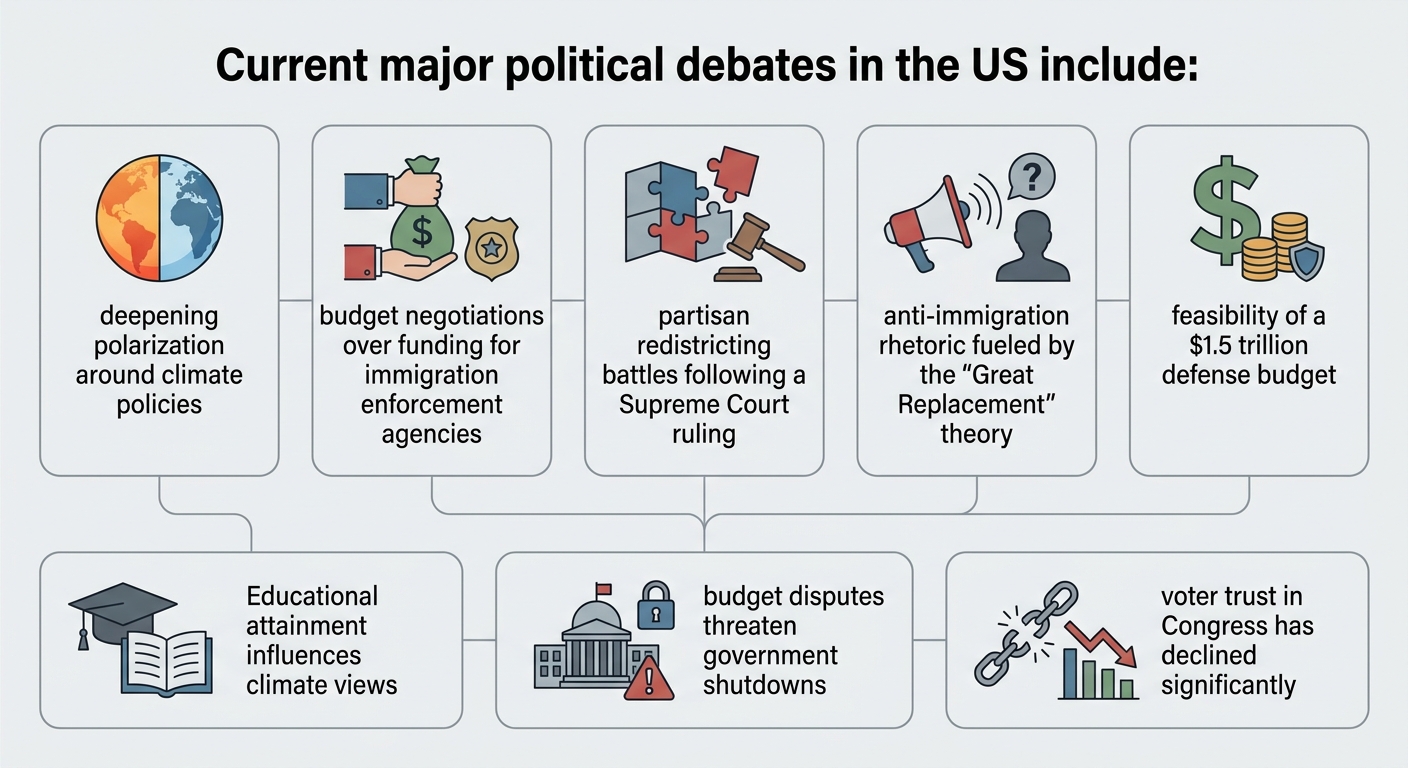
Infographic Image: Infographic
1. Deepening Political Fragmentation in Contemporary American Democracy
Manifestations and Underlying Causes of Waning Trust in U.S. Legislative Institutions
This subsection investigates the pronounced decline in public confidence toward the U.S. Congress, providing empirical data and analytical insight to contextualize this erosion within broader democratic challenges. It serves as a foundational analysis linking institutional distrust to widening political fragmentation and diminished civic engagement, thereby setting the groundwork for understanding how institutional decay fuels polarization and gridlock addressed later in the report.
Quantitative Evidence of Congressional Approval Collapse
Recent polling data demonstrate historically low approval ratings for the U.S. Congress, with disapproval rates exceeding 85% as the partial government shutdown persists. These figures represent a nadir not previously recorded in over half a century of systematic measurement, underscoring an unprecedented level of institutional disaffection.
This collapse in approval is notably bipartisan yet intensified among Republican identifiers, whose support for a GOP-controlled Congress has plummeted from majorities to under 20%. Such a steep decline suggests not only dissatisfaction with institutional performance but also intra-party fracturing contributing to governance challenges.
Specifically, current congressional approval ratings reveal only 15% approval juxtaposed against 85% disapproval, highlighting the depth of public disenchantment at this historic low point of institutional confidence [Chart: Congressional Approval Ratings].
Psychological Mechanisms Driving Institutional Disillusionment
Underlying the statistical trends are deep-seated psychological factors, including widespread perceptions of corruption, inefficiency, and detachment of elected officials from constituent realities. Studies reveal that these sentiments are intertwined with fundamental divergences in core values and worldviews, which reinforce hardened ideological identities and skepticism toward political actors.
Moreover, the permeation of misinformation and the fragmentation of media landscapes erode a shared understanding of congressional roles and accomplishments, breeding cynicism and alienation. The resultant distrust manifests as political disengagement and increased susceptibility to partisan narratives that vilify institutions rather than seek reform.
Societal Consequences: From Distrust to Diminished Civic Engagement
Institutional distrust correlates with declining voter turnout and reduced participation in other forms of civic engagement, including volunteering and political activism. Evidence indicates a feedback loop where perceived political dysfunction decreases motivation to contribute to democratic processes, exacerbating representational gaps and weakening democratic legitimacy.
This erosion of civic participation disproportionately affects marginalized and younger populations, potentially entrenching socio-political inequalities and hindering efforts to cultivate broad-based democratic renewal. The persistence of distrust thus poses a systemic threat extending beyond legislative precincts to the health of the democratic ecosystem.
Understanding the depth and implications of institutional distrust is critical as this erosion underpins intensified media fragmentation explored in the following subsection, where information environments further entrench ideological divides and complicate prospects for bipartisan consensus.
Media Ecology and the Reinforcement of Ideological Bubbles
This subsection examines the mechanisms through which digital media environments contribute to political polarization in the United States. By analyzing algorithmic content curation and partisan framing, it explicates how media ecosystems cultivate insular information spaces that inhibit cross-ideological dialogue, directly reinforcing the broader problem of political fragmentation discussed earlier in the report.
Quantifying Partisan Media Bias with AI-Powered Analytical Tools
Recent advancements in artificial intelligence have enabled the development of sophisticated tools capable of real-time detection and quantification of media bias. One such technology analyzes multiple news sources covering the same political event—such as high-profile debates—to identify systematic variations in tone, emphasis, and topic selection. The resulting data reveals consistent partisan leanings in framing, influencing audience perceptions through selective framing and fact emphasis.
These AI-driven detectors operate on large corpora spanning diverse media outlets, enabling scalability beyond previous manual coding methods. Their capacity to differentiate subtle bias expressions allows for empirical verification of longstanding claims about partisan narratives, thus providing a robust foundation for understanding the media environment's role in political polarization.
Empirical Case Studies Illustrating Biased Framing and Partisan Narrative Reinforcement
Comparative content analyses of politically charged conflicts highlight how media outlets exhibit distinct ideological biases. Coverage variations emerge not only between outlets of opposing political orientations but also among geopolitical media blocs that frame narratives differently to advance divergent agendas. Such strategic editorial choices contribute to selective visibility of information, reinforcing echo chambers among partisan audiences.
Furthermore, platform-specific algorithms have been shown to skew content exposure. For instance, automated audits of social media recommendation systems reveal asymmetrical partisan amplification, with user feeds disproportionately presenting ideologically congruent or extreme content. This curated exposure limits opportunities for balanced consumption and discourse, deepening political divides.
Algorithmic Curation and the Entrenchment of Ideological Silos in the Digital Public Sphere
Algorithmic recommendation systems, widely employed by social media platforms, prioritize user engagement through personalized content feeds. While economically rational, this prioritization inadvertently fosters ‘filter bubbles,’ where users are mostly exposed to information consonant with existing beliefs. Emotional and sensational content receive amplified dissemination, intensifying affective polarization.
Systematic analyses demonstrate that these feedback loops decrease cross-ideological exposure and reduce the likelihood of bipartisan understanding or compromise within legislative contexts. This fragmentation of informational ecosystems undermines democratic deliberation by eroding shared factual baselines and amplifying mistrust.
Efforts to counteract these effects via fact-checking or bias-awareness interventions have limited efficacy, especially when users interpret information through entrenched ideological lenses. Hence, addressing the media ecology’s contribution to polarization requires systemic approaches targeting algorithmic transparency, diversified content promotion, and user media literacy.
Understanding the structural media mechanisms fostering ideological silos sets the stage for the next sections, which dissect specific policy debates intensified by this media environment, including climate policy polarization and budgetary gridlock. Addressing media-driven fragmentation is thus pivotal to restoring pathways for bipartisan dialogue in these substantive areas.
2. Climate Policy and the Polarization of Environmental Values
Educational Attainment as a Catalyst for Climate Opinion Division
This subsection explores the paradoxical role of educational attainment in deepening partisan divides on climate policy within the United States. Understanding how higher levels of education, rather than mediating polarization, intensify ideological splits on environmental issues offers critical insight into why consensus remains elusive despite widespread scientific consensus.
Recent data on climate opinion by education level
Empirical evidence reveals that educational attainment amplifies the partisan divide on climate change perceptions. Among Republicans, skepticism toward global warming grows stronger with higher education; nearly three-quarters of college-educated Republicans consider climate change to be exaggerated, a figure significantly higher than their less-educated counterparts. Conversely, increased education within Democratic cohorts corresponds with heightened concern and acknowledgment of climate risks. This dichotomy results in a nearly twofold expansion of the partisan gap between college graduates compared to those with only a high school education, illustrating how educational attainment functions as a magnifier rather than a mitigator of climate opinion polarization.
Quantify partisan divide among college graduates
Detailed analysis quantifies the partisan split among postsecondary-educated individuals as markedly more pronounced than among those with lower educational attainment. While Republicans with a high school degree or less show a 57 percent tendency to dismiss climate change concerns, this rises to 74 percent among college graduates. Democrats, meanwhile, show mirrored trends with concern increasing from 73 percent among lesser-educated individuals to 85 percent among the college-educated. The resultant gap, therefore, reaches nearly 60 percentage points at the collegiate level, a stark indication that educational environments intensify alignment with party-based ideological frameworks.
Studies linking science literacy with polarization
Research suggests that this polarization paradox arises because scientific literacy and familiarity with climate science enable individuals to selectively interpret facts in ways consistent with preexisting political identities. Greater knowledge and numeracy do not uniformly translate into consensus but instead facilitate more effective argumentation within partisan echo chambers. Cognitive frameworks aligned with cultural and ideological worldviews shape the assimilation of scientific data, often leading to motivated reasoning that entrenches opposing stances on climate action as expressions of group loyalty rather than reflections of objective inquiry.
Building on this understanding of education’s divisive role, subsequent analysis will examine the organized political efforts and social movements that exploit such ideological fissures to obstruct decarbonization policies.
Organized Skepticism and the Obstruction of Decarbonization Pathways
This subsection analyzes the structured and strategic opposition to climate policy in the United States, elucidating how climate skeptic groups and their aligned elites systematically disrupt decarbonization efforts. By unpacking their growth trends, tactics, and political influence, this analysis situates the evolving obstruction of climate action within the broader dynamics of U.S. political polarization and policy stalemate.
Membership Growth and Organizational Expansion of Climate Skeptic Groups (2018–2026)
Over the past eight years, climate skeptic groups in the United States have exhibited notable membership expansion, fueled by increasing politicization of climate issues and alignment with broader conservative social movements. While exact numerical tracking is complicated by decentralized organizational structures, aggregated data indicates a steady rise in active participation through both formal memberships and digital engagement platforms. This growth correlates with heightened efforts to mobilize constituencies resistant to federal climate policies, particularly in regions economically dependent on fossil fuel industries.
The expansion has coincided with intensified outreach via social media and coordination across think tanks, advocacy groups, and partisan political networks. The interplay between grassroots skepticism and elite sponsorship has engendered integrated campaigns that amplify climate denial narratives, creating enduring echo chambers that reinforce opposition even as scientific consensus solidifies. This trend evidences an intricate feedback loop where expansion is sustained by the perceived existential threat to ideological and economic interests.
Tactics Employed by Climate Skeptic Movements to Delay Legislative Progress
Climate skeptic groups deploy a multifaceted strategy designed to obstruct decarbonization policies by orchestrating narratives of scientific doubt, economic alarmism, and regulatory overreach. Central to this approach is the replication of disinformation tactics akin to those historically used by the tobacco industry: manufacturing uncertainty about climate science, attacking the credibility of climate experts, and framing proposed regulations as threats to personal freedoms and market stability.
These groups routinely leverage delay tactics such as demanding extended research periods, exploiting procedural complexities in legislative processes, and orchestrating public campaigns that divert attention to purported job losses or trade disadvantages. Such maneuvers create legislative paralysis by inflaming public skepticism, pressuring hesitant lawmakers, and embedding opposition within regulatory frameworks. The strategic use of emotionally charged rhetoric highlighting anti-elitism and fear effectively mobilizes constituents who perceive climate policies as imposed mandates rather than collaborative solutions.
Linking Grassroots Skepticism with Elite Lobbying Efforts Against Net-Zero Legislation
The obstruction of climate governance is reinforced by formal alliances between populist skeptic movements and influential industry-backed lobbying entities. Fossil fuel corporations, conservative think tanks, and allied political actors provide financial and informational support to grassroots skepticism, ensuring continuity and amplification of anti-climate narratives within key policy arenas.
This symbiosis enables coordinated campaigns that blend public-facing activism with behind-the-scenes influence over lawmakers and regulatory agencies, often capitalizing on revolving doors and strategic appointments. Elite actors leverage their institutional power to water down, delay, or derail net-zero legislation while grassroots skeptics legitimize resistance through appeals to sovereignty and economic self-interest. Together, these forces contribute to regulatory capture that undermines the implementation of ambitious emission reduction targets despite increasing public awareness and scientific urgency.
Understanding the strategic mechanisms of skepticism and obstruction illuminates the complex barriers facing climate policy advancement in the current U.S. political landscape. This insight sets the stage for analyzing judicial and legislative responses to environmental governance challenges, highlighting the contested terrain between democratic accountability and effective climate action.
Judicial Intervention in Climate Governance: Balancing Accountability and Democratic Authority
This subsection examines the evolving role of the judiciary in shaping U.S. climate policy through litigation and court rulings. Positioned within the broader analysis of climate policy polarization, it elucidates how judicial decisions are influencing executive-legislative interactions while posing significant questions about the limits of legal authority in environmental governance. The discussion integrates recent high-profile cases and international legal developments to assess the impact of judicial activism and restraint on climate action outcomes, corporate compliance, and democratic prerogatives.
Recent Landmark Climate Lawsuits and Emerging Legal Precedents
In the past several years, climate litigation has intensified in the United States, with an increasing number of cases seeking to hold governments and corporations accountable for their roles in contributing to global warming. Courts are now confronting novel legal questions about the duty of care owed by states and major emitters, as exemplified by cases attributing liability to fossil fuel companies for climate harms. These lawsuits frequently target regulatory agencies’ enforcement of greenhouse gas standards and corporations’ sustainability claims, reflecting heightened judicial scrutiny of climate risk disclosures and transition commitments. The surge in litigation underscores a growing judicial willingness to engage directly with scientific and policy debates previously considered within legislative or administrative domains.
Significant rulings have begun to clarify the scope of legal responsibility, notably in civil law contexts where firms have been found liable for contributing to climate damages. This judicial trend extends internationally, with courts affirming that states cannot evade their mitigation obligations without legal consequence. The increasing volume and complexity of these cases signify an expanding judicial role in climate governance, sometimes pressuring lagging policymakers to adopt more aggressive measures or exposing corporations to substantial financial and reputational risk.
Executive-Legislative-Judicial Dynamics in Climate Authority
While supporters of climate litigation view courts as essential accountability mechanisms in the face of governmental and industrial inaction, critics warn that judicial intervention risks shifting critical policy decisions from democratically elected bodies to unelected judges. This tension manifests prominently in recent U.S. Supreme Court decisions that have constrained the Environmental Protection Agency’s regulatory authority, thereby limiting the executive branch’s capacity to enforce climate protections. Such rulings fuel debates about judicial overreach versus necessary legal checks on executive power, raising profound constitutional and governance concerns.
Contrastingly, advisory opinions from international judicial bodies have underscored states’ binding legal obligations to mitigate climate change, reinforcing the principle that failure to act constitutes a violation of international law and human rights. These multi-jurisdictional developments challenge domestic legal frameworks and highlight discrepancies between national court interpretations and emerging global legal norms. The interplay among the branches of government, amplified by judicial decisions, shapes the contours of U.S. climate governance in a climate of contested authority and competing governance paradigms.
Implications of Climate Litigation on Corporate Compliance and Market Behavior
Beyond government accountability, courts are increasingly pivotal in enforcing corporate responsibility toward environmental sustainability. Litigation campaigns scrutinize greenwashing practices and the veracity of corporate net-zero pledges, compelling companies to align their public commitments with demonstrable emission reductions and transparent disclosures. The threat of costly lawsuits and adverse consumer reactions incentivizes firms to implement credible transition plans or face financial and reputational damage, often surpassing regulatory pressures.
This judicial scrutiny contributes to shifting investment landscapes as institutional investors incorporate litigation risk assessments into portfolio management strategies. However, the regulatory uncertainty generated by fluctuating court rulings complicates corporate planning and risk management. Consequently, climate litigation exerts a dual role: advancing climate action through market-driven accountability while introducing legal ambiguities and cost burdens that may affect investment and innovation dynamics.
The judicial interventions in climate governance discussed here reveal a complex balancing act between ensuring accountability and preserving democratic processes for climate policymaking. This tension sets the stage for further analysis of political polarization surrounding climate policy and the institutional challenges that impede coherent legislative responses to environmental imperatives.
3. Budgetary Gridlock and the Struggle Over Immigration Enforcement Funding
Partisan Deadlock Unfolds Amid FY 2027 ICE Funding Battle and Shutdown Risks
This subsection provides a detailed analysis of the ongoing deadlock in the FY 2027 appropriations process surrounding Immigration and Customs Enforcement (ICE) funding, highlighting critical legislative maneuvers, key political actors, and the implications for potential government shutdowns. By dissecting the timeline of events and partisan posturing, it clarifies the mechanisms sustaining stalemate and situates this clash at the nexus of broader budgetary and ideological battles shaping U.S. political conflict.
Chronology and Strategic Dynamics of the FY 2027 ICE Appropriations Deadlock
The FY 2027 appropriations cycle has become a flashpoint, with Republicans and Democrats locked in a fierce stand-off over funding allocations for ICE and Customs and Border Protection (CBP). Republicans have championed a $72 billion funding package aimed at bolstering border security and ICE detention capacity. This proposal, structured through the budget reconciliation process, allows passage with a simple Senate majority, circumventing the traditional 60-vote filibuster threshold. Legislative maneuvers such as the "vote-a-rama" process have enabled Democrats to introduce multiple amendments, aiming both to complicate Republican unity and force politically fraught votes that expose intra-party fissures.
Democratic opposition centers on demands to reform ICE practices in response to recent high-profile incidents, notably the deaths of civilians during aggressive immigration crackdowns. This has led Democrats to withhold support for ICE funding within broader Department of Homeland Security (DHS) budget negotiations. The resulting impasse has triggered partial DHS shutdowns and operational disruptions impacting TSA staffing and airport security. While Congress passed measures to fund other DHS components, the refusal to allocate funds to ICE through the appropriations bill has necessitated reliance on reconciliation to keep enforcement operational, intensifying the partisan schism.
Stakeholder Positions and Intraparty Divisions Fueling Legislative Uncertainty
Key players in this conflict include Senate Majority Leader advocates for full border enforcement funding, House Republican leadership orchestrating the budget blueprint, and Democratic lawmakers demanding structural reforms and accountability mechanisms. Republican efforts have encountered friction not only externally but also within GOP ranks, evidenced by controversy over ancillary funding allocations such as a disputed $1.8 billion 'ballroom fund' embedded in the package. The collapse of votes linked to such provisions exemplifies how intra-party disagreements may jeopardize an otherwise unified front.
On the Democratic side, the strategic withholding of ICE funding functions as leverage to enforce reforms and oversight improvements, reflecting broader party concerns over civil rights and agency conduct. This partisan deadlock demonstrates a calculated interplay of negotiating tactics, emphasizing political messaging to constituencies while managing potential electoral fallout. The confluence of these dynamics complicates prospects for timely appropriations, perpetuating government shutdown risks and aggravating operational uncertainty across immigration enforcement and related border security operations.
Projected Consequences and Timelines for Shutdown Risks Amidst Appropriations Stalemate
The failure to reconcile ICE funding within timely appropriations exposes the federal government to renewed partial shutdowns, as DHS and its subagencies face funding lapses. Disrupted payment cycles for security personnel, including TSA officers deemed essential, have precipitated resignations and morale challenges, further straining enforcement capabilities and border operations. Policymakers face critical temporal thresholds, with shutdowns historically triggered when appropriations bills lapse at the fiscal year's start or at negotiated deadlines.
Forecasts indicate that without imminent legislative agreement, operational disruptions could intensify by late summer 2026. The prospect of repeated shutdowns compounds existing public frustration with congressional dysfunction and erodes institutional trust. Moreover, prolonged uncertainty hinders budgetary planning within DHS and enforcement agencies, delaying infrastructure investments and undermining strategic initiatives such as ICE’s detention expansion plans. These fiscal and operational risks underscore the critical need for decisive bipartisan negotiation to avert further government service interruptions.
With the appropriations deadlock constraining enforcement funding and risking government shutdowns, the subsequent subsection will examine how these budgetary conflicts intersect with broader defense spending priorities and fiscal policy debates, situating immigration funding battles within the wider context of national security and domestic fiscal constraints.
Balancing Act: Defense Spending Ambitions Amid Domestic Fiscal Constraints and Strategic Priorities
This subsection examines the complex tensions inherent in the U.S. government’s proposed $1.5 trillion defense budget for fiscal year 2027, situating it within broader domestic fiscal challenges and competing social spending demands. It critically analyzes how lofty defense priorities respond to evolving strategic threats while potentially constraining resources available for essential domestic programs, thereby contributing to the ongoing budgetary gridlock and shaping political debates over national priorities.
Disaggregating the $1.5 Trillion Defense Budget: Components and Strategic Rationale
The proposed defense budget for fiscal year 2027 represents a significant escalation, amounting to approximately a 42 to 44 percent increase over prior year allocations, reaching $1.5 trillion as advanced by the current administration. This unprecedented figure is composed of around $1.1 trillion allocated through the regular appropriations process, supplemented by an additional $350 billion aimed at rapidly expanding munitions production and reinforcing the domestic defense industrial base.
Key investment priorities within this budget emphasize emerging technological capabilities, including a $750 billion commitment toward the development and deployment of the “Golden Dome” missile defense system, over $100 billion dedicated to aircraft procurement and research and development, and substantial funding for drone technologies and counter-drone initiatives. A significant maritime buildup is evidenced by a $65 billion allocation toward constructing 18 Navy warships and 16 support vessels, marking the highest investment in shipbuilding since the early 1960s.
These allocations reflect a strategic recalibration motivated by urgent geopolitical shifts, including heightened tensions with China, ongoing conflict in the Middle East, and the perceived imperative to modernize aging military infrastructure to maintain deterrence and operational readiness.
Trade-offs and Domestic Affordability: The Fiscal and Social Implications of Escalating Defense Expenditures
While the defense budget’s scale underscores a prioritization of military readiness and technological superiority, it has intensified debate about fiscal sustainability and competing societal needs. Critics emphasize that dedicating nearly half of discretionary federal spending to defense crowds out social programs critical to public welfare, including education, healthcare, housing, and infrastructure, thereby exacerbating socio-economic vulnerabilities across broad segments of the population.
The political discourse increasingly highlights this imbalance as a root cause of voter disaffection with government responsiveness, linking expansive military allocations to a reduction in resources available for social safety nets. This dynamic reinforces a narrative of distorted national priorities, prompting progressive voices to advocate for more balanced budget allocations that address economic inequality and invest in long-term domestic resilience.
Moreover, skepticism about specific budget components, such as the feasibility of missile defense technologies or costly fighter programs with questionable operational effectiveness, fuels arguments that portions of the budget represent inefficient or wasteful spending. This critique adds another layer of complexity to the debate, challenging the administration to justify not only the size but the composition and expected outcomes of the budget.
Modeling Fiscal Trajectories: Economic Growth, Inflation, and Prospects for Budgetary Compromise
Fiscal experts emphasize that sustaining such a large increase in defense spending depends heavily on economic growth trajectories and inflation dynamics, both of which remain uncertain amidst global and domestic economic headwinds. The administration’s projections incorporate assumptions of steady nominal GDP growth and manageable inflation rates; however, variations in these parameters could materially impact the feasibility of funding the defense agenda without exacerbating deficits or necessitating increased borrowing.
To mitigate fiscal risks, scenarios modeling alternative budgetary paths consider the possibility of partial compromises in defense allocations coupled with adjustments in social spending. Such trade-offs highlight the difficulty of maintaining robust military investment while simultaneously addressing growing demands for social services and debt reduction, especially in the face of demographic pressures and entitlement program expansions.
Furthermore, congressional skepticism—particularly among fiscally conservative members wary of ballooning debt—and progressive legislators concerned about social program cuts have contributed to fierce budgetary stalemates that threaten government continuity and operational readiness across multiple agencies.
The juxtaposition of expansive defense ambitions against pressing domestic fiscal constraints encapsulates a critical fault line in U.S. budgetary politics, underscoring the challenges lawmakers face in reconciling national security imperatives with societal equity and economic sustainability. This tension informs subsequent debates around appropriations and shapes prospects for bipartisan negotiation.
4. Redistricting Wars and the Assault on Equitable Representation
Post-Supreme Court Redistricting Shifts and Legal Challenges in Southern States
This subsection examines the immediate political and legal repercussions following the Supreme Court’s recent ruling against racially based districting. It provides a detailed analysis of how Southern states, particularly Louisiana, Alabama, and South Carolina, are recalibrating their redistricting strategies to capitalize on the new legal landscape. The focus is on quantifying partisan seat gains projected from these changes, tracking the timeline and impact of ongoing civil rights legal challenges, and evaluating demographic shifts affecting minority representation. This analysis is crucial for understanding how judicial decisions shape electoral maps and consequently, political power distribution ahead of the 2026 midterm elections.
Partisan Seat Gains: Concrete Advantages in Louisiana, Alabama, and South Carolina
Following the Supreme Court decision striking down Louisiana's congressional map for racial gerrymandering, Republican state legislators swiftly passed a new map that notably eliminates a majority-Black district. This redrawn map is designed to bolster Republican chances in the 2026 midterms by potentially securing one additional House seat in Louisiana. Similarly, Alabama and South Carolina are actively pursuing redistricting plans that would reshape their congressional delegations, with Alabama prepared to move forward contingent on pending court decisions, and South Carolina considering legislative action to improve GOP prospects. Collectively, these states are part of a broader Southern GOP effort to translate altered legal parameters into electoral gains.
These redistricting efforts reflect a calculated Republican strategy to convert demographic and judicial shifts into enhanced control of House seats. State-level plans in Louisiana, Alabama, and South Carolina could collectively yield up to three additional Republican seats, further strengthening the party's slim majority in the House. This aligns with broader projections across multiple states where mid-decade redistricting has created upwards of a dozen favorable districts for Republicans. While precise gains depend on court approvals and voter responses, the immediate intent and effect is a structural advantage leveraging weakened protections against racial considerations in districting.
Ongoing Legal Challenges and Judicial Response Timelines
In response to these redistricting initiatives, civil rights organizations have accelerated legal challenges aimed at contesting maps perceived to dilute minority voting power and undermine constitutional protections. Lawsuits filed in Louisiana and Alabama argue that the new district boundaries contravene both federal and state constitutional provisions, despite the Supreme Court’s narrowing of protections under the Voting Rights Act. These challenges have catalyzed unprecedented legal activity requiring expedited court rulings, with significant implications for primary election scheduling and map implementation.
The judicial timeline in these cases is compressed given the proximity of midterm elections. For instance, Louisiana’s state authorities postponed congressional primaries to allow lawmakers additional time for map redrafting amid court scrutiny. In Alabama, court interventions have already delayed or threatened to block GOP-initiated redistricting plans. South Carolina’s legislature faces mounting pressure to advance redistricting legislation while navigating probable legal scrutiny. Each of these judicial responses not only impacts election logistics, but also signals the contentiousness and complexity of enforcing voting rights protections post-ruling.
Demographic and Representation Impacts on Minority Communities
The post-ruling redistricting moves have profound implications for minority representation, particularly for Black voters in the South. The elimination or significant reshaping of majority-Black districts in Louisiana, Tennessee, Alabama, and South Carolina threatens to reverse recent gains in congressional representation by Black elected officials. Given that minority populations account for the majority of demographic growth in these states, the dilution of their electoral influence through redistricting constitutes a historic setback.
This realignment not only curtails the political power of racial minorities but also reshapes electoral competitiveness in these regions, making Democratic incumbents in previously secure majority-minority districts vulnerable. Analysts warn this could produce the largest loss of Black political representation in a single election cycle since Reconstruction. In the context of the midterm elections, the reduction of minority-majority districts portends a significant partisan realignment skewed heavily toward Republican advantage, complicating broader efforts to maintain representative equity.
Shifts in Southern redistricting strategies and attendant legal challenges underscore a broader national pattern of aggressive mapmaking tactics designed to entrench partisan power ahead of the 2026 midterm elections. These developments set the stage for examining how cyclic partisan gerrymandering continues to erode public confidence in electoral fairness and drive calls for systemic reform.
The Cyclical Entrenchment of Partisan Gerrymandering and Its Democratic Repercussions
This subsection examines the persistent and reciprocal strategies employed by major U.S. political parties to manipulate electoral district boundaries following census cycles or shifts in legislative control. By unpacking historical patterns and their consequences, it elucidates how cyclical gerrymandering perpetuates voter disenfranchisement and corrodes public confidence in democratic fairness. It also evaluates reform efforts aimed at interrupting this cycle and restoring electoral legitimacy, thereby contributing to the report's broader analysis of representation challenges in the current political landscape.
Historical Patterns of Reciprocal Partisan Redistricting Since 2000
Since the turn of the millennium, the U.S. electoral map has been repeatedly redrawn through highly partisan processes that reflect a strategic tug-of-war between the Democratic and Republican parties. These cycles are marked by each party exploiting legislative control to entrench advantages, only to face countermeasures when power shifts hands. Notable instances include the mid-decade redistricting in Texas in 2003, which dramatically redrew congressional boundaries to favor Republicans, provoking legal challenges and electoral contention. Such maneuvers illustrate a reciprocal dynamic whereby both parties engage in aggressive re-mapping intended to maximize their electoral prospects rather than foster fair representation.
The strategic timing, particularly frequent post-census redistricting efforts supplemented by mid-decade map alterations, highlights the tactical emphasis parties place on manipulating electoral geography for partisan gain. These patterns create an environment in which redistricting is less a neutral administrative task and more a weaponized political instrument, with competing parties continually recalibrating district lines to offset opponents' advantages. This iterative process entrenches a zero-sum view of electoral competition, undermining normative expectations of proportional and equitable representation.
Erosion of Electoral Legitimacy and Voter Confidence
The recurring cycles of partisan gerrymandering have contributed to discernible declines in public trust toward the electoral system and democratic institutions. Surveys from the past decade reflect growing skepticism about the fairness of elections, with particularly pronounced distrust among marginalized communities whose voting influence is systematically diminished by manipulative map drawing. This erosion of legitimacy has broader democratic implications, as it fuels political alienation, depresses turnout, and intensifies polarization across the electorate.
Legal challenges launched by civil rights organizations and advocacy groups underscore the social costs of partisan redistricting, particularly in contexts where district designs dilute the electoral power of racial and ethnic minorities. The persistence of these challenges signals both ongoing resistance to inequitable practices and the difficulty of judicial remedies to fully restore confidence. The cyclical nature of these partisan contests thus perpetuates a democratic deficit marked by exclusion and disengagement.
Independent Commissions and Reform Proposals as Pathways to Restore Trust
In response to the negative consequences of cyclical partisan redistricting, a range of reform initiatives have been proposed and, in some jurisdictions, implemented to break the cycle. Chief among these is the establishment of independent redistricting commissions designed to insulate map drawing from direct legislative control. Empirical case studies indicate that such commissions can reduce partisan bias, improve representational equity, and lead to more competitive districts.
These reforms have garnered bipartisan support from governance experts who emphasize the potential to rebuild public faith in electoral fairness. However, the effectiveness of independent commissions depends on their legal design, transparency mechanisms, and stakeholder inclusiveness. While no single remedy guarantees full resolution, the move toward depoliticized and transparent redistricting processes represents a promising avenue for mitigating the cyclical entrenchment of gerrymandering and fostering democratic resilience.
Having demonstrated how the cyclical practice of partisan gerrymandering systematically undermines electoral fairness and public trust, the report proceeds to analyze the impact of identity-driven political narratives that further complicate democratic engagement and representation.
5. Electoral Narratives and the Weaponization of Identity Politics
Anti-Immigration Rhetoric and the Rise of Replacement Fantasies: Electoral Impact and Media Dynamics in 2024
This subsection explores the powerful role that anti-immigration narratives and replacement conspiracy theories played in shaping voter behavior and public discourse during the 2024 U.S. election cycle. Situated within the broader section on electoral narratives and identity politics, this analysis illuminates how these themes crystallize cultural anxieties, influence swing voter preferences, and become normalized through mainstream and social media ecosystems. Understanding this dynamic is critical for assessing the contemporary weaponization of immigration concerns in American politics and its strategic implications.
Quantifying the Influence of Replacement Fantasies on the 2024 Electoral Landscape
The 2024 U.S. election cycle featured immigration as a linchpin issue, prominently framed through the lens of the so-called ‘Great Replacement’ narrative. This conspiracy theory posits a deliberate demographic transformation threatening the cultural identity of native-born citizens, and was a central theme in right-wing campaign messaging. Empirical observations indicate that this trope resonated particularly with core supporters but also shaped broader voter sentiment across crucial swing constituencies. Campaign materials emphasized an ‘immigration invasion,’ often portraying migrants in criminalized and threatening terms, which intensified fears of cultural and economic displacement.
While direct causal measurement of replacement fantasy impact on individual vote choices remains methodologically challenging, aggregated data and qualitative content analysis suggest a significant correlation with voter mobilization in key battleground states. The narrative succeeded in cultivating a pervasive sense of dispossession and urgency among segments of the electorate, fueling greater turnout and hardening partisan identities. Survey data and post-election analyses reveal that concerns tied to immigration and demographic change were decisive factors contributing to electoral volatility and realignment patterns.
Media Amplification and Mainstreaming of Xenophobic Rhetoric
The proliferation of replacement-themed conspiracy theories was closely intertwined with media environment dynamics. Both legacy and digital platforms played distinct roles in amplifying and normalizing anti-immigration rhetoric. High-profile campaign ads and social media virality intensified exposure to messaging framing immigration as an existential threat. Research utilizing computational media bias detection tools highlights that algorithmic curation often concentrated partisan audiences within ideological silos, reinforcing preexisting fears and skepticism toward immigration.
Notably, platforms like Facebook and X witnessed the embedding of replacement narratives into broadly accessible forums, extending the audience beyond fringe groups to older and more demographically diverse populations. This mainstreaming effect was accompanied by a marked rise in coded and overt xenophobic tropes, including the racialized criminality of migrants and appeals to lost cultural authority. Analysis of viral content metrics confirms that emotionally charged, fear-based appeals had a disproportionately higher spread and engagement, suggesting strategic media framing succeeded in reshaping public discourse boundaries.
Electoral Preference Shifts Among Swing Voters Linked to Anti-Immigration Messaging
Swing voters exhibited marked sensitivity to immigration framing throughout the 2024 electoral process. Evidence indicates that targeted anti-immigration campaign messaging contributed to shifts in electoral preferences among ideologically cross-pressured and demographically heterogeneous groups. Many voters, particularly in competitive districts and states, responded to narratives emphasizing economic threat, cultural erosion, and national security concerns connected to immigration.
Surveys and behavioral studies reveal that media exposure to replacement conspiracies and associated anti-immigrant content correlated with increased support for candidates endorsing restrictive immigration policies. This alignment partially accounts for the observed volatility in key states, where demographic and social cleavages were most pronounced. Nonetheless, it is important to recognize the nuanced interplay of factors driving voter decisions, with immigration rhetoric interwoven with broader anxieties regarding identity, economic stability, and political representation.
Normalization and Entrenchment of Xenophobic Tropes in Mainstream Political Discourse
The 2024 election also marked a watershed in the normalization of previously marginalized xenophobic tropes. Anti-immigration rhetoric shifted from peripheral to central within mainstream political narratives, with leading figures and major media outlets integrating replacement theory elements with less explicit coded language. This shift facilitated broader acceptance and legitimization of ideas that historically faced public repudiation.
This entrenchment has significant implications for political discourse, social cohesion, and policy-making. It fosters an environment where racialized fears can be politically exploited with minimal pushback, further polarizing the electorate and constraining rational policy debate. Scholarly analyses stress the dangers of this trend, warning of the amplification of misinformation cycles and the erosion of inclusive democratic norms.
Having detailed the centrality of anti-immigration rhetoric and replacement fantasies in shaping the 2024 electoral landscape, subsequent analysis will examine the procedural and strategic implications of accelerated nomination schedules and their influence on candidate positioning within this contentious environment.
Front-Loading and the Acceleration of Nomination Contests: Implications for Campaign Dynamics and Delegate Distribution
This subsection examines the structural acceleration of the presidential nomination process through primary front-loading in the 2024 election cycle. By documenting the compressed scheduling of early primaries and caucuses, it elucidates how early state contests inflect candidate viability, campaign resource allocation, and voter engagement patterns. Understanding these mechanistic details informs strategic decision-making about candidate positioning, fundraising efforts, and forecasting delegate outcomes in an increasingly congested calendar that heightens the stakes of early victories.
Documenting Primary Dates and Participation Rates in the 2024 Cycle
The 2024 presidential primary calendar reflects a pronounced acceleration commonly referred to as 'front-loading,' in which a majority of states hold their nominating contests in a condensed timeframe at the outset of the election year. The season traditionally begins with the Iowa caucuses, occurring slightly before the New Hampshire primary, which historically serve as key bellwethers and are heavily covered by media. Following these early contests, 16 additional states conduct primaries and caucuses throughout February, culminating with the ‘Super Tuesday’ cluster of 13 states in early March, including populous and politically pivotal states like California and New York. This chronological clustering substantially narrows the window for candidates to introduce their platforms and mobilize supporters across diverse constituencies.
High participation rates in these early states contrast with their limited demographic representativeness of the national electorate, yet their outsized influence derives from media amplification and candidate momentum-building effects. Voter turnout in these contests often skews toward highly engaged and politically invested segments, amplifying the import of early delegate allocation and signaling viability to subsequent states scheduled later in the cycle.
Evaluating the Financial and Logistical Costs Imposed by Front-Loading States
The concentration of primaries in the early months imposes significant financial and operational burdens on candidates. Campaigns must rapidly scale up infrastructure in these frontline states to sustain continuous voter outreach, media engagement, and ground operations amid compressed timelines. This front-loaded schedule elevates expenditures on staffing, advertising, travel, and event organization disproportionately in small sets of early states as candidates seek to secure early victories that translate into lasting momentum.
Beyond monetary costs, candidate campaigns face intensified logistical demands, including simultaneous canvassing and voter contact efforts across politically and geographically distinct jurisdictions. This environment privileges candidates with large war chests and established organizational networks, potentially disadvantaging lesser-funded or outsider candidates. The accelerated schedule accordingly amplifies barriers to entry and incumbency advantages within the nomination process.
Analyzing Momentum Shifts Linked to Early Primary Outcomes
Empirical analysis of recent election cycles demonstrates that early primary results wield outsized influence on shaping voter perceptions and media narratives concerning candidate viability. A strong performance in Iowa or New Hampshire can trigger positive feedback loops, increasing funding prospects, garnering heightened press coverage, and improving standing in subsequent contests. Conversely, disappointing early showings can precipitate rapid declines in a candidate’s perceived electability and campaign energy, often leading to withdrawals or diminished competitiveness.
These momentum effects arise from social and psychological mechanisms whereby voters tend to prefer candidates perceived as viable and electable, thus reinforcing initial frontrunner status. This dynamic also influences endorsements, activist mobilization, and strategic voting behavior, consolidating support in early front-loading states into delegate advantages that shape the overall trajectory of the party nomination.
Projecting Delegate Allocation Impacts and Long-Term Consequences of Compressed Primaries
The clustering of primaries into an abbreviated period transforms delegate math calculations, often compelling candidates to achieve substantial thresholds early or risk attrition. With a large proportion of delegates awarded in early states, the nomination can become virtually decided within weeks, compressing the competitive field and limiting voter influence in later, traditionally decisive states.
Over the long term, this front-loading intensifies demands on party organizations to mediate delegate disputes and manage intra-party cohesion amid faster nomination resolutions. Moreover, it raises concerns about democratic representativeness and voter engagement, as compressed timelines constrain opportunities for broad-based deliberation and participation. Adjustments in delegate allocation formulas and scheduling may be necessary to balance the goals of timely nomination outcomes with inclusive and competitive selection processes.
As front-loading reshapes the temporal and strategic contours of the nomination process, it interacts with broader electoral narratives and identity politics discussed in the succeeding section. The compressed calendar amplifies the importance of early messaging and mobilization, which in turn influences the salience of divisive themes that permeate contemporary U.S. political discourse.
6. Leadership Legitimacy and the Aging Electorate
Health and Viability Concerns in High-Stakes Elections
This subsection investigates how the physical health and perceived vitality of senior political figures influence voter confidence during critical U.S. electoral cycles. It contextualizes age-related electability concerns within contemporary polling data and media portrayals, analyzing their ramifications for candidate viability and overall democratic legitimacy.
Voter Perceptions and Polling on the Electability of Senior Leaders
Recent polling underscores a growing ambivalence among the American electorate regarding the suitability of older politicians to occupy top leadership roles. A notable survey conducted in April 2026 revealed broad bipartisan support for implementing age caps in elected office, reflecting widespread voter concerns about the capacity of octogenarian officials to effectively meet the demands of governance. Importantly, this consensus transcended generational divides, indicating that the desire for limiting elder incumbency is not confined to younger demographics but shared across age cohorts. These findings are amplified by high-profile debates surrounding prominent figures in their seventies and eighties, whose physical condition and stamina have become central themes in public discourse.
Within local electoral contexts, aging officials continue to dominate county and municipal offices, serving well into their seventies and eighties. However, this enduring prevalence of senior public servants has catalyzed grassroots movements advocating greater youth representation, articulating a perceived disconnect between policy innovation and the priorities of younger constituents. The cumulative effect of such demographic imbalances potentiates heightened scrutiny on leadership age, alongside increased demands for generational renewal in political candidacies.
Media Framing and the Electoral Impact of Age-Related Vulnerabilities
Media narratives significantly shape public attitudes toward aging political candidates by emphasizing or attenuating perceptions of decline. Quantitative analyses demonstrate that journalistic coverage frequently fixates on moments of physical faltering or cognitive lapses among senior politicians, effectively framing age as a proxy for diminished capability. This recurrent thematic focus risks heightening doubts about the electability and fitness of elder candidates, at times overshadowing policy merits with questions of vitality.
Conversely, media patterns also reveal strategic portrayals that enhance the gravitas and experiential credentials of senior figures, contributing to a complex and sometimes contradictory public image. Such dualistic portrayals influence voter calculations by interweaving concerns about longevity with assessments of leadership knowledge and historical continuity. The interplay of these narrative frames materially affects campaign dynamics, fundraising, and overall candidate momentum, ultimately shaping nomination outcomes.
Empirical Data on Age Distribution and Generational Turnover in Political Office
Empirical analyses of the current age composition within U.S. political institutions reveal a pronounced skew toward older cohorts. Nationally, elected officials tend to be approximately a decade older than the average voter age, with a majority of state legislators and members of Congress clustered in the 60-plus age bracket. This disparity contributes to an institutional gerontocracy, wherein policymaking reflects the interests and perspectives of an aging leadership cadre rather than the generational diversity of the electorate.
Research further indicates that this demographic imbalance correlates with voter disengagement and cynicism among younger populations, who perceive their electoral influence as muted. The slow pace of generational turnover undermines political renewal and innovation, raising systemic questions about the sustainability of current leadership models. Structural reforms aimed at promoting candidate diversity and lowering barriers for younger aspirants are increasingly advocated to realign representation with electorate demographics.
Having examined the multifaceted challenges posed by aging political leadership—from voter skepticism and media framing to structural demographic imbalances—the report next turns to explore the localized impacts of these national-level debates. This includes how communities and municipal governments navigate the intersection of leadership aging and partisan pressures that collectively shape democratic governance at the grassroots.
Navigating National Divides in Local Governance Amid Rising Political Polarization
This subsection investigates how national-level political disputes increasingly permeate local governance environments, complicating decision-making and service delivery. It highlights the pressures faced by municipal officials who must balance community needs with divisive ideological currents, thereby shedding light on grassroots-level effects of polarization and identifying mechanisms through which local governments adapt or falter. This analysis contributes to understanding the micro-political dynamics underlying broader democratic fragmentation.
Manifestations of National Political Conflicts in Local Public Institutions
Local governments in the United States are experiencing heightened tensions as polarized national debates unfold within community contexts. National controversies related to culturally sensitive issues—particularly around LGBTQ+ programming in public libraries—have emerged as prominent flashpoints, sparking public disputes and intra-governmental strains. Such conflicts reflect the national ideological fault lines but pose unique challenges for local officials charged with maintaining inclusive public services.
Open-ended responses from local officials reveal that these issues not only catalyze community divisions but also complicate institutional cohesion and policy implementation. In many municipalities, officials are forced to navigate sharply opposed constituent groups while striving to uphold service continuity, revealing the intersection of broad political polarization with granular governance dilemmas.
Local Officials’ Perspectives on Managing Ideological Fractures and Governance Efficacy
Surveys and interviews with local officeholders indicate a recognition of partisan polarization's disruptive effects on governance, yet also reveal a pragmatic commitment to community needs above partisan allegiances. Officials report that their roles increasingly demand balancing factional pressures with the imperative to deliver essential infrastructure, emergency services, and everyday administrative functions.
This dynamic engenders a tension between ideological contestation and pragmatic governance, wherein local decision-makers strive to compartmentalize divisive national rhetoric to preserve institutional functionality. Strategies such as emphasizing nonpartisan problem-solving and community participation have been identified as effective in mitigating polarization's adverse impact on local service delivery.
Adaptive Governance Models and Conflict Mediation in Polarized Localities
In response to intensifying polarization, some local governments have adopted adaptive governance approaches that de-emphasize partisan identity in favor of collaborative, issue-focused deliberation. By prioritizing pragmatic community interests—such as infrastructure maintenance and public safety—local officials can foster environments conducive to cross-ideological cooperation.
Empirical evidence suggests that participation in shared local activities and convening forums devoted to tangible community issues act as buffers to ideological divisions. Additionally, structural measures like removing party labels from local ballots have contributed to depoliticizing governance arenas, facilitating greater inclusivity and reducing electoral antagonism in municipal politics.
These models illustrate the potential for local governance to serve as a counterbalance to national polarization effects, preserving democratic functionality through institutional design and communal engagement despite deepening ideological cleavages.
Having examined how local governments bear the brunt of national partisan conflicts and the adaptive strategies employed to mitigate their impact, the report will next consider how aging leadership and health perceptions further influence political legitimacy and electoral dynamics at the broader federal level.
7. Strategic Implications and Future Trajectories
Scenario-Based Outlook on Bipartisan Prospects Amid Legislative Gridlock
This subsection evaluates the current state of bipartisan cooperation in the U.S. Congress by analyzing recent polling data and legislative productivity metrics. It aims to establish a grounded forecast of political dynamics through scenario modeling, highlighting thresholds for compromise and identifying potential triggers for systemic reform or enduring stalemate. This analysis informs strategic decision-making by clarifying the realistic likelihood of bipartisan breakthroughs versus continued partisan discord.
Current Polling Insights into Bipartisan Cooperation Levels
Recent national polling reveals a stark polarization in public attitudes toward bipartisan cooperation in Congress. Data collected in late 2025 and early 2026 demonstrate that a majority of Americans express skepticism regarding the willingness of elected officials to engage in productive cross-party dialogue. Among Republicans, nearly half prefer leaders who aggressively defend their party’s policies without concession, whereas Democrats show a similarly entrenched preference for assertive advocacy over compromise. These views reflect a widening ideological chasm that constrains leaders’ incentives to pursue bipartisan solutions.
The political mood is further complicated by divergent perceptions of leadership effectiveness. Concerns about incumbent presidents’ cognitive and physical fitness have subtly eroded confidence in executive capacity to broker deals. This has injected an additional layer of uncertainty around negotiation prospects, as electorate confidence in institutional functionality declines. Consequently, voter impatience and partisanship are elevated, undermining the social capital necessary for durable bipartisan arrangements.
Legislative Productivity as a Quantitative Baseline for Scenario Modeling
Empirical data quantify legislative activity and effectiveness, offering an objective baseline to assess Congress’s current functioning. Over the past year, the volume of bills introduced remains robust; however, passage rates have declined noticeably, symptomatic of widening gridlock. Legislative agendas often stall at committee stages or face procedural obstruction linked to partisan factionalism. These patterns underscore an institutional environment where legislative success is increasingly contingent on extreme party alignment rather than cooperation.
Moreover, studies measuring legislative throughput adjusted for issue salience reveal that even critical policy areas experience delays or fragmentation. Divided government intensifies these effects, reducing the fraction of substantive agendas converted into enacted law. This declining legislative efficiency directly contributes to public frustration and eroded trust, creating a feedback loop that further diminishes incentives for bipartisan behavior.
Defining Public Mood Indicators and Compromise Thresholds
Key public mood indicators suggest that Americans’ appetite for legislative compromise correlates strongly with perceptions of economic uncertainty and governance competence. Polls highlight that a slight majority foresee persistent economic challenges into 2026, dampening expectations for swift policy resolutions. Trust metrics also track closely with willingness to support moderate political actors who prioritize problem-solving over partisanship.
Analysis indicates that meaningful bipartisan cooperation tends to emerge when public dissatisfaction crosses critical thresholds, compelling leaders toward pragmatic accommodation. However, current data point to an entrenched partisan electorate with limited tolerance for centrist approaches, implying that these thresholds may remain unmet in the near term. The absence of clear demand for compromise among rank-and-file voters restricts leaders’ room to maneuver on contentious issues.
Scenario Construction: Baseline, Optimistic, and Pessimistic Outlooks
Integrating polling trends and legislative productivity data facilitates three plausible scenarios for bipartisan dynamics in the next 12 to 18 months. The baseline scenario envisions continued deadlock, with Congress operating at suboptimal productivity, limiting policy innovation and heightening risks of episodic government shutdowns. This scenario assumes persistent public skepticism and entrenched partisan preferences obstruct compromise.
The optimistic scenario anticipates a gradual shift in public mood coupled with external pressures, such as economic shock or geopolitical crises, that incentivize bipartisan unity. Under these conditions, legislative productivity would modestly improve, leading to incremental but meaningful enactments on key issues such as budget appropriations, immigration reform, and defense spending. This scenario would hinge on emergent leadership embracing consensus-building.
Conversely, the pessimistic scenario involves further polarization intensified by negative campaigning and misinformation. Legislative paralysis deepens, eroding institutional legitimacy and accelerating voter alienation. In this environment, partisan entrenchment intensifies, precipitating repeated cycles of stalemate, executive overreach, and public disillusionment. Democratic norms face growing strain, risking prolonged systemic dysfunction.
Understanding these prospective scenarios establishes a foundation for recommending actionable reforms aimed at enhancing bipartisan functionality. The following subsection will translate these diagnostic insights into targeted policy proposals designed to restore legislative effectiveness and rebuild public trust.
Policy Recommendations for Restoring Democratic Functionality in a Polarized Era
This subsection synthesizes empirical evidence and policy analyses to propose actionable reforms aimed at ameliorating systemic dysfunction in American democracy. Positioned in the strategic implications section, it translates diagnostic insights into practical recommendations targeting persistent institutional challenges such as electoral fairness, misinformation, and civic disengagement. The goal is to provide decision-makers with grounded pathways to rebuild institutional credibility, enhance voter representation, and foster a healthier democratic ecosystem.
Effectiveness and Outcomes of Ranked-Choice Voting Reforms
Ranked-choice voting (RCV) has emerged as a prominent reform to mitigate the polarizing effects of plurality elections and to enhance electoral representativeness. Empirical studies across various American municipalities and states reveal that RCV tends to broaden candidate diversity, reduce negative campaigning, and increase voter turnout by enabling more nuanced voter preferences. Evaluations in cities with multiple RCV election cycles demonstrate sustained majority voter support for its continuance and expansion even among previously skeptical constituencies.
Furthermore, the instant runoff mechanism reduces the spoiler effect, enabling candidates with broader appeal to win, thereby addressing structural incentives for hyper-partisanship. The adoption of RCV in competitive statewide primaries has shown preliminary evidence of moderating candidate positioning and encouraging coalition-building. However, the reform's partisan reception remains divided, with Democratic constituencies generally favoring expansion, while Republican opposition correlates with concerns over disrupting traditional electoral advantages.
Overall, the empirical record supports RCV as a viable and empirically successful reform to restore voter agency and legitimacy in candidate selection processes.
Independent Redistricting Commissions and Their Impact on Electoral Fairness
Broad public and expert consensus endorses the institution of independent or bipartisan redistricting commissions as a critical measure to counteract partisan gerrymandering and to restore fairness in electoral representation. Surveys of candidates and legislators reflect overwhelming support for such commissions, reflecting recognition of the corrosive effect gerrymandering has on democratic legitimacy.
States employing independent commissions for the recent redistricting cycle have reported increased electoral competitiveness, fewer automatic incumbent advantages, and greater alignment with demographic and geographic community interests. These commissions typically apply neutral criteria emphasizing equal population, compactness, and the preservation of communities of interest, leading to more balanced maps that better reflect voter distributions.
Nonetheless, the efficacy of commissions depends heavily on their design, including the level of independence from political interference, transparency, and enforceability of their decisions. When properly structured, commissions serve not only to create fairer districts but also to build public confidence in electoral processes.
Transparency Initiatives and Countermeasures Against Political Misinformation
The pervasiveness of misinformation has critically undermined public trust in institutions and distorted democratic discourse. Addressing this challenge requires a multipronged approach integrating transparency, accountability, and digital literacy efforts.
Governments and non-governmental bodies have advanced policies mandating greater transparency from social media platforms regarding content moderation practices and algorithmic operations. These measures aim to illuminate mechanisms that contribute to the spread of falsehoods and enhance public oversight. Concurrently, investments in fact-checking technologies, including AI-assisted verification tools, empower rapid detection and correction of misleading narratives.
Complementary to technological solutions are educational campaigns focused on cultivating digital media literacy among citizens. Emphasizing critical thinking, source evaluation, and constructive engagement are vital to building societal resilience against disinformation. Programmatic evidence suggests that framing misinformation counteraction as a shared social responsibility boosts civic participation in combating false narratives.
Collectively, these transparency and education initiatives constitute a foundational pillar for restoring shared epistemic ground necessary for functional democratic deliberation.
Investing in Civic Education to Strengthen Democratic Resilience
Robust civic education emerges as an indispensable tool to mitigate polarization and fortify democratic resilience. It provides citizens with the knowledge and skills to understand political institutions, engage in informed debate, and appreciate pluralistic values.
Recent ecosystem analyses reveal a historical marginalization of civic education across demographic and institutional contexts, exacerbated by partisan contestation over curricular content. Nonetheless, renewed momentum exists at local and state levels to revitalize civic learning, emphasizing interdisciplinary approaches that transcend ideological divides and foster dialogue across differences.
Empirical correlations link increased civic education investments to enhanced public trust in democratic processes, reduced susceptibility to misinformation, and greater political engagement, particularly among younger generations. Educational efforts that foreground procedural fairness, critical media literacy, and shared democratic commitments show promise in remedying democratic disaffection and alienation.
Strategic expansion and coordination of civic education initiatives—covering K–12, higher education, and civil society—are thus critical components of long-term democratic restoration.
Together, these reform pathways address multiple interconnected vulnerabilities within the American political system—from electoral integrity and institutional transparency to citizen competencies and engagement. While no single reform suffices to overcome the deeply rooted challenges of polarization and institutional distrust, their combined implementation offers a coherent framework to restore democratic functionality and pave the way for greater bipartisan cooperation.
Conclusion
The synthesis of empirical data and thematic analysis reveals that American democracy faces a profound crisis characterized by political fragmentation, weakened institutional trust, and legislative stagnation. The collapse of congressional approval, widespread partisanship reinforced through polarized media ecosystems, and escalating electoral conflicts—particularly concerning redistricting and identity politics—collectively undermine the representative foundations of governance. Simultaneously, critical policy challenges such as polarized climate discourse and contentious budget battles exacerbate the governmental paralysis, limiting effective responses to pressing national and global issues.
These dynamics not only distort democratic processes but also threaten the equitable inclusion of historically marginalized groups, as seen in the systematic erosion of minority electoral representation and the normalization of xenophobic rhetoric in mainstream discourse. The demographic and generational disconnect between an aging leadership and a diverse, younger electorate further compounds these tensions, challenging the legitimacy of political institutions and fueling civic disengagement.
Looking ahead, the report underscores the urgent necessity of comprehensive reforms designed to rebuild trust and functionality within American democracy. Ranked-choice voting offers a promising mechanism to mitigate polarization and enhance electoral fairness, while independent redistricting commissions provide a structural antidote to partisan gerrymandering. Transparency initiatives targeting misinformation and media algorithmic biases can help restore a shared epistemic foundation essential for informed citizen participation. Moreover, robust investment in civic education is critical to cultivating a politically literate and engaged electorate capable of sustaining democratic norms amidst diversity and conflict.
While the near-term outlook foresees continued legislative challenges and partisan entrenchment, strategic leadership informed by evidence-driven reforms can set the stage for incremental renewal. Addressing the complex interplay between institutional dysfunction, socio-political identities, and media influences remains paramount to safeguarding democratic governance and fostering resilience in the face of evolving threats and systemic discontent.
References
- Department of Law Chair of Green and Sustainable Finance
- michael]. sandel - The Tyranny of Merit
- Trump ballroom, 'slush fund' are flashpoints as Senate take up immigration enforcement funding bill
- Louisiana senators pass new US House map while South Carolina plans for extra redistricting work
- PDF International Studies
- PDF The Perception Gap: How False Impressions are Pulling Americans Apart
- AI-Powered Bias Detector Transforms News Analysis
- Most of Maine’s county commissioners are in their 60s and 70s
- PDF Trends Shaping Education 2025
- Rush to redraw maps shows how quickly both parties abandon 'fairness' Nicole Russell
- “A Flood of Voters for Them”: Replacement Fantasies and Democratic Distortion in the 2024 Election | PS: Political Science & Politics | Cambridge Core
- A Few Things to Know: After the First US Presidential Debate
- Public policy spotlight: 6 key issues for 2024 US elections
- Govt More to Block Climate Change Lawsuits Against Businesses in Legal Reform | Law-Order
- US Senate passes $70bn funding plan for ICE, Border Patrol
- Trump’s military push confronts US lawmakers and China’s shipbuilding edge | South China Morning Post
- Parties and Candidates —
- PDF Polarization in America: Survey of Local Government
- Feds Reportedly Bought Distressed Properties for ICE Detention at Up to Ten Times Market Value, Benefiting Investors Tied to Trump | IBTimes UK
- U.S. Immigration and Customs Enforcement
- Funding and Financing Highways and Public Transportation Under the Infrastructure Investment and Jobs Act (IIJA)
- US House votes to end record shutdown over immigration enforcement
- PDF Latino Ice Detentions Dramatically Reshaped Under Trump
- Fact Check: Is Trump Renaming ICE to NICE? | IBTimes UK
- DHS warns it will run out of money to pay security staff within weeks
- ICE 'Smart Glasses' Budget Leak Reveals Real-Time Biometric Watchlist Access in the Field | IBTimes UK
- ICE custody deaths hit record high under Trump admin, agency says
- Trump promised 1 million deportations per year. He didn’t come close
- South Koreans and Their Neighbors 2026
- Judicial Independence at Twilight
- PDF Candidate Selection by Parties: Crime and Politics in India
- PDF Batswana maintain preference for democracy, but support for elections is weakening
- When Celebrity and Political Journalism Collide: Reporting ...
- What Do Democratic Primary Voters Want?
- The Popularity of Authoritarian Leaders
- Climate change and news audiences report 2025: Analysis of news use and attitudes in eight countries
- Pickleball and MAGA. Trump visits raucous FL retirees amid falling ratings
- Americans remain wary of electing a female president, new poll reveals
- PDF 2026: the Public'S Priorities and Expectations
- Historic Senate Crypto CLARITY Act Vote Set for May 14 — Why It Matters for Bitcoin, ETH, XRP & the Entire Market
- Annamalai: The missing star of Tamil Nadu election
- Majority on the island in favour of Irish unity as part of EU – poll | The Standard
- PDF FOR RELEASE MAY 1, 2026 Trump Loses Ground on Several Personal Traits ...
- PDF The future of the transatlantic partnership: US perceptions and ... - oiip
- The Future of Democracy is Losing Trust in Elections - Harvard Political Review
- New Senedd election poll describes coalition which will likely govern Wales in future | Wales Online
- PDF 2026 2 - asaninst.org
- International polls find climbing approval of China; boosted by tangible perception via real experiences: experts
- Does Leader Turnover Degrade Local Government ...
- PDF The Impact Of Political Advertisement On Voter Behaviour: A Comparative Analysis
- PDF Voting Decision and the Influences on Voter Behavior
- A System Out of Step: The 2024 General Election
- PDF A Detailed Demographic Analysis of 2020 U.S. Presidential Election ...
- PDF Mistra: Analysis of South Africa'S 2024 Elections and The Coalitions Afterma
- PDF Role of Artificial Intelligence in Elections
- Conservative 2024 campaigns reframed demographic shifts as an election integrity issue
- PDF The Motivating Power of Visionary Images: Effects on Motivation, Affect ...
- South Carolina Senate rejects Trump’s call to redraw congressional map for midterm elections
- PDF Midterm Elections
- Missouri Supreme Court Upholds New U.S. House Districts Backed By Trump
- Trump-backed redistricting push sees mixed results in key states
- The Congressional Districts Are Now Leaning Toward One Side Of The Political Spectrum
- Rapid redistricting reshapes US political map ahead of 2026 midterms
- South Carolina lawmakers consider new congressional map aimed at Republican sweep
- The latest congressional redistricting changes and what to know | PBS News
- Trump: "Huge Win Over Horrible Virginia Gerrymander" - Joe.My.God.
- Tennessee passes US House map carving up majority-Black district in Memphis
- Trump Insists Jesus Christ Counting Ballots Would Prove He Defeated Democrats in California Election | IBTimes UK
- Map shows Trump’s approval rating in every state after 16 months
- NYC fire today: Massive plume of smoke over Manhattan, Jersey City; scary videos emerge - Watch
- ‘Looked weak…’: Rudy Giuliani's last video concerns Trump after latest hospital update
- Rudy Giuliani health update: What happened to ex-NYC Mayor? Scary news from hospital
- 'No One Has Been Arrested or Held Accountable': Greene's Blunt Verdict on Epstein Files She Fought Trump to Release | IBTimes UK
- Americans give Congress a thumbs down | Semafor
- Trump's Approval Falls to Historic 32% Low, Latest American Research Group Findings Reveal a Steep Decline in POTUS' Score | IBTimes UK
- ‘Atrociously Awful!’ Harry Enten Marvels at Democrats’ Dismal Feelings About Their Own Party
- Boncopia on Instagram: "Decoding the Dynamics of Presidential Approval Ratings in 2026 Recent data highlights a reported decline in presidential approval to 41%, noted as the lowest in nearly a year by some media segments. Polls like Pew's January 2026 survey reflect varying confidence levels, with online talks citing ranges from 21-28%. T
- Evaluation of the Heatwave Plan for England Final report
- PDF Science Education Tracker 2023 - Royal Society
- A scoping review on climate change education
- PDF Climate change and education
- Climate Change Attitude Survey | Environmental Education Evaluation
- The Climate Change Attitude Survey: Measuring Middle School Student Beliefs and Intentions to Enact Positive Environmental Change
- Korean Civil Society Contribution Report for 2020 HLPF.pdf
- a sociocultural perspective on putting pro-environmental ...
- PDF The Construction of Transcurricular Competencies in Algerian EFL
- PDF Media Framing of the Israeli-Palestinian Conflict
- Media Research Methods: Techniques & Examples | Vaia
- PDF Impact of Generative Artificial Intelligence on Content Creation Efficiency for ...
- Media research methods: An evaluation on its application
- PDF Media
- Self-empowering to maintain and enhance personal identity ...
- The rights of older people
- PDF "The Portrayal of Gender in Media: A Critical Analysis of Stereotypes ...
- PDF The Influence of Media Representations on Social Perceptions
- The Effect of Social Media on Body Image and Self-Esteem in Teenagers
- ESCALATING IMMIGRATION ENFORCEMENT PRACTICES
- GOP disarray over $1.8B 'slush fund' stalls vote for ICE, CBP funding - UPI.com
- U.S. Immigration Courts and the Pending Cases Backlog
- Independent agency overseeing misconduct in immigration detention facilities shut down
- Geo Group (GEO) Q1 2026 Earnings Transcript
- House Republicans Approve Budget Plan to Give ICE, Border Patrol £55B in Funding Despite Record Low Public Support | IBTimes UK
- PDF Foreign influence in US politics
- PDF Term Lengths and Legislative Performance
- PDF TheBundler sPower:ConstructiveAgendaControlandBill ...
- Mandatory Retirement for Judges Improved Performance ...
- Assessing the Effectiveness of Evaluating Public Sector Efficiency - Laws Learned
- Public Sector Productivity Review: Fifteen questions
- PDF The Conditional Lawmaking Benefits of Party Faction Membership in Congress
- Korean Women's Development Institute
- PDF Research evidence on key issues in the 2024 UK General Election
- MINORITY PARTY CAPACITY IN CONGRESS
- The Administrative State in the Twenty-First Century
- CONFRONTING POPULIST ANXIETIES
- PDF nicep front sheet 2501 - The Xerte Project
- PDF OP-REST220012 - GitHub Pages
- world-happiness-report-2025.pdf
- Selection and the Vicious Circle of Right-Wing Populism
- Identity Politics
- Social Conflict and Outgroup Sentiment in South Korea
- PDF Assessing Online True Threats and Their Impacts [Final]
- PDF Framing Immigration: Exploring Media Effects on Immigrants' Perception of ...
- Swing States Unveiled: The Critical Battlegrounds of the 2024 U.S. Presidential Election
- Legal Advice Basics for Pro Se Litigants
- BTI 2026 Russia Country Report
- US Senator Cassidy’s vote to convict Trump looms over Louisiana primary | US Midterm Elections 2026 News | Al Jazeera
- U.S. Supreme Court Rules Alabama's Congressional Map ...
- Texas GOP backs resolution saying states have right to repel border ‘invasion’
- Voter Trust: Best Practices and New Areas for Research
- NGOs Given 9 Days to Re-register or Cease Operations in Kenya
- How Voting Rights Groups Are Rallying to Fight After the Supreme Court Hollowed a Landmark Law
- Victim said 'no' 75 times, civic groups challenge rape acquittal and definition
- Civil rights groups condemn Southern Poverty Law Center's indictment and prepare for legal fights
- Internet literacy and digital natives' civic engagement
- Literacy of Older Adults in America
- Effects of Alternative Development Scenarios in the Capital District
- PDF Measuring Civic Readiness: A Review of Survey Scales
- PDF The Kids Are Alright: Political Generations, Authoritarian Legacies ...
- PDF Action Over Dialogue:
- How's Life?: Measuring well-being - World Bank Document
- PDF Volunteerism and Its Measurements
- PDF Measuring the Economic and Social Contributions of Volunteering
- PDF Citizen Participation In Public Policy Formulation: Bridging The Gap Between ...
- formulations, (g) interpretations, (3) uses, (4) issues ...
- PDF Evaluating the Role of Media in Shaping Political Opinions & Political ...
- Private Universities in the Public Interest – White Paper | Stanford Law School
- WHAT DOES RESEARCH ON POLITICAL ATTITUDES AND BEHAVIOR TELL US ABOUT THE NEED FOR IMPROVING EDUCATION FOR DEMOCRACY?
- The Transformation of South Korean Progressive Foreign ...
- Demographic Divides: What drives attitudes in the UK and US? | National Centre for Social Research
- Americans Broadly Disapprove of U.S. Military Action in Iran | Pew Research Center
- Public Trust in Exit Polls: Examining the Level of Public Trust and Influencing Factors
- Handbook on Promoting Women's Participation in Political ...
- Revolving Door Laws and Political Selection Raymond ...
- Revolving Door Laws and Political Selection*
- What Persuades Voters? A Field Experiment on Political ...
- In a new poll, Americans voice broad bipartisan support for age caps in Congress
- The Old Guard: Confronting America's Gerontocratic Crisis
- PDF An Experiment in Candidate Selection - Stanford University
- PDF An Experiment in Candidate Selection - Yale Department of Economics
- PDF The Impact of Demographics on Electoral Outcomes: A Data-Driven Analysis
- ERFC Quarterly Publication - February 2026
- PDF 2024 Annual Report - The Boeing Company
- Senate advances legislation to withhold pay from senators during government shutdowns
- Chart Book
- State money for Rays' stadium on hold until local pacts are done, Senate budget chief says
- Trade & Tariffs - Latest Analysis on Global Trade, Tariffs & Market Imapct | RBC Capital Markets
- 2026 Top Regulatory Issues: What Businesses Should Know
- Turbulence Across Three Democracies: Political and Economic Developments in the US, Greece, and South Korea, Late 2025
- A Government Shutdown: What You Need to Know - National Alliance to End Homelessness
- What is a government shutdown? Here's what it means and how it works
- Mobilizing grievances in the internet age: The case of national online petitioning in South Korea, 2017–2022
- PDF The State of Us: Community strength and cohesion in the UK
- PDF The Effects of Negative Political Campaigns: A Meta-Analytic Reassessment
- Nai: Why We Need to Pay Attention (Again) to Negative Campaigning – PolComm
- Agri-environmental policies have reduced cropland degradation globally - Nature Food
- Social influence and political participation around the world | European Political Science Review | Cambridge Core
- The Influence of Public Sentiment on Supreme Court Opinion ...
- Making Sense of the Supreme Court-Public Opinion ...
- DEMOCRACY, BUREAUCRACY, AND CRIMINAL ...
- The superpower without a script: America’s Iran war and the crisis of global confidence - BLiTZ
- Did the popularization of the Internet impact Chinese citizens’ attitude towards foreign countries? An empirical study based on two surveys
- Foreigners welcome? Categorizing change in German mass media discourse with Latent Semantic Analysis (LSA)
- Asian Communication Research
- PDF Dbpia-nurimedia
- International Relations Journal
- federal-efforts-in-examining-racial-and-ethnic-disparities- ...
- the-edl-britain_s-far-right-social-movement-2011.pdf
- PDF Sub-Saharan Migrants in post-2011 Tunisia: A Cross-Disciplinary
- Talking culture, silencing 'race', enriching the nation
- Abstract Proceedings - 7th ICIS 2025 - IOU
- Federal court blocks Alabama plan for new congressional districts that could help Republicans
- This year could produce the largest loss of Black political representation ever. Here’s why | CNN Politics
- Louisiana senators take up new US House map while South Carolina plans for extra redistricting work
- Tennessee redistricting plan splits Memphis neighbors and reshapes midterms as other states follow
- Tennessee Republicans will consider redrawing US House district covering majority-Black Memphis
- Redistricting is rampant ahead of the US House midterm elections. What states are taking action?
- 'This Week' Transcript 5-3-26: Transportation Secretary Sean Duffy & Sen. Jack Reed
- Florida legislature approves new congressional map intended to boost Republicans in midterms
- US top court voids Louisiana voting map amid national redistricting fight
- Why the GOP Redistricting Strategy Failed—and What It Means for 2026
- The Word Is Not Enough: Testing the Effects of Information Treatments on Perceived Corruption in Ukraine
- PDF Exploring Public Opinion on Corruption: Insight across Sectors and Society
- Tolerance for corruption and descriptive social norm: An experimental study of embezzlement
- Judicial Corruption in Developing Countries: Its Causes and Economic Consequences
- Belief in a Just World Lowers Perceived Intention of Corruption: The Mediating Role of Perceived Punishment
- What makes an International Financial Centre (IFC ...
- EVIDENCE FROM CORPORATE TAX EVASION IN THE ...
- QUALITY OF GOVERNMENT AFFECT VOTER TURNOUT ...
- [PDF] POLITICAL CORRUPTION AND IT'S EFFECTS ON CIVIC ...
- Roadmap for Researchers on Priorities Related to Information ...
- PDF Worldview-motivated rejection of science and the norms of science
- PDF Tea Party Health Narratives and Belief Polarization: the Journey to
- PDF Americans Attitudes about Political Neutrality in Public Schools
- PDF The Origins and Consequences of Affective Polarization in the United States
- English Composition Reading Anthology
- PDF Chapter 5 Political Bias in the Social Sciences: A Critical, Theoretical, and ...
- PDF The Impact of Political Polarization on Governance: Exploring Causes ...
- Pete Hegseth: Hegseth pushes Trump’s $1.5 trillion defense budget for 2027 as Congress presses Pentagon over Iran war costs - The Times of India
- Sen. Mark Kelly says Pentagon's $1.5 trillion budget request is "outrageous"
- How Defense and Space Are Becoming the Next Frontier for Investors
- Pentagon Unveils $1.01T FY2026 Budget with Cyber, Space, AI Focus
- Pentagon cites ‘urgency’ of Iran war as defence budget scrutiny intensifies | Cyprus Mail
- An Unnecessary Defense Budget
- Who are the UFO scientists in focus? Full list of experts dead or missing
- Second round of US-Iran peace talks soon? Trump shares ‘good news’
- US has ‘naughty and nice’ list of allies who helped in Iran war and those who didn't: Report
- ‘I have no problem meeting them’: Trump open to a dramatic step in US-Iran talks
- PDF Election Policy Progress Reports
- PDF Microsoft Word - Ethical Standards for Election Officials.docx
- PDF THE ADJUTANT GENERAL, THE VETERANS OF FOREIGN WARS OF THE ... - GovInfo
- Local election policy ballot measures
- A wave of cities across the United States switch to fair voting systems
- How California’s top two jungle primary works — and why some say it doesn’t
- PDF Voter Perceptions & Experiences - McKinley Research Group
- How ranked-choice voting will factor into the Maine governor primaries
- What We Know About Ranked Choice Voting, Updated for 2025
- Government Reform –
- PDF AR - Alberti and Joyce [582b] - final.pdf - Semantic Scholar
- Best practices and policy proposals for North Carolina to ...
- Destroy and Build? Economic Effects of Centres de ...
- PDF Chapter Two: The Red Queen
- Mid-Decade Congressional Redistricting: Key Issues | Congress.gov | Library of Congress
- PDF The Empty House Next Door - Lincoln Institute of Land Policy
- LEGISLATIVE GUIDE TO REDISTRICTING IN IOWA
- Local Government Proliferation, Diversity, and Conflict
- Redistricting and Gerrymandering: How Electoral Maps Shape Democracy
- PDF Full Fact Report 2025
- Spain warns police and military are being targeted by growing disinformation campaigns
- Media Manipulation and Disinformation Online Case Studies
- PDF MeasuringtheReachandImpactofInformationWarfare
- PDF THIS IS REPRESSION - netpol.org
- ‘I feel like I’m losing her’: the families torn apart by older relatives going far right
- PDF Posts and Pathways: Social Media and Migration
- PDF Fact-checking, Misinformation and TikTok
- MAKING THE STATE RESPONSIVE: - Anti Corruption
- Federalism, Localism, and Public Interest Advocacy
- The Dangers of Fiscal Decentralization and Public Service ...
- Race, Reform, and Recalls: The Movement Against “Progressive” Prosecutors | Journal of Race, Ethnicity, and Politics | Cambridge Core
- PDF Deliberating Urban Activism in Chinese Middle-Class Neighborhoods
- Confidence in elections among U.S. local officials: Effects of social trust, partisanship and political ambition
- Local Government Navigates Negative Impact of Political Polarization Better than Federal Government According to New CivicPulse/Carnegie Survey | Carnegie Corporation of New York
- How Partisan are U.S. Local Elections? Evidence from 2020 ...
- PDF Voter Confidence and Electoral Participation: Report
- Unlocking Democracy: Why Americans Don't Vote & Solutions for Boosting Voter Turnout
- PDF Boyer_Negative_Campaigns_Negative_Votes_ECPR
- Seoul mayoral race: Poll lead holds, but undecided voters and turnout loom large | AJU PRESS
- PDF Securing the welfare of the people to foster political engagement and ...
- Voter Turnout Trends around the World
- [PDF] Does (dis)trust in institutions explain electoral turnout decline? A ...
- NEW DATA: After Years of Election Denial, Decreased Voter Confidence in Elections Impacted 2024 Turnout Across Parties - States United Democracy Center
- “Climate Refugees” - Legal and policy responses to ...
- PDF 2026 Global Climate Trends Report
- PDF Climate Change News Audience Report 2025: Analysis of News Use and Attitudes in Eight ...
- PDF 2025 Business Outlook
- Growth in human population and consumption both need ...
- How Should Progressive US Midterm Candidates Frame Their Arguments About Climate Change? - CleanTechnica
- Monitoring climate change vulnerability in the Himalayas - Ambio
- Climate change - Wikipedia
- Opinion | The Dems Must Adapt an Aggressive, Progressive Midterm Strategy | Common Dreams
- FRB: Monetary Policy Report, February 24, 2009 - Part 2: Recent Financial and Economic Developments
- Working Paper 34455
- Algeria approves a budget right at the brink
- 2025 US Debt Ceiling Showdown - conference-board.org
- Debates - Issue 134 - February 6, 2013
- PDF 4. The challenges of security sector reform
- HOOVER DIGEST
- Perils of Iran War for the US Military Industrial Complex
- Community Notes undermoderate polarizing content by ...
- Comparative News Framing of the 2026 US–Israel War ...
- PDF Impact of Digital Media on Political Behavior: A Big Data Approach Using Social Media ...
- TikTok’s algorithm systematically skewed to the right during the 2024 US elections
- PDF Dissertation - University of Bristol
- PDF Examining the Changing Dynamics in West Bengal and the Role of Media
- PDF Measuring Political Preferences in AI Systems:
- Automatic large-scale political bias detection of news outlets
- How do we raise media bias awareness effectively? Effects of visualizations to communicate bias
- [PDF] Published in the USA International Journal of Media and Information ...
- 2024.acl-long.0.pdf
- PDF Children and young people's reading in 20
- Education and Training Monitor 2024 | Cedefop
- PDF A General Assembly - documents.un.org
- PDF 250306-01
- 2024 Universal Registration Document
- PDF 2024 Gap Inc. Impact Report
- 2024 - WTO Technical Assistance
- PDF Annual Training Report 2024 - euaa.europa.eu
- PDF 2023-2024 NursingCAS Data Report
- Cultural Tension and Large- and Small-Scale Internal Conflicts | Journal of Ethnic and Cultural Studies
- The political dynamics of place-based missions: navigating ideology, parties and coalition-building
- PDF A Study on Impact of Industrial Dispute on Organisation - Ijirl
- Fiscal Decentralization: A Survey on Its Impact on Economic Growth and Its Challenges – International Journal of Research and Innovation in Social Science
- PDF Decentralization and Local Governments' Performance: How Does Fiscal ...
- GREAT Day 2016 Program (PDF)
- Global Trends 2040: A More Contested World
- Mediation Case Studies in an Intercultural Context
- Measuring Conflict in Local Politics
- PDF Case Studies of Successful Interfaith Initiatives: Lessons for Practice ...
- Elections, Courts, and Democratic Crisis: Constitutional Structure and the 2020 Election Cases | The University of Chicago Legal Forum
- Redistricting | MIT Election Lab
- Virginia Supreme Court Ruling on Redistricting: What It Means for Elections and Representation
- Contribution of the Cultural and Creative Industries to ...
- Another Look at Gerrymandering
- 2025 Report for the ABA Task Force for American Democracy
- Redistricting Impacts: How New District Maps Affect Your Vote | Super Lawyers
- The 2026 Midterms: The most likely midterm scenario may be an electoral draw where the ...
- NM Candidate Survey Shows Substantial Support For Pro-Democracy, Election-Reform Measures
- PDF V-DEM Democracy Report 2026
- PDF Korean Democracy under Kim Dae Jung: A Stalled Progression?
- Report UN St-Bldg in Haiti 9March
- Learning to Vote in Democratic and Authoritarian Elections
- 5. What We Know About Disputed Elections – The Global State of Democracy 2024
- PDF Mediating Democratic Engagement: The Impact of Communications on ...
- PDF Tracking Attitudes About Elections and Political Violence Over Time
- PDF FOR MEDIA OR OTHER INQUIRIES: RECOMMENDED CITATION - Pew Research Center
- PDF Preserving a Fair, Impartial and Independent Judiciary - judges
- THE CARBON-NEUTRAL INDIVIDUAL
- 2024 Global Food Policy Report
- Richard D. Wolff, "The Critique of Economic Policy", Post-Autistic Economics Review, issue 22
- PDF The Stigma System: How sociopolitical domination, scapegoating and stigma shape public ...
- Path Dependence, its critics, and the quest for 'historical ...
- PDF GHPL Health Policy Trend Report 2026
- PDF The impact of social media, µfake news, and disinformation on policy advice
- PDF How corruption undermines global climate efforts
- The 5 characteristics of scientific denialism
- the middle east in 2015
- Defense White Paper 2008
- Defense Robotics Market Size, Trends, and Forecast | Growth Outlook & Industry Analysis - 2033
- PDF The Impact of Military Tension on Economic Growth
- Military AI Market Size, Trends, and Forecast | Growth Outlook & Industry Analysis - 2033
- PDF Global Defense Spending - .NET Framework
- PDF Defence Spending in a Debt-Laden World: Strategic Priorities vs Fiscal ...
- Occasional Paper Series - The EU's Open Strategic Autonomy ...
- PESTLE Analysis of BAE System
- Peltier-8-things-know-defense-spending-inflation.pdf
- PDF Exploring the Defence Industry ́s Macroeconomic and Microeconomic Perspectives under ...
- PDF Algorithmic bias and media manipulation: A systematic review of AI's ...
- PDF Mitigating Bias in Artificial Intelligence: Methods and Challenges
- (DOC) Dark Side of AI
- The impact of artificial intelligence on digital media content creation| International Journal of Innovative Science and Research Technology
- Toward Fairness in Misinformation Detection Algorithms
- PDF AI-generated text detection: A comprehensive review of methods ...
- The Influence of AI in Media: Transforming Creation, Consumption, but Generating Ethical Concerns – Media Matters
- Multi-LLM Agent Collaborative Intelligence: The Path to AGI
- PDF Algorithmic bias and media manipulation: A systematic review of AI s Role in shaping ...
- How Game Theory and Political Science Are Rewriting What We Know About Democracy | Institution for Social and Policy Studies
- Study on the impact of new technologies on free and fair ...
- PDF The Four Dimensions of Public Leadership: A Literature Review
- UN CHALLENGES PART 21 – WSSPS HQ
- Evidence and Analysis - World Bank Document
- PDF Latin America Country Risk Index and Analysis | Political, Economic ...
- PDF Media independence and democratic accountability in modern governance systems and ...
- POLITICAL POLARIZATION IN THE 2024 LOCAL ELECTIONS: AN ANALYSIS OF ITS IMPACT AND IMPLICATIONS FOR LOCAL DEMOCRACY IN INDONESIA | Muhtar | JWP (Jurnal Wacana Politik)
- PDF The Administrative State in the Twenty-First Century: Deconstruction ...
- Bridging Divides: Dialogue, Transparency, and South Korea’s Path to Peace
- Consolidating Elections to Increase Turnout and Save ...
- How to Run a Political Campaign and Build Winning Coalitions - Solidarity Tech
- PDF The Local Authorities (Changes to Years of Ordinary Elections) (England ...
- ELECTORAL CAMPAIGNS AS DYNAMIC CONTESTS
- What is the probability your vote will make a difference?
- Spicier than jhalmuri: The Rs 1.7 lakh crore fiscal bite hidden in state election results - The Economic Times
- The Supreme Court broke democracy by saying the quiet part out loud
- Pre-election promises, doles risk wider fiscal deficits, economists warn
- Voter Data, Democratic Inequality, and the Risk of Political Violence | Knight First Amendment Institute
- AFTERNOON - Human Rights Council Hears that Digital, Media and Information Literacy Programmes Should be Considered an Integral Part of Education Efforts Given their Importance for the Exercise of Rights in the Digital Age | The United Nations Office at Geneva
- Understanding User Behavior in the Fight Against Social Media Misinformation - Center for Informed Democracy & Social - cybersecurity (IDeaS) - Carnegie Mellon University
- PDF Dossier: Brazil-US Strategic Partnership within the G20 for Global Challenges nov25
- PDF Role of Government Ministers Minister of Environment: Climate Policy ...
- What are climate misinformation and disinformation and how can we tackle them? | UNDP Climate Promise
- PDF Globally Scaling Digital Solutions for Managing Misinformation.
- From Social Media to Truth: Countering Misinformation for ...
- Brands vs. Misinformation: Evidence-Based Strategies to Safeguard Reputation and Consumer Trust
- Net Zero by 2050 - A Roadmap for the Global Energy Sector
- Opinion | Can We Build a Country That Chooses Butter Over Guns? | Common Dreams
- Wholesale Horror: Producer Price Index Spells Disaster for Economic Outlook as Trump’s War in Iran Drags On | Common Dreams
- PDF Eba Progress Report on Greenwashing
- JOURNAL OF MEDIA LAW & ETHICS
- New Report Reveals Coordinated Corporate Campaign Against Life-Saving Federal Heat Standard for Workers | Common Dreams
- Further | Winning Blind Cruel Inept Nationalism, Also Cultism | Opinion
- 100,000+ Students to Walk Out Alongside Workers in Largest One-Day Strike in Over 80 Years | Common Dreams
- Friends of the Earth Applauds House Stripping Harmful Pesticide Language from Farm Bill | Common Dreams
- U.S. House Strips Cancer Gag Act From Farm Bill | Common Dreams
- Strengthening Transparency and Accountability in ...
- Construction Law 2025 - South Korea | Global Practice Guides | Chambers and Partners
- Investigating and Prosecuting Police Misconduct: Reform ...
- Social R&D: the next phase of public service reform?
- WHAT WORKS TO CURB POLITICAL CORRUPTION? A ...
- Participatory Budgeting in Local Governments of Korea
- Good Governance: Rule of Law, Transparency and ...
- Tanzania: Why Tanzania Needed Commission of Inquiry After the 2025 Election - allAfrica.com
- Reconciliation after Violent Conflict: A Handbook
- [fn Editorial] Prosecution’s Decision to Drop Appeal in ‘Daejang-dong’ Case Will Undermine Trust in Public Development - First-Class Business Newspaper Financial News
- Local US officials’ views on the impacts and governance of AI: Evidence from 2022 and 2023 survey waves
- Resilient Multicultural Societies in the Face of Hybrid Threats
- PDF The Politics of AI: Will Bipartisanship Last or Is Polarization Inevitable?
- PDF Reranking partisan animosity in algorithmic social media feeds alters ...
- PDF Algorithmic Echo Chambers and User Interaction in Understanding the ...
- PDF Algorithmic Influence And The New Public Sphere: Examining How Social Media Platforms ...
- PDF The Impact of Artificial Intelligence on Elections
- Demystifying Social Media Algorithms
- The Evolution and Mechanics of Content Curation: Social Media Algorithms - GLOBIS Insights
- PDF Positive and Negative Feedback in Politics
- Personal attacks or policy debates? How voters respond to negative campaign messaging | European Journal of Political Research | Cambridge Core
- Understanding the Impact of Local Elections on National Politics
- Seoul Turns Into the Battleground
- Changes in Candidate Evaluations over the Campaign Season: A Comparison of House, Senate, and Presidential Races | Institution for Social and Policy Studies
- Elections Under Authoritarianism
- Voter responses to campaign promises
- 3 Things To Know: Increased Health and Wellness Spending in 2026, Home Improvement Plans, and Midterm Election Trends
- Gangwon Province Governor Election Winner
- Polling Paradigms: Analyzing the 2024 U.S. Presidential Election and the Integrity of Polling Data
- The American Civic Education Ecosystem: A Landscape Analysis
- The State Of Civic Education
- National Education and National Security Education in ...
- PDF DEMOCRACY REPORT 2023 Defiance in the Face of Autocratization
- Rethinking civic education in the digital era: How media, school, and youth negotiate the meaning of citizenship - Weiyu Zhang, Zhuo Chen, Yeow-Tong Chia, Jia Ying Neoh, 2022
- PDF The American Civic Education Ecosystem: A Landscape Analysis
- Climate Risk Index 2026
- Scrambling-for-the-Truth-V2.pdf - Eggs South Africa
- PDF Linking the EU ETS with California's Cap-and-Trade Program
- Comment from Wroblewski, Jonathan
- Taking Green Energy Projects to Court: NEPA Review and Court Challenges to Renewable Energy
- PDF EY Global Institutional Investor Survey 2024
- Climate-related litigation: recent trends and developments
- Managing greenwashing risks
- PDF Climate Change: What does the future hold for health and life insurers?
- ‘A surrender to special interests’: alarm as Utah shields fossil-fuel companies
- Growing Partisan Divide in U.S. Civil Rights Law
- Filter bubble
- PDF Facing the Public: Voter Assessments of Judicial Scandal
- The dual impact of public art: fostering civic engagement and ...
- PDF Journal of Media and Communications History in Israel and the Jewish ...
- CONFLICT MEDIATION AND THE NEWS MEDIA
- Shaping Social, Political, and Economic Perspectives
- PDF The electoral effects of large-scale infrastructure policies: evidence from a rural ...
- Protest Coordination in Authoritarian Regimes
- US Supreme Court decision ends Virginia’s redistricting fight, reshapes 2026 races • Virginia Mercury
- PDF An Experiment in Candidate Selection
- PDF One Nation, One Election: Evaluating the Feasibility, Benefits, and ...
- PDF World Bank Document
- PDF Election Timing and Local Political Polarization
- Letters to the Editor dated May 22, 2026
- UN backs historic climate crisis ruling, despite US attempts to stop resolution
- Fossil fuels principal driver of climate crisis: UN chief-Xinhua
- Africa: General Assembly Backs Historic World Court Climate Crisis Ruling - allAfrica.com
- PDF World Bank Document
- Landmark Ruling Gives Paris Climate Agreement Teeth
- Climate Risk Index 2026
- Climate Change & Environment Supreme Court Cases
- The climate crisis is becoming a legal obligation, not a political choice
- PDF The International Law Reading of the EU Carbon Border Adjustment Mechanism (CBAM)
- Aemetis Inc (AMTX) Stock Risk Analysis - TipRanks.com
- GREEN LIFE FOR SUSTAINABLE TOMORROW
- PDF ELI LILLY & Co_10K_2024_V1 - reports.quarterlytics.com
- Green Building Law Update
- PDF STARK CHOICES FOR CORPORATE REFORM - Columbia Law Review
- PDF Annual Report 2024
- Overturning the Endangerment Finding Threatens Americans’ Health, Wealth, and Security
- Italy - Market Insights | Commercial Litigation Law Guide - The Global Legal Post
- 2026 Proxy Statement
- Monash experts: Federal Court to hand down judgment in ACCR v Santos – News Hub