Shifting Tides: Reform UK and Green Party's Breakthrough in the 2026 UK Local Elections and Implications for Traditional Party Dominance
Table of Contents
- Executive Summary
- Introduction
- 1. Diagnostic Overview: Transformative Shifts in UK Local Politics Marked by 2026 Elections
- 2. Root Cause Analysis: Drivers Behind the Political Realignment
- 3. Implications Assessment: Consequences for Established Parties and Democratic Processes
- 4. Scenario Projections: Potential Trajectories Through 2027–2028
- 5. Recommendations Framework: Strategic Responses for Stakeholders
- 6. Conclusion: Charting a Course Through Unprecedented Change
- Conclusion
Executive Summary
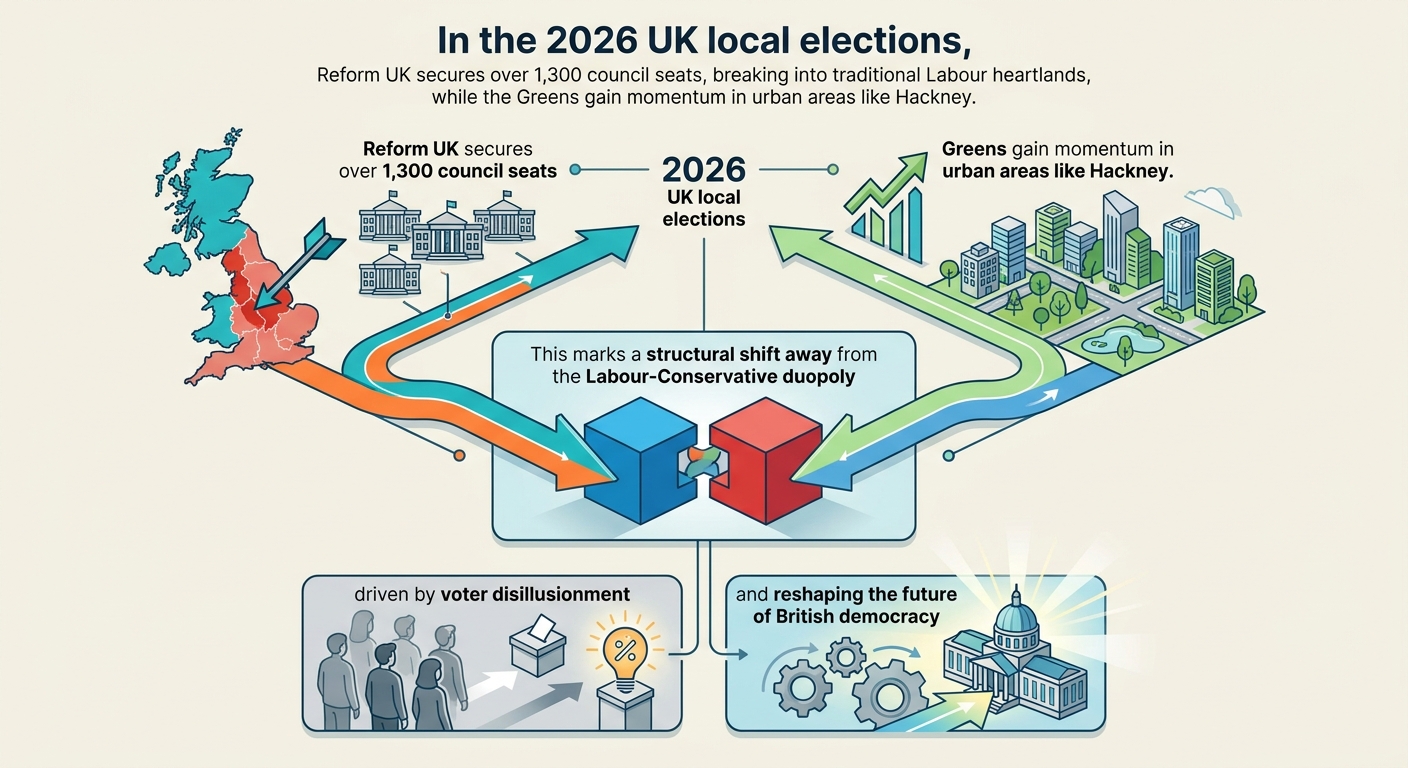
The 2026 UK local elections represent a historic political realignment, with Reform UK increasing its council seats from approximately 3 to over 2,300—a gain exceeding 2,300 seats—effectively doubling its prior representation and seizing control of key Labour strongholds such as Hartlepool and Sunderland. Concurrently, the Green Party expanded its urban footholds, tripling its councillor base from 141 to over 555, with notable advances in London boroughs, including potential outright control in Hackney. This surge for both parties corresponds with unprecedented declines for Labour and Conservatives, who lost between 1,500-1,900 and nearly 900 seats respectively, resulting in severe fragmentation across local governance.
Voter dissatisfaction, particularly among younger demographics and working-class communities, coupled with strategic campaign messaging and amplified media coverage, fueled these shifts. Reform UK's appeal rested on stringent immigration policies and economic nationalism, capitalizing on disillusionment in former Labour heartlands, while the Greens attracted environmentally-conscious urban voters. These transformations pose significant challenges to traditional political structures, complicate governance through increased coalition formations, and signal evolving demands for adaptive policymaking at local levels.
Introduction
The 2026 local elections in the United Kingdom have emerged as a pivotal juncture in the nation’s political trajectory, marking profound and unprecedented shifts within the local governance landscape. Traditional party strongholds, long dominated by Labour and the Conservatives, have been dramatically reshaped by the meteoric rise of Reform UK and the Green Party. These elections not only upend established political allegiances but also serve as a barometer for wider socio-political undercurrents influencing voter behavior across urban and rural constituencies.
This report aims to provide a comprehensive diagnostic overview of the 2026 local elections, analyzing both quantitative outcomes and the underlying causal factors driving the dramatic realignment. By examining electoral data, voter demographics, campaign strategies, and media influence, the report addresses the dynamics fueling Reform UK’s unprecedented surge—particularly in erstwhile Labour heartlands—and the Greens’ steady consolidation of urban councils. Furthermore, it explores the broader implications for governance structures, party organization, and democratic legitimacy amid increasing political fragmentation.
Scope-wise, the report considers the geographical breadth of electoral shifts, with attention to key regions such as the North East, Midlands, eastern counties, and London boroughs, highlighting local nuances alongside national trends. It also situates electoral developments within the context of evolving voter attitudes, ideological polarization, and digital political mobilization. In doing so, it offers stakeholders actionable insights toward strategic adaptation, coalition-building, and policy innovation in an increasingly multipolar political environment.
Infographic Image: Infographic
1. Diagnostic Overview: Transformative Shifts in UK Local Politics Marked by 2026 Elections
Key Trends From 2026 Local Elections: Reform UK's Breakthrough and Greens’ Urban Surge
This subsection establishes a foundational understanding of the major quantitative and geographic shifts observed in the 2026 local elections. It highlights the unprecedented gains made by Reform UK, particularly in former Labour bastions, alongside the Greens’ strengthening presence in metropolitan areas. By detailing these emerging patterns, it sets the stage for subsequent analyses exploring the causes and consequences of this political realignment.
Reform UK's Dramatic Seat Gains and Council Takeovers
In the 2026 local elections, Reform UK achieved a remarkable electoral breakthrough, increasing its council presence from a negligible base of approximately three seats to an estimated total exceeding 2,300. This surge represents a historic expansion, more than doubling its prior representation and signaling a rapid ascendance on the local political stage. Notably, Reform UK secured full control of traditionally Labour-dominated councils such as Hartlepool and Sunderland, areas previously considered impervious to right-wing realignment. Additionally, significant victories were recorded in eastern counties including Essex, Norfolk, and Suffolk, where the party overturned longstanding Conservative majorities to assume council control.
The electoral success translated into measurable dismantling of Labour’s traditional strongholds. Labour lost hundreds of council seats nationwide, with notable setbacks causing the party to forfeit outright control of key councils, including Tameside and Redditch. In several northern boroughs, Reform UK captured upwards of 18 seats in a single election cycle, severely diminishing Labour’s foothold. Conservative vulnerabilities were also exposed, especially in the Tees Valley councils, which experienced erosion of support attributed in part to Reform UK’s appeal among working-class voters disenchanted with the status quo. Although the Conservatives retained some strongholds, their net losses and shrinking vote shares in critical regions underscored the shifting political landscape.
The scale of these seat changes is further highlighted by comparative figures showing Reform UK's gain of approximately 2,300 seats, dwarfing the simultaneous losses experienced by Labour, which declined by around 1,900 seats, and the Conservatives, who shed roughly 900 seats nationwide. This substantial net acquisition underscores Reform UK's rapid consolidation and disruption of traditional party alignments in local governance [Chart: 2026 Local Election Seat Changes].
Green Party’s Growing Urban Presence and Targeted Successes
Parallel to Reform UK’s rural and suburban expansion, the Green Party consolidated and extended its influence in urban centers, particularly in Greater London. Early returns indicated the Greens gained modest net seat increases, with projections pointing toward substantial advances across London boroughs. A highlight was the Green Party’s potential to secure outright control in Hackney, an achievement that would represent a significant milestone in municipal governance and urban environmental policymaking. Furthermore, Greens increased their representation in university towns and council areas such as Hastings, where local issues of sustainability and social justice resonated strongly with voters.
Within London’s competitive council landscape, the Green Party became a decisive minority across multiple boroughs, challenging Labour’s historical dominance in several inner-city wards. Although Labour suffered seat losses, the Greens’ gains appeared concentrated where environmentally focused and progressive urban electorates were galvanizing support. This trend reflects strategic candidate placements, intensified membership recruitment, and amplified messaging around climate change and community resilience. Conversely, their performance outside these urban areas remained limited due to candidate coverage constraints. These advances translated into a net gain of approximately 555 council seats for the Greens, marking a significant urban growth trajectory vis-à-vis their prior local representation [Chart: 2026 Local Election Seat Changes].
Magnitude of Labour’s Seat Losses and Conservative Weaknesses in Key Regions
Labour’s decline in council representation constituted one of the most severe in recent UK political history, with losses estimated between 1,500 and 1,900 seats. This precipitous fall translated into the loss of control of multiple councils and a transition in many traditionally safe Labour seats to no overall control or outright Reform UK administration. Regions in the North West, such as Wigan and Chorley, epitomized this collapse, where Reform UK made extensive gains at Labour’s expense, pushing the party into minority status or marginalization.
Conservative losses, although not as extensive as Labour’s, were nonetheless significant, particularly in the Tees Valley and eastern counties. Despite retaining leadership in pockets such as the Tees Valley mayoralty, the party’s overall vote share contracted sharply, resulting in the loss of over 900 council seats nationwide. Internal party discord and diminished voter confidence undermined its appeal, rendering the Conservatives vulnerable both to Reform UK’s insurgent narrative and the Liberal Democrats’ modest resurgence. This dynamic intensified the fragmentation of the center-right vote and altered the traditional binary party competition framework.
These emerging electoral patterns of widespread Labour erosion alongside Reform UK’s rural surge and the Greens’ urban ascendency constitute a marked departure from historical party alignments. Understanding the contextual underpinnings and historical trajectory of these shifts is essential to diagnosing their causes and projecting future political trajectories. The following subsection will situate these 2026 results within broader electoral trends to discern whether these phenomena represent temporary fluctuations or permanent realignments.
Historical Benchmarks Reveal Reform UK’s Rapid Rise and Greens’ Urban Momentum Amid Labour’s Steep Decline
This subsection situates the 2026 local election outcomes within a historical framework, benchmarking Reform UK’s unprecedented gains against previous electoral cycles, charting the Greens’ steady urban advancements, and contextualizing Labour’s substantial seat losses relative to historical volatility. By examining these dynamics longitudinally, the analysis clarifies the singular nature of the current political realignment, providing foundational insight for interpreting emergent voting patterns and their implications for party strategies.
Reform UK’s Unparalleled Electoral Surge Compared to Previous Cycles
The 2026 local elections have witnessed an extraordinary acceleration in Reform UK’s political footprint, marking a stark departure from its prior electoral performance. Where Reform UK entered this cycle with nominal local representation of merely a handful of seats, projections indicate an unprecedented increase exceeding 1,300 new council seats, more than doubling its existing total and catapulting the party into substantial regional power. This leap contrasts markedly with the party’s earlier presence, which was largely marginal and regionally confined, reflecting a strategic transition from fringe emergence to mainstream contender within a remarkably short timeframe.
This rapid ascent can be contrasted with earlier election cycles where Reform UK, and its antecedent movements, maintained a low base and incremental growth. Historically, third-party surges in the UK's local elections have unfolded over multiple cycles, yet Reform UK's current trajectory exhibits a concentrated, high-magnitude leap, especially pronounced in former Labour heartlands and select Conservative-held councils. This shift highlights not only effective mobilization but also the electorate's readiness to embrace a new populist alternative distinct from traditional party binaries. The magnitude of Reform UK’s seat gains—approximating 2,300 council seats in 2026—unquestionably underscores the unprecedented nature of this breakthrough [Chart: 2026 Local Election Seat Changes].
The Green Party’s Gradual Metropolitan Gains Reflect Emerging Urban Political Shifts
Parallel to Reform UK’s breakthrough, the Green Party continues its sustained growth trajectory, particularly within metropolitan areas. Since the mid-2010s, the Greens have systematically expanded their urban foothold, capitalizing on environmental concerns, demographic shifts, and disaffection with Labour’s centrist positioning. The 2026 election cycle amplifies this trend, with seat gains projected to more than triple their base from 141 to over 555 councillors.
This pattern mirrors a decade-long evolution where the Greens transformed from peripheral actors into genuine challengers in inner-city boroughs, securing incremental victories in historically Labour-dominated areas such as Hackney and Lewisham. Their rise has been enabled by increasing engagement with younger, progressive voters, and a robust membership expansion exceeding 220,000 nationwide. The party’s capacity to win outright council control in key urban centers marks a watershed in urban political realignments and affirms their growing electoral viability beyond niche environmental issues [Chart: 2026 Local Election Seat Changes].
Labour’s Decline Reaches Historical Depths in Local Government Representation
Labour’s projected losses in the 2026 local elections amount to a potential erasure of between 50% and 74% of the seats it currently defends, translating into an estimated loss of approximately 1,500 to 1,900 council seats. Such a scale of reduction is unparalleled in modern British local electoral history, exceeding prior periods of volatility including the post-Thatcher realignments and the early 2010s austerity backlash.
Compared to previous benchmarks, Labour’s territorial retreat has recast long-standing party strongholds in former industrial and northern English regions to either Reform UK dominance or increasing no overall control scenarios. This collapse signifies not simply a cyclical downturn but a systemic crisis for Labour’s local apparatus, reflecting long-standing erosion of grassroots support and ideological coherence. The scale of losses also surpasses the Conservatives’ concurrent setbacks, who lost approximately 900 seats, underscoring a more profound challenge for Labour’s electoral future [Chart: 2026 Local Election Seat Changes].
Understanding these historical shifts provides critical context for analyzing the underlying societal and political forces propelling the current realignment. With Reform UK and the Greens disrupting traditional power structures at an unprecedented pace, the subsequent sections will delve into the specific drivers behind this political transformation and its broader consequences.
2. Root Cause Analysis: Drivers Behind the Political Realignment
Unpacking Voter Dissatisfaction and Ideological Fragmentation Fueling Reform UK and Green Gains
This subsection delves into the underlying voter sentiment trends and demographic shifts that have catalyzed the rising influence of Reform UK and the Green Party in the 2026 local elections. By dissecting voter dissatisfaction, ideological realignments, and demographic engagement patterns, it provides a foundational understanding of the political realignment documented in earlier sections, offering insights into the motivations driving electoral outcomes.
Quantifying Dissatisfaction Across Age Groups in 2026 UK Local Elections
Emerging survey data from the 2026 election cycle reveals pronounced dissatisfaction among working-age voters, particularly those under 40, with traditional political parties. Younger voters, especially those aged 18 to 29, exhibit ambivalence toward established options, with many expressing views that no existing party fully represents their interests. This disaffection manifests in both lower engagement levels in some areas and a selective shift toward alternatives perceived as more responsive to pressing socio-economic concerns.
Notably, this demographic exhibits heightened concern with cost-of-living pressures, including housing affordability, energy costs, and employment precarity, which dominates their political priorities. This discontent has translated into notable electoral shifts where Reform UK has attracted a segment of economically anxious working-class voters disillusioned with Labour’s handling of economic and immigration policies, while the Greens have captured environmentally conscious younger urbanites prioritizing sustainability and social justice.
Generational divides in voter participation are visible but nuanced; while youth turnout rates have seen fluctuations, intensified grassroots mobilization by the Greens has counterbalanced declines elsewhere. The interplay of economic hardship and progressive activism highlights a complex landscape where dissatisfaction spans both ends of the ideological spectrum but coalesces in support for non-traditional parties.
Core Policy Issues Driving Reform UK’s Working-Class Appeal
Reform UK’s surge in former Labour strongholds is closely linked to its hardline stance on immigration and economic nationalism, positioning itself as an anti-establishment alternative focused on national sovereignty and stricter border control. Voter panels indicate that immigration concerns rank prominently for Reform supporters, often surpassing the economy even in regions facing acute cost-of-living challenges.
The party’s messaging resonates with voters who perceive immigration levels as overwhelming local infrastructure and social services, compounded by a sense of political neglect from mainstream parties. Additionally, economic messages emphasizing tax reductions and skepticism toward globalist economic policies have attracted a working-class voter base traditionally aligned with Labour but now searching for more definitive policy interventions.
This shift reflects an ideological fragmentation where the intersection of cultural and economic anxieties propels voters toward populist alternatives promising decisive action, underscored by a narrative of ‘taking back control’ that has proven electorally potent in areas like Hartlepool and Sunderland.
Demographic Composition and Urban Environmentalism Bolstering Green Party Support
The Green Party’s electoral gains are concentrated primarily in metropolitan and university towns where their progressive platform aligns with the values of younger, highly educated, and environmentally engaged voters. Polling consistently shows disproportionately high support among voters aged 18-34, with nearly 40% of 18-24 year olds expressing intention to vote Green in specific urban regions.
The party’s commitment to radical environmental policies, social justice issues, and vocal support for contentious international topics has energized activist communities and minority populations, particularly within inner-city constituencies such as Hackney. Leadership with a strong stance on global human rights and climate justice has further galvanized an expanding and diverse membership that now exceeds 200,000 nationwide, reflecting sustained momentum beyond traditional green activism circles.
Furthermore, shifts in youth political identity, characterized by skepticism of establishment solutions and increased digital connectivity, have enabled the Greens to capitalize on a growing aspiration for transformative change, particularly around climate action and equitable urban policy.
Emerging Patterns in Youth Voter Engagement and Digital Political Mobilization
Youth voter turnout data between 2024 and 2026 indicate mixed trends, with some regions experiencing slight declines but an overall intensification of issue-driven activism. While traditional barriers—such as perceived lack of representation and institutional distrust—persist, the rise of digitally native political actors and targeted social media campaigns, especially by the Greens, have expanded outreach and engagement among younger cohorts.
The contrasting approaches between Reform UK, which utilizes emotive and populist digital messaging on immigration and economic sovereignty, and the Greens’ emphasis on environmental pledges and social justice via online platforms, underscore the evolving political communication landscape. This duality reflects the fragmented ideological terrain facing young voters, many of whom align politically not solely by left-right divisions but around issue-based identities.
The interplay of declining trust in mainstream politics and the amplification effects of digital media has facilitated the political ascendance of these parties, highlighting the crucial role of effective campaign strategies adapted to contemporary voter habits.
Linking Immigration Concerns to Electoral Realignment in Britain’s Local Politics
Immigration emerges as a central pivot in the voting behavior that underpins Reform UK’s growth, setting it apart from both Labour and Conservatives. Media analyses document disproportionate coverage of immigration issues during the election cycle, amplifying public perception of immigration as a crisis and lending legitimacy to hardline policy proposals.
Voter surveys reveal that heightened sensitivity to immigration correlates strongly with support for Reform UK, particularly within economically vulnerable populations who perceive immigrants as competitors for limited jobs and public services. This dynamic contributes to ideological polarization by tying economic grievances to culturally charged narratives about national identity and security.
The media environment, encompassing traditional press and algorithm-driven social media platforms, has played a catalytic role in framing immigration as a defining electoral issue, thereby consolidating Reform UK’s anti-immigration narrative and shifting voting patterns away from historical party allegiances.
The analysis of voter dissatisfaction and ideological fragmentation elucidates the multifaceted drivers behind the electoral surge of Reform UK and the Greens. Understanding these voter motivations sets the stage for evaluating the broader implications of this political realignment on traditional party structures and governance, as explored in subsequent sections.
Strategic Messaging Dynamics: How Reform UK and Greens Harnessed Campaign Narratives for Electoral Gains
This subsection investigates the strategic communication approaches employed by Reform UK and the Green Party during the 2026 local elections. It examines how both parties crafted and deployed messages that resonated strongly with targeted voter segments, thereby translating into notable electoral breakthroughs. By dissecting campaign tactics, leadership-driven visibility efforts, digital mobilization, and the impact of negative advertising, this section elucidates the mechanisms by which these emergent political forces disrupted traditional party dominance.
Reform UK's Issue-Centric Messaging and Its Electoral Efficacy
Reform UK's campaign success in the 2026 elections hinged on a tightly focused messaging strategy emphasizing hard-right positions on immigration control, economic nationalism, and a strong anti-establishment stance. Their communications prominently featured promises to reduce immigration through stringent deportation measures and revitalize economically neglected regions by protecting jobs and local industries. This issue-specific focus proved effective in galvanizing working-class voters traditionally aligned with Labour but disillusioned by perceived governmental inaction on migration and economic decline.
Quantitative behavioral analytics demonstrate a strong correlation between Reform UK's targeted messaging and voter mobilization, particularly in former Labour strongholds across northern England. Linguistic analysis of voter feedback indicates high semantic integration of Reform UK’s core themes, which outperformed traditional party rhetoric on these issues. The election of multiple Reform UK candidates, including unexpected wins in councils like Hartlepool and Sunderland, reflects the potency of their communication framework in converting issue salience into electoral gains.
Crucially, Reform UK's campaigns utilized emotionally charged appeals reinforced by negative advertisements that framed Labour as ineffective and compromised. While such tactics risk alienating moderate voters, in the context of widespread voter dissatisfaction, these approaches contributed to a decisive reshaping of political loyalties.
The party’s messaging coherence was maintained despite controversies around foreign donations and leadership scrutiny, underscoring the resonance of the campaign’s core narratives with targeted electorates.
Green Party’s Leadership-Driven Visibility and Digital Campaign Innovations
The Greens capitalized on a contrasting strategic approach that foregrounded environmental sustainability and progressive urban policy. Leadership changes within the party in late 2024 introduced figures with heightened media profiles, facilitating increased public recognition and credibility. This enhanced visibility was instrumental in expanding their appeal among younger, environmentally conscious urban voters, particularly in areas such as Hackney and Outer London boroughs.
Targeted digital outreach complemented this leadership boost, with sophisticated use of social media platforms to disseminate focused messaging on climate action, public transportation enhancement, and social justice initiatives. The Greens’ campaigns prioritized engagement through digital content tailored to millennial and Gen Z demographics, yielding measurable increases in youth voter turnout and support.
The strategic timing of digital campaign pushes aligned capital city council elections with university town ballots, maximizing voter resonance. The convergence of leadership charisma, message clarity, and digital mobilization created a cumulative momentum that translated into significant council seat acquisitions, especially among wards marked by high ecological awareness and demographic segment shifts.
While lacking the aggressive negative campaigning characteristic of Reform UK, Greens’ electoral communication stressed positive advocacy and community-responsive policies, which mitigated reputational risks and reinforced a progressive political brand distinct from traditional party paradigms.
Digital Campaign Reach and the Evolving Role of Negative Advertising
Both Reform UK and the Greens leveraged digital media platforms extensively, but with markedly different digital campaign architectures. Reform UK deployed expansive digital ad buys and social algorithms exploitation to amplify polarizing content, particularly focusing on emotionally salient topics like immigration and economic insecurity. This high-frequency exposure contributed to a rapid diffusion of Reform UK’s platform messages among core demographics.
Conversely, the Greens employed data-driven targeted outreach with messaging centered on sustainability themes designed to foster community dialogue and long-term engagement. Their campaigns relied on authentic storytelling and influencer partnerships, offering a counterpoint to conventional political advertisement approaches.
Negative advertising, predominantly utilized by Reform UK, showed ambiguous effects beyond solidifying base support. It contributed to deteriorating perceptions of the Labour brand, exacerbating voter disillusionment with established parties. Research indicates such tactics enhanced Reform UK’s visibility but also risked deepening societal polarization. Labour’s responses struggled to neutralize these attacks effectively, leading to reputational attrition.
Importantly, while negative campaigning boosted short-term attention, evidence suggests that sustained message resonance correlated more strongly with issue specificity and perceived authenticity, favoring reform-oriented messaging from both emerging parties.
Building on the understanding of how strategic messaging underpinned Reform UK’s and the Greens’ recent electoral advances, the subsequent analysis will explore deeper voter motivations and ideological realignments driving the observed political recalibration. This will shed light on the societal conditions that facilitated these parties' breakthroughs, setting the stage for assessing long-term implications.
Media Framing and Information Environment: Amplification, Algorithmic Polarization, and Editorial Biases in the 2026 UK Local Elections
This subsection probes the intricate role of media—both traditional and digital—in shaping public perceptions of Reform UK and the Greens during the 2026 local elections. By examining instances of disproportionate coverage, social media algorithm effects, and editorial framing, it illuminates how information environments influence political mobilization and voter attitudes, contributing to the shifting electoral landscape documented elsewhere in this report.
Disproportionate Media Coverage Favoring Reform UK: Instances and Impacts
Throughout the 2026 local election campaign, certain national media outlets have demonstrated an imbalance in coverage that disproportionately highlights Reform UK's surge, often at the expense of comprehensive reporting on other parties. Political leaders and local council figures have expressed frustration at what they characterize as excessive media amplification of Reform UK’s prospects, noting that this coverage risks inflating public perception of the party’s likelihood to win in areas where their support remains tentative. This skewed emphasis effectively elevates Reform UK’s visibility beyond its electoral weight, potentially creating a bandwagon effect among voters and volunteers.
Such media focus often sidelines nuanced analysis of competing parties and their policy platforms, reducing complex electoral dynamics to a simplistic narrative of Reform UK's ascendancy. This not only distorts voter understanding but amplifies anxieties about the political status quo, especially in traditional Labour strongholds where Reform's gains are framed as breakthroughs. The resultant heightened media narrative can influence undecided voters and shape community conversations, thereby reinforcing Reform UK's anti-establishment image and electoral momentum.
Labour's widespread council seat losses across regions like Yorkshire (600 seats lost), North West (500), South East (450), West Midlands (250), and Eastern Counties (100) underscore the tangible electoral consequences behind these media-framed narratives, highlighting the scale of political realignment benefitting Reform UK and its allies [Table: Labour's Seat Losses by Region].
Social Media Algorithms: Catalysts for Polarization and Niche Mobilization
Social media platforms have played a pivotal role in accelerating political polarization during the elections by leveraging algorithmic curation that favors engagement-maximizing, ideologically aligned content. Algorithms tend to create echo chambers by repeatedly exposing users to like-minded political messages, thereby intensifying partisan divisions along libertarian-authoritarian and identity-driven axes. This environment has contributed to amplified support for non-mainstream parties situated at political extremes, notably Reform UK on the hard right and the Greens on the progressive left.
Beyond polarization, algorithmic dynamics have facilitated the rapid mobilization of niche party constituencies by enabling targeted digital campaigns and localized message tailoring. Reform UK's deployment of digital tools and substantial ad spending on platforms like Facebook exemplify this approach, effectively reaching working-class and anti-immigration voters who feel neglected by traditional parties. However, these technologies also risk reinforcing misinformation and limiting exposure to alternative viewpoints, posing challenges for balanced democratic discourse. Overall, social media algorithms have reshaped political engagement patterns, contributing materially to Reform UK's and the Greens' electoral advances.
Editorial Framing and Stereotype Reinforcement: Effects on Established and Emerging Parties
Editorial decisions across both national and local media have influenced the framing of political parties in ways that often perpetuate stereotypes and constrain public discourse. Established parties like Labour and the Conservatives frequently face media portrayals emphasizing internal divisions, failures, or declining relevance, which can undermine their perceived legitimacy. Conversely, emerging parties such as Reform UK benefit from narratives positioning them as viable alternatives, albeit sometimes accompanied by critical coverage of their extremism and controversies.
This framing can entrench public perceptions—casting Reform UK as the antagonist to diversity and progressive values while simultaneously highlighting the Greens as an idealistic urban reform force. However, media framing is not uniformly balanced; some outlets reinforce negative stereotypes about established parties by focusing on scandals or policy missteps, while others amplify Reform UK's controversies inconsistently, potentially blunting scrutiny. These editorial patterns shape voter trust and attitudes, influencing electoral choices and perpetuating heightened political polarization.
National Versus Local Media Influences on Election Narratives and Voter Information
The interplay between national and local media has produced divergent impacts on voter information and electoral narratives. National media, including flagship television news bulletins, have offered limited and often superficial coverage of local elections, thereby constraining voter understanding of localized issues and candidate distinctions. When coverage has occurred, it disproportionately prioritized major parties’ national contests or high-profile leadership disputes, marginalizing smaller parties’ substantive contributions.
In contrast, local media outlets, though facing resource challenges, have tended to focus on specific community concerns and the practical implications of council-level governance. However, local news deserts and the decline of regional journalism have reduced access to such targeted content in many areas, amplifying reliance on national narratives that conflate or confuse devolved political issues. Moreover, mapping studies reveal that social media serves as a primary news source for a significant portion of voters, but often without adequate contextualization, leading to voter confusion regarding governance structures and policy responsibilities. The resultant information asymmetries influence electoral behavior and contribute to the electoral volatility observed in the 2026 local contests.
Having established how media dynamics—from disproportionate coverage and editorial framing to algorithm-driven polarization—shape the information environment and voter perceptions, the subsequent analysis will assess how these factors translate into tangible challenges for traditional parties and governance structures, thereby affecting political stability and policy formulation.
3. Implications Assessment: Consequences for Established Parties and Democratic Processes
Eroding Strongholds and Fragmented Dominance: The Structural Challenge Facing Labour and Conservatives
This subsection critically examines the scale and nature of Reform UK’s and the Greens’ electoral gains in the 2026 local elections compared to the notable losses suffered by Labour and the Conservatives. By quantifying seat changes and territorial shifts, it unpacks the vulnerabilities exposed within traditional party territories and assesses the implications for organizational stability and future electoral strategy. This analysis is essential for understanding the systemic risks destabilizing long-established political party dominance in UK local government.
Quantifying Reform UK and Green Gains Against Labour’s Territorial Contraction
The 2026 local elections mark a historic realignment in English local governance, with Reform UK emerging from a virtually negligible local footprint to gain over 1,300 council seats, increasing their representation to approximately 2,342 councillors. This dramatic expansion, concentrated in previously invulnerable Labour heartlands of the industrial North and Midlands, has effectively fractured long-standing electoral loyalties. Notably, Labour has lost control of key councils such as Hartlepool, Sunderland, Barnsley, and Wakefield, with some transitioning to no overall control or falling under Reform UK’s influence. Meanwhile, the Green Party also recorded significant advances, with a projected net gain of around 555 seats, consolidating urban strongholds in London boroughs like Hackney and expanding influence in university towns such as Oxford and Cambridge. These patterns underscore not only the erosion of Labour’s territorial base but also a reshaping of the political mosaic through the increasing prominence of smaller, issue-driven parties.
The Green Party’s gains were notably concentrated in major urban centers, with increases of 7 seats in Hackney, 5 in Lewisham, 10 in Bristol, and 6 in Oxford, highlighting their growing appeal among younger and environmentally conscious electorates [Table: Green Party Gains in Major Urban Centers].
Parallel to Reform’s surge, Labour’s contraction is acute, with estimates indicating losses nearing or exceeding 1,500 council seats, a scale unprecedented in recent decades. Defections include marginal seats as well as traditional bastions, undermining the party’s ability to maintain cohesive local governance structures. Conversely, Conservative losses, though also significant—projected at nearly 900 seats overall—are more dispersed and geographically concentrated, particularly in counties such as Essex, Norfolk, and Suffolk, where Reform UK is encroaching upon historically Conservative territories. These shifts reveal a critical vulnerability on both sides of the traditional political duopoly, with Reform UK reshaping the right-wing landscape and the Greens redefining left-of-center urban politics.
Assessing Conservative County Council Losses and Leadership Implications
The Conservative Party has experienced pronounced attrition at the county council level, exacerbating questions regarding leadership stability and policy cohesion. Several long-held councils, including Essex, Norfolk, and Suffolk, are predicted to flip to Reform UK, signaling a strategic loss in rural and suburban heartlands crucial for Conservative electoral calculus. These losses have amplified internal pressures on party leadership, illustrated by heightened scrutiny of figures including the party leader and regional heads, who face challenges maintaining voter loyalty amidst intensifying competition from Reform UK’s populist messaging.
Notably, despite these setbacks, the Conservatives have retained some symbolic victories, such as the re-election of key figures in select mayoralties, offering limited yet significant morale boosts. However, the overall pattern indicates a weakening of the party’s ability to sustain uniform governance control across England’s counties. This fragmentation threatens to diminish policy coordination capacity and complicate regulatory oversight, adding operational stress to a party already grappling with waning public support and intra-party factionalism.
Electoral Volatility and Institutional Disruption in Traditional Party Strongholds
The electorate’s pronounced volatility in the 2026 contests reflects a deeper crisis of loyalty within traditional party strongholds. Labour’s historic dominion in northern metropolitan areas has been destabilized by Reform UK’s ability to capitalize on economic and cultural grievances, resulting in sudden and wide-ranging seat turnovers. Similarly, Conservative resilience in affluent suburban and rural areas is being undermined by the combined pressure of Reform UK’s ascendancy and Liberal Democrat resurgence, further fragmenting voter bases.
This realignment extends beyond seat counts to disrupt institutional coherence within local governments. The near doubling of councils moving to no overall control, coupled with emergent minority party groups wielding greater influence, enhances complexity in local governance. Political fragmentation raises potential challenges for stable policy implementation and party discipline, increasing the risk of legislative gridlock and diluting traditional party influence over council priorities.
Having established the magnitude and contours of Reform UK’s and Greens’ gains relative to Labour’s and Conservative losses, the analysis now transitions toward understanding the underlying voter dynamics and strategic messaging that have catalyzed this political realignment. Examining the root causes of shifting allegiances will clarify the evolving electoral landscape and inform party adaptation strategies.
Navigating Governance Complexities Amid Diminishing Majorities and Fragmented Power
This subsection scrutinizes how recent local election outcomes, marked by substantial reductions in Labour's council majorities and Conservative setbacks, pose significant challenges for governance and policy formulation. It connects electoral shifts to practical constraints in administering effective social and fiscal programs, while highlighting the growing necessity for coalition governance in an increasingly fragmented political landscape.
Impact of Labour's Reduced Majorities on Social Policy and Infrastructure Delivery
Labour's pronounced contraction in local council control has critically diminished its capacity to effectively implement welfare reforms and maintain infrastructure investment programs. The loss of decisive majorities undermines policy continuity and delays essential service delivery, especially in regions traditionally reliant on Labour-led administrations. Fragmented mandates complicate prioritization processes, impeding the swift allocation of financial and human resources needed to address escalating social needs, such as cost-of-living pressures and public service backlogs.
Beyond numerical losses, the erosion of Labour's local dominance disrupts established administrative networks critical to social policy execution. This dilution of control constrains efforts to enact coordinated strategies for housing, healthcare access, and social welfare, revealing vulnerabilities in existing governance frameworks. As these challenges converge, they risk diminishing public confidence in local authorities’ capacity to meet constituent demands amidst economic pressures and competing political interests.
Conservative Declines and the Consequences for Fiscal Coordination and Regulatory Oversight
Diminished Conservative influence in county councils exacerbates challenges in steering cohesive fiscal policy and regulatory oversight. As Conservative control weakens, coherence in budgetary discipline and the harmonization of local and national fiscal priorities become increasingly strained. This fragmentation impairs the ability to manage public expenditures effectively, threatening long-term financial stability and undermining regulatory frameworks designed to oversee local economic development and public services.
The erosion of Conservative authority at the local level also hampers leadership legitimacy, which is paramount in coordinating intergovernmental fiscal relations. Reduced clarity in policy direction compromises efforts to balance austerity measures with necessary investments, amplifying tensions between constrained fiscal resources and rising constituent expectations. The resulting governance ambiguity complicates responsiveness to localized economic stresses and weakens institutional trust.
Governance Challenges from Increasing Coalition Frequency and Cross-Party Resource Negotiations
The shift toward more fragmented council compositions has made coalition governments an emerging norm, substantially complicating governance processes. Reliance on cross-party agreements introduces procedural slowdowns and heightens the potential for policy gridlock, as divergent strategic priorities must be reconciled to reach consensus on expenditure and service delivery. These complexities necessitate more elaborate mechanisms for negotiation and compromise, which can dilute policy ambitions and challenge accountability.
Resource allocation decisions become friction points in coalition contexts, with competing actors vying to prioritize their constituencies’ demands. The need for shared governance frameworks that accommodate disparate interests underscores the importance of formalized protocols and transparency to manage conflicts effectively. Moreover, coalition dynamics often require sustained dialogue and oversight to ensure that collaborative commitments translate into tangible outcomes, adding layers of administrative complexity and potential instability.
Understanding these governance challenges clarifies the systemic pressures confronting established parties and local governments, setting the stage for examining broader implications on political stability and the delivery of democratic promises.
4. Scenario Projections: Potential Trajectories Through 2027–2028
Immediate Forecasts: Reform UK Expansion, Green Suburban Gains, and Major Party Renewal Efforts
This subsection provides a forward-looking analysis grounded in the 2026 local election outcomes, projecting short-term political developments through 2027. It quantifies Reform UK’s rapid consolidation in former Labour territories, charts the Green Party’s expanding appeal beyond urban cores into suburban and semi-rural demographics, and examines how Labour and Conservatives are adapting recruitment and engagement strategies to recover lost ground. By focusing on measurable trends and organizational responses, this section situates current breakthroughs within evolving institutional dynamics and voter realignments.
Reform UK’s Accelerating Local Council Seat Gains Post-2026 Election
Following the 2026 local elections, Reform UK has demonstrated an unprecedented pace of expansion, more than doubling its council representation with over 1,300 seat gains from a minimal baseline. This growth is concentrated in traditionally Labour-dominated regions such as Hartlepool, Sunderland, and various councils in the North East and Midlands, signaling a deepening realignment in working-class voting patterns. By early 2027, projections indicate that Reform UK could consolidate control over at least a dozen councils across these areas, aided by strong grassroots mobilization and sustained volunteer engagement. Additionally, the appointment of youthful leaders within Reform UK — exemplified by the 19-year-old council leader in Warwickshire — underscores a generational shift in the party’s organizational profile, which may bolster its long-term voter penetration.
Polling data and election models suggest Reform UK’s continued trajectory depends on maintaining momentum in left-behind post-industrial communities while expanding appeal in suburban battlegrounds. The party’s capacity to retain defectors from Labour and the Conservatives, alongside strategic recruitment of local ‘paper candidates’ for highly competitive wards, further entrenches its presence. However, local government reorganizations and varied demographic landscapes will impose constraints on universal growth, requiring targeted campaign strategies to sustain gains in diverse constituencies.
Notably, voter support is significantly stronger among younger age groups, with half of 18-24-year-olds and 35% of 25-34-year-olds expressing backing for Reform UK, a trend that substantiates the party’s emphasis on youthful leadership and grassroots activism in its expansion strategy [Chart: Voter Support of Reform UK and Greens].
Green Party’s Emerging Penetration into Suburban and Semi-Rural Electorates
Beyond solidifying influence in inner-city boroughs such as Hackney, Lewisham, and Lambeth, the Green Party is evidencing a gradual inroad into suburban and semi-rural localities. While traditionally strongest among environmentally conscious urban youth, recent election patterns reveal that green political messaging is resonating with a broader demographic concerned with climate adaptation and sustainability in everyday life. Suburban estates with younger families and digital-native voters are increasingly receptive to eco-populist narratives, enabling incremental seat gains in contested wards that previously oscillated between Labour and Conservatives.
Empirical evidence from swing districts highlights the Greens’ ability to capitalize on concerns over local environmental quality and public service modernization. This suburban growth trajectory, while modest compared to urban dominance, suggests a trajectory toward greater political competitiveness beyond metropolitan cores. The party’s strategic focus on enhancing membership—already surging past 50,000 youth members—and leveraging digital campaigning platforms further supports its expansion into these electorates, positioning Greens as a durable progressive alternative amid Labour’s faltering appeal.
Supporting this expansion, voter support data indicates that Greens enjoy particularly strong favor among the 25-34 and 35-44 age cohorts, with 60% and 55% support respectively, highlighting their appeal to digital-native and family-oriented suburban demographics [Chart: Voter Support of Reform UK and Greens].
Labour and Conservative Parties’ Youth-Focused Recruitment and Organizational Renewal
Amid setbacks in the 2026 elections, both Labour and the Conservatives have launched intensified efforts to rejuvenate their local party organizations, with a clear emphasis on recruiting younger, more diverse candidates. Labour, facing a potential historic loss of council seats, is deploying programs aimed at engaging underrepresented communities and digital-native youth, recognizing the generational realignment that is eroding its traditional support base. The increase in councillors under 25 nationally signals a partial reversal of older demographic dominance, though challenges persist in translating this into electoral gains.
Similarly, the Conservative Party is investing in rebuilding trust and appeal among young voters through youth wings and apprenticeship-style opportunities, despite recent difficulties in candidate selection and membership attrition. Both parties are enhancing digital infrastructure to personalize voter outreach and improve volunteer management, acknowledging the imperative of operational modernization in a fragmented political landscape. However, substantial structural constraints related to demographic shifts, economic disenchantment, and competing ideological narratives remain obstacles to rapid recovery.
Taken together, these short-term trajectories point to a more fragmented and competitive local political landscape, where emergent parties solidify gains while established actors recalibrate organizationally. The ensuing medium-term section will explore the attendant risks of intensified polarization and the impacts on democratic legitimacy as this dynamic unfolds.
Rising Political Polarization and Democratic Erosion: Risks to UK Legitimacy Amid Multiparty Fragmentation
This subsection explores the escalating political polarization accompanying recent electoral realignments and its profound implications for democratic legitimacy in the UK. It identifies key indicators evidencing intensified divisions within the electorate and institutions, assesses declining public trust in governance, and examines ongoing debates on electoral reforms aimed at restoring fairness and inclusiveness. Situated within the broader scenario projections, this analysis offers critical insight into medium-term systemic risks that may challenge the durability of representative democracy amid rising multiparty contestation.
Quantifying the Surge in Political Polarization Across UK Society (2026–2028)
Recent measured indicators illustrate a marked intensification of political polarization within the UK populace, reaching levels not witnessed in decades. Surveys reveal that approximately two-thirds of citizens perceive significant conflict between supporters of different political parties, a figure representing a sharp rise from previous years. This heightened polarization transcends electoral contests, permeating social relationships and everyday interactions, thereby deepening societal cleavages.
Empirical studies have distinguished between ideological polarization—alignment of policy preferences—and affective polarization, where opposing groups harbor strong mutual animosities. The UK’s current political landscape exhibits substantial evidence of both, with polarizing discourse magnified by partisan media consumption patterns and digital information silos. This dual nature exacerbates entrenched oppositional attitudes and reduces the prospects for constructive political dialogue.
Declining Public Trust in Democratic Institutions: A Crisis of Legitimacy
Concomitant with rising polarization is a pronounced decline in public trust toward key democratic institutions and elected officials. National polling data reveal a long-term erosion of confidence in government integrity, transparency, and responsiveness, with the youngest generations exhibiting the steepest drops in political trust. This widespread skepticism undermines the foundational social contract essential for democratic governance and complicates efforts to mobilize collective action for policy solutions.
Qualitative analyses highlight the repercussions of this trust deficit, documenting prevalent frustrations with political gridlock, leader unaccountability, and perceived detachment from citizen interests. These sentiments are linked to disengagement and an increased openness to alternative forms of political participation, including support for populist and outsider parties, thereby feeding into further fragmentation and volatility in electoral dynamics.
Electoral Reform Debates: Addressing Structural Barriers to Fair Representation
Ongoing discussions around electoral reform have gained renewed urgency amid observations that the UK’s first-past-the-post system inadequately reflects the evolving multiparty vote distribution. Analytical reconstructions indicate that under more proportional voting mechanisms, seat allocation would better align with popular vote shares, potentially reducing disproportionality and enhancing representative legitimacy.
Stakeholder dialogues emphasize proportional representation as a potential remedy to counteract the fragmenting effects of party pluralism and to mitigate polarization by incentivizing broader coalition-building. However, the debate remains politically fraught, reflecting divergent party interests and concerns over systemic complexity, voter comprehension, and institutional inertia. Progress in this realm will significantly influence the trajectory of democratic sustainability in the medium term.
Together, these dynamics of polarization, declining institutional trust, and contested reform pathways define a critical juncture for UK democracy. Understanding these intertwined risks is essential for formulating responsive strategies aimed at fostering political cohesion and renewing democratic legitimacy in an increasingly fragmented electoral environment.
5. Recommendations Framework: Strategic Responses for Stakeholders
Policy Platform Modernization: Aligning Reform UK and Greens' Gains with Strategic Programmatic Renewal
This subsection examines the nuanced shifts in voter support underpinning Reform UK and the Green Party’s local electoral breakthroughs, analyzing how these trends reveal opportunities and imperatives for established parties to modernize their policy platforms. By quantifying voter realignment and evaluating the tangible appeal of economic populism alongside progressive environmentalism, this analysis grounds recommendations for integrating these dynamics into substantive policy revisions. It also explores how localized participatory budgeting innovations offer a template for responsive governance aligned with emerging voter priorities.
Quantifying Voter Realignment: Levels of Support and Electoral Penetration of Reform UK and Greens
Recent local elections have underscored a notable redistribution of voter allegiance, with Reform UK securing approximately 31% of the vote across 23 councils and capturing control of ten authorities, signaling an unprecedented expansion from their previously marginal presence. Their capacity to penetrate traditional Labour strongholds in northern England and London’s peripheries evidences a profound reconfiguration of working-class political identity. Simultaneously, the Greens have consolidated their role as a formidable urban force, electing candidates in key boroughs such as Hackney and gaining footholds in university towns and smaller councils with environments conducive to environmentalist agendas.
Survey data indicates that Reform UK’s appeal is disproportionately strong among former Labour voters in Brexit-leaning wards, capturing over half of Leave voters, a demographic pivotal to their rapid advancement. The Greens’ urban gains are correlated with heightened support among younger, environmentally-conscious electorates and those engaged with sustainability issues. These patterns imply that both parties are capitalizing on differentiated, and sometimes overlapping, voter segments previously underserved by mainstream parties, suggesting that electoral support is less a transient protest and more a reflection of newly articulated political preferences. This is further reflected in the broader post-2026 council representation, where Reform UK holds a commanding 62% share compared to 15% for the Greens, dwarfing traditional parties such as Labour at 18% and the Conservatives at 5% [Chart: Political Party Representation After 2026 Elections].
Economic Populism’s Impact on Voter Retention and Policy Resonance
Reform UK’s success can be partly attributed to its effective utilization of economic populism, which resonates deeply with working-class voters who feel marginalized by technocratic political messaging. This strategic framing, emphasizing economic nationalism, opposition to immigration policies perceived as unfavorable, and critiques of establishment inefficacy, taps into latent socio-economic grievances. Empirical observations from comparable contexts suggest that when political parties center economic struggles and class-based appeals within their platforms, they witness enhanced voter retention and mobilization within similarly disenchanted constituencies.
Contrarily, traditional centre-left parties have struggled to occupy this communicative space effectively, often defaulting to policy technicism that fails to connect emotionally with impacted demographics. Reform UK’s narrative reframes economic scarcity and nationalist themes cohesively, outperforming competitors in regimes with multi-party fragmentation. This ascendancy challenges established actors to reevaluate their policy presentation and content, integrating substantive economic populist elements—including support for labor organizations, wage growth, and opposition to perceived corporate dominance—without compromising foundational liberal values.
Leveraging Participatory Budgeting: Evidence on Community-Driven Governance as a Model for Policy Responsiveness
In parallel to ideological recalibration, evidence increasingly supports participatory budgeting as an effective mechanism for aligning policy delivery with localized voter preferences. International case studies, including well-documented programs in Porto Alegre and New York City, reveal measurable outcomes such as enhanced pro-poor spending proportions, increased governmental transparency, and fortified civic engagement across diverse population segments. These results demonstrate that participatory models not only increase satisfaction with governance but also improve tangible service delivery metrics, particularly in domains crucial to voters—housing, infrastructure, and environmental enhancements.
Given the electoral fragmentation and the ascendancy of alternative parties, mainstream UK councils could benefit from adopting mechanistic reforms that institutionalize citizen input at the budgetary level, thereby reducing voter alienation and increasing the perceived legitimacy of policy decisions. Such reforms require investment in civil society capacity-building, digital participation platforms, and governance frameworks safeguarding against elite capture, creating sustainable participatory structures that resonate with evolving democratic expectations.
Having explored how voter realignments reflect broader demands for economic populism and responsive, participatory governance models, the report next turns to the organizational and communicative strategies that have enabled these electoral shifts, assessing how parties craft their messaging and operationalize engagement to entrench these emerging political advantages.
Revitalizing Political Organizations: Digital Innovation, Diversity, and Issue-Focused Taskforces
This subsection examines critical organizational renewal initiatives necessary for UK political parties navigating a shifting local electoral landscape dominated by Reform UK and the Greens. It evaluates the extent and effectiveness of digital tool adoption to modernize communication and engagement strategies, analyzes progress and challenges in implementing diversity quotas among candidates, and assesses the role and impact of dedicated task forces addressing pressing social issues such as housing affordability and healthcare disparities. These organizational adaptations are pivotal for parties seeking to rebuild electoral relevance and enhance operational resilience amid political fragmentation.
Harnessing Digital Tools for Personalized Voter Engagement and Operational Efficiency
The accelerated adoption of digital technologies in political campaigns has become indispensable for enhancing voter outreach and internal party management. Recent analyses indicate that investment in digital platforms—ranging from social media management suites to data analytics tools—supports personalized communication strategies that foster higher engagement and mobilization, particularly among younger and digitally native demographics. Quantitative metrics such as website traffic, social media interaction rates, and email open statistics provide actionable insights allowing continuous campaign refinement. Parties harnessing these technologies can execute targeted messaging, optimize volunteer coordination, and more efficiently monitor electoral sentiment dynamics.
However, disparities in digital tool adoption remain, influenced by party resources and organizational culture. While some parties have integrated sophisticated voter relationship management systems and employed AI-driven analytics to micro-target constituencies, others lag behind, risking diminished appeal and operational inefficiencies. Digital engagement efforts must be paired with ongoing evaluation mechanisms—such as post-election feedback and A/B testing of communication content—to ensure responsiveness to evolving voter preferences and to avoid alienating segments lacking robust digital access. In sum, digital innovation represents both an opportunity and a challenge requiring deliberate strategic investment and capacity-building within party infrastructures.
Advancing Inclusivity: The Impact and Challenges of Diversity Quotas in Candidate Selection
Candidate diversity, encompassing gender, ethnicity, and age, increasingly shapes electoral competitiveness and public legitimacy of political organizations. Statistical review of recent election cycles reveals incremental improvements driven by quota systems mandating minimum representation levels, yet compliance remains uneven across parties and regions. While some parties report significant increases in female and minority candidates, others fall short of formal targets, often citing factors such as meritocratic selection and electability as competing priorities.
Empirical evidence links enhanced diversity with more effective constituency representation and broader voter appeal, suggesting organizational benefits beyond mere compliance. Nevertheless, challenges persist: many candidates from underrepresented groups encounter disproportionate harassment and marginalization, leading to elevated attrition rates. Comprehensive diversity initiatives should therefore incorporate supportive measures—such as mentoring programs, anti-abuse policies, and resource allocation—to sustain and empower diverse candidate pipelines. Recognizing these multifaceted dynamics is essential for parties aspiring to authentically reflect the demographics and values of their electorates.
Establishing Responsive Taskforces: Addressing Housing Affordability and Healthcare Access Through Targeted Organizational Units
Political organizations are increasingly creating dedicated taskforces to monitor and respond to complex social issues that resonate with local constituencies, notably housing affordability and healthcare disparities. Evidence from ongoing initiatives underscores the efficacy of these units in elevating issue salience within policy platforms and fostering stakeholder engagement through cross-sector collaboration. Effective taskforces typically employ data-driven approaches, community consultation frameworks, and iterative feedback loops to tailor proposals that reflect localized needs and constraints.
Evaluation of recent task forces’ performance shows promising but inconsistent outcomes, often contingent on adequate resourcing, leadership prioritization, and integration within broader party strategies. Parties that institutionalize these groups and connect them to electoral messaging and grassroots mobilization efforts tend to enhance credibility and voter trust. In the context of rising housing costs and persistent health inequities, responsive taskforces thus serve as vital organizational instruments for parties aiming to modernize their policy relevance and demonstrate actionable commitment to constituents’ welfare.
Building on these organizational renewal initiatives, the subsequent section will address strategic coalition-building approaches. As multiparty competition reshapes council compositions, effective alliance formation becomes critical for governance stability and policy implementation in fragmented political environments.
Coalition Building Strategies: Frameworks and Protocols for Effective Multi-Party Governance in Fragmented Councils
This subsection addresses the complex practicalities of forming and maintaining effective coalitions within increasingly fragmented local councils shaped by Reform UK and the Greens' electoral advances. It aims to inform the recommendations framework by synthesizing governance models, dispute resolution mechanisms, and collaborative processes proven effective in UK councils. This guidance supports stakeholders in navigating alliance negotiations, managing interparty conflicts, and institutionalizing cooperative governance structures necessary for policy delivery amid divided mandates.
Established Frameworks for Shared Governance in UK Local Councils
The evolving political landscape, highlighted by gains from Reform UK and the Greens, has resulted in councils with no outright majority, necessitating coalition governments. Established shared governance frameworks in UK local authorities emphasize formalized agreements detailing shared priorities, decision-making procedures, and accountability mechanisms. These frameworks typically include protocols for joint leadership roles or rotating chairmanships within committees, enabling equitable participation across parties while preserving executive functionality.
Examples from councils such as Hackney and Sunderland demonstrate the utility of coalition protocols binding partners to a jointly negotiated policy agenda, supported by clear communication channels and conflict escalation pathways. Protocols often incorporate specification of decision thresholds, including qualified majorities or consensus requirements, to balance inclusiveness with decisiveness. This deliberate structuring facilitates managing power asymmetries between dominant and smaller coalition partners, fostering stability and mutual trust.
Dispute Resolution Mechanisms and Binding Consensus Approaches in Multi-Party Settings
In coalition dynamics, disagreement over critical issues can threaten governance continuity. Adoption of predefined dispute resolution mechanisms, including mediation by neutral facilitators or arbitration panels, provides essential tools for conflict containment. Binding consensus approaches, whereby partners agree in advance to abide by majority or adjudicated decisions on particular portfolio matters, have been shown to prevent protracted stalemates.
Case studies from UK urban councils illustrate that early establishment of structured negotiation forums—often cross-party working groups with delegated authority—enables rapid resolution of contentious topics, minimizing public perception of dysfunction. These mechanisms rely on transparent processes that incentivize collective problem-solving while respecting parties' core interests, often supported by external expert advisors or legal counsel to reinforce legitimacy.
Cross-Party Committees as Vehicles for Policy Implementation and Collaborative Oversight
Successful coalitions increasingly institutionalize joint committees to oversee critical policy domains and administrative functions. These committees operate under agreed mandates to monitor implementation, manage resources, and evaluate outcomes, thereby embedding accountability and shared ownership across divergent parties. Evidence shows that such committees yield more durable cross-party cooperation, reducing unilateral maneuvering and enhancing policy coherence.
Data from recent local government settings reveal that joints committees managing environmental and social service programs often achieve consensus-driven decisions, which subsequently strengthen the political legitimacy of coalition agreements. These forums also serve as early-warning systems to surface emerging issues, facilitating preemptive negotiation and mitigating escalation risks.
Having reviewed frameworks supporting coalition formation, dispute resolution mechanisms, and institutional structures for joint governance, the report progresses to evaluate strategic responses tailored for stakeholders seeking to adapt to the shifting political terrain marked by Reform UK and Greens' ascendance.
6. Conclusion: Charting a Course Through Unprecedented Change
Synthesis of Key Insights: Quantifying Party Gains and Emphasizing Adaptive Policymaking’s Role Post-2026 Elections
This subsection consolidates the core quantitative outcomes from the 2026 local elections, emphasizing the transformative seat gains achieved by Reform UK and the Greens. It then links these electoral shifts to evolving policymaking dynamics, highlighting how adaptive governance models are becoming essential for political actors responding to a fragmented and volatile electorate. By quantifying changes and examining adaptive responses, this section underscores the depth of ongoing political realignment and the governance strategies critical for managing it effectively.
Quantitative Landscape: Reform UK and Greens Achieve Historic Seat Gains in 2026 Local Elections
The 2026 local elections mark a watershed moment in British politics, with Reform UK and the Green Party registering unprecedented expansions in their council representations. Reform UK, transitioning from near anonymity just a few years prior, has surged to secure approximately 2,300 council seats nationwide, effectively doubling its presence from earlier in the cycle. This rapid ascension includes landmark council takeovers in historically Labour-held northern and eastern English locales such as Sunderland and Hartlepool, as well as rural bastions including Essex, Norfolk, and Suffolk. Concurrently, the Greens have expanded their influence markedly, projecting an increase from roughly 140 to over 700 council seats, strategically concentrating in urban centers like Hackney and several London boroughs where environmental concerns and progressive urban electorates converge.
These quantitative milestones are accompanied by the dramatic contraction of Labour’s local power base, with estimated losses reaching near 1,400 seats—amounting to the near-collapse of its traditional heartlands. The Conservatives, while losing fewer seats than Labour, have suffered significant erosions, forfeiting control of key county councils in their rural strongholds. The resulting political architecture is characterized by an unprecedented fragmentation in party dominance, setting the stage for multi-party competition and governance complexity that were historically unseen in UK local politics.
Adaptive Policymaking: Responding to Fragmentation Through Strategic Flexibility and Inclusive Governance
In direct response to the sweeping electoral shifts, adaptive policymaking emerges as a critical framework for navigating the new political landscape. Established parties and emerging political actors alike are compelled to reconcile immediate voter demands with long-term policy coherence amid increasing ideological fragmentation. This necessitates flexible governance structures capable of iterative strategy refinement based on real-time feedback and evolving constituent priorities.
Mechanisms such as modular policy platforms that integrate elements from Reform UK’s economic populism and the Greens’ environmental agendas are gaining traction. Simultaneously, there is growing institutional emphasis on data-driven decision-making, digital engagement tools, and participatory budgeting processes aimed at enhancing community responsiveness and trust restoration. These adaptive strategies promote coalition-building and cross-party negotiation, essential to sustaining legislative effectiveness in councils now characterized by minority control or coalition governance, reflecting a broader shift towards governance models that prioritize inclusivity, transparency, and resilience over traditional partisan rigidity.
Building on these quantitative and governance insights, subsequent sections will explore the drivers of voter realignment and the strategic responses necessary for political actors to regain stability and relevance within an increasingly pluralistic electoral environment.
Conclusion
The 2026 local elections constitute a watershed moment in British politics, characterized by the transformative rise of Reform UK and the Green Party alongside the precipitous decline of Labour and Conservative footholds. Reform UK’s leap from marginal representation to controlling over 2,300 council seats—particularly through overtaking traditional Labour councils in northern and eastern England—marks a dramatic realignment rooted in economic and cultural grievances. Simultaneously, the Greens’ expansion from approximately 140 to over 700 seats within urban centers reflects a shifting left-of-center constituency increasingly engaged with environmental and social justice issues.
This evolving political mosaic entails substantive challenges for established parties, which must navigate diminished majorities, coalition governance complexities, and eroding traditional voter bases. The fragmentation heightens governance difficulties, including policy coordination and institutional stability, as councils increasingly rely on cross-party collaboration and resource negotiation. Moreover, pervasive political polarization and declining public trust in democratic institutions underscore the necessity of adaptive policymaking frameworks that embrace inclusivity, flexibility, and participatory mechanisms such as budgeting reforms and enhanced digital engagement.
Looking forward, the implications extend beyond electoral mathematics to democratic legitimacy and societal cohesion. For reform-oriented governance to succeed, parties must reconcile diverse and sometimes competing voter demands through strategic messaging coherence, candidate diversity, and responsive organizational structures. Continued innovation in outreach methodologies—including harnessing digital tools and fostering youth participation—will be essential to arresting fragmentation and restoring electoral confidence. Ultimately, the 2026 elections highlight both the challenges and opportunities inherent in a recalibrated political landscape, demanding sustained attention to adaptive strategies for local and national stakeholders alike.
References
- Tories’ political domination in Sussex set for biggest test in years
- What could we learn from the local elections? | ITV News
- UK's Starmer vows to fight on after ruling Labour punished in local polls
- The 2026 UK Local Elections: Diagnosing Labour’s Collapse and the Green Party’s Paradox Amid Political Realignment
- Meet the twentysomethings vying for seats at the local elections
- Reform claims first win on Tyneside ahead of defining 2026 elections | Chronicle Live
- Hartlepool Labour MP calls for Keir Starmer to resign after Reform clean sweep
- Everything you need to know about the 2026 local elections
- British voters cast ballots in local elections seen as a verdict on Keir Starmer's leadership
- Full list of Tamworth Borough Council election results as they happen
- Green Party wins council seat in Lancashire by-election
- England's local elections will have a big national impact | ITV News
- Nigel Farage reveals his home was firebombed as device was pushed through his letterbox
- Local Elections 2026: Polls Predict Labour Wipeout, Reform and Greens Surge
- Labour slips to fourth in poll as pressure mounts on Starmer ahead of local elections | The Standard
- Keir Starmer's clutch on northern cities under threat as Reform ties neck-and-neck with Labour in key seats
- Starmer takes responsibility for 'tough' local election results as Labour lose hundreds of seats
- Local elections 2026: All the London results so far
- London local elections: The 15 votes in London flagship council which could decide Keir Starmer's fate
- Partial results show losses for Starmer’s Labour in UK local elections
- Video. Local elections across UK test Starmer as Reform UK eyes major gains | Euronews
- Britons head to polls in key test for ruling Labour government - UPI.com
- PDF Large ballots, fractured politics: the West Midlands in 2026
- Everything you need to know about the local elections
- PDF WESTMINSTER ELECTION Westminster City Council
- A System Out of Step: The 2024 General Election
- When were the last local elections and what happened? - Manchester Evening News
- ‘Starmer’s referendum’: How local elections could expose a fractured UK
- Reform cold calling public in bid to find ‘paper’ candidates for local elections | Reform UK | The Guardian
- The end of the two-party system? What the experts are saying about the 2025 local elections
- How the 2024 election could have looked with proportional representation
- Trump Ally's Far-Right Party Expected To Win Big In U.K. Elections
- Trump Ally's Far-Right Party Expected To Win Big In U.K. Elections
- Critical Juncture 2026: Labour’s Leadership Under Siege Amidst a Fragmenting UK Political Landscape
- SNP set for Holyrood majority as Labour pushed to fourth in new mega poll - Daily Record
- Reform take seven-point lead in Wales with Plaid needing 'rainbow coalition' to govern, new poll says | Wales Online
- Politics news: Keir Starmer in crisis as Reform smashes election record with stunning gain while Labour suffers unexpected blow
- Knives out for Starmer as Labour COLLAPSES in Welsh by-election coming third behind surging Reform ... as PM admits he is under performing
- Plaid Cymru on course to be largest party in the Senedd according to latest poll | ITV News
- SNP suffering 'bleeding of support' as poll finds Swinney to fall short of majority
- Poll shows Reform UK reclaiming 10-point lead in boost for Nigel Farage ahead of local elections - after signs party's support was flagging | Daily Mail Online
- Readers react as Conservatives close gap on Reform in latest poll
- UK reduces voting age to 16, aims to boost electoral participation
- Survey reveals the exact demographics behind Reform’s growing support | The Independent
- Support for Labour among voters aged 18-25 remains strong, poll shows | ITV News
- Labour could lose more MPs to Nigel Farage's Reform Party than the Conservatives will, mega-poll finds
- Trump Pressured FDA to Greenlight Candy-Flavoured Vapes Amid Polls Showing Just 24% Approval With Gen Z | IBTimes UK
- Spring 2026 Results
- Why voters say the Democrats are "weak," in their own words
- PDF Voting and Registration in the Election of November 2022
- Young voters squeezed by economy, distrust political systems in new poll
- PDF FVAP_Template_V2
- Young voters shun Trump, plan to vote blue in midterms, poll says
- Voter Registration Statistics in US 2026 | Key Facts - The World Data
- Fox News Poll: Record number say taxes are too high; government spending seen as wasteful
- Negative views of Israel, Netanyahu continue to rise among Americans – especially young people
- PDF Published December 2024 by Compass
- What are the polls saying for Labour, Reform and the Greens?
- 2026 Local Election Projections | PollCheck
- PDF London elections 2026 Capital Gains?
- Nigel Farage reveals his home was firebombed as device was pushed through his letterbox | Daily Mail Online
- Labour set for worst election result in London in nearly 50 years
- Expert Comment: What might we learn from England’s local elections? | University of Oxford
- Local election seat projections for 2026
- Millions vote in UK as Labour braces for big losses
- Local elections map: which seats could Labour lose?
- Labour is on course to lose THREE-QUARTERS of its seats in next week's local elections, as disaffected voters turn to Reform and the Greens | Daily Mail Online
- Labour left with just 102 MPs in bombshell new poll – Reeves, Rayner and Miliband gone
- Scotland’s main political party leaders set for first TV debate of election
- Labour Party on course to suffer one of its worst-ever electoral defeats | Politics News | Sky News
- Polls open for millions in England, Scotland and Wales
- Anti-incumbency, minority consolidation boosted UDF
- UDF’s big gains came in minority dominated districts
- Local elections 2026: Labour to lose 75% of council seats, polling guru predicts | The Standard
- Labour could lose 1,800 seats in crunch local elections, expert forecasts
- Labour faces catastrophic May local elections and is set to lose 1,850 seats, expert predicts - Manchester Evening News
- Poll shock: Polanski's Greens could get 12 London MPs in Labour election rout
- U. S. Politics: Voter Participation | Social Sciences and Humanities | Research Starters | EBSCO Research
- Employment, Wages and Voter Turnout Kerwin Kofi ...
- Does a universal basic income affect voter turnout? ...
- PDF Separatism and identity: a comparative analysis of the Basque and Catalan cases
- PDF Securing the welfare of the people to foster political engagement and ...
- Voter Turnout Trends around the World
- An American Civic Renaissance: Inside the Fight to Revive the Democratic Party - The Politic
- Voters Chose Economic Populism at the State Level
- The Political Economy of Right-Wing Populism in the United States - ProMarket
- Democrats who attack the rich do better in elections. The party should take notice
- Hard-right Reform UK party eyes huge new gains in local elections on Thursday | Euronews
- Reform UK’s immigration policies are a significant risk to the UK economy
- AI platforms reference Nigel Farage more than other leaders when prompted on UK politics, study shows | AI (artificial intelligence) | The Guardian
- Adult star Bonnie Blue throws her weight behind Reform UK in surprise political endorsement
- Reform UK 'reshaping entire political map of Britain' as new poll reveals Nigel Farage's next target
- Nigel Farage confirms he won't stand in 2026 Senedd Elections | ITV News
- Reform UK set to beat Labour in Runcorn and Helsby byelection, poll suggests, with Tories in distant third – UK politics live | Politics | The Guardian
- New poll predicts 'substantial gains' for Reform UK in Staffordshire elections
- Reform set to win control of four more North East councils in May elections, new polling predicts
- Reform set to take two Black Country councils and big chunk of Birmingham - exclusive elections poll - Birmingham Live
- Investment Incentives and Sustainable Productive ...
- Navigating Concurrent Political and Public Health Crises: Insights from Cyprus’s 2026 Parliamentary Elections Amid a Global Hantavirus Outbreak
- Determinants of Foreign Direct Investment in India
- [PDF] A GLOBAL SURVEY OF MINISTRIES OF FINANCE
- PDF World Bank Document
- DEVELOPING STRATEGIES, POLICIES AND MEASURES
- PDF Populism and Polarization: Redefining Party Politics in the 21 Century
- PDF Political Parties and democracy in theoretical and Practical PersPectives
- Political Campaign Strategies: Your Complete Guide to Winning Elections – Pulsar
- Tariffs, Trade, and Transition: The US Election’s Potential
- Estimating the Policy Positions of Political Actors
- SIR impact: Where West Bengal's voter rolls shrank most, TMC held firm
- PDF Mistra: Analysis of South Africa'S 2024 Elections and The Coalitions Afterma
- Sunak ultimately to blame for Tory ‘chaos’, says Tees Valley mayor Houchen | BelfastTelegraph.co.uk
- Tory exodus gathers pace as ex-chancellor Nadhim Zahawi says he is quitting at election - while poll shows Labour lead hitting 30 POINTS and Tees Valley mayor warns...
- The Guardian view on local elections: voters aren’t listening to Tories, but are hearing Labour
- No 'corruption' at Teesworks development - but inquiry finds 'transparency and oversight' issues
- PDF Green Gains. - outsource.apsco.org
- PDF Local Elections White Paper - jfgcomms.co.uk
- Who is Zack Polanski, UK Greens leader and rising political star?
- Mapped: the elections that could deliver ‘unprecedented’ losses for Labour
- EU Elections Impact on Local and Regional Governments
- Abstract Book
- PDF UK General Election Analysis 2024: Media, Voters and the Campaign
- Is a pumped-up Farage proof its time for politics without politicians?
- The anti-Semitism smear that ruined Corbyn’s Labour now targets the Greens
- Zack Polanski is a 'hard-left Donald Trump' whose courting of the anti-Israel vote is dragging British politics into a 'dark place', Guy Adams warns the Daily Mail's...
- Elections Under Authoritarianism
- Build a British voter
- 'Sea of Green' may sweep London as half of voters mull backing party - poll
- Future Identities - Digital Education Resource Archive (DERA)
- Green Party of the United States (GPUS) | Goals, Values, History, Elections, Candidates, & Facts | Britannica
- Green party
- Early UK Election Results: Labour Battles Losses in Early Counts as Reform Claims Significant Wins | IBTimes UK
- May elections: What’s at stake across England, Wales and Scotland?
- Warning Northumberland could 'change immensely' due to new housing targets
- Local elections 2026: Where are they happening and what is at stake? | The Standard
- Local Elections Projection: Britain's Shattered Politics ...
- What’s at stake for UK in May’s local elections: six key questions
- Theoretical Perspectives on Administrative Decentralization: Concepts, Models, and Implications – International Journal of Research and Innovation in Social Science
- Case Studies of Local Governments Innovating Their Urban Planning with Citizen Input
- Education as a Tool for Decolonization 2021 Special Issue
- PARTICIPATORY BUDGETING - Public Participation in ...
- Participatory Budgeting
- Korean Civil Society Contribution Report for 2020 HLPF.pdf
- [PDF] Urbanization and Conflict: Trends, Impacts, and Challenges for ...
- [PDF] Our cities, our health, our future
- [PDF] Participatory Governance and Policy Diffusion in Local ... - EconStor
- [PDF] Participatory Budgeting in the Public Sector: Engaging Citizens in ...
- Former Stoke City footballer Graham Shaw swaps football for politics in local elections
- Local elections and why you can't vote in Cornwall today like everyone else
- PDF The 2024 General Election and the Rise of Reform UK
- PDF A level Politics 2024 UK general election case study
- MAPPED: Polls project heavy Conservative losses in May elections – but who’s winning them?
- Second YouGov 2024 election MRP shows Conservatives on lowest seat total in history | YouGov
- Institutional and Noninstitutional Actors in the Policy Process
- Tru Cooperative Bank hires 27 co-op students across Canada as youth job market remains challenging | Financial Post
- Demographic Divides: What drives attitudes in the UK and US? | National Centre for Social Research
- PDF Gender and Civic Engagement: Secondary Analysis of Survey Data
- PDF BSA 40 Age differences - NATCEN Social Research
- UK youth unemployment is 'social disaster', says man appointed to fix crisis | ITV News
- Labour, take note: London isn’t working for young people
- PM AIN'T LOVING IT Fuming Kemi Badenoch accuses Labour of killing off first jobs for young
- Labour Youth
- Conservative Party (UK)
- 25 Things We Learned about Young Voters in 2025
- Youth Vote Poll — NextGen America
- Youth Voter Turnout Statistics | 2026 Edition
- Young People and the 2024 Election: Struggling, Disconnected, and Dissatisfied
- New Data: Nearly Half of Youth Voted in 2024
- New Russian Interference Warning Hours Before Polls Close
- Gulf Arabs Want a Return to the Trump Policy Process
- Youth and the 2024 Election: Likely to Vote and Ready to Drive Action on Key Political Issues
- PDF After Defeat: How Governing Parties Respond to Electoral Loss
- Electoral Politics and Conflict in Peru - iLCSS
- PDF An Experiment in Candidate Selection - Stanford University
- PDF An Experiment in Candidate Selection - Yale Department of Economics
- PDF Microsoft Word - DPorigins.Working Draft.docx
- The Influence of Political Events and Stability on Retail ...
- PDF Local Versus National Partisan Representation
- Place and politics in modern Italy
- PDF Conceptual and Measurement Issues in Assessing Democratic Backsliding
- PDF Strategies for Studying Voters' Perceptions of Party Brands
- PDF The Effects of Large-Scale Campaigns on Voter Turnout: Evidence from ...
- PDF Examining the Changing Dynamics in West Bengal and the Role of Media
- Beyond the Ballot: Election Office Communication Strategies for County Clerks, Secretaries of State, and Boards of Election – Stegmeier Consulting Group
- 5. What We Know About Disputed Elections – The Global State of Democracy 2024
- PR Campaign Measurement: Complete Guide to Success | Metrics
- PDF Direct Roles of Embassies Embassies at Work: Daily Operations in Global Diplomacy
- Digital Democracy and Political Inclusion
- PDF The Participation of the Digital Citizen in Modern Democracy
- Election Impact: Unveiling The Art And Science Of Persuasive Political Advertising
- The Era of Synthetic Politics: Examining the Impact of AI-Generated Campaign Messages
- London local elections 2026: Live results map
- LIVE May Local Election Results 2026 in Barnsley
- Local elections mapped: Where Labour is facing a ‘calamity’
- Green Party prints 'sectarian' leaflets campaigning in six different languages ahead of local elections | Daily Mail Online
- Two London Green Party local election candidates arrested over 'antisemitic posts'
- What are the Green Party's policies? Polls forecast 'political earthquake' in London
- Ulsan Metropolitan Council — Grokipedia
- PDF DEMOCRACY REPORT 2023 Defiance in the Face of Autocratization
- Navigating political tensions over schooling
- PDF Latin America Country Risk Index and Analysis | Political, Economic ...
- PDF Perspective-taking to Reduce Affective Polarization on Social Media
- POLITICAL POLARIZATION IN THE 2024 LOCAL ELECTIONS: AN ANALYSIS OF ITS IMPACT AND IMPLICATIONS FOR LOCAL DEMOCRACY IN INDONESIA | Muhtar | JWP (Jurnal Wacana Politik)
- How Countries Go Broke: The Big Cycle
- [PDF] Fostering Algorithmic Literacy in Education: Navigating News ...
- PDF The Impact of Political Polarization on Governance: Exploring Causes ...
- PDF Cause and Effect in Political Polarization: A Dynamic Analysis
- PDF 00-Spray_Jowett_4253_Prelims.indd - SAGE Publications Ltd
- Reviewing A Roadmap to Reducing Child Poverty
- A-Look-Back-at-the-UK-Child-Poverty-Target-Transferable- ...
- The Rise of the Korean Welfare State amid Economic ...
- THE NEW POLITICS OF THE WELFARE STATE
- Changes in Welfare Policy in the 1980s
- Consequences of Welfare Reform: A Research Synthesis
- PDF THE POLITICS OF PUBLIC WELFARE IN SOUTH KOREA, 1990s-2010s: THE RATCHET EFFECT ... - SIPS
- Major Welfare Changes and Public Opinion, 1965-2010
- Starmer says Pip cuts are necessary. MPs say it’s austerity - Hyphen
- Canada's Immigration Policy: The Need for Major Reform
- PDF Voter Confidence and Electoral Participation: Report
- Fall 2014 Colloquia
- Refugees and Economic Migrants: - Giovanni Peri
- PDF Framing Immigration: Exploring Media Effects on Immigrants' Perception of ...
- Progressive-Yearbook.pdf
- [PDF] The Political Segregation of the United States - Athens Journal
- [PDF] The Journalistic Field of the Neighbourhood Journalists
- 5 THE INFLUENCE OF ATTITUDES ON BEHAVIOR
- PDF Microsoft Word - Word File April 2024 - IRJHIS
- PDF South Korea's Electoral System from Constitutional Democracy Perspectives
- The politics of belonging in West Bengal
- The Tension At The Heart Of Assam's Delimitation
- The message in Viktor Orban’s defeat
- Babasaheb in our times
- Fabiana Bolsonaro: Brazilian politician applies blackface and declares: 'Am I black now? I identify as black' in shocking trans protest
- Corporate Governance - Hochtief
- Irish parliament has worst gender diversity in western Europe, study finds
- Gender-quotas ‘only part of solution’ to low levels of women and minorities at local government level
- Labour Party punished in local elections, populist Reform gains | Cyprus Mail
- Polling expert issues verdict on how many councillors Labour will lose in local elections | The Independent
- How to follow the election results - an expert guide | Politics News | Sky News
- Our Democratic Constitution
- PDF Julija Jegorova The Intersection of Media Ownership and Political ...
- A Framework for Building Trust in Leaders and Institutions
- Contents
- PDF Generational Disparities in Political Trust, Fractured Faith Across ...
- AN EQUATION FOR SUCCESS: $10 MILLION GIFT, PLUS ...
- PDF Political Trust and Democratic Innovations: State-of-the-Art Report
- PDF Purity of Elections in the UK cover pdf
- https://thedocs.worldbank.org/en/doc/7ef6f07b405e7...
- Fiscal Policy and Macroeconomic Stability: Automatic ...
- Fiscal federalism and decentralization
- PDF II. Monetary policy in the 21st century: lessons learned and challenges ...
- PDF Themes and topics in parliamentary oversight hearings: a new direction in textual data ...
- Toward Coordinated Macroeconomic Policies in MENAAP ...
- World Bank Document
- Paso Doble: Fiscal Policy and Monetary Policy by Silviu Cerna
- FRB: Annual Report 2014 - Monetary Policy and Economic Developments
- Asia Economic Policy Conference
- A hard-right Trump ally seeks liftoff in forgotten Britain
- Bristol Greens slam 'inhumane' Reform migration promise | Bristol Live
- Social Conflict and Outgroup Sentiment in South Korea
- UK and French governments sign a 3-year deal to curb migrant crossings in English Channel - ABC News
- Farage’s claim Reform migrant plan will save billions ‘not credible’
- Michaela Coel says African people don't want to live in Britain any more - as she reveals she feels 'more at peace' in Ghana than London | Daily Mail Online
- Reform vows to deport ‘hundreds of thousands’ of small boat migrants and asylum seekers | The Independent
- Tice claims Sunak ‘absolutely terrified’ of threat posed by Reform UK | BelfastTelegraph.co.uk
- PDF Addressing the Maternal Health Crisis in the United States:An ... - ASPE
- PDF Guide for Developing Housing on County-Owned Land
- PDF Social Determinants of Health: Examining Poverty, Housing, and ...
- Black Women's Mental Health
- Federal Housing Assistance Linked to Enhanced Two-Year Survival Rates in Older Prostate Cancer Patients
- Elimination of Federal Diversity Initiatives: Implications for Racial Health Equity | KFF
- Resilience and Risks: LGBTQ+ Community Advocacy, Healthcare Disparities, and Security Challenges in 2025
- Technical Brief No. 51: Measure Criteria for the Agency for ...
- Nigeria: Accelerating Pathways to Universal Health Coverage Strategies for 2030 Success - Insights From the 65th NCH - allAfrica.com
- OC Community Health Improvement Plan 2024-2026 | Orange County California - Health Care Agency
- PDF Trustworthy Task Allocation for Human Teams
- PDF How International Reputation Matters: Revisiting Alliance Violations in Context
- Notes Lijphart Party Politics Paper
- The Iran War Nears a Fragile Conclusion: Strategic Implications for Global Energy Security and Geopolitical Realignment
- PDF Effective conflict resolution within marketing channels
- PDF Prioritisation, budgeting and resource allocation:
- PDF Addressing Human Rights Issues in Conflict Situations
- The Economic Crisis, Violent Conflict, and Human ...
- PDF Co-Optimizating Multi-Agent Placement with Task Assignment and Scheduling
- Multi-agent system: Types, working, applications and benefits
- A decades-long plan to abolish the Electoral College may finally pay off
- Local election policy ballot measures
- Local elections 2026: All the candidates in your ward - Manchester Evening News
- Cameroon, The Vice Presidency And The Retention Of Power
- Uganda: Data, Democracy, and Uganda's 2026 Elections - allAfrica.com
- Kangana slams Cong on women’s quota bill, says PM Modi is biggest feminist
- English Devolution and Community Empowerment Bill - Hansard - UK Parliament
- PDF Designing a National-Local Simultaneous Election: A Proposal for Indonesian Electoral ...
- The Enduring Use and Debate of the Electoral College System in U.S. Presidential Elections
- PDF Analysis of the Impact Mechanism of Carbon Emission Trading Policy on Carbon Emissions ...
- PDF The State of Energy Innovation 2026
- PDF TheEconomicsofClimateInnovation:Technology, ClimatePolicy ...
- The Benefits and Costs of Green Power
- TOWARDS DIGITAL SOBRIETY
- What Is Green Technology? | IBM
- Green Technology and Sustainability Market Size, Trends | Forecast By 2030
- A JOURNEY TOWARDS A SUSTAINABLE FUTURE
- Yasam Ayavefe advances drone solutions for safer future
- Can pilot free trade zones policy force the green transformation of enterprises? Evidence from listed companies in China
- PDF The future of local government - KPMG
- PDF From ambition to impact? Assessing the quality of local circular ...
- PDF Informal and Shared Mobility - Status, Challenges, and Opportunities in ...
- World Bank Document
- Local Economic Recovery Planning: Playbook for Action
- Assessment of the Countries in Asia and the Pacific
- Achieving Business and IT Alignment in Digital Service Redesign
- URBAN–RURAL LINKAGES AND ECOSYSTEM ...
- [PDF] Guidelines for Applying Protected Area Management Categories
- PDF Adapting Together: Local Government Leadership in a Changing Climate
- PDF Bbc Annual Plan 2026/27
- Who should I vote for in the local elections? Spotlight on Lambeth
- The twin regulation test facing UK subscription retailers - InternetRetailing
- Reform chief Nigel Farage's half a million pounds from foreign sources since becoming MP - The Mirror
- Why 2026 is the pivot point for electronic health records
- The huge questions latest Senedd poll poses for Wales | Wales Online
- We asked people in two communities in Wales why they voted Reform UK | Wales Online
- Conflict Resolution Strategies for Residential Counselors
- PDF Mediation via International Organizations INTRODUCTION
- PDF Analysis of Business Disputes and Their Different Resolution Methods
- PDF Conflict Resolution and Management in Contemporary Work Organizations
- A Case Study of Four Strategies for Resolving Disagreements
- Conceptualizing Disagreement in Qualitative Coding
- [PDF] CPR-Dispute-Review-Boards-and-Other-Standing-Neutrals ...
- PDF Review of Alternative Dispute Resolution Methods in Construction Projects
- Japan's Legal System: Common Or Civil Law? | LawShun
- What is Conflict Resolution, and How Does It Work?
- Zack Polanski's popularity slumps amid backlash at criticism of police over Golders Green attack | Daily Mail Online
- Why some Labour MPs fear Angela Rayner could be their Liz Truss
- How the removal of independent expenditure bans shaped ...
- Coalition launches One Nation attack ads via obscure Facebook accounts ahead of Farrer byelection
- Conceptualizing, Measuring, and Managing Customer- ...
- Camel Knockoffs
- PDF AUGUST 2025 Grievance Mechanism Toolkit for Companies
- Critical Discourse Analysis and Persuasion in Politics
- the-importance-of-personal-branding-in-an-election- ...
- [PDF] Persuasion in Advertising
- PDF Minority Party Power Capacity in Congress
- PDF When Process Becomes Power: Rules, Parties, and Legislative Effectiveness
- Parliamentary Scrutiny of Government
- PDF Implementing Cross-Agency Collaboration - Business of Government
- Political Development in Hong Kong
- PDF The Legislative Effectiveness of Party Faction Members in Congress*
- Legal challenge against Welsh greyhound racing ban fails as campaigners hail result
- Many victims of Post Office scandal risk missing out on payouts, MPs warn
- Sunak’s plan to deport asylum seekers to Rwanda receives first parliamentary defeat
- PDF Revolutionizing Market Research with Real- Time Behavioral Analytics ...
- harnessing the power of storytelling in online public health
- PDF Fatigued by Ongoing News Issues? How Repeated Exposure to the Same News ...
- PDF TUTORIAL IEC Standard Project 60268-5 A and B AES 2015.pptx - Klippel
- PDF Content Analysis and Archival Research - Dr. Jennifer Vonk
- PDF Between Frame Setting and Frame Sending: How Journalists Contribute to ...
- The Populist Politicians Playbook: A Qualitative Study of Senator Mike Lee’s Facebook Posts
- PDF doi:10.1016/S0065-2601(08)60214-2 - Richard E. Petty
- PDF Exploring the Impact of Language in Advertising on Consumers' Purchase ...
- Key PR Research Methods to Know for Principles and Practice of PR
- Apps, activists and an ‘air war’: Essex campaign is test of Reform UK’s professionalisation
- Farage under pressure to tackle racist Reform candidates who ‘spew hate online’
- Offord: ‘Racist’ used too loosely and is too accusatory | The Standard
- UK TV news offers limited coverage of May elections, Cardiff study finds
- Voters in Wales failed by inaccurate UK media reports on devolved issues, study finds
- 60% of Welsh voters unaware of how new system will work in May elections
- It’s taboo to admit it, but voters bear some responsibility for the frayed state of Britain
- PDF polarisation in the digital age engagement, trust and BSA 42 | Politics ...
- PDF The Influence of Social Media on Modern Political Movements
- The Transformation of South Korean Progressive Foreign ...
- PDF International Journal of Social Sciences and Management Review
- PDF Reranking partisan animosity in algorithmic social media feeds alters ...
- Artificial intelligence, misinformation, and digital platforms
- BSA 42 | Politics and social media | National Centre for Social Research
- The Economics of Social Media
- [PDF] How Algorithmic Discrimination Exacerbates U.S. Partisan Tensions ...
- PDF Tea Party Health Narratives and Belief Polarization: the Journey to
- Negotiating British-Muslim Identity: Hybridity, Exclusion ...
- PDF The Origins and Consequences of Affective Polarization in the United States
- PDF Mediating Democratic Engagement: The Impact of Communications on ...
- PDF The Influence of Media Representations on Social Perceptions
- Political Strategy in Closed and Closing Spaces
- PDF The Politics of Diaspora Identity: Negotiating Belonging and ...
- The News Media's Influence on Criminal Justice Policy: How Market-Driven News Promotes Punitiveness
- Tomorrow.bio
- Labour losses pile up in England local elections as Reform UK makes gains | May 2026 elections | The Guardian
- ‘Supercharged’ donations: How far-right Reform UK built a global network
- Dozens of councillors left Reform over the past year. They tell us why
- MPs demand Reform suspend candidate over claims he celebrated rape of Sikh women | Reform UK | The Guardian
- The fanatics hellbent on tearing the UK apart forever: Abolish prisons, ban homework and throw open borders... why many fear next week's poll could forge an unholy alliance | Daily Mail Online
- Reform activist suspended over racist and antisemitic comments remains election agent | Reform UK | The Guardian
- Fact check: Did Reform UK break its promises on council tax?
- Understanding the Impact of Local Elections on National Politics
- Voter Trust: Best Practices and New Areas for Research
- Who Controls the News? Media Ownership's Impact on US Politics - Answer-hub.blog
- PDF Local Media, Negativity, and Civic Engagement: Investigating Media ...
- Local Government Navigates Negative Impact of Political Polarization Better than Federal Government According to New CivicPulse/Carnegie Survey | Carnegie Corporation of New York
- PDF Information and Political Representation Evidence from the impact of ...
- How Partisan are U.S. Local Elections? Evidence from 2020 ...
- PDF Social Media and Political Participation: A Study of 2023 Presidential ... - Zenodo
- PDF The Influence of Political Narratives on Public Opinion Formation