Champions League Showdown and Fan Agency: Navigating Commercial Ambitions and Supporter Realities in Modern Football
Table of Contents
- Executive Summary
- Introduction
- 1. The Grand Stage: Setting Up the Ultimate Showdown Between Arsenal and PSG
- 2. Beyond the Pitch: The Human Experience of Attending Football's Greatest Event
- 3. The Power of Collective Voice: Liverpool's Ticket Pricing Policy Reversal
- 4. Synthesis: Where Competition Meets Community in Modern Football
- 5. Conclusion: Charting Football's Future Trajectory Through Critical Junctures
- Conclusion
Executive Summary
The 2026 UEFA Champions League final between Arsenal and Paris Saint-Germain (PSG) marks a historic contest — Arsenal’s first final appearance in 20 years and PSG’s bid for consecutive European titles. Arsenal secured an estimated €46 million in prize money en route, while PSG’s strategic victories have reinforced their burgeoning European dynasty. The final at Budapest’s 67,215-capacity Puskas Arena features a complex interplay of sporting narratives, logistical challenges, and global broadcast imperatives, including an early 5 PM BST kickoff designed to maximize Asian viewership by up to 20%.
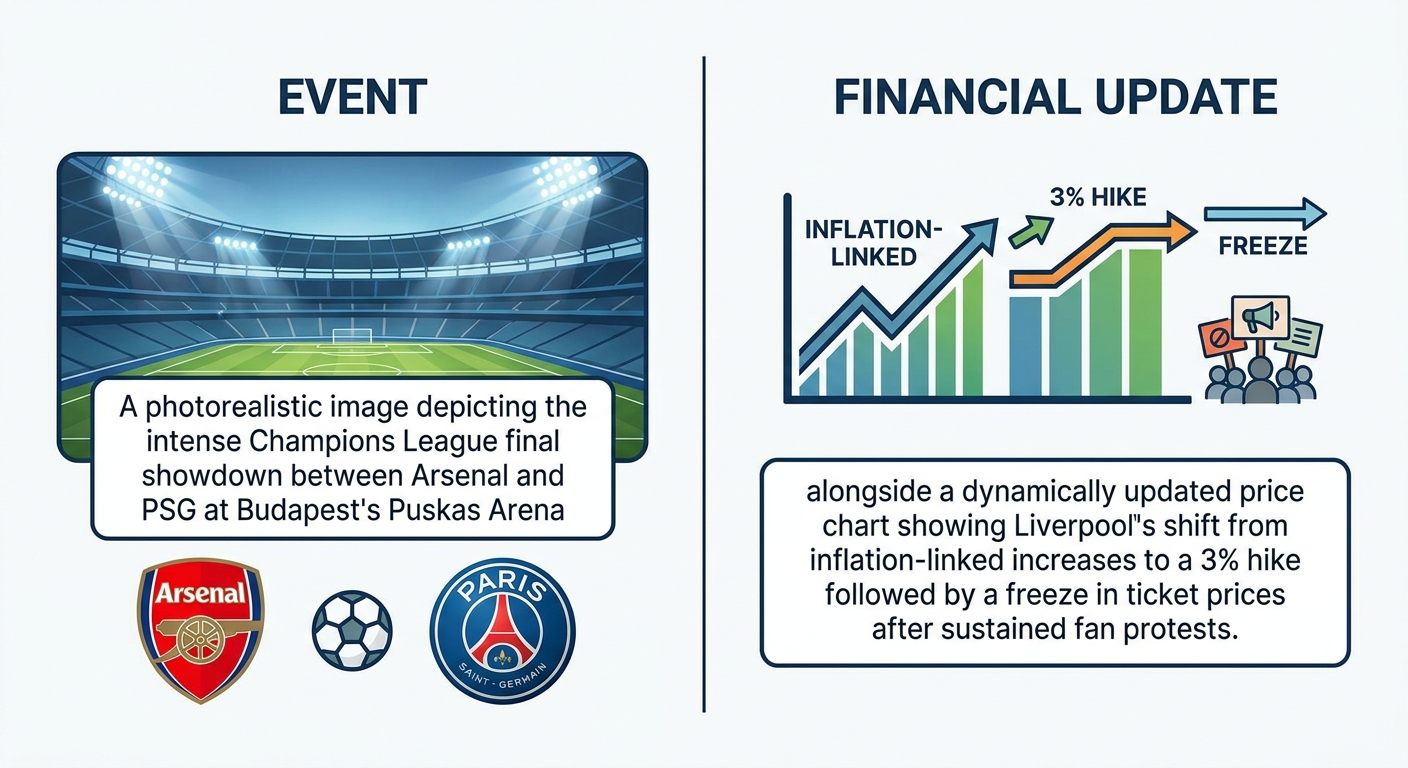
Simultaneously, Liverpool FC’s high-profile reversal of its inflation-linked ticket price increase — originally planned as up to 3% annually over three seasons but scaled back to a single 3% rise followed by a freeze — underscores the growing influence of coordinated fan activism. This policy shift reflects broader Premier League trends where the collective voice of supporters and formal governance mechanisms decisively shape commercial strategies. Together, the unfolding Champions League spectacle and Liverpool’s pricing case exemplify key tensions and evolving dynamics at the intersection of revenue growth, fan affordability, and stakeholder engagement in elite football.
Introduction
The 2026 UEFA Champions League final is poised to captivate the global football community as Arsenal confronts reigning champion Paris Saint-Germain (PSG) on May 30 at Budapest’s Puskas Arena. This milestone event transcends the immediate sporting stakes, encapsulating two decades of aspiration for Arsenal and PSG's ambition to solidify a nascent European dynasty. The final represents more than a match; it is a convergence of tactical philosophies, brand reinforcement opportunities, and significant financial implications that echo through the sport’s commercial and cultural landscape.
Concurrently, the football industry grapples with fundamental questions surrounding ticket pricing and fan accessibility, epitomized by Liverpool FC’s recent and unexpected policy reversal on season ticket price hikes. After announcing inflation-linked increases intended to secure approximately £1.2 million in additional annual revenue, Liverpool faced sustained and multifaceted supporter protests catalyzed by their Supporters Board and grassroots campaigns. The club’s subsequent retraction highlights a critical evolution toward fan-inclusive governance and challenges long-standing commercial paradigms.
This report aims to integrate these two parallel narratives — the sporting and logistical complexity of a premier event like the Champions League final and the ongoing recalibration of ticket pricing strategies within the Premier League. By examining the intricate balance between commercial imperatives and the authentic fan experience, this analysis offers insights relevant to club executives, policymakers, investors, and urban planners invested in football’s sustainable future. The scope encompasses tactical narratives, financial ramifications, fan engagement dynamics, and emerging governance models shaping 21st-century football.
Infographic Image: Infographic
1. The Grand Stage: Setting Up the Ultimate Showdown Between Arsenal and PSG
Historic Stakes and Financial Horizons in Arsenal vs PSG Champions League Final
This subsection establishes the critical historical and financial dimensions underscoring the 2026 UEFA Champions League final matchup between Arsenal and PSG. By contextualizing Arsenal’s return to Europe’s elite stage after two decades alongside PSG’s pursuit of consecutive titles, this analysis sets the foundation for understanding the sporting and commercial magnitude of the contest.
Arsenal’s Quest to End a Two-Decade Champions League Final Drought
Arsenal’s qualification for the 2026 Champions League final marks a seminal moment in the club’s history, representing its first appearance in the competition’s final in twenty years. This milestone follows a resilient campaign culminating in a tightly fought semi-final victory over Atlético Madrid. The Gunners’ defensive solidity, paired with clinical opportunism—exemplified by Bukayo Saka’s decisive strike—has distinguished this iteration from previous Arsenal European campaigns, offering a narrative of tactical maturity and progress.
Reaching the final is consequential not only for sporting pride, but for Arsenal’s standing in UEFA coefficient rankings which will influence future tournament seedings and qualification considerations. Moreover, this success enhances the club's brand positioning internationally, positioning Arsenal as a rejuvenated contender within Europe’s football elite and augmenting their financial appeal to sponsors and investors.
PSG’s Drive to Cement a Nascent European Dynasty
As reigning champions, PSG arrive at the 2026 final with ambitions to secure back-to-back Champions League titles, a feat last achieved by Real Madrid in the modern era. Their route to the final involved a pulsating aggregate win over Bayern Munich, characterized by potent counterattacks and strategic defensive discipline, highlighted by the opening goal from Ousmane Dembele and a resilient performance under sustained pressure.
PSG’s consistent European presence and growing trophy cabinet are bolstering the club’s global footballing stature and commercial interests. Success in this final would solidify PSG’s brand as a dominant force, reinforcing their value proposition to broadcasters and sponsors while enhancing their UEFA coefficient standing. This status underpins long-term financial projections that factor in prize money, merchandising boosts, and potential expansion of global fan engagement, particularly in emerging Asian and American markets.
Financial Implications and Brand Dynamics Shaping Both Clubs’ Futures
Progressing to the Champions League final generates immediate and substantial financial rewards, with UEFA prize distributions amounting to millions of euros, cumulatively enhancing club revenues from performance bonuses and broadcast share allocations. For Arsenal, reaching this stage secures an estimated prize money boost exceeding €46 million, encompassing incremental earnings for quarter-final, semi-final, and final qualifications. This injection supports both operational budgets and strategic investments in squad strengthening and infrastructure.
Beyond direct financial inflows, the final presents a pivotal branding opportunity for both Arsenal and PSG. The spotlight on this high-profile contest amplifies media exposure and marketability, facilitating expansion into key commercial territories via sponsorship deals and merchandise sales. Furthermore, enhanced UEFA coefficient impacts translate into more favorable future tournament positioning, which can sustain competitive and economic benefits. The final thus functions as a strategic inflection point, where sporting achievement intersects with long-term commercial trajectory.
Comparative Historical Narrative and Sporting Philosophies at the Pinnacle
The 2026 final’s narrative is steeped in contrasting legacies and tactical identities. Arsenal’s historical struggle to recapture European glory, last contested in 2006, contrasts sharply with PSG’s emerging dynasty centered on a star-studded roster and aggressive attacking ethos. Previous high-stakes encounters, including last season's semi-final clash won by PSG, add layers of rivalry and anticipation.
Strategically, Arsenal’s defensive resilience and pragmatic approach aim to counter PSG’s potent offensive machinery, led by dynamic players like Dembele. This confrontation represents more than a final; it embodies a clash between defensive discipline and attacking flair, reinforcing the match’s symbolic significance and sporting intrigue. These dimensions enhance the narrative value and global interest, further elevating the event’s commercial and cultural importance.
Having articulated the historic and financial stakes elevating the Arsenal-PSG final, the report naturally progresses to the practical realities of staging this global event, addressing logistical considerations and fan experiences that underpin the broader spectacle.
Logistical Architecture of a Global Spectacle: Ticketing Dynamics, Broadcast Strategy, and Fan Sentiment around the 2026 Final
This subsection explores the complex logistical framework underpinning the 2026 Champions League final, balancing the operational necessities of ticket distribution and venue capacity with UEFA’s strategic broadcast decisions aimed at maximizing global reach. It also assesses how these factors interact with the lived experiences and perceptions of fans, thereby illustrating the tensions between global commercial optimization and localized supporter satisfaction that are emblematic of contemporary elite football events.
Dissecting Ticket Allocation: Who Gets Access to the Limited Seats?
The Puskas Arena’s capacity of 67,215 establishes an upper limit that necessitates careful allocation among stakeholders for such a high-demand event. Arsenal supporters receive a prioritized allocation of 16,824 tickets, which constitutes approximately 25 percent of total capacity. From this tranche, priority is given to fans demonstrating substantial engagement through attendance at qualifying fixtures, effectively rewarding consistent patronage rather than casual interest.
In contrast, the broader public ticket availability remains highly constrained, with roughly 4,600 tickets released on a general sale basis, representing less than 7 percent of total stadium capacity. This sharply limited supply exacerbates accessibility challenges and drives intense competition, resulting in significant disappointment among longstanding Arsenal season-ticket holders. PSG ticket allocations, while not explicitly quantified here, adhere to similarly restrictive distributions focused on club members and partners, reflecting UEFA’s calibrated approach aimed at preserving exclusivity and managing crowd demographics.
Such a tiered system of distribution reflects the interplay of commercial imperatives and fan loyalty considerations, yet it inevitably channels scarcity into heightened demand, contributing to secondary market inflation and raising questions about equitable access for the traditional fan base.
Broadcast Timing and Market Reach: Navigating the Trade-offs of a 5 PM BST Kickoff
UEFA’s decision to move the final kickoff earlier from the traditional 8 PM BST to 5 PM BST reflects a deliberate strategy to capture an expanded viewership within the lucrative Asian markets, aligning match times with prime viewing hours across multiple time zones. This shift is projected to significantly uplift global television ratings, enhancing broadcasting rights value and sponsorship appeal by increasing the potential audience size during peak engagement windows.
Market analyses suggest the earlier timing could boost Asian viewership metrics by upwards of 15 to 20 percent compared to previous finals, thereby reinforcing UEFA’s commercial positioning in an increasingly multimodal media environment. However, this adjustment introduces friction with local fan experience, particularly affecting stadium attendees and UK-based supporters who must reconcile altered travel arrangements and reduced evening flexibility.
Survey data from fan groups indicate mixed reactions: while acknowledging the necessity of global market expansion, many supporters express frustration over reduced matchday atmosphere due to earlier match completion times and the inconvenience posed by adjustments to traditional pre- and post-match routines. This ambivalence underlines the challenge of harmonizing global broadcast optimization with preserving the authentic and communal elements fundamental to live attendance.
Fan Experience Amidst Logistical Constraints: Sentiments on Ticket Access and Scheduling
Empirical insights reveal that the scarcity of tickets available through official channels has left a substantial portion of eligible Arsenal fans unsupported, fostering disenchantment within core supporter groups. The reliance on attendance-based eligibility windows and balloting mechanisms, though designed for fairness, has intensified the sense of exclusion among those with longstanding affiliations who nevertheless fail to secure tickets due to high demand.
Moreover, the earlier kickoff complicates local transportation and accommodation plans, with reports citing increased costs and logistical hurdles. Though not part of ticketing per se, these factors compound the overall fan burden, serving as indirect barriers that may suppress attendance enthusiasm.
Such dynamics are illustrative of broader tensions in elite football events wherein efficient operational models that maximize broadcast exposure and commercial yield frequently clash with grassroots supporter expectations. UEFA’s current logistical design prioritizes global audience scale, yet the resulting local fan dissatisfaction underscores the need for innovative frameworks to reconcile these sometimes competing priorities.
Having delineated the intricate logistical architecture that shapes the Champions League final’s global spectacle through ticketing allocations, broadcast scheduling, and fan reception, the report now turns to the human dimension off the pitch. The subsequent section contextualizes the financial and operational challenges faced by traveling supporters, examining how economic and infrastructural constraints influence fan participation and experience in this landmark event.
Pathways to Glory: Contrasting Semifinal Strategies and Key Player Impacts in Arsenal-Atletico and PSG-Bayern Clashes
This subsection delves into the specific tactical journeys and player contributions that propelled Arsenal and PSG to the 2026 UEFA Champions League final. It serves to unpack the strategic diversity underlying each club’s path, providing critical insights into differing philosophies that shaped their semifinal successes. By comparing Arsenal’s defensive resilience and tactical pragmatism against Atletico Madrid’s disruption agenda, alongside PSG’s attacking dynamism versus Bayern Munich’s technical prowess, the analysis sets the stage for understanding the climactic final showdown.
Granular Analysis of Arsenal’s Defensive Architecture and Transitional Gameplay Versus Atletico Madrid
Arsenal’s route to the final was characterized by a disciplined defensive framework meticulously orchestrated by Mikel Arteta. Operating predominantly in a 4-3-3 system, the Gunners deployed a high defensive line combined with rigorous high pressing, designed to compress Atletico Madrid’s transitional opportunities. Central to this setup was the Rice–Zubimendi midfield axis, which emphasized controlling Atletico’s long-ball threats and deep runs from key attackers such as Julián Álvarez and Giuliano Simeone. Arsenal’s tactical discipline was evident in limiting Atletico’s counter-attacks, compelling the Spanish side to sustain possession under intense pressure, thereby disrupting their preferred rapid transitions.
The structure reflected a balance between risk mitigation and offensive initiative; Arsenal sought early breakthroughs to then consolidate possession, avoiding susceptibility to Atletico’s famed resilience. This approach manifested in a narrow 2-1 aggregate victory, underpinned by Bukayo Saka’s decisive first-half strike. Defensive organization remained paramount, with Arsenal conceding an average of less than a goal per game during their Champions League campaign. High pressing intervals forced turnovers and allowed Arsenal to maintain territorial dominance, while compact positional play mitigated Atletico’s usual unpredictability.
Atletico Madrid’s tactical response, meanwhile, adhered to their well-established strategy of disruption and counter-attacking. Their defensive shape involved flexibility between 4-4-2 and 4-2-3-1 formations, prioritizing central compactness and athletic pressing, yet their offensive potency was statistically their strongest in recent years, exceeding 35 goals this season. Despite an aggregate defeat, Atletico’s ability to exploit fleeting spaces and counter swiftly remained a central threat that Arsenal had to meticulously neutralize.
Key Performers and Tactical Nuances in PSG’s Semifinal Triumph Over Bayern Munich
Paris Saint-Germain’s semifinal victory over Bayern Munich showcased a blend of technical excellence and tactical adaptability that tipped a high-scoring aggregate battle in their favor. The first leg at Parc des Princes was emblematic of PSG’s attacking philosophy, with Ousmane Dembélé and Khvicha Kvaratskhelia each netting twice, leveraging their pace and positional intelligence to dismantle Bayern’s defensive lines. PSG’s offensive fluidity was matched by moments of defensive vulnerability, conceding four goals, but their capacity to outscore allowed a narrow 5-4 victory that set the tone for the return leg.
In the Allianz Arena, PSG’s early third-minute goal by Dembélé placed immediate pressure on Bayern, whose attempts at a comeback were stifled by a resilient Parisian defense that absorbed late aggression effectively. Despite Harry Kane’s stoppage-time equalizer, PSG advanced with a 6-5 aggregate, a testament to their efficient blend of high-tempo attack and measured defensive resilience. Notably, PSG’s ability to manage game phases—pushing aggressively early and locking down defensively in critical moments—illustrated their tactical maturity under coach Luis Enrique.
Key player contributions extended beyond goal scorers. The midfield’s tactical positioning curtailed Bayern’s rhythm, while strategic substitutions sustained intensity levels. The aggregate scoreline reflected not only individual brilliance but cohesive team synchronization between attacking initiative and defensive discipline. Conversely, Bayern’s renowned technical style, which had propelled them to multiple recent European triumphs, faced constraints confronting PSG’s proactive pressing and swift forwards.
Expert Commentary Contextualizing the Tactical Divergence and Strategic Implications
Post-match analyses from leading pundits and former professionals highlight the stormwater nature of the contrasting semifinal ties. Arsenal’s journey is frequently described as a ‘battle of attrition’ against Atletico’s physicality and pragmatic game management. Tactical discipline and structural solidity underpinned their path, emphasizing control over aesthetic flair. Such an approach aligns with evolving top-level football trends, where efficiency in defense complements opportunistic offence.
In contrast, PSG-Bayern presented a ‘technical masterclass’ underscored by attacking verve and end-to-end action. Observers note PSG’s strategic adjustments across both legs, leveraging early goal advantages with calibrated pressure management to negate Bayern’s late surges. Player performances, particularly from Dembélé and Kvaratskhelia, were lauded for decisive influence on game outcomes, while Bayern’s inability to fully capitalize despite numerous chances was emphasized as crucial.
These expert insights underscore distinct philosophical pathways—the measured pragmatism of Arsenal versus PSG’s expressiveness—each capable of yielding success at the highest stage. Their tactical variance also reflects broader competitive dynamics within European football, where adaptability and situational intelligence increasingly dictate outcomes of critical matches.
Having dissected the semifinal pathways and strategic contrasts that define Arsenal and PSG’s ascendance, the report moves forward to examine the larger human and commercial context surrounding the Champions League final. This includes the logistical challenges faced by supporters and broader economic considerations tied to the event’s global scale.
2. Beyond the Pitch: The Human Experience of Attending Football's Greatest Event
Financial and Logistical Hurdles Challenging Arsenal Fans’ Champions League Final Journey
This subsection delves into the multifaceted economic and logistical challenges confronting Arsenal supporters striving to attend the 2026 UEFA Champions League final in Budapest. By quantifying travel demands, dissecting accommodation cost volatility, and evaluating alternative travel solutions, it contextualizes the fan experience beyond the pitch, highlighting systemic pressures that affect accessibility and supporter participation in global football spectacles.
Scale and Economic Impact of Arsenal Fans’ Travel Demand to Budapest
With Arsenal reaching their first Champions League final in twenty years, an unprecedented surge in fan demand for travel to Budapest has emerged. The club’s official ticket allocation stands at 16,824, but vocal support within the fan base calls for a mass presence estimated at 200,000 individuals, illustrating that actual travel demand far exceeds available stadium capacity. This disparity places immense pressure on transportation infrastructure and services, compelling fans to compete for severely limited travel options.
Direct flights from London to Budapest on or near May 30 command prices up to £1,500, a stark increase from standard fares and reflective of demand-driven pricing models employed by airlines. The necessity for early booking and alternative routing fuels a complex market where basic affordability poses a significant barrier for many supporters. Consequently, hundreds of supporters are facing financial demands that may deter participation, underscoring a challenging intersection between fan enthusiasm and economic reality.
Accommodation Price Volatility and Its Impact on Accessibility
Hotel accommodation in Budapest on the night of the final has seen unprecedented price surges, with analyses revealing costs exceeding eighteen times the normal rates for comparable dates. For example, double rooms at centrally located hotels such as the Expo Tower Hotel and Bohem Art Hotel reach prices upwards of €1,400, compared to baseline prices of approximately €70 on adjacent nights. This intense inflation extends beyond individual hotels, with the near-complete saturation of available rooms driving a citywide accommodation scarcity.
Such inflated pricing effectively excludes a large segment of the fan base from securing proximate lodging, forcing many to either absorb disproportionate costs or explore lodging options outside the city center. The financial strain is not merely a function of individual choice but a consequence of market mechanisms responding to event-driven supply-demand imbalances, jeopardizing inclusivity and heightening socio-economic disparities among traveling supporters.
Alternative Transportation and Accommodation Strategies to Mitigate Costs
In response to prohibitive airfare and hotel costs, Arsenal supporters have innovated pragmatic travel solutions. Indirect routes involving flights to nearby cities combined with onward train journeys have become a viable alternative to direct flights, often reducing costs substantially albeit at the expense of increased travel time and logistical complexity. For instance, night trains originating from Bucharest offer an overnight transit option closer to Budapest, enabling fans to bypass peak flight prices.
Additionally, shared lodging initiatives emerging among fan groups aim to distribute accommodation expenditures by securing collective rentals or staying outside Budapest’s core urban zones. More unconventional alternatives, such as coach travel from London, priced as low as £339 for a return trip, present further opportunities for cost reduction. While these strategies broaden access, they demand heightened coordination, resilience, and temporal flexibility from supporters, reflecting the multifaceted challenge of balancing fan presence with pragmatic constraints.
Having established the significant financial and logistical burdens borne by traveling supporters, the report will next explore how global broadcast scheduling choices and local economic impacts compound the complexities faced by fans and host cities alike, framing the human experience of attending the final within a broader socio-economic context.
Global Broadcast Imperatives Clash with Local Economic Realities and Fan Access in Budapest
This subsection situates the Champions League final’s global broadcast scheduling choices alongside the economic and experiential consequences for Budapest’s local economy and the attending fan base. It critically examines the interplay between UEFA's commercial priorities, particularly the drive to capitalize on Asian markets, and the tangible impacts borne by local stakeholders — both fans and the city — offering insights into the complex balancing act behind hosting global sporting spectacles.
UEFA’s Asian Broadcast Strategy and the Premature Kickoff Time
UEFA’s advancement of the 2026 Champions League final kickoff from the traditional evening slot to 5 PM BST represents a calculated effort to capture and maximize viewership across the Asian market, aligning with the significant financial contributions from this region’s broadcast revenues. This scheduling move, endorsed by UEFA’s president, underscores a broader institutional prioritization of expanding the sport’s commercial footprint in time zones yielding substantial media and sponsorship income.
The decision to stage the final at 9:30 PM IST exemplifies the tradeoffs intrinsic to global football broadcasting: facilitating prime viewing slots for high-value international audiences invariably reshapes local fan experience patterns and match-day atmospherics. Despite claims of enhancing the overall matchday experience, this adjustment privileges broadcast rights monetization over traditional European local fan routines.
Economic Windfall and Strains on Budapest: Hosting Europe’s Premier Football Event
Hosting the Champions League final infuses Budapest with an economically consequential influx of visitors, yet the local financial benefits must be parsed carefully. While the city’s tourism and service sectors stand to gain from the thousands descending on the Puskas Arena precinct, the concentrated demand intensifies pressure on infrastructure, accommodation availability, and public services.
Economic assessments from comparable international events highlight that while direct visitor spending can reach impressive sums — often millions of euros — these gains coexist with disruptions and localized cost inflation. Budapest faces a familiar challenge: leveraging the event’s economic promise while managing logistical bottlenecks, elevated prices, and community impact. The disparity between transient event-related spending and sustainable urban economic development remains a core concern for policymakers.
Disproportionate Economic Burden on Local Fans Compared to Global Audience Benefits
Data on ticket allocations illustrate the paradox of limited direct benefits for dedicated local supporters against a backdrop of vastly amplified global consumption. Arsenal fans, allocated fewer than 17,000 tickets from a 67,000-seat stadium, contend not only with restricted access but also exorbitant travel and lodging expenses driven by event-induced local scarcity and price surges.
The significantly higher costs—flights surging beyond £1,500 and one-night hotel rates multiplying eighteen-fold—place substantial financial barriers on the core community of match attendees. This underscores a tension between globalized commercial imperatives, which leverage broad-reaching broadcast deals, and the localized realities of fan affordability and accessibility.
Moreover, compared to the millions potentially garnered from Asian broadcast markets, the economic burden weighing on the local fan base and Budapest’s residents accentuates structural inequities inherent in event economics. Local ticketing availability further compounds this imbalance, fueling frustration and raising questions about equitable fan inclusion.
Ticket Distribution and Access: Local Versus International Fan Equity
UEFA’s ticket allocation framework for the final affords Arsenal supporters a minor fraction of stadium capacity, with only approximately 4,600 tickets designated for general public sale beyond priority season-ticket holders. This severely restricts grassroots fan attendance, intensifying reliance on secondary markets with inflated prices.
The rigid, eligibility-based ticket distribution system, intended to prioritize committed fans, nevertheless results in large numbers of loyal supporters being priced out or excluded, as demand vastly outstrips supply. This limited accessibility stands in contrast to the global broadcast reach facilitated by the new kickoff timing, spotlighting a misalignment between commercial globalization and local supporter engagement.
The scarcity of tickets available locally may also depress in-stadium atmosphere and heighten security concerns by concentrating fewer die-hard local fans within a predominantly international or neutral crowd.
Having examined how broadcast-driven scheduling and economic factors create a complex and often inequitable environment for local fans and Budapest’s community, the report next turns to the micro-level fan experience. The following section explores the financial and logistical hurdles Arsenal supporters face traveling to the final, offering a grounded perspective on the human cost behind the spectacle.
3. The Power of Collective Voice: Liverpool's Ticket Pricing Policy Reversal
From Inflationary Hikes to Strategic Retreat: Mapping Liverpool’s Ticket Pricing Protest and Policy U-Turn
This subsection traces the complete chronology of Liverpool FC's ticket pricing controversy, detailing the timeline from the initial announcement of multi-year inflation-linked rises to the eventual retraction following sustained fan protests. By quantifying the financial stakes and documenting the scale of supporter mobilization, this analysis illuminates how grassroots activism exerted decisive influence over executive decision-making. It establishes a foundational understanding of the events that critically shaped Liverpool’s commercial and community strategy, pivotal for comprehending broader institutional responses to fan-driven pressures in modern football.
Critical Timeline: Liverpool's Ticket Price Increase Announcement and the Escalating Fan Response
Liverpool FC initially unveiled a controversial ticket pricing strategy in March 2026 that projected annual general admission price increases capped at 3%, aligned with inflation forecasts, planned for three consecutive seasons through 2028. This represented a marked departure from previous operational norms by locking fan costs to inflation, which risked cumulative season ticket price rises approaching £100 by 2028. The club justified this policy primarily on the grounds of sharply rising operational costs at Anfield, including an 85% increase in expenses, attributing the need for steady revenue growth to these financial realities.
Almost immediately, the announcement provoked a robust backlash across multiple strata of the Liverpool supporter base. Organized groups, including Spirit of Shankly and Spion Kop 1906, galvanized coordinated protest campaigns. These included highly visible demonstrations during home Premier League matches against Fulham and Crystal Palace, where thousands of fans employed symbolic yellow-card displays within the stands to signal their dissent and direct their grievances explicitly at the ownership group, Fenway Sports Group. Protests escalated in magnitude and frequency, spreading to outside Anfield with campaign vans deployed around Liverpool and fan mobilization intensifying rapidly over a matter of weeks.
This groundswell of opposition was underpinned by a growing concern among fans that the multi-year policy would erode accessibility and affordability, threatening the inclusive ethos historically underpinning fan participation at Liverpool's matches. The protests notably persisted despite initial club engagements with fan leaders, indicating widespread dissatisfaction beyond official supporter organizations. The multifaceted activism demonstrated the breadth and depth of fan resistance, combining in-stadium visual actions, digital campaigns, and public presence throughout the city, substantially raising the profile and pressure on Liverpool’s management.
Quantifying the Financial Stakes and Fan Mobilization Scale
Financially, Liverpool anticipated the pricing policy would yield approximately £1.2 million of incremental ticket revenue annually, supplementing a robust £120 million ticket income base from the prior fiscal year, which already reflected a 27% increase year-on-year, bolstered by stadium expansion and operational modernization. The new pricing model projected consistent rises with potential season ticket increases ranging from £21.50 to £27 for the upcoming 2026-27 season, escalating further in subsequent seasons tied to inflationary pressures.
From the fan mobilization perspective, protest participation figures were significant and sustained. The ‘Not a Pound in the Ground’ campaign mobilized thousands of supporters across multiple home games, with organized group participation cutting through traditional supporter demographic lines, incorporating diverse ethnic, gender, age, and disability representations. Visual protests were amplified at the Crystal Palace fixture, where yellow cards flooded the stands in the 13th minute symbolizing dissent. Additional protest elements included strategic calls to boycott spending within the stadium and delayed season ticket renewals, tactics designed to exert economic pressure on the club. The intensity of these actions conveyed a clear message of collective opposition with high organizational coordination.
Liverpool’s Supporters Board, representing a cross-section of the club’s fan base, expressed deep concern publicly regarding the policy. Their role as formal fan liaisons elevated the protest voices into structured dialogue with club executives, ensuring activists’ concerns could not be dismissed as fringe opposition. This institutional fan representation was instrumental in maintaining momentum while providing a channel to escalate discussions, an essential factor contributing to the eventual policy reversal.
Revised Policy Announcement: Analyzing Liverpool’s Strategic Retraction and Future Engagement Plans
Under mounting pressure and facing escalating protests, Liverpool publicly announced a policy revision on May 7, 2026. The club confirmed a partial retreat from its original three-year inflation-linked ticket price increase plan, committing instead to a limited 3% ticket price rise for the 2026-27 season followed by a complete freeze in 2027-28. This represents an immediate truncation of the incremental revenue trajectory, signaling a willingness to balance commercial objectives with fan affordability concerns.
The club attributed the change to ongoing dialogues with the Supporters Board and committed to co-developing longer-term, sustainable solutions addressing ticket affordability and accessibility. This approach emphasized exploring alternative revenue streams rather than relying exclusively on incremental ticket price increases. Club leadership publicly acknowledged the impact of operational costs but recognized the need for accountability and responsiveness to fan sentiment, a significant shift reflecting the potency of organized supporter influence.
This policy reversal sets a notable precedent within the Premier League context, where Liverpool joins a growing wave of clubs reevaluating pricing strategies in the face of fan activism. By circumventing a locked-in multi-season price model, Liverpool preserves strategic flexibility and signals an evolving governance model more attuned to fan engagement. The revised approach has garnered tempered praise among supporters, emphasizing a renewed trust and potential for collaborative future policymaking while acknowledging lingering dissatisfaction over the immediate 2026-27 price increase.
Having mapped the detailed trajectory of Liverpool's ticket pricing protests culminating in a pragmatic policy reversal, the report will next explore the mechanisms through which fan activism effectively translated into institutional responsiveness. This sets the stage to analyze the broader implications for corporate governance and supporter influence in shaping football’s commercial future.
Mechanisms of Stakeholder Influence: How Fan Activism Shapes Corporate Decisions
This subsection delves into the structural and practical dynamics through which Liverpool fans translated collective discontent into tangible policy change. By dissecting the formal governance pathways alongside the diverse and effective protest strategies employed, it illuminates the process that enabled fan activism to penetrate club decision-making. This analysis provides a critical counterpoint to the commercial logic outlined elsewhere, offering actionable insights into how stakeholder engagement mechanisms can recalibrate football’s pricing policies.
The Supporters Board: Composition, Mandate, and Influence within Liverpool FC
Liverpool’s Supporters Board functions as a constitutionally recognized liaison body designed to amplify diverse fan voices within the club’s governance framework. Its membership spans broad demographic and interest categories, including ethnic minority groups, disability representatives, LGBTQIA+ advocates, junior and women’s supporter segments, alongside geographical fan clusters such as international supporters and senior groups. This inclusivity ensures that policy feedback reflects a wide array of supporter priorities beyond simplistic majority rule.
Mandated to represent these voices formally, the Supporters Board holds consultative authority that, while not uniformly decisive, exerts measurable pressure on the club’s executive layer. Its engagement throughout the ticket pricing controversy included coordinated dialogue with Fenway Sports Group decision-makers, facilitating a transparent feedback loop. The Board’s ability to present unified positions bolstered its leverage, distinguishing it from fragmented fan protests and catalyzed sustained negotiation processes.
Quantitative and Qualitative Effectiveness of Diverse Protest Modalities
Liverpool supporters deployed a multi-pronged activism strategy combining symbolic visual protests, grassroots campaigns, and digital mobilization, creating a potent collective voice. The 'Not a Pound in the Ground' campaign epitomized this approach, with fans turning Anfield’s stands into a sea of yellow cards symbolizing dissent against the planned price hikes. Such visible, nonviolent demonstration at a marquee venue generated substantial media attention and brought immediate reputational costs to the club leadership.
Data on the chronology and scale of the protests reveal rapid escalation in fan participation and public visibility following the initial multi-year pricing announcement. The widespread coordination across multiple independent supporter groups amplified pressure points by localizing the issue in match-day atmospheres and sustaining momentum via social media campaigns. This combination of qualitative symbolism and quantitative breadth heightened a sense of urgency within club management, directly contributing to the accelerated timeline of policy revision.
Channels and Dynamics of Direct Communication Between Fans and Club Management
The pre-existing institutional channels between Liverpool fans and club executives, primarily mediated through the Supporters Board, proved crucial in translating protest energy into policy reconsideration. These channels facilitated iterative consultations that balanced express fan grievances with operational realities communicated by management, fostering a dialogue that avoided escalation into divisive confrontation.
Notably, the willingness of Fenway Sports Group to engage constructively reflected an organizational recognition of both reputational risks and financial implications inherent in ignoring fan dissent. The ensuing negotiation process saw commitments to pause inflation-linked increases and prioritize alternative revenue avenues, acknowledging fan input as a legitimate factor in commercial decision-making. The transparent public articulation of ongoing dialogue further legitimized the process and empowered fan representatives.
Digital Mobilization: Scope, Reach, and Impact of Online Campaigns
Liverpool fans leveraged digital platforms extensively to coordinate activism, disseminate campaign narratives, and build solidarity across geographically dispersed supporter bases. Social media hubs facilitated rapid information sharing, strategic planning for protests, and recruitment of new participants, transcending traditional barriers of communication that previously limited fan organizing effectiveness.
Metrics on engagement reveal broad online traction, with campaign hashtags and video content achieving high levels of visibility and interaction, connecting with both domestic and international audiences. This digital amplification not only increased external pressure on club stakeholders but also enhanced internal fan morale, reinforcing a sense of collective agency. The effective use of online tools exemplifies modern evolved protest tactics capable of delivering sustained, influential stakeholder voices.
Having detailed how Liverpool’s fans organized strategically to influence club policy through formal governance structures and multifaceted activism, the subsequent analysis will place this episode within the broader Premier League context. It will examine how Liverpool’s experience signals a potential inflection point in the balance between commercial imperatives and community values across English football.
Commercial Imperatives Meets Community Values: Navigating Ticket Pricing Tensions and League-Wide Trends
This subsection situates Liverpool’s ticket pricing policy reversal within the broader economic and sociopolitical context of Premier League football. By comparing league-wide regulation frameworks, collective fan mobilizations, and evolving pricing strategies of major clubs, it draws out the complex interplay between commercial growth ambitions and grassroots supporter demands. These dynamics highlight how Liverpool’s decision both reflects and influences market-wide tensions over affordability and long-term engagement.
Premier League Ticket Price Caps: Regulatory Frameworks and Enforcement
The Premier League has maintained a £30 price cap on away tickets since 2016, a policy praised for enhancing traveling fan attendance and atmosphere. This cap was extended unanimously for an additional two seasons, reinforcing a sustained commitment to mitigating the financial burden on away supporters. Evidence indicates attendance at away matches increased from 82% pre-cap to 91%, underscoring the policy’s effectiveness in preserving fan inclusivity across stadiums. While the cap on away tickets is firmly institutionalized, no corresponding ceiling exists for home match ticket prices, leading to a significant disparity in fan affordability depending on supporter location and club policies.
Enforcement mechanisms rely primarily on club-level compliance, with the Premier League overseeing adherence through shareholder oversight and public accountability. Supporters’ organizations and the Football Supporters’ Association (FSA) have played a vital role in monitoring and campaigning for these caps, creating pressure on the league and clubs to uphold them. However, the absence of a home ticket price cap has contributed to escalating costs for local fans, prompting numerous fan-led movements advocating for similar restrictions in that domain.
Fan Mobilization and Collective Demands: The Rising Call for Home Ticket Price Freezes
More than 100 organized fan groups across the Premier League have recently united to call for a freeze on home ticket prices for the 2026-27 and 2027-28 seasons, channeling growing dissatisfaction with inflated pricing amidst broader economic pressures. This collective action signifies an unprecedented level of coordination among supporters, emphasizing shared concerns about affordability and accessibility beyond travel-related costs.
Liverpool’s fan campaigns have been particularly emblematic of this movement’s potency. The 'Not a Pound in the Ground' initiative galvanized visible stadium protests and media attention that effectively pressured club management to reconsider initial inflation-linked pricing plans. Similar grassroots activism at other clubs mirrors this trend, signaling a shift towards more empowered fan bases capable of influencing club governance.
These coordinated campaigns underscore the increasing political agency supporters wield, forcing clubs to confront not only economic considerations but also their social license to operate. They represent a counterbalance to commercial strategies aimed at revenue maximization, reshaping the negotiation landscape between clubs and fans.
Financial Tradeoffs and Revenue Impact: Weighing Short-Term Gains Against Fan Loyalty
Premier League 'Big Six' clubs experienced a near 20% uplift in ticket revenue from the 2023/24 to 2024/25 seasons, driven largely by increased home ticket prices amid slowing broadcast growth. For Liverpool, the proposed multi-year inflation-linked increases were projected to yield an additional £1.2 million, reflecting clubs’ strategic reliance on match-day income as a significant revenue pillar.
Nonetheless, this pursuit has sparked protests and threatens to erode the traditional fan base as long-standing supporters may face exclusion due to financial pressure. The resulting fan alienation risks diminishing stadium atmosphere, brand loyalty, and long-term matchday revenue sustainability. Research also suggests that while premium pricing captures immediate financial benefits, sustained fan disaffection can undermine franchise equity by diluting the club’s cultural capital and emotional resonance within its core constituency.
Liverpool’s subsequent retreat—limiting ticket hikes to 3% followed by a price freeze—illustrates a critical commercial recalibration acknowledging the strategic value of supporter goodwill. This move implicitly recognizes that balancing revenue objectives with fan retention is essential to maintaining a stable and passionate supporter community.
Comparative Insights from Premier League Peers: Divergent Club Strategies and Emerging Market Signals
Among Premier League heavyweights, approaches to ticket pricing vary considerably. While some clubs like Sunderland are planning double-digit percentage hikes, others such as Manchester City and Nottingham Forest have froze prices for 2026-27, reflecting attempts to preserve affordability amidst fan pushback. Man City’s management notably intervened to prevent price rises after consultations with supporter boards, suggesting a growing recognition of fan influence within institutional decision-making.
Such disparities highlight that clubs are experimenting with differentiated models, balancing commercial imperatives against local fan economics and competitive positioning. The degree of transparency and supporter engagement in these decisions correlates strongly with fan base satisfaction and protest levels.
Liverpool’s strategy now functions as a market bellwether: a leading club publicly acknowledging fan concerns and moderating pricing signals a potential inflection point for the Premier League as a whole. This pivot may encourage other clubs to adopt more nuanced pricing strategies that integrate fan tolerance thresholds and loyalty preservation as core metrics.
The evolving equilibrium between market-driven ticket pricing and robust fan advocacy demonstrated by Liverpool’s policy shift offers a critical lens for understanding football’s future commercial governance. This tension sets the stage for the final section, which synthesizes these insights to propose integrated models that reconcile revenue maximization with supporter inclusion, offering actionable frameworks for clubs, leagues, and policymakers alike.
4. Synthesis: Where Competition Meets Community in Modern Football
Mastering the Balance: Navigating Revenue Growth While Safeguarding Fan Affordability in Premier League Football
This subsection critically examines the tension between clubs’ pursuit of maximized matchday revenue and the imperative of maintaining affordable access for their core supporter base. Positioned within the broader synthesis of commercial and community dynamics in modern football, it delivers evidence-based insights into pricing elasticity, fan behavioral responses, and strategic pricing frameworks that integrate supporter involvement. By dissecting empirical data and stakeholder engagement models, this analysis equips decision-makers with actionable frameworks for harmonizing financial objectives with sustained fan loyalty.
Disentangling Ticket Price Elasticity and its Strategic Implications for Fan Attendance
Empirical analyses from recent Premier League seasons reveal that ticket demand exhibits slight elasticity within the current pricing band. Attendance data indicate a price elasticity of demand near -1.14, signifying that a 1% increase in ticket prices tends to trigger a more than proportional 1.14% decline in matchday attendance. This elasticity underscores a critical threshold beyond which incremental price hikes risk undermining stadium atmosphere and long-term fan engagement.
Crucially, this dynamic is shaped not only by price but also by non-monetary factors such as fan loyalty, team competitiveness, and match significance. However, escalating ticket costs disproportionately affect traditional local supporters, whose emotional investment often exceeds that of affluent, occasional attendees. Sensitivity to pricing is compounded by stagnant income growth relative to ticket price inflation, constraining attendance especially among loyal fan segments.
Efficacy of Tiered Pricing and Targeted Discount Schemes in Sustaining Core Fan Engagement
Tiered pricing structures that differentiate between high-demand fixtures and lower-draw matches have demonstrated utility in expanding overall attendance while generating premium revenue during marquee games. Such models accommodate varied willingness to pay across fan segments, allowing clubs to capture surplus without uniformly burdening the entire supporter base.
Complementing tiered pricing, targeted discount programs—such as loyalty-driven incentives, early bird offers, and group sales—have proven moderately effective in bolstering attendance from core demographics. Evidence from analogous event industries suggests that well-calibrated promo campaigns can enhance repeat visitation and mitigate the adverse impact of price hikes.
Nevertheless, the positive effects of financial incentives are often modest and require precise framing. Behavioral economics research highlights the potency of loss aversion in fan decision-making; framing discounts as avoidance of price increases or losses tends to motivate attendance more reliably than framing as pure gain.
Integrating Fan Perspectives within Pricing Governance: Frameworks and Mechanisms
Recent developments exemplified by Liverpool's ticket pricing policy retreat illustrate the critical role of structured stakeholder engagement in the commercial governance of pricing decisions. The existence of formal supporter boards, incorporating diverse fan representatives, facilitates communication channels that translate grassroots concerns into club strategic deliberations.
Organizations that institutionalize fan input mechanisms—ensuring representation across socioeconomic, demographic, and experiential dimensions—achieve stronger legitimacy and mitigate reputational risks associated with perceived exploitative pricing. Such inclusivity aligns commercial objectives with the ethical imperative of community stewardship.
Operationalizing this integration often involves iterative dialogue, transparency in forecasting and pricing rationale, and co-creation of affordability initiatives. Clubs benefit from dynamic feedback loops enabling real-time adjustment of pricing strategies responsive to evolving fan sentiment and external economic conditions.
Financial Forecasting Sensitivity: Modeling the Impact of Pricing Adjustments on Revenue and Attendance
Robust financial models incorporating price elasticity data, fan segmentation attributes, and competitive landscape indicators allow clubs to simulate multiple pricing scenarios. Such sensitivity analyses reveal nonlinear tradeoffs wherein aggressive price increases may nominally boost short-term revenue but erode attendance and ancillary revenue streams, such as concessions and merchandise, in the medium term.
Stress-testing forecasts under optimistic and pessimistic demand assumptions enables decision-makers to identify resilient strategies that safeguard core income while maintaining fan goodwill. Hybrid models incorporating tiered pricing with selective discounting demonstrate improved balance by optimizing revenue capture across heterogeneous fan clusters.
An evidence-driven approach mandates continuous data collection—encompassing ticket sales, fan satisfaction surveys, and secondary market dynamics—to recalibrate forecasts and update pricing policies adaptively.
Having established a nuanced understanding of how pricing strategies impact fan attendance and revenue streams, alongside the critical role of incorporating supporter voices, the subsequent subsection explores emerging strategic opportunities. These innovations promise to transcend traditional ticketing paradigms and deepen fan engagement beyond match day, thereby expanding sustainable revenue avenues.
Harnessing Innovation: Personalized Hospitality, Augmented Reality, and Data-Driven Dynamic Pricing Transforming Fan Engagement
This subsection explores how modern football clubs and event organizers are strategically leveraging technological innovations and tailored service offerings to redefine revenue generation and fan interaction. Positioned within the synthesis section, it builds on understanding the commercial tensions elsewhere in the report by highlighting actionable opportunities that reconcile financial goals with enhancing the fan experience. These forward-looking insights aim to guide stakeholders seeking competitive advantage through innovative monetization and engagement models.
Tailored Hospitality Packages: Exclusive Experiences Driving Premium Revenues
Top-tier football clubs increasingly deploy personalized hospitality packages as a strategic lever to maximize matchday revenue while offering differentiated experiences that deepen fan loyalty. These packages commonly include premium seating in prime stadium locations combined with curated benefits such as complimentary food and drink, access to exclusive lounges, and opportunities for intimate engagements with current and former players. For example, packages offered by leading Premier League clubs provide tiers ranging from affordable premium seats under £100 to ultra-luxury experiences exceeding several hundred pounds per match, catering to diverse supporter segments and corporate clients alike.
The financial impact of these offerings is significant. Hospitality tickets capture higher margins than general admission and serve as critical value propositions for sponsors and business partners. The inclusion of player meet-and-greets or exclusive viewing areas further enhances appeal and willingness to pay, creating experiential differentiation difficult to replicate. Importantly, these packages can stabilize revenue streams against variable general ticket sales, especially during fixtures with fluctuating fan demand.
Augmented Reality Enriching Remote and In-Stadium Fan Experiences
Augmented reality (AR) technologies are emerging as powerful tools to bridge digital and physical fan engagement realms, delivering immersive, personalized interactions that elevate viewership and participation beyond traditional formats. Clubs and broadcasters have begun integrating AR features that overlay real-time player statistics, tactical information, and interactive content during live matches, accessible via mobile apps or stadium screens. This dynamic augmentation cultivates deeper fan involvement, enhancing understanding and emotional connection to the game.
Successful implementations have demonstrated that AR can foster fan motivation and sustained interest by enabling interactive learning and social sharing features. However, effective deployment depends crucially on technology quality and user experience design; high-fidelity AR applications that align with consumer preferences achieve higher adoption rates and engagement longevity. Noteworthy case studies include Manchester City's AI-enhanced mobile platforms that personalize content delivery based on fan behavior, complemented by stadium AR zones facilitating immersive communal experiences. These innovations signal pathways for clubs to monetize digital exclusives and maintain engagement during off-season or remote viewing contexts.
Data Analytics and Dynamic Pricing Models: Precision Revenue Optimization
Advanced data analytics underpin the growing adoption of dynamic pricing strategies in professional sports, enabling clubs to adjust ticket and hospitality package prices responsively to real-time demand signals, competitor pricing, and fan purchasing behaviors. This analytics-driven pricing endeavors to maximize revenue while maintaining market competitiveness and fan goodwill. By leveraging predictive models and price elasticity metrics, clubs can simulate scenarios to identify optimal pricing points that balance occupancy rates with yield management.
Dynamic pricing models are increasingly sophisticated, ranging from algorithmic adjustments in near real time to more manual, executive-driven price revisions. Flexible pricing systems allow for premium charges during peak-demand events and targeted discounts for less attended fixtures or supporter segments sensitive to affordability. Crucially, integration with customer relationship management tools facilitates segment-specific communications, increasing transparency and perceived fairness. In practice, clubs employing dynamic pricing report measurable uplifts in matchday revenue, with case studies citing increases between 10–15% during peak periods. The ongoing challenge lies in balancing revenue ambitions with sustaining long-term fan loyalty, necessitating hybrid models that blend fixed pricing and dynamic elements strategically.
Hybrid Engagement Models: Combining Physical and Digital Touchpoints to Maximize Revenue and Loyalty
Emerging hybrid engagement models integrate in-person experiences with digital platforms to diversify revenue and deepen fan relationships. By offering tiered hospitality combined with exclusive digital content, clubs create multiple interaction points that cater to varying fan needs and consumption patterns. Subscription-based digital memberships, augmented AR experiences, and loyalty programs complement traditional ticket sales, extending the monetization horizon beyond matchdays.
These models have demonstrated effectiveness in enhancing lifetime fan value by enabling tailored, ongoing connections that respond to individual preferences and usage intensity. Business intelligence systems harness data from both physical and digital channels to optimize package offers and engagement initiatives, driving repeat sales and advocacy. As clubs continue refining these hybrid approaches, measurable outcomes include increased attendance, higher per-fan revenue, and more resilient brand loyalty in the face of market fluctuations.
Having detailed the innovative commercial and technological practices redefining fan engagement and revenue strategies, the next logical step is to integrate these insights with broader organizational frameworks. This will enable clubs and governing bodies to devise balanced approaches that harmonize competitive objectives with supporter-centric values, ensuring sustainable growth in football’s evolving landscape.
5. Conclusion: Charting Football's Future Trajectory Through Critical Junctures
Crossroads for Modern Football Governance: Fan Influence, Transparency, and Regulatory Momentum
This subsection synthesizes the converging pressures shaping football governance today, anchoring the discussion in concrete developments around ticket pricing, fan engagement, and emerging regulatory frameworks. Positioned at the conclusion of the report, it draws together the thematic tensions observed between commercial imperatives and supporter advocacy, highlighting governance innovations and regulatory responses poised to redefine club-fan relationships going forward.
Magnitude and Dynamics of Recent Ticket Price Hikes Among Leading Clubs
Across top football clubs, ticket price increases in recent seasons have reflected strategic attempts to balance rising operational costs with revenue growth. Notably, the 'Big Six' English clubs recorded an approximate 20% increase in ticket sale revenues during the 2024/25 season, signaling a pronounced commercial emphasis on matchday income as television revenue growth moderated. Specific cases illustrate contrasting approaches: Arsenal has enacted controlled hikes ranging between 3% and 5%, while Liverpool initially pursued an inflation-linked ticket pricing policy projected to raise season ticket costs by up to £100 by 2028 before reversing course amid fan protests. The scale and pre-announcement of multi-year hikes mark a significant shift in pricing practices, increasing visibility but also fan unease.
Liverpool’s original multi-year plan would have generated incremental ticket revenues growing from approximately £1.215 million in 2026-27 to nearly £1.259 million by 2028-29, underscoring the significant financial stakes behind the proposed increases. However, the subsequent freeze on prices for 2027-28 reflects a strategic recalibration in response to fan sentiment and competitive pressures [Chart: Projected Ticket Revenue Increase for Liverpool FC] [Table: Comparative Ticket Pricing Structure for Premier League Clubs].
This upward pricing trajectory raises questions about affordability and long-term supporter loyalty, particularly as rising expenses disproportionately impact traditional local supporters compared to wealthier matchday attendees or tourists. Clubs with newly expanded stadium sections, such as Liverpool's Anfield Road stand, leverage these assets for incremental revenue but face intensified scrutiny regarding sustainable fan inclusion.
Models of Fan-Governance Collaboration and the Rise of Co-Determination
In response to escalating fan discontent, a growing number of clubs have institutionalized formal mechanisms to incorporate supporter voices into governance, promoting co-determination and collaborative decision-making. Liverpool's Supporters Board exemplifies this trend by representing diverse fan constituencies—including marginalized groups delineated by ethnicity, gender, age, and disability—and functioning as a critical intermediary influencing club management discussions on ticket pricing and policy adjustments.
Beyond individual clubs, broader governance innovations echo frameworks from democratic theory and public administration, emphasizing participatory budgeting, deliberative forums, and social accountability mechanisms. Such innovations facilitate iterative feedback loops between fans and club executives, enhancing transparency and enhancing trust. European football governance debates increasingly advocate for democratic forums enabling direct fan input on pricing, stadium relocation, and major strategic decisions, recognizing that inclusive engagement mitigates alienation and preserves long-term club identity.
This evolution moves supporters beyond passive consumption toward active stakeholders, reflecting a recalibration of power dynamics that blends commercial calculation with social legitimacy.
Regulatory Advances and the Institutionalization of Fan-Centric Oversight
Concomitant with club-level innovations, regulatory institutions and policymakers are intensifying scrutiny over pricing practices and fan engagement commitments. Proposed legislation for an Independent Football Regulator aims to oversee financial sustainability, safeguard club heritage, and institutionalize supporter participation in pricing decisions, ensuring fans possess genuine input structures and periodic accountability reports.
Recent proposals call for systematic reviews of concessionary pricing to protect vulnerable demographics, and for transparency mandates requiring clubs to disclose ticket pricing rationales and stakeholder consultation outcomes. These measures acknowledge fan affordability as integral to football’s social fabric rather than an external nuisance. Enhanced governance standards are emerging within national associations and UEFA, encompassing ethical benchmarks, anti-exclusionary policies, and community engagement mandates.
Regulatory momentum reflects recognition that unchecked commercialization risks eroding traditional club communities and long-term fan loyalty, with institutional reforms designed to harmonize revenue goals with equitable access.
Evolving Fan Engagement Standards Shaping Governance and Commercial Strategy
Post-2025, fan engagement standards have transitioned toward heightened expectations for communication, responsiveness, and personalization. Clubs are leveraging digital platforms and artificial intelligence to monitor sentiment, predict demand elasticities, and tailor ticketing offers, simultaneously enhancing revenue and satisfaction metrics.
Community Relations Managers and Fan Advisory Boards assume pivotal roles in real-time issue escalation and resolution, supported by monitoring tools that trigger proactive interventions ahead of crises. This professionalization of fan relations reflects a shift from unidirectional marketing toward dynamic co-creation of club experiences.
The convergence of technological enablement with governance reforms suggests that transparency and accountability in pricing decision-making will become non-negotiable. Clubs increasingly recognize that fostering authentic relationships with supporters underpins sustainable financial models more effectively than unilateral commercial maximization.
Club Transparency Initiatives Driving Governance Recalibration
Several clubs have begun pioneering transparency initiatives aimed at elucidating ticket pricing methodologies, operational cost structures, and revenue allocation to stakeholders. By opening dialogue and disclosing the rationale behind cost increases, these initiatives aim to rebuild trust fractured by prior price hikes perceived as opaque or exploitative.
Transparency facilitates more nuanced assessments of clubs’ financial pressures versus fan capacity and willingness to pay, enabling development of tiered pricing and targeted concession schemes to protect core supporter segments. Public disclosure also subjects clubs to reputational incentives, incentivizing fairness and moderating excessive commercial ambition.
The shift toward mandated and voluntary transparency represents a foundation for emerging hybrid governance models that integrate corporate strategy with social stewardship, positioning clubs as accountable bastions of community identity while navigating modern revenue imperatives.
Taken together, the amplification of fan voices, institutional innovations in governance, and regulatory measures mark a watershed moment in football’s evolution. As clubs confront the dual imperatives of revenue optimization and supporter inclusivity, new governance paradigms emphasizing transparency, co-determination, and equitable pricing will likely dominate the sport's trajectory. This convergence calls for sustained dialogue among clubs, fans, and policymakers to craft resilient frameworks ensuring football’s vitality for generations to come.
Conclusion
The 2026 Champions League final symbolizes football’s continuous evolution at the nexus of sporting excellence, commercial expansion, and global fan engagement. Arsenal’s return to the pinnacle after two decades confronts PSG’s quest for a European dynasty, weaving tactical contrasts with profound financial and branding consequences. Yet the logistical realities surrounding fan access, ticket scarcity, and broadcast scheduling reveal tensions inherent in reconciling a truly global audience with localized supporter experience and inclusion. The final thus embodies both football’s universal appeal and its operational and ethical complexities.
Liverpool’s ticket pricing policy reversal exemplifies the burgeoning power of organized fan agency in shaping commercial decisions once considered incontrovertible. The interplay of grassroots activism, institutional representation via Supporters Boards, and digital mobilization demonstrates a new landscape of stakeholder influence. This case not only challenges assumptions about revenue optimization but delineates best practices for fostering trust and legitimacy through transparent, participatory governance. As fan grievances translate into tangible policy shifts, clubs must reconsider traditional revenue models to maintain long-term brand equity and community connection.
Collectively, these developments signal a critical juncture for football governance. Incorporating fan perspectives within pricing strategies, balancing data-driven revenue management with ethical stewardship, and evolving broadcast and hospitality innovations are imperative to harmonizing financial imperatives with supporter loyalty and accessibility. Regulatory momentum toward formalized oversight and co-determination mechanisms further crystallizes the need for transparent, inclusive practices. Football’s future viability depends fundamentally on sustaining this delicate balance—ensuring that commercial success does not eclipse the sport’s core communal and cultural essence.
Looking forward, clubs and governing bodies are tasked with embracing dynamic, evidence-based approaches that accommodate price sensitivities, deploy tiered and personalized engagement models, and leverage technological innovation to enrich fan experiences both in stadiums and digitally. By integrating diverse stakeholder voices and fostering resilient fan communities, football can navigate commercial pressures while preserving the authenticity and accessibility that underpin its global resonance. This dual pursuit defines the sport’s pathway beyond 2026, with lessons from today’s marquee events and critical policy shifts illuminating the road ahead.
References
- Champions League semifinals offer contrast of easy-on-the-eye PSG-Bayern and robust Atletico-Arsenal
- Martin Keown makes bold Arsenal Champions League final prediction
- Premier League extends £30 cap on away tickets
- The best Champions League travel routes for Arsenal fans as costs soar
- Arsenal secure huge Champions League prize money boost
- Where is Champions League final 2026?
- Why Liverpool ticket price rise protests matter to rival fans
- PDF FAN ENGAGEMENT PLAN - assets.ctfassets.net
- PDF Commercialization Strategies in Football
- World Cup: The biggest public transport rip-offs and bargains for fans
- Premier League supporters struggle to cope as clubs continue to raise prices | Flashscore.com
- Premier League fans feel the pinch from ticket price hikes as clubs target tourists
- Liverpool scrap controversial ticket pricing plans after protests
- Extra flights arranged to fly Arsenal fans to Champions League final
- Arsenal vs PSG UEFA Champions League final to kick off at new time as fans in India set for early game
- Arsenal v PSG: What you need to know about the Champions League final
- Private Equity Investments in the Sports Industry. E1 Series
- Premier League VIP hospitality tickets for Man United and Man City
- Liverpool announce U-turn on controversial ticket price policy after supporter protests
- Liverpool scrap plans over Anfield ticket prices rise following supporter protests
- How Arsenal fans can get tickets for Champions League final
- Liverpool: Premier League champions reduce planned ticket price rises after fan protests
- Liverpool reduce planned rise in ticket prices
- Champions League final 2026: Date, time, venue, & tickets for Arsenal vs PSG
- PSG vs Arsenal: Champions League final prediction, kick-off time, TV, live stream, team news, h2h results, odds
- EasyJet issue statement as prices soar for Champions League final
- Arsenal fans plan trips to Champions League final but face £1,500 flights or Bucharest night train
- PSG set up Champions League final against Arsenal
- Arsenal to face PSG in Champions League final after French side overcome Bayern Munich | The Independent
- Bayern Munich 1-1 PSG (5-6 agg): Holders to face Arsenal in Champions League final despite late scare
- Birmingham City provide full season ticket information and explain price rises - Birmingham Live
- Newcastle United season ticket prices versus all Premier League clubs as Sunderland top list | Chronicle Live
- Are World Cup Tickets Worth the Price Tag?
- Manchester United insist season-ticket price increases are ‘fair and reasonable’ | Manchester United | The Guardian
- Fans from four rival clubs to protest at ticket prices
- 'Revolution isn't cheap' warning given as Newcastle United ticket prices rise
- PDF The Economic Determinants of Spectator Turnout: An Investigation into ...
- The European Club Footballing Landscape
- Price Salience and Product Choice
- The Rising Cost of Race Day Tickets: Is Attending the Grand National Still Worth It?
- ⚽ Premier League Ticket Costs: Do Prices Affect Attendance? - OLBG.com
- Football clubs face ticket price warning as perfect storm could hit fans
- Premier League season ticket prices 2024/25 and how Newcastle's compares after 5% hike
- Arsenal’s win over Atleti sparked ‘record broadband traffic spike’
- Arsenal fans face Champions League final hotel and flight rip-off
- Rice makes plea to Arsenal fans for Champions League final
- Manchester United and Arsenal are in an off-field row over FA Cup ticket allocation - Just Arsenal News
- Chess: World champ Gukesh beats title challenger Sindarov in rapid
- Luka Doncic injury update: When will the Lakers star return against the Thunder?
- Champions League final: Why resolute Arsenal will believe prolific PSG can be beaten
- PSG knock out Bayern to set up Champions League final with Arsenal | News24
- Resilient PSG edge past Bayern Munich to reach 2nd consecutive Champions League final
- Opta's supercomputer predicts Champions League winner after PSG beat Bayern Munich
- PDF 18th-Century Price-Riots, the French Revolution and the Jacobin Maximum
- Liverpool fans voice anger at club with scathing chant and gesture - Irish Mirror
- Liverpool fans express ‘deep concern’ over club’s future direction
- Why are Liverpool fans protesting before Fulham game today?
- Arne Slot sends message to Liverpool fans over planned protests
- Policy Research Brief: Innovative Models and Best Practices in Case Management and Support Coordination
- Does Transparency Improve Governance?
- Regulating Football
- Theoretical Perspectives on Administrative Decentralization: Concepts, Models, and Implications – International Journal of Research and Innovation in Social Science
- PDF Local Government in Japan 2020
- The formation mechanism of “sports fandom circle” in the digital media era: An analysis from the perspective of fan emotional dynamic development
- PDF The Characteristics and Effects of Fan Community Communication
- PDF Involving Stakeholders in the Risk Governance Process - IRGC
- PDF Report on the right to self-determination of Indigenous and Tribal Peoples
- PDF Political Trust and Democratic Innovations: State-of-the-Art Report
- PDF Vistana Sinature Network Staroptions Values Charts Float Period Alendar
- PDF Housing First Pilots: Cost Benefit Analysis - GOV.UK
- PDF Project Assessment: Decision Systems
- Hotels in Myeong-dong, Seoul from $37/night - KAYAK
- Hotels in Buk-gu, Daegu - Find cheap Buk-gu hotel deals with momondo
- 16 Best Hotels in Daegu. Hotels from $22/night - KAYAK
- Gyeonggi-do Hotels: 5,504 Cheap Gyeonggi-do Hotel Deals
- 16 Best Hotels in Liverpool. Hotels from $38/night - KAYAK
- 16 Best Hotels in Mokpo. Hotels from $14/night - KAYAK
- The regions where rent is dropping fastest
- Supercomputer predicts Champions League winner between Arsenal and Paris Saint-Germain
- Kane reveals PSG vs Arsenal final prediction after Bayern heartbreak
- Defensive Resilience and Offensive Spectacle: Arsenal’s Historic Champions League Surge and the PSG-Bayern Nine-Goal Semifinal Odyssey
- The PSG and Bayern lesson that the Premier League must take
- Liverpool-annual-report-2023.pdf
- PDF Summary of the Settlement Agreement Chelsea FC (4-year period)
- The Analysis Series: Analysis of WH Holding Limited: Financial distillation, ownership transition, and structural viability of West Ham United (FY 2024–2025)
- The Premier League Weekly: Race for Europe intensifies, Roberto de Zerbi in focus - India Today
- Financial Results for the Fiscal Year Ended March 31, 2024
- Financial Results for the Nine Months Ended December 31 ...
- The 10 locations Newcastle United considered for new super stadium as St James' Park decision made | Chronicle Live
- Postgraduate Dissertation Economic Goals and Game Plans
- Is This the Best FPL Gameweek 1 Team for 2025/26?
- USA vs Paraguay among World Cup games with unsold, exorbitant tickets
- Exorbitantly expensive tickets for early World Cup games still on general sale
- Fifa’s Infantino predicted sellouts and ‘1,000 years of World Cups at once,’ but fans aren’t biting
- Culture clash: FIFA insists tailgating not banned at World Cup
- Surge pricing could be coming to supermarkets, Bank of England warns
- Viagogo to ‘double-down’ on UK in face of ticket resale crackdown
- Fifa announces limited amount of $60 tickets for 2026 World Cup after fan fury
- 2026 FIFA World Cup Draw: Comprehensive Review of Format, Ticketing and Regulations
- Football too expensive for working class fans, says Merseyside MP
- Effects of Alternative Development Scenarios in the Capital District
- Guidelines for Implementing Carbon Capture, Utilization ...
- PDF Cost-Benefit Analysis
- NPS Strategic Investment and Asset Inventory Report FY ...
- PDF Methodologies for Preparation and Integrated Appraisal of Investment ...
- Guidance for Transportation Project Management
- PDF Cost/Time-distance Methodology for Analysing
- Measures of International Transport Cost for OECD Countries
- PDF and biogas bioproducts transport: a novel techno-economic analysis of ...
- Holidaymakers planning road trips abroad this summer warned not to snub 'essential' expense - Manchester Evening News
- PRAM Business Use Cases
- Discrimination at Business Establishments | CRD
- Strategic Sports Event Management
- Increasing attendances at health and fitness venues
- Analysis of Sales Promotion Effects on Household Purchase ...
- World Mice News
- Field work and Data Analysis
- Effective Pricing Strategy and Discount Management for Golf Course Retail Managers
- Early Bird Pricing: How to Use It to Maximize Event Sales
- Arsenal v PSG in the Champions League final will be a battle of contrasts, with a deeper significance
- Holders PSG edge Bayern Munich to reach Champions League final
- What to know about the 2026 Champions League final - WTOP News
- Ranked: 2026 Ballon d'Or favourite after Champions League finalists were confirmed
- Prime Video reveals Champions League Semi-Finals coverage
- Arsenal route to Champions League final after beating Sporting CP
- PDF Trends Report 2025
- UK fans vote Messi greatest American sports icon over Jordan and Brady - Somerset Live
- BLDC Ceiling Fan Market Size, Insights, SWOT & Growth & Forecast 2032
- PDF 2026 - The Wrap
- The Convergence of Combat Sports and Digital Infrastructure: Predictive Analytics and Fan Engagement in 2026 - Fightful | WWE News, AEW News, Pro Wrestling Backstage News
- Fan Loyalty and Community Building: Best Practices for 2025
- Fan Engagement Strategies for Community Relations Managers
- [PDF] Fan Engagement in Sports: The Advent of Artificial Intelligence | Reso
- ReelMind - Open Source AI Video Models Community
- Electric Fan Market 2025-2034 | Size,Share, Growth
- Assessing the Impact of US Monetary Policy: Implications for KOSPI and Major Corporates Amid Tech Innovation and Regulatory Risks
- In Motion
- Pricing of Life Insurance and Annuity Products
- PDF Adapting to uncertainty: Modeling adaptive investment decisions in the ...
- PDF Understanding Country Risk: A Framework for Global
- Financial stability analysis using aggregated data
- Establish key financial metrics for project evaluation | HelloLandMark
- Tees Valley Lithium - Alkemy Capital Investments Plc
- Integrated Business Planning (IBP) in FP&A
- Zain Abiddin – Subscriptions Growth
- PDF Deng, Yurou (2024) Future Development Analysis Based on the Price Reduction Trend of ...
- Nasdaq Index Methodology Guide
- AGENDA - REGULAR MEETING
- The Impact on Biotech: New Insider Trading and Related Disclosure Rules | Pearl Meyer
- GAO-25-106618, MILITARY OFFICER PERFORMANCE: Actions Needed to Fully Incorporate Performance Evaluation Key Practices
- Comprehensive Capital and Analysis Review and Dodd-Frank Act Stress Tests: Questions and Answers
- 2024 Guidelines Manual - Supplement to Appendix C ( ...
- Letter Template For Administrative Update Announcement - Free Samples in PDF | Letterin
- Chapter 2 - General Eligibility
- PDF MEETING OF THE BOARD OF EDUCATION - Legislative Committee January 9 ...
- 15 Sample Letters of Apology for Wrong Information - Words at Ease
- Diversification and Cooperation in a Decarbonizing World ...
- PDF ClubCorp Holdings, Inc. - Kerrisdale Capital
- Costco Wholesale Marketing Strategy: Membership-Driven Growth, Treasure-Hunt Pricing, Kirkland Differentiation - Latterly.org
- 117768/EU XXVII.GP
- Golf Course and Country Club Green and Guest Fee Market
- Rural football club takes legal action over 'unsustainable' fees
- Man City reduce matchday prices by up to 43% in major win for fans - Manchester Evening News
- The 50 best Asian food in Thiruvananthapuram (Trivandrum)
- Plymouth Argyle ranked highly in Fair Game Index 2024 national study
- Kenya: Is the Clubbing Culture Dying in Kenya? - allAfrica.com
- PDF 0001065280-25-000044
- PDF Development of China's News Media
- PDF Federal Communications Commission FCC 23-117 Before the Federal ...
- PDF DA 26-188 Released: February 25, 2026 - docs.fcc.gov
- Nigeria: Livestreams of IP and Sports - allAfrica.com
- urban-gro, Inc. (Nasdaq: UGRO) — Sri Lanka Cricket Confirms July 10 – August 5, 2026 and Four Venues for Lanka Premier League Season 6; Tournament Conducted in Partnership with UGRO Subsidiary IPG Group
- Interactive multimedia services for Asia-Pacific
- An In-depth Study on the Film Industry In the Philippines
- POLITICAL E - FSU Digital Repository
- NBA playoffs games to overlap next two nights, making the viewing experience even worse | OutKick
- Golden Tempo's Kentucky Derby win averages 19.6M for most-viewed since 1989
- PDF The Algorithmic Arena: Economic Modeling of Sports Rights in the ...
- Why Manchester United vs Liverpool kick-off time was moved today
- How to watch Man Utd vs Liverpool: TV channel, live stream and radio coverage - The Mirror
- PDF Market Access & Pricing Strategies
- Empirical evidence of English Premier League (EPL) usin
- PDF MPO Policy Committee members and representation
- PDF GENERIC MEDICINES MARKET REVIEW 2025 Key findings
- PDF Ceiling Fan Standard Evaluation - neea.org
- PDF Improving Ceiling Fan Efficiency - Etpi
- Stakeholder engagement framework to improve public housing delivery: A Stellenbosch case study | Xegwana | Journal of Local Government Research and Innovation
- Public Private Partnership Proposal Template In Powerpoint And Google Slides Cpb PPT PowerPoint
- PDF Financial Pricing of Insurance
- PDF Question and Answer for June 2018 Public Sector in Financial Management Papers
- PDF Corporate Governance Report
- Regulatory Approaches to Revenue Setting for Electricity ...
- how select committees can better hold regulators to account
- Constitution & Bylaws | Iowa Narcotics Officers' Association
- Committee on Disability Rights
- Board Dynamics Over the Startup Life Cycle
- [PDF] Committee on Disability Rights - New York State Bar Association
- [PDF] SUPPORTED DECISION-MAKING FROM THEORY TO PRACTICE
- PDF The Role of Lifelong Learning in Labour Market Competitiveness
- flash report on the q1 – q3 performance
- PDF GEM 2023/2024 Global Report: 25 Years and Growing - Trends Unplugged
- PERSPECTIVES ON BIOECONOMY
- The Economic and Geopolitical Implications of China's Belt and ...
- PDF THESIS - josha-journal.org
- PDF Theses of Doctoral (Phd) Dissertation
- Sports Marketing Strategies to Stay Connected
- Arsenal fan group ‘disappointed’ as final home fixture moved to Monday
- Arsenal Supporters’ Trust lament new kick off time for Burnley game
- Exploring the Effects of Event-induced Sudden Influx of ...
- PDF Club Days at Scottish Women's Football: SWPL Fan Engagement Repor
- Premier League scheduling is a problem and United fans are feeling the pain
- PDF Door to turnstile - Campaign for Better Transport
- FSA survey finds 75% of football fans are against the use of VAR
- VAR: FSA survey finds 75% of Premier League fans against system
- FAN SLAMFans slam major Championship broadcast change as game given nightmare start time
- Fifa ramps up efforts to sell luxury World Cup hospitality tickets after revenue re-evaluation
- FA Cup final tickets for Man City vs Chelsea have gone on sale early for Wembley
- Premier League VIP and hospitality tickets still on sale for biggest end-of-season games
- Guest Behavior Insights in Hospitality
- PDF Marketing Your Club, Attracting New Members (And Retaining All Members)
- [PDF] Conference Proceedings
- The Future of Football: How Clubs Are Embracing Innovative Tools to Drive Success
- Evidence and Analysis - World Bank Document
- Protest Statistics (2026): Latest Research
- DYNAMICS OF INTERORGANIZATIONAL COLLABORATION:
- Political Opposition - an overview | ScienceDirect Topics
- South Korea's Democracy Movement (1970-1993)
- Protest Dialectics: Introduction | Stanford University Press
- the problem of violence in popular mobilization
- PDF The Political Consequences of Social Movements
- [PDF] When Confirmation Bias Outweighs Expertise: A Factorial Survey On ...
- Why the psychology of collective action requires qualitative ...
- Beer marketing is facing a big test this summer
- Sports Broadcasting Practices and ) M
- World Junior hockey tournament made estimated $71.5M economic impact on Twin Cities
- PDF Determinants Of Success: A Comprehensive Review Of Factors Affecting ...
- Economic Evaluation for Select State ...
- sports consumption evolution
- PDF Sport Management; Principles and Applications; Sixth Edition
- [PDF] Online Webcast Demand vs. Offline Spectating Channel Demand ...
- 6+5 = Discrimination? Why FIFA‟s Proposed Quota Rule ...
- Premier League and Barclays Women’s Super League matches generate an estimated £2.3bn of consumer spending each season - A1 Retail Magazine
- How To Guide: 7 Proven Sports Marketing Strategies to Boost Loyalty & Revenue
- PDF Space for sport: commercial opportunities and use cases for digital transformation and ...
- PDF Artificial Intelligence in Sports
- PDF Optimizing Revenue Streams in Professional Sports: Strategies ... - IJRTI
- PDF Data science in sports analytics: A review of performance optimization ...
- Why More Teams Are Switching to AI-Powered Sports Analytics - WSC Sports
- PDF Ren, Minghao (2026) reality.
- PDF The Value of Augmented Reality Virtual Try-On and Product Information Distribution in ...
- Proceeding-iTELLS-2024-eISBN.pdf - Fakulti Pendidikan UKM
- Arsenal shift focus from Premier League race to Atletico clash in UCL semi-final
- Arsenal vs Atletico Madrid: Preview, h2h, tips & more as Lookman returns to London for UCL brawl
- Arsenal Look to Extend Form Against Visiting…
- Arsenal - Atletico: betting tip and bets with odds of 3.20
- Arsenal vs Atletico Madrid: Match preview, predicted line-ups, team news and prediction
- Arsenal vs Atletico Madrid Prediction & Betting Tips - Champions League
- Arsenal vs Atletico Madrid Predictions & Preview – Football Tips by BetOnValue
- Atletico Madrid vs Arsenal Predictions: First leg draw expected | Goal.com US
- Atletico Madrid vs. Arsenal prediction, odds, stats, best bets for Champions League semifinal first leg | Sporting News
- Atletico Madrid vs Arsenal Prediction and Betting Tips | April 29th 2026
- Adare households 'absolutely delighted' after free Ryder Cup tickets issued
- New Jersey transit agency confirms controversial $150 train, $80 bus tickets for World Cup matches
- England fans slam ‘rip off’ World cup train fare as cost soars to $100
- Sport Facility Operations Management
- England fans' UEFA EURO 2024 semi-final ticket information v Netherlands | England Football
- UEFA Euro 2024: Highlights, Progressions, and Key Matches
- Analysis of Euro 2024 Group Stage Outcomes and Host Nation Germany's Journey
- Wembley Stadium capacity: Total crowd, seat allocation for Real Madrid vs. Borussia Dortmund in 2024 UEFA Champions League final | Sporting News United Kingdom
- How to Use Competitive Pricing to Drive Profitable Growth
- Optimized Group Booking Management for Amusement Parks
- PDF The Aviation Technology Trends Radar Report 2025
- What Is a Dynamic Pricing Strategy and How Does It Work?
- PDF Impact of Dynamic Pricing Strategies on Consumer Behavior and Purchase ...
- AI Automation in Music Streaming Subscriptions | PDF | Artificial Intelligence | Intelligence (AI) & Semantics
- 7 Subscription pricing models: Choose The Best One!
- Pricing Psychology: Deciphering Consumer Behavior – Michigan Journal of Economics
- 4 Types of Data Analytics To Enhance Your Decisions
- WFI policy shuts the door on Vinesh’s Asian Games hopes
- Mike Vrabel finds support from unexpected source amid Dianna Russini scandal: ‘What is the code?’
- Star Fox remake reviews: New Nintendo Switch 2 trailer leaves fans in doubt; ‘I'm torn…’
- India eye U17 Women's Asian Cup history in decisive Lebanon clash
- Women upset Korea to assure India''s first medal; men crash out of Archery World Cup
- Kane and Bayern target Champions League comeback against PSG
- Bayern Munich vs Paris Saint-Germain Prediction and Betting Tips | May 6th 2026
- PSG beat Bayern 5-4 in Champions League semi-final first leg
- PSG vs Bayern Munich: Who will win in Champions League semifinal Leg 1?
- 'Highest rated' Lee Kang-in, 'one man show' against Munich... 100% pass success rate + 7 key passes – Archyde
- South Korea Fan Market Report: Size, Growth, Trends & Forecast (2025–2033)
- Most Affordable Ceiling Fans with Blades in 2025
- Olympics Marketing Strategy: Elevating Your Brand's Global Presence - Latterly.org
- PDF Kemandirian Aparatur Sipil Negara (ASN) Melalui Literasi Keuangan
- Ventilation Fan Market Size & Share | Industry Report, 2030
- Building Fan Engagement: Strategies & Tools for Organisers
- Predictive Analytics for Fan Retention: Guide 2025 - TwinTone - Interactive Video & Streaming AI Twins
- What’s Next: How Live Game Broadcasts are Redefining Fan Engagement
- Optimizing Player Substitution in Sports Data
- PDF Football Match Analysis - ijsred.com
- PDF Age-Related Effects of Physical Performance on Technical and Tactical ...
- MCINTOSH Samuel-thesis-Redacted.pdf
- Capture, analyse, visualise: An exemplar of performance analysis in practice in field hockey
- Live Match Analysis for Sports Teams and Clubs
- PDF MATCH ANALYSIS: How to Use Data in Professional Sport
- Part 5: How positions cover distances
- Top Soccer Databases: A Comprehensive Guide to Modern Performance Analysis | SoccerEDU
- Premier League Podcasts
- Scott Stinson: Doug Ford is a free-market champion. Except for this one
- Ticketmaster delists resale tickets in Ontario ahead of price cap
- Premier League clubs vote to keep £30 price cap on away tickets for further two years
- Premier League: Clubs agree on £30 cap on tickets for away games
- Premier League announce inflation-busting ticket cap as football fans rejoice
- Man City fans slam 'ridiculous' ticket prices as Aston Villa game is marred by empty seats - Manchester Evening News
- Intersecting Crises: Climate Vulnerabilities and Inflationary Pressures Shaping Resilience and Equity in New Orleans and the United Kingdom
- 6 Subscription Pricing Models Explained (2026 Guide to Choosing the Right Model) | Swell
- Top 10 Monetization Strategy Templates with Samples and Examples
- 10 Breakthrough Revenue Generation Techniques Reshaping Business in 2025
- Monetization For Hybrid Models
- Subscription business model defined: principles & how it works
- ROI of B2B Hybrid Events: KPIs, Metrics, and Success Stories
- The Evolving Landscape of U.S. Sports: Activism, Economics, and Future Trajectories (September 2025)
- Top 3 Transformations Coming in 2026 - Our Imagined Life
- Subscription Models Explained: Benefits, Drawbacks & Smarter Alternatives for Growing Revenue - Zintego
- Global Boycott of the US Grows as FIFA World Cup Takes Financial Hit | IBTimes UK
- 'What are you doing?' How City fans stood up to club on ticket prices
- Man City chairman intervened in season ticket talks after fan promise
- City freeze ticket prices for 2026/27 season and change ticket transfer system
- Soccer fans spending hundreds on World Cup tickets have another problem: sky-high transit fares
- Man City can clearly do what Liverpool FC and Man United would not
- PDF A balancing act Annual Review of Football Finance 2023
- PDF International Journal of Social Science and Economic Research
- [PDF] Equilibrium Price Dynamics in Perishable Goods Markets - NBER
- PDF Microsoft Word - Parlow.docx - Wayne Law Review