Navigating Rental Vehicle Toll Integration: Strategic Insights and Best Practices for E-ZPass and Regional Systems
Table of Contents
- Executive Summary
- Introduction
- 1. Understanding E-ZPass Integration in Rental Vehicles: Policy Framework and Strategic Implications
- 2. Regional Implementation Disparities: From Pennsylvania PlatePass to California FasTrak
- 3. Operational Execution: Mounting, Registration, and Digital Management Protocols
- 4. Risk Identification and Fraud Prevention Mechanisms
- 5. Best Practice Synthesis: Decision-Making Frameworks for Strategic Mobility
- 6. Implementation Roadmap: Short-Term Actions and Long-Term Resilience Building
- Conclusion
Executive Summary
This report comprehensively examines the complexities and strategic considerations of toll payment integration for rental vehicle users across the United States, with an emphasis on the E-ZPass network and regional alternatives such as Pennsylvania’s PlatePass and California’s FasTrak systems. Key findings indicate that personal transponder use, coupled with proactive rental vehicle registration in toll accounts, can reduce toll costs by 30% to 50% compared to rental company toll programs, which often impose daily administrative fees upwards of $10. However, significant interoperability limitations exist, notably in western and southern states, requiring travelers to adopt location-specific strategies.
Additionally, the study highlights critical operational factors including optimal transponder mounting to ensure toll reading accuracy, the imperative of thorough rental contract reviews to avoid inadvertent consent to costly programs, and the identification of prevalent toll-related scams targeting rental users. Recommended best practices encompass early opt-out from rental toll programs, meticulous documentation retention, utilization of digital management tools for real-time account monitoring, and robust traveler education to mitigate fraud risks. Collectively, these insights aim to empower rental vehicle users to strategically manage toll expenditures while navigating fragmented toll infrastructures.
Introduction
In the evolving landscape of electronic toll collection, rental vehicle users face increasing challenges in managing toll payments efficiently and cost-effectively. The proliferation of proprietary rental toll programs, regional interoperability constraints, and complex billing mechanisms necessitate a nuanced understanding of electronic tolling systems such as the widely adopted E-ZPass network and its regional counterparts like Pennsylvania’s PlatePass and California’s FasTrak. Without informed navigation, travelers risk incurring inflated charges and administrative fees that can substantially increase travel costs.
This report investigates the policy frameworks governing E-ZPass integration within rental fleets, explores strategic implications arising from regional toll system disparities, and delineates best operational practices for transponder deployment, account management, and dispute resolution. By synthesizing technical analyses, legal considerations, and emerging fraud patterns, the document aims to provide a comprehensive decision-making framework tailored to both frequent and occasional travelers utilizing rental vehicles.
The scope encompasses detailed evaluations of cost structures across key states, examination of interoperability barriers, and recommended procedural controls designed to optimize traveler autonomy while minimizing financial exposure. Emphasizing evidence-based strategies, the report addresses the confluence of technology, contractual obligations, and digital security within the multifaceted domain of rental vehicle toll operations.
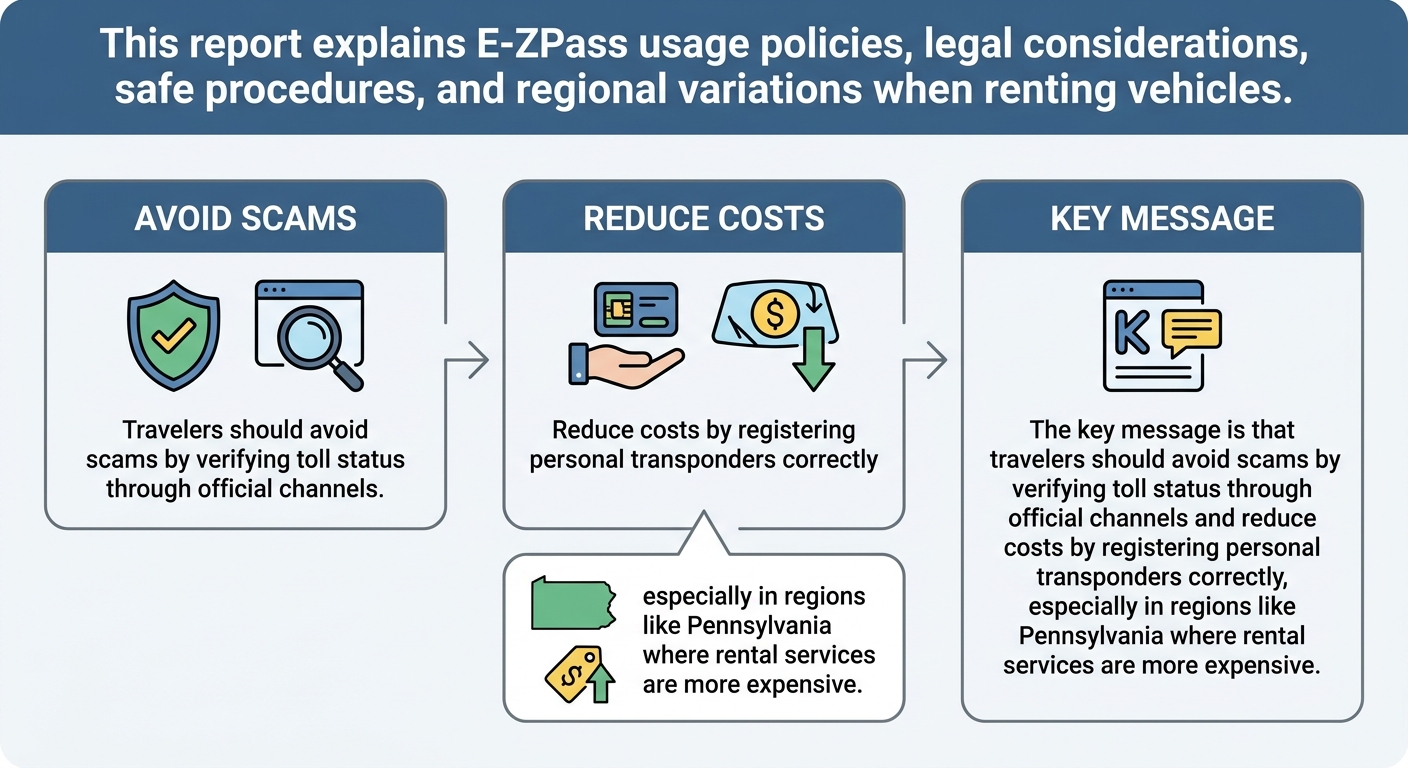
Infographic Image: Infographic
1. Understanding E-ZPass Integration in Rental Vehicles: Policy Framework and Strategic Implications
Industry Standards and Network Coverage: How Major Rental Providers Navigate E-ZPass Compatibility
This subsection establishes foundational understanding of how leading rental companies approach E-ZPass toll integration, highlighting policies that affect traveler autonomy and cost management. It situates rental provider practices within the broader context of a nationwide 19-state coverage network, examining operational flexibility and travel continuity implications for users deploying personal toll transponders in rental vehicles.
E-ZPass Policies Among Leading Rental Brands: Usage, Restrictions, and Traveler Empowerment
Major rental companies typically permit the use of personal E-ZPass transponders in their vehicles, recognizing the benefits of streamlined toll payments and reduced wait times for renters. Enterprise, for instance, explicitly allows customers to use their own transponders, provided renters register the rental vehicle’s license plate within their E-ZPass accounts prior to travel. This requirement ensures accurate billing and prevents duplication, aligning customer convenience with operational integrity. However, some firms maintain proprietary tolling systems or require renters to enroll in their internal toll programs, potentially incurring additional fees. Careful review of rental agreements is therefore vital to confirm whether personal transponder use is authorized without penalty.
The ability to use a personal E-ZPass transponder while traveling across multiple states underpins a significant advantage for renters, enabling consistent toll payment mechanisms without recurring registrations or disparate accounts. This is especially pertinent given widespread rental traffic along the densely populated Northeast Corridor, extending from Maine through Florida and as far west as Illinois. The availability of personal toll devices can mitigate exposure to costly administrative charges imposed by rental companies when defaulting to agency tolling services.
Leveraging the 19-State E-ZPass Network: Cross-Jurisdictional Benefits for Rental Car Travelers
The E-ZPass network’s extensive geographic coverage across 19 states provides rental vehicle users with unprecedented convenience in managing toll obligations across diverse jurisdictions. Travelers benefit from seamless interoperability that eliminates the need for multiple toll accounts or physical transponders when using personal E-ZPass tags. This broad network facilitates efficient route planning and supports extended road trips without interruption due to toll payment complexity.
While the substantial coverage area enhances ease of travel, users must remain aware of exceptions — notably in states such as Texas and California, where alternate electronic toll systems prevail. In such cases, E-ZPass tags may not be recognized, requiring users to consider regional alternatives or rental company transponders for compliance. This limitation necessitates pretrip research and, where feasible, temporary transponder registrations aligned with the rental period in order to avoid unintended charges or toll violations. Overall, adoption of personal E-ZPass devices within vehicles rented in the multi-state network minimizes dependence on costly third-party toll processing options and empowers travelers through direct account management.
With an understanding of how rental companies integrate and regulate personal E-ZPass use, the report next examines legal frameworks governing liability and contractual implications that impact traveler responsibilities and risk exposure.
Navigating Legal Safeguards and Contractual Obligations in Rental Vehicle Toll Programs
This subsection scrutinizes the critical legal and contractual frameworks that govern E-ZPass usage in rental vehicles. By unpacking opt-out procedures and liability distinctions, it equips travelers with the clarity needed to avoid unwanted charges and to understand their financial and legal exposure under diverse rental agreements. Positioned early in the report, this analysis lays the foundational awareness essential for subsequent discussions on regional toll program disparities and operational practices.
Comprehensive Opt-Out Procedures to Avoid Automated Rental Toll Programs
Rental companies often enroll vehicles automatically into proprietary toll payment programs that impose daily fees or usage surcharges, posing a significant risk of double billing when a traveler uses a personal E-ZPass in the same vehicle. To mitigate this, travelers must proactively opt out of these rental toll programs at the point of vehicle pickup. This opt-out should be explicitly requested and documented in writing or electronically by the rental agency to ensure traceability.
The opt-out process typically requires clear communication with the rental agent, insisting that the vehicle's plate or transponder not be enrolled in the proprietary toll program. Some jurisdictions and companies provide procedural checklists or policies to facilitate this request; however, enforcement consistency varies. Travelers should also secure confirmation—such as a written note on the rental agreement or a separate receipt—to preserve evidence in the event of dispute. Importantly, failure to opt out does not absolve the renter from charges, including administrative fees that may apply even when the traveler uses a personal transponder.
Because toll processing is predominantly automated and heavily reliant on license plate recognition, travelers must be vigilant in verifying at pickup whether the rental vehicle’s toll module is active or if the plate has been enrolled in any toll payment service. Proactively mounting and registering a personal E-ZPass, accompanied by removal or deactivation of the rental company’s toll device where possible, further reduces the likelihood of redundant charges.
Liability Frameworks Under Explicit Versus Implicit Consent in Rental Toll Agreements
Liability for toll payments and related administrative fees hinges substantially on the nature of consent provided by the renter at contract initiation or vehicle handover. Explicit consent involves clearly affirming agreement to enrolled toll programs, often documented through signed acknowledgments or checkboxes within rental agreements. Under this framework, renters accept responsibility knowingly for any toll charges and markups associated with the rental company’s system.
Conversely, implicit consent arises from tacit acceptance, such as not actively declining toll program enrollment or failure to communicate opt-out intentions. This form of consent can bind renters inadvertently, exposing them to costly fees despite the absence of explicit agreement. Rental contracts often include clauses that either presuppose acceptance of electronic toll enforcement or impose toll payment obligations linked to the vehicle’s license plate, which renters rarely scrutinize thoroughly at signing.
The consequences of these consent variations underscore the vital importance of carefully reviewing rental agreements for toll-related disclosures and opting out where feasible. Travelers should also retain all documentation—such as the rental contract, opt-out confirmations, and toll receipts—to support any disputes or claims of erroneous charges. Rental companies may enforce toll payment plus administrative fees as stipulated in the agreement, and jurisdictions differ on consumer protections or reversal policies in contested cases. This layered complexity highlights how consent mechanics translate into concrete financial risk for travelers.
Documentation Protocols for Dispute Resolution in Rental Vehicle Toll Usage
Given the high incidence of billing conflicts arising from overlapping toll program charges, solid documentation practices are paramount for renters to validate their position in disputes. Travelers should systematically preserve the entire rental contract, emphasizing toll-related terms, any written opt-out confirmations, and detailed records of toll charges incurred—both on the rental company’s statements and their own E-ZPass account.
Chronological record-keeping enables the identification of duplicate charges or unexplained administrative fees, which can signal inaccuracies or contractual breaches. When contesting charges, renters benefit from presenting clear evidence of opting out, usage of a personal transponder, and communication with the rental company. This enhances the probability of successful dispute resolutions and may invoke consumer protection provisions in certain jurisdictions.
Additionally, travelers should be aware of timing considerations, as tolls and administrative fees may post with delays, complicating reconciliation. Retaining documentation for at least the rental duration plus a statutory limitation period—often 1 to 2 years depending on the state—supports effective claims and possible chargebacks. Encouraging rental agencies to provide distinct toll billing summaries separate from other rental fees furthers billing transparency and aids auditing by travelers.
Having delineated the legal safeguards and contractual pitfalls associated with toll usage in rental vehicles, the report proceeds to analyze how these issues manifest unevenly across regions. The following section contrasts the financial and administrative burdens imposed by proprietary systems, highlighting jurisdiction-specific adaptation strategies that complement the foundational legal understanding established here.
2. Regional Implementation Disparities: From Pennsylvania PlatePass to California FasTrak
Evaluating Toll Cost Structures and Rental Fees in High-Impact States: Pennsylvania and California Analysis
This subsection investigates the financial implications of proprietary toll payment systems for rental vehicle users in key jurisdictions, focusing on Pennsylvania’s PlatePass program and California’s FasTrak system. By dissecting fee structures, administrative surcharges, and potential savings through personal transponder use, it establishes a critical foundation for understanding traveler costs and strategizing cost-effective toll management in these differentiated regional frameworks.
Dissecting Pennsylvania’s PlatePass Toll and Administrative Fees: Impact on Rental Car Users
Pennsylvania’s PlatePass service introduces a layered cost structure that compounds traveler expenses beyond standard toll rates. Rental car companies typically offer PlatePass as an optional all-inclusive toll service, charging a fixed daily service fee in addition to the highest undiscounted toll rate for all electronic toll roads used during the rental period. This daily fee fluctuates but frequently centers around $10 per day, applied on every day toll roads are used rather than every day of the rental, potentially inflating charges for users with short rental spans but multiple toll encounters.
If the PlatePass option is declined yet tolls are incurred, travelers face not only the unmitigated toll charges but also significant administrative fees imposed by the rental companies. These administrative fees are often undisclosed upfront or buried within rental agreements, leading to unexpectedly high surcharges. This markup creates a strong financial incentive for renters to avoid the PlatePass system unless inclusive convenience outweighs cost concerns. Moreover, PlatePass’s daily flat fees can quickly eclipse the actual toll costs, especially for brief use or infrequent toll crossings.
Conversely, using a personal E-ZPass transponder linked directly to the Pennsylvania Turnpike E-ZPass system can drastically reduce toll expenditures. By adding the rental vehicle details, including exact rental start and end dates, renters can ensure that tolls are charged at standard E-ZPass rates without additional administrative surcharges. This approach demands proactive advance planning and familiarity with the E-ZPass PA portal but offers a more economical alternative, especially for travelers anticipating extended stays or frequent toll use along the route.
While commission-based temporary toll registration services sometimes emerge as alternatives, their financial attractiveness varies, depending heavily on the administrative fees taken by intermediaries and the traveler’s duration of stay. For renters with longer-term use and multiple toll interactions, these services can offer competitive savings but still may lag behind direct E-ZPass registration in cost efficiency.
Assessing California FasTrak Rental Fees and Incentive Models: Navigating Complexity in Toll Payment
California’s FasTrak system represents a distinct tolling environment where interoperability with national systems like E-ZPass does not exist, necessitating region-specific strategies for rental car users. Rental companies frequently equip vehicles with FasTrak transponders; however, using the rental company’s FasTrak service often implies additional fees layered atop standard toll amounts. These charges may include daily usage fees and administrative costs, which can be comparable in magnitude to those seen in Pennsylvania’s PlatePass program.
To minimize excess toll expenses, frequent or long-duration visitors to California are encouraged to obtain personal FasTrak transponders or establish temporary FasTrak accounts associated with their rental vehicles. Such personal or temporary registrations enable direct payment to toll agencies, avoiding rental company surcharges. Notably, the FasTrak ecosystem in California is fragmented among numerous local agencies, each with distinct account rules and minimum balance requirements, making the choice of the most appropriate transponder issuer critical for maximizing discounts and simplifying compliance.
Incentive structures within certain California toll districts further influence cost outcomes. For example, prepaid FasTrak accounts offer earned discount programs that reward consistent usage with reduced toll rates in subsequent billing cycles, effectively lowering the per-trip toll cost. These programs, combined with the elimination of monthly account maintenance fees in some jurisdictions, enhance the economic benefit of direct FasTrak management over rental company toll programs. Thus, short-term travelers face a complex payoff matrix in deciding whether to rely on rental company provisions or self-managed accounts.
Additionally, the average duration of traveler stays shapes the feasibility of cost-saving approaches. For brief visits with minimal toll crossings, the convenience of rental company transponders may justify their premium. In contrast, travelers with longer stays or higher volume toll road use stand to gain tangible financial advantages through personal FasTrak transponders or pre-registration of rental vehicles on toll operator portals, mitigating inflated toll markups and administrative fees.
Comparative Cost-Benefit Modeling for Travelers: Personal Transponders Versus Rental Company Toll Services
A holistic cost-benefit evaluation reveals that personal transponder use significantly curtails toll expenses in both Pennsylvania and California, particularly for travelers expecting multiple or prolonged toll engagements. For instance, proprietary systems impose daily administrative fees that aggregate substantially over time, eroding intrinsic toll discounts offered directly by toll authorities.
Scenario modeling for Pennsylvania’s Turnpike demonstrates that even a modest multi-day rental incurs PlatePass fees which, when combined with the highest toll rates, can exceed direct E-ZPass toll payments by 30 to 50 percent. This disparity magnifies for travelers with extended durations or frequent toll crossings, making self-managed transponder linkage a financially prudent decision.
In California, the layered agency structure, divergent fee schedules, and variable incentive schemes complicate straightforward savings estimates. Nevertheless, travelers who pre-register their rental vehicles or maintain personal FasTrak accounts generally avoid the rental company’s service fees and unlock discount programs such as earned toll reductions and elimination of monthly fees. This approach optimizes cost savings proportionate to toll road usage intensity and duration, with the break-even point for transitioning away from rental company transponders typically occurring within the first few days of toll road travel.
Moreover, administrative practices in some rental company programs lack transparency in fee disclosure, increasing the risk of unexpected charges. Consequently, a strategic, anticipatory choice to deploy personal transponders or engage in official short-term toll account setups supports better control over toll-related expenditures and significantly reduces risk of overstated toll bills.
Importantly, travelers opting to decline proprietary toll programs must carefully follow opt-out procedures to avoid automatic enrollment and subsequent fees. Key steps include requesting opt-out at vehicle pickup, documenting the request with confirmation, and verifying the absence of auto-enrollment in the rental toll program. These active measures are essential safeguards against inadvertent charges and add a layer of complexity to the cost management process [Table: Opt-Out Procedures for Rental Toll Programs].
Having explored the economic burden posed by rental car tolling programs and the financial advantages of personal toll device use in Pennsylvania and California, the report now advances to examine regional technical interoperability challenges and tailored workaround solutions necessary to operationalize such cost mitigation strategies effectively.
System Interoperability Constraints and Localized Solutions in Multi-State Rental Toll Management
This subsection examines the fragmented landscape of electronic toll systems in the United States, focusing on the technological and operational challenges posed by regional incompatibilities such as the non-interchangeability of E-ZPass and California’s FasTrak systems. It provides a detailed mapping of zones where E-ZPass is not accepted and evaluates the efficacy of localized account setups, particularly temporary registries, that mitigate fees and operational friction for rental vehicle users. Additionally, this analysis highlights best practices for rental agencies navigating multi-jurisdictional toll systems to optimize user experience and cost effectiveness.
Mapping E-ZPass Non-Acceptance and Regional Toll System Fragmentation
The United States tolling infrastructure remains characterized by marked regional segmentation, resulting in critical interoperability gaps. Predominantly, E-ZPass operates within a 19-state network concentrated in the northeastern and midwestern corridors, covering major thoroughfares such as the I-95 corridor and extending westward to states including Minnesota and Illinois. However, significant portions of the country either do not support E-ZPass directly or maintain independent systems. Notably, states like California operate FasTrak, Texas uses TxTag, and Florida's SunPass, though SunPass is partially interoperable with E-ZPass in some areas, interoperability remains limited overall.
This partitioning creates zones where personal E-ZPass transponders fail to register tolls, compelling rental agencies and travelers to adopt alternative arrangements. Maps reflecting the national electronic toll collection ecosystem delineate the extents of E-ZPass usability versus exclusion zones, revealing clusters in the Southwest and the West Coast where E-ZPass is unsupported. These non-acceptance zones pose a significant challenge to rental car users who rely on their personal transponders, as toll charges incurred without valid detection are typically routed through video tolling programs, often incurring additional fees and surcharges.
Adoption and Effectiveness of Temporary Toll Account Setups for California FasTrak Users
California’s exclusive use of FasTrak necessitates distinct strategies for rental vehicle tolling. Recognizing the incompatibility between FasTrak and E-ZPass, rental companies often provide transponders or encourage renters to register for temporary FasTrak accounts. Temporary account enrollment has gained traction as a cost-saving approach that bypasses the considerable administrative fees commonly charged under rental company toll programs. By pre-registering a vehicle’s license plate with FasTrak prior to toll incursions, travelers can avoid inflated markups and retain direct control over toll payments.
Recent trends indicate a growing number of rental users opt for such temporary registrations, facilitated by online portals dedicated to rental toll management. This flexibility benefits longer-term visitors who anticipate multiple toll crossings across California’s 29 tolled bridges, lanes, and roads. Moreover, integrated discount schemes tied to prepaid FasTrak accounts incentivize travelers to maintain their own accounts or use short-term registrations, improving cost efficiency. While this method requires proactive engagement, the reduction in both toll rates and administrative premiums substantiates its adoption for informed travelers.
Technological Barriers to Interoperability Between E-ZPass and FasTrak Systems
The underlying technology infrastructures of E-ZPass and FasTrak utilize distinct radio frequency protocols, account management schemas, and transponder classification systems, which inhibit seamless interoperability. E-ZPass employs a specific transponder ID and vehicle classification integration calibrated for the 19-state network, including axle counting and HOV modes. Conversely, FasTrak is a state-specific system with unique account requirements, varying transponder types – including sticker tags and switchable Flex devices – and differing vehicle eligibility rules, especially for clean air vehicles and carpool incentives.
Interoperability challenges extend beyond hardware differences to encompass software and contractual frameworks. The lack of a unified national standard constrains the ability of toll authorities and rental companies to offer a single transponder solution, complicates backend transaction settlements, and necessitates multiple accounts or manual reconciliations. Efforts to harmonize tolling technologies face regulatory, financial, and operational barriers, given the heterogeneous governance of tolling agencies and disparate customer service protocols.
Localized Multi-System Navigation Strategies and Case Studies in Rental Toll Management
In response to these interoperability constraints, several rental agencies have developed multi-system operational protocols that combine hardware deployment, customer education, and dynamic billing solutions. Case studies reveal that providing renters with clear instructions to opt out of rental company pre-installed toll services when using personal transponders, along with practical guidance on mounting and deactivating rental transponders, reduces duplicate charges and improves customer satisfaction.
In regions like California where FasTrak dominates, some rental companies offer temporary accounts or device rentals, while others rely on video tolling paired with third-party invoicing, a process known for high fees and administrative delays. Success in multi-system environments hinges upon robust platform integration, seamless license plate registration processes, and transparent communication of toll policies. Furthermore, the implementation of mobile applications that sync vehicle and transponder data in real time emerges as a best practice, enabling adaptive toll management across jurisdictional boundaries.
Recommendations for Rental Agencies to Adapt Toll Management Practices Amid System Fragmentation
To address the prevailing fragmentation, rental agencies should refine their toll management practices by prioritizing the enablement of renter autonomy through personal transponder usage where feasible, coupled with robust support for regional system requirements. This includes proactively informing renters about non-E-ZPass states at the time of rental and facilitating temporary account registrations for alternative toll systems like FasTrak.
Agencies are advised to implement comprehensive deactivation protocols for in-vehicle transponders to prevent billing conflicts, as concurrent transponder activation invariably leads to disputed charges. Investment in digital tools that automate vehicle registration linkages, send real-time usage alerts, and streamline billing reconciliation can reduce operational overhead and enhance transparency. Collaboration with toll authorities to negotiate reduced administrative fees and explore multi-system interoperable solutions must be pursued as part of strategic long-term planning.
Having outlined the regional technological and operational barriers of E-ZPass and FasTrak system incompatibilities, and assessed localized management adaptations, the report next shifts to the practical execution aspects of toll transponder mounting, registration workflows, and account management techniques that underpin successful toll navigation in rental vehicles.
3. Operational Execution: Mounting, Registration, and Digital Management Protocols
Optimizing E-ZPass Transponder Placement in Rentals: Engineering Standards and Signal Integrity Assurance
This subsection delves into the technical imperatives of physically mounting E-ZPass transponders in rental vehicles to maximize signal detection reliability and minimize toll processing errors. It addresses engineering principles governing ideal transponder positioning, the influence of vehicle-specific factors such as windshield treatments, and empirically validated guidelines designed to prevent missed reads. As part of a broader operational execution framework, these insights empower travelers to proactively mitigate common signal failures encountered in rental scenarios, thereby reducing billing disputes and operational friction.
Precision Mounting Coordinates: Engineering-Driven Standards for Consistent E-ZPass Reads
Optimal transponder mounting requires precise adherence to placement protocols that align with antenna positioning and toll gantry reader geometry. Empirical evaluations consistently identify the area immediately behind the windshield, centered just below or behind the rearview mirror, as the principal locus for signal transmission efficacy. This location accommodates the transponder’s overhead antenna, ensuring unobstructed line-of-sight to toll sensors. Deviations from this standard, including placement in cup holders, dashboards, or loose within the cabin, dramatically increase the probability of missed reads and fallback reliance on license plate recognition, with attendant risks of administrative billing errors.
Physical mounting strips with adhesive backing supply a secure, vibration-resistant interface required to maintain stable orientation throughout transit. Proper adhesion mitigates the deleterious effects of vehicle motion and environmental vibration on signal consistency. Additionally, instructions from toll authorities emphasize pre-positioning the transponder before entering E-ZPass lanes because signal delays or late arrivals compromise read windows. Failure to install the device prior to the toll gantry typically results in non-detection and consequent invoicing complexity.
Mitigating Signal Interference: Effects of Metallic Window Tints and Vehicle-Specific Factors
Window treatments employing metallic components, such as traditional metallic-tinted films, often obstruct or degrade the radiofrequency signals used by E-ZPass transponders operating near 915 MHz. These interferences manifest as reduced read rates and increased non-detections which escalate operational risks for rental drivers relying on personal toll accounts. Given that many rental fleets utilize vehicles with factory-installed tints or aftermarket modifications, travelers must assess windshield characteristics promptly.
Modern ceramic tint alternatives offer significant improvements by eliminating metal particles that cause signal attenuation. These nano-ceramic films maintain high ultraviolet and infrared rejection while preserving RF transparency critical for transponder communication. Therefore, vehicles equipped with advanced ceramic window tints exhibit markedly better transponder performance reliability. When metallic interference is unavoidable, toll authorities recommend alternative mounting sites such as lower windshield corners, closer to dashboards, or even external plate-mounted transponders where supported, to circumvent signal blockage zones.
Manufacturers and agencies provide guidance on identifying and adapting to these factors, advising that users verify signal strength empirically by testing toll passage performance or employing diagnostic tools where available. Understanding vehicle-specific conditions can avert frequent misreads and preempt costly billing disputes arising from unnoticed signal dropouts.
Empirical Validation and Performance Metrics: Quantifying Signal Loss by Placement Variations
Controlled field studies demonstrate that improper positioning of transponders outside the recommended zones results in statistically significant decreases in read success rates, with some misplacements reducing detection reliability by over 40%. Data collected from observable toll transactions confirm that mounting transponders on interior elements such as center consoles or glove compartments correlates with frequent missed scans and subsequent toll-by-mail charges directed to rental companies rather than the traveler’s personal account.
Test data also disclose that variations of only a few centimeters in vertical or horizontal placement can influence signal strength due to the complex geometries of vehicle windshields and the positioning of toll facility readers. These subtle variations underscore the necessity for standardized mounting zones tailored to vehicle make and model, along with clear user instructions.
Further, travelers must avoid having multiple active transponders in close proximity within the same vehicle, as overlapping RF signatures create read conflicts that increase the likelihood of double charges. Empirical evidence supports mandatory removal or temporary deactivation of rental agency transponders when personal devices are in use, ensuring singular identification and clean billing.
A thorough understanding of these nuances, supported by quantitative evidence, is essential for ensuring operational consistency and maximizing cost efficiency in toll payments during rental vehicle use.
Having established the critical technical parameters and interference considerations for transponder placement, the report next progresses to address how effective account management and timely registration of rental vehicle license plates complement physical mounting practices to ensure accurate toll processing and dispute avoidance.
Dynamic Account Configuration and Precise Temporal Controls for Rental Vehicle Toll Management
This subsection addresses the critical operational details of configuring E-ZPass accounts to accurately and securely manage toll payments for rental vehicles. It focuses on the procedural steps for dynamically linking rental license plates, managing time-bound access to tolling systems, and safeguarding account integrity. These elements are essential for travelers aiming to avoid billing errors and unauthorized toll charges when deploying their personal transponders in transient rental scenarios.
Step-by-Step Procedures for Adding Rental Plates via the E-ZPass Application
Effectively managing toll payments in rental vehicles requires proactively updating the E-ZPass account with the rental license plate information. Users should first log into their personal E-ZPass account through the official website or mobile application prior to encountering any toll points. This often involves inputting the rental vehicle’s license plate number along with the issuing state, establishing a temporary linkage for the duration of the rental period.
Many E-ZPass regions provide functionality to assign effective start and end dates for the added plate, enabling precise temporal control in line with the rental timeframe. In cases where date-specific features are unavailable, best practice dictates adding the plate immediately upon vehicle pickup and removing it promptly after vehicle return to minimize liabilities or inadvertent charges.
The application workflow usually follows clear prompts facilitating intuitive plate addition. Users should ensure completion before the first toll crossing to avoid system defaulting to toll-by-plate invoices directed at the rental company. Retaining transaction confirmations and updating account records in real-time is strongly advised to preserve audit trails and expedite dispute resolution if discrepancies arise.
Understanding Registration Delays and Billing Synchronization Challenges
A significant operational challenge lies in the time lag between submitting rental vehicle information and the toll system recognizing the update. This synchronization delay can range from several minutes to several hours depending on backend processing schedules and regional system architectures.
Such lag times may result in temporary billing mismatches where tolls incurred shortly after vehicle pickup fall under plate-based invoicing attributed to the rental company rather than the traveler’s E-ZPass account. This stresses the importance of early account updates prior to travel commencement.
Users should monitor their E-ZPass accounts within 24 to 48 hours post-travel to ensure all tolls have been appropriately posted. When anomalies are detected, timely communication with customer service is essential to correct records and avoid incurring penalties or redundant fees.
Moreover, utilizing a personal E-ZPass transponder significantly mitigates the high fees often charged by alternative toll payment methods such as Pennsylvania's PlatePass service, which imposes daily administrative and undiscounted toll fees that can exceed $85 per day compared to substantially lower costs when using personal E-ZPass transponders [Chart: Estimated Daily Fees of Pennsylvania's PlatePass vs. Personal E-ZPass].
Robust Security Protocols to Prevent Unauthorized Modifications in Rental Toll Accounts
Protecting the integrity of E-ZPass accounts during temporary rental plate additions mandates strict security measures embedded within account management platforms. Authentication procedures typically require multi-factor verification to confirm the identity of the account holder before enabling modifications related to vehicle registrations.
Access controls enforce role-based permissions and session timeouts, reducing opportunities for unauthorized users to alter account data, which could lead to fraudulent toll charges or personal data exposure. Furthermore, transaction logging captures detailed records of all plate additions, removals, and edits, supporting accountability and forensic investigations if needed.
Travellers should consistently safeguard their login credentials and utilize any offered security features such as one-time passcodes or biometric authentication. Regular audits of account activity post-rental use can identify suspicious changes early, enabling prompt remediation and decreasing financial risk.
Having established the operational mechanisms for mounting and registering transponders and managing rental vehicle plates dynamically, the subsequent section will delve into risk identification, focusing on how improper configurations and system exploitation create vulnerabilities in toll management and how travelers can mitigate such risks.
4. Risk Identification and Fraud Prevention Mechanisms
Emerging Rental Car Toll Scams and Phishing Threats: Patterns, Tactics, and Authenticity Checks
This subsection critically examines the recent and evolving scam landscape targeting E-ZPass users in rental vehicles. By identifying prevalent exploitation tactics and clarifying the distinguishing features of legitimate communications, it equips stakeholders with the insights necessary to recognize and counteract fraudulent activities. Positioned within the broader risk identification framework, it underscores the urgent need for awareness and vigilance amid increasingly sophisticated digital deception schemes.
Top E-ZPass Rental-Related Scams of 2023: Anatomy and Impact
The toll payment ecosystem connected to rental vehicles experienced a surge in scams during 2023, conspicuously exploiting both systemic vulnerabilities and user unfamiliarity with rental toll policies. Among the top schemes, rental agencies’ unauthorized enrollment practices prevail, wherein renters unknowingly accept high markups by implicitly consenting to rental company toll programs without explicit confirmation. This results in inflated bills due to daily convenience fees layered atop actual toll costs, often leading to protracted dispute resolutions and financial losses for consumers.
Complementing this operational deception is an increase in synthetic billing scams. Fraudsters either fabricate toll charges linked to non-existent trips or manipulate license plate recognition by hijacking legitimate transponder data, triggering erroneous fee assessments. The financial impact is exacerbated by renters’ limited means to cross-verify charges amidst complex rental agreements and transient use, underscoring a significant attack vector that leverages informational asymmetry. High frequency of such incidents highlights systemic monitoring deficiencies and consumer confusion in rental toll management.
For instance, a recent comparison of California FasTrak charges reveals that rental company FasTrak fees can average $20 per usage compared to just $5 when travelers use their personal FasTrak accounts, illustrating the substantial financial impact of these surcharges embedded by rental providers.
Comparison of charges incurred through rental company FasTrak services versus personal FasTrak use.
Phishing Tactics Targeting E-ZPass Users: Digital Impersonation and Psychological Exploits
Phishing campaigns targeting E-ZPass users have evolved beyond generic spam to highly convincing personalized messages, frequently impersonating toll agencies or rental providers with alarming precision. The most pervasive tactic involves SMS and email messages that claim unpaid toll balances, urgently prompting recipients to make immediate payments through embedded links or QR codes. These lures blend authentic branding elements with fabricated transactional details, engendering a false sense of legitimacy and time pressure that compels rapid, uncritical compliance.
Notably, attackers have enhanced sophistication by leveraging new technologies such as adversarial AI and autonomous phishing bots, enabling scalable, adaptive fraud efforts that dynamically craft convincing narratives tailored to recipient profiles. The use of proxy infrastructure with international call origins and URL shorteners to obscure malicious payloads challenges conventional detection methods. Such approaches significantly raise the risk of credential harvesting, account takeover, and financial theft, especially among less digitally literate demographics unaccustomed to the nuance of official toll communication channels.
Distinguishing Authentic E-ZPass Communications from Fraudulent Alerts
A critical defense against phishing is the ability to differentiate bona fide toll agency notifications from fraudulent imposters. Official communications from E-ZPass and member agencies are characterized by well-defined properties: they are sent through verified channels, never request personal or payment information via unsolicited emails or texts, and typically provide account information through secure, official websites or mobile applications. Notifications about toll payments generally originate from region-specific phone numbers and avoid using shortened URLs or QR codes directing recipients to payment portals.
Red flags signaling fraud include unsolicited demand messages referencing small but urgent fines, sender information originating from unexpected or international country codes, and the presence of hyperlinks that lack domain consistency with official toll road agencies. Legitimate toll billing processes avoid immediate pressure tactics and do not threaten penalties or account suspensions through text messages. Authorities recommend always verifying any alert by independently accessing the official E-ZPass portal or contacting customer service directly, refraining from engaging with suspicious links or attachments.
Having identified prevalent schemes and outlined the distinguishing features of genuine toll communications, the subsequent subsection will focus on the operational mitigations and consumer tools available to fortify defenses against such multifaceted fraud risks.
Strengthening Toll Fraud Defenses: Verified Resources, Dispute Pathways, and Digital Literacy Initiatives
This subsection focuses on the critical defenses against toll-related fraud and misuse, emphasizing the integration of authoritative verification channels, structured dispute reporting processes, and targeted digital literacy programs. It contributes to the broader risk management framework by equipping rental vehicle users with the necessary tools and knowledge to proactively detect and counteract fraudulent schemes while ensuring effective resolution of billing discrepancies.
Authoritative Channels for Toll Fraud Verification and Reporting
Mitigating toll fraud requires travelers to rely on official and secure communication pathways when verifying toll charges or responding to suspicious contact attempts. Public toll agencies provide dedicated customer service centers and online portals that serve as the primary outlets for authentic account management. Users encountering dubious messages or payment requests should directly access these official platforms rather than engaging with unsolicited links or contacts. Encouragingly, many tolling authorities now emphasize zero-tolerance for communication via text or email soliciting payment, underscoring that any such messages with embedded links are fraudulent attempts aimed at harvesting sensitive data.
In support of this verification framework, users can utilize contact centers equipped with trained representatives who can authenticate claims, clarify account statuses, and guide toll payment procedures securely. Agencies often publish clear guidance on recognizing legitimate correspondence, including official domain names and phone numbers. Importantly, law enforcement partnerships augment these efforts by facilitating formal fraud reporting and coordinating investigations. Mechanisms such as federal Internet Crime Complaint Centers enable victims to document incidents, helping agencies track prevalent fraud patterns and deploy timely countermeasures.
Structured Toll Dispute Reporting and Resolution Procedures
Disputing inaccurate toll charges or suspected fraudulent transactions demands a rigorous reporting pipeline with transparent steps to ensure accountability. Customers are advised to promptly document billing irregularities, retaining all relevant rental agreements, toll receipts, and correspondence. Most toll service providers have established protocols allowing users to submit disputes directly through online portals, phone hotlines, or in-person service centers. Adherence to specified timeframes for dispute submissions is critical, as delays can diminish resolution prospects and escalate fees.
Beyond self-reporting, coordinated dialogue with rental companies is essential, particularly when tolls are assessed to vehicle license plates absent personal transponder use. Understanding the contractual nuances around liability and fee transfers prevents unexpected financial burdens. When disputes escalate, agencies often provide escalation channels including formal appeals processes and mediation opportunities. These frameworks empower consumers to contest charge validity while ensuring toll authorities can maintain system integrity and revenue protection.
Educational Programs Advancing Digital Literacy Against Toll-Related Scams
Reducing user susceptibility to toll fraud increasingly relies on comprehensive digital literacy initiatives that address sophisticated scam methodologies. These programs are tailored to diverse demographics, recognizing that older adults and digital novices face heightened vulnerability. Educational curricula commonly emphasize the identification of phishing and smishing tactics, safe navigation of electronic toll payment systems, and best practices for maintaining personal data security.
In-person technology training, supplemented by ongoing support forums, has demonstrated measurable success in bolstering learner confidence and critical evaluation skills. Collaborative efforts among government agencies, transportation authorities, and community organizations contribute to expanding access and maximizing outreach effectiveness. Furthermore, embedding fraud prevention modules within broader digital inclusion campaigns enhances awareness and resilience. As electronic toll systems become more pervasive, fostering informed user bases through accessible education remains a cornerstone of sustainable fraud mitigation.
Building upon the identification of fraud vectors, these mitigation infrastructures and consumer vigilance tools establish a proactive defense system. The ensuing assessment of best practice frameworks will integrate these protective elements into actionable decision-making models, reinforcing traveler empowerment and adaptive response capabilities.
5. Best Practice Synthesis: Decision-Making Frameworks for Strategic Mobility
Pre-Trip Assessment and Documentation Protocols: Financial Benchmarks, Contractual Checks, and Billing Timelines
This subsection provides a strategic blueprint for travelers preparing to navigate toll payments using rental vehicles, emphasizing the importance of comprehensive pre-trip financial and contractual scrutiny as well as understanding toll billing timelines. It aims to empower users with actionable knowledge to anticipate costs, mitigate risks from ambiguous contract terms, and manage billing cycles effectively to avoid unwelcome fees or disputes.
Quantifying Rental Toll Administration Fees to Anticipate Financial Exposure
Rental toll administration fees represent a significant and often underappreciated component of the total cost incurred by travelers using toll roads in rental vehicles. Across major providers, these fees vary notably in structure and magnitude but commonly include per-toll surcharges, daily convenience fees, and administrative processing charges that may range from a few dollars up to $25 or more per violation or toll event. Such fees can rapidly escalate costs, particularly during frequent toll road usage or extended rental periods.
For instance, proprietary services like PlatePass impose a flat daily rate for unlimited toll access but concurrently charge the highest undiscounted toll rates, which can outweigh personal transponder use over longer trips. Conversely, opting out and paying tolls directly often results in additional administrative fees levied by rental agencies, compounding costs beyond the base toll. Therefore, making a financial projection based on expected toll road usage and rental agency policies is essential to avoid unwelcome cost surprises.
Comprehensive Contract Review Checklists to Ensure Toll Policy Transparency
Effective pre-trip preparation must include a rigorous examination of rental agreements for toll-related clauses. Such contracts frequently embed complex provisions concerning toll payment liabilities, authorization to enroll in rental toll programs, opt-out rights, and dispute procedures. Failure to identify or understand these obligations may expose the traveler to automatic toll program enrollments that trigger inflated fees and possible double billing.
A structured checklist should cover verification of toll program participation options, specific administrative fees associated, procedures to register personal transponders if permitted, and explicit consent mechanisms. Documentation should be meticulously collected at pick-up, encompassing signed agreements, opt-out acknowledgments, and initial vehicle condition reports. This evidence is foundational for effective dispute resolution when billing discrepancies arise, emphasizing the need for travelers to maintain detailed transaction and communication records.
Clarifying Toll Billing Timelines and Dispute Windows to Optimize Audit Trails
Understanding the temporal dynamics of toll billing and dispute processes is critical for managing financial accountability. Rental and toll administrators often operate with delayed billing cycles, which may extend from several days to multiple weeks post-rental. This latency complicates early detection of erroneous or duplicate toll charges, stressing the necessity of proactive monitoring.
Dispute windows typically range between 30 to 60 days following the initial charge appearance, necessitating timely retrieval and review of invoices and account statements. Failure to raise concerns within these periods often results in forfeiture of recourse rights, and unresolved charges may lead to compound penalties or damage to traveler credit. Travelers should therefore integrate timeline projections into their audit preparation, actively tracking toll usage throughout and after the rental period to promptly identify irregularities.
With a fortified understanding of anticipated financial impacts, contractual obligations, and billing timelines, travelers can transition to real-time management techniques. The following subsection will explore dynamic monitoring strategies and adaptive responses that maintain cost control and facilitate dispute resolution during active rentals.
Real-Time Monitoring and Adaptive Response Systems for Toll Disputes and Journey Control
This subsection deepens the strategic framework by focusing on mechanisms and tools that empower travelers to actively monitor toll transactions as they occur, promptly detect anomalies, and effectively escalate disputes when necessary. Complementing preparatory and documentation protocols, these real-time and adaptive strategies enable dynamic control over toll-related costs and support rapid resolution of billing irregularities, central to informed decision-making in rental vehicle toll usage.
Standard Dashboard Alert Features for Toll Anomalies
Modern toll management platforms increasingly incorporate real-time dashboard alerts designed to identify irregular transaction patterns, such as duplicate charges, unexpected fees, or unregistered license plate billing. These alert systems leverage automated anomaly detection algorithms that compare current toll activity against historical usage baselines and predefined thresholds, enabling prompt flagging of potential discrepancies during the travel period itself.
Typical alert features include visual notifications for unusual toll frequencies, rapid spikes in charges, or inconsistencies between transponder reads and registered vehicle data. User interfaces often allow for granular filtering by date, location, and transaction type, supporting immediate investigative action. Integration with mobile apps enhances travelers’ situational awareness by pushing notifications directly to their devices. Such adaptive monitoring tools serve as the frontline defense in minimizing post-trip disputes and unexpected financial burdens.
Common Toll Dispute Escalation Procedures and Critical Contacts
When toll discrepancies arise during or after a trip, escalating the issue efficiently is crucial to mitigate charges, fees, or violations. Standard escalation protocols generally begin with direct contact to the toll authority’s customer service team via dedicated hotlines, email support, or online portals. Most agencies provide clear procedures for contesting charges, accompanied by evidence submission requirements such as rental agreements, transponder registration screenshots, and payment receipts.
If frontline resolution attempts fail, escalation ladders often include supervisory review levels, formal dispute resolution units, and in some cases, third-party mediation or arbitration services. Maintaining thorough documentation throughout this process enhances traveler's bargaining position. Additionally, rental agencies may have their own toll dispute departments, but communication channels can vary and sometimes delay resolution, underscoring the benefit of direct engagement with toll operators first.
Traveler awareness of critical contact points, including state or facility-specific violation payment centers, complaint hotlines, and online grievance forms, expedites remediation. Prompt reporting of anomalies and adherence to prescribed timelines can prevent administrative fees and negative credit implications, especially where automated billing by rental companies is involved.
Traveler Feedback Mechanisms for Continuous Toll Process Improvement
Incorporating traveler feedback into toll system management fosters continuous improvements aimed at reducing errors and enhancing user experience. Many toll authorities and rental companies now implement structured feedback loops through online surveys, mobile app input options, and dedicated customer experience portals.
Feedback mechanisms capture qualitative data on billing clarity, dispute responsiveness, and navigational ease related to toll usage in rental vehicles. Analyzing this input allows agencies to identify systemic weaknesses such as ambiguous signage, software integration flaws between rental fleets and toll systems, or confusing billing statements. Translating traveler insights into operational adjustments—such as refining user interfaces, enhancing communication channels, and streamlining dispute adjudication—sharpen overall service quality.
Moreover, some innovative mobility hubs apply real-time feedback dashboards that aggregate traveler reports, enabling swift managerial action during peak travel periods. These adaptive frameworks create a participatory environment where users help co-shape toll experiences, supporting long-term trust and compliance.
Building on proactive preparation and thorough documentation, real-time monitoring and adaptive response systems complete the toll usage strategy by equipping travelers with dynamic oversight tools and established procedures for resolving incidents as they arise. This interactive approach cultivates greater control, reduces financial risk, and enhances the overall efficiency of toll payment processes during rental vehicle journeys.
6. Implementation Roadmap: Short-Term Actions and Long-Term Resilience Building
Accelerating First-Time User Onboarding: Timelines, Resource Allocation, and Seasonal Review Cycles
This subsection focuses on the critical initiation phase for travelers engaging with E-ZPass and toll payment systems in rental vehicles. By dissecting common onboarding timeframes, resource commitments during initial usage, and the timing for recurring review aligned with travel seasonality, it establishes a pragmatic foundation for users to rapidly achieve operational competence while minimizing financial and logistical risks.
Realistic User Onboarding Timelines: Structuring Skill Acquisition for Seamless E-ZPass Integration
Effective onboarding timelines for first-time E-ZPass users in rental vehicles commonly span from immediate setup to a short acclimation period, typically ranging between 1 to 4 weeks. Within this window, users progress from initial transponder mounting and account configuration to practical understanding of billing cycles and toll lane navigation. Structured onboarding benefits from rapid initial action—such as registering the rental vehicle on the user’s transponder account within the first 24 hours—to prevent erroneous toll charges and penalties. Empirical user data indicates that interactive digital tools, coupled with clear manufacturer guidelines, accelerate proficiency, reducing potential toll misbilling incidents and enhancing confidence during road travel.
To expedite this process, it is essential to emphasize hands-on familiarization in the early days of rental usage, augmented by in-app registration workflows and automated account synchronization. Such accelerated pacing not only streamlines immediate toll usage but also builds a behavioral pattern of proactive account management, mitigating downstream billing complications often encountered by novice users.
Optimizing Resource Allocation During First Month: Balancing Administrative Effort and Travel Efficiency
Initial resource allocation for first-time E-ZPass users engaging with rental vehicles typically concentrates on administrative activities, including contract review, transponder setup, and documentation retention. Such efforts generally demand focused attention during the first 7 to 14 days, with time investments ranging from 1 to 3 hours cumulatively, depending on prior familiarity and complexity of regional toll systems. Efficient onboarding benefits from consolidating related activities—such as confirming liability clauses in rental agreements simultaneously with transponder registration—to reduce cognitive load and time constraints on travelers.
Travelers allocating resources effectively prioritize leveraging mobile platforms for real-time account modifications, thereby minimizing manual interventions and reliance on customer support. This tech-enabled resource deployment enables sustained operational efficiency during peak usage periods. Furthermore, allocating dedicated review time for toll statement verification before the first billing cycle closure improves error detection and dispute readiness, limiting unnecessary toll-related expenses.
Seasonal Travel Peaks and Review Frequency: Data-Driven Scheduling for Periodic Toll Account Assessment
Seasonal travel patterns exert a measurable influence on toll system utilization, necessitating strategically timed review intervals for rental vehicle E-ZPass management. Analysis of travel seasonality indicates concentrated peaks commonly occur during summer months, holiday weekends, and major local events. In response, periodic account reviews scheduled at 30 to 60-day intervals, synchronized with these high-traffic cycles, optimize monitoring efficacy while preventing cumulative billing discrepancies.
A data-driven approach to review frequency recommends augmented vigilance prior to and following identified seasonal peaks to accommodate fluctuating toll rates and rental duration variances. Aligning review schedules with historical travel demand data enhances fiscal oversight, promotes timely dispute resolution, and ensures ongoing verification of vehicle registration details in rapidly changing rental environments.
Building upon the establishment of realistic timeframes and resource strategies for initial deployment, the subsequent subsection will address the imperative of long-term sustainability measures that ensure continued compliance, technology adaptability, and resilience in an evolving toll infrastructure landscape.
Sustaining E-ZPass Operations: Strategic Investment in Hardware, Software, and Training Cycles
This subsection examines the critical sustainability factors required to maintain efficient and resilient E-ZPass systems within rental vehicle contexts. By analyzing hardware lifecycle management, software upgrade budgeting, and training curriculum update cadence, it empowers operational leaders to anticipate technical obsolescence, financial planning demands, and knowledge retention needs. This forward-looking perspective ensures enduring toll payment accuracy and compliance while mitigating risks related to system failures or outdated protocols.
Optimizing Hardware Refresh Cycles to Prevent Operational Disruptions
E-ZPass transponder and related tolling hardware require disciplined lifecycle management to sustain reliable functionality, particularly amidst evolving toll infrastructure and vehicle fleet integration. Industry data indicates that hardware components typically necessitate replacement or significant upgrade every three to five years to avoid performance decay and maintain interoperability with updated toll communication systems. Aligning refresh cycles with this timeframe minimizes risk of malfunctions that could result in inaccurate toll readings or billing errors, which are particularly costly for rental vehicle operators who must reconcile multi-vehicle deployments.
Adopting a proactive refresh strategy allows operational teams to anticipate procurement, installation, and testing phases without service interruptions. This is vital where E-ZPass transponders are deployed on rental vehicle fleets moving through varying toll jurisdictions, ensuring transponders remain compatible and legally compliant. Additionally, maintaining a buffer stock of spare or replacement units supports rapid response to hardware failures detected during routine maintenance, thereby preventing lapses in toll payment capability.
Strategic Budgeting for Software Upgrades and Platform Evolution
Software ecosystems underpinning E-ZPass account management and toll transaction processing demand continuous investment to address regulatory changes, interface enhancements, security patches, and system integration improvements. Current financial modeling for comparable transport and payment platforms estimates annual software upgrade budgets ranging between $20,000 and $55,000 for mid-scale deployments, inclusive of major OS compatibility work and patch cycles.
Allocating consistent funding facilitates rapid adaptation to emerging tolling standards and ensures seamless vehicle registration management across rental fleet transponders. Acknowledging the complexity of third-party dependencies and the criticality of digital security, budget plans should also envelop ongoing vulnerability management and compliance auditing. By embedding software expenditure forecasts into overall toll system operating budgets, stakeholders safeguard against deferred maintenance that could cascade into costly downtime or legal liabilities.
Institutionalizing Training Cadence to Reinforce Compliance and System Competency
The operational effectiveness of E-ZPass in rental vehicles hinges on well-informed personnel adept at managing transponder deployment, account configurations, and dispute resolution protocols. Sustaining this competency requires a structured training curriculum reviewed and updated regularly to integrate regulatory shifts, technological developments, and emerging operational challenges.
Best practices suggest an annual review cycle as a baseline, with accelerated updates where rapid regulatory or technological changes occur. This cadence supports a workforce capable of preempting common errors such as improper transponder mounting, late vehicle registration, or misinterpretation of documentation clauses, all of which may trigger avoidable charges or reputational damage. Leveraging interactive and modular learning formats further enhances retention and facilitates scalable dissemination of updated guidance across geographically dispersed teams.
Integrating these sustainability elements—hardware lifecycle management, software budgeting, and ongoing training—establishes a robust operational framework. Together, they ensure that E-ZPass deployment in rental cars can adapt efficiently to evolving demands, maintain regulatory compliance, and minimize frictional costs for both providers and travelers alike. The following section will operationalize these strategic investments by outlining actionable short-term deployment steps tailored for first-time users and rental operators.
Conclusion
The integration of electronic tolling in rental vehicles presents a multifaceted challenge characterized by a fragmented technological landscape, variable contractual liabilities, and evolving operational risks. This analysis demonstrates that informed use of personal E-ZPass or region-specific transponders, aligned with proactive rental vehicle registration and rigorous opt-out protocols, markedly enhances financial outcomes by circumventing excessive rental company fees. Signal integrity achieved through precise mounting and awareness of vehicle tinting effects is critical to maximizing transaction accuracy and avoiding default surcharges based on license plate recognition.
Regional disparities, particularly between interoperable E-ZPass states and localized systems such as Pennsylvania’s PlatePass and California’s FasTrak, require tailored approaches that balance convenience against cost. Travelers undertaking longer or toll-intensive itineraries derive substantial benefits through personal account management and temporary registrations, whereas short-term users must weigh convenience premiums against risk. Concurrently, heightened vigilance against escalating toll-related scams underscores the importance of digital literacy and reliance on verified communication channels to protect consumer assets.
Looking forward, rental agencies and toll authorities are encouraged to collaborate on harmonizing interoperability standards, enhancing transparency in fee disclosures, and investing in digital tools that support real-time monitoring and dispute mitigation. For travelers, embedding systematic pre-trip assessments, adaptive journey oversight, and comprehensive documentation routines establishes resilience against billing anomalies and fraud. Ultimately, cultivating a proactive, technology-enabled approach empowers rental vehicle users to navigate the intricate tolling ecosystem with confidence, minimizing unexpected costs and reinforcing strategic mobility.
References
- Can I Use My E-ZPass in a Rental Car? A Guide for Frequent Travelers
- News and updates - E-ZPass
- Using your E‑ZPass in a New York rental car
- Can I Use My E-ZPass in a Rental Car?
- Using your E-ZPass in a New York rental car
- Using your E‑ZPass in a rental car in New York
- Rental Vehicles - EZPassPA
- Save Money on Your Next U.S. Car Rental: Use E-ZPass - Mr. Thrifty Canada - Save More. Make More. Live Bigly.
- Can I Use My E-ZPass in a Rental Car?
- PlatePass Pre Paid Toll Service for Rental Cars| Dollar
- Using EZPass in a Rental Car: Expert Q&A Guide
- Using Your EZ Pass in Another Vehicle: What You Need to Know
- FAQs
- Rental Vehicles | PA Turnpike
- Paying tolls with a rental car - Talk of The Villages Florida
- I have an E-Z Pass for my car and just bought another car. Can I use the same pass from another car for this one or do I
- Complete Guide to E-ZPass: Everything You Need to Know in 2025
- Add a rental car plate to E-ZPass in New York
- Can You Use E-ZPass in Another Car How To Avoid Violations - CarXplorer
- Transferring Your E-Zpass To A New Vehicle: A Simple Guide | ShunAuto
- Can I use my VA EZ Pass in a rental car - TollGuru
- Rental Car - EZPassNH
- Idea Management Software Market Share & Trends [2035]
- 100+ User Onboarding Statistics You Need to Know in 2026
- A Comprehensive Analysis of SAP S/4HANA Flexible ...
- 8 Essential Insurtech UX Design Strategies to Drive Growth in 2026
- Free trial promotion: Free Trial Strategies: Fueling Marketing Success for Entrepreneurs - FasterCapital
- Top 5 Mistakes When Implementing Identity Verification
- Employee Onboarding: A Complete Guide + Template
- Boosting Efficiency with Modern Tech
- KYC Customer Onboarding: Challenges, Tools, And Best Practices - Cellbunq
- I Promoted My CMO to CPO — Here's What Happened. | Entrepreneur
- E-ZPass Program | E-ZPass Group
- How to Avoid Rental Fraud: Ultimate Guide to Spotting Scams on Craigslist, Zillow, Airbnb & More
- New phishing scam targets your FOMO with fake party invitations
- BH Management Companies
- Traffic violation text scams are evolving with QR codes | Mashable
- Traffic violation text scams are evolving with QR codes
- E-ZPass FAQ
- About | E-ZPass® Virginia
- FAQ | E-ZPass® Virginia
- Can You Use A EZ Pass On Another Car The 3 Critical Steps - CarXplorer
- E-ZPass
- Yuma County Intergovernmental Public Transportation ...
- FAQS | TollRoadsinVA
- Budget Truck Rental
- Electronic Toll Collection Systems - TxDOT Research Library
- E-Toll
- [PDF] Evaluating the Role of Private Investment in Infrastructure Assets
- Action Meeting - Commonwealth Transportation Board
- 5 Things You Should Never Do In A Rental Car
- Why Traffic Camera Tickets & Toll Charges Will Cost You More In A Rental Car
- 2024 Universal Registration Document
- Publication 463 (2025), Travel, Gift, and Car Expenses | Internal Revenue Service
- ANNUAL REPORT
- PDF Appendix H-3 Evaluation of Tolling Effects on Low-Income Populations
- preliminary proxy statement subject to completion dated april ...
- PDF Title VI Equity Analysis - Service and Fare Changes FY2024 ... - WMATA
- Fort Norfolk Retirement Community, Inc. ANNUAL ...
- RESTRICTED WT/TPR/S/473 5 May 2025 (25-3050) Page
- General Policies | Dollar Car Rental
- PDF Analysis of Prop 206 Impact on Provider Network Adequacy
- PDF Reforming America's Healthcare System Through Choice and Competition
- Current Population Survey Design and Methodology ...
- PDF Assessing IPv6 Adoption in Major USA Metropolitan Areas: A Comparative Study of ISPs ...
- PDF World Bank Document
- PDF 2025 Annual Evaluation of Fuel Cell Electric Vehicle Deployment and ...
- PDF MediaGuide_Web.indd - Georgia Humanities
- PDF Medicaid Access in Brief-Children and Youth with Special Health Care Needs
- SME-Driven Research through Collaborative R&D - the PRiMa-Q Project - CETIC - Your connection to ICT research
- Project portfolio management and managing multiple projects
- PDF Estimating Effort and Time for Design Projects - Value Analysis
- Prompting Techniques
- The Total Economic Impact™ Of Writer
- Operations Research
- Contractor view on project cost overruns
- What is Project Scheduling?
- What is project planning? Definition, stages, process and examples
- What is resource leveling? Definition, techniques and best practices | Plane Blog
- Imposter Scams Are Becoming Infrastructure-Aware as Fraudsters Target Daily Payment Systems
- PDF 2024 Instruction 1040 - Internal Revenue Service
- Understanding Vishing: Voice Phishing Explained | Doppel
- Ultimate Guide to Phishing | Okta
- EL PACCTO 2.0 | 1
- Techniques - Enterprise | MITRE ATT&CK®
- Google has a solution for those ‘unpaid toll’ text scams | Newscom
- iPhone Users Targeted by Innovative 'Smishing' Scam Exploiting Apple’s Security Safeguards
- Chinese Innovations Spawn Wave of Toll Phishing Via SMS – Krebs on Security
- The Fall of LabHost: Law Enforcement Shuts Down Phishing Service Provider
- E-ZPass FAQ
- Ceramic Car Window Tinting: Advanced Nano-Technology for Superior Protection | COMPANY
- Ceramic Tint | SunTek
- Navy_21.2_SBIR_v5.docx
- Maine Motor Vehicle Inspection Manual
- VLT Preferences in Car Window Tinting | PDF | Refractive Index | Refraction
- PDF Aggressive Driving - United States Department of Justice
- VI-87 - Vehicle Inspection Operations & Training Manual - Safety
- Millimeter Wave Frequencies Getting a Grip on the Glass Weave Effect
- FasTrak Throughout California
- Tollpass | FAQS
- 2025 annual report - California Transportation Commission
- The Toll Roads Launch New Earned Discount Program
- Toll Calculator
- 91 Express Lanes - FAQs
- New Year Rings in Toll Increase at Seven Bay Area Bridges
- Bay Area FasTrak Scam Text | Trend Micro News
- FasTrak
- Bonds in Construction Contracting | www.waru.edu
- PDF Product Filing Review Handbook
- PDF Constructiblity Reviews - a primer 6-6-12 version
- Hot Topics in International Trade - August 2024 - Using a Contract Review Checklist for Commercial International Trade Contracts | JD Supra
- Procurement and Contract Management Handbook
- PROCUREMENT & CONTRACT MANAGEMENT ...
- PDF Procurement Under Grants Policy Guide Procurement Policy for Recipients ...
- PDF Managing Risk for Safe, Efficient Trade
- How to review a contract: business contract review tips from experts
- [PDF] Insurance Inspection Manual
- PDF Seasonality in the tourist accommodation sector
- PDF Managing Seasonality and Overtourism for Sustainable Tourism Development: Challenges ...
- Data Revisions and Bond Return Predictability
- Effective Handling of Cancellations and Rebookings
- Tourism and the Seasons
- global swot analysis
- [PDF] Statewide Traffic Data Collection, Processing, Projection and Quality ...
- Real-Time Market Intelligence: Using AI to Capture Emerging Travel Demand | TravelAI.com
- [PDF] Ready for Takeoff? - Documents & Reports
- [PDF] Small Unmanned Aircraft System (sUAS) Traffic Analysis (A11L.UAS ...
- Notice to Vacate Guide for Landlords and Tenants
- Section 8 Renewal Policy Guidebook
- Free Month to Month Rental Lease Agreement Templates | PDF
- Step-by-Step Guide to Reviewing Rental Contracts Safely in the United States
- BoloSign - The eSignature Platform for Small Businesses
- PDF PowerPoint Presentation
- What Is a Sublease? How Does a Sublease Work?
- CHAPTER 537
- FEDERALLY ASSISTED TENANTS' RIGHTS AFTER A ...
- Residential Lease
- Network - E-ZPass
- Frequently Asked Questions
- PennDOT, Pa. State Police warn residents about scams threatening suspension of driving privileges over toll violations
- Smishing Triad Broadens Fraud Campaign to Include Toll Payment Services
- Watch Out for This E-ZPass Text Scam
- Revealed Preference Methods for Studying Bicycle Route ...
- PDF Deep Learning-Based Fatigue Monitoring in Natural Environments: Multi ...
- Gyrophone: Recognizing Speech From Gyroscope Signals
- PDF A Review on Partial Discharge Behavior in Insulators
- PDF The Sparse Fourier Transform: Theory & Practice
- Chapter 3 Review of Carrier Based PWM Methods and ...
- GSA-227890 GRAMMAR D1.4 Version 1.17 Gap Analysis of ...
- A Practical Approach to Indoor Path Loss Modeling Based on ...
- PDF Device Analyzer: Understanding smartphone usage
- PDF Link Budget and Fade Margin - Campbell Sci
- PDF Final Report - calmac.org
- PDF Over Current Sensing Techniques - Texas Instruments
- Industrial Viewpoints on RAN Technologies for 6G
- INTERNATIONAL GRAND INVENTION, INNOVATION AND ...
- Performance Assessment of Prefabricated Integrated Facade ...
- Dani Thesis 2013
- Materials Development and Electrical Test Roadmap ...
- Advanced Packaging Fundamentals
- Latest News, Events and more from EFFECT Photonics
- Insights - EFFECT Photonics
- E-ZPass Private Application
- Untitled
- New Jersey Drivers Switch to SunPass Amid E-ZPass Privacy Concerns Over Alleged China-Linked Contract
- MassDOT warns about E-ZPass ‘smishing’ scam
- Mastering organizational network infrastructure: A strategic ...
- PDF AI Infrastructure: Momentum, Mismatch, and the Emerging Correction Risk
- TOWARDS DIGITAL SOBRIETY
- PDF A comparative analysis of the ESG impact of payment instruments
- Unisys Deliverable 3 - Washington Technology Solutions
- The Total Economic Impact Of Apple Devices For K-12 ...
- Smartphone industry is over-marketing AI
- Systems Integration and Support for On-Premises Deployments Panel
- Cadence Design Systems' SWOT analysis: stock poised for growth amid hardware refresh cycle By Investing.com
- Microsoft’s Windows 10 End Might Spark Start Of New AI PC Spending
- Billing Frequency and Timing
- Inter-Service Provider LNP Operations Flows – Narratives
- PDF DoD GTCC Regulations Rev 09Apr2025 - Defense Travel Management Office
- 1160-S.E AMC CONF S4615.3 ESHB 1160
- PDF Terms and Conditions for Issuance and Use of Keb Hana Individual Debit Card
- GUIDANCE NOTE ON INTERNAL AUDIT OF ...
- Carbon Free Power Project Application for Limited Work ...
- Chapter 6: Dispute resolution processes - Parliament of Australia
- Chelan County Short-Term Rentals
- PDF Comparison Chart1 of The Immigration-related Fee Changes Brought By
- os>>~ry uide To The
- Minnesota IRP License Manual - MN.gov
- NOTICE OF PUBLIC HEARING
- 2023-2024 Bill 549 Text of Previous Version (Mar. 02, 2023) - South Carolina Legislature Online
- INTERSTATE SYSTEM TOLL ROADS IN THE UNITED ...
- chapter 123
- Another toll hike: It’ll cost more to drive on the Pa. Turnpike in 2026
- Texas tollway authorities show little mercy for Texans of color, vulnerable communities
- assessing fiscal soundness theory and practice
- Understanding notification and consent
- INTER AGENCY GUIDELINES FOR CASE MANAGEMENT ...
- in the court of chancery of the state of delaware
- The Right to Be Hurt. Testing the Boundaries of Consent.
- PDF Exploring the Intersection of Medicine and Law: A Comprehensive Analysis of Medical ...
- Figma Software Services Agreement
- PDF AAG-SOP - assets.ctfassets.net
- Guidelines for writing clinical notes
- HIE-Whitepaper
- (Full Expedia Support) What Is the ...
- 【✔Expert Guide✔2026】Can You Dispute an Expedia Charge? Full Process Explained Careers and Employment | ASHA Career Portal
- PDF ATIS-0300106 - Alliance for Telecommunications Industry Solutions
- USFK-REG-55-37-Korea-Traffic-Management- ...
- FAQ Page
- Frequently Asked Questions | The Toll Roads
- environmental and social management plan (esmp)
- PDF Construction Contract Administration Guide
- PDF TIBER-EU Framework
- Invitation for Bid (IFB) for Court Docket and Case Management ...
- PDF Recognition agreements
- Types of Legal Disputes and Resolution Methods
- Collaboration Agreements — Everything You Need to Know
- A world where everyone can communicate
- "2026 Guide to Fiji Airways Escalation: Get Your Issues ...
- PDF The Trillion-Dollar Security Race Is On
- 3-Year Mobile Development TCO: What US Enterprises Actually Pay 2026
- Healthcare Payment System Development : Step-by-Step Guide
- Letter Template For Hardware Upgrade Proposal - Free Samples in PDF | Letterin
- How to budget for the total cost of ownership of AI solutions
- Introduction to BIM for Mixed-Use Developments
- Calculating ERP ROI: Legacy ERP vs. a new ERP system? | SAP
- Case Management Software Development: Use Cases & Costs
- Implementation Cost Breakdown: What You Need to Know Before Launching Your Project - Itexus
- What Are the 9 Operating Costs for an Automated Restaurant Business? – Businessplancom
- PDF Incumbents' Pricing and Nonpricing Responses to Entry in ... - UMass
- Tourism in the Green Economy - Background Report
- The Development of a Web-Based Small Airport Economic ...
- PDF Appendix C Toll Discount Analysis - IN.gov
- PDF Tolling and pricing strategies: Revenue options for consideration in ...
- Nonstop Flights and Firm Innovation in the Global Context
- PDF Modeling, planning, and optimizing public transport systems with ...
- PDF Valuing Transit Service Quality Improvements - vtpi.org
- [PDF] Economics of Transportation Systems: A Reference for Practitioners ...
- [PDF] EPA/DOT Report: Technical Methods for Analyzing Pricing ... - ROSA P
- PDF Guide On Rental Or Leasing Services As At 9 June 2025
- PDF Registry of Supervised Nonbanks that Use Form Contracts to Impose Terms ...
- PDF Mail-In Violations and Infractions Schedule Penalties to be Accepted by ...
- ANNEX II. Country Report
- Vehicle Registration Statistics: Market Data Report 2026
- Ohio BMV
- South Carolina Vehicle Registration - Fees, Inspection, Renewal and More
- International Registration Plan - Apportioned License Plate | Missouri Department of Transportation
- IRP MANUAL
- SK Telecom's Digital Inclusion Progress Report
- PDF Recent Trends in Multidisciplinary Research@2025
- Evaluation for Basic Plan of Age-Friendly City in Suwon and its ...
- DIGITAL TRANSFORMATION OF SOCIAL WELFARE
- Empowering the Elderly in a Digital World: The Crucial Role of In-Person Technology Support – International Journal of Research and Innovation in Social Science
- FEASIBILITY (NEEDS-ASSESSMENT) SURVEY RESULTS ...
- PDF Assessing the Impact of Cryptocurrency Adoption on
- PDF Addressing digital equity and the digital divide - The City of Calgary
- Programs and Courses | BRCC
- Money Movement in Retail Banking Solutions: Speed, Security & Self-Service
- Effective Waste Management Training Review
- Training Field Instructors: Beyond the Stated Needs : Applied Learning in Social Work Education
- PDF Assessing Pharmacy Practices and Outcomes Using Case Study Analysis: a Comprehensive ...
- Enhancing the Collaboration between TVET Institutions ...
- 8 Free Employee Training Plan Templates in 2025 | Rippling
- Manifestly Checklists | Training and Development Checklist
- PDF Getting to Grips with the new mandatory Relationships Education ...
- PDF Adaptive Curriculum Learning - CVF Open Access
- ICMIESS 2025 Proceedings
- Improving image classification of gastrointestinal endoscopy using curriculum self-supervised learning - Scientific Reports
- Anomaly detection report guide
- What is Anomaly Detection in Time Series? Meaning, Architecture, Examples, Use Cases, and How to Measure It (2026 Guide) – DataOps School
- Anomaly detection visualizations and dashboards
- Anomaly detection | New Relic Documentation
- Setting up server monitoring for a Rails app on Hatchbox
- Building a Real-Time HTTP Anomaly Detection Engine for Nextcloud with Python, Nginx, and iptables
- PDF Network intrusion detection using hybrid approach - wjarr.com
- Gable Blog | What Are Data Anomalies?
- Anomaly Detection
- GitHub - opensearch-project/anomaly-detection: Identify atypical data and receive automatic notifications
- Commuting the CBBT – CBBT
- 7 Examples of IoT in Everyday Life
- [PDF] An Evolution of the Military Exclusion Zone - Air University
- PDF for standards and specifications - GMP Navigator
- PDF Guide to the preparation, use and quality assurance of blood components ...
- PDF Guide to the preparation, use and quality assurance of blood ... - IPST
- PDF for standards and specifications - gmp-compliance.org
- API Security Lab - eprints
- Microsoft cloud security benchmark v2 - Asset Management
- Architecture Best Practices for Azure Cosmos DB for NoSQL - Microsoft Azure Well-Architected Framework
- EBA Guidelines on ICT and security risk management
- Global Payments Fraud: The Latest Trends in Credit Card Theft and How to Stay Safe
- PRC State-Sponsored Actors Compromise and Maintain Persistent Access to U.S. Critical Infrastructure | CISA
- Intelligent Transport Systems (ITS) Introduction Guide
- PDF Integrated Corridor Management: Implementation Guide and Lessons Learned
- The Mobility Hub of the Future
- PDF The Impacts of Flight Cancellations or Delays on Passenger Attitudes ...
- INTERNATIONAL AIR TRAVELERS CBP Collaborates with ...
- Personalized Passenger Experience in Airports: A Data ...
- PDF Dynamic Toll Pricing Models and Traffic Flow Optimization - IJSR
- PDF A Hybrid Dynamic Toll Pricing Framework for Congestion Management and Revenue ...
- Transitioning Between Versions of Traffic Management ...
- Frequent Driver Discount & Programs
- PDF The role of intelligent technology in the development of urban air ...
- PDF R&D on Complex Autonomous Assurance
- A Literature Review on the Smart Wheelchair Systems
- PDF IOT Enabled School Bus Tracking and Student Monitoring System
- GNSS Spoofing Detection using Two-Antenna Differential ...
- PDF NEPA Reviews of Tolling and Road Pricing Projects
- Analysis and Control of Autonomous Mobility-on-Demand ...
- ANALYSIS AND EVALUATION OF THE INFLUENCE OF SELECTED ITS SERVICES ON ROAD TRAFFIC SAFETY AND EFFICIENCY ANALIZA I OCENA …
- Blockchain technology and the sustainable supply chain
- The Freight Technology Story: Intelligent Freight Technologies and Their Benefits - FHWA Freight Management and Operations
- US Tolling Market Size & Forecast
- Logistics Automation Market Analysis By Application, Type, Technology, and Geography - Global Industry Outlook and Forecast 2026-2033
- Interoperability | Advocacy
- A Comprehensive Review of Microgrid Energy ...
- [PDF] Building an Inclusive Digital Payments Ecosystem - BFA Global
- Can I take tolls in a rental car?
- Tollpass | EHI Multibrand Toll Receipt
- Tollpass | Toll Receipt Lookup
- Car Rental Des Moines International Airport (DSM) DSM | Enterprise Rent-A-Car
- Car Rental Hoover | Enterprise Rent-A-Car