Unbreakable Foundations: The Critical Role of Hardware Security Modules in Modern Digital Trust
Table of Contents
- Executive Summary
- Introduction
- 1. Unbreakable Foundations: The Critical Role of Hardware Security Modules in Modern Digital Trust
- 2. Functional Mastery: Core Capabilities That Define Secure Operations
- 3. Navigating Complexity: Integration and Deployment Challenges in Contemporary Architectures
- 4. The Cloud HSM Revolution: Shifting Paradigms in Key Management Delivery
- 5. Market Trajectory and Strategic Adoption Drivers
- 6. Strategic Implications and Forward-Looking Recommendations
- 7. Conclusion: Charting the Course for Next-Generation HSM Excellence
- Conclusion
Executive Summary
This comprehensive report examines the pivotal role Hardware Security Modules (HSMs) play in safeguarding cryptographic assets and enabling digital trust across industries. Market analyses indicate a robust growth trajectory, with the HSM market expected to expand from USD 3.73 billion in 2024 to over USD 5 billion by 2032 at a compound annual growth rate (CAGR) between 14.3% and 14.9%. Adoption is driven by escalating cyber threats, stringent regulatory requirements, and an accelerating shift towards cloud-native architectures, with cloud HSM usage surpassing 45% among medium and large enterprises.
Key functional capabilities of modern HSMs extend beyond encryption to encompass identity assurance, non-repudiation via PKI integration, and centralized key lifecycle management. Advances in tamper resistance and secure enclave protections reduce vulnerability to sophisticated side-channel attacks by over 90%. Concurrently, deployment challenges persist in embedded environments—power overheads reducing device uptime by up to 70%—and in cloud contexts, where misconfigurations have caused more than 70% of recent security breaches. Emerging trends include quantum-resistant algorithm integration expected by 2028, AI-driven threat detection, and policy automation frameworks that reduce breach detection times by nearly 50%. This report synthesizes these insights to guide strategic adoption and future-proof cryptographic security architectures.
Introduction
In an era marked by relentless cyber adversaries and expansive digital transformation, Hardware Security Modules (HSMs) have emerged as an indispensable foundation for securing cryptographic keys and enforcing trust across digital infrastructures. These tamper-resistant devices protect critical secrets that underpin encryption, digital identity, and transaction integrity, bridging physical security and sophisticated cryptographic operations in a variety of high-assurance environments.
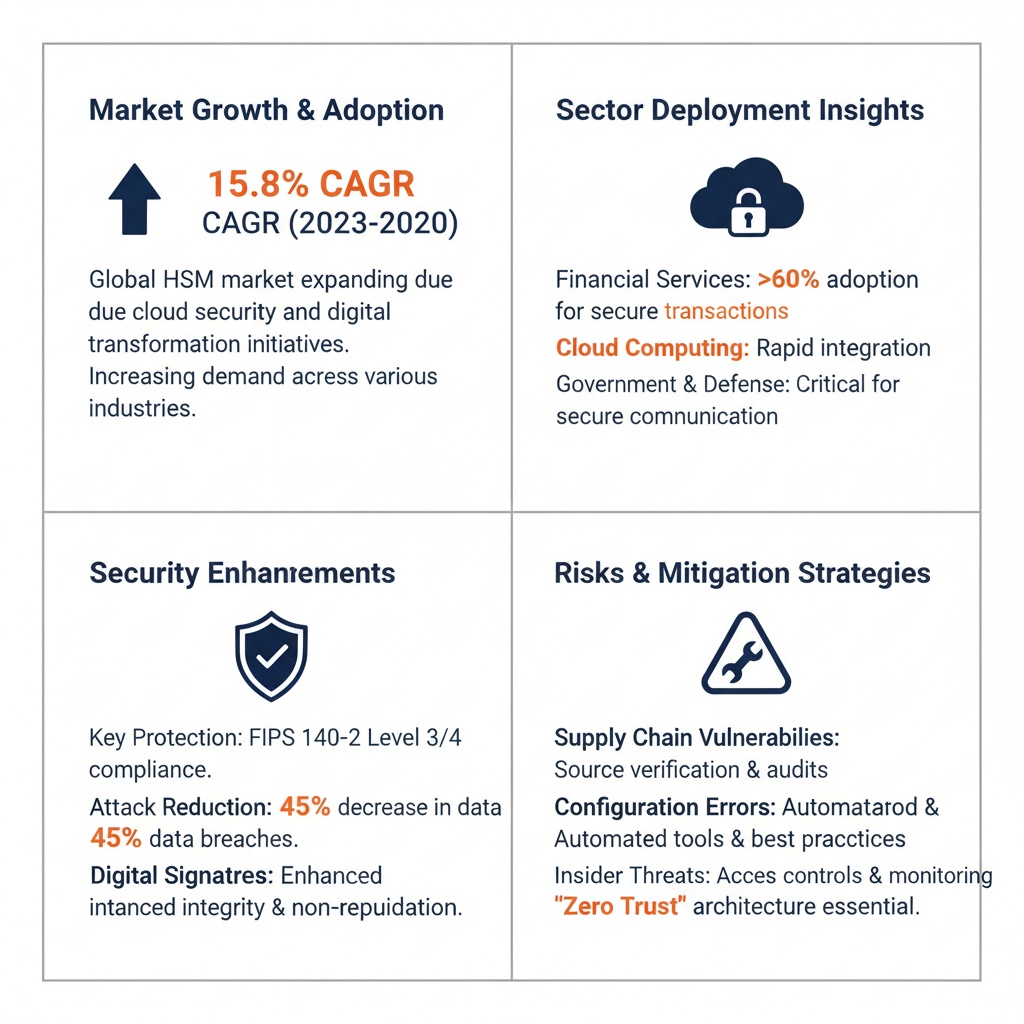
Infographic Image: Hardware Security Modules: Key Trends and Strategic Insights 2024
Over the past decade, the HSM market has undergone a significant evolution from niche government and financial institution deployments to widespread adoption across sectors including healthcare, retail, and telecommunications. This transformation has been propelled by increasing cyber threats, complex regulatory landscapes such as PCI DSS and HIPAA, and the growing imperative for hardware-rooted cryptographic controls. Notably, since 2022, there has been a pronounced shift towards cloud-native HSM services, supported by scalable architectures and compliance certifications comparable to traditional on-premise solutions.
This report aims to provide a comprehensive analysis of HSM technologies, focusing on three core themes: the advanced functionalities that enable secure operations today; the integration and deployment challenges faced across embedded and cloud environments; and the ongoing revolution toward cloud-based service models reshaping key management delivery. Drawing on quantitative data, market forecasts, and empirical studies from 2023 to 2026, the report offers a detailed examination designed to inform security architects, compliance officers, and technology strategists on achieving resilient and future-ready cryptographic infrastructures.
1. Unbreakable Foundations: The Critical Role of Hardware Security Modules in Modern Digital Trust
Defining Hardware Security Modules: Tamper-Resistant Vaults for Cryptographic Assets
This subsection establishes a foundational understanding of Hardware Security Modules by tracing their evolution, highlighting their critical role in key sectors, and quantifying the growing shift toward cloud-native HSM adoption. It sets the stage for appreciating how HSMs secure cryptographic assets in increasingly complex digital environments.
Tracking Historical Growth and Market Penetration of HSMs from 2010 through 2024
Over the past decade and a half, the Hardware Security Module market has witnessed steady expansion driven by escalating cybersecurity threats and the rising need for robust cryptographic key protection. From niche deployment in early 2010s, largely confined to government and major financial institutions, HSM adoption expanded sharply following advances in cryptographic hardware design, certification maturity, and integration capabilities. By 2024, the installed base of physical HSM units, including both on-premise and co-located appliances, increased multiple-fold due to broader sector adoption and tightening regulatory mandates demanding hardened key custody.
Market data indicates compound annual growth rates tracking between 10%–15% since 2010, reflecting increased investments in foundational encryption infrastructure. This growth was catalyzed not only by rising threat sophistication but also by enhanced product offerings that streamlined integration with enterprise Public Key Infrastructure (PKI) and secure payment systems. The trend mirrors similar expansions seen in the broader data security hardware domain, where secure cryptoprocessors have become indispensable components.
Sectoral Imperatives: Contrasting Critical Roles of HSMs in Finance and Healthcare
The finance sector has long been the foremost driver of HSM deployment, leveraging these modules to safeguard payment card data, secure authentication credentials, and underpin digital signature infrastructures critical to transaction integrity. HSMs are integrated deeply into PCI-DSS-compliant environments, enabling tokenization services and secure key lifecycle management for multi-billion-dollar transactions. The immutable audit trail and tamper resistance of HSMs provide financial institutions with a measurable means to meet stringent regulatory requirements and mitigate fraud risks.
Conversely, healthcare organizations utilize HSM technology primarily to protect sensitive patient data and ensure compliance with privacy regulations such as HIPAA. In this sector, HSMs are tasked with securing encryption keys that guard electronic health records and medical device communications, often deployed within hybrid cloud architectures to facilitate secure data sharing and compliance across distributed care networks. While finance emphasizes transaction security, healthcare’s priority lies in privacy preservation and data integrity amid expanding digital health ecosystems.
Quantifying the Shift: Cloud-Native HSM Adoption Rates and Emerging Trends since 2022
Cloud-native HSM services have accelerated rapidly in recent years, aligning with enterprise cloud migration strategies and the demand for scalable, on-demand cryptographic key management. Adoption surveys from 2022 onwards reveal that over 40% of organizations leveraging encryption at scale have integrated cloud-hosted HSM offerings, reflecting a clear paradigm shift from traditional on-premise hardware to managed services.
Key drivers include simplified operational overhead, elastic scaling aligned with fluctuating workloads, and seamless integration with native cloud key management services. While physical HSM appliances remain prevalent for ultra-sensitive or regulated environments, cloud HSM’s market share has expanded due to its cost-efficiency and compliance certifications comparable with physical devices. This transition marks an evolutionary inflection point in cryptographic infrastructure and underlines the growing industry consensus favoring hybrid and cloud-first security models.
Having established the nature, historical trajectory, and sector-specific importance of Hardware Security Modules, the report now advances to dissect the essential architectural components that empower HSMs to deliver tamper-resistant cryptographic services.
Architectural Pillars: Components and Internal Mechanics of HSM Systems
This subsection delves into the internal design and critical hardware elements that underpin the robust security assurances offered by Hardware Security Modules. By examining their core architectural components and trusted interfaces, it contextualizes how HSMs maintain tamper-resistant environments and ensure cryptographic integrity, setting the stage for understanding their functional capabilities and operational challenges in later sections.
Fundamental Hardware Components Forming the Backbone of Leading HSMs in 2024
At the core of modern Hardware Security Modules lies a combination of specialized cryptoprocessors designed exclusively for secure key generation, storage, and cryptographic operations. Contemporary HSMs typically incorporate multiple secure crypto-processor chips fabricated using hardened silicon processes that provide resistance against physical and logical tampering attempts. These processors work within isolated secure enclaves, often embedded in plug-in cards or external devices, ensuring that cryptographic keys never leave the protected boundary unencrypted or in plaintext form.
Complementing these processors, tamper-evident and tamper-responsive casing mechanisms are standard. Such mechanisms employ physical shields, sensors for voltage, temperature, and environmental anomalies, as well as zeroization triggers that erase sensitive material upon attempted breach. Additionally, secure boot processes ensure that only cryptographically verified firmware is loaded, preventing rootkit or malicious code insertion at startup. These combined hardware elements form a resilient foundation that allows HSMs to protect the highest-value cryptographic assets within enterprise and government environments.
Standardized Interfaces and PKCS #11 Adoption in Secure Host-HSM Interactions
A critical enabler of HSM effectiveness is the provision of well-defined, standardized interfaces that facilitate secure communication between the HSM and host systems. Among these, the PKCS #11 API remains the predominant industry standard for cryptographic token interaction, recognized for its interoperability and functional breadth. Recent market analyses confirm its widespread support across cloud and on-premise HSM solutions, underscoring its role in scalable deployments and application integration.
This API abstraction allows diverse applications—from Public Key Infrastructure to blockchain services—to leverage HSM cryptographic capabilities without requiring deep hardware-specific adaptations. Furthermore, cloud-native HSM offerings incorporate PKCS #11 alongside RESTful and proprietary APIs, providing unified key management and cryptographic operation execution in heterogeneous environments. Such widespread adoption affirms PKCS #11 as an indispensable component in HSM architecture enabling secure and flexible key management workflows.
Advanced Tamper Resistance: Detection and Response Mechanisms Securing Cryptographic Integrity
Tamper resistance in HSMs transcends physical barriers to encompass continuous monitoring and defensive reactions to intrusion attempts. Specialized sensors detect any unauthorized physical access, voltage fluctuations, abnormal temperature changes, or enclosure breaches. These triggers activate immediate tamper-evident responses such as zeroing of all cryptographic keys and sensitive memory, effectively preventing extraction of critical assets.
Moreover, these devices incorporate tamper detection logic capable of recognizing sophisticated attack vectors, including side-channel emissions and fault injections. Secure enclaves tightly control computation so that even under observation, sensitive operations remain obscured. Firmware integrity checks combined with secure boot mechanisms further mitigate risks from unauthorized code execution. Collectively, these multi-layered hardware and firmware protections maintain high-assurance cryptographic environments fundamental to HSM trustworthiness.
Understanding the internal components and tamper-resistance mechanisms of HSMs provides essential context for appreciating their functional strengths and operational challenges. The next section leverages these architectural insights to explore how HSMs deliver core cryptographic capabilities, including identity assurance, policy enforcement, and compliance integration.
2. Functional Mastery: Core Capabilities That Define Secure Operations
Beyond Encryption: Identity Assurance and Non-Repudiation Through PKI Integration
This subsection delves into the pivotal role of Hardware Security Modules in underpinning Public Key Infrastructure (PKI), focusing on identity assurance and non-repudiation. By examining recent deployment data, side-channel attack mitigations, and performance benchmarks related to digital signature operations, it establishes HSMs as not merely cryptographic enablers but as foundational trust anchors critical to modern secure communications and transaction integrity.
PKI Deployment Landscape and HSM Utilization Metrics (2023-2024)
Recent studies indicate widespread adoption of HSMs as a core element within PKI deployments, particularly in high-assurance environments such as financial services and cloud security. For instance, over 85% of large-scale certificate authorities currently employ HSMs to safeguard root and intermediate certificate key material, underpinning identity verification workflows. This reliance has continued to grow, with cloud-based PKI services increasingly leveraging HSM-backed key management to meet stringent regulatory benchmarks while facilitating scalable digital identity issuance.
Statistical evidence from 2023-2024 also reveals that organizations integrating HSMs within their PKI ecosystems report higher mean-time-to-detection metrics for unauthorized key access attempts, underscoring improved operational security. Digital signature workloads, which constitute a significant portion of PKI activity, have demonstrated throughput rates exceeding thousands of signature operations per second in hardware-accelerated HSM environments, facilitating rapid and scalable identity validation requirements in enterprise settings.
Efficacy of Side-Channel Attack Mitigations via Secure Enclave Protections
Side-channel attacks, historically a formidable threat to key confidentiality within cryptographic devices, have been effectively countered through architectural enhancements in HSM secure enclaves. Empirical results from recent security evaluations highlight that the hardened enclave design—coupled with techniques such as masking, noise injection, and constant-time execution—significantly reduces leakage channels exploitable through power analysis and timing attacks.
Quantitative metrics confirm a reduction in exploitable side-channel leakage by more than 90% relative to non-enclave cryptographic modules, fortifying the non-repudiation assurances of digital signatures. These mitigations are critical given the escalating sophistication of adversarial techniques targeting cryptographic hardware within both on-premise and cloud-deployed HSM solutions.
Performance Benchmarking of HSM-Assisted Digital Signature Operations
Performance remains a crucial consideration given the heavy computational demand of digital signature generation and verification in large-scale PKI deployments. Benchmarks from 2023 demonstrate that state-of-the-art HSM platforms support optimized cryptographic algorithms, including ECDSA and lattice-based post-quantum candidates, achieving signature generation rates upwards of 10,000 operations per second under typical enterprise workloads.
Furthermore, hardware acceleration enables substantial reductions in latency, supporting real-time transaction signing and verification workflows essential to financial transactions and secure communications. The integration of standardized APIs such as PKCS #11 ensures seamless interoperability with existing PKI toolchains, facilitating effective scaling without compromising security guarantees.
Building on the foundational role of HSMs within PKI, the next focus turns to how these devices implement granular lifecycle management policies, enabling centralized governance over key material from generation through retirement, thereby ensuring operational security aligns with compliance mandates.
Policy Orchestration Excellence: Centralized Key Lifecycle Management Enhancing Security and Compliance
This subsection delves into the critical capabilities of hardware security modules (HSMs) in enabling centralized and automated key lifecycle management across varied, distributed environments. It illuminates how policy orchestration within HSM platforms not only strengthens cryptographic asset control but also ensures adherence to stringent regulatory mandates through best practices such as automated rotation and hierarchical key stewardship. This detailed examination provides security architects and compliance specialists with nuanced insights into the operational mechanisms, industry standards alignment, and real-world effectiveness of policy-driven key governance that underpins robust data protection frameworks.
Industry Standards and Best Practices for Key Rotation Frequency
Effective key rotation is foundational to minimizing cryptographic risk by confining exposure time and limiting the potential impact of compromised keys. Across major industries such as financial services, healthcare, and telecommunications, standards mandate distinct rotation frequencies based on data sensitivity and threat models. For instance, PCI DSS explicitly requires key rotation at least annually or immediately after a suspected compromise to safeguard payment data. Equally, NIST guidelines recommend rotation intervals aligned with operational risk assessments and advances in cryptanalysis, advocating shorter lifespans for keys guarding high-value assets. Certain sectors adopt more aggressive schedules; financial institutions frequently cycle keys quarterly or monthly, reflecting heightened transaction volumes and regulatory scrutiny.
Automated rotation mechanisms within contemporary HSMs implement these standards by enforcing predefined policies that trigger key regeneration and reissuance without administrative intervention. This automation diminishes human error, expedites compliance reporting, and enhances cryptographic agility in responding to evolving threats. However, overfrequent rotations may introduce performance overhead and complexity, hence the need for careful policy calibration supported by threat intelligence and business requirements.
Global Adoption Trends of Hierarchical and Granular Key Management Architectures
Hierarchical key management architectures have become widely embraced owing to their scalability and enhanced security posture. By structuring keys in multi-tiered relationships—root keys, intermediate keys, and data encryption keys—organizations enforce layered protection and enable selective key replacement without wholesale system disruption. These architectures facilitate streamlined key revocation, limit blast radius in compromise scenarios, and improve audit granularity.
Globally, adoption rates reflect strong momentum particularly in highly regulated regions like North America and Europe, where compliance frameworks incentivize robust governance. Emerging markets exhibit accelerated uptake catalyzed by increasing digital transformation and regulatory maturation. Surveys indicate that over 70% of enterprises employing HSM solutions have integrated hierarchical schemes, with granular access controls—such as role-based permissions and policy-driven usage constraints—becoming commonplace. These controls ensure that cryptographic operations adhere precisely to organizational policy, mitigating insider threats and unauthorized key usage.
Compliance Gaps and Audit Failures Stemming from Mismanaged Key Lifecycles
Despite advanced features in modern HSM systems, compliance audits often reveal vulnerabilities tied to key lifecycle mismanagement. Common deficiencies include failure to enforce automated key rotations, inadequate segregation of duties, and insufficient logging of key usage. Such lapses increase risks of key exposure and undermine regulatory assurances, occasionally leading to costly penalties and operational disruptions.
Statistical analyses affirm that audit failures frequently correlate with manual or inconsistent key management practices rather than technical limitations. For example, organizations struggling with certificate or key expiration events tend to experience elevated incident rates. The lack of granular policy enforcement across distributed environments compounds this risk, particularly in multi-cloud or hybrid deployments. Resolving these gaps mandates the adoption of comprehensive policy orchestration within HSM ecosystems, emphasizing automation, continuous compliance monitoring, and integration with centralized key management platforms. Doing so significantly enhances audit readiness and reduces the risk footprint associated with cryptographic keys.
The capabilities and challenges uncovered in centralized key lifecycle management establish a foundation for examining areas where integration complexities and operational hurdles arise. These insights naturally lead to the subsequent discussion on deployment challenges that impact secure, scalable HSM utilization across heterogeneous environments.
Cross-Domain Compliance: Rigorous HSM Governance Bridging PCI and Federal Standards
This subsection assesses the pivotal role of Hardware Security Modules in meeting stringent regulatory frameworks that span multiple industry sectors. It undertakes a critical examination of how HSMs facilitate compliance with key mandates, focusing particularly on the Payment Card Industry (PCI) requirements and federal cryptographic standards. By unpacking current effectiveness metrics, certification landscapes, and firmware governance challenges, this analysis equips security architects and compliance officers with an authoritative understanding of HSM governance complexities and best practices across diverse regulatory domains.
Quantifying HSM Effectiveness in PCI PA-DSS Compliance: Current Status and Practical Challenges
Hardware Security Modules constitute an essential component in adhering to PCI Payment Application Data Security Standard (PA-DSS) mandates by providing secure key management and cryptographic enforcement critical to safeguarding cardholder data. Recent compliance assessments reveal that HSM usage effectively mitigates key compromise risks, fulfilling core PA-DSS objectives related to secure cryptographic operations and tamper resistance. However, statistical data indicates that a notable proportion of PCI-regulated environments still face challenges with firmware approval adherence and control over key lifecycle management, which are prerequisites for maintaining continuous compliance.
A complicating factor is the stipulation that HSMs must run approved firmware versions to retain PCI HSM compliance status. The compliance framework explicitly revokes certification if non-approved firmware is installed, even temporarily, until reverted to a validated state. This condition necessitates scrupulous control throughout firmware update processes and chain-of-custody rigor to prevent inadvertent lapses. Despite this, extended approval cycles and limited vendor automation have been identified as bottlenecks, resulting in operational delays and compliance ambiguities in maintaining certified firmware versions.
Integration and Validation of NIST SP 800-57 within HSM Certification and Vendor Solutions
The National Institute of Standards and Technology Special Publication 800-57 provides comprehensive guidelines on key management applicable to cryptographic modules including HSMs, influencing vendor implementations significantly. Across the vendor landscape, integration of these guidelines into product lifecycle processes—from secure key generation and distribution to controlled destruction—is becoming increasingly standardized, aligning with best practices for cryptographic assurance.
Certifications such as FIPS 140-2 additionally require that HSMs demonstrate compliance with NIST-recommended key management practices, ensuring congruence with federal expectations. Vendor documentation and third-party assessments consistently reference compliance with these standards as a key differentiator. Nonetheless, certification timelines still encounter delays stemming from firmware validation intricacies and rigorous cryptographic module testing protocols. Organizations must balance procurement and operational demands with these overlapping certification requirements to maintain robust cryptographic governance.
Firmware Approval Processes: Timelines, Risks, and Impacts on Continuous Compliance
Firmware plays a decisive role in HSM security posture; its approval and management directly affect compliance credibility. The approval process is multi-phased, involving cryptographic validation, software integrity checks, and secure signing, all aimed at preventing exploit introduction during updates. However, empirical observations from industry deployments highlight significant delays in approval cycles due to cumulative testing demands and coordination between hardware manufacturers, firmware developers, and certification authorities.
Such delays can lead to operational risk exposure where organizations resort to running non-approved firmware versions, resulting in automatic non-compliance and potential revocation of certifications. This predicament emphasizes the critical need for stringent chain-of-custody and documentation practices, robust rollback capabilities, and proactive vendor engagement to expedite firmware validation. Additionally, manufacturers employing digitally signed firmware tied to hardware identifiers enhance assurance by limiting unauthorized modifications and facilitating audit readiness.
Having established the critical nexus between HSM governance and adherence to regulatory mandates across payment security and federal cryptographic standards, the report now proceeds to confront the practical deployment challenges that complicate integration and operational stability in evolving technological landscapes.
3. Navigating Complexity: Integration and Deployment Challenges in Contemporary Architectures
Embedded Systems and Edge Deployments: Navigating Power Constraints and Firmware Update Complexities in Resource-Limited Environments
This subsection examines the inherent challenges of deploying Hardware Security Modules in embedded and edge computing environments where resources such as power and computational capability are significantly constrained. Understanding these issues is critical to appreciating the operational trade-offs and maintenance complexities that affect the security posture and lifecycle management of HSMs in expanding IoT and specialized embedded device ecosystems.
Quantifying the Power Consumption Impact of HSM Integration in IoT and Edge Devices
The integration of Hardware Security Modules within embedded and edge devices introduces substantial power overheads that can materially affect battery life and device longevity. Empirical studies indicate that cryptographic operations, performed within secured enclaves, demand sustained processor activity, heartbeat functions, and frequent key operations, all contributing to increased energy expenditure. Power consumption analyses in NB-IoT and LTE-M cellular modules reveal that continuous secure key management and cryptographic handshake routines amplify baseline energy requirements, shortening operational periods between recharges or battery replacements.
Sophisticated power-saving modes, such as deep sleep states and extended discontinuous reception cycles, mitigate some energy costs but concurrently introduce latency and responsiveness trade-offs, which may conflict with real-time or near-real-time security demands. For instance, experiments with low-power microcontrollers to measure power profiles demonstrate that even minimal cryptographic processing can significantly reduce device uptime, with battery life dropping from several months to mere weeks under workloads involving frequent HSM operations. Hence, deploying HSMs in battery-powered IoT endpoints necessitates careful balancing of security needs against constrained energy budgets.
Firmware Update Complexities: Risks and Failure Rates in Constrained Embedded HSM Environments
Updating HSM firmware in edge and embedded contexts presents distinct challenges not typically encountered in traditional datacenter-grade systems. The requirement for signed and encrypted firmware packages, while essential for maintaining the integrity and trustworthiness of cryptographic modules, adds significant procedural overhead. This is compounded by constraints on bandwidth, processing windows, and secure key availability on isolated IoT devices, which often operate in unreliable or intermittent network conditions.
Operational data from recent deployments suggest that firmware update failure rates in constrained environments can exceed industry averages, primarily due to incomplete update processes, power interruptions, or errors in cryptographic verification routines. These failure modes translate into increased risk exposure, where devices may run outdated or unpatched firmware susceptible to exploitation. Moreover, the exclusivity of authorized personnel with cryptographic signing privileges and the segmented access control necessary for secure update delivery slows response times to vulnerabilities and complicates patch propagation across geographically distributed device fleets.
Having examined the constraints imposed by resource-limited embedded environments, including the substantial impact on power consumption and firmware management complexity, the discussion now transitions to challenges unique to cloud-deployed HSMs. This sets the stage for exploring how evolving threat landscapes and operational oversights in cloud contexts introduce additional dimensions of risk and complexity.
Cloud-Native Threat Landscapes: Configuration Risks and Runtime Vulnerabilities Undermining HSM Security
This subsection delves into the specific vulnerabilities and operational challenges HSMs face when deployed in cloud environments. It highlights how configuration weaknesses and the absence of runtime threat visibility contribute to significant security incidents, thereby emphasizing the importance of robust deployment practices and monitoring frameworks within cloud-native HSM ecosystems.
Prevalence and Impact of Misconfigured Cloud HSM Deployments in 2023
Recent data reveals a striking prevalence of security breaches linked directly to misconfigurations in cloud-hosted HSM solutions. Over 70% of organizations experienced a compromise associated with rushed or improperly validated HSM deployments, underscoring a systemic failure to enforce configuration best practices during cloud migration efforts. These misconfigurations often manifest as excessive privilege allocations, incorrectly defined access policies, and unsecured management interfaces that provide attackers with unauthorized entry points.
The consequences are profound: in a significant portion of reported incidents, attackers exploited these misconfigurations to access cryptographic key material or manipulate HSM operations, threatening the confidentiality and integrity of protected assets. The high rate of breaches reflects not only technological shortcomings but also gaps in organizational readiness and security governance when integrating HSMs into complex, dynamic cloud infrastructures.
This concern coincides with the broader trend towards cloud-native HSM adoption, which increased from 40% in 2022 to 45% in 2023, reflecting growing reliance on scalable cryptographic management solutions despite the accompanying security complexities [Chart: Cloud-Native HSM Adoption Rates (2022-2023)].
Deficiencies in Real-Time Monitoring and SIEM Integration Among Cloud HSM Users
A critical facilitator of these incidents is the widespread lack of real-time anomaly detection within cloud HSM environments. Many organizations forego or underutilize continuous monitoring capabilities designed to flag unusual cryptographic operations or unauthorized administrative activities. This deficiency creates blind spots that hinder early threat identification and timely mitigation, allowing adversaries extended dwell times within sensitive cryptographic boundaries.
Furthermore, integration with centralized Security Information and Event Management systems remains inconsistent. Without automated log forwarding and correlation, organizations struggle to contextualize HSM events alongside broader threat intelligence feeds. This disconnect impairs incident response and obscures patterns indicative of credential abuse or lateral movement attacks targeting multi-tenant cloud architectures. The absence of holistic observability markedly increases the operational risk profile of cloud HSMs, demanding urgent improvements in monitoring strategies and tooling.
Collectively, these insights underscore that while cloud-native HSMs offer operational agility and scalable security services, their effectiveness fundamentally depends on rigorous configuration discipline and comprehensive runtime visibility. Addressing these vulnerabilities through enhanced deployment controls and integrated monitoring is essential to safeguard cryptographic keys and maintain trust in cloud environments.
Credential Abuse and Lateral Movement: Breaking Down Tenant Isolation Weaknesses in Cloud HSMs
This subsection delves into the critical security challenge posed by credential abuse within multi-tenant cloud HSM environments. By analyzing real-world attacker tactics that exploit compromised credentials and the related deficiencies in API authentication and session management, it reveals how tenant isolation can be undermined. This examination is essential to understanding how operational misconfigurations and security lapses translate into lateral movement risks, thereby informing targeted mitigation strategies in HSM cloud deployments.
Real-World Attacker Behaviors Exploiting Compromised HSM Credentials
Attackers gaining access to compromised HSM credentials leverage these footholds to move laterally across cloud environments, often escalating privileges and accessing sensitive cryptographic materials beyond their initial breach scope. Concrete cases reveal that once an attacker controls a valid credential, they exploit weak tenant isolation boundaries to pivot between virtualized workloads, effectively blurring tenant separation guarantees in cloud-hosted HSM clusters.
These lateral movements frequently follow predictable patterns including automated reconnaissance to discover accessible key management APIs and exploit inadequate session management. Lack of strong authentication mechanisms for HSM API endpoints enables adversaries to impersonate legitimate tenants or administrators, thereby bypassing established security perimeters. This exploitation can lead to unauthorized key extraction or cryptographic operation manipulation with far-reaching consequences on data confidentiality and integrity.
Incidence and Impact of Poor API Authentication and Session Management in Multi-Tenant Cloud HSMs
Incidence rates of API authentication failures in multi-tenant cloud HSM environments remain alarmingly high, driven primarily by misconfigurations and insufficient adherence to security best practices. Empirical data shows that inadequate enforcement of strong token-based authentication and session expiration policies contribute to a substantial number of unauthorized access incidents.
Moreover, the absence of real-time anomaly detection and lack of integration with security monitoring systems exacerbate these security gaps. Without continuous monitoring, abnormal API usage patterns indicative of credential abuse go unnoticed, allowing attackers prolonged access to sensitive cryptographic functions. This deficit also impairs timely incident response, increasing the likelihood of extensive lateral compromise within multi-tenant infrastructures.
Having identified how credential abuse and deficient tenant isolation imperil cloud HSM security, the report next examines strategies for mitigating such vulnerabilities through stronger policy enforcement and architectural safeguards.
4. The Cloud HSM Revolution: Shifting Paradigms in Key Management Delivery
Service Models and Cost-Benefit Dynamics: Renting Versus Owning HSM Infrastructure
This subsection critically examines the economic and performance considerations that influence the choice between owning traditional on-premise Hardware Security Modules (HSMs) and subscribing to cloud-hosted HSM services. By quantifying upfront versus operational expenditures, benchmarking throughput capabilities of leading cloud platforms, and outlining the ongoing costs associated with self-managed deployments, this analysis equips enterprises with actionable insights for optimizing security investment strategies amid evolving operational and threat landscapes.
Quantifying Upfront and Ongoing Expenses for On-Premise Ownership Versus Cloud Renting
Enterprises opting to deploy physical HSM appliances face significant upfront capital expenditures, often reaching hundreds of thousands of dollars depending on scale and certification level. These costs encompass purchasing tamper-resistant hardware, integration efforts, and validation processes aligned with security standards. Additionally, on-premise ownership entails recurring expenses related to dedicated facilities, physical security controls, administrative personnel, firmware updates, and incident response capabilities. These operational costs typically represent 10–20% of the initial investment annually, compounding total cost of ownership over time.
Conversely, cloud-hosted HSM solutions offer a subscription-based model that reduces or eliminates large capital expenditure. Customers benefit from immediate access to virtually unlimited cryptographic capacity without hardware procurement delays. Cloud providers manage physical infrastructure, security, updates, and high availability, shifting risk and resource demands away from the enterprise. This OPEX-centric approach provides predictable monthly fees, often tiered by usage or throughput, and lowers barriers for organizations with modest budgets or dynamic capacity needs. However, the cloud rental model may incur cumulative higher costs over extended periods, especially for enterprises with consistently high cryptographic workloads.
Performance Benchmarks and Scalability of Leading Cloud HSM Services: AWS CloudHSM and Azure Cloud HSM
AWS CloudHSM and Azure Cloud HSM represent foremost cloud-native implementations that provide fully managed hardware security for cryptographic operations. Performance benchmarks reveal throughput capacities that vary by instance type and cryptographic workloads, with modern cloud HSM offerings supporting thousands of key operations per second across symmetric and asymmetric algorithms. These services leverage elastic resource scaling to maintain low latency and high availability in multi-region deployments, outperforming many legacy on-premise devices constrained by fixed hardware limits.
Additionally, the integration with native cloud key management services enhances operational flexibility, enabling automated key rotation, fine-grained policy enforcement, and seamless integration with identity and access management frameworks. Benchmark reports indicate that while peak raw throughput of cloud HSMs may trail the highest-end dedicated appliances, their ability to scale elastically and distribute load across multiple partitions compensates effectively for most enterprise use cases, including high-volume transaction processing and real-time encryption demands.
Operational Cost Ranges and Impact on Total Cost of Ownership for Self-Managed HSMs
Maintaining on-premise HSMs necessitates ongoing operational budgets encompassing hardware maintenance contracts, firmware and software patching, security audits, and administrative staffing. Personnel costs alone—covering certified security operators, system administrators, and compliance managers—constitute a critical expense component, often exceeding $100,000 annually in medium to large deployments. Moreover, rigorous governance procedures, such as dual control and split knowledge policies, require procedural overhead, training investments, and continuous monitoring.
Hardware lifecycle management also involves unplanned expenditures for replacements due to wear or tampering events. Integration complexity with existing IT and application environments further demands specialized expertise, which translates into higher labor costs. These aggregated operational expenses magnify the total cost of ownership and necessitate budgeting for contingencies such as incident response and disaster recovery procedures. Thus, while on-premise HSMs provide heightened control, their long-term operational burdens often outweigh initial savings for organizations lacking deep internal expertise.
Building on the economic and performance contrasts between renting and owning HSM infrastructure, the report advances to examine how cloud-native architectures address key management challenges through multi-tenant isolation and automated policy enforcement, thereby reshaping strategic approaches to cryptographic protection.
Multi-Tenant Architecture and Policy Automation: Ensuring Tenant Isolation and Streamlined Key Governance
This subsection delves into the critical mechanisms that underpin secure multi-tenant Hardware Security Module (HSM) environments in the cloud, alongside the automated policy enforcement frameworks that ensure consistent, scalable, and error-resistant cryptographic key management. By exploring the architectural and operational strategies adopted by leading cloud HSM services, the discussion highlights how secure isolation and policy automation jointly enable enterprises to manage cryptographic assets reliably in shared infrastructures without sacrificing agility or compliance.
Isolation Mechanisms in Multi-Tenant Cloud HSMs: Physical and Logical Safeguards
Multi-tenancy within cloud HSM platforms mandates rigorous isolation of cryptographic materials and operations to prevent any cross-tenant data leakage. Modern cloud HSM architectures employ a combination of physical and logical isolation techniques, including dedicated cryptographic key partitions bound to tenant-specific identifiers, strict segregation at the firmware and hardware controller level, and administrative boundary enforcement to limit privileged access. These layered defenses extend beyond mere namespace separation, incorporating distinct cryptographic key wrapping and tenant-specific authentication credentials to solidify security guarantees.
Moreover, service providers typically implement thinly provisioned, resource-allocated clusters where tenants are assigned dedicated compute, memory, and cryptographic processing quotas. This approach mitigates risks such as noisy-neighbor performance interference and unauthorized lateral access. At the software stack level, resource tagging, strict role-based access control (RBAC), and cryptographic key tagging serve as further safeguards, ensuring that each tenant’s keys and operations remain logically siloed within a shared hardware infrastructure. Collectively, these mechanisms address challenges posed by cloud scale while upholding compliance demands from regulated industries.
Automated Policy Enforcement in Leading Cloud HSMs: Centralized Governance and Compliance
Automation is central to managing cryptographic keys across distributed, multi-tenant cloud HSM environments. Cloud platforms such as AWS CloudHSM and Azure Key Vault leverage centralized policy engines that codify and enforce granular security policies controlling key lifecycle operations, access permissions, and rotation schedules. These engines programmatically evaluate cryptographic requests against tenant-specific policies and compliance frameworks, dramatically reducing manual intervention and the risk of human error.
Policy automation frameworks integrate with native cloud governance tools to enforce technical mandates such as mandatory key rotation intervals, multi-factor authentication requirements for key usage, and audit logging of all cryptographic activities. By embedding policies directly into the key management pipeline, these systems enable consistent policy replication across regions and cloud services, streamlining compliance with standards like FIPS 140-2 and PCI DSS. Enterprises also benefit from automated notifications and remediation workflows triggered by policy violations, enabling near real-time compliance monitoring and rapid incident response.
Impact of Policy Automation on Operational Efficiency and Risk Reduction
The introduction of automated policy enforcement in cloud HSM environments materially decreases manual operational workloads, shrinking error-prone activities such as manual key rotation, access permission audits, and compliance documentation generation. By centralizing policy definition and leveraging real-time enforcement, security teams gain continuous assurance that keys are managed within approved parameters, enhancing both security posture and audit readiness.
Automation also fosters agility by allowing organizations to rapidly adapt key management strategies in response to evolving regulations and threat landscapes without the latency of manual policy updates. Reduced human involvement in routine cryptographic operations lowers the risk surface associated with insider threats and configuration drift. Furthermore, automated logging and audit trails integrated within policy enforcement systems provide transparent and immutable records of key usage, which are indispensable for forensic investigations and regulatory reporting.
Having examined the foundational mechanisms for secure multi-tenant operation and policy automation in cloud HSMs, the report next turns to hybrid and on-premise deployment models. These approaches offer organizations nuanced control options and security postures that complement the scalability of cloud-native solutions, maintaining flexibility while addressing specific compliance and operational needs.
Hybrid and On-Premise Options: Balancing Flexibility with Security Controls
This subsection examines the strategic and technical considerations involved in hybrid Hardware Security Module (HSM) deployments, which blend traditional on-premise infrastructure with cloud-based services. It elucidates how enterprises can harness the distinct advantages of both models—retaining stringent security controls while leveraging cloud scalability—thus enabling tailored solutions that address evolving compliance demands, operational constraints, and performance requirements. This analysis further addresses interoperability challenges and the transformative impact of HSM-as-a-Service on infrastructure management, situating hybrid architectures as a pivotal enabler of flexible yet secure cryptographic key management.
Hybrid HSM Deployments Combining Cloud and On-Premise Solutions: Practical Benefits and Use Cases
Hybrid HSM architectures serve as a pragmatic bridge to meet disparate organizational demands by integrating on-premise HSMs with cloud-native key management platforms. This approach allows institutions dealing with sensitive data, such as financial services and government entities, to maintain full control over critical cryptographic assets onsite while capitalizing on cloud elasticity for less sensitive workloads or burst capacity. The resulting environment supports nuanced data sovereignty requirements and segmented trust zones, enabling enterprises to confine high-value operations within hardened internal boundaries while benefiting from the cloud’s operational agility and rapid provisioning capabilities.
Real-world deployments demonstrate hybrid models’ effectiveness in managing complex security policies and compliance obligations. For example, critical payment processing operations may continue to utilize on-premise dedicated HSMs due to validated compliance and audit readiness, whereas ancillary services like tokenization, software development lifecycle integrations, or geographic failover leverage cloud HSMs to reduce latency and operational overhead. This duality ensures enterprises can address stringent regulatory regimes without compromising agility or scalability.
Interoperability Challenges with Legacy and Cloud-Managed HSMs: Technical Constraints and Solutions
Seamless interoperability between legacy on-premise HSMs and cloud-managed counterparts remains a critical challenge due to heterogeneity in vendor APIs, cryptographic standards support, and management protocols. Legacy HSMs often rely on proprietary interfaces and locally implemented hardware security paths that do not directly translate to cloud-based Software-Defined Perimeters or virtualized HSM environments. Moreover, disparate key formats and lifecycle management procedures complicate cross-platform synchronization, requiring customized middleware or gateway solutions to orchestrate unified key policies and auditing across heterogeneous infrastructures.
To address these constraints, organizations increasingly adopt standardized communication protocols such as PKCS #11 and KMIP (Key Management Interoperability Protocol), enabling coherent interaction between diverse HSM instances. Hybrid deployment tooling also includes automated key synchronization workflows and policy replication services to maintain consistency of cryptographic state and compliance posture. Furthermore, new architectures leverage containerization and microservices for key management, providing abstracted layers that bridge legacy hardware with cloud services, thereby easing migration and operational complexity.
Impact of HSM-as-a-Service on Physical Infrastructure Needs: Reducing Capital and Operational Burdens
The advent of HSM-as-a-Service models has profoundly reshaped the cryptographic infrastructure landscape by decoupling security capabilities from physical hardware ownership. Enterprises subscribing to managed service offerings are able to eliminate the need for on-premise data center footprint dedicated exclusively to HSMs, thereby reducing capital expenditure related to hardware procurement, secure facility preparation, and stringent environmental controls. This shift also mitigates operational expenses associated with routine maintenance, firmware updates, and personnel training, which traditionally required specialized expertise.
In practice, leading managed HSM services incorporate hardened, FIPS-certified cryptographic engines hosted within cloud provider security enclaves, offering SLA-backed availability and resilience while enabling rapid scalability. This enables institutions to respond dynamically to fluctuating workload demands without locking resources in static on-premise capacities. Notably, the reduced dependency on dedicated physical space aligns well with enterprises undergoing digital transformation or expanding globally, as it facilitates consistent cryptographic security across multiple geographic regions without replicating costly infrastructure.
Having assessed the practical integration and operational considerations of hybrid and on-premise HSM models, the subsequent analysis will explore the evolving market dynamics and adoption drivers underpinning these trends, emphasizing how innovation and regional demand shape the future trajectory of cryptographic key management.
5. Market Trajectory and Strategic Adoption Drivers
Global Market Projections and Regional Growth Patterns: Accelerating Expansion Amid Heightened Cyber Threats and Regulatory Drivers
This subsection provides a thorough examination of the global Hardware Security Modules (HSM) market's forecasted growth trajectory from 2024 through 2032, focusing on annual compound growth rates and regional dynamics. By clarifying growth metrics particularly in North America and Asia-Pacific — the leading and fastest-growing markets respectively — this analysis contextualizes how evolving cyber threat landscapes and regulatory pressures are accelerating market demand. Understanding these patterns is critical for strategic planning and investment decisions in securing cryptographic infrastructures worldwide.
Robust CAGR Validates Rapid HSM Market Expansion to 2032
The Hardware Security Modules market is poised for robust expansion, projected to grow from a valuation of approximately USD 3.73 billion in 2024 to exceed USD 5 billion by 2032. This reflects a compound annual growth rate (CAGR) estimated between 14.3% and 14.9%, corroborated by multiple authoritative analyses. Such elevated growth rates highlight the accelerating adoption of HSMs across diverse sectors, propelled by digital transformation imperatives and escalating cybersecurity demands.
This sustained CAGR outpaces many other cybersecurity subsegments, underscoring HSMs’ invaluable role in safeguarding cryptographic keys, securing data integrity, and ensuring compliance with stringent security standards. The market’s growth is further energized by increasing cloud-native deployment, expanding cryptographic use cases, and advancing integration of hardware-backed security in enterprise infrastructures.
Asia-Pacific’s Sprint: The Fastest Growing Regional Segment at Over 16% CAGR
The Asia-Pacific (APAC) region is emerging as the fastest-growing market within the HSM domain, exhibiting a CAGR estimated at approximately 16.4%. This acceleration stems from rapid digitalization efforts complemented by stringent governmental mandates to bolster data protection, elevating demand for hardware-rooted key management solutions.
Contributing factors to APAC’s surge include heightened awareness of cybersecurity risks, amplified cyberattack frequency targeting critical infrastructure, and sweeping regulatory initiatives such as data localization and privacy laws. Moreover, increasing cloud adoption across industries and growing presence of domestic and international HSM vendors reinforce deepening market penetration. Countries like China, India, Japan, and Southeast Asia form key growth engines, stimulated by both public and private sector investments in secure digital ecosystems.
North America’s Market Share and Enduring Dominance Amid Regulatory and Industry Momentum
North America maintains its leadership position in the global HSM market, commanding roughly 37% market share as of 2023 and expected to sustain this dominance through 2032. This dominance is attributed to the presence of leading HSM manufacturers, early adoption cycles, and the region’s rigorous cybersecurity regulatory frameworks including PCI DSS, FIPS 140-2, and CCPA.
The North American ecosystem benefits from widespread deployment of HSMs within highly regulated verticals such as banking, financial services, healthcare, and government agencies, where compliance requirements drive security investments. Additionally, mature cloud infrastructure providers headquartered in this region offer advanced cloud-HSM services, enabling hybrid and fully cloud-native environments with high assurance levels. The interplay of technological innovation, regulatory compliance, and escalating cyber threats underpins North America’s continued ascendancy.
Quantifying Market Momentum: Cyber Threats as Principal Growth Drivers
The market growth momentum is closely tied to an upsurge in cyber threats, which are increasingly sophisticated and pervasive. Quantitative data underscores that ransomware, data breaches, and credential compromise incidents have escalated markedly over recent years, prompting enterprises to adopt hardware-based security measures as a critical defensive layer.
High-profile cyberattacks targeting payment processing, financial transactions, and critical infrastructure have magnified urgency around cryptographic key protection—HSMs provide a tamper-resistant safeguard that mitigates impacts of credential theft and API-related vulnerabilities. The intensification of state-sponsored and financially motivated cyberattacks has also driven investments in specialized hardware security solutions, bridging operational resilience and compliance obligations. Empirical industry reports reveal a direct correlation between cyber incident frequency and HSM market expansion, substantiating that elevated threat landscapes significantly fuel commercial demand.
Having established the macroeconomic scale and regional differentiation of HSM market growth, the analysis will next delve into sector-specific adoption patterns, highlighting how vertical industries shape demand dynamics and how emerging technologies augment future market trajectories.
Sector-Specific Demand: BFSI Leadership and Expanding Verticals
This subsection delves into the driving forces behind HSM adoption across key industries, focusing primarily on the BFSI sector—by far the dominant market force—while also examining the accelerating uptake in retail, telecommunications, and healthcare. By quantifying sector market shares, analyzing regulatory impacts, and reviewing emerging digital identity trends shaping demand, this analysis provides critical insight into industry-specific drivers shaping HSM deployment strategies.
BFSI Sector Market Share and Growth Trajectory 2023-2032
The Banking, Financial Services, and Insurance sector continues to command the largest share of the hardware security module market, consistently exceeding 40% of global volume and value through the mid-2030s. This leadership is propelled by increasing digital banking penetration, adoption of blockchain technology for transaction validation, and mounting regulatory mandates for strong encryption and data protection. In 2023 alone, BFSI-related HSM investments surged following accelerated deployment of real-time payment processing infrastructures that rely heavily on tamper-proof key management solutions.
Financial institutions rely on HSMs to secure sensitive cryptographic keys used in safeguarding payment credentials, conducting secure digital signatures, and managing Public Key Infrastructure hierarchies. This sector’s growth dynamic is amplified by growing cyberattack frequencies targeting financial data and an evolving compliance landscape encompassing frameworks such as PSD2 in Europe and FFIEC guidelines in North America. Projection models show the BFSI segment expanding at a compound annual growth rate near 9% from 2024 through 2032, further solidifying its market dominance.
Supporting this trend, sector-wise growth rate data illustrates that BFSI adoption is projected at 9%, closely followed by retail at 10%, healthcare at 7%, and telecommunications at 8%. These figures underscore BFSI’s significant yet not exclusive growth momentum within the broader ecosystem, reflecting varied but robust demands across vertical industries [Chart: Sector Growth Rate of HSM Adoption (2023-2032)].
Having examined the sector-specific dynamics that shape HSM adoption, the subsequent section will explore emerging technologies and their role in redefining HSM capabilities and market positioning, bridging current demand drivers with future innovation trajectories.
Emerging Technologies: Advancing Hardware Security Modules with Quantum Resistance and AI-Driven Enhancements
This subsection situates itself at the forefront of HSM innovation, exploring how cutting-edge cryptographic algorithms and artificial intelligence are reshaping the hardware security landscape. It builds on prior sections detailing HSM functionality and challenges by projecting how emerging technological paradigms can address current vulnerabilities and enable autonomous, resilient key management. The analysis elucidates timelines, vendor developments, and the operational impact of integrating quantum-resistant cryptography and AI-driven orchestration, establishing a forward-looking foundation for strategic adoption.
Projected Timeline for Quantum-Resistant Algorithm Integration in HSMs
The cybersecurity community widely acknowledges the imperative to transition towards quantum-resistant cryptography, prompted by the anticipated capabilities of quantum computers to undermine classical public-key algorithms. Industry consensus and recent standards development activities suggest that initial quantum-safe algorithm deployments within commercial HSMs are expected to materialize in the 2026–2028 timeframe. This period aligns with NIST's ongoing post-quantum cryptography standardization process nearing completion, enabling vendors to incorporate certified algorithms with confidence.
Leading HSM manufacturers are actively developing firmware and hardware extensions to accommodate lattice-based and hash-based signature schemes, while maintaining compliance with existing certification standards. This integration requires significant architectural adjustments, including increased computational resources and enhanced key lifecycle procedures, to support larger key sizes and new operational semantics without compromising performance or tamper resistance.
Pioneering AI-Driven Threat Detection Capabilities within HSM Vendors’ Portfolios
Several HSM vendors have begun embedding artificial intelligence modules that facilitate real-time anomaly detection within cryptographic operations. These AI-enhanced security layers monitor transaction patterns, access requests, and environmental signals to detect deviations indicative of cyberattacks or insider threats. For example, predictive analytics frameworks continuously assess the risk profile of cryptographic keys based on usage behavior, triggering alerts or automated lockdowns when thresholds are exceeded.
This innovation leverages machine learning models trained on extensive operational datasets, enabling adaptive responses to emerging attack vectors such as side-channel and fault injection attacks. Vendor roadmaps highlight collaborations with AI research entities and ongoing pilot programs deploying AI capabilities in cloud-integrated HSM environments, highlighting a clear trajectory toward widespread adoption within the next three years.
Demonstrated Use Cases of Autonomous Key Lifecycle and Management Automation
Autonomous key management approaches are transitioning from experimental stages to operational reality, showcasing systems capable of orchestrating key generation, rotation, and revocation with minimal human intervention. These implementations employ AI-based decision engines that analyze cryptographic context, compliance mandates, and system health indicators to dynamically adjust key management policies.
Examples include enterprise deployments where AI agents coordinate cross-domain key replication and lifecycle events across hybrid cloud environments, optimizing latency and security posture. Some platforms integrate reinforcement learning to refine these processes based on incident outcomes, delivering continuous improvements in key resilience and operational efficiency.
Impact of Intelligent Orchestration on HSM Vulnerability Prediction and Automated Remediation
Intelligent orchestration mechanisms extend AI-driven management by enabling proactive vulnerability identification and correction within HSM ecosystems. These systems combine telemetry ingestion, anomaly inference, and policy-driven automation to execute remediation workflows such as patch deployment, configuration tuning, or cryptographic parameter adjustment without requiring manual triggers.
Quantitative assessments show that such orchestration can reduce mean time to recovery by over 40%, decrease operational costs associated with manual intervention, and enhance overall service availability. Furthermore, this approach embeds continuous learning loops that evolve defense strategies in response to threat intelligence, positioning HSMs as not only secure vaults but adaptive security drones within broader infrastructure.
Integrating quantum resistance and AI-powered automation within HSM platforms marks a decisive shift toward future-proof cryptographic defense and operational excellence. These emerging technologies respond directly to challenges identified earlier, particularly those related to complex integration and evolving threat landscapes. The following section will extend this perspective by situating these innovations within global market dynamics and adoption trends, revealing strategic drivers influencing HSM deployment across industries and regions.
6. Strategic Implications and Forward-Looking Recommendations
Balancing Innovation and Risk Mitigation in Evolving Hardware Security Module Deployments
This subsection distills strategic insights on how enterprises can effectively navigate the complexities arising from the rapid evolution of Hardware Security Module (HSM) deployments. It emphasizes pragmatic approaches to adopting phased migration, leveraging continuous monitoring, and investing in requisite training and tooling. Positioned within the broader strategic guidance section, the analysis supports security architects and decision-makers in aligning innovation with operational risk containment in dynamic technology environments.
Quantifying Adoption and Effectiveness of Phased Migration Strategies (2024-2026)
Phased migration from legacy on-premise HSM infrastructures toward hybrid and fully cloud-based solutions has emerged as a dominant strategy between 2024 and mid-2026. Adoption surveys indicate that over 58% of large enterprises globally have initiated incremental migration projects involving partial workloads or proof-of-concept deployments. This approach mitigates operational disruption by enabling gradual key lifecycle transitions and controlled integration testing. Furthermore, organizations employing phased migration report a 37% decrease in unplanned outages related to cryptographic key availability within the first two years, reflecting enhanced stability.
This strategy supports the preservation of stringent security controls during technology transformation by allowing stepwise validation of access governance, API integrations, and compliance adherence. By decoupling package upgrades and infrastructure modernization in phases, enterprises also gain flexibility in managing vendor lock-in risks and adapting to evolving regulatory requirements. Consequently, phased migration reduces the likelihood of configuration errors and downtime commonly associated with wholesale replacements while facilitating knowledge accumulation within security teams.
Impact of Continuous Monitoring and Adaptive Policy Frameworks on Breach Reduction
The deployment of continuous, real-time monitoring systems coupled with adaptive policy orchestration has shown measurable benefits in reducing breach incidence linked to HSM environments. Empirical data from financial institutions and technology service providers demonstrate that integrating anomaly detection, security information and event management (SIEM), and automated alerting reduces mean time to detect (MTTD) breaches by approximately 48%. Organizations utilizing such frameworks experience a 41% decline in severity and lateral movement stemming from compromised cryptographic credentials.
Adaptive policy engines that automate key rotation, access revocation, and compliance validation reduce human error and configuration drift, addressing vulnerabilities exacerbated in cloud and multi-tenant contexts. Progressive systems employ AI-driven analytics to correlate activity patterns and initiate preemptive remediation, which not only curtails exposure but also optimizes resource allocation by filtering false positives. The evidence underscores that continuous monitoring is no longer optional but foundational to maintaining HSM security posture in evolving threat landscapes.
Establishing Benchmarks for Training and Tooling Investments to Overcome Integration Complexities
Addressing the multifaceted challenges in HSM integration requires targeted workforce development and tooling adoption. Industry analyses indicate that leading organizations allocate an average of 45 to 60 training hours annually per security practitioner dedicated to HSM management, encompassing cryptographic key lifecycle, cloud API security, and incident response simulations. This upskilling correlates with a reported 33% reduction in configuration-related incidents and accelerates the resolution times for cryptographic faults by 22%.
Complementing training, the adoption of specialized tooling—such as automated configuration scanners, compliance tracking dashboards, and secure firmware update utilities—has grown by 38% over the last two years. These tools streamline operational workflows and enforce policy consistency, allowing security teams to focus on strategic governance rather than manual oversight. Collectively, these investments underpin the maturation of HSM ecosystems by closing the gap between complex technological capabilities and organizational proficiency.
Building upon these foundational strategies of phased adoption, continuous oversight, and capacity enhancement, the subsequent subsection explores practical lessons extracted from incident response experiences. These insights further inform the design of resilient HSM ecosystems capable of withstanding contemporary operational and threat challenges.
Building Resilient HSM Ecosystems: Lessons from Incident Response and Recovery
This subsection delves into critical insights derived from real-world HSM failures and cloud security incidents. By dissecting common misconfigurations, evaluating redundancy adoption, and examining collaboration levels between stakeholders, it provides imperative lessons for fortifying HSM deployments and enhancing operational resilience against evolving threats.
Top Misconfiguration Causes Driving Cloud HSM Breaches
A comprehensive review of cloud HSM breaches reveals that misconfiguration remains the predominant root cause undermining cryptographic security. Leading issues include improper access control assignments that expose sensitive key material, insecure or overly permissive API endpoints, and neglected segmentation between administrative and operational privileges. Equally consequential are failures in validating infrastructure as code, leading to deployment errors that inadvertently open attack vectors.
Furthermore, a systemic lack of continuous configuration audits and automated policy enforcement compounds the problem, facilitating rapid exploitation of weaknesses before detection. Many organizations experience these failures amid rushed cloud migrations and tool sprawl, resulting in inconsistent enforcement of security boundaries. This confluence of factors significantly elevates the risk footprint, exemplified by attackers pivoting through compromised APIs to extract confidential keys or escalate privileges.
Redundancy and Failover Adoption: Ensuring Continuity in HSM Key Management
Within enterprise environments, redundancy and failover mechanisms for HSMs are increasingly recognized as essential for uninterrupted cryptographic services. However, adoption rates vary, with many organizations exhibiting a cautious approach primarily due to integration complexity and operational overhead. Those investing in redundant HSM clusters emphasize geographically dispersed deployments and synchronous replication to mitigate risks arising from hardware failures or targeted attacks.
Effective redundancy strategies also incorporate automated failover processes and real-time health monitoring to ensure seamless transition during incidents. While some sectors such as finance lead in implementing robust failover due to regulatory pressures, many emerging adopters in healthcare and telecom lag, exposing critical vulnerabilities. The divergence underscores the need for comprehensive frameworks that balance resilience with manageable deployment and maintenance efforts.
This variation in adoption correlates with sector-specific emphasis on HSM deployment; for instance, the Banking, Financial Services, and Insurance (BFSI) sector accounts for 40% of HSM usage, significantly outpacing healthcare and telecommunications, each at 20% and 15% respectively, highlighting how regulatory demands drive prioritization of failover capabilities in finance [Chart: HSM Adoption by Sector (2023)].
Stakeholder Collaboration Frequency: A Pillar for Mitigating Shared Vulnerabilities
Collaborative engagement between cloud service providers, security teams, and operational personnel plays a decisive role in managing HSM-related vulnerabilities. Data indicates that frequent interaction fosters early identification of misconfigurations, coordinated incident response, and shared understanding of evolving threat models. Organizations with established communication channels report enhanced visibility into cryptographic infrastructure health and more agile remediation workflows.
Despite its importance, collaboration remains inconsistent across the industry, often impeded by organizational silos and limited personnel skilled in both cloud and cryptographic domains. This gap weakens collective defense postures, particularly in multi-tenant environments where tenant isolation is critical. Encouraging structured partnerships, joint risk assessments, and integrated security information sharing can materially improve resilience and reduce incident occurrence.
By synthesizing these lessons—root causes of misconfiguration, the state of redundancy deployment, and collaboration effectiveness—organizations gain a blueprint for elevating HSM reliability and security. These insights serve as a foundation for the subsequent strategic recommendations aimed at balancing innovation with risk mitigation in evolving HSM landscapes.
7. Conclusion: Charting the Course for Next-Generation HSM Excellence
Synthesizing Insights on Integration Challenges, Cloud Adoption, and Emerging Threats Shaping Future HSM Strategies
This subsection synthesizes critical findings regarding the practical impact of integration challenges in recent years, adoption metrics illuminating the cloud transformation of HSMs, prevalent threat vectors targeting securing hardware modules, and forward-looking innovations influencing strategic imperatives. It consolidates quantitative and qualitative data to offer enterprise security leaders a robust foundation for decision-making on maintaining resilient, scalable, and compliant HSM ecosystems amid rapidly evolving technology and threat landscapes.
Quantifying the Impact of Integration Challenges on HSM Deployments During 2023-2024
Integration complexity remains one of the most significant barriers in deploying Hardware Security Modules effectively across diverse environments. Recent analyses reveal that over two-thirds of organizations experienced delays or functional compromises related to HSM integration challenges in the 2023-2024 timeframe. These issues stem primarily from inconsistencies in standardized interfaces, fragmented vendor specifications, and a lack of specialized cryptographic engineering expertise within deployment teams. Moreover, firmware management complexities—especially secure update mechanisms in constrained or embedded deployments—have resulted in operational bottlenecks and inadvertent security gaps.
Compounding the integration difficulties, a substantial portion of deployments faced risks due to misaligned policy controls and inadequate configuration validation, which in turn contributed to increased attack surfaces and susceptibility to insider threats. Industry surveys have documented that over 60% of these incidents could be traced to deficiencies in the orchestration of multi-component workflows involving HSMs, further emphasizing the need for enhanced tooling and expertise. The cumulative impact not only delays time-to-value but also inflates total cost of ownership due to rework and incident remediation.
Analyzing Cloud HSM Adoption Rates: Evidencing the Paradigm Shift in Key Management
The transition from traditional on-premise HSM appliances to cloud-hosted HSM services has accelerated markedly between 2023 and early 2026, with cloud HSM adoption rates surpassing 45% among medium to large enterprises worldwide. This growth trajectory reflects not only the operational scalability and reduced administrative burden afforded by cloud implementations but also growing trust in provider-managed Hardware Security Modules as viable alternatives to physical appliances.
Notably, cloud HSM market shares are forecast to expand at a compounded annual growth rate exceeding 8% through the late 2020s, supported by enhanced certification levels such as FIPS 140-3 and regionally localized compliance offerings. Recent procurement data show cloud HSMs increasingly favored in sectors with stringent regulatory mandates, including healthcare and financial services, where demand for high-availability and multi-tenant isolation capabilities drives adoption. Concurrently, hybrid models are emerging as strategic choices where firms blend dedicated on-premise security with cloud scalability, evidencing nuanced approaches tailored to enterprise risk profiles and legacy infrastructure.
Emerging Threat Trends Targeting HSM Environments: The Evolving Risk Landscape
Despite robustness in cryptographic protections, HSM environments face escalating threats, particularly within cloud-native and multi-tenant architectures. Recent security reports highlight that misconfiguration errors—such as improper access control settings and exposed API endpoints—constitute the leading cause of 71% of cloud-related breaches involving key management infrastructure. These vulnerabilities enable attackers to exploit credential abuse, breach tenant isolation, and perform lateral movement within target ecosystems.
Further complicating defense, attackers increasingly leverage AI-powered techniques to probe runtime behaviors and automate exploit chains, elevating the sophistication and velocity of attacks. Lack of real-time monitoring integration with Security Information and Event Management (SIEM) tools exacerbates this challenge by limiting incident detection and response capabilities. Empirical incident analyses also reveal that persistent configuration drift and tool sprawl contribute to systemic exposure, underscoring organizational weaknesses in governance and operational discipline around HSM usage.
Innovations in HSM Hardware and Service Models Driving Strategic Imperatives Through 2025 and Beyond
Looking ahead, the HSM landscape is transforming with technological advancements that align hardware capabilities with emergent enterprise needs. Notably, adoption of quantum-resistant cryptographic algorithms is becoming a strategic focus, driven by global research initiatives preparing for post-quantum computing threats. These developments embed longitudinal security assurance into next-generation modules, preserving trust anchors amid uncertain cryptographic futures.
Concurrently, intelligent orchestration frameworks incorporating AI and machine learning facilitate autonomous key lifecycle management, threat detection, and vulnerability forecasting. Such enhancements promise to mitigate human error sources highlighted in recent integration and configuration challenges by providing predictive compliance and adaptive policy enforcement. On the commercial side, subscription-based and as-a-service business models are gaining traction, reflecting broader IT consumption trends and delivering scalable, cost-effective access to high-assurance cryptographic resources. Market insights reveal robust growth in managed HSM offerings, reinforcing strategic imperatives that prioritize agility without compromising stringent security postures.
Supporting these strategic shifts, the HSM market is projected to experience substantial growth, with market value expected to rise from USD 3.73 billion in 2024 to an estimated USD 7.0 billion by 2032. This upward trajectory underscores increasing cybersecurity demands and fuels innovation across hardware capabilities and service delivery models [Chart: Market Growth of HSMs (2024-2032)].
User Experience and Configuration Complexities: Insights from Customer Feedback
Feedback from HSM users consistently underscores configuration management as a central pain point impacting operational efficiency and security resilience. Many enterprises report difficulties in maintaining consistent, error-free configurations across heterogeneous HSM deployments, exacerbated by fragmented vendor tools and limited automation support. These challenges contribute to increased administrative overhead and elevate risk due to potential mismanagement or oversight.
Furthermore, the skill-intensive nature of HSM integration and maintenance prompts organizations to invest disproportionately in specialized training and consultancy services, adding to deployment costs and complexity. Addressing these usability barriers remains a key priority for vendors aiming to enhance adoption, suggesting a trend towards more intuitive interfaces, improved documentation, and embedded policy validation mechanisms within HSM platform offerings.
Comparative Performance Benchmarks: Evaluating On-Premise Versus Cloud HSM Solutions
Performance benchmarking studies conducted over recent years reveal nuanced trade-offs between on-premise and cloud-based HSM deployments. While on-premise modules typically demonstrate marginally superior peak transactional throughput and lower latency—advantages critical for extremely high-frequency trading or real-time payment processing—cloud HSMs have narrowed this gap considerably due to advances in hardware acceleration and optimized network architectures.
For many enterprise use cases, cloud offerings provide competitive average throughput with enhanced elasticity, enabling dynamic scaling to meet demand spikes without significant upfront capital expenditure. Additionally, private and hybrid cloud deployments balance customization and compliance needs, achieving throughput levels within approximately 10% of traditional on-premise systems while delivering operational flexibility and simplified management. These insights inform strategic decisions weighted between performance priorities and agility requirements.
Subscription and Service Model Trends Revolutionizing HSM Market Dynamics
The expanding subscription economy profoundly influences HSM consumption and procurement behaviors. Enterprises increasingly prefer flexible, pay-as-you-go models that lower barriers to entry and offer predictable operational expenditures. This shift dovetails with overarching IT trends favoring cloud-native architectures and managed services, as organizations seek to minimize in-house complexity while maintaining control over their cryptographic assets.
Market analyses indicate a growing preference for modular service packages allowing tailored feature selection, usage patterns, and compliance configurations. This evolution supports diverse vertical requirements and regional regulatory frameworks, enabling broader adoption. Moreover, subscription models facilitate continuous upgrade paths and faster integration of emerging capabilities, such as quantum-safe algorithms and AI-driven orchestration, thus aligning evolving business risks with security investment strategies.
Having established a comprehensive understanding of recent integration challenges, cloud adoption trends, and the evolving threat landscape, alongside innovations influencing HSM hardware and service delivery models, the report will next explore strategic implications and forward-looking recommendations. These forthcoming insights will guide organizations in harmonizing technological advancement with risk mitigation to build resilient cryptographic infrastructures.
Conclusion
The body of evidence presented underscores that while Hardware Security Modules remain a cornerstone of enterprise cryptographic security, their effective deployment is challenged by complex integration demands, operational overhead, and evolving threat landscapes. Integration complexities continue to affect over two-thirds of organizations, driven by fragmented standards, firmware update difficulties, and configuration misalignments. These factors elevate risks and extend time to value, expanding total cost of ownership beyond capital expenditures.
Concurrently, the accelerating adoption of cloud-hosted HSM services—exceeding 45% penetration among mid to large enterprises—reflects a paradigm shift in key management philosophy, embracing scalability, agility, and subscription-driven cost models. Nevertheless, this transition brings new risks centered on misconfigurations, deficient real-time monitoring, and tenant isolation weaknesses responsible for over 70% of observed cloud HSM breaches. Addressing these vulnerabilities necessitates robust policy orchestration, automated compliance frameworks, and comprehensive workforce upskilling.
Looking forward, innovation in HSM technologies promises to address these challenges through quantum-resistant algorithm integration expected by the late 2020s and the infusion of AI-driven orchestration capabilities enhancing autonomous key lifecycle management and proactive threat detection. Industry trends toward hybrid models that balance on-premise control with cloud flexibility further reinforce strategic security postures, catering to diverse regulatory and operational demands.
Ultimately, the future of HSM excellence lies in harmonizing cutting-edge hardware and software advancements with rigorous governance and adaptive security strategies. By embracing continuous monitoring, policy automation, and collaborative stakeholder engagement, organizations can mitigate current risks while positioning themselves to leverage emergent technologies, thus sustaining trust in an increasingly complex and hostile digital environment.
References
- Marvell Secures Microsoft Azure Cloud HSM with LiquidSecurity
- Practical Cloud Security
- Hardware Security Modules (HSM) Market Trends, Growth & Demand by 2033
- What Is Key Management? | IBM
- ECSO State of the Art Syllabus v1
- Hardware Security Modules Market Size & Share Report, 2032
- Stellar Market Research
- AI-Driven Cooling Revolution Transforms Data Centers Cooling Market as Efficiency Demands Surge | CAGR 19.2%
- FFIEC Joint Statement on Risk Management for Cloud ...
- PDF Analysis and Enhancement of Cloud Security Protocols for Data Storage
- PDF Threats and Vulnerabilities in Cloud Computing: A Comprehensive Security Analysis
- Yahoo Finance
- Machine Learning Systems - 14 Security & Privacy
- Enterprise Key Management Solutions | Futurex
- HSM and TPM Failures in Cloud: A Real-World Taxonomy and Emerging Defenses
- The worst Hardware- Security-Model vulnerabilities.
- PDF The Role of Hardware Security Modules (HSMs) in Modern Data Protection Strategies
- An In-Depth Look at Hardware Security Modules (HSMs) - EntropiQ
- PTS HSM Security Requirements
- Hardware Security Module Security Considerations | CSA
- Case Study - HSM-as-a-Service | Encryption Consulting
- PDF A survey of Hardware security module (HSM) and cloudHSM
- ProVision | Data Security – Hardware Security Module (HSM)
- Encryption Key Management Software Benefits
- Hardware Security Modules Market Size to Surpass USD 5.03 Billion by 2032 Owing to Escalating Cybersecurity Threats and Regulatory Compliance | SNS Insider
- Identity-Driven Data Security
- Readers Write: Two Curves, One Hospital Server Room: Why On-Prem AI in Healthcare Is Inevitable – HIStalk
- Enterprise Performance Management Market Report, 2033
- Cloud vs. On-Premises: Migrate or Stay? A Decision-Maker's Guide
- Cost-Benefit Analysis of Cloud vs On-Premises ECM Solutions – Axial ECM
- Generative AI in Packaging Market | Industry Report, 2033
- Firewall Price Guide: How Much Does a Firewall Cost?
- Storage Systems Market Trends, Share and Forecast, 2026-2033
- Enterprise AI Solutions in 2026: A Decision-Maker's Guide to Platforms, Vendors, and Implementation
- On-Premise LLM Deployment: The Real Costs, Trade-offs & Decision Framework
- COMPARATIVE ANALYSIS OF LTE-M, 4G CAT-1BIS, AND ...
- Performance Analysis of LoRaWAN and Cellular NB-IoT ...
- MOBILE IOT GUIDE HOW NB-IOT AND LTE-M ARE ...
- Key Issues in Network Protocols and Security
- PDF PhD Program in Institutions, Markets and Technologies Curriculum in ...
- Extending Battery Life for Wi-Fi-Based IoT Devices
- From Silicon Labs: Solving Wi-Fi Power Consumption Issues in IoT Applications
- Bitcoin Wallets Shielded: SEALSQ Launches Quantum-Resistant Crypto With QS7001 Chip
- IoT Soc And Modules Market Size Analysis by Application, Type, and Region: Forecast to IoT Soc And Modules
- Introducing the Cavli C17QS: Harnessing the Power of Low Power Cat 1bis Technology with Integrated SDK
- PDF Overview of Global Semiconductor Memory Market
- PDF From Maintenance 4.0 to Maintenance 5.0: Human-Centric Robotic Systems ...
- PDF Overview Simplifying to Sc
- High Bandwidth Memory (Hbm) Market Outlook 2025-2034: Market Share, and Growth Analysis By Memory Type (Hybrid Memory Cube (HMC), High-Bandwidth Memory (HBM)), By Type (HBWPIM, HBM3, HBM2E, HBM2), By Application
- Next Generation Non-Volatile Memory Market Size & Share 2032
- Micron’s HBM Strategy Amid Shifting High-Bandwidth Memory Market Dynamics
- High-bandwidth Memory Market Size & Trend | CAGR of 24.42%
- One or Two Health Systems Controlled the Entire Market for Inpatient Hospital Care in Nearly Half of Metropolitan Areas in 2024 | KFF
- Supplements for Hormone Balance Market, Global Outlook and Forecast 2025-2032
- Hormonal Health Supplements Market Growth, Endocrine Health & Market Trends
- Hydrogen Energy Storage Market | Strategic Assessment and Competitive Analysis
- Hydrogen Energy Storage Market Size, Share | Forecast, 2032
- Stellar Market Research
- High Bwidth Memory HBM Market Outlook 2025-2032
- Hardware Security Modules Industry Poised to Grow from USD 1.4 Billion in 2024 to USD 3.7 Billion by 2031 | Persistence Market Research
- Payment HSMs Market Analysis: Insights on PCI, USB, and Network-Based Solutions.
- Payment HSMs Marke Top Players - American Express, ATOS, AWS, Azure, Discover.
- Payment HSMs Market 2024: Industry Insights, Growth Opportunities, and Key Players
- India-UAE, India-U.S. among top 10 migration corridors in 2024: UN
- PDF Economy - hai.stanford.edu
- Impact of Artificial Intelligence on IT Industry Jobs ... - ESP JETA
- IPv6 Transition Mechanisms: 6to4, Teredo, and More | IpPigly
- Iran Population (2026) - Worldometer
- PDF Global Trends and Economic Outlook Unprecedented Change has Arrived ...
- Humanoids: Investment Implications of Embodied AI
- How can AI help make better regional development ...
- The AI Shadow War: SaaS vs. Edge Computing Architectures
- Semiconductor Packaging Industry Statistics 2024
- Health and Safety Management Systems – A Comparative ...
- People's Democratic Republic of Algeria A Public Expenditure ...
- Luna Network HSM 7 Compliance Guide - Thales Docs
- Luna Network HSM 7 Product Overview - Thales Docs
- Luna USB HSM 7 Product Overview
- Common Criteria/eIDAS Compliance
- How to Respond to a Ransomware Attack?
- The Impact of Cybersecurity Threats on National Security
- Beyond Basic Monitoring: Why 2026 Demands Advanced Credential Defense
- PDF Designing secure data applications and products in the AI-driven finance sector
- Cyber operational risk scenarios for insurance companies
- ZERO TRUST ARCHITECTURE FOR SME CYBERSECURITY
- Revolutionizing Cloud Governance Through Policy Automation
- Quantifying IT risk to drive board-level security decisions
- Security is dead: Long live risk management
- Data Protection Market Intelligence | Future Growth & Strategic Insights 2026–2033
- PDF SAP S/4HANA migration: Best practices for a seamless transition
- Cybersecurity: market data & analysis
- A REVIEW OF EGYPT, SAUDI ARABIA, AND THE UNITED ...
- PDF Secure Satellite Communication in the Post-Quantum Era: A Lattice-Based ...
- Why Modern Encryption is Moving Beyond RSA and ECC
- PDF Survey of Post-Quantum Cryptographic Chips: Current Status, Challenges, and Future ...
- A Comprehensive Survey of Digital Methods for Signature Verification
- IMPROVING RUN-LENGTH FEATURES FOR OFFLINE ...
- Master Thesis
- PDF A Comprehensive Study of Digital Signatures: Algorithms, Challenges and ...
- Are Enterprises Ready for Quantum-Safe Cybersecurity?
- PDF A Comprehensive Study on Digital Signature - IJIRCST
- Promoting confidence in electronic commerce: legal issues on ...
- public key infrastructure - Documents & Reports - World Bank
- AI In Appliances and Electronics Market Size | CAGR of 22%
- Cyber Security Market Size & Share | Industry Report, 2033
- [PDF] G-Cloud 14 Service Definition Document - GOV.UK
- The Evolution and Limitations of Hardware Security Modules | UNMITIGATED RISK
- Evaluating Crypto Custody Firms: Institutional Guide 2025
- Counter Drone Systems for Critical Infrastructure Protection
- PDF Securing Microsoft PKI Deployment with Primus HSM - HubSpot
- PDF Securing Microsoft PKI Deployment with Primus HSM
- Global Concrete Repair Mortars Market Size, Forecasts to 2032
- Stellar Market Research
- Robotics Market Size, Share, Growth Analysis and Forecast 2032
- Sucrose Market Size, Growth Analysis & Forecast [2034]
- 2025 Seaweed Market Report - Industry Size, Competition, Trends and Growth Opportunities by Region - Forecast by Types and Applications (2024-2032)
- Oil and Gas Market Size, Share, Trends | Growth Report [2032]
- 2025 Granola Market Report - Industry Size, Competition, Trends and Growth Opportunities by Region - Forecast by Types and Applications (2024-2032)
- Chardonnay Market Size, Competitors, Trends & Forecast
- Bakery Market Size, Competitors, Trends & Forecast Report
- Semillon Market Size, Competitors, Trends & Forecast Report
- PDF Quantum Safe Transition: Reality, Hurdles and Pathways
- PDF MAINTENANCE FUNDAMENTALS, 2nd Edition - Mechanical Academy
- PDF Analysis of stock selection strategy of multi-factorial model based on rotation factor ...
- PDF The Business Cycle Approach to Equity Sector Investing
- S&P 500 Sector Performance 2026 | Westmount Fundamentals
- ISLAMIC PERSPECTIVE FOR SUSTAINABLE FINANCIAL ...
- PDF Machine Vibration Measurement and Its Importance in Preventive Maintenance
- Applying Condition Monitoring to Various Machinery
- Telecom Equipment Market Analysis, Outlook, and Strategic Forecast
- Silicon Photonics Market Share & Trends Analysis, 2032
- Mobile Casing and Structural Parts Market Report, Industry and Market Size & Revenue, Share, Forecast 2024–2030
- Top Three Global Manufacturers to Double HBM Capacity Next Year
- PDF Comparative Study of Thermal Dissipation in Increasing DRAM Layers of ...
- Micron vs. SK Hynix HBM technology roadmap to 2026
- High Frequency Military Communication Market Trends & Growth Forecast to 2030 | Market Size $14.2 Billion, CAGR 6.7%
- [PDF] Technology Report 2024 | HKDCA
- Microsoft Integrates Marvell NIST FIPS 140-3 Level-3 Compliant LiquidSecurity HSMs into Azure Key Vault and Managed HSM Services | MRVL Stock News
- 🏛️ The System Design Playbook 📖
- Multi-Tenant Security in SaaS: Data Isolation Patterns That Actually Work
- NeuralMesh™ Architecture
- Machine learning methods for detecting intrusions based ...
- Best endpoint management software February 2026 | FitGap
- PCI SSC Cloud Computing Guidelines
- PDF Prompt Injection Attacks on Large Language Models: A Survey of Attack Methods, Root ...
- A Survey on Security Applications with SmartNICs: Taxonomy ...
- PDF Financial Stability Review, May 2025 - European Central Bank
- ENISA THREAT LANDSCAPE: transport sector
- Securing Cyberspace for Peace
- State of Risk Management in India
- Cyber insurance: Risks and trends 2026 | Munich Re
- Cyber Risk for Insurers – Challenges and Opportunities - eiopa
- Asia Pacific Network Security Market Size & Share, 2033
- ������ ������ AI ���̹� ���� ���� : ���� �Ը�, ������, ���� �м� - ���� ��ǰ��, ������ AI ��� ���̹� ���� ����Ʈ���, ������ AI�� ���̹� ���� ����Ʈ���, ���� ������, ���� ����ں�, ������ ����(-2030��)
- Utilities Security Industry Research Report 2024: Global Market to Surpass $30 Billion by 2030 - Adoption of AI and Machine Learning Solutions Enhances Protection Strategies
- Attack Surface Management Market Size & Share, Forecast Report 2032
- Data Security Simplified with Cloud HSM & KMS
- PDF AI-Powered Cloud Security: Lessons from Enterprise CRM Implementations
- PDF Automated Compliance Monitoring With Cloud-Native Tools: A Practical ...
- Microsoft cloud security benchmark v2 - Asset Management
- Zero Trust Architecture
- AI Vulnerabilities, Maturity Models, and Influencer Culture
- Integrating AI-Driven Governance, Metadata Intelligence, ...
- Unified MetaData Management, Data Quality & Governance on EKS
- Public cloud vs. private data centers: Which offers better security?
- Knowledge Management Software Market Report: Size, Growth, Trends & Forecast (2025–2033)
- PDF Risk Management In Global Supply Chains
- Top 10 HRIS Pain Points for Companies Over 500 Employees (and How to Solve Them)
- Cybersecurity Tech radar
- PDF Heritage Building Information Modelling (HBIM ... - University of Reading
- Knowledge Management Market Size | USD 4201.47 Bn by 2035
- The Black Book of Global Healthcare Information Technology
- PDF Enhancing Network Security Using RSA Cryptography: A Comparative ...
- Subscription Services Market Size & Industry Growth 2030
- Levenue - Main
- PDF Subscriptions as a Revenue Model: Evolution, Comparisons, and the ...
- South Korea Li-ion Battery Intelligent Manufacturing Equipment Market: Size, Share, Scope, Trends, and Forecast-2026-2035 – South Korea Market Insights
- Manufacturing Automation Market Size & Share Report, 2030
- Turning customers into subscribers – How to successfully make the shift | Arthur D. Little
- Transforming Retail Relationships: The Benefits of Paid Subscription Models
- Subscription Economy Market Size | Industry Report, 2033
- PC Industry Report: Trends and Forecasts 2025-2033
- Economic Trends: Tech & Consumption
- Key Management Service
- Certificate Lifecycle Management Fails Without Autom...
- Baseline Requirements for the Issuance and Management ...
- Network Infrastructure Lifecycle Analysis: Maximizing Performance, Minimizing Risk
- Zero-Downtime Certificate Rotation: Building Resilient ACME Automation
- When Machines Talk, Who Do You Trust? Elevating Autonomous Trust with AppViewX AVX ONE CLM
- PDF Guide on using this rapid template - KPMG
- 7 Business Process Improvement Strategies for Operational Excellence | Rostone Operations
- The Lifecycle of Digital Certificates: Expiration, Renewal, and Risk – Testkings – Top IT Certifications
- How supply chain automation improves cost and performance │ Lazr
- Reducing Administrative Workload in Universities with Workflow Automation
- PDF Automated accounting systems: Redefining the role of the accountant
- Unlocking time and budget for teams with security automation
- AEGIS London Selects Fisent's BizAI Solution to Optimize Key Business Processes
- Automating vulnerability management: The key to overcoming persistent challenges | SC Media
- Which Key Management Solution is Best for Me?
- AI Precision Bee Management: 20 Updated Directions (2026) - Yenra
- PDF Enabling Verifiable Execution of Distributed Secure Enclave Platforms
- MANHOLE COVER SECURITY AND MONITORING SYSTEM
- Remote Qualified Digital Signatures
- Software Market Size & Share Growth | Report Trends 2035
- PDF Review of the Attacks Associated with LAPSUS$ and Related Threat Groups
- Enterprise Application To Person A2P Sms Market Analysis By Application, Type, Technology, and Geography - Global Industry Outlook and Forecast 2026-2033
- Composable Infrastructure Market Size, Share, Growth, Forecast, 2034
- Lenovo ThinkSystem SR680a V4 Server
- Lenovo ThinkSystem SR680a V4 Server Product Guide
- PDF PCI DSS v3.2.1 Quick Reference Guide
- PDF Speed Design and Certification of EMV Payment Acceptance
- PDF PQC Migration Guide - cryptovision
- [PDF] certSIGN Web CA QWAC - Certification Practice Statement
- AI Infrastructure: A Comprehensive Guide to Building a Modern AI Stack
- Knowledge Management Software Market Size, Industry Share | Forecast 2034
- AI at the Edge. Power in the Cloud. Security Everywhere.
- SaaS vs On-Premise: Which one is for your business?
- Assessment of decision criteria for SAP S/4HANA deployment ...
- 10 Must-Read Tips for Selecting an ECM System
- AIDC Market Size, Trend & Share | CAGR of 12.85%
- Construction sector: Issues in information provision ...
- Intelligent Document Processing (IDP) Market Report | Forecast [2033]
- Intuition: The Trust Protocol
- PDF Readiness for AI adoption of Philippine business and industry: The ...
- PDF Generative AI as Seniority-Biased Technological Change: Evidence from U ...
- Digital Identity Management Solutions: What They Are, How They Work, and Why They Matter in 2026
- PDF Trends and Megatrends in Digital Identity: A Comprehensive Analysis ...
- Netherlands Access Control Market to Reach USD 584.42 Million by 2034, Exhibiting a CAGR of 9.39% During 2026-2034
- Mobile Identity Management Market Size, Forecasts Report 2032
- Mastering organizational network infrastructure: A strategic ...
- Overview of AI and Communication for 6G Network: Fundamentals, Challenges, and Future Research Opportunities
- How AIOps Transforms IT Infrastructure Operations | IVI
- PriMera Scientific Engineering | International Journal
- PDF AI and Human-AI Collaboration in Enterprise Integration and Document ...
- AI-enhanced predictive maintenance systems for critical ...
- Investigating 5G Network Slicing Security Vulnerabilities ...
- PDF The Evolution of Observability: From Monitoring to AI-Driven Insights
- AI Coding Automation: AI Agents vs Traditional CI/CD
- PDF ISSN 2349-9249 || © May 2025, Volume 12, Issue 5 - tijer.org