The Ripple Effect: Geopolitical Tensions, Oil Prices, and Airline Operations
An Analytical Insight into How Global Conflicts Shape Energy Markets and Aviation Industry Dynamics
Table of Contents
Executive Summary
This analysis examines the intricate chain of impacts stemming from geopolitical tensions on global oil prices and, subsequently, on airline industry operations. Key findings highlight how conflicts and strategic disruptions in crucial oil-producing regions and transit chokepoints drive significant oil price volatility, leading to sustained elevated fuel costs in 2025 and 2026. These surges impose considerable financial pressures on airlines, compelling them to implement operational adjustments including route rationalization, flight cancellations, and fleet management realignments.
Further, the study identifies airline strategies for mitigating fuel cost risks, such as fuel hedging and pricing adjustments, while recognizing the broader economic reverberations including inflation-driven demand shifts, regulatory constraints on airspace, and evolving market competitiveness. The combined dynamics underscore a complex landscape where geopolitical risks continually reshape energy markets and aviation sector operations, necessitating adaptive strategic responses for maintaining industry resilience and profitability.
Introduction
Geopolitical tensions represent a critical and growing source of uncertainty in global energy markets, with pronounced effects on the pricing and supply security of crude oil. Given the aviation sector’s heavy reliance on jet fuel, understanding how such tensions ripple through oil markets and influence airline economics is essential for stakeholders navigating a volatile operating environment. This analysis centers on recent developments surrounding key geopolitical flashpoints, particularly in the Middle East, and explores their influence on oil price dynamics during 2025 and early 2026.
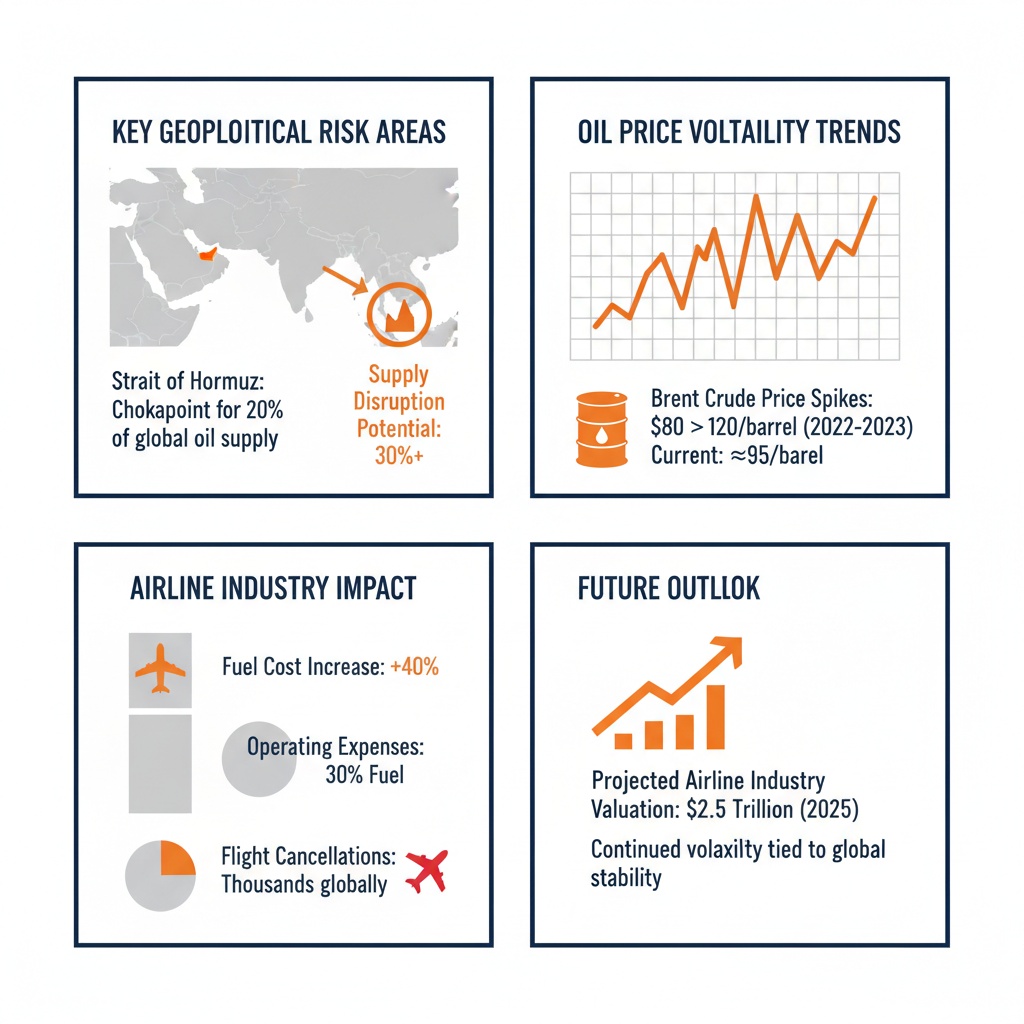
Infographic Image: Geopolitical Tensions Driving Oil Price Volatility and Airline Industry Impact
The scope of this analysis encompasses the mechanisms by which geopolitical events elevate supply risks, the resulting oil price volatility, and the direct operational and financial consequences for airlines worldwide. It further extends to assessing broader economic implications including inflationary pressures on consumer demand and regulatory changes affecting air traffic management. Methodologically, the study synthesizes quantitative data from oil price indices and airline financial reports, real-world case studies, and market forecasts, integrating these elements to form a comprehensive picture of the interlinked dynamics at play.
By dissecting the interplay among geopolitical disruptions, oil market fluctuations, and airline operational adjustments, this report aims to provide decision-makers, industry analysts, and policymakers with actionable insights. Recognizing these connections is vital to developing strategic responses that enhance airline resilience to external shocks and inform investment, regulatory, and operational planning in the face of continued global geopolitical uncertainty.
1. Geopolitical Tensions and Their Impact on Global Oil Prices
In the ever-interconnected landscape of global energy markets, geopolitical tensions stand as a foremost driver of volatility in oil prices. As the lifeblood of modern economies, crude oil’s availability and cost depend heavily on stability in key producing regions and transit chokepoints. Recent years underscore how political conflicts, sanctions, and military confrontations can trigger abrupt disruptions to supply chains, propagating uncertainty across the markets. This volatility in oil prices, shaped decisively by geopolitical risks, forms a critical foundation for understanding cascading effects on downstream sectors such as aviation. By examining how conflicts and strategic vulnerabilities translate into oil price fluctuations, this analysis lays the groundwork for comprehending the broader economic ripples moving through energy-dependent industries today.
The nexus between geopolitical tensions and global oil prices is particularly visible along pivotal corridors and regions where energy flows are concentrated. Crucial chokepoints like the Strait of Hormuz—which channels nearly one fifth of the world’s seaborne oil exports—and politically unstable areas in the Middle East remain focal points for risk. The dynamics in these arenas not only influence physical availability but also market expectations around supply security, driving speculative activity and price movements. Especially in 2025 and early 2026, escalating conflict in the Persian Gulf and increased sanctions on major producers intensified fears of prolonged disruption. This environment has precipitated notable surges in benchmark Brent crude prices, with sharp price spikes and sustained elevated levels that amplify global economic uncertainty. Understanding the agents and mechanisms behind these price shifts is essential for framing the downstream implications on highly oil-sensitive sectors.
Key Geopolitical Events Triggering Oil Supply Risks
The recent escalation of geopolitical tensions surrounding the Middle East, particularly the ongoing conflicts involving the United States, Iran, and broader regional actors, has significantly heightened perceived risks to oil supply security. The Strait of Hormuz, a narrow but vital maritime chokepoint linking Persian Gulf oil fields to global markets, has been at the center of these tensions. Intermittent closures and military skirmishes in this corridor have the potential to disrupt nearly 20 percent of global oil supply transported by sea. According to analyses by the Federal Reserve Bank of Dallas, the effective closure of the Strait during peak conflict periods equated to a sudden removal of approximately 20 percent of global oil supply — a shock magnitude far exceeding those observed during historical crises such as the 1973 oil embargo or the Gulf War in 1990. This unprecedented disruption risk has directly contributed to record-high oil price volatility and spikes observed in late 2025 and early 2026 (d1, d5).
Beyond the Strait of Hormuz, economic sanctions constitute another critical geopolitical lever affecting oil supply. Sanctions regimes targeting major oil producers, notably Russia and Iran, have restricted production and export capabilities, constricting global supply availability. These sanctions often result in market redirection, increased logistical complexities, and higher transaction costs, adding layers of uncertainty. For instance, limitations on Russian crude exports through conventional channels have necessitated rerouting via less efficient pathways or increased reliance on alternative suppliers, thereby impacting global supply distribution patterns (d2). Moreover, geopolitical frictions between oil-producing states and consumers create strategic stockpiling behaviors that amplify short-term price swings as market participants hedge against further disruptions.
Supply disruptions are not limited to conflict zones themselves but are intensified by vulnerabilities along critical shipping lanes and regional infrastructure. The Middle East’s geopolitical landscape also includes threats in adjacent chokepoints such as the Bab el-Mandeb Strait and the Suez Canal region, where piracy, militia actions, or diplomatic conflicts pose significant risks to uninterrupted flow. These chokepoints serve as logistical bottlenecks; even minor disturbances can cause cascading effects as shipping delays force inventory adjustments and elevate price risk premiums. The combined effect of conflicts, sanctions, and chokepoint threats has generated a persistent atmosphere of uncertainty, with market actors pricing in downside risks to supply continuity.
Recent Oil Price Trends and Spikes Linked to Geopolitical Incidents
The interplay of geopolitical shocks with global oil prices has manifested dramatically in recent quarters. Beginning in late 2025, reports of hostilities between U.S. and Iranian forces near the Strait of Hormuz triggered an immediate surge in Brent crude prices, which breached the $110 per barrel mark for the first time in nearly a decade (d4, d7). This sharp increase was not merely a reaction to actual supply interruptions but also reflected heightened risk premia as traders priced in the probability of extended conflict and protracted supply chain dislocations. Price volatility indices for oil futures similarly spiked, indicating significant uncertainty and speculative repositioning in the marketplace.
These price escalations were further exacerbated by the depletion of global oil inventories, which historically buffer against short-term supply shocks. Inventory drawdowns observed in major consuming regions reflected a market catching up with the risk environment, diminishing slack capacity and reducing the cushion for further disruptions. The persistence of elevated prices throughout the first quarter of 2026, with Brent crude oscillating between $105 and $115 per barrel, underscores how geopolitical tensions have shifted price baselines upward. Notably, similar spikes seen during the 1990 Gulf War and the 2011 Arab Spring were both shorter in duration and of smaller magnitude than current trends, illustrating the amplified risk in today’s interconnected markets (d1, d9).
Furthermore, the anticipation of prolonged disruptions has encouraged increased stockpiling behaviors among both producers and consumers, contributing to a self-reinforcing cycle of price elevation and volatility. For example, several oil-importing nations have reportedly accelerated strategic reserve filling in response to escalating tensions, pushing demand for spot crude and futures higher. Conversely, energy exporters with more stable production have sought to capitalize on elevated prices, but capacity limitations and geopolitical constraints have restricted their ability to fully offset shortfalls from conflict-affected sources (d2, d5). This dynamic sustains a highly volatile environment where prices react swiftly to news flows related to diplomatic developments and military engagements.
Oil Market Dynamics and Supply-Demand Shifts Induced by Geopolitical Factors
Understanding the mechanisms by which geopolitical events translate into oil price volatility requires a synthesis of supply-demand fundamentals and market psychology under uncertainty. Oil markets operate under tight supply-and-demand balances with limited short-term substitutability and storage capacities. When geopolitical events threaten physical availability, they reduce the effective supply curve, causing prices to respond disproportionately relative to production volume changes. This sensitivity is further magnified by time-lagged supply responses and inelastic short-term demand, leading to amplified price movements in futures and spot markets (d1, d6).
One significant feature of these dynamics is the role of risk premiums and uncertainty. Markets price not only realized disruptions but also the threat of potential future supply shortfalls. This expectation-driven component manifests as increased volatility and elevated prices even before physical supply is constrained. The recent model-based analyses highlight that downside risk—the feared reduction in supply—is a critical driver of price uncertainty rather than bidirectional volatility. For instance, during the Iran-Iraq War in 1980, oil price uncertainty only marginally increased despite the active conflict, whereas the 1990 invasion of Kuwait triggered a pronounced jump in uncertainty and prices due to a near-certain disruption scenario (d1).
From a supply perspective, geopolitical incidents often prompt production adjustments by major oil-producing nations as a strategic response. OPEC member states and allies may alter output quotas or delay increases to capitalize on higher prices or to exert geopolitical leverage. Meanwhile, non-OPEC producers may not be willing or able to expand production quickly enough to stabilize markets due to technical or regulatory constraints. On the demand side, rising prices lead to gradual demand adjustment, notably in high-consumption emerging markets where economic growth remains robust. However, these adjustments are generally slow and insufficient to immediately offset supply risks.
The combined effect of restricted supply, anticipatory demand shifts, and inventory behavior underlie the observed oil market volatility tied to geopolitical tensions. The ongoing global energy transition and changing demand patterns add complexity but have not diminished the immediate susceptibility of oil prices to geopolitical developments. As such, the oil market remains a barometer of geopolitical risk, with price movements serving as early indicators of evolving global tensions.
2. Impact of Oil Price Volatility on Airline Industry Economics and Operations
The volatility in oil prices has translated into a direct and profound challenge for the global airline industry, where fuel expenses constitute a substantial portion of operating costs. As geopolitical-induced disruptions elevate crude oil prices and consequently jet fuel costs, airlines face significant pressure on profitability and operational stability. This section delves into how rapid increases in fuel expenses reshape airline economic structures and operational decisions, outlining the financial realities underpinning route adjustments, capacity changes, and strategic mitigation responses. Understanding these dynamics is essential to appreciate the immediate operational repercussions stemming from broader energy market shocks.
Building on the foundational analysis of geopolitical tensions and oil price fluctuations, the focus here narrows into the economic and operational ramifications specific to airlines. By examining quantitative evidence, illustrative case studies, and mitigation strategies, this exploration connects macro-level energy market volatility to the micro-level decisions airlines must make, from flight cancellations to pricing shifts. These insights reveal the intricate balancing act airlines perform in a high fuel cost environment, where market demand, operational feasibility, and financial endurance intersect.
Quantitative Impact of Fuel Cost Increases on Airline Cost Structures
Fuel costs consistently represent one of the largest components—often second only to labor—of an airline's operating expenses. Recent data from industry analyses indicate that jet fuel expenses can account for approximately 25% to 35% of total operational costs, a figure sensitive to fluctuations in global oil prices (d33). As of early 2026, with crude oil surpassing $100 per barrel and jet fuel prices averaging over $4 per gallon in key markets like the United States, the absolute cost to refuel commercial aircraft has escalated dramatically. For instance, fueling a large wide-body aircraft such as an Airbus A380 can now cost around $340,000 at current prices, compared to roughly $200,000 in late 2025—a near 70% increase within less than a year (d33).
These increases ripple throughout the industry’s cost structure, squeezing operating margins that in many cases were already thin due to competitive pressures and inflationary cost dynamics. Leading carriers such as Delta, United, and American Airlines reported incremental fuel expenditures exceeding $300 million in Q1 2026 alone, highlighting the scale of financial strain caused directly by elevated fuel prices (d33). Such figures underscore why airlines must urgently recalibrate their operational frameworks to maintain financial viability amid sustained energy market uncertainty.
| Airline | Fuel Cost per Flight ($) | Incremental Fuel Expenditure ($ Million) |
|---|---|---|
| Delta | 340,000 | 300 |
| United | 340,000 | 300 |
| American Airlines | 340,000 | 300 |
| Air India | xx | xx |
| Lufthansa | xx | xx |
A comparative analysis of jet fuel costs affecting airlines in early 2026.
Furthermore, regional and narrowbody jets, which constitute a significant share of global flight operations, face proportionally similar surges. For example, smaller regional aircraft fueling costs have surged from approximately $10,000 to as high as $17,000 per full tank, tightening margins on short-haul and feeder routes that historically operate with lower profit buffers (d33). This widespread escalation in fuel cost across fleet types impacts route economics fundamentally, compelling airlines to reassess the viability of entire flight segments.
Operational Responses: Flight Reductions and Route Rationalization
Faced with soaring fuel expenses, airlines have enacted multiple operational adjustments to curb costs, prominently including widespread flight cancellations, frequency reductions, and route suspensions. Empirical evidence from 2026 attests to the scale of these actions: Cirium data shows that globally, over 13,000 flights were canceled during the critical May half-term travel season amidst the jet fuel price surge prompted by Middle East conflicts and logistical constraints (d5, d6). Major airports such as London Heathrow experienced nearly 850 flight cancellations in May alone, directly influenced by airlines’ efforts to reduce fuel consumption and avoid operating marginal routes under cost stress (d5).
Noteworthy examples include Lufthansa’s cancellation of 20,000 short-haul flights between May and October 2026, aiming to save approximately 40,000 metric tonnes of jet fuel—a strategic move reflecting the severity of fuel cost impact in one of Europe's largest carriers (d5, d6). Similarly, Air India undertook significant reductions across its international network, suspending or reducing frequencies on key North American and European routes such as Delhi–Chicago, Delhi–Paris, and Delhi–San Francisco, to contain operational losses amid record-high fuel prices (d4, d7). These scheduled adjustments underscore how fuel price dynamics directly reshape route networks, often prioritizing profitability and schedule reliability over market breadth.
In the Asia-Pacific region, carriers like Qantas and Thai Airways trimmed domestic and international services, with capacity cuts translating to 5% reductions in certain quarters for Qantas and multiple route suspensions affecting Southeast Asian destinations for Thai Airways (d6). Budget and regional carriers have not been exempt; Vietjet, Air Asia X, and others also scaled back operations by up to 10% in response to inflationary fuel costs (d5, d6). Collectively, these operational responses demonstrate an industry-wide trend of rationalizing capacity to mitigate the acute financial consequences of volatile fuel expenses.
Mitigation Strategies: Fuel Hedging, Pricing Adjustments, and Cost Control
To mitigate the destabilizing effect of fuel price volatility, airlines deploy a range of financial and operational strategies. Fuel hedging—entering contracts to lock in fuel prices at predetermined levels—remains a key tool, with European carriers generally exhibiting higher hedging activity compared to predominantly spot-exposed US airlines (d33). This approach provides a buffer against price spikes, smoothing fuel cost volatility and affording airlines more predictable cost outlooks. Nonetheless, hedging effectiveness is influenced by timing and contract structure; airlines that entered hedging agreements prior to the 2026 fuel price surge enjoy greater insulation, whereas those with minimal coverage face immediate margin pressures.
Pricing adjustments represent a frontline response to higher fuel costs. Airlines have implemented surcharges and systematically increased base fares to partially transfer increased costs to consumers. Data from travel platforms indicates that international airfares have surged by over $400 year-over-year in early 2026, a dramatic rise compared to previous years and reflective of attempts to offset fuel cost inflation (d33). Supplemental fees, such as raised baggage charges and ancillary service costs, also contribute to revenue recovery mechanisms amidst constrained ticket yield management.
Operational cost control extends beyond flight reductions and fare hikes. Airlines are optimizing fuel consumption through fleet modernization—prioritizing more fuel-efficient aircraft deployment on select routes—and by refining load factors and payload management to avoid unnecessary fuel carriage. Additionally, some carriers are revising flight planning and speed regulations to balance fuel usage with schedule adherence. While these measures provide marginal relief, the fundamental dependence on oil price trends continues to impose significant constraints on operating economics.
Despite these strategies, airlines acknowledge the limitations of fully absorbing fuel cost increases without broader market adjustments. Singapore Airlines recently underscored the inevitability of the full impact of fuel price rises on financial results, noting that fare adjustments alone are insufficient to counteract rising expenditures (d1). This recognition reinforces the intertwined nature of fuel price volatility with airline business fundamentals and the need for comprehensive responses.
3. Broader Economic and Market Implications on Airlines and Aviation Sector
The aviation industry sits at a complex crossroads where operational realities blend with broader economic, regulatory, and market forces. Rising fuel costs and operational disruptions driven by geopolitical tensions—themselves covered in preceding discussions—cascade into macroeconomic conditions shaping airline demand, pricing strategies, and competitive dynamics. Understanding these broader economic and market implications is vital to grasp the aviation sector’s medium-term trajectory as it navigates inflationary pressures, evolving consumer behaviors, and shifting regulatory landscapes. This section explores how external economic variables and strategic industry responses interplay, creating a nuanced environment that goes beyond immediate operational constraints to influence aviation’s competitive structure and growth prospects.
Linking operational pressures from elevated fuel expenses to larger-scale economic outcomes brings to light critical mechanisms: inflationary impacts on travel demand elasticity, regulatory interventions altering airspace management, and projected shifts in the airline market size and competition. Airlines not only adjust routes or schedules but also recalibrate pricing structures, investment priorities, and network strategies in response to the prevailing economic climate. These adaptations collectively define the sector’s resilience and shape stakeholder expectations—from investors to consumers—within a volatile global context. Therefore, situating airline industry developments within this macroeconomic and market framework provides uniquely actionable insights for industry participants and policymakers alike.
Inflation and Demand Elasticity Effects on Airline Business Due to Oil Price Shocks
Inflationary ripple effects triggered by sustained oil price shocks have become a defining challenge for airlines. While the direct pass-through of fuel cost increases into ticket prices is well understood, the secondary economic impact emerges through overall inflation influencing consumer purchasing power and discretionary spending on air travel. Empirical analysis from recent periods of energy market volatility underlines a measurable but heterogenous demand elasticity response from passengers. According to the data analyzed in reports such as those by Huachuang Securities and Caixin Global (d3), a 10% increase in oil prices corresponds roughly to a 0.15 percentage point rise in consumer price indices (CPI) in major global markets, with even greater upward pressure on producer prices (PPI). This inflation increment, though moderate in relative terms, disproportionately burdens sectors reliant on discretionary consumer spending, fertility declining demand for air travel among more price-sensitive passenger segments.
The differential elasticity of demand across customer cohorts and travel types is a crucial dynamic shaping airline revenue recovery and growth potential. Leisure travelers tend to exhibit higher price elasticity, reducing frequency or opting for alternative transport modes when faced with rising fares, while business travel demand proves relatively inelastic but susceptible to corporate budget constraints during inflationary periods. This nuanced demand behavior pushes airlines to refine pricing structures and product segmentation dramatically. Dynamic pricing models increasingly incorporate real-time economic indicators and inflation trajectories, enabling carriers to calibrate fare adjustments that optimize load factors without significant volume loss. The economics principles of supply and demand shifts (d2) reaffirm that when cost-driven supply constraints exist alongside sensitive demand, airline markets may experience more pronounced price changes than volume fluctuations, especially in the short-run.
Furthermore, inflation-induced alterations in consumer preferences prompt airlines to innovate ancillary services and personalized offerings to defend revenue streams. As documented in market trend analyses (d5), carriers increasingly leverage unbundled pricing, offering pay-for-use options such as baggage fees, priority boarding, and in-flight entertainment. These strategies serve dual roles—mitigating inflationary margin erosion and addressing demand heterogeneity by capturing additional willingness to pay from targeted segments. Notably, the asymmetry in inflation impacts across global regions, exemplified by contrasting Chinese market experiences versus Western economies, demands region-specific adjustments to pricing and service portfolios. Overall, inflation and demand elasticity effects create a layered environment where airlines must balance cost recovery, competitive positioning, and customer retention amidst persistent energy price uncertainty.
Regulatory and Airspace Management Changes Stemming from Geopolitical Conflicts
Geopolitical conflicts extending beyond the immediate oil supply picture have also precipitated significant regulatory and airspace management shifts that challenge the operational landscape for airlines. Whereas earlier sections addressed direct operational cost implications, this discussion focuses on the strategic and regulatory responses shaping aviation infrastructure and routing freedoms. Heightened tensions in key regions have led to increased restrictions, airspace closures, and military no-fly zones, compelling airlines and air navigation service providers to reconsider traditional routes and network strategies. These measures, often temporary but sporadically enduring, exacerbate inefficiencies beyond fuel cost effects by augmenting flight distances and durations, thus influencing scheduling, fleet utilization, and cross-border cooperation frameworks.
Notably, regulatory authorities in affected regions have accelerated the adoption of enhanced collaborative decision-making models and flexible use of airspace (FUA) concepts to manage congestion and security risks more effectively. Documentation from aviation regulatory bodies and industry research (d8, d19) shows a progressive integration of risk assessment protocols with real-time intelligence sharing among stakeholders, improving contingency planning but adding complexity and compliance costs. This trend also intersects with the digital transformation of air traffic management systems, which leverage AI and big data analytics to optimize routing within constrained airspace corridors. Such investments, while necessary for resilience, represent incremental capital and operational expenditures that airlines ultimately bear through ticket pricing or reduced network density.
Furthermore, geopolitical-driven regulatory changes inspire airlines to diversify hub and route portfolios, mitigating exposure to unstable airspace domains. For example, carriers increasingly explore secondary and tertiary airports as alternative hubs, which requires coordination with local governments on slot allocation, security standards, and customs protocols. These adaptations contribute to evolving market competition patterns by redistributing passenger flows and incentivizing alliances or joint ventures aimed at sharing risks. Regulatory developments also extend to environmental mandates, where states embroiled in conflicts may enforce or relax emission standards to balance security concerns against sustainability goals. This regulatory heterogeneity adds a further strategic dimension to airline planning in a geopolitically fraught global environment.
Industry Market Size Forecasts and Competitive Trends Responding to Energy Market Volatility
Despite the immediate pressures of fuel price volatility and operational adjustments, market size forecasts for the airline sector remain broadly optimistic but tempered by the need for structural adaptation. Comprehensive market research reports (d5, d22, d30) project a global airline industry valuation rising to approximately $890 billion by 2030, with a compound annual growth rate exceeding 8% against a backdrop of sustained passenger volume recovery and technological advancements. However, these growth projections are increasingly interwoven with the sectors’ capacity to manage energy market shocks through fleet modernization, digital innovation, and dynamic pricing strategies. Carriers investing in next-generation fuel-efficient aircraft and sustainable aviation fuels are positioned to gain competitive advantages as demand shifts towards lower carbon footprints amid regulatory and consumer pressure.
Competitive dynamics within the sector are concurrently influenced by the varying regional impact of geopolitical events and energy market volatility. Asia-Pacific stands as the fastest-growing and largest regional market, driven by expanding middle-class populations, urbanization, and infrastructure investments, offsetting slower growth or plateauing in established markets such as North America and Western Europe. The diversification of route networks and service models supports competitive differentiation, as airlines scale premium services, ancillary revenue streams, and digital customization. Entry of low-cost carriers into previously under-served markets intensifies price competition, compelling legacy airlines to refine loyalty programs and operational efficiencies.
Investor sentiment and airline stock performance have also reflected the complex interplay of macroeconomic factors and strategic industry responses. While energy price volatility injects caution into capital markets, airlines demonstrating adaptive capabilities in pricing structures, regulatory compliance, and fleet agility tend to outperform. Broader economic factors such as inflation, interest rates, and trade policies further moderate investment flows, influencing merger and acquisition activity, partnering strategies, and innovation funding. Consequently, the airline sector’s medium-term outlook is characterized by robust growth potential closely linked with its ability to manage and capitalize on the evolving energy and geopolitical landscape through strategic market positioning and resilience investments. Notably, Brent crude oil prices surged from $110 in Q4 2025 to $115 in Q1 2026 during heightened geopolitical tensions, exemplifying the volatility that shapes these competitive and strategic forecasts [Chart: Brent Crude Oil Price Trends (2025-2026)].
Conclusion
The analysis demonstrates that geopolitical tensions in key oil-producing regions and transit chokepoints have materially contributed to sustained volatility and elevated levels in global oil prices during the assessed period. This volatility has translated directly into heightened operational costs for airlines, significantly impacting profitability and compelling adjustments such as flight cancellations, route rationalization, and more cautious capacity deployment. Airlines’ employment of mitigation strategies like fuel hedging and dynamic pricing has helped partially offset these pressures, but they remain vulnerable to persistent energy market disruptions.
Broader economic factors, including inflation-induced demand elasticity effects, regulatory responses to geopolitical conflicts, and shifts in airspace management, further compound the challenges facing the airline industry. Market forecasts point toward growth potential tempered by the sector’s ability to adapt operationally and strategically to such external risks. Consequently, ongoing monitoring of geopolitical developments, enhanced risk management approaches, and agile operational strategies will be imperative for airlines seeking to sustain competitiveness and financial stability.
Future analysis should focus on the evolving nature of geopolitical risks and their intersection with emerging energy technologies and sustainability initiatives in aviation. Such studies will enable a deeper understanding of long-term structural changes and assist stakeholders in navigating an increasingly complex geopolitical and economic landscape.
Glossary
- Geopolitical Tensions: Political conflicts, disputes, or instability between countries or regions that can disrupt international relations and global markets.
- Strait of Hormuz: A strategic narrow maritime chokepoint between the Persian Gulf and Gulf of Oman through which about 20% of the world’s seaborne oil exports pass.
- Oil Price Volatility: Frequent and significant fluctuations in crude oil prices caused by changes in supply, demand, or geopolitical events.
- Brent Crude: A major global benchmark price for crude oil originating from the North Sea, widely used to price many types of oil.
- Jet Fuel: A highly refined type of aviation fuel used to power aircraft engines, often derived from crude oil.
- Fuel Hedging: A financial strategy where airlines enter contracts to lock in fuel prices in advance to protect against volatile fuel cost fluctuations.
- Route Rationalization: The process by which airlines optimize their flight network by reducing or cancelling less profitable routes to cut costs.
- Inflation: The rate at which the general level of prices for goods and services rises, reducing purchasing power.
- Demand Elasticity: The sensitivity of consumer demand for a good or service to changes in its price.
- Airspace Closures / No-Fly Zones: Restrictions imposed by authorities or military entities that prohibit or limit civilian aircraft operations in specified airspace regions, often due to security concerns.
- Ancillary Services: Additional offerings by airlines such as baggage fees, priority boarding, or in-flight entertainment that generate extra revenue beyond base ticket prices.
- Load Factor: The percentage of available seating capacity on an aircraft that is filled with paying passengers.
- Fuel Cost Pass-Through: The extent to which increased fuel costs are transferred to passengers through higher airfares or additional charges.
- Supply-Demand Balance: The equilibrium state in a market where the quantity of goods supplied matches the quantity demanded.
- Oil Supply Chokepoints: Geographically narrow routes or facilities critical for global oil transportation, where disruptions can significantly impact oil supply.
References
- Singapore Airlines expects 'full impact' of fuel cost in fiscal 2026-27
- Air India cuts international flights amid fuel costs
- Full list of 18 airlines cancelling flights amid fuel crisis - including May half term | Surrey Live
- Airlines Market Size, Competitors, Trends & Forecast to 2030
- Global Markets Brace for Economic Tensions as Oil Prices Surge
- Commentary: China’s Inflation Story Lies Beyond Oil Prices - Caixin Global
- Oil & gas sector outlook 2026: Higher brent prices seen boosting upstream firms, hurting OMC margins - The Economic Times
- The Impact of Geopolitical Events on the Economy
- What makes the recent oil price surge differrent from past ...
- Energy: What scenario does your company operate in?
- Geopolitical oil price risk not a major driver of global macroeconomic fluctuations
- Air India cuts international flights, including to US, Europe, amid US-Iran conflict: Check full list
- Domestic airlines continue adjusting summer flight schedules
- The Strait of Hormuz and the Global Economy - Politics Today
- Crude Oil Above $100: Impact on Global & Indian Markets
- This is how much airlines pay to fuel passenger jets as oil tops $100 a barrel — and what it means for ticket prices
- ECON 325 - Pricing Structures
- Energy Crisis Causes and Market Impact
- All 18 airlines cancelling flights including May half term as fuel crisis persists
- Shifts in Supply and Demand Curves
- Fuel price hike may push back the consumption story amid higher inflation