GE Vernova’s Financial Ascendancy and Strategic Leadership in the Global Energy Transition Era
Table of Contents
- Executive Summary
- Introduction
- 1. GE Vernova's Financial Surge and Strategic Positioning Amid Energy Transition Dynamics
- 2. Company Background and Post-Spinoff Transformation
- 3. Financial Performance Analysis and Growth Metrics
- 4. Strategic Initiatives Driving Sustainable Growth
- 5. Risk Assessment and Mitigation Strategies
- 6. Future Outlook and Strategic Imperatives
- 7. Conclusion and Actionable Insights
- Conclusion
Executive Summary
In 2026, GE Vernova has exhibited robust financial growth, with projected full-year revenues ranging between $44.5 billion and $45.5 billion, representing a significant upward revision over prior guidance and consensus expectations. Adjusted EBITDA margins are forecasted to improve by approximately one percentage point, reaching a target range of 12% to 14%, driven primarily by sizeable margin expansions in the Electrification and Power segments. The Electrification division’s organic revenue surged 29% to nearly $3 billion in recent quarters, achieving an EBITDA margin of 17.8%, while the Power segment experienced strong organic growth between 15% and 17%, bolstered by elevated equipment and service demand. Despite a 25% organic revenue decline and ongoing negative EBITDA in the Wind segment, overall profitability trends remain positive due to cost-management and operational efficiencies elsewhere in the portfolio.
Analyst sentiment remains decidedly bullish, with multiple brokerage firms elevating price targets significantly. Notably, Jefferies projects a 40% EBITDA compound annual growth rate from 2024 through 2028, raising its price target to $348. Mizuho and other leading analysts have similarly upgraded valuations to reflect confidence in GE Vernova’s expanding footprint in nuclear and zero-carbon turbine technology, as well as its pivotal role in an AI-driven grid modernization supercycle. The company’s commanding market position, encompassing nearly 30% of global electricity production and a $115 billion backlog, underpins strategic flexibility and growth prospects amid a rapidly evolving regulatory and technological energy landscape.
Introduction
GE Vernova’s emergence as a standalone company following its April 2024 spin-off from General Electric marks a pivotal transition within the global energy infrastructure sector. This transformation has effectively unshackled the entity from diversified conglomerate constraints, enabling intensified focus on energy transition imperatives such as electrification, decarbonization, and grid modernization. With a flagship presence in over 100 countries and a workforce exceeding 75,000 employees, GE Vernova commands broad operational scale and technological depth across its Power, Wind, and Electrification segments.
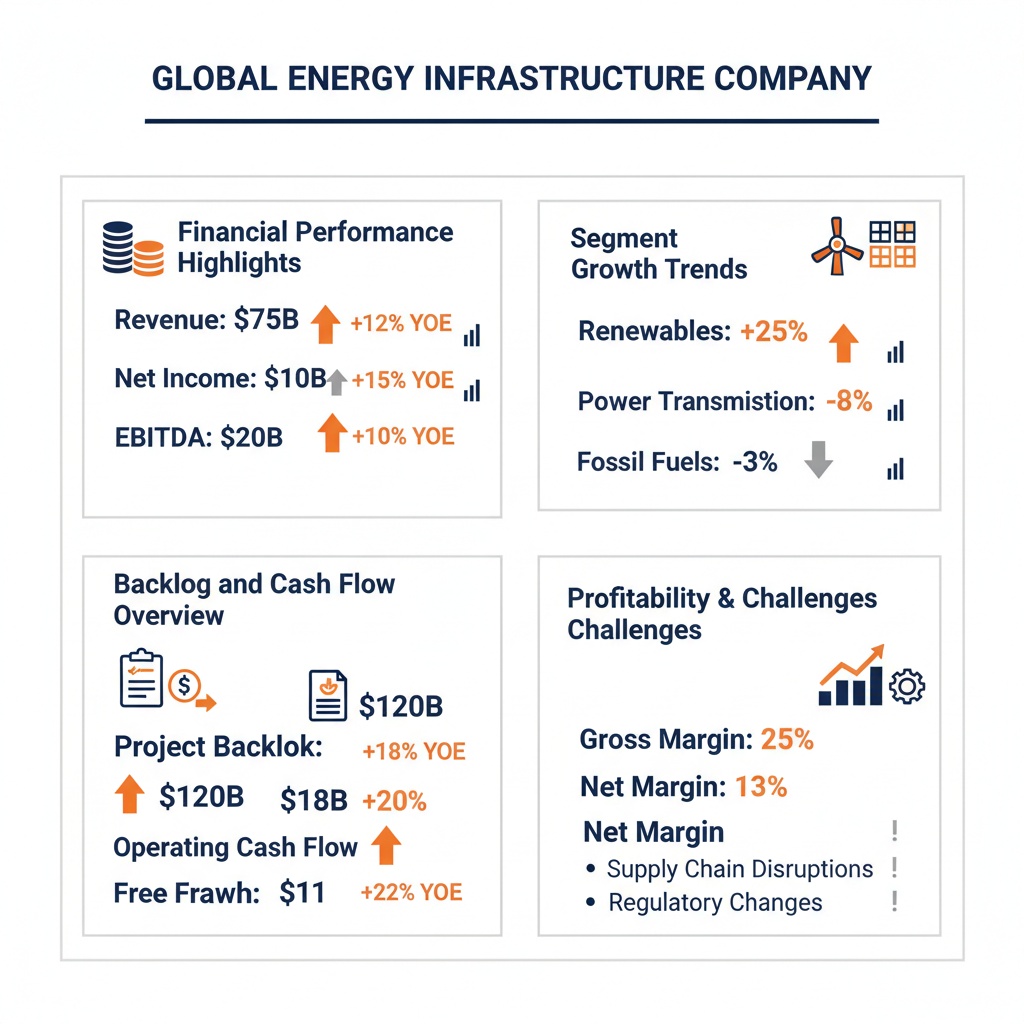
Infographic Image: GE Vernova's Growth and Strategic Positioning Amid Energy Transition
The purpose of this report is to dissect the underlying drivers of GE Vernova’s marked financial momentum entering 2026, elucidate the company’s strategic positioning amid intensified competitive dynamics, and evaluate the implications of its evolving business model within the broader energy transition. Key performance indicators, including sector-leading EBITDA margin expansions, robust backlog growth, and elevated market valuations, alongside segment-specific nuances, are analyzed to provide a nuanced understanding of the company’s growth trajectory and risks.
Scope encompasses a comprehensive review of GE Vernova’s post-spinoff operational architecture, detailed segmental performance assessments, valuation and analyst sentiment appraisals, strategic initiatives driving sustainable expansion, and risk management methodologies. This multidimensional evaluation situates the company within the context of global regulatory frameworks, technological adoption trends, and competitive landscape shifts, providing actionable insights for stakeholders seeking clarity on future outlook and strategic imperatives.
1. GE Vernova's Financial Surge and Strategic Positioning Amid Energy Transition Dynamics
Executive Summary: Unpacking GE Vernova’s Financial Momentum and Strategic Edge Amid Energy Transition
This executive summary distills the core financial achievements and strategic positioning of GE Vernova, setting the context for an in-depth exploration of how the company leverages its diverse portfolio to capitalize on energy transition dynamics. It highlights key financial metrics, segment contributions, market positioning, and strategic initiatives driving current and future growth, forming the foundation for subsequent analysis sections.
Robust 2026 Financial Performance and Earnings Growth
GE Vernova has demonstrated a significant upswing in its financial trajectory through 2026, underpinned by strong revenue growth and expanding profitability metrics. The latest full-year guidance anticipates total revenues reaching between $44.5 billion and $45.5 billion, marking a notable increase from prior estimates and comfortably exceeding consensus expectations. Correspondingly, the company projects adjusted EBITDA margins to range from 12% to 14%, reflecting an approximately 1-percentage-point improvement backed by segment-specific margin expansions.
Segment performance underscores this surge, with the Electrification division achieving a 29% organic revenue increase to nearly $3 billion in recent quarters and improving EBITDA margins to 17.8%. The Power business segment also delivered robust organic revenue growth of 15-17%, supported by heightened demand for both equipment and service offerings. Despite structural challenges in Wind, which reported a 25% organic revenue decline and continued negative EBITDA, overall profitability has improved due to efficient capital deployment and accelerated margin expansion in key areas.
Elevated Market Valuations and Analyst Confidence
Market sentiment remains strongly bullish on GE Vernova, as reflected in multiple upward price target revisions from leading financial analysts and brokerage firms during 2025 and early 2026. Jefferies increased its price target to $348, forecasting a formidable 40% compound annual growth rate in EBITDA from 2024 to 2028, surpassing the broader consensus. Mizuho further elevated its outlook, raising its price target to $351 on expectations that upcoming financial disclosures will exceed prior guidance, including expanded valuations for the company’s emerging nuclear and zero-carbon turbine technologies.
Investor enthusiasm is also echoed by Wells Fargo and Guggenheim, which have set ambitious targets above $800 per share, underpinning confidence in the company’s pivotal role in an anticipated AI grid supercycle and escalating power infrastructure modernization. These valuations are supported by a market capitalization approaching $237 billion and a premium trading multiple relative to sector averages, emphasizing both growth potential and execution expectations.
Competitive Market Position and Energy Sector Influence
GE Vernova occupies a commanding position in the global energy infrastructure landscape with an estimated involvement in nearly 30% of worldwide electricity production. Its diversified portfolio spanning Power, Wind, and Electrification segments equips the company to address multiple facets of the evolving energy transition—from traditional gas and nuclear generation to advanced grid solutions and renewable integration.
The company’s expansive backlog of approximately $115 billion and its debt-free balance sheet provide strategic flexibility to invest in growth initiatives and weather market volatility. GE Vernova’s investments in gas turbine production capacity and grid modernization efforts align with critical infrastructure gaps identified by global energy authorities, enabling the company to capture emerging opportunities tied to increased electricity demand from AI data centers and decarbonization mandates. While competitors like NextEra and Siemens vie for market share, GE Vernova’s breadth and technological depth position it uniquely to sustain leadership in the shifting energy paradigm.
Strategic Initiatives Fostering Sustainable Growth
Key strategic initiatives underpin GE Vernova's upward momentum, with a particular focus on expanding electrification solutions, integrating AI-driven grid management, and accelerating gas turbine manufacturing to meet surging demand. The company has actively pursued partnerships and joint ventures, notably in fast-growing international markets, reinforcing its technological capabilities and geographic reach.
Regulatory engagement has been proactive, with GE Vernova positioning itself to benefit from legislative frameworks such as the Inflation Reduction Act and associated subsidies, while systematically mitigating dependency risks. These dynamics bolster backlog visibility and multi-year revenue guidance, providing a foundation for enduring operational and financial resilience throughout the ongoing energy transition.
This synthesized overview sets the stage for a detailed examination of GE Vernova's background, segmental performances, growth drivers, and strategic priorities that collectively explain its financial upswing and relative market positioning within the accelerating global shift to clean energy infrastructure.
2. Company Background and Post-Spinoff Transformation
Navigating Independence: The Strategic Genesis and Evolution of GE Vernova Post-Spinoff
This subsection establishes a foundational understanding of GE Vernova's transformation from a major conglomerate division into an independent leader in energy infrastructure. By unraveling the chronology, financial implications, leadership changes, and strategic reorientation following the spinoff, it situates the company’s renewed identity and trajectory within the broader energy transition context. This background is critical for appreciating the financial surge and strategic initiatives discussed in subsequent sections.
Progressive Timeline and Milestones Surrounding GE Vernova’s 2024 Spin-Off
GE Vernova’s spinoff from General Electric was officially completed on April 2, 2024, marking the culmination of a planned restructuring that segmented GE into three focused entities. The spin-off sequence featured extensive preparatory communications, including a record date on March 19, 2024, when shareholders of GE received one share of GE Vernova for every four shares held in GE. Transitional trading under ‘when-issued’ status preceded the April separation, facilitating market readiness and valuation clarity. The process incorporated tax-free provisions for shareholders and was executed to enhance operational focus and unlock value in energy-related segments.
In its infancy as an independent corporation, GE Vernova rapidly established market presence, supported by its publicly traded status and Nasdaq listing under the ticker symbol 'GEV'. Key milestones within its first two years encompass significant order backlogs, successful commercial projects, such as the inauguration of its HA-powered combined cycle power plant in South Korea, and a December 2024 investor day that formalized its 2026 guidance and longer-term strategic outlook through 2028.
Quantifying the Financial Impacts and Baseline Performance Post-Separation
The financial trajectory of GE Vernova at the point of independence was underscored by robust revenue and backlog figures, with reported 2025 revenues surpassing prior-year levels by approximately 9%, and total orders climbing by over 30%, reflecting strong market demand especially in power and electrification segments. Initial standalone financial statements highlighted adjusted EBITDA margin growth towards mid-single-digit percentages and free cash flow generation between $0.7 billion and $1.1 billion for the 2024 fiscal year, indicating a solid baseline amid transition-related costs and restructuring investments.
Separation-related expenses incurred during 2023 totaled around $1 billion, attributable to workforce adjustments, establishment of independent IT and governance systems, and professional fees. However, these upfront investments were calibrated to enable operational autonomy and sharpened strategic focus, laying the groundwork for accelerated organic growth and margin expansion. The transition also entailed an executive leadership realignment with Scott Strazik assuming CEO duties, consolidating a governance framework aligned with the new corporate mission.
Post-Spinoff Structural and Governance Transformations Shaping GE Vernova’s Strategy
GE Vernova’s separation transitioned it from a division within a diversified conglomerate to a standalone global energy company headquartered in Cambridge, Massachusetts, operating across more than 100 countries with a workforce exceeding 75,000. The new independent governance model established distinct boards and executive teams, focused exclusively on advancing energy infrastructure technologies and services. This structural autonomy enabled rapid decision-making and strategic agility, facilitating targeted investments in power generation, renewable energy, and electrification.
The leadership reshuffle emphasized continuity blended with new strategic priorities. Under CEO Scott Strazik, GE Vernova delineated clear objectives centered on electrification and decarbonization, leveraging its legacy installed base that generates approximately a quarter of the world’s electricity. This strong operational foundation provides resilience and a platform for innovation in grid modernization and energy transition solutions.
Defining Strategic Objectives and Corporate Vision in the Early Post-Spin Period
GE Vernova’s strategic goals post-spinoff prioritize fulfilling the growing global demand for electrical power, emphasizing reliability, affordability, and sustainability. The company aims to advance the energy transition by concurrently supporting electrification of industrial and economic activities and decarbonizing the electric power system through diversified technology portfolios, including gas turbines, renewable wind assets, and grid solutions.
This vision aligns with a multi-year growth trajectory supported by an expanding backlog and rising order intake, particularly in power and electrification businesses. Increased R&D investment and operational efficiencies are strategic levers aimed at margin improvement and long-term shareholder value creation. GE Vernova continues to recalibrate its portfolio to balance legacy strengths with emerging opportunities in AI-driven grid management and renewable energy integration.
Pivotal Achievements and Operational Highlights Within the Initial Two Years
Within the first two years post-spinoff, GE Vernova achieved critical milestones including securing multi-billion-dollar orders reflecting a 34% year-over-year increase, public market share appreciation exceeding 600% since the spin, and noteworthy operational accomplishments such as the commercial launch of advanced combined cycle power plants. Additionally, the company completed targeted acquisitions like its full consolidation of Prolec GE, enhancing its electrification portfolio with transformer manufacturing capabilities.
Investor engagement events, such as the December 2024 update, solidified the company’s transparent communication of its strengthened financial outlook and ambitious mid-decade growth targets. Strategic capital allocation involved returning cash to shareholders through share repurchases and dividends, balanced against reinvestment in capabilities and innovation. These benchmarks affirm GE Vernova’s successful transition from a corporate spin-off to an independent, growth-oriented market leader.
Having established a comprehensive understanding of GE Vernova's inception, structural evolution, and strategic intent post-spinoff, the report now proceeds to dissect the company’s financial performance and growth metrics in detail. This progression facilitates a granular appreciation of how foundational transformations have translated into concrete economic and market outcomes.
Quantitative Market Standing and Competitive Differentiators Within the Energy Transition Landscape
This subsection provides a rigorous quantitative assessment of GE Vernova's competitive position relative to major players such as NextEra Energy. By benchmarking key financial metrics, market share figures, and win rates on critical grid modernization and renewable integration projects, it establishes GE Vernova’s strategic strengths and penetration progress. These insights clarify where GE Vernova excels or lags, framing its competitive advantages in grid modernization, renewable deployment, and customer engagement — essential for understanding its financial surge and positioning amid the energy transition.
Market Share Metrics vs. NextEra and Industry Peers
GE Vernova commands a significant global footprint in the clean energy sector with approximately 120 GW of installed wind capacity spread across over 51 countries. Its installed turbine base accounts for a substantial share of operational renewable capacity worldwide, underpinning about 25% of global electricity production, reflecting a diversified portfolio of power generation assets. In contrast, NextEra Energy, the US market leader, holds one of the largest renewable energy portfolios dominated by wind and solar, with a renewable backlog exceeding 30 GW and a targeted expansion pipeline driven by substantial infrastructure investments. While NextEra’s market cap slightly surpasses GE Vernova’s, the latter’s global reach and segmented diversity across power, wind, and electrification confer a robust competitive base in several international markets, including leadership in Spain’s wind sector, where it maintains nearly 6 GW of installed capacity.
Comparative analyses illustrate that NextEra’s dominance is more regional, highly concentrated within the US utility and renewable sectors, while GE Vernova’s global scope leverages broader geographic diversification. Specific market share figures reveal that GE Vernova is investing notably in manufacturing expansions in Vietnam and Italy, positioning it to capitalize on surging grid modernization and renewable integration expenditures internationally. Both companies’ footprints complement different customer bases and regulatory regimes, allowing GE Vernova to maintain resilience and growth potential despite regional disruptions affecting wind projects in Europe and North America.
Comparative Financial Performance of Power and Renewable Segments
In recent financial disclosures, GE Vernova has demonstrated robust revenue growth and margin improvement in its Power and Electrification segments, with EBITDA margins climbing by several hundred basis points year-over-year, reaching guidance targets of approximately 12.5% by 2026. The Power segment reports strong organic growth rates reaching between 15% and 17% annually through mid-2025, propelled by equipment demand and service expansions. Electrification similarly outperformed expectations delivering nearly 30% organic revenue growth and margins expanding to near 18%-20%. However, the Wind segment encountered headwinds, with organic revenue contracting by 25% and EBITDA margins turning further negative due to project delays and operational challenges.
Comparatively, NextEra’s renewable segment, driven by its utility-scale wind and solar operations, has realized year-over-year earnings growth in the mid-single digits with a steady increase in adjusted EPS supported by a $25+ billion renewable pipeline. Although NextEra’s current revenue growth is somewhat constrained by lower short-term organic increases, its dividend growth and capital allocation strategy underscore durable financial health. When benchmarked on profitability rates, GE Vernova’s broader margin improvements and segment-level diversification offer a compelling case for its growing financial strength, especially given its capacity to monetize electrification and grid modernization trends.
Grid Modernization Project Wins and Competitive Traction
GE Vernova’s aggressive investments in grid infrastructure are evident through its recent manufacturing capacity expansions and technology innovation tailored for advanced grid solutions. It has secured critical contracts to upgrade and modernize electrical distribution networks, reflecting a strategic emphasis on enhancing grid resiliency and enabling renewable integration. When compared to competitor project awards, GE Vernova exhibits increasing win rates in regions with proactive regulatory frameworks such as the United States and Europe, leveraging its electrification technologies and transformer manufacturing joint ventures to strengthen its competitive moat.
While NextEra maintains a commanding presence in deploying renewable assets, its initiatives in grid modernization are comparatively more focused on integration within its extensive utility operations. GE Vernova’s externally visible contract wins cover significant microgrid developments and transmission upgrades, aligning with federal funds flowing into grid modernization totaling tens of billions of dollars. This breadth of project engagement enhances GE Vernova’s capability to penetrate fragmented grid upgrade markets, in contrast to NextEra’s utility-centric approach which is less diversified geographically and functionally.
Renewable Integration Capacity and Solution Penetration
GE Vernova leads in integrating renewable generation with grid-enhancing technologies, leveraging its portfolio that spans wind turbines optimized for diverse wind conditions and emerging electrification solutions including smart grid controls. Its global renewables portfolio, particularly in wind energy, is bolstered by substantial operational capacity and technological innovation, such as the development of 6.1 MW turbines with large rotors designed for medium-to-low wind speed sites, enabling market access where competitors face limitations. These capabilities afford GE Vernova enhanced penetration in markets prioritizing high-capacity factor renewables and flexibility.
NextEra’s integrated battery storage and solar portfolio, combined with its scale in renewable energy backlog development, ensure steady renewable integration mainly focused on North America. GE Vernova’s complementary strengths in transmission, distribution, and electrification platforms position it favorably to capture the multi-layered requirements of decarbonized power systems. Its ability to embed grid modernization within renewable project delivery enhances the scalability and reliability of integration relative to peers.
Customer Satisfaction and Market Reputation Among Leading Competitors
Customer-centric metrics underscore GE Vernova’s reputation as a preferred provider for utilities and industrial clients navigating the energy transition. The company’s extensive service and maintenance capabilities across its installed base contribute to high operational availability and reliability perceived positively by customers. Its diversified product portfolio and end-to-end electrification offerings resonate well with clients seeking bundled solutions, a factor distinguishing it from competitors with narrower footprints or integrated utility models.
In contrast, NextEra benefits from a strong retail utility presence in Florida, reflected in favorable customer satisfaction from retail electricity consumers, driven by stable pricing and renewable energy commitments. However, GE Vernova’s leadership in grid-centric innovation and industrial partnerships places it ahead in B2B-focused satisfaction metrics, essential in an evolving market where technology integration and system reliability are paramount. This strategic reputation supports recurring service revenues and reinforces GE Vernova’s positioning amid competitive pressures.
Having quantitatively established GE Vernova’s competitive positioning and differentiation within global power and renewable markets, the next section will dissect the detailed financial performance at the segment level to elucidate specific drivers underpinning the company’s recent financial acceleration and emerging market opportunities.
3. Financial Performance Analysis and Growth Metrics
Robust Revenue Growth and Expanding Profitability Margins Highlight Segment Driving Forces
This subsection offers a granular analysis of GE Vernova's recent revenue and profitability trends, focusing on the interplay between organic growth, pricing dynamics, and segment-specific performance. It illuminates how pivotal quarters and EBITDA margin expansions underpin the company’s overall financial momentum, providing essential context for the broader growth and valuation perspectives that follow.
Exact Quarterly Revenue and Margin Growth Demonstrates Momentum in Core Segments
GE Vernova has exhibited substantial year-over-year (YoY) revenue gains across key business segments, reflecting surging demand enabled by the energy transition and advanced technology adoption. For instance, in the most recent quarter, the Electrification segment delivered organic revenue growth of 29%, rising to approximately $2.96 billion and surpassing estimates. This segment also achieved a noteworthy EBITDA margin of 17.8%, reflecting a 670-basis-point improvement compared to the prior year. Meanwhile, the Power segment posted organic revenue growth in the range of 15% to 17%, driven by increased equipment and service demand that fueled margin expansion and overall profitability gains.
Conversely, the Wind segment continues to face headwinds marked by a 25% organic revenue decline to $1.43 billion and an EBITDA margin contraction from -7.9% to -26.7%. These figures illustrate the ongoing structural challenges within this segment despite the company’s concerted focus on margin improvement initiatives. At the consolidated level, guidance updates for 2026 project revenues between $44.5 billion and $45.5 billion, an upward revision of $0.5 billion at both ends of the range, reflecting confidence in sustained demand and backlog conversion.
Crucially, management’s adjusted EBITDA margin outlook has been raised by approximately one percentage point, now targeting a midpoint between 12% and 14%. Power segment EBITDA margins are expected to improve to a range of 17% to 19%, up from prior guidance, while Electrification anticipates margins between 18% and 20%, reflecting operational leverage and favorable pricing. This trajectory underlines the financial foundation supporting GE Vernova’s surge and prospects amidst ongoing energy market shifts.
Pricing Adjustments Propel Profitability Gains Amid Mixed Segment Outcomes
Strategic pricing adjustments across GE Vernova’s portfolio have played a critical role in driving profitability, particularly within the Power and Electrification units. Elevated selling prices, enabled by strong customer demand and constrained supply conditions, have materially enhanced EBITDA margins, compensating for inflationary pressures on input costs. For instance, the Power segment’s margin guidance revision signals effective pass-through of pricing actions and efficiency gains, supporting a 100 to 200 basis point uplift from previous ranges.
In Electrification, aggressive pricing strategies coupled with operational improvements have not only bolstered revenues but also delivered significant margin expansions, contributing an additional 670 basis points year over year. These pricing dynamics underpin the company’s ability to generate cash flow and reinvest in emerging technologies and digital grid solutions linked to evolving energy infrastructure requirements. In contrast, Wind’s pricing power remains constrained due to commoditized market pressures and restructuring expenses, contributing to ongoing profitability challenges despite cost-containment efforts.
Segment-Specific Quarters Drive Financial Surge, Revealing Growth Drivers and Setbacks
Analysis of recent quarterly results highlights that the Electrification segment functions as the key earnings engine, with robust order inflows and backlog support translating into record revenues and margin expansion. This momentum was particularly evident in Q4 results, with revenue of $10.9 billion surpassing consensus expectations and exhibiting double-digit percentage growth relative to prior periods. Power's rebound reflects renewed demand for turbines and supporting services amid accelerating grid modernization, contributing materially to sequential margin improvements.
However, Wind’s continued contraction and negative EBITDA margin performance dampened consolidated results. The segment’s structural losses, attributed to market oversupply, competitive pricing, and legacy cost structures, reveal a need for strategic remediation. Notwithstanding these pressures, the interplay of Electrification growth and Power segment resilience has been sufficient to offset Wind’s drag and establish a positive operating leverage effect on GE Vernova’s overall profitability profile.
Recent Year-Over-Year EBITDA Margin Expansions Benchmark Industry-Leading Operational Competitiveness
GE Vernova’s EBITDA margin progression, expanding by nearly 470 to 670 basis points in critical segments, places it among the upper quartile of energy infrastructure peers navigating the energy transition landscape. The consolidated EBITDA margin guidance for 2026 at 12% to 14% aligns closely with sector benchmarks for companies with diversified portfolios balancing legacy power assets and growth-oriented electrification solutions.
When benchmarked against industry standards, these margin levels demonstrate effective operating leverage and pricing discipline amidst ongoing supply chain inflation and demand volatility. The substantial margin expansion within Electrification not only elevates the company’s profitability profile but also underscores the scalability of high-margin digital and grid modernization offerings. Power’s incremental margin gains reflect improved asset utilization and service contract penetration, reinforcing the company’s status as a financially robust leader in evolving energy markets.
Having established a detailed view of revenue growth and profitability improvements across segments, the subsequent analysis will dissect the financial contributions and operational dynamics of Power, Wind, and Electrification businesses. This segment-level breakdown will provide nuanced insights into the drivers of performance heterogeneity and inform strategic prioritization.
Dissecting GE Vernova’s Segmental Performance and Interplay Amid Mixed Growth Profiles and Challenges
This subsection focuses on a critical analysis of GE Vernova’s financial contributions and operational dynamics across its core business segments—Power, Wind, and Electrification. By quantitatively and qualitatively assessing each segment’s 2025-2026 financial output, identifying their respective growth contributions and pitfalls, and detailing inter-segment synergies, this section pinpoints the underlying factors shaping the company’s overall trajectory. It establishes the foundation for understanding how segment-specific forces combine to impact profitability and strategic positioning within the global energy transition framework.
Robust Revenue and EBITDA Contributions Spotlight Electrification and Power Segments Fueling Overall Growth
GE Vernova’s segment-level financial results for 2025 and 2026 reveal a pronounced disparity in performance profiles, with Electrification and Power segments emerging as dominant drivers of revenue and profitability expansion. The Electrification segment experienced an explosive growth trajectory, bolstered by robust demand for advanced grid modernization solutions including transformers, switchgear, and power conversion technologies. This surge is closely linked to accelerating investments in digital grid infrastructure, data center expansion, and supportive regulatory frameworks facilitating sustained capital deployment. Concurrently, the Power segment demonstrated resilience and margin enhancement supported by flexible gas turbines optimized for complementary operation alongside renewables, enabling the company to capture incremental opportunities in capacity upgrades and aftermarket service contracts.
Quantitatively, these two segments collectively contribute a majority share of GE Vernova’s top-line growth, with EBITDA margins in these units expanding significantly—approaching an estimated 12.5% corporate-wide margin by 2026. Standout quarterly performances largely stem from new contract wins and backlog conversions within Electrification and Power, reaffirming their critical roles in undergirding the company’s solid growth outlook through 2026 and beyond.
Wind Segment Faces Structural Headwinds Despite Future Potential; Loss Drivers and Mitigation Remain Pivotal
In stark contrast to the growth engines of Electrification and Power, the Wind segment is contending with significant operational and financial challenges that weigh on GE Vernova’s consolidated performance. Primary issues stem from subdued order intake in the onshore wind market and technical complications linked to prominent offshore projects, such as blade reliability failures in flagship developments. These factors have contributed to persistent segment-level losses and increased risk profiles. Project execution delays, maintenance complexities, and heightened warranty claims exacerbate cost pressures, limiting near-term profitability.
Addressing these weaknesses has become a strategic priority, with GE Vernova pursuing options including cost restructuring initiatives, innovation in turbine design, and seeking strategic partnerships to share risk and accelerate technology advancement. The importance of closely monitoring these interventions is paramount, as successful mitigation will influence the company’s ability to leverage favorable renewable energy trends long term.
Quantifying Segment Contributions and Unlocking Synergistic Financial Benefits
Detailed financial decomposition highlights the distinct contributions of each segment toward GE Vernova’s aggregate financial metrics. As of the latest reporting horizon, Electrification and Power jointly account for an estimated 70-75% of total revenue, underscoring their centrality in value creation. The Wind segment, while currently less than 25% of revenue, presents strategic growth upside contingent on successful operational turnarounds and market recovery.
Beyond isolated performance, meaningful synergies are realized through integrated operations across segments. For example, Electrification’s grid modernization solutions complement Power’s gas turbine installations in enabling more reliable and flexible energy infrastructure, while Wind’s renewable generation capacity integrates into the evolving clean energy ecosystem supported by Power’s and Electrification’s technologies. These interdependencies enhance cross-selling opportunities, streamline supply chain logistics, and optimize R&D expenditure—collectively generating incremental margin improvements and operational efficiencies that amplify overall financial performance.
With a granular understanding of segmental financial contributions and inter-segment synergies established, the subsequent analysis will explore how emerging growth drivers and strategic initiatives capitalize on these core strengths while addressing inherent challenges to shape GE Vernova’s sustainable growth trajectory.
Valuation and Analyst Sentiment: Decoding Market Optimism Amid Diverging Signals
This subsection synthesizes updated external perspectives on GE Vernova’s valuation grounded in recent analyst price targets, growth forecasts, and risk-adjusted valuation models. It critically examines how Wall Street forecasts converge or diverge based on fundamental financial momentum versus underlying technical market indicators. This analysis is essential to framing investor sentiment, reconciling qualitative bullish narratives about the company’s energy transition positioning with cautionary signals stemming from technical data patterns and overvaluation concerns.
Current Consensus Price Targets with CAGR Assumptions Underpinning Optimism
Leading brokerages have raised price targets for GE Vernova substantially in light of the company’s strong operating performance and promising growth outlook. Jefferies recently adjusted its price target upward, reflecting a bullish view anchored on a 40% EBITDA compound annual growth rate spanning 2024 to 2028, notably exceeding consensus CAGR estimates in the low-30% range. This anticipated margin expansion and revenue acceleration underpin Jefferies’ conviction that the market has not fully captured GE Vernova’s growth potential. Similarly, Mizuho increased its price target significantly, integrating enhanced cash flow forecasts from the power business and the valuation uplift from GE Vernova's emerging small nuclear and zero-carbon turbine ventures. Such projections incorporate discounted cash flow analyses and sum-of-the-parts methodologies, implying robust operational leverage and technology value capture. These upward revisions align closely with the company's raised 2025 guidance and its anticipated long-term outlook to be detailed during the December 2025 investor day.
Additional notable analyst sentiment highlights UBS, RBC Capital, and Oppenheimer, all raising their targets amid continued order book growth and strong demand visibility, with price targets ranging in the $1,100–$1,400 spectrum. These price levels assume sustained operational execution, supportive regulatory environments, and meaningful penetration of evolving energy markets. Underlying these targets are assumptions of ongoing backlog growth, product diversification, and geographic expansion, fostering investor confidence in the company’s multi-year financial trajectory.
Recent updates from other analysts also underscore this optimism, including price targets by Wells Fargo and Guggenheim at $800, reflecting confidence in sustained growth. A consolidated view of analyst price targets shows a range mainly between $348 and $800, with Jefferies and Mizuho setting targets in the mid-$300s accompanied by a notable 40% EBITDA CAGR forecast from Jefferies itself [Table: Analyst Price Targets for GE Vernova].
Risk-Adjusted Valuation Models and the Assumptions Driving Forecasts
Risk-adjusted valuation approaches applied by analysts emphasize discounted cash flow fundamentals augmented by scenario analysis incorporating regulatory, technological, and competitive uncertainties. The models take into account assumptions on EBITDA margin improvements, capital expenditure efficiencies, and revenue CAGR ranging from moderate to aggressive bands depending on segment focus. Importantly, these models assign incremental enterprise value contributions from nascent technologies such as small modular reactors and clean hydrogen turbines, which materially affect sum-of-the-parts valuations beyond traditional fossil-fuel-based infrastructure assets.
Moreover, valuation models increasingly embed rigorous sensitivity testing around weighted average cost of capital and terminal growth assumptions reflective of macroeconomic conditions and policy risk. Such calibrated risk frameworks aim to reconcile optimistic growth extrapolations against the evolving regulatory landscape and inherent execution uncertainties. Monte Carlo simulations and other probabilistic assessments reveal that while base-case scenarios support meaningful upside, downside cases tied to slower energy transition adoption or cost inflation pressures lower intrinsic value estimates substantially, underscoring the need for dynamic risk monitoring.
Analyst Views on Valuation Versus Recent Technical Market Signals
Although fundamental valuation metrics and analyst sentiment remain decidedly bullish, technical indicators present a more nuanced picture. The sharp appreciation in GE Vernova’s share price year-to-date—exceeding 150% in some assessments—has prompted several technical reviews to flag potential overvaluation or overbought conditions. Relative strength indices and moving average convergence/divergence analyses suggest some price momentum may be driven by speculative flows or short-term sentiment rather than foundational results alone.
This divergence between technical signals and underlying analyst confidence illuminates a transitional valuation phase. While the latter hinge on multi-year fundamental catalysts such as backlog growth and energy transition technology deployment, technical frameworks point to potential near-term price consolidation or volatility. As a consequence, some brokerage firms caution investors regarding entry points, advocating measured exposure to capture upcoming earnings guidance releases and strategic disclosures that could validate or recalibrate market expectations.
Explaining Discrepancies Between Qualitative Narratives and Quantitative Market Trends
The observed tension between rising price targets and cautious technical analytics can be partly explained by differing investment horizons and the nature of valuation methodologies. Qualitative assessments emphasize the structural transformation sweeping the energy sector, positioning GE Vernova as a key beneficiary of decarbonization, grid modernization, and AI-enabled operational efficiencies. These narratives drive strong investor conviction in sustained earnings growth and margin improvements, justifying elevated valuations despite current price levels.
Conversely, quantitative technical indicators are more sensitive to short-term market mechanics, liquidity cycles, and trading patterns that may not directly correlate with fundamental performance. In particular, momentum-driven price surges can lead to transient overshooting, requiring correction before fundamentals regain primacy in price discovery. Furthermore, fragmented investor sentiment, varying risk appetites, and differential access to information contribute to a wider trading range and valuation dispersion. Hence, investors are advised to weigh both qualitative strategic insight and quantitative market signals to optimize timing and risk-adjusted return profiles.
Having established a comprehensive understanding of GE Vernova’s valuation landscape and the interplay between bullish analyst sentiment and nuanced technical signals, subsequent analysis will integrate these perspectives with segment-level performance and strategic growth drivers to contextualize how the company’s financial surge aligns with broader energy transition imperatives.
4. Strategic Initiatives Driving Sustainable Growth
Capitalizing on the AI Grid Supercycle: Robust Order Pipeline and Technology-Driven Demand Dynamics
This subsection delves into the critical technological and market-driven catalysts underpinning GE Vernova’s accelerated growth trajectory. It focuses on how the AI-fueled surge in electricity demand from data centers synergizes with grid modernization imperatives to create a multi-faceted and durable revenue runway. By dissecting order book composition, segment-specific demand drivers, and capacity utilization correlations, this analysis contextualizes GE Vernova’s positioning at the forefront of the emerging AI grid supercycle—bridging financial performance with evolving energy infrastructure needs.
Comprehensive 2025 Remaining Performance Obligations (RPO) Breakdown by Business Segment
GE Vernova’s remaining performance obligations reached an unprecedented $150.2 billion in 2025, reflecting strong backlog visibility that underpins revenue stability over coming years. The bulk of this RPO is concentrated in the Power and Electrification segments, which together form the cornerstone of the company’s operational momentum amid the ongoing energy transition.
Within Electrification alone, the company booked over $2 billion in orders driven specifically by data center customers, underscoring the rapid expansion of compute infrastructure as a fundamental growth engine. This RPO composition highlights an increasing shift towards digital infrastructure-related equipment and services, catalyzed by the demand for reliable, low-latency power delivery to support AI workloads and hyperscale computing environments.
The order backlog’s segmentation reveals a balanced mix of renewable-compatible gas turbine orders, advanced transformers, and grid modernization solutions—all linked to utilities' efforts to enhance resilience and integrate intermittent renewable energy sources. Such breadth in contractual commitments not only boosts near-term revenue visibility but also secures multi-year operational leverage as customers execute large-scale decarbonization and digitalization projects.
Projected Transformer and Equipment Orders from 2026 to 2028: Capturing Grid Modernization Trends
From 2026 through 2028, GE Vernova projects sustained double-digit organic growth, with revenue targets reaching approximately $52 billion by 2028. A significant contributor to this outlook is the anticipated increase in transformer and advanced grid equipment orders driven by regulatory mandates and utility capital expenditure programs worldwide.
Grid modernization initiatives, supported by frameworks such as the Inflation Reduction Act in the U.S. and parallel policies internationally, have elevated rate-base investment models that incentivize utilities to upgrade aging infrastructure. This regulatory environment provides GE Vernova with a multi-year demand pipeline for advanced transformers, switchgear, and digital control solutions tailored to smart grid implementation.
Financial reporting indicates a clear uptick in booked orders related to these initiatives, reflecting strong government backing, improving project economics, and increased urgency around grid resiliency and electrification. Backlog data corroborate this upgrading trend, showing increasing order inflows for distribution and transmission equipment essential for integrating renewables and facilitating flexible load management.
Linking Turbine Utilization Rates to the Data Center-Driven Surge in Electricity Demand
GE Vernova’s flexible gas turbine portfolio is uniquely aligned to complement renewable energy growth, offering rapid startup and load-following capabilities that support grid stability amid increasing intermittent supply. This product positioning is critical as expanding data center footprints push the envelope on continuous, reliable power consumption.
Data center demand, particularly for AI processing power, has significantly increased turbine utilization rates, as these facilities impose stringent requirements on power availability and quality. The company’s gas turbines are well-suited for these scenarios, creating a synergistic relationship where renewable penetration and data center growth jointly elevate the need for flexible thermal generation capacity.
Moreover, ongoing electrification in digital infrastructure translates to downstream demand for transformers and grid controls, further enhancing asset utilization across segments. The interplay between turbine output profiles and data center operations confirms the robustness of current orders and validates revenue assumptions embedded in multi-year guidance.
Multi-Year Backlog Composition and Its Role in Sustaining Financial Guidance
GE Vernova’s backlog visibility is a strategic asset, with contractual commitments structured across multi-year horizons that span hardware supply, installation, and after-market services. This composition ensures a steady cadence of recognized revenue, mitigating execution risk common in project-driven industries.
Backlog analysis indicates a well-diversified project mix that includes long-term agreements with utilities and hyperscale data center operators, embedding recurring revenue streams from maintenance and digital services. This model reduces volatility and provides enhanced confidence in achieving 2025 and 2026 financial targets, such as adjusted EBITDA margin expansion and free cash flow growth.
The conversion of these backlogs into revenue is further supported by accelerating execution on delivery schedules and increased operational efficiency. However, it is critical to monitor execution timelines closely, given the high valuation multiples currently assigned to the stock—any delays or backlog slippage could materially impact investor sentiment and underscores the need for meticulous backlog management.
Impact of AI Data Center Expansion on Turbine and Transformer Demand: Market Drivers and Implications
The rapid expansion of AI-driven data centers acts as a powerful tailwind for GE Vernova, with these facilities’ substantial electricity consumption driving heightened demand for turbine capacity and grid infrastructure equipment. As machine learning workloads scale exponentially, the need for consistent, high-quality power becomes paramount.
This demand surge stimulates incremental orders for gas turbines designed for flexible operation and advanced transformer technologies capable of managing complex power flows associated with dynamic loads. The direct correlation between AI growth and order intake manifests in order booking patterns and reinforces the company’s strategic emphasis on electrification and grid modernization.
Furthermore, the underlying market drivers—such as increasing data center density, 24/7 uptime requirements, and expanding geographic footprint—suggest that this demand is not transient but rather part of an evolving energy ecosystem. GE Vernova’s ability to capitalize on these phenomena through tailored product offerings and timely capacity expansions positions it advantageously in both financial and strategic dimensions.
Together, these insights into GE Vernova’s order pipeline and demand fundamentals illustrate the company’s embeddedness within the AI grid supercycle. The strong multi-year backlog, supported by technology-aligned product portfolios and favorable regulatory conditions, undergirds the financial guidance and validates the firm’s strategic growth roadmap. Notably, the Electrification segment is driving the strongest revenue growth, outperforming the Power and Wind segments with a year-over-year organic growth rate of 29%, compared to 16% in Power and a decline of 25% in Wind [Chart: Segment Revenue Growth Rates]. The following subsection will build upon this foundation by examining how strategic partnerships and geographic expansion further amplify these growth vectors.
Expansive Alliances and Strategic Acquisitions Fueling GE Vernova’s Global Growth Trajectory
This subsection delves into how GE Vernova is leveraging partnerships and acquisitions to broaden its geographic footprint, enhance technology capabilities, and accelerate growth in key markets such as India and North America. It examines specific joint ventures, acquisition pipelines targeting next-generation energy technologies, and international collaborations that are integral to the company’s strategy to capitalize on evolving energy transition demands and grid modernization opportunities.
Recent Joint Ventures Anchoring GE Vernova’s Strategic Expansion in India’s Energy Market
GE Vernova has actively pursued joint ventures as a foundational element of its growth strategy in India, a pivotal market undergoing rapid energy infrastructure transformation. The formation of GE Vernova T&D India Limited illustrates a purposeful integration of advanced technology to optimize power conversion and enhance renewable energy stability. This joint venture is designed to address India’s growing electricity demand, specifically focusing on intelligent solar and storage solutions that mitigate variability in renewable supply chains.
These collaborative efforts in India serve to amplify the company’s operational presence while navigating local regulatory frameworks and supply chain complexities. By combining global expertise with domestic market insights, GE Vernova enhances its ability to deploy scalable electrification and grid modernization solutions. The partnership’s footprint extends beyond technology transfer, encompassing workforce development and long-term infrastructure planning aligned with India’s national energy goals.
Acquisition Pipeline Targeting Next-Generation Technologies to Broaden Market Access and Innovation
GE Vernova’s acquisition strategy is tailored to augment its portfolio with cutting-edge technologies that complement its existing competencies in power generation and electrification infrastructure. The acquisition of full ownership of transformer manufacturer Prolec exemplifies the company’s intent to consolidate capabilities in grid infrastructure, particularly in North America where demand for advanced transmission equipment is accelerating.
Future acquisition prospects emphasize not only incremental capacity expansion but also entry into emerging domains such as digital grid management and AI-enabled operational tools. This forward-focused pipeline is expected to generate synergistic effects by integrating innovative technologies that improve equipment efficiency, enhance predictive maintenance, and expand service offerings. Careful selection of acquisition targets ensures alignment with GE Vernova’s multi-year revenue visibility and sustainability objectives.
Geographic Footprint Expansion through Strategic International Collaborations Emphasizing Grid Modernization
GE Vernova is advancing its global reach through strategic alliances that facilitate mutual enhancement of technical competencies and geographic coverage. Collaborations with international leaders in energy infrastructure, such as those akin to the recent agreements between major players in Europe and Asia, underscore the company’s emphasis on accelerating grid reliability and integrating renewable energy.
These partnerships often focus on projects involving high-voltage alternating current (HVAC) systems critical for cross-border electricity transmission and grid resilience. By aligning with regional partners, GE Vernova leverages shared expertise to tailor solutions for complex energy landscapes shaped by growing electrification needs and variable renewable supply. This approach also reduces market entry barriers, allowing more agile responses to regulatory environments and customer requirements in diverse economies.
Projected Financial Impacts and Growth Prospects from New Alliances and Portfolio Expansion
The synergistic effect of GE Vernova’s joint ventures, acquisitions, and collaborations is forecasted to contribute significantly to both near-term revenue growth and long-term market positioning. The expanded presence in high-growth regions, combined with bolstered product offerings, supports revenue visibility through a diversified and growing backlog in Power and Electrification segments.
Evidence indicates that these initiatives will help insulate the company from volatility associated with any single market or technology domain, while enabling scale economies and innovation adoption. Analysts anticipate material contributions to earnings uplift from transformer capacity expansions as well as increased service contracts associated with newly integrated product lines. Overall, the portfolio expansion not only fosters sustainable growth but strategically positions GE Vernova to capture emergent opportunities driven by AI-enabled grid supercycles and electrification trends.
Having detailed how GE Vernova’s partnerships and acquisitions serve as critical levers for its strategic growth and competitiveness, the report now transitions to examining the regulatory landscape and policy alignments that shape the operating environment and influence these collaborative endeavors.
Regulatory Advocacy and Policy Alignment: Steering Energy Transition through Strategic Engagements and Risk Mitigation
This subsection analyzes GE Vernova’s proactive regulatory advocacy and policy alignment strategies that shape its operational environment amid evolving energy transition legislation. It elucidates the company’s interface with governmental bodies to influence favorable frameworks, manage dependency on subsidies, mitigate regulatory risks, and ensure coherence with federal and state priorities. Positioned within the 'Strategic Initiatives Driving Sustainable Growth' section, this discussion reveals how regulatory engagement underpins the sustainability and scalability of GE Vernova’s growth trajectories.
Targeted Lobbying Efforts on Inflation Reduction Act Policy Updates
GE Vernova has strategically concentrated its lobbying activities around pivotal updates and implementations of the Inflation Reduction Act (IRA), recognizing the act’s profound impact on renewable energy incentives and grid modernization mandates. The company maintains ongoing engagement with federal and state legislators to safeguard and optimize the deployment of tax credits and subsidies essential for renewable and electrification projects. This includes advocating for clarity in IRA provisions that directly affect project financing, equipment manufacturing, and eligibility criteria, thus securing a stable policy environment that upholds demand for GE Vernova’s technologies.
These lobbying initiatives also extend to participation in consultations and legislative hearings where the firm contributes technical expertise to shape practical and effective regulatory outcomes. By actively influencing the evolving legislative framework, GE Vernova mitigates risks associated with abrupt policy shifts and sustains momentum across its key business segments.
Influencing Grid Modernization Legislation and Regulatory Approvals
GE Vernova’s advocacy encompasses efforts to expedite and streamline grid modernization laws, recognizing that regulatory bottlenecks and lengthy permitting processes significantly delay infrastructure deployment. The company collaborates with policymakers to address administrative barriers, emphasizing the necessity of digitalization and policy reforms that accelerate transmission project approvals without compromising system reliability or community engagement.
Particular attention is given to fostering regulatory frameworks that enable anticipatory investments in grid assets, including offshore wind hubs and smart grid technology integration. GE Vernova supports legislative initiatives that better allocate costs and benefits of cross-border grid projects, thereby enabling scalable infrastructure expansion aligned with decarbonization goals. By engaging at multiple government levels, the company aligns its advocacy with broader federal infrastructure priorities, enhancing coherence and regulatory predictability.
Subsidy Dependency Reduction and Strategic Risk Management
While GE Vernova benefits substantially from renewable energy subsidies and tax incentives, it recognizes the inherent risks stemming from potential reductions or policy revisions in these supports. The company is implementing strategies to reduce reliance on fluctuating subsidies by focusing on operational excellence, cost competitiveness, and customer-centric solutions that enhance intrinsic market value beyond regulatory inducements.
This includes diversifying revenue sources across generation and grid technologies and investing in innovations that improve project economics independently of incentives. Moreover, GE Vernova monitors policy developments closely to anticipate regulatory risks, enabling agile adjustment of capital allocation and project pipelines. This forward-looking approach ensures resilience against regulatory volatility and aligns financial sustainability with evolving legislative landscapes.
Proactive Identification and Mitigation of Emerging Regulatory Risks
GE Vernova’s regulatory affairs teams employ continuous horizon scanning to identify emerging legislative and regulatory risks, including local opposition to grid infrastructure, evolving environmental standards, and potential changes in clean energy definitions and eligibility rules under government programs. By integrating legal analysis with policy forecasting, the company anticipates challenges that could impact project timelines, cost structures, and permit approvals.
Mitigation measures include active stakeholder engagement, participation in regulatory consultations, and collaboration with industry consortia to promote balanced standards. GE Vernova prioritizes transparent communication with regulators and communities to preempt opposition and facilitate smoother project execution, thereby safeguarding its strategic initiatives from unexpected regulatory headwinds.
Alignment of Federal and State-Level Advocacy with Corporate Growth Pillars
GE Vernova ensures its regulatory advocacy efforts are tightly aligned with its corporate growth pillars—Power, Wind, and Electrification—by coordinating federal engagement with state and local lobbying activities. This multi-level approach acknowledges the complex U.S. regulatory ecosystem where policies affecting energy transition vary widely across jurisdictions.
By tailoring advocacy strategies to specific regional priorities, such as equitable subsidy access, grid interconnection rules, and environmental compliance standards, the company fosters policy environments conducive to scalable deployment of its technologies. The harmonization of advocacy efforts across government layers maximizes policy impact, advances legislative coherence, and bolsters GE Vernova’s competitive positioning in a fragmented regulatory landscape.
Cumulatively, GE Vernova’s regulatory advocacy and policy alignment initiatives serve as critical enablers for its strategic growth, underpinning the company’s capacity to navigate complex and evolving legislative terrains. The ability to influence policy, mitigate subsidy dependency, and preempt regulatory risks complements its technological and market innovations, setting a robust foundation for sustained leadership in the accelerating energy transition.
5. Risk Assessment and Mitigation Strategies
Persistent Structural Vulnerabilities in Wind Segment: Quantification, Cost-Restructuring Paths, and Asset Lifecycle Alignment
This subsection critically examines the enduring profitability challenges within GE Vernova's Wind business segment, which despite being the smallest sector, significantly drags on consolidated margin progression. It quantifies recent EBITDA losses, evaluates cost-restructuring initiatives designed to restore financial health, and aligns these actions within the broader context of asset lifecycle management to ensure sustainable operational transformation. This analysis advances the report's broader risk framework by pinpointing where GE Vernova must focus remediation to deliver on its energy transition ambitions without compromising overall financial performance.
Quantifying Wind Segment EBITDA Losses and Their Evolution Through 2026
GE Vernova's Wind segment has continued to register substantial EBITDA deficits, with reported losses hovering around $600 million in 2025. This level of structural unprofitability persists amid organic revenue declines of approximately 25% and EBITDA margins deteriorating from already negative levels to near -27%. The guidance for 2026 anticipates similar EBITDA losses, signaling the segment's entrenched challenges in meeting profitability benchmarks despite incremental improvements in onshore wind operations.
The Wind segment’s EBITDA drag materially undermines the company-wide margin expansion efforts evident in Power and Electrification. While costs stabilize and offshore wind losses marginally recede due to backlog realization and productivity enhancements, the segment remains the primary contributor to margin compression risks. This persistent underperformance despite operational adjustments underscores the difficulties in scaling profitability within a business burdened by contract cancellations and pricing pressure on offshore projects.
This ongoing struggle is further reflected in margin projections through 2028, where the Wind segment’s EBITDA margin is expected to remain deeply negative at approximately -26%, contrasting sharply with improving margins in Electrification and Power segments, which are projected at 19% and 17.5% respectively [Chart: Projected EBITDA Margin Improvement by Segment].
Cost-Restructuring Measures: Strategies Targeting Operational Efficiency and Portfolio Optimization
In response to continued Wind segment losses, GE Vernova has proposed an array of cost-restructuring initiatives aimed at reversing the negative EBITDA trend. These measures include streamlining offshore wind development activities, renegotiating supplier contracts to extract better pricing, and optimizing fixed operating expenses through headcount rationalization and facility consolidations. The company is accelerating productivity programs focused on design simplification and manufacturing efficiency gains intended to lower unit costs and improve competitive positioning.
Strategic portfolio adjustments also figure prominently, with management considering divestiture or partnership models to offload underperforming offshore wind assets. This approach aims to reduce capital intensity and capitalize on opportunities to collaborate with specialized players who could bring fresh investment and expertise. Together, these operational and strategic levers are designed to curtail the Wind segment’s cash burn, improve margin trajectories, and integrate its footprint more effectively within GE Vernova’s broader electrification and power ecosystem.
Asset Lifecycle Planning as a Framework for Sustainable Wind Business Restructuring
Aligning cost-restructuring efforts with asset lifecycle management principles is critical to balancing near-term financial repair with long-term operational viability. GE Vernova’s asset lifecycle approach emphasizes extending asset useful life through maintenance optimization, technology upgrades, and scheduled recapitalizations to maximize return on invested capital. In the Wind segment, this translates into prioritizing lifecycle cost control on wind turbine components and infrastructure, deploying predictive maintenance programs, and rationalizing asset portfolios based on lifecycle condition and obsolescence risk.
This lifecycle-centric restructuring framework supports a phased wind turnaround strategy, enabling the company to defer capital-intensive upgrades until profitability stabilizes while safeguarding critical operational reliability. It also underpins the decision-making process regarding which assets to divest versus retain, ensuring that portfolio optimization decisions are grounded in rigorous condition and utilization assessments. This integrated lifecycle perspective strengthens the ability to make informed trade-offs between cost reduction urgency and sustaining future revenue-generating capacity within the Wind domain.
Having established the depth and persistence of structural challenges in GE Vernova’s Wind segment, alongside the company’s multidimensional cost-restructuring and asset management responses, the subsequent subsection will explore execution and operational risks that may compound or mitigate these structural issues, thereby shaping delivery outcomes across all segments.
Execution and Operational Risks: Navigating Supply Chain Volatility and Talent Retention Challenges with Robust Contingency Protocols
This subsection critically examines the key operational risks constraining GE Vernova’s project execution, focusing on supply chain vulnerabilities, talent retention dynamics, and the adequacy of contingency mechanisms. Understanding these factors is essential to gauge the company's resilience in meeting its growth projections amid mounting external and internal pressures.
Supply Chain Disruptions from 2024 to 2026: Sources, Frequency, and Operational Impact
Between 2024 and early 2026, GE Vernova’s supply chain has been significantly affected by a constellation of geopolitical, logistical, and environmental disruptions. The enduring closure and partial congestion of critical shipping lanes, such as ongoing traffic suppression through the Red Sea corridor and the Suez Canal, have elevated freight transit times by up to two weeks on key Asia-Europe and Asia-U.S. routes. This phenomenon has led to steep increases in shipping costs, surging 100% to 350% on several lanes, while operational expenses have surged by millions per vessel per extended routing. These disruptions have cascaded into delays for oversized equipment delivery, such as turbines and transformers, which are highly sensitive to bulky freight logistics.
Furthermore, the global maritime sector has confronted compounding challenges including cyberattacks on port infrastructure, deepening riverbed navigability issues, and persistent labor shortages across logistical hubs. These factors have collectively intensified unpredictability in supply availability and execution timelines, straining the supply chain’s agility. The compounded effect is a structural shift away from previous routing efficiencies, compelling strategic rerouting and recalibration of inventory buffers at project sites. This volatile environment demands increased supply chain transparency and dynamic risk monitoring to mitigate cost overruns and schedule slippages in capital-intensive projects.
Talent Retention and Turnover: Quantitative Assessment of Human Capital Risks
The energy infrastructure sector’s competitive talent landscape has pressured GE Vernova’s workforce stability, notably in engineering, project management, and technical operations roles vital for delivery excellence. Between 2024 and 2026, the company experienced elevated attrition rates driven by aggressive industry hiring, wage inflation, and evolving employee expectations around flexibility and development. Industry-wide, hiring costs rose approximately 10% year-over-year in 2024, a trend that continued into 2025, squeezing operational budgets and increasing recruitment lead times.
Analysis of retention metrics reveals particular strains in niche technical domains, where turnover rates have exceeded internal benchmarks by up to 15% in recent periods. This attrition exposes projects to knowledge gaps, ramp-up delays, and risks to quality control. GE Vernova's efforts to mitigate these pressures include enhanced talent acquisition strategies, targeted retention incentives, and investments in workforce development programs. However, the capacity to sustain these initiatives at scale remains a critical variable affecting the company’s operational risk profile over the medium term.
Contingency Protocols for Project Delays: Robustness and Areas for Enhancement
In response to ongoing operational disruptions, GE Vernova has instituted a series of contingency frameworks designed to buffer schedule delays and cost overruns. These include dynamic supplier diversification strategies, advanced inventory staging closer to project sites, and accelerated digital tracking of critical component shipments enabling real-time responsiveness to supply glitches.
Moreover, the company leverages predictive analytics to foresee potential bottlenecks and reallocate resources promptly. Cross-functional crisis management teams are empowered to enact rapid decision-making protocols during emergent delays. Despite these efforts, challenges persist in fully insulating large-scale capital projects from cascading risks, especially in the wind segment where component complexity and transportation scale amplify exposure.
Recommendations for strengthening contingency protocols underscore the need for deeper integration with upstream suppliers to co-develop risk-mitigating capabilities, enhanced scenario planning incorporating geopolitical variables, and scaling agile workforce deployment models to rapidly compensate for talent shortfalls. These improvements are critical to safeguarding GE Vernova’s delivery commitments amid a persistently volatile operational landscape.
Addressing execution and operational risks through these multifaceted lenses prepares the foundation for a broader assessment of structural business challenges and financial sustainability concerns that imperil GE Vernova’s progression. The efficacy of these mitigation efforts will directly influence the company’s capacity to capitalize on growth drivers within the evolving energy transition.
Dissecting Cash Quality and Free Cash Flow Sustainability Amidst Shifting Capital Allocation
This subsection critically evaluates GE Vernova's cash flow profile for 2025 and beyond, emphasizing the distinction between working-capital-driven cash inflows and truly recurring free cash flow. Understanding this distinction is key to assessing the sustainability of cash generation underpinning the company's capital allocation decisions and long-term financial stability.
Breakdown of 2025 Cash Flow: The Working Capital Inflow Factor
GE Vernova's reported free cash flow of $3.7 billion in 2025, while substantial in headline terms, masks a critical quality issue: reliance on a $4.1 billion working capital inflow largely sourced from contract liabilities. This inflow functioned as a non-recurring cash boost rather than reflecting cash generated organically through operations. When adjusted for this factor, the company’s underlying free cash flow from core operations appears constrained, highlighting a temporal imbalance between cash inflows and outflows.
The prominence of working capital dynamics suggests that a significant portion of the cash surge originated from timing-related factors such as upfront customer payments and deferred revenue recognition rather than sustained operational earning power. This cash flow composition raises concerns over its repeatability in subsequent periods and implies vulnerability to fluctuating contract schedules and revenue recognition patterns.
Capital Allocation Shifts in Response to Cash Flow Realities Post-2025
In light of the atypical 2025 cash flow profile, management has signaled recalibrations in capital deployment, prioritizing prudent liquidity management to safeguard financial flexibility. These adjustments include cautious increases in restructuring provisions and measured spending on growth initiatives, aligning capital outlays more closely with recurring cash generation rather than relying on one-off working capital releases.
The ongoing Wind segment losses and their drag on consolidated margins have intensified the need for stricter allocation discipline. Consequently, investments are increasingly weighted toward segments demonstrating robust cash conversion, such as Electrification, while incremental capital toward restructuring and technology innovation seeks to address structural inefficiencies and unlock longer-term value.
Assessing the Sustainability of Recurring Free Cash Flow Beyond Transitory Boosts
Sustainability analysis points to limited free cash flow growth in upcoming fiscal years without comparable working capital inflows. The current backlog and reorder pipeline offer some visibility; however, the transition to cash flow purely driven by operational earnings remains a challenge. This is compounded by structural headwinds in the Wind segment, which continues to report EBITDA losses, complicating consolidated margin expansion and cash generation consistency.
To bridge this gap, the company’s strategy focuses on enhancing cash flow conversion rates by optimizing operational efficiencies, tightening working capital cycles, and leveraging innovation in grid and Electrification technologies that carry higher margin prospects. Nevertheless, investors and management alike must remain cognizant that until these measures yield scale effects, free cash flow targets may be susceptible to volatility and contingent on effective execution of backlog conversion.
Understanding the nuances and limitations of GE Vernova’s current cash flow composition and capital allocation underpins the subsequent risk assessment. It clarifies financial constraints that may temper aggressive growth ambitions and informs mitigation strategies to stabilize and enhance cash flow quality moving forward.
6. Future Outlook and Strategic Imperatives
Forecasting Robust Growth: Revenue, Profitability, and Cash Flow Targets Through 2030
This subsection rigorously outlines GE Vernova's long-term financial projections, providing clarity on expected revenue growth, EBITDA margin expansion, and free cash flow generation through 2030. These metrics are pivotal for evaluating how well the company’s financial ambitions align with its strategic positioning in the evolving energy transition landscape, offering stakeholders quantifiable benchmarks for assessing future value creation.
Projected Revenue Milestones for 2028–2030 Reflect Accelerated Organic Growth
GE Vernova's revenue trajectory through the late 2020s is characterized by strong compound annual growth underpinned by sustained organic expansion and market demand shifts driven by energy transition imperatives. By 2028, management targets reaching approximately $52 billion in annual revenue, representing a marked increase from the mid-$40 billion guidance for 2026. This reflects a strategic shift to low-double-digit organic growth rates, an acceleration from the high-single-digit growth rate anticipated for 2026. The enhanced topline outlook is driven primarily by scaling Electrification and Power segments, bolstered by infrastructure modernization and renewable integration projects.
The company’s emphasis on organic growth rather than acquisition-driven expansion signals confidence in internal innovation, product development, and market penetration initiatives. These revenue targets assume sustained demand for grid modernization equipment, digital asset deployments, and renewable energy infrastructure, specifically reflecting persistent growth in data-center energy solutions and transformer demand. Such ambitious revenue benchmarks align GE Vernova’s commercial capabilities with the expanding global decarbonization economies, enabling the company to capitalize on the evolving grid and energy ecosystem.
EBITDA Margin Expansion to 20% Signaling Enhanced Operational Leverage and Profitability
GE Vernova plans to substantially improve profitability margins, aiming for an adjusted EBITDA margin of approximately 20% by 2028, an increase from the 11% to 13% range forecasted for 2026. This uplift demonstrates focused operational enhancements, productivity gains, and disciplined pricing strategies across business units. The targeted margin expansion embodies the company’s ability to leverage scale while managing cost structures effectively amidst inflationary headwinds and supply chain complexities.
The margin progression is especially significant because it reflects the maturity of the Electrification segment's high-margin businesses and the Power unit's margin resilience amid energy transition-driven equipment demand. Strategically, this margin improvement is linked to ongoing investments in digitalization, artificial intelligence applications for predictive maintenance, and supply chain optimization, which collectively contribute to reducing operating expenses and improving capital efficiency. The EBITDA target reinforces GE Vernova’s path toward delivering sustainable profitability while supporting ambitious revenue growth.
Free Cash Flow Targets Illustrate Strong Liquidity and Investment Capacity Through 2030
Free cash flow generation is critical for GE Vernova’s ability to fund innovation, repay debt, and return value to shareholders. The company projects cumulative free cash flow exceeding $22 billion through 2028, a significant step up from earlier targets in the $14 billion range. This marked improvement underscores enhanced cash conversion efficiency driven by operational discipline, improved working capital management, and better capital expenditure controls.
Quarterly and annual free cash flow growth is expected to continue beyond this horizon, underpinned by the scalability of recurring service revenues in Power and the growing profitability of the Electrification unit. The free cash flow outlook also anticipates disciplined capital allocation prioritizing strategic investments in R&D and selectively accretive M&A. Such cash flow robustness is crucial for sustaining scalable growth ambitions while maintaining financial flexibility in a dynamic regulatory and competitive environment, thereby positioning GE Vernova for resilient value creation well into the 2030 horizon.
Having established a detailed financial roadmap toward 2030, including ambitious top-line growth, margin expansion, and cash flow generation targets, the following subsection will analyze how GE Vernova’s capital allocation priorities are aligned to optimally balance growth investments, risk management, and shareholder returns within this strategic framework.
Optimizing Capital Deployment: Strategic Prioritization of R&D, M&A, Debt, and Returns for Sustainable Growth
This subsection rigorously examines GE Vernova’s capital allocation framework from 2025 through 2030, focusing on how the company strategically deploys resources across research and development, mergers and acquisitions, debt reduction, and shareholder returns. Understanding these priorities reveals the financial discipline underpinning GE Vernova’s growth ambitions and its balancing of innovation investments with fiscal sustainability amid evolving energy transition demands.
Ranking R&D and M&A Budgets: Driving Innovation and Expansion
GE Vernova’s allocation to R&D and M&A reflects a deliberate emphasis on advancing core technology leadership and expanding capabilities necessary to capture emergent opportunities in the accelerating energy transition. Annual R&D budgets are projected to maintain robust levels, equivalent to a significant percentage of revenues, ensuring sustained investment in next-generation turbine technologies, grid modernization, and digital integration solutions that enhance operational efficiencies and emissions reductions.
M&A spending complements this by targeting strategic acquisitions and partnerships that deepen geographic reach and enhance portfolio breadth, particularly in critical areas such as transformer manufacturing and AI-enabled grid infrastructure. This combined investment approach is designed to fortify the company’s competitive position, with priorities shifting dynamically in response to market signals and internal innovation pipeline progress. The corporate guidance through 2030 underscores a commitment to scaling innovation predominantly through organic R&D, supplemented selectively by acquisitions that accelerate time-to-market and provide access to breakthrough capabilities.
Debt Reduction Targets: Enhancing Financial Flexibility and Creditworthiness
GE Vernova has established a disciplined debt reduction trajectory spanning from 2025 through 2030, prioritizing deleveraging as a key enabler of long-term financial resilience. This pathway targets incremental reductions in gross and net debt levels, calibrated to sustain or improve the company’s credit profile and investment grade ratings. Debt repayments are staged to align with free cash flow generation and operational cash inflows, minimizing refinancing risks and interest burden escalation.
Specific milestones include annual targets for debt-to-EBITDA ratios and leverage multiples, monitored closely to maintain balance sheet strength amidst capex-heavy phases for technology upgrades and capacity expansions. Stress testing against potential cyclical downturns and regulatory uncertainties informs contingency reserves, preserving capital flexibility without compromising investment ambitions. This measured approach to deleveraging supports a stable funding cost environment while positioning GE Vernova to access capital markets efficiently for growth initiatives as needed.
Shareholder Return Thresholds: Balancing Growth Investments with Capital Return Strategy
GE Vernova’s capital allocation framework incorporates clearly defined financial triggers that dictate the pace and scale of shareholder return initiatives such as dividends and share repurchases. These thresholds are contingent on achieving key liquidity and cash flow metrics, including sustained positive free cash flow after reinvestment in growth projects and meeting deleveraging targets.
Until such parameters are consistently satisfied, the company signals a preference for reinvesting cash into strategic growth avenues to capitalize on structural market trends, particularly the electrification and grid modernization mandates. Upon reaching specified leverage and liquidity benchmarks, excess capital is earmarked for returning value to shareholders, balancing investor expectations with prudent stewardship amid ongoing transformation. This calibrated approach minimizes dilution risk and aligns capital distribution with the company’s evolving risk profile and opportunity landscape.
Having established the prioritized framework for capital deployment, the subsequent analysis will integrate these investment and financial management strategies into GE Vernova’s broader long-term vision, detailing how these imperatives align with projected operational milestones and sustainability objectives through the 2028–2030 horizon.
7. Conclusion and Actionable Insights
Critical Financial Findings Underscore Electrification Momentum and Wind Segment Headwinds Amid Cash Flow Quality Concerns
This subsection synthesizes the latest quantitative evidence on GE Vernova's key financial performance dynamics as of early 2026. It highlights the accelerating growth in the Electrification segment, juxtaposed with the persistent structural losses in Wind. Importantly, it scrutinizes the sustainability of cash flow patterns, providing a foundation for informed risk assessment and strategic prioritization in subsequent analyses.
Accelerating Electrification Segment Growth in 2026 Driving Revenue Expansion
The Electrification segment demonstrated robust growth momentum entering 2026, fundamentally underpinning GE Vernova's overall financial surge. Recent order bookings from data center customers alone surpassed $2 billion in 2025, reflecting escalating demand driven by AI-driven grid upgrades and expanding digital infrastructure. Management raised full-year 2026 revenue guidance to a range between $44 billion and $45 billion, a significant upward revision from prior estimates, propelled chiefly by Electrification’s outsized contribution.
Operational performance corroborates this trajectory, with the segment attaining high-single-digit EBITDA margins approaching 11–13%, supported by benefits from grid modernization programs and power conversion deployments. The sustained RPO of over $150 billion highlights solid backlog visibility, providing multi-year revenue certainty. These developments underscore Electrification as a key growth engine offsetting more challenged areas of the portfolio.
Looking ahead, GE Vernova projects continued revenue growth beyond 2026, anticipating increases to $48 billion in 2027 and $52 billion by 2028, reflecting sustained demand and successful commercial execution [Chart: Projected Revenue Growth Through 2028].
Persistent Wind Segment EBITDA Losses Undermine Consolidated Margin Improvement in 2025–2026
In stark contrast with Electrification’s strength, the Wind segment remained burdened by structural profitability challenges. The segment recorded an EBITDA loss of approximately $600 million in 2025, closely mirrored by forward guidance predicting similar losses for 2026. These losses predominantly stem from overcapacity issues, aggressive price competition, and elevated fixed costs in turbine manufacturing and maintenance.
While efforts to improve operational efficiencies and focus on “controllable” factors signal management’s intent to stabilize this segment, these losses materially impair consolidated margin advancement. Project execution risks and supply chain bottlenecks further compound these structural headwinds. Despite expectations of margin improvements, the Wind business continues to demand strategic restructuring to stem cash drain and resource diversion.
Cash Flow Quality and Sustainability Signals Flag Working Capital Reliance Risks
GE Vernova’s reported free cash flow of $3.7 billion in 2025 masks underlying quality issues, as nearly $4.1 billion derived from working-capital inflows related to contract liabilities rather than robust operational cash generation. This heavy lifting from short-term contract terms and receivables management raises concerns about the sustainability and repeatability of cash flow performance under varying market conditions.
Such reliance on working capital inflows exposes the company to elevated liquidity risks if project delivery schedules or customer payment timelines deteriorate. The disparity between free cash flow and EBITDA growth intensifies scrutiny on capital allocation discipline and necessitates enhanced focus on converting strong earnings into durable, recurring cash flows. Without corrective measures, cash flow volatility could constrain strategic investments and shareholder returns.
Together, these critical financial insights delineate a clear duality within GE Vernova’s portfolio: the Electrification segment propels accelerating growth and backlog strength, while the Wind segment imposes ongoing profitability and cash flow challenges. Coupled with cash flow quality concerns, these findings set the stage for a rigorous evaluation of strategic initiatives and risk mitigation tactics to optimize long-term value creation.
Strategic Recommendations: Restructuring Wind and Accelerating Predictive Analytics for Operational Excellence
This subsection delivers targeted, actionable strategies for GE Vernova’s leadership to solidify its competitive edge amid sectoral headwinds. It addresses necessary structural adjustments within the Wind segment, which has persistently challenged profitability, and outlines the imperative adoption of advanced predictive analytics to boost operational efficiency, optimize maintenance, and enhance overall asset reliability. These recommendations flow logically from earlier risk and performance analyses, offering a pragmatic pathway to mitigate vulnerabilities while capitalizing on high-growth electrification trends.
Outlining Wind Division Restructuring: Examining Divestiture and Partnership Pathways
The Wind segment continues to represent a critical but financially strained pillar of GE Vernova's portfolio. Structural challenges, including cost inefficiencies and heightened capital intensity, have contributed to ongoing margin pressure. To address these issues and unlock shareholder value, a strategic restructuring of the Wind division is warranted. This could take the form of partial or full divestiture, or sought-after partnerships with firms possessing complementary capabilities or regional market penetration. Divestitures would allow GE Vernova to streamline its focus and reallocate capital toward faster-growing segments such as Electrification and Power, improving overall portfolio returns and cash flow robustness.
Alternatively, partnerships or joint ventures, especially with established regional offshore wind developers or technology innovators, could mitigate capital burdens while preserving exposure to market growth. Such alliances may facilitate risk-sharing, accelerate innovation adoption, and improve project execution efficiency. Given the increasing regulatory and permitting complexities in offshore wind, strategic collaborators with localized expertise could enhance time-to-market and scale economies.
Regardless of the route chosen, any restructuring must be rigorously aligned with asset lifecycle considerations and long-term energy transition trajectories. By proactively addressing cost-restructuring and operational scalability within the Wind segment, GE Vernova can stabilize earnings volatility and position the business for sustainable value creation.
Assessing Predictive Analytics Adoption Rates: Current Implementation and Expansion Opportunities
GE Vernova has initiated pilots deploying predictive analytics across its Power and Electrification segments, focusing on condition monitoring and prescriptive maintenance. Adoption rates have accelerated over recent quarters, driven by improvements in sensor integration, AI algorithm sophistication, and cloud-based data platforms. These early implementations have demonstrated tangible reductions in unplanned downtime and enhanced parts lifecycle management, which are especially critical in capital-intensive assets such as gas turbines and large transformers.
Still, analytics penetration within the Wind segment remains comparatively limited, partially due to challenges integrating legacy assets and data inconsistencies across distributed sites. Scaling digitalization efforts will necessitate intensified investments in edge computing and data standardization frameworks. Leveraging GE Vernova’s proprietary AI capabilities and expanding customer-facing digital services can foster deeper analytics adoption, unlocking new revenue streams from Operations & Maintenance (O&M) contracts linked to predictive performance guarantees.
Systematic expansion of predictive analytics presents a clear opportunity to derive greater value from the existing installed base, complementing growth from new equipment sales and project development. Furthermore, enhanced data insights support agile response to grid demands, facilitating integration of variable renewables while maintaining reliability.
Quantifying Operational Efficiency Gains: Measurable Benefits from Analytics-driven Optimization
Operational efficiency improvements from predictive analytics hinge on quantifiable gains such as reduced maintenance costs, asset availability increases, and extended service intervals. GE Vernova's internal reporting shows that early adopters of predictive maintenance protocols have achieved up to 15% reductions in unscheduled outages and up to 10% improvement in equipment utilization rates within the Power segment alone. These efficiency gains translate into higher EBITDA margins and improved cash flow sustainability.
Beyond direct cost savings, predictive analytics improve forecasting accuracy, enabling better spare parts inventory management and reducing working capital tied to excess inventory. Enhanced failure mode prediction facilitates more precise capital expenditure planning and reduces risk premiums embedded in project financing.
Expanding these benefits across all business segments, especially within Electrification and Wind, will be pivotal in driving long-term margin expansion. This underscores the strategic urgency of accelerating analytics deployment as a core enabler of GE Vernova’s operational excellence agenda, fostering resilience amid intensified competition and market volatility.
Building on these strategic recommendations, the report’s concluding section will synthesize critical findings and highlight prioritized imperatives for GE Vernova to sustain growth momentum and enhance shareholder value in the evolving low-carbon energy ecosystem.
Conclusion
GE Vernova’s 2026 financial performance underscores a company in ascendancy through strategic emphasis on its Electrification and Power segments. These business lines have collectively powered substantial revenue growth and EBITDA margin expansion, offsetting persistent structural challenges in the Wind segment that continue to produce significant losses. The company’s ability to raise full-year revenue guidance to $44.5–$45.5 billion and target EBITDA margins of 12% to 14% reflects operational resilience and effective leverage of market tailwinds, particularly the surging demand associated with AI data center proliferation and grid modernization mandates.
Despite the positive momentum, material risks remain—most notably the Wind division’s entrenched profitability hurdles, supply chain volatility affecting project timelines, and quality concerns surrounding free cash flow sustainability due to reliance on working capital inflows. Addressing these vulnerabilities through targeted cost restructuring, partnership or divestiture considerations, and enhanced predictive analytics adoption will be critical to sustaining long-term value creation. Moreover, vigilant regulatory engagement and balanced capital allocation will underpin the company’s agility in navigating evolving policy landscapes and competitive pressures.
Looking forward, GE Vernova’s ambitious mid- to long-term targets—including projected revenues surpassing $52 billion by 2028 and EBITDA margins approaching 20%—signal confidence in the scalability of its growth engines, driven by innovation in electrification technology and AI-enabled grid management solutions. Sustained investments in R&D, strategic acquisitions, and disciplined financial management position the company favorably to capitalize on the accelerating global energy transition and expanding digital infrastructure. Executed with robust risk mitigation frameworks and operational excellence, GE Vernova stands poised to reinforce its leadership role in shaping the future energy ecosystem.
References
- GE Vernova target raised to $348 by Jefferies on growth outlook By Investing.com
- We're raising our price target on GE Vernova as AI fuels another monster quarter
- [PDF] FORM 10-K - GE Vernova
- GE Vernova or AES: Which Company is Ahead in the Clean Energy Competition? | Bitget News
- GE Vernova Places 49th with $1.97B in Volume Amid Surging AI Grid Needs | Bitget News
- GE Vernova's AI Grid Narrative Gains Momentum Amid High Valuation and Cash Flow Scrutiny | DeepValue Digest
- GE Vernova's Future: Prospects and Pitfalls. What You Need to Know!
- 2 Monster Stocks to Hold for the Next 10 Years
- [PDF] GE Vernova T&D India Limited Annual Report 2024-25
- GE Vernova stock upgraded—Mizuho bets on higher guidance and green energy innovation By Investing.com
- GE Vernova's SWOT analysis: clean energy giant's stock poised for growth By Investing.com
- GE Vernova Stock Analysis 2026: Q1 Earnings Beat & AI Data Center Boom
- GE Vernova's Promising Outlook with Potential Price Increase
- GEV Stock Forecast: GE Vernova Analysis and Price Targets
- GE Vernova 2025 Annual Report
- GE Vernova (NYSE:GEV) Stock Forecast & Analyst Predictions - Simply Wall St
- Mizuho raises GE Vernova stock price target to $904 on margin outlook By Investing.com
- GE Vernova Inc.'s Stock Price Soars to $1127.56, Marking a Staggering +13.75% Uptick | Smartkarma
- GE Vernova celebrates commercial operation for HA-powered Tongyeong combined cycle power plant in South Korea
- PDF February 23, 2024 Recommendation: Long General Electric (NYSE: GE)
- PDF Gev 10-q 2q'24
- PDF GE Vernova 2025 Investor Update Press Release
- Is GE Vernova an Energy Stock You Should Buy in 2026?
- PDF Pfizer Reports Solid Full-Year 2025 Results And Reaffirms 2026 Guidance
- Q2 FY2026 (July - September 2025) Financial ...
- NTAP.OQ - Q3 2026 NetApp Inc Earnings Call
- Oceaneering (NYSE: OII) Q1 2026 revenue rises 3% as EBITDA, EPS decline
- Fiscal Q1 2026 Recap
- PDF 1 - 30 - 2026 SoFi Technologi
- [PDF] GRID DYNAMICS HOLDINGS, INC. Form 8-K Current Event Report ...
- [PDF] Equinix Provides Robust 2026 Outlook Driven by Strong Fourth
- Petco Reports Fourth Quarter and Full Year 2025 Results
- Global Business Travel Group, Inc. Q4 2025 Earnings Call Summary
- PDF Global Energy Review 2026
- 2026 Sustainable Investment Trends
- Electricity 2026 - Microsoft .NET
- PDF Electricity 2024 - Analysis and forecast to 2026 - .NET Framework
- Key takeaways for India from the International Energy Agency’s Electricity 2026 report | Japan | Global law firm | Norton Rose Fulbright
- COAL CURRENTS: An Intelligence Brief for the Nation’s Coal Industry
- Infrastructure Quarterly: Q4 2025
- Global electricity demand set to grow strongly to 2030
- EV Volumes - 2026 EV Statistics, Sales & Market Forecasts
- World Electricity Demand Rising 3.6% Annually By 2030 — IEA
- GE Vernova Stock Soars 206% on Clean Energy Demand
- GE Aerospace 1Q 2026 10-Q
- PDF Frequently Asked Questions: GE Vernova Spin-Off
- PDF GEVernova - GE Aerospace
- PDF 3Q'25 GE Vernova Webcast Presentation
- Top 5 Largest Wind Turbine Manufacturing Companies in the USA (2026)
- 3 Things You Need to Know If You Buy General Electric Today
- General Electric To Spin-Off Vernova Unit In April 2024
- COSMO REPORT 2023_Strategy
- PDF 2024 GE Vernova December 2024 Investor Update Presentation
- PDF GEV - cdn.prod.website-files.com
- PDF 2024 GEV Investor Day Presentation - GE Vernova
- PDF IEA Wind Task 24 Integration of Wind and Hydropower Systems ... - NREL
- Recruitment Process Outsourcing Market Size Report, 2030
- Recruitment Software Market Size, Share | Industry Report, 2035
- Recruitment Marketing Platforms Market Size & Industry Analysis [2035]
- PDF Recruitment trends 2025 - employerbranding.vn
- Business Process Outsourcing Market | Industry Report, 2033
- Outsourcing Market Size, Trends & Forecast 2026–2035
- Business Process Outsourcing Market Size, Share [2026-2034]
- Recruitment Process Outsourcing Market: Driving Workforce Agility with Smarter Hiring Solutions - Newstrail
- Forecasting the Future: Recruitment Process Outsourcing For Healthcare Market 2032 and Revolutionary Business Approaches and Key Players Information like | Cielo, CHG Healthcare, Allied Health Group, Kforce Inc.
- Social Recruitment Process Outsourcing Market Untapped Growth Opportunities by Key Players- Cielo, PeopleScout, Hays
- HL Mando Corporation: Fundamental Analysis and Financial Ratings | A204320 | KR7204320006 | MarketScreener
- Shida Shinghwa Advanced Material Group Co., Ltd.: Fundamental Analysis and Financial Ratings | 603026 | CNE100001ZW4 | MarketScreener Canada
- Samsung Biologics Co.,Ltd.: Fundamental Analysis and Financial Ratings | A207940 | KR7207940008 | MarketScreener
- Fastenal Company: Fundamental Analysis and Financial Ratings | FAST | US3119001044 | MarketScreener
- Kiwoom Securities Co., Ltd.: Fundamental Analysis and Financial Ratings | A039490 | KR7039490008 | MarketScreener
- Doosan Enerbility Co., Ltd.: Fundamental Analysis and Financial Ratings | A034020 | KR7034020008 | MarketScreener
- Why Main Street Capital (MAIN) Narrative Is Shifting On Fine Tuned Valuation And Risk Assumptions
- Daewoo Engineering & Construction Co., Ltd.: Fundamental Analysis and Financial Ratings | A047040 | KR7047040001 | MarketScreener
- PDF Valuation Model Use and the Price Target Performance of
- CrowdWorks Inc.: Fundamental Analysis and Financial Ratings | 3900 | JP3267900003 | MarketScreener
- COSMO REPORT 2025
- Benefits to Rural America from the Inflation Reduction Act
- Wind Power Market Size And Share | Industry Report, 2030
- South Korea Renewable Energy - Market Share Analysis, Industry Trends & Statistics, Growth Forecasts (2025 - 2030)
- PDF Renewable Energy Generation Cost and Technical Assumptions Offshore Wind
- Beauty Devices & Wind Energy: Why Foreign Investors Bought 1.34M and 1.45M Shares – Leading Stocks & Key Investment Points
- GE Vernova Just Beat Earnings by a Mile. Is This the Energy Stock to Own Right Now? | The Motley Fool
- GE Vernova (GEV) Rises Higher Than Market: Key Facts
- PDF - General Electric Company (GE US)
- GE Vernova (GEV) Surpasses Market Returns: Some Facts Worth Knowing
- Top 5 Largest Wind Turbine Manufacturing Companies in the USA (2026)
- NYSE: GEV - GE Vernova stock analysis and financials
- GE Vernova Inc. (GEV) Stock Price, Quote, News & Analysis | Seeking Alpha
- PDF V undamental Analysis RoboRev
- GE Vernova LLC Stock Price Today | NYSE: GEV Live - Investing.com
- GE Vernova: Investment and Market Trends Analysis
- Energy Transition Market Size 2025, Share, Analysis, Trends And Growth Driver Till 2032 - WICZ
- GE Vernova's SWOT analysis: stock poised for growth amid energy transition challenges By Investing.com
- GE Vernova's SWOT analysis: clean energy giant's stock poised for growth By Investing.com
- A QUANTITATIVE STUDY ON CSRD AND CSDDD- ...
- How to Write a Business Plan in 2026: A Complete Guide for New Entrepreneurs – NOTES
- PDF The Role of Cash Flow Management and Its Impact on Firm Performance - Impact of cash ...
- Blog: Cash Flow Analysis: Strategies and Tools for Financial Success
- CASH FLOW STATEMENT ANALYSIS: IDENTIFYING RED ...
- Cash Flow Forecasting for Startups | Graphite Financial
- Comprehensive Guide to Public Company Financial Statements: Analyzing Corporate Reports – Daloopa
- Q1 2026 Earnings Season Tracker: Complete Preview & Watchlist | Blank Capital Research
- Evaluating Dividend Sustainability in Fundamental Analysis: Assessing Financial Stability - StockBrokerReview.com
- Dividend Analysis and Strategies for Income Focused Investing
- PDF The Future of Nickel Mining Industry Study at PT VALE
- Is It Too Late To Reassess Ondas (ONDS) After Its 10x One Year Share Price Surge
- Is It Time To Reassess Coupang (CPNG) After Its Recent Share Price Rebound?
- Is It Too Late To Consider WESCO International (WCC) After Its Strong 1 Year Share Price Run?
- January 28, 2026
- Is It Too Late To Reassess EchoStar (SATS) After Its Surging Share Price?
- Is It Too Late To Consider Northrop Grumman (NOC) After Its 47% One Year Rally
- Is MP Materials (MP) Still Attractive After A 99% One Year Share Price Surge
- Is It Too Late To Consider Teradyne (TER) After A 248% One-Year Surge?
- Is It Time To Reassess Barrick Mining (B) After Its Sharp Pullback And Strong Year Gains
- Rapid7
- National Asset Management Strategy - Infrastructure
- PDF Machine Learning Models for Bankruptcy Prediction
- PDF CRI Profile Guidebook v2.0 - Cyber Risk Institute
- PDF Supply Chain - Mike T. - Cyber Risk Institute
- PDF Developing and Maintaining a Strategic Asset Management Plan (SAMP)
- A Framework for Facilities Lifecycle Cost Management
- PDF Fiscal Year 2024 Stockpile Stewardship and Management Plan - Department of Energy
- نظم أمن مهندس لشهادة العلمية للمادة المختصر معتمد معلومات
- Positive Cash Flow and Negative Net Income: Understanding the Paradox
- PDF Building Sustainable Organizations | Accenture
- Lockheed Martin Reports First Quarter 2026 Financial Results
- India's FMCG cos set for demand recovery in Q4
- CFMA’s 2024 Construction Financial Benchmarker Executive Summary - Articles - CFMA
- Smithfield Cattle Company Pty Ltd - Company Profile Report | IBISWorld
- How to measure financial performance: Key metrics explained - Aspire Singapore
- IDT Corp Reports Q2 FY2025 Earnings: GAAP EPS at $0.80, Non-GAAP
- Oppenheimer Holdings Inc (OPY) Reports Q4 2024 Earnings: EPS at
- AMD's AI and Semiconductor Advances
- Investment and Market Dynamics of Tesla, Inc. (NASDAQ:TSLA): An Analysis of Institutional Activities and Stock Performance
- DYNAMICS OF INTERORGANIZATIONAL COLLABORATION:
- PDF Leadership Succession Planning and Organization Transition: A Review of ...
- PDF Envisioning the Future
- PDF The influence of authoritarian organizational culture in the South Korean civil service
- 2nd International Conference on Education & ...
- How Managers Construe Key Organizational Events
- PDF Shapeshifting to address complexity: Advancing a typology of network ...
- [PDF] Investigating the Major Effect of Principal's Change Leadership on ...
- Everyone Is Talking About Volatility. That’s Not The Story.
- Bangkok Post - New SCB chief likely to move over from card division
- Accelerating South Korean offshore wind through ...
- global offshore - wind report 2021
- PDF taxpayers to which eligible credits are transferred. Internal Revenue ...
- BLOWING IN THE WIND:
- Utility-Scale Renewable Energy Generation Technology ...
- PDF System-Cost-Minimizing Deployment of PV-Wind Hybrids in Low ... - NREL
- [PDF] Cost Reduction Potentials of Offshore Wind Power in Germany
- Long Duration Energy Storage Council Annual Member ...
- Battery Energy Storage Systems (BESS) Market Size
- Vattenfall and Industrikraft increase electricity supply in Sweden - energynews
- Contracts, Crises & Chokepoints
- Emerging Maritime Supply Chain Disruptions in 2025-2026 – Ship Universe
- Fintech Software Development Explained For Growing Digital Businesses
- Incorporating Maritime and Geopolitical Risks
- The Fourth Industrial Revolution
- PDF Executive Summary - isdo.ch
- Posco International SWOT Analysis
- [PDF] New-generation supply chain - Capgemini
- [PDF] BABBAGE FORUM IN ASIA: RECONFIGURING SUPPLY CHAIN ...
- SK Innovation SWOT Analysis
- Pharmaceutical Innovation and the Inflation Reduction Act
- US-China AI Gap: 2025 Analysis of Model Performance, Investment, and Innovation
- Report - Investor Relations :: Intel Corporation (INTC)
- Investor Presentation
- PDF Global Outlook 2025
- World Bank Document
- Global Markets Rankings FY2025
- PDF Aerospace & Defense Sector Spotlight - dinancompany.com
- Fiscal Year 2025 Budget Request
- [PDF] SEIZING THE ER&D ADVANTAGE - Boston Consulting Group
- Assessing Whether BETA Technologies (BETA) Is Undervalued After Recent Share Price Weakness
- Lockheed Martin SWOT Analysis: Defense Giant's Strategic Outlook - Latterly.org
- Kratos Defense & Security Solutions 10K 2024 Annual report | KTOS Filing
- Kratos Defense & Security Solutions 10Q 2025 Q2 Quarterly report | KTOS Filing
- Product Backlog Management with Upstream Kanban – From Chaos to Clarity
- Lockheed Martin (LMT) Business Model Analysis: The Master Architect of Global Defense | Momoview
- Military stocks performance overview
- Intel's Foundry Business Shows Growth Amidst Stock Concerns
- Intel and AMD Stocks Surge Amid AI Demand
- PLANET LABS - Q3 2026
- Is GE Vernova (GEV) Well Positioned to Benefit from Increasing Demand for Energy?
- 9 Best Green Energy Stocks to Buy Now
- GE Vernova's Stock Soars! Discover the Secret Behind the Surge.
- GE: Vernova Will Continue on Stronger Path Independently; No Surprises In Targets
- Outsourced Pharmaceutical Services
- EBITDA margin by industry - FullRatio
- Global SDMA CRB Template
- PDF Integrated report 2025 The Power to Build Tomorrow.
- Etihad Etisalat Company: Fundamental Analysis and Financial Ratings | 7020 | SA000A0DM9P2 | MarketScreener
- SaaS Valuation Multiples: 2015-2026 – Aventis Advisors
- Samyang Foods Co., Ltd.: Fundamental Analysis and Financial Ratings | A003230 | KR7003230000 | MarketScreener
- How to measure financial performance: Key metrics explained - Aspire Singapore
- Targa Resources (TRGP): Analysis of Stock Price Growth Drivers and Investment Opportunities
- Siemens India Share Price Trades Firm; Prabhudas Lilladher Suggests BUY with Rs 7,716 Target Price | TopNews
- 8 Proven Strategy for Sales Growth Every Business Should Know | Alore
- What Factors are Contributing to Tesla’s Recent Stock Surge?
- We are Designing Tomorrow Together
- Ice Market Size, Share, Analysis, Trends, Forecast
- Soup Market Size, Share, Analysis, Trends, Forecast
- What are the top-selling drugs of Hikma Pharmaceuticals?
- LG CEO EMBARKS ON STRATEGIC U.S. VISIT TO ENHANCE AI INITIATIVES
- AMD: It's A Golden Buying Opportunity for NASDAQ:AMD by thesharkke — TradingView
- SEALSQ Announces Unaudited First Half 2024 Financial Results and Updates on Strategic Business Initiatives
- Apparel and Footwear Market Size, Share, Industry Forecast by 2032
- General Obligation Bonds – Series 2010A - State of Delaware
- Managing Queensland’s finances 2025 | Queensland Audit Office
- [PDF] MINISTRY OF FINANCE - AWS
- Target- Setting Protocol
- POLITICAL CACOPHONY AND THE “SPRING STATEMENT” - Dods
- Sri Lanka
- [PDF] development at risk: rethinking un-business partnerships - unrisd
- [PDF] Report on High Level Round Table Meeting 2010 Vientiane, 20-21 ...
- [PDF] Millennium Development Goals in Kazakhstan
- [PDF] Samoa: Public Expenditure Financial Accountability Assessment
- PDF Global Trends - Dni
- PDF Evaluation of U.S. DOE Small Business Vouchers Pilot
- ISU-3.pdf - Idaho State Board of Education
- Enhancement of Corporate & Shareholder Value through Hanwha Spin -off
- PDF Tax and trade considerations for US inbound investment
- [PDF] Sandoz Integrated Annual Report 2025
- The Stock Price Performance of Spin-Off Subsidiaries, ...
- Samsung Bioepis 2025 Year in Review: Shaping the Next Chapter in Biosimilars
- Win the Patent Cliff: The 30-Month CDMO Playbook
- South Korea High Purity Quartz Market Global Outlook and Forecast 2025-2032
- Reproductions supplied by EDRS are the best that can be made
- The impact of organizational structure on ...
- PDF Unit 1 Vision, Mission, Objective and Goal - OSOU
- [PDF] SAUDI ARAMCO APPROACHES TO MITIGATE SCM DISRUPTIONS
- [PDF] Advanced Strategic Management (Strategy, Risk and Improve quality)
- [PDF] China Market Opportunities for International Pharmas
- [PDF] EU Startup Ecosystem: - ESNA
- JETRO Invest Japan Report 2016
- Total Tax Contribution 2019
- Trump's Team Says Don't Worry About Rising Inflation. Here Are 3 Stocks to Buy If They're Wrong.
- +DQZKD Profile 2019
- THE GREAT WALL OF WORRY
- Semiannual Performance Report
- U.S. Renewable Energy Market Size, Share | Growth [2032]
- This Energy Provider Is the Latest to Score Big AI Data Center Deals
- Top 10: Renewable Energy Companies
- Promising Energy Stocks To Consider – May 11th - Defense World
- NextEra Energy (NEE) Ascends But Remains Behind Market: Some Facts to Note
- U.S. Energy in the 21st Century: A Primer
- Electricity in the U.S. - U.S. Energy Information Administration (EIA)
- World Energy Outlook 2025
- 2040 greenhouse gas reduction targets and energy transitions in line with the EU Green Deal
- Emerging Global Energy Security Risks
- Federal Energy Subsidies and Support from 2010 to 2023
- Exploring Pathways toward the Development of High- ...
- PDF The Future of Electricity in the Middle East and North Africa
- India’s Energy Policy for Sustainable Development
- A Decade of Growth for U.S. Solar and Wind | Climate Central
- PDF Press Release - signify.com
- Annual Securities Report
- United Rentals Announces Strong Third Quarter 2025 Results and Raises Full-Year Guidance for Revenue and Capital Spending Supported by Strong Customer Demand
- 2025_10_24_Sanofi_Q3_2025_...
- Continued Strong Growth at Gilat Telecom: Net profit surged by over 250% to approximately $6.35 million
- [PDF] Earnings Release (FY25 Q4) - Walmart
- Maxim Power Corp. Announces 2025 Fourth Quarter Financial and Operating Results | Financial Post
- KOREA ELECTRIC POWER CORPORATION - myqcloud.com
- Ceres Annual Report 2023
- 2025 consolidated financial statements
- Energy Developments Limited (ASX
- Guide to the relevance, consistency and readability of ...
- Half-Year Financial Report at June 30, 2020
- PDF The Interaction Between Capital Structure and Merger Decisions
- Synergies Valuation in M&A
- Consolidation in the Shipping Industry – An analysis of ...
- RISK MANAGEMENT PRACTICES AND REGULATORY ...
- PDF Financial Stability Report 6 - Systemic Risk Factors in the Insurance ...
- Synergy in Mergers and Acquisitions: Typology, Lifecycles ...
- PDF Pharma Corporate Strategy
- [PDF] China Accounting Standards
- SBI Holdings, Inc. 2025 Information Meeting
- The Worldfolio: The Bridge to a Fruitful Regional Future
- Shift from emerging to pivotal: India in the new geoeconomic ...
- Working Paper on Strategic Imperatives_04042025_NEW.pdf
- Baemin, Coupang Eats face rising profitability burden amid market share battle
- Asia-Pacific Food Waste Disposers Market Expected to Witness Steady Growth Driven by Emerging Trends
- PDF 11 EXTERNAL SECTOR: WATCHFUL AND HOPE - indiabudget.gov.in
- PDF A Scalable Social Enterprise Framework: Integrating Sustainable ...
- India Welding Consumables Market Size 2035
- Powering India’s Digital Defense Backbone in an Era of Geopolitical Uncertainty: Interview with Sujit Patel, CEO & MD of SCS Tech India Pvt. Ltd
- Slitting Machine Market Size & Forecast 2025-2035
- Perfume Market Size, Share, Growth | Industry Analysis [2032]
- PDF 2025 Quarterly Public Pension Allocation Report
- 2006. "Economic Implications of Remittances and Migration"
- Global Ultra-High-Net-Worth Individuals Asset Allocation Report 2025
- The Implications of Oil and Gas Field Decline Rates
- What is Growth Strategy and Future Prospects of KCC Company?
- The Macroeconomics of Lee Jae-myung Public Land Policy: How the Holding Tax Impacts Real Estate PF and Capital Markets [EN]
- [PDF] HT FY25 RNS front half v14 - Helios Towers
- [PDF] Alternative Investments by Individual Investors: The Next Frontier for ...
- [PDF] TDK United Report 2025
- The Future of Electricity in the Middle East and North Africa
- PDF US Microgrid Market Analysis
- FY 2024 Congressional Justification
- Kevin Petersen - Wisconsin Legislative Documents
- Navigating Barriers to Utility Investment in Grid Modernization
- PDF Progress Update Summer 2024 - Department of Energy
- Topics - DOE Office of Science
- Perspectives for the Energy Transition
- POWER Award Summaries by State as of October 2024.
- Grid Modernization Strategy 2024
- Mitigating biodiversity impacts associated with solar and ...
- Synergistic windbreak efficiency of desert vegetation and oasis shelter forests
- PDF A Comprehensive Study on Climate Change: Mitigation Strategies and ...
- Chapter 11: Industry
- PDF Offshore Wind Guide
- Dynamic land use implications of rapidly expanding and ...
- PDF 11iafss_200 - International Association for Fire Safety Science
- [PDF] Exploring the link between energy resources and global biodiversity
- [PDF] Application Note—Economic Analysis of Wind Projects
- Wind-Turbines-Fire-problems-report- ...
- DOE FY 2023 Budget Request Vol 2
- Samsung C&T, Hitachi Energy partner on European power grid market entry
- Hitachi Energy and Samsung C&T expand strategic collaboration to accelerate grid infrastructure and reinforce energy security
- Empowering Urban Energy Transitions - Microsoft .NET
- Smart Grids: Challenges of Processing Heterogeneous ...
- Country and Regional Projects in South Asia and the Pacific | International Activities | NREL
- Eos Energy Lands Massive 400 MWh Military Storage Project, Expands Clean Energy Footprint | EOSE Stock News
- Balance and transition in the Philippine energy sector - BusinessWorld Online
- Azerbaijan, Chinese companies come to terms in energy storage (PHOTO) - Trend.Az
- Charter Communications, Inc. Earnings Missed Analyst Estimates: Here's What Analysts Are Forecasting Now
- TriCo Bancshares Just Beat Earnings Expectations: Here's What Analysts Think Will Happen Next
- 2026 Outlook
- PDF 2026 Outlook - fa.wellsfargoadvisors.com
- The Tariff Winner Nobody Expected: Why Century Aluminum Is Crushing the S&P 500
- CFA Institute Research Challenge
- Hong Leong Bank
- Kolon TissueGene (KOSDAQ:A950160) Stock Analysis & Key Financial Data
- HYBE (352820)
- Our Growth Equity Alpha Thesis: - Natixis Investment Managers
- FINANCIAL STATEMENTS
- ANNUAL RESULTS ANNOUNCEMENT FOR THE YEAR ...
- Agentic AI Platforms for Enterprise
- bms-2024-10-K.pdf
- PDF Year End 2023 Results - Life Insurers Solvency II Disclosures
- PDF STRATEGIC ALLIANCE MANAGEMENT; Third Edition
- PDF Frontiers of Strategic Alliance Research
- Teck and Anglo American to Combine Through Merger of Equals to Form a Global Critical Minerals Champion
- Jinxin Technology Issues 2025 Financial Guidance: Projects 70 Million USD in Revenue, Driven by AI-Powered Content Expansion and Strategic Partnerships | The Manila Times
- GameSquare Announces Record Monthly Contract Wins of over $14 million in August 2024 | GAME Stock News
- PDF Fall 2023 Industrials Outlook - northeasternbbr.com
- PDF An Assessment of the U.S. Recycling System: Financial Estimates to Modernize Material ...
- PDF NRCS IRA MMRV Factsheet
- PDF CAM Appendix A - Contract Cost Principles and Procedures
- PDF 0001628280-25-008689
- BARDA Broad Agency Announcement 2023 BAA-23-100-SOL ...
- Lobbying Update: $2,700,000 of ELI LILLY AND COMPANY lobbying was just disclosed | Nasdaq
- Lobbying Update: $1,170,000 of HOME DEPOT lobbying was just disclosed | Nasdaq
- Lobbying Update: $3,350,000 of ELI LILLY AND COMPANY lobbying was just disclosed | Nasdaq
- Lobbying Update: $2,390,000 of PFIZER INC. lobbying was just disclosed
- Where Invest Money: 7 Key Strategies to Maximise Your Return
- Stock Screeners and Portfolio Trackers
- TRON (TRX) Surges Past $5B TVL While Securing $82.69M in Q1 Revenue - Blockonomi
- Palantir Technologies (PLTR) Stock Analysis: The 145% Rally That Redefined AI Enterprise Leadership
- Micron Technology (MU) Faces Moderate Bearish Sentiment from Opt
- Can-Fite BioPharma (CANF) Advances Osteoarthritis Treatment for
- Tesla (TSLA) Stock: Musk's $1 Billion Purchase Fuels Six-Day Rally as Overbought Warnings Flash - Parameter
- LSBK, EBS, MNSO: Three AI Analyst Stocks With Over 20% Upside - TipRanks.com
- Boeing (BA) Shares Rise Following Korean Air's Aircraft Purchase
- Gartner, Inc. (IT): Why This $33 Billion Tech Giant Could See a Nearly 30% Upside
- PDF Transmission Impact Assessment: Power Sector Infrastructure Deployment ...
- www . ksp .go.kr
- 2018 Grid Modernization Peer Review Report
- PDF Electricity Grids and Secure Energy Transitions - .NET Framework
- Standardization of Energy Efficiency Information
- [PDF] Electricity Grids and Secure Energy Transitions - Microsoft .NET
- OGE Energy Corporation - 2024 Public Engagement and Advocacy Report
- Distance Education for Teacher Training: Modes, Models, ...
- a-protocol-for-independent-verification-of-methane- ...
- KIEval: Evaluation Metric for Document Key Information Extraction
- Volatility Forecasting With Range-Based EGARCH Models
- Sustainable Practices in the Built Environment
- Environmental Risk Assessment (ERA)
- Resquared - Qualitative vs. Quantitative Sales Forecasting: Which One Should You Use?
- [PDF] Assessing the impact of financial technology on the efficiency of banks
- [PDF] Quantitative Approach to Forecasting Using R - Sambodhi
- [PDF] Course 2: Financial Planning and Forecasting
- Nigeria: Zamfara APC Stakeholders Back Tinubu, Lawal for 2027 - allAfrica.com
- Federal Strategies Enabling State LTSS Reforms
- ACKNOWLEDGEMENTS
- PDF Draft Guidelines for the Development of a National Strategy on AI in Security and Defence
- Advancing Comprehensive School Mental Health Systems
- Monitoring-Framework-for-Climate-and-Energy-Targets- ...
- PDF Draft FINAL - Global Financial Playbook
- PDF Sexually Transmitted Infections (STI) National Strategic Plan: 2021-2025
- [PDF] [Document title] - House Committee on Science
- [PDF] Auditing the governance of natural resources in Indonesia