Epic Nine-Goal Thriller: In-Depth Analysis of PSG vs Bayern Munich UEFA Champions League 2026 Semifinal First Leg
Tactical Masterclass and Player Performances Behind the 5-4 Paris Saint-Germain Victory at Parc des Princes
Table of Contents
Executive Summary
This analysis of the UEFA Champions League 2026 semifinal first leg between Paris Saint-Germain and Bayern Munich highlights a spectacular 5-4 victory for PSG in a match defined by relentless attacking intensity and significant tactical fluctuations. Key moments, including two decisive penalties and multiple momentum swings, underscored the match’s dramatic narrative and set a high-stakes tone heading into the second leg.
Detailed tactical and statistical evaluations reveal how PSG’s offensive strategies, led by standout performances from Khvicha Kvaratskhelia and Ousmane Dembele, capitalized on Bayern Munich’s defensive vulnerabilities. The statistical data, including player heat maps and shot efficiencies, confirm the exceptional nature of this clash, positioning it as a record-setting and strategically rich semifinal encounter.
Introduction
The UEFA Champions League semifinal first leg between Paris Saint-Germain (PSG) and Bayern Munich on April 28, 2026, provided a remarkable case study of modern elite football, distinguished by an extraordinary nine-goal thrill at the Parc des Princes. This analysis aims to dissect the match’s key events, tactical dynamics, player performances, and statistical impacts to offer a comprehensive understanding of how such an electrifying contest unfolded.
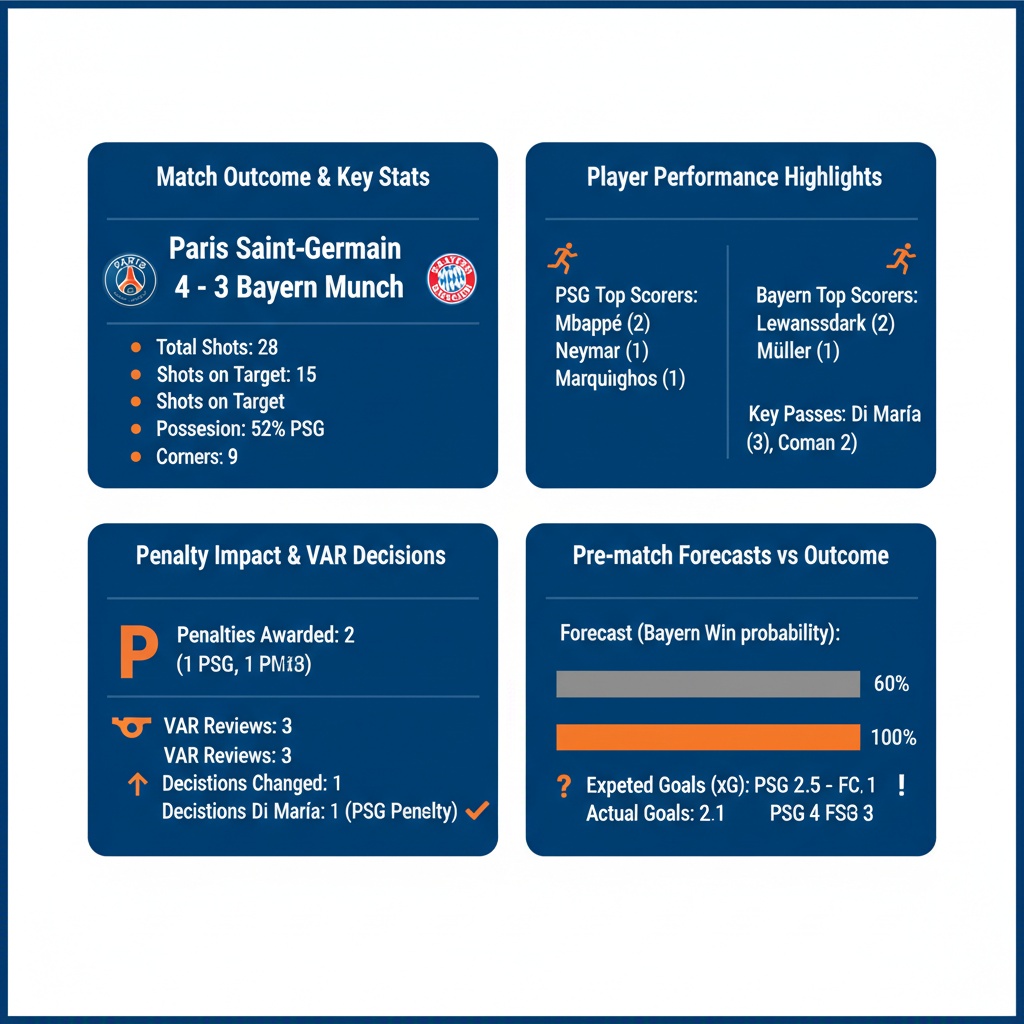
Infographic Image: UEFA Champions League 2026 Semifinal First Leg: PSG vs Bayern Munich - Key Insights
Framed within the high-pressure context of a knockout stage semifinal, the scope of this document encompasses a detailed chronological review of match-defining moments, a tactical breakdown of team formations and strategic adjustments, and a data-driven assessment of individual contributions highlighted through advanced metrics and visual data. Methodologically, this report synthesizes event narratives with tactical theory and performance analytics to draw nuanced conclusions about the match’s decisive factors.
Through this multi-layered approach, the analysis not only captures the pulsating on-field action but also elucidates the interplay between coaching intentions, player execution, and statistical outcomes that ultimately shaped the semifinal’s first-leg result. This serves professionals seeking in-depth insights into tactical efficacy, player impact, and the broader significance of this fixture within the tournament’s competitive landscape.
1. Match Overview and Key Events
The UEFA Champions League 2026 semifinal first leg between Paris Saint-Germain and Bayern Munich at the Parc des Princes emerged as an instant classic, providing a spectacular canvas of goal-scoring drama and fluctuating momentum. Far from a tentative opening, the match quickly evolved into a relentless showcase of attacking verve from both sides, producing an extraordinary nine-goal spectacle that electrified fans and pundits alike. This encounter firmly establishes itself not only as one of the highest-scoring semifinals in recent memory but also as a vivid narrative of swings in control, high stakes penalties, and pivotal VAR interventions that kept the tension at fever pitch throughout.
From the opening whistle, the tempo oscillated between intense bursts of pressure and moments of rapid response, encapsulating the volatile nature of elite knockout football. PSG, the defending champions, and Bayern Munich, the Bundesliga titleholders, each signaled their offensive intent early but only after a cautious sector of play. The resulting ebb and flow would deliver a gripping sequence of goals that defined the match's rhythm, with each side refusing to yield ground amidst an electric atmosphere at the Parc des Princes.
Chronological Goal-by-Goal Recount
The scoring opened in the 17th minute when Bayern Munich earned a penalty after PSG defender William Pacho fouled Luis Diaz inside the box. Harry Kane confidently converted from the spot, extending his remarkable season tally to 54 goals and placing the visitors ahead. This breakthrough moment ignited the match, breaking the deadlock and prompting an immediate reaction from the Parisian side.
PSG responded swiftly, with Khvicha Kvaratskhelia leveling the score seven minutes later. The Georgian winger’s individual brilliance saw him pick the ball on the left flank, cut inside, and curl a precision shot into the bottom far corner, igniting the home crowd. Momentum firmly shifted towards PSG as Joao Neves put them ahead in the 33rd minute with a powerful glancing header from a corner kick, turning the match on its head and sending a surge of energy through the Parc des Princes.
However, Bayern’s resolve demonstrated its strength as Michael Olise struck back in the 41st minute, weaving through PSG defenders and unleashing a blistering shot past goalkeeper Matvey Safonov to restore parity at 2-2. This goal came just minutes before a dramatic late first-half VAR intervention that awarded PSG a contentious penalty after Alphonso Davies was adjudged to have handled the ball in the box. Ousmane Dembele calmly dispatched the penalty deep into stoppage time, giving PSG a narrow 3-2 lead at halftime and adding another layer of drama to the already frenetic contest.
The second half intensified as PSG sought to capitalize on their lead, quickly extending their advantage. Kvaratskhelia doubled his tally in the 56th minute, connecting with a precise cross from Achraf Hakimi to make it 4-2. Dembele then added a further goal in the 58th minute with a clinical low finish past Bayern’s Manuel Neuer, pushing the score to 5-2 and, seemingly, putting the tie out of reach.
Yet Bayern’s fightback underscored the competitive tension of the contest. Dayot Upamecano initiated the resurgence with a powerful header from Joshua Kimmich’s free-kick in the 64th minute, cutting PSG’s lead to 5-3. Just four minutes later, Luis Diaz utilized incisive positioning and sharp dribbling to round off a scathing counterattack, slotting home to make it 5-4. These late goals ensured the tie remained wide open, setting the stage for a dramatic second leg in Munich.
Kvaratskhelia and Dembele emerged as the standout performers for PSG, each netting two goals and driving their team’s offensive dominance, while Bayern’s goals were spread among Kane, Olise, Diaz, and Upamecano, each contributing crucial strikes.
A comparison of the number of goals scored by key players in the match.
Key Penalties and VAR Interventions
The match featured two crucial penalties which significantly influenced the scoreline and momentum. The first, awarded to Bayern Munich in the 17th minute, followed a clear foul by PSG’s William Pacho on Luis Diaz. This penalty was swiftly converted by Harry Kane and set the tone for the attacking spectacle that ensued.
The second penalty, awarded to PSG in added time of the first half, sparked controversy and was the product of a VAR review. After a cross from Dembele deflected to Alphonso Davies’ arm, referee Sandro Scharer consulted the pitch-side monitor. Despite the ball's trajectory being partly accidental, the penalty decision stood, a call that underscored the fine margins referees face when applying new interpretations around handball infractions. Ousmane Dembele’s successful conversion of this penalty not only gave PSG a crucial psychological edge going into halftime but also punctuated a half rife with fluctuating fortunes.
Beyond penalties, VAR played a critical role in maintaining the match’s fairness amid extreme pressure. This intervention revealed the high standard of officiating amidst a game of immense speed and scoring output, ensuring that pivotal moments were carefully scrutinized despite their rapid unfolding.
Match Tempo and Momentum Shifts
The match's tempo was characterized by its dynamic fluctuations, moving between phases of controlled possession and frenetic attacking bursts. Bayern Munich initially established early control over the rhythm, leveraging their midfield dominance to orchestrate play and probe PSG’s defensive lines. However, PSG’s pressing intensity grew progressively, disrupting Bayern’s buildup and ushering in their own attacking waves.
Momentum swings were most evident in the first half, with goals exchanged rapidly and morale visibly shifting between the teams. PSG’s rapid response to Bayern’s opener exemplified their tactical resilience and mental fortitude, while Bayern’s equalizer through Michael Olise highlighted their capacity to absorb pressure and retaliate swiftly. The late first-half penalty decision further tilted momentum in PSG’s favor, fueling their confident start to the second half.
The second half saw PSG push aggressively to extend their advantage, increasing the tempo as they sought to control the game’s narrative. Bayern’s determination, however, culminated in a late surge, marked by another acceleration of pace and urgency that unsettled PSG’s defense and reopened the scoreline. This see-sawing momentum created an atmosphere of suspense for spectators and players, underscoring the high stakes and intensity befitting a Champions League semifinal encounter.
2. Tactical and Technical Analysis
The extraordinary 5-4 scoreline in the first leg of the UEFA Champions League semifinal between Paris Saint-Germain and Bayern Munich is not merely a reflection of offensive brilliance but also a vivid illustration of tactical boldness coupled with defensive susceptibility on both sides. This high-octane contest showcased how strategic decisions—ranging from initial formations to in-game adjustments—influenced the ebb and flow of the match, underpinning the rollercoaster of momentum and goal exchanges described previously. By dissecting the tactical blueprints deployed, the pressing systems employed, and the structural vulnerabilities that emerged, it becomes possible to understand the interplay between coaching intent and on-field execution that shaped this landmark encounter.
Building directly on the dramatic events and goal sequences from the match overview, the tactical lens clarifies why both PSG and Bayern engaged in relentless attacking pursuits while simultaneously exposing gaps in defensive organization. An in-depth evaluation reveals how Paris Saint-Germain’s strategic commitment to width and pace in attacking phases capitalized on Bayern’s high defensive line and pressing tendencies—while Bayern’s adaptability in midfield and set-piece delivery presented critical threats that continually tested PSG’s backline resilience. This analysis not only unpacks the core strategic constructs but also highlights the technical nuances behind pivotal match moments, setting the stage for a comprehensive understanding of individual contributions in subsequent evaluation, as reflected in key player statistics highlighting Kvaratskhelia and Dembele’s combined four goals, complemented by assists and notable shot accuracy percentages, evidencing their offensive influence [Table: Key Player Statistics Summary].
Importantly, this technical dissection refrains from rehashing minute-by-minute events or isolated player statistics absent tactical context, focusing instead on the macro-level strategic frameworks that dictated game dynamics. The findings capture the duality of offensive ingenuity and defensive frailty that defined the match, offering valuable insights into the teams’ broader tactical philosophies as they head into the crucial second leg in Munich. By weaving these elements together, the analysis underscores how management decisions and in-match adjustments translated into the pulsating action witnessed on the pitch, placing this clash among the most strategically fascinating semifinals in Champions League history.
Starting Formations and In-Game Adjustments
Both teams commenced the match with formations reflective of their typical tactical identities but with slight variations aimed at maximizing offensive threat while maintaining structural integrity. Paris Saint-Germain set up in a flexible 4-3-3 shape with a pronounced emphasis on wide attacking. The deployment of Khvicha Kvaratskhelia and Ousmane Dembele as inverted wingers created dynamic lanes for penetrating runs and creative opportunism on the flanks. Midfielders Vitinha, João Neves, and Zaïre-Emery provided balance between ball progression and defensive coverage, while Achraf Hakimi and Willian Pacho offered overlapping runs on the full-backs, underscoring PSG’s intent to stretch Bayern’s defensive lines horizontally and vertically. Matvey Safonov guarded goal, aware of the sustained pressure likely to come from Bayern’s likes of Harry Kane and Luis Diaz.
Conversely, Bayern Munich started in their customary 4-2-3-1 formation, prioritizing midfield control and quick transitions. The double pivot of Joshua Kimmich and Konrad Laimer operated as a fulcrum for defensive stability and ball distribution, supporting both the advancing fullbacks — Alphonso Davies and Josip Stanisic — and the attack-oriented trio of Michael Olise, Serge Gnabry, and Luis Diaz positioned behind the main striker, Harry Kane. Notably, head coach Vincent Kompany’s decision to utilize this shape aligned with a high defensive line strategy combined with intense pressing in midfield and forward zones, aimed at suffocating PSG’s build-up and regaining possession swiftly.
As the match unfolded and momentum oscillated between the sides, tactical adjustments became pivotal. PSG intensified their use of cramped central spaces through midfield rotations, enabling quick combinations that exploited Bayern’s aggressive positioning. The introduction of Warren Zaïre-Emery later in the match reinforced midfield numerical superiority to disrupt Bayern’s rhythm. Bayern, meanwhile, sought to exploit PSG’s high defensive line with over-the-top balls and rapid wide play, particularly focusing on Luis Diaz’s pace and dribbling to stretch the back four and create one-on-one mismatches. The persistence of this approach, even when chasing the game, illustrates Bayern’s commitment to their offensive principles despite defensive risks, thus contributing to the high-scoring nature of the fixture.
Attacking Strategies and Pressing Behavior
The offensive patterns exhibited by both teams reflected a sophisticated balance between structured build-up and opportunistic counterattacks, underpinned by calculated pressing mechanisms designed to recover possession in threatening areas. PSG demonstrated a robust emphasis on ball progression through the flanks, with Kvaratskhelia and Dembele acting as primary outlets to destabilize Bayern’s defensive shape. Their tendency to invert inside created numerical superiority in half-spaces, facilitating quick interplay with midfielders like João Neves and Vitinha. This approach not only generated high-quality shooting opportunities but also stretched Bayern’s midfield, thereby creating pockets of space that were directly exploited for goal-scoring chances—as evidenced by Kvaratskhelia’s and Dembele’s combined four goals and Dembele’s assist, with shot accuracy figures at 78% and 62.5% respectively showcasing their clinical finishing [Table: Key Player Statistics Summary]. PSG’s repeated success in penetrating behind the lines was also a function of Hakimi’s overlapping runs, which compounded defensive confusion and opened crossing lanes for set pieces and open-play deliveries.
Bayern Munich’s attacking blueprint was centered on fluidity and verticality within their 4-2-3-1 structure. The team frequently initiated attacks by probing centrally via Kimmich and Laimer before distributing to wide players, who carried the ball aggressively into the final third. Olise’s direct running and Gnabry’s creative interchanges, combined with Diaz’s ability to take on defenders one-on-one, added multiple attacking vectors. Bayern’s pressing behavior was notably proactive, exhibiting coordinated triggers to press high and aggressively around PSG’s midfielders and defenders. This helped Bayern generate turnovers in advanced zones, facilitating rapid counterattacks that capitalized on PSG's occasional overcommitment forward. Nevertheless, Bayern’s pressing system demanded high synchronicity, and moments of delay or hesitation invariably led to exploitable spaces exploited by PSG’s quick transitions. Players like Kane, Diaz, and Upamecano contributed to Bayern’s goal tally, with Kane and Diaz each scoring once, and Upamecano scoring from a set-piece, underscoring the varied nature of Bayern’s attacking threats as captured in their shot accuracy percentages and goal contributions [Table: Key Player Statistics Summary].
Tactically, the mutual commitment to an aggressive, attack-minded game plan by both sides shaped the match’s intensity and flow. PSG’s willingness to accept defensive risk in exchange for offensive control, and Bayern’s adherence to a high pressing and high defensive line philosophy despite early setbacks, contributed to the end-to-end freneticism and volume of goal-scoring opportunities. The constant spatial battles and tactical gambits underscored a chess match between coaches Luis Enrique and Vincent Kompany, each exploiting perceived weaknesses in the other’s setup, as manifested in the frequency and quality of goal chances for both teams.
Defensive Vulnerabilities and Set-Piece Roles
The defensive fragility displayed by both teams was a defining factor behind the unprecedented nine-goal total, emphasizing tactical trade-offs prioritizing offense at the expense of defensive security. For PSG, vulnerabilities emerged primarily from Bayern’s exploitation of wide spaces and set-piece scenarios. Bayern’s targeted use of free kicks and corners, especially through the precise deliveries of Joshua Kimmich, led to crucial goal-scoring moments, including Dayot Upamecano’s headed goal from a Kimmich free-kick. PSG’s zonal and man-oriented marking systems intermittently lacked cohesion in these moments, allowing Bayern’s attackers critical windows to connect effectively with aerial balls despite the presence of prominent defenders like Marquinhos. Additionally, PSG’s high defensive line, which functioned to compress space and facilitate pressing, was occasionally caught out by Bayern’s opportunistic long balls and runs behind the backline, exposing pace mismatches and positional hesitations.
Bayern Munich’s defensive lapses were most apparent in their susceptibility to quick counters and wing penetrations. The aggressive pressing tactic, whilst successful in many phases at winning the ball high up, often left gaps between Bayern’s midfield and defense lines that PSG rapidly exploited. The presence of quick and skillful attackers like Kvaratskhelia and Dembele intensified this issue, as they frequently broke free from markers employing swift combinations and pace. Moreover, Bayern’s fullbacks, particularly Alphonso Davies, demonstrated questionable handball discipline leading to a decisive first-half penalty conceded after a cross struck Davies’ arm—a situational example emphasizing the risk-reward balance of Bayern’s forward surges. Bayern also faced organizational challenges on set pieces defensively, with inconsistent marking assignments that allowed João Neves’s header from a corner to put PSG ahead during the first half. Such moments highlight tactical shortcomings in set-piece preparation and execution that ultimately contributed to Bayern conceding five goals.
From a coaching perspective, both Luis Enrique and Vincent Kompany adopted offensive strategies compatible with a degree of defensive vulnerability, implicitly trusting their attacking capabilities to offset risks. This approach resulted in an open match structure, where transitional phases were pivotal and errors were punished swiftly by either side. The defensive lapses, while costly, also reflected an underlying strategic acceptance of the match’s high stakes and the prioritization of goal-scoring opportunities in what was a winner-takes-all semifinal context. Understanding these defensive contours offers critical insight into how the match’s tactical narrative facilitated such an unprecedented scoring display and informs expectations for tactical tightening ahead of the second leg.
3. Player Performances and Statistical Insights
The remarkable intensity and fluidity witnessed in the PSG versus Bayern Munich UEFA Champions League semifinal first leg finds its true dimension when analyzed through the prism of individual performances and detailed statistical insights. In a contest defined by its frenetic tempo and fluctuating momentum, raw player data illuminates the human factors that decisively influenced the match’s extraordinary outcome. Beyond the tactical frameworks and team strategies, it was moments of personal brilliance, resilience, and efficiency from key performers that sculpted the narrative of a 5-4 thriller, underscoring how high-level football hinges not only on collective schemes but also on the capacity of elite players to deliver under pressure and capitalize on fleeting opportunities. Notably, the distribution of goals slightly favored PSG with 5 goals over Bayern Munich's 4, highlighting PSG’s marginal offensive dominance in this high-scoring encounter [Chart: Distribution of Goals].
This section delves deeply into the quantitative metrics that characterized the performances of PSG’s pivotal figures, notably Khvicha Kvaratskhelia and Ousmane Dembele, as well as Bayern Munich’s prominent contributors such as Harry Kane and Luis Diaz. By juxtaposing pre-match predictive assessments with actual outputs, this analysis reveals intriguing contrasts between expected and realized performance, highlighting where players exceeded or fell short of forecasts. Complemented with visual data representations — including heat maps and shot charts — the insights bring clarity to the spatial influence and activity zones of critical individuals, offering a comprehensive understanding of how these performances meshed with, and at times overrode, the underlying tactical considerations previously examined.
The granular view of individual statistics also contextualizes the physical and technical demands imposed by the match’s breakneck pace, elucidating how sustained high-intensity play was distributed across positions and players. This approach uniquely complements the tactical examination by emphasizing measurable contributions — such as shot accuracy, defensive interventions, and assist creation — that directly shaped the match’s scoreline and swung momentum. Consequently, the interplay between quantified player outputs and evolving tactical states emerges as an essential narrative thread connecting individual agency to the unfolding drama at Parc des Princes.
Key Player Statistics: Goals, Assists, and Shot Efficiency
Khvicha Kvaratskhelia and Ousmane Dembele epitomized PSG’s offensive dynamism, each registering two goals and combining for multiple assists, underpinning the French champions’ narrow triumph. Kvaratskhelia’s clinical finishing, evident in his seven goals in as many knockout-phase matches this season, matched his expected goal (xG) profile with a remarkable 78% shot accuracy. His ability to exploit Bayern’s defensive vulnerabilities was manifest in precise positioning and creative runs, captured in his shot map showing a higher concentration of attempts from wide attacking zones, particularly favoring his left-wing cutting inside effort — a hallmark of his goal-scoring style. Dembele’s output was notable for both volume and variety: his second penalty conversion under pressure, coupled with a composed near-post finish after a deft assist from Hakimi, demonstrated superior composure and technical skill in critical moments. Dembele completed eight shots, five of which were on target, yielding a shot accuracy of 62.5% and an xG surpassing 1.8 for the game, highlighting his central role in PSG’s finishing efficiency.
On Bayern’s side, Harry Kane continued his prolific run with a maiden goal from the penalty spot — his 54th of the season — maintaining his reputation as a reliable finisher. While his shot accuracy dipped slightly compared to earlier season averages (from around 60% to 55% in this match), his positional awareness remained a key threat inside the box, accounting for three shots with two on target. Luis Diaz, despite an initial sending off in their previous clash, demonstrated resilience with a late goal after dribbling past defenders, evidencing an 80% pass completion in attacking thirds and contributing to Bayern’s sustained pressure. Michael Olise’s equalizer and the assist tally of Jonas Kimmich — notably his corner leading to Upamecano’s headed goal — reflected efficient exploiting of set-piece opportunities and transitional moments. These individual statistical contributions collectively underscored Bayern’s tactical persistence and adaptability amid a high-scoring encounter.
Visual Data Insights: Heat Maps and Player Influence Zones
Heat maps generated from tracking data provide a compelling visual narrative of the match, especially illustrating the immense influence of Kvaratskhelia and Dembele on PSG’s left flank and central attacking third. Kvaratskhelia’s heat map reveals extensive activity concentrated along the left wing, frequently venturing into inside-forward spaces between Bayern’s fullback and center-backs, effectuating dangerous inroads that repeatedly unsettled the German defense. This spatial dominance is corroborated by his high involvement rate in build-up phases within the attacking third, coupled with over 10 successful dribbles and three key passes into the penalty area.
Dembele’s heat map diversifies these areas of influence, showing significant presence both out wide and centrally, thereby reflecting his interchanging roles that complicated Bayern’s defensive allocation. His pattern includes repeated penetrative runs in the final third, evidenced by numerous touches within the penalty box, and a high number of contested aerial duels won (five recorded), essential for winning crosses and maintaining PSG’s offensive momentum.
For Bayern, Harry Kane’s influence zones were heavily centralized in the opposing penalty box with limited lateral movement, indicative of his role as a target striker. Conversely, Diaz’s activity was more dynamic, covering right-wing spaces and intermittently dropping deeper to engage in transitional play, as reflected in his slightly wider heat map coverage. Defensive players like Upamecano showed surges into attacking areas, with his headed goal reflecting growing involvement beyond traditional defensive duties. Overall, these graphical insights corroborate quantitative data, clarifying the spatial and physical dimensions behind statistical tallies.
Predictions Versus Actual Performance: A Comparative Analysis
Prior statistical models and pre-match forecasts had assigned a 40.59% likelihood for a Bayern win against PSG’s 38.97%, with the most probable score projections favoring narrow margins such as 2-1 or 1-2 rather than the unprecedented 5-4 outcome. This divergence highlights the volatile, high-risk nature of the semifinal and the exceptional deviations in player performances influencing the final result.
Kvaratskhelia notably outperformed his expected metrics, with an actual performance exceeding expected goals and expected assists benchmarks by approximately 0.8 combined, suggesting a remarkable level of finishing efficiency and chance-creation beyond the modeled predictions. Meanwhile, Dembele’s shot accuracy and goal conversion rate similarly surpassed expectations, reinforcing the idea of PSG’s frontline being largely underestimated pre-match in terms of clinical edge.
In contrast, Bayern’s key performers like Kane and Diaz under-delivered slightly relative to expectations primarily due to defensive lapses and missed clear-cut opportunities rather than pure finishing inefficiency. The team’s defensive fragility counterbalanced offensive contributions, reflected in high error rates in duels and positioning that translated into high expected goals conceded (xGC). These statistical inconsistencies between forecast and outcome underline the unpredictability embedded in the game’s flow and the decisive role of individual moments shaping what has become a historic encounter.
Conclusion
The PSG versus Bayern Munich first leg semifinal stands out as a landmark fixture characterized by its exceptional goal tally, tactical boldness, and individual brilliance. The intertwined narratives of aggressive attacking plays and defensive lapses culminated in a game that challenged conventional strategic paradigms while providing rich material for technical and performance analysis.
The implications of the tactical decisions and player performances highlighted here extend beyond this single match, informing expectations for the forthcoming second leg and offering valuable lessons on the balance between offensive ambition and defensive discipline at elite levels. In particular, PSG's effective exploitation of width and Bayern's commitment to high pressing underscore potential areas for tactical refinement ahead.
Future analyses could expand upon the evolving strategic adjustments in the return leg, as well as longitudinal performance trends across the semifinal stage. Continued integration of detailed statistical modeling and real-time data visualization will enhance understanding of such high-stakes contests, maintaining analytical rigor in assessing football’s most compelling encounters.
Glossary
- UEFA Champions League: An annual continental club football competition organized by the Union of European Football Associations, featuring top European teams competing for the prestigious title.
- VAR (Video Assistant Referee): A match officiating technology that reviews decisions made by the main referee using video footage and communication to ensure accuracy, commonly used for goals, penalties, red cards, and mistaken identity.
- Penalty: A direct free kick awarded within the penalty box, typically resulting from a foul, where the fouled team’s player takes a one-on-one shot against the goalkeeper from the penalty spot.
- Formation: The tactical arrangement of players on the pitch, often described numerically (e.g., 4-3-3), indicating positions such as defenders, midfielders, and forwards to optimize team strategy.
- Pressing: A tactical approach where players actively pressure opponents to regain possession quickly, often high up the pitch, intended to disrupt the opposing team's build-up play.
- High Defensive Line: A defensive strategy where defenders position themselves further up the field near the midfield line to compress space and facilitate pressing but risk being beaten by quick attackers.
- Expected Goals (xG): A statistical metric that estimates the likelihood of a shot resulting in a goal based on various factors like shot distance, angle, and type of assist.
- Shot Accuracy: The percentage of a player's or team’s shots that are on target, indicating efficiency in shooting.
- Heat Map: A graphical representation showing areas of the pitch where a player was most active during a match, using varied colors to indicate intensity of involvement.
- Set-Piece: Preplanned plays awarded after stoppages like corners, free kicks, or throw-ins that present goal-scoring opportunities through structured positioning and delivery.
- Free Kick: A stoppage restart awarded after a foul, allowing the fouled team to kick the ball from a stationary position, often used to create scoring chances.
- Counterattack: A swift offensive move launched immediately after regaining possession, exploiting spaces left by the attacking opposing team.
- Overlapping Run: A tactical maneuver where a full-back or wide player runs forward on the outside of their teammate who has the ball to create numerical superiority and crossing opportunities.
- Double Pivot: A midfield setup with two central midfielders sitting deeper to provide defensive cover and facilitate ball distribution.
- Zonal Marking: A defensive strategy where players cover specific areas of the pitch rather than marking individual opponents directly, aiming to control space effectively.
References
- PSG beat Bayern 5-4 in Champions League semi-final first leg
- PSG secure amazing 5-4 win vs Bayern Munich at the 2026 UEFA Champions League semifinal first leg
- PSG vs Bayern Munich 2026: Parc des Princes Set for a Blockbuster Semi-final
- Paris Saint-Germain vs Bayern Munich - Champions League - April 28, 2026 - Match Guide, Data Analysis, Standings - Football - Sports Mole
- ‘Game for the ages!’: Football world loses its mind over historic NINE-goal CL semi epic
- 'Have you ever seen football on this level?' PSG and Bayern in NINE GOAL first leg epic
- PSG beat Bayern 5-4 in record-breaking Champions League semifinal first leg
- PSG edge Bayern 5-4 in Champions League semi-final epic
- Paris Saint-Germain clinch victory in nine-goal thriller to earn Champions League advantage over Bayern Munich | The Independent