Comprehensive Analysis of LG Monitors: Market Position, Technology, and Performance
Evaluating LG's Innovation, Financial Health, and Competitive Edge in the Display Industry
Table of Contents
Executive Summary
This analysis presents a comprehensive evaluation of LG monitors, highlighting key technical advancements such as cutting-edge OLED and high refresh-rate technologies that deliver superior visual performance. The study also examines LG Display and LG Electronics’ robust financial growth, which underpins ongoing innovation and product development in the competitive monitor sector.
Further, LG’s strategic positioning amidst dynamic market conditions is elucidated by comparing its offerings against major competitors, emphasizing its leadership in OLED technology and ergonomic design. These insights collectively underscore LG’s sustained ability to meet evolving customer demands while maintaining a strong foothold in the global display market.
Introduction
The monitor display industry is undergoing rapid technological transformation, driven by advancements in panel technology, resolution, refresh rates, and user-centric features. In this dynamic context, LG has emerged as a prominent innovator, particularly through its development and deployment of OLED technology and high-performance monitors tailored for professional, gaming, and creative segments.
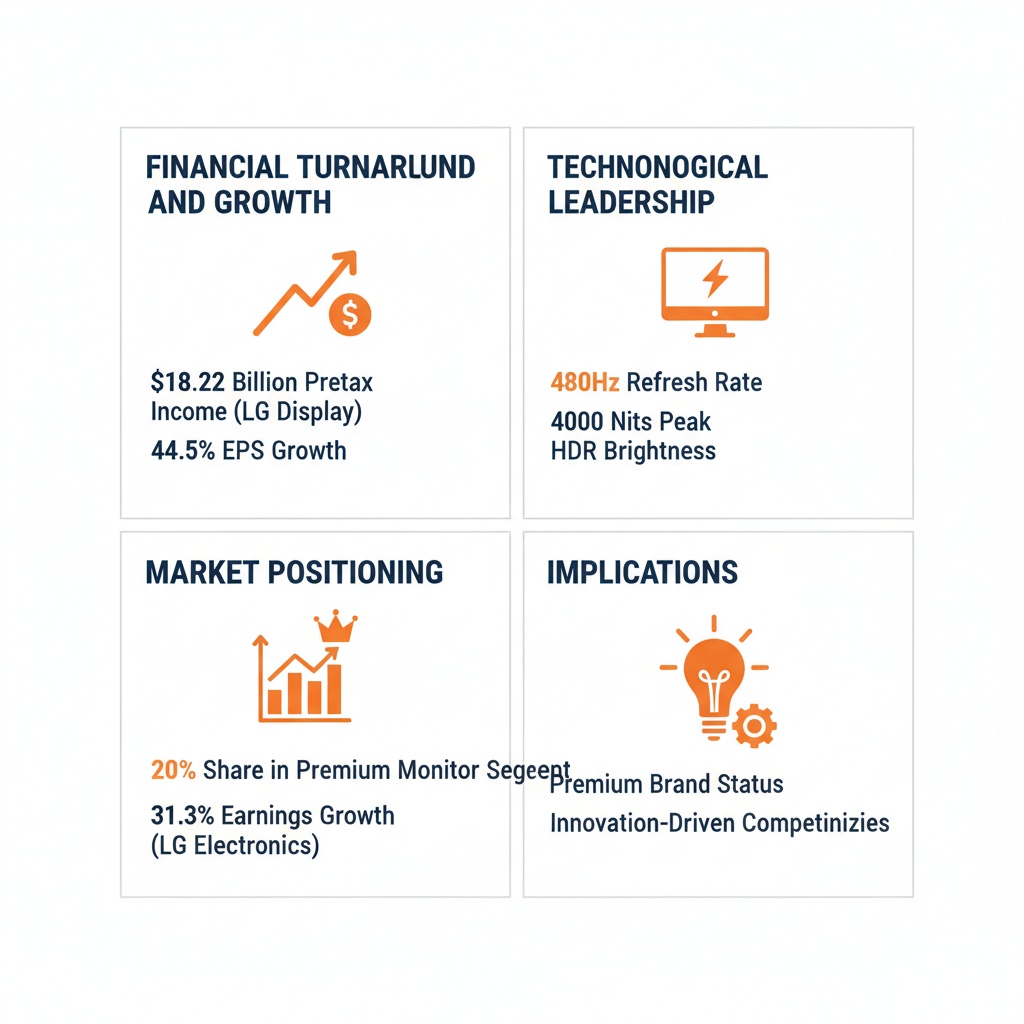
Infographic Image: LG Monitors: Innovation, Performance, and Market Leadership
This analysis aims to provide a detailed exploration of LG monitors, focusing on their technological features, financial and market performance, and competitive positioning. The scope encompasses a technical review of product innovations, an assessment of LG Display and LG Electronics’ economic health and strategic initiatives, and a market analysis situating LG within the broader competitive landscape.
Employing a structured methodology, the report integrates product specification data, financial reports, analyst consensus, and market share insights to present an evidence-based evaluation. This multi-dimensional approach facilitates a nuanced understanding of LG’s capabilities and challenges, offering stakeholders actionable perspectives on its current and future positioning in the monitor industry.
1. LG Monitor Product Features and Technological Innovations
LG has positioned itself at the forefront of display technology innovation through a relentless focus on advanced panel technologies, high-refresh-rate capabilities, and ergonomic design tailor-made for professional and enthusiast users. This foundation not only distinguishes LG monitors in a crowded and evolving market but also serves as the technical baseline enabling LG Display and LG Electronics to capitalize on emerging consumer demands for immersive, high-performance visual experiences. Drawing momentum from breakthroughs in OLED technology, LG redefines visual fidelity and responsiveness, establishing a benchmark critical for understanding the brand's competitive edge and informing subsequent financial and market strategies. Despite this strong positioning, Samsung leads the global monitor market with a 35% share, while LG holds a significant 20%, reflecting its focus on premium OLED offerings and specialized technologies that differentiate it from other competitors [Chart: Market Share Comparison of Leading Monitor Brands].
Transitioning from the exploration of foundational display technologies, this analysis delves deeper into LG’s product innovations that currently set new standards for image quality, response times, and user comfort. By dissecting LG’s key technical specifications—such as cutting-edge OLED panels with unique pixel arrangements, outstanding refresh rates reaching up to 165 Hz, and superior HDR implementations—the discussion highlights how LG masterfully integrates material science and engineering to empower users with exceptional viewing performance. Furthermore, the ergonomic design aspects, including extensive adjustability features, demonstrate LG’s commitment to optimizing the user workspace, reiterating the brand’s holistic approach to monitor innovation.
Key Technical Specifications and Innovations
Central to LG’s technological ascendancy is its pioneering use of OLED panels, a technology that delivers unparalleled contrast ratios, deep blacks, and vibrant colors by independently illuminating each pixel. The recent introduction of tandem OLED structures—specifically the 4-stack tandem variant first deployed in LG’s 48-inch C6 model—significantly advances these capabilities. By stacking multiple OLED layers, LG achieves remarkable gains in brightness, effectively doubling the luminance compared to conventional 27 to 32-inch OLED monitors. This innovation not only enhances HDR (High Dynamic Range) performance but also ensures the monitor excels in highly demanding applications that require superior highlight rendering and shadow detail fidelity.
Complementing OLED technology, LG incorporates high refresh rates up to 165 Hz in select models, satisfying the needs of gamers and professionals requiring smooth motion handling and reduced latency. Technical reviews confirm these monitors exhibit exceptionally low response times and minimal input lag, elevating user experience in dynamic visual contexts such as fast-paced gaming, video editing, and animation. The synergy between OLED’s pixel response speed and LG’s optimized refresh rate support culminates in fluid and crisp imagery, with benefits extending to reduced motion blur and enhanced precision.
Regarding resolution and color accuracy, LG consistently offers monitors with 4K and 5K UHD panels, supporting a broad color gamut enriched by novel subpixel arrangements that include the introduction of an RGWB (Red, Green, Blue, White) pixel matrix. This innovative approach improves brightness efficacy while maintaining excellent color fidelity and sharpness, addressing common OLED challenges of reduced peak brightness without compromising visual clarity. Surface treatments such as glossy coatings combined with anti-reflective properties further amplify these benefits by minimizing glare and enhancing text legibility, even in bright ambient lighting.
LG’s HDR implementations reinforce the monitors’ appeal for creators and content consumers alike. With peak brightness levels reaching approximately 4,000 nits in some models and advanced local dimming capabilities, LG monitors render HDR content with remarkable depth and realism. HDR standards like Dolby Vision are supported, although users should be aware of occasional software hiccups related to Dolby Vision mode switching when connected to Windows PCs, which LG has iteratively targeted in firmware updates.
Ergonomic and User Adjustment Features
Beyond raw display performance, LG integrates comprehensive ergonomic features to support diverse user environments and preferences. Contemporary LG monitors typically include tilt, swivel, rotation, and height adjustment mechanisms allowing users to tailor the viewing angle and position precisely. For instance, tilt and swivel capabilities often span a wide range, with some models enabling up to 180 degrees swivel, facilitating flexible desk arrangements and collaborative workflows.
Height adjustability is critical for reducing neck and eye strain by aligning the monitor’s center with the user’s natural line of sight. LG’s monitors commonly offer smooth height adjustments to cater to various sitting or standing postures, fostering healthier work habits during extended use. Rotation functionality enables effortless switching between landscape and portrait orientations, supporting tasks such as document editing, coding, and design that benefit from vertical screen layouts.
These adjustment features underscore LG’s emphasis on workspace optimization, addressing ergonomic concerns increasingly recognized in modern office and creative settings. Combining eye-level positioning, glare reduction through precise angle control, and user-friendly hardware interfaces, LG monitors create an accommodating environment tailored to reduce fatigue and enhance productivity.
Known Limitations and User Experience Challenges
Despite the impressive technological strides, LG monitors do encounter several limitations that influence overall user experience. A noteworthy concern arises from the phenomenon known as 'black crush,' where shadow details can appear compressed or lost, especially prior to calibration. This issue manifests due to the intrinsic nature of OLED panels and requires user or professional adjustment to optimize dark scene reproduction, particularly in content with high contrast or cinematic imagery.
Certain software-related challenges have also been documented. For example, Windows-based PC connections sometimes default the brightness level inaccurately—fixed around 4,000 nits irrespective of content needs—necessitating manual recalibration by users to attain intended luminance balance. Additionally, the integration of Dolby Vision HDR can experience sporadic toggling back to game mode, reflecting firmware stability areas that warrant attention. LG has been actively releasing updates to mitigate such glitches, reflecting responsiveness yet acknowledging an area of ongoing refinement.
From a hardware standpoint, while built-in speaker systems are convenient, they are reportedly prone to distortion at higher volumes and offer limited bass reproduction. This limitation often persuades users seeking audio fidelity to prefer dedicated sound solutions. Furthermore, the relatively large physical dimensions—such as the 48-inch class models—may challenge users with limited desk space, necessitating careful consideration of the environment where such displays are deployed.
Lastly, longevity and burn-in concerns typical of OLED technology, though mitigated through advanced pixel-shifting algorithms and usage guidelines from LG, still require vigilance. Users should balance the visually rich experience with appropriate usage patterns to ensure sustained panel integrity over time.
2. LG Display & LG Electronics Financial and Market Performance
Building on the foundation established by LG's relentless pursuit of technological innovation in monitor displays, a thorough understanding of the corporation's financial and market performance is crucial to appreciating how LG sustains its leadership and competitiveness in the global monitor sector. The financial robustness of LG Display and LG Electronics provides the essential capital and strategic flexibility to fuel continuous research and development, operational scaling, and market expansion. As of early 2026, the promising financial trajectories coupled with favorable analyst sentiments underscore LG's capacity not only to maintain its technological edge but also to navigate evolving market dynamics with resilience and agility.
In 2025, LG Display and LG Electronics reported significant improvement in earnings and revenue, marking a recovery and growth phase after several challenging years. This upturn is indicative of effective strategic realignment and successful commercialization of advanced technologies such as OLED and ultra-high refresh-rate panels introduced in the previous years. The interplay of strong financial metrics and positive market outlook lays a solid groundwork that supports LG’s aggressive innovation roadmap, which was detailed in prior analyses. Consequently, this section delineates LG’s key financial indicators, analyst consensus, and recent corporate developments that collectively affirm its vigorous positioning within the display technology sector.
Key Financial Metrics and Growth Trends
LG Display has demonstrated a remarkable turnaround in earnings in the fiscal year 2025, recording a pretax income of approximately $18.22 billion USD, a profound rebound from a negative earnings position in 2024. This transition from losses to profitability reflects successful execution of cost control measures, boosted sales of premium OLED panels, and diversification into emerging segments such as automotive and commercial displays. Revenue growth, although steady, has been measured, with annual increases forecasted at around 2.3%. This modest revenue growth contrasts with an impressive earnings growth rate projected at 44.8% per annum over the next three years, signaling improved operational efficiency and margin expansion rather than volume-driven growth alone. Such a dynamic illustrates LG Display’s strategic focus on high-value products prioritizing profitability over sheer scale.
Equally telling is the expected growth in earnings per share (EPS) for LG Display, forecasted at approximately 44.5% annually. This EPS acceleration is supported by ongoing share repurchases and operational profits that enhance shareholder value. The company’s future return on equity (ROE) is foreseen to improve to around 14.3%, which, while moderate compared to tech industry leaders, reflects sound capital utilization in a capital-intensive sector. Historical data reveals a recovery trend from previously declining earnings, with LG Display shifting course from a five-year trajectory of negative earnings growth to a positive outlook driven by its strategic pivot towards OLED technologies and innovation leadership. These metrics provide a compelling narrative of financial resilience and forward-looking growth, critical for sustaining R&D investments and product pipeline development.
| Metric | LG Display | LG Electronics |
|---|---|---|
| Pretax Income (USD) | 18.22 billion | N/A |
| Earnings Growth Rate (%) | 44.8 | 31.3 |
| Revenue Growth Rate (%) | 2.3 | 5.2 |
| EPS Growth Rate (%) | 44.5 | 32 |
This table summarizes the major financial metrics for LG Display and LG Electronics in 2025.
Turning to LG Electronics, the diversified electronics manufacturing giant complements LG Display’s specialized focus with its strong consumer durables portfolio and substantial presence in smart home and commercial display solutions. LG Electronics is projected to achieve an earnings growth rate of approximately 31.3% per year and revenue growth near 5.2% annually. The latter indicates a healthy expansion trajectory buoyed by product lineup enhancements, broader market diversification, and innovation in IoT-enabled devices. EPS for LG Electronics is expected to grow by roughly 32% annually, reflecting effective cost management and productivity improvements across its divisions.
LG Electronics’ forecasted return on equity stands at a slightly more modest 9.8%. This figure, while lower than LG Display’s, is consistent with the diversified risks and capital allocation across multiple sectors. Key financial performance indicators are supported by recent dividend approvals and an equity buyback program totaling KRW 100 billion, signaling confidence in sustained cash flows and commitment to shareholder returns. LG Electronics’ financial trajectory showcases a balanced approach to growth and value generation, thereby furnishing a stable financial base for continued innovation in its monitor product lines and complementary technologies.
Analyst Ratings and Stock Forecast Summaries
The consensus analyst rating for LG Display as of early 2026 remains generally positive with a "Buy" recommendation predominating. Coverage from thirty-six analysts reveals a broad confidence in the company's recovery strategy and its outlook for earnings and EPS growth. Several analyst reports highlight LG Display’s strengthened portfolio of OLED technologies, including the unveiling of a 240Hz RGB stake OLED panel and next-generation automotive displays, as strong catalysts for enhanced revenue streams in upcoming quarters. The forecasted earnings growth of nearly 45% per annum positions LG Display attractively relative to both domestic and international electronic industry peers, making it a compelling investment consideration.
Market valuations suggest a notable premium given LG Display's potential for high-margin returns from innovative panel offerings, although revenue growth projections remain conservative, reflective of the capital-intensive nature of the display business. Analysts emphasize that while near-term challenges such as memory chip supply fluctuations and market volatility persist, LG Display’s fundamental earnings trajectory is robust, underpinned by strategic operational focus and successful product commercialization.
For LG Electronics, analyst sentiment is equally favorable with a strong emphasis on its diversified product portfolio blending consumer electronics, home appliances, and evolving display solutions. Valuation metrics indicate a premium positioning with a price-to-earnings (P/E) ratio around 54.2 as of April 2026, signaling market expectations of high future earnings growth. Despite a lower return on equity relative to LG Display, LG Electronics benefits from a good analyst coverage base and has recently issued multiple positive earnings guidance updates for successive quarters in 2025 and 2026. Market observers note the company’s ongoing innovation in AI-powered home solutions and smart display technologies as supportive of sustained top-line and bottom-line growth.
Stock forecasts from major financial institutions and market intelligence platforms portray LG Electronics as a stable growth stock, with projected earnings growth outpacing industry averages and consistent dividend payouts enhancing its appeal for income-oriented investors. The company's strategic acquisitions and technology developments in smart monitors and IoT integration strengthen its medium-term prospects. These positive analyst outlooks reinforce investor confidence, supporting capital inflows and market capitalization consistency.
Recent Corporate Updates Impacting Financial Outlook
Recent corporate activities from LG Display and LG Electronics demonstrate proactive strategic management aligned to market demands and innovation leadership. Notably, LG Display’s annual general meetings in early 2026 underscored commitments towards expanding OLED production capacity and fortifying automotive display solutions, which are anticipated to drive revenue diversification and diminish reliance on more cyclical segments. Initiatives such as the commercialization of blue phosphorescent OLED panels and the launch of proprietary “Eyesafe® Circadian Displays” showcase LG Display’s pursuit of niche, high-value market segments that offer differentiated growth opportunities.
LG Display has also successfully completed a significant follow-on equity offering amounting to KRW 1.29 trillion, reinforcing its balance sheet strength and funding capacity for large-scale R&D and facility upgrades. The company is positioning itself towards emerging market trends, including AI-enabled display technologies and stretchable display innovation, as highlighted at CES 2026 and SID Display Week 2025. These initiatives are expected to enhance earnings quality and support a higher operational margin profile over the medium term despite an overall modest revenue growth rate.
On the LG Electronics front, a sequence of strategic product launches and corporate announcements has marked the 2025-2026 period. The introduction of the new Ultragear OLED gaming monitors with a 480Hz refresh rate enhances LG’s competitive edge in the high-performance gaming segment. Additionally, broad adoption of AI-driven home hub and smart telematics solutions signals diversification into high-growth adjacent markets beyond traditional consumer electronics. Recent equity buybacks and dividend declarations further attest to healthy cash flow generation and constructive management views on shareholder value optimization.
Organizational restructurings implemented in late 2025 and early 2026 emphasize a focus on innovation management and operational efficiency. Partnerships and acquisitions, such as the majority stake acquisition in Athom BV and collaboration with Dolby Laboratories, strengthen LG Electronics' technological ecosystem and enhance long-term revenue sustainability. Collectively, these developments affirm the companies’ strategic agility and robust financial footing, providing confidence in continued positive market performance and capacity for ongoing investment in breakthrough technologies.
3. Competitive Positioning and Market Context of LG Monitors
In today’s dynamic and rapidly evolving global display market, understanding LG monitors' competitive positioning is pivotal to appreciating the brand’s broader strategic trajectory. As LG leverages its technical prowess and financial momentum, it does so within an intensely competitive environment marked by accelerating innovation cycles, shifting consumer preferences, and diversified market segments. This context offers critical insight into how LG’s distinctive display technologies and corporate strategies translate into tangible market presence and customer appeal. Extending from the foundational product and financial analyses, this section situates LG monitors among key rivals and evolving market forces, highlighting factors that differentiate LG’s offerings and shape its competitive edge as of early 2026.
Against a backdrop where display technologies quickly commoditize, LG manages to carve out a premium niche thanks to its pioneering adoption of OLED technology and aggressive innovation in refresh rates and color accuracy. However, the company also confronts strong competition from entrenched industry leaders who command significant market share and brand loyalty, particularly Samsung. By comparing LG’s technological differentiators alongside consumer trends and emerging innovation priorities, this narrative sheds light on how LG navigates the market complexities and positions itself for sustainable growth in a sector defined by rapid technological advancement and shifting user demands.
Key Competitors and Market Positioning
LG monitors operate within a competitive landscape dominated by several large multinational corporations with diverse product portfolios, including Samsung, Dell, ASUS, and Sony. Among these, Samsung represents LG’s principal rival, wielding considerable influence through its extensive LCD and QD-OLED panel manufacturing capabilities, broad product range, and established global distribution channels. According to the latest market share data available from industry reports (see document d2), Samsung leads the overall global monitor segment with a share approximating 35%, whereas LG holds a robust 20% in key premium categories, particularly those leveraging OLED technology.
Sony, while smaller in scale relative to LG and Samsung, has recently ventured into niche gaming monitors with very high refresh rates, such as the INZONE M10S II featuring up to 720Hz using LG’s tandem OLED panels (d1). This collaboration underscores LG’s role not just as a competitor but also as a technology supplier, helping the brand expand its influence indirectly in specialized high-end markets. Additionally, Taiwanese and Chinese brands like ASUS and TCL continue to pressure the mid-tier market segment, pushing affordability and incorporation of emerging features such as mini-LED backlighting. In this diverse field, LG positions itself predominantly as a premium brand, focusing on display innovation, user experience, and distinctive OLED-based performance advantages.
LG’s strategic positioning intentionally capitalizes on its leadership in OLED certification and its ability to integrate high refresh rates with superior panel technology, as seen in advanced panels enabling 120Hz and beyond refresh rates with near-instantaneous response times and deep contrast ratios. This contrasts with competitors who primarily rely on LCD-based technologies, often supplementing them with quantum dot enhancements. While LCD remains dominant in unit volume, especially for general productivity monitors, LG has successfully targeted creatives, gamers, and professional users who prioritize color fidelity, contrast, and motion clarity, enabling LG to command premium pricing and improve its market share in these segments.
Comparative Technological Differentiators and Consumer Appeal
The hallmark of LG monitors’ competitive advantage lies in its sophisticated OLED technology, which continues to redefine display quality benchmarks. Unlike traditional LCDs, OLED panels emit light per pixel, facilitating true blacks, exceptional contrast ratios, and wide viewing angles. This intrinsic advantage appeals distinctly to creative professionals, content creators, and gamers seeking superior immersive experiences. As evidenced in various industry reviews and market feedback (d2), LG’s OLED monitors consistently receive accolades for vibrancy and fluid motion rendering, an edge that Samsung and others partially counter with QD-Display and mini-LED approaches, though these often cannot match OLED’s black level precision and pixel response speed.
Additionally, LG’s recent introduction of tandem OLED panels has enabled remarkable refresh rates while maintaining image fidelity. This is exemplified in Sony’s gaming monitors leveraging such panels to push refresh rates to 720Hz for competitive gamers (d1). This technological leap places LG at the forefront of gaming display innovation, marrying extreme speed with display quality. Although such ultra-high refresh rates cater to a niche professional domain, they underline LG’s commitment to pioneering developments that enhance consumer appeal in performance-critical segments. Furthermore, LG’s monitors incorporate ergonomic and smart display technologies aimed at improving user comfort and productivity—elements that enhance consumer appeal beyond pure visual performance.
Consumer preferences continue trending toward higher resolutions (4K and above), incorporation of HDR, and smart connectivity features, where LG aggressively integrates AI-powered processing and adaptive sync technologies to optimize display output according to use case scenarios. Comparatively, while Samsung and others focus on refining LCD-based enhancements, LG’s first-mover advantage in OLED and its ability to fuse speed with clarity create a distinct market proposition. This combination of superior picture quality and usability resonates strongly with discerning users, particularly in creative and gaming sectors, driving brand loyalty and premium positioning.
Market Trends Influencing Monitor Demand and Innovation Priorities
The display monitor market in 2026 continues to be shaped by a constellation of technological and consumer trends that directly influence LG’s innovation priorities and competitive posture. The widespread adoption of remote and hybrid work environments accelerates demand for monitors with versatile connectivity, ergonomic adjustability, and eye-care features. Additionally, an upswing in immersive gaming culture and professional content production fuels growth in ultra-high-definition displays with fast refresh rates and color accuracy. These trends compel manufacturers to innovate beyond basic resolution improvements, integrating advanced panel technologies and smart AI-driven enhancements (d2).
Moreover, there is a notable market bifurcation between mass-market affordability and premium segment specialization. While mainstream consumers increasingly prioritize cost-effective 4K IPS panels with smart TV ecosystem features, professional and gaming users exhibit willingness to invest in OLED displays, ultra-fast refresh rates, and advanced HDR standards—fields where LG capitalizes through its continuous research and development investments. The rise of streaming platforms and 8K content experimentation also nudges the market toward future-proof capabilities, prompting LG to maintain leadership in cutting-edge display tech while balancing production costs and scalability.
Sustainability concerns and energy-efficient designs further shape market demands, with governments and consumers expecting lower power consumption and eco-friendly manufacturing processes. LG’s OLED panels inherently consume less power in typical usage due to pixel-level lighting control, furnishing another competitive advantage amid growing regulatory pressures and consumer eco-awareness. Finally, innovations in AI-based image processing and adaptive display technologies are becoming standard expectations, driving LG to embed smarter functionalities that enhance visual experience dynamically. These market trends collectively underscore the evolving expectations that LG must anticipate and address to sustain and expand its competitive positioning.
In line with these strategic efforts, projected earnings growth rates from 2025 through 2028 reinforce LG Display’s potential to outpace LG Electronics, sustaining a robust annual growth rate of 44.8% compared to LG Electronics’ steady 31.3%. This financial momentum highlights LG’s capacity to invest continuously in OLED technologies and innovative display features, underscoring its resilient market position amid ongoing competitive pressures [Chart: Projected Earnings Growth for LG Display and LG Electronics].
Conclusion
In summary, LG monitors exemplify a convergence of advanced OLED technologies, high refresh rates, and ergonomic designs that collectively enhance user experience and distinguish the brand within a competitive market. Supported by strong financial performance and favorable analyst outlooks, LG Display and LG Electronics demonstrate robust capacity for sustained innovation and strategic growth.
Market analysis reveals that LG’s premium positioning, bolstered by pioneering panel technology and adaptive product development, allows it to maintain competitive advantage against industry leaders such as Samsung and Sony. Yet, addressing known technical limitations and navigating evolving consumer trends remain critical to consolidating its market share.
Looking ahead, recommendations include continued investment in OLED advancements, expansion of ergonomic and AI-driven features, and proactive management of software and hardware challenges to optimize user satisfaction. Further analysis focusing on emerging display technologies and shifting market dynamics will be essential to anticipate future opportunities and threats in this rapidly evolving sector.
Glossary
- OLED (Organic Light Emitting Diode): A display technology where each pixel emits its own light, enabling superior contrast ratios, true blacks, wide viewing angles, and faster response times compared to traditional LCD panels.
- Tandem OLED Panel: An advanced OLED display structure consisting of multiple stacked OLED layers (e.g., 4-stack) to significantly increase brightness and enhance HDR performance without compromising image quality.
- Refresh Rate: The number of times per second a monitor updates its display, measured in Hertz (Hz); higher refresh rates (e.g., 165 Hz, 480 Hz) result in smoother motion and reduced latency, especially important for gaming and video applications.
- HDR (High Dynamic Range): A display technology that improves contrast and color accuracy by enabling monitors to render bright highlights and dark shadows more realistically, enhancing visual depth and detail.
- RGBW Pixel Matrix: A pixel arrangement that adds a white subpixel alongside the traditional red, green, and blue subpixels to improve brightness efficiency while maintaining color fidelity on OLED displays.
- Black Crush: A display issue where shadow details are lost or appear compressed, often occurring on OLED screens prior to calibration, affecting the visibility of dark image areas.
- Input Lag: The delay between a user's input (like a mouse movement or keystroke) and the corresponding display response; lower input lag improves responsiveness in gaming and professional applications.
- Dolby Vision: An HDR standard providing dynamic metadata to optimize picture quality scene-by-scene or frame-by-frame, enhancing brightness, contrast, and color accuracy on compatible displays.
- Return on Equity (ROE): A financial metric indicating how effectively a company uses shareholders' equity to generate profits, expressed as a percentage.
- Earnings Per Share (EPS): A company's profit divided by its number of outstanding shares, representing the profitability available to each share of stock.
- Market Share: The portion of total sales in a market accounted for by a company, often expressed as a percentage of total industry sales.
- Input Lag: The time delay between a signal input and the display’s visual response, crucial for applications requiring rapid feedback such as gaming and video editing.
- Ergonomics (in monitors): Design features like tilt, swivel, height adjustment, and rotation that allow users to customize monitor positioning to reduce physical strain and enhance comfort during prolonged use.
- Local Dimming: A technique in HDR displays where specific areas of the backlight dim independently to improve contrast by enhancing dark scene detail without affecting bright areas.
- Quantum Dot (QD) Display: A display technology that uses semiconductor nanocrystals (quantum dots) to enhance color and brightness in LCD panels, often used by competitors like Samsung.
References
- LG OLED TV 최초 C6 48인치에 4스택 탠덤 패널 탑재 확인
- FAQs
- Sony’s new gaming monitor serves a 720Hz refresh rate atop an OLED panel
- LG Electronics (DB:LGLG) Stock Forecast & Analyst Predictions - Simply Wall St
- LG Display (NYSE:LPL) - Earnings & Revenue Performance - Simply Wall St
- LG Display (LPL) - Earnings
- LG Electronics Inc. (Technology) Stock Forecast & Analysis ₩122,200 | Alpha Lenz
- Samsung vs. LG: Who Will Claim the Global Throne in the ... YouTube · 서울경제TV 3주 전
- LG Display (NYSE:LPL) Stock Forecast & Analyst Predictions - Simply Wall St
- LG Display Reports 2025 Earnings Results
- LG Display (LPL) Stock Forecast & Price Target - Investing.com
- LG Display (NYSE:LPL) 주가 전망 및 애널리스트 예측 - Simply Wall St
- TV screen looks dull? These 10 4K TVs offer sharper visuals for cinematic viewing at home