Global Energy and Financial Turbulence in the Wake of the 2026 Iran Conflict and Hormuz Blockade: An Analytical Assessment
Table of Contents
- Executive Summary
- Introduction
- 1. Escalating Geopolitical Tension and the Hormuz Blockade: Anatomy of a Global Energy Supply Shock
- 2. Structural Vulnerabilities Exposed: OPEC Response and Production Network Fragility
- 3. Financial Market Turbulence: Volatility Spikes and Policy Dilemmas
- 4. Regional Adaptation Strategies: Divergent Paths Toward Energy Security
- 5. Long-Term Implications: Energy Trilemma Intensification and Strategic Reorientation
- Conclusion
Executive Summary
The coordinated US-Israel strikes in February 2026 precipitated a profound geopolitical crisis culminating in Iran’s blockade of the Strait of Hormuz, effectively cutting off approximately 20 million barrels per day of crude oil and liquefied natural gas (LNG), representing one-fifth of global oil consumption. This unprecedented chokepoint disruption triggered an immediate 40% surge in Brent crude prices within the first month, pushing prices beyond $100 per barrel and contributing to a simultaneous 90% escalation in European natural gas (TTF) prices, as Qatari LNG exports were sharply curtailed following missile damage to liquefaction infrastructure. OPEC+ production plunged by 27% in March 2026, the steepest decline in three decades, as Gulf producers faced export constraints and storage saturation.
Financial markets responded swiftly, with the MSCI All Country World Index declining 3.7% in the first week of March and record capital flight from emerging markets, particularly India, which lost approximately $240 billion in wealth. Central banks faced acute policy challenges balancing inflation control against growth risks, with the Federal Reserve maintaining rates amid rising energy costs and the ECB navigating a complex inflation-growth trade-off. Meanwhile, adaptation strategies varied: Europe accelerated renewables deployment and LNG terminal expansion, North America leveraged rising shale production and LNG exports, and developing economies confronted energy shortages, inflationary pressures, and balance-of-payments strains. The crisis has intensified the global energy trilemma—security vulnerabilities, affordability pressures, and sustainability setbacks—underscoring urgent needs for strategic realignment and investment shifts in a volatile geopolitical landscape.
Introduction
The early months of 2026 have witnessed a rapid escalation of geopolitical tensions in the Middle East following a coordinated military campaign by US and Israeli forces targeting critical Iranian nuclear and military infrastructure. This operation resulted in the elimination of Iran’s Supreme Leader and senior commanders, sparking intense retaliatory actions, including Iran’s blockade of the Strait of Hormuz, a vital maritime corridor responsible for transporting approximately one-fifth of the world’s oil and liquefied natural gas supplies.
The immediate impact of these developments was a drastic reduction in global energy flows, unprecedented price volatility, and a broad spectrum of economic and financial market disruptions. The blockade and subsequent supply constraints brought to light structural vulnerabilities within global energy systems, notably the overreliance on a single chokepoint and the fragility of OPEC’s production and export networks.
This report aims to provide a comprehensive and systematic analysis of the geopolitical crisis and its cascading effects on energy markets, financial systems, and regional adaptive responses. Building on current empirical data through April 2026, it examines the scale and mechanisms of the supply shock, market reactions, policy challenges faced by central banks, and the differentiated strategies pursued by key global actors to mitigate immediate risks and bolster long-term energy security.
The scope of the report encompasses detailed quantifications of oil and gas flow disruptions, price transmission dynamics, production network contractions, financial volatility, and policy dilemmas. It further explores emerging patterns in energy transition acceleration amidst crisis conditions, structural shifts in global LNG trade, and evolving investment strategy frameworks required to navigate an increasingly volatile geopolitical environment.
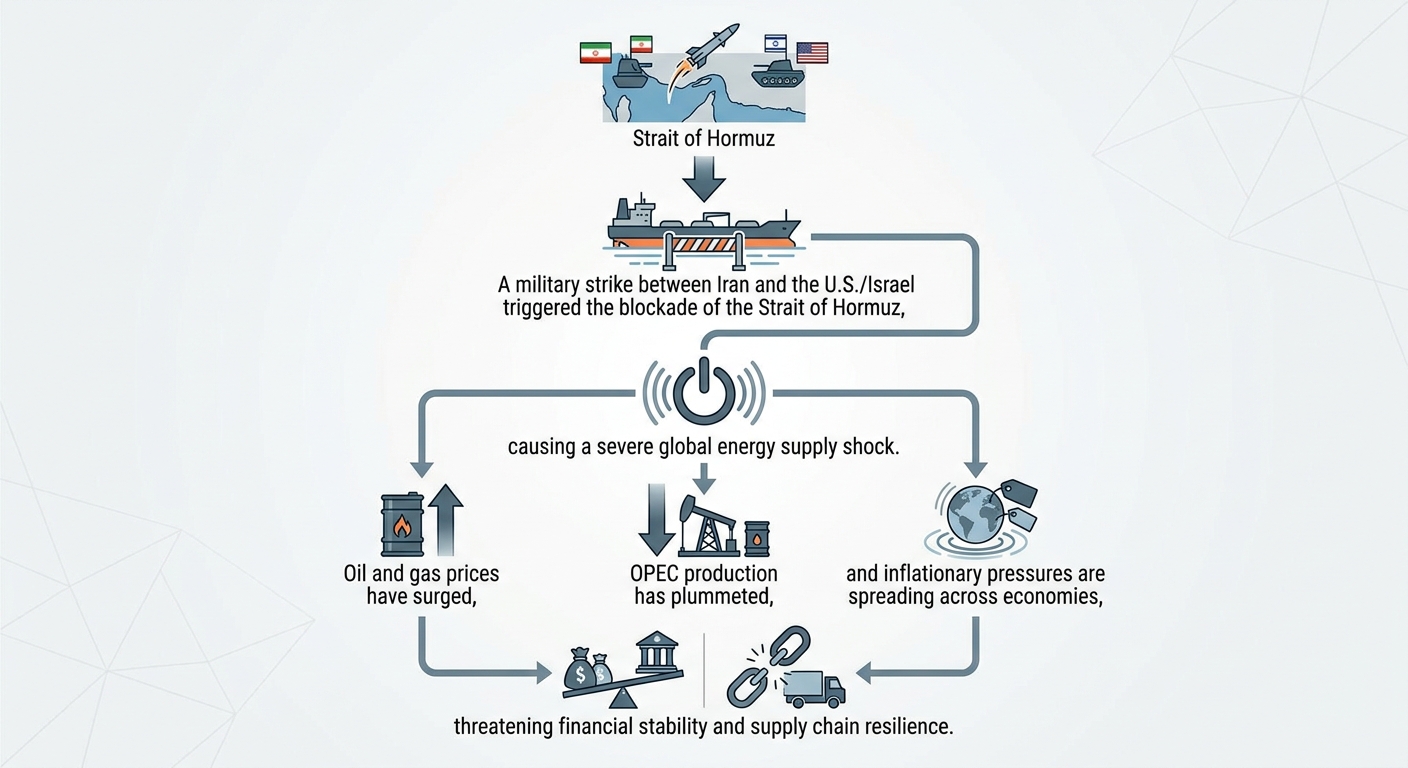
Infographic Image: Infographic
1. Escalating Geopolitical Tension and the Hormuz Blockade: Anatomy of a Global Energy Supply Shock
Military Escalation and Strategic Retaliation: From Targeted Strikes to Regional Confrontation
This subsection establishes the foundational narrative of the conflict’s rapid escalation, focusing on the initial US-Israel military operation and Iran’s immediate asymmetric response. By delineating the sequence, scale, and human cost of the February 28 strikes, together with Iran’s strategic rationale for the subsequent blockade, this analysis lays the groundwork for understanding the ensuing disruption in global energy flows and broader geopolitical ramifications.
Scale and Human Cost Anchoring the Escalation Context
On February 28, 2026, a synchronized US-Israel military campaign executed precision strikes against Iran, targeting high-value regime and military assets, including nuclear facilities and leadership compounds. These operations resulted in the elimination of Iran’s Supreme Leader and several senior commanders, signaling a dramatic shift in regional power dynamics. The immediate human toll was severe, with reported casualties exceeding 3,000 across Iran, encompassing both military personnel and civilian populations, including critical damage from a highly controversial strike on a school in the southern city of Minab that alone accounted for over 170 child fatalities. The violence extended beyond Iran’s borders, inflicting additional deaths and injuries in Lebanon, Iraq, Israel, and Gulf states, magnifying the conflict’s regional intensity.
The scale of the strikes, both in terms of targets hit and resulting casualties, underscored a calculated effort by US and Israeli forces to degrade Iran’s strategic capabilities decisively. The ensuing forty-day mourning period declared by Iran and the formation of an interim leadership council by Tehran’s political elites reflect the profound internal disruption triggered by these strikes. This lethal blow not only intensified hostilities but also galvanized Iran’s resolve toward asymmetric retaliation, reshaping the conflict’s trajectory toward a protracted regional confrontation.
Sequence and Intensity of Iran’s Asymmetric Military Responses
In the immediate aftermath, Iran implemented a strategic asymmetric warfare campaign leveraging ballistic missile strikes, unmanned aerial vehicle (UAV) operations, and proxy engagements to counterbalance its conventional military disadvantages. Iranian forces executed missile and drone attacks targeting US military bases in Iraq and Gulf countries, sought to destabilize Israeli security, and inflicted infrastructural damage throughout the region, signaling a multifaceted escalation strategy.
The blockade of the Strait of Hormuz emerged as a centerpiece of Iran’s retaliation, effectively halting approximately 20% of global oil and LNG transit through this critical chokepoint. This move exploited Iran’s geographic leverage to exert maximal economic pressure on the global energy system, compelling international actors to confront the real risk of an extended supply shock. Iran’s declaration of control over the strait, paired with explicit warnings of force against military vessels, reinforced the blockade’s strategic and symbolic significance. Notably, attempts at diplomatic negotiation failed to resolve the standoff, with high-level talks ending without agreement, thereby perpetuating uncertainty and heightening the risk of further escalation.
Iran’s asymmetric countermeasures, characterized by targeted military strikes, proxy warfare, and economic disruption tactics, reflect a deliberate doctrine designed to offset superior adversary capabilities, impose protracted costs, and maintain political leverage. This adaptive strategy has evolved over decades and continues to underpin Tehran’s regional posture amid heightened conflict.
Political and Regional Ramifications of the Initial Operation
The initial strikes and Iran’s retaliatory measures precipitated a rapid deterioration in Middle Eastern stability, broadening the scope of conflict and disrupting existing diplomatic frameworks. Regional states experienced direct attacks, with Syria, Bahrain, Oman, Saudi Arabia, Iraq, and Lebanon reporting casualties and damage amid intensifying unrest. The fracturing of mediation efforts, notably the collapsed Islamabad negotiations, underscored the entrenched mistrust and diminishing prospects for near-term de-escalation.
Politically, the removal of Iran’s Supreme Leader destabilized Tehran’s governance architecture, catalyzing a reshuffle in leadership and fueling nationalist rhetoric. The emboldened stance of Iran’s parliament and Revolutionary Guard signaled an unwillingness to yield, heightening confrontation risks. Meanwhile, international actors recalibrated their strategies to address the dual challenges of regional security and global energy supply disruption, recognizing the linkage between geopolitical conflict and economic volatility.
The operation’s political fallout also intensified investor anxiety, driving near-term market volatility and spurring strategic realignments in energy security policies worldwide.
Having established the scale and strategic dynamics of the initial military engagements and Iran’s asymmetric countermeasures, the analysis now shifts to the tangible disruption of critical energy infrastructure, with a focus on the Strait of Hormuz’s blockade and its cascading effects on global supply chains.
Critical Infrastructure Disruption: The Hormuz Chokepoint and Its Global Significance
This subsection quantifies the strategic magnitude of the Strait of Hormuz amid the escalating Iran conflict and analyses how its blockade serves as the central trigger for the unprecedented global energy supply shock. By measuring baseline throughput volumes, capturing immediate market price reactions, and contextualizing these against historical supply disruptions, it establishes the foundation for understanding the scale and urgency of current market disturbances.
Baseline Energy Flows Through the Strait of Hormuz: Establishing the Scale of Vulnerability
The Strait of Hormuz remains the single most critical maritime chokepoint in the global energy system, historically channeling approximately 20 million barrels of crude oil and liquefied natural gas daily prior to the blockade. This volume represents roughly one-fifth of worldwide oil consumption and nearly one-third of seaborne crude oil shipments, underscoring the strait’s indispensable role in sustaining global energy supplies. The disruption of this transit route, therefore, removes a pivotal supply artery from the market, creating a vacuum that cannot easily be filled by alternative infrastructure or pipelines due to geographic and capacity constraints.
Empirical data from early 2026 confirm that the flow reduction induced by the blockade effectively removed at least 12 to 20 million barrels per day of crude and LNG from global distribution. This loss surpasses any prior supply disruption recorded in modern history, eclipsing even the scaled supply reductions experienced during the 1973 Arab oil embargo, which accounted for approximately 4–5 million barrels daily. These figures highlight not only the physical significance of the Hormuz passage but also its outsized influence on the global energy balance given prevailing consumption patterns and dependency.
Market Price Shock within the First Week: Immediate Financial Sensitivity to the Blockade Announcement
The announcement and subsequent enforcement of the Hormuz blockade precipitated an immediate and violent response in global energy markets, reflective of acute supply anxieties and disrupted trade expectations. Brent crude oil prices surged from approximately $72 per barrel prior to the conflict to surpass the $100 mark within under one month, with notable price gains materializing in the very first week after blockade enforcement. In quantitative terms, this constituted a price jump exceeding 40%, a rate of increase unprecedented in speed and magnitude for such a large-scale supply disruption.
Concurrently, European natural gas benchmarks, particularly the Title Transfer Facility (TTF) prices, exhibited sharp escalations exceeding 90% year-to-date by April 2026, indicative of collateral impacts in regional gas markets further constrained by LNG shipment suspensions from Gulf producers such as Qatar. The immediate price response extended beyond crude oil to encompass refined petroleum products, shipping insurance premiums, and freight costs, all of which soared as risk perceptions intensified. This rapid price transmission confirms the global market’s hypersensitivity to chokepoint security and the systemic interdependencies inherent in energy supply chains.
Historic Comparison: Assessing the 2026 Supply Shock Against the 1970s Oil Crisis
Contextual analysis reveals that the 2026 Hormuz blockade surpasses the oil supply shocks of the 1970s both in absolute volume and systemic impact. While the 1973 embargo led to a loss of about 4–5 million barrels per day and caused crude prices to quadruple over several months, the current crisis impinges on roughly four times that volume, with crude surging to levels over $100 per barrel within weeks. The 1970s shock precipitated widespread fuel shortages, prolonged recessions, and a reconfiguration of global energy policy frameworks, notably prompting the creation of strategic petroleum reserves and energy diversification initiatives.
Despite modern improvements in energy infrastructure resilience, strategic reserves, and diversified sources including renewables and natural gas, the geographic concentration of supply flowing through Hormuz remains a pronounced vulnerability. The scale of disruption in 2026 surpasses these historical precedents, challenging the capacity of emergency stocks and alternative supply channels to fully alleviate price and supply pressures in the near term. This comparison underscores the unprecedented nature of the current supply shock and its capacity to redefine energy security imperatives across consuming and producing nations alike.
Having established the unprecedented scale of supply disruption through the Strait of Hormuz and its immediate transmission into global energy pricing, the next section will analyze how these physical constraints expose structural fragilities within OPEC’s production network and subsequent cascading effects on supply chain logistics.
Accelerated Price Transmission: From Physical Constraints to Financial Market Turbulence and Energy Cost Shocks
This subsection is critical in linking the tangible disruptions caused by the Strait of Hormuz blockade and Qatar’s LNG export suspension to the swift and pronounced reactions observed in global energy prices. By dissecting the trajectory of key commodity benchmarks and tracing the contagion effects across oil, natural gas, and LNG markets, this analysis enables a deeper understanding of how physical supply constraints rapidly propagate through financial markets, affecting both price formation and market volatility.
Brent Crude Price Rally Amid Geopolitical Tensions: From Stability to $100+ per Barrel Threshold in 2026
Brent crude oil prices have experienced a marked escalation since the outbreak of conflict in early 2026, rising from average levels near $57-$60 per barrel at the start of the year to consistently breach the $100 mark by March. This surge reflects a near 76% year-to-date increase, largely driven by physical supply constraints from the Strait of Hormuz closure and heightened geopolitical risk premiums. The coordinated US-Israel strike on Iran and subsequent Iranian asymmetric retaliation triggered immediate concern around the disruption of approximately 20 million barrels per day of oil flows previously transiting Hormuz, which accounts for close to 20% of global crude and LPG exports. Saudi Arabia, the UAE, and other Gulf producers’ incremental pipeline outputs have been insufficient to fully offset the void. The resultant supply-demand imbalance has fueled acute price spikes, with analysts warning of further elevated volatility should the conflict intensify or expand to other critical routes such as Bab el-Mandeb. Despite current price levels falling short of the historic peaks of 2022, the rapid ascent in Brent prices underscores the vulnerability of global crude markets to chokepoint disruptions and geopolitical shocks.
European TTF Natural Gas Prices: Surging by Over 90% Since January 2026 Amid LNG Export Halts and Seasonal Demand
The European natural gas benchmark, Title Transfer Facility (TTF), has witnessed an extraordinary price surge of over 90% since the beginning of 2026. Triggered by the closure of the Strait of Hormuz and consequential suspension of Qatari LNG exports—the latter comprising approximately 20% of global LNG supply—European gas prices have been propelled to multi-year highs. Production outages at Qatar’s Ras Laffan liquefaction complex due to missile strikes have reduced export capacity by an estimated 17%, with recovery projected to take three to five years. This acute supply shock occurred against the backdrop of lower-than-average European gas storage, compounded by colder-than-expected winter weather in early 2026, which intensified heating demand. The port congestion and tanker bottlenecks aggravated the market tightness, driving TTF prices to unprecedented levels near €60 per MWh at peak moments. Market participants and analysts caution that prolonged disruptions risk sustained price elevation, with estimates indicating that even a one-month complete LNG flow stoppage could push TTF prices to nearly 74 €/MWh, while longer outages might double this figure. This price escalation represents not only tight physical fundamentals but also heightened risk premiums reflecting uncertainty about regional energy security.
LNG Market Dynamics and Qatari Export Suspension: Prolonged Capacity Loss and Market Tightening
Qatar’s LNG export suspension, triggered by Iranian drone and missile attacks targeting the Ras Laffan industrial cluster, has precipitated a significant global supply shock. The facility, the world’s largest liquefaction site, lost approximately 17% of its export capacity—equivalent to 12.8 million tons per annum—including damage to key LNG trains with repair timelines extending up to five years. This de facto closure, combined with the Strait of Hormuz blockade that prevented LNG tankers from transiting, resulted in the unprecedented trapping of at least thirteen fully loaded LNG vessels within the Gulf. The abrupt withdrawal of such a substantial share of liquid gas from global markets sent ripple effects across Asia and Europe, sharply driving up spot and futures prices. Countries heavily reliant on Qatari LNG, including key Asian importers and European utilities, faced acute shortages, compelling them to scramble for alternative supplies at elevated prices or to reduce industrial consumption. The market anticipates a delayed but protracted tightness, as infrastructure repairs and geopolitical resolution timelines remain uncertain, sustaining upward pressure on LNG prices and exacerbating inflationary pressures in energy-intensive economies.
As physical supply constraints cascade into soaring prices across key energy benchmarks, the financial markets have responded with increased volatility and risk re-pricing, creating complex feedback loops between tangible shortages and investor sentiment. The following section will analyze these financial market reactions in detail, assessing equity market corrections, safe-haven flows, and central bank policy dilemmas in the face of simultaneous inflationary and growth pressures.
2. Structural Vulnerabilities Exposed: OPEC Response and Production Network Fragility
Collective Output Collapse: Quantifying OPEC’s Record Production Decline Amid Hormuz Disruption
This subsection provides a detailed, data-driven assessment of the unprecedented production contraction experienced across OPEC member states during the escalating Iran conflict and Strait of Hormuz blockade. By quantifying monthly output declines and associating them with disrupted supply routes, it exposes the scale of structural vulnerability within the group’s production network. Understanding these dynamics is critical to comprehending OPEC’s constrained supply response and the broader implications for global energy market stability.
Magnitude and Country-Level Breakdown of OPEC Production Declines in Early 2026
The onset of the 2026 Iran conflict and subsequent Strait of Hormuz blockade precipitated an extraordinary contraction in OPEC’s crude oil output. In March alone, OPEC+ production plummeted by approximately 27%, with volumes falling from the pre-conflict baseline of around 29.5 million barrels per day (mbd) to approximately 22 mbd. This drop represents the sharpest monthly decline in at least three decades, eclipsing decreases observed even during the 2020 pandemic-induced demand shock.
The contraction was most acute among Gulf members directly affected by the Hormuz chokepoint closure, notably Saudi Arabia, Iraq, the United Arab Emirates, and Kuwait. These countries collectively reported output drops in the range of 8.9 mbd in March, accounting for over 85% of the total OPEC reduction. Saudi Arabia, for example, saw its exports curtailed substantially due to blocked maritime routes despite attempts to increase throughput via alternative pipelines.
Smaller non-Gulf OPEC members partially offset the output loss with minor production increases, including Kazakhstan's recovery of 460,000 bpd following facility repairs, but these gains were insufficient to materially mitigate aggregate declines. This uneven pattern underscores the geographical concentration of supply vulnerabilities and the limited substitutability of Gulf crude within OPEC’s network.
Impact of Hormuz Strait Closure on OPEC’s Production and Export Capacity
The Strait of Hormuz functions as the conduit for approximately 20 million barrels per day of crude and refined products, making its effective closure tantamount to an immediate and severe production constraint for Gulf producers. Faced with tank storage saturation and inability to export, these nations had to reduce actual upstream production, exposing a direct causative link between chokepoint disruption and supply contraction.
Alternative export routes, such as Saudi Arabia’s East-West pipeline, were operated at or near maximum capacity, but their combined throughput capacities fall significantly short of handling the full volume displaced by Strait closure — estimated at roughly 10 million barrels daily. This bottleneck forced OPEC countries to bring forward and deepen production cuts beyond previously scheduled quotas.
The systemic effect was a forced production standstill scenario, where physical infrastructure and geopolitical realities nullified OPEC’s capacity to respond supply-side to price signals, highlighting the strategic fragility of concentrated energy export networks dependent on singular chokepoints.
Activation and Limits of Alternative Pipeline Utilization in Response to Supply Disruptions
Alternative pipeline networks, while vital to circumventing the Hormuz Strait vulnerability, have limited spare capacity and were rapidly saturated amid increased reliance. Saudi Arabia’s East-West pipeline maximized flows to compensate for maritime blockage, but its throughput represents less than 60% of usual Gulf exports, underscoring a structural capacity shortfall.
Similarly, enhanced cross-border pipeline use between Iraq, Kuwait, and Turkey achieved some rerouting benefits but could not absorb the demand for Gulf crude transportation withdrawn from seaborne routes. The limited scalability of these alternative corridors constrained OPEC’s ability to offset immediate export losses and maintain market supplies.
Consequently, the residual supply gap contributed directly to price surges and market uncertainty, indicating that the pipeline infrastructure, while a critical strategic asset, cannot singly resolve chokepoint-induced disruptions at this scale or duration.
This supply gap is reflected in the steep increase of Brent crude oil prices, which surged sharply following the conflict and Hormuz blockade, exceeding $100 per barrel by March 2026, before slightly retreating to $95 in April, illustrating intense market responses to constrained OPEC output and export bottlenecks [Chart: Brent Crude Oil Price Surge (2026)].
Having established the scale and geographic contours of OPEC’s output collapse driven by the Hormuz Strait closure, the analysis will now shift to examining the cascading disruptions permeating transportation networks beyond crude oil production, highlighting a broader contagion effect within the energy supply chain.
Supply Chain Contagion: Quantifying Secondary Shocks Across Aviation, Maritime, and Petrochemical Networks
This subsection explores the cascading impacts of the Iran conflict beyond crude oil supply, focusing on disruptions in critical transportation and chemical supply chains. It sheds light on how airspace restrictions, port congestions, and breakdowns in fertilizer and petrochemical logistics substantially weaken broader industrial and economic networks. This analysis complements the preceding discussions of primary energy supply shocks by detailing the operational and economic consequences rippling through interconnected global transport and manufacturing sectors.
Quantifying Gulf Carrier Flight Groundings and Operational Adjustments Amid Airspace Closures
The coordinated military strikes and ensuing hostilities led to near-total closures of Iranian and several neighboring states’ airspaces, triggering a dramatic grounding of regional carrier flights. Gulf-based airlines such as Qatar Airways, Kuwait Airways, and Emirates significantly reduced operations, particularly evident in the cessation of numerous scheduled flights at major hubs like Doha, Dubai, and Kuwait. For instance, Qatar Airways suspended regular services with a phased, cautious resumption strategy targeting a gradual return to over 120 destinations by mid-May 2026.
Monthly flight cancellations reached unprecedented levels; Indian carriers alone reported over 10,000 lost Gulf-bound flights in the initial five weeks following conflict outbreak, shrinking daily roundtrips from 300-350 to under 90. Kuwaiti airspace remained fully closed for prolonged periods, crippling Kuwait International Airport’s commercial operations. Though Saudi Arabia cautiously reintroduced selective routes such as Jeddah-Dubai and Riyadh-Damascus, broader regional connectivity remains constrained.
These disruptions severely curtailed passenger traffic and business travel, impacting tourism revenue and corporate mobility while heightening operational complexity and costs for airlines. International carriers continue adopting conservative stances due to persistent safety concerns, resulting in protracted flight suspensions and rerouting, thereby diminishing Gulf carriers' pivotal role in global air travel networks.
Assessing Port Congestion and Shipping Route Rerouting Pressures in Key Persian Gulf Maritime Hubs
The closure of the Strait of Hormuz and associated maritime restrictions have sharply reduced vessel transits, from approximately 141 daily ship calls in February to just a handful in early March 2026. This dramatic decline precipitated escalated congestion at alternative regional ports as rerouted cargo and energy flows sought safe harbors outside conflict zones.
Ports in the Persian Gulf, including Dubai, Fujairah, and Salalah, faced operational backlogs compounded by heightened security protocols and insurance surcharges. Container freight indices reflected these strains, with heightened freight futures volatility underscoring market anticipations of prolonged supply chain tightening. Shipping alliances and vessel operators grappled with reconfiguring service schedules and capacity allocations, notably increasing transit durations and logistical costs.
The bottlenecks have disrupted the timeliness and reliability of both bulk energy shipments and general cargo movements critical to regional and global trade. As a result, supply chain resilience has been tested, prompting shippers and logistics providers to seek flexible routing strategies and enhanced real-time tracking to mitigate unpredictable delays.
Volume Reductions and Supply Pressures on Fertilizer and Petrochemical Shipments Amid Middle East Instability
Fertilizer and petrochemical supply chains dependent on Middle Eastern production and export routes have suffered acute contractions. Nitrogen fertilizer exports from the region have effectively halted due to infrastructure damage and transit restrictions through the Hormuz corridor, contributing to a tightening global supply and upward pressure on prices.
Key petrochemical feedstocks—such as LPG, naphtha, and ethane—saw sharp declines in throughput, with estimated losses exceeding half a million barrels per day in March alone. The shortage forced many Asian producers to scramble for alternative imports from places like the United States and Australia, incurring longer transit times and doubling freight costs.
These supply shocks have triggered operational scaling back or force majeure claims in petrochemical facilities and fertilizer manufacturers, especially where inventory buffers are insufficient. The cascading effect heightens risks of raw material scarcity across agriculture and industrial sectors globally, with developing regions notably vulnerable due to import dependency and limited supply chain flexibility.
Having detailed the multifaceted secondary disruptions to transportation and chemical supply networks emanating from the Iran conflict and Hormuz blockade, the report next examines the resilience and fragilities within OPEC’s production framework. This facilitates an integrated understanding of how interconnected vulnerabilities amplify the overall energy market instability.
Reserve Capacity Stress Test: Strategic Petroleum Stocks Under Scrutiny
This subsection critically examines the role of strategic petroleum reserves as a buffer in the face of the Iran conflict and Strait of Hormuz closure. It evaluates the timing, scale, and effectiveness of emergency crude drawdowns by the United States and China’s contrasting inventory approach, alongside an assessment of reserve adequacy metrics across major consuming nations. These analyses provide essential insights into how emergency stocks have shaped immediate market stability and the vulnerabilities emerging from their current capacity constraints amid ongoing geopolitical shocks.
Timing and Scale of US Strategic Petroleum Reserve Drawdowns During the Crisis
In response to the escalating conflict and the resultant blockade of the Strait of Hormuz, the United States implemented an unprecedented emergency release from its Strategic Petroleum Reserve (SPR), commencing in late March 2026. The coordinated International Energy Agency release plan involved deploying approximately 172 million barrels over a 120-day period, marking one of the largest and fastest drawdowns in the Reserve’s history. This initial release served to temporarily alleviate global supply pressures exacerbated by the loss of nearly 20 million barrels per day of crude flow through the chokepoint. Following the primary emergency drawdown, the US Department of Energy authorized a loan program designed to release an additional 10 million barrels sourced primarily from the Bryan Mound site, with repayments due by late 2027. This exchange mechanism intended to provide immediate market supply without permanent depletion of the reserve.
Monthly drawdown data from February to April 2026 indicate a rapid depletion trend, with the Reserve’s inventory dipping from an early 2026 peak of around 415 million barrels to approximately 409 million barrels by mid-April. The volumetric reductions during this period significantly outpace historical releases tied to prior disruptions such as hurricanes or geopolitical conflicts. While this injection of liquidity into crude markets temporarily suppressed extreme price spikes, the Reserve remains at roughly 58% of its total authorized capacity, underscoring limited strategic flexibility should supply interruptions persist or intensify beyond mid-2026.
China’s Strategic Crude Purchases Amid Sanctions and Import Patterns
Contrasting with the US release strategy, China has actively expanded its crude oil stockpiles throughout 2025 and into 2026, accumulating an estimated 1.4 billion barrels—positioning it as the holder of the world’s largest oil reserves by volume. This build-up includes increased imports of sanctioned crude from producers affected by geopolitical constraints, facilitated by maintained but unstable maritime shipment routes. Chinese national oil companies and independent refiners have capitalized on discounted prices, allowing for stockpiling that both insulates domestic supply chains and positions China strategically for prolonged market volatility.
The continued inflow of discounted crude, despite sanctions and elevated shipping risks, underlines China’s emphasis on long-term energy security objectives over short-term price stabilization concerns prevalent in Western economies. These stockpiles act as a de facto strategic buffer but also raise complexity in global supply-demand balances, as Chinese crude inventory policies diverge significantly from the drawdown approaches adopted by other major consumers. This asymmetry contributes to ongoing volatility in oil benchmarks, influencing global price dynamics and complicating coordinated international response efforts.
Evaluating Reserve Adequacy Metrics Across Major Energy Consumers
Assessment of strategic petroleum reserve adequacy involves contrasting current stock levels against country-specific consumption profiles and import dependencies in the context of extended supply disruptions. The US SPR, with a total capacity near 714 million barrels, currently operates below its design maximum, limiting scope for additional emergency drawdowns. Major consuming nations in Europe and Asia rely heavily on imports transiting the Hormuz Strait, where strategic reserves are critically important for short-to-medium term market stabilization. However, many developed countries, including several in the European Union, maintain emergency reserves at levels substantially below the 90-day net import coverage benchmark set by international standards.
Emerging and developing economies face even greater vulnerabilities due to smaller and less liquid stockpiles relative to consumption needs and import reliance. Reserve adequacy measures such as ratios of strategic stocks to monthly consumption and import reliance indicate that countries like India and several Southeast Asian states have emergency stockpiles with coverage durations as low as 30 to 45 days, paired with rising borrowing costs and balance-of-payments pressures amid the price surge. Further complicating adequacy is the growing interdependence of financial reserves and currency stability, where diminished foreign exchange buffers constrain capacity to weather prolonged energy shocks without economic dislocation.
This uneven reserve distribution exposes systemic weaknesses in the global energy security architecture, as the reliance on physical stockpiles intersects with geopolitical constraints and market liquidity needs. The ongoing drawdowns in the US and divergent stockpiling in China illustrate a bifurcated global strategic response, underscoring urgency for diversified supply routes and multilateral coordination to mitigate material shortages and price volatility.
With strategic petroleum reserves drawn down at a rapid pace and reserve adequacy strained unevenly across key consuming nations, attention shifts to the cascading structural impacts on OPEC production capacities and their constrained ability to offset disruptions. The following section probes into the fragility revealed in the OPEC production network and related supply chain contagion effects.
3. Financial Market Turbulence: Volatility Spikes and Policy Dilemmas
Equity Market Correction and Safe-Haven Flight: Analyzing Capital Shifts Amid Heightened Geopolitical Risk
This subsection examines the pronounced volatility and asset reallocation within global equity markets triggered by the escalating Iran conflict and consequential disruptions in energy supply. By quantifying equity index downturns, documenting the surge in gold prices, and detailing sector rotation dynamics, this analysis provides strategic insight into investor behavior and systemic risk adjustments during acute geopolitical stress. Understanding these market movements is critical for stakeholders aiming to navigate risk exposures and portfolio resilience in the face of sustained uncertainty.
Quantifying Global Equity Index Drawdowns and Recovery Patterns
Global equity markets experienced a marked correction in early 2026 corresponding with the outbreak of hostilities in the Middle East. The MSCI All Country World Index declined by approximately 3.7% within the first week of March, with broad-based selloffs evident across major regions. The S&P 500 demonstrated relative resilience, falling by roughly 2.0%, while European and Asian ex-Japan equities registered steeper losses exceeding 5%. Several indices, including Japan’s Nikkei and emerging market benchmarks, faced corrections reaching double-digit percentages in some instances.
Volatility spikes induced by uncertainty around energy prices and supply chain disruptions prompted risk-off investor behavior. Notably, over 90% of global equity markets saw declines exceeding 5%, with over 40% experiencing corrections surpassing 10%, levels typically associated with bear market territory. Despite this, many markets staged rebounds later in the quarter, buoyed by modest policy shifts and investor repositioning, underscoring the transitory nature of conflict-triggered selloffs in historical perspective.
Safe-Haven Demand Evident in Record-High Gold Prices and Capital Flows
Gold prices surged to unprecedented levels in early 2026, reaching all-time highs above $5,500 per ounce during January before stabilizing around $4,400 to $4,600 by late April. This ascent was largely driven by increasing safe-haven demand amid growing geopolitical risk and inflation concerns compounded by energy price shocks. Institutional investors, including central banks and high-net-worth entities, significantly increased allocations to gold-backed vehicles and physical holdings, underscoring gold’s role as a strategic hedge against currency debasement and fiscal uncertainty.
The robust inflows into gold ETFs and increased use of gold options reflect a structural shift in investor sentiment. While some short-term volatility accompanied the gold rally due to Fed hawkishness and a stronger US dollar, consensus forecasts from major financial institutions project continued elevated gold prices through 2026 as geopolitical volatility and inflationary pressures persist. This trend highlights the evolving correlation dynamics within portfolios where hard assets regain prominence during systemic stress.
Sector Rotation Dynamics: Growing Capital Allocation to Energy and Defense Amid Market Correction
The intensification of the Iran conflict and resultant energy supply shocks led to a significant sectoral reallocation within equity markets. Investor flows shifted away from traditionally defensive sectors such as consumer staples and pharmaceuticals—which also experienced unusual downturns—toward energy and defense stocks that benefitted from the conflict-driven risk premium elevation.
Energy-related equities gained pronounced investor interest, buoyed by soaring oil and gas prices reflective of constrained Middle Eastern supply. Defense sectors similarly attracted capital, reflecting increased government spending expectations and heightened geopolitical risk. This convergence in sector performance attenuated the diversification benefits typically employed in portfolio construction, as correlations among defensive and cyclical stocks rose sharply during this period. Such patterns underscore systemic vulnerability and the need for revised risk management frameworks in geopolitically sensitive periods.
As equity and commodity markets navigate heightened volatility, the evolving interplay between risk appetite and safe-haven preferences places central banks at a policy crossroads. The implications of these financial market adjustments for monetary strategy and emerging market stability will be explored in the following subsection.
Central Banking Crossroads: Navigating Inflation Control Amid Energy Supply Shocks and Growth Risks
This subsection critically evaluates the complex policy environment faced by leading central banks, particularly the Federal Reserve and European Central Bank, as they confront simultaneous inflationary pressures from surging energy prices and weakening economic growth prospects. By dissecting recent monetary policy decisions and underlying constraints, it illuminates how traditional tools are challenged by the unique characteristics of the current supply-driven shock, providing essential insights for policymakers grappling with stabilization versus growth support dilemmas in an increasingly volatile global financial landscape.
Federal Reserve's Steadfast Interest Rate Policy Despite Oil Shock
In the early months of 2026, the Federal Reserve chose to maintain a steady interest rate stance, diverging from earlier market expectations of imminent rate cuts. This decision reflects the Fed’s recognition of the pronounced inflationary bias introduced by the Iran conflict–induced energy crisis, which has pushed benchmark oil prices above the $100-per-barrel mark. While such elevated energy costs directly feed into consumer price indices, the Fed’s framework emphasizes the necessity to anchor inflation expectations despite growth headwinds. Policymakers appear wary of prematurely easing monetary policy amid an inflation environment substantially driven by externally imposed supply constraints rather than domestic demand pressures.
The oil price surge has effectively constrained the Fed’s maneuvering room, as aggressive rate cuts risk exacerbating inflation expectations, undermining long-term price stability. This stance underscores a critical differentiation in monetary policy: supply-driven inflation—originating from physical scarcity—is largely unresponsive to demand management via interest rates, unlike demand-pull inflation. Consequently, the Fed’s approach embodies a cautious balance aimed at preventing a wage-price spiral while avoiding deep economic contraction, though this path increases uncertainty about the durability of economic recovery and the risk of a stagflationary period.
ECB’s Delicate Inflation-Growth Balancing Act in the Eurozone
The European Central Bank faces one of its most challenging policy junctures in recent history, tasked with simultaneously managing persistent inflationary pressures and fragile economic expansion amidst the Iran conflict’s energy shock. Unlike the Fed’s more data-independent posture, the ECB has adopted a 'data-dependent' approach to monetary policy adjustment, closely monitoring inflation metrics, GDP growth, and unemployment trends. Inflation remains above the ECB’s 2% target, primarily fueled by energy and services price rigidity, but economic activity is stagnating, with sluggish GDP growth risking a protracted downturn.
This juxtaposition creates an acute policy trade-off: tightening monetary policy to combat inflation risks exacerbating economic weakness, while easing could further entrench inflation expectations. The ECB’s use of multiple key interest rates aims to finely tune liquidity conditions, but the Eurozone’s structural heterogeneity complicates aggregate inflation targeting. Member states experience varied inflation rates and growth dynamics, challenging a unified policy action and limiting the ECB’s toolkit effectiveness. Recent modest interest rate stabilization contrasts with emerging market easing trends, reflecting the ECB’s cautious attempt to sustain growth momentum without compromising price stability.
Monetary Policy Constraints and the Limits of Conventional Tools under Supply-Side Inflation
Central banks globally confront significant limitations in deploying traditional monetary policy levers amid supply-driven inflation caused by physical energy shortages. Interest rate hikes, the conventional response to rising prices, prove largely ineffective against cost-push inflation because they do not address the root cause—restricted oil availability. Instead, aggressive tightening risks inducing a recession by stifling demand without relieving supply scarcity, a dynamic reminiscent of past energy crises.
Furthermore, quantitative easing and liquidity injection strategies face contradictory effects: while intended to stimulate growth, they may exacerbate inflationary pressures by increasing money supply amid constrained supply. Exchange rate interventions to contain imported inflation impose additional complexities, especially when geopolitical tensions limit international cooperation. Consequently, policymakers must evolve alternative frameworks that reconcile inflation control with growth support, including calibrated fiscal measures and strategic petroleum reserve utilization, while managing market expectations to prevent inflation un-anchoring.
Having explored how central banks operate under unprecedented constraints imposed by a supply-side energy shock, the report next examines the differentiated vulnerabilities across emerging markets, where capital flight and currency pressures further complicate economic stabilization efforts.
Emerging Market Vulnerabilities Amidst Heightened Capital Flight and Currency Stress
This subsection examines the pronounced financial distress experienced by emerging markets, focusing on the extent of capital flight and currency pressures triggered by the escalating Iran conflict. By quantifying wealth erosion, analyzing capital outflow magnitudes, and evaluating the monetary policy responses by emerging market central banks, it highlights the systemic spillover risks and accommodative constraints within these economies. This analysis is vital for understanding how geopolitical shocks emanating from Middle Eastern tensions translate into acute financial fragilities in developing regions, influencing global risk perceptions and policy design.
Magnitude of Wealth Loss in India Due to the Iran Conflict
India has borne a significant economic shock in the wake of the Iran conflict, with a staggering loss of approximately $240 billion in wealth over a single week during March 2026. This precipitous decline stemmed primarily from the sharp spike in global oil prices and resulting inflationary uncertainties, which adversely impacted investor sentiment and equity valuations across multiple sectors, notably infrastructure and aviation. The confluence of rising energy costs and geopolitical uncertainty induced a broad selloff in Indian equities, reflecting a pronounced risk-off stance among foreign and domestic investors alike.
Beyond market capitalization erosion, this wealth loss underscored deeper structural vulnerabilities linked to India's heavy reliance on Middle Eastern energy imports, which constitute over half of its crude oil and liquefied petroleum gas demand. The resultant currency depreciation further exacerbated inflationary pressures and widened the current account deficit, threatening to undermine monetary policy flexibility. While domestic institutional investors attempted to stabilize markets through phased capital infusions, these efforts proved insufficient to arrest the swift attrition of investor confidence amid volatile geopolitical narratives.
Quantification and Drivers of Emerging Market Capital Outflows in March 2026
March 2026 marked an unprecedented capital flight episode for emerging markets, with total outflows peaking at $70.3 billion—the largest single-month withdrawal since the COVID-19 pandemic shock in 2020. Equity markets accounted for the bulk of these outflows, with nearly $56 billion divested, as investors rapidly recalibrated risk in response to heightened Middle East geopolitical tensions and surging commodity prices.
Asia was disproportionately affected, as emerging Asian economies experienced a swift reversal from earlier positive inflows driven by technology sector optimism. The Iran conflict, through its direct impact on energy prices and investor risk appetite, precipitated a regime shift in portfolio allocation strategies. This flight to quality was compounded by tightening global financial conditions, which, alongside U.S. monetary policy normalization, intensified pressure on emerging market assets and currencies.
Within this context, India alone saw foreign portfolio investors exit with a record ₹1.14 lakh crore (approximately $12.3 billion) in March, marking the highest monthly foreign investment withdrawal ever. The protracted geopolitical uncertainty and sustained oil price elevation significantly curtailed foreign appetite for Indian equities, notwithstanding intermittent domestic buying support.
Emerging Market Central Banks’ Monetary Policy Responses to Currency Pressures
Facing acute currency depreciation and capital outflows, numerous emerging market central banks have adopted aggressive monetary tightening measures to defend exchange rates and curb inflationary spillovers. The convergence of external shocks and internal vulnerabilities has constrained policy maneuverability, as monetary authorities grapple with the dual mandate of stabilizing currencies while preserving growth momentum amid deteriorating external balances.
For India specifically, the Reserve Bank maintained a steady policy rate of 5.25% despite inflationary pressures escalating due to the conflict, indicating a cautious balancing act amid growth risks and fiscal constraints. In broader emerging markets, central banks implemented timely rate hikes, often exceeding 50 basis points, to stem capital flight and anchor inflation expectations, despite associated trade-offs such as higher borrowing costs and dampened domestic demand.
Empirical observations reveal that these policy responses varied by region and severity of exposure: while some economies prioritized rapid interest rate increases, others supplemented tightening with foreign exchange interventions. However, the effectiveness of such interventions is often muted under conditions of sustained geopolitical uncertainty and synchronized global monetary tightening, underscoring the persistent vulnerabilities these markets face.
Collectively, the emerging market financial market turbulence characterized by massive capital outflows, sharp wealth depletion, and constrained monetary responses illustrates the far-reaching consequences of the Iran conflict beyond immediate oil supply disruptions. This dynamic amplifies systemic risks and adds complex layers to global macroeconomic stability, necessitating a nuanced understanding of emerging market resilience and policy adaptability. The subsequent section will explore how advanced economies’ central banks and financial markets react within this volatile environment, highlighting the cross-border transmission mechanisms at play.
4. Regional Adaptation Strategies: Divergent Paths Toward Energy Security
Europe’s Accelerated Energy Transition: Scaling REPowerEU Targets and Expanding LNG Infrastructure Amid Crisis
This subsection evaluates Europe’s strategic and policy responses to the intensifying energy security challenges triggered by the Iran conflict and resulting supply shocks. It focuses on how the EU has recalibrated its renewable energy ambitions under the REPowerEU framework and rapidly expanded liquefied natural gas (LNG) infrastructure to diversify supplies. This analysis is critical for understanding Europe’s efforts to balance immediate energy needs with its longer-term climate objectives in a volatile geopolitical context.
Recalibrated REPowerEU Renewable Energy Targets Reflect Urgency of Crisis
In response to the compounded energy security risks unveiled by disruptions in Middle Eastern supply routes, Europe has revised and accelerated its renewable energy deployment targets under the REPowerEU initiative. As of early 2026, the binding renewable energy share target for 2030 has been increased from 40% to a minimum of 42.5%, with aspirations reaching 45%. This marks a substantive acceleration relative to pre-crisis plans, emphasizing solar and wind deployment as pivotal pillars. The EU’s renewable electricity share has seen a rapid increase, already reaching over 25% by 2024, supported by record capacity additions of approximately 260 GW since 2021, predominantly solar photovoltaic and wind power. This scaling up aligns with an urgent need to reduce reliance on fossil fuels, particularly amid the phaseout of Russian gas and escalating global price volatility.
Such ambitious targets, while essential, impose significant challenges. Europe must effectively double past deployment rates of key renewable technologies over the coming years. Grid integration constraints, permitting delays, and the imperative of maintaining public support remain persistent obstacles. Additionally, attention is increasingly directed toward energy storage expansion, with cumulative EU battery and other storage capacities surpassing 55 GW, and over 30 GW in active development pipelines. Storage systems are becoming indispensable to accommodate the increasing intermittent generation from renewables and to enhance system flexibility amid fluctuating LNG imports and variable climate impacts.
Expansion and Modernization of LNG Terminals: Strengthening Supply Diversification
Complementing renewable scale-up, Europe has aggressively expanded its LNG regasification capacity to replace curtailed pipeline imports and secure alternative supply sources. Since 2023, European LNG import terminal capacity has risen by approximately one-third, a growth chiefly driven by new floating storage regasification units (FSRUs) which offer rapid deployment and operational flexibility without long-term infrastructure lock-in. This expansion has been particularly evident in Germany, Belgium, Greece, and Spain, with Germany’s Hanseatic Energy Hub and Belgium’s Zeebrugge terminal representing flagship projects scheduled for operation by 2027 and fully operational in early 2025, respectively.
The geographic diversification of LNG suppliers has also accelerated. Long-term contracts and spot market purchases have increased particularly from the United States and Qatar, which are poised to ramp up liquefaction capacity over the next five years. However, despite these developments, the utilization rate of Europe’s total LNG terminal capacity remains relatively low—below 40%—reflecting a structural realignment of demand downward due to energy efficiency gains, fuel switching, and variable weather conditions. This underpins the complex interplay between maintaining security of supply during crises and avoiding stranded assets in a transitioning energy system.
Definitive Timelines for New LNG Import Agreements and Infrastructure Commissioning
Europe’s strategic LNG supply agreements align tightly with infrastructure commissioning schedules to ensure timely delivery amid the ongoing energy shock. Several major LNG import terminals, particularly floating units, are slated to reach operational status between 2024 and 2027, with key projects such as Germany’s Hanseatic Energy Hub targeting commencement in 2027, securing over 15% of national LNG demand. The European Union’s policy framework enforces accelerated market access and regulatory approvals for such facilities, expediting deployment in alignment with REPowerEU priorities.
Simultaneously, the EU has crafted contractual frameworks with LNG suppliers to guarantee volumes under long-term agreements, including those with U.S. exporters whose flexible destination clauses permit cargo reallocation towards Europe. This strategy mitigates risks of supply deficits due to geopolitical disruptions or market volatility in alternative LNG-consuming regions. Nevertheless, the limited near-term liquefaction expansion capacity in the U.S. and Qatar means that supply growth will be incremental and unlikely to offset completely the deficits created by pipeline reductions until the late 2020s.
Europe’s accelerated renewable deployment combined with rapid LNG infrastructure expansion constitutes a multi-pronged approach to reinforce energy security and reduce fossil fuel dependency. These proactive measures serve as a foundation for the subsequent section’s analysis of North America’s strategic advantage in leveraging its production and export capacity to further reshape global energy flows.
North American Strategic Advantage: Leveraging Unconventional Resources and Expanding LNG Export Footprint
This subsection examines how the United States has transformed the Iran conflict-driven energy crisis into a strategic economic and geopolitical advantage by significantly enhancing domestic shale oil production and rapidly expanding LNG export capacities. Against the backdrop of Middle East supply disruptions, U.S. energy sector resilience and export growth underscore a pivotal shift in global energy trade dynamics, impacting market shares and realigning regional dependencies. The analysis quantifies production gains, catalogs recent LNG contract signings, and assesses the implications for the global LNG trade landscape.
Robust Growth in U.S. Shale Production Bolsters Domestic Supply Amid Global Disruptions
Between 2025 and early 2026, U.S. shale production demonstrated sustained and accelerated growth, increasing both crude and natural gas output significantly. This growth is a direct result of investment rebounds, technological improvements, and infrastructure expansions, notably in the Permian Basin and Eagle Ford formations. The resilience of unconventional production has been critical in enabling the U.S. to offset some of the supply shocks caused by the Strait of Hormuz blockade. As a result, the United States has further solidified its position as a net energy exporter, largely insulated from Middle East supply variances due to its minimal reliance on imports transiting the Gulf region.
The capacity expansion is reflected in forecasted increases in natural gas production, with U.S. output expected to rise by more than 2.5% year-over-year in 2026. Additionally, coal production and electricity demand growth in key regions complements the upward trend, reinforcing domestic energy security. Importantly, this production surge supports the expanded LNG export volumes required by global buyers seeking alternatives to Middle East supply interruptions.
Record-Setting U.S. LNG Sale and Purchase Agreements Highlight Strategic Export Positioning
In 2025 and continuing into 2026, U.S. LNG developers have signed an unprecedented volume of sale and purchase agreements (SPAs), totaling approximately 40 million tons per annum. This represents the highest contractual momentum since 2022, driven by heightened demand from Europe and Asia reacting to Middle East supply uncertainties. Most agreements secure long-term commitments, ranging from 15 to 20 years, thus underpinning forthcoming investment decisions for new liquefaction capacities and enabling rapid development of additional export infrastructure.
Concurrently, the operational tempo of existing liquefaction facilities, particularly in Louisiana, has accelerated. For instance, U.S. LNG exports surged to a record 11.7 million metric tons in March 2026, bolstered by ‘panic buying’ and strategic stockpiling by importers. Projects such as Plaquemines LNG are expanding towards a target capacity exceeding 45 million tons per annum by the early 2030s, positioning the U.S. as a critical ‘swing producer’ capable of responding flexibly to shifting global demand patterns.
Shifts in Global LNG Market Share and Trade Flows Emerge From U.S. Export Expansion
The conflict-induced disruption of traditional LNG suppliers, notably Qatar’s forced production suspension and export facility damage, has accelerated shifts in global LNG market shares. The U.S. has substantially increased its share of global LNG exports, capturing a dominant position as alternative buyers reassess their sourcing strategies. Europe accounts for approximately 64% of U.S. LNG exports as of early 2026, reflecting urgent demand to replace lost gas flows from the Gulf region. Asian markets are likewise major consumers of U.S. LNG, benefiting from both spot cargoes and long-term contract volumes.
This realignment has profound implications for the global energy trade map. The U.S. export surge undermines the Gulf producers’ geographical market dominance, while bolstering North America’s geopolitical influence through reliable energy provision. Additionally, emerging export projects in Latin America, such as Mexican FLNG terminals, complement U.S. capacity growth by offering geographic diversification that circumvents regional chokepoints. Collectively, these developments signify a transformative moment in global energy logistics, anchored by formidable North American supply capabilities.
The United States’ ability to leverage unconventional production and execute rapid LNG export expansion not only mitigates some impacts of Middle East supply shocks but also precipitates wider reconfigurations in global energy trade. This strategic advantage contrasts with the more constrained responses seen in other regions and sets the stage for examining diverging adaptation paths in Europe and developing economies.
Developing Economies' Exposure Matrix: Import Dependency and Balance-of-Payments Risks
This subsection critically examines the acute vulnerabilities faced by developing economies in the Indo-Pacific region amid the escalating Iran conflict and resultant energy supply disruptions. Centering on fuel scarcity frequency, balance-of-payments pressures, and inflationary stress across pivotal economic sectors, it delineates how these nations’ heavy import dependencies and constrained financial buffers intensify systemic risks. Insights here are essential to understanding the differentiated regional impact and framing tailored policy and risk mitigation strategies.
Frequency and Severity of Fuel Shortages Across ASEAN in 2026
The closure of the Strait of Hormuz and disruptions in Middle Eastern oil and LNG exports have precipitated repeated fuel shortage incidents within ASEAN countries throughout early 2026. Multiple member states, including the Philippines, Laos, Thailand, and Malaysia, have formally declared energy emergencies or imposed rationing measures in response to volatile and spiking petroleum prices.
For example, Laos witnessed near 50% increases in diesel prices within the span of a week, severely affecting transportation and industrial fuel availability. Similarly, Cambodia was among those experiencing some of the steepest regional petroleum price surges, while petrochemical companies in Indonesia and Singapore declared force majeure due to supply uncertainties. These frequent shortages destabilize local energy markets and exacerbate economic fragilities within import-dependent economies.
The heavy reliance of these countries on crude and LNG imports—often sourced from Middle Eastern suppliers traversing the Hormuz corridor—magnifies susceptibility to external shocks. Data indicate that some ASEAN nations depend on Middle Eastern crude for up to 95% of their imports, leaving little room for quick substitution and buffering of supply interruptions.
Balance-of-Payments Deficits and Fiscal Strain in Import-Dependent Developing Countries
Developing economies experiencing soaring energy import costs face profound balance-of-payments challenges, which erode foreign exchange reserves and constrain fiscal space. The recent surge in global oil prices beyond the $100 per barrel mark has led to significant increases in import bills, directly widening current account deficits for net energy importers.
Statistical analyses reveal that emerging and developing countries are projected to see marked declines in current account surpluses through 2025 and 2026, reflecting worsening trade balances due to higher energy expenditures. Fiscal authorities grapple to contain mounting pressures on sovereign borrowing costs amid depreciating currencies and tightening external financing conditions.
For highly energy-import dependent countries within ASEAN and broader Indo-Pacific, these intensified deficits impede macroeconomic stability and limit capacity to fund emergency energy reserves or implement subsidy programs at scale, thus amplifying vulnerabilities to price shocks and external credit shocks.
Inflationary Spillover Effects on Agriculture and Industrial Sectors
The inflationary impact of soaring fuel and energy prices permeates critical economic sectors, particularly agriculture and manufacturing, compounding socio-economic stresses in developing economies heavily reliant on these industries. Rising fuel costs increase transportation and input expenses for farmers, leading to higher food prices and reduced household purchasing power, disproportionately burdening lower-income populations.
Industrial sectors face elevated production costs driven by inflating prices of energy-intensive inputs such as steel, cement, and petrochemicals. This dynamic reduces industrial competitiveness and can slow manufacturing output growth, intensifying economic contraction risks amid a global demand slowdown.
Recent inflation trends in countries like India highlight sharper price increases relative to more resilient advanced economies, underscoring how energy import dependency accentuates inflationary pressures. Furthermore, disruptions to labor availability in sectors such as agriculture and construction, triggered by broader economic ramifications of the conflict, threaten to exacerbate inflation and productivity challenges.
Having delineated the specific dimensions of supply vulnerabilities, macroeconomic imbalances, and inflationary pressures confronting developing importing nations, the report proceeds to contrast these challenges with strategic adaptation measures undertaken across regions, highlighting differentiated policy responses shaped by varying resource endowments and institutional capacities.
5. Long-Term Implications: Energy Trilemma Intensification and Strategic Reorientation
Energy Trilemma Reinforcement: Security Vulnerabilities, Affordability Pressures, and Sustainability Setbacks
This subsection critically examines how the escalating Iran conflict and resultant disruptions, particularly the blockage of the Strait of Hormuz, are amplifying the long-standing energy trilemma challenges. It highlights how heightened energy security risks, rising affordability strains manifesting as stagflation, and a reversion toward fossil fuel dependence converge to intensify systemic vulnerabilities. The analysis informs strategic considerations for balancing immediate crisis management with long-term sustainability objectives.
Quantifying Stagflation Risks from Escalating Energy Price Shocks
The sharp surge in global energy prices triggered by the Iran conflict and the effective blockade of the Strait of Hormuz has materially elevated stagflation risks across multiple advanced and emerging economies. Recent economic projections indicate that core inflationary pressures, primarily driven by elevated oil and gas costs, have risen by up to 1 to 2.5 percentage points in the affected regions, compressing real growth prospects. For example, forecasts for the European Union reveal a contraction in projected GDP growth by as much as 0.4 percentage points for 2026, paired with a comparable inflation increase, signaling the onset of a stagflationary environment. This pattern echoes the persistent inflation-growth trade-offs observed during historical energy crises but is compounded by the structural complexity of modern supply chains and monetary frameworks.
The broad-based nature of these shocks differentiates the current episode from prior supply disruptions, as energy prices simultaneously elevate transportation, industrial input, and consumer goods costs, reinforcing inflation persistence. Though some monetary authorities maintain hawkish stances, the difficulty in balancing inflation control without exacerbating growth downturns persists. The convergence of high energy cost volatility and slower growth momentum raises the possibility of stagflation episodes enduring for several years absent decisive structural adjustments.
Deepening Energy Security Risks Tied to Hormuz Supply Disruption
The blockade of the Strait of Hormuz represents a critical escalation in global energy security vulnerabilities by effectively severing access to approximately 20 million barrels per day of crude oil and LNG exports. This chokepoint disruption exerts outsized influence on global markets, creating pronounced supply shortfalls that traditional buffering mechanisms struggle to mitigate. The geographic concentration and constrained navigability of the strait amplify the risk of extended interruptions and raise geopolitical stakes for regional and international actors.
Beyond the immediate supply gap, the conflict's ongoing nature has exposed the limitations of existing strategic petroleum reserves and alternative pipeline networks, underscoring structural fragilities in global energy infrastructure. The elevated war-risk premiums on maritime insurance and the reluctance of commercial shippers to navigate the volatile corridor further compound supply uncertainties. Collectively, these factors sharpen the linkage between geopolitical instability in critical sea lanes and systemic energy insecurity at a global scale.
Assessing Crisis-Induced Shifts Toward Greater Fossil Fuel Reliance
The immediate imperative to secure energy supplies amid the conflict has prompted a tactical retrenchment toward fossil fuel utilization, undermining progress on sustainability targets. Countries facing acute supply constraints have increased investments in traditional hydrocarbon infrastructure and temporarily scaled up coal usage, particularly in regions lacking robust renewable alternatives. This response creates a tension between short-term security imperatives and long-term decarbonization commitments.
The pressure to maintain affordability and supply stability discourages rapid renewable deployment in some markets, risking infrastructure lock-in that could entrench carbon-intensive pathways. Nonetheless, the crisis simultaneously highlights the strategic value of renewable energy resilience as countries with greater renewable capacity exhibit comparatively lower exposure to supply shocks. This dual dynamic reinforces calls for integrated energy strategies that prioritize diversification and decarbonization alongside immediate security needs.
The intensification of the energy trilemma—marked by exacerbated security risks, severe affordability challenges, and complex sustainability trade-offs—sets the stage for analyzing how these pressures influence climate policy debates and investment strategies. The following subsections will explore how high energy prices serve simultaneously as implicit carbon pricing mechanisms while impacting the trajectory of decarbonization efforts, and outline adaptive financial frameworks designed to navigate this volatile geopolitical landscape.
Climate Policy Crosscurrents: Examining the De Facto Carbon Tax Effect Amid Energy Price Surges
This subsection critically interrogates the contested notion that the sharp rise in fossil fuel prices triggered by the Iran conflict and resulting supply shocks functions as an implicit carbon tax. Positioned within the report’s forward-looking analysis of long-term energy and financial implications, this discussion assesses how sustained price levels shape decarbonization incentives, dissecting the delicate interplay between exogenous geopolitical disruptions and endogenous regulatory climate policies. It contextualizes near-term emissions trajectories and policy recalibrations, thereby informing strategic decisions on climate risk management and transition planning.
Analyzing the Carbon Tax Effect of Sustained $100+ Oil Prices from Geopolitical Shocks
The surge in global oil prices exceeding $100 per barrel amidst the Iran conflict—reflecting a severe supply shock from the closure of the Strait of Hormuz—has reignited discourse on whether such sustained price levels can effectively replicate carbon pricing mechanisms. Elevated fossil fuel costs inherently raise the marginal expense of carbon-intensive activities, theoretically encouraging shifts toward lower-emission alternatives, thus mimicking a carbon tax’s economic incentive structure. However, this de facto effect differs substantively from formal carbon pricing in terms of predictability, policy integration, and targeted allocation of revenues toward green investments.
Empirical analysis suggests that despite the significant immediate price shocks, the nature of these spikes—driven by geopolitical instability rather than deliberate climate policy frameworks—limits their efficacy as reliable signals for energy transition investment. The volatility and uncertainty surrounding conflict-driven price escalations tend to discourage long-term planning and capital deployment in renewables and energy efficiency, as market actors weigh the prospect of price normalization on an event-driven timeline. This dynamic contrasts with carbon taxes, which operate as stable, policy-driven price signals explicitly intended to reduce emissions over time.
Distinguishing Supply Disruption Impacts from Regulatory Climate Drivers
It is essential to differentiate the transient supply-induced price effects from the sustained structural shifts prompted by climate regulations such as carbon taxes and emissions trading systems. The Iran-induced supply shock imposes an exogenous cost increase externally unrelated to climate objectives, whereas regulatory instruments embed carbon costs as part of comprehensive decarbonization strategies with explicit emissions reduction targets and market transparency.
Moreover, geopolitical price shocks often introduce economic distortions, such as stagflationary pressures, that muddle the policy environment. Central banks’ constrained ability to address supply-side inflation without compromising growth exemplifies this tension. In contrast, well-designed carbon pricing policies are poised to internalize environmental externalities while fostering predictable revenue streams and technology innovation. The conflation of conflict-driven energy price hikes with carbon pricing risks misleading policy discourse and investment signals, potentially hampering aligned climate action.
Quantifying Near-Term Emissions Changes Attributable to Price Shocks During the Conflict
In the immediate aftermath of the supply disruption, analysis indicates a tangible yet complex impact on emissions trajectories. Elevated natural gas and oil prices have exerted downward pressure on consumption in vulnerable sectors, leading to estimated direct CO2 reductions due to suppressed demand—especially in European and Asian gas markets. However, these benefits are partially offset by substitution effects, where curtailed gas usage is replaced by coal or diesel, raising net emissions in some instances.
The overall short-term emissions impact remains uncertain and geographically uneven. While reductions in fossil fuel consumption driven by high prices can complement decarbonization goals, the simultaneity of increased military operations and logistical challenges introduces additional greenhouse gas emissions. This dichotomy complicates the emission accounting baseline, suggesting that without integrated, policy-driven measures, price-driven emissions reductions remain fragile and prone to reversal when market conditions stabilize.
Having delineated the nuanced interplay between geopolitical price shocks and formal carbon pricing constructs, the subsequent subsection will explore how these tensions feed into evolving investment strategies, highlighting the recalibration of risk frameworks amidst enduring market volatility and climate policy uncertainty.
Investment Strategy Evolution: Enhancing Risk Management Amid Rising Geopolitical Volatility
This subsection examines how investment strategies are adapting in response to the heightened geopolitical uncertainty stemming from the Iran conflict and associated energy market disruptions. It specifically focuses on shifts in sector correlations, the identification of robust inflation hedges, and evolving geographic diversification approaches within portfolios. Understanding these dynamics is essential for strategists and portfolio managers seeking to optimize risk-adjusted returns while navigating persistent market volatility and structural shocks.
Rising Sector Correlations and the Diminishing Benefits of Traditional Diversification
The protracted geopolitical tensions centered around Iran coupled with the closure of the Strait of Hormuz have elevated systemic risk levels, resulting in a notable convergence of sector correlations across global equity markets. Under typical market conditions, portfolio diversification benefits arise from low or negatively correlated sectors. However, the current crisis has compressed disparities between traditionally uncorrelated sectors, notably energy, technology, and consumer discretionary, leading to increased co-movement and synchronized sell-offs during volatility spikes.
Empirical data from early 2026 reveals that energy sector equities, which had previously operated with low correlation to defensive sectors, now exhibit strong positive correlation with broader market indices due to their amplified role as inflation hedges and beneficiaries of rising commodity prices. Conversely, sectors sensitive to consumer spending and discretionary income, such as tech and consumer discretionary, have experienced sharper drawdowns with reduced differentiation in performance relative to financials and industrials. This convergence challenges conventional diversification approaches and necessitates that investors recalibrate risk models to account for contagion effects triggered by geopolitical and energy price shockwaves.
Identifying Inflation-Hedged Equities Amid Surging Energy Prices
The inflationary pressures generated by constrained oil supplies and escalating energy costs have refocused investor attention on equities with strong inflation-hedging characteristics. Energy sector firms, particularly those with significant pricing power and operational leverage to energy price fluctuations, continue to outperform as their revenues align closely with rising commodity benchmarks. Additionally, precious metals mining companies have emerged as effective proxies for inflation protection, benefiting both from their underlying asset values and relative insulation against fuel cost inflation.
Leading examples in this category include select energy producers that have secured long-term supply contracts and mining companies such as Agnico Eagle Mines and Wheaton Precious Metals, which have posted strong margins despite rising input costs. Investors are also allocating to firms in consumer staples and utilities sectors that demonstrate pricing power in inelastic demand segments, thus providing downside protection in stagflationary scenarios. The strategic incorporation of Treasury Inflation-Protected Securities and commodities exposures complements equity positions to form a multi-asset inflation hedge framework.
Geographic Diversification: Portfolio Reallocation Strategies to Mitigate Regional Risk
Geopolitical risk differentials and energy import-export dynamics have driven a reorientation of geographic exposures in investor portfolios. Countries and regions variably impacted by the Iran conflict and resultant energy shocks necessitate tailored allocation adjustments. For instance, oil-exporting nations such as Saudi Arabia, the UAE, and to an extent the United States, have benefited from improved trade balances and currency strength, prompting increased investor allocation toward these markets.
Conversely, major energy-importing economies in Europe and Asia, notably Japan and South Korea, face heightened risk from supply disruptions and price inflation, triggering risk-off flows and currency pressures. To manage these risks, investors are increasingly favoring diversification into markets with lower energy import dependencies or those offering robust energy transition pathways. Additionally, strategic regional diversification includes tilting allocations towards emerging markets demonstrating resilient policy responses and away from those with heavy import reliance or fragile balance-of-payments positions. This geographic risk management strategy is bolstered by real asset investments and enhanced engagement with AI-driven screening tools to identify both opportunities and vulnerabilities.
This approach is further underscored by observed capital flight patterns, where emerging markets—particularly in Asia—experienced significant capital outflows amounting to approximately $56 billion in March 2026, compared to $14.3 billion from other regions, reflecting heightened investor caution amid geopolitical and energy market uncertainties [Table: Emerging Market Capital Outflows in March 2026].
Building upon the evolving investment landscape shaped by rising correlations, inflationary forces, and shifting regional risk profiles, the subsequent sections will explore how financial market volatility and central banking policy dilemmas interact to influence portfolio construction and capital flows in this complex geopolitical context.
Conclusion
The 2026 Iran conflict and the consequent Strait of Hormuz blockade represent a watershed moment in global energy and financial markets, producing supply shocks and price surges unmatched since the 1970s oil crises. The immediate loss of roughly 20 million barrels per day in oil and LNG supply, combined with damage to critical export infrastructure, has strained OPEC’s capacity to maintain production and exposed the limitations of alternative transport routes. These disruptions have sent ripple effects throughout financial markets, prompting sharp equity corrections, record emerging market capital outflows, and sectoral reallocations favoring energy and defense industries.
Central banks find themselves navigating uncharted waters as conventional monetary tools prove inadequate in addressing supply-driven inflation and growth retardation simultaneously, heightening the risk of protracted stagflation. Meanwhile, the contrasting strategic responses—accelerated renewables targets and LNG capacity expansions in Europe, robust unconventional resource production and export growth in North America, and severe energy shortages in developing economies—highlight the divergent adaptation pathways shaped by differing resource endowments and policy environments.
Beyond the near-term turmoil, this crisis intensifies the global energy trilemma by underscoring systemic security vulnerabilities, driving affordability pressures that exacerbate socio-economic disparities, and complicating the pursuit of sustainability goals through temporary fossil fuel reliance. The volatility induced by geopolitical and market shocks challenges investors to rethink diversification strategies amid rising sector correlations and compels governments to enhance multilateral coordination on supply security and strategic reserves.
Looking forward, a strategic reorientation is essential. This involves bolstering resilient infrastructure, diversifying supply routes, advancing pragmatic energy transition policies, and refining financial and policy frameworks to better accommodate supply-side shocks. The dynamic interplay of geopolitical risk, market responses, and technological evolution will define the trajectory of global energy security and economic stability in the coming decade, demanding adaptive governance and proactive risk management by stakeholders across sectors.
References
- [PDF] Macroeconomic and sectoral impact of US-Israel-Iran conflict
- Oil Price Surge: Iran War Impact on Global Economy 2026
- Middle East war sparks India market crash: $240 billion wealth wiped out in just one week
- Iran Conflict Energy Price Surge: Global Impact
- The global economy is under pressure; the Iranian conflict brings the energy crisis back to the forefront
- Global Economic and Strategic Impact of the Iran–Israel–USA War
- Global Economic Impacts of the War in Iran
- U.S. - Iran Conflict Escalates: What It Means for Oil, Inflation, and Your Portfolio
- The Impact of the U.S.-Israel-Iran Conflict on the Global Economy
- Global Oil Prices Fluctuate in 2026 Amid Geopolitical Tensions
- Six Key Assessments of Global Financial Markets Amidst the US-Iran Conflict – China-CEE Institute
- The 2026 Iran Conflict: Oil Price Shock and the Implications for African Economies – Beko capital Advisory
- China Holds Largest Oil Stockpiles As Prolonged Iran War Raises Fears Of Global Supply Shock: Report
- US-Iran War: Strait of Hormuz Closure Energy Impact
- US-Iran War Market Impact: Investment Strategies for the Strait of Hormuz Crisis (2026)
- Iran Conflict Threatens Largest Oil Supply Shock Since 1970s-Here Are the Cycle Implications
- PDF Strengthening resilience in response to the Iran conflict
- FactFeed
- Middle East conflict: our analysis
- Iran Conflict Causes Global Energy Market Volatility and Supply Disruptions
- Strait Out Of Hormuz: The Oil Crisis Crashing Asia's Markets | EBC Financial Group
- [PDF] Sectoral Stock Market Responses to the Israel Iran Conflict
- 2026 Iran war - Wikipedia
- Geopolitics, Energy Prices, and Carbon Policy: Will Conflict with Iran Reshape U.S. Climate Strategy? - Bergeson & Campbell, P.C.
- Hormuz Tensions Fuel Oil Price Rally
- US Gains Economic Edge as Iran Conflict Disrupts Global Energy Markets
- How the Iran war could shift energy policies around the world
- Energy Geopolitics in a Fragmented World: A Comparative Analysis of Europe and the Middle East
- The economic fallout of the Iran war for Indo-Pacific developing countries | Lowy Institute
- Iran War Update: Rising Tensions Impact Global Markets & Oil Prices - NewsPress India
- Iran War's Impact on Global Energy Markets — WARFRONT
- Middle East Conflict Escalation: Global Financial Market Implications & Investment Strategy - Maxthon | Privacy Private Browser
- Global economy faces inflation and growth test amid escalating co
- Strangled Flows and Soaring Prices: The 2026 US-Iran Crisis and Its Reverberations Through Global Energy and Economy
- Stagflation Alert: Energy Prices Trigger Economic Storm
- The effects of rising energy prices amid geopolitical ...
- UK Energy Shock: Deutsche Bank Reveals Alarming Growth Risks in 2025 Economic Forecast
- What is a supply shock and how does it contribute to stagflation?
- Iran war 'shock' is dimming outlook for many economies: IMF
- Iran war could mean stagflation for EU, Dombrovskis says | Cyprus Mail
- Middle East Conflict's Broad Economic Shock: Inflation Surge and Growth Risks Across Major Economies
- Strait of Hormuz Conflict Heightens Global Inflation and Recession Risks
- Is the world ready for the ‘unthinkable’ amid West Asia conflict? IMF chief asks
- EU energy mix: Crisis pushes balance on nuclear, renewables and security | Euronews
- REPowerEU - 4 years on
- Empirical Assessment of Carbon Reduction and Energy ...
- Criteria Assessment Indicators
- Supply chain analysis and material demand forecast in ...
- BLOWING IN THE WIND:
- PDF GLOBAL OFFSHORE WIND REPORT 2023 - yenader.org
- Renewables 2024
- The war in Ukraine and the EU’s policy of economic globalisation: new security challenges and issues
- Renewable Energy Market Size to Exceed USD 7.13 Trillion by 2035
- PDF Buying the Dip
- PDF A Complete Geographic Breakdown of the MSCI ACWI IMI
- Global Strategic Core Equities
- State Street Ireland Unit Trust
- PDF Pension fund investment and the UK economy
- Who is Killing the London Stock Exchange's Equity Market?
- PDF Impact of rising global oil prices - OCBC Bank
- PDF MUFG | Impact Assessment
- Watch These Nasdaq 100 Futures Levels Amid Global Stock Markets Rout
- Decoding Global Stock Market Trends: Ten Indicators to Watch | Blog | MacroMicro
- Time.now
- Trump’s warning, CENTCOM plan and Iran’s response: What we know about US' blockade in Strait of Hormuz
- War in the Middle East: casualty figures from across the region
- The 2026 Iran–United States–Israel Confrontation: objective analysis of causes, justifications, legal issues, likely endgames and economic consequences - Geopolitical Brief
- Reuters: War Toll Surpasses 5,000 as Middle East Conflict Deepens
- JD Vance faces the biggest test of his career as he leads Trump's talks with Iran... but experts warn 'strategic error' could blow up entire peace mission | Daily Mail Online
- LIVE: Treasurer grilled over scramble to keep nation moving
- Death toll mounts in US-Israeli war on Iran, over 200 children among casualties - Abb Takk News
- Iran Reports 1,255 Dead, 12,000 Wounded in United States–Israeli Attacks – The Whistler Newspaper
- Iran also has Tomahawks: Trump on whether US missile struck Minab school - India Today
- Gaztransport & Technigaz BASE DOCUMENT
- Global LNG Outlook 2023-27
- PDF Global LNG Outlook 2023-27 - Department of Energy
- GIIGNL Annual Report
- 2021 WORLD LNG REPORT
- Global LNG demand to drive shipping’s gas carrier sector
- Expert Analysis in Climate-Related Gas, LNG and Power Disputes
- Which Are the Top Liquefied Natural Gas (LNG) Companies in 2025?
- [PDF] Greece 2023 Energy Policy Review
- Quarterly Monetary Policy Report - January to March 2025
- Iran War Upends IEA's Oil Market Outlook as Global Supply and Demand to Contract in 2026 - Energy News, Top Headlines, Commentaries, Features & Events - EnergyNow.com
- PDF Oil Market Report
- Stock market today: S&P 500, Nasdaq close slightly higher on hopes of Iran deadline extension
- OPEC+ states to compensate for 3.797 mbd of excess oil production by July 2026 - Business & Economy - TASS
- Oil 2025: Analysis and forecast to 2030
- EIA Ups Brent Price Forecast, Still Sees Drop in 2026
- OPEC Oil Output Declines Despite Planned Production Increase - The Pinnacle Gazette
- EIA forecasts lower oil price in 2025 amid significant market uncertainties - U.S. Energy Information Administration (EIA)
- OPEC+ members to delay oil production increases
- Navigating the 2026 Oil Price Surge and Middle East Geopolitical Crisis: Economic Impacts and Strategic Implications for India
- Hormuz Disruption and Red Sea Escalation – Africa’s Deepening Economic and Security Crisis | African Security Analysis
- IEA Chief Warns Of 'Biggest Energy Security Threat In History' As Hormuz Crisis Deepens: 'Getting Worse Every Day'
- Strait of Hormuz Tensions Raise Global Alarm Over Trade and Energy Supply
- Energy Security Concerns Grow as Geopolitical Tensions Disrupt Global Supply Chains - NYC Today
- Hormuz Oil Crisis: Global Energy Market Disruption Risk
- Strait of Hormuz - ICAS
- Mideast Tension Risks Global Oil Supply via Hormuz
- The Strait of Hormuz and India’s Energy Security: Strategic Vulnerabilities in Critical Sea Lanes of Communication
- PDF Geopolitical Risk Analysis_Strait of Hormuz March 10
- Is Gold Heading for $6,000? Compare Goldman Sachs 2026 Gold Forecast to JPMorgan and other Banks'| KuCoin
- India Gold Price Forecast
- Why Morgan Stanley slashed its gold price forecast to $5,200, down from $5,700 — is the gold bull run over and what does it signal for the 2026 gold price outlook ahead
- Gold Price Forecast | US–Israel Strikes, Oil Supply Concerns | Capital.com
- Gold Price Predictions 2026, 2027, 2028, 2029, 2030 - XS
- Gold forecast and tracker: How high will gold go in 2026?
- Gold Price Forecast 2026 | AURUM
- XAUUSD Forecast 2026: Gold Price Predictions and Market Outlook
- Gold Demand Just Broke a Record. Supply Can't Keep Up
- Gold Price Forecast & Predictions for 2026, 2027, 2028–2030, 2040 and Beyond | LiteFinance
- World Energy Outlook 2025
- Global LNG Outlook 2024-2028
- PDF The LNG industry GIIGNL Annual Report
- PDF Natural Gas Supply Security in Korea - .NET Framework
- EU draws the line on Russian gas with gradual ban from 2026, oil set to follow suit in 2027
- EU Reaches Deal to End Russian Oil and Pipeline Gas Imports by Late 2027
- Tariffs Or More Energy: Analyst Warns Of High Costs, Limited Capacity If Europe Bows To Trump's LNG Push - United States Natural Gas Fund LP (ARCA:UNG) - Benzinga
- RCSGS | Blog - Iran’s Asymmetric Warfare Strategy: Evolution, Achievements, and Challenges
- The Proxy Dilemma
- The Arab Gulf States and Iran: Military Spending, ...
- 35 Iran–USa relatIonS
- PDF HOPE for a New Regional Security Architecture: Toward a Hormuz ... - IAI
- PDF Striking Back Iran and the Rise of Asymmetric Drone Warfare in the ...
- Iran Military Power Ranking — Military Power Rankings
- PDF Deterring Iran in the Gray Zone: Insights from Four Decades of Conflict
- RCSGS | Research - The Iran War: Global Strategic Consequences
- AI as a “New Front” in Wars in the Middle East
- Hormuz Blockade Pushes Iran’s Economy Toward Breaking Point
- Iran Blocks Hormuz Strait: How 2026 Tensions Are Shaping Global Trade and Travel - Travel And Tour World
- 15 charts that explain why the Strait of Hormuz shutdown matters for the global economy
- Colombia Energy Crisis: Import Dependency & Economic Impact
- Strait of Hormuz Closure: Global Oil Market Impact
- PDF The ripple effects of Strait of Hormuz closure
- The Strait of Hormuz and the 2026 energy supply shock
- Middle East crisis destroying global economy, IMF laments
- What the Strait of Hormuz Blockade Means for Collision Repair - PartsTrader
- U.S. Gas Prices Could Stay Above $3 Into 2027 As Global Energy Shock Persists | IBTimes
- Oil Discoveries, Territorial Claims, and Interstate Conflicts
- armed conflicts and price volatility of crude oil
- Oil and intra-state conflict in Iraq and Syria: sub - Bilkent
- 1 Regional Turmoil and Realignment Middle East Conflicts and ...
- Op-Ed: When the World Shifts, We Feel It First: A Structural Analysis of Global Energy Disruption and Its Impact on the U.S. Virgin Islands | St. Croix Source
- PDF Conceptualising the Causes and Consequences of Failed States
- Don't lock in future fossil fuel insecurity in response to the Iran war - CEOBS
- Iran War: Hormuz Closure Puts up to $2.2 Trillion of Global GDP at Risk
- Crude oil prices may surge above $100 per barrel amid West Asia conflict: ICICI Bank report - The HinduBusinessLine
- PDF Defence Operational Energy Strategy - GOV.UK
- United Arab Emirates, Qatar, Saudi Arabia, Oman, Bahrain, Kuwait, Iran and United States Aviation Shifts Reshape Global Travel Routes and Tourism Flows Amid Ongoing Airspace Limits — What Travelers Should Prepare for Now - Travel And Tour World
- Mideast war boosts London Heathrow airport traffic | The Peninsula Qatar
- Middle East flight updates: Airlines resume routes, but disruptions remain after ceasefire | The National
- How the Middle East conflict will impact air travel
- Why US-Iran ceasefire isn't a day too soon for bleeding Indian aviation
- Singapore Airlines extends Dubai flight cancellations
- Middle East flight updates: International airlines extend suspensions | The National
- Is Kuwait International Airport Open Today? Airport Remains Closed Due To Drone Attack By Iran
- Africa: Iran War Constricting International Travel - allAfrica.com
- Philippines carriers continue to cancel Gulf flights
- U.S. tariff deal could undermine South Korea's climate goals
- Africa’s LNG Exports Climb 27% in Early 2026, Driven by Supply Shifts
- U.S. LNG Exports Soar To Record Levels In March Amid Panic Buying
- Green light for more US LNG to non-free trade agreement countries
- Short Term Energy Outlook: November, 2025
- The War in Iran and Closure of the Strait of Hormuz Could Focus Greater Attention on Latin America's Energy Prospects - Center on Global Energy Policy at Columbia University SIPA | CGEP %
- SunSirs: China's Natural Gas Market to Achieve Basic Supply-Demand Balance by 2025
- U.S. LNG developers sign highest volume of sale and purchase contracts since 2022 - U.S. Energy Information Administration (EIA)
- Korea Shipbuilding Industry : Dominate the Global Ocean Economy
- Malaysia’s Petronas set to tap Qatar for natural gas as local reserves dwindle | South China Morning Post
- PDF LNG Portfolio - Strategic Spotlight 2026 - Shell Global
- A world where everyone can communicate
- Global Oil Inventories Slide Rapidly as Supply Flows Disrupt Market Stability - Blockonomi
- PDF Handbook: Climate risk in the financial statements
- PDF Handbook: Climate risk in the financial statements - KPMG
- Oil Prices Surge Amid Geopolitical Tensions: A Deep Dive into Current Market Dynamics - The Tech Edvocate
- [PDF] The Role of Critical Minerals in Clean Energy Transitions
- [PDF] Energy services security: some metrics and policy issues
- [PDF][PDF] Price Vs. Value, Tesla-a Trillion-Dollar Company
- PDF 0001045810-23-000017
- [PDF] 10-K - 01/29/2026 - MaxLinear, Inc.
- Economic objectives of exchange rate coordination: price stability, growth, external balance - Bembew Economics
- PDF Investment Perspectives Mid-Year 2024 Outlook Descent from the peak
- Evolving Monetary Policy Frameworks in Low-Income and ...
- ECB interest-rate forecasts – Projections for the next five years | Capital.com
- Inflation differentials: consequences for monetary policy
- Eurozone Inflation Sparks Critical ECB Rate Repricing – DBS Analysis Reveals Shifting Landscape
- ECB Inflation Risks: Navigating Conflict-Driven Economic Pressures in 2025
- [PDF] EY European Economic Outlook October 2025
- [PDF] US tariffs: economic, financial and monetary repercussions
- War in the Middle East – implications for markets and macro
- PDF Inflation effects of oil and gas prices in the UK: Symmetries and ...
- PDF Essays on the oil price volatility implications on macroeconomics and ...
- Oil Price Shocks, Fuel Subsidies and Macroeconomic (In) ...
- The effects of oil price shocks on the Iranian economy
- Hormuz, Trump, & The Carbon Paradox - CleanTechnica
- PDF Monetary policy, relative prices and inflation control: flexibility ...
- The Near-Term Impacts of Carbon Mitigation Policies on ...
- 3chapter - oil scarcity, growth, and global imbalances
- Carbon pricing and inflation expectations | Brookings
- Balancing Environmental Considerations and Cost Optimization to Shape the Future of Sustainable Procurement: Daisuke Okumura | Panasonic Group Magazine
- DOE: Oil Industry players must declare storage capacity to assist with supply estimates
- BTC, ETH, SOL news: Bearish bets lose $430 million as bitcoin breaks $74,000
- Analyst Flags Peace Momentum but Gives Oil Market Warning
- U.S. Gas Prices Poised To Surge As Trump's Iran Blockade Sends Oil Markets Into Shock | IBTimes
- ‘Volatile situation’: East Texas economist breaks down impact of Strait of Hormuz blockade
- POLITICS How a US blockade near the Strait of Hormuz could work and the impact ahead for the global economy APRIL 14, 2026 | 8:05 PM
- What is gold and silver price prediction for Monday, and will precious metals continue to rise or fall again? Analysts insights, market outlook and what should investors do now
- risk, shocks, building resilience
- Iran's Permission-Based Hormuz Transit System Sparks Fear of a Politically Controlled Energy Chokepoint
- PDF Middle East conflict - Xeneta analyst briefing
- PDF CUSTOMER ADVISORY - apllogistics.com
- PDF LINERLYTICA - en.bands.financial
- A Study of the Long-Term Impact of the Iran– Israel War
- UAE quits OPEC: What that means for the Gulf, energy markets and beyond
- The Impact of the U.S.-Israel-Iran Conflict on the Global Economy
- How the Iran war oil and gas supply shock compares with past disruptions
- Iran Conflict Exposes Thailand’s LNG Vulnerability [Op-Ed]
- The Heavy Price of the Iran War on the Energy Markets
- Iran War Reshapes Global LNG Trade
- Iran war is both a boost and a threat to Australia's LNG | Reuters
- TRT World - LNG prices surge, supply outlook cut as US-Israeli war on Iran disrupts key exports
- PDF Forecasting central bank Liquidity in Algeria
- Iran War Could Trigger Global Recession: Energy Crisis
- OPEC Oil Output Drops 7.88M Barrels Due to Iran War
- Iran Conflict Impact on Oil Prices: Market Analysis
- Economic Impacts of US-Iran War: Global Supply Risks
- Iran War Impact on Oil Prices: Market Volatility 2026
- Iran War Impacts on Global Economy: Key Risks & Effects
- Global Energy Crisis: Economic Impact & Recovery Guide
- Oil Prices Disrupt Central Bank Plans for Rate Cuts
- Strait of Hormuz Crisis: Global Energy Market Impact
- PDF Hidden Inflationin Supply Chains:Theory and Evidence
- The Geostrategic Role of Afghanistan in Connecting Central Asia with South Asia
- IMF warns of Asia’s vulnerability to war-induced energy shock
- Energy Efficiency as the First Fuel: A Strategic Response to Geopolitical Oil Supply Disruptions Across ASEAN - ASEAN Centre for Energy (ACE)
- PDF One Asia, One Sky - iscc-system.org
- PDF US-Iran Conflict Update: Oil market impact assessment
- What the Iran war shows about Singapore's energy resilience for now and the future
- Energy Security in Transition: ASEAN's Path to Strategic Resilience - ASEAN Centre for Energy (ACE)
- Geoeconomic risks cloud Southeast Asia’s energy future – GIS Reports
- ASEAN braces itself for economic fallout from Mid-East crisis, warns of ‘prolonged instability’
- Southeast Asia shuts offices, limits travel as oil crisis deepens
- PDF SPDR Chart Pack March - SSGA
- Key charts to help identify current sector trends
- Foreign Investors Dump 49 Trillion Won in Korean Chip Stocks Despite Samsung's Strong Earnings
- Agentic Projections of the Iran War - EdgeTheory
- Services sector slows as Iran war fuels inflation: ISM survey
- Barrick Mining Corporation (B) Stock Forecasts
- Iran War Breaks Link Between Oil Prices and GCC Markets | MSCI
- Economic impact of the 2026 Iran war - Wikipedia
- The Petroleum System Is Entering Its Volatile Decline Phase - CleanTechnica
- PDF Energy Crises and Inflationary Feedback Loops: Comparing the 1970s and ...
- Trust and monetary policy
- PDF IFG Progress Digest Issue 10_JIBOR
- Could the Hormuz crisis eclipse the 1970s oil shock?
- What was the 1970s oil crisis, and are we heading for something worse?
- Brent Crude Prices Surge Amid Middle East Conflict Risk
- Iran's Strait of Hormuz Blockade Forces Global Oil Market Into Worst-Case Supply Shock Trade Setup
- What is Stagflation? | CoinGlass
- Aug 2025 Fertilizer Market Review | Green Gubre Group
- Fertilizer prices are rising in 2026 while crop pr...
- Fertilizer Supply Shock Reshapes Global Trade Route
- Economic impact of West Asia shock
- Iran war: A growing threat to global food systems
- [PDF] St. Louis Regional Freight Study - Final Report - June 2013
- PDF 12 March 2026 - iea.blob.core.windows.net
- SunSirs: The Global Chemical Industry Faces Profound Adjustments
- Africa: Why Africa Is Key to New Delhi's Strategic Autonomy - allAfrica.com
- Industries Qatar posts net profit of QR3.5bn for nine months | The Peninsula Qatar
- Indians forced to return home as Iran war rocks Gulf economy
- 'It's one battle after another for the economy': Now, West Asia conflict clouds India’s growth outlook
- How Middle East war could impact India’s trade and macro stability: NITI Aayog report - The Times of India
- Iran war, a test for India’s economic resilience
- Can India Inc Seize Middle East Trade Revival After Iran Ceasefire?
- India's central bank warns of Iran war-fueled inflation, growth risks as it keeps policy rates steady
- Global Oil Shock: Iran War Jolts Indian Markets, Weakens Rupee And Raises Costs Across Economy
- Iran conflict may slash India’s GDP by 1% next year, warns EY – The Indian EYE
- War: India's growth may need to get ready for 1 ppt hit
- Iran war could shave off 1% point from India's FY27 GDP growth forecast: EY | Economy & Policy News - Business Standard
- PDF EXHIBIT 6 - Department of Energy
- Brent Crude Topped $109, and Inventories Are Draining at a Record Pace. These Energy Stocks Could Win.
- Europe Emerges As Key Buyer Of U.S. Strategic Petroleum Reserve Oil
- Energy and Water Development: FY2026 Appropriations
- Global Strategic Oil Stocks Show China and US as Leaders
- US To Loan 10 Million Barrels Of Oil From Strategic Reserve Amid Iran War Supply Crunch
- US seeks bids for 10mn bl crude release from SPR | Latest Market News
- Crude Oil Prices Adjusted for Inflation
- Global Oil Supply Chain & US Oil Sovereignty
- annual report
- SOCIAL POLICY IN ALGERIA:
- 54th ANNUAL REPORT 2014
- Commodity price fluctuations and their impact on monetary ...
- OIC ECONOMIC OUTLOOK 2025
- THE IMPACT OF CRUDE OIL PRICE FLUCTUATIONS ...
- [PDF] Business Management - Academic Journals
- [PDF] Asia Economic Policy Conference
- [PDF] The New Global Economic Order - Dani Rodrik
- The Case against the International Monetary Fund
- Navigating the cross-current of headwinds and tailwinds
- 2 Mining Stocks to Buy in 2026 to Hedge Inflation
- Petrol, diesel prices on 14 April: Fuel rates today in your city
- Friday's Inflation Report Could Move Markets. Here's How to Hedge It.
- Equity Outlook: Middle East War, Energy Shock Test Fragile Markets
- Oil Crisis 2026: How Strait of Hormuz Closure is Driving $100+ Oil Prices
- Economic Watch: Energy shocks from Mideast tensions to reshape global market outlook-Xinhua
- PDF Inflation Hedging and Real Assets: Are Public and Private Investments ...
- PDF What 30 Years of Real Asset Behaviour Tells Us About Inflation Hedging
- PDF Energy Outlook 2026 - rabobankna.com
- FPI exodus in four months of 2026 surpasses all of last year - The Economic Times
- PDF Capital Flows and Monetary Policy in Emerging Markets around Fed ...
- Global Financial Stability Report, April 2026, Chapter 1
- Geopolitical shocks, capital outflows, financial inclusion ...
- Asset Allocation Insights - March 2026
- Emerging Markets See Biggest Outflows Since 2020 Amid Asia Sell-Off - P.A. Turkey
- FPIs extend selling streak to 21 session; pull out ₹1.37 lakh crore
- India Stocks Eye Strong Open on Peace Hopes, But FII Exodus, Weak Rupee Weigh | Whalesbook
- FIIs Pull Record ₹1.14 Lakh Crore From India in March 2026 | Market News & Analysis
- Emerging markets: A key investment theme for 2026
- PDF Lessons from recent experiences on exchange rates, capital flows and ...
- PDF 4Q 2023 Global Asset Allocation Viewpoints - Principal Financial Group
- BIS Papers - No 163 Monetary policy decision
- Economic Outlook 2025-27 - ACREDIA
- PDF World Bank Document
- Pandemic and War Inflation: Lessons from the International ...
- PDF Mapping the housing needs in the EU, assessing the impacts of scarcity ...
- Gate.io CEO Dr. Han Says Crypto Market Has Entered Bear Phase | Bitcoin Market | CryptoRank.io
- [PDF] Economic Review - Federal Reserve Bank of Kansas City
- PDF Geopolitical Risk Premium: Pricing Volatility in 2026
- Al Rayan Bank posts QR361m net profit in Q1 | The Peninsula Qatar
- Central Bank Dilemma 2026: Navigating Monetary Policy in a Fragmented Global Economy | News | informedclearly
- Hormuz Disruptions: China’s Energy Security and Supply Chains
- [PDF] IMPACT OF GEOPOLITICAL ENVIRONMENTAL AND SOCIAL ...
- PDF Geopolitically Driven Energy Crises and Low-Carbon Diversification
- Middle East Geopolitical Tensions: Implications for Global Markets and Indonesian Industry
- PDF 2026 Geostrategic Outlook - EY
- [PDF] Year Ahead 2026 | Escape velocity? - UBS
- [PDF] Geo-Political Risk and Strategic Decisions in Current Global Business
- PDF Navigating Risk in an Uncertain Future
- PDF Global risk & resilience outlook
- PDF 2026 Global Risk Map
- The Impact of the 2026 Iran War on Global Trade, Energy ...
- Average salary in South Korea
- PDF Tracing Inflation Trends in India: A Historical and Contemporary Review
- The Expansion of Market and Inflation in India
- [PDF] Inflationary Trends and Their Influence on India's Economic Stability
- BlackRock's Fink says deportations will have severe impact on agriculture, construction
- BlackRock's Fink says Trump deportations will have severe impact on agriculture, construction
- Navigating inflation and how it impacts agriculture businesses | MMA
- 2022 review and 2023 outlook: towards price stabilization
- PDF Energy Outlook 2025: Growth amid challenges 24 January 2024
- Electricity 2026 - Microsoft .NET
- Natural Gas Procurement & Sourcing Intelligence Report, 2030
- How is the Middle East Conflict Impacting Global Oil Prices
- PDF Global Gas Security Review 2024
- How energy markets have responded to the Middle East war — RT World News
- Energy prices soar, stocks tumble as Iran war stokes inflation fears - France 24
- Economic Perspectives February 2026
- European natural gas prices surge amid supply concerns By Investing.com
- PDF Gas Market Report -Q1 2025 - iai.it
- PDF Gas Market Monitor
- Algeria: Selected Issues Paper; IMF Country Report 12/22
- PDF The size of foreign exchange reserves
- Sustainable Logistics and Supply Chain Management
- China and India's Energy Security in Africa
- PDF Indicators Used for the Assessment of the Reserve Adequacy of Emerging ...
- PDF Required Reserve Ratios Table - reffonomics.com
- Chapter 2 Developing an Energy Security Index
- 25 India's Energy Security Chietigj Bajpaee Introduction
- US Blockade Strait of Hormuz: Global Energy Crisis
- NATURAL GAS
- PDF Indicators Used for the Assessment of the Reserve Adequacy of Emerging and ... - MNB
- Qatar’s $20 Billion LNG Blackout Forces Pakistan Back to the Spot Market
- Qatar vows to remain reliable energy supplier to India amid West Asia tensions
- PDF QATAR ECONOMIC REPORT - .NET Framework
- Ceasefire Sparks Tentative Revival of Work on Qatar LNG Project
- European Natural Gas Futures Slump by 20% on Ceasefire Relief
- PDF The Iran War and Disruption to LNG Supply from the Persian Gulf
- Qatar Energy declares force majeure on LNG supply Contracts to four countries - Business & Economy - TASS
- Qatar to lose 17% of LNG exports for the period up to five years — Reuters - Business & Economy - TASS
- Qatar’s LNG export halt extends to longest since at least 2008
- Shell and TotalEnergies Issue Force Majeure After Qatar LNG Shut Down
- PDF QATAR MPO - World Bank
- PDF Qatar's prospects in the global gas market