AI Demand and Its Ripple Effect on Memory Supply for Manufacturers
An Analytical Deep Dive into Memory Market Dynamics Driven by Artificial Intelligence Growth
Table of Contents
Executive Summary
This analysis examines the profound impact that the rapid expansion of artificial intelligence (AI) workloads has on the global memory supply chain, focusing on high-performance memory types such as HBM, DRAM, and NAND. It highlights how AI-driven demand for both large-scale training and inference tasks is exerting unprecedented pressure on manufacturing capacities, leading to significant price surges and intense market tightness throughout 2024 to mid-2026.
The report further explores the manufacturing constraints faced by dominant memory producers, including capacity limits, material shortages, and strategic supply agreements that collectively restrict available supply and reshape market dynamics. Finally, it evaluates the technological innovations and capital investment strategies underway aimed at addressing these challenges, projecting a continued evolution in memory supply aligned with sustained AI infrastructure growth through 2027 and beyond.
Introduction
The unprecedented growth of artificial intelligence (AI) technologies has triggered significant shifts in the semiconductor memory market, principally by amplifying demand for specialized memory products critical to AI workloads. This document provides an in-depth analysis of how the rising AI memory consumption — driven by both resource-intensive training and widespread inference applications — is reshaping supply-demand dynamics across the memory industry, with cascading effects on market prices and availability.
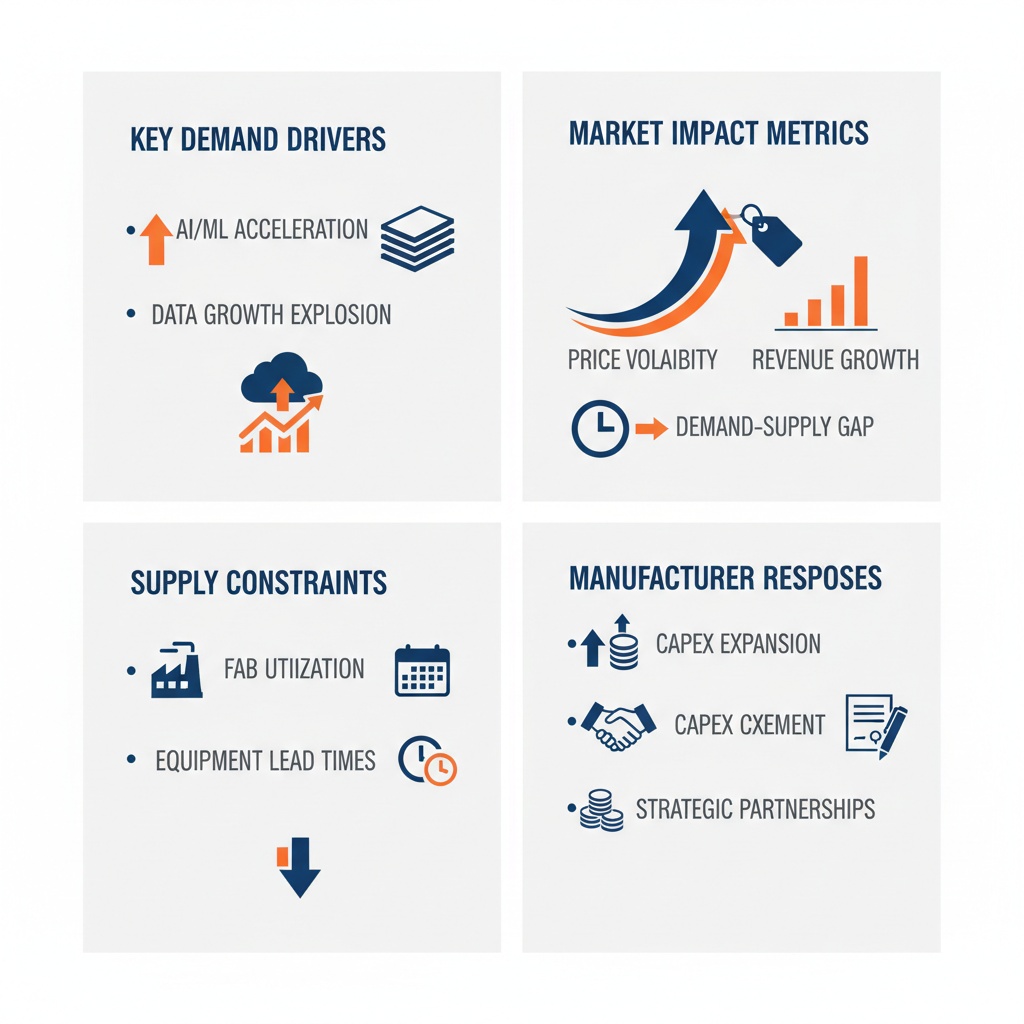
Infographic Image: AI-Driven Memory Demand & Supply Dynamics: Key Insights
Focusing on the key high-performance memory types utilized in AI infrastructure — high-bandwidth memory (HBM), dynamic random access memory (DRAM), and NAND flash storage — this analysis investigates the scope of demand increases, manufacturing challenges, and market responses. It underscores the complex interplay between demand surges and structural supply limitations imposed by concentrated manufacturing capacity, long lead times, and raw material constraints.
The methodology combines quantitative market data, supply chain insights, and industry forecasting to provide a comprehensive perspective on current conditions and future outlook. Through this analytical lens, the document aims to equip stakeholders with clarity on the systemic shifts shaping memory supply and the strategic adaptations of core manufacturers within this evolving landscape.
1. AI-Driven Memory Demand Surge: Market Trends and Drivers
The unprecedented expansion of artificial intelligence (AI) technologies is catalyzing one of the most significant demand surges in the global memory chip market in decades. This surge is not merely a function of the increased computational throughput AI models require but is fundamentally driven by the distinct memory consumption patterns inherent to AI workloads, particularly the dual pillars of large-scale training and real-time inference. Unlike conventional computing processes that operate within predictable memory demands, AI workloads—due to their complexity, scale, and statefulness—are reshaping the industry’s memory landscape, causing capacity to tighten and prices to escalate. As foundational enablers of AI infrastructure, memory components like high-bandwidth memory (HBM), dynamic random-access memory (DRAM), and NAND flash are witnessing explosive growth in consumption, underscoring their pivotal role in the AI-driven technological transformation.
Deepening this dynamic is the clear bifurcation within AI memory demand, driven principally by the differing technical profiles and resource intensities of training versus inference workloads. Large model training, characterized by its voracious appetite for ultra-high-speed data transfer and massive capacity to accommodate extensive neural networks, exerts extraordinary pressure on HBM and server-grade DRAM volumes. In contrast, inference—the continuous, widespread deployment of AI models to generate outputs in real-world applications—scales a different facet of memory requirements, emphasizing persistent data storage, rapid access to contextual data, and warm-tier memory like enterprise SSDs based on NAND technologies. This layered memory utilization has recalibrated manufacturer priorities and market realities, precipitating price inflations and conspicuous supply constraints. The resulting market turbulence requires careful examination to understand both the distinct drivers of demand and the prevailing structural conditions that define memory availability in 2026.
Differentiation of AI Workloads Impacting Memory Demand
AI workloads bifurcate into two primary categories—training and inference—each with unique and intensifying demands on memory technology. Training AI models, especially large language models and complex neural networks, demands memory solutions that deliver extreme bandwidth and proximity to processing cores to maintain efficient computation. Here, high-bandwidth memory (HBM) emerges as a critical enabler, providing the exceptionally fast data throughput required to feed AI accelerators during training iterations. For example, projects like OpenAI’s large-scale models have been reported to consume upwards of 900,000 DRAM wafers monthly, representing nearly 40% of global DRAM production just for training workloads. This concentration spotlights the disproportionate resource consumption attributed to AI training, which dwarfs conventional memory use in scale and intensity. The shift toward HBM prioritization is further evidenced by Samsung, SK Hynix, and Micron reallocating production capacity from traditional DRAM and NAND lines toward HBM to meet this growing training demand.
Monthly DRAM wafer usage for AI training models compared to global DRAM production.
Inference workloads, by contrast, emphasize operational efficiency across diverse environments and require memory capacities that sustain continuous data access, storage, and retrieval with lower latency but extremely high availability. These workloads generate an exponential increase in AI ‘state’: conversation histories, prior results, embeddings, and retrieval databases. This necessitates a distinct memory hierarchy strategy, where ‘warm-tier’ memory—enterprise-grade NAND flash SSDs—serve as an optimal balance between speed and cost, holding extensive contextual datasets that cannot fit into expensive, high-bandwidth tiers like HBM. System DRAM also remains essential to support the seamless orchestration of inference tasks but contends with capacity reallocation pressures due to the premium on HBM. Additionally, as inference becomes ‘always-on,’ memory demand grows not simply in volume but in the complexity of retrieval and indexing operations, further expanding the infrastructure footprint.
This delineation between training and inference creates a multifaceted demand profile for memory manufacturers and the market at large. HBM’s highly specialized nature combined with its profitability attracts focused production investments, yet the finite capacity to produce HBM chips redirects resources away from traditional DRAM and NAND supply pools, squeezing market availability for other sectors. Meanwhile, inference’s growing storage and fast-access requirements drive broad-based demand spikes for enterprise SSDs and system DRAM, heightening overall memory consumption across the stack. This complexity underpins the structural tightness in supply and the elevated pricing environment pervasive today.
Memory Price Increases and Supply Tightness Attributed to AI
The tangible impact of AI-driven demand on memory prices and supply tightness has been acute and well-documented across multiple market analyses throughout late 2024 and into 2026. Notably, DRAM contract prices surged by approximately 172% year-over-year by the third quarter of 2025, with particular segments such as DDR5 witnessing month-over-month price increases sometimes exceeding 80–100%. NAND flash prices reflected similar dynamics, with some NAND products experiencing 160% price growth due to intensifying demand from AI storage solutions. These price escalations are far beyond typical cyclical memory market variances and represent a fundamental realignment in market supply-demand economics.
The scarcity is not limited to high-end memory but extends to traditional commodity DRAM and NAND markets, as producers have diverted capacity to prioritize the more profitable and urgent high-bandwidth memory segments. This reallocation has led to notable supply shortages impacting diverse industries beyond AI-specific markets, including automotive, consumer electronics, and telecommunications sectors, which rely heavily on DRAM and NAND availability for their operations. Furthermore, the supply tightness has caused extended lead times, with delivery windows for memory modules expanding from typical 2–4 weeks to 8–12 weeks, complicating procurement strategies and inflating costs. Such pressures are aggravated by market behaviors such as hoarding and speculative purchasing by intermediaries, which dampen product circulation and exacerbate volatility.
Geopolitical factors have further constrained supply normalization by disrupting the semiconductor trade flow through tariffs and export restrictions that emerged prominently during 2025. This context restricts inventory replenishment capacity globally and sustains heightened prices despite market demand fluctuations. Despite expectations that price growth might moderate post-2026, current data point to a prolonged period of tight supply, with major memory manufacturers signaling ongoing allocation prioritization toward AI-centric products. For instance, in Q1 2026, SK Hynix reported near doubling of DRAM prices compared to the previous quarter, with NAND prices rising in tandem, underscoring persistent pressure. Such market conditions indicate structural shifts rather than transient shortages, with durable impacts on pricing and availability.
Market Share and Production Capacity of Major Memory Manufacturers Underpinning Supply Constraints
Market concentration significantly magnifies the supply constraints experienced in the memory domain. The global memory manufacturing landscape is heavily dominated by three principal players: Samsung Electronics, SK Hynix, and Micron Technology. Collectively, these three companies command more than 90% of the DRAM and HBM production capacity worldwide and lead innovations in NAND flash technologies. This oligopolistic structure means decisions within any one manufacturer—including shifts in product mix, capital expenditure, or geographical production focus—have outsized ripple effects across global memory supply chains.
Recent corporate trajectories highlight this influence. Samsung Electronics and SK Hynix have significantly expanded their HBM production lines, prioritizing large-scale AI training demand despite the consequent contraction in capacity for legacy DRAM and NAND products. SK Hynix’s Q1 2026 financial report underscored these patterns, revealing a 198% revenue increase year-over-year attributable primarily to heightened AI-related memory chip sales, alongside price-driven revenue growth. Meanwhile, Micron’s strategic realignment away from consumer-oriented Crucial memory module lines in late 2025 further illustrates a market shift imposing resource allocation decisions heavily skewed toward AI infrastructure customers at the cost of other segments.
Capacity expansions lag behind demand growth due to the inherently capital-intensive and time-consuming nature of memory fabrication. Even as these leading manufacturers accelerate capital expenditure programs targeting HBM and DDR5 technologies, new high-volume production lines often require more than a year from groundbreaking to yield ramp-up. As such, present-day supply constraints relate directly to both existing physical capacity limits and strategic product prioritizations determined by competitive profit dynamics. This concentrated capacity and slow scalability leave the industry vulnerable to demand shocks, making AI’s surging memory needs a key structural catalyst tightening the overall memory market ecosystem.
2. Memory Supply Constraints and Manufacturer Challenges
Amid the rapidly intensifying demand for memory driven by AI workloads, the memory manufacturing ecosystem is confronting unprecedented supply-side constraints that threaten to bottleneck the industry’s ability to meet evolving needs. As highlighted in the preceding discussion on AI-driven demand surges, the pressure on high-performance memory types such as DRAM, NAND, and High Bandwidth Memory (HBM) has escalated sharply. This section delves into the supply-side realities underlying these pressures, detailing how capacity limitations, prolonged manufacturing lead times, critical material shortages, and strategic contractual engagements collectively constrict available memory supply. Understanding these challenges is essential to contextualize the current tightness in memory availability and the structural tension faced by key manufacturers.
The supply limitations are particularly acute at the manufacturing level because of the intricate production processes and the capital-intensive nature of memory fabrication. While demand-side dynamics continue to intensify, the capabilities of leading memory producers—Samsung, SK Hynix, and Micron—remain bounded by physical capacity ceilings and logistical complexities. Equally impactful are upstream constraints from material shortages, especially in substrates and silicon wafers, as well as strategic supply agreements that constrict market liquidity. Together, these factors form a multifaceted supply bottleneck, amplifying scarcity and contributing to the inflexibility in scaling output swiftly despite urgent AI-driven market needs. This is further reflected in the dramatic year-over-year DRAM price increase of 172% as of Q3 2025, underscoring the acute supply-demand mismatch in the current memory landscape [Chart: Yearly DRAM Price Increase Percentage].
Capacity Constraints and Manufacturing Lead Times for DRAM, NAND, and HBM
The supply-side strain in the memory industry is tightly linked to the limited production capacities inherent in DRAM, NAND, and HBM manufacturing facilities. Each of these memory types demands distinct fabrication complexities, which directly translate into bottlenecks that cannot be rapidly alleviated. DRAM production, for instance, requires extremely precise photolithographic processes, advanced cleanroom environments, and expensive capital equipment, contributing to long cycle times from wafer fabrication to finished modules. Similarly, NAND flash memory faces capacity ceilings aggravated by its multi-level cell technology, which increases fabrication difficulty and yields sensitivity.
High Bandwidth Memory (HBM), a critical component in AI training and inference accelerators due to its superior bandwidth and energy efficiency, presents arguably the most challenging capacity limitations. HBM fabrication involves 3D stacking of memory dies interconnected by through-silicon vias (TSVs), an advanced and time-consuming process with low fault tolerance and yield constraints. Industry reports (referenced in documents d11, d16, and d27) indicate that current HBM production lead times have extended to upwards of 26 weeks, compared to DRAM’s approximately 18–20 weeks, and NAND’s averaging 20–22 weeks under strained conditions. These extended lead times reflect not only process complexity but also capacity saturation in key manufacturing plants, especially those operated by Samsung and SK Hynix, who dominate global supply.
Capacity expansion programs are underway, yet the pace of these investments fails to immediately relax supply tightness. For example, while Samsung is accelerating fab upgrades in China and South Korea, such expansions typically require 12 to 24 months to reach ramp-up due to the prolonged tool installation, tuning, and yield ramp procedures (d1). Consequently, memory output remains constrained in the near term, limiting the industry's responsiveness to the soaring AI-induced demand.
Impacts of Material Shortages and Substrate Supply on Memory Production
Beyond manufacturing capacity, the availability of critical raw materials and substrates has emerged as a core supply chain vulnerability for memory producers. The fabrication of DRAM, NAND, and HBM modules relies heavily on specialized materials such as silicon wafers, high-purity chemicals, photoresists, and substrates including copper-clad laminates (CCL) for integrated circuit (IC) packaging. Shortages and lead time elongations in these materials cascade downstream, exacerbating already strained production capabilities.
Recent supply chain intelligence (d19, d23, d24) highlights acute shortages of high-end substrate materials. Specifically, advanced copper-clad laminates using T-glass fiberglass cloth—essential for high-frequency signal integrity in next-generation memory modules—have become constrained due to capacity limitations among substrate manufacturers. These limitations directly impede memory module assembly rates because substrates form the foundational base upon which DRAM and NAND ICs are mounted and interconnected.
Additionally, silicon wafer availability remains a bottleneck. Though wafer suppliers have increased production somewhat, the alignment of wafer sizes and quality grades with memory fab requirements lags behind the rapid acceleration in memory demand, leading to procurement delays and higher costs. Compounding these raw material challenges are global supply risks related to geopolitical restrictions, export controls, and pandemic-triggered logistical disruptions, which have intermittently throttled material inflows. The interconnectedness of the semiconductor supply chain means even marginal shortages at the material level ripple significantly through memory output volumes, restricting manufacturers’ ability to fulfill AI-sector orders promptly.
Strategic Supply Deals and Contract Trends Restricting Market Liquidity
Strategic commercial behaviors adopted by memory producers and AI service providers further constrict memory availability in open markets, intensifying supply rigidity. As AI players strive to secure long-term access to scarce memory resources, manufacturers increasingly resort to locking up substantial portions of their capacity through extended contract agreements. Such strategic supply deals are designed to guarantee stability for both sides amid volatile demand and supply conditions but inevitably reduce the volume of memory available for spot sales or smaller customers.
Recent industry data (d4, d37, d40) show that upwards of 70% of DRAM and NAND output from top-tier manufacturers is presently committed under multi-year supply contracts with major hyperscale AI cloud providers or AI chip design firms. This contractual concentration creates an oligopolistic supply environment where supply is effectively pre-committed well in advance, leaving limited product liquidity for the broader market. These long-term contracts often include pricing floors or volume guarantees that reduce market price elasticity, reinforcing higher price stability despite demand fluctuations elsewhere.
While such contract strategies provide manufacturers with predictable revenue streams and enable capital investment planning, they also entrench supply-side inflexibility. Small and medium-sized customers face elongated lead times and diminished access to newer memory generations, which in turn can hinder innovation diffusion and ecosystem diversity. Notably, this practice deviates from traditional memory market dynamics where more supply availability typically emerged in response to price signals. In the current AI-driven paradigm, preproduction commitments have fundamentally shifted supply allocation mechanisms, amplifying the tension between strong demand inflows and limited immediate market supply.
3. Manufacturer Responses and Future Outlook for Memory Supply
As global AI workloads relentlessly expand in scale and complexity, the memory manufacturing industry is strategically mobilizing to bridge the widening gap between insatiable demand and constrained supply. Building directly upon the previously outlined supply challenges, this section explores how leading memory producers are innovating technically and operationally to recalibrate the memory ecosystem for the AI era. Unlike previous memory market cycles driven largely by consumer electronics, today's surge is fueled by large-scale AI training and inference workloads that necessitate not only more memory but fundamentally new architectures optimized for ultra-high bandwidth, low latency, and enhanced energy efficiency. The manufacturers' responses, therefore, transcend mere capacity expansions, embracing groundbreaking memory technologies and customized system designs tailored specifically for AI compute workloads.
The evolution of memory solutions for AI—characterized by emerging standards such as HBM4 and novel composable GPU architectures with bespoke memory subsystems—embodies the industry's recognition that future supply adequacy hinges on innovation as much as volume. Major players are concurrently executing ambitious capital expenditure (CapEx) programs aimed at expanding production lines even as they pioneer next-generation memory modules designed to seamlessly integrate with increasingly heterogeneous and disaggregated AI accelerator systems. Market forecasts consistently show that these technological and capacity investments are critical to sustaining supply-demand equilibrium through 2027 and beyond, aligning with projected AI infrastructure growth trajectories. This forward-looking strategy exemplifies how manufacturers are shifting from reactive bottleneck management to proactive ecosystem transformation, shaping the future capabilities and economics of AI memory supply.
Emerging Memory Technologies Optimized for AI
High Bandwidth Memory (HBM) continues to be the cornerstone of innovation targeting AI workloads due to its unparalleled combination of bandwidth density and energy efficiency. The latest generation, HBM3e, already deployed in current AI accelerators such as Nvidia’s H200 and AMD’s MI300, delivers bandwidth exceeding 1.2 terabytes per second per stack with capacities of up to 36 GB. However, the imminent arrival of HBM4 in 2026 marks a transformational leap, nearly doubling interface widths to 2048 bits and vastly increasing per-stack bandwidth beyond 2 terabytes per second. This new standard introduces a co-processor model through logic die integration, enabling more advanced data processing within the memory stack itself, thus accelerating throughput and efficiency. Critical improvements in power delivery, thermal management, and signal integrity accompany this architectural overhaul, making HBM4 particularly adept at the next generation of large language model (LLM) training and real-time inference implementations where latency and throughput are stringent bottlenecks.
Alongside HBM4, composable GPUs equipped with custom memory subsystems are redefining how memory is allocated and utilized for AI workloads with varying sizes and computational profiles. These GPUs leverage disaggregated, flexible architectures that dynamically pool memory resources across multiple GPU dies to match the precise demands of models ranging from 8 billion to 400 billion parameters. By integrating tailored interfaces and optimized interconnects, composable GPU designs minimize overheads and improve utilization rates significantly compared to fixed-resource configurations. For instance, Marvell’s recently announced custom HBM compute architecture achieves up to 25% greater compute capacity and 33% more memory capacity per accelerator by streamlining memory-controller interactions and adopting advanced 2.5D packaging techniques. Collaborations between memory manufacturers such as Samsung, Micron, and SK Hynix and silicon innovators like Marvell are accelerating the delivery of these customized memory architectures, ensuring AI infrastructure can scale not merely in volume, but in architectural sophistication.
Capital Expenditure and Capacity Expansion Plans
Facing the dual imperatives of escalating demand and technological innovation, leading industry players are committing unprecedented investment to ramp up memory production capabilities. Samsung Electronics, the preeminent player, has publicly committed to increasing HBM and DRAM capacity with a focus on advanced process nodes tailored to high-bandwidth products, aiming to commission multiple new fabrication facilities and expand existing lines by late 2026 through 2027. SK Hynix and Micron similarly are investing billions of dollars to accelerate capacity expansion, with particular emphasis on facilities optimized for high-density 3D stacking technologies essential for HBM4 and next-generation DRAM modules.
These capital expenditures represent not only scale augmentation but also modernization of production technologies, including enhanced lithography, tighter process controls, and integrated testing suites designed specifically for AI-grade memory quality assurance. Such investments culminate in reduced cost per bit and improved yield rates, critical for sustaining competitive pricing amid tight supply conditions. Notably, manufacturers are balancing the long lead times inherent in semiconductor facility construction—often spanning 18 to 24 months—with the rapidly evolving AI workload profiles by adopting agile capacity deployment strategies and deepening strategic partnerships with cloud hyperscalers, thereby ensuring a responsive and demand-aligned supply pipeline. Currently, lead times for HBM production have extended to approximately 26 weeks, significantly longer than NAND's 20-22 weeks and DRAM's 18-20 weeks, highlighting the challenges in scaling high-bandwidth memory supply to meet AI demand [Table: Memory Production Lead Times].
Forecasts of Memory Supply and Demand Trends Aligned with AI Growth
Industry modeling for the 2025-2027 timeframe projects continued robust growth in demand for high-performance memory products driven predominantly by AI infrastructure expansion. Market analysts forecast compound annual growth rates (CAGR) exceeding 50% in HBM demand, with DRAM and NAND also exhibiting above-average growth trajectories linked to proliferating AI models and ever-larger datasets. Supply forecasts incorporate anticipated capacity expansions and technology insertions, indicating a gradual easing of near-term shortages by mid-2027, contingent on successful ramping of HBM4 production and composable GPU memory integration.
Quantitative supply projections suggest that by 2027, the installed base of HBM4-capable accelerators could surpass that of all previous generations combined, enabled by scaled production volumes from Samsung, SK Hynix, and Micron. Similarly, DRAM capacity aligned with AI workloads is expected to grow by over 30%, underpinned by new fab expansions and enhanced manufacturing efficiencies. These trends reflect a structural shift in memory supply dynamics, where performance-driven innovations increasingly coalesce with volume output to satisfy heterogeneous AI demand profiles.
However, despite anticipated capacity uplifts, supply-demand balance will remain nuanced, with emerging memory technologies initially constrained by complex design integration cycles and capital intensity, underscoring the necessity for continuous innovation and strategic supply chain management by manufacturers and AI ecosystem participants alike.
Conclusion
The analysis reveals that AI-driven memory demand is instigating significant and sustained pressure on the global memory supply ecosystem, precipitating notable price increases and supply shortages mainly due to constrained manufacturing capacity and concentrated supplier dominance. The bifurcation of memory needs between large-scale training and inference workloads further complicates supplier allocation strategies and market dynamics.
In response, memory manufacturers are deploying a multifaceted strategy that includes accelerating capacity expansions, pioneering next-generation memory technologies such as HBM4, and fostering innovative memory architectures tailored to AI’s evolving computational profiles. These efforts, while promising, face inherent lead time and capital intensity challenges that will moderate supply relief in the near term.
Looking forward, continued monitoring of supply-demand imbalances, strategic contractual behaviors, and technological adoption remains critical. Further analysis should explore the longer-term implications of shifting memory supply paradigms on AI ecosystem growth, the potential for diversification of supply sources, and the impact of emerging memory standards on cost structures and market competitiveness.
Glossary
- High Bandwidth Memory (HBM): A type of high-speed memory architecture designed for use in AI training and inference accelerators, characterized by 3D stacking of memory dies interconnected by through-silicon vias (TSVs) to deliver extremely high data throughput and energy efficiency.
- Dynamic Random-Access Memory (DRAM): A widely used type of volatile memory that provides fast data access for computing systems; in AI contexts, it supports both training and inference workloads but faces supply constraints due to manufacturing complexity and demand shifts toward HBM.
- NAND Flash: A type of non-volatile storage memory commonly used in enterprise solid-state drives (SSDs), leveraged in AI inference workloads to store extensive contextual and warm-tier data, balancing cost and access speed.
- AI Workloads: Computational tasks related to artificial intelligence, typically divided into two main types: large-scale training—which requires massive, high-bandwidth memory capacity—and inference, which involves real-time model deployment with different memory access and storage needs.
- Inference: The AI workload phase where trained models generate outputs or predictions in real-time or near-real-time applications, requiring persistent, low-latency memory access often supported by DRAM and NAND flash storage.
- Large-scale Training: The process of building AI models through extensive data processing and iterative computation, demanding ultra-high-speed, high-capacity memory such as HBM and server-grade DRAM to handle large neural networks efficiently.
- Through-Silicon Vias (TSVs): Vertical electrical connections that pass through stacked silicon dies in 3D memory architectures like HBM, enabling high-density interconnects necessary for fast data transfer and reduced latency.
- Composable GPUs: Advanced graphics processing units designed with flexible, disaggregated memory architectures that enable dynamic pooling and allocation of memory resources across multiple GPU dies to optimize AI workload performance.
- Silicon Wafers: Thin slices of semiconductor material serving as the substrate for fabricating integrated circuits, including memory chips; shortages or misalignment in wafer specifications can significantly bottleneck memory production.
- Copper-Clad Laminates (CCL): Substrate materials used in integrated circuit packaging that provide the physical base and electrical pathways for memory modules; supply shortages of advanced CCL types impact assembly rates and overall memory manufacturing throughput.
- Supply Contracts: Long-term agreements between memory manufacturers and large AI customers that lock in capacity and pricing, reducing the quantity of memory available in open markets and contributing to supply inflexibility.
- Capital Expenditure (CapEx): Investment funds allocated by memory manufacturers to expand and upgrade production facilities, critical for increasing manufacturing capacity and developing next-generation memory technologies.
- HBM4: The upcoming fourth generation of High Bandwidth Memory technology, expected to nearly double bandwidth over HBM3e and integrate logic die co-processors for enhanced data processing efficiency in AI applications.
- Latency: The delay between a request for data and the delivery of that data, a critical performance metric in AI inference where low latency enhances real-time responsiveness.
- Memory Fabrication: The complex manufacturing process by which memory chips such as DRAM, NAND, and HBM are produced, involving photolithography, cleanroom environments, and multi-step assembly that contribute to long lead times and capacity constraints.
References
- Marvell Announces Breakthrough Custom HBM Compute Architecture to Optimize Cloud AI Accelerators
- Here’s how our TPUs power increasingly demanding AI workloads.
- Optimizing AI Model Performance Through Dynamic GPU Allocation
- PC chipmakers warn CPU shortages cloud 2026 shipment outlook
- Adata reports soaring earnings on strong memory demand
- 반도체의 수요와 공급 이해하기_메모 | Valley AI
- Nvidia supplier SK Hynix's Q1 profit rises five-fold, meets forecasts
- HBM3e and HBM4: IC design guide for next-generation high bandwidth memory
- Equity Insight: Memory - The Hidden Bottleneck Behind the AI Boom | Investment Insights
- Industry faces "acute" CPU shortage with hope that Intel 18A yields improve - OC3D
- AI Servers in 2025: What Hardware is Needed to Run LLMs and Neural Networks? - Unihost.com Blog
- Printronix P8000 Barcode Label Printer
- How AI Forces Are Spurring a Memory Chip Shortage - Z2Data
- AI server demand locks up memory supply through 2027, prices seen holding firm
- AI PCB supply crunch squeezes margins on rising materials and energy costs
- Memory price surge reshapes global notebook competition in 2026
- How HBM4 Improves Latency And Energy Efficiency For AI Inference?
- HBM·D램 최소 3년간 품귀 … '장기 호황' 날개 단 하이닉스 - 매일경제
- Samsung and SK Hynix race to upgrade China chip plants as NAND demand surges
- AI-Driven Memory Market Growth: DRAM & NAND Trends | Futuretech Components
- 삼성·SK 보유자 필수 체크… AI 슈퍼사이클 '끝물' 경고신호 3 - 글로벌이코노믹
- AI Architecture Evolution Set to Drive Memory Market Revenue to a New Peak in 2027, with Annual Growth Exceeding 50%
- Memory Prices Soar Higher Than Gold: AI Demand Sparks Industrial DRAM Shortage - Blog - Forlinx Embedded Technology Co., Ltd.
- 머신러닝 컴퓨터 사양, AI 모델 학습용 PC 스펙과 구성 방법!