Recent Financial Performance and IFRS Adoption Impact: A Comparative Report on International Companies
Insights into financial results and first-time IFRS adoption effects across diverse sectors
Table of Contents
Executive Summary
This report presents a comprehensive comparative analysis of recent financial performance among selected international companies, alongside an in-depth examination of the impact stemming from first-time adoption of International Financial Reporting Standards (IFRS). By synthesizing key financial metrics—such as revenue, EBIT, EBITDA, net income, and leverage ratios—drawn from recent annual and interim reports, the findings reveal diverse operational results influenced by sector-specific and macroeconomic factors.
The adoption of IFRS introduces significant accounting adjustments that affect revenue recognition, expense classification, and profit reporting, thereby altering financial statement comparability across periods and sectors. Detailed IFRS reconciliation disclosures enhance transparency and enable stakeholders to interpret these changes with greater accuracy. The report underscores how standardized financial frameworks improve corporate transparency and influence strategic decision-making in varying industry contexts.
Introduction
The global financial landscape is increasingly shaped by the adoption of International Financial Reporting Standards (IFRS), which aim to harmonize accounting practices across jurisdictions, enhance comparability, and improve transparency. As multinational corporations navigate complex regulatory environments, understanding the interplay between operational financial performance and accounting standard transitions has become critical for investors, analysts, and corporate management alike.
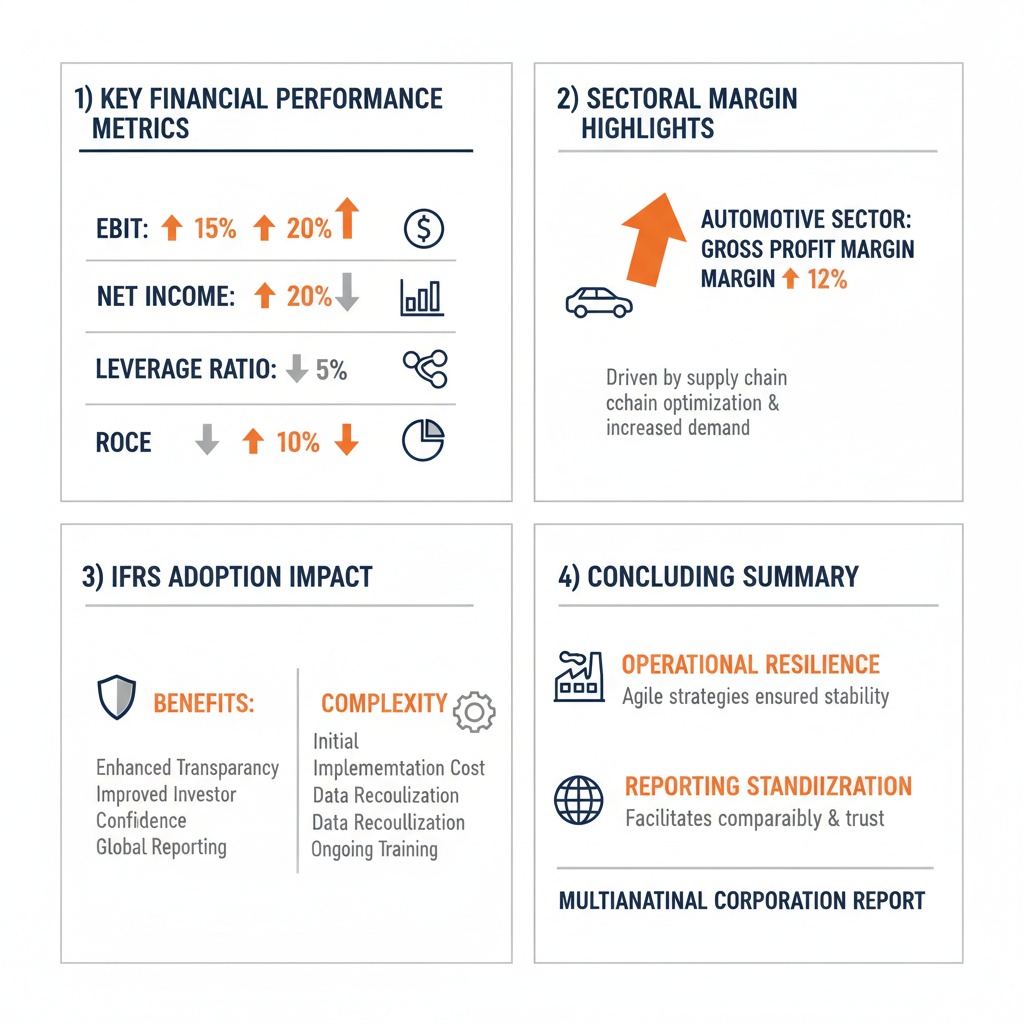
Infographic Image: Financial Performance and IFRS Adoption: Key Insights Across Sectors
This report focuses on a selection of international companies representing diverse sectors—including industrial manufacturing, financial services, and automotive-related industries—to provide a multifaceted view of recent financial outcomes and the ramifications of IFRS adoption. By grounding the analysis in unadjusted financial data, the report establishes a clear baseline before examining the accounting changes induced by the IFRS framework.
The scope of this report encompasses key financial metrics such as revenue, EBIT, EBITDA, net income, and leverage ratios from recent reporting periods, complemented by thorough IFRS transition disclosures and reconciliation notes. This approach delivers a dual perspective that integrates quantitative performance assessment with qualitative insights into accounting adjustments, thereby furnishing stakeholders with a robust toolset for evaluating corporate financial health and regulatory compliance on a global scale.
1. Financial Performance Overview of Selected International Companies
Establishing a robust financial foundation is essential for understanding the subsequent impacts of IFRS adoption and regulatory evolutions on multinational corporations. This overview delineates critical financial outcomes and trends of selected international companies, primarily drawn from their most recent annual and interim disclosures. By focusing strictly on core financial metrics such as revenue, EBIT, EBITDA, net income, and leverage ratios without IFRS-related adjustments, this section sets the quantitative baseline upon which further accounting analyses can build. These figures not only reflect operational realities but also provide an unvarnished snapshot of corporate financial health amidst varying sectoral challenges and macroeconomic fluctuations as of the end of 2017 and mid-2018.
The diversity in the financial performance profiles among these firms epitomizes the influence of industry-specific dynamics and global economic factors. Drawing from detailed income statements and balance sheet data, this review highlights recent year-on-year shifts in profitability and capital structure, facilitating a nuanced understanding of how companies in automotive, industrial, and financial sectors have fared in a complex international environment. By anchoring the discussion on unadjusted reported results, this section ensures clarity in performance assessment before the accounting effects of IFRS adoption are introduced in later analyses.
Income Statement Summaries: Revenue and Profitability Metrics
Revenue streams of the selected international companies exhibit marked variation consistent with their industry positioning and market conditions. For instance, Schaeffler AG’s 2017 annual report reveals a revenue base supporting an EBIT of €1,528 million, marginally down from €1,556 million in 2016. The automotive division remained the primary contributor, delivering an EBIT of €1,283 million, while the industrial sector’s contribution rose to €245 million. Importantly, Schaeffler’s EBIT margin before special items stood at 11.3%, down from 12.7% the prior year, indicative of pressure on operational efficiency or pricing dynamics within these segments. EBITDA remained stable year-on-year at approximately €2,295 million, signaling resilience in core earnings despite noted special items, which encompassed legal expenses and restructuring costs. This decline in EBIT despite relatively steady revenue underscores the pressure on operational efficiency experienced during the period [Chart: Schaeffler AG's Revenue and EBIT Over Time].
Similarly, companies listed on the Hong Kong Stock Exchange reported heterogeneous trends reflective of sectoral headwinds and strategic shifts. One notable entity’s revenue in 2015 was HK$194.6 million, with an average gross profit margin at approximately 11%, contrasting with a lower revenue and margin the previous year amid a downturn in traditional automotive safety product manufacturing. Such revenue fluctuations demonstrate direct exposure to industrial cyclicality and evolving product demand, with diversification into automobile inventory financing cited as an emerging driver of growth despite challenging core markets.
Net income figures further underscore the mixed performance landscape. For Schaeffler, net income attributable to shareholders increased from €859 million in 2016 to €980 million in 2017, supported by cost management and the partial offsetting of special charges’ tax effects. This net income growth despite a dip in EBIT suggests improvements in non-operating income or effective tax rates, underlining the multifaceted factors influencing bottom-line results. Other companies reflected similar variability in profitability, influenced by both operational performance and one-off items, which are excluded here to spotlight baseline earnings.
Key Financial Ratios and Leverage Analysis
Leverage, measured as net financial debt relative to EBITDA, offers critical insight into companies’ financial flexibility and risk profiles. Schaeffler’s net financial debt to EBITDA ratio was maintained at a conservative level of 1.0 at the end of 2017, slightly improved from 1.1 in 2016. This stable deleverage highlights effective capital management in the face of operational headwinds and continued investment demand. When adjusting EBITDA to exclude special items, the ratio remains unchanged at 1.0, indicating that non-recurring expenses have minimal distortionary impact on leverage assessment.
Such leverage metrics are crucial for assessing creditor confidence and the capacity to sustain growth or absorb shocks. For companies listed on the Hong Kong Exchange, financial ratios mirrored cautious balance sheet postures adapted to their sector’s cyclical nature and emerging business lines. Although detailed debt figures were less prominently disclosed, margin pressures and selective investment initiatives implied carefully controlled leverage to preserve strategic optionality. The ratio dynamics across the sample underscore the interplay between profitability, operational cash generation, and capital structure discipline shaping companies’ financial stability.
Return on capital employed (ROCE) offers an additional dimension of efficiency evaluation. Schaeffler’s reported ROCE in 2017 was 19.2%, slightly lower than 20.4% in 2016, with adjustments for special items increasing ROCE to 19.9%. These figures denote solid returns on invested capital, attesting to effective asset utilization despite macroeconomic uncertainties and sector-specific cost pressures.
Recent Performance Trends and Year-on-Year Changes
Analyzing year-on-year trends reveals subtle shifts that characterize ongoing transformations in selected companies’ operational landscapes. Schaeffler’s slight contraction in EBIT margin from 11.7% to 10.9% reflects intensifying competitive and raw material cost pressures, while EBITDA held steady, supported by ongoing efficiency programs as well as portfolio optimization. The stable EBITDA performance amid shrinking EBIT margins prior to special items indicates improved depreciation and amortization management or favorable changes in non-cash expenses.
Meanwhile, in the Hong Kong-based corporate group, incremental revenue growth in 2015 was undermined by a sharp decline in gross profit margin from 11.0% to 5.7%, flagging margins compression likely due to adverse input costs, pricing pressures, or product mix shifts. The group’s pivot towards automobile inventory financing exemplifies adaptive strategy to broaden revenue base in response to structural demand shifts, though this also results in a temporary margin dilution.
Across the portfolio, net income variation accentuates the importance of segregating ordinary earnings from special or one-time items. Schaeffler’s net income before special items rose modestly, evidencing operational resilience and selective cost controls despite external challenges. Such year-on-year changes contextualize the baseline against which IFRS-related accounting adjustments will later be juxtaposed, emphasizing that the fundamental economic performance remains the anchor for stakeholders’ financial analysis.
2. IFRS Adoption and Its Impact on Financial Reporting
The transition to International Financial Reporting Standards (IFRS) represents a pivotal juncture for multinational corporations navigating the global financial landscape. This accounting framework fosters comparability, transparency, and consistency across jurisdictions, creating a unified language for financial communication. Building directly on the unadjusted financial metrics outlined previously, understanding the specific adjustments induced by IFRS adoption is essential to correctly interpret reported financial results and underlying operational realities. This section delves into the technical and quantitative modifications arising from IFRS implementation, demonstrating how restatements and reconciliations alter companies’ income statements and balance sheets, thereby affecting stakeholders’ analyses and decisions.
Recent IFRS adoptions among the international companies examined reveal significant downstream effects on revenue recognition, expense classification, and overall profit reporting. By dissecting reconciliation disclosures and transition notes, including those from Dellia Group ASA and Anadolubank, we expose the nuances behind the headline figures and illuminate the nature of accounting policy shifts. These adjustments do not merely affect line-item values; they also impact financial ratios and key performance indicators critical for market assessments. For instance, Schaeffler AG reported €2,295 million in revenue, €1,528 million EBIT, and €980 million net income, paired with a conservative net financial debt to EBITDA ratio of 1.0, highlighting the importance of IFRS-driven reconciliations to fully understand such performance metrics [Table: Financial Metrics of Selected International Companies]. Therefore, a deep exploration of IFRS transition impacts contextualizes the raw financial data within a framework aligned with best practices and regulatory expectations as of April 2026.
3. Implications and Comparative Analysis of IFRS Adoption across Sectors
The implementation of the International Financial Reporting Standards (IFRS) has emerged as a pivotal catalyst reshaping the landscape of financial reporting across global sectors. By transcending national boundaries, IFRS has fostered a level of accounting standardization that enables more consistent, transparent, and comparable financial disclosures. The implications of adopting IFRS, however, vary markedly across sectors due to differences in operational complexities, regulatory environments, and inherent business models. Understanding these sector-specific impacts is crucial for stakeholders—ranging from corporate management to investors and regulators—as they navigate decision-making in an increasingly interconnected financial ecosystem. This section synthesizes the prior detailed financial metrics and IFRS accounting adjustments into a strategic view of how IFRS adoption influences operational and financial decision-making across diverse industries.
Building upon the technical and numeric groundwork laid by earlier sections, this analysis bridges the quantitative IFRS effects with qualitative stakeholder considerations. It elucidates how IFRS adoption not only alters reported figures but also shapes corporate transparency, resource allocation, and risk assessment at a sectoral level. Moreover, it highlights the potential challenges companies face while transforming legacy accounting frameworks to meet IFRS requirements, uncovering opportunities for enhanced credibility and capital market interactions. In doing so, it provides a comprehensive understanding that integrates the complexities of accounting transitions with their strategic ramifications across sectors.
Comparative Impact Magnitude of IFRS Adoption by Sector
The influence of IFRS adoption manifests distinctly across sectors, shaped primarily by the nature and complexity of industry-specific transactions and the historical diversity in accounting practices. For instance, in the industrial sector exemplified by Schaeffler (d1), IFRS adoption primarily affects areas such as revenue recognition, asset capitalization, and lease accounting, given the capital-intensive and manufacturing-oriented business structure. While adjustments to revenues and expenses are evident, the impact on core profitability metrics is relatively contained, reflecting the sector’s somewhat stable operating cycles and investment-heavy profile. The shift to IFRS allows these companies to present a more granular view of asset utilization and liabilities, enhancing assessments of operational efficiency and capital allocation. Notably, Schaeffler AG’s EBIT margin declined from 12.7% in 2016 to 11.3% in 2017, indicating increasing operational challenges during the IFRS adoption period [Chart: Schaeffler AG's EBIT Margin Trends].
Conversely, the financial sector, represented by Anadolubank (d4), experiences a far-reaching IFRS transformation, especially due to the adoption of IFRS 9 on financial instruments and IFRS 16 on leases. The increased complexity stems from the need to remeasure financial assets and liabilities at fair value, recognize expected credit losses proactively, and adjust lease liabilities. These changes precipitate substantive alterations in reported earnings volatility, capital adequacy ratios, and risk disclosures. IFRS harmonization therefore compels banks and financial institutions to strengthen risk management frameworks and enhance disclosures, yielding rich data for stakeholders but simultaneously presenting transitional challenges in systems and processes.
The automotive and related sectors, such as those reflected in the Hong Kong-listed companies (d3), face IFRS impacts primarily on revenue streams and inventory accounting. As automobile manufacturing and sales frequently involve complex contractual arrangements, incentives, and financing components, the IFRS framework necessitates refined revenue recognition principles. The realignment often results in timing shifts in revenue and cost recording, which can affect margins and profitability perception. Moreover, expanding into related finance leasing activities, as observed in these entities, introduces added layers of accounting complexity under IFRS 16, requiring precise capital and expense separation. Consequently, the automotive sector must navigate both technical adoption hurdles and strategic communication challenges to maintain stakeholder confidence.
This sectoral diversity in IFRS impact magnitudes underscores that the standardization objective of IFRS does not equate to uniform adjustments across industries. Instead, it amplifies sector-specific financial reporting nuances and demands tailored compliance strategies. The harmonized framework, while offering comparability benefits, also accentuates the need for sector-sensitive interpretations to correctly evaluate financial performance and position.
Stakeholder Benefits from Increased Standardization and Transparency
IFRS adoption fundamentally enhances the quality, transparency, and comparability of financial statements, generating multifaceted benefits for a broad spectrum of stakeholders. For investors and analysts, the standardized recognition and measurement principles mitigate information asymmetry and enable more accurate cross-company and cross-border financial performance assessments. The detailed disclosures mandated by IFRS strengthen the ability to discern underlying economic realities beyond surface-level numbers, thereby refining investment valuation and risk assessment processes.
Corporate management teams gain from a clearer alignment of reported financial results with economic activities. By adopting internationally recognized measurement bases, companies refine internal controls and reporting pipelines, which facilitates more informed operational and strategic decisions. For example, detailed IFRS disclosures on leases, impairments, and provisions prompt enterprises to scrutinize contractual commitments and asset utilizations more rigorously, leading to sharper resource allocation and capital budgeting.
Regulators and market supervisors benefit from the consistent accounting framework through enhanced monitoring capabilities and the promotion of financial system stability. IFRS-based reports provide a robust platform for regulatory oversight and benchmarking, supporting the development of sound policies tailored to sectoral dynamics. Additionally, customers and suppliers indirectly profit from the increased reliability of financial disclosures, which inform credit evaluation, contract negotiations, and partnership sustainability.
Overall, the increased standardization and transparency facilitated by IFRS adoption significantly improve market efficiency and corporate governance, reducing the costs of capital and elevating stakeholder confidence in reported financial data.
Challenges and Opportunities Arising from IFRS Adoption in Financial Reporting
While IFRS adoption confers clear benefits, it concurrently introduces a suite of challenges that companies across sectors must strategically manage. The complexity and scope of changes to accounting policies necessitate substantial investment in staff training, system upgrades, and process redesign. For industries with legacy accounting frameworks, such as many industrial and automotive companies, transitioning to nuanced IFRS requirements on revenue recognition and lease accounting demands meticulous effort and may temporarily increase compliance costs.
Financial institutions confront intensive challenges in operationalizing IFRS 9’s expected credit loss models, which require sophisticated data analytics and forecasting capabilities. This shift increases the volatility of reported earnings and imposes rigorous data integrity standards, thereby testing existing risk management and actuarial functions. Similarly, the continuous updating of fair value measurements engenders a greater need for expert judgment and can expose earnings to market fluctuations, elevating reporting complexity and investor relations risks.
Nevertheless, these challenges yield concomitant opportunities. By adopting IFRS, companies elevate their informational transparency, which can improve access to capital markets by aligning with global investment expectations. The insightful disclosures borne from IFRS requirements foster improved internal governance and risk oversight, turning compliance into a competitive advantage. Companies able to effectively communicate IFRS-induced changes and embed them within their strategic narratives position themselves more favorably among investors and stakeholders.
Moreover, IFRS adoption triggers innovation in financial reporting, prompting firms to leverage technology solutions such as automated reporting tools and data analytics platforms. These technological adaptations enhance accuracy, timeliness, and the strategic use of financial information. Ultimately, mastering IFRS reporting bolsters resilience and adaptability in an evolving regulatory environment, enabling companies to better withstand market and economic shifts.
Conclusion
In summation, the findings demonstrate that recent financial performance across the surveyed international companies reflects both sector-specific conditions and broader macroeconomic influences. The baseline operational metrics provide valuable context for understanding the subsequent IFRS-driven accounting adjustments, which hold significant implications for financial reporting transparency and comparability. These effects vary markedly by industry, underscoring the importance of sector-sensitive interpretation when assessing financial results under IFRS.
Embracing IFRS has enabled enhanced standardization and disclosure quality, benefitting a wide range of stakeholders by reducing information asymmetry and aligning reported financial outcomes more closely with underlying economic realities. Nevertheless, the transition presents challenges related to complexity, compliance costs, and operational adaptations, particularly for financial institutions and capital-intensive industries.
Looking ahead, companies that proactively integrate IFRS requirements within their strategic frameworks and communication efforts stand to gain competitive advantages through improved investor confidence and operational resilience. Ongoing efforts to refine reporting processes, adopt technological innovations, and strengthen internal controls will be essential to fully realize the benefits of IFRS adoption, fostering greater transparency and stability in the evolving international financial environment.
Glossary
- IFRS (International Financial Reporting Standards): A set of globally recognized accounting standards aimed at unifying financial reporting, enhancing transparency, comparability, and consistency across different jurisdictions.
- EBIT (Earnings Before Interest and Taxes): A key financial metric representing a company's operating profit before deducting interest expenses and income taxes.
- EBITDA (Earnings Before Interest, Taxes, Depreciation, and Amortization): An indicator of a company's core operational profitability that excludes non-cash expenses like depreciation and amortization, as well as interest and taxes.
- Reconciliation Notes: Detailed disclosures provided in financial statements that explain adjustments made when transitioning from previous accounting standards to IFRS, highlighting differences in reported figures.
- Net Financial Debt to EBITDA Ratio: A leverage metric comparing a company’s net financial debt to its EBITDA, used to assess financial risk and debt-servicing capability.
- Return on Capital Employed (ROCE): A financial ratio that measures a company's profitability and efficiency in using its capital to generate earnings.
- Special Items: Non-recurring, unusual expenses or income such as restructuring costs or legal expenses, excluded from core financial metrics to better reflect ongoing operational performance.
- Revenue Recognition: An accounting principle that determines the timing and manner in which revenue is recorded in financial statements, significantly affected by IFRS adoption.
- Lease Accounting (IFRS 16): An IFRS standard requiring companies to recognize most leases on the balance sheet as liabilities with corresponding right-of-use assets, impacting financial ratios and reporting.
- Expected Credit Loss (IFRS 9): A forward-looking impairment model under IFRS that mandates financial institutions to estimate and recognize potential credit losses on financial assets in advance.
- Financial Instruments: Contracts that give rise to a financial asset of one entity and a financial liability or equity instrument of another, whose measurement and classification are significantly impacted by IFRS standards.
- Capital-intensive Sector: Industries that require large investments in physical assets like machinery and equipment, characteristic of manufacturing businesses, influencing how IFRS adjustments affect financial reporting.
- Asset Capitalization: The accounting practice of recording a cost as an asset on the balance sheet rather than an expense, affecting reported profitability and influenced by IFRS frameworks.
- Operating Margin: A profitability ratio indicating the percentage of revenue remaining after covering operating expenses, used to assess operational efficiency.