The Impact of Smartphone Pricing on Consumer Behavior: A Comprehensive Analysis
Understanding How Pricing Strategies Shape Consumer Decisions in the Smartphone Market
Table of Contents
Executive Summary
This analysis examines the significant impact of smartphone pricing on consumer behavior, highlighting how varying price tiers influence purchase timing, brand loyalty, and upgrade cycles. It reveals that pricing strategies not only shape consumer preferences and switching tendencies but also interact closely with perceived value and product feature differentiation to determine purchasing decisions.
Market conditions, including component costs and economic factors, further modulate pricing approaches and elicit adaptive consumer responses such as delayed purchases or brand switching. The findings offer actionable insights for manufacturers and marketers to develop optimized pricing frameworks that align with evolving consumer motivations, technological advancements, and competitive market dynamics.
Introduction
Smartphone pricing remains a critical determinant in shaping consumer behavior within an increasingly saturated and competitive market. As manufacturers navigate rising component costs, evolving technological features, and shifting market demands, understanding the relationship between pricing strategies and consumer purchasing decisions becomes essential for sustaining profitability and market share. This analysis aims to explore how different pricing levels influence consumer choices, including purchase frequency, brand switching, and perceived product value.
To achieve this, the scope of this analysis encompasses a comprehensive evaluation of current global smartphone pricing trends, economic and market drivers of price fluctuations, and the segmentation of products into distinct price tiers. It subsequently delves into psychological and economic behavioral responses to pricing, employing established consumer motivation and valuation models to illuminate varying purchase patterns.
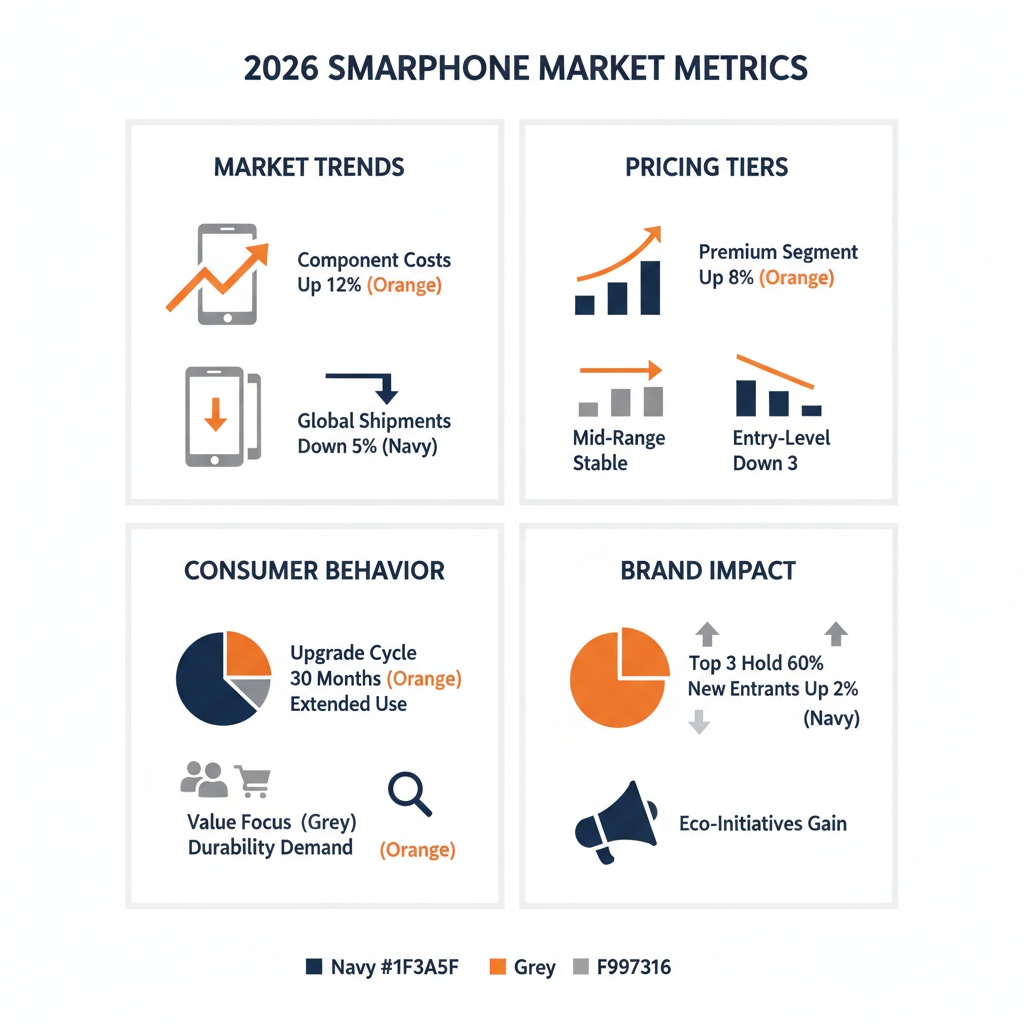
Infographic Image: Key Trends in 2026 Smartphone Pricing, Consumer Behavior, and Perceived Value
Methodologically, this study integrates data from shipment volumes, pricing indices, and behavioral research findings, ensuring an evidence-based approach that blends macroeconomic contexts with micro-level consumer insights. This multidisciplinary framework facilitates a nuanced understanding of how pricing strategies influence consumer decisions and market outcomes, offering strategic guidance for stakeholders seeking to optimize pricing in alignment with consumer preferences and economic realities.
1. Smartphone Pricing Trends and Market Dynamics
In the evolving landscape of the global smartphone market, pricing stands as a critical variable shaping both manufacturer strategies and overall market outcomes. This foundational section offers a comprehensive examination of pricing trends and market dynamics, situating the topic within the macroeconomic and industrial forces that influence product costs and availability. By tracing shifts in shipment volumes, dissecting price tier segmentation, and elucidating key cost drivers such as component pricing, this analysis establishes the essential backdrop against which consumer behavior and marketing strategies unfold. The interplay of these market-level factors reflects the complex exchange between supply-side constraints and demand-side responses, underscoring the critical role pricing plays in governing market performance and innovation trajectories as of early 2026.
Building upon the insights of recent market reports and shipment data, it becomes clear that the smartphone ecosystem is experiencing nuanced transformations. Rising component costs—especially in memory modules and advanced 5G-compatible chips—combine with shifting market saturation levels and competition dynamics to craft a pricing environment that demands strategic recalibration by manufacturers. This section’s unique perspective centers on integrating shipment volumes with cost structures and product segmentation, offering informed explanations for price fluctuations and market shifts without delving into consumer psychology or marketing execution. Through such a lens, stakeholders gain a grounded understanding of the economic context that underpins the subsequent analysis of consumer responses and perceived product value.
Overview of Global Smartphone Pricing Trends and Cost Drivers
Global smartphone pricing in 2026 continues to reflect the convergence of several potent cost pressures, most notably those originating from the semiconductor supply chain. Recent data highlights a significant surge in memory chip prices, with DRAM and NAND flash components experiencing year-over-year increases exceeding 12%, which has imposed margin squeezes particularly on manufacturers reliant on Chinese supply chains (d4). This spike in component prices is attributable to constrained supply amid geopolitical tensions and the escalating complexity of 5G and AI-driven functionalities embedded in new devices. Furthermore, inflationary pressures in raw materials such as rare earth elements essential for advanced sensors and camera modules contribute further costs. These upstream factors force a rebalancing in the pricing strategies of smartphone brands, often leading to upward adjustments especially in mid-range and premium tiers, where value capture depends heavily on feature differentiation.
The competitive landscape intensifies these pricing dynamics. Chinese OEMs, historically focused on aggressive value pricing, are increasingly pivoting toward premiumization to safeguard profitability amidst eroding component cost efficiencies (d4). The accelerated product update cycles initiated by these manufacturers aim to capitalize on consumer willingness to pay more for cutting-edge features while amortizing rising costs over newer, high-margin models. This trend has been compounded by a global slowdown in volume growth; shipment forecasts for China, a bellwether for the broader market, predict declines below 600 million units in 2026, marking the lowest levels seen since 2021 (d2). Consequently, suppliers and manufacturers face a dual challenge of managing supply chain cost escalation while responding to softer demand that constrains revenue growth, reinforcing the need for precise and adaptive pricing approaches.
In addition to hardware cost drivers, ecosystem factors such as carrier financing models in key regions also influence effective consumer pricing. For example, in the United States, subsidy structures and carrier-affiliated sales channels have become instrumental in making premium devices financially accessible despite list price increases (d3). This mechanism partly buffers consumers from immediate price hikes but raises longer-term considerations on device upgrade cycles and brand loyalty. Collectively, these cost and market forces compel manufacturers to continuously refine pricing tiers, balancing raw cost inputs with strategic positioning and regional market nuances.
Shipment Volumes and Market Shifts Reflecting Pricing Dynamics
Shipment and sales volume metrics reveal critical insights into how pricing trends translate into actual market shifts. According to recent analytics, global smartphone shipments have plateaued following several years of rapid growth, with a noted contraction in major markets such as China and parts of Southeast Asia (d2, d4). This volume stagnation reflects a maturation of smartphone penetration and substitution effects from longer replacement cycles and economic uncertainty. While premium segments have shown resilience, notably supported by innovations such as foldable displays and integrated AI assistants showcased by market leaders (d3), mid-range and budget segments face pressure from delayed purchases and heightened price sensitivity.
American market data illustrates this phenomenon clearly: Apple’s dominance with a 63% share is bolstered by premium device sales, aided by ecosystem lock-in and carrier subsidies, while Samsung commands 21% market share with its innovative foldable lineup pushing the higher end of the spectrum (d3). Meanwhile, brands like Motorola and OnePlus capture value in price-sensitive cohorts by offering compelling feature sets at affordable price points, signaling a segmented but competitive terrain where shipment growth is increasingly tied to differentiated value propositions rather than pure volume expansion. These shipment patterns imply that pricing tier segmentation shapes consumer access and choice, which manufacturers leverage by tailoring product lines to simultaneously address budget limitations and aspirational desires.
On a global scale, the subdued shipment outlook pressures manufacturers to optimize portfolio mixes, often favoring models with higher profitability per unit to offset volume declines. The contraction below 600 million units in China during 2026 portends a cautious market where aggressive discounting is limited by already thin margins and escalating input costs (d2). This environment drives an intensified focus on supply chain efficiencies, component sourcing strategies, and dynamic pricing models aligned to regional demand elasticity. Consequently, market data reinforces how shipment trajectories serve as real-time signals of pricing health and competitive positioning, enabling manufacturers to recalibrate strategies proactively.
Smartphone Price Tiers and Their Strategic Significance
The segmentation of smartphones into distinct price tiers remains a foundational framework for understanding market offerings and consumer accessibility. Generally, the market is divided into three broad categories: budget (under $300), mid-range ($300–$600), and premium (above $600), with an ultra-premium subcategory emerging around flagship foldable and specialized devices (over $1,000). Each tier reflects not only price but the convergence of feature sets, build quality, branding, and technological innovation, creating strategic touchpoints for manufacturers to target diverse consumer segments (d3).
Budget-tier smartphones continue to serve as critical entry points in emerging markets and for cost-conscious buyers globally. Their significance lies in volume contribution and market penetration, albeit constrained by lower margins and commoditized feature sets. Mid-range devices represent the fastest-growing segment, where manufacturers balance affordability with advanced features like multiple cameras, 5G connectivity, and AI-powered enhancements. This tier embodies the battleground for capturing aspirational consumers upgrading from budget models without premium price exposure (d3).
The premium segment, dominated by established brands such as Apple and Samsung, emphasizes cutting-edge innovation and ecosystem integration, justifying higher prices through perceived and actual value differentiation. Importantly, recent trends show increased price points within this tier driven by expensive components and feature-rich designs, such as foldable screens and custom silicon chips (d4). These ultra-premium offerings act as portfolio flagships that elevate brand prestige and support downstream pricing of lower-tier models. Their strategic significance also extends to stimulating consumer upgrade cycles and sustaining profitability amid volume declines in other tiers.
From a manufacturer perspective, nuanced management of these tiers is critical for responding to component cost shocks and market saturation effects. Strategic shifts noted in 2026 include accelerated product refresh cycles in mid-range and premium tiers to incorporate latest innovations that justify higher prices, reflecting an industry-wide push toward premiumization even within traditionally budget-conscious markets (d4). Additionally, manufacturers increasingly leverage distinct features and ecosystem lock-ins to maintain pricing power across tiers, navigating a complex landscape shaped by both cost inputs and competitive pressures.
2. Consumer Behavior Patterns in Response to Pricing
Smartphone pricing sits at the nexus of market realities and individual consumer psychology, shaping core decision-making behaviors that ultimately drive market dynamics. Building on foundational insights into pricing trends and market conditions, the examination of how consumers interpret and respond to different pricing levels reveals a multifaceted behavioral landscape. Consumers do not react to price in isolation; instead, pricing interacts with their motivations, risk perceptions, and value assessments to influence the timing, frequency, and loyalty of their purchases. Understanding these behavioral patterns is paramount for manufacturers and marketers aiming to align their pricing strategies with nuanced consumer responses in an evolving economic environment.
The interplay between smartphone price points and consumer purchasing decisions manifests in distinct behavioral typologies and motivational frameworks that direct buying activity. This section delves deeply into the types of consumer behaviors pertinent to smartphone purchases, integrating established motivation models such as approach-avoidance behavior and valuation effects that nuance how consumers weigh cost against perceived benefits. Additionally, it analyzes empirical evidence on how pricing fluctuations prompt brand switching and alter purchase frequency, highlighting the adaptive nature of consumers amid variable pricing signals. This behaviorally grounded perspective complements and extends the market-contextual data presented previously, setting the stage for understanding how perceived value mediates these responses.
Types of Consumer Behavior Relevant to Smartphone Purchases
Consumer behavior in the smartphone market can be categorized into several overlapping types that reflect varying degrees of involvement, risk perception, and decision complexity. Complex buying behavior appears when consumers face high-priced smartphone options, such as flagship devices, often characterized by extended research, comparison, and deliberation. These buyers evaluate technological specifications, ecosystem compatibility, and post-purchase service carefully, as the investment is significant and the risk of buyer’s remorse is high (d1). In contrast, dissonance-reducing buying behavior typically surfaces with mid-range smartphone purchases where consumers recognize moderate risk and seek reassurances through warranty policies, return options, and peer evaluations to mitigate potential dissatisfaction.
Habitual buying behavior dominates in budget or entry-level smartphone segments where consumers exhibit brand loyalty or repeat purchasing driven by familiarity and low perceived risk. These consumers often rely on brand recognition or previous satisfactory experiences, resulting in less cognitive effort during purchase. On the other end of the spectrum is variety-seeking behavior, where some consumers deliberately switch brands and models, motivated by novelty, exploration, or dissatisfaction. This behavior highlights a lower involvement purchase pattern but with a consciously maintained openness to alternatives, particularly prevalent among younger demographics or technology enthusiasts.
Understanding these behavioral types’s stratification enables clearer identification of how pricing tiers influence consumer engagement levels. Premium-priced smartphones demand high involvement and foster complex buying patterns, whereas aggressive pricing in low to mid segments may encourage habitual or variety-seeking purchases. The interaction of these types with pricing signals elucidates the consumer decisions that shape market segmentation and volume distribution.
Consumer Motivation Models: Approach-Avoidance and Valuation Effects
Consumer motivation frameworks offer critical insights into how pricing influences smartphone purchase decisions. The approach-avoidance model delineates an intrinsic tension whereby consumers are drawn towards attractive benefits (approach motivation) while simultaneously repelled by potential costs or risks (avoidance motivation) associated with price and product attributes (d4). For instance, a consumer might be motivated to purchase the latest smartphone because of cutting-edge features and social status but simultaneously deterred by the steep price or fear of rapid obsolescence. This dynamic tension shapes not only the initial purchase decision but also timing and the evaluation of upgrade cycles.
Valuation effects further elucidate how consumer goals and contexts recalibrate the perceived worth of smartphones relative to their price. Consumers actively overvalue or undervalue products depending on motivational relevance—a phenomenon evident when price sensitivity fluctuates according to individual circumstances. For example, a consumer experiencing urgent functional needs or social pressures may overweight the utility of a mid-to-high tier smartphone, perceiving its price as justified or even discounted in value terms (evaluation uplift). Conversely, during economic uncertainty or lower motivational relevance, similar devices may be undervalued relative to their cost, leading to purchase deferment or preference for cheaper alternatives.
These motivational perspectives demonstrate that price sensitivity is neither fixed nor purely rational but is modulated by psychological mechanisms responsive to internal goals and external conditions. This complexity is essential for anticipating consumer responses beyond linear cost-benefit analyses.
Impact of Pricing on Brand Switching and Purchase Frequency
Pricing exerts a significant and measurable influence on consumer behaviors related to brand loyalty and the cadence of smartphone purchases. Evidence from recent studies and surveys (d15, d9) indicates a marked increase in brand switching when consumers encounter price shocks, either through sudden price hikes or the availability of lower-cost alternatives. Economic factors — such as recessions or currency fluctuations — intensify these tendencies by enhancing price sensitivity, leading consumers to reassess brand choices in favor of more affordable options, sometimes at the expense of established loyalty (d5).
Furthermore, price levels and promotions directly affect purchase frequency. When premium smartphone prices rise beyond a perceived threshold, consumers often extend their upgrade cycles, postponing new acquisitions to optimize value and avoid high replacement costs. Conversely, competitive pricing in mid-tier segments incentivizes more frequent purchases, enabling consumers to upgrade more regularly without bearing excessive financial burdens. This pattern underscores the elasticity of purchase frequency vis-à-vis pricing and economic conditions.
Dynamic pricing environments also catalyze variety-seeking and experimentation, particularly among younger consumers willing to switch brands for cost savings or perceived better value propositions. This fluidity challenges traditional brand loyalty and underscores the critical importance of pricing as a lever for both customer retention and acquisition.
Overall, pricing functions as a powerful behavioral trigger that governs not only whether consumers buy but also when and from whom they buy. Brands that effectively anticipate and respond to these pricing-induced behavioral shifts are better positioned to maintain market share and optimize consumer lifetime value. Moreover, the predicted shipment volumes—600 million units in China compared to 400 million in Southeast Asia and 1.2 billion globally in 2026—signal saturation in key markets such as China, underscoring the necessity for adaptive pricing strategies to sustain consumer engagement and manage brand loyalty in an increasingly competitive environment [Chart: Global Smartphone Shipment Forecasts (2026)].
3. The Role of Perceived Value and Product Features in Pricing Impact
In the intricate dance between smartphone pricing and consumer behavior, perceived value emerges as a pivotal mediator, shaping how customers interpret price points beyond their face value. While pricing establishes an initial anchor, it is consumers’ subjective assessment of what a product is worth—its perceived value—that ultimately governs purchase decisions, brand loyalty, and upgrade cycles. This perception frequently diverges from the product’s actual or intrinsic value, underscoring a complex dynamic that manufacturers strategically navigate through product features and marketing to uphold demand and justify pricing tiers. Building on behavioral interpretations of pricing sensitivity explored earlier, this analysis illuminates how companies leverage perceived value and product attributes as strategic levers to mitigate price resistance, differentiate offerings, and influence consumer preference patterns in an increasingly competitive smartphone market. The segmentation of the smartphone market into Budget (30%), Mid-Range (40%), Premium (20%), and Ultra-Premium (10%) tiers further reflects distinct consumer categories shaped by varying perceived value propositions and feature expectations [Chart: Smartphone Price Tier Segmentation].
Perceived value operates as a conceptual lens through which consumers weigh the trade-offs between cost and benefits, where benefits encompass not only functional performance but also emotional, social, and experiential dimensions. Despite objectively similar technical specifications or quality, smartphones may command vastly different prices based on the strength of perceived value cultivated by brands. For instance, premium devices that integrate cutting-edge features, aesthetically refined design, and brand cachet often command prices multiple times higher than budget alternatives without a proportionate increase in actual hardware capability. Hence, perceived value acts as a decisive filter that moderates how price impacts purchase intent and loyalty, entwining with product features and marketing narratives to craft a compelling value proposition that resonates with target audiences.
The interplay between perceived value and product features is vital in deflecting the raw price sensitivity often exhibited by consumers, especially amidst economic fluctuations or increasing market saturation. Sophisticated feature differentiation—ranging from advanced camera systems and biometric security to software ecosystem integration and durability enhancements—bolsters the perceived utility and exclusivity of smartphones, thereby elevating their perceived value. Concurrently, marketing efforts that emphasize these features’ benefits, and embed them within narratives of status, lifestyle, or innovation, amplify emotional and social values attached to the product. In today’s digitally connected world, social media and community engagement further intensify this effect by providing platforms where brand perception, user experiences, and peer validation circulate rapidly and influence broader consumer sentiment on pricing fairness and product desirability.
Perceived Value vs. Actual Value: Defining the Crucial Distinction
Perceived value is defined as the worth a consumer assigns to a product based on their subjective interpretation of its benefits relative to its cost, encompassing functional, emotional, and social factors, whereas actual value refers to the objective, measurable attributes and performance that the product delivers. This distinction is fundamental in smartphone markets, where consumer willingness to pay often diverges from the technical specifications or durability metrics alone. For example, while two smartphones might share similar chipsets or screen resolutions, brand positioning, design aesthetics, and ecosystem lock-in can shift consumer perception, leading to greater acceptance of premium pricing for one over the other. The importance of perceived value lies in its capacity to influence purchasing decisions more potently than the raw product capabilities, thereby granting manufacturers a strategic window to price flexibly and cultivate differentiated market segments (d5, d7).
Moreover, perceived price—the consumer’s interpretation of whether a price feels fair, expensive, or a good deal—interacts subtly but distinctly with perceived value. A price may be objectively high but still perceived as justified if aligned with strong value signals like brand prestige or feature exclusivity. Conversely, a low price can erode perceived value if consumers suspect subpar quality or lack of innovation. This interplay underscores that building perceived value is not solely about expanding a product’s feature set but about carefully aligning product benefits and price cues to customer expectations and perceived fairness within context (d5).
Enhancing Perceived Value Through Product Features and Marketing
Product features are the tangible and intangible attributes that directly address consumers’ needs, solve pain points, or create delight. In the smartphone sector, these include core functional capabilities like processing power, battery longevity, camera quality, and display technology, but also extend to less tangible experiential features such as software smoothness, integration within a broader product ecosystem, and after-sales services. Research underscores that well-curated, distinctive features elevate the perceived functional value, which becomes the foundation for justifying price premiums and encouraging upgrade behavior (d6, d8).
However, raw product features require effective marketing translation to maximize impact on perceived value. Marketing communicates not only what features exist but why they matter, framing them within narratives that resonate emotionally and socially with the target audience. This communication transforms technical specifications into user benefits and lifestyle enhancements—key drivers in consumer valuation processes. Highlighting innovations such as AI-enhanced photography or sustainability-focused materials in marketing campaigns creates aspirational appeal and status signaling that amplify social and emotional value dimensions, critical in making consumers willing to pay a higher price despite alternative lower-priced offerings with similar base functionality (d5, d7).
Moreover, iterative refinement and clear articulation of product feature benefits enable companies to occupy unique value niches. For example, introducing premium design elements alongside exclusive software capabilities delivers a multi-layered value proposition and reduces direct price competition. This feature-marketing synergy proves especially effective in premium smartphone segments, where consumers expect both technical excellence and symbolic capital to justify elevated prices.
Social Media and Community Influence on Consumer Perception of Price
The pervasive influence of social media and online communities has emerged as a decisive factor in shaping and reinforcing perceived value of smartphones and their pricing. Platforms such as Instagram, YouTube, TikTok, and specialized forums are arenas where consumers share product experiences, unboxings, reviews, tutorials, and status symbolism, creating a rich tapestry of peer-generated content that profoundly impacts public perception and willingness to pay (d1, d4, d7).
Social media marketing activities that emphasize entertainment, customization, real-time interaction, and trendiness not only enhance brand awareness but also construct perceived brand equity, which consumers often equate with quality and justify higher prices. Influencer endorsements and user-generated content serve as social proof, validating product claims and tipping perceived value upward through trust and aspirational association. Crucially, the community dialog around smartphones—highlighting reasons for brand preference, switching, or upgrade timing—shapes a collective perception landscape, often accelerating adoption momentum for products that successfully harness this ecosystem (d7, d4).
Additionally, social media enables brands to personalize communication and engage consumers continuously, reinforcing the linkage between product features and perceived benefits in a dynamic, participatory manner. This ongoing engagement nurtures emotional and social value, deepening consumer-brand relationships and helping to sustain pricing power in the face of commoditization pressures. Consequently, companies’ adeptness in leveraging social media and nurturing online communities has become a strategic imperative to elevate perceived value and maintain robust demand.
Conclusion
The analysis underscores that smartphone pricing is a multifaceted lever profoundly influencing consumer behavior, with effects extending beyond simple cost considerations to encompass perceived value, feature differentiation, and psychological motivations. Pricing tiers delineate consumer engagement levels and buying behavior, ranging from complex, deliberative purchases in premium segments to habitual or variety-seeking behaviors in lower tiers. Manufacturers must therefore craft pricing strategies that reflect not only cost structures but also the nuanced behavioral dynamics of their target audiences.
Furthermore, the interplay between economic factors, such as component costs and market saturation, and consumer responses like brand switching and adjusted purchase frequency highlights the need for adaptive and data-driven pricing models. Perceived value, enhanced through strategic product features and effective marketing—including leveraging social media and community engagement—emerges as a pivotal mediator that can buffer against price sensitivity and sustain demand.
Moving forward, further analysis is warranted to refine predictive models of consumer responsiveness to dynamic pricing and to explore the impact of emerging technologies and market disruptions on pricing efficacy. For manufacturers and marketers, continuous monitoring of behavioral trends coupled with agile pricing and value communication strategies will be vital to maintaining competitiveness in the evolving smartphone landscape.
Glossary
- Price Tier Segmentation: The classification of smartphones into categories based on their price, commonly divided into budget (under $300), mid-range ($300–$600), premium (above $600), and ultra-premium (over $1,000). This segmentation reflects differences in features, build quality, and target consumer groups.
- Component Costs: Expenses associated with the raw materials and parts used to manufacture smartphones, including memory chips like DRAM and NAND flash, semiconductors, sensors, and rare earth elements that influence the final pricing of devices.
- Approach-Avoidance Behavior: A consumer motivation model describing the internal conflict where buyers are simultaneously attracted to smartphone benefits (features, status) but repelled by costs or risks (high price, obsolescence), impacting purchase decisions and timing.
- Perceived Value: The subjective worth a consumer assigns to a smartphone based on functional, emotional, social, and experiential benefits relative to its price, which may differ significantly from the product’s actual technical or intrinsic value.
- Brand Switching: Consumer behavior characterized by changing from one smartphone brand to another, often in response to pricing changes, promotions, or perceived better value, affecting brand loyalty and market dynamics.
- Purchase Frequency: The rate at which consumers acquire new smartphones, influenced by pricing strategies, economic conditions, and personal motivation, often determining upgrade cycles and market demand.
- Shipment Volumes: The total number of smartphones shipped by manufacturers to markets, used as an indicator of market size, demand, and growth trends.
- Ecosystem Lock-In: Consumer tendency to remain loyal to a smartphone brand due to integrated services and compatible devices within a product ecosystem, which increases switching costs and affects purchasing behavior.
- Feature Differentiation: The strategy of incorporating distinctive smartphone features—such as multiple cameras, foldable displays, or AI capabilities—to create perceived value and justify pricing tiers.
- Variety-Seeking Behavior: A consumer purchasing pattern where buyers intentionally switch brands or models to explore novel features or experiences, often motivated by novelty rather than price or loyalty.
- Dynamic Pricing: Pricing strategy where manufacturers or sellers adjust smartphone prices in response to market demand, competition, or cost changes, influencing consumer purchase timing and behavior.
- Marketing Narratives: The storytelling and messaging techniques used by smartphone brands to communicate product features, benefits, and brand values, enhancing perceived value and influencing consumer perceptions.
- Social Media Influence: The effect of platforms like Instagram, TikTok, and YouTube, where user-generated content, influencer endorsements, and peer interactions shape consumer perceptions of smartphone brands, features, and pricing fairness.
- Economic Elasticity of Demand: The sensitivity of consumer demand for smartphones to changes in pricing, where higher elasticity indicates greater impact of price changes on purchase decisions and volume.
- Supply Chain Cost Escalation: Increases in the expenses related to sourcing and manufacturing smartphone components, often driven by geopolitical factors and raw material scarcity, which affect manufacturers’ pricing strategies.
References
- Product Features: Definition, Types & Importance | Reteno
- Chinese smartphone shipments to fall below 600 million units in 2026, lowest level since 2021
- Rising component costs push Chinese phone makers to speed product cycles and favor high-end models
- CHAPTER 3 Consumer Preferences and Choice
- Product Feedback: Definition, Examples, and Applications | LaunchNotes
- The Effects of Recession on Consumer Buying Behavior towards Shopping and Brand Switching – International Journal of Research and Innovation in Social Science
- (1) 소비자 동기의 핵심 개념 이해 (2) 매슬로우의 동기이론 (3 ...
- Top Smartphone Companies in USA (2026)
- How to Increase Perceived Value (And Why It Matters More Than Actual Value)
- Sustainable customer retention through social media marketing activities using hybrid SEM-neural network approach
- Consumer Behavior Insights: Key Types, Patterns & Segmentation
- Product Features: Definition, Examples, and Applications | LaunchNotes
- The 8 Types of Market Research (& How to Use Them)
- Market Research vs. Marketing Research: Understanding the Distinction
- Product Features: 4 Types of Product Features - 2026 - MasterClass
- The Effects of Social Media Marketing on Consumer Behavior
- The Impact of Social Media Advertising on Consumers\' ...