The Impact of West Asia Geopolitical Tensions on Indian Equity Markets in 2026
An Analytical Exploration of Market Dynamics, Macroeconomic Pressures, and Investor Responses
Table of Contents
Executive Summary
This analysis examines the profound impact of escalating geopolitical tensions in West Asia on Indian equity markets throughout early 2026. It highlights how volatility in crude oil prices, driven by regional conflicts and strategic chokepoint disruptions, transmits significant macroeconomic shocks to India via inflationary pressures, currency depreciation, and trade balance strains. These factors collectively influenced sharp market adjustments reflected in key indices, sectoral performances, and foreign institutional investment flows.
The study also explores the behavioral dimension of market responses, emphasizing how investor sentiment and risk aversion under geopolitical uncertainty contribute to market volatility and shifting capital allocations. Despite episodes of pronounced risk-off behavior and sell-offs, the analysis identifies emerging strategic investment opportunities in select sectors such as energy and defense, underscoring the importance of nuanced, data-driven decision-making amid complex external shocks.
Introduction
Geopolitical tensions in West Asia have historically wielded considerable influence over global economic stability, primarily due to the region's pivotal role in global energy supplies and strategic maritime routes. In 2026, renewed escalations involving key actors including Iran and the United States have reintroduced volatility into oil markets and raised concerns about potential disruptions at critical points such as the Strait of Hormuz. These developments pose significant risks to India, one of the world's largest crude oil importers, directly affecting its macroeconomic fundamentals and financial markets.
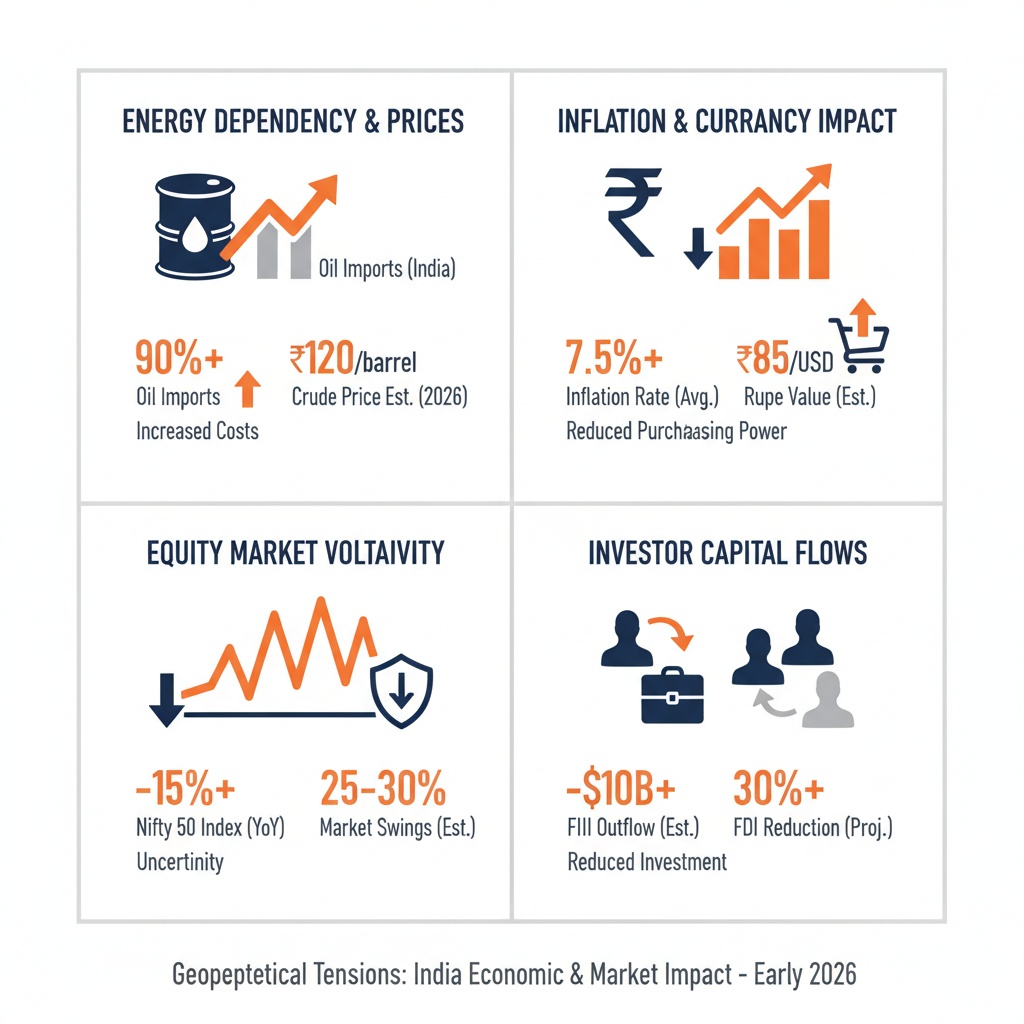
Infographic Image: Geopolitical Tensions and Their Impact on India’s Economy and Markets in Early 2026
This analysis seeks to systematically investigate how the unfolding West Asian geopolitical landscape affects Indian equity markets through multi-dimensional channels. It encompasses an assessment of crude oil price sensitivities, inflationary and currency dynamics, monetary and fiscal policy responses, market index volatilities, sector-specific valuation impacts, and behavioral responses of both foreign and domestic investors. The scope covers empirical data from Q1 2026 alongside behavioral finance insights to provide a holistic understanding of market mechanics under stress.
The methodological approach integrates macroeconomic analysis, quantitative market performance tracking, and qualitative sentiment evaluation, supported by recently observed data and documented capital flow trends. By dissecting these interconnected layers, this analysis aims to equip investors, policymakers, and analysts with actionable insights and strategic frameworks necessary to navigate the heightened uncertainty stemming from West Asia’s geopolitical tensions.
1. Geopolitical Landscape and Its Macroeconomic Implications
The escalating geopolitical tensions in West Asia during early 2026 have crystallized as a pivotal external shock to the Indian economy, fundamentally shaping its macroeconomic landscape. As one of the world’s largest crude oil importers, India's macro-fundamentals are inherently sensitive to developments in this volatile region. Notably, the recent temporary ceasefire between the US and Iran and the partial reopening of the Strait of Hormuz offer a brief respite, but the underlying risk of renewed conflict continues to inject considerable uncertainty into global oil markets. This backdrop underscores the indispensable role of the oil price channel in transmitting geopolitical instability to India's inflation, currency dynamics, and broader economic stability. Understanding this connection is essential for framing the subsequent market and investor responses within India’s economy.
India’s Oil Import Dependency and Crude Price Sensitivity
India’s crude oil import dependency has remained structurally high for decades, intensifying as the economy's energy demand grew alongside rapid industrialization and urbanization. As of April 2026, approximately 85% of India’s crude oil requirements are met through imports, equivalent to roughly 4.5 million barrels per day, with key suppliers including the UAE, Saudi Arabia, Iraq, and increasingly diversified sources from Africa and Russia. The predominance of Middle Eastern crude in the import basket—highlighted by UAE (42%), Saudi Arabia (20%), and Iraq (17%) shares—ties India’s energy security directly to the stability of West Asia geopolitics and supply routes such as the strategically vital Strait of Hormuz.
The sensitivity of Indian crude import costs to geopolitical shocks is primarily transmitted through Brent crude prices, which have historically traded at a premium to West Texas Intermediate benchmark levels by five to ten dollars per barrel. Brent serves as the benchmark for India’s crude purchase contracts, with prices oscillating sharply amid regional conflicts. Between 2024 and early 2026, Brent crude witnessed volatile swings between $70 and $120 per barrel, peaking at around $118 in March 2026 amidst renewed Middle East tensions. These price surges are episodic responses to supply risk fears, tightening physical availability, and precautionary market behavior.
The combination of high import dependency and crude price volatility leads to substantial fiscal and economic consequences. When geopolitical risks intensify, as observed during the Iran-US standoff or the brief Strait of Hormuz closure, crude prices spike, increasing India’s oil import bill significantly. For example, at Brent prices exceeding $100 per barrel, monthly crude import costs can surpass ₹300 billion (approximately $4 billion), exerting notable pressure on India’s trade balance. Furthermore, Indian refiners, while benefitting upstream producers like ONGC from higher realizations, face complex margin volatility downstream due to their inability to fully pass along elevated input costs under regulated fuel pricing frameworks.
Impact on Inflation and Currency Dynamics
The direct transmission of rising crude oil prices to domestic inflation in India is profound and multifaceted. Elevated oil prices increase the costs of transportation, logistics, and production inputs across a spectrum of goods and services, triggering a classic cost-push inflation scenario. This effect permeates sectors including petrochemicals, fertilizers, manufacturing, and retail consumer goods, erecting a chain of inflationary pressures that complicate the Reserve Bank of India’s (RBI) monetary policy landscape.
Empirical data from Q1 2026 corroborates this impact: headline Consumer Price Index (CPI) inflation rose to 6.5% year-over-year in March 2026, exceeding the RBI’s target range, primarily driven by fuel and transport price surges linked to crude prices. Notably, food inflation has also edged upward, as fertilizer and irrigation costs climb alongside higher natural gas and diesel prices, straining agricultural supply chains and food production expenses. These compounded inflation pressures are politically sensitive, given their direct impact on household consumption and poverty alleviation goals.
Simultaneously, the Indian Rupee has exhibited significant volatility and depreciation against the U.S. dollar in this period, weakening from near ₹76 per dollar in early 2025 to about ₹94 in March 2026—a depreciation exceeding 23%. Since oil imports are invoiced in U.S. dollars, this devaluation magnifies the rupee cost of crude imports independently of dollar price movements, further exacerbating inflationary pressures by raising domestic fuel prices even without changes in dollar-denominated oil prices. The depreciation is a function of a widening current account deficit, driven by the soaring oil import bill and geopolitical risk aversion among foreign investors, as evidenced by increased volatility in currency markets during episodes of West Asia tension.
The interlinked dynamics of price surges and currency depreciation create a feedback loop, whereby higher crude prices weaken the rupee, which in turn increases crude import costs and fuels further inflation. This complex macroeconomic stress requires nuanced policy calibration to avoid a spiral of inflation and currency instability.
Government and Central Bank Policy Responses to Energy Price Shocks
India’s policy apparatus has confronted these energy price shocks with a combination of fiscal and monetary measures aimed at cushioning macroeconomic disruption while preserving growth momentum. On the fiscal front, the government has employed excise duty reductions on petrol and diesel as immediate relief mechanisms to soften the pass-through of crude price inflation to end consumers. For instance, recent excise cuts lowered rates by up to ₹9 per liter on key fuels, manifesting as temporary support to mitigate inflation spikes and consumer distress during peak price volatility in early 2026.
Simultaneously, targeted subsidies remain an important tool, particularly in sectors like fertilizers, where rising natural gas and energy costs transmit inflation risks to agriculture and food prices. However, sustaining such subsidies amid fiscal constraints challenges government budgeting and capital expenditure plans, limiting room for aggressive stimulus or infrastructure spend expansion. The higher energy import bill driven by crude price surges can widen the fiscal deficit, prompting cautious fiscal management.
The Reserve Bank of India faces a complex policy quandary amid these developments. On the one hand, rising inflation above the prescribed target range necessitates monetary tightening or calibrated liquidity measures to anchor inflation expectations. On the other hand, elevated geopolitical uncertainties and global financial volatility weigh down growth prospects, dissuading aggressive rate hikes. In early 2026, the RBI opted for a balanced approach—maintaining accommodative stance while actively monitoring inflation developments and currency stability. The central bank has also engaged in forex intervention to curtail extreme rupee volatility and stabilize external account metrics, attempting to decouple currency depreciation from inflationary momentum.
Macroprudential tools have been cautiously deployed to manage capital flows amid episodic foreign portfolio investor (FPI) volatility triggered by geopolitical uncertainty. Thus, India’s policy response refracts the competing demands of inflation control, currency resilience, and growth support within a geopolitically constrained external environment.
Recognizing the systemic risks of energy import dependence, the government has also accelerated strategic initiatives such as expanding domestic refining capacity, promoting ethanol blending in transportation fuels, and enhancing renewable energy adoption. These medium-to-long term measures aim to reduce crude import sensitivity and build macroeconomic resilience against recurring West Asia shocks, aligning with the broader energy security and climate goals.
2. Impact on Indian Equity Market Performance and Sectoral Trends
The turbulence emanating from escalating geopolitical tensions in West Asia has reverberated significantly across Indian equity markets, transforming macroeconomic shocks into pronounced market-level volatility and sectoral shifts. Building upon the foundational macroeconomic context, this section delves into how the crosscurrents of heightened crude oil price volatility, currency fluctuations, and inflationary pressures have manifested within key market indices and sectors, shaping investor allocations and market valuations in early 2026. Unlike traditional macroeconomic analyses, this perspective offers a granular, data-driven understanding of market mechanics—linking geopolitical uncertainties directly to equity market outcomes and identifying actionable implications for investors navigating this uncertain terrain.
Throughout the first quarter of 2026, Indian benchmark indices experienced pronounced fluctuations correlated closely with geopolitical developments in West Asia, notably the ongoing Iran-US tensions and disruptions in the Strait of Hormuz. Sensex and Nifty 50 indices exhibited sharp corrections amounting to declines exceeding 10 percent during key episodes of escalation, accompanied by elevated market fear reflected in the India VIX index, which surged beyond historical norms, signaling heightened uncertainty and risk aversion among market participants. This elevated volatility contrasted sharply with the relative steadiness observed in the prior year, underscoring the direct transmission of geopolitical risk shocks into market pricing mechanisms. While these episodes triggered broad-based risk-off sentiment, the impact was decidedly uneven across sectors, reflecting contrasting sensitivities to oil price movements, currency fluctuations, and shifting investor risk appetite.
Foreign institutional investors (FIIs) and domestic institutional investors (DIIs) played pivotal roles in shaping market flow dynamics amid this uncertainty. The first quarter recorded significant net outflows by FIIs, with data indicating withdrawals exceeding ₹88,000 crore by mid-March 2026—the highest recorded monthly FII sell-off in recent years—primarily triggered by geopolitical anxieties and concurrent global monetary tightening signals. Conversely, DIIs absorbed much of this selling pressure, deploying capital in value-oriented sectors, and bolstering market resilience. Data shows DIIs registering net inflows of ₹1,40,000 crore in March 2026 alone, highlighting a strong counterbalance to FII exits and reflecting a defensive investment posture amid market volatility [Chart: FII and DII Investment Flow Trends in March 2026]. This bifurcation of capital flows offers an important insight into the structural undercurrents at play; while global investors sought liquidity amidst risk aversion, domestic investors leveraged dislocations to accumulate high-quality assets at attractive valuations, setting the stage for differentiated sectoral outcomes and opportunities. Together, these dynamics form the core fabric of Indian equity market behavior in the face of West Asia’s geopolitical upheaval.
Summary of Market Indices Movement and Volatility Metrics
The Indian equity markets, as measured by the Sensex and Nifty 50, demonstrated acute sensitivity to the intensification of tensions in West Asia throughout Q1 2026. Notably, the Sensex registered a peak-to-trough decline exceeding 11 percent between January and mid-March, with the Nifty 50 mirroring this movement closely. These drawdowns were punctuated by intraday surges in volatility, as the India VIX index spiked from an average of 15 in late 2025 to peak levels surpassing 28 during the height of geopolitical scares around late February and early March. Such elevated volatility reflects not only heightened uncertainty but also rapid repricing of risk premiums by market participants in response to shifting oil price trajectories and currency fluctuations.
Crude oil prices played a critical intermediary role in influencing market indices behavior. Brent crude surged over 25 percent within a span of under two months, breaching $115 per barrel by mid-March 2026 amid concerns over supply chain disruptions at the strategically vital Strait of Hormuz. Given India's import dependence of over 85 percent for crude oil, this spike translated into immediate cost pressures for energy-intensive sectors, tightening margins, and dampening corporate earnings projections. Against this backdrop, equity markets grappled with the dual challenge of pricing in inflationary headwinds and possible monetary policy recalibrations, spurring cautious positioning and episodic market corrections.
Additionally, currency fluctuations, particularly the depreciation of the Indian Rupee against the US Dollar to levels near ₹93.50, compounded market stress. Such weakness reflected the adverse external account pressure arising from higher import bills and corresponding capital outflows. The rupee depreciation introduced further earnings concerns for corporates with foreign currency exposure and amplified volatility in foreign exchange derivatives markets, which in turn fed into equity market risk metrics. This concatenation of higher oil prices, currency pressure, and geopolitical uncertainty was materialized in beta adjustments and sector rotation amongst Indian equities, crystallizing in the pronounced cleavages observed in market performance.
Sector-Specific Impacts and Value-Buy Opportunities
The sectoral landscape of the Indian equity market exhibited marked divergence under the geopolitical and macroeconomic duress, highlighting clear winners and losers that present nuanced opportunities and risks for discerning investors. The energy sector surfaced as the unparalleled beneficiary of the crude oil supply concerns, with integrated energy companies and upstream producers posting elevated earnings forecasts, driven by windfall gains from rising Brent prices and advantageous crude sourcing dynamics. Notably, companies such as ONGC and Nayara Energy leveraged their asset flexibility and operational scale to capitalize on widened refining margins amid Brent volatility. Dahivedan et al. (d5) report optimistic earnings revisions for ONGC into fiscal 2027, emphasizing a robust margin environment despite prevailing market stress.
Conversely, the downstream oil marketing companies (OMCs) and gas distribution players encountered margin squeeze due to lagged pricing adjustments and higher input costs. Public-sector refiners such as Bharat Petroleum (BPCL) and Indian Oil Corporation Ltd (IOCL) faced direct profit compression resulting from sustained elevated international fuel prices not immediately transmitted to consumer prices, constraining marketing margins. Gas sector players like GAIL and Indraprastha Gas Limited encountered volatility linked to imported LNG cost inflation and pricing rigidities, as cited in sector-specific analyses (d5). This bifurcation within the energy value chain underscores the importance of thorough fundamental analysis when identifying sector winners amid geopolitical shocks.
The defense sector demonstrated a pronounced upside, catalyzed by anticipated increases in government spending driven by heightened strategic imperatives and the Atmanirbhar Bharat defense indigenisation agenda. Market participants have increasingly viewed defense as a safe-haven thematic play amidst geopolitical uncertainty, with heightened order flows into key domestic players engaged in missile systems, avionics, and unmanned platforms. Recent capital allocation trends and policy signals further bolster this sector’s medium-term prospective growth profile, as geostrategic alignments emphasize self-reliance and accelerated procurement—a dynamic uniquely accentuated by West Asia tensions (d2, d6). The defense sector’s relative insulation from input cost volatility alongside anticipated revenue growth positions it as a compelling sector for strategic accumulation.
Consumer discretionary sectors, especially automobile manufacturers and ancillary industries, experienced mixed outcomes. Rising fuel costs and inflationary pressures dampened demand sentiment in the short term, leading to valuation compression for discretionary consumption stocks. However, the structural resilience of select auto component manufacturers benefiting from global supply chain reorientation away from China (China+1 strategy) provided pockets of opportunity, especially among firms integrated into tier-one global supply chains. This sector-level differentiation affirms the evolving market narrative where tactical sector allocation must incorporate both cyclical headwinds and structural demand shifts.
Other sectors such as information technology and financials experienced relative underperformance, influenced by risk-averse investor reallocation away from growth-sensitive segments towards defensive assets. Utilities and select infrastructure plays benefited from stable cash flows and increasing policy support tied to energy diversification and renewable investments. Overall, these sectoral divergences highlight the importance of precision in portfolio construction, where discerning value across and within sectors can unlock superior risk-adjusted returns amidst heightened volatility and uncertainty.
FII and DII Investment Flow Trends in Response to Geopolitical Developments
The impact of geopolitical uncertainty was keenly reflected in the contrasting flows of foreign institutional investors (FIIs) and domestic institutional investors (DIIs) during early 2026. FIIs exhibited significant net outflows, amounting to approximately ₹88,000 crore by mid-March alone, marking the steepest monthly exit since 2018 (d7). These outflows were predominantly motivated by global risk aversion stemming from West Asia tensions, coupled with domestic inflationary pressures exacerbated by oil price shocks and hawkish global monetary policy signals. The selling by FIIs often acted as a catalyst for index declines and amplified volatility, given their outsized role in market liquidity and directional momentum (d8).
In a notable counterbalance, DIIs—comprising mutual funds, insurance companies, pension funds, and other domestic asset managers—steadily increased their net purchases during this period, absorbing much of the selling pressure from FIIs. Data indicates DIIs cumulatively purchased over ₹1,40,000 crore in March 2026, reflecting a strategic opportunity play, supported by attractive valuations emerging from the sell-offs and confidence in India’s medium-term growth prospects despite geopolitical headwinds [Chart: FII and DII Investment Flow Trends in March 2026]. This domestic investor resilience provided much-needed market stabilization, cushioning broader index drawdowns and facilitating sector rotation towards quality names and defensive plays (d2, d34, d35).
Analyzing sector-wise flow patterns reveals a strategic tilt by both FIIs and DIIs aligned with evolving risk perceptions. FIIs exhibited accelerated exits from consumer discretionary, information technology, and cyclically sensitive sectors, while increasing allocations marginally to energy and defense. Conversely, DIIs favored energy, utilities, and select consumer staple segments, reflecting a defensive orientation. Importantly, some segments within the industrials and materials sectors attracted meaningful institutional interest from DIIs, driven by structural growth themes such as infrastructure development and the manufacturing renaissance catalyzed by global supply chain realignments.
The persistent divergence in FII and DII activity underscores a broader structural theme in Indian equity markets: while foreign investors remain cautious amid external shocks, domestic institutions continue to reinforce market depth and act counter-cyclically. This dynamic emphasizes the criticality for investors to monitor real-time capital flow patterns as important indicators of market direction and sectoral rotations during periods of geopolitical stress. Integrating flow data with fundamental sector analyses enhances forecasting precision and enables more tactical portfolio adjustments aligned with evolving market realities.
3. Investor Behavior and Market Sentiment Under Geopolitical Uncertainty
The unfolding geopolitical tensions in West Asia have generated waves of uncertainty that extend far beyond the immediate regional conflict zones, profoundly affecting global financial markets. While Section 2 detailed the quantitative index movements and sectoral shifts witnessed in Indian equity markets amid these tensions, it is the underlying investor psychology and sentiment dynamics that truly drive such volatility and market reactions. Understanding how investors behave in the face of geopolitical uncertainty is essential to decoding market swings—especially in emerging markets like India, which remain sensitive to external shocks through capital flow reversals and risk repricing. This section delves into the nuanced patterns of investor risk aversion, the pivotal role of foreign institutional investors (FIIs) in shaping market direction, and the behavioral finance principles that govern decisions during crises. By viewing market responses through the lens of investor sentiment cycles and psychological triggers, we unveil the qualitative undercurrents shaping equity valuations beyond fundamental and technical factors.
Geopolitical volatility acts as a powerful psychological stimulus that sharpens investor risk perceptions, often triggering reflexive and sometimes counterproductive behaviors. These behaviors stem from cognitive biases such as loss aversion, herd mentality, and availability bias, which can lead to exaggerated price movements disconnected from long-term fundamentals. Moreover, the strategic allocation decisions by foreign institutional investors—who control a substantial portion of tradable Indian equities—serve both as amplifiers and barometers of market sentiment. Their collective risk reassessment can initiate swift flight-to-safety maneuvers or market rebounds, reinforcing the cyclical nature of market sentiment. Hence, for investors aiming to navigate the turbulent 2026 landscape marked by recurring West Asia flashpoints and their reverberations on Indian markets, grasping the psychology behind risk aversion and capital flows is as critical as macroeconomic analysis and sectoral evaluation.
Patterns of Investor Risk Aversion and Flight-to-Safety Asset Preferences
Investor behavior under geopolitical stress is characterized primarily by heightened risk aversion that manifests almost instantaneously following adverse news flow. The unpredictability of conflict escalation and the asymmetry of available information create an environment rife with uncertainty, which investors interpret as increased probability of loss. Empirical data from multiple geopolitical episodes since 2023 reveal a consistent pattern: the immediate aftermath of West Asia tensions triggers a pronounced 'flight to safety' phenomenon among both domestic and international investors. This behavior encompasses rapid liquidation of risk-exposed assets, primarily equities, accompanied by increased demand for traditionally perceived safe havens such as gold, the US dollar, and high-grade government bonds.
In the context of Indian equity markets, the flight-to-safety is visible through abrupt sell-offs in sectors most sensitive to crude oil price shocks and global trade uncertainties, notably discretionary consumer goods and capital-intensive industries. Investors simultaneously ramp up their holdings in gold ETFs and short-term government securities. Data from Q1 2026 indicate that during peak tension episodes, gold prices surged by up to 5%, while the Indian rupee depreciated nearly 1.5% against the US dollar within a single week, underscoring capital shifts toward safety. Furthermore, volatility indices like the India VIX spike sharply, capturing the market’s collective risk intolerance and hedging demand. This pattern aligns with behavioral finance theory, which posits that under threat perception, investor preference shifts from return maximization toward capital preservation—a fundamental cognitive shift critical to understanding short-term market dynamics amid geopolitical instability.
Role and Influence of Foreign Institutional Investors’ Sentiment and Behavior
Foreign institutional investors hold a dominant influence over Indian equity market liquidity and valuation trends, accounting for nearly 40% of total market capitalization trading volume as of early 2026. Their sentiment and collective behavior serve as a key transmission channel through which geopolitical shocks ripple through the markets. Analysis of FII flows during heightened West Asia tensions in 2025 and early 2026 reveals a pattern of rapid withdrawal followed by cautious re-entry aligned with diplomatic developments and conflict de-escalation signals.
Sentiment among FIIs is acutely sensitive to news headlines and geopolitical intelligence, often driving abrupt shifts in portfolio allocations. The behavioral patterns include an initial surge in risk-off positioning, characterized by increased allocations to US Treasuries and global liquidity products, followed by selective rebalancing into sectors perceived as defensive or insulated from geopolitical fallout. The preference for safe-haven currencies, such as the US dollar and Swiss franc, further reflects the currency risk aversion among these investors during crisis periods. Notably, sophisticated FIIs engage in dynamic hedging strategies to mitigate exposure, leveraging derivative instruments to circumvent direct equity sell-offs. This nuanced behavior highlights the importance of sentiment analysis in forecasting FII flows, which in turn critically impacts market direction and volatility in Indian equities during geopolitical episodes.
Behavioral Finance Cues Relevant to Managing Investments During Geopolitical Crises
Behavioral finance provides valuable insights into the cognitive and emotional biases influencing investor decisions during geopolitical uncertainty—insights that can enhance risk management and investment discipline. Among the most pervasive is loss aversion, where the pain of potential losses disproportionately outweighs equivalent gains, prompting premature selling and heightened market volatility. This phenomenon was evident during the late 2025 flare-up in West Asia tensions when Indian equity markets experienced sharp sell-offs disproportionate to the eventual economic impact, illustrating reactive rather than rational decision-making driven by fear.
Herd behavior further compounds volatility as individual investors mimic the majority, often amplifying price swings. This is reinforced by availability bias, where recent or highly salient geopolitical events dominate investor attention, sometimes overshadowing broader market fundamentals. Investors may overweight conflict headlines and underappreciate mitigating factors such as diplomatic negotiations or economic resilience, leading to excessive market pessimism. Recognizing these biases, seasoned investors and wealth managers can adopt contrarian strategies—buying during phases of excessive fear and maintaining disciplined diversification to mitigate overexposure to any single geopolitical risk.
Moreover, the concept of ‘sentiment cycles’ is crucial: markets often endure an initial phase of panic and sell-off, followed by stabilizing hope and eventual recovery as information flow clarifies. Historical precedence from previous geopolitical crises underlines the importance of avoiding emotional trading during the fear and despair phases. Instead, employing systematic investment frameworks, such as dollar-cost averaging and periodic portfolio rebalancing, can reduce the impact of volatility spikes induced by sentiment shifts. Integrating sentiment indicators, such as market volatility indexes and FII flow data, with behavioral finance principles equips investors to better navigate the inevitable oscillations associated with geopolitical crises.
Conclusion
The interplay between West Asia geopolitical tensions and Indian equity markets reveals a complex transmission mechanism where crude oil price shocks serve as the primary conduit linking external conflicts to domestic economic vulnerabilities. The resulting inflationary pressures, currency fluctuations, and heightened market volatility present both challenges and strategic opportunities. The observed patterns of foreign institutional investor withdrawal juxtaposed with domestic investor accumulation underscore the evolving structural dynamics influencing market resilience.
From an investment perspective, an informed and nuanced approach that accounts for sector-specific sensitivities and investor sentiment cycles is critical. Energy and defense sectors emerge as potential beneficiaries amid sustained geopolitical risks, while discretionary sectors face headwinds. Policymakers’ calibrated responses—balancing inflation control with growth support—will remain pivotal in mitigating systemic risks and ensuring stability.
Finally, the analysis identifies key areas warranting further exploration, including longer-term impacts of strategic energy diversification initiatives, evolving global capital flow patterns in response to geopolitical shocks, and enhanced modeling of behavioral finance factors in emerging market contexts. Continued monitoring and adaptive strategies will be essential for market participants aiming to optimize portfolios and policy frameworks in an environment marked by enduring geopolitical uncertainties.
Glossary
- Brent Crude: A major trading classification of sweet light crude oil that serves as a global benchmark price, particularly used for pricing Indian crude oil imports.
- Foreign Institutional Investors (FIIs): Investment entities such as mutual funds, pension funds, and hedge funds based outside India that invest in Indian equity markets and influence liquidity and market trends.
- India VIX: The volatility index for the Indian stock market, measuring the market’s expectation of near-term volatility based on Nifty options pricing.
- Flight to Safety: An investor behavior pattern during times of market stress or geopolitical uncertainty where capital shifts from risky assets to safer ones like gold, government bonds, or stable currencies.
- Monetary Tightening: A central bank policy action to increase interest rates or reduce liquidity aimed at controlling inflation and stabilizing the currency.
- Cost-Push Inflation: Inflation caused by rising input costs, such as crude oil price increases, which push up prices across goods and services.
- Foreign Portfolio Investors (FPIs): A subset of foreign institutional investors specifically investing in equity and debt securities without having direct control over the companies.
- Atmanirbhar Bharat: An Indian government initiative aiming for self-reliance in manufacturing and defense sectors, particularly emphasized during geopolitical tensions.
- Strait of Hormuz: A strategically critical maritime chokepoint between Oman and Iran through which a significant portion of the world’s crude oil exports, including to India, transit.
- Excise Duty: A government tax on the manufacture or sale of certain goods within the country, including petrol and diesel, used as a tool to manage fuel prices.
- Reserve Bank of India (RBI): India’s central banking institution responsible for monetary policy, currency management, and regulating financial stability.
- Consumer Price Index (CPI) Inflation: A measure of the average change over time in the prices paid by consumers for a market basket of consumer goods and services.
- Domestic Institutional Investors (DIIs): Indian-based financial institutions such as mutual funds, insurance companies, and pension funds that invest in domestic equity markets.
- Beta Adjustment: A change in a stock’s or sector’s sensitivity to overall market movements, often reflecting risk reassessment during volatile periods.
- Herd Behavior: The tendency of investors to follow the majority or crowd, which can lead to amplified market swings during periods of uncertainty.
References
- The Inflationary Impact of Rising Oil Prices in India: An Analytical Perspective
- Understanding Investor Behavior in Times of Geopolitical Conflict
- Impact of geopolitical risk on investor sentiment
- How Global Tensions Influence the Performance of the Indian Stock Market
- PDF The West Asia Conflict and Its Impact on The Indian Economy
- Rising oil prices and West Asia tensions are impac...
- 주식 시장의 롤러코스터 - 투자 심리 사이클 완벽 공략법
- Foreign Institutional Investors (FII): The Driving Force Behind The Indian Stock Market
- Instagram의 한국자기계발리더협회님 : "중동의 정세 불안을 주목하라: 이란과의 군사적 충돌이 주가에 미치는 영향 📈 최근 몇 년간, 국제 정세는 항상 예측하기 어려운 변수들로 가득 차 있습니다. 중동 지역의 정치적 긴장은 세계 경제와 금융 시장에 큰 영향을 미치고 있죠. 이란과 미국 간의 군사적 갈등이 심화되면서, 이 문제는 점점 더 많은 논의의 중심이 되고 있습니다. 이번 블로그 글에서는 미국과 이란 간의 군사적 갈등이 주식 시장 및 글로벌 경제에 미치는 영향에 대해 심층적으로 살펴보겠습니다. 이를 통해 투자자들이 현재 시장에서 어떤 전략을 가져야 할지를 논의해 보겠습니다. 🌍 중동은 전략적 위치와 자원 덕분에 항상 국제 사회의 주목을 받아왔습니다. 최근 이란의 군사적 행동과 미국의 대응은 더욱 긴장감을 고조시키고 있으며, 이러한 사태는 글로벌 주식 시장에 즉각적인 영향을 미치고 있습니다. 특히, 한국을 포함한 아시아 시장에서도 그 여파가 나타나고 있습니다. 이란의 군사적 긴장은 단순한 지역 문제를 넘어서, 전 세계 경제에 중대한 영향을 미치고 있습니다. 📉 미국과 이란 간의 갈등이 심화될수록 주가는 불안정한 모습을 보이고 있습니다. 투자자들은 갈등이 경제에 미치는 리스크를 우려하며, 변동성 높은 거래를 택하고 있습니다. 이런 상황에서 외국인 투자자들의 매도세가 증가하면서 한국의 코스피 지수도 큰 하락폭을 보였습니다. 이러한 현상은 단기적인 시장의 불안정을 반영하며, 장기적으로는 경제 전반에 부정적인 영향을 미칠 수 있습니다. 💱 더불어 중동의 불안정한 정세는 외환 시장에서도 큰 변화를 가져오고 있습니다. 최근 원화의 가치가 하락하면서, 수입 물가가 상승하게 되고 이는 소비자 물가 상승으로 이어질 수 있습니다. 소비자 물가 상승은 결국 경제에 악영향을 미치게 되죠. 따라서 외환 관련 투자자들은 더욱 신중하게 시장을 분석할 필요가 있습니다. ⚠️ 이란과의 갈등이 심화되면서 글로벌 경제의 리스크 요소도 증가하고 있습니다. 세계 각국의 경제 성장률이 둔화되고 있으며, 이러한 경향은 원자재 및 상품 가격에 직접적인 영향을 미칩니다. 특히, 석유와 가스 가격의 상승은 소비자와 기업에게 직접적인 부담을 줍니다. 결과적으로, 이러한 가격 상승은 전 세계 경제의 불확실성을 증가시키는 요인이 되고 있습니다. 🇰🇷 한국 경제 또한 중동의 정세 불안에 민감합니다. 석유 수입국인 한국은 중동에서 발생하는 갈등이 에너지 가격에 미치는 영향을 강하게 느낄 수밖에 없습니다. 또한, 한국 기업들의 해외 진출에도 부정적인 영향을 미칠 수 있으며, 이는 향후 경제 성장에 제약이 될 것입니다. 이러한 측면에서도 한국 경제는 중동 상황과 긴밀한 연관성을 가지고 있음을 알 수 있습니다. 🛡️ 그래서 투자자들은 이러한 불안정한 상황에서 어떻게 대처해야 할까요? 현재는 안전 자산에 대한 선호가 더 강해질 것으로 예상됩니다. 금, 미국 달러 등은 그 가치가 상승하는 경향을 보일 것입니다. 이 때문에 포트폴리오를 재조정하고 안전 자산에 대한 투자 비율을 늘리는 것이 중요합니다. 👩💼 전문가들은 현재 중동에서의 갈등이 장기화될 가능성이 높다고 경고하고 있습니다. 주식 투자자들은 격변하는 시장 상황을 지속적으로 모니터링하고, 리스크 관리에 유념해야 한다고 조언합니다. 이러한 불확실한 중동 정세는 투자자에게 장기적인 전략의 필요성을 암시합니다. 📜 결론적으로, 중동의 정세 불안은 경제 전반에 걸쳐 심각한 영향을 미치고 있으며, 투자자들은 현재의 시장 상황을 면밀히 분석할 필요가 있습니다. 이란과의 군사적 충돌은 한국을 포함한 세계 경제에 많은 리스크 요소를 안겨주고 있으며, 이에 따라 투자 전략 역시 신중하게 변화해야 할 것입니다. 현재의 경제 상황은 언제 바뀔지 모르기 때문에 유연한 투자가 필수적입니다. 안전 자산으로의 이동과 리스크 관리 전략을 통해 불확실한 시장 속에서도 자신만의 투자 전략을 세워나가는 것이 중요합니다. 여러분의 투자에 행운이 함께하길 바랍니다! #중동정세 #이란갈등 #주식시장 #투자전략 #글로벌경제 #안전자산 #경제변화 #외환시장 #한국경제 #리스크관리"
- India Oil Sector: Geopolitics Boosts Producer Prices, Squeezes Refiners | Whalesbook
- Key charts to help identify current sector trends
- India Markets Plunge Amid West Asia Tensions, Presenting Value Buys
- 중동전쟁 관련주 TOP10 | 미국 이란 이스라엘 전쟁
- 투자자 심리 파악을 위한 지표 사용법
- Understanding Geopolitical Risk in Investments | MSCI
- Geopolitics and Indian Markets: How Trump Tariffs, Middle East Tensions and China-Taiwan Affect Your Portfolio - Altius Investech
- Foreign Investors Withdraw ₹88,180 Cr from Indian Equities | DD News On Air
- A strategic ethanol shift amid West Asia tensions
- Iranian oil flows to India remain uncertain amid sanctions signals and market volatility | Domain-b.com
- Global equity markets, including... - The New Indian Express