Navigating the Energy Shock: Real-Time Insights on Iran War’s Impact on Commodity Markets
A Data-Driven Briefing on Market Volatility, Price Surges, and Supply Chain Risks
Table of Contents
Executive Summary
This briefing provides a concise overview of how the ongoing Iran war is dramatically reshaping global commodity and energy markets. Key insights highlight an unprecedented surge in oil prices nearing $200 per barrel, driven by heightened geopolitical risk premiums and strategic chokepoint vulnerabilities such as the Strait of Hormuz. The ripple effects extend beyond energy, causing critical fertilizer shortages that jeopardize global food security. Automated, real-time intelligence synthesis is essential for stakeholders to anticipate market disruptions and adapt rapidly to evolving conditions.
Introduction
The escalation of the Iran war in early 2026 has created profound uncertainty within global commodity markets, notably in the energy sector. This conflict, marked by multifaceted geopolitical tensions and regional military actions, threatens vital supply routes and elevates risk perceptions that extend beyond physical disruptions. The resultant volatility and price surges reflect a complex interplay of strategic chokepoints, risk premiums, and speculative market behaviors.
This briefing aims to distill the latest real-time data, geopolitical developments, and supply chain dynamics to empower investors, policymakers, and industry stakeholders with actionable insights. By focusing on key market signals—including oil price trajectories, commodity index performance, and fertilizer supply constraints—the document underscores the interconnected risks that necessitate agile strategy adjustments in an environment of pervasive instability.
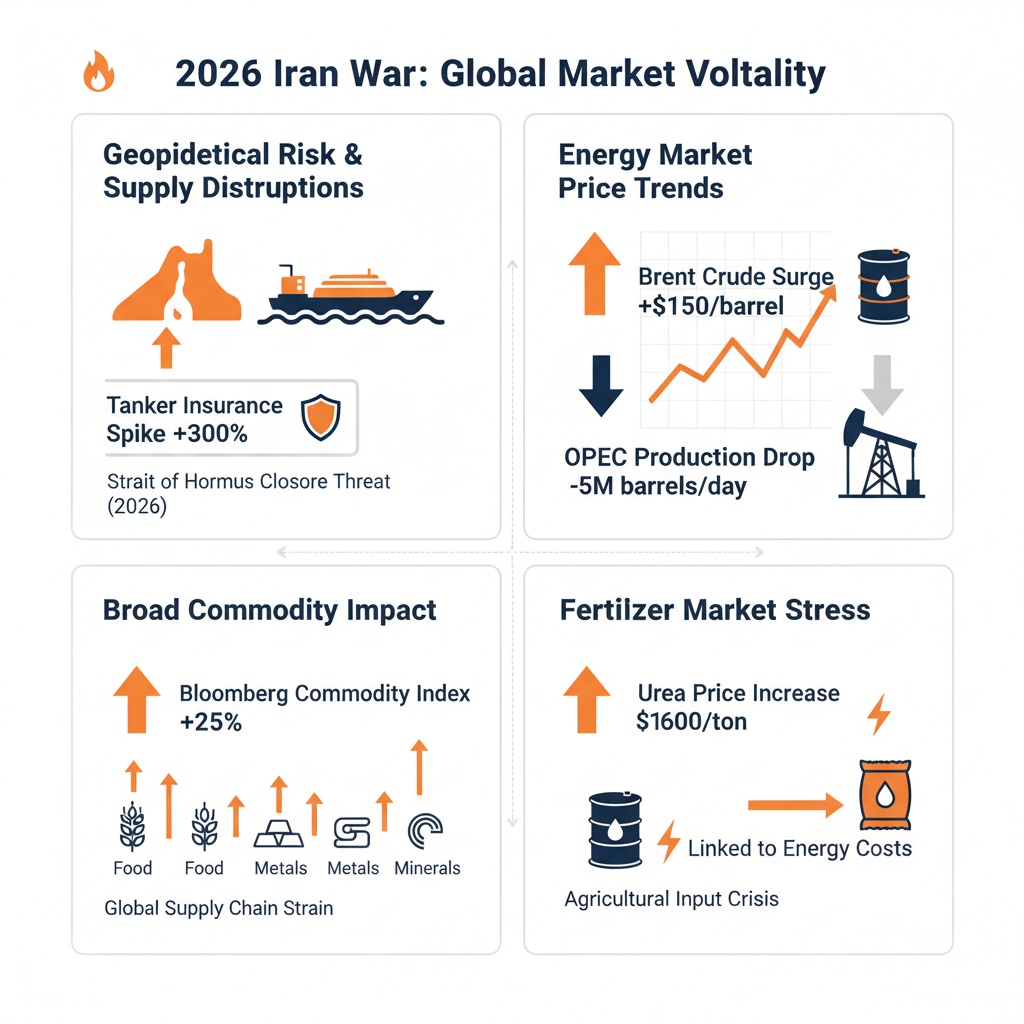
Infographic Image: Geopolitical Conflict Drives Unprecedented Energy and Food Market Volatility in 2026
1. Geopolitical Drivers of Market Volatility
The escalation of the Iran war and its spillover conflicts in the Middle East have emerged as the primary catalysts destabilizing global commodity and energy markets in 2026. This conflict, unfolding at the nexus of deep-rooted regional animosities, strategic interests, and global power contestations, fundamentally reshapes market sentiment by injecting profound uncertainty into supply chains that underpin the world economy. Unlike previous energy disruptions that were driven solely by physical supply shocks, the present Iran war generates a multi-layered geopolitical risk premium embedded in commodity pricing, which anticipates not just immediate outcomes but prolonged systemic volatility. This section unpacks the geopolitical dynamics driving market turbulence, situating the energy shock within the broader matrix of conflict, strategic chokepoint vulnerabilities, and risk perception among sovereign and private actors.
By contextualizing market volatility in the concrete realities of the Iran war and related regional tensions, we establish a critical foundation for interpreting subsequent price trends and supply chain disruptions. Understanding the war's direct impact on critical energy transit routes—most notably the Strait of Hormuz, through which nearly one-fifth of the world’s oil and liquefied natural gas shipments pass—is essential to grasp why markets respond so sharply to political signals. This geopolitical dissection enables a nuanced comprehension of how risk premiums elevate price levels independent of immediate physical supply cuts, emphasizing the anticipatory nature of modern energy markets. The analysis here distinguishes cause from effect, clarifying why the ongoing conflict is the linchpin in the current surge of global market volatility.
Overview of the Iran War and Regional Conflict Escalation
The Iran war, which intensified rapidly since early 2026 with coordinated military actions involving Iran, Israel, and allied powers, extends beyond a conventional state-to-state conflict and embodies a multifaceted geopolitical struggle over regional influence, energy control, and security alliances. The military engagements commenced with airstrikes and proxy escalations, followed by a series of sanctions, retaliatory attacks on oil infrastructure, and cyber disruptions targeting energy companies and critical logistics. This conflagration not only includes the direct combatants but embroils neighboring states and global powers vying for strategic dominance, creating a complex theater of conflict that fuels persistent uncertainty in global markets. The broad geographic scope of instability—from the Persian Gulf to Levantine flashpoints—exacerbates fears of wider disruptions in a region accounting for over 30% of global oil production capacity.
Key developments in March and April 2026, such as Iran’s intermittent threat and partial closure of the Strait of Hormuz, constitute turning points that triggered global energy price shocks. These actions directly threaten the free flow of crude oil and natural gas exports not only from Iran itself but also from Saudi Arabia, the United Arab Emirates, Kuwait, and Iraq, whose economies rely heavily on this transit corridor. The conflict’s progression has seen fluctuating periods of attempted diplomacy shadowed by aggressive military posturing, which together sustain a highly volatile environment. Regional allies have bolstered military presence, while international bodies have issued travel warnings and moved to secure alternative energy and shipping routes, signaling that the conflict’s impact transcends immediate war zones.
Impact of Middle East Instability on Energy Supply Routes and Pricing
The Strait of Hormuz epitomizes the vulnerability of global energy supply chains to regional instability. Handling roughly 20% of the world’s seaborne oil exports and nearly 30% of global liquefied natural gas shipments, this narrow maritime corridor is a critical artery for international energy flow. The Iran war-induced threats to this chokepoint have precipitated widespread concern among market participants, triggering sharp spikes in insurance premiums for tanker vessels, rerouting of shipments, and heightened logistical complexities. Alternative routes—such as the East-West pipeline in Saudi Arabia and the Bab el-Mandeb corridor—operate near full capacity and are insufficient to entirely offset the risk of Hormuz disruption. Consequently, any credible threat or partial blockade along this passage instantly translates into amplified market nervousness.
In response, the geopolitical risk premium embedded in oil prices has surged independently of immediate physical supply reductions. For example, despite actual OPEC production declines of 7.3 million barrels per day reported in March 2026—largely attributable to operational disruptions and voluntary cuts—markets have reacted disproportionately due to the perception of prolonged and systemic risk. Insurance costs for maritime transport through the Gulf of Oman and Arabian Sea have escalated to levels approximately 50 times above peacetime rates, translating to an additional cost of several dollars per barrel. This escalation pressures refinery margins and influences regional price spreads, with Asian refineries experiencing margin contractions between 40-60% during peak tension months. The elevated operational risks lead to increased spot market premiums, especially in Asian crude benchmarks that rely heavily on Middle Eastern supplies.
Beyond physical passage, the conflict disrupts not only shipping but also onshore infrastructure—pipelines, ports, and storage facilities—through direct attacks or sabotage attempts. These infrastructural threats compound uncertainties and delay recovery timelines, compelling energy companies and national producers to reassess production planning, storage buffer levels, and supply diversification. The aggregate effect is a fragile energy ecosystem where supply chains are persistently at risk, and market participants are incentivized to price in these compounded geopolitical threats through risk premiums above the fundamental cost-structure benchmarks.
Geopolitical Risk Premiums in Oil Markets: Mechanisms and Market Behavior
Geopolitical risk premiums represent the component of commodity prices that exceeds the intrinsic supply-demand fundamentals, reflecting perceived uncertainties, potential disruptions, and strategic positioning driven by political conflict. In the context of the Iran war, these premiums have become the dominant factor amplifying oil price volatility. The premium accounts for a combination of factors including heightened tanker insurance costs, increased costs of alternative logistical routes, uncertainty regarding production stability in conflict-affected fields, and speculative positioning by market participants hedging against worst-case scenarios. For instance, futures contracts for Brent crude in mid-2026 contain inflated prices driven not by current supply constraints alone but by market anticipation of protracted risk in transit security and production reliability.
Empirical market data from April 2026 illustrates the dynamic role of geopolitical risk premiums. The volatility index (VIX) associated with crude oil futures has spiked by over 300%, reflecting traders’ increased sensitivity and hedging demand. Transaction spreads between prompt and deferred contracts have widened, implying a steepened futures curve as markets price in higher near-term uncertainty with gradually moderating long-term risk. Option markets show volatility premiums approximately threefold above historical averages, indicating increased demand for protective trading strategies amid murky conflict outlooks.
This elevated risk environment also encourages marked portfolio shifts among institutional investors and hedge funds, with increased allocations to energy-defensive assets and commodities that traditionally serve as inflation and geopolitical hedges, such as gold. The interplay of fundamental and speculative flows exacerbates price swings, at times decoupling prices from physical supply fundamentals. Such dynamics challenge classical market models, requiring stakeholders to incorporate real-time geopolitical intelligence, automated risk signal processing, and integrated scenario analyses to navigate these unprecedented fluctuations effectively.
In summary, geopolitical risk premiums arising from the Iran war and associated Middle East conflicts are foundational to understanding the unprecedented market volatility observed in 2026. These premiums amplify price movements, complicate supply chain predictability, and introduce persistent uncertainty that necessitates adaptive risk management strategies for all energy market actors.
2. Market Dynamics and Price Trends in Energy Commodities
The ongoing conflict in Iran has fundamentally reshaped the global energy commodity landscape, driving price turbulence that reflects both acute geopolitical risks and deeper structural imbalances. Building directly on the geopolitical context outlined previously, this section quantifies the market’s reaction by analyzing empirical evidence of oil price movements and broad commodity index performance, underscoring the unprecedented volatility gripping energy markets. This data-driven exploration affirms that the war’s influence extends well beyond isolated political events, compelling market participants to recalibrate risk assessments, trading strategies, and portfolio allocations under rapidly evolving conditions.
Oil prices, particularly benchmarks such as Brent crude and West Texas Intermediate (WTI), have exhibited extraordinary swings in the first quarter of 2026. Brent crude, which prices roughly three-quarters of global trade, surged sharply from near $70 per barrel at the start of the year to intraday peaks around $119.50, marking one of the most rapid and volatile price rallies in recent memory. WTI followed a similar trajectory, climbing above $100 per barrel for the first time since mid-2022. This volatility, characterized by multi-day daily price fluctuations exceeding 10%, is rooted in market anxiety over potential supply disruptions at strategic chokepoints such as the Strait of Hormuz, where approximately 20% of global oil transits during peacetime. These price distortions are amplified by intense speculative activity, high-risk premium embedding, and the unpredictable nature of the conflict’s progression. Notably, Brent crude prices rose from $70 in January to $110 by March, underscoring sharp market sensitivity to evolving geopolitical tensions [Chart: Brent Crude Price Volatility (Q1 2026)].
The broader commodity market has mirrored this volatility, with the Bloomberg Commodity Index rising an unprecedented 24% during the first quarter alone. This surge signals systemic risk embedded in global commodity supply chains and reflects investors’ flight to hard assets amid inflationary pressures and geopolitical uncertainty. The index’s performance is not merely a reaction to short-term price spikes but indicative of a fundamental repricing of energy and raw materials that challenges conventional supply-demand paradigms. Most notably, the sustained elevated oil price level near or above the $100 mark is setting a new norm in market expectations, forecasting scenarios where crude prices could approach or surpass the $200 per barrel threshold under protracted conflict.
Forecast models and market sentiment analyses concur that the crisis environment remains highly fluid, with sharp downside corrections occurring alongside speculative rallies. For example, fluctuations between approximately $90 and $120 per barrel for Brent crude in the past three months validate the market’s sensitivity to both real-time geopolitical developments and anticipatory price signaling. Leading energy analysts anticipate that unless a rapid de-escalation occurs, the prevailing supply uncertainty and risk premium could push oil prices well beyond $150 per barrel, potentially testing the psychologically significant $200 level by late 2026. Such price elevations would amplify inflationary pressures worldwide while accelerating shifts toward energy diversification and alternative sourcing strategies.
Recent Oil Price History and Volatility Metrics
Oil price trajectories over the past few months have been marked by extreme volatility unprecedented since the 2014–2015 shale price collapse. Brent crude began 2026 trading in the range of $65 to $75 per barrel but exploded upward by more than 60% by late March, sustaining levels around $110 thereafter. The intraday volatility index (OVX) for crude oil, which measures market-assessed risk through option pricing, climbed to its highest recorded levels since 2020, reflecting intense uncertainty and amplified trader hedging activity.
WTI crude has tracked Brent closely, albeit generally trading at a discount due to quality and transport differentials, with ranges in the $95 to $105 band during recent weeks. Daily price swings have often exceeded 5% intraday, underscoring reactive trading patterns linked to conflicting news about the conflict’s intensity and potential diplomatic resolutions. For instance, U.S. presidential statements hinting at conflict resolution temporarily halved rally gains, only for market fears over renewed escalation to swiftly regain traction.
This heightened price variability is not solely a function of immediate supply-demand dislocations but also reflects market structure changes. Futures market backwardation—the condition where near-term prices exceed longer-dated contracts—has consistently signaled tight spot market conditions and elevated risk premiums for physical delivery. This term structure pattern compels holders of physical crude and refined products to command premium prices amid perceived scarcity or transport risks, further magnifying price swings in response to geopolitical developments.
Bloomberg Commodity Index Performance and Significance
The Bloomberg Commodity Index, a widely referenced basket of multiple commodity futures including energy, metals, and agriculture, has surged by 24% in Q1 2026, reflecting a synchronized upward momentum across critical commodities. The energy component—weighted heavily in the index—has been the primary driver, with crude oil, natural gas, and refined petroleum products registering double-digit gains. This basket-level performance confirms that inflationary pressures and supply-chain disruptions transcend isolated markets.
From an investment perspective, the index’s sharp rise indicates a shift in risk allocation within commodity markets, favoring energy security-sensitive assets amidst global uncertainty. This surge surpasses the typical seasonal fluctuations and points to an enduring structural repricing, fueled both by interruptions in physical supply chains and systemic inflation expectations. Moreover, inflationary spillovers from energy price spikes are elevating input costs across the production spectrum, creating ripple effects in manufacturing, transportation, and food supply chains.
Market participants increasingly use the Bloomberg Commodity Index as a leading barometer for inflation-linked asset reallocations. The stark increase this quarter has already triggered responses including reassessments of cost pass-through, revisions of monetary policy inflation outlooks, and strategic hedging by pension funds and sovereign wealth funds. This index performance strongly supports the argument for real-time, automated briefing tools that deliver rapid intelligence and actionable market signals to mitigate the impact of sudden commodity shocks.
Forecasts and Key Price Levels Impacting Market Expectations
Looking beyond immediate price action, consensus forecasts display a wide range of possible outcomes depending on the conflict’s trajectory and broader market dynamics. Near-term projections from key industry analysts indicate Brent crude is likely to maintain an elevated plateau between $100 and $120 per barrel over the next one to three months due to ongoing supply risk premiums and constrained inventories. This forecast corresponds to persistent geopolitical tensions around the Strait of Hormuz and slow restoration of disrupted export capacity.
More alarmingly, scenario analyses prepared by major financial institutions and industry experts highlight pathways in which Brent crude could breach $150 per barrel and even approach $200 per barrel by the end of 2026 should the Iran war escalate or supply chokepoints remain effectively closed for extended periods. This scenario accounts for compounding factors such as insurance cost spikes for maritime transit, widening OPEC+ production discipline, and heightened speculative investment in energy futures fueled by inflation hedging demand.
Conversely, short periods of tactical de-escalation or coordinated releases of strategic petroleum reserves by consuming nations could introduce temporary price relief with declines into the $90–$100 range. However, such declines are unlikely to represent a structural reset given the embedded nature of the new geopolitical risk premium and diminished global spare capacity. These varied forecast ranges underscore the critical need for continuous, automated market monitoring that can rapidly interpret emergent price signals and update strategic decision frameworks in volatile environments.
3. Fertilizer Shortages and Global Food Security Risks
The cascading effects of the Iran war extend well beyond volatile energy markets, penetrating deeply into agricultural systems and global food security frameworks. As energy prices surged due to conflict-related disruptions at critical chokepoints like the Strait of Hormuz, the fertilizer supply chain has suffered acute shocks, exposing intricate interdependencies between energy availability, fertilizer production, and food supply. This section illuminates the fundamental mechanisms whereby surges in energy costs and export restrictions precipitate widespread fertilizer shortages, in turn escalating food prices and threatening agricultural productivity worldwide. By shifting the narrative from upstream energy shocks to downstream humanitarian and economic impacts, it underscores the multidimensional risks now embedded in the global food system.
Transitioning from the energy price dynamics previously analyzed, the reality unfolding is that fertilizer markets—especially nitrogen and phosphate-based products—are constrained by more than cost alone; physical supply disruptions stemming from geopolitical risks have critically diminished fertilizer availability. Given that fertilizers are foundational inputs for modern agriculture, responsible for enhancing crop yields and soil fertility, their shortage portends significant declines in agricultural output, ripple effects across commodity markets, and increased food insecurity. Understanding the linkages between energy-induced fertilizer supply constraints and regional vulnerabilities is vital for policymakers, investors, and stakeholders seeking to anticipate and mitigate these compounding risks amid a volatile global landscape.
Mechanisms Linking Energy Shocks to Fertilizer Supply Constraints
The fertilizer sector is highly sensitive to fluctuations in energy markets, particularly because the production of nitrogen-based fertilizers—such as ammonia and urea—relies extensively on liquefied natural gas (LNG) both as a feedstock and fuel source. The Iran war has simultaneously elevated LNG prices and constricted supply through disruptions in export routes including the Strait of Hormuz, which transits approximately 20% of global LNG exports. This choke point also handles 23% of ammonia and 34% of urea exports worldwide, magnifying the conflict’s impact on nitrogen fertilizer availability. High LNG prices inflate production costs directly, while elevated oil prices increase transportation and processing expenses, cumulatively pushing fertilizer prices upward and limiting supply.
Beyond cost factors, the conflict has manifested direct physical dislocations in global fertilizer trade. Restrictions on exports of fertilizers and their precursors—such as sulfur, a byproduct essential for phosphate fertilizers—have constrained shipments from key producers based in the Middle East. This dual pressure of supply shortages and higher input costs has led to a global market tightening. Regions heavily dependent on imported fertilizers, particularly those reliant on Middle Eastern exports, now face significant accessibility challenges. The confluence of energy scarcity, logistic disruptions, and geopolitical risk premiums has thus created an unprecedented bottleneck in fertilizer supply chains, evident in the sharp price increases and availability fluctuations documented across multiple key markets.
Data and Examples of Rising Fertilizer and Food Prices
Empirical data underscore the severity of current fertilizer market disruptions. Since the war’s escalation, global urea futures have surged by approximately 49% relative to pre-conflict levels, with localized market data, such as in Illinois, USA, showing urea prices up by 42% and ammonia by 18.5%. These sharp price increases are symptomatic of constrained supply compounded by elevated energy input costs. Concurrently, fertilizer affordability challenges affect farmer procurement decisions during critical planting seasons, with the U.S. Department of Agriculture (USDA) estimating that as of early 2026, roughly 25% of American farmers had yet to purchase fertilizer for spring planting.
This constrained fertilizer access is translating into tangible effects on agricultural production costs and crop planning choices. The USDA's Prospective Planting report anticipates a 3% decline in corn and wheat acreage—the most fertilizer-intensive crops—while less fertilizer-dependent crops like soybeans may see acreage increases, reflecting adaptive farmer strategies to mitigate input cost pressures. Meanwhile, composite food price indices, such as the FAO Food Price Index and USDA inflation projections, reveal an upward trajectory in global food prices, with estimates predicting a 3.6% year-on-year increase for 2026 in the United States alone. The Food and Agriculture Organization (FAO) and World Food Programme (WFP) warn that sustained elevated fertilizer and energy prices could exacerbate food commodity inflation globally, with pronounced impacts in vulnerable regions.
Market intelligence from financial institutions corroborates these trends. For example, Goldman Sachs highlights a roughly 40% rise in nitrogen fertilizer prices since the conflict began, emphasizing the dual role of supply constraints and elevated LNG-driven production costs. It projects that fertilizer shortages—and the consequent rise in costs—could depress crop yields in key agricultural regions, heightening the risk of tighter grain supplies and escalating global food prices. This data-driven panorama elucidates the direct transmission of energy market disturbances into fertilizer price inflation and food price instability.
Regional Risks and Policy Interventions to Mitigate Food Security Threats
The global impact of fertilizer shortages and resulting food security risks is unevenly distributed, with regional disparities shaped by import dependencies, storage capacities, and agricultural practices. Developed agricultural economies like the United States benefit from relatively higher fertilizer reserves and early-season procurement, offering some short-term insulation against supply shocks. Conversely, large agricultural exporters and import-dependent regions in Europe, Australia, and the Southern Hemisphere face heightened risk in upcoming planting seasons, as delayed fertilizer purchases and diminished reserves collide with ongoing supply constraints. This temporal and spatial variability accentuates the challenge of managing food security in a protracted conflict environment.
In response, policymakers are exploring multi-layered interventions to smooth supply constraints and cushion vulnerable farming communities. Short-term relief measures include tariff reductions and import facilitation from alternative suppliers such as Morocco and Russia, aimed at diversifying fertilizer sourcing. Medium- to long-term strategies emphasize boosting domestic fertilizer production capacity, with a growing focus on sustainable alternatives like ammonia facilities powered by renewable energy to reduce reliance on LNG and insulate fertilizer markets from energy price volatility. Additionally, loan guarantees and financial support for farmers, as initiated by the U.S. government in early 2026, aim to alleviate the financial stress caused by input price inflation and sustain agricultural productivity.
Internationally, coordinated efforts to monitor fertilizer and food price volatility, coupled with targeted food assistance programs, are critical to offsetting potential spikes in acute hunger—estimated by the WFP to increase by up to 45 million people if the conflict and elevated prices persist beyond mid-2026. Embracing smart agriculture technologies, optimizing fertilizer use efficiency, and investing in robust supply chain resilience are also policy priorities to mitigate food security risks. The interplay of these measures reflects a growing recognition of the systemic nature of the crisis, requiring integrated, cross-sectoral responses to safeguard global food systems amid ongoing energy and supply shocks. The broader market turbulence is reflected in the Bloomberg Commodity Index, which surged by 24% during the first quarter of 2026, signaling rising investor concerns and the pervasive inflationary pressures across commodity markets triggered by these compounding crises [Chart: Bloomberg Commodity Index Performance (Q1 2026)].
Conclusion
To navigate the persistent turbulence fueled by the Iran war, stakeholders must prioritize continuous monitoring of geopolitical developments and integrated market indicators. The confluence of elevated oil price risk premiums and fertilizer supply disruptions demands urgent attention to mitigate systemic shocks across energy and food sectors. Real-time, automated briefings like this one provide a critical advantage in decoding complex market signals and supporting timely decision-making.
Key decisions revolve around managing exposure to escalating commodity price volatility, reinforcing supply chain resilience, and implementing coordinated policy interventions to alleviate downstream food security risks. Proactive engagement with evolving intelligence will be essential to anticipate shifts and safeguard economic and social stability amid ongoing geopolitical uncertainty.
Glossary
- Geopolitical Risk Premium: An additional cost embedded in commodity prices, especially oil, reflecting uncertainty and potential disruptions caused by political conflicts and instability rather than immediate supply-demand fundamentals.
- Strait of Hormuz: A narrow, strategically critical maritime chokepoint between the Persian Gulf and the Gulf of Oman, through which about 20% of the world's seaborne oil and nearly 30% of global liquefied natural gas shipments transit.
- Brent Crude: A major trading classification of crude oil sourced from the North Sea, serving as a global benchmark for oil prices and influencing approximately three-quarters of worldwide oil trade.
- West Texas Intermediate (WTI): A grade of crude oil produced in the United States, often used as a key pricing benchmark for oil in North America, typically trading at a slight discount to Brent crude due to quality and transportation differences.
- Bloomberg Commodity Index: A diversified futures index tracking the performance of multiple commodity futures including energy, metals, and agriculture, widely used to gauge overall commodity market trends and inflationary pressures.
- Liquefied Natural Gas (LNG): Natural gas that has been cooled and condensed into a liquid form for ease of storage and transportation, crucial as both a fuel source and feedstock, especially in fertilizer production.
- Urea: A nitrogen-based fertilizer essential for modern agriculture, synthesized using ammonia and widely used to improve crop yields and soil fertility.
- Ammonia: A nitrogenous compound used primarily as an intermediate in the production of fertilizers such as urea; its manufacturing heavily depends on natural gas as a feedstock.
- Futures Market Backwardation: A market condition where the price of a commodity's near-term futures contracts is higher than prices for longer-term contracts, often indicating tight immediate supply or elevated risk premiums.
- Option Volatility Index (OVX): A market metric measuring the expected volatility of crude oil prices derived from options pricing, signaling trader sentiment and risk assessment in oil markets.
- Strategic Petroleum Reserves: Government-maintained stockpiles of crude oil used to stabilize markets and provide supply relief during disruptions or emergencies.
- Chokepoint: Critical narrow passages or routes in global trade, such as waterways or pipelines, whose disruption can significantly affect the supply and pricing of commodities like oil and gas.
- Risk Premium: The additional return or cost that investors demand to compensate for uncertainty and potential losses from risks such as geopolitical instability or supply disruptions.
- Nitrogen-Based Fertilizer: Fertilizers containing nitrogen compounds, including ammonia and urea, fundamental for enhancing crop productivity and soil health.
- Food Security: The state in which all people have reliable access to sufficient, safe, and nutritious food to maintain a healthy life, threatened by disruptions in agricultural inputs or supply chains.
References
- Crude Oil Volatility Peaks as Iran Tensions and Trade Policy Collide
- Oil Price Surge Sparks Global Panic 31-03-2026
- Crude Oil Prices Today: Brent, WTI Volatile Amid Iran Tensions, Strait of Hormuz Risk Keeps Markets on Edge
- Iran War Update: Rising Tensions Impact Global Markets & Oil Prices - NewsPress India
- Iran War Impact on Oil Prices: Market Volatility 2026
- The war in Iran has shaken up financial markets. See the impact of the conflict, in five charts
- Energy Demand Shifts as Oil Supply Disruptions Persist
- 미국-이란 전쟁, 주목할 만한 산업 동향은? - CIVICNEWS(시빅뉴스)
- WTI Oil Price Chart - WTI Oil Prices Per Barrel
- Iran Conflict & Oil Prices Impact on the Stock Market 2026
- PDF Environmental Impact of Pesticides: Toxicity, Bioaccumulation and ...
- Crude Oil Price Forecast 2030: 5-Year Crude Oil Prediction | Plus500
- Oil Markets Face Historic Volatility as Iran Conflict Threatens Strait of Hormuz Supply
- Oil Prices Swing Wildly as Trump's Iran Comments Rattle Markets | Market News & Analysis
- 호르무즈 해협 차질이 글로벌 농산물 가격에 미치는 영향 By Investing.com
- Oil Price Volatility: Geopolitical Tensions Drive Critical Market Risks in 2025 – Rabobank Analysis
- The Iran War Is Fueling Inflation. Are Markets Concerned?
- 스마트농업의 미래: 식물공장과 수직농장의 도전과 기회
- [PDF] Linking Land Quality, Agricultural Productivity, and Food Security
- The Iran–Israel–USA Conflict and Its Impact on Global Capital Markets: A Detailed Analysis with Emphasis on Ghana
- What are the major challenges facing modern agriculture?
- 해외 군사 충돌 영향 국제 유가 원자재 금융시장
- WTI 브렌트유 가격 글로벌 유가 시장 수요 공급 지정학적 리스크
- [PDF] Organic Fertilizer an Alternative to Chemical (Inorganic ... - IIPRDS
- International Food Policy Research Institute (IFPRI)
- Current price of oil as of March 30, 2026
- USOIL 차트 및 쿼트 — TradingView
- Iran De-escalation Talks Impact Global Energy Markets
- The Role of Agriculture in Achieving Food Security – Greeneeds Blog
- What is driving global energy and oil price volatility | News.az
- LDPmanagement on Global Market Shifts and the Role of Diversified Strategies in 2026 - TechBullion
- WTI Crude Oil Price Charts | Oilprice.com
- Brent Oil Price Chart - Brent Oil Prices Per Barrel
- Iran, Fertilizer, and Food Security: Risks, Impacts, and Policy Responses
- WTI 가격 변동 분석| 원유 시장을 움직이는 요인들 | 원유, 국제유가, 에너지, 투자, 경제 – 엠제이뉴스