Navigating the 2026 Generative AI Landscape: Strategic Insights on Claude, Gemini, and ChatGPT Performance and Adoption
Table of Contents
- Executive Summary
- Introduction
- 1. Generative AI Landscape Overview: Market Shifts and Strategic Implications
- 2. Comparative Analysis of Leading Models: Strengths, Limitations, and Use Cases
- 3. Strategic Adoption Framework: Aligning Technology Choices with Organizational Goals
- 4. Implementation Roadmap: From Piloting to Enterprise Integration
- 5. Future Outlook and Emerging Trends
- 6. Conclusion and Executive Summary
- Conclusion
Executive Summary
The generative AI market in early 2026 exhibits a significant shift from single-player dominance to competitive multi-model dynamics among ChatGPT, Google’s Gemini, and Anthropic’s Claude. ChatGPT retains a substantial global user base with approximately 900 million weekly active users and a market share around 60%, yet it faces saturation pressures. In contrast, Google’s Gemini has surged with a 315% increase in market penetration over the past year, commanding 13%–29% shares in key territories and benefiting from deep integration within Google’s ecosystem, while Claude captures 10%–20% market share driven by specialized enterprise adoption focused on ethical AI and regulated sectors.
Benchmark evaluations highlight Claude Opus 4.7 as the leading coding AI with a 64.3% score on SWE-bench Pro, outperforming Gemini 3.1 Pro (54.2%) and GPT-5.4 (57.7%), alongside breakthrough vision capabilities supporting input images up to 3.75 megapixels with a 98.5% visual-acuity benchmark score. Gemini excels in mathematical reasoning, achieving over 77% on ARC-AGI-2 and demonstrating advanced multimodal integration with a million-token context window. Ethical safeguards remain a priority; Claude’s Constitutional AI enhances resilience against prompt injections and enforces principled response alignment, whereas Gemini leverages engineering defenses and continuous red-teaming.
Strategic adoption strategies emphasize aligning AI model selection with organizational goals, focusing Claude on analytic-intensive, compliance-sensitive tasks, and Gemini for creative, real-time, and multimedia-enriched workflows. Pricing models converge near $20/month for core subscriptions, with tiered scaling reflecting differing ecosystem commitments and feature sets. A phased implementation roadmap advocates cautious pilot deployment, robust training, and transparent communication to mitigate resistance and ensure sustainable enterprise integration.
Introduction
The rapid advancement and proliferation of generative AI technologies have reshaped digital transformation efforts across industries, challenging organizations to strategically adopt tools that maximize productivity while managing operational and ethical risks. As consumer and enterprise dependence on AI assistants deepens, discerning the capabilities, limitations, and strategic fit of leading AI models becomes essential for informed decision-making.
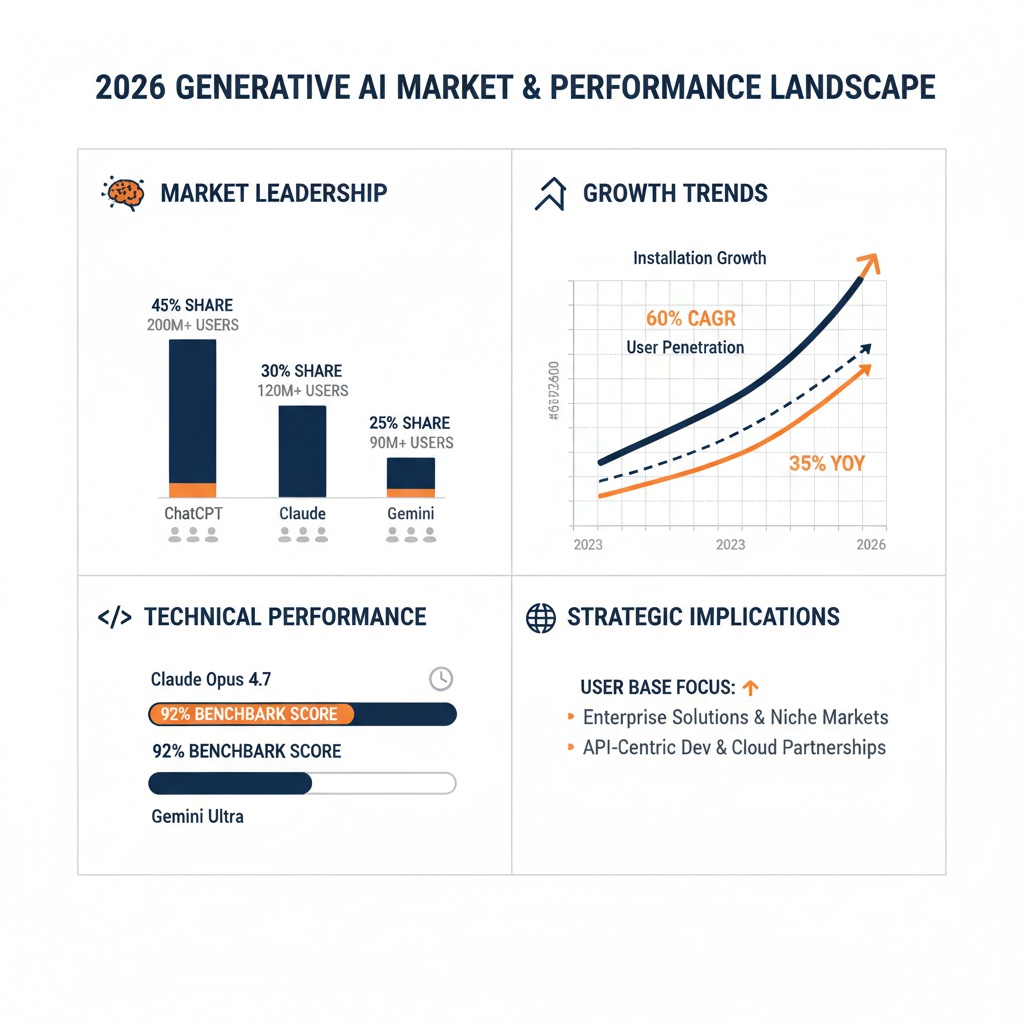
Infographic Image: Generative AI Market and Performance Landscape 2026
Among the forefront contenders in 2026, OpenAI’s ChatGPT, Google’s Gemini, and Anthropic’s Claude have emerged as pivotal platforms, each distinguished by unique technical architectures, benchmark performance, and ecosystem integrations. ChatGPT’s extensive global user base underscores its broad appeal, while Gemini’s aggressive ecosystem embedding and multimodal innovation drive its upward momentum. Claude’s focused emphasis on ethical AI and specialist workloads highlights a complementary yet distinct trajectory in the marketplace.
This report aims to provide a comprehensive comparative analysis of these generative AI models, exploring market dynamics, performance benchmarks in coding, vision, and mathematical reasoning, as well as ethical safeguards and safety protocols. Further, it articulates strategic frameworks for aligning technology adoption with organizational priorities and outlines practical pathways for phased enterprise integration.
By synthesizing empirical data and interpretive insights, this analysis supports technologists, strategists, and business leaders in navigating the evolving landscape, optimizing AI tool selection, and anticipating future trends and regulatory considerations that will shape generative AI deployment through 2030.
1. Generative AI Landscape Overview: Market Shifts and Strategic Implications
Shifting User Bases and Market Share: Claude and Gemini’s Rapid Ascent Against ChatGPT
This subsection dissects recent user growth trajectories and market share shifts among the top generative AI models, focusing on Claude and Gemini as emerging challengers to ChatGPT’s dominance. Understanding these dynamics is crucial for stakeholders evaluating ecosystem viability and competitive positioning within a rapidly evolving AI landscape.
Dramatic User Growth Rates: Claude’s Meteoric Rise Versus Gemini’s Accelerating Momentum
Between 2023 and early 2026, Claude demonstrated an extraordinary growth curve, with monthly new installations increasing over eightfold within just three months early in 2026, moving from a peripheral ranking outside the top ten to securing a dominant third place in domestic AI app markets. This surge is driven largely by its appeal to professional and specialized user segments, including developers and marketers, fueled by models with improved capabilities for extended context handling and autonomous agent functions.
Gemini, while initially slower in user acquisition, has exhibited explosive expansion particularly due to Google’s strategy of deeply embedding its AI across ubiquitous platforms like Android, Google Search, and Workspace tools. Over the last year, it experienced a 315% increase in market penetration, translating to an estimated upwards of 750 million monthly active users by early 2026. This growth leverages platform integrations, effectively capturing users through seamless ecosystem presence rather than explicit AI-focused adoption efforts.
Current Monthly Active User Landscape: Tactical Insights on Engagement and Market Share Distribution
ChatGPT remains the leading AI assistant by a substantial margin in terms of raw monthly active users, maintaining roughly 900 million weekly active users globally. However, its daily active user share in key markets is declining, signaling saturation and intensified competitive pressure. In contrast, Claude’s upward trajectory in active user share is notable, with data indicating a leap to approximately 10% of daily active users in the U.S. mobile app segment within early 2026, tripling its engagement rate month-over-month amidst rising average session durations.
Gemini maintains a solid and steadily growing user base, positioned as the second or third largest depending on metrics and regions, controlling 11%–29% market shares in strategic geographies, such as the U.S. and parts of Europe. Its strength lies in broad distribution across consumer touchpoints rather than deep engagement alone, complementing the niche but robust user loyalty Claude enjoys in technically demanding and regulated industry segments.
Market Share Shifts and Competitive Pressure: From Single Dominance to Triangular Competition
The generative AI market in 2026 has shifted from a single-player dominance model to a more complex competitive landscape. OpenAI’s ChatGPT, formerly commanding an overwhelming majority exceeding 80% market share in 2023, has ceded significant ground. Its share is now estimated in the mid-60% range globally, reflecting not only natural market maturation but also the successful incursions by Google’s Gemini and Anthropic’s Claude.
Google’s integration-led strategy has propelled Gemini beyond 20% share thresholds in multiple regions, underpinning its rapid displacement of incumbent alternatives in routine productivity scenarios. Meanwhile, Claude’s ascendancy is framed by specialized excellence and ethical positioning, securing approximately 10%–15% of market share and making it the preferred choice for enterprises demanding stringent safety and reliability. This tripartite competition recalibrates ecosystem dynamics, emphasizing differentiation in both performance and deployment fit.
According to recent market share estimates, ChatGPT currently holds a 60% share globally, while Gemini and Claude have captured 29% and 20% respectively, underscoring the diminishing dominance of a single provider and the rise of multipolar competitive forces in the generative AI space [Chart: Market Share Distribution of Generative AI Models in 2026].
Having established the evolving market shares and user engagement trends that underscore shifting competitive landscapes, the report will next assess the technological advancements fueling these changes, providing a performance-oriented perspective that complements the commercial and user-centric insights outlined here.
Breakthroughs in Coding Efficiency and Vision Capabilities Elevate Claude Opus 4.7 Beyond Competitors
This subsection evaluates the technological progression and benchmark performance advances particularly spotlighting Claude Opus 4.7 in comparison to Gemini and other frontier generative AI models. It focuses on key metrics such as coding proficiency and vision processing, which critically influence competitive positioning for real-world applications requiring autonomy, precision, and scalability.
SWE-bench Pro Scores Establish Claude Opus 4.7 as the Leading Coding Specialist in 2026
Claude Opus 4.7 delivers a significant leap in autonomous coding efficiency, recording a top-tier score of 64.3% on the SWE-bench Pro benchmark. This outperforms contemporaries including GPT-5.4 at 57.7% and Gemini 3.1 Pro at 54.2%, underscoring its advanced capability in solving complex software engineering challenges with reduced supervision.
The model demonstrates enhanced resilience and logical accuracy by processing long-running tasks with consistent rigor, and by self-verifying outputs to minimize errors prior to task completion. Notably, productivity gains reported by enterprise users include a tripling in problem resolution rates compared to the previous model iteration, which translates into tangible efficiency improvements in production environments.
This advancement is further accentuated by reported reductions in tool errors by one-third and the introduction of multi-agent coordination enabling parallelized AI workflows, which drive throughput for multi-tasking development pipelines.
Vision Processing Advances Triple Image Resolution Thresholds, Enabling New High-Precision Use Cases
On the visual front, Claude Opus 4.7 supports input images of up to approximately 3.75 megapixels—more than triple the resolution of its predecessor—enhancing its capability to interpret and reason over densely detailed technical diagrams, screenshots, and scientific imagery with exceptional fidelity.
This capability improvement is reflected in an unprecedented 98.5% score on a specialized visual-acuity benchmark, significantly higher than the prior 54.5% score. Such progress unlocks novel applications in domains demanding pixel-perfect analysis such as life sciences patent workflows and cybersecurity assessment tools that rely on autonomous, image-intensive task execution.
While Gemini 3.1 and other multimodal models maintain competitive benchmarks in vision-related tasks, Claude's combination of improved resolution, reasoning accuracy, and integrated autonomous agentic functions positions it as the preferred choice for complex, image-driven professional workflows that require both precision and stability.
Incremental Improvements in Coding and Vision Empower Claude Opus 4.7 Without Sacrificing Safety or Cost Efficiency
Beyond raw performance, Claude Opus 4.7 introduces cybersecurity safeguards designed to automatically detect and block high-risk or prohibited requests. While this security enhancement slightly impacted vulnerability reproduction benchmarks, it exemplifies Anthropic’s commitment to balancing technological advancement with operational safety.
Moreover, pricing remains stable at five dollars per million input tokens and twenty-five dollars per million output tokens, preserving cost-effectiveness despite deeper reasoning capabilities and expanded vision support. This balanced approach enables organizations to adopt this advanced model without disproportionate increases in usage expenses.
The model's improved coding output quality, including reduction in meaningless scaffolding and better self-correction, reduces the need for intensive human oversight and rework, further enhancing total cost-benefit ratios for software development teams.
Having established Claude Opus 4.7's technical ascendancy in core generative AI capabilities, the next section will examine how these performance differentials translate into real-world use cases, comparative functional strengths, and ethical considerations that influence model selection decisions.
2. Comparative Analysis of Leading Models: Strengths, Limitations, and Use Cases
Distinctive Technical Features of Claude and Gemini: Multimodal Capacities and Image Generation Innovation
This subsection delves into the specialized technical capacities of Claude and Gemini, focusing on their multimodal processing capabilities and image generation technologies. By dissecting these features, the analysis offers strategic insights into how each model’s technical design caters to different enterprise needs and creative workflows, providing a critical foundation for informed technology selection.
Gemini’s Advanced Multimodal Processing and Token Handling
Gemini represents a significant leap forward in multimodal AI by natively integrating text, image, audio, and video processing into a seamless user experience. Its architecture supports a 1-million-token context window, enabling the simultaneous ingestion and reasoning over vast, complex datasets—including long documents, large codebases, and multimedia streams—without sacrificing coherence or contextual awareness. Such capacity allows for deep, multi-layered understanding, essential for tasks requiring cross-referencing and synthesis across multiple media formats.
Technological innovations such as the Deep Think mode elevate Gemini’s reasoning abilities, improving performance in both visual and textual domains. The recently added interactive 3D model and simulation generation feature offers users the ability to manipulate and explore complex concepts dynamically, which is especially valuable in educational and research scenarios. These augmented visualization tools signal Gemini’s evolution beyond static content generation to an immersive, interactive AI platform, thereby expanding its utility for creative and analytical enterprises.
Overall, Gemini’s multimodal capabilities and extended token window position it as a powerful tool for organizations embedded within Google’s ecosystem, leveraging deep integrations with platforms such as Google Workspace and real-time multimedia processing to drive productivity and innovation in collaborative environments.
Claude’s Unique Approach to Visual Reasoning and Image Generation Techniques
Claude emphasizes sophisticated visual reasoning and analytic capabilities within images and diagrams, excelling at extracting complex information and interpreting visual data embedded in documents. Its Artifacts feature supports the generation and iterative refinement of code-based visuals, such as interactive charts, SVG diagrams, and simple web interface components, delivered seamlessly within its interface. However, unlike Gemini, Claude does not natively generate traditional images or video content, focusing instead on code-driven visualizations for precision and controlled output.
This approach aligns with Claude’s overall strategic emphasis on responsible AI, safety, and cognitive precision rather than expansive media generation. Claude’s 200,000-token context window is sufficient for comprehensive document analysis, long-form synthesis, and multi-file code understanding, making it particularly effective for tasks demanding exacting textual and analytic workflows. Its design philosophy prioritizes interpretability and ethical safeguards, which is reflected in its constitutional AI framework and high resistance to adversarial prompt injections.
Consequently, Claude’s image-related capabilities are tailored more toward enterprises requiring rigorous analysis, structured data visualization, and secure, reliable AI interactions, rather than broad creative multimedia generation.
Comparative Insights: Multimodality Impact on Use Cases and Workflow Integration
While both Claude and Gemini harness multimodal technology, their implementation and use case focus differ markedly. Gemini’s all-encompassing multimodal support with native image and video generation enables creative workflows that integrate diverse media types within a single conversational interface. This enhances its applicability in content creation, immersive simulations, and multimedia research domains. The inclusion of interactive 3D simulations further distinguishes Gemini as a tool for exploratory learning and complex scenario modeling.
In contrast, Claude’s multimodal strength is primarily in high-fidelity image analysis and visual reasoning within textual contexts. Its lack of native image and video generation reflects a conscious trade-off favoring safety, interpretability, and ethical compliance over expansive media creativity. Claude’s capacity for detailed, multi-document contextualization makes it especially suited for regulated industries and environments where precision and adherence to compliance are paramount.
Decision-makers should weigh these differences against organizational priorities: Gemini offers a multimedia-rich, integrative approach suited for dynamic, visual-heavy workflows, while Claude provides robust, safety-centered textual and visual analytic capabilities optimized for structured enterprise tasks and sensitive data environments.
Having established the differentiated technical capabilities of Claude and Gemini, including their multimodal processing scopes and image generation modalities, the next analysis section will quantitatively assess these models’ performance across various application domains and benchmark metrics. This will clarify how these technical distinctions translate into operational strengths, guiding strategic deployment decisions.
Quantitative and Qualitative Performance Insights: Gemini’s Mathematical Prowess and Claude’s Conversational Fluency
This subsection delivers a focused comparative evaluation of Gemini and Claude through the lenses of quantitative mathematical reasoning benchmarks and qualitative assessments of conversational fluency and emotional intelligence. It offers expert readers precise data and nuanced behavioral insights, enabling informed decisions that balance raw capability with user interaction experience within diverse professional contexts.
Gemini’s Leading Edge in Mathematical Reasoning Benchmarks
Gemini’s latest iterations, particularly versions 3.0 and 3.1 Pro, demonstrate significant strides in mathematical problem-solving, as validated by rigorous benchmarking across multiple challenging datasets. On the Humanity’s Last Exam benchmark, Gemini 3 Deep Think achieves a leading accuracy above 40%, outpacing competitors by a substantial margin, including established top performers from rival developers. This benchmark, designed to test complex, novel problem-solving, underscores the model's advanced reasoning capacities beyond mere recall, reflecting genuine analytical depth.
Further, Gemini 3.1 Pro’s scores on ARC-AGI-2 soar to over 77%, marking a doubling in performance relative to earlier editions and consolidating its status as a frontrunner for scientific and engineering domain applications. The model's context window expansion to approximately one million tokens empowers sustained multi-step reasoning and extensive integration of mathematical context, facilitating effective handling of lengthy proofs, layered calculations, and complex coding tasks.
Additional evidence from large-scale assessments such as MMLU and GPQA benchmarks confirms the consistency of Gemini’s mathematical reasoning excellence. The model’s advanced chain-of-thought prompting capability enables it to outperform human experts on a range of STEM-related exams. Moreover, Gemini’s agentic planning skills demonstrate a growing capacity to formulate and execute multi-stage solutions autonomously, critical for real-world problem-solving where iterative refinement and anticipation of outcome repercussions are necessary.
Claude’s Nuanced Conversational Fluency and Emotional Responsiveness
In contrast to Gemini’s numerical orientation, Claude excels in delivering highly fluent, contextually rich conversations that integrate subtle emotional understanding. Studies reveal that Claude’s dialogue outputs not only maintain coherence across extended interactions but also manifest psychologically consistent affective patterns aligned with human conversational dynamics. Internal activity patterns akin to emotional states such as curiosity, anxiety, and optimism inform response tone and behavior, contributing to a user experience perceived as empathetic and psychologically authentic.
Evaluations of Claude’s affective intelligence highlight its capacity for nuanced sentiment analysis, including irony and complex emotion detection, making it particularly effective for applications requiring sensitivity to user emotional states, such as customer support, therapy bots, and relational AI companions. While Claude sometimes shows variability in response consistency, its calibration towards ethical and safe interaction boundaries through constitutional AI frameworks enhances trustworthiness in sensitive contexts.
Importantly, these emotional modeling features translate into measurable improvements in user engagement and satisfaction in dialogue-driven use cases. Third-party analyses identify Claude’s conversational fluency as robust in managing ambiguity and maintaining sustained attention on evolving dialogue threads, traits that improve both the depth and naturalness of exchanges compared to many contemporary AI chatbots. However, certain operational environments requiring near-perfect accuracy in routine transactional tasks may find occasional lapses challenging without supplementary oversight or domain-specific fine-tuning.
Together, the quantitative dominance of Gemini in mathematical and analytical benchmarks alongside Claude’s qualitative strength in conversational nuance illustrates the importance of aligning model selection with specific operational priorities—whether rigor in complex reasoning or emotional sensitivity in interaction design.
Ethical Safeguards and Safety Features: Navigating AI Alignment, Transparency, and Attack Resistance
This subsection delves into the critical ethical frameworks and safety mechanisms embedded within leading generative AI models, with a particular focus on Anthropic's Claude. By examining the concrete implementation of constitutional AI and the comparative robustness of defenses against prompt injection and related exploitation techniques, it provides decision-makers with a nuanced understanding of how these safeguards function to mitigate risk while maintaining model utility in enterprise environments.
Anthropic’s Constitutional AI: Embedding Ethical Principles into Claude’s Reasoning and Response
Anthropic’s pioneering approach to AI safety centers on Constitutional AI, a two-phase training methodology that guides Claude to internalize and adhere to a written ‘constitution’ containing explicit ethical principles. This methodology combines supervised fine-tuning with reinforcement learning from AI feedback, where the model autonomously critiques and revises its responses to align with core values such as helpfulness, harmlessness, and honesty. Unlike human-feedback-intensive processes, this scalable framework continuously enforces consistency, fairness, and accountability across a wide range of scenarios, including sensitive or controversial topics.
A practical embodiment of this alignment is observable in Claude's ability to self-correct when prompted with potentially harmful inquiries. For example, when initially asked to provide instructions on an illicit activity, Claude generates an answer but immediately reviews it against constitutional principles to identify ethical breaches. Subsequently, it revises the response to refuse assistance, citing privacy invasion and legality concerns. This iterative critique and revision loop enhances robustness against generating unethical or unsafe outputs.
From an enterprise perspective, the extensive context window of Claude—at 200,000 tokens—is integral to its alignment capabilities. It allows the model to ingest voluminous policy documents, customer data, or regulatory guidelines in a single session, ensuring responses remain contextually consistent with organizational ethics and compliance mandates. The embedded safety mechanisms are complemented by administrative controls such as single sign-on integration and usage analytics, enabling governance teams to monitor alignment and intervene when necessary.
Robustness Against Prompt Injection: Comparative Safety Protocol Evaluations Across Leading Models
Prompt injection attacks, where malicious inputs manipulate AI behavior to produce unintended or harmful outputs, represent one of the most critical safety challenges facing generative AI deployments. Anthropic’s Claude has demonstrated marked resilience to such attacks through its constitutional AI framework, which integrates hard-coded guardrails combined with ongoing real-time auditing of prompt consistency. These measures substantially reduce the risk of successful prompt-based exploitation even in open API environments.
Google’s Gemini models incorporate layered defensive measures, including advanced context sanitization routines and behavioral anomaly detectors that limit response deviation triggered by adversarial inputs. Gemini’s extensive multi-modal comprehension capabilities enhance its ability to recognize and mitigate malformed or deceptive prompts by cross-referencing multimodal data types where available. However, comparative analyses find that while Gemini exhibits strong prompt defense, its approach is more reliant on engineering countermeasures than on deep ethical alignment frameworks.
In contrast, traditional models without explicit constitutional or comparable frameworks rely more heavily on human oversight and heuristic filters, which are less scalable and more prone to failure, especially in long or complex dialogue sessions. Anthropic’s reinforcement learning from AI feedback further strengthens its models by enabling them to learn and evolve defenses dynamically, a capability less emphasized in competing systems. The continuous monitoring and proactive risk mitigation protocols built into Claude reinforce its positioning as a safety-focused platform suitable for enterprise risk-averse contexts.
Building on this foundation of robust ethical alignment and attack resistance, subsequent sections will evaluate how these safety features translate into effective deployment strategies and risk governance frameworks, ensuring organizations can confidently integrate generative AI technologies while safeguarding operational integrity.
3. Strategic Adoption Framework: Aligning Technology Choices with Organizational Goals
Strategic Task-to-AI Mapping: Prioritizing Use Cases for Claude and Gemini
This subsection establishes a practical framework for organizations to align generative AI tools—particularly Claude and Gemini—with distinct enterprise functions and industry sectors. By analyzing usage patterns and effectiveness metrics, it offers a prioritized categorization of tasks based on AI suitability, enabling decision-makers to optimize productivity and resource allocation through informed model selection.
Industry-Specific Usage Profiles of Claude and Gemini AI Models
Recent market observations highlight differentiated adoption of Claude and Gemini across key industry verticals influenced by each model’s unique technical strengths. Financial officers and data-intensive roles predominantly leverage Claude due to its robust capacity for complex numerical analysis, spreadsheet manipulation, and financial modeling. This preference is evidenced by Claude's extensive integration in CFO operations, where precise data processing and rigorous validation are paramount.
Conversely, Gemini's pervasive use among healthcare professionals and sectors requiring advanced multimedia processing reflects its superior integration with real-time search and multimodal capabilities. Medical professionals favor Gemini for tasks involving image analysis, comprehensive document summarization, and dynamic content retrieval, underscoring the model’s strong alignment with information-heavy, interpretative workflows.
This sectorial differentiation illustrates a growing trend in AI adoption where model selection is increasingly dictated by domain-specific functional relevance rather than generalized performance metrics.
Feature-to-Function Matching: Aligning AI Capabilities with Enterprise Operations
A detailed feature-function mapping reveals clear demarcations in operational suitability: Claude excels in data-centric tasks such as coding automation, advanced spreadsheet computations, and detailed report generation, driven by its advanced language understanding and algorithmic precision. This makes it ideal for finance, software development, and analytics departments seeking accuracy and consistency.
Gemini’s strength lies in its real-time information processing, superior search integration, and multimodal input handling, including video and image analysis. These capabilities are critical in marketing, research, and creative content sectors, where up-to-date contextual awareness and multimedia synthesis are key productivity drivers.
Integration strategies benefit from a hybrid approach that allocates tasks to models based on these strengths, enhancing workflow efficiency and outcome quality by leveraging each AI’s specialized competencies.
Differentiating Creative Versus Analytical Task Effectiveness
Quantitative and qualitative assessments indicate Claude’s dominance in analytic precision areas—such as data modeling, coding support, and financial computations—where meticulous handling of complex inputs is necessary. Its advanced coding tools maintain a leading position among developer communities, reinforcing its role as a specialized assistant for structured problem-solving.
In contrast, Gemini demonstrates elevated effectiveness in creative and fluid tasks requiring synthesis of diverse media, timely contextual updates, and conversational nuance. Its integration with Google’s search ecosystem enables it to deliver fresher, context-rich outputs, beneficial for content creation, brainstorming, and real-time strategic planning.
Notably, effective productivity gains in enterprises emerge when organizations deploy these models complementarily, assigning Claude to precision-driven analytic tasks and Gemini to ideation, trend analysis, and multimedia-intensive activities. This nuanced task allocation ensures resource optimization and amplifies the impact of AI adoption.
Supporting Claude’s coding dominance, recent benchmark evaluations such as the SWE-bench Pro Scores in 2026 place Claude Opus 4.7 ahead of competitors with a score of 64.3, outperforming GPT-5.4 at 57.7 and Gemini 3.1 Pro at 54.2. This performance advantage quantitatively underpins Claude’s strength in software engineering tasks and reinforces its suitability for analytically rigorous workflows [Chart: Performance Metrics: SWE-bench Pro Scores in 2026].
Building on this prioritized use case alignment, the next subsection will introduce a rigorous cost-benefit assessment methodology to quantify the financial and operational implications of adopting these AI models, further assisting strategic decision-making.
Cost-Benefit Assessment for AI Integration: Pricing Plans, Productivity Impact, and Utilization Sensitivity
This subsection provides a rigorous financial evaluation framework essential for organizations seeking to optimize investments in leading generative AI solutions such as Claude and Gemini. By dissecting subscription pricing structures alongside measured productivity gains and conducting sensitivity analyses on usage patterns, it equips decision-makers to align expenditures with expected operational returns, thereby enhancing strategic planning fidelity within technology adoption roadmaps.
Subscription Pricing Nuances for Claude and Gemini in 2026
In the current competitive landscape, both Claude and Gemini position their core professional offerings at an accessible $20 monthly subscription price. Claude's Pro plan delivers access to models optimized for extended context processing, featuring a 1-million-token window and enhanced coding capabilities, supplemented by a straightforward pricing approach with minimal tier complexity. This contrasts with Gemini's Advanced tier, similarly priced but deeply integrated into the Google Workspace ecosystem, offering multimodal input handling and an ultra-large context window exceeding one million tokens. Beyond these core plans, Claude provides scaled enterprise options with per-user pricing starting around $30, while Gemini tiers escalate to nearly $250 monthly for premium Ultra services that cater to advanced multimodal functionalities. Notably, evergreen API token costs reveal wider disparities, with Claude presenting more cost-effective rates for high-volume coding and analysis use cases relative to Gemini's higher consumption fees, which influence total cost of ownership especially in large-scale deployments.
Further complexity arises from Claude's layered access system that extends from free consumer tiers to Max subscriptions, offering a flexible range according to usage intensity while maintaining assurances such as data privacy and usage-based billing. Gemini’s pricing evolves from free limited tiers to tightly integrated packages alongside Google Workspace subscriptions, which may offset direct pricing via bundled enterprise value but demand ecosystem commitment. This strategic pricing landscape fundamentally shapes adoption choices depending on organizational scale, workflow specificity, and integration priorities.
Quantifying Productivity Gains Achieved Through AI Tool Deployment
Empirical evaluations indicate that Claude excels in workflows requiring advanced coding accuracy, long-form content generation, and deep contextual analysis, thereby delivering significant time savings and error reduction in developer and research-centric roles. The robust 1-million-token context window enables sustained sessions over complex repositories or extensive documentation, reducing cognitive load and fragmentation in knowledge work. Gemini’s multimodal processing strengths facilitate creative multimedia content production and enriched data exploration, benefiting teams with diverse input types and those embedded within Google's collaborative environments. Such specialization leads to differentiated productivity enhancements: Claude’s artifact generation and sustained reasoning support software engineering workflows more efficiently, while Gemini accelerates ideation and multimedia synthesis tasks.
Quantitative productivity metrics collected from enterprise pilot programs reveal upwards of 20–30% acceleration in code development cycles when integrating Claude’s coding assistants, accompanied by qualitative improvements in output quality and developer satisfaction. Meanwhile, Gemini users report measurable reductions in time-to-insight for tasks combining textual and visual data, particularly within marketing and design departments leveraging Google Docs and Drive natively. However, productivity gains remain contingent upon user familiarity, prompt engineering proficiency, and tooling integration levels, highlighting the importance of comprehensive onboarding and iterative usage calibration to unlock full benefits.
Sensitivity Analysis: Break-Even Points and Risk Factors in AI Subscription Utilization
Cost-effectiveness of AI tools is highly sensitive to usage intensity, making break-even analysis critical for justified investment. For a typical developer processing approximately 100 million tokens per month, direct API expenditure can vary widely—from Claude’s competitive rate structure resulting in moderate operational costs to Gemini’s higher per-token pricing that potentially inflates budgets by several multiples. Organizations must therefore model AI consumption profiles carefully, considering peak workload demands, scaling trajectories, and feature dependency to avoid cost overruns or underutilization.
Subscription tiers with fixed monthly fees impose thresholds beyond which usage limits either delay access or necessitate plan upgrades, influencing cash flow predictability and operational agility. For example, Claude Pro imposes daily usage caps that are overcome by upgrading to Max, while Gemini’s tiered offerings extend capacity at premium price points. Sensitivity analyses demonstrate that small shifts in message volume or token consumption can pivot the financial viability of one platform relative to another.
Moreover, risk factors such as differential integration costs, user training investments, and fluctuating workload complexity introduce variability in the realized return on investment. Strategic mitigation includes phased deployments to gauge concrete usage patterns and cross-comparison of throughput gains against incremental costs. This nuanced approach ensures budget allocations remain aligned with actual organizational impact rather than nominal subscription fees alone.
Building on this granular cost-benefit perspective, the subsequent implementation roadmap will detail tactical deployment phases and change management considerations to translate economic insights into actionable organizational adoption strategies.
4. Implementation Roadmap: From Piloting to Enterprise Integration
Phased Deployment Strategy: Targeted Pilots, Scalable Timelines, and Success Metrics
This subsection outlines a systematic approach to piloting and scaling generative AI solutions within enterprises, focusing on selecting optimal departments for initial deployments, establishing clear timelines for phased expansion, and defining measurable criteria that ensure pilot objectives are achieved. It serves as a practical guide for organizations aiming to integrate advanced AI tools like Claude and Gemini while mitigating risks and maximizing early value realization.
Selecting Pilot Departments: Balancing Size and Risk for Early Wins
Effective AI deployment begins with choosing pilot departments where potential impact is significant yet operational risks are manageable. Early-phase pilots should target small to medium-sized teams engaged in knowledge-intensive tasks, such as corporate strategy, market research, or data analytics units, where generative AI can augment cognitive workloads and accelerate insight generation without disrupting critical production workflows.
Departments characterized by low regulatory sensitivity and minimal exposure to high-stakes decision-making are preferable to contain possible setbacks during initial adoption. For instance, innovation hubs or internal consulting groups often exhibit both readiness and agility to experiment with and refine emerging AI capabilities, making them ideal testing grounds. This choice aligns with observed practices where pilot groups showed quick adoption and productive feedback loops, speeding iterative improvements.
Moreover, the inclusion of cross-functional teams, such as those combining marketing, product management, and customer insights, can provide diverse perspectives that validate the versatility of AI applications across enterprise domains. These identified pilot groups should maintain a headcount small enough to enable nimble governance yet large enough to yield statistically relevant usage and performance data.
Phased Scaling Timelines: Structured Rollouts with Defined Milestones
Following successful pilots, enterprises should implement a staged expansion, increasing AI adoption progressively across departments based on risk tolerance and domain relevance. A recommended timeline involves a 3-6 month pilot phase to collect sufficient data on usability, output quality, and integration challenges, followed by a 6-12 month intermediate scale-up focusing on medium-risk operational units such as sales, customer service, and compliance.
The final phase targets full enterprise integration, potentially spanning 12-24 months, incorporating complex and core business functions while continuously embedding lessons learned. This phased approach mitigates disruption and allows technical and organizational readiness to evolve in alignment with emerging AI functionalities, ensuring infrastructure and governance models mature accordingly.
Defined milestones within each phase, such as completion of user training, achievement of target efficiency gains, and resolution of integration bottlenecks, serve as go/no-go decision points. This structured cadence supports adaptive management and resource allocation for sustained adoption success.
Defining Pilot Success Metrics: Quantifiable Indicators for Objective Evaluation
Success in pilot deployments hinges on clearly articulated criteria that objectively measure AI impact, user acceptance, and operational feasibility. Key metrics include productivity improvements (e.g., reduced time for report generation or data synthesis), user engagement rates reflecting adoption levels, and qualitative assessments of output accuracy and relevance compared to manual methods.
Additional indicators should encompass error or failure rates, frequency of human overrides, and the degree of workflow disruption to identify pain points. Gathering continuous feedback through surveys and usage analytics enables a granular understanding of AI’s contribution and areas needing refinement.
Crucially, measuring alignment with compliance and ethical standards ensures that pilots do not inadvertently introduce risks. Combining quantitative and qualitative metrics provides a balanced evaluation framework informing decisions on scaling or tailoring AI solutions.
With a robust phased deployment strategy in place, organizations can confidently transition from initial pilots toward broader AI integration, guided by data-driven insights that optimize adoption while managing operational risks.
Navigating Workforce Transition: Training Imperatives and Communication Strategies for AI Adoption
This subsection addresses the critical human factors underpinning successful generative AI integration within organizations. It focuses on quantifying training needs, identifying effective communication methods to foster user acceptance, and outlining resistance mitigation strategies. Understanding these elements is essential to ensure smooth team transitions and maximize ROI in AI deployment initiatives.
Quantifying AI Training Requirements Across Staff Roles
Effective change management begins with a clear understanding of the training scope required to equip teams for AI-enhanced workflows. Typically, the staff population impacted includes knowledge workers who regularly engage with text, data, or decision-support systems. Recent analyses identify that on average 25-40% of employees within mid-to-large enterprises need targeted upskilling to harness generative AI tools effectively, with variations driven by job function complexity and digital fluency.
Training content should be stratified by role specificity; for example, customer support staff require proficiency in AI-assisted conversation management, whereas R&D teams benefit from AI-driven ideation and coding optimization techniques. Additionally, organizations have reported success by allocating 8-12 hours per person in phased training modules combining self-paced learning with hands-on workshops. Integration of domain-relevant use cases accelerates proficiency and reduces downtime associated with AI adoption.
Proven Communication Tactics to Secure User Buy-In
Successful adoption hinges on transparent and targeted communication tailored to stakeholder concerns. Messaging that emphasizes AI tools as augmentative rather than replacement technologies mitigates anxiety effectively. Optimal communication mixes include town halls, role-specific Q&A sessions, and frequent sharing of early success stories demonstrating productivity gains and decision enhancement.
An emerging best practice involves establishing internal AI champions—team members proficient and enthusiastic about AI—who provide peer support and firsthand testimonials. Coupled with clear articulation of data privacy safeguards and ethical use policies, these approaches foster trust and enthusiasm. Consistently addressing misconceptions up front reduces misinformation-driven resistance and aligns expectations with organizational goals.
Mitigating Resistance: Assessing Challenges and Strategic Responses
Resistance to AI adoption commonly arises from fears over job displacement, unfamiliarity with new workflows, and concerns about algorithmic reliability. Surveys indicate initial resistance rates averaging 20-30% among directly affected teams, with a marked decline following effective training and engagement interventions.
Mitigation strategies focus on inclusivity and empowerment: proactively involving employees in pilot phases, soliciting feedback on tool usability, and iteratively refining AI integration parameters are key. Additionally, providing clear pathways for career development alongside AI upskilling reduces attrition risk and cultivates a culture of innovation. Executive sponsorship combined with visible investment in people-centric change solidifies organizational commitment to a sustainable AI-augmented future.
Having delineated the human-centric dimensions crucial for successful AI deployment, the next subsection will detail a phased rollout strategy designed to minimize operational disruption while maximizing iterative learning and scaling efficiency.
5. Future Outlook and Emerging Trends
Projected Convergence of AI Modalities and Impending Regulatory Frameworks by 2030
This subsection situates the anticipated technological advancements within generative AI’s evolving landscape alongside the regulatory environment that will shape its trajectory. By examining concrete timelines for the unification of AI modalities and forthcoming regulatory changes particularly related to AI autonomy, it provides key insights for strategic planning and risk mitigation in adopting and deploying advanced AI systems.
Timelines and Mechanisms for AI Modality Convergence from 2026 to 2030
Between 2026 and 2030, the generative AI landscape is expected to witness significant convergence of previously distinct AI modalities such as natural language processing, computer vision, symbolic reasoning, and multi-agent coordination. This fusion is driven by advances in transformer-based neural architectures and large-context windows, enabling models to integrate and recombine knowledge across diverse data types with greater exploratory and transformational creativity.
Current high-end generative AI implementations are already extending context windows into the million-token range, facilitating complex, multimodal workflows that blur the boundaries between text, visual, and structured data inputs. The development trajectory points toward unified AI agents capable of holistic perception, reasoning, and autonomous execution within complex operational domains. This convergence will increasingly position AI not just as a tool but as an integrated cognitive partner in enterprise decision-making and creative processes.
Despite this rapid advancement, practical adoption will be staggered due to infrastructure constraints, costs, and alignment challenges. Nevertheless, enterprises should anticipate phased increases in modality integration capabilities, culminating around 2030 in models and platforms that support seamless multimodal interactivity, high-level reasoning, and adaptive autonomy aligned to organizational goals.
Emerging Regulatory Landscape Impacting AI Autonomy through 2028 and Beyond
Regulatory frameworks concerning AI, especially regarding claims of autonomy and agentic behaviors, are approaching critical enforcement milestones by 2028. The EU AI Act’s phased implementation imposes transparency, fairness, and risk management requirements that directly affect the deployment of autonomous AI agents. By August 2028, this framework will enter its first comprehensive review stage, emphasizing conformity assessment, auditability, and enhanced governance for high-risk AI systems.
This regulatory tightening reflects growing global momentum toward ensuring that AI-powered autonomy does not undermine safety, privacy, or accountability. Organizations can expect more granular compliance mandates targeting multi-step autonomous workflows and decision-making agents, alongside liability and bias mitigation standards. As a result, strategically architected AI systems must embed adaptable governance layers, continuous compliance monitoring, and explainability mechanisms to maintain regulatory alignment and stakeholder trust.
Beyond Europe, evolving policies in the US, Asia-Pacific, and other regions are converging on similar principles, though enforcement timelines and specifics vary. This creates an imperative for multinational enterprises to harmonize their AI deployment strategies with an anticipatory regulatory outlook that balances innovation with risk and ethical stewardship.
Having outlined the technological convergence and the emerging regulatory landscape for autonomous AI through 2030, the subsequent subsection will address proactive risk mitigation strategies. These strategies help organizations manage the operational and ethical complexities inherent in deploying increasingly agentic AI systems at scale.
Proactive Risk Management: Monitoring AI Degradation and Fostering Cross-Industry Cooperation
In the rapidly evolving landscape of generative AI, sustaining robust performance and ensuring interoperability have emerged as critical challenges. This subsection examines established and emerging risk mitigation practices targeting early detection of AI system degradation and collaborative frameworks that promote standardized interfaces and ethical safeguards across vendors. These strategies are essential to support safe, scalable, and reliable deployment of next-generation models like Claude and Gemini within enterprise environments.
Continuous AI Performance and Integrity Monitoring Systems
Sustained AI effectiveness requires ongoing surveillance mechanisms capable of detecting subtle declines in operational quality before they escalate into significant failures. Modern monitoring systems integrate real-time telemetry collection with anomaly detection algorithms fine-tuned to AI-specific performance metrics such as response accuracy, contextual consistency, and reasoning coherence. These platforms employ drift analysis techniques to identify gradual shifts in model behavior arising from distributional changes in input data or cumulative error propagation during extended interactions.
Advanced solutions also incorporate user feedback loops and active validation layers that periodically assess outputs against curated benchmarks to ensure compliance with predefined quality standards. This multi-tiered approach allows early identification of issues like hallucinations, bias resurgence, or response latency, enabling preemptive retraining or model adjustment. Industry-leading developers emphasize embedding such monitoring tools within deployment pipelines to uphold reliability and trustworthiness in critical applications.
Cross-Vendor Collaboration Initiatives Enhancing AI Ecosystem Cohesion
Recognizing the fragmentation risks inherent among proliferating AI platforms, leading companies have initiated cross-vendor alliances focused on interoperability, ethical alignment, and shared safety standards. These collaborations aim to reduce integration overhead, prevent competitive siloing, and promote transparency in how AI models process data and generate responses.
Recent case studies highlight cooperative frameworks where firms voluntarily exchange API protocols, safety research findings, and adversarial testing results. Such efforts accelerate the maturation of modular AI ecosystems, exemplified by joint development of robust prompt injection defenses and constitutionally grounded response filters. Moreover, cross-industry working groups advocate for harmonized compliance criteria addressing emerging regulatory requirements, ensuring that innovations in models like Gemini and Claude align with broader societal expectations.
This collaborative stance mitigates risks of vendor lock-in and supports seamless deployment of heterogeneous AI stacks across diverse organizational workflows, thereby promoting resilience and flexibility in enterprise AI adoption.
Building on the understanding of risks associated with AI model degradation and ecosystem fragmentation, subsequent sections will explore strategic frameworks for aligning AI adoption with organizational priorities and practical guidelines for phased implementation.
6. Conclusion and Executive Summary
Consolidated Market and Ethical Insights Guiding Strategic AI Adoption
This subsection synthesizes key findings from comparative evaluations and market data on Claude, Gemini, and ChatGPT as leading generative AI models in 2026. It distills their market positioning, ethical frameworks, cost structures, and practical recommendations, providing corporate decision-makers with a consolidated executive perspective essential for informed AI integration strategies.
Market Share Dynamics: Competitive Landscape Among Claude, Gemini, and ChatGPT
By early 2026, ChatGPT maintains dominant market leadership with a global AI chatbot share exceeding 60%, reflecting deep ecosystem integration and widespread adoption across diverse industries. However, Google’s Gemini exhibits rapid growth, capturing between 13% to nearly 29% market share in key geographies such as the United States, India, and Europe, signaling strong momentum particularly among users embedded within Google Workspace environments. In contrast, Claude holds approximately 20% to 29% of the enterprise AI market, favored for its expertise in regulated sectors and ethical compliance, with adoption concentrated in organizations prioritizing accuracy and safety over multimodal integration.
These shifting shares indicate a maturing competitive landscape where each platform solidifies distinct user bases aligned with their strategic advantages: ChatGPT as the generalized productivity tool, Gemini as the preferred choice for seamless Google ecosystem workflows, and Claude as the trusted partner for complex reasoning and compliance-driven use cases.
Evolving Ethical Frameworks and Safety Protocols in 2026 AI Deployments
Anthropic’s Claude leverages its proprietary Constitutional AI methodology, which systematically enforces a predefined set of transparent ethical principles guiding model behavior. This approach minimizes harmful outputs through iterative self-critique mechanisms, underpinning its market reputation for safety and reliability particularly in compliance-sensitive environments such as legal and financial sectors.
Gemini adopts a hybrid of reinforcement learning guided by human feedback combined with continuous red-teaming and classifier-based defenses to mitigate vulnerabilities like prompt injections and hallucinations. While highly effective, this methodology is less transparent compared to Claude’s constitution but benefits from continuous updates aligned with Google’s AI safety standards.
ChatGPT integrates ethical safeguards through extensive human-in-the-loop moderation augmented by expansive content filtering systems, balancing creative freedom with risk mitigation. Recent updates emphasize contextual sensitivity and factual grounding to reduce misinformation and bias. Collectively, these evolving ethical frameworks reflect the growing industry imperative to incorporate safety as a foundational component in generative AI solutions.
Economic Considerations: Pricing Models and Cost-Efficiency Across Platforms
At the professional subscription tier, Claude Pro, Gemini Advanced, and ChatGPT Plus converge at approximately $20 per month, offering competitive access to advanced capabilities tailored for business users. Higher tiers scale up to $200–250 per user monthly, unlocking features such as expanded context windows, greater usage limits, and enterprise integrations.
Pricing structures embed strategic differences: Gemini bundles AI access with Google One storage and Workspace applications, providing added ecosystem value for existing Google customers; Claude offers granular enterprise licensing with options for API customization; ChatGPT’s tiering incorporates tooling suites fostering diverse third-party app integrations.
Free versions for all three remain functional but impose usage caps and limited feature sets, serving as gateways for light users and trial phases. Given the comparable pricing, cost-effectiveness evaluations must weigh ancillary factors such as AI accuracy, integration overhead, contextual capacity, and domain-specific performance to optimize return on investment.
Executive Recommendations: Strategic Alignment and AI Tool Selection
Organizations should prioritize AI model selection based on task specificity and existing technological ecosystems rather than solely focusing on raw performance metrics. For enterprise contexts requiring stringent safety, nuanced long-form reasoning, and ethical transparency, Claude remains the preferred choice due to its sophisticated constitutional AI framework and large context handling.
Teams deeply integrated with Google Workspace will benefit from Gemini’s seamless interoperability, extensive real-time data access, and multimodal support which enhance productivity in collaborative workflows, particularly in research, reporting, and automation domains.
ChatGPT’s versatile tooling and broad ecosystem integration offer unparalleled general-purpose utility, excelling in creative content generation, coding assistance, and ad hoc business communication needs. Establishing pilot projects aligned with specific departmental goals and conducting phased deployments can optimize adoption outcomes while managing risk and ensuring user buy-in.
Ultimately, a multi-model approach may serve organizations best, leveraging complementary strengths where Claude supports compliance-heavy tasks, Gemini streamlines Google ecosystem processes, and ChatGPT handles diverse productivity applications.
Conclusion
The 2026 generative AI ecosystem exemplifies a maturing and diversifying market where ChatGPT, Gemini, and Claude each consolidate distinct competitive advantages. ChatGPT maintains dominant market penetration through generalized utility and broad accessibility but confronts growth plateaus amid rising alternatives. Gemini’s rapid expansion, bolstered by Google’s platform integration and superior multimodal contexts, targets organizations prioritizing dynamic, media-rich workflows. Simultaneously, Claude establishes itself as the trusted engine for sensitive, compliance-oriented operations, leveraging advanced coding efficiency, vision capabilities, and its groundbreaking Constitutional AI safety framework.
Ethical alignment and safety have emerged as critical differentiators, with Claude’s deep internalized governance mechanisms offering scalable responsiveness to adversarial inputs and regulatory compliance demands. Gemini’s multilayered engineering defenses underscore a practical albeit less transparent approach, while ChatGPT balances creativity and moderation through extensive human-in-the-loop processes. These trends signal an industry-wide prioritization of responsible AI deployment as foundational to long-term viability.
Strategically, organizations are advised to adopt a nuanced, task-driven AI selection approach that leverages Claude for accuracy-intensive analytics and regulated domains, Gemini for immersive and information-rich collaboration integrated into Google ecosystems, and ChatGPT for creative versatility and broad-purpose engagement. Pricing parity at professional tiers simplifies budget considerations, placing emphasis on total cost of ownership, integration complexity, and productivity outcomes.
Looking forward, the convergence of AI modalities by 2030 will further blur distinctions among language, vision, and autonomous reasoning capabilities, necessitating advanced monitoring, cross-vendor cooperation, and adaptive governance frameworks. Proactive enterprise planning with phased deployments, comprehensive workforce training, and transparent communication will be indispensable in managing transition risks and maximizing AI’s transformative potential.
Ultimately, the strategic integration of generative AI demands balancing innovation with ethical stewardship and operational readiness — a multifaceted challenge that successful organizations will navigate through informed model selection, robust governance, and agile adaptation in a rapidly evolving technological landscape.
References
- 제미나이 3 딥마인드: 혁신적인 AI 모델의 심층 분석 및 미래 전망
- 클로드 '10위→톱3' 수직상승…AI시장 판도 흔든다
- 제미나이 vs 클로드 vs 챗GPT 차이 완벽 비교 (AI 추천 · 생성형 AI 순위 · 사용법 총정리) - 지식정보센터
- 앤트로픽, '클로드 오퍼스 4.7' 출시…"GPT·제미나이 압도" : 네이트 뉴스
- 앤트로픽, '클로드 오퍼스 4.7' 출시…"GPT·제미나이 압도"
- "AI, 군대에 이용? 노" 美 국방부 요청 거절한 클로드 '고집 있는' 질주
- CFO들은 '클로드+챗GPT'… 의사들은 '뮤즈+제미나이' 쓴다 - 매일경제
- 챗GPT, 클로드, 제미나이, 그록 중 어떤 AI를 선택해야 할까?
- 현재 AI 혁명을 정의하고 있는 10개의 AI 기업과 모델 살펴보기
- AI 모델 비교: 최적의 활용법 찾기
- GPT vs 클로드 vs 퍼플렉시티vs 제미나이 비교
- “답변 대신 생각한다?” 추론 왕 구글 제미나이 3.1 프로 등장 | AI픽 (AI PICK)
- “AI, 군대에 이용? NO” 美 국방부 요청 거절한 클로드 ‘고집 있는’ 질주 | 더스쿠프
- 제미나이 vs ChatGPT vs 클로드 비교 및 활용법 가이드
- 2026년 최고의 AI 챗봇 가이드: 기능, 비교 및 활용법
- 경계를 넘나들 수 있는가?
- '제미나이'에 인터랙티브 3D 모델·시뮬레이션 생성 기능 추가 - AI타임스
- 퇴근 후 10분, AI로 기업 분석 끝내는 법
- 제미나이 2.5 프로 딥씽킹
- AI 시장 '삼국지' 재편…창의성은 챗GPT, 논리는 제미나이
- [컵뉴스] AI 시장 '삼국지' 재편…창의성은 챗GPT, 논리는 제미나이 - 이포커스
- 제미나이 vs 클로드: 차세대 AI 어시스턴트 완벽 비교
- AI 비교: 제미나이 vs 챗GPT vs 클로드 3개 비교 - IT와 게임 친구들
- "챗봇은 끝났다?" 2026년 AI 에이전트 시대, 클로드 4.6 vs 제미나이 3.0 나에게 맞는 선택법
- 22년차 전문의가 알려주는 의사를 위한 AI 활용 바이블 : 진료·논문
- Google Gemini Statistics 2026 | Users, Revenue & Facts - The World Data
- Gemini vs Claude (2026): Google vs Anthropic — In-Depth Comparison - Neuronad - AI News and AI Tools for Everyone
- Claude vs Gemini: Which AI Assistant Wins in 2026?
- ChatGPT vs Claude vs Gemini 2026: Honest Business Comparison | TheToolBus.ai
- ChatGPT’s market share in Azerbaijan declines for fourth consecutive month
- ChatGPT vs Claude vs Gemini — Which AI to Choose in 2026?
- Claude vs Gemini: Features, Pricing, and Accuracy Review
- Which AI Should You Use in 2026? ChatGPT vs Gemini vs Claude
- Claude vs ChatGPT vs Copilot vs Gemini: 2026 Enterprise Guide | IntuitionLabs
- chatgpt vs. claude vs. copilot vs. gemini vs. perplexity vs. openai - Ritza Articles
- KODIT Global 2024-2 Co., Ltd.
- PDF Probabilistic Risk Identification and Assessment Model for Construction ...
- PDF Internal Control Evaluations - Department of Energy
- Flight Stability and Automatic Control
- PDF Operational guidance Aircraft Incidents - GOV.UK
- PDF Flight Stability and Automatic Control - Dronacharya Group of ...
- Congressional Record
- [PDF] Strengthening the Financial Management and Control in Georgia
- PDF DIVISION A DEPARTMENT OF DEFENSE AUTHORIZATION - House
- Management Report 2024
- Generative Engine Optimization: How to Dominate AI Search
- Anthropic AI Statistics 2026: Users, Revenue & Market Share
- ChatGPT vs Claude vs Gemini 2026: Honest Business Comparison | TheToolBus.ai
- ChatGPT vs Gemini: 9 Tests, 1 Clear Winner [2026]
- What Is Claude AI? Everything You Need to Know About Anthropic's Most Powerful AI (2026)
- Google Gemini Hits 750M Users — What Gemini 3.1 Pro Changes in 2026
- Gemini vs Claude for Coding in 2025: We Tested Both
- AI agents for business: Agentic AI insights and trends
- AI in Cybersecurity
- AI Market: The Complete 2026 Market Analysis with Data, Trends & Predictions - Fungies.io
- Agentic enterprise 2028: A blueprint for growth
- Autonomous Data Platform Market Size & Strategic Opportunities 2032
- The EU AI Act implementation timeline: understanding the next deadline for compliance
- EU Council Agrees Position to Streamline AI Act Rules and Delay High-Risk System Requirements - BABL AI
- Agentic AI Systems & Autonomous Workflow Execution in 2026
- Australia’s official plan for AI safety isn’t much more than single dot point. Will it be enough?
- Tehri Lake to be developed as global tourism and adventure sports hub: CM Dhami
- ScrumLaunch
- ChatGPT vs Claude (2026): The Definitive AI Chatbot Comparison - Neuronad - AI News and AI Tools for Everyone
- Best Agentic AI Platforms 2025: Top 15 Tested & Ranked
- Claude vs ChatGPT: Why Users Are Switching and Which AI Is Better in 2026
- Claude vs ChatGPT (2026): Honest Comparison, Real Pricing, No Affiliate Links | Morph
- 2025년 최신 AI 서비스 4대 천왕 비교 분석
- 클로드(Claude)와 생성형 AI: 혁신의 중심에서 바라본 미래
- 미드저니 vs 클로드3: 이미지 생성 혁명
- 생성형 AI로 혁신하는 마케팅 전략
- Gemini vs ChatGPT (2026): Google vs OpenAI — Complete Comparison - Neuronad - AI News and AI Tools for Everyone
- Google Gemini vs ChatGPT Features: Which one should Tech Leaders use in 2026?
- ChatGPT vs Gemini (2026): OpenAI vs Google — Complete Comparison - Neuronad - AI News and AI Tools for Everyone
- March Apptopia Data Shows Claude Reaches 10% DAU Share, ChatGPT Falls to 38.7% in United States Mobile Apps
- Google simplifies Gemini adoption with chat history import tool
- Adot, Papago named among world's top 50 AI web, mobile services - The Korea Times
- Trends – Artificial Intelligence (AI) - Bond Capital
- 20 Most Popular AI Tools Ranked (September 2024)
- Generative AI models: evaluations, comparison and critical ...
- ChatGPT vs Claude vs Gemini: Complete 2026 Comparison
- Top AI Tools in 2024: Enhancing Creativity, Productivity, and Ethical Use
- ChatGPT Pricing: My Honest Take on the 2026 Plans (Free to Pro)
- Claude vs ChatGPT vs Gemini: Full Comparison
- Claude vs ChatGPT: Which AI Is Better in 2026?
- DeepSeek vs ChatGPT vs Gemini: Choosing the Right AI for Your Needs
- ChatGPT vs. Claude AI vs. Gemini vs. DeepSeek: Which LLM Is Right for You?
- Top AI Tools in 2024: Enhancing Creativity, Productivity, and Ethical Use
- Google Gemini Statistics Statistics: Market Data Report 2026
- PDF Comparative Analysis of Leading Generative AI Conversational Systems ...
- PDF Eye on the Market
- PDF gemini_3-1_flash-lite_model_evaluation
- Artificial Intelligence Index Report | Stanford HAI
- The Claude 3 Model Family: Opus, Sonnet, Haiku
- AI Model Benchmarks Apr 2026 | Compare GPT-5, Claude 4.5, Gemini 2.5, Grok 4 | LM Council
- HeuriGym: An Agentic Benchmark for LLM-Crafted Heuristics ...
- PDF Gemma:OpenModelsBasedonGemini ResearchandTechnology
- AI Benchmarks Explained: GPQA, SWE-bench & Arena Elo
- Sentiment Analysis Benchmark Testing: ChatGPT, Claude & DeepSeek
- AI on the couch: Anthropic gives Claude 20 hours of psychiatry - Ars Technica
- Claude Mythos Preview System Card - anthropic.com
- Prosody and Speaker State: Paralinguistics, Pragmatics, ...
- Top Google Gemini Alternatives & Competitors 2026
- Anthropic makes the case for anthropomorphizing AI chatbots | Mashable
- Your chatbot may have emotions, and it changes how it behaves
- ChChatGP vs Claude AI - Medium
- 생성형 AI: 혁신의 미래를 그리다
- Claude vs ChatGPT: A Comparison of AI Chatbots
- Anthropic Claude Pricing: Every Plan and API Cost Explained (2026) - PanelsAI
- The Claude Code Handbook: A Professional Introduction to Building with AI-Assisted Development
- ChatGPT Pricing: My Honest Take on the 2026 Plans (Free to Pro)
- Antigravity vs Claude Code: The Free Alternative That Changes Everything 🚀
- Claude vs ChatGPT 2026: Real Benchmarks + Pricing Compared
- DeepSeek vs ChatGPT vs Gemini: Complete Comparison 2026 | TECHi®
- "ChatGPT vs Claude vs Gemini 2026: Which AI Model Dominates the Market?" - trendscoped.com
- Google's Gemini Chatbot Gets a Major Upgrade! | AI News
- Vision Models: LLMs with Image Input Capabilities | Artificial Analysis
- MCP Atlas
- SWE-InfraBench: Evaluating Language Models on Cloud ...
- mme-realworld: could your multimodal llm challenge high- ...
- Benchmarking PDF Accessibility Evaluation
- Optimization of biosafety laboratory management via an... : Chinese Medical Journal
- DeepSeek vs ChatGPT vs Gemini vs Claude: AI 2025 Comparison
- GPT-5.4 vs Claude Opus 4.6 vs Gemini 3.1 Pro: Real Benchmark Results Compared
- KoACD: The First Korean Adolescent Dataset for Cognitive ...
- The Top 10 AI Agent Platforms for Enterprise: A Comprehensive Comparison Guide
- Anthropic's AI Showdown: Launches Claude Cyberwar in Innovative Bot-vs-Bot Cyber Defense | AI News
- Introducing nanocode: The best Claude Code that $200 can buy. · salmanmohammadi nanocode · Discussion #1
- Updated January 2025: a Comparative Analysis of Leading Large Language Models
- [PDF] Untitled
- Anthropic Claude - AI Vendor Risk Profile - Credo AI
- Claude AI Review: Full Breakdown of Features & Use
- What Is Claude AI and How Does It Compare to ChatGPT?
- Anthropic: Pioneering AI Safety and Innovation
- The Era of Predictive AI Is Almost Over — The New Atlantis
- Anthropic Ships Claude Opus 4.7 as Mythos Stays Under Lock and Key - Brave New Coin
- Claude Opus 4.7 launches with coding improvements, but it's no Mythos
- Anthropic Releases Claude Opus 4.7 to Remind Everyone How Great Mythos Is
- Introducing Claude Opus 4.7
- Anthropic reveals new Opus 4.7 model with focus on advanced software engineering - 9to5Mac
- Claude Opus 4.7: What the release notes don't tell you about token costs
- Anthropic releases Claude Opus 4.7 with automated cybersecurity safeguards - Help Net Security
- 😺 LIVE NOW: Claude Opus 4.7 Just Dropped. Let's Break It.
- Claude Opus 4.7 leads on SWE-bench and agentic reasoning, beating GPT-5.4 and Gemini 3.1 Pro
- Anthropic's Claude Code is having its "ChatGPT" moment